Tropicalities
pp. 36-40 · Read in the full issue
The Fiji tourism scene, always a pot pourri of fact and fiction, offers something new every month. If there isn’t a super new resort project in the air, there’s a proposal to introduce a new cruise ship.
Or a rumour of a million-dollar hotel takeover.
Recent actual developments include the introduction of a $F50,000 pleasure cruiser called Adi Kuila on a daily run between the Korolevu Beach Hotel and the island of Vatulele; the purchase of the 112 ft Blue Lagoon cruiser Sayandra by Tradewinds Marine Ltd.; news of the Royal Military Forces’ forthcoming trip to Canada; Naviti Investments Ltd.’s purchase of the Hotel Isa Lei for an undisclosed sum (PIM, April, p. 31), and the expansion to Australia of Hunts of the Pacific Ltd., Fiji’s biggest handler of incoming tour business.
The rumour department included a hopeful prediction that news of the much-vaunted Natadola resort development, subject of a complicated land-wrangle, would be released “any day now”; a whisper that the highly successful Tradewinds Hotel in Suva had received three offers in as many months and that all offers had fallen through, and speculation that the luxury cruise vessel Norango, former private cruiser of the multi-milionaire Woolworth family, would soon join Fiji’s cruise industry.
Local people were interested to hear that sales of Fijian masi (bark cloth) had earned more than $F20,000 for the villagers of Lau, Vanua Levu and Vatulele during the past six months—and that Fijian firewalkers had overcome the problem of two week’s abstinence before each per formance and had agreed to walk the hot stones twice a month. (The explanation was simple, said Korolevu Hotel entertainment director, Hector Macdonald. They’d split themselves into two groups, so that one group could be abstaining while the other was not. Payment to the firewalkers would be more than $7OO a month).
On the personal side, people sympathised with Fiji Visitors Bureau general manager Rory Scott’s plea for formal wear, more appropriate to the Islands than collar and tie. He was inspired by a recent trip to the Philip pines, where he found everyone, including the President, wearing the traditional barong tagalog, or em-
Fiji Just
Doesn't Stop
Happening
broidered shirt, even on the most formal occasions.
“Despite much ribald ribbing since I first brought up the subject of the embroidered shirt, I feel the matter should be given more thought,” said Mr. Scott at a recent board meeting.
“The bula shirt has become closely associated with Fiji. I suggest we come up with something a little more dressed-up-perhaps a white bula shirt with a band of masi. It would be ac ceptable to all races.”
Hunts of the Pacific Ltd. has achieved something of a commercial coup for the Islands with its purchase of a major shareholding in the Syd ney-based company, Paxton’s Aus tralian Tours Pty. Ltd.
It’s believed to be the first time that a primarily Fiji-owned business has established itself in Australia by gaining control of an Australian owned company.
Paxton’s Australian Tours, (an associated company of Robert Pax ton’s Travel and Paxtours, between them occupying a five-floor office building in Pitt Street, Sydney) is one of the biggest tour companies handling overseas visitors to Australia.
Hunts of the Pacific, which is registered as a public company although not yet listed on the stock exchange, handles more than 25,000 visitors entering Fiji on group tours each year.
Managing director of the Hunts group, Mr. R. W. Warner, said the name Paxton’s Australian Tours would be phased out and replaced with the name Hunts of the Pacific Australia Ltd. by the end of this year.
The company plans to open a
servicing office in Melbourne, estab lish representation in other Australian States and enter the ground trans portation field in Sydney.
An announcement about the open ing of a new Hunts’ office in New Zealand was also expected during April or May.
The Fiji-based company opened its first overseas office in mid-1970 when it bought out Keithie Tours and formed Hunts of the Pacific (Sol. Is.) Ltd., in which Mendana Travel of Honiara is a shareholder.
Hunts’ Travel Service was estab lished in Suva 25 years ago by two of the best-known people in Pacific tourism, Iris and Harvey Hunt. They are directors of Hunts of the Pacific, which was formed in December, 1969 to handle tourist traffic into Fiji. BO AC Associated Companies are shareholders.
The company now has more than 130 staff-members, operates a large fleet of air-conditioned chauffeur driven cars, runs air-conditioned coaches and has an interest in the largest U-drive company in Fiji.
Still down
on his neck
Premier of the Cook Islands, Mr.
A. R. Henry, found during a visit to Auckland in April that his con troversial Entry and Departure Amendment Bill was still bringing the critics down on his neck, as it deserved. The bill allows the gov ernment to deport anybody not at least 50 per cent. Polynesian if they have not been conducting themselves in a desirable manner—whatever that might mean.
He denied at Press interviews in NZ that the amendment was racially discriminating. He said if it were discriminatory then he would be ‘‘dis criminating against 16 of my own grandchildren who have more Euro pean than Cook Islands blood”. In any case, he said, it was an interim measure and permanent legislation on immigration would be introduced in October and only after consulta tion with the NZ Government.
Earlier, in Rarotonga, the Premier said that “good settlers in the Cooks —the useful and law-abiding ones— have nothing to fear”. He would not use the laws against people “who just talked”.
Mr. Henry had already made it clear that he would probably use the law to get rid of two particular men in the Islands, both allegedly involved with drugs. He also seems to have his sights on another man, but for a different reason.
There is no appeal against a de cision made under the new bill.
In Fiji in April a similar aspect of a somewhat similar problem also brought controversy. ITie Fiji Gov ernment refused to accept demands by the parliamentary opposition for an appeals tribunal to review minis terial decisions on passport and immigration matters.
The government claimed that an appeals system for the new Passport Act wasn’t necessary because the Fiji constitution protected citizens from “arbitrary or capricious” deci sons by ministers.
The Attorney-General, Mr. John Falvey, said where a passport was cancelled or withdrawn by a minis ter, the aggrieved person could appeal to the Supreme Court on the ground that he had been deprived of his constitutional rights. The decision didn’t satisfy the Opposition.
During the debate on the Citizen ship Bill, the Fiji Minister for Labour, Ratu Sir Edward Cakobau, said appeals against deprivation of citizenship could be made to a com mittee of inquiry composed of barristers and solicitors.
Mr. K. C. Ramrakha, an Opposi tion member, used the debate to attack the immigration laws of Aus tralia and New Zealand, which he said discriminated against the people of Fiji on the grounds of race or colour.
“Let us not deceive ourselves about Australia and New Zealand,” he said. “They are posing as friends and benefactors but the amount of benefit we are getting is not much.”
Fiji may vote
on death penalty
Fiji’s House of Representatives in April voted to extend by a further 12 months a suspension of the death penalty that had already been in force for the past five years. The House resisted pressure from within and without (the Methodist Church in Fiji) to abolish hanging altogether.
Surprisingly both the Prime Minister, Ratu Sir Kamisese Mara and the Leader of the Opposition, Mr. S. M. Koya, declared themselves personally against doing away with the death penalty.
Mr. Koya said it seemed that the majority of the Fiji public supported retention of the gallows. Mr. C. A.
Shah, Opposition, called for the complete abolition of hanging and Alliance member Mr. H. W. W. Yee said that a complete review of all legislation relating to the death penalty was needed.
The outcome was a suggestion from the Prime Minister that the subject of retaining or abolishing the death penalty should become the subject of a national referendum — which would be Fiji’s first. By May 31 next year, when the new extension will expire, a decision will have been made on whether to hold the referendum. General elections must in any case be held by May.
Opposition leader Mr. Koya told the House he had inquired about the number of cases dealt with by judges sitting in the Western District during the past three years.
“It has been nothing but murder, murder, murder,” he said, adding, “Murder has become cheap in this country since suspension.” It was the country people who lived in fear of murder. They were scared of the man who waited in the canefields with a cane knife or a shotgun.
The death penalty will still apply where a police officer is murdered by a convict, or where a person commits two separate murders.
Meanwhile, in Tonga the Privy Council in April confirmed a death sentence on Kelepi Suli Leao, 45, of Houma, for the murder of Taufa Lutelo last November. He was hanged on April 27.
The last death sentences in Tonga were imposed on three men in 1968 but these were commuted to life imprisonment. The Privy Council’s latest decision is in the face of appeals for clemency from the Free
Wesleyan Church and members of the public.
Banabans won't
forgive Britain
The people of Rabi Island, Fiji, were now settling down as part of in dependent Fiji, where they were loyal citizens, spokesman for the islanders, Tebuke Rotan, said in Suva in April.
But this didn’t mean, he said, that the Rabi people were happy with Britain over her treatment of them, and they would continue to demand from Britain a greater share in Ocean Is land phosphate.
Tebuke Rotan visited Sydney and Canberra in April to make further plans for the next move “to get jus : tice for the Banabans”. The Rabi islanders are the original Banabans of Ocean Island, in the Gilbert and Ellice, and in March the British Gov ernment rejected a memorandum from the Rabi people asking that a British parliamentary select commit tee be set up to investigate their long standing complaints that Britain had virtually taken their birthright from them.
Tebuke revealed that the Rabi islanders had been discussing the pos sibility of publicly wearing black armbands “in mourning for the death of justice”, as one way of protesting against Britain’s action in rejecting the points made in the memorandum.
Huahine on the
tourist beat
Tahiti’s two internal airlines, Air Tahiti and Air Polynesie, inaugurated services from Tahiti to Huahine early in April.
Huahine, one of the Society Islands, is 80 miles north-west of Tahiti. It is a rugged volcanic island, divided into two parts by a strait which, at low tide, may be crossed on foot at its narrowest section. The two parts are called Huahine-nui and Huahine iti—Big and Little Huahine.
The island’s airport is on the north (over)
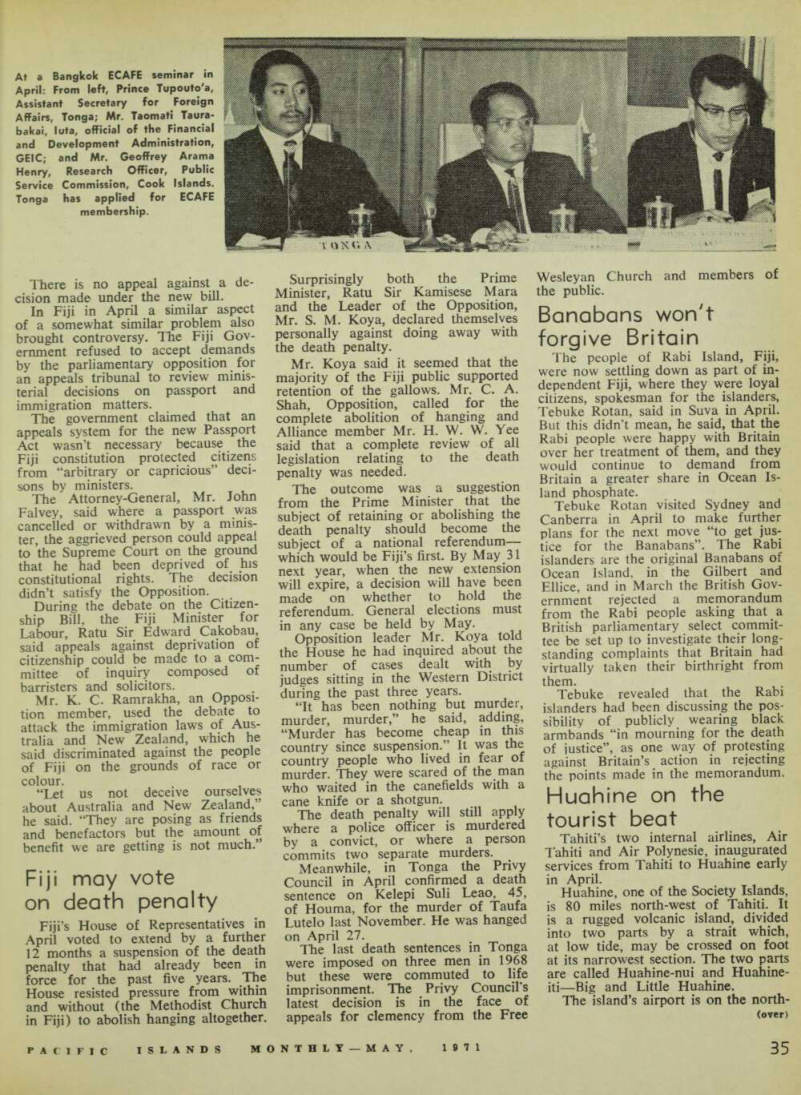
At a Bangkok ECAFE seminar in April: From left, Prince Tupouto'a, Assistant Secretary for Foreign Affairs, Tonga; Mr. Taomati Taura bakai, luta, official of the Financial and Development Administration, GEIC; and Mr. Geoffrey Arama Henry, Research Officer, Public Service Commission, Cook Islands.
Tonga has applied for ECAFE membership.
western side of Huahine-nui, about 2i miles from Fare, the main village.
The chief of Fare, Oopa Pita, a nephew of the noted political leader Pouvanaa a Oopa, was among the large crowd of Huahineans who turned out on April 3 to greet the Governor of French Polynesia, Mr.
Pierre Angeli, and other inaugural passengers.
The opening of the Huahine strip, which is only suitable for small air craft, means that all the main islands of the Society Group are now within easy reach of Tahiti. The other islands, Bora Bora, Raiatea and Moorea, have had airstrips for years.
Air Polynesie, which has announced a thrice-weekly service to Huahine with a Twin Otter, will fly Tahiti- Huahine-Raiatea and return on Mondays and Wednesdays, and Tahiti-Huahine-Tahiti on Saturdays.
The flying time from Tahiti to Huahine is 50 minutes, whereas the flight from Huahine to Raiatea takes only 15 minutes.
Those visiting Huahine on the new air services should find plenty to interest them.
Besides pleasant people and much attractive scenery, Huahine has a profusion of ancient stone maraes, many of which have been restored in the last few years by Dr. Yoshiko Sinoto, of the Bishop Museum in Honolulu.
Huahine is also notable for the still-pervading influence of the London Missionary Society whose missionaries laboured on the island from 1818 to 1890. The LMS mis sionaries included the Rev. William Ellis, author of Polynesian Researches, a well-known South Seas classic.
Huahine has been a French island only since 1888. Before that, it was an independent kingdom.
A French force was sent to occupy Huahine in 1846 following the decla ration of a French protectorate over Tahiti and Moorea in 1842. How ever, the Huahineans strongly resisted, killing 18 of the French troops and wounding 43, and the French with drew.
Subsequently, Britain and France concluded a treaty which guaranteed that Huahine (as well as Bora Bora, Raiatea and their dependencies) should remain independent.
The treaty remained in force until 1887 when Britain agreed to its abrogation on condition that France withdrew certain military forces that had been stationed in the New Hebrides.
The French Tricolor was raised over Huahine in the following year.
In those days, the island had a popu lation of about 1.200. It now stands at a little over 3,000.
Another breakthrough
in Church relations
The Melanesian Council of Churches in Papua-New Guinea has become one of the very few such organisations to include the Roman Catholic church in their membership.
At its general meeting in August last year, the MCC voted un animously to invite the Roman Catholic church to join. And the Roman Catholic bishops of Papua- New Guinea, at their last episcopal conference, decided to accept the invitation.
The secretary of the MCC, the Rev. John Key, commented: “This move will give further impetus to ecumenical co-operation and under standing in this country and will be regarded with great interest in other parts of the world.
“Very few national councils of churches include the Roman Catholic church as a full member. . . . This initiative by churches in a develop ing nation could prove a significant breakthrough in inter-church relations and show the way forward to other longer-established churches.”
Fr. Key said that Roman Catholic representatives had already been ap pointed to the MCC’s executive com mittee, but the church would be formally received at the next general meeting of the council in October.
Members of the MCC since its formation in 1965 have been the Anglican church, the Baptist mission, the Evangelical Lutheran church, the Salvation Army and the United Church (formerly the Methodist mis sion and the Papua Ekalesia which grew out of the London Missionary Society).
In the Wake of
the Britannia
Philatelists are frequently, with good reason, disgusted at the stamp policies of some of the Pacific terri tories, whose governments issue ex pensive commemoratives at the fall of a coconut. But there was genuine stamp value in the issue of a com memorative by Pitcairn Island on February 22 to mark the arrival that day of the Duke of Edinburgh, the island’s first royal visitor (who gave them all a day to remember by shaking hands with virtually every body on the island—population 82 islanders).
The Crown Agents in London overprinted the current 10c definitive and despatched them aboard the Royal Yacht Britannia with the Duke. But a mere 1,000 stamps only were overprinted and every one went to Pitcairn in this royal fashion.
Not surprisingly, none was left at the end of the day.
This mention of the Duke reminds us to apologise for a gremlin which had us saying unintentionally last month that the Duke’s visit to the New Hebrides was “unimaginative”.
It was the Duke’s visit to Vila which we found unimaginative (although some would argue), and there is more to the New Hebrides than Vila.
At Malekula the dancing by 12 teams from the Big Nambas people, and the Small Nambas and others, and the Namangki grading ceremony, at which a full-circle tusked pig, was symbolically killed, were spectacular and without precedent.
This was the first time the Big and Small Nambas had danced out side their own villages. The work done by District Agent Darvall Wilkins to achieve this was itself spectacular.
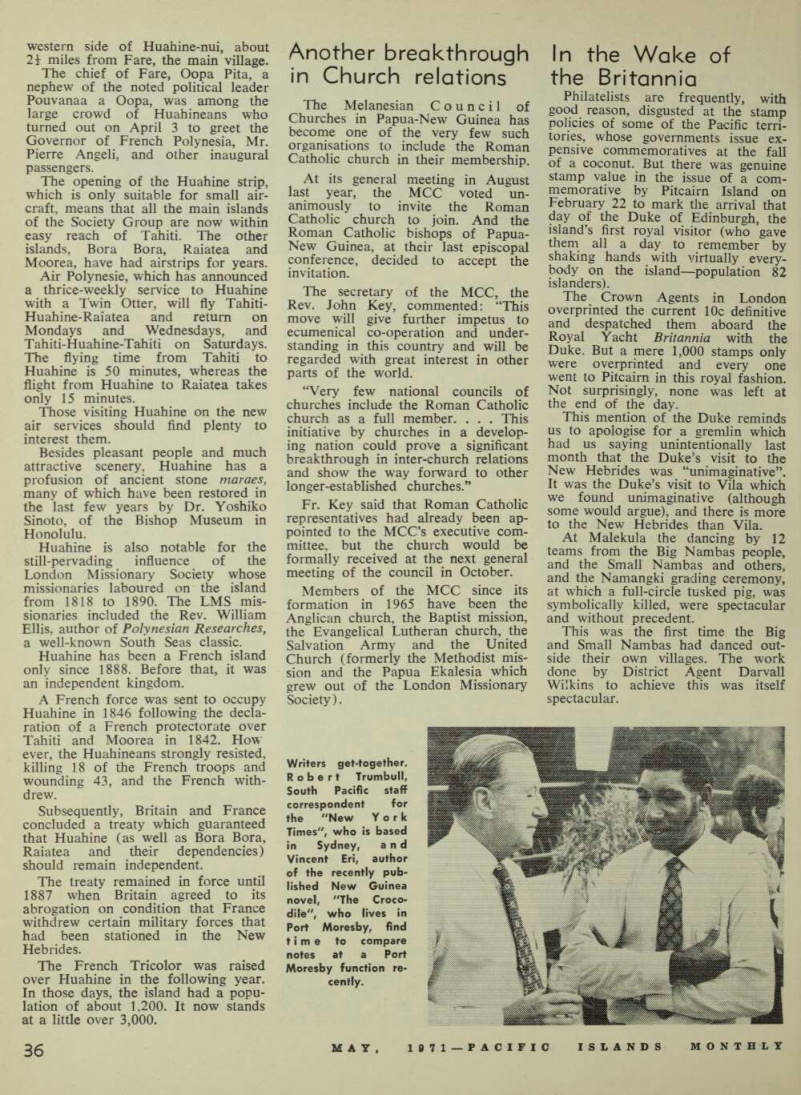
Writers get-together.
Robert Trumbull, South Pacific staff
correspondent for
the "New York Times", who is based in Sydney, and Vincent Eri, author of the recently pub lished New Guinea novel, "The Croco dile", who lives in Port Moresby, find time to compare notes at a Port Moresby function re cently.
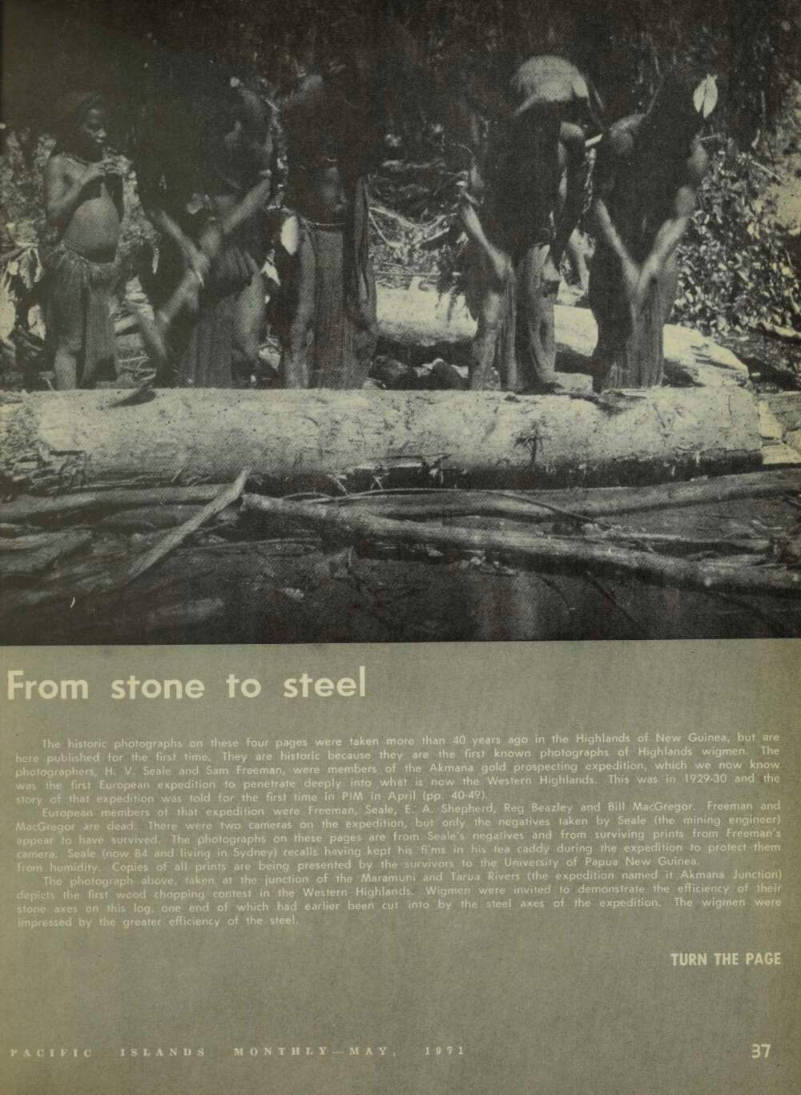
From stone to steel
RThe historic photographs on these four pages were taken more than 40 years ago in the Highlands of New Guinea, but are iere published for the first time. They are historic because they are the first known photographs of Highlands w.gmen The photographers, H. V. Seale and Sam Freeman, were members of the Akmana gold prospecting expedition, which we now know was the first European expedition to penetrate deeply into what is now the Western Highlands. This was in 1929-30 and the story of that expedition was told for the first time in PIAA in April (pp. 40-49). , European members of that expedition were Freeman, Seale, E. A. Shepherd, Reg Beazley and 6,11 MacGregor. Freeman and MacGregor are dead. There were two cameras on the expedition, but only the negatives taken by Seale <the mining engineer) appear to have survived. The photographs on these pages are from Seale's negatives and from surviving prints from Freeman s camera. Seale (now 84 and living in Sydney) recalls having kept his ferns in his tea caddy during the expedition to protect them from humidity. Copies of all prints are being presented by the survivors to the University of Papua New Guinea.
The photograph above, taken at the junction of the Maramuni and Tarua Rivers (the expedition named it Akmana Junction) depicts the first wood chopping contest in the Western Highlands. Wigmen were invited to demonstrate the efficiency of their stone axes on this log, one end of which had earlier been cut into by the steel axes of the expedition. The w.gmen were impressed by the greater efficiency of the steel.