New Caledonia
pp. 34-35 · Read in the full issue
hosts the islands
Just four months to go to the South Pacific Games in Papeete in Septem ber and Islands territories are either hard at work holding their own cham pionships, or sending the cream of their athletes to perform “overseas”.
For instance, the New Caledonians in April matched themselves against boxers from Fiji, Rugbymen and weightlifters from Tahiti and yachts men from New Zealand.
The Fijians starred in an interna tional boxing evening on April 3, organised by the Le Nickel company’s sports club. The Fijians contested 10 amateur bouts against the locals, while middleweight gold medallist from the Port Moresby Games, Ali pate Korovou, fought a professional bout against Australian Dick Blair.
The Fijians won three of the amateur bouts: Alipate Ledua (super lightweight), Sefanaia Vakacequ (middleweight) and Eminohi Harada (flyweight). The locals won four: Emmanuel Tonhoueri (lightweight), Mitra Kaloi (welterweight), Noel Hmae alias Kautche and Wallisian Sosefo Lie as superwelters. Three bouts were drawn.
In his professional match, Korovou won a points victory over the Austra lian, Blair. The Fijian champion has been working a year in New Cale donia and was keenly supported by 2,000 spectators in the Noumea in door stadium.
The Fijian boxers were followed by the Tahiti Rugbymen and weight lifters. Rugby has not been a tradi tionally strong sport among the Pacific French and the Tahitians claimed to have been only playing about one year. The rivalry was nevertheless keen; New Caledonia won both matches at the Magenta stadium, 9-3 and 12-6.
In the weightlifting, Tahiti won three out of five categories. Best re sults by the Tahitians were: A. Mar tin (lightweight) with 539 lb; Andre Chung (middleweight) with 627 lb, and Eric Smith (light-heavyweight) defeated Port Moresby gold medal list Selefen, with 73 H lb. Caledonian winners were Gutuhau Soane (feather weight silver medallist at Port Moresby) with 539 lb, and Martial Bone (heavyweight) with 726 lb.
Caledonian sporting interest then turned to yachting, when the territory was represented in the NZ yacht race from Whangarei to Noumea. It was the third time this event had been
organised, but more significant for the Caledonians, they were competing for the first time aboard the “Dame de Corail” (Coral Maid.) Line honours were taken on April 25 by NZ sloop Kismul with, second, 31 ft yacht, Chico; Chico was un official winner on corrected times.
Coral Maid was not among the leaders at the finish,
PNG withdraws from
Rugby, volleyball
The New Caledonians will send 240 to the Games.
Papua-New Guinea announced in April it would send a team of 164 a considerable cut in numbers follow ing a decision not to be represented in Rugby or volleyball.
The Rugby withdrawal came as no surprise as the PNG association was faced with a difficult fund raising effort, and the team had already com pleted a tour of North Queensland.
Volleyball was different; the game is increasing in popularity in the terri tory and there was some dismay when volleyball administrators announced they wanted to spend funds on home facilities rather than an overseas trip.
The team will sport a new look.
Hats are gone for both sexes. The men will wear bottle-green shorts, long white socks, and green slip on shirts bearing a pattern similar to the Games tiara flower emblem. The women will wear pant suits.
New Guinea’s preparations are reaching fever pitch as final and pre liminary trials are held, and sporting bodies frantically raise funds to reach a target of at least $60,000. A sub sidy has been promised by PNG’s government, but it’s contingent on what is raised by public subscription.
Marathon trials in Port Moresby nearly ended in tragedy when Solo mon Island runner Andrew Dakatia was knocked down by a car and seri ously injured. At last report he was
recovering, but had been sent to Bris bane for further treatment.
Athletes around PNG are faced with the problem—as in other years —of a lack of good coaches, and to make matters worse the team that won a good share of gold medals at the third Games has been scattered to many centres and some top ath letes complain of lack of competition.
Woman athlete Salitia Pipit, who won the 800 metres at Port Moresby, is regarded as one of the best pros pects. At last year’s championships she easily won all titles from 100 to 800 metres.
PNG’s swimmers seem certain again to give a good account of them selves. A training squad was chosen early this year and training is inten sive. At least 12 swimmers will make the trip and they will include gold medallist Nigel Cluer, Max Mowen and Charlie Martin, who since the last Games has broken both butterfly and backstroke records over 100 metres. Women swimmers Anne Pini and Tiko Mae from last Games, and Helen Burns, are the lady stars and these “veterans” will be backed by promising young swimmers appearing for their first Games.
PNG basketball teams seem sure to figure in the finals again at Papeete.
The women will be out to repeat their gold medal win of the third Games, while the men will try to turn their silver from those Games into gold.
There is a new lineup of boxers on the scene. Three centres have been holding regular tournaments and competition for places in the boxing squad will be keen.
A Port Moresby club soccer team recently made a most successful tour of North Queensland, winning all its matches. This has revived hopes that PNG might at last break into the “big” final at the Games. Adminis trative problems have plagued this popular sport for two years, but offi cials are now hopeful that funds will be forthcoming for the Games team.
Weightlifters should again win their share of the medals with old stars like the Seeto brothers going.
Champion yachtsman Dobbs has announced he will not be available this year and there’s keen competi tion from “Fireball” men in Lae, Madang, Rabaul and Port Moresby for places in the team. Trials are to be held in Lae in June.
With archery being staged for the first time at the Games it’s anybody’s guess how the competition will go.
PNG cyclists will face stiff competi tion from the experienced wheel men of New Caledonia.
Amateur Sports Federation secre tary, Jack Pini, will manage the team.
Mr. Pini was swimming manager at Port Moresby.
French are diving favourites
French Polynesia, with no need to worry about sending a team on ex pensive travel, will, as host, expect its share of gold medals. And in no event will it be so confident as in the Games first underwater fishing event.
The team’s past performances include runners-up three times in the world championships and twice winners of the French championships.
The Papeete organisers have sent details of the event to the nine terri tories taking part (Cook Islands, Fiji, Guam, French Polynesia, BSIP, Tonga, Nauru, New Caledonia and Wallis and Futuna), a total of 27 contestants.
It’s expected that the hunting area will be around Tahiti, although the reef has been rather denuded of fish by local fishermen. The contestants will have to dive about 20 metres for a minute or more and bring their catches to the surface. There should be some good fishing in spite of the local fishermen. September is the egg laying season for smaller fish and big ger ones come to the edge of the reef looking for them. Sharks are also plentiful in the area, but are not re garded as particularly dangerous.
However, precaution against them will be taken.
A special programme is being printed to explain the different varieties of Tahiti fish and their habits, to the competitors.
Fiji and Tahiti
fight it out again
The cream of Fiji and Tahiti ath letes met again at Easter during Fiji’s track and field championships, held at Suva’s Buckhurst Park. They provided one of the most exciting days of sport seen in Fiji for a long time.
Three of Tahiti’s “big names” — Jean Bourne (South Pacific Games 100 and 200 metres champion), Jean Salmon (Games high jump cham pion), and Michel Paillie (800 and 1,500 metres runner) —added spice to the proceedings, and both Bourne and Salmon produced spectacular per formances.
From Fiji’s point of view some of the greatest thrills came from watch ing young hurdler Seru Gukilau, who won the first heat of the 400 metres hurdles in a record of 55.55. In the final, Gukilau broke his new record, turning in a time of 55.45.
In the afternoon, Gukilau and
Tahiti’s Salmon dead-heated in the 110 metres hurdles, in a new Fiji’s all-comers’ record time of 15.25.
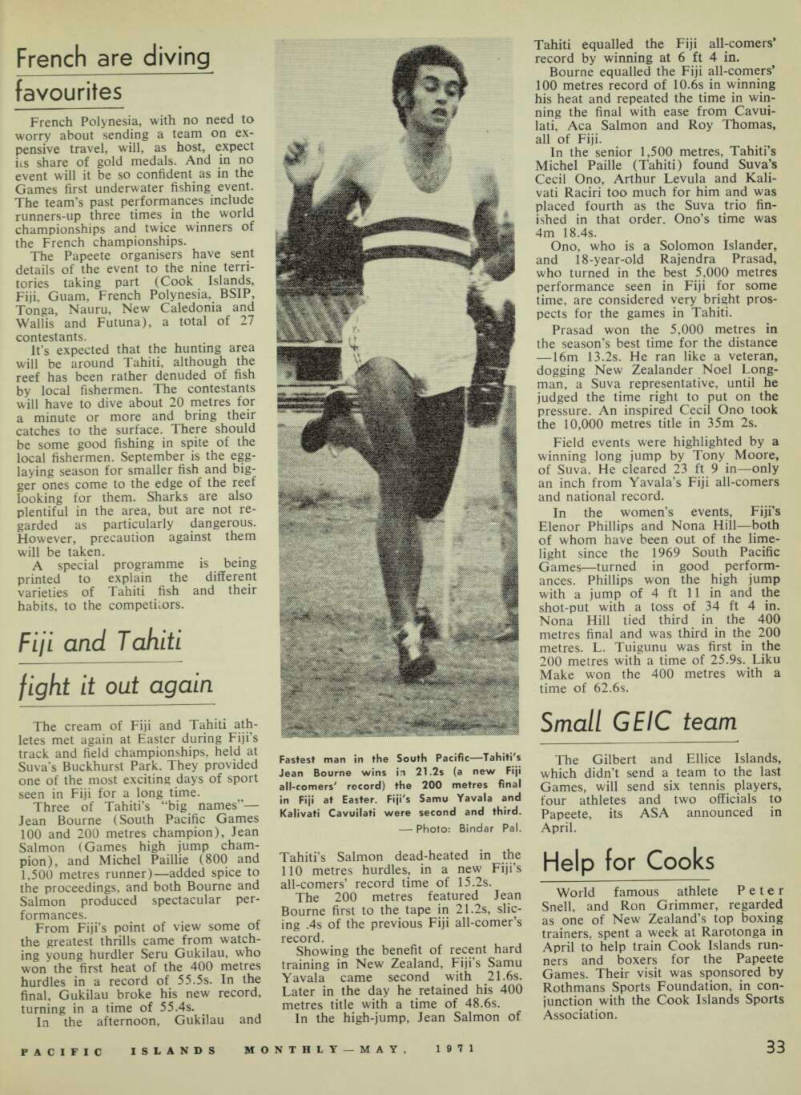
The 200 metres featured Jean Bourne first to the tape in 21.25, slic ing .4s of the previous Fiji all-comer’s record.
Showing the benefit of recent hard training in New Zealand, Fiji’s Samu Yavala came second with 21.65.
Later in the day he retained his 400 metres title with a time of 48.65.
In the high-jump, Jean Salmon of
Tahiti equalled the Fiji all-comers’ record by winning at 6 ft 4 in.
Bourne equalled the Fiji all-comers’ 100 metres record of 10.6 s in winning his heat and repeated the time in win ning the final with ease from Cavui lati, Aca Salmon and Roy Thomas, all of Fiji.
In the senior 1,500 metres, Tahiti’s Michel Faille (Tahiti) found Suva’s Cecil Ono, Arthur Levula and Kali vati Raciri too much for him and was placed fourth as the Suva trio fin ished in that order. Ono’s time was 4m 18.45.
Ono, who is a Solomon Islander, and 18-year-old Rajendra Prasad, who turned in the best 5,000 metres performance seen in Fiji for some time, are considered very bright pros pects for the games in Tahiti.
Prasad won the 5,000 metres in the season’s best time for the distance —l6m 13.25. He ran like a veteran, dogging New Zealander Noel Long man, a Suva representative, until he judged the time right to put on the pressure. An inspired Cecil Ono took the 10,000 metres title in 35m 2s.
Field events were highlighted by a winning long jump by Tony Moore, of Suva. He cleared 23 ft 9 in—only an inch from Yavala’s Fiji all-comers and national record.
In the women’s events, Fiji’s Elenor Phillips and Nona Hill —both of whom have been out of the lime light since the 1969 South Pacific Games—turned in good perform ances. Phillips won the high jump with a jump of 4 ft 11 in and the shot-put with a toss of 34 ft 4 in.
Nona Hill tied third in the 400 metres final and was third in the 200 metres. L. Tuigunu was first in the 200 metres with a time of 25.95. Liku Make won the 400 metres with a time of 62.65.
Small GEIC team
The Gilbert and Ellice Islands, which didn’t send a team to the last Games, will send six tennis players, four athletes and two officials to Papeete, its ASA announced in April.
Help for Cooks
World famous athlete Peter Snell, and Ron Grimmer, regarded as one of New Zealand’s top boxing trainers, spent a week at Rarotonga in April to help train Cook Islands run ners and boxers for the Papeete Games. Their visit was sponsored by Rothmans Sports Foundation, in con junction with the Cook Islands Sports Association.
Fastest man in the South Pacific —Tahiti's Jean Bourne wins in 21.2s (a new Fiji all-comers' record) the 200 metres final in Fiji at Easter. Fiji's Samu Yavala and Kalivati Cavuilati were second and third. -Photo: Bindar Pal.