Footnotes
pp. 32-33 · Read in the full issue
TN Papua-New Guinea, whose House of Assembly has now decided against both “Pagini” and “Niugini” and has put off inde finitely a decision on a new name, political parties come and go and change their names overnight in a most bewildering fashion.
At the March meeting of the House the air cleared a little, and it may clear more at the June meeting if proposals to re-arrange seating so as to allow party members to sit together come to fruition. At the moment it is still not quite clear which and how many members each party can claim.
As predicted in this column, the prolonged ges tation of the so-called Independent Group, formed in 1968 to oppose the mildly radical Pangu Party but with no publicly avowed positive platform, has produced two parties, one led by Tei Abal of the Western Highlands and the other by Julius
Chan of New Ireland.
Mr. Abal’s party, which first called itself the Compass Party but has now changed its name to the United Party, may be re garded as located in the far right of the political spectrum. It is in the main a Highlands party, and indeed has its origin in part in a social organisation called the Brothers Four Movement (the four brothers being the four Highlands districts) and in part
in a political programme propounded by John Watts, member for the Western Highlands Regional electorate.
The United Party is at present trying to shed two embarrassing images, that of a regional party and that of an expatriate dominated one. Its anxiety to do this no doubt accounts for its adop tion of the rather insipid name United Party in place of the much more evocative label Compass Party.
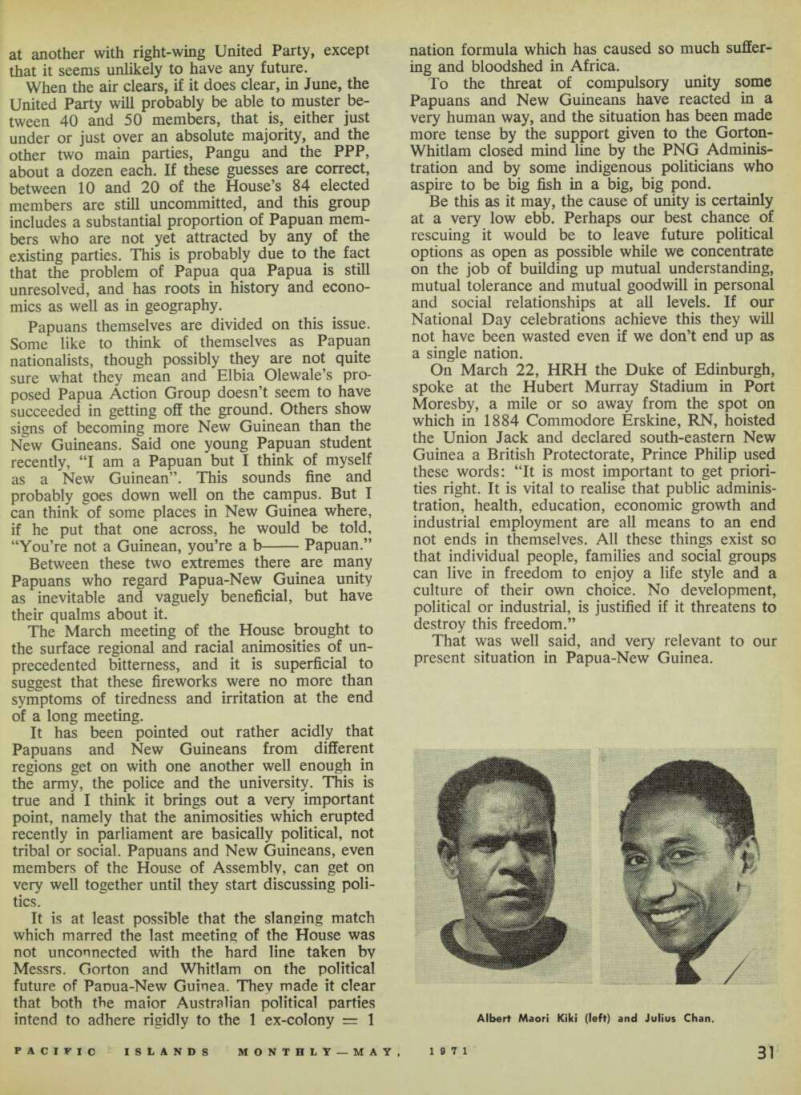
Mr. Chan’s party, which has named itself the People’s Progress Party, may perhaps be best described as a right centre party. At present it is playing things quietly (Julius Chan is by nature a quiet man), and by so doing is at least avoiding the faux pas which are being made by the more vocal parties. At present the PPP appears to com prise mainly New Guinea islands and coastal mainland members.
On the political left is Pangu (Papua and New
Abc Of P-Ng's
Parliamentary
Politics
Guinea Union), which was formed prior to the 1968 national elections and has since received a generous measure of publicity both in Papua-New Guinea and overseas.
Its parliamentary leader, Michael Somare, young, energetic and forceful in debate, heads a small, rather uneven and sometimes unpredictable team. Pangu has been the target of a lot of abuse and has encountered plenty of frustration since
1968, but has recently had the
inspiring experience of doing
very well indeed in elections for the newly established urban local government councils in Port Moresby, Lae and Madang. Its successes include the election of its national secretary, Albert Maori Kiki, to the Port Moresby Council.
Whether this success presages success in next year’s national elections remains to be seen. We
may expect that the conservatives will use it to bolster their oft repeated claim that radicalism is an urban phenomenon, against the conservatism of the rural areas.
That incredible figure, young Thomas Kavali, the radical Highlander, has formed his own party, the Papua New Guinea National Party. Definitely a party of the left, though how far left does not yet appear. This mini-party does not number more than two or three in the House, but could form the rallying point for a younger generation of less conservative Highlanders at the next elec tions.
The fifth party somewhat tenuously present in the House is the Sepik based Christian Demo cratic Party (or United Democratic Party as it sometimes cadis itself) to which three or four MHAs claim to adhere. But what can one say of a party which announces its impending amalga mation at one moment with left-wing Pangu and
With Percy Chatterton
in Port Moresby
at another with right-wing United Party, except that it seems unlikely to have any future.
When the air clears, if it does clear, in June, the United Party will probably be able to muster be tween 40 and 50 members, that is, either just under or just over an absolute majority, and the other two main parties, Pangu and the PPP, about a dozen each. If these guesses are correct, between 10 and 20 of the House’s 84 elected members are still uncommitted, and this group includes a substantial proportion of Papuan mem bers who are not yet attracted by any of the existing parties. This is probably due to the fact that the problem of Papua qua Papua is still unresolved, and has roots in history and econo mics as well as in geography.
Papuans themselves are divided on this issue.
Some like to think of themselves as Papuan nationalists, though possibly they are not quite sure what they mean and Elbia Olewale’s pro posed Papua Action Group doesn’t seem to have succeeded in getting off the ground. Others show signs of becoming more New Guinean than the New Guineans. Said one young Papuan student recently, “I am a Papuan but I think of myself as a New Guinean”. This sounds fine and probably goes down well on the campus. But I can think of some places in New Guinea where, if he put that one across, he would be told, “You’re not a Guinean, you’re a b Papuan.”
Between these two extremes there are many Papuans who regard Papua-New Guinea unity as inevitable and vaguely beneficial, but have their qualms about it.
The March meeting of the House brought to the surface regional and racial animosities of un precedented bitterness, and it is superficial to suggest that these fireworks were no more than symptoms of tiredness and irritation at the end of a long meeting.
It has been pointed out rather acidly that Papuans and New Guineans from different regions get on with one another well enough in the army, the police and the university. This is true and I think it brings out a very important point, namely that the animosities which erupted recently in parliament are basically political, not tribal or social. Papuans and New Guineans, even members of the House of Assembly, can get on very well together until they start discussing poli tics.
It is at least possible that the slanging match which marred the last meeting of the House was not unconnected with the hard line taken by Messrs. Gorton and Whitlam on the political future of Paoua-New Guinea. They made it clear that both the maior Australian political parties intend to adhere rigidly to the 1 ex-colony = 1
nation formula which has caused so much suffer ing and bloodshed in Africa.
To the threat of compulsory unity some Papuans and New Guineans have reacted in a very human way, and the situation has been made more tense by the support given to the Gorton- Whitlam closed mind line by the PNG Adminis tration and by some indigenous politicians who aspire to be big fish in a big, big pond.
Be this as it may, the cause of unity is certainly at a very low ebb. Perhaps our best chance of rescuing it would be to leave future political options as open as possible while we concentrate on the job of building up mutual understanding, mutual tolerance and mutual goodwill in personal and social relationships at all levels. If our National Day celebrations achieve this they will not have been wasted even if we don’t end up as a single nation.
On March 22, HRH the Duke of Edinburgh, spoke at the Hubert Murray Stadium in Port Moresby, a mile or so away from the spot on which in 1884 Commodore Erskine, RN, hoisted the Union Jack and declared south-eastern New Guinea a British Protectorate, Prince Philip used these words: “It is most important to get priori ties right. It is vital to realise that public adminis tration, health, education, economic growth and industrial employment are all means to an end not ends in themselves. All these things exist so that individual people, families and social groups can live in freedom to enjoy a life style and a culture of their own choice. No development, political or industrial, is justified if it threatens to destroy this freedom.”
That was well said, and very relevant to our present situation in Papua-New Guinea.
Albert Maori Kiki (left) and Julius Chan.