Magazine Section
pp. 45-122 · Read in the full issue

Grim Retribution For Papuans
Who Backed The Losing Side
Third and final part of "Papua at War", by TOM GRAHAMSLAW.
It was October, 1942, and a group of us had been landed by a United States Air Force DCS on a new airstrip at Wanigela, on the north-east coast of Papua. Our job as members of the Australian New Guinea Administrative Unit was to report on the activities of the Japanese in that area.
I was glad to arrive, oddly enough, because shortly after our DC3 took off from Port Moresby, enemy Zeros were reported overhead and our pilot announced he was taking “evasive action” This consisted of flying so close to the tree tops through mountain valleys that I decided we were going to crash. And then we left the valleys and followed the coastline all the way from Abau to Milne Bay, at a height hardly above sea level! The journey took us two hours instead of 35 minutes.
The RAAF were in control at Wanigela, and when I reported that our party would go as far as Oro Bay by canoe we were warned not to travel in daylight because there was a general instruction to aircraft to shoot up everything moving on the water.
We took that advice and set off at night in six small dugouts, the only
canoes obtainable. My party included Jack Wilkinson, pre-war miner and Middle East veteran, who was a tower of strength, and six police, ineluding Constable Sanopa (who had been with me on the Kokoda Track and was loyal and courageous), and Sergeant Katui, who had won a Military Medal for his exploits against the Japs when they first landed at Buna, Corporal Craddock and Frivate Russell; two army signallers, also were included to handle commumcations.
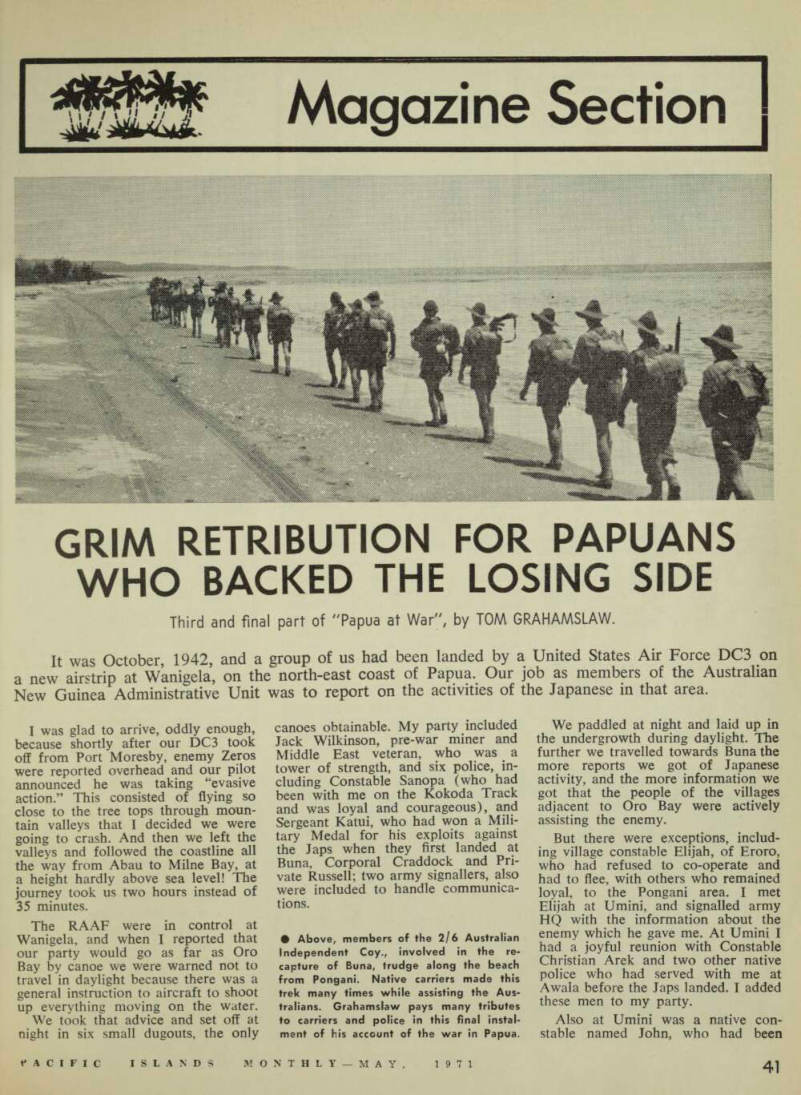
• Above, members of the 2/6 Australian Independent Coy., involved in the re capture of Buna, trudge along the beach from Pongani. Native carriers made this trek many times while assisting the Aus tralians. Grahamslaw pays many tributes to carriers and police in this final instal ment of his account of the war in Papua.
We paddled at night and laid up in the undergrowth during daylight. The further we travelled towards Buna the more reports we got of Japanese activity, and the more information we got that the people of the villages adjacent to Oro Bay were actively assisting the enemy, But there were exceptions, includj n g v in a g e constable Elijah, of Eroro, w g o re f usec i to co-operate and j ia( j t 0 fl e6j w i t h others who remained loyal, to the Pongani area. I met Elijah at Umini, and signalled army H Q withthe information about the enemy which he gave me. At Ummi I had a .joyful reunion with Constable Christian Arek and two other native police who had served with me at Awala before the Japs landed. I added these men to my party.
Also at Umini was a native con stable named John, who had been
sent from Port Moresby via Tufi to report on the Japanese, as he was a local man. He now volunteered to go to Buna in the guise of a Buna native, despite a risk that he might be be trayed by people under enemy influ ence.
John's mission was most success ful. He returned to me after eight days with details from Buna of enemy anti-aircraft positions, barge hide-outs and areas in which large bodies of troops were concentrated. We sent this in code to Port Moresby.
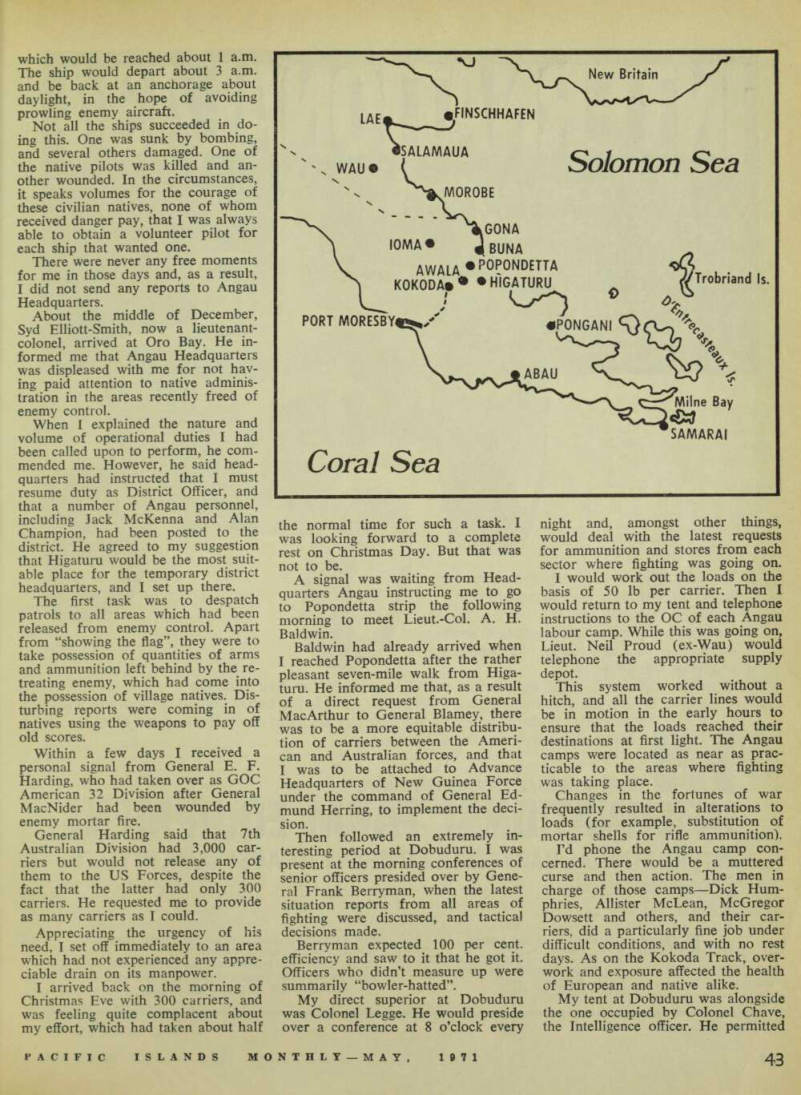
John brought back some of the in vasion money with which Japanese had paid him and his fellow villagers for the bananas and taro which they had taken into Buna for sale, I had already heard from the people at Umini that the Japanese had been paying as much as 10/- for a bunch of bananas. This contrasted with the payment of two to three sticks of tobacco (worth less than 1/-) which was standard rate of payment.
I pointed out that the notes were worthless and would not be accepted when the Japanese were beaten and stores re-established. I asked, “Have the Japanese built any stores from which goods may be purchased?”
As the answer was in the negative, the natives looked thoughtful and were inclined to agree with me that the Jap money was indeed worthless. (At that stage I was not to know that when the Americans came in their thousands, they would regard invasion money as curios and pay good, highly negotiable dollars for them!) I learned that Japanese patrols rarely penetrated beyond Oro Bay.
In view of this, and to ensure that our whereabouts did not become known to the people on the Buna side of Oro Bay, I decided to base on Mendoropu and do my patrolling from there.
On the few occasions we came across natives from villages under enemy influence we seized them, and sent them back under escort to Tufi, where they were detained until we decided it was safe to release them.
I continued with that sort of work for several weeks, being involved in a number of adventures, until Ameri can forces arrived in the Pongani area. General J. H. MacNider, com manding officer of the US 32nd Divi sion, obtained permission from the New Guinea Force to use my ser vices, and this somewhat curtailed my patrolling for the time being.
I had a lucky escape on one occa sion soon after the American land ings when I was asked by Colonel R.
McKinney, with the US forces, to
accompany him on a vessel leaving one afternoon with arms and ammu nition, but I declined because I had some other things to attend to.
The vessel and two other similarly laden ships had only gone a few miles when we saw them attacked by 18 Japanese aircraft and in a matter of minutes they were blazing wrecks and sank. We later found and buried bodies (including those of four native carriers) which had hoated ashore during the night. 1 was profoundly relieved to find that Bill Osborne, one of my Angau men, who, with 40 carriers, had been aboard the ship, had swum to safety. But I was dis tressed to learn that Colonel McKin ney had been lost, for in the short time I knew him we had become firm friends. He was a fine man.
The loss of the ships meant that American troops engaging the enemy between Hariko and Boreo had to be supplied with food and ammunition from dumps established at Eroro until replacement vessels arrived from Milne Bay. After surviving a some what protracted attack by seven enemy aircraft, our first main task was to organise carrier lines, and at one stretch of about a month, car riers from Baniara and Tufi did an outstanding job carrying for a daily return journey of 26 miles along a sand beach, with numerous streams to cross, every day and without time off, regardless of the weather.
Walking on sand is heavy going at any time, but with a 50 lb pack it is particularly hard. The carriers were dive-bombed by enemy aircraft on several occasions.
During this period I was called on to provide natives with local know ledge to pilot American small ships on the last stage from Oro Bay to Hariko. The ships would leave Por lock Harbour in the late afternoon, call at Oro Bay to pick up the pilot, who would travel on her to Hariko,
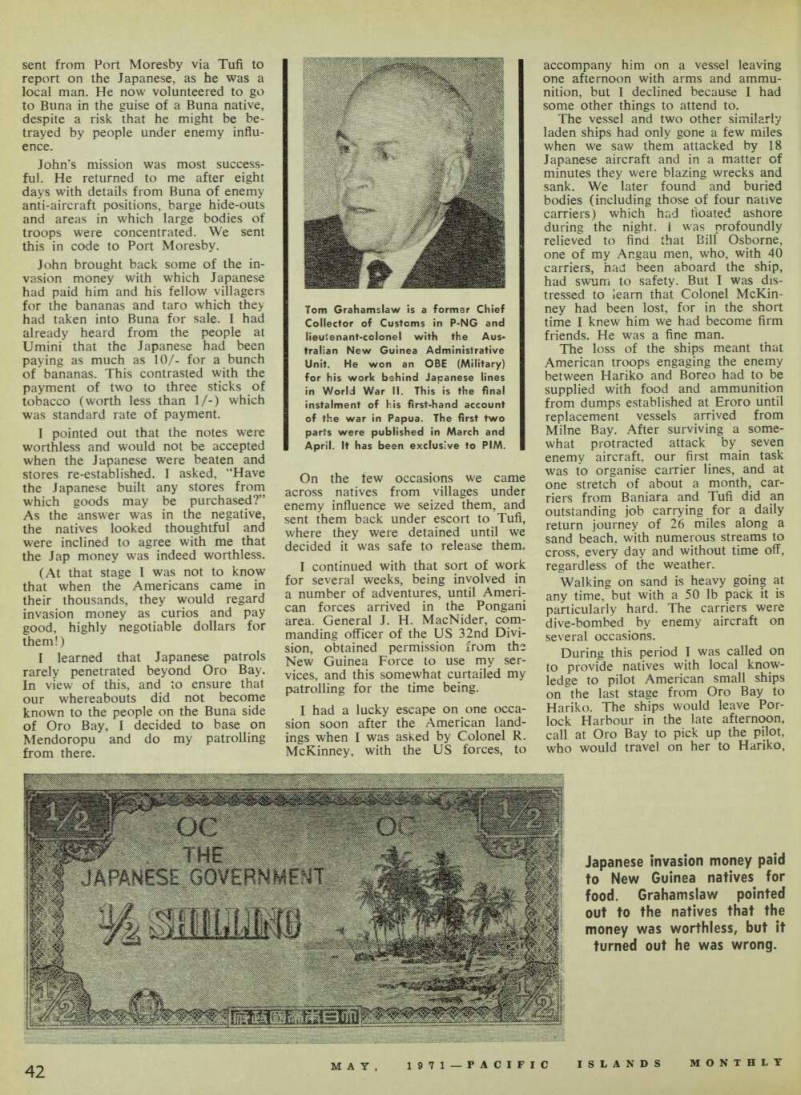
Tom Grahamslaw is a former Chief Collector of Customs in P-NG and lieutenant-colonel with the Aus tralian New Guinea Administrative Unit. He won an OBE (Military) for his work behind Japanese lines in World War II. This is the final instalment of his first-hand account of the war in Papua. The first two parts were published in March and April. It has been exclusive to PIM.
Japanese invasion money paid to New Guinea natives for food. Grahamslaw pointed out to the natives that the money was worthless, but it turned out he was wrong.
which would be reached about 1 a.m.
The ship would depart about 3 a.m. and be back at an anchorage about daylight, in the hope of avoiding prowling enemy aircraft.
Not all the ships succeeded in do ing this. One was sunk by bombing, and several others damaged. One of the native pilots was killed and an other wounded. In the circumstances, it speaks volumes for the courage of these civilian natives, none of whom received danger pay, that I was always able to obtain a volunteer pilot for each ship that wanted one.
There were never any free moments for me in those days and, as a result, I did not send any reports to Angau Headquarters.
About the middle of December, Syd Elliott-Smith, now a lieutenant colonel, arrived at Oro Bay. He in formed me that Angau Headquarters was displeased with me for not hav ing paid attention to native adminis tration in the areas recently freed of enemy control.
When I explained the nature and volume of operational duties I had been called upon to perform, he com mended me. However, he said head quarters had instructed that I must resume duty as District Officer, and that a number of Angau personnel, including Jack McKenna and Alan Champion, had been posted to the district. He agreed to my suggestion that Higaturu would be the most suit able place for the temporary district headquarters, and I set up there.
The first task was to despatch patrols to all areas which had been released from enemy control. Apart from “showing the flag”, they were to take possession of quantities of arms and ammunition left behind by the re treating enemy, which had come into the possession of village natives. Dis turbing reports were coming in of natives using the weapons to pay off old scores.
Within a few days I received a personal signal from General E. F.
Harding, who had taken over as GOC American 32 Division after General MacNider had been wounded by enemy mortar fire.
General Harding said that 7th Australian Division had 3,000 car riers but would not release any of them to the US Forces, despite the fact that the latter had only 300 carriers. He requested me to provide as many carriers as I could.
Appreciating the urgency of his need, I set off immediately to an area which had not experienced any appre ciable drain on its manpower.
I arrived back on the morning of Christmas Eve with 300 carriers, and was feeling quite complacent about my effort, which had taken about half
the normal time for such a task. I was looking forward to a complete rest on Christmas Day. But that was not to be.
A signal was waiting from Headquarters Angau instructing me to go to Popondetta strip the following morning to meet Lieut.-Col. A. H.
Baldwin.
Baldwin had already arrived when I reached Popondetta after the rather pleasant seven-mile walk from Higaturn. He informed me that, as a result of a direct request from General MacArthur to General Blarney, there was to be a more equitable distribution of carriers between the American and Australian forces, and that I was to be attached to Advance Headquarters of New Guinea Force under the command of General Edmund Herring, to implement the decision.
Then followed an extremely interesting period at Dobuduru. I was present at the morning conferences of senior officers presided over by General Frank Berryman, when the latest situation reports from all areas of fighting were discussed, and tactical decisions made.
Berryman expected 100 per cent, efficiency and saw to it that he got it.
Officers who didn’t measure up were summarily “bowler-hatted”.
My direct superior at Dobuduru was Colonel Legge. He would preside over a conference at 8 o’clock every
night and, amongst other things, would deal with the latest requests for ammunition and stores from each sector where fighting was going on.
I would work out the loads on the basis of 50 lb per carrier. Then I would return to my tent and telephone instructions to the OC of each Angau labour camp. While this was going on, Lieut. Neil Proud (ex-Wau) would telephone the appropriate supply depot.
This system worked without a hitch, and all the carrier lines would be in motion in the early hours to ensure that the loads reached their destinations at first light. The Angau camps were located as near as prac ticable to the areas where fighting was taking place, Changes in the fortunes of war frequently resulted in alterations to loads (for example, substitution of mortar shells for rifle ammunition), I’d phone the Angau camp con cerned. There would be a muttered curse and then action. The men in charge of those camps—Dick Hum phries, Allister McLean, McGregor Dowsett and others, and their car riers, did a particularly fine job under difficult conditions, and with no rest days. As on the Kokoda Track, over work and exposure affected the health of European and native alike.
My tent at Dobuduru was alongside the one occupied by Colonel Chave, the Intelligence officer. He permitted
me to read the translations of Japan ese diaries, totalling over 100, which had been recovered from the bodies of enemy dead. These made fascinat ing reading, depicting as they did the experiences, hopes and fears of the writers.
It was while reading the transcrip tion of one of these diaries that I obtained the first authentic knowledge of the fate of Captain L. Austen and his party. I had left Austen when we had got away from the Jap land ings at Buna. Garbled accounts had already been received from native sources which indicated that the party had been wiped out by Japanese, after betrayal by certain natives.
The diary in question made two separate references to Austen’s party.
The first entry recorded that natives brought in nine Australian prisoners, comprising five men, three women and one child. The writer was most im pressed by the beauty of one of the women, Louise Artango. Louise was part-Filipino and part-Papuan. The other two women were Miss Lashmar and Miss Brenchley, of Sangara Mis sion.
The second entry in the diary, made on the day after the party was handed over, stated that the nine Australian prisoners had been shot and beheaded. The writer said that when the time came for the beheading of Louise Artango he felt quite sick.
He made only a passing reference to the killing of the others.
I also found a mention of Austen’s party in the transcription of another Japanese diary. This particular Japan ese had served in a number of areas —Hong Kong, Singapore, Java, Rabaul and Buna, before meeting his end at Milne Bay. One of the interest ing things mentioned in his diary was that his countrymen had established a shrine near one of the volcanoes at Rabaul, where they went to pray.
His diary made two references to Austen’s party. The first entry re corded the date (which coincided with that shown in the other diary), and the number and sex of Australians brought in to the Japanese at Sinemi; the second entry made a brief com ment of the shooting and beheading of the nine prisoners on the following day. It all made sad reading.
During this period of my work, sizeable numbers of New Guinea natives who had been brought from Rabaul to carry for the Japanese, had either escaped or been released by our troops as the enemy fell back to their last remaining strongholds at Buna and Gona. These natives, after convalescing in the hospital-cum convalescent camp run by Dr. Vemon at Popondetta, very willingly joined our Angau carrier lines.
I now received a report that about 500 New Guinea carriers had escaped early in the campaign and had made their way to the Waria region, where they were being fed by the local people. A patrol was despatched to fetch them in. They were in good fettle on arrival at Dobuduru, and were put to work immediately in the carrier lines, a task which they under took with gusto.
One of my duties, on behalf of Army Intelligence, was to interrogate New Guinea natives recently released from the Japs. Although reasonably fluent at Motu, which is the lingua franca of Papua, my knowledge of Pidgin was extremely limited. I was making heavy weather of it one morn ing when I received a visit from G.
A. V. Stanley (well-known Terri torial, who was staging through Dobuduru at the time. Stanley, who was serving in a hush-hush unit, spoke Pidgin almost as well as he did Motu, which is saying a lot. I gratefully ac cepted his offer to take over from me.
The majority of natives employed before the war in Rabaul and on plan tations in New Britain came from other districts, such as the Sepik, Mad ang, Bougainville, etc. These natives farmed themselves amongst the Tolai villages when the Japanese occupied Rabaul.
Several months later, the Japs had sent out word that if these “foreign” natives came into Rabaul they
would be sent back to their own vil lages. The natives fell for the offer, and something like 2,000 reported to Rabaul for “repatriation”. Instead, they found themselves transported to Buna to work as carriers.
These carriers had an exceedingly bad time. After the first day in from Buna the Japs compelled them to forage for their own food. This in volved raiding village gardens, which did not endear them to the owners of the gardens. In point of fact, a number of unfortunate New Guinea carriers were speared and killed by Papuans when caught raiding gardens.
Jap stragglers who raided gardens also met with the same fate.
Within a few days of my arrival at Dobuduru I commenced to receive visits from officials of native villages, ranging as far back as Bofu. All of them had stories of hardships result ing from the enemy occupation.
However, the answers they gave to my questions convinced me that the Japanese had treated them reasonably well. Apart from demands for food stuff, which was paid for in invasion money, about the only other pressure exerted by the Japanese was for car riers and guides, and this was mainly in the early stages of the invasion.
The Japanese made it clear to the natives that, if they assisted the Aus tralians and Americans in any way, they would be severely punished.
However, with the exception of a few isolated instances, the Japanese left their womenfolk alone.
It was not long before I received disturbing reports that several of the village constables, now eager to be of service, had taken a major part in the betrayal and killings of the
Continued on p. 105
• Warrant Officer Wilkinson (left) and Captain Grahamslaw supervise the un loading of a radio set on the north-east coast of Papua late in October, 1942, in order to transfer a spotting station closer to the Japanese at Oro Bay.— Photo: Aus tralian War Memorial.
Anglican missionaries, Australian soldiers and American airmen whose aircraft had been shot down or had made forced landings. I duly noted the reports, but decided not to take any action until our troops had achieved victory. In any case, because of my operational duties and lack of field personnel, I was not in a posi tion to conduct an investigation.
The Orakaiva natives could never understand why we treated Japanese prisoners so well. There were times when an instruction to carriers to act as stretcher bearers for sick or wounded Japanese prisoners almost met with open rebellion.
I happened to be passing an Ameri can dressing station one morning when I heard a hullabaloo centred around a group of Orakaiva stretcher bearers. The American medical officer and several of his men were shouting at the Papuans, who were shouting back.
The cause of the commotion was a dead Japanese lying on a stretcher. It seemed he had been very much alive when the stretcher party departed from the American forward lines, and the MO suspected foul play. He drew my attention to a large recent lump on the side of the Jap’s head. The carriers strenuously denied the MO’s accusations.
Knowing my Papuans, I dispensed
with preliminaries.
“Why did you kill him?” I said.
“He tried to get off the stretcher and run away, so we gave him a little hit with a stick to keep him quiet”, was the virtuous reply.
From then on, whenever it was necessary to carry a Japanese patient, a police constable accompanied the stretcher to ensure the safe arrival of its occupant.
But later however, I ran into an old friend, Captain Lea Ashton, who was a member of Commander Eric Feldt’s coastwatchers and who was in charge of a small party of native police which had been engaged on a reconnaisance mission in the Buna area, similar to the one I had carried out.
Lea’s party penetrated as far as Inonda. It had already passed through country where the attitude of the natives was far from friendly, but it was not until he reached Inonda that his party encountered open hostility.
Several of his police were attacked by local natives and had to fight their way out of trouble.
As it was obviously impossible for Lea to obtain any information of military significance, he joined up with Australian troops and was awaiting his next posting when I met him.
Organised enemy resistance in the Buna area ceased on January 26, 1943. Advance New Guinea Force folded up and I found myself at tached to the American 41st Divi sion, which was entrusted with the task of mopping up the remaining Japanese troops, estimated to be about 2,000.
I received a request from the American command for Angau per sonnel to act as guides for mopping up parties. As this meant combat duty I decided to call for volunteers from the seven Angau labour camps, ranging between Soputa and Oro Bay.
Many of the men in these camps had served in AIF units in the Middle East and Greece, and had been trans ferred to Angau after the Japanese invasion of the territory. Some of them complained to me that they had enlisted to fight, and not to be con demned to mostly non-combatant duties required by Angau.
My invitation met with the desired response, and the Angau volunteers, supplemented by volunteers from my native police, were duly attached to American patrols.
Lieutenant Fred Bannigan (.pre war Wau identity) was, perhaps, the most reckless soldier under my com mand. He accompanied several American patrols and had hand to hand encounters with the enemy. By the time fighting finished, Fred had an enviable collection of Japanese souvenirs, from swords to watches, which he had acquired the hard way.
Unfortunately, two of our police were killed in one engagement near the mouth of the Giruwa River. The Angau warrant officer with them man aged to escape by swimming the river under enemy fire.
Before his departure, General G. A.
Vasey decided to commemorate the work done by the carriers who had accompanied his troops across the Kokoda Track by presenting 10 of them with Loyal Service Medals. As I was the senior Angau officer in the area, I was instructed to translate his speech.
I reported to Colonel Canet, of 7th Aust. Division, and sought advice as to the nature of the speech. Canet in formed me that it was his job to write the speech, and that he would be doing it that afternoon. He sug gested that meanwhile I join the offi cial party of Australian and Amen can generals and other high-ranking officers who were about to make their first inspection of Sanananda after its capture. Accompanied by an Ameri can major. T ioined the official party.
Heavy fighting had taken place in
Captain Grahamslaw gives instructions to his native police before they go out on reconnaissance in the Oro Bay area.
A man needed a strong stomach
this area, and the bodies of enemy troops, some of whom had been dead for weeks, and others who had been killed a day or two before, littered the track. The stench was indescrib able. The last stretch of seven or eight miles had to be traversed on foot, and a man needed a strong stomach to avoid being sick.
The official party was protected by a strong guard, which was necessary because pockets of the enemy re mained on both sides of the track.
When I got back to 7th Division
Headquarters, Colonel Canet had just completed the general’s speech. It was a very good one. It praised the car riers for their loyalty and meritorious contribution to the war effort and it conveyed the thanks of the sovereign.
The only part that worried me was where the general said that his troops would be returning to Australia to re cuperate, and his speech finished with the wish that the carriers would also be sent home for a well-earned rest.
I knew that there was not the slight est possibility of us being able to release the carriers for some consider able time.
The general duly made his speech to more than 3,000 carriers, and hun dreds of Australian troops. Then fol lowed my translation, which was listened to in complete silence. It was a faithful translation until I got to the part where the general wished the carriers could be sent home to rest.
My rendition was that the Austra lian soldiers, who had fought with great loss of life to preserve Papua and its native people, were going home to recuperate so that they could come back and resume fighting until the enemy was beaten, and that in the meantime it was necessary for the carriers and people like myself, who belonged to the territory, to re main at our posts.
I had some doubts as to the re ception that would be accorded to my concluding words, and it was an enor mous relief when the natives broke into cheers and yells of approbation.
I was released from operational duties towards the end of March, 1943. After 24 days leave in Austra lia I resumed duty as District Officer, Mambare District.
There was much to be done in a district which had suffered severely from the ravages of war.
Headquarters Angau gave the dis trict priority in staff, and capable and experienced officers such as Claude and Alan Champion, and Jack McKenna, together with keen new comers like Peter Kaad and Ron Galloway, who later made names for themselves in the post-war administra tion, were posted to the district.
Intensive patrolling became the order of the day, and within a few months the whole of the district had been covered by our patrols.
We learned that the propaganda carried out by Angau officials prior to the enemy landing at Buna, paid dividends. The bulk of the native population, including most of the offi cials, had heeded our talk, and accord-
Some went over
ingly refrained, as far as they were able, from giving assistance to the enemy.
As was to be expected, a number of natives did go over to the enemy.
The Europeans in the district were few in number —not more than 40— and the enemy came in their thous ands. It was natural that people would soon be convinced that there was a new master in the land, and it was understandable that those with a grudge against the government or against Europeans generally, would flock to the service of the enemy.
Then there were the opportunists who thought they saw a chance to obtain positions of power and authority for themselves.
One of the first things the Japan ese did in the Buna area was to ap point a representative in each village.
The representative was accorded the rank of captain. All Japanese orders went through him, and the Japanese punished those who did not obey his instructions. Some of the “captains behaved like autocrats during their few months in office. Others had ac cepted office with reluctance, and only because the Japs insisted on having a representative in each village.
Shortly after native administration was re-established in the district, and the people were satisfied that the Japs had been defeated, they seized the captains and brought them to Higa turu for punishment.
My problem was how to mete out justice to these men to the satisfaction of the village people. They could possibly have been charged with an act of treason under the Criminal Code. However, I did not think it would be right to attempt to apply this law to people who had no know ledge of its existence.
The captains were taken into pro tective custody to shield them from the wrath of their people, while I re ferred the matter to HQ Angau for decision.
A reply came from headquarters to the effect that my reasoning was cor rect and the captains should be re leased.
My quandary was that the village people were adamant that the men should be punished. In a number of instances they asserted that, if the government did not act, they would mete out punishment themselves.
After much deliberation, I thought 1 had the answer. I assembled the captains, about 40 in number, and suggested to them that an honourable way to make amends for their treach-
Death by hanging
ery would be by signing on to work for the army for two years.
My suggestion was seized upon with relief. These men had been ex pecting some dire form of punish ment, and they were glad of the op portunity to get away from the wrath of their people, and allow time to cover up the scars, as it were.
The erstwhile captains were signed on and went overland to Port Moresby to work for the army as car riers, etc., in the forward area.
Shortly after restoration of native administration, Angau officials ar rested an ex-village constable named Embogi, and a number of his com patriots, for the betrayal and killings of the Ambasi spotters named Hanna and Holyoak, the Gona Mission teachers Miss Hay man and Miss Parkinson, two European members of the PIB, and several American air men.
Embogi and four other natives from the Sangar area were sentenced to death.
One morning the ADO, Captain Frank Moy, and myself, were in our newly constructed office at Higaturu preparing reports for headquarters when a jeep arrived from the airstrip at Popondetta, carrying a passenger with the rank of captain.
The new arrival introduced himself as an officer of Royal Papuan Con stabulary HQ. He produced copies of warrants for the execution by hanging of Embogi and the other four con demned men.
He wanted to know if we had a gallows. I replied “No,” and at the same time pointed out that a gallows couldn’t be constructed at short notice, as the only tools on the station were one hammer and one hand saw.
We had no nails.
The hangman then announced that a tree would have to do. Accom panied by Captain W. R. Humphries, who at the time was conducting in vestigations into major crimes com mitted during the period of enemy occupation, he went in search for a suitable tree. They arrived back a couple of hours later, sweating, but successful.
The constabulary man was anxious to get the job over and done with, but I informed him that, firstly, I would not act until the originals of the warrants had been received, and secondly, the condemned men would have to be given the opportunity to bid farewell to their relatives.
The hangings took place several days later, in the presence of thous ands of people from nearby villages.
I addressed the multitude in Motu,
‘Just punishment’
which a number understood, explain ing fully why the men were being executed and to make sure that the words sank in, the station interpreter repeated what I said.
It was a grim experience which 1 shall never forget.
Each man was given a chance to speak and each elected to do so.
Embogi’s speech had a profound effect on all of us. He had a sonor ous voice, and was obviously a gifted orator. The gist of his speech was that he went wrong because he was uneducated and did not know better.
He freely admitted his crimes and said that the punishment he was about to receive was just. He concluded by enjoining his people to heed what the government said and to obey its laws.
Embogi had been one of the first people to report to me after our troops re-entered the Buna area, and I had taken a liking to him. How ever, it was not long before I had heard whispers that he had been on friendly relations with the Japanese, had played a major part in the be trayals of the Europeans, and had actually participated in the killing of the PIB lieutenant and others.
The other four also spoke up like men. They admitted their guilt, and said they were prepared to pay with their lives.
I lay awake most of that night listening to the drums beating, and the wailing of the mourners in the villages adjacent to Higaturu, and re living the events of the day.
I had seen death in various forms during the preceding 12 months, but nothing affected me as deeply as the hangings of Embogi and his fellow murderers.
Perhaps it was the courage they displayed when the time came for them to die. Be that as it may, the punishment meted out to them was in accordance with their own tribal code of “an eye for an eye . . .
In this first half of 1943 there were many trials of natives charged with the murders of Europeans during the period of five months following the Japanese landing at Buna on July 21. Those murdered included several Australian soldiers who had been separated from the main body of troops. Others were American airmen who had parachuted to earth after their planes had been shot down in aerial combat with Japanese air craft.
The pattern of murder was usually the same. In the first place, the sol diers or airmen, after having made contact with the natives, would be taken to a central place in the vil-
Built the gallows
lage, usually a rest house, where they would be given food and drink. Then, as they were relaxing in the belief that they were amongst friendly people, they would be attacked from behind and killed.
Within a few months of resumption of civil administration in the district, we had particulars of the majority of murders committed during the enemy occupation. In a number of instances the murders were reported to us by village officials.
There were other cases where officials and people deliberately with held information, but there was usually someone who surreptiti ously passed the word to the authori ties. In one instance, a patrol officer got a lead on the murder of an American airman when he noticed a small child in a village playing with American notes of large de nominations.
I was on patrol one day when a messenger arrived from Claude Champion at Higatum, advising that instructions had been received from Port Moresby to construct a gallows. Claude also said he had been sent warrants for the execution of 17 natives convicted of wilful murder.
I replied telling Claude to go ahead and build the gallows, and at the same time I fixed a date for the exe cutions, which would allow sufficient time for the relatives and fellow vil lagers of the condemned men to reach Higatum.
By the time I returned to Higa turu, Claude, with the able assistance of the station clerk, Nansen Kaisa, had constructed a gallows with two trapdoors from bush materials, in accordance with the specifications received from headquarters. It was a very good job, although not a labour of love. With good reason they regarded it as a disagreeable duty.
The gallows were situated in the centre of what could be described as a natural amphitheatre, several miles below Higatum. Higatum and its environs was crowded with natives from as far afield as the mountain country above Kokoda.
News of the approaching execu tions had reached the American forces in the Dobudum-Oro Bay area, of whom there were about 20,000. Fearing that there would be an influx of Americans wishing to see the spectacle, I got their com manding general to place our area out of bounds to his troops.
The day before the hangings, rela tives and friends of the condemned
Gashed cheeks
men trooped through Higaturu, wail ing and beating drums. These groups included women who had gashed their foreheads and cheeks with stones until the blood welled.
As a group reached the flagpole near the office, their wailing would suddenly cease, and they would pound the earth in unison with their feet. These exhibitions of grief accen tuated the feeling of depression which permeated station personnel, Euro peans and natives.
On the morning of the executions the hillsides surrounding the gallows were packed with thousands of natives, and there was a hushed silence as we appeared.
The procedure was as follows: The condemned men would be led, two at a time, from the station to the gallows. I would then mount the gallows and inform the multitude of the crimes the men were being pun ished for. The men would then be asked if they wished to speak.
With but two exceptions they elected to do so. On conclusion of the speeches, the men would mount the gallows, where they would be blind folded before being led on to the trapdoors. The trapdoors would then be released and the bodies would dis appear.
I might explain here that the gal lows were built on posts about 10 ft high. These posts were surrounded by hessian to ensure that the dangling bodies could not be seen.
The detailed instructions from headquarters, based on old English rules, provided that each body had to hang for 30 minutes, after which it was examined by a medical officer, who had to declare that life was ex tinct before it was cut down.
The bodies would be removed out of sight before the next lot of two condemned men were led down. In some instances, where the relatives wanted it. the bodies were handed to them for burial. Otherwise, they were buried in the station cemetery.
With one exception the condemned men who spoke recanted their evil ways when addressing their people.
One of these attributed his acts to his lack of education, and the fact that he was not a Christian. He called upon his people, and the village councillors in particular, to ensure that thereafter the children were brought up as Christians and that all went to school.
The exception was a man who had been a village constable. His speech was short and to the point. He said,
Hanged herself
“The government is about to kill me.
My wives must follow me.”
The whole grisly job lasted from about 8 a.m. until the late afternoon.
When it was over, Jack McKenna and I moved around the village people.
“Do you agree that everything is square now?” we enquired. “Yes, we agree,” they replied.
I spoke to the two wives who had been instructed by their husband on the gallows to kill themselves. One was elderly, and the other quite young.
“He was a bad man who has been made to pay for his crimes, and you should take no notice of his talk,” I said.
I then spoke to the village con stable and to the village elders, re questing them to watch the women to make sure they did not kill them selves.
Some time later I received word that the young woman had hanged herself. The village elders had kept an eye on her for about a week and then relaxed in the belief that the danger period was over. It turned out that there was no need for con cern about the older woman. She made it clear that she regarded his execution as good riddance.
Late in 1943 I received a list from Angau headquarters with the names of five Orakaiva natives who were re quired to give evidence concerning Japanese atrocities to the War Atroci ties Commission, then sitting in Mareeba, North Queensland, under the Chief Justice of Queensland, Sir William Webb. Included in my party was Captain H. T. Kienzle, who had done so much on the Kokoda Track, and Warrant Officer Robinson, one of the survivors of the Japanese massacre of Australian soldiers at Tol Plantation, New Britain.
Kienzle and I took it in turns to translate the evidence given by the native members of our party. We had to be particularly careful with our rendition, as the only evidence ad missible was what had actually been seen by the witness.
Perhaps the most harrowing evi dence was that given by a native from Kakendatta (near Popondetta) concerning the killings of the Aus tralian missionaries, Miss May Hay man and Miss Mavis Parkinson, soon after the fall of Buna.
This man was lying in the under growth near the coffee buildings at Popondetta observing the movements of Japanese troops stationed there, when he saw the two European women being led out from one of
How they died
the coffee buildings. As I recall it, the witness said that the women had been in the building for a full day and night. He saw a number of Japan ese enter and depart.
When the women came out, a Japanese stepped forward and seized Miss Parkinson and started to hug her. She pushed him away. He there upon drew a bayonet or dagger from his scabbard and stabbed her in the throat. She gave a slight scream and dropped dead.
Another Japanese, who was stand ing near Miss Hayman, drew a hand kerchief from his pocket and handed it to her, indicating at the same time that she was to blindfold herself.
She did so and then stood with head upright facing the Jap, and with out speaking. The Jap then bayoneted her in the breast and she fell dead.
The bodies were buried in a shallow grave at Popondetta.
This, to the best of my knowledge, was the only factual eyewitness ac count of the deaths of those two dedi cated and courageous young Austra lian women.
Angau continued to function in New Guinea until June 24, 1946, when Major-General Morris, who had commanded it very ably from the very beginning, folded up its activi ties.
During a period of more than four years, the men of Angau had taken part in every Allied campaign, rang ing from Milne Bay and the Kokoda Trail to Manus and Bougainville.
They led patrols deep into enemy occupied territory and became the eyes and ears of the Allied forces.
They accompanied task forces as guides, interpreters and scouts, and took over control of the native popu lation. Their responsibilities included the rehabilitation of large numbers of natives left homeless and without food by the effects of war.
The men who served in Angau came from the pre-war administra tions of Papua and the Mandated Territory of New Guinea, together with civilians from those territories who had enlisted in the Australian Military Forces. They were supple mented by volunteers who transferred from various units of the AMF.
Collated in detail and presented as a comprehensive picture, the record of Angau’s achievements would un doubtedly be one of the epic stories of World War 11. It is to be hoped that the story, still to be written, will find a historian to do it justice.