They Worked
pp. 59-61 · Read in the full issue
Their Way
IN
From SUE WENDT, in Suva There’s something archaic and turn-of-the century about the term “planter”, though it’s still very much a way of life in many parts of the Islands.
The term sits strangely on the wiry shoulders of energetic young Robin Mercer, one-time bank johnny.
But even the Savusavu old-timers (who might have viewed him at first with a mixture of suspicion and scepticism ) have to admit he’s earned it.
Little more than 18 months ago, Rob Mercer was pushing a pen (as security officer) in the Suva branch of the Bank of New Zealand, which he’d joined at Lautoka 15 years before.
Now, out of guava jungle and tangled bush a few miles from sleepy Savusavu, he and his wife Lynette have created a model plantation— beautifully-kept, productive and diversified. And on the beach frontage, they’ve built a unique holiday resort.
The plantation, 150-acre Matani kavika, lies halfway between the town and the airstrip.
“We have 15 acres under coconuts and could get by on our own copra earnings,” explains 33-year-old Rob, who is probably the only first genera tion planter in Fiji. “But we believe in diversity, so we’ve established cattle, pigs, milking cows and poultry
to supply our own needs. We keep the Morris Hedstrom store in eggs too.”
He hopes to grass the plantation and start a dairy herd. There’s no town milk supply and the Savusavu Travelodge gets its milk from Suva. . Hut his big venture at the moment is the resort, village-style, called Kontiki Lodge.
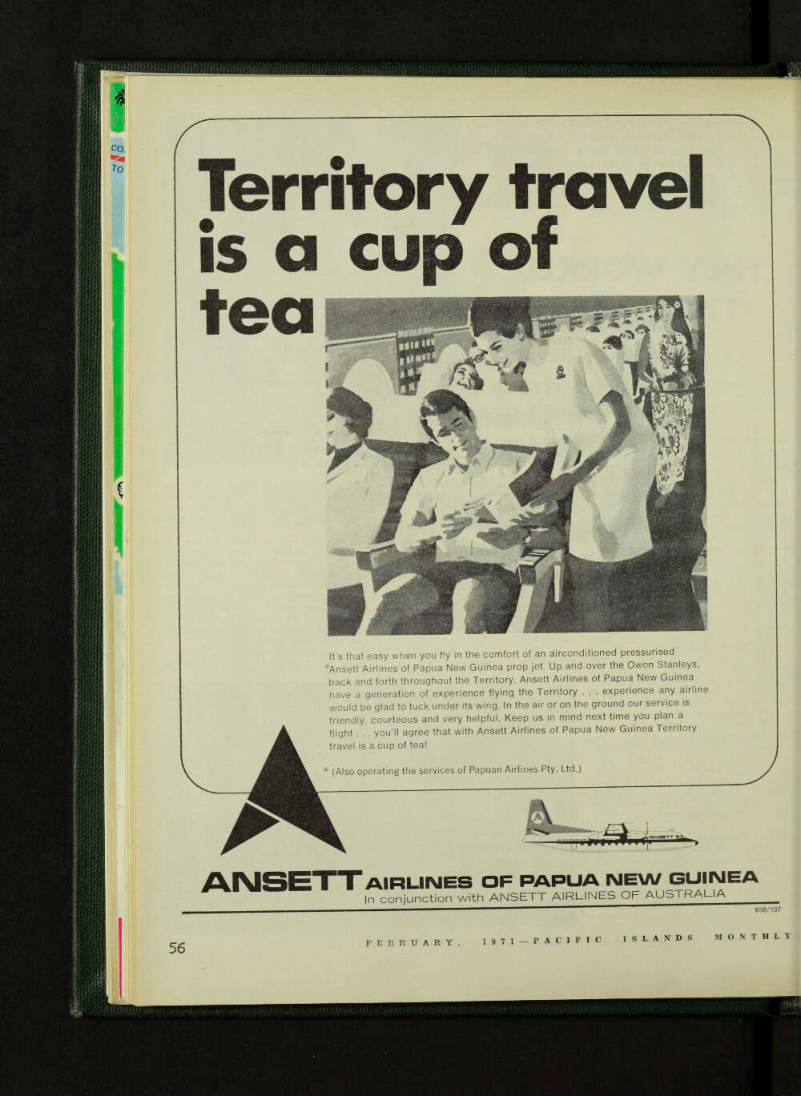
It contains six thatched huts, swimming pool and large recreation and dining bure. For guests, there are an outrigger canoe, horseriding and reef-viewing.
No big overseas investment was involved in its erection. It was purely
a local effort, with Robin and Lynette sketching out the original plans, installing the plumbing and electricity and making the curtains and bed spreads.
But they had a whole village full of Fijian helpers. They became so much a part of the project that at the official opening recently they performed mekes for more than an hour, refusing to take any payment.
Although born elsewhere—Christ church and Melbourne respectively— Rob and Lynette have spent virtually all their lives in Fiji, A measure of Rob’s Fiji involve ment is the part he played in forming 6
As newcomers join the dwindling ranks of old rimers, the planter breed is changing. Today he's diversified, and just as likely to be involved with tourism and airstrips as with copra, cocoa and vegetables. But he's still critical of government neglect of his area. Here are two stories of the new breed, from Fiji and Papua.
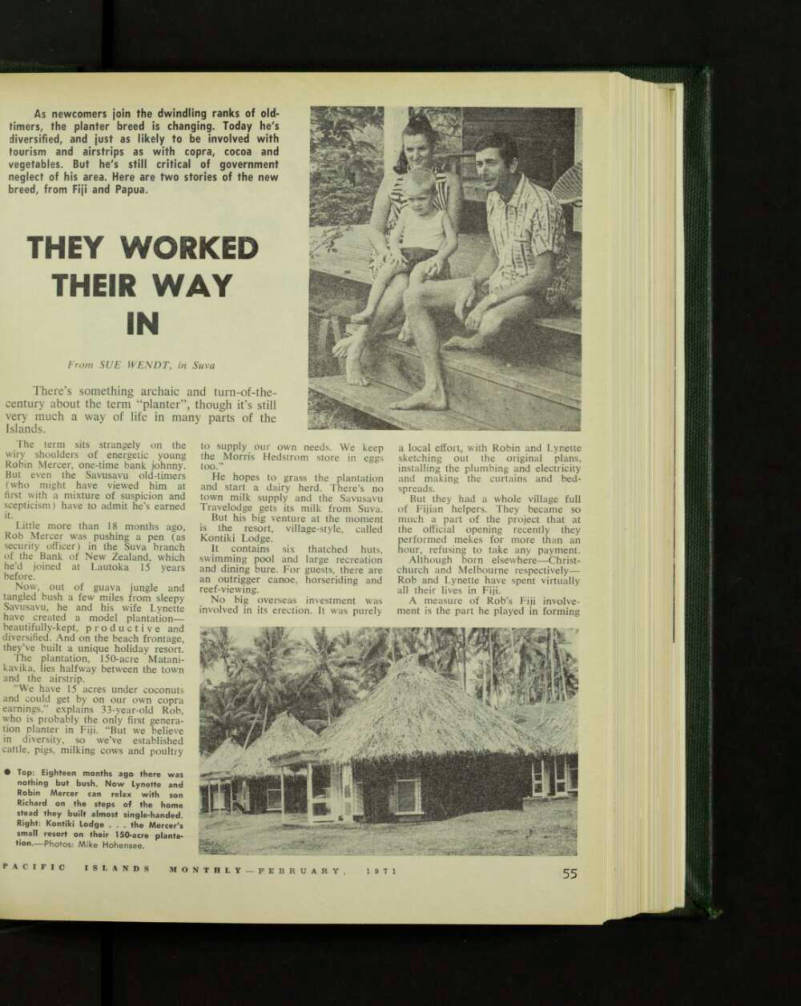
Top: Eighteen months ago there was nothing but bush. Now Lynette and Robin Mercer can relax with son Richard on the steps of the home stead they built almost single-handed.
Right: Kontiki Lodge . . . the Mercer's small resort on their 150-acre planta tion.—Photos: Mike Hohensee.
the Fiji Bank Officers’ Association in 1968. Representative of all the banks in Fiji, the association set about equalising conditions between local employees and expatriates. It achieved an immediate 10 per cent, rise in salaries—and is currently pushing for a five-day working week.
Robin Mercer finds it hard now to recall exactly what prompted him to sink all his savings into Matani kavika (he got it from C. G. O. Parr three months before the big price jump—says it has doubled now in value), but says that following the formation of the union, his relation ship with some of the bank’s executives began to deteriorate. ■‘l had some pretty serious second thoughts though, after I’d given my three months’ notice,” he says. “And then when I was humping coils of barbed wire through the bush and getting my first real blisters I used
to wonder if I’d done the right thing.’
There must have been some raised eyebrows around the bar at the old Planters’ Club when young Mercer landed in Savusavu as deck cargo on the Fijian Princess, armed with a three-ton truck and plenty of zeal.
These days though he and his wife are two of the most respected mem bers of a very-hard-to-crack com munity, Rob Mercer is even sec retary of the Planters’ Club and official tax consultant for some of his neighbours.
He’s also a member of the Cakaudrove Rural Development Committee, a game ranger for the Northern Division and continues as honorary ornithologist for the Fiji Museum.
He even manages two other plan tations—one of them 200-acre Naidi Plantation, bought recently by three Americans from Colorado. The other
is on Nawaci Island, which was bought by Harry Achilles from Mrs Malley for $l2l 000 two years ago Some people say Savusavu is stili in the last century compared with the rest of the world Time isn’t of too much importance there and if it wasn’t for Fiji Airways and the oc casional cruise ship there wouldn’t be much contact with outsiders Robin Mercer, like many others, believes the government should be doing much more than it is to bring the town and the rest of Vanua Levu up to the standard of Viti Levu At the moment he’s pretty out spoken about the need for speedy extensions to the long outdated Savu savu airstrip, so that it can handle something bigger than the present 15-passenger Herons. Until this hap pens, there will be no real tourist trade in Savusavu. And certainly the locals deserve something better.