The problems
pp. 52-55 · Read in the full issue

that visitors can cause!
From a Rarotonga correspondent The forthcoming tourist on slaught—the one that is expected
when Rarotonga’s jet airport
opens next year—is dominating
the Cook Islands scene in every facet of activity.
Nobody really expects the Cooks to be filled with a million tourists in the first week of the big event, but outsiders might be forgiven for thinking that the islanders expect it to happen that way. They are certainly apprehensive about the influx.
They have no intention of stopping it, but they are frightened they may be swept right off their feet when it happens, and yet at the same time most islanders are anxious that the visitors should enjoy the Cooks.
There is a matter of national pride involved.
Among the recent debates that have been sparked off by the plans to welcome tourists is one on liquor.
More than 3,000 of Rarotonga’s 3,400 voters signed a public petition seeking changes in Rarotonga’s liquor laws, and this was debated at length, and with much interest, in the Legislative Assembly in Decem ber—having been introduced by the Premier himself, Mr. Albert Henry.
The Premier moved that the petition be referred to the government for favourable consideration—which the assembly finally did.
The government presumably now will come up with some legislation which will resolve the problem, and that will be referred back to the assembly.
As the liquor situation stands at present in Rarotonga, there are no licensed premises available for any body who wants to walk off the street and buy a drink, dance and be entertained. But in 1972 tourist hotels will be given licences for such facilities.
The petition debated by the as sembly said the limitations made no allowances for the increasing demand among Rarotonga residents for
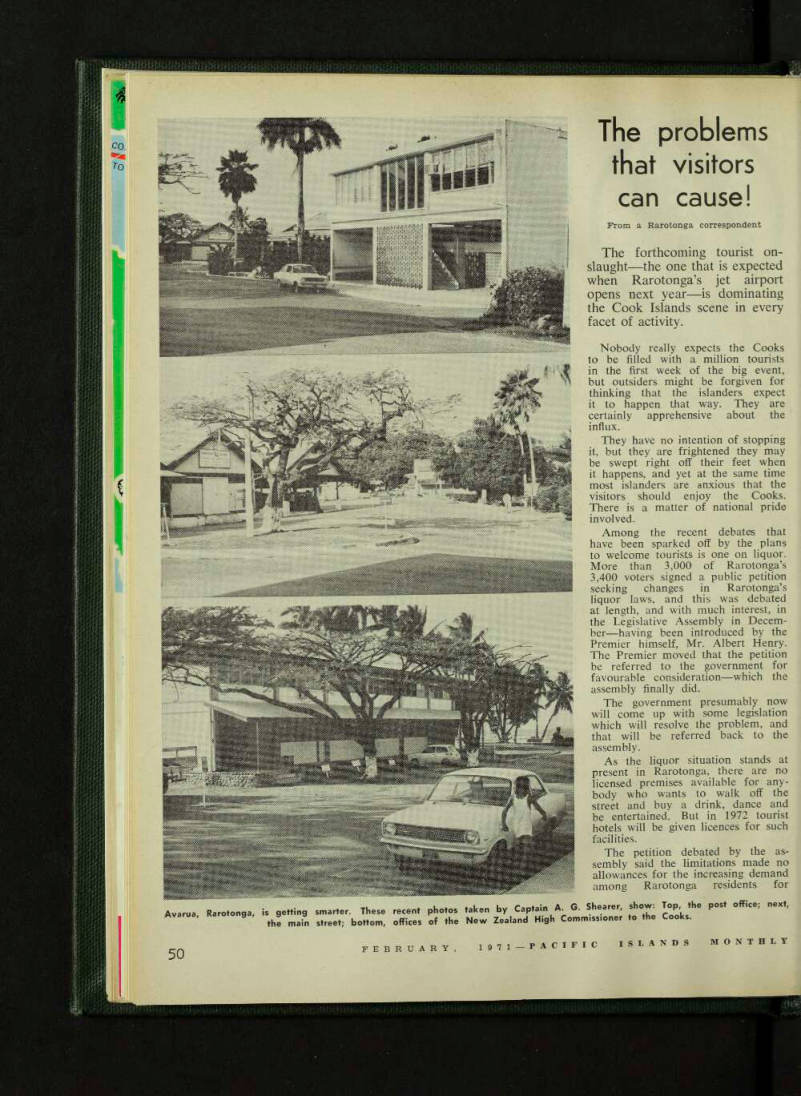
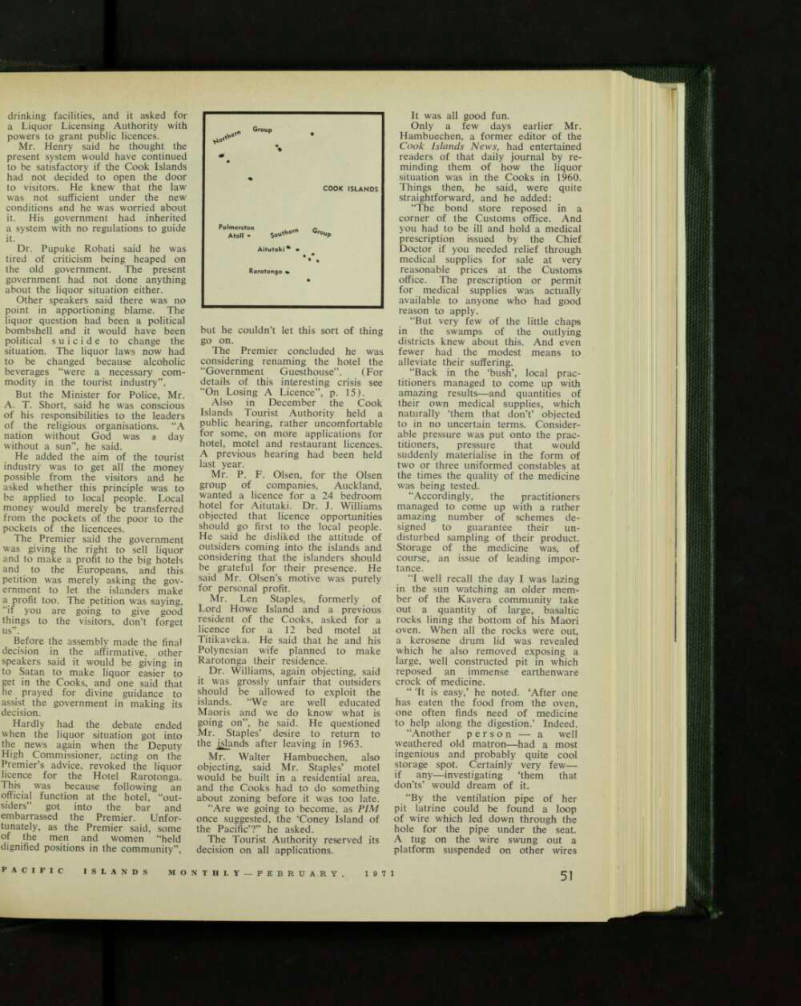
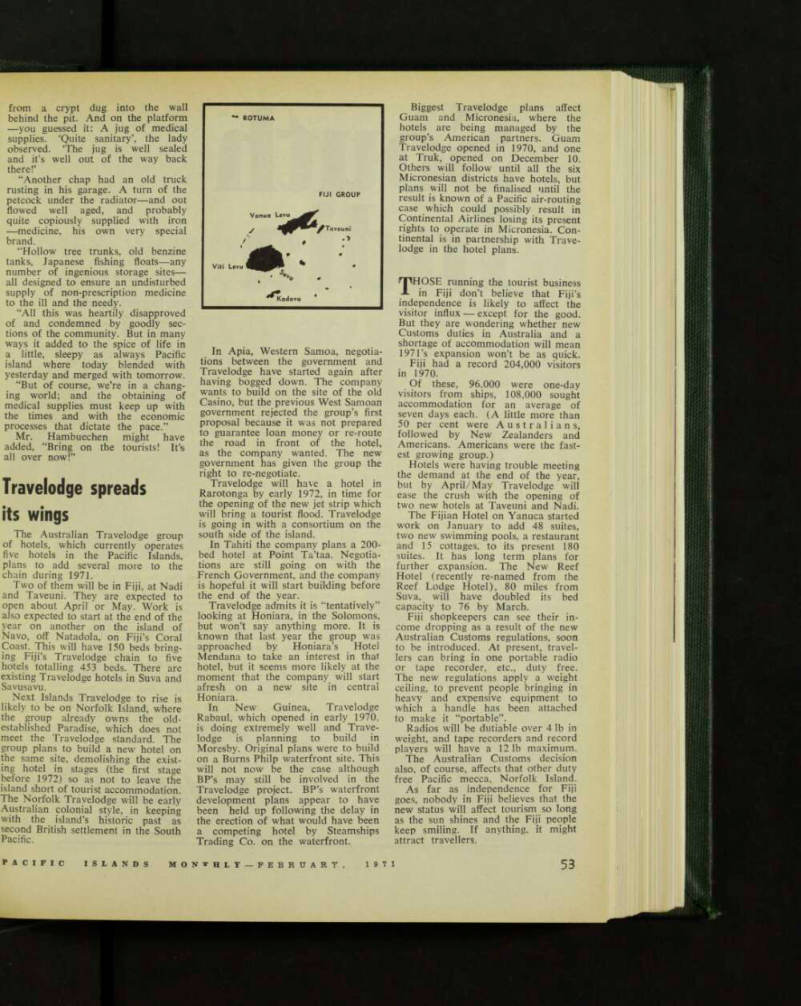
Avarua Rarotonga, is getting smarter. These recent photos taken by Captain A. G. Shearer, show: Top the post office; next, the main street; bottom, offices of the Ne w Zealand High Commissioner to the Cooks.
drinking facilities, and it asked for a Liquor Licensing Authority with powers to grant public licences.
Mr. Henry said he thought the present system would have continued to be satisfactory if the Cook Islands had not decided to open the door to visitors. He knew that the law was not sufficient under the new conditions and he was worried about it. His government had inherited a system with no regulations to guide it.
Dr. Pupuke Robati said he was tired of criticism being heaped on the old government. The present government had not done anything about the liquor situation either.
Other speakers said there was no point in apportioning blame. The liquor question had been a political bombshell and it would have been political suicide to change the situation. The liquor laws now had to be changed because alcoholic beverages “were a necessary com modity in the tourist industry”.
But the Minister for Police, Mr.
A. T. Short, said he was conscious of his responsibilities to the leaders of the religious organisations. “A nation without God was a day without a sun”, he said.
He added the aim of the tourist industry was to get all the money possible from the visitors and he asked whether this principle was to be applied to local people. Local money would merely be transferred from the pockets of the poor to the pockets of the licencees.
The Premier said the government was giving the right to sell liquor and to make a profit to the big hotels and to the Europeans, and this petition was merely asking the gov ernment to let the islanders make a profit too. The petition was saying, “if you are going to give good things to the visitors, don’t forget us”.
Before the assembly made the final decision in the affirmative, other speakers said it would be giving in to Satan to make liquor easier to get in the Cooks, and one said that he prayed for divine guidance to assist the government in making its decision.
Hardly had the debate ended when the liquor situation got into the news again when the Deputy High Commissioner, acting on the Premier’s advice, revoked the liquor licence for the Hotel Rarotonga.
This was because following an official function at the hotel, “out siders” got into the bar and embarrassed the Premier. Unfor tunately, as the Premier said, some of the men and women “held dignified positions in the community”,
but he couldn’t let this sort of thing go on.
The Premier concluded he was considering renaming the hotel the “Government Guesthouse”. (For details of this interesting crisis see “On Losing A Licence”, p. 15).
Also in December the Cook Islands Tourist Authority held a public hearing, rather uncomfortable for some, on more applications for hotel, motel and restaurant licences.
A previous hearing had been held last year.
Mr. P. F. Olsen, for the Olsen group of companies, Auckland, wanted a licence for a 24 bedroom hotel for Aitutaki. Dr. J. Williams objected that licence opportunities should go first to the local people.
He said he disliked the attitude of outsiders coming into the islands and considering that the islanders should be grateful for their presence. He said Mr. Olsen’s motive was purely for personal profit.
Mr. Len Staples, formerly of Lord Howe Island and a previous resident of the Cooks, asked for a licence for a 12 bed motel at Titikaveka. He said that he and his Polynesian wife planned to make Rarotonga their residence.
Dr. Williams, again objecting, said it was grossly unfair that outsiders should be allowed to exploit the islands. “We are well educated Maoris and we do know what is going on”, he said. He questioned Mr. Staples’ desire to return to the islands after leaving in 1963.
Mr. Walter Hambuechen, also objecting, said Mr. Staples’ motel would be built in a residential area, and the Cooks had to do something about zoning before it was too late.
“Are we going to become, as PIM once suggested, the ‘Coney Island of the Pacific’?” he asked.
The Tourist Authority reserved its decision on all applications.
It was all good fun.
Only a few days earlier Mr.
Hambuechen, a former editor of the Cook Islands News, had entertained readers of that daily journal by re minding them of how the liquor situation was in the Cooks in 1960.
Things then, he said, were quite straightforward, and he added: “The bond store reposed in a corner of the Customs office. And you had to be ill and hold a medical prescription issued by the Chief Doctor if you needed relief through medical supplies for sale at very reasonable prices at the Customs office. The prescription or permit for medical supplies was actually available to anyone who had good reason to apply.
“But very few of the little chaps in the swamps of the outlying districts knew about this. And even fewer had the modest means to alleviate their suffering.
“Back in the ‘bush’, local prac titioners managed to come up with amazing results—and quantities of their own medical supplies, which naturally ‘them that don’t’ objected to in no uncertain terms. Consider able pressure was put onto the prac titioners, pressure that would suddenly materialise in the form of two or three uniformed constables at the times the quality of the medicine was being tested.
“Accordingly, the practitioners managed to come up with a rather amazing number of schemes de signed to guarantee their un disturbed sampling of their product.
Storage of the medicine was, of course, an issue of leading impor tance.
“I well recall the day I was lazing in the sun watching an older mem ber of the Kavera community take out a quantity of large, basaltic rocks lining the bottom of his Maori oven. When all the rocks were out, a kerosene drum lid was revealed which he also removed exposing a large, well constructed pit in which reposed an immense earthenware crock of medicine.
“ ‘lt is easy,’ he noted. ‘After one has eaten the food from the oven, one often finds need of medicine to help along the digestion.’ Indeed.
“Another person a well weathered old matron—had a most ingenious and probably quite cool storage spot. Certainly very few— if any—investigating ‘them that don’ts’ would dream of it.
“By the ventilation pipe of her pit latrine could be found a loop of wire which led down through the hole for the pipe under the seat.
A tug on the wire swung out a platform suspended on other wires
from a crypt dug into the wall behind the pit. And on the platform —you guessed it: A jug of medical supplies. ‘Quite sanitary’, the lady observed. ‘The jug is well sealed and it’s well out of the way back there!’
“Another chap had an old truck rusting in his garage. A turn of the petcock under the radiator—and out flowed well aged, and probably quite copiously supplied with iron —medicine, his own very special brand.
“Hollow tree trunks, old benzine tanks, Japanese fishing floats—any number of ingenious storage sites— all designed to ensure an undisturbed supply of non-prescription medicine to the ill and the needy.
“All this was heartily disapproved of and condemned by goodly sec tions of the community. But in many ways it added to the spice of life in a little, sleepy as always Pacific island where today blended with yesterday and merged with tomorrow.
“But of course, we’re in a chang ing world; and the obtaining of medical supplies must keep up with the times and with the economic processes that dictate the pace.”
Mr. Hambuechen might have added, “Bring on the tourists! It’s all over now!”
Travelodge spreads
its wings
The Australian Travelodge group of hotels, which currently operates five hotels in the Pacific Islands, plans to add several more to the chain during 1971.
Two of them will be in Fiji, at Nadi and Taveuni. They are expected to open about April or May. Work is also expected to start at the end of the year on another on the island of Navo, off Natadola, on Fiji’s Coral Coast. This will have 150 beds bring ing Fiji’s Travelodge chain to five hotels totalling 453 beds. There are existing Travelodge hotels in Suva and Savusavu.
Next Islands Travelodge to rise is likely to be on Norfolk Island, where the group already owns the old established Paradise, which does not meet the Travelodge standard. The group plans to build a new hotel on the same site, demolishing the exist ing hotel in stages (the first stage before 1972) so as not to leave the island short of tourist accommodation.
The Norfolk Travelodge will be early Australian colonial style, in keeping with the island’s historic past as second British settlement in the South Pacific.
In Apia, Western Samoa, negotia tions between the government and Travelodge have started again after having bogged down. The company wants to build on the site of the old Casino, but the previous West Samoan government rejected the group’s first proposal because it was not prepared to guarantee loan money or re-route the road in front of the hotel, as the company wanted. The new government has given the group the right to re-negotiate.
Travelodge will have a hotel in Rarotonga by early 1972, in time for the opening of the new jet strip which will bring a tourist flood. Travelodge is going in with a consortium on the south side of the island.
In Tahiti the company plans a 200bed hotel at Point Ta’taa. Negotia tions are still going on with the French Government, and the company is hopeful it will start building before the end of the year.
Travelodge admits it is “tentatively” looking at Honiara, in the Solomons, but won’t say anything more. It is known that last year the group was approached by Honiara’s Hotel Mendana to take an interest in that hotel, but it seems more likely at the moment that the company will start afresh on a new site in central Honiara.
In New Guinea, Travelodge Rabaul, which opened in early 1970, is doing extremely well and Trave lodge is planning to build in Moresby. Original plans were to build on a Burns Philp waterfront site. This will not now be the case although BP’s may still be involved in the Travelodge project. BP’s waterfront development plans appear to have been held up following the delay in the erection of what would have been a competing hotel by Steamships Trading Co. on the waterfront.
Biggest Travelodge plans affect Guam and Micronesia, where the hotels are being managed by the group’s American partners. Guam Travelodge opened in 1970, and one at Truk, opened on December 10.
Others will follow until all the six Micronesian districts have hotels, but plans will not be finalised until the result is known of a Pacific air-routing case which could possibly result in Continental Airlines losing its present rights to operate in Micronesia. Con tinental is in partnership with Trave lodge in the hotel plans.
THOSE running the tourist business in Fiji don’t believe that Fiji’s independence is likely to affect the visitor influx except for the good.
But they are wondering whether new Customs duties in Australia and a shortage of accommodation will mean 1971’s expansion won’t be as quick.
Fiji had a record 204,000 visitors in 1970.
Of these, 96,000 were one-day visitors from ships, 108,000 sought accommodation for an average of seven days each. (A little more than 50 per cent were Australians, followed by New Zealanders and Americans. Americans were the fast est growing group.) Hotels were having trouble meeting the demand at the end of the year, but by April/May Travelodge will ease the crush with the opening of two new hotels at Taveuni and Nadi.
The Fijian Hotel on Yanuca started work on January to add 48 suites, two new swimming pools, a restaurant and 15 cottages, to its present 180 suites. It has long term plans for further expansion. The New Reef Hotel (recently re-named from the Reef Lodge Hotel), 80 miles from Suva, will have doubled its bed capacity to 76 by March.
Fiji shopkeepers can see their in come dropping as a result of the new Australian Customs regulations, soon to be introduced. At present, travel lers can bring in one portable radio or tape recorder, etc., duty free.
The new regulations apply a weight ceiling, to prevent people bringing in heavy and expensive equipment to which a handle has been attached to make it “portable”.
Radios will be dutiable over 4 lb in weight, and tape recorders and record players will have a 121 b maximum.
The Australian Customs decision also, of course, affects that other duty free Pacific mecca, Norfolk Island.
As far as independence for Fiji goes, nobody in Fiji believes that the new status will affect tourism so long as the sun shines and the Fiji people keep smiling. If anything, it might attract travellers.