Pacific Islands Monthly
News Magazine Of The South Pacific
February, 1971
Australia, Nz, Geic, Bsip 50C
PNG, FIJI, COOKS, TONGA, W. SAMOA, N. HEBRIDES 45c
Nauru, Norfolk, Niue 45C
AMERICAN SAMOA 70c HAWAII 80c MICRONESIA 90c NEW CALEDONIA 65 CFP FRENCH POLYNESIA 75 CFP
Advertisements & other items, pp. 2-16 (9 items)
February, 1971-Pacific Islands Monthi
No. 1~ the friendly one
50 centres throughout Papua and New Guinea on a 10,000 mile network. 100 centres in Australia. TAA links the lot.
Across the Territory we give you more flights to pick from.
More cargo space. More seats.
Including daily Friendship
services between Moresby and all major centres. Plus daily ‘Bird of Paradise’ T-Jet flights connecting Brisbane, Sydney, Melbourne, Adelaide and Perth with the Territory.
If you plan to take off soon, keep our big link-up in mind.
And call your Travel Agent or
TAA.
Port Moresby 2101, Lae 3191, Madang 2478, Rabaul 2567, Goroka 8, Mt. Hagen 4 or 301, Wewak 103.
TAA
No. 1~ the friendly one
AIRLINES OF NEW GUINEA
♦ :: Papua Australia 319 2741 k
M M
THROUGHOUT THE PACIFIC
HJI,SAMOA,TONGA, NIUE Is, NORFOLK Is.
BURNS PHILP
(SOUTH SEAT CO. LTD. „
REGISTERED OFFICE: SUVA, FIJIj^
TELEPHONE NO: 22661 W\ jm
TELEX NO: FJ1127
Code Address: "BURNSOUTH' m [mi
SHIPPING AGENCIES
The New Zealand Shipping Co. Ltd.
Shaw Savill & Albion Co. Ltd.
Blue Star Port Line (Management) Ltd.
Bank Line Ltd.
General Steamship Corporation Ltd.
Compagnie des Messageries Maritimes Royal Interocean Lines Daiwa Navigation Company Ltd.
Sitmar Line Flotta Lauro (Lauro Lines) Australasia Pty. Ltd.
Tonga Shipping Agency.
EXCLUSIVE
DISTRIBUTORSHIPS
INCLUDE
Akai Taperecorders Sunbeam Appliances Dunlop Products Hitachi Electronics Holden Motor Vehicles Rolex Watches Revlon Cosmetics Pentax Cameras Massey-Ferguson Tractors Olympic Tyres Penfold Wines
AGENTS FOR
Queensland Insurance Co. Ltd.
Shell Company (P. 1.) Ltd.
Bureau Veritas
ASSOCIATED COMPANIES
Burns Philp (New Hebrides) Ltd.
Burns Philp Trustee Co. Ltd.
Automotive Supplies Co. Ltd.
Corrie & Co. Ltd.
Wrought Iron and Steel Construction Co. Ltd.
Bish Ltd.
SPECIALISED SERVICES
Expert advice on Shipping; Forwarding,- Customs formalities; Insurance.
COMPLETE TRAVEL
SERVICE
accredited agents for the
INTERNATIONAL AIR
TRANSPORT ASSOCIATION
OVERSEAS AGENTS: SYDNEY*LONDON*SAN FRANCISCO
Qrnott's/«“ Biscuits
in triple wrapped, tropical packs
m % m tcVv Sco w > nf' ii Arnott’s SCOTCH FINGER Biscuits.
A butter-rich, chunky biscuit with the true flavour of shortbread.
Arnott’s CHEESE JATZ Biscuits.
Crisp cracker biscuit with a fine cheese flavour — perfect for entertaining. \ 4* Arnott’s SALTINE Biscuits.
Light, tangy, crisp cracker biscuit. . . perfect with salads, cheese, soup or eaten plain ill Biscuit Arnott’s MILK ARROWROOT Biscuits.
A wholesome, nourishing biscuit especially suitable for children, but a favourite with all the family.
mm m a Arnott’s SAC Biscuits.
A light, crisp cracker biscuit... delicious with butter and cheese, ham, jam or other spreads.
nteCarioM
MO Arnott’s MONTE CARLO Biscuits.
Crisp short biscuits, flavoured with pure honey and coconut,sandwiched with vanilla cream and raspberry jam. m shredded wheatmeal Bircult* Arnott s SHREDDED WHEATMEAL Biscuits.
A wholesome biscuit with the nutty flavour of crunchy whole wheatmeal.
Delicious plain or buttered. m ■aP S'lCt H Arnott’s NICE Biscuits.
A sweet plain short-texture biscuit sprinkled with fine sugar. Popular for morning tea.
There is no Substitute for Quality
E 670
a car account at the Commonwealth tafpsthe A Pam out op
paying
open one
today
'<o 0 Get with the Strength bam comommiTH
iUMNOMiS
mm* m wmm
83DVlNI3iS
fmmmm mmm m wm m.
Spoil yourself a little
r iui ml
arouse! *S
Slide Projector
If you like to just sit back and enjoy your own slide show or perhaps just the KODAK CAR'OUSEL ‘S’ Slide Projector. There is a choice of six impress your friends a little, you need interchangeable lenses. The unique gravity feed will allow you to act the entrepreneur with confidence and finesse. This is one of the finest slide projectors ever made.
See your Kodak dealer he will be glad to give you a demonstration.
KODAK (Australasia) PTY. LTD.
379 George Street, Sydney. 2000.
Kodak dealers throughout the Islands.
AV CONTENTS 50 MADE IN AUSTRALIA
Brymay
Waterproof matches
Greenlites
m lill: ii - ■ ; - /'v * i
Bright new label
and still the only matches in
the world that light when wet.
Greenlites are made for your part of the world.
They’re tropical matches —waterproof matches.
Ask for them.
MADE IN AUSTRALIA BY BRYANT & MAY • M23M
I ' . <<■> V ■ A •; m : Anything you can do, I can do better.
They’re both right. And they both have their place on a Qantas jet. That’s why Qantas introduced stewards in the first place. Because they do some things better than hostesses. Then again, hostesses have a few things over stewards.
It all adds up to the best service you’ll find on an airline. That’s why we’re the world’s favourite.
anntas
Australia’s round the world Arline.
QANTAS, with AIR INDIA, AIR NEW ZEALAND, BOAC, MSA and SA.A.
JW1.8217
For
RUM
at its best...
say
OVERPROOF AND UNDERPROOF
In 5 oz. and 13 oz. flasks and 26 oz. and 40 oz. bottles BLENDED AND BOTTLED BY JOHN WALKER & SONS LIMITED.
V s
THE BIG FLAVOURS COME TO THE
SOUTH PACIFIC
I i:
CartanW
§imerS
-1 The red hibiscus symbol proudly marKs the introduction of some of New Zealand s most popular soft drinks by Island Bottlers of Fiji Ltd., from their new modern factory.
In Apia in Western Samoa the same flavourful range is produced by the Apia Bottling Company and people everywhere are asking for these famous names- ,
LEMON and PAEROA, TARTAN DRY GINGER
ALE and the colourful fruity range of JU'CY
SOFT DRINKS.
They're yours to enjoy . . . time after time.
Manufactured under franchise to Innes Tartan Ltd., Auckland, New Zealand by-
M ISLAND BOTTLERS OF FIJI LTD.
W APIA BOTTLING COMPANY LTD.
au 9 II
continuous IMi
reverse
m AK AFs CS-50 is the first stereo cassette recorder with automatic coot mu ous reverse re-
cording/ playback. Thanks to
its “ INVERT- O- MATIG ”
mechanism, you can also make up to two hours of hi-fi recordings. Manual reverse is possible, too, and the CS-50’s sound quality is unbeatable. Its 30 to 16,000Hz frequency response at
1% ips compares favorably
with open reel models. From 0,16 to 0.2% wow/flutter. Auto stop and shut-off. Also aval table is the CS-50D Stereo Cassette Tape Deck—an idea! partner with the SW-30 Hi-Fi Stereo Speaker System.
Audio & Video
AKAI
AKAI ELECTRIC CO., LTD,
Ohta-ku, Tokyo, Japan S ST ffd L A i R nc P oh Lt , d o’ 276 Castlereagh St.. Sydney, N.S.W. NEW ZEALAND: G. Glausiuss Coy, P.0. Box 640, Christchurch SUVA: Burns Philp (South Sea) oia Western Samoa NflBFnnf'' ci a S wnc h d 63 ’ C 2L*-, Lt ?o SAM0A: Burns Philp (South Sea) Co ' Ltd ' Pag0 Pag0 ’ American Samoa/Burns Philp (South Sea) Co., Ltd., h lD (New HpSZ h RF0 K SL £^ S P^ U r r n n nJ. hl!p . , South Sea) Co ’ Ltd - Norfolk lsland ’ South Pacific NEW HEBRIDES; Burns Philp (New Hebrides) Ltd., Port Vila/Burns i LI b . L D d ’u. S nS. t .° m EW CALED0N,A: Menard Freres”, P.0. Box 123, Noumea BRITISH SOLOMON ISLANDS: Mendana Enterprises (Solomon Island) Ltd., P 0. fw niiMF* c o o' P NAUPU - Nauru Co-operative Society COOK ISLANDS: N.T. Napa (Avarua) Ltd., Rarotonga TAHITI; Ets. Comimpex., P.0. Box 200, Papeete PAPUA & EW GUINEA. S.0. Svensson (N.G.) Ltd., P.0. Box 705, Port Moresby TONGA: Burns Philp (South Sea) Co., Ltd., Nuku Alofa
Three flexible rules
tor keeping standards up and costs down Handiflex The specially designed hard wearing polystyrene case stands up to hard knocks and accidental drops. A natural choice for craftsmen and ideal for a thousand-andone jobs around the home.
Whiteflex Extra strong die-cast, chromium plated case. Easy to read black markings on a white background. Like all other Rabone Chesterman rules, replacement blades are readily available.
Here are three Rabone Chesterman flexible tape rules which accurately measure up to every need, and because they're built to last you get real value for money. Every one has a bonderised tempered steel blade. All are available in a choice of lengths. And for faster, more convenient work, every Rabone Chesterman rule is shaped to fit your hand, snugly and securely.
Interflex Same case and craftsmanship as 'Whiteflex', but with black markings on a plated steel blade. Shares with all the other rules the Rabone Chesterman feature of a sliding tip for 'hook over' or 'end on' measuring.
Insist on Rabone Chesterman for a lifetime of accuracy as a rule they are unbeatable.
Rabone
■ Rabone Chesterman Ltd.
Chesterman Birmingham 18, England.
TABATA SKIN <& SCUBA
•■W n mi Vs* #'■ •. - . nm'nrimnini " !
For full particulars on our lines, write to: The TABATA line offers the importer a complete range of RUBBER
SKIN & SCUBA DIVING
EQUIPMENT and ACC-
ESSORIES for both the professional and amateur. Years of specialized manufacturing experience has establidied our line's
REPUTATION FOR QU-
ALITY, ATTRACTIVE
and PRACTICAL DESI-
GNS and VERY COMP-
ETITIVE PRICES. We a-
Iso offer a varied line i of rubber sundries for golfing, skiing and other popular sports.
Manufacturers II
TABATA CO., LTD
. —w C ACTAQATA
Yajima 81dg.,2-2Yoshi.cho, Nihonbashi ,Chuo.ku,Tokyo CabIe:"EASTABA”Tokyo TELEX:2S2 *2806 EASTABATA TOK Teh (663)8651
ALUMINIUM
ADJUSTABLE
SUN
LOUVRES
Free Colour
Catalogues Available
i / For more than 50 years the products of Wunderlich Limited manufacturers and distributors of Australia's largest range of building materials have been exported throughout the Islands of the South Pacific.
The company's range of products, which are available to meet the needs of architects and builders, is well known. • Wunderlich Aluminium Adjustable Sun Louvres are made to order to a standard shape (width and profile)—in aluminium up to 12' high —to operate from inside or outside the
building.
Head Office: 393 Cleveland St., Redfern, N.S.W., Australia. 69 0366
WSL6.6SE
Va "a m
SOME OF THE FIRMS
WE REPRESENT ARE:
A. W. Allens (Confectionery) Sunshine Biscuits Sunrise (Confectionery) Flamenco (Instant Coffee) Cremota (Quaker Oats, Jets Pet Foods) Merchants (Canned Soft Drinks) Highness (Canned Vegetables, Canned Fruit Drinks) Lunchtime (Honey) South Pacific Canneries (Scallops, Abalone) Safcol (Canned Tuna, Salmon) Hancock's (Spaghetti, Cereals) Melbourne Canning (Jams, Bleach) Water Wheel (Flour, Sharps, Wheat) General Food Corporation (Twisties, Twirlies) Edward Zorn (Margarine, Cooking Fats) Robert Timms (New Guinea Gold Coffees, Teas) Bx Plastics (Sandals) Homy Peds (Sandals) Magnet (Mattresses) Esteel (Cookwear) Teco (Cafe Bars) Mitchell's (Abrasives) Regent (Swiss Watches) Gainsborough (Furniture) Tamco (Melanie Crockery, Nylon Hardware) Elmaco (Plastic Household Goods, Electrical Fittings) Brownbuilt (Pre-fabricated Houses) Ryline (Fluorescent Lights) Chargemaster (Fluorescent Lamps) Franklite (Light Fittings) Electronic Industries (Electrical Household Appliances) Jex (Steel Wool) Austramax (Pressure Lamps) Preservene (Soap Products) Charles Tims (School Requisites) Ascow and Philadelphian (Shirts) Lawn Chair and Tubco (Garden Furniture) Sunrise Lustretone (S.S. Sinks, Plumbers' Supplies) Kerex (Kerosene Burners) Arena (Football Boots) Ferrari (Men's Shoes)
S. E. TATHAM
& Co. Pty. Ltd.
MELBOURNE, AUSTRALIA
G.P.O. Box 8, Cables “SET"
Telephone 60-1125
EXPORT AGENTS
PACIFIC ISLANDS
AGENTS
Australian buying and shipping agents for the Gilbert and Ellice islands Colony Wholesale Society
DIRECT ENQUIRIES WELCOMED
Associate Company
S. E. TATHAM (FIJI) LTD
Suva, G.P.O. Box 671.
Lautoka, P.O. Box 366.
SINCE 1924
ir the big-mouthed
irge they specified
JMMINS POWER!
m rench owners have christened her ‘Merou’ (the groper) because her huge tonnages of ) are swallowed through the great mouth engineered into her bow. jned and built by Carrington Slipway, Newcastle, ‘Merou’ will operate for the SCET usation of New Caledonia, to carry equipment and materials to construction sites ways, airfields, earthworks) all round the South Pacific! er mammoth task, her designers specified mammoth power-two keel-cooled nms Vl2-525-M diesels with two Cummins ClO5-BIM 41.5 KVA iaries, one keel-cooled and one radiator-cooled— ceptional arrangement to guarantee reliable rmance in tropic waters, nins service influenced the choice ly with Cummins reputation. Cumparts and maintenance service i throughout Australia and be-
wherever Cummins-powered
)oats range the seas. i tT: m\i
jav
- (■IS % Distributor
CUMMINS DIESEL SALES
& SERVICE (AUST.) PTY. LTD.
,d Office: 164-170 Hume Highway, Lansvale, N.S.W., 728-6211. Telegrams "CUMTORQ' Melbourne • Brisbane • Adelaide • Perth • Hobart Darwin • Lae • Townsville • Pt. Hedland • Mt. Isa Sydney Grafton Factory
CUMMINS DIESEL
AUSTRALIA
(Cummins Diesel Sales Corporation, incorporated in U.S.A. with Limited Liability) Ringwood, Victoria
Act now to make X 1971-and all the rest \ of the Seventies —years that are just as enriching as you'd like them to be.
With Sansui quality stereo.
A truly professional control amplifier is a great way to start, and with Sansui you can choose from among the 100 watt AU-666 or 85 watt AU-555A, both with Triple Tone Control circuit, or the compact 46 watt AU-222.
The all-new 2-speed Automanual SR-2050C turntable is an ideal program source, incorporating as it does the unique Sansui Auto Lift/Stop mechanisms, but the 2-speed manual SR-1050C is just as outstanding in its price range.
For speaker systems, the 40 watt SP-150 or 30 watt SP-70, both of which combine high performance with rare beauty, are a good way to spread the cheer.
And the 2-way 4-speaker SS-20 stereo headphone set is a very special way to keep it to yourself.
Whatever your choices, your nearest authorized Sansui dealer will be happy to demonstrate them. Start the new year right and make a resolution to see him soon.
Matching components, matchless stereo. the sansui exhibit aboard the SAKURA-MARU when It comes to your area PRABHU BROTHE"'" ”‘ r> 0 idcnHc Tpl 70183 / SERVONNAT Rue des Polius, Tahitiens Papeete, Tahiti. Tel. 03-29 / O “ AN ™U,'eUC™c CO: LTD.T4-I,T'choTne,~lzurnb Suginami-ku, Tokyo, Japan
3
ACIFIC ISLANDS MONTHLY—F E B R U A R Y , 1971
5
ACIFIC ISLANDS MONTHLY FEBRUARY, 1071
February. 1971 Pacific Islands Monthl
7
ACIFIC ISLANDS MONTHLY FEBRUARY, 1971
9
ACIFIC islands MONTHLy_p E B R u A R Y . 1971
10
p.beuao, 19 , .-pacific islands month:
11
ACIFIC ISLANDS monthly FEBRUARY. 1971
The Editor's Mailbag
On Losing A Licence
Sir, —You might be interested to hear how the Otera Rarotonga (Rarotonga’s hotel) lost its liquor licence.
On Wednesday afternoon, Decem ber 9, the Premier, the Hon. A. R.
Henry, opened the new building that houses the Cook Islands Liquor Supplies. This is the new name for the Government Bond—the sole im porters of liquor into the Cook Islands. For the first time apparently in the Cook Islands a certain amount of intoxicating liquor was passed among the 200 invited guests follow ing the speeches to celebrate the opening. Had matters rested there, all would have been well.
But, an hour or so later, down the road in the hotel an official ceremony was held to farewell the NZ High Commissioner and his family who were going off on leave for two months. Once again 200 guests were invited. Now, with a limited number of people to draw upon to fill such an invitation list it was inevitable that a good number of people were invited to both functions.
The farewell to the High Com missioner was held in the verandah lounge. A short corridor length away was the Banana Court, the hotel’s bar. With a sizeable number of guests arriving in a cheerful frame of mind from the new liquor store opening, some avoided the verandah lounge and headed for the Banana Court and settled down to enjoy themselves. (Although the Banana Court is tech nically a house bar, it has been used by increasing numbers of local people during 1970 following the closing of the 27 unlicensed bars on the island.
This practice was apparently con doned by the Internal Affairs Depart ment who run the hotel.) Anyway, by the time speeches were being made on the verandah a certain amount of noise was coming down the corridor to the distraction of both speakers and audience. At the con clusion of the ceremony the Premier stepped along to see what was going on and to his surprise and annoyance he saw drinking, singing and dancing, with a number of his intended guests leading the fun.
The following day, the Deputy High Commissioner, acting on the Premier’s advice, revoked the hotel’s liquor licence which had enabled bona fide guests to purchase and con sume liquor in the Banana Court.
This means that hotel guests who want to drink now have to buy their liquor from the liquor supplies store, something over a mile from the hotel, and once they have brought it back they have to cool it in the communal fridge (and watch it closely mean while) before drinking it in the privacy of their room. Drinking is not allowed elsewhere.
The fact that hotel guests them selves had no part in making the noise appears to have been ignored.
The noisy ones, who were described in the Cook Islands News as “men and women who hold dignified positions in our community, and government officials”, were not regular patrons of the Banana Court and its closing will not affect them.
So far, one loophole has been worked into the system. The crew of the NZGS Moana Roa called on the Premier to put their point of view and they now have a couple of rooms in the hotel where they can drink cold beer supplied by the hotel at liquor store prices. They can, if they like, invite hotel guests to join them.
From the long-term point of view the revocation of the licence means two things. Firstly, future visitors to the Cook Islands who intend staying at the Otera Rarotonga will be put to a certain amount of inconvenience before they can drink legally in their bedrooms (and anyone arriving on the Northern Star on a Saturday afternoon is in for a dry weekend).
Secondly, licensees of the yet-to-be built hotels had better keep the noise down in the bar.
Hardly the way to promote a tourist industry.
Mike Linden.
Otera Rarotonga, Rarotonga.
Geic Copra
Sir, —I refer to the article headed “GEIC copra plans seem doomed”, published in PIM (Nov., ’7O, p. 129).
All the evidence indicates that our copra plan is likely to be a success.
Although it is moving ahead more slowly than our first optimistic targets, it is nevertheless progressing faster than most such agricultural schemes in the less developed parts of the world.
As for the statement, “no resident will bet that the colony’s 30,000 tons output target by 1975, under its adopted development plan, can be
achieved”; this is understandable since in fact the development plan does not mention this target. The only statement made on this subject in the plan is that, “production at a postwar annual average of 7,000 tons is well below the territory’s theoretical maximum of 30,000”.
The Development Plan projects an output of 20,000 tons by 1986, which is 10,000 tons less and 10 years later than the “facts” quoted by your Tarawa correspondent. As the plan has only been under way since June this year, an operational time of five months is obviously insufficient to ascertain whether or not 1986 targets will be achieved.
The statement concerning copra producers’ earnings and tax payments is also incorrect. The copra board in 1970 is likely to pay out $1,060,000 to owner-occupier small producers of the Gilbert and Ellice Islands. The amount will be broken down as follows: Paid to producers, $450,000; freight costs, $440,000; export duty, $170,000: Total, $1,060,000. The net value received for a ton of copra by the copra board before duty is paid is $ll7, not $l5O as stated in the article, and an average of $34 is paid in export duty. The board will therefore receive $1,025,000 from copra sales in 1970 and will sub sidise the price by $35,000. The amount of copra taxation is re cognisably high and ways and means of shifting the burden are at present being considered.
There is also an impression created by the article that the coconut planta tions of the Line Islands are efficient, whereas the groves of the Gilbert and Ellice Islands are inefficient, which is also a false one. This does not mean to say that improvements cannot be made and efforts are being made in every sector to in crease output by more efficient methods and by new planting, so that the production of copra may reach the target figure of 20,000 tons
by 1986.
R. T. Harberd.
Director of Agriculture, Tarawa.
Dec. 16, 1970.
Outboard Motor Maintenance
Sir,—As subscribers to your maga zine, and as a company involved in the Pacific region through sales of our Johnson and Evinrude outboard motors, we would like to mention an area of our operations which, we feel could be of interest to PIM readers Outboard Marine International is the regional office of Outboard Marine Corporation, of Waukegan, Illinois, the manufacturers of both Johnson
(Continued on p. 125
Continued from p. 16)
md Evinrude outboard motors. Our Australian affiliate is Outboard darine Australia Pty. Ltd. of Canter iury Road, Bankstown, NSW.
From the Hong Kong office we over Asia and most of the Pacific, rith the major exceptions in the Pacific of P-NG, the New Hebrides, Solomons and New Caledonia.
When we say “cover this area” we mbrace a large range of duties and esponsibilities to our distributors and ic public. The most important, in ic eyes of the public, is the train ig of people within the area in the laintenance of our outboard motors.
We have service engineers who •ayel through the Pacific holding laintenance courses, of about two r eeks’ duration, in various centres, hese courses are financed by Out oard Marine and the local distribu >r, at no cost to the students.
During 1970 we have held schools i Truk, Majuro, Guam, Apia, Suva nd Lautoka.
Although the main aim is to pro ide courses for our distributors’ per >nnel, in most cases we have people om local vocational institutes, ades’ schools, government depart- Lents and the armed forces, in attend ee.
One of the problems we find in anning this type of school is that e cannot let everyone who may be terested know that such training is "ovided. Neither our distributors nor irselves can contact everyone and e find there is often some misunder anding about the nature of the >urses by local people.
We feel that these schools are not ily of general interest to the people the Pacific but that a little back ound in PIM will help us immeasur >ly in the future.
G. M. Shea,
Service Engineer. utboard Marine ternational SA, Hong Kong.
Death At Cairns
Sir, —A little item for your “Deaths Islands People” column. Lynn ilson of New Zealand, well known Wabag and Mt. Hagen and various ew Guinea goldfields, died here cently. I think he was well known members of PIM staff. Lynn was ic of the best.
Wishing continued success to PIM. ould be obliged if you would ndly pass my good wishes to the rand Old Man, RWR. I’m not so iung myself, 79.
Harry Dawkins
(once of New Hebrides). cLachlan St., urns, Queensland.
Pacific Islands
Monthly
Established 1930: 41st Year of Publication.
Owned And Published By
Pacific Publications (Aust.) Pty. Ltd.,
29 Alberta St., Sydney, N.S.W., 2000.
Postal Address: G.P.O. BOX 3408, SYDNEY,
N.S.W., 2001.
Telegraphic Address; PACPUB, Sydney.
Telephones: 61-9197, 61-7101, 61-4669.
Chief Executives: Managing Director: R. W. Robson.
Executive Director/Publisher: Judy Tudor.
Executive Director/Business Manager: Selwyn Hughes.
Executive Director/Chief Editor: Stuart Inder.
Pacific Islands Monthly
Editor: Stuart Inder.
Advertising Manager: W. A. Gasnier.
Branch Offices
Fiji: Pacific Publications (Fiji) Ltd., Fiji Times Building, 20 Gordon Street, Suva. Tel.: 25601.
Fiji Times Office, Mayfair Building, Namoli Ave., LAUTOKA. Telex: 1144. Tel.: 60-422.
Papua-New Guinea; Pacific Publications (N.G.) Pty. Ltd. Representatives: PORT MORESBY, P.O, Box 16; LAE, P.O. Box 227; RABAUL, Mr.
Steve Simpson, P.O. Box 433 (c/- Rabaul Photographic. Tel.: 2677).
Representatives
Victoria: Advertising—Wilke & Co. Ltd., 37 Brown's Road, Clayton, Vic., 3168. Tel • 544-8222.
Queensland; Advertising—Beale Media Services, 232 St. Paul's Terrace, Fortitude Valley, Qld., 4006. Tel.: 51-5827.
New Zealand: General.—J, D. Whitcombe, C.P.O.
Box 2229, Queen St., Auckland. Tel.: 456056 Advertising.—J. E. Sanders, P.O. Box 25-015, Auckland. Tel.: 583-563.
United Kingdom; S. R. Warman, Park House, 22 Park Street, Croydon, CR9 3NP. Tel.: 01-6884177.
Overseas Newspapers (Agencies) Ltd., Cromwell House, Fulwood Place, London, W.C.I. Tel • 01-242-0661. Cables: WESNEWS, London, DS4‘.
Japan: Advertising—Universal Media Corpora tion, C.P.O. Box 46, Tokyo. Tel.; 666-3036.
Agents
All main trading firms and stores in the Pacific Islands.
Pacific Publications Pty, Ltd. is the Australian agent for THE FIJI TIMES.
Subscription Rates:
"Pacific Islands Monthly" is air-freighted to all subscribers and agents in the Pacific Islands; copies to other areas go by surface mail, Australia (including Lord Howe and Thursday Is.), 8.5.1. P., Gilbert and Ellice Is.: $5.50 Aust.; Papua-New Guinea, Norfolk Island, Nauru, Tonga and New Hebrides: $5.00 Aust.; New Zealand: $5.50 NZ; Fiji, Cook Islands, Niue and Western Samoa: $5.00 (local currency); American Samoa: $B.OO US; U.S. Mainland, Micronesia (including Guam): $lO.OO US; Hawaii: $9.00 US; New Caledonia: 750 French Pacific francs; Tahiti and French Polynesia; 850 French Pacific francs; United Kingdom and elsewhere: £3/5/- Stg.
Copyright ©, 1971, Pacific Publications (Aust.) Pty. Ltd.
Advertisements & other items, pp. 18-22 (5 items)
&wmt CadimtfJi
s'iwwt CadSmtfA
& a/axt CaMuMfX
Swant Cadiu/tifA
o 3^ It’s worth saying over and over again because there’s a glass and a half of pure, fresh, full-cream milk in every half-pound of Cadbury Dairy Milk Chocolate. No other chocolate can possibly give you that creamy, creamy Cadbury taste. Look for the famous purple wrapper.
CADBURY
DAIRY MILK CHOCOLATE
the biggest selling block chocolate in Australia MD4/32/0
The House of Dunhill, the most distinguished tobacco house in the world
takes pride in presenting
Dunhill King Size
Filter Cigarettes.
unn
LONDON PARIS NEW YORK
The most distinguished tobacco house in the world.
NP29
/ a a * u HH
The
f: :•••:"
Sffl
SI SS&t
Instead of having your cargo lifted up, over, then down into the hold, why not play safe and simply have it go straight in and down? That’s side-port unit-loading —the fast, safe way to load and unload cargo.
Side-port loading is standard procedure in the “Island Chief,” “Coral Chief” and “Papuan Chief.” These three vessels provide regular, scheduled services between Sydney, Brisbane and Port Moresby, Samarai, Lae, Madang, Rabaul, Kavieng and Honiara in Papua-New Guinea and The British Solomon Islands.
If you would like to know more about how to cut down your cargo costs, tell the New Guinea Australia Line that you want to see the 20-minute film ‘Cargo Revolution.’ This shows you how—and more!
For specialised assistance, please contact:
□ New Guinea Australia Line
MEMBER OF THE SWIRE GROUP
PTY. LTD.
Rykiel NEW GUINEA— Steamships Trading Co.
General Agents: PORT MORESBY— Steamships TradingI Co Ud. SYDNEY Swire & <3 ■ lehr. st Pty. Utd Agents at: BRISBANE-Wills, Gilchrist Sanderson Pty 911 (For “Papuan Chief’
Some people know us as a assenger ship, and some as a argo ship. We like to think of urselves as a cargo ship that arries passengers.
Whichever way you look at , you can be sure of one thing: argo Care. The Taiyuan provides a ist, reliable and safe cargo service.
Every third Saturday the aiyuan leaves Sydney. For
The MS Taiyuan
takes as
much care
of her cargo
as she does
other
passengers
Brisbane, Noumea, Lautoka and Suva. On board is every kind of cargo: frozen and chilled foods, heavy machinery and vehicles.
The M.S. Taiyuan provides you with a transport deal over this route that is not bettered by any other carrier. All you have to do is contact one of our local agents for more details. And leave the rest to us.
r =ZS£HS
LTD.
m a uu
MEMBER OF THE SWIRE GROUP
SUVA—Morris Hedstrom Ltd. SYDNEY-Swire & Gilchrist Pty. Ltd. Agents in : MELBOURNE-P. & 0. Lines of Australia Pty. ■ BRISBANE—WiIIs, Gilchrist & Sanderson Pty. Ltd. NOUMEA—Etablissements Ballande, Service Maritime. LAUTOKA—Morris Hedstrom Ltd. 920/86
Milk and cream
all rolled into one
It whips into thick, creamy toppings ideal for desserts, fruit pies!
It pours straight from the can into tea or coffee, over cereals, whenever you cook !
It stores without refrigeration protected in its gold-lined can ! mehtiJ:
Ideal
EVAPORATED
m
NESTLES
Ideal
Evaporated milk
17
ACIFIC ISLANDS MONTHLY FEBRUARY. 1971
18
FEBRUARY. 7971-PAC.FIC .SLANDS MONTHL
19
*ACI F I C ISLANDS MONTHLY FEBRUARY. 1971
20
,EBRU A B T ■ •* 1 * PACIFIC .SL. N D S MONTH.
Up Front
with the Editor
As a young newspaper reporter in Sydney just after the war, my job for a year or two was to interview overseas air passengers as they arrived at Sydney airport. That was the time when the airlines were flying giant DC6’s on the trunk routes and Pan Am’s new deck and-a-half Stratocruisers were something to wonder at.
Those were interesting, satisfying, balmy days of interviewing for those of us who enjoyed talking to people.
Passengers were not so numerous that they had to be processed by computer, and as they waited for their baggage to be cleared in the Customs hall (to which we had ac cess) we reporters would speak to every arriving passenger over the age of two.
We got a lot of dead air, but we also got a lot of stories—and the afternoon editions were always well larded at that time with human in terest, collected from real people who told it like it was. And al though we didn’t write everything, we reporters became extraordinarily well-informed on conditions in other countries, on politics, commerce, heology, international wheat sales— name it. And our background cnowledge put depth into all our nterviews.
It was during those days at Syd ley airport that I first found out vhat I have since proved a hundred imes—that as a general rule the rigger the stature the more ap proachable the man, once you are ible to talk directly to him. It was
be nobodys-trying-to-be-somebodys
vho protected themselves with spokesmen and who were rudely un lelpful should you happen to break he barriers.
That type of nobody is usually insure of himself, and his attitude s a reflection of it. It is my experi ence that the common man no natter how exalted his position s a friendly fellow, happy to ex change conversation if he can see r ou are interested.
Here on PIM we are a fortunate pt because the Pacific Islands are billed with the common man, of Pvery rank, happy to exchange con
versation with us. We get a warm welcome from Islands people be cause the Islands are a club with a common interest.
Sydney newsmen of my acquaint ance who sometimes find themselves visiting PlM’s Pacific, express envy at our easy path in Press relations.
They complain that back in Sydney they are being forced to deal more and more with the spokesman, less and less with the people who create the action.
I better understood their com plaints following a visit I made to Sydney’s new international airport in January in an effort to see Tupua Tamasese Lealofi, Prime Minister of Western Samoa, en route to the Singapore conference.
The Press have long since been banned from the Customs area, where they would only gum up the conveyor belt system that processes the passengers who hourly pour from the big jets. But worse, the Press interviewing room has been superseded by the sumptuously-ap pointed VIP rooms operated by the major airlines and not open to the Press.
The most interesting people will be hidden away between planes without having made contact with anybody but Customs. Their pres ence may be unacknowedged by the airline, who may perhaps act as the VlP’s spokesman. This, of course, is sensible and legitimate business for the airlines, who want to serve their customers.
Such a room Tamasese entered on his flight to Sydney, and a mes sage I got to him, after great diffi culty, brought the verbal reply: “I’ll see nobody until I return.”
It took phone calls to Canberra before I could establish his return arrival time, but I put on my best
suit and nicest tie and drove again to Sydney airport in the early morning to meet with Prime Minister Tama sese. Again I was told he was to be taken “the back way” to the VIP room for the two hours his party had between planes. No, they said, the VIP room was sacrosanct. I could not see him there unless he wanted to see me, and I could not see him myself to ask him.
But since I had assured Qantas that the Samoan Prime Minister would surely allow me to introduce myself, if only to take a minute of his time, they kindly agreed to ap proach the Prime Minister while I waited discreetly in the ante-room.
Then they returned with the answer, “The Prime Minister won’t see you”.
“Oh!” I said. “Did you remind him he said he would talk on his return and that I only wanted to say hullo?”
“Yes, yes we did our best. We can do no more!”
Feeling like a gatecrasher caught in the act, I left the ante-room of the VIP lounge, unhappily con scious of the fact that face-to-face contact may possibly have had a different ending. My Sydney col leagues were right. Life can be tough in this city.
I hope that back in the Islands the VIP’s don’t introduce the methods they see demonstrated in places like Singapore and Sydney and use the “system” to protect themselves from personal contact, for this would be the end of the South Pacific that I know and admire. It would be the end of the human history and the background information that every reporter must have if he is to report events accurately and sympathet ically. Please, let’s not have a com munication gap in the South Pacific.
Stuart Inder
Our Cover
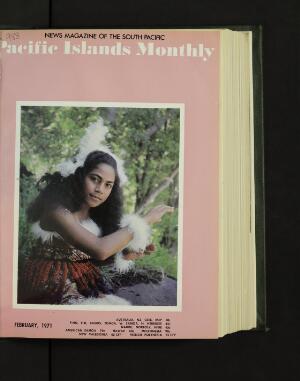
Although some readers won’t believe us, we don’t really go out of our way to put Islands girls on our covers. Quite often cover pictures fust force them selves to our attention, such as this charming study by Bruce Adams of a lovely Tongan at present in Sydney—Faka’iloki moana Malta Koleti Visinia Fifita. She’s a member of a well-known Tongan family, and on our cover she is wear ing traditional Tongan dress for a traditional Tongan dance (ta’olunga).
Advertisements & other items, p. 24 (1 item)
Bougainville Copper.
Adding up a 350 million dollar industry.
Bougainville Copper will begin production operations in 1972, but the Bougainville undertaking is already adding substantially to the economy of Papua-New Guinea.
When the project is finished, the Territory will have gained a new deep water port and a 135 MW power station at Anewa Bay; a brand new town for over 8000 inhabitants at Arawa, another town at the Panguna mine site, and a multi-million dollar all-weather access highway to Panguna.
These installations are in addition to a much improved airport ancillary road system, communications network and other services and facilities.
In the spirit of co-operation and mutual New skills must be learned in preparation for tasks ahead.
benefit, Bougainville Copper is providing additional careers in employment, education and training. Considerable provision has also been made to contribute to community and social development. Annual production will average 150 thousand tons of contained copper in concentrate and 500 thousand ounces of gold.
This will more than double the Territory’s exports, and should provide revenue to the Administration to the order of $3OO million in the first ten years of operation, depending on the world price of copper.
It all adds up to over 350 million dollars worth of basic industry for the people of the Territory of Papua-New Guinea.
Bougainville Copper Pty.
Panguna, Bougainville, T.P.N.G.
Limited.
An aerial view of the mine and facilities of Panguna.
A section of highway under construction in the Crown Prince Ranges.
RCIO*
In This Issue
General
Britain's new aid plan 36 Secondary education plan 59
American Samoa
Fire cause not found 39 Photographic book 83 Tui Chanel dies 112
Cook Islands
On losing a licence 15 "Tagua" still aground 36 Stamps criticism 43 Visitor problems 50 Travelodge on Rarotonga? 53 Wanted by Wells Fargo 71 Shipping troubles 88
Fiji
Commonwealth Conference 28 Air Pacific news 30 Fashion photos 31 Immigration 32 Scanty dress 39 Lack of teachers 39 Castaway not for sale 43 Record number of visitors 53 Hotel and Customs problems 53 New breed of planter 55 Manganese encouraging 99
French Polynesia
Travelodge plans 53
Gilbert And Ellice Islands
Reply on copra 15 Cudmore's post 32 Phosphate economy 97
Johnston Island
Air ban because of gas 31
Lord Howe Island
Close view of the Queen 85
Nauru
Elections 30 Air services 31 BBC not welcome 40 Retirement 84 Postmaster dies 112
New Caledonia
Wanted: Housing 42 "Civilisation moderne" 47 Overseas sport boost 47 French TV star 84 Potato appeal 97
New Hebrides
Political future 32 Vila's urban blight 41 "Incomprehensible" book 83
Niue
Temporary medical officer 84 Bad copra news 117
Norfolk Island
Travelodge expansion 53
Papua-New Guinea
Would Whitlam cast them adrift? 24 Questions of self-government ... 26 UN mission 27 John Ryan reports 34 Murder arrest 35
Teachers' association formed 39 Overdue honour? 41 Priest returns at 69 42 Rare honour for priest 42 Making the Kokoda Track pay ... 57 There's progress in West Irian ... 62 Vincent Eri's novel 79 Japanese cars sell ... 98 Oil search precautions 100 More business news 101
Solomon Islands
Relics of Bishop Patteson 29 Anglican Council meets 29 Making your own money 41 Travelodge plans 53 Free schools equipment 84 Archdeacon Reynolds 84 New pearling business 99
Tonga
Dull Sunday 27 Commonwealth Conference 28 New appointment 84 King to tour India 84 Cardiograph presented 85 Student success in P-NG 85
Us Trust Territory
Air services 31 Congress meets ... 32 Unexploded bombs 39 Starfish deaths 39 Travelodge expands 53 New appointments 84 New inter-island boat 87
Western Samoa
Commonwealth Conference 28 Aggie Grey in Fiji 36 Boat present 39 Samoan Progressive Movement ... 42
Travelodge plans 53
Photographic book 83 New appointments 84
DEPARTMENTS: Letters to the Editor, 15; Up Front with the Editor, 21; New Guinea Diary, 34; Nuts, 39; Tropicalities, 40; Footnotes with Percy Chatterton. 44; Magazine Section, 71; Yesterday, 77; Book Reviews, 79; People, 84; Pacific Shipping, 87; Cruising Yachts, 94; Business and Development, 97; Produce Prices, 103; Shipping and Airways Information, 105; Deaths of Islands People, 112; From the Islands Press, 117.
Advertisements & other items, pp. 26-29 (1 item)
MsSsS
WOULD WHITLAM CAST P-NG ADRIFT
TO MAKE FRIENDS ELSEWHERE?
From JOHN RYAN, in Port Moresby If Gough Whitlam, MHR, were not clearly Caucasian, one might easily mistake him for one of those legendary, inscrutable Chinese gentlemen who make a living quoting Confucius from a very great height.
His 14-day P-NG politicking certainlv caused confusion ' , But m strict fairness, to Queens Counsel E. G. Whitlam, M.H.R., his final news statement laying down Labour Party policy on P-NG was a sheer masterpiece. It put P-NG in its unpalatable, rightful place m the wider picture of white Australia s bid to make friends with other, bigger coloured neighbours.
Out of a campaign here that caused endless confusion, Whitlam’s tablethumping Press Secretary Graham Freudenberg put together a final, classic Whitlam speech on paper which set out P-NG’s problems in
usKajrs&jrsre
the real truth. (See Whitlam’s full statement opposite.)
Most people, including Whitlam, would agree that it s far easier to be Leader of Her Majesty’s Loyal (Labour) Opposition in the Westminster democracy of Australia, than j t tQ be p r j me Minister. The Opposition boss can always be on the attac k ... and the PM (whether hi§ ar a Umen ts are right or wrong) always appears to be, and often is, on defensive. It’s easier to criticise tban t 0 cre ate.
P-NG is the worst possible place for PM Gorton to have to fight a rearguard against Whitlam.
There are too many, largely unavoidable things wrong in P-NG . . . we Australians got started here much historically innocent villagers into an Australian political pressure-cooker,
and Gough Whitlam is turning the heat right up. , If PM Gorton really cares about the human aspirations and fears ot P-NG villagers, then the best he can do is what he’s doing right now move the pressure-cooker sideways to simmer.
Whitlam’s January, 1970, visit sparked off the great debate: he suggested self-government for F-NO in 1972 and political independence from Australia in «7«- .
Heratue biack I;fomd—and^heard force the lde a. He fo villagers , no ur te ™^ at d^iXg and their leaders are now mscussi g self - government and ;
MsSsS
h} o .™ a go, oetore wmtiams nrs visit. (See John Guise, for the high
Come into my parlour!
Actually Gough Whitlam in Rabaul is offering Mataungan patron, Oscar Tammur, MHA, a ride in the government car sent to pick up Mr.
Whitlam. Third man, left, is the president of Mataungan, Damien Kereku.
Photo: Brian White, 2GB News.
lights of the BBC interview (p. 33).
Whitlam not only reinforced his 1970 political suggestions he rudely told the reluctant majority of the 1,000,000 highlanders that if he becomes Australia’s Prime Minister in 1972, he’ll bestow (not offer) self-government early in 1973 by act of Federal Parliament, and bestow independence in 1976.
And for the majority of the 1,600,000 villagers of the Trust Territory of NG there was the blunt Whitlam decision that there’s no way in the world that they’re going to get self-government or independence without having Australia’s sovereign, non-selfgoverning Territory of Papua tagging along as well.
For the 600,000 Papuans, some of whom cling to the old myth called “Australian citizenship”, the single unit (New Guinea and Papua) idea for joint self-government and independence was probably an equally unpopular pill.
I’m convinced that PM Gorton reached the conclusion months ago (after his July, 1970, visit) about making sure that Papua and New Guinea become a single, self governing unit. In a back-handed way, PM Gorton owes Whitlam a vote of thanks for telling P-NG that there is no alternative. What happens after self-government and indepen dence will simply be up to New Guineans and Papuans.
Whitlam found that his 1970 visit had sparked off a serious and impor tant debate about more rapid con stitutional development in this last major colonial situation, but he found too that the go-slow group, in numbers, easily overwhelms the so called radical “elite”.
He was disappointed in the appar ent reluctance of the community at large to want to stand on its own political feet, and his final policy statement on what Labour will do with P-NG if it comes to power in 1972 was simply a threat and a promise that if native people here don’t get on with it quicksmart, then they’ll have no choice under a Labour Government.
Not until the very last day did Whitlam give, in veiled terms, the real reason for Labour’s determina tion to force P-NG village people to take their constitutional future seriously.
Labour wants to get Australia out of P-NG as quickly as possible so that Canberra, whether its run by Liberal-Country or Labour, will be able to friends more easily with the 300 million former colonised neighbours in Australia’s very near north.
For Australia’s sake, Labour wants 300 million genuine, pro-Australian
(Continued on p. 26)
friends in South-East Asia even if it has to cut 2,300,000 P-NG peasant farmers adrift in a ruthless, un-caring world of power politics in which P-NG will count for very little indeed.
I believe Whitlam was (and knows he was) guilty of markedly over stating some of his criticisms of the Gorton Government policies in P-NG, and that he over-stated some situa tions purely for cheap politicking.
When he came last month, the political ball was once again at the toe of his expensively-clad political foot . . . and he kicked good and hard.
That he hopelessly and knowingly confused more than half the native population was probably unforgive able — until he sat down with Press Secretary Freudenberg to put his final thoughts on paper.
And in that statement, Whitlam restored much of his image as a presumably honest, genuinely pro- Papua-New Guinea politician. . . .
AND WHAT
THE PEOPLE
THINK!
New Guinea’s House of Assembly Select Committee on Constitutional Development, led by Paulus Arek, was busily quizzing New Guineans in every district in January to find out what they thought the next political steps in P-NG should be.
Among other questions, the com mittee was asking New Guineans when they wanted self-government.
It will report to the assembly in March.
Some of the things the committee has so far heard: • The Tutukuvul Isukul Associa tion of New Hanover, New Ireland, asked that New Ireland, New Britain, Manus and Bougainville be banded together as one state following inde pendence, with the capital at Rabaul The new State would “be like Hawaii” and it would be a membei state of the US. . • A public meeting m Kavieng New Ireland, rejected any move foi early self-government for P-NG, anc wanted one central government The name for the nation should be Nui Gini, not Pagini as the constii tutional committee had already pro) posed. w u1 . • At Lorengau, Manus, a publi< meeting wanted self-government 11
1972, with a central government and one house of parliament. The coun try should be known as New Guinea. • North Bougainville meetings told the committee they wanted self government by 1972, or even im mediately. But in southern Bougain ville, at Kieta and Buin, those at meetings said they wouldn’t answer the committee’s questions until it agreed to hold a referendum to de cide whether Bougainville should secede from Papua-New Guinea. • Early self-government would mean “a big fight” and tax in creases, according to a meeting at Kaiapit, in the Markham Valley. A schoolteacher said Fiji was “only a dot on the map” but had had 100 years to prepare for self-government; P-NG had far less time. • Former MHA Barry Holloway, at Kainantu, Eastern Highlands, ad vocated a system of provincial gov ernment, with central government allocating the tax money. • A meeting at Kabwum wanted P-NG’s new name to be Agini, with the “A” standing for Australia and “gini” for New Guinea.
UN MISSION ARRIVES
Meanwhile, while the constitu tional committee was still doing the rounds another quiz session was starting at the other end of the terri tory in January—this one a four man mission from the UN, making one of its regular inspections of the UN trust territory. It is to report by mid-year.
The mission is led by Sir Denis Allen, of the UK, and comprises Messrs Paul Blanc (France), Adnan Raouf (Iraq) and Charles Wyse, of Sierre Leone. They will remain in the territory until March, and hope to listen in to the March meeting of the House of Assembly.
Sir Denis might turn out to be like another British knight, Sir Michael Foot (as he was then called), who very quietly and charmingly led an earlier UN mis sion to New Guinea and then rocked everybody with a hard-headed re port which really got things stirring.
Like Foot, Sir Denis has a diplo matic background, although he is not UK British. He is a New Zea lander, born in Wanganui 60 years igo, but sent to Cambridge for his tertiary education, which was the hing to do in those days. He never lot home again.
After Cambridge he joined the hplomatic service, in 1934, and :rom then on got involved in places
where things were occurring. China, for instance, between 1937 and 1942, where he got so engrossed in the struggle that he says he felt like Rip van Winkle when he returned to wartime London and saw everything that had been happening in Europe during his absence.
Then three years in Washington in the late 1940’5, which was an im portant period for America’s foreign policy; and then deputy commis sioner-general for Britain in South East Asia in that formative period, 1959-62. His job there was to be a top-level diplomatic and political liaison officer.
And then Ambassador to Turkey from 1963-66 and finally No. 2 in the Foreign Office until his retire ment in 1969.
Sir Denis is a good listener. He read everything he could get on New Guinea, and went there with an open mind, anxious to see whether there was any pattern in all the conflicting material he had been absorbing.
He was also aware that, again, he was arriving in a country at a forma tive time—that New Guinea was at a crossroads, with pressures building up and with decisions to make.
The report of this UN mission could be another milestone in P-NG’s progress.
New Guinea parliamentary tour: Siwi Kurondo, Assistant Ministerial Member for Forests (right), is part of a party of territory politicians on a fact-finding tour of the Pacific (see p. 39). He's here being introduced to Solomon Islander, Willie Betu, chairman of the Solomons Governing Council Education and Welfare Committee, by Mariano Kelesi (centre), member of the Govco Finance Committee. The NG parlia mentarians considered, during their stay, that political union with the Solomons was out of the question. "We asked the Solomon Islanders," said one member, "and they did not show much interest." Photo: Ted Marriott.
What Whitlam said
This was Mr. Whitlam’s final summing up following his P-NG tour; In the past year the political climate of Papua-New Guinea has been transformed. A year ago, [Labour Party] proposals for self government were met with official hostility and public dismay.
Some elementary truths about the early and inevitable end of colonialism in Papua-New Guinea held the terror of the novel and unknown. Now, the most signi ficant leaders of Papua-New Guinea and a significant section of the population accept that they must shortly come to terms with their own future as a self-gov erning nation. It has been remark able proof of the power of an idea. There can be no turning back now.
For the past fortnight my col leagues and I have met and talked with some hundreds of the present and future leaders of Papua-New Guinea. Despite the vast improve ment in the level of political debate in every part of the ter ritory, it is clear that political education has been deficient.
Again and again we asked the people if they had ever heard the Administration explain the advan tages of self-government. In variably, the answer was “no”.
With the shining exception of the new Administrator himself [Mr. L. W. Johnson] it would seem practically nothing has been done to dispel confusion and fear about the meaning and con sequences of self-government.
On the contrary, needless anxiety and false fears have been planted and nourished. Con sequently, my colleagues and I found that in many parts of the territory our visits became a mis sion of reassurance that Austra lia’s contribution to the welfare of Papua-New Guinea would be enhanced and expanded after self government and later, after independence.
There can be no qualification about the depth of the commit ment of the Australian Labour Party in this matter. The representative nature of the col leagues who have been with me in the territory, would allow and ensure that. Beyond the personal commitment, the Labour Party as a whole finds its most deeply
held conscientious convictions affronted in Papua-New Guinea.
It would be impossible for a party like ours to condone or connive a vast inequality, en trenched privilege, blatant ex ploitation, and racial discrimina tion. These inescapable attributes of colonialism disfigure life in this colony, as in all other colonies. They debase the dedica tion, energy and enterprise devoted over the years by the many thousands of fine Australians who have worked in the territory.
Australia’s role as a colonial power is a wrong thing in itself.
It would be bad for us as a nation even if we were able to isolate ourselves from the pressures and opinions of all other countries.
But we enjoy no such luxury of isolation. In particular, we live in a region in which every one of our neighbours for thousands of miles around were former colonies. Each detests colonialism.
To all these neighbours and all our fellow members of the Com monwealth of Nations, every justification the government of Australia makes for dragging its feet in Papua-New Guinea, every argument about the inability of native people to govern them selves, smacks of racial super iority. Australia’s major diplomatic efforts, notably at the U.N., but in most world capitals, are devoted to justifying the official position on Papua-New Guinea.
This is a sterile exercise. It cripples our power for any con structive diplomatic initiative. We are needlessly placed on the defensive. It needlessly com plicates our relations with our neighbours and with our friends, including our chief ally the United States, which possesses the world’s most powerful black community.
All Australians must now realise how damaging and dangerous a reputation Australia’s present policies produce. We are a Euro pean nation on the fringe of the most populous and deprived coloured nation in the world.
What the world sees about Aus tralia is that we have an aboriginal population with the highest infant mortality rate on earth; that we have eagerly supported the most unpopular war in modern times on the ground that Asia should be
(Continued next page)
our battleground for freedom; that we failed to oppose the sale of arms to South Africa; that the whole world believes that our im migration policy is based on colour; and that we run one of the world’s last colonies.
We may rightly profess our good intentions and feel that we are merely the victims of special circumstances, but the combina tions of such policies leans heavily indeed on the world’s goodwill and on Australia’s credibility.
The true patriot will therefore not seek to justify and prolong these policies, but will seek to change them.
In Papua-New Guinea, it will be found increasingly that the questions of the timing of self government involves a quibble about the matter of two or three years. Even if the Gorton govern ment were to survive, self-govern ment will come in the life-time of the next House of Represen tatives. • The Australian Government has a clear duty to speed up pre parations for the inevitable day.
Target dates for self-government and independence should be set now, as we are obliged to do by the unopposed [1970] decision of the UN General Assembly. • The official [Australian] members of the House of Representatives should be re moved now. • Elected [native] ministers should be made responsible to the House of Assembly in fact. • Political education should receive top priority. • The Australian Parliament should immediately ratify the International Labour Organisation conventions on plantation workers and on race relations for the ter ritory. • A new set of labour laws and ordinances should be drafted and approved to make labour laws and conditions conform with these conventions. • Employment preferences should be given to unionists. • The Australian Government should spell out clearly the en titlements of Australian public servants [7,000], and should make it plain that it accepts responsibi lity for their future welfare, both in the territory and in Australia.
Only if this is done, can local isation of the Public Service pro ceed speedily and smoothly.
There is no need to wait until 1972 for these things to be done. They constitute in them selves the essence of self-govern ment. • Australian businessmen and Australian companies have a parti cular interest in the establishment of a self-governing New Guinea.
By its very nature, an Australian Administration committed to its own abdication eventually, cannot guarantee the validity and perm anency of business and invest ment arrangements it may make.
The best safeguard against ex propriation is that an indigenous independent government should ac cept responsibility for the laws and arrangements under which property is held and capital is invested.
There are clear risks in the present situation in which all employers and businessmen are expatriates, while New Guineans are employees and customers.
In the final analysis, the at titudes of the Australian Labour Party to New Guinea involve a convinced judgment about the very nature of man.
We cannot accept that nations should be ruled by other nations.
We cannot accept that men do not wish to be free. We cannot accept that the people in Papua- New Guinea are some special ex ception in a world where millions have died for independence.
It may be true that men can not be forced to be free.
It is certainly true that men cannot be forced to rule others.
An Australian Labour Govern ment will not be black-mailed into accepting an unnatural role as rulers over those who have had no say, and can have no say in electing us.
Australia’s obligation in the United Nations is to hand over Papua-New Guinea as a single entity as soon as possible.
Papua-New Guinea has a chance of remaining united only if self-government comes quickly.
Self-government in itself will be the real unifying force in this country. To delay self-government is to promote separatism. Self government must be given quickly to the people as a whole. Other wise section after section will seize with anger and bitterness towards us, what we should grant wholly and whole heartedly.
Advertisements & other items, p. 28 (1 item)
Whitlam said
26
FEBRUARY, 1971-PAC.FIC ISLANDS MONTHLY)
ADRIFT?
"Thou shalt
not swim"
Prom a Nukualofa correspondent Tonga’s Sunday observance law, that “it shall not be lawful to do work or play games or trade on the Sabbath”, brought some of the population to near screaming point on a hot Janu ary Sunday. At Monatapu beach, Tongatapu, a Jeepload of police arrived, not in uni form, but using police whistles quickly cleared the water of swimmers. Those people pic nicking on the beach were also ordered away in case they later took to the water. The police warned that in future buses and cars heading for the beaches would be turned back The law has come to accept the shattering roar of diesels generating electricity on Sun day, and public utilities such as hospitals, telegraph and broad casting. Last year the seismic survey vessel was allowed to work Sunday. But you can’t go swimming; you can’t ever take a bus or taxi to church.
It’s not the Sabbath that’s so annoying—it’s the inconsistency.
Pacific problems overshadowed at
the Commonwealth Conference
From MATT WILSON, who covered the Commonwealth Prime Ministers’
Conference in Singapore.
The voice of the South Pacific was almost drowned at the Commonwealth Conference by emotion-charged pronouncements, mainly from African delegates, about Britain’s proposal to sell arms to South Africa. Before the conference started, the arms debate was warming-up and by the time talks actually got under way, the Press and a good many of the delegates were in a state of near-hysteria.
It seemed that arms-for-South Africa was the only issue worthy of a place on the agenda. But in their quiet, dignified way, the three Prime Ministers from the Islands did man age to leave a mark on the meeting.
In fact Mr. Lee Kuan Yew, Prime Minister of Singapore and the con ference chairman, was moved to say of Fiji’s Ratu Sir Kamisese Mara, “We have heard many eloquent ad dresses and I would particularly like to mention the Prime Minister of Fiji. He spoke with simplicity and he spoke with sincerity and he won the respect of us all.”
Perhaps Mr. Lee was engaging in polite niceties as a gesture to the newest Commonwealth member, but Premier Lee is not a man to waste words and time on mere gestures.
A delegate from Barbados put into words the feelings of many other delegations when he told me, “The three new members [Fiji, Tonga and Western Samoa all joined the Com monwealth last year] made a very good impression. They are impres sive people, they spoke well and pre sented their cases well.”
The Islands delegations, led by Ratu Sir Kamisese, Prince Tui’pele hake and Tamasese Lealofi, adopted the strategy of a joint approach to the conference and its agenda. But they made it clear that they were not working from a common brief.
They felt a protest about the French nuclear tests near Tahiti would carry more weight with the force of three Prime Ministers be hind it than an objection from a solitary delegation.
The French and their A-bomb tests have become a prime target for Pacific leaders. They were at the re ceiving end of some angry protests during the South Pacific Conference in Suva last September. This result
ed in a walk-out by Mr. H. Nettre, the senior French Commissioner.
The Commonwealth Conference for the first time gave Islanders the opportunity to personally air their feelings about the French tests on a world stage. They asked for Com monwealth support in pressuring the French to stop the tests.
How effective the call will be, re mains to be seen. But France might —just might—start to listen if she receives representations from a powerful group of nations like the Commonwealth.
The Islanders should now follow up their initial salvo and find out how, in practical terms, the Com monwealth can twist the French tail for them, and if in fact it will do so.
It’s entirely possible that not all the Commonwealth countries will be prepared to support the Islanders. I gather, for instance, that there was some hair-splitting over the phrase ology to be used in the conference communique in the section dealing with the South West Pacific.
Some delegates felt that by saying that they “shared” the Pacific con cern at the tests—and the American transfer of poison gas to Johnston Island—they would be aligning themselves too closely with the pro tests.
This, for reasons known only to themselves, they apparently did not want to do. So someone proposed that “share” should be replaced by “recognise”. By saying that they “recognised” the Islanders’ concern, rather than “sharing” it, they felt they would be in a more detached position.
Procedures of this sort were nor mal during the preparation of a communique, the Islanders discover ed. Hours could be spent on discus sing the implications of one word or phrase.
Sir Keith Holyoake, Prime Minis ter of New Zealand, provided a cur ious sidelight to the fears expressed by the Islanders about the Ameri cans storing poison gas at Johnston Island (see p. 31).
The Islanders wondered with some reason why their “front doorstep” should be used as a dumping ground for the gas. And they pointed out that in Okinawa, from where it was to be moved, residents had evacuated their homes.
I therefore asked Sir Keith, “Elder Statesman” of the Commonwealth, and leader of one of the Islands’ big gest neighbours, if he would give his support to their protests.
Sir Keith, always accommodating with the Press, gave me a few min utes of his time before going back to the conference hall for an after noon session.
He went through his anti-test rou tine with practised professionalism, pointing out that in the past he had protested about the tests on behalf of Fiji, Tonga, Samoa and the Cook Islands. He had in fact raised the question at previous Commonwealth conferences and at the United Nations, he said.
When I asked him whether he would support the poison gas pro test, Sir Keith gave the surprising reply: “I don’t know anything about that. I have no comment on that.”
I could only assume there was a remarkable gap in Sir Keith’s know ledge of Pacific affairs, especially when the gas story had received newspaper coverage during the weeks before the conference.
But Prime Ministers are busy men, and one can only assume that aides had not thought the matter was im portant enough to brief him on.
Perhaps the greatest contribution the Islanders made to the meeting
was their South-Seas style of opera tions.
A member of the Samoan delega tion for instance amazed delegates and journalists with his Sinatra-style crooning in the bar of the Hilton.
A Tongan delegate made the crack, “Why all this fuss about arms when there are all these legs about?” (He was gazing appreciatively at the waitress serving drinks at a re ception).
And the Prime Minister of Fiji was able to bring an occasional touch of light relief to the some times stiff and tense meetings.
“They’re like a breath of fresh air,” one veteran newsman said.
This is not to say that the Islanders took the conference lightly.
It was their first joint foray into international politics—and the close ups they got of some of the world leaders in action should serve them well when they evolve their own foreign policies.
There was the technical assistance aspect of the meeting too, and the establishment of useful contacts and the exchange of ideas between lead ers of countries with similar prob lems.
Among the successful background talks at tiie conference was one be tween Fiji’s Ratu Mara and Britain’s Prime Minister Heath on the Com monwealth Sugar Agreement. Britain announced it was awaiting a reply from the EEC about a British pro posal, to begin in 1975 if accepted, for special marketing arrangements for Fiji and Mauritius sugar. Ratu Mara expressed himself “quite pleased”.
Ratu Mara also asked Mr. Heath for British training of Fiji army officers. Australia’s Prime Minister John Gorton displayed a willingness to allow Fiji craftsmen to be trained in Australia, and has asked Ratu Mara for firm proposals.
At the conference itself, the Western Samoan Prime Minister, Tupua Tamasese Lealofi, said the intrusion of foreign fishing vessels into Samoan waters was a problem for Samoans, “who are dependent on the sea for much of their liveli hood . It was, he said, a more pressing problem for Samoans “than it is for this distinguished gather ing”.
Ratu Mara was to make an offi cial visit to India following the con .erence, and was to have talks with ECAFE headquarters in Bangkok.
Advertisements & other items, p. 31 (1 item)
Guam's Governor Installed
The first Governor of Guam to be fleeted by popular vote, Carlos G. -amacho, was officially installed on juam in January,
big church talks
Migration an issue at big church talks
From SUSAN YOUNG, in Honiara Delegates to the South Pacific Anglican Council left Honiara after a week oftalks in January, feeling that they had done something constructive This was in marked contrast to the council meeting last year, when members failed lamentably to come up with anv tresh ideas, or even a new statement of their work
SPAC is a fairly informal associa tion of the Dioceses of Melanesia, Polynesia, Papua-New Guinea and Carpentaria. It meets periodically to talk about and plan for the work of the church and to see how the dioceses may best help each other.
At Honiara, the representatives did not get much closer than last year to defining the precise nature and purpose of SPAC; but they did at least definitely decide that they wanted the organisation to continue working.
One of the most encouraging
features of the council, however was the outspoken part played by most ot the Pacific Islanders present. This effect seems to have been achieved chiefly by means of splitting the council into racial groups for the detailed discussions.
At first glance, such a procedure might seem anathema to any church organisation. In fact, freed from the diffidence which both brown and white often feel in each other’s com pany, the scheme resulted in some refreshingly uninhibited talking. It also resulted, during the council’s plenary sessions, in a genuine feeling of mutual respect and profound racial harmony.
This was evident in the statement which the delegates issued at the end of their meetings.
They felt it was of “the utmost importance” that church, government and commerce should increasingly give indigenous people opportunities for leadership and responsibility. But they said that it was also important
Relics of Bishop John Coleridge Patteson, martyred 100 years ago in the Solomon Islands, were placed in a shrine at St. Barnabas' Cathedral, Honiara, in a special ceremony (see above) on January 17. The relics, delivered from London by the Society for the Propaga tion of the Gospel, are the palm leaf that was placed over the dead bishop's body, his Bible and deeds of consecration.
Photo: Ted Marriott.
that expatriates should stand beside Islanders in this transition period— “lt is emphatically not a time for the expatriates to walk out, or to be pushed out.”
The delegates said that SPAC itself should express the local mind and that it should have an indigenous majority.
To this end, the council will next year hold a special consultation at which all the representatives will be Pacific Islanders. A few expatriates will be present, but only as consultants.
Amid a welter of domestic and wider topics, the council also took time to tackle the immigration issue.
Delegates said the council should “speak as one voice” to Australia and New Zealand, urging them to be “more humane” in their immigration laws and policies—especially towards Islanders wishing to enter those countries.
Delegates also expressed concern for people living in overcrowded areas of the South Pacific. They sug gested that a survey should be made, to determine the best areas for resettlement schemes. The delegates said that governments should, where necessary, amend their immigration laws to permit resettlement.
They went on to say that, where it was not already being done, Pacific churches and governments should be urged to pay local people with equal qualifications the same basic salaries as expatriates. They felt that such a policy would help to keep Pacific Islanders in their own countries, instead of going overseas in search of better jobs.
Advertisements & other items, p. 31 (1 item)
Pacific Islands Monthly_F E B R U A R Y . 1971
Big plans for Fiji airline
Fin investors have guaranteed 5F20.000 in fresh capital for the Fiji
— • <£* M Tl^r
six months He hopes to make Air Pacific Fiji's ma,or Air Pacific will carry Fiji Airways wail-listed passengers on the Suva Tun and will 7pply' to operate scheduled Coast of Viti Leva, a fortnightly service to Wallis and Futuna vossibly one between Nadi Airport and Savusavu. .
P The company will also apply to to such Lakeba Vatulele and Malolo Lailai, as airstrips are built on them The southern Viti Levu service, linking Suva, Deuba, the Cora Coast and Nadi, looked like becoming the company s most important, Mr ' that by the end of 1971 we would be running a regular service between Nadi, Natadola, Sigatoka, Korolevu and Deuba, using a 10-seat aeroplane
DeRoburt back
as President
President Hammer Deßoburt, of Nauru, in January was re elected for his second term of three years. He became the
republic’s first president follow
ing independence in 1968. His
re-election was by parliament,
and he was unopposed.
The President made no changes in his cabinet. He retains for himself the portfolios of External Affairs, Internal Affairs, and Island Develop ment and Industry.
The other portfolios are: Health and Education, Austin Bernicke; Justice. Joseph Detsimea Audoa; Finance, James Ategan Bop; Works and Community Services and Minister Assistant to the President, Buraro Detudamo.
New Speaker of Parliament is a young man. Kenas Aroi, and Deputy Speaker is Victor Eoaeo.
Four new members of parliament were elected in the first elections held in the republic since the phos phate island became independent three years ago.
A total of 48 candidates contested the 18 seats in the Nauru Parlia ment on January 23. Nauru follows
the Australian preferential system of voting.
The Speaker, the Reverend I.
Amram, was one of the four can didates defeated in the election. He was replaced by Kinza Clodumar, a 25-year-old Arts graduate from the Australian National University in Canberra, who is now with the Nauru Public Service. The other three new members, Lawrence Stephen, Ruben Kun and Kennan Adeang, are all aged under 30 and all went to school in Australia. Kun is an Arts graduate at the ANU, Stephen trained as a teacher in Sydney, and is deputy head of Nauru’s primary school.
Stephen unseated Asa Paul Diema; Kun unseated Totouwa Depaune; Adeang unseated Gioura Derog. All members of cabinet were returned.
Only in the Anabar constituency were the two sitting members, Gada raoa and Doguape, elected unop posed. Four candidates stood against President Deßoburt in the Boe con stituency.
Nauru, a former United Nations Trust Territory under Australian ad ministration, became independent on January 31, 1968. The Nauruan population totals about 3,400 out of a total of about 6,500 —the others being mainly Chinese and Gilbert and Ellice Islanders working for the Nauru Phosphate Corporation. Only Nauruan citizens may vote.
Nauru is shortly to extend its over seas representation to include Japan, with which it has growing business.
A Nauruan representative will be ap pointed to Tokyo.
There are already representatives in London and Melbourne.
It’s understood that the Japanese Government was anxious to have full Nauruan diplomatic representation in Tokyo but President Deßoburt takes the sensible view that Nauru does not require the expense of a diplo matic corp. in a formal sense. Its overseas offices are more in the nature of business offices.
The Tokyo decision will, how ever, mean that Japan will have representation in Nauru.
• An internal airline is to be set up in the Cook Islands under the direction of Air New Zealands new Cook Islands manager, Mr. R.
G. Millensted. The airline will init ially link Rarotonga with Aitutaki; Mr. Millensted will also help in the establishment of tourist industry ser vices and supervise preparations for the start of the new jet services next year. He arrives in March.
Johnston Is.
Air ban on Johnston Is.
By a staff writer
The first consignment of mustard and nerve gas, unwanted by the American armed forces, was shipped in January to Johnston Island, a tiny, flat American possession about 700 miles south-west of Honolulu. The gas came from Okinawa, and more is to follow For a Pacific island, Johnston is about as isolated as you can get and there is no native population—just a team of bored Americans working for the government. Johnston is mostly airstrip (see PIM, Oct., p. 30) and the gas will be stored in buildings surrounded by high bunk ers. It’s not likely to cause trouble to outsiders.
However the American gas has caused so much trouble in Okinawa (where there have been demonstra tions, and where on one occasion there was a gas leakage), that the US Government is taking no chances on Johnston, Continental Airlines in mid-Janu ary, under US Government orders, made its last stop at Johnston for refuelling on the long Air Micro nesia flight which links Hawaii with the US Trust Territory of Micro nesia.
And as a result, the Republic of Nauru has had to be unexpectedly wiped off Air Micronesia’s schedule.
Air Micronesia 727 jets have been flying Honolulu, Johnston, Majuro, Kwajalein on the service ending at Guam and Saipan. Each fortnight they have extended the Majuro leg on to Nauru and return, thus giving travellers access to the South Pacific.
But this extended leg has only been possible because of the Johnston re fuelling stop. Air Micronesia is planning now to use Midway Island, which will add considerably to the flying time.
In late January, Air Nauru had applied to the US CAB to operate
the fortnightly service Nauru-Majuro
return, at a higher fare and cargo rate.
Air Nauru is a charter service based in Australia and operating on behalf of the Nauru Government with a small but fast Falcon fanjet.
It flies to Nauru weekly via Brisbane and Honiara and recently extended its service from Nauru to Tarawa in the Gilbert and Ellice Islands.
Chic Fiji
From SUE WENDT, in Suva Fiji photographers are really getting into the swing of things when it comes to fashion, as this shot by Bal Ram shows. He took it on the foreshore of Suva Harbour, using a couple of willing Fijian lads and New Zealand visitor Karen McDowell as models.
Karen, 19, was in Fiji to help promote Dot Patterns, a dress pattern drafting system which her boss, Mr. D. Waters, was setting up in Fiji. The parent company is in NZ.
The local photographers are doubtless influenced by the work of numerous overseas photographers who’ve used Fiji locations recently. American Vogue, for instance, carried 16 pages of spectacular fashion shots in its January issue, with blonde model Gunilla, cavorting along Viti Levu beaches and stepping it out with muscular Fijian meke dancers. American Airlines and Saks Fifth Avenue were responsible for the promotion. The prestigious European magazine, Elegance, also devoted 22 pages of its January 71 issue to Fiji fashion shots part of a promotion by Qantas and the Pacific Harbour resort and residential development at Deuba.
immigration image
Polishing up Australia's immigration image
Prom a Suva correspondent After nearly four years in Fiji as Australian High Commissioner, tall urbane Bob Birch has departed to a new posting in the Depart ment of Foreign Affairs, Canberra.
He leaves the task of polishing-up Australia’s immigration image in the hands of 46 year-old Rowen Osborn, who held diplomatic postings in Karachi, The Hague, Tokyo and London before returning to Canberra in 1967 as an assistant secretary in Foreign Affairs.
Mr. Osborn’s territory as Aus tralian High Commissioner includes Tonga and Western Samoa, as well as Fiji. . . .
He arrives at a time when Aus tralia’s image as a land of golden opportunity is more than a little tarnished in the minds of Pacific Islanders seeking to migrate there.
It’s a thorny problem—and like ly to become thornier still in view of recent worldwide publicity about Australia’s “racialist policies”.
In the past, Mr. Birch has answered “colour bar” accusations as diplo matically as possible, pointing out that liberalisation of the conditions under which non-Europeans were able to take up permanent residence in Aus tralia had led to the emigration of a number of families from Fiji.
“Our reputation is affected by the inability of everyone to pop on a plane and go,” he said recently.
“Many applicants do not realise that Fiji people are not the only ones needing a visa for Australia.
Americans and others also need them,”
Commenting on charges of “com mercial exploitation”, the former High Commissioner said that Aus tralian “risk capital” had made a
significant contribution to Fiji’s development. .
Much of the private capital required by Fiji over the next few years would come from Australia, he said. Con fidence in Fiji’s economy was re flected in the fact that Fiji had been granted unique permission to raise loans on the Australian market.
Meanwhile, in Suva an actior initiated by Mr. L. G. Ushei’, pub' lisher of The Fiji Times, against the Pacific Review claiming libel anc defamation, has been won by Mr Usher. Mr. Usher charged that tht newspaper had carried on an im proper campaign against him ai mayor and as editor. The Suprem Court dismissed four of the fiv counts but found the fifth proved an awarded $5,000 to Mr. Usher.
And the Supreme Court in lafl January dismissed a charge of cot tempt of court brought against M Usher and The Fiji Times over ai article written by Mr. R. W. Robso a year ago. In it, Mr. Robson dea forthrightly with allegations made t the Pacific Review that he and hi publications were “racist” and ant Indian”. The Fiji law authority charged some months later that tt article was in contempt because tl libel action brought by Mr. Ushi against the journal had not yet bee heard.
This double success coincided wit the award—in the new year honou. list—of the CBE to the NZ-boc Mr. Usher, who has lived for • years in Fiji and was for three tern mayor of Suva. (See p. 85).
Electoral Dispute In Micronesia
Work of the inaugural meeting of the Fourth Congress of Mlcr °~ nesia, in Saipan , was delayed in January as a result of a dispute over the credentials of some of the members for Palau.
A special Senate committee later recommended that the election of Senator Roman Tmetuchi, of Palau, in the general elections of last November, be declared null and void. It also recommended that the government thoroughly investigate alleged irregularities in the Palau elections. , £ At the November elections tor Congress the Liberal Party won all four of Palau’s contested seats three for the Representatives and one for the Senate. The Progressive Party immediately petitioned the election commissioner to declare the elections void, alleging that votes had been tampered with and some people had voted illegally.
The complaints went to the High Court, which said that it was “abundantly clear that there were serious and numerous irregularities in the election”, but that the sole judge of the qualifications of mem bers was the Congress of Micro nesia itself.
The dispute held up the swearing in of the Palau delegation, but did
not prevent the election of Senator Amata Kabua (Marshalls), as Sen ate President, and Rep. Bethwel Henry (Ponape), as Speaker of the House. They had held these posts in the previous Congress.
Speaking to the Micronitor, in Majuro, Marshall Islands, in Janu ary, Mr. John Dorrance, formerly with the US Embassy in Canberra and now special adviser to the TT High Commissioner, said he thought that when Micronesians fin ally decided what form their poli tical future would take, it would probably be some form of associa tion with Washington, and that cer tainly Washington wanted some form of association. But free as sociation was not there for the ask ing—because the US had to gam something from the association as well as Micronesia.
He could not see that the matter could finally be resolved and put into effect in less than a “couple of years at the earliest”, but it could be much longer.
Geic
Cudmore leaves
Assistant Resident Commis sioner of the Gilbert and Ellice Islands, Mr. Derek Cudmore, with his wife, left the GEIC in January to become Admin istrator of the British Virgin Islands in the Carribbean.
Mr. Cudmore joined the West ern Pacific High Commission in 1957 as Administrative Officer in the BSIP; in 1967, when Deputy Financial Secretary, he was transferred to the GEIC as Assistant Resident Commissioner.
From June, 1969 to January, 1970, he was Acting Resident Commissioner and last year was given the OBE.
Mr. A. J. Hunter, Deputy Financial Secretary in the Solo mons, has been appointed in Mr. Cudmore’s place.
Advertisements & other items, p. 34 (1 item)
32
FEBRUARY. 1 9 ,1_PACIFIC ,SLA N D S MONTHL,
Will Lean
'New Guinea
Towards Asia'
From JOHN RYAN, in Port Moresby
That wily old Papuan gentle
man, John Guise, MHA, has got himself on BBC television with a
statement laying the guidelines
to the tough diplomatic job
facing Australia in South-East Asia during the rest of this century.
Interviewed in the House of Assembly, Port Moresby, by the BBC’s top current affairs man Kenneth Allsop, Speaker of Parlia ment John Guise made no bones about it.
“Australia must get used to the idea that an independent Papua-New Guinea would lean towards South- East Asia, not towards Australia.
Ves, I agree that Australia—the way she sees herself in this part of the world —has to change. Australia is a remote white country in a regional world of coloured people . . . her hinking has to change. We in Papua- Mew Guinea will lean towards \sia . . .”
Interviewer Allsop: Now what about ?apua-New Guinea? You must agree hat it is the most under-developed :ountry in the world?
Mr. Guise: I agree to this . . . >ut every man has the supreme right o govern himself. I know the vast najority of my people are against the Australian Labour Opposition -eader) Mr. Whitlam, but I am one •f the minority which believes that lie sooner we do it the better—self overnment in 1972 and independence y 1976.
Allsop: With your 700 tribes and 00 languages and many other bar ters, how will you meet the problems f self-government and independence?
Mr. Guise: There are problems •. • many problems, but if we poli cians go on thinking only about lese problems, we will all end up 1 a mental institution. We must irget our problems and (striking his ght fist into his left palm) get on ith the job! You see, we have been auditioned against thinking! We ave been conditioned against getting n with the job ourselves. We must art now] Allsop: What about your type of avemment?
Mr. Guise: I can tell you that this
Westminster system from your country (Britain) and from Australia will not work here. We must have a modified Presidential system . we must work out something that will work for this country.
Allsop: What about money after independence?
Mr. Guise; I think, with respect, that you will agree that Australia relies a great deal on money from the United States and that your own country, Great Britain, also relies on money from other countries. We in an independent Papua-New Guinea would also rely on money from other countries. Every country has to do this With respect, no country is really independent ... in this way, Australia will have to go on giving us large amounts of money whether S -fi ] ! kes ** or not *• -. s^e knows she will have to go on giving us money • • . because she wants a friendly Papua-New Guinea. If Australia did not give us the money, then we would have to look for it in other places • • • like Japan, Indonesia or even (Communist) China.
Ninety-eight Scouts from Papua-New Guinea were among 12,000 from all over the world at the ninth Australian Jamboree near Sydney in January.
Leader of the contingent was Richard Litau (right) from Manus Island, and helping in administration was Hebou Anisi (below). Assistant Lady Cubmaster for the Ist Ela Group, Port Moresby.
After winning camping awards at the jamboree, the contingent spent 10 days sight-seeing in Sydney.
Cook Islands aid goes up
New Zealand s financial aid to the self-governing Cook Islands is still going up. Mr Duncan Maclntyre, NZ Minister of Island Affairs, announced on January 22 that the Cooks would receive $NZ6,900,000 for the next three years about $500,000 more than in the previous three years.
More , than . two-thirds of this will ?? -? n i admi P ls tration expenses. Main projects are $380,000 for Rar °tonga hospital and $lBO,OOO for a new teac bers’ college on Rarotonga.
A new hos P ita l at Aitutaki gets $85 > 000 and $90,000 goes towards improving water supplies.
A special loan of $225,000 will go towards the extra international commumcations necessary when the Rarotonga airport opens, and another $75,000 will be allocated to a new electric power generator.
T , « , . 7*, , . Included in the total financial aid is $420,000 for specific projects yet
to be put forward in detail by the Cooks Government, and which should give the works programme flexibility. y V lO Cook Islands were also pre- Paring for the visit, in the Brhtama on February 27, of the Duke of
accompanied™ 11 \tountbatten"s
daughter Ladv Y Rrahourni^ att ?uf rov 8 i L n y n i °^ rne * . The p;f r i; r n ha^ e v * slted
hf % day Ra T
wSrn w u °u°-? nue r- ® Western Samoa, New Hebrides, Fiji, Solomon Islands and Papua-New Guinea. P
Advertisements & other items, p. 35 (1 item)
33
ACIFIC ISLANDS MONTHLY FEBRUARY, 1971
New Guinea
Diary
With John Ryan
The Mataungan Saga
Papua-New Guinea’s “Political Headsman” is carrying out four executions at Rabaul in what appears a vain attempt at restoring harmony among the 70,000 Tolai tribespeople violently split for so long over multi-racial local government.
The headsman’s blade was honed by the Tolai Minis terial Member for Education (and MHA for Gazelle) Mr. Matthias Toliman, and the execution order was authorised by Mr. Toliman’s native and European colleagues in the Administrator’s Executive Council.
The non-voting Australian members of the AEC naturally showed some reluctance, because the heads they’re helping to despatch belong to the innocent three Europeans and one Chinese elected legally, along with 34 Tolais (in an electorate totally dominated by Tolais), to the new Gazelle Multi-racial Council in 1969.
But the four heads must roll . . . because Mr. Matthias Toliman believed their sacrifice was the only positive, remaining method of trying to break down the final plank in the violent Tolai Mataungan Association s plat form of absolute opposition to the idea of foreigners the Europeans and the Chinese having any part in governing Tolais. . .
Local Government began in P-NG m 1950 and within two years, it made its first appearance among the Tolais in and around Rabaul. Local Government was expanded dramatically from January, 1964 (the result of UN political pressure) and 147 councils now cover nearly two million of P-NG’s 2,300,000 villagers.
Bv political edict from Konedobu a couple of years ago (largely as the result of further UN and other pressure) the Australian Administration here began a campaign of turning the one race Native Local Govern ment Councils into multi-racial councils, as the founda tion for truly multi-racial local government ... and to make Europeans liable to pay for local government services bv paying council taxes.
The word multi-racial was probably unfortunate Certainly there’s been publicly-voiced criticism of it by native leaders, some of whom see the word as the thin edge of the wedge allowing Europeans to gradually take over and control local government. Such are the misinterpretations in P-NG.
At Rabaul at least two years ago, Australian patrol officers suggested to the Gazelle Native> Council that: it might be an advantage to make it a multi-racial council, so as to rope in the many Europeans in Rabaul and close environs. The native councillors agreed, and the multi-racial proclamation was made . . • and John Kaputin’s Mataungan (“Alert”) Association emerged almost overnight as a powerful, emotional anti-council, anti-European pressure group insisting that Tolais should be governed by Tolais not by ‘foreigners already controlling Rabaul’s retail empire. .
There were immediate protest marches involving up to 10 000 Tolais; in December, 1969, the Mataungans began bashing Gazelle Multi-racial Council native members; there were recent Mataungan death-threats against
Tolais (Mr. Toliman included) who were supporting the Administration.
Mataungan waged economic and death-threat black mail against the Gazelle Council, against the central government; and political threats against the AEC, Canberra; and threatened secession from P-NG.
Strangely enough, the Mataungan v. Gazelle Council war is largely a local power struggle ... the 70,000 Tolais are splinter groups; some support Mataungan, others the council.
Some support nobody . . . they simply use the existing powerplay as a good excuse for refusing to pay their annual Sl6 council tax, thereby proving their complete failure to understand the fact that the P-NG Welfare State has disappeared and that everybody with an income is now expected to help pay for local services.
The AEC has decided that the Gazelle Multi-racial Council will now revert to a native local government council. It’s a political victory of some importance for Mataungan as a pressure group, but also possibly a tragedy for the apparently laudable idea of multi-racial local government now embraced by nearly 130 of the other 147 councils in P-NG. .
But the real tragedy is the virtual certainty that the reversion to a native Gazelle council will do little to solve the real problem at Rabaul: Mataungan is already committed to establishing its own system of local govern ment in direct opposition to the Administration-sponsored Gazelle council. . . . .
In the Rabaul powerplay, the opposition to the three Europeans and the one Chinese on the Multi-racial Gazelle Council was simply a political vehicle tor Mataungan; with that vehicle now removed, Mataungan (according to the best available reports from Rabaul) has found another; i.e., the new native Gazelle council is still the result of Australian Government sponsorship, and therefore must be opposed just as vehemently as it was when still multi-racial. , , , Mataungan therefore, remains an emotional local independence movement.
The only really significant developments recently in the Rabaul saga are Mataungan’s decision (after promp ting from a senior Papuan politician) to rely m future on passive resistance rather than violence; and Mataungan s uphill battle to talk Tolai supporters into putting up the money to finance John Kaputin’s basically good idea oi a Mataungan Economic Community aimed at keeping Tolai earnings within the Tolai community, rather thar allowing them to go out of the area across Europear and Chinese shop-counters.
"Separate Currency" Panic
The big private enterprise companies in P-NG hav< something like SI.OOO million invested in tangible asset! here and because they’re so important to publi< financing, these companies are extremely good extremely unofficial lines of top-level information ou
of Administration headquarters at Konedobu.
When wild rumours of an almost immediate new banknote issue for P-NG began sweeping P-NG mid- November, the big companies weren’t too worried. If Canberra or Port Moresby had been planning a new currency, devaluation of the existing Australian dollar used here, or a freeze on the repatriation of foreign capital, the big companies would have been quietly tipped off well in advance.
The secret would have leaked out to lesser individuals as well, because it’s well-known at Konedobu that the bigger the secret, the more likely that somebody will let it out.
But the ordinary “foreigners” public servants, pri vate enterprise employees and the smaller companies have no such immediate access to Konedobu’s “secrets”.
When the rumours began flying, the “little” investors and the employees began to panic.
One Port Moresby bank lost 19 per cent, of its European private savings . . . and the rumours were regarded by some as so strong, that one bank accountant felt obliged to send his own personal savings back to the relative safety of Australia to beat any “freeze”.
It was a highly damaging flock of rumours, and Administrator L. W. Johnson, Treasurer J. E. Ritchie (he called the private bank managers together to re assure them) and Federal Treasurer Bury and Minister for External Territories Barnes, were forced to issue statements denying categorically that there was any such plan to tamper with the dollar.
Even touring Labour Opposition leader Whitlam found it necessary to say publicly that among the four things P-NG’s first independent government should think about after Labour’s proposed independence for them in 1976, would be to think about the possibility of a separate currency. Whitlam’s backhanded favour to Prime Minister Gorton’s Liberal-Country coalition government took the heat out of further rumours that if Whitlam became PM in 1972, then a P-NG currency change would follow quickly.
The rumours proved one thing conclusively: there are a lot of foreigners in P-NG who’ll quit the country overnight if there’s even the faintest risk of their Australian dollar being devalued or “frozen” here. For village people beginning to realise the value of foreign investment, it was a sobering and perhaps cynical lesson n money-politics. 30ING public Danny Leahy Jr, 40, of the famous pioneering Leahy amily in the P-NG Highlands, is going to turn his retail rade store empire into a public company with share loldmgs for the village people he’s grown up with n Gorokas beautiful Asaro Valley.
Danny Leahy started in 1949 in a grass-thatch hut vhen there were only 13 houses at Goroka in New jumea s Eastern Highlands District, and with partner :ddie Collins he now runs 60 trade stores with annual umovers running over $1 million. Largely because the wholesale service he offered native would-be •usmessmen, the Asaro Valley now has 1,500 other illage tradestores scattered around a network of 860 rules of roadway.
He concedes that native store operators have still got o learn the hard facts of stock-accounting. “They’ve een how my show has grown up ... and I think lot of the old-timers, the blokes who are about the ame age as me, know that they could have a business ike mine if they’d been prepared to work too ”
Now, the Collins and Leahy trade store business is omg to be offered 49 per cent, to Asaro Valley people d further involve them in the business of the rigidly-run nvate enterprise they need so badly.
Advertisements & other items, p. 36 (1 item)
February I.R ,Sia N D S Monthly
Murder Hunt
A Papuan from the rugged Goilala area, Peter Evoro, 28, was charged in Port Moresby on January 25 with the murder of two Australian men and a Papuan girl, and with the attempted murder of an Australian woman.
His arrest ended the most intensive manhunt in Papua’s civil history.
Three hundred armed military and 200 police (see photo) searched scrub country just outside of the Port Moresby town limits for the murder weapons and for the murderer. They recovered a rifle hidden inside bamboo. Canberra had put tremendous pressure on the police to find the killer at all costs, for it feared that skilled Australians and their families might have second thoughts about going to Port Moresby while there was a gunman searching for victims.
The lawlessness started on Sunday, December 20, when a New Guinea man shot Mrs. Judith Thompson, an Australian, with the Thompson’s own .22 rifle, stolen the previous week. Then on Sunday, January 10, Paul Quinn, 25, of Sydney, walked through the door of his house and was shot dead. Police believe the attacker then made his way to Bomana, two miles away, where he shot and stabbed Dale Wayne Wilson, 27, and then pursued a Papuan girl and stabbed her to death.
The charged man was remanded to appear again in court on February 8.
One result of the killings is that the police will make new efforts to get Europeans to give up firearms they have hidden in their homes.
Photo: New Guinea News Service
Advertisements & other items, p. 37 (1 item)
35
ACIFIC ISLANDS MONTHLY FEBRUARY. 1971
For British
New Aid Plan
Dependencies
From KEN McGREGOR, in London Britain is setting up a trouble shooting department in its For eign and Commonwealth Office to tackle common problems
affecting remaining British de
pendencies.
As yet unnamed, the department is a result, partly, of a recommendation of the fledgling Dependent Territories Administrative Staffing Unit of the FO. The DTAFU was itself only born last year, to recruit administra tive officers for territories.
An FO spokesman told PIM the new troubleshooting department would “strengthen the arm of depend ent territories and try to consolidate expertise in these matters”.
It would cover the three areas of dependencies: Gibraltar, St. Helena and the Falklands; the West Indies; and the Pacific and Indian Ocean Department (including the Gilbert and Ellice Islands, the New Hebrides and the Solomons).
Miss Eleanor Emery currently heads the third group, and will remain in this capacity.
I understand the new department will specialise in aid, finance, grant in-aid and personnel bugbears com mon to all dependencies. Its budget and administrator have not yet been determined.
The Marquis of Lothian, Under secretary, FO, told the House of Lords in January that the depart ment would “preserve the expertise
inherited from the old Colonial Office, which would otherwise disappear as a result of natural wastage”.
He said that in addition to develop ment aid and technical assistance Britain would continue to provide budgetary aid to dependent territories whose own revenues were insufficient to cover the day-to-day running costs of their administration, and economic and social services.
Neither Britain nor most of the territories concerned liked this form of aid which from Britain’s point of view represented an open-minded commitment. Britain intended to bring budgetary aid to an end wherever possible. This did not mean that Britain proposed to limit depen
dencies’ expenditure more rigorously.
On the contrary, the emphasis was on increasing their revenues and Britain would assist them to exploit their natural resources to that end.
Lord Shepherd (Labour) said the economic problem of the Solomon Islands was just as important to Britain as the problems of the English Highlands and Islands of Scotland.
He said political development in the colonial territories would “be marginal” in the next few years.
The Marquis’ remarks on aid are particularly relevant to the Gilbert and Ellice Islands, whose main source of revenue —royalties from phosphate —will dry up about 1976.
I understand a decision has already been made to continue grant-in-aid to the GEIC indefinitely, regardless of deficits after 1976 or independence in the late 1970’5.
Britain’s general rule is when col onies become independent, grant-in aid (to make up budget deficits) ceases. However, exceptions have already been made in at least two instances in Africa by the UK Treasury.
The GEIC will be another excep tion. (See also p. 97).
Old friends meet in Suva . . . Apia's hotel doyen Aggie Grey enjoys a drink with Vince Costello, once mine host of the old Garrick and now co-owner of the Hotel Suva. Mrs. Grey was passing through Suva on her way to New Zea land for a holiday in January.
Photo: Bindar Pal.
The 168-ton Cook Is lands vesel "Tagua", which went aground at Mangaia, in the Cooks, on December 15, was still there in late January, with every possibility of her being pushed further on to the reef by the sea. She is holed on one side.
Photo: Johnson's Studio.
Advertisements & other items, pp. 39-40 (1 item)
Kiiunui
It’s like having the
milkman call each
& 25 *5? rh
morning.
You could have your own private jetstrip, and airlift daily supplies of pasteurised milk. And have fresh, real milk for cuppas and coffee and breakfast cereals.
OR you could transfer a couple of cartons of PAULS LONGLIFE MILK from the cupboard to the refrigerator each night—and have the same fresh, real milk in the morning. Take your pick.
Costs a lot less with PAULS LONGLIFE MILK, that keeps weeks and weeks without refrigeration, opens up like ordinary pasteurised milk. «<nothing taken away nothing added —just safe, high quality dairy milk for baby and the up and coming. Ideal for infant feeding, PAULS LONGLIFE MILK is completely safe because it comes out of the container entirely germ-free.
IN PINTS AND HALF PINTS
available throughout the Pacific Islands
TRADE ENQUIRIES TO:
PAULS FOOD LTD
LONGLIFE MILK DIVISION
P.O. BOX 12
SOUTH BRISBANE 4101
AUSTRALIA.
COME
ON DOWN!
See your Travel Agent or AIR NEW ZEALAND for further information.
AIR NEW 21 AIAND
KNOWS THE SOUTH PACIFIC BEST
Freshen up down South in a clean, green country where even the prices keep you coo!.
There's more of everything you ever wanted to do and it's all only a few comfortable hours away by
AIR NEW ZEALAND DC-8.
Come on down to New Zealand, the clean, green country with the clearest skies in the South Pacific.
I mm m mm-
Nutshell
• A territory-wide teachers’ as sociation was formed during a recent four-day teachers’ conference in Port Moresby. The new association, open to all mission and Administration teachers employed by the Territory Teaching Service, is called the Papua- New Guinea Teachers’ Association.
The conference, attended by 43 teachers from all parts of Papua-New Guinea was called by two teachers’ representatives on the Territory Education Board, Mr. Lawrence Lavatul and Mr. Terry Chapman, to give views on the formation of the association. • Another 48 West Irianese, including 21 men, have been granted permissive residence in Papua-New Guinea. In early January there were a further 38 West Irianese living in the territory awaiting determination of applications for permissive residence. • Micronesia’s crown of thorns starfish killer teams had at the end of last year wiped out more than 90,250 of the coral eaters. The star fish control programme began in the Marianas in 1969 where 25,384 were killed; then Palau accounted for 14,216; Truk, 36,137, and Ponape, 14,517. Each district now has a four man team assigned to the Department of Resources and Development’s Marine Resources Division. • The giant snail (Achatina fulica ) is now well established in the Port Moresby area, with sightings having been reported from most suburbs.
Several hundred small snails (Gonaxis quadrilateralis ) have been released as predators on the giant snail, which is a plant-eating pest. The Port Moresby population has been warned not to kill the small snails. • All New Guinea’s Ministerial and Assistant Ministerial Members are to get salary increases. In addition to various other privileges, the ministerial office holders will receive an extra $l,OOO a year, bringing Ministerial Members’ salaries to $6,000 and Assistant Ministerial Members’ salaries to $4,750. • People in the Marianas District of Micronesia have been warned not to touch unexploded bombs, which are still scattered about in large quantities. The weapons, both Ame rican and Japanese, are now really dangerous, because of their age.
• Membership of the Public Service Association of Papua-New Guinea has exceeded 14,000 —10,800 local officers and 3,200 from over seas. In early 1970 membership stood at 11,000. The steady growth of local officers, according to the PSA, can be attributed to improvements in salaries and conditions. The PSA ex pects membership to increase to 17,000 by the end of June. • Five ministerial office holders in the Papua-New Guinea House of Assembly were to visit the BSIP, Fiji, Samoa, New Zealand and Aus tralia in January. The party Ministerial Member for Labour Mr.
Toua Kapena; Assistant Ministerial Member for Lands and Surveys, Mr. Andagari Wabiria; Assistant Ministerial Member for Forests, Mr.
Siwi Kurondo; Assistant Ministerial Member for Local Government, Mr.
Kaibelt Diria and Assistant Ministerial Member for Corrective Institutions, Mr. Meek Singiliong—was part of a continuing programme of political education tours for MHA’s and local government officers. • A special committee has report ed to the Governor of American Samoa, John M. Haydon, that it was unable to determine the cause of the fire which destroyed the Legislature Building on November 12. The com mittee, headed by Lieutenant-Gov ernor Frank Mockler, said eye witnes ses conflicted on where the fire started, but it spread rapidly because of in flammable material stored inside the building, which itself was old. Arson was ruled out and the committee added that, contrary to rumour, no electrical appliances, such as coffee pots, were in use in the building. • The second South Pacific Seminar is to be held at the Univer sity of the South Pacific, Suva, from July 14 to 17. Sponsored by the USP. the Fiji School of Medicine, the Pacific Theological College and the Pan Pacific and South-East Asian Women’s Association, it will discuss “Living in Town problems and priorities in urban planning in the South Pacific”. Interested govern ments, educational institutions and organisations should contact John Harre, University of the South Pacific, PO Box 1168, Suva. • New Zealand’s Minister of Marine, Mr. McCready, handed over a 17 ft NZ-built fibre-glass boat to the Western Samoan Fisheries Research and Development Division on January 10.
At the same time he told the fisheries leaders that Western Samoa —at present importing some
SS3 00,000 of fish yearly—should be able to catch sufficient fish itself to become self supporting.
Mr. McCready also promised Samoa a vehicle, diving equipment and expert NZ advice on the con struction of ferro-concrete boats.
Meanwhile the Western Samoan Fisheries Division—under the direc tion of Mr. William Travis (see PIM, Dec., p. 91) —is progressing. Village fishing partnerships have been estab lished and are catching sufficient fish for their local needs. • A member of the Fiji House of Representatives has criticised the scanty dress of some tourists and called for the introduction of dress control. Mr. C. S. Pillay said he was pleased some villages had banned mini skirts. He said people in rural areas were not used to seeing tourists walk around in “topless bras”, bikinis and similar attire, and some control was necessary. d Elderly Tokelau Islanders are concerned at the numbers of their younger generation migrating to New Zealand, according to District Officer of the Tokelaus, Mr. D. W. J, Stewart, Mr. Stewart said in January, if the Tokelauans were taken to NZ piecemeal they would be wiped out as a race; it was vital, as they slowly migrated, that they were kept as a group. At the moment only the under-45’s were migrating and they were leaving the elderly to fend for themselves. • Work on a new Administration radio station at Alotau in the Milne Bay District of Papua-New Guinea, will start before the end of June.
Tenders for resiting the station, now operating from Samarai, will be called before April. • Children are going to school in Fiji faster than teachers can be found to instruct them. Head of the School of Education at the University of the South Pacific, Professor R. C. Honey bone, said recently that for the past few years children have been entering primary school at the rate of 5,000 a year, while at the same time primary teacher graduates from Fiji colleges have scarcely increased at all. He hoped for more cash for education in the next and following budgets, and expansion of the USP. (The 1971 budget allows $F9,127,000 for education, $1,946,000 more than last year. Capital expenditure for education over the next five years of the development plan is planned to total $7,968,000). Meanwhile in Fiji schools there are 121,000 receiv ing primary, and 16,000 receiving secondary, education.
Tropicalities
Britain’s top BBC Current Affairs reporter Kenneth Allsop and his film team now touring the Pacific, have been refused entry to Nauru. Allsop told our man in Port Moresby, John Ryan, he was astounded.
Bbc Not
Welcome
In Nauru
“We’d heard rumours before reaching Papua-New Guinea that the Australians might be a bit nervous about a news-in-depth BBC team filming and recording P-NG people, and we thought that if we were to have trouble with anybody, it would be the Australians,” he said.
“But in P-NG we’ve had the very best of co-operation—and now the Nauruans, with probably a great deal less to be nervous about, are carry ing on like they’ve got a State Secret.”
BBC team leader Anthony Sum mers said Nauru’s offices in London and Australia had given every assistance in the early arrangements for the Nauru visit in January. “But then we got an urgent cable from President Hammer Deßoburt that it would be ‘inconvenient and embar rassing’ for us to visit him . . . there was some mention of no accommoda tion. but it all sounds ridiculous.”
Allsop and Summers cabled furthei entreaties to President Deßoburt from P-NG, and Vice-Chancellor of the P-NG University Dr. John Gunther (an old friend of President Hammer Deßoburt) telephoned Nauru to try to help the BBC team.
Dr. Gunther: “Hammer and his Chief Secretary —an Englishman kept on telling me on the telephone that it would not be convenient for a BBC visit. I don’t know what’s going on. I don’t think even the Queen of England will get the BBC into Nauru!”
As a last resort, Summers fired off to Nauru on January 13 a SA3O cable explaining carefully to the President, that the BBC was interest ed in the celebrations marking the third anniversary of Nauru’s indepen dence, and was interested in the im minent general election —but was also interested in the ordinary life of the 6,000 people on Nauru and the unique island itself. Hoping for an answer, the BBC team then flew on to Honiara, Santo, Vila, on the way to a film interview with King Taufa’ahau of Tonga.
The Allsop-Summers team is spend ding thousands of pounds sterling on the Pacific tour for film for
Britain’s top-ranking nightly half hour show called “24 Hours”.
There is in fact no hotel accom modation on Nauru, and visitors must stay privately. But it is most un likely that lack of accommodation is the reason for the refusal to allow the team entry, because the Nauruans are extremely hospitable people and accommodation would be found if the government was anxious to have the BBC team come.
President Deßoburt and his Ministers are sensitive to outside criticism of Nauru. They were very critical of an article on Nauru pub lished last year by the Reader’s Digest, written by a freelance. Free lance journalists will find it difficult, probably impossible, to get an entry permit for Nauru these days.
The attitude to the BBC team is probably also due simply to official apprehension that Nauru may be dealt with unkindly by the media, and since Nauru is not at present in the market for tourists, the government probably considers it has nothing to lose by keeping up the barriers.
Honour when
it's (over) due
A Papuan, Mr. Toua Kapena, MHA, seems to think the Queen overlooked him far too long.
After receiving the top award— Commander of the Order of the British Empire—in the New Year Honours, Mr. Toua Kapena ex pressed pleasure—and quickly pointed out that he believed he should have been honoured years earlier.
He was quoted saying: “I felt I should have had a MBE or BEM at least five years ago . . . for the
service I have given my country . . .”
Mr. Toua Kapena, 50, Ministerial Member for Labour, began in gov ernment service in 1933, and has been heavily involved also in co operatives, local government, London Missionary Society work, sport, pub lishing and many other pursuits.
Mr. Toua Kapena has claims to civil honour, but P-NG’s Europeans were a little taken aback when he went on record bluntly saying so.
P-NG’s native people do not always follow European protocol, as they’re showing more and more nowadays.
Twelve other P-NG people—six local people and six Europeans— were also honoured this year—Sister Elizabeth Mildred Crouch (Baptist Mission, Tokin via Wewak) MBE; Mr. Pita Simogun, war hero and former MHA now planting oil palm on New Britain, MBE; Lutheran missionary Reverend Zurewe Zurec nuouc, OBE; former Director of Public Health Dr. R. F. R. Scragg, OBE, who’s now the Professor of Social and Preventive Medicine at the University of P-NG; Deputy Police Commissioner B. J. Holloway, who’s been P-NG police trouble shooter in spots like Navuneram (1958), Buka Island (1962), New Hanover (1964), Rorovana (1970) and Rabaul (1970), an MBE; Mr.
Tataing Nabir for work in rural development, MBE; Mr. Fred Shaw- Mayor for his outstanding contribu tion to scientific research on P-NG fauna, especially Birds of Paradise, MBE; Mr. Kora Kabua, who joined the Public Service in 1937, among other things as messenger and inter preter for the late Mr. Justice Gore, BEM; Sgt. Mange Sopa, for 23 years in the Police Force, BEM; Mr.
Mr. Toua Kapena, CBE.
Pukari Lokoko, for services to health, BEM; Archdeacon By am William Roberts for outstanding services to education, OBE; Mr. Frederick Townsend of the Department of Civil Aviation, Queen’s Fire Service Medal.
Once again, the notable absentee was Speaker of Parliament Mr. John Guise, MHA, who let it be known a couple of years ago that he was not much interested in the London awards. On record, Mr. Guise has outstanding claims to a civil award, although in 1970 he was given an honorary doctorate by the University of Papua and New Guinea. Some newspapers give him the “Dr.” prefix, others don’t. The Speaker himself is not fussy one way or another.
Vila's urban blight
Urban blight in Vila, capital of the New Hebrides? A call is going out to oppose the setting up of more ugly hoardings on bush roads around the town.
Writes Tessa Fowler: “Vila is a much more enjoyable town in which to live because visitors are interesting for residents who are tired of the same old faces. Yet tourism is start ing to spoil the country.
“Surely there should be legislation against hoardings, before the roads around Vila are made impossibly ugly?”
More on making
your own money
F/M’s long report about how the Solomon Islanders make their own money (Nov., p. 61) has prompted old Solomon’s hand R. A. Lever, of Surrey, England, to give us some additional information about the making of hard cash in the Islands.
P/M’s article by R. W. Taylor talked about white shell money produced by the people of Langa Langa Lagoon, Malaita, from a species of cockle. Mr. Lever adds some facts about the better known and more valuable red money, worth about four times that of the baser white variety.
It’s prepared from a kind of oyster.
Mr. Lever continues: One reason for its greater value is that the thorny oyster lives in fairly deep water attached to stones, thus requiring expenditure of some diving effort to collect and bring it to the surface. This particular mollusc, known to the natives as romo, is called Spondylus varius by scientists and has a wide distribution in Mela nesia.
A specimen length of shell money lying before me as I write has 16 discs to the linear inch, and what an
incredible amount of work must have been expended to cut, polish, pierce, smooth the rims and thread them on fibre cords! The material used for the tip of the drill is chert.
Besides the red and white shells there is a third species, a greyish mussel; the discs from this, called marawai, usually being used at the end of the fathom lengths, 10 of which are frequently fastened together.
It used to be the custom for older strings to be sent back to the “mint” where they were made so as to be refurbished. This comprised cleaning, repolishing and restringing for which labour two old strings* handed in meant one reconditioned string coming back.
Although most accounts of shell money in the Solomon Islands deal with Malaita, this industry used also to be carried out from Ysabel in the centre of the group, to Gaudalcanal, Nggela, Ulawa and San Cristobal in the east. No records from the western islands have been seen but the money was bartered as far afield as Bougainville and, I believe into New Guinea, though this has now ceased. It is certainly most interesting that, within the limits of the protectorate, currencies of shell money, porpoise teeth and, in Santa Cruz, feather money were all prepared.
The photograph of a woman using a hand drill to make money (see
above) was taken in mid-1945 and should make interesting comparison with the current ones from Mr.
Taylor. One wonders if the some what stripped-down exponent could conceivably be the mother, or aunt, of one of the blouse-wearing dam sels shown similarly at work in PIM November with their ingenious pump drill. This picture was taken on Auki Island,
Rpnrhinn thp
, 11 , , ,
DlOWn-aWaV Islanders
. , , ,„ i . l ucklan , d ; largest Polynesian centre “*• T now h“ s ato Pacitlc Islanders now has a local newspaper which offers a com- Prehens.ve coverage of Islands affairs as weM as local news - . .
Called West End News, it is owned and published by a group of young Aucklanders who are responsible for complete production apart from printing. It’s distributed free weekly to households in Auckland s central ar, d western suburbs and further afield by subscription, Headquarters are in Ponsonby which, together with adjacent Grey Lynn, is where most of Auckland s Pacific Islanders live, In operation for only a few months, the paper is already the most popular reading in the district. And no wonder, because each week along
The pump drill at work, making money. See below.
with articles of local and national interest in English it publishes half of a page in Maori, Rarotongan and Samoan, summarising Auckland and Island news. Translation is done by Polynesians living in Auckland. Many of them contribute stories of their own.
West End News has vociferously supported the new Ponsonby Com munity Centre with its Citizens’
Advisory Bureau whose main role is to help new New Zealanders, especially from the Pacific Islands, to adjust to their new homeland.
Mr. Michael Hart, president of the Community Association, founded the paper.
It has also supported the local Boystown Police and Citizens’ Club’s efforts to encourage more Pacific Islands youngsters to use its recreational and civic training facilities.
Another organisation well covered by the News is the Samoan Progres sive Movement whose president, Manitete Fonoti, is a regular visitor to the paper’s office. It has given much editorial space to the move ment’s appeal for $500,000 to build a multi-storey Samoa House in the central city, including an article in Samoan written by vice-president, Charlie Tuai.
Says editor John Harris: “What we are trying to do is both help Pacific Islanders settle into Auckland life by telling them about the place in their own languages, and also to let them know what is going on back home. And of course there’s plenty for non-Pacific Islanders too. We have found that most Aucklanders are interested in the Islands to some extent.”
Mr. Harris hopes to travel around the Islands soon to familiarise him self with present conditions.
Another interesting aspect of West End News is the advertisements in the Islands languages. Arranged by advertising manager Mel Schwass, they have reportedly had a great impact on Island readers.
He's a Papuan chief
An Australian priest has been awarded a rare honour by the Orokaiva people of Agenehambo in Papua’s Northern District. Arch deacon Martin Chittleborough of the Anglican Mission at Agenehambo, has been given an otohu, symbol of a chief. He is thought to be only the third white man to be honoured in
this way, the others being Anglican Bishop of Papua-New Guinea, Bishop David Hand, and Prince Charles, who received his otohu when he visited the area in 1966. An otohu is made from boars’ tusks and dogs’ teeth and is worn round the neck. The people also gave him a set of church vest ments made out of tapa cloth.
Archdeacon Chittleborough. who comes from Adelaide, has lived at Agenehambo for five years. He was appointed Archdeacon of the North ern District early in 1970.
He's back to work
at sixty-nine
A priest who first set foot in Papua- New Guinea 42 years ago, has re turned to stay—after an absence of 21 years.
He is Canon John Bodger, who first went to the territory in 1929.
He spent 21 years there working for the Anglican Mission, most of the time at the cathedral station of Dogura, in the Milne Bay District.
Then he went back to England and became secretary of the com mittee which works to raise funds and staff for the mission in the territory. Canon Bodger retired from that job after 17 years. Two years ago he made a nostalgic, four month long visit to Papua-New Guinea and shortly afterwards ac cepted an invitation from the bishop to work in the territory once again.
Now at the age of 69, he has taken charge of the Anglican church’s grow ing work at Alotau new town, in his old area of Milne Bay. He will also be engaged in translation work.
Canon Bodger says it’s good to be back “home”, and that he hopes eventually to retire in the territory.
“But not just yet,” he adds, “there’s too much work to be done!”
Wanted dead or
alive: Housing
Latest move in the Noumea housing-labour shortage has been the publication of some interesting advertisements in the local Press. In the first case, a local importing firm offered 30,000 francs CFP (SA27O) reward for suitable lodgings.
The company states it is prepared to pay this amount to the person finding it “an apartment with one or two bedrooms and a rent of no more than 25,000 CFP (SA22O) per month, furnished or unfurnished”, not unreasonable conditions, one must admit.
The second advertisement is from a business enterprise asking possible
Right, a man with a rare honour— Archdeacon Martin Chittleborough, with his new badge of office, made of boars' tusks and dogs' teeth. His vestments are of tapa.
Canon John Bodger
clients “Have you resolved the housing crisis?” and picturing a man who has—attached to ball and chain inside a prison cell.
The current acute shortage of housing is impeding the inflow of new workers and thus adding to the strain on the labour market. The government employment office is every week advertising lengthy lists of positions vacant, as well as the qualifications of overseas French seeking jobs in the territory. How ever, the problem of negotiating work contracts is aggravated by the lack of adequate accommodation in Noumea, and so wages continue to rise.
In a bid to gain employees, the Societe Le Nickel, for example, has offered to pay young women while they learn to type. A local petrol service station has just offered 40,000 CFP (SA36O) monthly salary for a man to work a 40-hour week washing cars, having his diver’s licence and being able to grease vehicles.
In addition to the financial im plications of the housing-labour shortage, certain social consequences are invariably involved. While in creasing numbers of qualified person nel are being sought from metro politan France, the Caledonians are demanding a greater effort towards training local youngsters, of Mela nesian and European origin, to take a better place in the expansion promised ahead.
A law to protect local workers already restricts to no more than 10 per cent, the number of foreigners an employer may hire. This con dition thus favours the recruitment of new workers from France, French Polynesia, New Hebrides and Wallis islands, rather than other Pacific islands.
Not playing
philatelic cricket?
Philatelists, as we all know, are suspicious of some Pacific stamp issues. Latest issue of the Pacific Stamp Journal, published in Auck land, says the November release of Cook Islands stamps—two emergency surcharged provisionals—was not pleasing “either aesthetically or philatelically”. It says the reason given for the surcharging of a $4 on $B, and $4 on $lO, was that regular supplies of the $4 definitive were exhausted.
The Journal adds that it was originally hoped that need for a $4 value would be met by the use of two copies of the new supplies
of the $2 but a large proportion of the stocks had been damaged by flood.
Rather wryly, the Journal points out: “It is indeed fortunate that stocks of the $8 and $lO were on hand for surcharging at the time of the September floods, for as recently as last August the Cooks Philatelic Bureau was unable to supply these values from normal stocks, though a very few were available in official reserves!
“It would be interesting to know how many of each value were surcharged and whether it is the policy of the Philatelic Bureau to hold large official reserves, which apparently are not available for execution of orders from normal stocks,”
Somebody in NY
loves us
A luxury apartment a stone’s throw from Manhattan’s prestigious Fifth Avenue seems an enigmatic place to be evaluating boatbuilding in the Solomons, or family planning in the Gilberts.
The place, however, happens to be nerve centre for an American phenonemon of the late 60’s—the four-year-old Foundation for the Peoples of the South Pacific.
FSP’s office is the former apart ment of Mr. and Mrs. Maurice Silverstein, who’ve now moved to a penthouse atop the same 15-floor building. Their former home now serves as a bed and office for FSP’s only full-time staff, two Australians, Father Stan Hosie, and Queenslander Bill O’Donnell. O’Donnell joined FSP in January last year to run its NSW branch, and was recently visiting New York.
As reported {PIM, Nov., 1969, p. 38), attractive and lively Mrs. Silver stein (former film star Betty Bryant) is FSP’s president. On the executive are Messrs. Lee Steiner, a New York attorney, Maurice Silverstein, Judge T. R. Kupferman, of New York, Robert H. O’Brien, a former film company executive, and Austin Verow, a Catholic priest. Father Hosie is executive director.
Why a New York base? FSP’s answer is that it must be near, and in contact with, rich people, institu tions and companies which could donate for projects in the Islands.
It must also be near agencies such as the United Nations or the US Government, which might be per suaded to co-operate on joint pro jects.
Funded projects by the FSP have
varied from $U561,750 for financing Hango Agricultural College, Tonga, to $3OO to buying a dinghy for a mission at Ataa, Malaita, in the Solomons.
Last year members and directors of FSP raised $133,363; of this, $83,962 was funded to 18 projects in Fiji, Tonga, New Hebrides, New Guinea, Solomons and Western Samoa.
By the end of this year, FSP ex pects to have raised a total of over $400,000 in its first four years of serious fund-raising for the Islands.
Prospects ahead are good, directors feel, particularly if the US can be made aware of the South Pacific.
They remain optimistic that at least one aid programme, running into several million dollars, could eventuate.
One experience FSP has found is that local missions and Islanders have proved more helpful and frank on discussions over proposed projects than Islands’ governments and top civil servants!
The group’s very existence depends, however, on its ability to raise funds, by staging parties, etc., or directly asking Islands’ firms for donations.
But Islands’ firms so far have been anything but generous. FSP has in fact been shown the door on occasions.
He's not so
castaway
Dick Smith, owner of the Casta way resort on Fiji’s Qalito Island and Plantation Village on nearby Malolo Lailai, is not to sell Castaway for $600,000 after all (see PIM, Sept., p. 61). He said in Sydney in January the deal had fallen through and Castaway was no longer for sale.
Neither was his Stardust cruise busi ness.
Instead, he says he will spend $lBO,OOO, on extending Castaway’s 33 units to 50. He plans also to build four more small village resorts on Malolo Lailai and run his Stardust cruise within his resorts. He’s negotiating for Air Pacific to fly to Malolo Lailai once the airstrip is constructed, and he’s bringing in a German chef to control catering. He also owns 2,500 acres of land 15 miles from Suva and near the Pacific Harbour project, which he says he will probably develop as a residential/ tourist area.
Mr, Smith commented in relation to the German chef, that he had found the Immigration authorities more co-operative since independence than before.
Footnotes
one has asked me for a New Year message.
This, of course, is not surprising; I can’t think of any good reason why anyone should.
However, I propose, belatedly and unasked, to offer one. It is this: Beware of slogans.
Last year, when our September public holiday was transmuted from “Commemoration Day” into “National Day”, we were presented with a slogan to go with it “We Are One People”.
This noble sentiment was exhibited on posters, in English, Motu and Pidgin, within a circle of figures holding hands.
It seems to have met with general approval, though one observant high school lassie noticed that all the figures were male, and proceeded to ink in skirts on alternate hand-holders. And our local cartoonist, J. K. McCarthy, took a swipe at it by reminding us of its resemblance to the “Ein Volk” of Adolf Hitler’s time.
“We Are One People”. An
obvious untruth. We are an
agglomeration of tribes brought
arbitrarily together under a single administration by a colonial power, which is currently exhorting us to become one nation.
“We Are One Nation” would have been a not unreasonable slogan, if we must have a slogan, because although not true at the moment indeed, inter-regional, inter-tribal and even intra-tribal
bickering seems to have reached an all-time high—it could, given lashings of faith, hope and charity, become true in the foreseeable future.
“We Are One People” could not. It could only be made to become true by mounting a massive campaign to encourage inter-tribal marital unions, and it would take about a thousand years to achieve. There are, of course, ways in which this period could be shortened.
For instance, bonuses could be offered for babies born from inter-tribal unions.
But this would probably upset the proponents of family planning, so it might be necessary to approach the problem from the opposite direction and institute fines for parents producing mono
tribal offspring.
More drastically still, mono-tribal unions could
They Cant
Impose Unity On
New Guinea
be prohibited by law; this would at least be in line with the current trend towards repressive legislation. But even with such extreme measures as this, progress would be very slow.
On January 6, the day on which the Christian Church recalls the visit of the wise men to Bethlehem, the wise men of the Australian Labour Party visited Mount Hagen, birthplace of the “go-slow” Compass Party, and Mr. Whitlam was told in no uncertain terms that the people of the Western Highlands don’t
want to be rushed into home rule.
The same news bulletin which reported this confrontation also reported that on Manus Island our Select Committee on Con stitutional Development had been told equally forthrightly that on that island they wanted home rule next year. The men of Manus rubbed the message in by accusing European members of the House of Assembly of advocating a “go-slow” policy for their own advantage.
These irreconcilable contradictions have met both Mr. Whitlam’s Labour Party delegation and Mr. Paulus Arek’s select committee wherever they have gone.
In the face of a situation like this, Messrs.
Gorton and Barnes’ dictum that the people of Pagini can have self-government when the majority of them want it evades the issue.
Mr. Barnes still appears to take it for granted that a territory-wide referendum would produce a majority vote against early home rule. A year ago I would have agreed with him; now I wouldn’t like to bet on it. But, whichever way it went, a referendum would only point up and accentuate the deep cleavages between region and region, and even within regions, on this issue.
With Percy Chatterton
in Port Moresby
Mr. Whitlam’s blunt statement that a Labour Government, if voted into power, will decide this issue for us not only makes sense, but is a logical outcome of Pagini’s past.
In 1920, the Australian Government of the day arbitrarily decided to administer ex-German New Guinea and ex-British/Australian Papua as two separate territories. They remained separate territories till 1942.
In 1945, another Australian Government equally arbitrarily decided to unite them.
On neither occasion were Papuans or New Guineans asked what they wanted. So it is logical enough for a date for home rule to be equally arbitrarily decided by yet another Australian Government.
However, there’s a bit more to it than that.
The decision of 1945, however “right” it may have been from an administrative point of view, was the starting point for the development of a whole complex of inter-regional animosities, jealousies and fears, which over the years have been aggravated by unequal economic develop ment, and sometimes perhaps by “divide and rule” tactics. They are now going to be very hard to allay.
Mr. Whitlam appears to want Australia to opt out of all responsibility for them. At a meeting with Papuan leaders in Port Moresby, he stated flatly that his party, if it came to power, would give Pagini self-government willy-nilly as a unit, and leave us to sort out our inter-regional stresses and strains for ourselves.
Messrs. Gorton and Barnes have taken the same stance.
This “sort it out for yourselves afterwards” attitude seems to me to be a most blatant piece of buck-passing. It is the kind of thing which Belgium did in the Congo and which Britain did in Nigeria.
As I see it, Australia has a responsibility to help us to solve the problems touched off by its arbitrary decision of 1945 and its subsequent policy of unequal development and its divide and-rule tactics before it hands over the respon sibilities of government to us.
I hope to live long enough to see the colonial hotchpotch which Australia inherited from Britain and Germany become a united nation. I hope to be allowed to become a naturalised citizen of that nation. But the national unity I want to see is a national unity based on the voluntary co-operation of the peoples of the diverse regions and islands which make up the hotchpotch. • I don’t want a national “unity” based on the fiat of Mr. Whitlam or Mr. Gorton. • I don’t want a national “unity” based on repressive laws.
• I don’t want a national “unity” based on bludgeons, by whomsoever wielded. • Above all, I don’t want a national “unity” based on emotion-arousing slogans.
Of these bogus bases for unity, the most dangerous are the slogans.
In the 1930’5, someone in Germany invented a slogan for “Hitler Youth”. Hitler rocketted to power, and the world was plunged into war.
I don’t suggest that the slogan was the only factor, but it was one factor, and a powerful one.
Remember it? “We spit on freedom”.
National Day
14 September
Advertisements & other items, p. 48 (1 item)
Australian building
materials go everywhere
What's in Australia for you? Some of the best building materials in the world. Last year, Australia spent over $A 2,000,000,000 (SUS 2,220,000,000) building skyscrapers, apartments, factories and homes. Australian building materials cover everything from hardboards to louvres, floor coverings to cement. All manufactured to the most modern standards. This is the year to look to Australia for building materials and fittings for homes, apartments and skyscrapers, competitively priced and available by fast, frequent sea and air services.
Australian Department of Trade and Industry.
what’s in
Australia
for you ?
Find out today. All you have to do is contact the Australian Government Trade Commissioner who will put you in touch with suppliers of Australian products: Ramson House, 18 Pratt St, SUVA, Fiji, (P.O. Box 1252). Tel: 2 5624.
L.H/PC/BU/817
"Civilisation moderne"
comes to Noumea
From HELEN ROUSSEAU , in Noumea Noumea, New Caledonia, continues to boom, thanks to the nickel economy. But strange things are happening as the modern civilisations begin to take over.
When a Pacific island begins to produce marching girls, a tenpin bowling alley, two antique shops and its first business credit cards, then visitors may well ask is it really still a Pacific island.
The Noumea marching girls first appeared several months ago, when the island was in the midst of cele brations surrounding September 24, the main territorial festival time. The troupe of 21 attractive “majorettes” had been trained by a secretarial teacher at the Chamber of Com merce. The girls were accompanied by the local French military band and proved quite a sensation as they marched around the centre of town.
The Le Commodore tenpin bowling alley opened its doors at the end of December. It is part of an amuse ment complex yet to be completed, in front of the aquarium overlooking Anse Vata beach.
It is planned to keep the bowling alley open from 10 a.m. to midnight, with special demonstrations having been held initially to acquaint the Caledonians with this new form of indoor amusement. The hall is managed by Mr. Blin, who previously had experience in a Sydney bowling alley.
Marching girls and tenpin bowling may be readily accepted as signs of evolution in Noumea, but surely the opening of “antique” shops is an even further indication, in reverse, that other objects round about must be getting “modern”.
The new boutiques Brie a Brae and Ad Lib, have been opened in the districts known as the Motor Pool and Anse Vata, respectively.
Brie a Brae, as its name implies, assembled all manner of wares from the whips and branding irons of in land “stockmen”, to ancient pistols, secondhand furniture and so-called
“hippie” jewellery.
Ad Lib seems to be concentrating more on antique furniture, collected overseas by its operator, Max Shekelton. Many of the period pieces are from England: nothing is as normal, since the boutique is intended for a French clientele. And that clientele may now choose such objects as an 18th century rocking cradle,
at $450 —nothing as normal either, for the nickel-plated babies of the coming Caledonian generation.
It may be this rapidly increasing cost of living in Noumea which has prompted the launching of a further innovation in Caledonian society— the issuing of the territory’s first credit cards.
This system was introduced in the New Year by one of the island’s main chain store groups—Etablisse ments Ballande. The principle of sales on credit has long been accepted in the territory. In earlier days, when the population was smaller and more intimate, this operated in an almost casual fashion. However, the current speeding-up of business tempo and rapid influx of migrant workers has resulted already in the shocks of false cheques and cheques drawn on insufficient funds, by clients who have then tried to fly out of the ter ritory. A more controlled and speedy system has become necessary.
There have been attempts to wean the Caledonians out of their credit buying habits: one supermarket has totally abolished such sales, while another offers a 5 per cent, rebate on cash purchases. However, the shopping on credit seems rather to be increasing. When food prices can jump as much as 20 per cent, on the shelf overnight and a modest couple’s round of the supermarket food shelves (excluding meat) can cost $3O per week, the need for a handy credit card becomes fairly obvious.
In any case, the Caledonians can console themselves that these are but the birthpains of the newborn “civilisation moderne”. • At a Coroner’s Court inquiry at Vila into the death of Mrs.
Susan Wallington at Tanna on September 13, the Coroner, Mr. R.
J. S. Hutchinson, found that Mrs.
Wallington died by accident or mis adventure from the inhalation of carbon monoxide fumes emitted by a gas water heater in an unventilated room. The Coroner drew attention to the dangers of operating any gas burning appliance in an inadequately ventilated room.
competitors boost
Overseas coaches and competitors boost Caledonian sportsmen
From a Noumea correspondent The new year has opened with many a Caledonian sportsman hoping to qualify for a trip to Tahiti next September and join in the IVth South Pacific Games.
National French trainers continue to arrive in Noumea from Paris and matches with overseas sportsmen re main the ambition of each discipline.
Young swimmers who had some what relaxed their training last winter, especially during the H month’s closing of the main Noumea club’s pool, were drawn back into the competitive spirit with the return of their coach in late October.
Jacques Mouren had been six months abroad, travelling in the United States and France. On his way home, Mr. Mouren spent a week studying techniques of the famous Santa Clara club in California.
The end of the year found his young charges occupied primarily with school examinations and Mr.
Mouren regretted that he did not have enough racing swimmers.
At that stage Thierry Ruyer had not again started to train. Marie-Jose Kersaudy was not training seriously, while Dolores Anewy had to recover from an appendix operation. Last northern summer, Dolores swam in the French team at the European championships in Barcelona: she was eliminated in the 800 metres.
Meanwhile, Mr. Mouren’s club, the Cercle des Nageurs Caledoniens, is looking forward to the arrival soon of French coach Francois Oppenheim.
Mr. Oppenheim has become very popular with the Caledonian swim mers since his visit to train them for
the South Pacific Games in Noumea, December, 1966. Mr. Oppenheim is now to settle in Noumea and become secretary of the CNC club, with his wife also assisting at the pool.
Once his youngsters have begun shaping up under this reinforced coaching, Mr. Mouren says he would welcome some overseas swimmers in Noumea about May.
Caledonian soccer players also have the aid of a French coach, now that Mr. Rene Fleurian has arrived in Noumea for a three-year stay.
One of Mr. Fleurian’s first tasks was to organise prospecting tours of the inland and outer islands, in search of promising young men from among the 4,000 soccer players in the ter ritory.
The French trainer is working together with popular Caledonian coach, Guy Elmour, who undertook his third three-week training course in France, during the latter part of the year.
The energetic president of the Caledonian Football League, Guy Fouques, after heading this sport for 12 years, recently announced that he will retire after the Tahiti Games.
Mr. Fouques pointed out that he will be the only sporting president to prepare a Caledonian team for all four South Pacific Games.
In his programme for this year, Mr. Fouques says he hopes the Cale donians will have a trip overseas and also receive teams from New Zealand and NSW (Australia), before the Tahiti Games.
Meanwhile, during the visit of the Australian national soccer team last October, various Pacific soccer officials met in Noumea to discuss the terms of the Oceania Cup com petitions scheduled for next October.
This event will be held in Noumea, with six countries and territories participating—Australia, Fiji, French Polynesia, New Zealand, Papua-New Guinea and New Caledonia.
Other sportsmen are equally keen in their preparations for contests
with other Pacific Islanders. The third and final round of the Caledonian Underwater Spearfishing championships took place, with eight pairs competing, in December. Vic tory went to Aime Bourgoin and Albert Tuipua, the latter from French Polynesia.
Team sports have also seen keen preparations over the past months.
In volleyball, a special course for trainers and referees was held in the latter months of the year. The league reports that the strength of its women’s team has weakened with the loss of several of its top 1969 Games players. Among the men volleyballers, the champions remain the young students at Paita seminary.
Men and women basketball teams flew to Auckland for two weeks of competition in October-November.
The Caledonians won about half of their matches against New Zealand teams. The women were led by Mrs.
Corrie Gaveau, formerly of North Auckland, who is now a prominent player in Noumea. After their trip, the Caledonians were looking for ward to the arrival of a coach from New Zealand, Ross Williams.
Yachting is a sport which has seen a rapid increase in supporters over the past year: Noumea now has no less than seven yacht clubs, some of them but newly-formed and lacking in equipment. Their enthusiasm is quite obvious, however, as an increasing number of com petitions are held around the bays of Noumea over the weekends.
But the sport which undoubtedly captured the greatest interest was cycling. After the 12-day Tour de Caledonie race around the island in September, the track season attracted a keen bunch of overseas contestants in December. The arrival of French trainer Mr. Moussard was followed by that of two New Zealand cyclists, John Dean and Harry Kent, as well as two Australians, Gregory Barnes and Ken Latta. Four champions from France then flew in for 10 days, to add to the excitement of the races. The Frenchmen were Daniel Morelon, with a grand col lection of international racing titles, accompanied by Gerard Quintin, Alain Dupontreux and Michel Zucca relli.
Unfortunately, the first big inter national evening produced serious falls which resulted in fractured limbs, speedily eliminating Zuccarelli and Barnes from further races.
Thus in swimming, soccer, basket ball and cycling especially, overseas coaches and competitors are assisting New Caledonia’s sportsmen to equip themselves for their performance in Tahiti.
Advertisements & other items, pp. 50-51 (1 item)
snack-size,
Brockhoff
Salada is the
man-size,
snack-size,
bite-size
cracker!
There’s value, variety and quality in
BROCKHOFF
BISCUITS
Crisp ’n’ golden Brockhoff Salada snaps into action!
Straight from the pack man-size for big healthy sandwiches. Snap them into two for snack-size savouries and sippetts with soup. Snap them in four, and Salada serves bite-size for quick tasty nibbles. Oven-crisp Brockhoff Salada is three crackers in one. the
BROCKHOFF
n n n
8 OZ. NET
versatile CRACKER JCv' • o 5542/8 X6V4
I
A magazine
of fact
and ideas
NEW
GUINEA
AND AUSTRALIA, THE PACI
AND SOUTH-EAST ASIA
Look for the latest issue on New Guinea's Neighbours.
Out February.
75c A COPY
At your bookstore or from: The Sydney & Melbourne Publishing Co. Pty. Ltd. 29 Alberta St., Sydney, N.S.W. 2000. (Postal Address: Box 1813, G.P.0., Sydney, N.S.W., 2001.)
The problems
that visitors can cause!
From a Rarotonga correspondent The forthcoming tourist on slaught—the one that is expected
when Rarotonga’s jet airport
opens next year—is dominating
the Cook Islands scene in every facet of activity.
Nobody really expects the Cooks to be filled with a million tourists in the first week of the big event, but outsiders might be forgiven for thinking that the islanders expect it to happen that way. They are certainly apprehensive about the influx.
They have no intention of stopping it, but they are frightened they may be swept right off their feet when it happens, and yet at the same time most islanders are anxious that the visitors should enjoy the Cooks.
There is a matter of national pride involved.
Among the recent debates that have been sparked off by the plans to welcome tourists is one on liquor.
More than 3,000 of Rarotonga’s 3,400 voters signed a public petition seeking changes in Rarotonga’s liquor laws, and this was debated at length, and with much interest, in the Legislative Assembly in Decem ber—having been introduced by the Premier himself, Mr. Albert Henry.
The Premier moved that the petition be referred to the government for favourable consideration—which the assembly finally did.
The government presumably now will come up with some legislation which will resolve the problem, and that will be referred back to the assembly.
As the liquor situation stands at present in Rarotonga, there are no licensed premises available for any body who wants to walk off the street and buy a drink, dance and be entertained. But in 1972 tourist hotels will be given licences for such facilities.
The petition debated by the as sembly said the limitations made no allowances for the increasing demand among Rarotonga residents for
Avarua Rarotonga, is getting smarter. These recent photos taken by Captain A. G. Shearer, show: Top the post office; next, the main street; bottom, offices of the Ne w Zealand High Commissioner to the Cooks.
drinking facilities, and it asked for a Liquor Licensing Authority with powers to grant public licences.
Mr. Henry said he thought the present system would have continued to be satisfactory if the Cook Islands had not decided to open the door to visitors. He knew that the law was not sufficient under the new conditions and he was worried about it. His government had inherited a system with no regulations to guide it.
Dr. Pupuke Robati said he was tired of criticism being heaped on the old government. The present government had not done anything about the liquor situation either.
Other speakers said there was no point in apportioning blame. The liquor question had been a political bombshell and it would have been political suicide to change the situation. The liquor laws now had to be changed because alcoholic beverages “were a necessary com modity in the tourist industry”.
But the Minister for Police, Mr.
A. T. Short, said he was conscious of his responsibilities to the leaders of the religious organisations. “A nation without God was a day without a sun”, he said.
He added the aim of the tourist industry was to get all the money possible from the visitors and he asked whether this principle was to be applied to local people. Local money would merely be transferred from the pockets of the poor to the pockets of the licencees.
The Premier said the government was giving the right to sell liquor and to make a profit to the big hotels and to the Europeans, and this petition was merely asking the gov ernment to let the islanders make a profit too. The petition was saying, “if you are going to give good things to the visitors, don’t forget us”.
Before the assembly made the final decision in the affirmative, other speakers said it would be giving in to Satan to make liquor easier to get in the Cooks, and one said that he prayed for divine guidance to assist the government in making its decision.
Hardly had the debate ended when the liquor situation got into the news again when the Deputy High Commissioner, acting on the Premier’s advice, revoked the liquor licence for the Hotel Rarotonga.
This was because following an official function at the hotel, “out siders” got into the bar and embarrassed the Premier. Unfor tunately, as the Premier said, some of the men and women “held dignified positions in the community”,
but he couldn’t let this sort of thing go on.
The Premier concluded he was considering renaming the hotel the “Government Guesthouse”. (For details of this interesting crisis see “On Losing A Licence”, p. 15).
Also in December the Cook Islands Tourist Authority held a public hearing, rather uncomfortable for some, on more applications for hotel, motel and restaurant licences.
A previous hearing had been held last year.
Mr. P. F. Olsen, for the Olsen group of companies, Auckland, wanted a licence for a 24 bedroom hotel for Aitutaki. Dr. J. Williams objected that licence opportunities should go first to the local people.
He said he disliked the attitude of outsiders coming into the islands and considering that the islanders should be grateful for their presence. He said Mr. Olsen’s motive was purely for personal profit.
Mr. Len Staples, formerly of Lord Howe Island and a previous resident of the Cooks, asked for a licence for a 12 bed motel at Titikaveka. He said that he and his Polynesian wife planned to make Rarotonga their residence.
Dr. Williams, again objecting, said it was grossly unfair that outsiders should be allowed to exploit the islands. “We are well educated Maoris and we do know what is going on”, he said. He questioned Mr. Staples’ desire to return to the islands after leaving in 1963.
Mr. Walter Hambuechen, also objecting, said Mr. Staples’ motel would be built in a residential area, and the Cooks had to do something about zoning before it was too late.
“Are we going to become, as PIM once suggested, the ‘Coney Island of the Pacific’?” he asked.
The Tourist Authority reserved its decision on all applications.
It was all good fun.
Only a few days earlier Mr.
Hambuechen, a former editor of the Cook Islands News, had entertained readers of that daily journal by re minding them of how the liquor situation was in the Cooks in 1960.
Things then, he said, were quite straightforward, and he added: “The bond store reposed in a corner of the Customs office. And you had to be ill and hold a medical prescription issued by the Chief Doctor if you needed relief through medical supplies for sale at very reasonable prices at the Customs office. The prescription or permit for medical supplies was actually available to anyone who had good reason to apply.
“But very few of the little chaps in the swamps of the outlying districts knew about this. And even fewer had the modest means to alleviate their suffering.
“Back in the ‘bush’, local prac titioners managed to come up with amazing results—and quantities of their own medical supplies, which naturally ‘them that don’t’ objected to in no uncertain terms. Consider able pressure was put onto the prac titioners, pressure that would suddenly materialise in the form of two or three uniformed constables at the times the quality of the medicine was being tested.
“Accordingly, the practitioners managed to come up with a rather amazing number of schemes de signed to guarantee their un disturbed sampling of their product.
Storage of the medicine was, of course, an issue of leading impor tance.
“I well recall the day I was lazing in the sun watching an older mem ber of the Kavera community take out a quantity of large, basaltic rocks lining the bottom of his Maori oven. When all the rocks were out, a kerosene drum lid was revealed which he also removed exposing a large, well constructed pit in which reposed an immense earthenware crock of medicine.
“ ‘lt is easy,’ he noted. ‘After one has eaten the food from the oven, one often finds need of medicine to help along the digestion.’ Indeed.
“Another person a well weathered old matron—had a most ingenious and probably quite cool storage spot. Certainly very few— if any—investigating ‘them that don’ts’ would dream of it.
“By the ventilation pipe of her pit latrine could be found a loop of wire which led down through the hole for the pipe under the seat.
A tug on the wire swung out a platform suspended on other wires
from a crypt dug into the wall behind the pit. And on the platform —you guessed it: A jug of medical supplies. ‘Quite sanitary’, the lady observed. ‘The jug is well sealed and it’s well out of the way back there!’
“Another chap had an old truck rusting in his garage. A turn of the petcock under the radiator—and out flowed well aged, and probably quite copiously supplied with iron —medicine, his own very special brand.
“Hollow tree trunks, old benzine tanks, Japanese fishing floats—any number of ingenious storage sites— all designed to ensure an undisturbed supply of non-prescription medicine to the ill and the needy.
“All this was heartily disapproved of and condemned by goodly sec tions of the community. But in many ways it added to the spice of life in a little, sleepy as always Pacific island where today blended with yesterday and merged with tomorrow.
“But of course, we’re in a chang ing world; and the obtaining of medical supplies must keep up with the times and with the economic processes that dictate the pace.”
Mr. Hambuechen might have added, “Bring on the tourists! It’s all over now!”
Travelodge spreads
its wings
The Australian Travelodge group of hotels, which currently operates five hotels in the Pacific Islands, plans to add several more to the chain during 1971.
Two of them will be in Fiji, at Nadi and Taveuni. They are expected to open about April or May. Work is also expected to start at the end of the year on another on the island of Navo, off Natadola, on Fiji’s Coral Coast. This will have 150 beds bring ing Fiji’s Travelodge chain to five hotels totalling 453 beds. There are existing Travelodge hotels in Suva and Savusavu.
Next Islands Travelodge to rise is likely to be on Norfolk Island, where the group already owns the old established Paradise, which does not meet the Travelodge standard. The group plans to build a new hotel on the same site, demolishing the exist ing hotel in stages (the first stage before 1972) so as not to leave the island short of tourist accommodation.
The Norfolk Travelodge will be early Australian colonial style, in keeping with the island’s historic past as second British settlement in the South Pacific.
In Apia, Western Samoa, negotia tions between the government and Travelodge have started again after having bogged down. The company wants to build on the site of the old Casino, but the previous West Samoan government rejected the group’s first proposal because it was not prepared to guarantee loan money or re-route the road in front of the hotel, as the company wanted. The new government has given the group the right to re-negotiate.
Travelodge will have a hotel in Rarotonga by early 1972, in time for the opening of the new jet strip which will bring a tourist flood. Travelodge is going in with a consortium on the south side of the island.
In Tahiti the company plans a 200bed hotel at Point Ta’taa. Negotia tions are still going on with the French Government, and the company is hopeful it will start building before the end of the year.
Travelodge admits it is “tentatively” looking at Honiara, in the Solomons, but won’t say anything more. It is known that last year the group was approached by Honiara’s Hotel Mendana to take an interest in that hotel, but it seems more likely at the moment that the company will start afresh on a new site in central Honiara.
In New Guinea, Travelodge Rabaul, which opened in early 1970, is doing extremely well and Trave lodge is planning to build in Moresby. Original plans were to build on a Burns Philp waterfront site. This will not now be the case although BP’s may still be involved in the Travelodge project. BP’s waterfront development plans appear to have been held up following the delay in the erection of what would have been a competing hotel by Steamships Trading Co. on the waterfront.
Biggest Travelodge plans affect Guam and Micronesia, where the hotels are being managed by the group’s American partners. Guam Travelodge opened in 1970, and one at Truk, opened on December 10.
Others will follow until all the six Micronesian districts have hotels, but plans will not be finalised until the result is known of a Pacific air-routing case which could possibly result in Continental Airlines losing its present rights to operate in Micronesia. Con tinental is in partnership with Trave lodge in the hotel plans.
THOSE running the tourist business in Fiji don’t believe that Fiji’s independence is likely to affect the visitor influx except for the good.
But they are wondering whether new Customs duties in Australia and a shortage of accommodation will mean 1971’s expansion won’t be as quick.
Fiji had a record 204,000 visitors in 1970.
Of these, 96,000 were one-day visitors from ships, 108,000 sought accommodation for an average of seven days each. (A little more than 50 per cent were Australians, followed by New Zealanders and Americans. Americans were the fast est growing group.) Hotels were having trouble meeting the demand at the end of the year, but by April/May Travelodge will ease the crush with the opening of two new hotels at Taveuni and Nadi.
The Fijian Hotel on Yanuca started work on January to add 48 suites, two new swimming pools, a restaurant and 15 cottages, to its present 180 suites. It has long term plans for further expansion. The New Reef Hotel (recently re-named from the Reef Lodge Hotel), 80 miles from Suva, will have doubled its bed capacity to 76 by March.
Fiji shopkeepers can see their in come dropping as a result of the new Australian Customs regulations, soon to be introduced. At present, travel lers can bring in one portable radio or tape recorder, etc., duty free.
The new regulations apply a weight ceiling, to prevent people bringing in heavy and expensive equipment to which a handle has been attached to make it “portable”.
Radios will be dutiable over 4 lb in weight, and tape recorders and record players will have a 121 b maximum.
The Australian Customs decision also, of course, affects that other duty free Pacific mecca, Norfolk Island.
As far as independence for Fiji goes, nobody in Fiji believes that the new status will affect tourism so long as the sun shines and the Fiji people keep smiling. If anything, it might attract travellers.
Advertisements & other items, pp. 53-58 (3 items)
51
PACIFIC ISLANDS MONTHLY FEBRU AR Y . 19 7 1
52
FEBRUARY, 1 8 71-P A C I F I C ISLANDS MONTHLY
The right trailer for the job:
the right tractor for the trailer. (MF2I tipping trailer and MFI3S or MFI6S tractors)
Ask your nearest MF distributor for more information.
Distributors: South Pacific Area Ela Motors Limited, P.O. Box 75, Port Moresby, Papua. Branches throughout Papua/New Guinea.
Burns Philp (South Sea) Co. Ltd., P.O. Box 61, Lautoka, Fiji.
Branches throughout Fiji, Tonga, Western Samoa, and other South Pacific Territories.
Pacific Motors S.A., 9 Rue Jean Jaures, Noumea, New Caledonia.
Pentecost Pacific S.A., Port Vila & Santo, New Hebrides.
R. C. Symes Pty. Ltd., P.O. Box 83, Honiara, Guadalcanal, British Solomon Islands Protectorate.
Etab Donald Tahiti, P.O. Box 131, Papeete, Tahiti.
twelve forward speeds and four reverse. Flip up a switch for 30% increase in speed in any of the normal six forward gears. Flip it down for an immediate 25% increase in pulling power. The MFI3S/165 Ferguson Hydraulic System gives complete control over remote cylinders, position and draft control and automatic weight transfer with mounted implements.
The MF 21 tipping trailer and the MF 135 tractor make a great matched combination.
MASSEY-FERGUSON
The MF 21 is a two wheeled trailer with a 31/2 ton capacity. The more you load, the better the traction. When capacity loaded it carries two thirds of the weight over its own wheels and transfers one third to the tractors rear wheels for better traction, especially in difficult conditions.
A fast two stage hydraulic ram lifts the trailer through 56° for clean tipping. Low loading height and easy handling make it the right trailer for plantation and general use.
The right tractors for the MF 21 are the MF 135 and the MF 165 with standard six speed transmission. Multi-Power models give you more exact power for the job with
South
India
Palm-fringed tropical beaches, quiet waterways, luxury hotels.
J
ORJL
1 Smiles as wide as all India 2 Tropical Exotica! Beach at Kovalam 3 Awe-Inspiring temple art and architecture A Main street in a southern village 5 Canal at Cochin the Venice of India It doesn't happen quickly.
You discover South India piece by precious piece. Your gateway is the great city of MADRAS with its bustling bazaars and fascinating beach temples at mahabalipuram. From here you cross South India to TRIVANDRUM, a tropical city of infinite charm. Relax on palm-fringed beaches at KOVALAM lapped by the warm waters of the Arabian Sea. Live in a Maharajah s beach palace.
From TRIVANDRUM a side trip to the famous PERIYAR GAME SANCTUARY, or a short car ride to the breathtaking beauty of the three ocean coastline at CAPE COMORIN, India's southernmost point. At COCHIN on the west coast, board a powered canoe and explore the labyrinth of canals that weave and wind between tree-lined villages. For COCHIN is the Venice of India.
Then a plane-hop via COIMBATORE for a scenic drive high into the hills to OOTY. A spectacular climb through lush forests to this hill station resol * nestled 7,000 feet above the prolific green of India's garden southland. Inland to BANGALORE, commercial heart of the South. Thriving. Wealthy.
Exquisitely beautiful.
And then a decision. Whether to head North to the romantic Lake Palace at Udaipur and the majestic Taj Mahal at Agra, to press on to Europe, or to head back home rich in knowledge and laden with treasures. Or whether to dwell forever in the bosom of India. The incredible South.
Fly there soon. See your travel agent and make it easy.
AIRINDIA
■h BOA Cand Oanm Ths ,h “ «*“ f" ** * Suva Office : Victoria Parade, Suva. (Tel. 25 561 and 25 646) Nadi Office : Terminal Building. Nadi Airport. (Tel. 72 344 and 72 5521 A252.86.1005c i Tfiwandrttrrt Kovalam
(FOR®
News magazine of the South Pacific
• . . with concise reporting on the significant news of the South Pacific, penetrating background stories, bright informative magazine articles, big picture features, Pacific travel, profiles of Pacific personalities, a cruising yachtsman's department, Islands' business and development, reviews of the latest books and a special section for planters.
Take out a subscription and dip yourself each month into the real South Pacific.
USE THE FORM OVERLEAF TO BECOME A REGULAR READER
!■■■ SUBSCRIPTION ■
One Year Two Years Australia (including Lord Howe and Thursday Is.), 8.5.1. P., Gilbert and $5 5Q $10 . 2 5 Papua-New Guinea, Norfojk Island, $ 9 25 Nauru, Tonga and New Hebr.des .. $5 00 SI &f NZ New Zealand •• • * Fiji, Cook Islands, Niue and Western $9.25 Samoa ' (Local Currency)
c $8 00 US $15.25 US
American Samoa * U.S. Mainland, Micronesia (including si o oo US $l9 25 US Guam) $9.00 US $17.25 US Hawaii yen p 1 425 F.
New Caledonia . 750 F. J'Jg F.
Tahiti and French Polynesia • 125/-Stq United Kingdom and Elsewhere .. ■■ 65/-Stg. 125/ Mg.
Please enrol me as a subscriber to “Pacific Islands
Attached find payment of for
subscription.
□ NEW □ RENEWAL
(CAPITAL LETTERS)
Three Years $15.00 $13.50 $15.00 NZ $13.50 $22.50 US $28.50 US $25.50 US 2,100 F. 2,400 F. 180/- Stg.
Monthly”.
... years
NAME
ADDRESS
COUNTRY
29 I
pacific islands monthly
Box 3408, G.P.0., Sydney, N.S.W. 2001, Australia. > Alberta Street, Sydney, N.S.W. 2000.
They Worked
Their Way
IN
From SUE WENDT, in Suva There’s something archaic and turn-of-the century about the term “planter”, though it’s still very much a way of life in many parts of the Islands.
The term sits strangely on the wiry shoulders of energetic young Robin Mercer, one-time bank johnny.
But even the Savusavu old-timers (who might have viewed him at first with a mixture of suspicion and scepticism ) have to admit he’s earned it.
Little more than 18 months ago, Rob Mercer was pushing a pen (as security officer) in the Suva branch of the Bank of New Zealand, which he’d joined at Lautoka 15 years before.
Now, out of guava jungle and tangled bush a few miles from sleepy Savusavu, he and his wife Lynette have created a model plantation— beautifully-kept, productive and diversified. And on the beach frontage, they’ve built a unique holiday resort.
The plantation, 150-acre Matani kavika, lies halfway between the town and the airstrip.
“We have 15 acres under coconuts and could get by on our own copra earnings,” explains 33-year-old Rob, who is probably the only first genera tion planter in Fiji. “But we believe in diversity, so we’ve established cattle, pigs, milking cows and poultry
to supply our own needs. We keep the Morris Hedstrom store in eggs too.”
He hopes to grass the plantation and start a dairy herd. There’s no town milk supply and the Savusavu Travelodge gets its milk from Suva. . Hut his big venture at the moment is the resort, village-style, called Kontiki Lodge.
It contains six thatched huts, swimming pool and large recreation and dining bure. For guests, there are an outrigger canoe, horseriding and reef-viewing.
No big overseas investment was involved in its erection. It was purely
a local effort, with Robin and Lynette sketching out the original plans, installing the plumbing and electricity and making the curtains and bed spreads.
But they had a whole village full of Fijian helpers. They became so much a part of the project that at the official opening recently they performed mekes for more than an hour, refusing to take any payment.
Although born elsewhere—Christ church and Melbourne respectively— Rob and Lynette have spent virtually all their lives in Fiji, A measure of Rob’s Fiji involve ment is the part he played in forming 6
As newcomers join the dwindling ranks of old rimers, the planter breed is changing. Today he's diversified, and just as likely to be involved with tourism and airstrips as with copra, cocoa and vegetables. But he's still critical of government neglect of his area. Here are two stories of the new breed, from Fiji and Papua.
Top: Eighteen months ago there was nothing but bush. Now Lynette and Robin Mercer can relax with son Richard on the steps of the home stead they built almost single-handed.
Right: Kontiki Lodge . . . the Mercer's small resort on their 150-acre planta tion.—Photos: Mike Hohensee.
the Fiji Bank Officers’ Association in 1968. Representative of all the banks in Fiji, the association set about equalising conditions between local employees and expatriates. It achieved an immediate 10 per cent, rise in salaries—and is currently pushing for a five-day working week.
Robin Mercer finds it hard now to recall exactly what prompted him to sink all his savings into Matani kavika (he got it from C. G. O. Parr three months before the big price jump—says it has doubled now in value), but says that following the formation of the union, his relation ship with some of the bank’s executives began to deteriorate. ■‘l had some pretty serious second thoughts though, after I’d given my three months’ notice,” he says. “And then when I was humping coils of barbed wire through the bush and getting my first real blisters I used
to wonder if I’d done the right thing.’
There must have been some raised eyebrows around the bar at the old Planters’ Club when young Mercer landed in Savusavu as deck cargo on the Fijian Princess, armed with a three-ton truck and plenty of zeal.
These days though he and his wife are two of the most respected mem bers of a very-hard-to-crack com munity, Rob Mercer is even sec retary of the Planters’ Club and official tax consultant for some of his neighbours.
He’s also a member of the Cakaudrove Rural Development Committee, a game ranger for the Northern Division and continues as honorary ornithologist for the Fiji Museum.
He even manages two other plan tations—one of them 200-acre Naidi Plantation, bought recently by three Americans from Colorado. The other
is on Nawaci Island, which was bought by Harry Achilles from Mrs Malley for $l2l 000 two years ago Some people say Savusavu is stili in the last century compared with the rest of the world Time isn’t of too much importance there and if it wasn’t for Fiji Airways and the oc casional cruise ship there wouldn’t be much contact with outsiders Robin Mercer, like many others, believes the government should be doing much more than it is to bring the town and the rest of Vanua Levu up to the standard of Viti Levu At the moment he’s pretty out spoken about the need for speedy extensions to the long outdated Savu savu airstrip, so that it can handle something bigger than the present 15-passenger Herons. Until this hap pens, there will be no real tourist trade in Savusavu. And certainly the locals deserve something better.
Advertisements & other items, p. 60 (1 item)
Territory travel
is a cup of
tea
M * V m A fiigl" m .rav, A It's that easy when you fly in the comfort of an airconditioned pressurised *Ansett Airlines of Papua New Guinea prop jet. Up and over the Owen Stanleys, back and forth throughout the Territory. Ansett Airlines of Papua New Guinea have a generation of experience flying the Territory . . . experience any airline would be glad to tuck under its wing. In the air or on the ground our service is friendly, courteous and very helpful. Keep us in mind next time you plan a flight . . . you’ll agree that with Ansett Airlines of Papua New Guinea Territory travel is a cup of tea! * (Also operating the services of Papuan Airlines Pty. Ltd.) M,
AIRLINES OF PAPUA NEW GUINEA
In conjunction with ANSETT AIRLINES OF AUSTRALIA
His Eye Is On The Kokoda Track
From JOHN RYAN, on the Kokoda Track Dutchman Tom Vanderkuip is going flat out to make Papua- New Guinea’s famous wartime Kokoda Track into a tourist
moneyspinner.
Tom set out from Holland in 1952 for South America as a veterinary officer for the UN’s Food and Agri culture Organisation, but ran out of work.
Now, he’s the only European in in isolated community of 400 Papuan /illagers at Naoro, 20 minutes up he Kokoda Track by air from Port Moresby, and two days on foot from Dwer’s Corner, at the Port Moresby [southern) end of the track.
Under bachelor Tom’s guidance, he Naoro villagers built a 1,340-ft lirstrip and when I reached the little 'alley with fellow track-walkers Dr.
Brian Kelly and Bob McDonald, fom and his village helpers were rying to extend and harden the strip.
Jntil they do, the Naoro airstrip has o be closed to all but the smallest (lanes. Even now, they get only one week to take a small load (because >f the short, wet runway) of fruit nd vegetables for Port Moresby.
Why does a lone European live here?
“I just want to get on my own— /hen I first saw this valley, I bought it was beautiful,” says fom Vanderkuip.
“I walked in along the Kokoda
Track from Ower’s Corner, and ar ranged with the Naoro Village Council for land for a house, and here I am.”
The house is on sawn-timber piers, walled with two-inch bamboo, thatched with grass and boasts a kerosene refrigerator (sold to him by an American mining company which quit the area), pressure lamps and a tiny portable radio.
Tom reckons 200 Europeans try walking the 50-mile Kokoda Track every year, but estimates that only 40 per cent, make it. To help them, Vanderkuip has turned out Track Maps, with very useful notations.
He’s thinking of publishing a small handbook.
“This country could make a small fortune out of tourists on the track,” he says. “It needs to be ‘sold’, and then more people will come.”
Until they do, Tom Vanderkuip and his Papuans will go on battling against the afternoon rains and the Naoro swamp to try to improve their airstrip so larger planes can drop in with tourists wanting a “bush” weekend at Naoro, or wanting to walk the two days back to Ower’s Corner through loribaiwa.
And the larger planes will then also make it easier for Tom to keep his head up financially by shipping choice fruit and vegetables to the expanding market in Port Moresby.
Long-term, he’d like to build a hotel at Naoro; a pipe-dream cer tainly, but not impossible.
Like most outstation, private-enter
prise people in P-NG, he’s “down” on the government: “They’ve never done anything for Naoro—the agri cultural officers keep on coming here, but nothing’s been done.
“A few calves came in for a village cattle industry, but how do we get them to market?—walk them six days back along the Kokoda Track?—they’d be so thin when they got the:e, they just wouldn’t be able to stand up.”
Tom Vanderkuip
Advertisements & other items, pp. 61-62 (2 items)
57
ACIFIC ISLANDS MONTHLY FEBRUARY, 1971
neighbours
why not
visit the
9 We have an awful lot in common. Yet we visit each other so seldom. Times are changing fast. It’s possible to travel round the islands quickly and comfortably these days — in 40-seater jetprop aircraft. Get a Timetable and Fares folder from Fiji Airways, or your travel agent.
Fiji Airways Limited, P.O. Box 112, Suva.
General Sales Agent
for BOAC, QANTAS
and TAA in East Fiji and Tonga. Also General Sales Agent
for BOAC, QANTAS
and Air New Zealand in British Solomon Islands Protectorate, New Hebrides, Gilbert and Ellice Islands Colony and Nauru. □ □
nauru
HS „ k
o
SOLOMON
k ISLES
CD
NEW
GUINEA
ft
samoa
TflT Q
p new m
hJ hebrides
3 O
tmomim
O OOi
in/
rants AfRWi
COVERING 4,500,000 SQUARE MILES OF THE SOUTH PACIFIC 1269
Education
They'll Make
Relevant
By a staff writer
Students in the Gilbert and Ellice Islands may no longer have to learn how to knit a pull over and cook rissoles; and Tongan children may not have to puzzle over Maori words they can’t understand, and flowers they have never seen. That’s if all goes to plan with a SUS3i million United Nations project to build a new Islands secondary school curriculum and examina tion system in the next four years.
Tile project will give 10 Islands territories a secondary education system more relevant to their social conditions and customs and not bor rowed piecemeal from the UK or New Zealand. (The territories are contributing SUS 148,000 to the project in cash, plus $2,038,000 in housing facilities, use of existing equipment, etc. UNDP is giving $1,401,200 in cash). 8 g ™ing P a * in UNDP/ UNESCO project, one of the most R°c S ip y e^ er > T t 1 he Islands > are the BS!P, Cook Islands, Fiji, GEIC, Tonga, New Hebrides, Niue, Tokelau Islands, Western Samoa and possibly Nauru. Absent are French, Austra lian, and US territories.
The Secondary School Curriculum Development Unit, based at the University of the South Pacific, Suva Has been busy the past year making orehmmary contacts with Islands eachers and administrators, producing eachers aids for the new curriculum md holding classes to instruct Islands teachers in new teaching uethods. 6 The new curriculum is being intro luced by degrees, as experiments and rials prove its adequacy.
First change is in Form I Science.
Vlore than 120 teachers will intro luced the new science course in S°2L 1 1 0 o V ch ° ols , at the beginning )t the 1971 school year. , Th e UNDP is spending 100,000 on travel to allow UN Jcople to visit the other islands and :stabhsh the courses.
After the new materials have >een tried out in schools throughout he South Pacific, they will be
revised and rewritten in the light of feed-back.
The man in charge of the UNDP course is Dr. G. D. Bishop, chief technical adviser of the Secondary School Curriculum Development Unit. He planned to visit Vila in January to conduct the basic science course himself among school teachers in the English-speaking schools.
Material for Form I Home Econo mics looks like being next subject for launching.
The unit itself will continue after the end of the project as a permanent vehicle for keeping the curriculum and examinations up to date. It will be manned by local staff, now being trained.
Dr. G. D. Bishop is quick to dispel any thought that the UN has come into the South Pacific to tell the Islanders how to educate their young. The UN is collaborating closely with local teachers and administrators to produce what gov ernments want, he says.
Dr, Bishop envisages dropping the “external” examinations system al together for “more appropriate” local examinations run by a body such as a South Pacific Examinations Council. (A similar idea for a South Pacific Trades Certification Board was proposed by Fiji at the last South Pacific Conference, and it is being studied). He says external examina tions can be “cramping” to Islands children.
Dr. Bishop says the new curricu
lum will encourage pupils to under stand basic principles of subjects rather than learning by rote. Dr.
Bishop wants emphasis on ex perimentation and creativity rather than passivity and blind conformity.
Subject areas will be integrated as far as possible. There could well be a new subject—social studies —to encompass what is traditionally taught as geography, civics, history, socio logy, etc.
Dr. Bishop adds: “No French speaking territory is taking part in our experiment because the French system of education is a highly centralised one, and educational policy in territories such as French speaking New Hebrides is dictated from metropolitan France. Con sequently our project will only be concerned with English-speaking New
Hebrides . . . much as we would like to become involved with, and collaborate with, the French-speaking schools.
“We shall make no discrimination between church and government schools. So far, we have had nothing but the closest collaboration from both types of schools and very little to suggest there was any conflict between the two schools.
“English will be taught with English spelling. But we shall devise a more functional English course, with considerable emphasis on spoken and written English, without too much of the customary preoccupation with ‘high-falutin’ grammar.”
Late this year it’s planned to start a similar UNDP project with Islands primary education.
Advertisements & other items, pp. 63-64 (1 item)
Willem Ii
SPECIALIST EXPORTERS
FRESH FRUIT AND VEGETABLES
N.Z. DAIRY BOARD GHEE
GERRARD WIRE TYING EQUIPMENT
GENERAL MERCHANDISE COOLER
FREEZER
Turners Supply Company Limited
POTATOES
GARLIC
ONIONS
BLUEPEAS
Current Quotations from:
P.O. Box 1370, AUCKLAND.
Cables "TUSCO" Auckland.
PACIFIC EXPORT DIVISION of TURNERS& GROWERS LTD. Wholesale Fruit and Produce Merchants, Auckland, New Zealand.
WILLEM II
THE CIGARS
WHICH MADE
DUTCH CIGARS
FAMOUS
HH!J
mi
MV. WILLEM lISIGARENFABRIEKEN
VALKENSWAARD HOLLAND
A holiday in Fiji is not complete without a stay at
KOROLEVU BEACH HOTEL
Korolevu, the South Pacific's most famous resort, is a must for all visitors to Fiji. Situated on the beautiful Coral Coast of Viti Levu, Korolevu is a holiday-maker's dream. The beautiful curving white sand beaches and the shimmering palm fronds make a stay at Korolevu a truly memorable occasion.
Other Northern Hotels at Suva, Sigatoka, Nadi, Lautoka, Ba and Tavua.
KOROLEVU BEACH HOTEL,
KOROLEVU-I-WAI, NADROGA, FIJI.
Sales Representative: Shaul International, Hotel Representatives, 34th Floor Australia Square Sydney, N.S.W., 2000, Australia.
Telephone: 27-4601. Cable: "Rephotel", Sydney.
Shaul International, 6th Floor, 330 Collins Street Melbourne, 3000, Victoria, Australia.
Happiness is a healthy baby
growing on Heinz,
the only Peak-Nutrition process Baby Food
Only Heinz has the Peak-Nutrition cooking process. We developed it. And we hold the patent. That’s why Heinz gives your baby more to grow on than other baby foods.
More essential nourishment for a healthy body. More flavour. More vitamins B^B 2 . Is anything but Heinz good enough for your baby, in these first vital years?
Heinz Peak-Nutrition process Baby Food gives your baby more to grow on .. • than other baby foods i m tm
BABY
ABY
>UK maim %
Not so primitive
after all
In January, 14 American women tourists thought they were in the middle of a New Guinea tribal riot, when they heard yelling and break ing glass outside their bedrooms at the Mount Hagen Hotel.
They promptly locked themselves in, convinced that tourist publicity about primitive New Guinea was dead right after all.
Sydney’s 2GB radio journalist interviewer Brian White, holidaying at Mount Hagen, told New Guinea News Service that the tourists were wrong. The Hagen Hotel was simply on fire (eventual damage at least $200,000) and the yelling and batter ing of doors was by native firemen and policemen trying to save the guests.
One native fireman breaking plate glass to get one American to safety cut his wrist so badly he needed 14 stitches.
Steamships Trading Co. Ltd. is already at work rebuilding the gutted hotel.
Advertisements & other items, p. 65 (1 item)
End the problem
m i a£ .
of dry skin
Unless you take particular care harsh weather can easily rob your complexion of the precious moist oils quicker than the oil ducts of the skin can replace it, thus resulting in dry skin and the foundation of wrinkles.
A little extra attention should be taken at this time of the year by smoothing oil of Ulan over the face and neck daily before applying makeup. Oil of Ulan is recommended because of its special isotonic properties that help nature to maintain the natural oil and moisture balance of the skin.
Beauty, the glow of a healthy complexion and protection of your skin from dryness are yours when you use this unique tropical oil regularly.
Beauty skin specialists are also recommending that the oil of Ulan should be smoothed over the face last thing at night before retiring to give your skin the added benefit of night-time nourishment.
be a lottery
An examination can be a lottery
How inadequate is the present “imposed” secondary school cur riculum in the South Pacific?
Project manager of the UNDP curriculum development unit. Dr.
G. D. Bishop, gave these instances in January: “In the Kingdom of Tonga several school principals pointed out the great disadvantages that children in the South Pacific suffer when they take external School Leaving examinations. In the recent New Zealand School Certificate examination pupils were set an English composition on the Golden Kiwi. Children in the South Pacific and even adults who had not been to NZ could be forgiven for sup posing the composition had some thing to do with a New Zealand bird. “I understand that the Golden Kiwi is the name for the NZ National State Lottery. No doubt most NZ children would know what the Golden Kiwi referred to, since their parents would buy these lottery tickets, but how on earth could the children in the South Pacific be expected to know this, least of all those in Tonga where lotteries are illegal?
“This is one further example of the need to change to our own local South Pacific Regional School Leaving Certificate as soon as possible.
“In this same NZ English paper pupils were asked to write a
composition on constructing an earthenware oven. Tongan children would have answered such a ques tion with glee, resulting from their considerable experience in this field. But not one pupil attempted what would have been almost a gift question because in the ques tion paper the Maori word for an earth oven was used, and Tongan children don’t know Maori.
“All principals of the high schools complained that in the biology examination all the photo graphs of the flora and fauna related to Australian or NZ ones, common to any school child in one of these countries but completely foreign to children in the South Pacific.
“The difficulty posed by children having to sit an examination in a language which is not their mother tongue is exemplified by this ques tion which pupils at Tupou High School (Tonga) attempted in the recent Victoria (Australia) School Leaving Certificate examination. In the history paper they were asked to comment on a statement that a particular policy was ‘not so much a failure as being too successful’.
In Tongan the words ‘too’ and ‘very’ are synonymous. The entire class of pupils answered the paper as though the statement referred to the policy being very successful.
One can understand their missing completely the subtlety of the statement.”
There's progress
in West Irian, he says
From JOHN RYAN, in Port Moresby American, Thomas F. Power Jr., has developed a special knack in working with the Indonesians in West Irian.
He’s just finished four years as executive secretary of The Fund Of The United Nations For The Development Of West Irian (FUNDWI), which has been using $A30 million left by the Dutch when Sukarno, Ellsworth Bunker and the United States forced them to quit in 1962.
The Dutch $A30 million was “on ice” until the end of 1966, when Indonesia, yanked out of the United Nations by Sukarno, was taken back in by President Suharto. A team of international UN consultants examined West Irian in 1967, were appalled by the economic damage caused by the Indonesians since their takeover on May 1, 1963, and re commended an economic campaign of rejuvenation to cost an officially estimated S60 million.
But the world wasn’t interested in West Irian or its estimated 800,000 villagers, and Tom Power and his
(Continued on p. 127)
Tom Power, of FUNDWI.
UN superiors had to make do with the Dutch SA3O million. For Power, who got into post-war planning with the US State Department in 1941, West Irian’s heart-breaking attempts to get back onto its puny economic feet, has been his largest single responsibility.
Power makes no claims about the overall success of the UN plan of rehabilitation for West Irian, but un mistakable touches of pride do come through.
And so do touches of the dedicated ‘steel” in his manner . . . and this is what made his association with ;he Indonesians so successful. Power s a no-nonsense Boston American -vho made it clear way back in 1967 hat no matter how the Indonesians ; elt about the vanquished Dutch, the Dutch SA3O million was going to be xsed for development—not for quiet mndouts to Djakarta and Djajapura West Irian) government agencies or :ivil servants.
This established, Power and his taff got on with the job.
It was a tough one. Between May, 963. and July, 1967, when the UN onsultants arrived, much of the )utch equipment in West Irian had >een allowed to run down, or had ieen shipped out to nearby Indo icsian provinces.
The entire framework of West dan’s administration, transport, com aunications, cash-cropping, and law nd order was on the edge of col apse.
Worst was the marine fleet. Of the 6 ships working when the Dutch ulled out, only 40 were still in the fater. Because the ships were not working, the crops weren’t getting ut and food and other essential sup lies weren’t getting in. Because the lips were not carrying maintenance quipment and fuel to the major utlying towns and airstrips, the viation industry was also nearly at standstill.
Diesel power stations, water sup lies, timber, mills, fishing, fleets,
>wn bus services—anything requir
ig regular greasing and oil, was i a very sorry state. FUNDWI also ad to try, within the limits of iplomacy and being a “guest” in test Irian, to build up an infra ructure of transport and industry lat would continue despite lack of tention from the sometimes care ss Indonesian civil service. Or more irticularly, from West Irian village iople who often had neither the
aining nor the incentive to maintain lem.
Now, four years later, Tom Power nd FUNDWI have earmarked all of le original Dutch $3O million for svelopment programmes to 1972.
Only one other nation—Canada ith $A 176,000 —has agreed to con ibute towards West Irian’s rehabili ition. Canada gave its money for /iation spares, and for aviation Ilowships to help teach Indo jsians how to maintain Twin Otter rcraft made in Canada, and flying )w in West Irian.
Recently, Holland and Australia sgan negotiating to try to channel ore money to West Irian through e new Asian Development Bank, here may be (according to Power) chnical problems with the bank, it Holland has pledged $5 million r West Irian, and Australia has edged $2 million from a $lO mii >n contribution to the bank.
Australia has an obvious diplo atic interest in the economic well ing of West Irian: the Indonesian ovince shares an unmarked 455ile mountain and swamp border th Australian-administered Papua- Guinea, and since 1963, more an 3,000 refugees (political and onomic) from the West Irian lages have sneaked across the rder to Australian territory.
About 400 have been granted per issive residence (political asylum) t Australia wants to help reduce ; flow across the border, so that ationships between Canberra and akarta will not suffer. An economic y affluent West Irian is one way keeping the West Irianese at me.
In the interests of international rmony on the New Guinea Island 63,000 square miles, estimated al population 3 million) the Aus lians want to try, within reason, avoid a severe economic imbalance tween the Indonesian and Aus lian halves. It’s a superhuman ), because the total budget for ; 2,200,000 village people in Aus
tralian territory this year (fiscal 1970/71) is a record $241 million, while in West Irian it’s considerably less for an estimated 800,000 vil lagers.
Here’s what FUNDWI, with some help from Djakarta, has achieved so far:— • Marine fleet: 38 ships working now, but FUNDWI spare parts have just arrived for more than 30 others, and Indonesia has signed a contract with Dutchman, J. van den Bos at Sorong shipyard, for the rehabilita tion of many ships there. Eight small coastal ships also built in New Zea land for West Irian. • Aviation: Nine Indonesian planes now flying, and ground-to-aii civil aviation radio network being improved. Three major new airstrips being built at Wamena and Waghete (Highlands) and at Nabire on the Tjenderawasih coast, capable oj taking Indonesian Air Force Hercules transport planes to supply feeder services to many of the 27 smaller main airstrips. • Power stations: Nearly a dozer diesel power stations being rehabili tated, including the big generator ai Djajapura; water supplies in severa towns also being upgraded, and on( new supply being installed. • Public transport: New Daf buse: (from Holland) have just arrived a' Djajapura to replace many origina buses broken down or “cannibalised’ since 1963. New maintenance work shops equipped near Djajapura. • Health: Equipment and training for local and Indonesian staff. One of the early priorities—spraying anc prophylactics against malaria—due to begin in 1971. Large quantities o; malarial-suppressive tablets were shipped into West Irian during 197( but could not be distributed to vil lagers because of the long am severe breakdown in shipping and ai: transport. • Education: Fellowships foi higher training, including the sendini
f selected village teachers to lacquarie University, New South teles. • Fishing: A Japanese skipjack una) fleet now working strongly i north-western (Sorong) waters, id making good hauls with prices Japan nearly twice as high as ex acted. West Irian villagers also fing trained at sea. Inland fisheries e also expanding rapidly, with ousands of small fish-ponds being tablished throughout the Highlands, pecially among the estimated 60,000 dani tribespeople of the Baliem alley. • Timber: New Zealand (Wel igton) company J. C. Groome Ltd. id FUNDWI now well advanced ith the $750,000 sawm i 11 in g id export-log project between jajapura and the border with Aus ilian New Guinea. The first big ipments are now on the way to pan, and prospects are good. • Small industry: A small loans ency is being established with JNDWI and Indonesian money, look for native business prospects help recreate West Irian’s in istructure of small businesses erything from barber shops to soft ink factories.
At the bottom end of the ladder, JNDWI is also trying to achieve mething positive for the primitives: estimated 30,000 Asmat swamp /ellers of the Casuarina (south ern) coast of West Irian. The ;mats, world-famous wood-carvers, ; former cannibals and headhunters ing extraordinarily difficult lives the area in which Michael Rocke ler was lost in November, 1961.
Dutchman J. C. Hoogebrugge and JNDWI are encouraging the mats to resume carving, and more m 1,800 pieces have been shipped Rotterdam for world sale. Power /s the money will go back to the mats in two ways—first, as pay mt for work; secondly, for the ilding of medical aid clinics and • drugs in the highly malarial, ingrove Asmat country.
Is Indonesia serious about trying develop West Irian?
Power: “Yes. I think they are illy trying. They have lots of )blems in other parts of Indonesia, t in West Irian they now mean siness.” • Dillingham Corporation Ltd. has m awarded a contract valued at Dut $l3 million for road projects the South Wahgi and Southern ghlands highways in Papua-New linea. The sections—from Kundi a to Minj, Kudjip to Mt. Hagen, . Hagen to Togoba and Kaupena Asaisa.
Advertisements & other items, pp. 67-74 (2 items)
The long and short of the COLT GALANT
With the Galant, the distance between two points is short, with long intervals between stops for fuel. Low fuel consumption and troublefree performance make the reasonably priced Galant long on economy. The long sloping hood and short deck give the Dyna-wedge Galant a fresh sporty look. Spacious interior, reclining urethane foam seats, tilt steering wheel and multi-use con trol lever are but a few of the features that make the Galant longer on luxury and safety. Choose either of Galants two powerful Saturn engines, 87 or 95 HP. See your dealer today for the long and short of the Colt Galant! a co it V vm f
■Wj m
7* :
MITSUBISHI
MOTORS CORPORATION
formerly Motor Vehicle Headquarters of Mitsubishi Heavy Industries. Ltd-
f A» S
oV£ R
4
fO* ttOSt ' lH
tH« %A«“>
<V‘ O-
(jilleApie J
HOR
ANCHOR
FLOUR
MAINTOP HIGH PROTEIN
BISCUIT FLOURS AND WHEATMEALS
Gillespie flours are milled from selected high quality Australian wheats and are entoleted for purity. Their consistent high quality has made them the best-known, most asked-for, brands of flour in the Islands. (Entoletion is a special purification process which reduces the risk of insect infection.)
GILLESPIE BROS. PTY. LTD
HEAD OFFICE:
52 Union St., Pyrmont, Sydney, N S W (G.P.O. Box 2518, Sydney, 2001).
Phone: 660-4933
CABLE ADDRESS:
"GILLESPIE",
Sydney and Brisbane
BRISBANE OFFICE:
Albion, Brisbane, Queensland. (P.O. Box 8, Albion, Brisbane, 4010) Phone: 6-1121
\ V $ '1 'I Sc-h,ly.. ** *o4#** %^.*' (0 &,_
m k % 3
I - V, v >“ ■••; ■ ; : , / * ; t~ ' ...
V. V* mt^tXp .*\*V ' -V'- ’‘--S' " *■'" •" ■ - - . ■ - • - j . , '■• ' ' ' ‘ <*v - * » ■■ V . 0**5 “Seldom can one find such tangible proof that the manufacturer makes the product better than it has to." No idle boast where the DATSUN 1600 is concerned, for this is the nocompromise, four-door, five-passenger sedan that is winning rallies and beauty shows all over the globe.
Rally-wise, the 1600cc, 96HP OHC engine with its top speed of 100 mph, and the Nissan Unitary Body Construction on the 4-wheel independent suspension are powering the DATSUN 1600 across the finishing line ahead of all competition time after time.
In the beauty department, the classic lines of the 1600 are designed for beauty experts who demand a blending of speed, efficiency and economy. The interior DATSUN luxury is a legend.
There is room to relax, room to stretch and room to put the 1600 through its paces. DATSUN offers you so much more in comfort, safety and extras. The maximum performance for the minimum upkeep. Get wise, get with it, get the DATSUN 1600.
NISSAN MOTOR CO., LTD.
Available at:
BOROKO MOTORS LTD.
Port Moresby, Lae, Madang, Mt. Hagen.
RABAUL GARAGE LTD. Rabaul.
SUVA MOTORS LTD. Suva, Lautoka.
MORRIS HEDSTROM LTD. Apia
E.D. PENTECOST. Noumea.
PENTECOST PACIFIC S.A. Port Vila, Santo
R.C. SYMES PTY. LTD. Honiara
B.F. KNEUBUHL. Pago Pago
SIRIUS SERVICE STATION Norfolk.
SOCIEDADE AGRICOLA
PATRIA E TRABALHO LDA, Dili
JACOB ENTERPRISES Nauru
DATSUN
mm
No one knows more about navigational aids than Stone- Chance. Whether for terminals, platforms, radio towers, off-shore obstructions, headlands, estuaries, islands or any other marine hazard, Stone-Chance have got total capability . . . and the experience to go with it. And that combination can work for you.
There’s a free consultancy service to advise you on the oest system for your needs. There’s also a complete project service from installation through to commissioning and subsequent servicing and maintenance.
Stone-Chance navigational aids are operationally sophisticated and they do the job they’re designed for dependably.
We think that’s the most important consideration when you’re protecting the massive capital investment involved in marine installations.
Like to know more ? Send for our publications on short to medium range, and medium to long range navigational aids.
STONE-CHANCE NAVIGATIONAL AIDS
Stonc-Platt Australasia Pty. Ltd., 66 Helen Street, Sefton, N.S.W . Uistralia. 1. ZF 30 Lantern Horizontal range up to 16 miles plus azimuth illumination. 2. Powertone- Sound through 360° in horizontal plane—with down-sweep. 3. Diver—Glass fibre buoy also available with battery operated flashing light. 4. Gannet Channel marker buoy in glass fibre (other types available in steel). 5. Osprev- I .arge general purpose buoy in glass fibre (10 other types available in steel). (). Power Beam Beacon—A variety of flashing characters by revolving lens for static installations. 7. Albatross—Directional beam leading light.
Stone-Chance
Worlds
largest range
of fight and
sound
equipment
NAURU PACIFIC SHIPPING LINES
HEAD OFFICE: NAURU, CENTRAL PACIFIC
Melbourne Agency Office: Woles Corner, 227 Collins Street, Melbourne.
Cables: "Deimanu", Melbourne. Telex; 31158. Telephones: 654-4977, 63-2481
FLEET
M.V. EIGAMOIYA
M.V. ROSIE D
M.V. ENNA G
5,700 tons D.W.T. 1,993 tons D.W.T 7,763 tons D.W.T
12 Passengers
48 Passengers
1 1 Passengers 5 Knots 4 Knots. 6 Knots.
S HjPn
Q Sr <C C 5 x i LP
NAURU
GUINEA
NEW
EASTERN
FUI
COAST
SERVICES
NAURU MELBOURNE PORT MORESBY LAE RABAUL
KIETA NAURU MELBOURNE SUVA LAUTOKA
NUKUALOFA APIA
Other South Pacific Ports subject to inducement.
AGENTS:
Carpenter Shipping Agencies Ltd. (Port Moresby Lae, Rabaul). Carpenters Fiji Limited (Suva). Morris Hedstrom Ltd. (Lautoka). Tonga Shipping Agency (Nukualofa). 0. S. Nelson & Co. Ltd. (Apia). Russell & Sommers Ltd. (Auckland). Toei Kaiun Sangyo Kaisha Ltd. (Tokyo). Wallem & Co. (Philippines) Ltd. (Manila).
For all particulars apply:
NAURU LOCAL GOVERNMENT COUNCIL
227 COLLINS STREET, MELBOURNE, 3000
There’s something
very shady about
Pillar Naco
Pillar Naco
Adjustable Sun Louvres
(Our summer heat beaters)
A ¥ % Save more money - We ll also save you money on airconditioning - because our Sun Louvres reduce heat build-up on your building’s glass exterior. The result? Air- I conditioners don’t have to work so hard, pushing sluggish, hot air around. So operating and maintenance costs are down.
That means the bigger your with Pillar Naco Sun Louvres.
Beat hot-house living - Sunrooms turn to steam baths, without protective shade. That’s where Pillar Naco Sun Louvres come in - as patio partitions Tr .
Meet our heat beaters . . . and enjoy summer on the shady side - Pillar Naco Sun Louvres . . . they tame summer heat, glare and hot gusty winds to cool, relaxing comfort!
No more summer swelter - Life’s a breeze with Pillar Naco Sun Louvres, right for the home, office or factory.
Take Pillar Naco Sun Louvres in commercial use. They actually increase efficiency and raise output!
How? Surveys show that direct sunlight induces drowsiness and lethargy in office staff. . . and glare causes eye-strain, headaches and increased error-rate. Pillar Naco put an end to all that!
D
naco
« or even poolside weather-breaks - they suit all styles of homes giving privacy to outdoor life and year-round comfort.
Choose from three styles - V-profile, Z-profile and Ellipsoid profile - in plated steel or aluminium exciting color range with a choice of manual or remote control operation.
Enquiries to: — Pillar Naco Pty. Limited, Export Division, Box 715, G.P.0..
Brisbane, Queensland, Australia. all in an
69
ACIFIC ISLANDS MONTHLY FEBRUARY, 1971
Magazine Section
The Strange Story Of The Man
Wells Fargo Couldn't Get
• Did Charles Wells Banks rob the American firm of Wells Fargo of more than $20,000 and clear off to the Cooks to escape retribution?
Or was Banks the "fall guy" for others who stole the money? The real story of Charles Wells Banks may never be known, but the facts that are known add to the colourful history of the Cook Islands.
From W. H. Percival, in Rarotonga
When Charles Wells Banks came to the Cook Islands in 1888, nobody there suspected that he had been accused of robbing Wells, Fargo and Company, the famous American fast mail service and bankers, of more than SUS2O,OOO and that a reward of $l,OOO had been placed upon his well thatched head.
No Cook Islanders then knew that a relentless man hunt for him was being carried out.
Mr. “J. Scard”, alias Charles Wells Banks, lived for a time on Atiu Island, one of the southern Cook Group, and there he married a local lass named Tuatika.
It’s unlikely that she knew that her handsome “husband” already had a wife in America whom he hadn't bothered to divorce.
The couple went to live in Rarotonga where “Scard” became Government Auditor and Registrar of Deeds and also accountant for the New Zealand firm of Donald and Edenborough. He fitted well into the Rarotongan society of his day, trusted and well liked, as he had been in San Francisco’s society before he and more than $20,000 of Wells Fargo money disappeared simultaneously.
Charles Wells Banks was born on June 3, 1839, tiear Birmingham, England. He went to sea as a cabin aoy at 14, jumped ship in New York and worked in m iron foundry. Later he became a clerk.
When the American Civil War broke out, Charles ‘ought for the Union with the 206th New York Volunteers. He was given a medical discharge after eceiving a bullet in the left leg during the battle at Peasant Hill, then he moved on to New Orleans where le became a quartermaster’s clerk.
After the war, Charles worked in Washington as ‘hief clerk in the Freedmans’ Bureau, an organisation hat dealt with the problems of settling Negro ex-slaves nto the community. Then he returned to New York vhere he became a customs house inspector.
Still restless, he returned to New Orleans, a gay ity be had come to love, and developed a taste for ;ood living. A good looking man, with a full black •card, thick wavy hair and intelligent grey eyes, he Iways dressed neatly and was fond of the company •f g° od looking women. (Turn to the next page).
He became a naturalised American citizen in New Orleans on May 14, 1867. Four years later he went to San Francisco with the probable intention of settling there.
Early in 1871 Charles Banks, still limping from his war wound, was given a junior position in the accounts department of Wells, Fargo and Co.; but before long his ability at book keeping was recognised and he was promoted to cashier of the Express Department.
The pony express, which Wells Fargo started in 1860, had made the firm famous for its fast mail service.
Starting from St. Joseph, Missouri, relays of horses and riders covered the 2,000 miles of wild frontier to San Francisco in 10 days.
Charles Banks became a member of the exclusive Union and Bohemian clubs of San Francisco; he always bought good quality clothes, and was a kindly, if somewhat vain, man. He was well informed on current topics and enjoyed discussion with the sharpest'brains in San Francisco.
Feeling settled at last, he got mar ried, and dabbled in the stock market with moderate success. He became owner of a gravel mine and a vine yard, and established his wife in a beautiful home in Oakland.
By his own efforts and abilities Charles Wells Banks had transformed himself from a poor immigrant boy into a highly respected member of San Francisco’s upper middle classes.
But even that was not enough to quench his ambition.
During the late summer of 1886 he sent his wife off to New York for a long holiday, and rented a room in a part of San Francisco where he was unknown, using the alias, “J. Scard”.
Under the same name he booked a passage to Australia on the Star of Papeete and then put the final part of his plan into operation.
On November 1, 1886, he didn’t appear at his office. When the safe was opened later that morning it: was found that over $20,000 hadl disappeared.
Enquiries revealed that Banks hadl also vanished from the San Franciscoi scene. Wells Fargo called in Chief] of Detectives Jim Hume and toldi him to find Banks and the missings $20,000 —and fast. Hume was in structed to keep the affair secret fori as long as possible, otherwise the; firm’s reputation for dependability might be seriously damaged.
Ace detective Hume had the reputation of a sheriff-detective whc always got his man and he had: no intention of letting Charles Banks ruin his image.
Within a few days Hume shooW the executives of Wells Fargo rigidl
He reported that Charles Banks, that dignified, erudite and scientifically minded gentleman, had led a double life. For intellectual exercise he had exchanged views with the best brains in the city, and for exercise of another sort he had frequented the lowest brothels of the waterfront.
It was quite fashionable for “respectable” men to use brothels what rocked Wells Fargo was Banks’ choice of brothels. Hume also repor ted that Banks had supported as many as three mistresses at a time, and reluctantly admitted that Banks was no longer in San Francisco.
Then the news was broken to the public. Jim Hume issued a reward poster announcing that “Wells, Fargo and Company’s Express” was offering a $l,OOO reward for “Charles Wells Banks, who up to November 1, 1886, was cashier of the Express Depart ment of Wells, Fargo and Company, at San Francisco, California, on which date said Banks absconded, a defaulter in a sum exceeding $20,000.” In addition Wells Fargo offered as re ward, 25 per cent of the total money recovered from Banks.
Hume’s poster gave a very detailed description of Banks, even to the shape of his nose, his false teeth, and varicose veins, which he endeavoured to cure by the use of elastic bandages.
“Disposition, quick and nervous, smokes tobacco, but does not chew it,” noted Chief Detective Hume.
“Age 47, height about sft 8 in. or 9 m.— weight about 1451 b.”
Wells Fargo never revealed the exact amount of money that dis appeared with Charles Banks. They iust said it was a sum exceeding $20,000 a fortune in those days.
Jim Hume felt that Banks was no longer in America and his hunch was verified when the Star of Papeete berthed again in San Francisco. One of his men showed the master the “wanted” poster, and the captain at once recognised Charles Banks as “Scard”, although Banks had shaved off his beard and moustache.
Hume sent detectives to Sydney and Auckland to track Banks down.
In Auckland, the detectives talked with schooner captains whose vessels did regular runs from there to the Cook Islands—and they learned quite a lot about Charles Banks. They took passage on the next ship for Rarotonga, confident that they would soon be splitting the reward money among themselves.
When they landed in Rarotonga and tried to arrest him, Charles Banks aappily informed them that the Cook Islands had no extradition treaty with he , US which was the main reason ae had chosen to settle in the Cook slands.
He also let them know that he
was a friend of Queen Makea, the chieftainess recognised by the British Government, and who ruled the Cook Islands with a very firm hand. He told them that the Cook Islands were under British protection and that the Cook Islands kingdom was autonomous. The detectives returned home, Hume was not yet beaten. He reasoned that with his tastes and background, Banks would not be able to endure life in Rarotonga for the rest of his days; that he would have to break out of his South Pacific prison to the bright lights of Auckland or Sydney. He made certain that the moment Banks set foot in either country he would be immediately arrested.
But Charles must have known that his record and description were well known throughout the Pacific, and that once he boarded an Aucklandbound schooner the skipper would put him in irons for the reward money. He never left the Cook Islands.
In 1897, when Charles had been living in the Cooks for nine years, investigation into the Cook Islands Administration revealed something of his background. The following year he relinquished his government appointment.
Still trusted and well liked, he continued to be Donald and Edenborough s accountant, and its successor, A. B. Donald (C. 1.) Ltd., until he became blind.
His life became dull, composed
mainly of work and highlighted by the arrivals of inter-island trading schooners and steamships from the US and NZ.
His salary as accountant, and some times acting manager, would have been only a fraction of what he had earned in America. He lived frugally and worked hard, a man married to his job.
Until blindness he read Kipling and played billiards occasionally with his European friends. He became a regular churchgoer and in later years became worried about his spiritual welfare. He drank gin and brandy in very moderate quantities. On formal occasions he was smartly turned out i n white duck, blancoed boots and sun helmet, He died in Rarotonga on March 21, 1915, aged 75, and was buried in the graveyard of the London Missionary Society’s church in Avarua. His wife had died earlier, An obituary written by Torea Katoriki j n April, 1915, said this about Charles Banks: “During his long and painful blind ness, borne with great patience and resignation, he was very well attended by his friends, especially by the Shearman family. The funeral, which took place on Monday, March 22, was very largely attended by a large number of mourners testifying to the esteem and respect in which he was held.”
And Jim Hume never did get his man.
Advertisements & other items, pp. 75-76 (2 items)
71
ACIFIC ISLANDS MONTHLY FEBRUARY, 1971
$L,Ooo Reward!
WELLS, FARGO & COS EXPRESS.
■Bs® v CHARLES WELLS BANKS, who up to November 1,186 G, was Cashier of the Express Department of Wells, Fargo ami Company,.at Sau Francisco, Cal., on which date said Bants absconded, a defaulter in a sum exceeding $20,000.
Wells, Fargo and Company will pay $l,OOO Reward for ti e arrest and delivery to me, at any jail, in any of the States or Territories of the United States, of the said Charles W. Bunk*.
In addition to above reward of $l,OOO, 25 per cent will be pa d of all pinnies recovered from said Banks and turned over to said Express Company.
U right, reproduction
nformation leading to
of part of a poster issued in San Francisco in November, 1886, offering a reward for the arrest of Charles Banks, "or discovery of his whereabouts if beyond the reach of extradition".
MORE SERVICE/MORE PORTS/
MORE OFTEN
CARGOES WITH
I€ARLAI\IDER
Services to and from: Sydney • Brisbane • Port Moresby • Rabaul • Lae • Samarai • Madang • Wewak • Vanimo • Manus Is. • Buka • Kieta • Kavieng • Honiara • Vila • Santo • Norfolk Island • Lord Howe Island.
KARLANDER NEW GUINEA LINE LTD.
MANAGING AGENTS: KARLANDER (AUSTRALIA) PTY. LTD.
37-49 Pitt St. (6th Floor), Sydney, N.S.W., Australia. Tel.: 27 6301 Brisbane: F. H. Stephens Pty. Ltd., 30 Albert St. Tel.: 31 1476 Agents: Port Moresby—New Guinea Co. Ltd.
Samarai —Burns Philp (N.G.) Ltd.
Kieta —Breckwoldt & Co. (N.G.) Pty. Ltd.
Wewak —Burns Philp (N.G.) Ltd.
Rabaul —Rabaul Trading Co. Pty. Ltd.
Madang — B. J. Back Pty. Ltd.
Lae—N.G.G. Trading Company.
Honiara—E. V. Lawson Pty. Ltd.
VH-iS
The best performing STOL “twin is Islander, (260 or 300 hp engines) New 300 hp fuel injected Lycoming series 10-540 engine option improves performance all-round, lifts the Islander s all engi ceiling to 22,000 ft and cruise speed to 167 iuph. Lands where other ‘twins” can’t. Costs less to buy, less to keep Finance 10% deposit, repayments up to five years. Immediate delivery. Get the facts, write;
Islander Aircraft Sales Pty. Ltd.,
Australian, T.P.N.G. and South Pacific Distributors, P.O. Box 130, Lakemba, N.S.W. 2195. Sydney: 70-0692.
Was Banks Covering
Up For Others?
By W. G. Coppell
Charles Wells Banks is undoubtedly a character of some interest in the short European history of the Cook Islands, and the mystique of his American adventures have given him a legendary aura. But did he in fact steal that cash “in excess of $20,000?” We have a poster which says he did. He himself said he didn’t.
I got interested in the Banks’ story as a result of the stranding on the reef off Black Rock, Rarotonga, in 1966 of the Canadian ketch Trenda way. William Heather of Arorangi undertook the salvage of the vessel.
For the best part of a week William directed upwards of 100 Maori and European helpers as the vessel was manhandled along the reef, and suc cessfully re-launched in a small pas sage which had been blasted some years previously for fishing canoes.
That evening William invited a group of Europeans who had been active in the salvage work to a feast in his house at Arorangi. During the evening there was much talk of ship wrecks and adventures and I men tioned that I had been compiling a history of Cook Islands shipping.
William produced a box containing a set of old diaries and asked me my opinion of them.
These were diaries written by Charles W. Banks, extending over
more than a decade from 1892, which meticulously recorded weather information, shipping news and items of gossip. I was able to persuade William that the diaries should be properly preserved and he allowed me to take possession of them for the Cook Islands Library and Museum Society, of which I was the secretary.
It appears that there are still others of these diaries in private hands in Rarotonga, but a number of appeals for them to be placed in the museum have been unsuccessful, and the pity is that unless a change of heart takes place the remaining diaries will eventually be lost.
It is worth while turning back to the 1897 inquiry into the Administra tion of the Cook Islands to see what the contemporary evidence was about Banks’ character and background.
The inquiry was conducted by Sir James Prendergast, and among other questions the judge examined a petition signed by Messrs. Kohn, Piltz, Taylor and the Craig brothers, which objected to the fact that John Scard (alias Banks), being the Gov ernment Auditor, was also manager for Donald and Edenborough, who were the bankers for the Cook Islands Government, that he assisted the Postmaster in sorting letters, assisted the Licensing Officer and the Customs Officer and that in his capacity of Government Auditor he was auditing his own books.
F. J. Moss, the British Resident, in defence, stated that “Mr. Scard was appointed Government Auditor in July, 1891, then being in business as an accountant and having charge of the books and accounts of rival trading firms by whom he was thoroughly trusted.” For his duties as Government Auditor, Banks was paid £l5 per annum, and Moss said he had been moved to appoint Banks to a position of trust as he was not a drinking man.
Mr. C. Kohn was one of Banks’ main critics at the inquiry, but he had to reply in the negative when the judge asked “whether he has heard a word against Mr. Scard during 13 years.”
Captain Emil Piltz gave evidence which throws light on the question of the interest detectives showed in Banks: “He arrived here (in the Cook Islands) 10 or 11 years ago; he
went round the group and stayed at Atiu. I knew him well at that island.
My vessel was under the American flag at the time, sailing between Cook Islands and San Francisco.
“Mr. Scard, at Atiu, gave me a letter and trusted me with several inquiries to be made in San Francisco, and the letter, on arrival, after making inquiries, was to be torn up, so as to prevent inquiry.
“During my stay in San Francisco, I had no end of detectives and police men running after me and guarding my ship day and night, wishing me to inform them where Mr, Scard or Banks was. This letter intrusted me by Mr. Scard informed me not to reveal what island he lived on at the time, which I did not do. I was called on by policemen and asked to inform where he was.
“I told Mr. Scard on my return of this. He told me to tear up all he had intrusted me. He made no comment. I heard that he was wanted by Wells, Fargo, and Co., Bankers.
He said he knew it. This was 1892.
Mr. Moss may not have known of this till now.”
Moss’ evidence throws a different light upon the reasons for Banks’ exile in the Cook Islands: “In 1891 Mr. Exham [who had been British Consul] pointed out Mr.
Scard to me. He told me that he had been officially offered $l,OOO if he would go back to San Francisco, the object being that he should give evidence against others high up in Wells, Fargo, and Co., who had been speculating largely with the firm’s money, and whose wrongdoings Mr.
Scard, as book-keeper, had lent him self to conceal. Mr. Exham told me that when he offered this to Mr.
Scard he said, ‘Not for a hundred times the money; they have been my best friends’.”
Sir James Prendergast accepted the Moss version of the story without any doubts and in his official report to the New Zealand government said, “Mr. Scard’s manner impressed me favourably. I should myself, had I been a resident of Rarotonga, have been disinclined to rake up this mis conduct against Mr. Scard, unless I had had good reasons to think that his conduct at Rarotonga had been open to question.”
Banks and Moss, the British Resident, were good friends, and Banks was later an ardent supporter
of Moss during developments which led to Moss’ removal from the Cooks, and his replacement by Colonel W.
E. Gudgeon.
When Moss returned to New Zea land Banks wrote to his friend by every mail from October 10, 1898, until Moss’ death in 1904. These letters are preserved in the Moss Papers held by the Auckland Museum and Institute and provide more evidence about Banks. In his letter of October 10, 1898, he signs him self “Jno. Scard” and on November 8, he tells Moss that he has tendered his resignation as Government Auditor. On December 6, he relates that his resignation has been accepted and that confusion is being caused on Rarotonga by his use of the names Scard and Banks.
Banks worked hard to support Moss in his campaign for vindication, and in his letters he provides Moss with information about Gudgeon’s actions both before and after the annexation of the Cook Islands to New Zealand.
On December 3, 1899, Banks says, “This Scard-Banks business makes complications. I do not know which name to use, so have arranged the second sheet so you can use which you think best.”
In December, 1898, Banks was given twelve months notice by Donald and Edenborough and he fell on hard days thereafter. He managed to survive an attempt to deport him along with the other Europeans Ellis, Peter Cowan, Mac Alister, Henry Nicholas, and Sherman. On May 3, 1904, he wrote to Moss that he was making efforts to obtain a pension from the US Government for his war service.
But since that was the year of Moss’ death, that is where the cor respondence ends.
Perhaps the full story will be told one day.
Advertisements & other items, p. 78 (1 item)
Kenwood
Optimum Combination for Audiophiles
For the optimum in Hi-Fi sound reproduction, there's no beating the KT-7000 Solid State AM/FM Stereo Tuner and 180-watt KA-6000 Solid State Stereo Amplifier combination. The 3-FET, 4-IC and 2-Crystal Filter tuner is specially designed to provide greatest selectivity, superb sensitivity and spurious response ratio in combination with the powerful KA-6000 Amplifier.
Fill your home with the pleasures of Hi-Fi sound by choosing KENWOOD.
TT-10 4-Track, 3-Head, 3-Speed Solid State Stereo Tape Deck KL-660 4-Way, 5-Speaker System (Input power 60-Watt) KL-660 TT-10 ■ ■ 4f’ 7 ; m ”4 ' * ■
*lll
:4 ! 77. $1 1 % »: I * KT-7000 KA-6000 m the sound approach to quality
TRIO ELECTRONICS, lIMC.
For minute information, write to; 2P -SECTION, TRIO ELECTRONICS. INC. 6-5. l-chome. Shibuya. Shlboya.ku, Tokyo. Japa
The Authors
W. H. Percival, a PIM cor respondent in Rarotonga, and Dr. W. G. Coppell, a former Deputy Director of Education in the Cooks, and now of Sydney, have for years both been interested in the career of Charles Banks. Both, separately, have gone to much time and trouble to find the information published in this combined ac count of Banks' exploits. Its publication, PIM hopes, will bring additional information to light, and possibly some cor rections.
Advertisements & other items, pp. 79-80 (2 items)
Survives deportation bid
75
PACIFIC ISLANDS MONTHLY— FEBRUARY, 1971
(Continued from previous page)
Survives deportation bid
Electrolux
PLUG IN YOUR NEW ELECTROLUX
- AND ENJOY A BETTER LIFE!
Think of it—cold drinks and fresh food whenever you want it.
Plenty of ice cubes from the large freezing compartment, and lots of meat and vegetables in the slim, modern cabinet. You open the door to a new way of enjoying life when you open your new Electrolux electric refrigerator.
The new all-electric refrigerators from Electrolux are built for tropical climate, and will work day and night with all the trouble-free performance that you have come to expect from an Electrolux product.
There is a size just right for your home. Call on us and see the complete range.
S 3
Electrolux
DISTRIBUTED BY
Modern, slim-line design at a afford.
Quality built into every detail.
Large capacity for ice-making.
All-electric operation —very low price you can running costs.
W. R. CARPENTER & CO. LTD.
W GUINEA CO. LTD., Rabaul, Madang .AMDS PRODUCTS LTD., Port Moresby. )RRIS HEDSTROM LTD., Fiji, Western Samoa and their Lae, Mt. Hagen.
Tonaa agents
COMPTOIR FRANCAIS DES NOUVELLES HEBRIDES,
BURNS PHILP LTD., Vila, Santo, Norfolk Is. f v LAWSON PTY. LTD., Honiara.
Santo, Vila.
Yesterday
Twenty years ago this month, the Pacific seemed finally to be throwing off the affects of World War II. The news reports in PIM were beginning to be forward-looking, as administrators, planters and businessmen tackled new problems instead of complaining about what-might-have-been. Some of the problems are still with us.
For instance, in the issue of PIM for February, 1951, the magazine discussed what it described as the “worsening relations” between the people of New Caledonia and French Oceania with the Paris government.
Paris continued to offend her Pacific colonies by sending administrators “noted for incompetence and political bias”, and PIM predicted that the French colonies would weaken their ties with France and seek closer rela tions with Australia and the United States.
In Papeete in January the Assembly had refused to confirm the govern ment’s plans to introduce new taxa tion to provide for a deficit of 19 million francs. One of the main reasons for the deficit was the need to pay government officials higher salaries, plus back pay to those who had lost their jobs in 1940 as a result of the war. There was “disgust” because numbers of these officials had supported Vichy France. The rebellion was led by the Mayor of Papeete and Assembly vice-president, Mr. Alfred Poroi.
But the most tragic news of the month was the eruption on January 21 of Papua’s Mount Lamington, resulting in the death of 4,000 natives and 35 Euro peans. New Guinea people were calling for a public inquiry as to why there had not been sufficient warning given by the Adminis tration, as there had been signs of activity in the mountain. The Minister for Territories, Mr.
Percy Spender, said there was no need for an inquiry. Among those dead was the well-loved Director of Native Labour, Mr.
W. R. Humphries.
Trans Oceanic Airways, of Sydney, :ouldn’t inaugurate its flying-boat service between Australia and Port Moresby in February, as it had planned, because its new Solent crashed off Malta while en route to Australia. The aircraft was piloted W Caot"in Brian Monkton. The crew escaped, but one of the passengers jro'vneH The 17,940-ton “Aorangi”, the last Jassenger ship on the Sydney-North America run, was laid up in Sydney \^nn l nL a buyeK She had lost about .600,000 for her owners since she yegan the service in 1948.
To overcome an acute housing hortage in Noumea, a semi-official milding society had been authorised
by the Governor-General, with the backing of the colonial administra tion, the municipality, the Caisse Centrale of Overseas France, and leading banking, industrial and com mercial houses of New Caledonia.
The Noumea population had grown in five years from 15,000 to 18,000 while fewer than 150 new dwellings had been built. Today Noumea has a population of near 50,000 and the housing shortage is still critical.
The “coconut telegraph”' said that plans to bring Indonesian labour into the New Hebrides had been dropped.
Instead it was planned to import some 500 Italians to ease the labour situation.
Tonga celebrated the 50th anniver sary of the signing of the Treaty of Friendship between the kingdom and Great Britain on February 15. Queen Salote left Auckland, where she had been spending the summer, to be present at the ceremonies, which in cluded feasts, a procession, a regatta and dances.
Two youths in Papeete were sen tenced to death by guillotine for the murder of Mr. Arthur Brander in July, 1950. Mr. Brander, nephew of the last King of Tahiti, Pomare V, had been stabbed to death at his home. The youths were to appeal.
Plans to brew beer in Port Moresby were close to fruition.
New Guinea, with a European population of 10,000 (New Guineans weren’t permitted to drink) was consuming 350,000 gallons of beer a year, all im ported and sold at 4s. a bottle.
Mr. Joe Bourke of Wau, a pro moter of the scheme, announced a licence had been granted for the new South Pacific Brewery in Moresby. A brewer had been
engaged in Germany and would supervise construction of the plant. SP beer is still busy quenching thirsts in the territory in 1971.
Fifty young Micronesians arrived in Fiji to enter the Central Medical School. The arrival of the new stu dents created accommodation prob lems, but, PIM reported, there were no complaints. It was felt that the compliment paid the Suva School by the Americans in deciding that Suva should train their native medical per sonnel, far outweighed any temporary inconveniences.
There was strong discontent among planters in British terri tories of the South Pacific about the £5O sterling per ton f.o.b. being paid for copra by the British Ministry of Food. The free market price at European ports was more than double this.
PIM felt the nine year contract, which British planters had accep ted in 1948, was in need of review because of the devalua tion of sterling and the rise in costs of copra production in the South Pacific.
A strike by Tahiti seamen for more pay collapsed when the Governor announced he would put Marines to work as seamen in their place if they did not get back to work. The men had been on strike since December 15, asking for 5,000 francs (about SA3S) a month, instead of the 3,000 francs they were getting.
Ratu J. A. R. Dovi - the first Fijian to gain a full
medical degree - looked
like this 20 years ago, ac cording to Brett Hilder, who did this drawing for PIM in 1951. "Dr. Tom" is a brother of the late Ratu Sir Lala Sukuna.
Advertisements & other items, pp. 82-84 (1 item)
te/eafcdf.
i
wffelw&Ci CREAM
, ASSORTED
BISCUITS
VO % K m
te/eafcdf.
you’ll love the freshness
buy some now!
Manufactured by David Webster & Sons Pty. Ltd., 468 Gympie Rd., Kedron, Brisbane 4031.
The authentic account of the first 97 years
of Port Moresby's history
PORT MORESBY
yesterday and today lan Stuart
In Port Moresby's short life, history has washed over it. There was a change of ownership, from Britain to Australia, early this century.
There were wars, depressions, royal commissions, scandals, witchhunts, pioneering fortitude, acts of self-sacrifice, self-reliance and bravery—all the normal behaviour of people thrown together in an isolated, tropical outpost.
Port Moresby is a mine of information for those seeking knowledge of the town or the Territory of Papua; to people who have been actively connected with either, and believe they know them well, the book brings new awareness and insight.
Use the Form Overleaf When Ordering
■—i OHUER FORM
"PORT MORESBY Yesterday and Today" sells in Australia and P.-N.G. for $5.50 * Aust., plus 26c posted; Pacific Islands and overseas countries, $5.50 Aust., plus 70c posted; U.S.A., $7.00 U.S., posted.
Please send copy(ies)
YESTERDAY AND TODAY ” to
‘PORT MORESBY
NAME ...
ADDRESS
(BLOCK LETTERS, PLEASE)
for which payment of is enclosed.
I
Pacific Publications (Australia) Pty. Ltd.
29 Alberta Street, Sydney, N.S.W. 2000. (Postal address: Box 3408, G.P.0., Sydney, N.S.W. 2001) When ordering ask for our Pacific book catalogue !
Book Reviews
A First Papuan Novel
That Comes Off
The first novel to be published from a Papuan writer is naturally going to attract more than its fair share of attention whether or not it deserves it, so it’s cheering to be able to say that Vincent Eri’s The Crocodile is a first novel worth reading.
Already I want to know if he has anything more to say, and if so, when will we have the chance to see whether one swallow makes a summer.
Vincent Eri, born in 1936 in the Papuan Gulf country, is a mission educated former school teacher who these days is a public servant with the P-NG Education Department, where recently he has been acting superintendent of primary education.
Last year he was among the first batch of graduates from the Uni versity of Papua and New Guinea.
The Crocodile is volume one of a new Pacific Writers Series by Bris bane’s Jacaranda Press, the general editor of the series being that man of wide interests in the Arts, Ulli Beier, of Port Moresby.
Disillusioned with the white man
The Crocodile is the story of a Gulf District villager, Hoiri Sevese, of his days with the mission school just before the Pacific War, of his marriage, his experiences as a carrier for an Administration patrol and with the wartime Australian Army, and of his eventual disillusionment with life in a country controlled by white men.
One assumes there are a lot of Vincent Eri’s own experiences in this novel, although he would have been too young for the war. It is a novel nreoccupied with white men, and :heir effect on the village people.
Whether missionary, patrol officer, Migau officer, housewife or shop keeper, they’re an unlovely lot—
inconsiderate, even callous, greedy, always ready to exploit their superiority, and with as much con tempt for the Papuan as the Papuan has for them.
But the white man wins every
time and Hoiri Sevese finally realises dimly that there is nothing he can do about it, that his son may better himself if he can buy a white man’s education.
Yet this is not a bitter novel. The unfriendly white men and women are not paraded for the sake of impact; each is a recognisable char acter in a familiar situation. As for instance, Mrs. Jones, of Port Moresby, who is showering when she asks young Hoiri to get her towel from the bedroom.
“Hoiri felt excited and uneasy. It was a while before he found the right towel. ‘Here is your towel, Sinabada’, Hoiri called out.
“ ‘Open the door and bring it to me,’ she ordered.
“Lots of things began to go round in Hoiri’s mind all at once. He could not afford to disobey her when she was kind enough to permit him and his father to stay in the boy house with Aravape. What if her husband came to the house un expectedly and found him with his
This is Vincent Eri country. This set of four P-NG stamps depicting traditional native houses was released on January 27. They show housing in the Eastern Highlands, Milne Bay, the Purari delta and the Sepik. The Purari is not far from the scene of Eri's novel, reviewed on this page. On March 31, P-NG will issue another set of four stamps, depicting territory mammals.
wife in the bathroom? How would he be able to explain this situation and how could his explanation be convincing? He could not imagine a whole lifetime behind the prison walls. Inch by inch Hoiri opened the door and stood inside. He could see her pale white feet below the curtain; soapy water was still run ning down the shins. Excitement
rose within him. With his face hidden behind the curtain Hoiri held out the towel.
“All of a sudden the curtain was drawn back and there stood before him the wet, dripping, banana-white figure of the woman who wanted the towel. Hoiri did not know whether to shut his eyes or open them wide.
In that brief moment his vision was attracted to the circle of wet black hair below the abdomen. It was with a sigh of relief that Hoiri returned to his uncle who was enjoying his betel nuts.
“ ‘lt’s a very difficult situation to be in,’ said his uncle. ‘Other cooks have had similar experiences. You see, she doesn’t really expect you to look at her.’
“ ‘But that’s inhuman. Anyone would!’
“ ‘Nevertheless, if she provokes you you must never respond. Cooks who think like you end up cooking for other prisoners in Bomana prison.
When you are in Moresby, it is wiser to act less manly. Whatever happens, the magistrate will never believe your story.’ ”
But this novel is of special interest for its scenes of village life, not town life. The account of one of the pre-war great lakatoi trading voyages from the Gulf to Port Moresby is fascinating stuff. The author is happier with description than with dialogue, some of which is inclined to be stilted.
And I would have liked to have got to know Hoiri’s wife better before she was taken by the crocodile of the title. Some more family scenes, some more character build ing, could have been given us with out interfering with the flow of the story.
But these are minor criticisms, and on the strength of this novel I would think that Vincent Eri is capable of getting control of his characters. I read The Crocodile through at a sitting, and it kept my unflagging interest.
It will now be interesting to see whether he will produce a novel as readable as this one without necessarily relying on racial con frontation for its appeal. Is he capable of pointing up the problems between black man and black man, because if he can he will be a novelist to be taken seriously, not simply the capable writer that he is. —SI. (THE CROCODILE. The Jacaranda Press. $3.50).
Women
Afloat
Though old salts still contend that “a woman’s place is in the home”, more and more wives and families these days are taking to the water.
For many in the Islands nowadays, a boat is the equivalent to a week ender.
In bygone days a woman aboard a yacht was content to be decorative.
Not any more. But there still is a surviving feeling that a woman on a boat cannot cope with more than the purely domestic chores —that her place, in fact, is in the galley.
Joyce Sleightholme, wife of the editor of Yachting Monthly (UK), in a new book The Sea Wife’s Hand book (Angus and Robertson Ltd., Sydney, $4.75), sets out to remedy that singularly male opinion.
In a small family cruiser where father elects to handle the boat singlehanded most of the time, a woman who knows how to throw a heaving line, take a compass bearing, stow a sail, secure a mooring line, and such, makes all the difference between the small yacht being dangerously undermanned and adequately crewed. In a sudden predicament, a woman who can really sail a boat could mean the difference between life and death.
Mrs. Sleightholme takes the novice, girlfriend or wife, gradually but thoroughly along the seaway with such chapters as: Coming to Terms with Yachting; Wives and Boat Buying; Basic Crewing (and on to the advanced stages); Victualling the Galley; and Coping with Emergencies.
There is good advice on Children Afloat, Sea-and-Shoregoing Clothes, and First Aid and Sanitation.
The 200-page book is copiously illustrated with excellent photographs and simple, clear diagrams.
Altogether, a handy addition to the family skipper’s bookshelf. —SH.
Advertisements & other items, pp. 86-88 (1 item)
Concessionaire
FIAT
American Samoa Silver Star Transport Inc.,
P.O. Box CB-4, PAGO PAGO.
Motibhai & Co. Ltd.,
P.O. Box 40, BA.
New Caledonia Agence Automobile S.A.,
P.O. Box 842, NOUMEA.
New Guinea New Guinea Motors Pty. Ltd.
P.O. Box 1027, BOROKA.
New Hebrides Societe Bourgeois & Cie.,
P.O. Box 28, PORT VILA.
New Zealand Torino Motors Ltd.,
P.O. Box 6240, AUCKLAND
Norfolk Island Red Rental Ltd., P.O. Box 147,
NORFOLK ISLAND.
Solomon Islands Chan Wing Motors Ltd.,
P.O. Box 820, HONIARA.
Tahiti Agence Tahiti Poroi,
P.O. Box 83, PAPEETE.
Western Samoa E. A. Coxon & Co. Ltd.,
P.O. Box 38, APIA.
Fiji
FIAT
SPORT
COUPE
Now you can
fall in love
over again.
Rat introduce a new 124 Sport Coupe You know how it is when you’ve been in love a long time. And you hardly notice you’re in love anymore. Then suddenly she changes. Just a little. And all the old magic returns.
Our 124 Sport Coupe has changed too. See the difference? The bonnet has new curving lines. There are four headlights, with quartz iodine bulbs that would light a landing strip.
Larger stop lights a wise precaution with a new twin circuit, four disc, brake system.
And the reversing light has moved under the bumper out of harms way.
Inside, our bucket seats are now trimmed with cloth, which is cooler.
Passengers have individual ventilation, which could be hotter or cooler. And the dash looks even more aeronautical.
When will your Italian Love Affair begin? Again.
A
great bunch
of flours.
Robert Hutchinson makes the greatest bunch of flours in the Pacific. Bakers’ flour.
Superlite cake and sponge flours.
Biscuit flour and cracker flour.
Wheaten sharps and wheaten meal.
We’re particularly proud of our bunch of flours. So we have a technical advisory service to help you use them properly.
So next time you see a Robert Hutchinson flour (or even one of our Hutmill stock feeds), remember it’s just one of the bunch.
ROBERT
HUTCHINSON
LIMITED
the flour people
Hartington Street, Glenroy, Victoria. Australia. 3046. Telephone Melbourne 306 7261
Incomparable,
Incomprehensible
New Hebrides
From a Vila correspondent
New Hebrides, Islands of
ishes and Coral, published by
-oral - Tours, of Vila, has
)rightened up the lives of New
iebrides people, and even
aused a debate in the New
iebrides Advisory Council.
In December, a member of the ouncil, George Kalkoa, moved a lotion that the publishers withdraw ie book, because it could hurt the lurist industry by its inaccuracies.
Another member, Mr. Hamlyn farris, said the New Hebrides did ot want the kind of tourists that prtam passages in the book seemed imed at attracting. The motion was arried.
What sort of book causes this kind f comment?
This one is meant to be a publicity Tort for the Hotel du Lagon, which owned by Coral-Tours. One of the lings it does is claim that just about 'erything that the hotel plans to aye in the next five years is in ustence now.
But the fun is due to the fact that e book was apparently written in rench and the translator hardly lew any English. The result is a xt alternating between the ridiculous id incomprehensible.
Some quotes: “Breeding is pursued intensively”, t is true that people have a lot of tildren here).
“At Ambrym the volcanoes are ry active and require unquestionable nletic abilities”. (Presumably local hletes get their training holding e volcanoes down). In Ambrym 50 “Man Bush celebrates rank issage ceremonies” (but they do >t tell you where these evil-smel ig passages are). Usual food in the sw Hebrides is “traditional stuffed id of an iguana and pig” (but as lana is not known in the New jbrides there must be some hungry ople locally).
Erromango is described as an
island “dear to Erromango, who was inspired by its trees”.
The magnificent Ambrym slit gongs, which are described in a recent and adequately translated French book as “the greatest achieve ment of Oceanic Art” are, together with other objects of primitive art of the New Hebrides, the subject of a chapter which is almost entirely incomprehensible. For instance, “The plastic Hebrides woman is the pedestal of lively shades according to simple motifs”, and, “The statues and Tiki, close to Polynesian art, allow you to try to understand this primitive art, so rich in colours and in space”.
Imbedded in this curious and con voluted prose are a surprisingly large number of errors of fact—for instance the total land area of the New Hebrides is given as half as big again.
Bob Paul, of New Hebrides Air ways, is particularly incensed because he is quoted as believing that there is an element of Nazi-ism in the John Frum movement of Tanna. That is very far from being his opinion.
QAMOA IN COLOUR, written and photographed by James Siers, and Islands of Australia, photo graphed by Douglass Baglin with text by Barbara Mullins, are two of the more worthwhile recent picture books. Both are notable for their high-class colour photography, with the accolade going to Baglin, who in any case has been at it longer.
Islands of Australia (Horwitz, $8.95) deals with all of Australia’s offshore islands and island territories.
Many of the smaller islands most Australians will never have heard of, but clear maps and readable text
enhance the magnificent pictorial coverage of island people, plants and animals.
This is more than a coffee table volume. It’s a gazetteer that needs to be in every Australian library, and a few others besides.
James Siers’ text in Samoa in Colour (A. H. and A. W. Reed, 55.95) is more stilted than Mullins’, but he makes up for it with the quality of his pictures. Both American and Western Samoa are covered. It’s a coffee table volume, or a book for the visitor to remember the place by.
BALI the beautiful, Bali the land that time forgot. And now, “Bali—morning of the world”. There have been more books written about this tiny island in the last year (since the big jets moved in) than in the previous 50.
Bali Morning Of The World, photographed by German, Hubert Sieben, and written by lan Grant, is a jewel written about a jewel. The text is one of the best I have read on Bali—short, evocative and factual.
It takes in all that has to be said and goes a little further.
The photographs are simple, thoughtful and to the point—in line with the Balinese way of doing things. It’s another Reed book, at
S7.So.—Jse.
“Objective" answer
Defending theology against a tide of contemporary philo sophical thinking, basically an tagonistic towards religious thought, is a thankless task.
Most would seek safety by ex pounding the belief that faith in God is the ultimate justification for being a Christian. Not so Dr. Frederick Ferre, who, in Language, Logic and God, tackles philosophers on their own ground and argues the “objective truth” of theology.
First published in 1962 and now re-issued as a Fontana paperback ($1.90) this is a book for the man who believes in his God and desires to prove his point without having to resort to explaining religion as a “matter of faith”.
Advertisements & other items, p. 89 (2 items)
83
ACIFIC ISLANDS MONTHLY FEBRUARY, 1971
Port Moresby
A Book Collector's Must
The publishers of Canon lan Stuart's new book, "PORT MORESBY: Yesterday and Today", are accepting orders for the limited edition of 250 numbered copies, bound with a Port Moresby tattoo design, and each signed by the author. This handsome limited edition is being allocated In strict order of receipt.
Canon lan Stuart, who is rector of Port Moresby, has researched into Port Moresby's past to produce this valuable and highly-readable first full account of the territory's capital.
Priced at $lO.OO Aust. posted.
Available only from:
Pacific Publications
(Aust.) Pty. Ltd.
29 Alberta St., Sydney
N.S.W. 2000.
(Postal Address: Box 3408 G.P.0., Sydney, N.S.W., iydney, N.S.W., 2001)
People
• Mr. Rodney Cole has relin quished his position of Fiji Secretary of Finance to become deputy managing director of the Papua-New Guinea Development Bank. Mr. Cole, 42. was born in Suva and was in the Fiji public service for 20 years. His father was in the Fiji Lands Depart ment, and between them they had about 50 years unbroken service with the Fiji Government. Mr. Cole is succeeded by a Fijian, Mosese Qionibaravi, 32. • Jonathan Koshiba, 29, of the Palau District, Trust Territory of the Pacific Islands, was promoted recently to the position of Executive Assistant in the Office of the Trust Territory High Commissioner, Saipan. Koshiba now holds a senior position in a key administrative unit of the government.
As principal staff member and advisor to the Executive Officer, Koshiba is also responsible for all administrative work in support of the offices of the High Commissioner, the Deputy High Commissioner and the Executive Officer.
Educated at Guam and the University of Hawaii, where he graduated in June, 1966, with a major in History, Koshiba had been employed for 3i years in the Division of Land Management as a Research Officer. For his entire working career, he has been trained by and was under the supervision of an Australian, William McGrath, now Chief of Land Administration and formerly with the Papua and New Guinea Administration (1953-1966). • First Fiji-Indian Methodist deaconess, Miss Susan Sunita Karan, who recently completed her training in Suva, was in January holidaying in New Zealand. As a deaconess in Fiji she will conduct occasional services, visit families and homes and help young people. She will work full-time at Nausori Methodist Church on probation and then will be ordained. Miss Karan’s family live at Ba, where her Hindu father runs a cane farm. The rest of her family are, like her, Christians. • Mr. Tom Muir, a man with plenty of Islands experience, has been appointed the New Zealand Volunteer Service Abroad’s first full time field officer in the Pacific. Based in Suva, he will travel throughout the
Islands visiting volunteers and as sessing assignments. Mr. Muir holds a Trained Teacher’s Certificate and a Diploma of Physical Education and Youth Leadership and has also com pleted a year’s study in community development at Columbia University, New York. In 1957 he was Assistant Director of Social Development in the Cook Islands and became director in 1959. In 1967 he became Sec retary of the Cooks Internal Affairs Department and was reponsible for establishing and maintaining youth services. • Mr. Abouke Dowati, of the Nauruan Lands and Survey Direc torate, retired on December 31, after a 35-year civil service career un broken except for the war years. The next day, Nauru’s Manager, Broad casting Services, Mr. Graham Leggott left by Air Micronesia at the com pletion of his contract with the republic. A New Zealander, he had formerly spent 15 years in Fiji, and now intends to see the world before settling in London. • Popular French TV star, Georges de Caunes, warned Pacific Islanders about female emancipation when he made a brief stopover in Noumea at Christmas.
The French broadcaster claimed that the feminist movement is getting so strong in Europe these days that it provoked a strange sight recently in the heart of Paris: a large group of women marched along the famed boulevard of the Champs Elysees to the memorial inside the Arc de Triomphe arch, where they placed a wreath in memory of the “femme
of the “soldat inconnu” —honouring the wife of the Unknown Soldier.
Georges de Caunes was on his way to Sydney, where he animated an hour-long television programme in colour, relayed direct by satellite, to show Parisians on New Year’s Eve how the festive season is celebrated in the South Seas. His film included shots at Sydney’s Manly beach, showing Father Christmas arriving in a surfboat from the waves—no doubt a strange sight to the winter bound inhabitants of France. • Medical Superintendent of the Auckland Hospital Board’s subsidiary obstetric hospitals, Dr. W. H.
McDonald, was to leave New Zealand in January for six months on Niue as temporary chief medical officer. • Thirty-seven tons of school books and clothes were due to arrive in Honiara aboard the SS Chengtu from Hong Kong recently—a gift from former Marine, Lowell Bulger, who 28 years ago fought on Guadal canal and never forgot the bravery of Solomon Islanders against the Japanese. Mr. Bulger was to formally present the equipment (for schools all over the Solomons) in Honiara, to Solomon Islander war hero, Sgt.- Major Jacob Vouza, • Mr. Robert McClellan, 40, former Auckland Star journalist, is now in Tonga as information officer in the Premier’s office. Working under the Volunteer Service Abroad scheme, he will be concerned with publication of the English-language Tongan Chronicle, and will also be involved in fostering interest in the kingdom’s programme of social and economic development. • King Taufa’ahau of Tonga will visit India sometime this year. Hisi plans have not been announced, but: in Tonga in December was Highi Commissioner for India in Fiji, Mr., A. P. Venkateswaran, who discussed! with the king arrangements for the: visit. And Western Samoa’s Head ofi State, Malietoa Tanumafili 11, has been invited to make an official visitl to New Zealand. He said in December! he would probably make the visit, his first out of the country, some; time in 1972, the 10th anniversary; of Western Samoa’s independence. • Archdeacon H. V. C. Reynolds has recently celebrated 40 years as a priest and 35 years in the Diocese of Melanesia. Serving with the Melanesian Mission in the New Hebrides from 1935 to late 1938, he then moved to the Solomons, where he is still based. He became Archi
Jonathan Koshiba
deacon in 1946 and in 1957 was awarded the OBE. • Ratu Edward Cakobau, Fiji’s Minister for Labour and a descendant of the once-powerful Tui Cakobau, ruler of Fiji, was knighted with the KBE in the new year honours list.
He becomes the third Fijian to have received a knighthood. First was to the late Ratu Sir Lala Sukuna. Fiji’s Prime Minister, Ratu Sir Kamisese Mara, was knighted two years ago.
Other citizens of Fiji named in the list were: CBE—Leonard Gray Usher, pub lisher of The Fiji Times and former Mayor of Suva; OBE—Adi Laisa Ganilau, community services, and Andrew Indar Narayan Deoki, former MLC; MBE Sethi Narain, Suva businessman, and Patrick Tasman Raddock, Senior Labour Officer and prominent sports admin istrator. • A New Guinean, Mr. Robin Vuaina Kumaina has been appointed Registrar of Savings and Loan Societies for Papua-New Guinea. He eplaces Mr. L. G. Thomas, who is etiring. Mr. Kumaina was appointed >eputy Registrar in May, 1969. • Mr. Nelson Pokari Nicholas is jack in Papua-New Guinea after a rear at the National Art School in Sydney, on a Churchill Fellowship.
Jis self-confessed aim is to shake he territory’s art world out of its ethargy. Originally from Fife Bay n the Milne Bay District, Nelson lopes to spur local artists into con entrating on fine art, rather than lave them “mark time”, as he puts t, with traditional art forms and rtifacts. He is to teach art at Ceravat High School, New Britain. • A Tongan doctor doing post raduate work in Sydney has proved o popular with the medical staff at tie Royal Prince Alfred Hospital, hat he leaves for Tonga in January arrying two cardiographs subscribed 3r him by resident and visiting doc- Drs. Dr. Villiami Tufui is expected ) present the cardiographs to lukualofa Hospital. • Mr. Tupuola Nuuausala, 57, is le first Samoan to head the Western amoa Trust Estates Corporation, irmerly the Crown Estates. He was jcently appointed acting general lanager to succeed long-time ;sident Mr. Pat Kelly who resigned nd returned to New Zealand in ►ecember. The corporation’s assets re said to be worth some SWSS mil on. • A US heavyweight wrestling lampion and a Samoan matai— lat’s Peter Fanene Maivia, who Jceived both titles in one week
before Christmas. First, on December 21, he defeated American heavy weight champion, “The Destroyer”, before a partisan crowd in Apia. He put the Destroyer out of action with an inverted headlock; then, three days later he became Muaau, a chiefs title from Samusu, Fagaloa, at the home of his uncle, Minister of Education, Amoa Tausilia, at Toga fu’afu’a. • Mr. A. O. Hall has been assigned to Sydney by American Airlines as maintenance and engineer ing liaison in the South Pacific with responsibilities covering NZ, Fiji and Australia. Qantas currently handles American’s maintenance requirements in Sydney and Nadi, and Air New Zealand in Auckland. • One Lord Howe Islander who had a grandstand view of the Pope during his historic visit to Sydney was Lance Wilson. Lance was cox swain of the VIP launch that took Pope Paul round Sydney Harbour. • Former Secretary to the Tongan Government, Inoke Faletau, arrived in Suva in January to take up his appointment as first Resources and External Relations Officer for the University of the South Pacific. Mr.
Faletau made a big impact in Suva last September when he headed the Tongan delegation to the South Pacific Conference. He will live on campus with his wife, Evelini, and two children. • A 20-year-old Indonesian prin cess, Carla Mengko, visited Tonga in January. She is the grand-daughter of the last Rajah of Sangihe, a group of islands north of the Celebes.
Since Indonesia became a republic the Rajah lost his title. Carla was
accompanied by her fiance, Joel Gaines, a Honolulu teacher. • Two Tongan students have gained academic distinction in Papua- New Guinea. Tukutau Taufa and his wife were two of six students who graduated as doctors at the Papua Medical College, and Tukutau’s brother, Liuaka, emerged as star scholar at the Papua-New Guinea Institute of Technology. Tukutau in particular had problems. His Hanua badan wife, Reia, gave birth to a baby in the middle of their studies.
The brothers are sons of the Rev. and Mrs. J. Taufa, Tongan mis sionaries working in Bougainville. • Mr. Keith Franzheim, US Ambassador to New Zealand, has also been appointed US Ambassador to Western Samoa. Mr. Franzheim will reside in NZ but will visit West ern Samoa later in the year to present his credentials. • Western Samoan doctor, Hani pale Mose, has been granted a World Health Organisation fellow ship for an observation tour to study public health planning methods in Manila, Taipei, Singapore, Kuala Lumpur, Wellington and Suva. The tour will last three months. • Leota Leulua’iali’i Ituau, Mem ber of Western Samoa’s Parliament for Anoamaa West, left Samoa on January 8 on a fact-finding tour of New Zealand. He said although his fares were being paid by the govern ment, his trip was not an official one. He would have talks with NZ ministers involved in Pacific affairs and find out whether information received in Samoa through official channels would be the same as any released to him as a private MP.
Inoke Faletau, first USP resources and external relations officer, with his wife, Evelini, and two children, Susana (5) and Mapa (3).
Advertisements & other items, pp. 90-92 (3 items)
84
FEBRUARY, ! 9 71-F A C I F L C ISLANDS MONTHLY.
85
ACIFIC ISLANDS MONTHLY FEBRUARY. 1971
Millers Limited
MARINE & GENERAL ENGINEERS
BARGE & BOAT BUILDERS FOUNDRYMEN
BOILERMAKERS SHIP REPAIRERS
METALOCK AGENTS
-J&
LARGEST BARGE BUILT IN
Vessels up to 1,000 tons can be overhauled and fitted out at Millers' wharf and slipping facilities are available to Millers on the Government slipways. Millers have the largest workshops in Fiji, which house the latest machinery, providing FlJl —by MILLERS of course! prompt and efficient service. Millers can handle almost any job—Building Construction, Automotive Engineering, Joinery, Air Conditioning and Refrigeration plus Furniture and Upholstery factories.
£_ I A/7 I CD
FIJI.
BOX
296, SUVA,
PHONE 23031.
Pacific Shipping
Matson Now Sails
Under A New Flag
Following US Government ap proval for the purchase of Matson Navigation Company’s South Pacific passenger and freight services. Pacific Far East Line was to officially raise ts flag on the SS Mariposa on January 12 before sailing from San Francisco for the Islands.
Along with the Mariposa, Pacific Far East has acquired Matson Line’s )ther luxury liner, the Monterey [see PIM, Sept, p. 95), the freight vessels, Sonoma and Ventura, and a ihipyard contract for two container Lips under construction in Maryland, JS.
A Pacific Far East spokesman said n January the company intends to continue the same cruises now idvertised by Matson through the >outh Pacific and elsewhere. Matson Jne staff in Sydney, Melbourne and Auckland would be integrated into Far East’s organisation im nediately, but phone numbers and iddresses would remain the same in he interim.
Newly appointed vice-president of he Pacific Far East passenger ivision is Mr. Sam N. Mercer, former ►resident of a Washington travel •rganisation.
Ip's Sell The
Ast One
Bums Philp and Co. Ltd. has sold ic Montoro to Gibbons and Co. of ingapore. It was expected the Mon ?ro would be handed to the new wners in late January. A Singapore rew was to fly to Australia to sail ie ship to Singapore. On her de very voyage she was to take a cargo f wheat to Indonesia.
The Montoro, which BP’s operated etween Australia and P-NG, was the ist ship in the fleet to be sold. BP’s >ok delivery of Montoro, 3,700 tons, 5 a new ship early in 1957.
She was the subject of a clash stween BP’s and several maritime nions recently {PIM, Nov., 1970, p. 9)- s were prepared to spend up ) $200,000 to convert her to carry
an Australian crew. However, after a survey it was found impossible to supply single cabins, and to meet other requirements,
A Real Islands
Trader
Evangeline 11, an all-steel 250 ton 98 ft diesel motor vessel built in Japan in 1963, has been delivered to Majuro in the Marshall Islands.
Evangeline II will enter the Mar shalls inter-island service as an ocean going general merchandise store.
Owned by Majuro trader Ajidrik Bien, the ship was purchased in Japan and converted there for her new role. The main retail store housed in front of the bridge is complete with counters and shelves and island residents simply come on board with their shopping lists and select their groceries. Copra and other island produce will be pur chased and stored in the large single hold.
The ship carries a Japanese captain and chief engineer and six Mar shallese crew members. Eventually the Japanese nationals will be re placed by Marshallese, The Marshalls cover 600,000 square miles of sea.
Guam Retains Link
With Australia
Guam won’t lose its shipping link with Australia after all ( PIM , Jan., p. 88), Nauru Pacific Shipping Line has stepped into the breach, and, early in February will start a regular service between Melbourne and Guam with the Eigamoiya.
Something of a shipping infant, but a lusty one, Nauru Pacific now has three ships offering a variety of ser vices throughout the South-West Pacific. Among their calls are Suva, Lautoka, Apia, Nukualofa, Rabaul, Kieta, Lae, Madang and Guam.
Apart from the Eigamoiya, there are the Rosie D and the Enna G. The Eigamoiya, built in 1968 in Scotland, is a four-hatch cargo ship with a capacity of 5,875 tons for general cargo and 275 tons for refrigerated cargo. She has de-luxe accommoda tion for 12 passengers. Present inten tions are that she will not call at Australian ports, other than Mel bourne, on the Guam run.
The Rosie D is expected to call at Guam in May. Built in 1955, she has
The "Evangeline II".
Photo: Bill McGrath.
a capacity for more than 14,000 tons of general cargo and 100 tons of refrigerated cargo. Her passenger capacity is 48.
The Enna G is a cargo-passenger ship of 9,336 tons, air-conditioned, with capacity for 110 passengers.
Naum Pacific agent in Guam is Pacific Far East Line (Guam) Ltd.
Islands Ships
Held Up In Nz
The New Zealand Seamen’s Union was causing more hold-ups to Islands shipping in January. A black ban on the Jean Philippe lasted three weeks before being called off in the union’s favour, and work could begin on loading 1,000 tons of cement for the Rarotonga airport project. The Thallo, in Auckland January 18, faced the same trouble.
Both disputes had been causing trouble since early December. The union wanted, in the case of Jean Philippe, that the Fijian crew get NZ seamen’s wages and, in the Thallo’s, that the crew be replaced by NZ seamen.
Gammon-Milne, the consortium in charge of the Rarotonga airport contract, said they were considering picking up cement in Fiji, Taiwan or Japan if the dispute continued over the Jean Philippe.
When the union tried to get NZ wages for the crew of the Jean Philippe in early December, the officers took the ship to sea, but some of the Fijian crew on board refused to work. The Fijians were dropped at Nukualofa and it is believed non-union men replaced them. The January strike is over this and the owners’ (Reef Shipping Co.) refusal to pay NZ wages.
Mr. John Marshall, NZ Minister of Labour, said the dispute was covered by a 1968 agreement, signed by owners and union, that the ship, while trading out of NZ to any Pacific destination, would pay the Fijian crew NZ wages and observe NZ union conditions for half the time that lapsed from first arrival in NZ to first arrival in NZ on each sub sequent voyage. (The Jean Philippe is Suva-registered; managing director of Reef Shipping, Mr. T. McNicholl, is an Auckland home builder).
The dispute was resolved on January 18 after talks between the NZ Federation of Labour, Reef Shipping and Gammon-Milne. The parties agreed to abide by Mr.
Marshall’s explanation of the 1968 agreement —and cement was due to begin loading at Whangarei the next day. , On January 19, however, the strike was on again. This time watersiders walked off after a derrick collapsed when the first slings of cement were
loaded. All work stopped and a NZ Marine Department surveyor began an investigation.
During the same period the Thallo, chartered by the Cook Islands Gov ernment from New Zealander-owner Athol Rusden, arrived in Auckland.
When last there in December ( PIM , Jan., p, 89) watersiders refused to work her until the owner agreed to replace Fijian crew with NZ crew in 1971.
When Thallo docked on January 18, tvatersiders agreed to unload bananas but not non-perishable goods. Water siders and Seamen’s Unions met to liscuss further action.
However according to a Cook islands Shipping Agency spokesman, ;he crew would be replaced with seamen, not NZ ones. This vas legitimate as the Thallo was on i traditional Cooks run.
Japanese Tuna Boats
:an stay in p-ng Japanese tuna long-lining ships may ontinue to operate in Papua-New Guinea’s 12-mile declared fishing zone or a further five years, according to n understanding recently reached in 7okyo under the terms of the Australian/ Japanese Fisheries agree ment of 1968 relating to P-NG.
Conditions are that the Japanese Jovernment will make every effort to stablish joint venture fishing enter rises based on P-NG facilities. Japan ; also required to make a feasibility tudy on the establishment of an in- Jgrated fishing and canning industry ased at Madang.
Ip Go Freight Rates
The New Guinea-Australia Line, .arlander and Conpac Pacific Ex ress Lines are to lift their freight ites on cargoes from Sydney and risbane to Papua-New Guinea and le BSIP, and vice versa. The new ites, up 15 per cent., will apply om March 1.
The increase is the first on these :rvices since July, 1961. It comes ard on the heels of an announcement y Nauru Pacific Shipping Lines of a se of 20 per cent, in freight rates Jtween Melbourne and P-NG.
The three companies concerned id that rising costs had eventually /ertaken economies that had been ade through the introduction of utised services, and a later rationali ition by main operators (Burns Philo id AWP Line).
■Ng Shipping Inquiry
Ill Meet Soon
The recently - appointed Coastal lipping Commission in Papua-New uinea (PIM, Dec., p. 30) will soon :gm its investigations. Under its rms of reference it’s required to
make recommendations on four points: • The ownership and control of coastal shipping; • The degree of control to be exercised by the Administration over the volume and types of tonnage, and on navigational and safety matters; • The methods by which such con trols should be exercised, the forms of licensing and certifica tion and the vesting of the powers; • Regulatory, investment and train ing measures for the continuing modernisation and stability of the industry, especially the inter main port trade, including the possibility of direct participation by the Administration.
The members of the commission far appointed are Captain J.
Lewin (chairman), Commonwealth Department of Shipping and Trans ient; Professor Kolsen, Economics professor, Queensland University; Captain W. J. Gibson, Superintendent >f Marine, Department of Transport. fourth member, an independent P resident, is yet to be named.
Lut The Matson
Lag Flies Here
Flying the white and blue flag 'f Matson Navigation Company, her ormer owner, the Falls of Clyde /as gently tugged to her permanent erth in the Port of Honolulu in ite December. The 92-year-old iron essel, former general cargo vessel, latson bark rig, and sailing oil anker, is being restored as a floating aaritime museum. She is the world’s nly four-masted full-rigged ship still float and the only sailing oil tanker ill in existence.
But in 1963 she almost became part f the breakwater off Vancouver, he was saved by public donation, ad since 1968 the Bishop Museum i Honolulu, present owners, has been storing her. The lower standing gging has been installed to make le Falls of Clyde look like a sailing up again and the museum has ;arched the world for such authentic ems as various types of wire to ipport the masts, rigging leather, ockhold tar, teething wire and ham ■olme. Completed quarters feature ich elegant trapping as carved teak almgs and a curved glass skylight /er the saloon. Two cargo holds mdships are being converted into .hibit areas. Restoration costs are ose to SUSI million and admission the ship and sales from a local gift op, go towards this.
In The News This Month
Akademik Korolev Capitaine Cook Capitaine Tasman Capitaine Wallis Chita Three Eigamoiya Enna G Erwin Schroeder Evangeline II Fai Sin Fair Sky Francis Drake George Anson Hone Moss II lota Isobel Jacques del Mar II Jean Philippe
Lemming Malaysia Malekula Mariposa Mauri Koa Monterey Montoro Queen Elizabeth Rebel Rosie D Sana Seawise University Sonoma Thallo Tofua Ventura Wailana West Wind
Advertisements & other items, pp. 93-96 (3 items)
87
ACIFIC ISLANDS MONTHLY FEBRUARY, 1971
jpmjlnen
FOR ALL WHO DESIRE BETTER COATINGS
AND SURFACES
r r \
gloss
m
NEW! FORMARINE
Anti-Fouling
FORMINEX POLYURETHANE COATINGS;
Give a luxurious finish to all types of surface interiors, timber floors, furniture, kitchen cupboards, cement floors, fibreglass, FORMARINE: For boats, swimming pools, skis, homes, etc.
SPECIAL INDUSTRIAL COATINGS: For all industries. In clear and 20 attractive colours.
FORMINEX FORLINYL: For vinyl and lino floors—never needs polishing. Also available in complete floorcare packs.
FORMINEX PAINT STRIPPER: 100% effective on any paint surface.
FORMINEX BRUSH KLEEN: Removes all paint from any brush.
FORMINEX DEWAXER: Floor cleanser and concentrated dewaxer.
FORMINEX THINNERS: Specially formulated and recommended for use with Forminex coatings.
FORMARINE VARNISH: In clear and timber shades.
Available throughout the South Pacific from:
BROWN & WOOD LTD., BURNS PHILP & CO. LTD., NELSON & ROBERTSON PTY. LTD., STEAMSHIPS TRADING CO. LTD., W. R. CARPENTER & CO. LTD., ISLAND PRODUCTS PTY. LTD., NEW GUINEA CO. LTD., MORRIS HEDSTROM LTD., THEO. THOMAS & CO. PTY. LTD., W.S.T. (SALES) PTY. LTD.
THINK BIG SAVE
NOW A NEW, MORE ECONOMICAL, MORE PRACTICAL WAY OF
BUYING YOUR FISHING LINE BY WEIGHT
Buying by weight you buy first quality line at very reduced prices to expensively packed fishing lines. 1 t m 1/4 lb m
AZLON
THE FISHING LINES YOU CAN RELY ON. NOW AVAILABLE IN THE NEW ECONOMY * LB., A LB. AND 1 LB. SPOOLS.
AZLON in i lb. spools, 6 to 35 lb. in mist grey. MAKO in £ lb. spools, 6 to 60 lb. in pale blue. MAKO in 1 lb. spools, 70 to 250 lb. in pale blue.
APPROXIMATE YARDAGE PER \ LB. SPOOL APPROXIMATE YARDAGE PER 1 LB. SPOOL b. Breaking Strain 640 Yards 500 420 385 360 320 290 240 210 Approximate Yardage per \ lb. Spool. 45 lb. breaking strain, 545 yards. 60 lb. breaking strain, 910 yards.
CONTACT US FOR ALL YOUR BOATING NEEDS!
Marine Accessories Co. Pty. Ltd.
HEAD OFFICE: 16 DARGHAN STREET, GLEBE, N.S.W. 2037.
Cable Address: "Mako" Sydney. Phone: Sydney 660-6244.
PLEASE WRITE FOR PRICE LISTS.
1-Ulbhl.eLlL*!
A. j - JllAl - JilJkL l*j - —ill A i - JtlAl Jd.
NEDLLOYD LINES
MANAGERS •
NEDERLAND LINE • ROYAL DUTCH MAIL • AMSTERDAM
ROYAL ROTTERDAM LLOYD ROTTERDAM
REGULAR SAILINGS BY FAST, MODERN, CARGO VESSELS
from CONTINENTAL PORTS via PANAMA to
PAPEETE, APIA, SUVA, LAUTOKA, NOUMEA and
NEW ZEALAND
other ports called at subject to sufficient inducement
heavy-lift facilities —refrigerated space—cargo deeptanks
Ets. Donald Tahiti, Papeete.
Carpenter's Fiji Ltd., Suva.
For further particulars apply to agents
0. F. Nelson & Co. Ltd., Burns Philp (South Sea) Co. Ltd., Agence Maritime Pentecost, Apia. Nukualofa. Noumea.
Russell & Somers (Wellington) Ltd., Wellington, N.Z.
"N
& m wm
Q\u LJ zCKx lIMJe @ aj -nfln
NO RUST
NO ROT
NO LEAKS
40 Ft. DIESEL WORK BOAT of FERRO-CEMENT DESIGNED BY WELL KNOWN AUST. NAVAL ARCHITECT FOR
ISLAND SERVICE. BUILT UNDER RIGID SUPERVISION
BY HARBOURS & MARINE DEPT., Q’LAND.
FOR A LIFETIME LOW COST VESSEL WRITE TO:
MARINE FURNISHING bundaberg pty. ltd
P.O. Box 69, BUNDABERG, Q. 4670
Phone 72 1260
89
ACIFIC ISLANDS MONTHLY FEBRUARY, 1971
Shipping
briefs
• There were no new develop ments in moves by Thomas Nation wide Transport Ltd. of Australia to acquire the Union Steamship Co., in January. TNT representatives met with P & O men in London for talks but there were no announcements.
Meanwhile USS has its South Pacific service under review. Concerned about the lessening return loads for its ships, because of a drop in the Islands banana crop, USS is faced
with either cutting back its services or switching to modern, unitised ships. To rub salt into USS wounds, the Tofua sailed from Auckland at December’s end, several hundred tons short of what she expected to load. • The Port Moresby wharf, damaged when hit by the Malaysia on August 14, has been repaired and again can take two ships. More than 100 feet of the wharf had to be re paired ( PIM , Dec., p. 95), and while that part of the wharf was out of commission, supply ships to Port Moresby from Australia were subject to some costly delays. • Critics of MILI’s rates and
services were in December invited to write about their complaints to the Micronesia Water Transportation Review Board, which is holding a prehearing conference to examine these complaints in January. The meeting will vet them and submit any important ones to a full review board on February 3. • The Jacques del Mar 11, sold by Societe Maritime Caledonienne, Noumea, to John Manners and Co. (Aust.) Pty. Ltd., has not vanished entirely from the Pacific scene. Re named the Isobel, she will be used for charter work all over the world, in cluding the Pacific. She was last on the Sydney-Lord Howe-Norfolk-Noumea route, and before that was the BP’s ship, Malekula. • Latest Soviet ship to anchor in Caledonian waters is the Akademik Korolev, which visited Noumea in December, One of the world’s most modern scientific vessels, the Russian ship with its crew of 133 men and women, was on a voyage of Pacific research, [ts route is scheduled to include NZ, Pahiti and across to Canada before eturning to Vladivostock. The ikademik Korolev was reported as mdertaking important atmospheric esearch related to Soviet space
activities, as well as studies of ocean currents in the tropics. • The George Anson, in February, and the Francis Drake, in March, will sail to Hong Kong where they will fly paying-off flags. Both ships will be laid up there and offered for sale.
These passenger-cargo chips, operated by H. C. Sleigh Ltd., have been on the Australia-Guam-Far East run for a number of years ( PIM, Jan., p. 88).
So far H. C. Sleigh Ltd. has given no public indication of replacements for these ships, although replacements are thought to be under consideration. • Tahiti and Lae, New Guinea, will be two new ports for P & O during this year’s round of 33 cruises, which will carry an estimated 50,000 people into the South Pacific and SE Asia. • Two new 25,000 ton luxury liners to cruise the South Pacific are being built in Italy for Sitmar Cruises, a subsidiary of Sitmar Lines. Sitmar hopes to have them in operation by the end of 1971. Meanwhile Sitmar Line’s Fair Sky was due to call for the first time at Vavau in the Tonga group in early January. The 1,200 passengers on board are being offered an “unspoilt” Polynesian village fNeiafu) at which they would be offered feasting, dancing, picnics.
harbour trips and, of course, sale of handicrafts. • The Erwin Schroeder, chartered by Messageries Maritimes to carry cargo between Fiji, Australia, New Caledonia and the New Hebrides ( PIM, Jan., p. 85) was due to make her first visit to Suva early in February, carrying more than 3,000 tons of gypsum for a cement factory.
An MM spokesman said in January the vessel would later be replaced by another. Carpenters had been appoint ed the company’s Suva representatives. • Former Cunard liner, Queen Elizabeth, re-named Seawise Univer sity, may put into Suva during a series of cruises carrying university students. Her new owner, the C. Y.
Tung shipping group of Hong Kong, is to overhaul her in Hong Kong.
Then she will become available for a series of cruises, the first in Sep tember, on which US university students will be carried.
Advertisements & other items, pp. 97-99 (2 items)
91
ACIFIC ISLANDS MONTHLY FEBRUARY, 1971
Queensland
BENEFIT FROM 84 YEARS
OF INSURANCE EXPERIENCE
INSURANCE
Company Limited
(INCORPORATED 1886 IN AUSTRALIA)
HEAD OFFICE; 82 Pitt Street, Sydney FlJl—Branch Office, Suva, Manager for Fiji: K. Galloway.
LAUTOKA, BA, LEVUKA, LABASA—Bums Philp
(South Sea) Co. Limited. District Manager at Lautoka: U. Singh.
PAPUA & NEW GUlNEA—Branch Office, Port Moresby: Manager for Papua & New Guinea: D. J. Granter.
SAMARAI, LAE, MADANG, RABAUL, KAVIENG,
MT. HAGEN—Bums Philp (New Guinea) Limited District Manager at Rabaul: J. S. Bell. District Manager at Lae: J. D. Mac Lean. District Manager at Mt. Hagen: G. F. Donnelly.
HONIARA (b.s.i.p.)— Breckwoldt & Company (s.i.) Pty. Limited.
NOUMEA—T. A. Hagen, Ste W.A. Johnston S.A.R.L.
VlLA—Bums Philp (New Hebrides) Limited.
SANTO—Bums Philp (New Hebrides) Limited NORFOLK ISLAND—Bums Philp (South Sea) Co. Limited OTHER SOUTH SEA ISLANDS—Bums Philp (South Sea) Co. Limited.
Assets exceed $A60,000,000
A3OSA
INTERNATIONAL 434
...the"do-everything”
tractor that’s got
everything you
want!
w&S * The International 434 has proved itself on farms in the tropics from Queensland to Papua and New Guinea.
It’s got the power to plough and haul and the extra big tyres give you a lot of extra traction when the ground is soft.
Gears and transmission are right for the conditions around you. You II find the lnternational 434 will beat all the others both in the better equipment it offers and the better performance it gives. Why buy anything else? None of the others come anywhere near the 434 for value.
■ Just ask for a demonstration.
INTERNATIONAL FARM EQUIPMENT
INTERNATIONAL HARVESTER COMPANY OF AUSTRALIA PTY. LTD.
Details available
from:
FIJI; Niranjan's Auto Port, Suva and Lautoka.
NEW GUINEA: N.G.G. Trading Co., Lae.
Steamships Trading Co. Ltd., Rabaul.
New Guinea Goldfields Ltd., Wau.
Wewak Engineers, Wewak Govt. Council, Mt. Hagen.
NEW CALEDONIA: Marine Agricole Electrique, Noumea.
TAHITI; Produits Shelltex, Papeete.
PAPUA: Steamships Trading Co. Ltd., Port Moresby.
SOLOMON ISLANDS; Solomon Motors Ltd., Honiara.
NEW HEBRIDES: Kerr Bros. Pty. Ltd., Sydney.
BUY IN BRISBANE
SHIPCHANDLERY—YACHT FITTINGS
Rigging work a specialty at
THE SMALL SHIPS CENTRE
177 Wellington Rd., East Brisbane, Queensland, 4169, Australia.
PROMPT MAIL ORDER SERVICE.
fibreglass
islander 43
«.v* *» .♦ v . <*»»«., S> ’
CRAY BOAT-TRAWLER FOR
LONG RANGE FISHING OR EXTENDED
PERIODS AWAY FROM HOME BASE...
Lams*
• Cruising range 1,500 miles . . . speed 8.7 knots . , . fuel consumption, 2i gallons an hour with a 5 L. W. Gardner * Comfortable onboard living for four or more • $38,000 to $42,000 absolutely complete with refrigeration, machinery, motor—yes, even food! • Has a current N.Z. Marine Department Survey Certificate • Length 42ft 6in, Beam 12ft, Draught sft, Displacement 16 tons and up to 10 ton refrigerating capacity * Can be modified to suit any conditions or regulations • For full details contact:
GEORGE & ASHTON LTD.
P.0.80x 205 6, Dunedin New Zealand Phone: 54-108 ill
Cruising
Yachts
• REBEL, American trimaran skippered by Marvin Glenn and his wife Ann, arrived in Rabaul from Madang on December 23, after a week’s stop-over in the Witu Islands.
Their plans call for continuing cruis ing to Bougainville and the Solomons, through the Louisiades to Samarai, and on to Port Moresby. • SANA, Carl Fristrom’s 39-ft wish-bone ketch, from Brisbane has been several months in Rabaul, arriving from the Trobriand Islands.
His departure from Rabaul and his future plans are uncertain. • MAURI KOA, 28-ft NZ sloop has been home to lan and Robyn Singleton for the past five years as they cruised from their home port of Paremata, NZ, to New Caledonia, New Hebrides, the Solomons, and New Guinea. After more than two years in the territory, they are look ing toward their return to NZ, where they hope to build a bigger boat.
Their route when they leave Rabaul will be to the Gilbert and Ellice Islands, via the Lord Howe Group, and perhaps Nauru or Ocean Island. • CHITA THREE, 40 ft sloop, of Nagoya (Japan), has the distinc tion of being the first Japanese cruis
ing yacht to officially enter a Micro nesian port since World War 11. On November 20, the HINEMOSS 11, a 29 ft Japanese sloop-rigged cruising yacht entered Saipan Harbour for a day but was ordered back out to sea as the crew did not have an entry permit or necessary papers (see below). She went on to Guam and NG.
The Chita Three arrived at Saipan on December 16, and left for Guam on December 18. It is skippered by Hiroshi Totsuka of Nagoya and has as crew Tsutomo Tashiro, Takeshi Yokoyama and Miss Junko Tahara. The Chita Three was built in Japan in 1968 and is currently on a Western Pacific circle cruise.
Skipper Hiroshi Totsuka is a well known yachtsman in the Pacific. In February, 1969, Totsuka sailed the Chita Three to Los Angeles, arriving in late April in time to enter the Trans-Pacific race to Honolulu. From Honolulu, she sailed around Samoa and Fiji before returning to Japan.
The yacht is equipped with an 8 H.P.
Volvo engine, an English mast with a jib and mainsail, and an automatic steering gear. Totsuka teaches during summers in a sailing school in Nagoya and takes lengthy cruises, often entering races, during the rest of the year. He has sailed to the United States three times. • HINEMOSS II from Osaka, Japan, now in Rabaul, NG, with three young men: Hiroshi Hayashi, skipper; Teruo Honjo, and Mitsuhiro Kunishige. The yacht left Osaka in October on an intended world cruise and arrived in Rabaul via Saipan
and Guam. Future route will take them to Australia, South Africa, the Caribbean, the USA, Europe, South America, and Japan. • WEST WIND skipper Luman Moody wants experienced crew to sail with him from Sydney to Durban, April/May. Last April he and Londoner, Ron Bridle, set out for Durban via Indonesia in the 30 ft. schooner, but at Surabaya, Java, both went down with hepatitis and had to fly home. • LEMMING, a small Canadian ketch, arrived at Rarotonga recently from Hawaii and Penrhyn, with skipper-owner Les Hambleton on board. He planed to sail to Western Samoa via Suwarrow. • FAI SIN (Flying Goddess) ar rived Rabaul in January on her shake down from her building yards, Choy Lee, in Hong Kong. She’s a 50 ft offshore keeler built for American Ted Harmer, 62, who’s skippering Fai Sin with Bob Mehner (Seattle) as first mate and navigator. They left Hong Kong around the middle of 1970 for a slow cruise (via Manila, Madang, Rabaul so far) to Honduras.
En route, they took aboard crew members Penny Shumaker (from New York) and Andy Devonish- Meares from Sydney.
Fai Sin, on her way to Rabaul, was first to Bob and Betty Culver stranded on the beach at Long Island, east of Madang. Their yacht WAILANA broke up on the reef two days earlier. The boat had been aground a week and was a complete write-off. Ted stayed with the Culvers until the Australian Navy took them and their belongings to Madang. Fai Sin was due to leave Rabaul January 18 for Kieta, Honiara and Guadal canal, carrying Aussie, Kevin Kirk, as crew from Kieta. • ANALANI, yacht with Bob and Judy Willis, leaves soon from Madang for extended cruising. Also leaving Madang soon are Earl Koepke, Rudi Ceasar and crew, on board RENEE TIGHE, for Indo nesia, Malaysia, Ceylon, India and South Africa. lan and Robyn Singleton of yacht MAURI KOA were hauled out at Put Put Harbour, New Britain, in January, fitting out to continue on to the Gilberts. • FINEST ERE, 75 ft schooner with Ryan de Graff and three crew was reported missing after being five days late into Sydney from Fiji in early January. An air alert was called off after it was leamt that the boat reached Noumea on Decem ber 28 and left for Sydney the next day.
Advertisements & other items, pp. 100-102 (2 items)
Inside New Guinea
In your business, do you need to keep up with New
Guinea affairs, but haven't the time?
Then INSIDE NEW GUINEA is produced every Wednesday for you. INSIDE NEW GUINEA is Papua-New Guinea's first and only business and political newsletter.
It supplies inside information on what's going on, in capsule form, for busy executives who need to know.
INSIDE NEW GUINEA is airmailed to your desk every week from Port Moresby, SASO for a full year.
INSIDE NEW GUINEA
Published by the New Guinea News Service and
available only by direct subscription.
Write: Box 5050, PO BOROKO, PAPUA-NEW GUINEA
Get the PHILADELPHIA idea
PHILADELPHIA
n»»N!i
CREAM CHEESE
PftSUUmSED
KRA
I
PHILADELPHIA. BRAND* Cream
Cheese gives you a new idea on cheese cakes, savouries, dips, desserts, snacks and main course dishes.
And because it's made from rich farm cream, PHILADELPHIA is a sheer delight to spread. Always so marvellously smooth. Try our luscious No- Bake Lemon Cheese Cake and get the PHILADELPHIA idea.
NO-BAKE LEMON CHEESE CAKE
Crumb Crust: 2 cups sweet biscuit crumbs 4 02. butter, melted 12 oz. can evaporated milk, well chilled
8 02. PHILADELPHIA BRAND Cream
Cheese, softened at room temperature 1 cup castor sugar 1 teaspoon vanilla essence Whipped cream or strawberries Crumb Crust: Combine biscuit crumbs and melted butter. Press onto bottom and sides of a buttered 9 inch cake tin with removable base. Bake in a moderate oven (350°F Gas, 375°F Electric) for 10 minutes. Cool and chill. essence and beaten evaporated milk.
Fold in the warm jelly mixture. Pour into prepared crumb crust and chill for several hours or overnight. Decorate with whipped cream or strawberries. 10 to 12 servings.
FREE colour recipe booklet “44 ways with PHILLY"
For more ideas with PHILADELPHIA BRAND Cream Cheese, just write to us: Dept. P., Kraft Foods Limited, Box 5065, G.P.O., Melbourne, 3001.
Filling: 1 packet lemon jelly crystals % cup boiling water 1 dessertspoon grated lemon rind V4 cup lemon juice Filling: Dissolve jelly crystals in boiling water, add lemon rind and lemon juice; cool slightly. Beat evaporated milk until thick. Beat the PHILA- DELPHIA BRAND Cream Cheese until smooth, blend in sugar, vanilla More good food ideas from
KRAFT
reg’d trade mark 059-P-163
REFRESH YOURSELF!
THE NEW
ORANGE
HEALTH DRINK
WITH ALL THE
FLAVOUR OF
ORANGES
One pack makes a great big pint. Available at all food stores, in Orange, Pineapple, Pine-Ora and Graoefruit flavou ; ■ v (Or bl so v ■ ; I r ■ -, ssis ■ I,: ’ll!.: ■ ■■
loftasSi
ORANGE HEALTH DRINK
WITH VITAMINS A &C
MAKES 1 PINT
H :
95
ACI F I C ISLANDS MONTHLY FEBRUARY, 1971
Business and Development
A Temporary Reprieve For The
Gilbert And Ellice Islands
When Ocean Island phosphate deposits are exhausted, the GEIC will lose about $2,500,000 a year—about 54 per cent, of recurrent revenue—not to mention the wages earned by several hundred of the colony’s people employed in the industry. But recent revised estimates of the island’s phosphate reserves suggest that mining could continue for eight or nine years; or two years longer than had been expected.
To maintain the present extraction rate of 550,000 to 600,000 tons a year for the full eight years, the British Phosphate Commissioners will need to procure mining leases over all remaining phosphate land at Ocean Island.
Negotiations have been in progress for some time now between the BPC and Banaban landowners over the conversion of building leases to mining leases, and over a small area which was missed in early surveys and must, therefore, be the subject of a separate leasing agreement.
The price paid for Ocean Island phosphate is still tied to the price paid by the BPC at Nauru. The Nauruans have sold phosphate to Japan at $l4 and $l5 a ton but the BPC price for Nauruan phosphate remains at $12.30, suggesting that the “world price” for phosphate is rather higher than that which the partner governments, with their ef fective monopoly of the markets in Australia and New Zealand, are pre pared to pay.
As a result of discussions held between the three partner govern ments—UK, Australia and NZ—at Suva in March, last year, the Ocean Island price has now been raised to $12.30 a ton as from July 1 last.
Whether the phosphate deposits last until 1976 or 1979, the domin ant fact of the GEIC’s economic life remains: When the phosphate is fin ished, so is the major source of gov ernment revenue.
And, as Reuben Uatioa, the col ony’s Chief Elected Member, pointed out at the September South Pacific Conference in Suva, the average per capita income in the colony could by 1978 be down to half what it was in 1968, unless new sources of revenue are discovered.
The colony, with the assistance of aid funds, is now making every ef fort to develop and diversify its economy. At last, a Fisheries De partment has been established and 1971 will be a year of intensive re search to see if a large scale fishing industry can be established.
Coconut improvement and re planting schemes, and crop diversifi cation are receiving close attention from the Agriculture Department.
Attempts are being made to estab lish such import-replacement indus tries as the production of timber for local use.
If the targets in the colony’s de velopment plan can be achieved, and a large scale fishing industry can be
established, then the economic future of the GEIC might not be as dark as it has been pictured in the past.
But there will be problems to overcome because the plan does not take full account of the human factor and the difficulties that will be in volved in persuading the people who live on the outer islands to change, not simply their methods of coco nut cultivation, but their whole way of life.
As the colony has found to its cost in the past, it is not easy to translate ideas into action. All the people will need to become vitally concerned and involved in the vari ous projects.
But it is not reasonable to expect the people of the outer islands to be so involved when they have little real understanding of the problems that must be faced. Perhaps a partial solution could be found in a greater degree of decentralisation of gov ernment and services and more tour ing by senior officers from all gov ernment departments!
Some of the atmosphere of the "laissez-faire" islands—the sort of islands which seem to have no hope of a burgeoning economy—is reflected in this restful picture of the British Residency at Tarawa. Photo: A. G. Shearer.
Jap cars press
ahead in P-NG
PNG Motors, the public motor vehicle franchising company cover ing most major centres in Papua-New Guinea, is converting its sales drive to Japanese makes—and successfully.
In 1970 PNG took on the Subaru, made by Fuji Heavy Industries, with spectacular success, pushing the make into third best seller, and all done with one engine size in one basic body, with 2-door, 4-door, station wagon and sports sedan versions.
As well, PNG has taken over the Mazda distributorship from Rabaul based John Dowling, dropped prices around $2OO a car to meet Toyo Kogyo’s demands for volume sales, and virtually doubled sales in the first month.
The victim of all this Japanese business has been the Austin/Morris line of cars which have disappeared at least temporarily from PNG showrooms. The British/Australian makes have become uncompetitive in price and goodies to attract the buyers, and the situation is getting tougher all the time.
At the end of 1969, Austin/Morris between them were the second-most populous cars on territory roads.
Holden had the most.
The situation for “Australia’s own” car and the British makes, as well
as European makes such as Peugeot, has changed dramatically in the last few years. Holden still clings to a substantial share of the market, but the trend is apparently irretrievably to the Japanese.
In 1967, Japanese makes held 39 per cent, of the car and station wagon market; in 1968, 46 per cent.; in 1969, 53 per cent.; and in June- July-August, 1970, were comfortably holding 65 per cent. Now, that's progress.
Toyota and Nissan/Datsun are still top of the heap, but Subaru, Mitsubishi (Colt), and Mazda are baying ever louder and either of the last two could unseat one.
The Subaru campaign is now enter ing its second phase, with an alter native 1,300 cc engine available throughout the range, new colours, stereo tape players to complement the standard radio fitting, and AIR CONDITIONING. This is likely to bring on a bun-rush of optional air conditioning where it is a real boon on hot and dusty roads.
Aust. exporters
under fire
An Australian trade survey mission to Papua - New Guinea, concerned about Australia’s lessening share of the territory’s imports, has criticised the lack of “export consciousness”
among Australian exporters who send insufficient or delayed documents to their clients in New Guinea.
The mission Messrs. F. R. G.
Strickland, managing director, H.
Halford Pty. Ltd.; F. J. Watt, mana ging director, Tozer Kemsley and Milbourn (A’asia) Pty. Ltd.; R. R.
Clark, director, McPherson’s Ltd,; K. W. Wilkinson, assistant director, International Trade Relations Division, Department of Trade and Industry, Canberra, and R. D. Wright, assistant trade commissioner, Pacific Islands visited Lae and Port Moresby last August. The mission was part of a project initiated by the Export Development Council to study all aspects of Australia’s exports to the territory.
In its just-published report, the mission declares that Australia has great competitive strength in New Guinea, but is not fully exploiting it. because: ® Ships almost invariably arrive in Port Moresby or Lae ahead of docu ments and manifests, which means cargoes cannot be cleared. If cargoes are not cleared within four days of a vessel’s departure, storage and bond charges equivalent to those in Sydney are levied.
This factor, together with break ages and losses, inflates the price of Australian products in New Guinea, while eliminating the benefits of speed
and service from Australia. The mission blames the documentation delays on a “lack of export con sciousness” causing inadequate docu ments to be sent to the importer, and slowness of mail and clerical procedures.
The documentation problem could be very much eased if territory Customs introduced a single column invoice with value-for-duty based on f.0.b., and an effective “check-to arrive” system.
The present two column invoice requirement stems from a general adoption of Australian Customs pro cedures and systems, the mission said.
Although existing legislation allows import entries to be made before the arrival of a vessel, the system’s ad vantages are largely negated by the late arrival of shipping manifests. • There are serious problems in the loading and unloading of cargoes.
As no wharf reservations apply in the port of Sydney, shippers do not know until the last minute where the ship is to load. This results in congestion at the wharves and delays in the pre paration of manifests. In territory ports the absence of manifests rules out planned stacking or unloading.
This, combined with poor stevedoring and packaging, brought about dam age. • Many territory firms buy on a hand-to-mouth basis, using the faster shipping services. Consignments are consequently often spall, resulting in non-standard packaging being used to fill the odd orders.
Although the mission makes no formal recommendations, it suggests that Australian exporters should check with importers on the type of packing necessary. Some importers had told the mission they were even willing to pay a premium on pack aging if this could guarantee their cargoes arriving on time in good condition. Established firms should also keep their agency arrangements under review to ensure that all outlets are effectively covered.
"Encouraging"
manganese finds
Following encouraging manganese finds in north-east Viti Levu, the Australian-backed United Mining and Exploration company has plans for stepping up its prospecting operations in Fiji, In lanuary an Indian geologist was due to arrive in Fiji to take over as exploration manager of the company.
He is Mr. C. Agrawal, who will first turn his attention to Wainibuka in eastern Viti Levu.
The Fiji-registered company, which is associated with Mt. Coora Mining,
has licence to prospect 118,000 acres at Wainibuka, 6,100 acres in the Sivia area near Nadi, another 12,400 acres at Tubutau, and 35,000 acres at Mangondro.
According to one of its directors, Mr. Vishnu Deo, a Fiji-born accoun tant now living in Sydney, the out look is “very encouraging”.
“At Wainibuka, we have found six different spots where mineral outcrops exist,” he said in Suva recently.
“Further studies will have to be carried out to see whether heavy ex penditure on mining is warranted.
But I’m very encouraged by the pro gress so far.”
The associated company, Mt. Coora
Mining, has prospecting rights at Kilkivan, Marlborough and Charters Towers in Queensland.
MOP being worked
in BSIP
After a period of 40 years, BSIP’s rich Manning Strait pearling beds are being worked again. In the days when natural pearls and mother-of pearl shell were worth something, Captain Hamilton and his team of Tahitian divers, using “hard hat” equipment made a good living there.
Now a new company, the Solomon
Islands Mother of Pearl Company, has been formed.
It uses modern equipment and scientific farming techniques and has financial backing from a Thursday Island Group, represented in the Solomons solely by members of the Palmer family. Mr. Ernie Palmer, one-time recruiter for Lever Bros., is on the board of directors and handles the paperwork in Gizo. Two of his sons, Phil and Len, live on Aratoba Atoll between Wagina and Rob Roy Islands in the Strait.
From these headquarters the company’s two vessels, the T.I.
lugger Chiomi and the converted Moreton Bay prawn trawler Tafura, range over the Strait. Main harvest is still gold lip MOP shell which yields the occasional pearl but in these days of artificial pearl culture, they have to be really exceptional to be worth anything, The company is also perfecting a new technique for the formation of large artificial blister pearls by gluing plastic hemispheres onto the inside surface of young shell. It i s also experimenting with various kinds of spat collectors to collect pearl shell larvae during the breed
ing season and grow them to market able size.
Like Captain Hamilton, the Palmers find Polynesians make the best divers and most of theirs come from Ontong Java, in the Northern Solomons. They use Gilbertese boat crews from the nearby resettlement on Wagina. The divers do not use scuba equipment but “hookah” gear and an on-board compressor pumps air, via a rubber hose, to a regulator held directly in the mouth.
Despite all their modern equip ment, one of Phil Palmer’s treasured possessions is one of Captain Hamil ton’s old brass diving helmets he found abandoned on a nearby island.
It hangs in the Palmer’s living room, a reminder of days long past.
The Palmers may soon have neigh bours in Manning Strait. CRA Exploration Ltd. has just completed a survey for bauxite on Wagina and if the deposits prove as extensive as hoped, the island will have an air strip, port, and small European township. Employment would then be provided for the island’s resettled Gilbertese—over 2,000 of them, who form the largest colony of Gilbertese so far in the Solomons.
P-NG oil search
"precautions"
Announcing that 28 applications had been received for petroleum ex ploration permits in five offshore areas of Papua-New Guinea, Australian Minister for External Territories, Mr.
C. E. Barnes, said in January “every precaution” would be taken against harmful effects from oil exploration when exploration started.
The Petroleum (Submerged Lands) Act, under which the permits would be issued, made adequate pro vision for the application of any safeguards considered necessary, he said. The act enabled directions to be issued to ensure strict control over drilling operations and to prevent drilling in any particular area.
Any recommendations put forward by the current Great Barrier Reef Royal Commission, which had appli cation beyond the area of the reef, would be examined, and action would be taken where appropriate, to pro tect the interests of the people of
P-Ng.
Mr. Barnes said that interest in petroleum exploration in the terri tory was encouraging. In 1969, $10.7 million was spent on oil prospecting there and a similar amount was spent in 1970. Several wells were expected to be drilled in 1971.
He added the most sought after area for oil exploration when appli
cations were invited recently was near the Trobriand Islands, for which 17 applications had been made. Names of the successful applicants would be announced by the end of March.
Meanwhile in January, Oil Search Ltd. announced that Texaco Overseas Petroleum Co. and California Asiatic Oil had exercised their option with Australasian Petroleum Co. Ptv.
Ltd., for the drilling of an interestearning well on a structure in the western portion of APC’s Permit No. 27 in Papua. Preparations are already in progress and it’s anticipated that drilling will commence towards June.
Partners in APC are Oil Search Ltd., BP and Mobil.
D kir" 1 *1
P-Ng S Oil
i
war hots up
i . , The oil-fuel supply situation in Papua-New Guinea has suddenly come of age—all because of the old stimulus, competition.
The giant British Petroleum organisation is now selling well in P-NG, and Caltex has just announced plans for a further $2 million expansion—service stations and bulk fuel depots. Caltex has the tender for fuel supplies for the P-NG Electricity Commission throughout the territory and the coastal tanker, Pacific Voyager, carries Caltex to outer islands.
For years, Shell and Mobil had P-NG on their own, but late starters Caltex and BP are now really on the move ( PIM , Dec., p. 105). r\ • f* ■ .
repsi-Cola arrives
™ w , .
The Pert Moresby Freezing C°., n a fure and riistrihm. h pf *? mitmifacducts In PNr b Pepsi-Cola pro- Pens?ro^ G which -c repsi-cola, which is now repreemrV 6 into U p r Nr h a 3 f S direct entry into P-NG at a period when consiimption rs rising rapidly. in ivoz-bs son drink sales there il ei i e QM S 7fi a e 1 a f l sl ‘ B mi ) lion ’ and tW ° years later ’ they reached $3
siVeSp livL. i fn e ed
* ld .? al u OZ * b o°n tt ea i lOC a 27 oz family bottle at 20c and lit i\ nng ' P u i, ca “ a V 6c 7 „ HrinV pnLin bott 5 - s " St A 0? annK container sold m P-NG which na ?, a i?' S r\ al r!i! e fP rcw cap d u manager of the ot°Vi, M ? reSby f feezing C P’’ speakin g t me time of the launch, said that ont i n p 2 lltlcal and economic frJ 31 e d a y as t, poten ti a l ro«oI nCr aS Iu 8 ** pr . oduc tivity anc j ge ot the soft dnnk industry.
Advertisements & other items, pp. 104-106 (1 item)
Got a fresh drinking water problem?
Solve it for a few cents a day • THE DESALIN 750 PURIFIES WATER FROM ANY SOURCE TO A STANDARD FIT FOR
HUMAN CONSUMPTION
• NO OUTSIDE HEAT SOURCE REQUIRED
04
• NO CHEMICALS • NO MEMBRANES
• OPERATES WITH BELT DRIVE FROM EXISTING SHAFT,
DIESEL ENGINE
I The DESALIN 750 will operate in isolated areas with very little maintenance. The unit is easily transportable to any water source ■ and requires no installation.
ELECTRIC MOTOR, PETROL OR
MAIL THIS COUPON NOW
To; A. A. HEATH & ASSOCIATES PTY. LTD., 104 Wellington Parade, East Melbourne, Victoria, 3002.
Sold and serviced by: Please send me by return mail full details of
the DESALIN 750 AMBIENT DESALINATOR.
A. A. HEATH & ASSOCIATES pty. ltd. 104 WELLINGTON PARADE, EAST MELBOURNE, VICTORIA 3002.
Travel or retire
without a care
in the world
With Burns Philp Trustees at your service, getting away for a hardearned rest is easy. No fuss, no worries—simply appoint us to act as your Agents or Attorneys. There's nobody better qualified to handle the day-to-day management of your business, real-estate and other investments and assets. And you'll find nobody to take a more personal and professional interest in your financial affairs.
Then, of course, there are the services we provide to help you do the very most for the security of your family. Services like Will planning; farm, portfolio and business management; action as your Executor. For further information, or for the free (and obligationfree) brochure explaining our services more fully, contact:
BURNS PHILP TRUSTEE COMPANY LIMITED
In Fiji: Mr. A. W, Cooper (Resident Manager), in Papua-New Guinea: Senior Trustee Executives regularly visit main centres.
Write to us at Head Office, Fiji Board of Directors: Sir Maurice Scott, C.8.E., D.F.C., D. M. N. McFarlane, C.8.E., H. A. Baker.
Fiji Manager: A. W.. Cooper. Fiji Office: Rodwell Road, SUVA. Telephone 2-4661.
Directors: J. D, 0. Burns, P. T. W. Black, E. P. Lee, L. N. Stanford, A. H. E. Furze.
Managing Director: A. H. E. Furze. Secretary; J. M. MacCallum.
Head Office: 51 Pitt Street, Sydney, Australia, 2000.
Telephone; 241-1021. Telegrams: "BURNSTRUST", Sydney.
Branch Offices: 446 Collins Street, MELBOURNE. Also Registered Offices at BRISBANE, MORESBY (Papua) and VILA (New Hebrides).
PORT
Canberra Agent; BURNS PHILP TRUSTEE COMPANY (CANBERRA) LIMITED, 86 Northbourne Avenue, Canberra City, A.C.T., 2601..
m
MICK SIMMONS LTD.
THE MODERN HOME OF SPORT
adidas ROME
A strong very good looking shoe and for a long time our best seller.
Oxhide white upper, adidas Arch support, toe cap and reinforced heel counter. Now fitted with our newest patent, the "Achilles Protector".
Padded tongue and white non-slip Olympia sole. Excellent for outdoor training and competition.
PRICE $11.95
SPECIAL ATTENTION GIVEN ALL MAIL ORDERS
ORDERS AND ENQUIRIES TO MICK SIMMONS,
720 GEORGE STREET, HAYMARKET, N.S.W. 2000, AUSTRALIA
PANEL
HOUSING
LATEST SYSTEM OF PRE-FABRICATED HOUSE BUILDING.
POLYURETHENE PANELS, 8 FT x 4 FT SECTIONS. • NO SKILLS REQUIRED • FULLY INSULATED
• MANY DESIGNS, SIZES, STYLES.
Send for the “PANEL” Brochure now
GEORGE HUDSON, Homes Division,
186-190 Hume Highway, CABRAMATTA, SYDNEY, N.S.W. 2166.
Indonesia 'Shocks'
The Copra
Buyers
From KEN McGREGOR, in London “Indonesia may have to stop exporting copra within the next a ° ir £ , .
Ve , y e ? rs because of declining
production,” Mr. Abdullah Jusuf,
chairman of the Indonesian Tonra rn-nnprnrivp rVntr P ciriH . °P fa °P eratlve Centre, said m LJecemoer. t* i . j
ne3?°thit Tw tt
j? t hl b ® f - re W d War 11 the worl ds major copra f„ X tt H m mn C ’ eaSe h C °, pra in *be mid-19705, shook the London broking market. Fears now are that the Philippines, world’s biggest pro ducer for over 10 years, will further dominate the uncertain market at the expense of minor producers in the South Pacific.
The news comes at the time when Britain is fighting a rather hopeless battle to have its imports of copra and coconut oil from British asso ciated territories continue when she is a member of the European Common Market. British associated territories at the moment are exempt from a 15 per cent, import duty when selling these products to the UK.
Only a year ago an official Indo nesian statement said that production of copra would be stepped up in the eastern regions of the republic.
In his December statement, Mr.
Jusuf said production in 1951 reached 1.5 million tons- in 1961 it dropped to 1.1 million’tons. The production was estimated at 600,000 tons, he said. He gave “old coconut trees and disease .. as the reasons for the decline, which London f ee ] s s i mD i v adds UD to n eelect In 1969 Indonesia exported 230,000 tons G f copra; the Philippines 544 743 tons; the ’lomh Pacffie about naOOO tons and Cevlon 19 052 tons Imports to the UK from ‘ British sources totalled 45,050 tons. In the same year the UK imported 42,490 tons of coc onut oil, 37,000 tons of w bich came from Fiji and New Guinea. The US imported 190,837 tons of coconut oil from the Philip pines in 1969, giving the Philippines a total export coconut figure in 1969 of about 800,000 tons. (Under a separate preference agreement with the US, applicable until 1974, Philip pine copra and coconut oil enters the US at a similar discount rate to that under the British arrangement.) The us has been slightly lowering its preference import quota for Philip
pines Promts and some brokers feel the agreement may not be renewed in its exact f° rm - Most, however, feel because of the huge US financial stake in the Philippines, there is no question of the US abandoning Philip pines copra.
Producers in the Pacific Islands cannot produce copra or coconut oil as cheaply as Philippines producers, and costs in the South Pacific are certain to rise, Also, Philippines copra can obtain cheaper freight rates by Baltic charter to Europe and other destinations than can Islands copra.
Q ne danger> brokers fccl> is that should copra and coconut oil prices accelerate in the 70’s with Indonesian output falling off, manufacturers could switch to the fast-developing and cheaper substitute nalrn nil In 1969 world exports were 700,000 tons 374 000 tons of which ramp
Malaysia Prices hate var^d
J? last vearn £l o B a ton—wefi beliw prices of conra and Tl“ 8 pnces 01 copra and coconut 011 a ,
Appeal TO ©Ot
V*aieaOrlian pOiafOCS
. , . beginning of summer again raised a problem for New Cale uoman farmers how to sell their P°tato crop. ( happened last year, west coast farmers around Bourail and La Foa themselves filling their sheds Wlt r t0 u S °r po i a {? es ’ raised from s A eed tubers carefully selected from Australia and France. , Sev !f al hun d red tons were awaiting s^ e .’ tbe Problem being that stocks ot im POried potatoes were still avail ab.le’ and bein 8 sold for a lower pr ‘ c .® tban tbe Caledonian growers coldd economically accept.
Appeals were made in the local Press and °“ TV exhorting house wives to eat Caledonian potatoes, though it was admitted that “of c °urse, the price is higher than that for imported potatoes”, Noumea shoppers are accustomed to buying their 5-kilogram sacks of imported “pommes de terre” for as b ttle as 7c . Aust. per lb. However, the top p nce on the local product was 9c wholesale, delivered to Noumea retailers.
In a move to highlight the plight of growers, the Agricultural Defence Union was reported as sending ap pealing letters to the Governor’s Office, the Territorial Assembly, local Agriculture Department, Noumea Radio and TV, etc. The letter claimed that “dozens of tons are rotting and being lost for lack of conservation and selling facilities”. The union called for building of a freezer.
Trade Briefs
• The P-NG Administration has announced that following consulta tions with employers and employees in Australia and the territory, a new authority is to be established to help develop industrial organisations in Papua-New Guinea. Called the Bureau of Industrial Organisations, its main purpose will be to give “greater stimulus and support” to the development of industrial organisa tions in the territory. The bureau’s operations will be guided by a tripar tite governing board consisting of representatives of government, em ployers and employees. • Australia’s Commonwealth Banking Corporation is looking seriously at the idea of more responsible Corporation jobs in Papua-New Guinea for New Guinean employees. CBC in P-NG employs 36 New Guineans, and senior bank officers went into conference in January to begin some long-term planning for the training of local people.
New Guinea News Service says that Australia’s Reserve Bank branch in Port Moresby has already appoint ed a local man —Tolai, Mr. Henry Toßobert —as deputy manager, but other banks in the territory have no counterparts. Mr. Toßobert is an economics graduate from Sydney university, the first New Guinean to gain such a degree. • Development of a new variety of pineapple has been announced by the Primary Industries Department in Queensland. Pineapples are an important Australian export, and the new type is expected in time to take an important place in this market.
Called the Queensland Cayenne, the new fruit descends from the best of several hundred single plant selec tions made 20 years ago, and since then subjected to exhaustive testing under a range of seasonal conditions.
Given top production priority, there are plans to have at least half a million of the plants available to growers for the 1975 planting season. In production, the new pine apple should increase yields without substantial increase of production costs. • John Lysaght (Australia) Ltd., is joining with two of Europe’s big gest companies in a joint venture to process steel cladding and other building and manufacturing materials in Noumea. The companies, Com pagnie Industrielle de Trevaux, Paris, and Societe Generale d’Entreprises, Paris, are better known as CITRA and SGE. Both are major French
civil engineers and building contrac tors. CITRA is part of the giant Schneider Group which also has interests in steel and banking.
The New Caledonia company, in which Lysaght will hold major interest, Societe Industrielle pour la Co-operation Technique (SICOTEC), is scheduled to be in production by April. Roll-forming equipment to process corrugated steel, roofing, and cold-formed sections for building and manufacturing, will be installed. • Broken Hill Proprietary Co.
Ltd. has applied for a prospecting authority to cover about 510 square miles of the East New Britain District of Papua-New Guinea, The jigsaw shaped section applied for stretches
from Teriu to north of Pende on the Open Bay coast. From the coast, at its widest, the application cuts into the Bainings for a distance of about 28 miles. BHP’s application has been set down for hearing at Wau on February 17. Another Australia-based mining company, Minjur Mines Pty.
Ltd., has applied for prospecting authority in the Putput area of the Central Bainings, East New Britain. • Cook Islands workers who in January went on strike for more money at the Rarotonga airport pro ject, returned to work after a week.
Negotiations were in late January being carried out between contrac tors and the New Zealand Govern ment to give them more money.
Advertisements & other items, p. 108 (1 item)
Employers
SELECT YOUR EXPATRIATE STAFF
FROM NEW ZEALAND
New Zealanders are constantly proving their value to industry in the Pacific.
Mr. Herbert Cavit, Managing Director of Cavit's Pacific Transtaff Ltd., can give applicants factual and up-to-date information on working and living conditions in the South-West Pacific. He will also adequately screen applicants on technical skills and moral character before making recommendations.
Fees are reasonable and you cannot do better than appoint Cavit’s as your Staffing Agents.
CAVIT’S PACIFIC TRANSTAFF LID.
STAFFING CONSULTANTS FOR THE PACIFIC
SIXTH FLOOR, WINDSOR HOUSE, 58-60 QUEEN STREET,
AUCKLAND 1, NEW ZEALAND.
P.O. Box 1345. Phone: 362-582. Cable: "TRANSTAFF", Auckland.
Appointments in Fiji, Samoa, Tonga, New Hebrides, Solomon Islands, Papua New Guinea.
Produce Prices
(Unless otherwise stated, quotations are in Austrft'i-’n currency Australian dollar equals SI 00 New Zealand; 98-99 cents Fiji; 110 french Pacific francs; $1.24 Western Samoa; SI 00 Tonga; 9/3 sterling and SMI USA).
Copra
Copra industries are controlled through copra ooards in NG, the Solomons, the GEIC, both Samoas, Fiji, Tonga and the US Trust Territory.
New Hebrides, the Cooks, French Polynesia and New Caledonia don't have boards and copra is either sold individually by growers to overseas buyers or used for local making of soap, etc.
The boards were born after World War II and their functions, which vary among terri tories, include orderly selling overseas, main taining stabilisation funds, raising government revenue and developing copra on long-term bases.
NEW GUINEA: The board, with planters' reps, directs distribution and sales and pays piasters. Buyers include: Unilever, of the UK, Australia and Japan, and coconut oil and desiccated coconut mills (controlled by Car penters) on New Britain.
January prices, delivered main ports, were: hot-air dried, $l3B per ton; FMS, $135 per ton,- smoke-dried, $133 per ton.
FIJI: —The board fixes prices on Philippines copra, taking into account freight, taxes, selling costs, shrinkage, etc. Prices recently were: Ist grade, SFIS2; 2nd grade, SFI42; CAS, $F 124.
WESTERN SAMOA: The board makes pay ments to producers through its agents—local firms —and sells the copra on the open market with a portion to Abels Ltd., NZ. Recent prices were SWSIIB for Ist grade, SWSIIB for Ist grade sun dried, and SWSIOS for 2nd jrade.
TONGA: All copra is sold to the board which sends it to Europe and the open market. January prices to growers were &T 115.50 Ist grade, and $T103.50 2nd grade, 3er ton. Per coconut, 2c.
SOLOMON IS.: —All production through board it prices based on Philippines rates. Output joes to the UK, Japan, Australia and the rest
to the open market. Recent prices were; ist grade, $130; 2nd grade, $126; 3rd grade, $ll6 per ton, BSIP ports (Honiara, Yandina and Gizo).
GILBERT AND ELLICE: —Board pays growers $78.40 per ton and receives $143.05 per ton overseas; 2nd grade price 3£c per lb.
NEW HEBRIDES: Copra sold direct by planters to France and Japan. Official market price on Jan. 15 was $B5 (8,500 Pac. francs).
Marseilles, 1,260 francs, Dec. 11.
COOK IS.; —Copra goes to Abels, Ltd., of Auckland, who operates NZ's copra crushing mill. Prices for January 1 to March 31 were fixed, subject to freight adjustment, at $NZ174.18 Ist grade, hot air dried; $NZ172.09 Ist grade, sun dried, and $NZ170.53 standard grade.
US TRUST TERRITORY:—Board pays $U5112.50 per ton, grade 1; $lOO per ton, outer islands.
Other Produce
BECHE-DE-MER: Chang Sing Loong Co., Suva, quote F3sc (4 in. to 7 in.) to F4oc (9 in. to 11 in.) lb depending on quality.
Honiara.—Live slugs, over six inches, black six for 10c, other colours—l2 for 10c.
CHILLIES.—SoIomons, Honiara, Tabasco, grade one, dried 22c per lb; long red, grade one, dried, 12c per lb.
COCOA.—lslands rates are based on Ghana prices. Ghana price on Jan. 19 (Dec./Jan. shipment) was stg. 259/6 per cwt., c.i.f., UK Continent Spot.
Jan. 20, Quote No. 1: In store Rabaul, export quality $440 per ton, delivered ex wharf Sydney $5OO. Quote No. 2: Best quality ex-wharf Sydney $515, in store NG ports $435 (for immediate UK, Continent and USA ship ments).
Forward prices: Apr./June, $527 (in store, NG ports).
W. Samoa.—Nominal quotation for Jan. 15 was Ist grade, £Stg.2Bo; 2nd grade, £Stg.26o, f.o.b. per ton.
New Hebrides.—Beach, Vila, Santo, $3OO per ton (nom.).
Solomons.—4 cents a lb delivered to a fermentary, 3 cents a lb at buying points.
COFFEE.—P-NG: Jan. 20, Quote No. 1, good quality A grade per lb; B grade 42£c; C grade 40c,- X grade and native X grade 41c (ex-store Sydney).
W. Samoa.—Recently, WSTEC ground and dried beans, 49 sene per lb (wholesale).
CROCODILE SKINS. Recent Sydney buyers quoted for 12 in. and over, Ist grade quality as follows: 8.5.1., Honiara—sl.Bo to $2.20 per in.; Gizo: $2.10 per in,
Green Snail Shell. $350-$4Oo A Ton,
f.o.b.
PAPUAN GUM: Graded gum $195 per ton, f.0.b., NG ports.
PASSIONFRUIT.—Cook Islands, Islands Foods Ltd. pays growers NZ2.5c per lb for good fruit.
PEANUTS. P-NG: Sydney agents reported recently f.0.b., Lae; Kernels—white Spanish 17.25 c lb.
PEARL SHELL.—Torres Strait Pearlshellers' Assn, has no recent quotes because of the current off-season. Solomons.—Honiara, mother of pearl blacklip 15c lb, goldlip 20c lb. Cook Islands.—Manihiki, 40c-46c per lb; delivered Rarotonga, 50c-56c per lb. French Polynesia.
—Tuamotu, Gambier shells, to $l,OOO per ton, Papeete.
PYRETHRUM.—NG growers 17c lb, flowers RICE (Aust.): Prices, until Mar. 31, 1971, are—P-NG: Dried brown rice, $132 per ton, f.o.w. Sydney. Vitamin-enriched white rice, $146.50 per ton. Other Pacific Islands; Polished white (56 lb bags) or dried brown rice (112 lb bags), $156 per ton, f.o.w.
RUBBER.—P-NG price is based on Singapore rates which on Jan. 18 were.- No. 1 RSS prompt shipment (Malayan cents per lb) b 492 c, s 492 c; Mar. b 51 §c, s 51 §c.
SANDALWOOD.—New Hebrides, landed on the beach, Vila and Santo, $250 a ton.
SHARK FINS; Chang Sing Loong Co., Suva, offers 55c per lb for well-dried fins of commercial quality.
TROCHUS.—Honiara—3c to 4c per lb—NG —slso-$ 160 per ton.
TURTLE SHELL— BSI: First grade unmarked 60c to $1.50 a lb at Gizo.
VANILLA BEANS. Prices recently were; White and yellow label processed standard packs, $7.50; green label $7.40, c.i.f., Sydney.
Tonga.—sl4.2o, f.0.b., Nukualofa; $14.50, Mel bourne.
Uk, Us Quotes
COPRA.—LONDON, Jan. 18, Philippines, in bulk, SUS23S per long ton, c.i.f., UK/North European ports,- US Pacific coast, b SUSI 93,
S Sus2O7.
Coconut Oil.—London, Jan. 18, £Stg.L72.
RUBBER.—LONDON; Jan. 18, No. 1 RSS Spot (per lb.), b 18-7/16d, s 18-13/16d; Feb., b 17-9/16d, s 17-13/16d; May, b 19-3/16d, s 19-7/16d.
Exchange Rates
FlJl.—Through Bank of NSW, ANZ Bank, lank of NZ, Bank of Baroda. Sterling dollar >n Fiji dollar, buying £1 = $F2.11; selling ►2.085. Aust. dollar on Fiji dollar, buying iA1.0117 = SFI; selling $A1.0288 = SFI.
WESTERN SAMOA.—Through Bank of Western iamoa, controlled from NZ, seller $A1.2470 to >WS Tala 1.
Norfolk Is., Papua-New Guinea. Aus
ralian currency used: no exchange payable in ransactions with Australia.
FRENCH PACIFIC COLONIES.—Pacific francs CFP) are used in New Caledonia, New Hebrides jointly with Australian dollars), Wallis and utuna Islands and Fr. Polynesia. French Bank, iydney, on Jan. 20, quoted: Selling, Noumea md Papeete, 109 Pac. francs to $ Aust.; ipprox. 97 Pac. francs to US $; Noumea 18 ’ac. francs to 1 French franc (conversion rate; Pac. franc equals 0.055 French franc). Paris ondon: Buying 13.20 francs to £. Also, £ quals 240.04 Pac, francs.
Stock Market
Sydney Sellers
Oil And Mining Shares
Dec. 22 Jan. 20 ANG Hold. 1.00 . . . 1.00 1.00 Bali Plantations .50 .55 .54 Burns Philp 1.00 . . . 3.00 2.90 Burns Philp (SS) 2.05 . 2.98 3.00 Carpenter .50 ... . 2.00 1.90 Choiseul Plntn. 1.00 2.75 2.70
C.S.R '00
5.82 6.00 Dylup Plntn. .50 . . . .68 .70 Fiji Industries 1.02 . . 2.30 2.45 Kerema Rubber .50 . .21 .22 Koitaki Rubber .50 . . .63 .70 Lolorua Rubber .50 . . .35 .32 Makurapau Plntn. .50 . .58 .60 Maribol Rubber .50 . . .24 .24 P-NG Motors 50 . . . .52 .51 Plantation Hldqs, .50 . .70 .72 Queensland Ins. 1.00 3.18 3.10 Rubberlands .50 . . .21 .19 Sogeri Rubber .50 . . .55 .55 Sth. Pac Ins. .50 . . 1.06 1.05 Steamships Tdg. .50 .61 .60 Territory Brewery .50 . .40 .36
Buka Min. .10 . . .05J .04 £
C.R.A. .50 . .
12.40 10.20 Cultus Pacific .25 .40 .28 Emperor .10 ... , .60 .38 Highland Gold .20 . .22 .19 NG Gold Ltd. .35 . .50 .40 Oil Search .50 . . . .25 .27 Pacific 1. Mines .25 .16 .14 Papuan Apin. .50 . . .41 unquoted Placer Dev.* . . . 33.00 31.00 Southland .25 . . * No par value 2.25 2.40 Sydney stock exchange share price index tor ordinaries on Dec. 20 it was 498.37. 22 i was 510.49. On Jan.
Advertisements & other items, p. 110 (1 item)
Service
THE BANK LINE
MONTHLY SERVICES
U.K., CONTINENT to PAPUA-NEW GUINEA & SOLOMON ISLANDS PAPUA, NEW GUINEA to NORTH AMERICA & U.K., CONTINENT SOLOMON ISLANDS, FIJI, TONGA, SAMOA AND TARAWA to U.K.,
CONTINENT
☆ U.S. GULF/AUSTRALASIA VESSELS CALL AT FIJI WHEN REQUIRED T / &
FOR PARTICULARS APPLY;
THE BANK LINE (AUSTRALASIA) PTY. LTD., SYDNEY, N.S.W.
FIJI
DIRECT
SERVICE
The cargo link with the U.K.
Sailings every four weeks
yjii 11 Jir
LONDON
To APIA (W. SAMOA) SUVA & LAUTOKA Also cargo at through rates with transhipment in Suva for Levuka Labasa, Nukualofa, Vavau, Niue and Pago Pago.
BETHELL, GWYN & CO. LTD.,
Beaufort House, St. Botolph Street, London, E.C.3., England.
BURNS PHILP
(SOUTH SEA) CO. LTD
Suva, Fiji.
Shipping
& Airways Information
Sydney - West Irian • Indonesia
P.N. Djakarta Lloyd Shipping Company operates a six to seven weeks' cargo service from Indonesia to Sydney, Melbourne and Fremantle; there are inducement calls at Djayapura and Brisbane.
Details from John Manners and Co. (Aust.) Pty. Ltd., 4 Bridge Street, Sydney (27-9164).
Sydney - Fiji
CSR operates a passenger/cargo run with the MV Rona, departing Sydney every three to four weeks for Suva and Lautoka and return.
Details from Colonial Sugar Refining Co.
Ltd., 1 O'Connell Street, Sydney (2-0515).
SYDNEY - NZ - FIJI/TAHITI - UK Chandris, Australis and Ellinis maintain a two-monthly passenger service from Sydney via NZ, Suva (Australis), Papeete (Ellinis) to Britain.
Details from Chandris Line, 135 King Street, Sydney (28-2451). ' Sitmar Line, with two liners, operates a six-weekly passenger service from Sydney, Mel bourne or Brisbane to Southampton, UK via Balboa, Panama, via NZ or Papeete.
Details from Sitmar Line, 22 Bridge Street, Sydney (27-4521).
Sydney - Lord Howe
A Karlander vessel calls every month at Lord Howe from Sydney.
Details from Karlander Aust. Ltd,, 19-31 Pitt Street, Sydney (27-6301).
Sydney - Norfolk Island -
New Caledonia
„ Jacques del Mar (owned by Societe Maritime -aledomenne, Noumea) operates a three-weekly Dassenger-cargo voyage from Sydney to Norfolk and Noumea.
Details from F. H. Stephens Pty. Ltd., 5 Macquarie Place, Sydney (27-8311).
Charqeurs Caledoniens, with the Vide de loumea operates three-weekly Sydney-Noumea.
Details; Hetherington Kingsbury Pty. Ltd 1 Bridge Street, Sydney (27-1671).
Sydney - Geic - Honolulu
Columbus Lines operate monthly passenger argo sailings from West Coast, US to Aus ralasia, returning via Tarawa, GEIC and Hono ulu to Nth. America.
Details from Columbus Overseas Services Pty, td.. 19 Bridge Street, Sydney (27-4149).
Sydney - New Caledonia - New
Hebrides - French Polynesia
Messageries Maritimes Line passenger-cargo essels, Tahitian and Caledonien from Mar eilles via West Indies and Panama, call egularly at Papeete, Taiohae (Marquesas roup), Vila, Noumea and Sydney, and return ) n^ ance - v ' a Africa or Panama.
Polynesia maintains three-weekly oassenger iihngs —Svdney, Noumea, Vila and Santo Details from France Australia, 261 George reet. Sydney (27-2654).
SYDNEY - NOUMEA - LAUTOKA - SUVA China Navigation Line's MV Taiyuan offers regujar three-weekly service from Sydney id Brisbane to Noumea, Lautoka and Suva.
Details from Swire and Gilchrist, 8 Spring reet, Sydney (27-4701), Morris Hedstrom Ltd., iva and Lautoka.
SYDNEY - NZ - FIJI - HAWAII
Canada - Uk
P. and 0. liners call regularly at Auckland, Suva and Honolulu on eastbound and westbound voyages between Sydney and the US; occasional calls at Pago Pago and Tonga.
Details from P. and 0. Lines of Aust. Pty.
Ltd., 55 Hunter Street, Sydney (2-0317).
SYDNEY - NZ - FIJI - AM. SAMOA -
Hawaii - Cooks - Tahiti
Shaw Savill's Northern Star, Southern Cross and Ocean Monarch make seven round-the-world voyages each year, and also cruise in Pacific.
They sail from Southampton, alternately via South Africa and Panama, calling at Sydney, Wellington, Auckland, Suva, Pago Pago, Hono lulu, Rarotonga and Papeete.
MELBOURNE - FIJI - W. SAMOA -
Tonga - Nauru
Nauru Pacific Shipping Line operates regu larly from Melbourne to Suva, Lautoka, Apia, Tonga and Nauru.
Details from Nauru Pacific Shipping Lines, Wales Corner, 227 Collins Street, Melbourne.
AUSTRALIA - FIJI - US - NZ Karlander (Aust.) Pty. Ltd. operates 25-day cargo services from Melbourne and Sydney for Suva, Lautoka, Los Angeles, San Francisco and Auckland with sideport door ships, Woolgar, Slevik and Wyvern.
Details from Karlander (Aust.) Ltd., 19-31 Pitt Street, Sydney (27-6301); F. H. Stephens Pty. Ltd., 554 Flinders Street, Melbourne 62-3333); Burns Philp (SS) Co. Ltd., Suva and Lautoka.
Australia - New Caledonia -
Fiji - New Hebrides
Messageries Maritimes Line with Erwin Schroeder operates monthly service from Adelaide, Melbourne, Port Kembla (occasional) Sydney, Newcastle (occasional) and Brisbane (occasional) to Noumea, Suva, Lautoka, Port Vila and Santo.
Inquiries from Messageries Maritimes, 332 fjJt Street, Sydney (61-6664), or Burns Philp (SS) Co. Ltd., Suva and Lautoka.
Australia ■ P-Ng
Compac Pacific Express (Burns Philp and AWP Line) operates three-weekly passenger cargo service from Melbourne, Sydney and Brisbane to Lae with Nimos, and to Port Moresby with Samos; every six weeks from Adelaide, Melbourne and Sydney to Lae and Madang with Delos.
Details from Burns, Philp and Co. Ltd., 7 Bridge Street, Sydney (2-0547).
New Guinea Australia Line's vessel Coral Chief operates every 15-17 days from Sydney to Brisbane, Port Moresby and Samarai (alt. voyages); Island Chief operates every 21 days from Sydney to Brisbane, Lae, Madang and Rabaul; Papuan Chief operates every 21 days from Sydney and Brisbane to Rabaul, and alt voyages to Honiara and Kavieng.
Details from Swire and Gilchrist, 8 Spring Street, Sydney (27-4701). s Karlander New Guinea Line's six cargo vessels call at Brisbane, Lord Howe, Port Moresby, Samarai, Rabaul, Lae, Madang, Wewak, Kieta, Honiara, Gizo, Yandina, Manus, Vila, Santo, Norfolk Island. Three carry passengers.
Details from Karlander Aust. Ltd., 19-31 Pitt Street, Sydney (27-6301).
Amplex NG, with Jette Bue, operates monthly Sydney-Rabaul-Lae, Fulleborn, Wilelo and Bakada.
Details: Hetherington Kingsbury, 4 Bridge Street, Sydney (27-1671).
Nauru Pacific Shipping Line operates regu larly from Melbourne to Rabaul, Madang, Lae, Moresby, Kieta and Guam.
Details from Nauru Pacific Shipping Lines, Wales Cnr., 227 Collins Street, Melbourne.
Australia - P-Ng - Far East
Austasia, with Malaysia, runs two-monthly Aust. ports Moresby - Djakarta - Singapore.
Details: Macquarie Travel, 183 Macquarie Street, Sydney (221-3799).
E. and A. Line passenger ships, Cathay and Chitral, call at Port Moresby monthly on round trip from Melbourne, Sydney and Brisbane to Manila, Hong Kong, Keelung, Kobe, Yokohama and Rabaul.
Details from E. and A. Line, 55 Hunter Street, Sydney (2-0317).
FAR EAST - FIJI • NEW ZEALAND China Navigation operates a monthly cargo service from Hong Kong to Lautoka, Suva, NZ ports, Manila, Kaohsuing, Keelung, Hong Kong.
Details from Swire and Gilchrist, 8 Spring Street, Sydney (27-4701).
EUROPE - TAHITI - W. SAMOA - TONGA •
Fiji - N. Caledonia - Nz
Nedlloyd Lines operates from Europe three weekly via Panama to Tahiti, Apia, Fiji and New Caledonia; every alternate month from tha Continent to Tahiti, New Caledonia and NZ.
Details from Royal Interocean Lines, 261 George Street, Sydney (2-0573).
North Europe - New Caledonia
Hamburg/Sued operates monthly services from Dunkirk and Le Havre to Noumea, via Panama.
Details from Columbus Overseas Services Pty. Ltd., 19 Bridge Street, Sydney (27-3861).
Far East - New Guinea -
South Pacific
China Navigation Co. Ltd. operates monthly from Japan to NG and South Pacific ports.
Details from Swire and Gilchrist, 8 Spring Street, Sydney (27-4701).
Europe - Tahiti ■ New Caledonia
Messageries Maritimes operate four services a month from north and Mediterranean Euro pean ports to Papeete and Noumea, one return ing direct from Papeete, one returning direct from Noumea, one returning via Japan (after Noumea) and one returning via NZ (after Noumea).
Details from Messageries Maritimes, 332 Pitt Street, Sydney (61-6664).
Far East - Fiji - Nz
Royal Interocean Lines operates three weekly with four ships from Manila, Pt. Swettenham, Singapore, Bangkok, Hong Kong to Suva, Lautoka and NZ.
Details from Royal Interocean Lines, 261 George Street, Sydney (2-0573); Burns Philp (SS) Co. Ltd., Suva and Lautoka.
Far East - P-Ng - Bsi
China Navigation operates monthly from Japan and Hong Kong to Wewak, Madang, Lae, Rabaul, Kieta, Honiara, Port Moresby.
Details from Swire and Gilchrist, 8 Spring Street, Sydney (27-4701).
Geic - Hebrides - Sydney
The GEIC Wholesale Society operates a 12-weekly cargo service between Tarawa and Sydney, using Moanaraoi, with occasional south ward calls at Santo or Vila.
Details from Kerr Bros., 65 York Street, Wdney (29-5703).
JAPAN - SAMOA - FIJI - N. CALEDONIA •
N. Hebrides - West Irian
Daiwa Line runs a monthly passenger/cargo service from Japan via Guam to Apia, Pago Pago, Suva, Lautoka, Noumea, Vila, Santo, Djayapura, Biak and Sarong.
Details from Burns Philp (SS), Suva.
Japan - New Guinea
Mitsui and China Nav. vessels provide fortnightly services from major Japanese cities to major NG ports, and return.
Details from Swire and Gilchrist, 8 Spring Street, Sydney (27-4701).
New Zealand - Cook Is.
NZGS Moana Roa (40 passengers) makes montniy trips from Auckland to Rarotonga, with calls at Niue and other Cook Islands when cargo warrants.
Details from NZ Department of Island Territories, Wellington (71-846) or any office cf Union SS Co. of NZ, Ltd.
Nz ■ Cook Is. ■ Tahiti
Holm Shipping Co. Ltd. operate a 24-day service from NZ to Rarotonga and Papeete.
Details from Holm Shipping Co. Ltd., John Bates Building, 10 Customs St. E„ Auckland (33-946).
NZ - FIJI - TONGA - SAMOAS Union Steam Ship passenger-cargo vessels fofua, Waimate and Taveuni (cargo only) leave Auckland alternately every two weeks. Tofua calls at Suva, Niue, Pago Pago, Apia, Vavau, Nukualofa, Suva and Auckland. Taveuni calls at Lautoka, Suva, Pago Pago, Apia, Nukua lofa, Suva and Auckland. Waimate leaves Tauranga for Auckland, Lautoka, Suva, Apia, Nukualofa.
Details from USS, Quay and Commerce Streets, Auckland (379450).
NZ • N. CALEDONIA • NG - NORFOLK NZ Export Line operates a 14-day service from Auckland to Noumea, Pt. Moresby, Lae, tabaul, Norfolk Island, and return.
Details from Maritimes Services Ltd., 22 Kitchener Street, Auckland, or Shiptraco, Sydney (27-4149).
Holm and Co.'s vessel Holmburn operates fortnightly between Auckland and Noumea.
Details from Holm and Co. Ltd., 10 Customs Street East, Auckland (49930).
NZ • NORFOLK IS. - NEW CALEDONIA
New Hebrides - Fiji
Sofrana, with three ships, operates regularly out of Auckland to Tauranga (NZ), Noumea, Vila, Santo, Suva, Futuna, Lautoka, Wallis, and return.
Details from Holm Shipping Co. Ltd., 10 Customs Street East, Auckland (33-946).
Tonga • Fiji - Australia
Tonga Copra Board vessel Niuvakai operates a five-week cargo service from Nukualofa, Apia, Suva and Sydney.
Details from Burns Philp and Co. Ltd., 7 Sridge Street, Sydney (2-0547).
UK - PANAMA - SAMOA - FIJI The Fiji Direct Service is maintained by Conference vessels, sailing at regular monthly intervals out of London, via Panama, for Apia, Suva and Lautoka.
Details from Burns Philp (SS), Suva UK - PAPUA - NG - BSI Bank Line operates a monthly direct service from Europe via South Africa to Pt. Moresby, Samarai, Lae, Madang, Wewak, Kavienq, Rabaul and Honiara, occasionally extending to Tarawa, GEIC, Vila and Santo, New Hebrides, Noumea, Kieta, Djayapura and Yandina.
Details from Bank Line (A/asia.) Pty. Ltd.. 269 George Street, Sydney (27-2041).
Us/Japan - Micronesia
MILI, with several inter-island passenger cargo ships, ooerates regular services out of the US west coast and Japan, via Honolulu and Guam, to ail major Micronesian ports, including Saipan, Yap, Koror, Ponape, Truk, Kusaie, Kwaielein, and Maiuro.
Details from American Trading, Box 168, GPO, Sydney (25-5421).
Us - Hawaii/ Samoa • Australia
Matson operates monthly service from Los Angeles with the Sonoma, and Ventura to
Sydney, Brisbane, Melbourne, Pago Pago and Los Angeles.
Details from Matson Lines, 50 Young Street, Syoney (27-4272).
Us - Fiji/Tahiti - Australia
Bank Line Ltd., operates regular services from US Gulf ports to Australia and NZ.
Calls at Suva, Lautoka and Papeete on demand.
Details from Bank Line (A/asia.) Pty. Ltd., 269 George Street, Sydney (27-2041).
Matson liners Mariposa and Monterey operate regularly from San Francisco, Los Angeles, Bora Bora, Papeete, Auckland, Sydney, and return via Suva, Niuafoou, Pago Pago and Honolulu to San Francisco.
Details from Matson Lines, 50 Young Street, Sydney (27-4272).
USA • TAHITI - SAMOA - FIJI ■ NEW
Caledonia
Pacific Islands Transport's Thorsgaard, Thorsisle and Thor I operate three-weekly from West Coast Nth. American ports to Papeete, Pago Pago, Apia, Suva, Lautoka, Noumea, and occasionally Santo, Vila.
Details from Trans-Austral Shipping Pty.
Ltd., 19 Pitt Street, Sydney (27-2441).
Advertisements & other items, p. 111 (1 item)
105
*ACI F I C ISLANDS MONTHLY FEBRUARY, 1971
Airways
Trans Pacific Services
US • HAWAII - BRISBANE - SYDNEY Qantas, with 707's, operates Brisbane and Sydney, departing from San Francisco to Sydney on Tues.
SYDNEY • FIJI ■ TAHITI - MEXICO Qantas, with 707's, operates twice weekly out of Sydney on Tues. and Fri. and return out of Mexico City on Tues. and Sat. Stops at Acapulco.
SYDNEY ■ FIJI - HAWAII • CANADA CP Air, with DCB's, operates weekly services out of Sydney on Sat. and Vancouver on Thurs.
SYDNEY • NZ ■ HAWAII or TAHITI - USA Air-NZ, with DCB's, operates out of Sydney and Los Angeles on Wed., Fri. and Sun.
SYDNEY - FIJI • HAWAII - USA Qantas, with 707's, operates daily services, from Sydney to San Francisco, and San Francisco to Sydney. , , BOAC, with VClO's, operates from Sydney to Los Angeles on Mon., Tues., Wed., Thurs., and Sat., and Los Angeles on Mon., Tues.
Thurs., Sat. and Sun.
American Airlines, with 707's, operates two daylight flights from Sydney to Nadi and Honolulu and one non-stop daylight flight to Honolulu, returning to Sydney from Honolulu on Thurs., Fri. and Sat., the Thurs. service being direct.
SYDNEY or NOUMEA • USA (via FU>
Nz Or Tahiti)
UTA, with DCB's, operates out of Sydney on Mon. and Fri. and Noumea on Mon., Wed. and Sat.
SYDNEY - USA (VIA N. CAL., FIJI
Or Hawaii)
PanAm, with 747'5, arrive Sydney from Los Angeles, via Honolulu and Nadi, on Sun. and Thurs., and leave on return flight the same day. , PanAm, with 707's, operates five days a week return trans-Pacific service out of Sydney and Los Angeles; Mon., Wed. and Fri. flights to Australia go to Melbourne and return to Sydney the same day. Mon. Sydney-LA flight is via Noumea and Honolulu. Jets connect with services to London, Europe and Far East. Jets fly Sydney-Hawaii non-stop both ways Tues., Wed., Fri. and Sat.
NZ - FIJI - AM. SAMOA - TAHITI OR
Hawaii - Usa
PanAm, with 707's, operates out of Auck
land, via Tahiti, on Tues., and via American Samoa and Honoloulu on Thurs. and Sat. for Los Angeles and San Francisco.
American Airlines, with 707's, operates out of Auckland to Honolulu via Pago Pago on Wed. and via Nadi on Thurs., and out of Honolulu for Pago Pago and Auckland on Mon. and for Nadi and Auckland on Tuesday.
Fiji - Hawaii
American Airlines, with 707's, operates out of Honolulu to Fiji on Tues., Wed., Fri., Sat. and Sun., and out of Fiji to Honolulu on Tues., Thurs., Fri., Sat. and Sun.
Indonesia Or Malaysia - Usa (Via
Darwin, Noumea, Nz Or Tahiti
UTA, with DCB's, operates a weekly service out of Djakarta to Los Angeles on Tues. and return on Thurs, A non-stop Noumea-Singapore flight operates on Mon., Tues. and Thurs.
Australia-Far East
Sydney ■ P-Ng • Far East
Qantas, with 707's, operates services out of Sydney on Mon., and Wed. to Port Moresby and Hong Kong, and return from Hong Kong on Tues. and Sun. Wed. and Sun. flights via Manila.
Australia-New Zealand
Qantas, Air-NZ, BOAC and PanAm operate regular trans-Tasman services. The Qantas aao Air-NZ services link major NZ cities with Australian east coast cities.
Australia-Pacific Islands
(For other schedules touching these Islaadi see also trans-Pacific services.)
Brisbane - Nauru
Air Nauru, with a Falcon Fan jet, operates weekly Brisbane-Honiara-Nauru and takes no passengers for Honiara (Solomons).
Details; Nauruan Government Office, 227 Collins St., Melbourne.
Sydney - Fiji
Air-1 ndia, with 707's, operates weekly services to Nadi on Tues., returning to Sydney on Wed.
Sydney - Lord Howe Is
Airlines of NSW, with flying-boats, operates four times weekly, return services from Rose Bay, Sydney, to Lord Howe. Extras on holidays.
Sydney - New Caledonia
Qantas and UTA operate Sydney to Noumea Mon. (2 flights). Wed., Fri. and Sun.; and Noumea to Sydney on Mon., Wed., Fri., Sat. and Sun.
Sydney - New Zealand • Fiji
BOAC, with 707's, operates services out of Sydney on Mon. and Sat., and out of Nadi on Tues. and Sun. NZ call is at Auckland.
Sydney - Norfolk Is.
Qantas, with DC4's, operates three times weekly. More in holiday periods.
Australia - P Ng
TAA and Ansett, with 727's or DC9's, operate 14 times a week from Sydney or Melbourne to Pt. Moresby.
Queensland - Papua
TAA Fokkers operate Townsville, via Cairns, for Port Moresby on Tues. and Brisbane, Townsville, Cairns, Port Moresby on Mon., Port Moresby, Cairns, Townsville on Mon. and Port Moresby, Cairns, Townsville, Brisbane on Thurs.
Ansett, with Fokkers, operates Wed. service Townsville-Cairns-Port Moresby-Cairns, and a Thursday service Cairns-Port Moresby-Cairns- Townsville.
New Zealand-Pacific Is.
(For other schedules touching these islands see also trans-Pacific services.)
Nz - Am. Samoa
PanAm, with 707's, operates from Auckland to Pago Pago on Thurs. and Sat., and returns on Wed. and Fri.
Nz - Cooks
RNZAF planes make regular calls, Auckland- Rarotonga return. Passengers are carried.
Nz - Fiji
Air-NZ, with DCS's, operates daily return services from Auckland to Nadi with BOAC, using 707's.
Nz - Fiji - Am. Samoa
Air-NZ, with DCS's, operates services out of Auckland on lues, and Sat. and from Pago Pago on Tues. and Fri.
Nz - Tahiti
UTA, with DCS's, operates weekly from Auckland on Thurs. and returns Wed. Air-NZ, with DCS's, operates weekly, Auckland on Sun., returning Sat.
Nz - New Caledonia
UTA, with Caravelles, operates weekly from Noumea on Tues. and returns Wed. Air-NZ, with DCS's, operates from Auckland on Sun., returning Sat.
Nz ■ Norfolk Is.
Air-NZ, with chartered Qantas DC4's, operates twice weekly, leaving Nl on Wed. and Sat. and Auckland on Sun. and Thurs.
Nz • Fiji • Hawaii
Air-NZ, with DCB's, operates out of Auck land to Fiji and Honolulu on Thurs., and out of Honolulu to Fiji and Auckland on Thurs.
Inter ■ Territory Services
Chile . Easter Is. • Tahiti
Lan-Chile, with 707's, operates weekly, leaving Santiago on Thurs., leaving Papeete on Fri. (returning to Santiago on Sat.). Stop over at Easter Island is about six hours.
Details from Lan-Chile, 88 Pitt Street, Sydney (28-9629).
Geic - Nauru
Fiji Airways and Air Nauru each operate fortnightly between Nauru and Tarawa (weekly service).
Fiji - Western Samoa - Tonga
Fiji Airways, with 748's, operates one service a week from Suva to Apia and Nukualofa, via Nadi, leaving Monday, and one from Nadi to Apia and Nukualofa, leaving Wed. Return services, one to Suva and one to Nadi on Mon. and Fri.
FIJI - NEW HEBRIDES - BSIP -
Port Moresby
Fiji Airways, with 748's, operates from Suva on Wed., Fri. and Sun., via Vila and Santo, to Honiara. Planes leave Honiara on Tues., Thurs. and Sat. for Suva. On Mon. 748's fly direct to Pt. Moresby from Honiara and return to Honiara same day; staying overnight before flying to Fiji Tues.
Fiji Tonga
Fiji Airways, with 748's, operates from Suva to Nukualofa four times a week.
Hawaii - Am. Samoa
PanAm, with 707's, operates from Honolulu to Pago Pago on Wed. and Fri.
Hawaii - Am. Samoa - Tahiti
PanAm, with 707's, operates to Tahiti, via Pago Pago on Thurs. and to Tahiti direct on Tues. and Sat.
Hawaii - Nauru - Micronesia
Air Micronesia, with 727'5, operates from Honolulu on Wed. and Sun., via Johnston Is., Majuro, Kwajalein, Ponape, Truk, Guam and Saipan, and returns on Wed. and Sat. Nauru calls fortnightly, alternate Thurs., from Majuro, terminate Guam.
It was reported in January that Johnston Is. and Nauru may be dropped from this service, and Midway may be added as a refuelling stop.
Hawaii - Tahiti
UTA, with DCB's, leaves Papeete Tues. for Honolulu and returns same day.
New Caledonia - New Hebrides
UTA, with Caravelles, operates four return services a week, out of Noumea on Mon., Wed., Fri. and Sat., making a call at Vila.
NEW CAL. - WALLIS IS. - NEW CAL.
UTA, with Caravelles, operates a twice monthly service, leaving Noumea on the second and third Thurs. of the month.
New Guinea - West Irian
TAA, with DC3's, leaves Madang on alternate Sat. for Djayapura and returns the same day.
P-Ng • Solomons
TAA, with Fokkers and DC3's, operates twice weekly. Wed, planes leave Moresby to Honiara, returning Thurs. Sat. leave Rabaul via Buka, Kieta, Munda, Yandina to Honiara, re turning Sun.
Tahiti - Usa
UTA, with DCB's, operates on Mon., Tues., Thurs., Fri. (2 flights) non-stop from Papeete to Los Angeles, and return the same day.
PanAm, with 707's, operates to San Francisco, via Los Angeles on Mon. and Fri.; to San Francisco, via Honolulu on Tues. and Sat.; and to San Francisco, via Pago Pago and Honolulu on Sun. and Thurs.; from San Francisco via Honolulu and Pago Pago, to Tahiti on Sat., and from San Francisco, via Los Angeles, to Tahiti on Wed. and Sat.
Air-NZ, with DCB's, flies to Los Angeles from Papeete on Sun., leaves Los Angeles Fri.
W. Samoa • Am. Samoa
Polynesian Airlines, with DC3's, operates between Apia and Pago Pago at least twice a day (all flights, 45 min.).
W. Samoa - Tonga
Polynesian Airlines, with 748's, operates twice weekly Apia-Nukualofa.
W. Samoa - Fiji
Polynesian Airlines, with 748's, operates from Apia on Mon., returning to Nadi on Fri.
FIJI - AM. SAMOA - COOK IS.
Fiji Airways (chartered by Air-NZ) with HS748's, operates fortnightly service from Nadi to Rarotonga, via Pago Pago (technical stop), returning via Aitutaki and Pago Pago. Service leaves Nadi on Thurs. and returns on Fri. (Fiji time).
Internal Services
Am. Samoa - West Samoa
Three charterers operate: Air Samoa Ltd. of Apia and South Seas Airways and Air Samoa Inc. of Pago Pago.
Apia's firm, with Islanders, flies Fagaiii, Faieolo and Asau; South Seas, with a Cherokee seaplane, to Pago, Manua, Rose and Swains and Air Samoa Inc., with Cessnas, to Pago and Faieolo.
Fiji
Fiji Airways, with HS748's, DC3's and Herons operates regular services to Labasa, Matei, Nadi, Nausori and Savusavu.
Details: Qantas, BOAC or Air-NZ.
Air Pacific, with Beech Barons, operates to Ovalau Island, Korolevu, Natadola, Ba and Vatu koula and with Grumman Mallard Amphibian to Vanua Balavu, Kadavu and Lakeba.
Details from Air Pacific Ltd., P.O. Box 1259, Suva (Telephone: 22666).
French Polynesia
Air Polynesia, with DC4's, Twin Otters and a Bermuda flying-boat, operates to Bora Bora, Huahine, Moorea, Papeete, Raiatea and Rangiroa.
CTetails from RAI, Quai Bir Hakeim, Papeete, or any UTA office.
Air Tahiti and Air Moorea, with light air craft, operate charter services from Papeete to Moorea, Raiatea and Bora Bora.
Air Tahiti with Piper Aztec and RAI with Twin Otter operate services from Papeete to Da Huka.
Gilbert And Ellice Islands
Fiji Airways, with Herons, operates regular services between Tarawa, Butaritari, North Tabiteuea and Abemama.
Guam - Us Trust Territory
Air Micronesia, with 727's and DC6's, operates regular services connecting Saipan with Guam, Yap, Koror, Ponape, Truk, Kwajalein, Majuro and Rota.
Details from Air Micronesia, Saipan and Honolulu.
Air Pacific, with Piper Navajos, operates
regular services linking Guam, Saipan, Tinian, and Rota, and charter services are available to other Trust Territory islands.
Details, Air Pacific Inc., Saipan.
Papua - New Guinea
TAA, operates to Baimuru, Baiyer River, Bali, Balimo, Banz, Bialla, Buin, Bulolo, Buka, Cape Gloucester, Cape Hoskins, Chimbu, Daru, Esa'ala, Finschhafen, Garaina, Gasmata Is., Goroka, Gurney, Ihu, Jacquinot Bay, Kainantu, Kandrian, Kavieng, Kerema, Kieta, Kikori, Lae, Madang, Malalaua, Manus, Mini, Misima, Mt.
Hagen, Munda, Namatanai, Nissan Is., Popon detta, Pt. Moresby, Rabaul, Talasea, Tol, Wabog, Wakunai, Wau, Wapenamanda, Wewak, Yandina.
Ansett operates to Aroa, Balimo, Banz, Bereina, Buin, Buka, Bulolo, Cape Rodney, Daru, Goroka. Kainantu, Kairuku, Kavieng, Kieta, Kokoda, Kunidawa, Lae, Losuia, Madang, Mendi, Momote, Mt. Hagen, Paili, Popondetta, Port Moresby, Rabaul, Rorona, Samarai, Tapini, Tufi, Vanimo, Vivigani, Wabag, Wakunai, Wanigela, Wapenamanda, Wau, Wewak, Woitape.
Papuan Airlines operates to Aroa, Balimo, Bereina, Cape Rodney, Daru, Gurney, Kairuku, Kokoda, Losuia, Mendi, Mt. Hagen, Paili, Popondetta, Pt. Moresby, Rorona, Tapini, Vivigani, Wanigela and Woitape, Girua, Rorona, Tufi, Safia.
Also, Aerial Tours operate in the Sepik area, and Territory Airlines in the Highlands.
New Caledonia
Air Caledonie, with Twin Otters, Herons and Islanders operates regular services to Hienghene, Houailou, Isle of Pines, Isle Ouen, Kone, Kouaoua, Koumac, Lifou, Mare, Noumea, Ouvea, Poindimie, Touho, Voh.
Details from Air Caledonie, Noumea.
New Hebrides
Air Melanesia, with Norman Islanders, Dperates to Erromanga, Lamap, Longana, Lonorore, Norsup, Santo, Tanna, Tongoa, Vila and Walaha.
Details from Air Melanesia, Vila.
Solomon Islands
Solair, with Beech Barons and Doves, jperates to Auki, Avu Avu, Barakoma, Gizo, Honiara, Kira Kira, Marau, Munda, Parasi, Sege, fandina, Santa Cruz, Mono and Rennell Is.
Details from Solomon Islands Airways Ltd., 3ox 23, Honiara, BSIP.
Fewer tourists
to Noumea
AS NOUMEA hotels became even lx more crowded with businessmen it the end of the year, the number )f visitors holidaying on the island n December dropped 51 per cent.
>ver December, 1969. Figures for
he whole of last year show that only 4,375 overseas tourists were able to nake Noumea their holiday destina ion, 11 per cent, less than for 1969.
Vt the same time, the number of ourist-days (96,742) finished up 27 »er cent, below the 1969 level. (These igures do not include passengers rom cruise ships, who may be stimated at over 20,000 for the ear.)
Australians (about 7,000) remained
he largest group to visit the ter itory, followed by over 2,000 New Zealanders. Bearing in mind the elative size of their populations, owever, it is interesting to note that ver 6,000 Caledonians visited their
lustralian neighbours last year.
One innovation to the New Cale
donian tourist trade last year was the arrival in the territory of the first charter flight of tourists. The plane, marked Modern Air, was carrying 60 Americans, en route from Papua- New Guinea to New Zealand, on a world tour.
The new Hotel Mocambo, at Baie des Citrons, was to receive its first clients in January. Owned by the Ravel brothers, the new 35-room hotel has TV for each guest and a telex service (so far only available to link with Paris). Rates for the air-conditioned rooms range from SAI3 per single to $l7 per double, breakfast extra.
Meanwhile, in a move to speed-up the transport of incoming tourists, UTA is now prepared to fly visitors from Tontouta international airport into Magenta domestic airport in Noumea (35 miles by road). A plane is also available to fly visitors back from the Isle of Pines direct to Tontouta (instead of Magenta, as previously) in order to by-pass Noumea. Both these services are offered only in the one direction indicated, and furthermore, they are special flights to link up with flights in or out of Sydney, and will operate only if there is sufficient passenger demand.
Advertisements & other items, pp. 113-117 (4 items)
107
*ACI F I C ISLANDS MONTHLY FEBRUARY, 1971
Micronesia Interocean Line Inc
Regular freight and passenger service between
U.S. PACIFIC PORTS - HAWAII - JAPAN - MICRONESIA
(OTHER PORTS ON INDUCEMENT)
Home Office: Micronesia Interocean Line, Inc., P.O. Box 471, Saipan, Mariana Islands, 96950, Trust Territory of the Pacific Cables: 'Mili' U.S. General Agents: Interocean Steamship Corp., 680 Beach Street, San Francisco, California 94109, 'Phone (415)-771-6400
TWX 910-372-7388 RCA 27-337
Cables: 'lnterco' Hawaii Agents: Hawaii Freight Lines Inc.
P.O. Box 1601, Honolulu, Hawaii 96806.
'Phone 567-031 Telex: 723-407 Cables: 'Freight' Far East General Agents: Interocean Shipping Corporation, Room 627, lino Bldg., 1-1, Uchisaiwai Cho, 2-Chome, Chiyoda-ku, Tokyo, Japan.
Telex; 781-2335 Cables: 'Oceaninter'
POLYNESIA LINE LTD.
Regular freigfit and passenger service between
U.S. PACIFIC PORTS - CANADA - TAHITI - SAMOA U.S. General Agents: Interocean Steamship Corp., 680 Beach Street, San Francisco, California 94109, 'Phone (415)-771-6400
TWX 910-372-7388 RCA 27-337
Cables: 'lnterco'
(OTHER PORTS ON INDUCEMENT)
Tahiti Agents: Maison Morgan-Vernex, Papeete.
Cables: 'Morex' Samoa Agents: B. F. Kneubuhl, Pago Pago.
Cables: 'Kneubuhlinc' Australian Agents: American Trading Shipping Co. (Pty.) Ltd., G.P.O. Box 168, Sydney, N.S.W., 2001, Australia Telephone No.: 25-5421 Telex: AA20486 Cable: 'Amtraco', Sydney
UHf
DAIWA LINE
DIRECT MONTHLY SERVICE
JAPAN/GUAIVI & SOUTH PACIFIC
M.V. "SAMOA MARU" V-20
Guam Suva Lautoka Pago Pago Jan.
Feb.
Feb.
Feb. 30-31 9-10 12-13 16-17 Apia Noumea Vila Santo Feb. 17-18 Feb. 23-25 Mar. 5- 5 Mar. 6- 6 AGENTS: GUAM: Atkins, kroll (Guam) Ltd.
APIA: Burns Philp (South Sea) Company, Ltd.
PAGO PAGO: B.F. Kneubuhl., Inc.
NUKUALOFA: Tonga Shipping Agency.
SUVA: Burns Philp (South Sea) Co., Ltd.
LAUTOKA: Burns Philp (South Sea) Co., Ltd.
NOUMEA: Agence Maritime Pentecost.
SANTO: South Pacific Fishing Co. (N.H.) Pty. Ltd.
VILA; Burns Philp (New Hebrides) Ltd.
HONIARA: British Solomons Trading Company Ltd.
PAPEETE: Etablissements Baldwin.
Heavy lift and reefer cargo space available. Subject to alternation with or without notice*.
Next sailing-M.V. "FIJI MARU" V-30 Middle February.
JAPAN/WEST IRIAN
M.V. "SILVER LIGHT" V-2
Djajapura Biak Jan.
Feb. 29-31 2- 5 Sorong Dili Feb.
Feb. 7- 9 12-15 AGENTS: H.K.; Dietrich Air Freight Service (H.K.) Ltd.
S'Pore: The Borneo Company (Singapore) SDN BHD Djajapura: P.N. Pelajaran Nasional Indonesia Biak: P.N. Pelajaran Nasional Indonesia Dili: Sang Tai Hoo Darwin; Burns Philp & Co., Ltd.
Subject to alternation with or without notice.
Next sailing-M.V. "SHUNKO MARU" V-ll Middle February.
THE DAIWA N/ftTIGATION CO.,LTD.
OSAKA: "DAILINE" TOKYO: “FUNEDAILINE"
UNION STEAM SHIP CO. of N.Z.
LIMITED
Serving the Pacific for nearly 100 years.
Regular Sailings by Modern Vessels
From Auckland to Lautoka, Suva, Pago Pago, Apia, Niue, Vavau, Nukualofa. Also from Lyttleton, Tauranga to Lautoka, Suva, Apia, Nukualofa. Regular sailings from Australia to New Zealand to enable transhipment of cargo to all the above ports.
Ship your cargo by a Union Company Vessel.
BRANCHES AT ALL MAIN AUSTRALIAN, NEW ZEALAND AND ISLAND PORTS.
PACIFIC ISLANDS TRANSPORT LINE
Owners: Thor Dahls Hvalfangerselskap A/S—Sandefjord, Norway.
Motor Vessels "THORSGAARD" and "THOR I"
Regular Freight and Passenger Services between Pacific
Coast Ports of U.S.A. and Canada
and
TAHITI - SAMOA - TONGA - FIJI - NEW CALEDONIA
NEW HEBRIDES
GENERAL STEAMSHIP CORPORATION LTD.
General Agents 400 California Street, San Francisco, California, U.S.A.
APlA—Burns Philp (South Sea) Company, Ltd.
PAPEETE Agence nationale Tahiti.
Maritime Inter- PAGO PAGO—G. H. C. Reid & Co.
NOUMEA—Etablissements Ballande.
SYDNEY—Trans-Austral Shipping Pty. Ltd.
SUVA—Borns Philp (South Sea) Company, Ltd.
LAE/RABAUL—Burns Philp (New Guinea) Ltd.
PORT VILA Comptoirs Francais de Nouvelles Hebrides.
FOR SALE
BODEN’S BOAT DESIGNS PTT. LTD.,
695 George St., Sydney, 2000. Get your Bodens Boat Designs and Boat Building Book from newsagents everywhere. Posted direct $A2.20 surface mall.
CONCRETE BLOCK MACHINE. Makes
blocks, flags, edgings, screen-blocks, garden stools —up to 8 at once and 06 an hour. SAIO7 c.i.f. main ports. Send for leaflets. Forest Farm Research, Londonderry, N.S.W., 2753.
COLOUR SLIDES of Australia and overseas, bargain prices, free list. A. Lindsay, Box 138, Coogee, N.S.W. 2034, Australia.
FLEETS. 60 ft. steel workboat, bit. 1970, in survey, new 240 h.p. Caterpillar diesel, 1,000 gals, fuel, radio, sounder, etc. $57,500.00. Fleets, Rowe’s Bldg., Edward Street, Brisbane. Cable: Fleets, Brisbane.
EDUCATIONAL
THE RAPID RESULTS COLLEGE. World
famous postal tuition for G.C.E., School Certificate, Accountancy, Banking, Insurance, Law, Marketing, Secretaryship, etc. Our Airmail Service gives you the full benefit of expert London tuition without delay. Write to-day for your FREE copy of “Your Career” to the
Principal, THE RAPID RESULTS COL
LEGE, Dept. ZDI Tuition House, London, S.W. 19, England.
AGENTS WANTED
WE SEEK active agents to handle our lines, such as: towelling hats, bula shirts, rugby jerseys, soccer shorts, swim shorts, briefs and many other lines. Attractive commission paid. Write to: Amdigo Manufacturing Co., P.O. Box 78, Lautoka, Fiji Islands.
Classified Advertisements
Per line, 95c Aust.; Minimum rate. 4 lines.
Mark Russell Nav-Kit
Teach yourself navigation! by Sun, Stars, Moon, Planets in a few easy weeks! with Modern Quick H 0249 (AP3270) used by Mariners and Airmen the world over.
Kit includes: • Four Permanent Nav-Forms • Two Easy-to-use Star Charts • Complete Simple Instructions • Practice Problems Guaranteed Satisfaction!
Send $6 today to:
BARRINGTON HOUSE PUBL,
16 Hydebrae Street, Strathfield (P.O. Box 130, Homebush, 2140), N.S.W., Australia.
TRADE ENQUIRIES
EXPORTERS seeking new customers for; all kinds of fittings for shirt cufflinks, earrings, necklaces, etc., made of sea, tortoise and coconut shell. Stainless steel cutlery. Novelties. Gunter Kampf, Import-Export, 2000 Hamburg 70, Lavendelweg. West Germany.
ACCOMMODATION
ARE YOU WONDERING where to spend your next leave? The Entrance on the beautiful Central Coast of N.S.W. offers you excellent accommodation at reasonable rates, especially from May to November. Enjoy swimming, fishing, golf, bowls, etc., in our relaxed and friendly atmosphere. Warren Taylor (7 years Pacific Islands), will be glad to advise you on your next holiday arrangement's.
Write to: Bob Lilburn Real Estate, 90 The Entrance Rd., The Entrance, N.S.W 2261. Phone: Gosford 32-2380.
MANDALAY, spacious, modern, S.C. holiday units, near beach. Pool, fans, screens, TV. Early booking advisable, brochure.
Mandalay, Palm Cove, Cairns, Q’ld. 4870.
THE RIDGE MOTOR INN. Cnr, Leichhardt and Henry Streets, Brisbane, Qld., 4000.
Ultra modern, superbly appointed selfcontained suites including telephone, TV, radio, piped music. Fully air-conditioned, refrigerator & tea making facilities.
Licensed rooftop Restaurant with the best band in town. On warm days you can relax by the pool and take refreshments in the poolside snack bar. Write for attractive 4 colour brochure; Tel.; 21-5000 or Telex thru 40099.
GOODWIN TOWERS, Gold Coast, Queensland. Completed August, 1960. 35 luxury home units with panoramic views of the Gold Coast from each one. Off-season tariff: $5O per week. We have many other flats, home units, houses and motels from $lB p.w. off season. All tariffs are subject to special rates for long term bookings. Write for brochure. Personal attention to every inquiry. Pat Long, trading as A.E.T.S. (R.E.1.Q.), Box 197.
Burleigh Heads, 4220. Phone 5-2112 or 5—2375. Gold Coast.
METROPOLITAN MOTEL. Cnr. Leichhardt and Little Edward Streets, Brisbane, Qld., 4000. Quiet, old established, moderately priced. Self-contained suites Including telephone, TV, air-conditioning, radio, frig, tea making facilities. Licensed Restaurant. Tel.; 21-6000. Brochures available. Telex 40099.
POSITION WANTED
CANADIAN CONSTRUCTION SUPER-
INTENDENT age 40, single, former member R.C.M. Police would like to settle and work in Pacific Islands. Experienced in all types construction including sewer, water open pit mining, rock and earthworks, all types plant, highway and railway construction. Replies to: ‘S’, c/o Pacific Islands Monthly, G.P.O. Box 3408, Sydney, N.S.W. 2001.
BOOKS, MAGAZINES, ETC.
ALL BOOKS AND JOURNALS ON AUS-
TRALASIA AND THE PACIFIC BOUGHT
AND SOLD. Catalogues issued and sent free on application. Correspondence invited. Berkelouw, 114 King St., Sydney. 2000. Telephone: 28-7874.
THE SACRED HENS, Legends of Samoa. 45 fascinating tales, soft cover. Equiv. of $U52.25 post paid, surface. P.O. Money Order only. Wright, Box 587, Apia, W.
Samoa.
WANTED
FREEHOLD LAND
Am interested in buying a large tract of freehold land in the South Pacific. Might pay cash.
Please write: "PAM", cl- Box 3408, G.P.0., Sydney 2000, Australia.
Stay at —
JOHN OXLEY
MOTEL
491 WICKHAM TERRACE,
BRISBANE.
(750 yards City Hall) Every possible facility.
At very sensible rates.
SEND FOR BROCHURE
VISITING BRISBANE?
Stay at TOWER MILL MOTEi. First class air-conditioned accommodation, T.V., private bathroom and verandah with a delightful view. Two restaurants.
From SlO.OO per day Book through your Travel Agent or Airline office or direct to 239, Wickham Terrace, Brisbane. Telephone 31-1421.
Our Brushless Alternator power plant
series provides a mode! for every power
project need
Dunlite offers a choice from the largest range of power plants manufactured in Australia over 200 models, wind-driven and engine-driven, from 1 to 1 50 KVA ... all available with the superior brushless alternator. Moreover, enginedriven units are supplied with a choice of more than 10 alternative makes of engine.
What makes the Dunlite Brushless Alternator so superior? Because its modern design and safety features have made all others completely out of date and expensive to maintain. With absence of contact brushes the only moving part in the alternator is the heavy duty ball-race. The design is simple, construction rugged and completely self-contained (no separate control panel or switchboard necessary). This Dunlite Brushless Alternator is self exciting, self regulating, self protecting! . . . it's tropic-proofed and is a ready-to-run package unit with no special installation requirements.
What other AC power
plant gives you all this
as STANDARD equipment?
★ ENGINE HOUR METER— indicates when to carry out maintenance and oil changes. ★ SINGLE UNIT DESIGN —guaranteeing longer plant life and safer operation.
★ OIL PRESSURE SAFETY SHUT DOWN
—to prevent costly breakdowns.
★ AUTOMOTIVE TYPE STARTER—
eliminates decompressor solenoids, linkages, etc.
★ SIMPLIFIED CONTROL PANELS— for
easy installation. ★ NO D.C. WINDINGS— banishes commutator and brush gear problems.
★ STATIC VOLTAGE CONTROL— main-
tains voltage within close limits.
For further proof of Dunlite Brushless Alternator superiority see your nearest distributor—he knows!
DUNLITE
★ 0.8 POWER FACTOR ALTERNATOR
—eliminates costly power factor correction condensers.
ELECTRICAL CO PTY LTD
21-27 FROME STREET, ADELAIDE, SOUTH AUSTRALIA 5000.
Distributed by: — • Rural Services Pty. Ltd., 65 Ipswich Road, Woolloongabba, Brisbane. • New Britain Electrical Co., Rabaul. • N.G.G. Trading Company Ltd., Lae. • Colyer Watson (N.G.) Ltd., Goroka.
109
ACIFIC ISLANDS MONTHLY FEBRUARY, 1971
111
ACIFIC ISLANDS MONTHLY FEBRUARY, 1971
Deaths of Islands people
Tui Chanel Tui Chanel, district commissioner of the Boy Scouts in American Samoa and a local businessman, died at the Lyndon B. Johnson Tropical Medical Center, American Samoa, on December 16. He was 55.
Mr. Chanel, in addition to scout ing, operated the Chanel Photo Studio in Fagatogo and was also a long-time local employee of Air New Zealand.
Mr. Ruben Kun The death occurred suddenly on December 17 of Mr. Ruben Kun, the Postmaster of Nauru.
Mr. Kun entered Nauru’s Public
Service in 1930 in the office of the Superintendent of Native Affairs.
The next year he was transferred to the Accounts Branch, where he re mained until his death.
He is survived by a wife and five children.
Mr. Sam Samuela Mr. Sam Samuela, a Member of the Cook Islands Legislative Assembly and a leading politician for many years, died recently, survived by a wife, 11 children and several grand children.
The Cook Islands News said of him on November 2: “Another stalwart in the struggle of the Cook
Islands people to stand on their own feet is gone. ‘Old Sam’ was a fighter.
He argued, he struggled for what he believed was right for his people. ‘“Old Sam’ joined forces with the Premier, Hon. A. R. Henry, in the early thirties and together with many other Cook Islands leaders, worked for a system under which the lives of the people could be improved.”
Canon Peter Rautamara Canon Peter Rautamara, the first Papuan to become an Anglican priest, died in January at Dogura, Papua, aged about 92.
Canon Rautamara was the last known Papuan who could remember the arrival of the first Anglican mis sionaries—the Rev. Albert MacLaren and the Rev. Copland King. He was a small boy in a village near Dogura when they landed in August, 1891.
They must have a deep impression on the young lad. At any rate, by 1914 Peter Rautamara was a deacon and three years later he became the first Papuan Anglican priest.
Canon Rautamara spent almost all his ministry, and later his lively retirement, in and around Dogura.
And there he was buried, after a service conducted by Assistant Bishop Henry Kendall, in the cathedral of St. Peter and St. Paul.
Dr. Joseph Nonemacker The death occurred in Yap, Mic ronesia, on December 24, of Dr.
Joseph Nonemacker, 65, the first Peace Corps volunteer dentist as signed to the trust territory. Dr.
Nonemacker went to Yap only last October under a new programme making it possible for highly skilled individuals to volunteer for work without the larger group training normally associated with the corps.
Dead at 103
Ilias Matane, father of Mr.
Paulias Matane, Papua-New Guinea’s Departmental Head of the Department of Business Development, died on January 3, aged 103. Mr. Matane received the news of his father’s death some 30 minutes after assuming his new post.
Mr. Ilias Matane was born in Viviran village on East New Britain. He taught at mission schools in various villages on the Gazelle Peninsula and was a pastor of a Methodist mission for over 20 years.
Advertisements & other items, pp. 118-122 (3 items)
Potatoes & Onions
SADDLERY AND RIDING EQUIPMENT
Send for FREE illustrated catalogue of:— Saddlery Horse rugs Breaking-in-gear Whips (Stock and riding) Yarding canes (sheep and cattle) Riding clothing Riding boots (elastic-side and Polo) Polo equipment Driza-bone raincoats Pony Club and Hunting Caps
HOME TANNING OUTFITS
For tanning all kinds of skins. Kangaroo, rabbit, sheep, crocodile, bullock hides, etc.
Price $3.50 Post FREE.
JOHN CHARLTON & CO. PTY. LTD.
168-170 PACIFIC HIGHWAY, ST. LEONARDS, N S W., 2065 Phones; 43-1010, 43-6087. After Hours; 451-4718.
Telegraphic & Cable Address: "CHARLTONS", Sydney.
Established Cable Address:
18 70 “WEYSEAS, SYDNEY ”
Place yourselves in the hands of Specialists for your requirements in
FRESH FRUIT & VEGETABLES
POTATOES & ONIONS
★ We invite your enquiries
WEYMARK & SON (Overseas) Pty. ltd.,
14-18 STEAMMILL STREET, SYDNEY, N.S.W. 2000
was thinking
This man
about your cargo problems
back in 1872
John Samuel Swire, Gentleman and founder of Butterfield and Swire and the China Navigation
Company.
In 1872 he was organising the transportation of cargo along the Yangtze River. Today, almost one hundred years later, the China Navigation Company he founded provides the most extensive network of cargo routes within the area bordered by Japan, Tahiti, New Zealand, Australia and the Malay Peninsula.
Twenty-six ships, custom-built for the trades they serve, carry over one million tons of cargo to over forty ports on the western rim of the Pacific. % The China Navigation Company—the name that has become synonymous with experience . . . reliability . . . speed . . . service.
For further details and all enquiries there are Agents at the following ports: Melbourne: P. & 0. Lines of Australia Pty. Ltd.
Brisbane: Wills, Gilchrist & Sanderson Pty. Ltd.
Papua and New Guinea: Steamships Trading Co. Ltd., Port Moresby, Samarai, Lae, Madang, Rabaul, Kieta. m CN CO Wewak: Kavieng: Burns Philp (New Guinea) Ltd.
Fiji: Morris Hedstrom Ltd., Suva, Lautoka.
Western Samoa: Morris Hedstrom Ltd., Apia.
Tonga; Morris Hedstrom Ltd., Nukualofa and Vava'u.
Tahiti: Etablissements Donald, Papeete.
Japan: Swire McKinnon, Tokyo, Yokohama, Osaka, Kobe and Nagoya.
Eastern Managers: Butterfield & Swire, 9 Connaught Rd., Central, Hong Kong.
New Caledonia: Etablissements Ballande, Noumea. 8.5.1. P.: British Solomons Trading Co. Ltd., Honiara.
New Hebrides: Les Comptoirs Francais des Nouvelles-Hebrides, Vila and Santo.
SWIRE & GILCHRIST PTY. LTD.,
General Agents in Australia, 8 Spring Street, Sydney. Phone: 27-4701.
THE CHINA NAVIGATION CO LTD
922/FP
Anything soes.
With Bacardi rum.
The worlds great rum:
With Bacardi rum do your own thing, tonic ... soda ... dry ... Coke; One jigger of Bacardi and they all become something else.
K H V Coca-Cola" and "Cok." are registered trade marks of Ihe Coca-Cola Company Limited Bacard, and Bat device are registered trade marks of Bacardi & Company Limited.
The Corona Mark II has a new engine.
A new front grille. New tail lights.
New exterior styling. A new steering wheel. New air vents.
But the same old first name.
Toyota. Beautiful!
TOYOTA
DISTRIBUTORS: TERRITORY OF PAPUA & NEW GUINEA ELA MOTORS LIMITED: Burns Philp House, Musgrave Street, Port Moresby, Papua / U.S. TRUST TERRITORY: MICROL CORPORATION: ’O- Box 234, Saipan, Mariana Islands, Trust Territory of the Pacific Islands / FIJI ISLAND: AUTOMOTIVE SUPPLIES CO. LTD., P.O. Box 143, Lautoka / AMERICAN SAMOA: IURNS PHILP (SOUTH SEA) CO., LTD , Pago Pago / WESTERN SAMOA: BURNS PHILP (SOUTH SEA) CO., LTD., Apia / GUAM: RICKY’S AUTO CO., P.O. Box 1458, Agana
Gome to where the flavour m
115
•ACI F I C ISLANDS MONTHLY FEBRUARY, 1971
From the Islands Press
M M VTAKED women were Mm £ L* what Toke Sawej saw ■ H on his recent trip to the States. It seems that while driving hrough San Francisco with Albatross Hading Company manager, Dan Neb ett, the two businessmen came upon hree young ladies in their birthday inest. Sounds like the way people Tom the mainland used to talk about he people from the islands.— ltem rom the “Micronitor”, Majuro, US Trust Territory.
PNG AN children are usually well mannered and polite, but this mage was spoilt for some recent ourists. They were taken to see the ►low holes at Houma by local riends. Children persistently badgered be visitors to buy souvenirs and even sked for money. When the visitors efused and asked the childern to top pestering them, the children be ame rude. They followed the isitors, shouting at them, and then, s the visitors left in a car, the hildren threw sticks and stones.
Tie case could be an isolated one, ut it gave this small group of >urists a bad impression.— News em in the “Tonga Chronicle”.
PHE Police Department have for l sale a number of young fowls hich may be bought alive or ressed. If any person is interested, lease apply at the Police Office in Jofi. All orders for dressed birds ill be delivered by the Police ourier.— ltem in “Tohi Tala Niue”.
IS a regular visitor to Lord Howe over the past nine years, I rongly object to the decision of the ord Howe Island Board to rid the land of the goats. You will agree lat they have been a part of Lord owe for many, many years and ive become a way of life. I agree tat they eat some plant life, but they ve back to the tourist and animal ver a lasting memory, as the young ds frolic from crag to crag, watched rer by their dutiful parents. There a place for both without spoiling e surroundings.— Letter from Harry othery to Lord Howe’s “Signal”, he same issue announced that hunt g parties had killed 180 wild goats, actically the island’s entire popula m; they had been doing extensive image to island flora.
A TOTAL of 74 people were brought before a special sitting of the Native Court at Avu, Guadal canal, to face charges of taking part in a fight in a public place. The charges arose when 47 people from the Mole area and 27 people from the Talise area met and began to fight.
No weapons were used and nobody was seriously hurt. The fight started
after a Talise man refused to pay the bride price for his marriage to a girl from Mole. He thought the price was too much.— ltem from BSIP news sheet, Honiara.
IN general the current outlook on Niue for a rapid increase in copra production is discouraging. An ex tensive campaign which included school competitions and radio news items, has had no effect. Observa tions made at village meetings indi cate that, with other sources of in come available, the revenue formerly obtained from the sale of copra is becoming of less importance to the
eople in their daily lives, and the resent copra production methods re regarded as “old industry”, which oes not appeal to the young people, lany of whom are migrating to New Zealand, — Item in “Tohi Tala Niue”. an incident in a L Nausori school where five senior upils were caught doing examina ons for five junior pupils, the Education Department has arranged system under which future candi ates for examination will be identi ed by their teachers before they iter the examination room.— ltem in iji Government newssheet, Suva.
AST passionfruit season we were -4 paying up to 400 scheme and rivate growers each month and many mes there was some confusion ;cause growers would give different ames to the buyers, or little children ould give their own names instead f their parents’ names. To avoid lis confusion next season we have ;cided to register all growers and ve them a number.— ltem in “Tohi ala Niue”.
THERE’S a great gulf between the - constitutional status of Fiji and merican Samoa, as we all know, ow big? Well, Fiji’s 1971 budget as revealed in parliament by the inister of Finance. The Samoan rritory learnt the size of its 1971 idget when the Governor announced at the weekly Pago Pago Rotary lub lunch. —Comment in the “Flot m and Jetsam” column of “The ji Times”. i SWITCHED radio telephone service is now available between e Solomons and Kenya, Uganda, mzania, Malawi and Zambia. This available because there is now a rect telephone link between Aus ilia and Kenya via the Indian
Ocean satellite. The P and T Depart ment say that the rates to these East African countries are 58.61 for three minutes, plus $2.87 for each additional minute.— ltem in BSIP lewssheet, Honiara. of the times? ... a faded T-shirt printed with the slogan, ‘Help stamp out poverty—give me HO”, worn by a young boy who ooked as if he could do with it, too, —ltem in “The Fiji Times”.
JJPEAKING as a teacher myself I can assure you that distractions caused by teachers wearing mini-skirts lo happen in parts of the territory. am a mission teacher. And I know hat Standard 6 children in one school ;ot into serious trouble with one eacher who wore a mini. They be ame uncontrollable, the boys especi lly, and it was several days before ve found out why there was trouble.
Ve had the same kind of trouble in wo other schools in different districts. -Extract from a letter by S. T. Bare eba to the “Post-Courier”, Port doresby. rHE Head Teachers have thought very much about using “ng” in tead of “g”. They have talked about ie matter and have now decided that will be all right to use “ng” in :ead of “g”. From now on teachers ill teach pupils the “ng” spelling as i Halamahanga and Lialangi.— ltem i “Tohi Tala Niue”.
"iUR formula for success as a * country has been described as production divided by population quals standard of living”. Recent imily planning figures indicate that early half the people of the colony re readily accepting contraceptive lethods as a means of having only le number of children they want, hey do this for common-sense per >nal reasons. But in order to break ie back of the population problem requires that all the people of the >lony restrict their families to no lore than three children. —ltem in Colony Information Notes”, Tarawa.
"\OGS are not, definitely not, * allowed on Angoram airstrip, ut they’ve been going there anyway, id pilots have been getting upset lout it. So last week the Deputy dministrator, Mr. Newman, made ie dog ban official. He officially 'oclaimed the airstrip, controlled by ie Administration, to be a “pro fited area for dogs”. Just what ould happen to dogs now trespassing i the strip, he did not know.— ltem “Post-Courier”, Port Moresby. (over)
IN a very short period last week the people of Mauke collected $64.68 for the East Pakistan Disaster Relief Fund. — Item in the “Cook Islands News”.
PEOPLE may have noticed that the maximum and minimum tem peratures given on 2ZN have dropped sharply over the last week. This is not because there has been a sudden cold spell, but because the Radio Department has changed its thermo meters. —Item in “Tohi Tala Niue".
ON December 22, Te loteba had his toes crushed by the end of Tabakea at Bairiki wharf. As a re sult of the accident, Te loteba lost one of his toes. The same day Nei Teebantaake Taubenua had both her feet crushed by the end of the Tabakea. It’s believed she was trying to stop her children from going too near when her feet were caught.— Item in “Colony Information Notes”, Tarawa.
A SIXPENNY piece dated 1910 was found in the mouth of a fish during a feast at Viru Harbour re cently. The coin was very worn and was found by one of the guests, Mr.
Billy Salole. Everybody was very in terested to see the coin and wondered bow it had got into the fish’s mouth. —ltem from BSIP newssheet, Honiara.
AFTER a seaman passenger had punched the driver of a taxi which was being driven along the PWD jetty at Walu Bay, the taxi swerved and fell into the sea. The driver escaped uninjured; the taxi was later hauled out of the water. Police are making investigations. —ltem in Fiji Government newssheet, Suva.
THE public are hereby advised that the 1 p.m. clinic usually taken 3y the Director of Health on Mon lays and Fridays will still be avail able and will be taken by the Acting Director of Health, Dr. H, Nemaia, >r if he is absent, the clinic will be conducted by one of his appointed leputies.— Notice in the “Tohi Tala Niue".
ON Saturday evening a nine-year old girl was found by one of he Cook Islands Trading Co. staff n the store. She was smoking a cigarette behind the counter and was n possession of $l7 and goods taken rom the store. She told she had gained entrance |H
through a window.— ltem WB fip
from “Cook Islands News". 7 w
Advertisements & other items, pp. 123-140 (10 items)
117
ACIFIC ISLANDS MONTHLY FEBRUARY, 1971
Buying Agents
VMOT I ***
rtj
D A gubbay PTY. LTD.
ISLAND
BUYING AGENTS
FURNITURE
AGRICULTURAL EQUIPMENT
CONSTRUCTION EQUIPMENT
CANNED FOOD
TOYS & SPORTSGOODS
BUILDERS HARDWARE
HOTEL & MOTEL SUPPLIES
m rsn £ Experience and Knowledge Serving the Islands.
D. A. GUBBAY PTY. LTD.
149 Castlereagh Street, Sydney, N.S.W., Australia Telephone; 61-9969, 61-8320, Cables; NANYOTRADE SYDNEY.
MORRIS
HEDSTROM
LIMITED
HEAD OFFICE: SUVA, FIJI
• GENERAL MERCHANTS
• PRODUCE BUYERS
• IMPORTERS AND
EXPORTERS
• PLANTATION OWNERS
® COMMISSION AND
INSURANCE AGENTS
LONDON OFFICE:
MORRIS HEDSTROM LTD,,
Park House, 22 Park Street, Croydon,
CR9 BNP
AUSTRALIAN
REPRESENTATIVE:
W. R. CARPENTER & CO. LTD.,
(Merchandise Division) The A. & N.Z. Building, 68 Pitt Street, Sydney, 2000.
Registered Cable Addresses: • DEUBA—SUVA • CAMOHE—SYDNEY • SUVAMARK—LONDON • MORRISCO—NUKUALOFA
• DEUBA—APIA • CODES: ALL.
AGENTS AND DISTRIBUTORS FOR:
• Bacardi International • China Navigation Co. • Crittall Hope Export • John Dewar & Sons Ltd. • Electrolux Limited • Elizabeth Arden • Evinrude Outboard Motors • Ford Motor Co. • Glaxo Laboratories • Goodyear Tyre & Rubber Co. • Guinness Exports Ltd. • Jas Hennessy & Co. • Imperial Chemical Industries e Mobil Oil Australia Ltd. • Max Factor & Co. Inc. • McWilliams Wines Pty.
Ltd. • Napier Bros. Ltd. • Parker Pen Company • Proctor & Gamble • Rootes Ltd. • Ronson Products Ltd. • Rowntree & Co. Ltd. • Tanqueray Gordon & Co.
Ltd. • Taubmans Ltd. • Viners of Sheffield • Yorkshire Imperial Metals Ltd.
Morris Hedstrom Ltd. ore LLOYD S AGENTS in
FIJI and WESTERN SAMOA.
For friendly service and complete satisfaction it’s Morris Hedstrom Ltd. in
FIJI - WESTERN SAMOA - TONGA
T**o£ MAS* ««OISTt# to
Condensed
SWEE
CARNATION
PRODUCT!
Now you can enjoy Peacock Full Cream Sweetened Condensed Milk... a top quality condensed milk made by the producers of Carnation Evaporated Milk. It’s on sale at your local store at a value-for-money price.
Planning a trip to Honiara, Guadalcanal, Solomon Islands?
STAY AT BLUMS HOMETEL
Situated in the heart of Honiara. • Featuring modern self-contained rooms $6.00 single, $9.00 double. • Cafe service available all hours. • Hire cars.
Cable BLUM HONIARA or write to Box 39, Honiara, for further information.
Established 1890 offering merchants in the Pacific, buying service giving prompt, careful and expert attention to all requirements.
For that service with a difference, cable "Success", Sydney.
Sole Distributors in the Pacific for; Tilley lamps, Plastevic antifouling paints, Fulda tyres, Success & Tiara footwear, 4711 Eau de Cologne, Hilite batteries, Woodcemair prefab houses, Ross frozen foods, Balgay jams, Success canned fish, kerosene refrigerators, jute sacks, ice cream, torches, textiles, furniture, electric appliances.
HIGHEST PRICES OBTAINED ON WORLD MARKETS
FOR YOUR
SHELL - COCOA - COFFEE - COPRA - ETC.
'SUCCESS'—Sydney
31 MACQUARIE PLACE, SYDNEY, N.S.W. 2000.
G.P.O. BOX 5315, SYDNEY, 2001.
CABLE ADDRESSES
'TAlTCO'—Sydney
Good health.
Happiness.
Australian
Dairy Foods.
They go together—
naturally.
Australian Dairy Foods provide you with the body-building goodness that you and your children need.
Concentrated energy from Australian butter. Vital protein and calcium from Australian cheese.
Australian Dairy Foods contain the natural health and strength giving properties that all of us need — every day.
Always the best. Australian Dairy Food products include: Butter, Ghee, Cheese, Full Cream, Skimmed and Malted Milk Powders, Baby Food and Invalid Food.
I % \ 9.- For good health . . . look for the word 'Australia' on the label.
Right
to
point
>/ u 9 h to
Conpac's cargo express
to Port Moresby, Lae
and Madang
Three fast Conpac ships are now sailing to regular-interval schedules between Sydney, Brisbane, Adelaide, Melbourne and Papua/ New Guinea. Direct services that mean faster, more dependable deliveries. Flexible services that offer you the choice of container (including refrigerated container), pallet or unit loading to eliminate pilferage and damage.
Call your Conpac Agent for full details and sailing dates - and get your goods there on time.
MV Samos leaves Sydney for Brisbane and Port Moresby every 18 days. MV Nimos leaves Sydney for Brisbane and Lae every 19 days. MV Delos leaves Adelaide for Melbourne, Sydney, Lae and Madang every 44 days.
conprc
CONTRINERS PHCIFIC EXPRESS LINE
A joint enterprise of Burns Philp and the Australia-West Pacific Line. ,odamc SYDNEY: 7 Bridge Street, Telephone 2 0547. BRISBANE. 133 Mary Street, Telephone 31 0391. MELBOURNE: 340 Collins Street, Telephone 67 8941. ADELAIDE: Dalqety Australia Ltd., 35 Baker Street, Pt. Adelaide, Telephone 4 1191. PORT MORESBY: Musgrave Street, Telephone 2369. LAE: Macdhui Street, Telephone 2269.
MADANG: Coastwatchers Avenue, Telephone 2023.
CONI 7.87
24464
Only Pea-Beu Insecticide
guarantees to kill ajl
insect pests... FAST!
Pea-Beu is the strongest insecticide available today A recent survey, which included laboratory testing, conclusively proved that Pea-Beu aerosol insecticide contained the highest concentration of the world’s most powerful insect killing ingredients. Flies, mosquitoes, in fact no insect can survive its powerful fume action. Powerful Pea-Beu penetrates to all corners with devastating effect to all flying and crawling insect pests, even seeking out and destroying those hiding in inaccessible places. Because of its strong concentration, Pea-Beu aerosol insecticide is very economical. You need only short bursts in a room to ensure complete protection from all disease-carrying insect pests.
Pea-Beu kills all insects
The dangers of diseases spread by insect pests cannot be stressed enough, especially to mothers of young children. Pea-Beu is the only insecticide that will kill all insect pests, even the hardy cockroach. Regular spraying with powerful Pea-Beu aerosol insecticide will eradicate insect pests such as flies, mosquitoes, cockroaches, fleas, ants, moths and silverfish and all insect pests that bring the dangers of disease into your home.
Pea-Beu safeguards your family's health
Your family’s health depends on their protection against flies, mosquitoes, ants, cockroaches and all disease-carrying insect pests.
The powerful, wide-spreading action of Pea-Beu permeates to all corners of the room, seeking out and destroying all insect pests, even those hiding in inaccessible places.
Always remember the health of your family depends on your choice of insecticide. Powerful Pea-Beu is guaranteed to kill all disease-carrying insect pests before they have a chance to bring illness into your home.
Powerful Pea-Beu—guaranteed the strongest, most
powerful insecticide available today.
W. H. GROVE & SONS LTD.
Established 1896
Island Merchants
'6-18 FANSHAWE STREET, AUCKLAND
Telegraphic and Cable Address: “Grove”, Auckland. P.O. Box 490, Auckland, New Zealand Entrust your requirements to the firm with more than 70 years 7 practical experience in the Island trade.
REPRESENTING MANUFACTURERS
THROUGHOUT FIJI, SAMOA, TONGA, NEW HEBRIDES, NEW CALEDONIA, SOLOMON ISLANDS, SOCIETY ISLANDS, COOK ISLANDS, NIUE, PAPUA,
NEW GUINEA, ETC.
SHIPPERS OF ALL CLASSES OF NEW ZEALAND MANUFACTURES AND PRODUCE SPECIALLY PREPARED FOR THE ISLAND TRADE IN FIJI as: W. H. GROVE & SONS (FIJI) LIMITED
7 n / / / 'JA
P(//WP££s£pe/ro/
Australia's best selling non-electric Iron! For reliability, ease of handling, and excellence of quality at a low price, you can't beat the HANOI, It's simplicity itself to operate—NO PUMPING IS REQUIRED. IT'S IMPOSSIBLE TO OVERFILL THE FUEL TANK and one tilling does approximately 2 hours effortless ironing. Attractively finished in nickel plate. Spare parts always available.
THE PORTABLE OUTDOORS COOKER bt a sensible price!
Twin independent burners for fast cooking. Twin tanks for double capacity. Steel case, when opened, acts as triple-wind shield. Rustproof. Noisy or silent burners as required. Small or large porcelain enamel ovens also available separately. HANOl—the lowest priced 1 QUALITY Twin Burner Portablei
HANDIWORKS
.Lid.
Compo Rd., Salisbury No rtf], Ph. 47 2121 Brisbane, Queensland; Australia
Otis cater for increasing demands with a fully equipped Fiji office serv mg the Dumbwaiters or complete Pacific area. Lifts or escalators, preventive maintenance. Whatever your demands in vertical transportation demand Otis. Otis G. B. Mari Building, 14 Pier Street, Suva. Phone 25-485.
Up! Goes the
demand for Otis
GENERAL
FOODS
..bring you the good things in life! iL
ICE CREAM
A?A Good things like creamy smooth Tip Top ice cream. A whole range of flavours in take-home packs, in novelties, and in bulk. Tip Top another quality General Foods product.
Trade enquiries to General Foods Corporation (N.Z.) Ltd., P.O Box 722, Auckland, N.Z.
A 4255
FT □ra
MADE IN GER
Petromax products exclusively available from:
Breckwoldt & Co.
Head Office: Hamburg / Germany iui u t jud (•" m i a* Van our branches are: I is
BREWO
BRECKWOLDT & CO. (N.G.) PTY. LTD.
P.O. Box 222, RABAUI.
P.O. Box 1549, Boroko, PORT MORESBY.
P.O. Box 185, MADANG.
P.O. Box 557, LAE.
P.O. Box 72, KIETA.
P.O. Box 237, MT. HAGEN.
P.O. Box 178, WEWAK.
BRECKWOLDT & CO.
P.O. Box 47, APIA.
BRECKWOLDT & CO. (5.1.) LTD.
P.O. Box C 5, HONIARA.
SB % YA
T/JT///IA
JmwvSTS
HELLABY’S
CANNED MEATS
PACIFIC
ARROW
ft
ARROW
CO*MB»
si:"" ♦
rWjSmc
THE
YORKSHIRE INSURANCE
CO. LTD.
(Incorporated in England) A MEMBER OF THE GENERAL ACCIDENT GROUP OF COMPANIES
ALL CLASSES OF INSURANCE
AUSTRALIAN HEAD OFFICE: 10-12 Spring Street, Sydney.
Group Manager for Australia: R. M. Trotter.
PAPUA AND NEW GUINEA BRANCH: Douglas Street, Port Moresby.
Manager: J. L. Walters, A.A.1.1,
CHIEF ISLAND REPRESENTATIVES
Port Moresby, James Services Pty. Ltd.; Rabaul, A.S.P. (N.G.) Ltd.; Lae, Radio Cabs (Lae) Pty.
Ltd.; Madang, W. Stokes; Manus, Edgell & Whiteley Ltd.; Honiara, 8.5.1. P., E. V. Lawson, Ltd.; Suva, Williams & Gosling Ltd.; Noumea, R. Laubreaux; Norfolk Island, Martin's Agencies; Apia, E. A. Coxon & Co.
♦ SULLIVAN EXPORT SERVICE *
C. SULLIVAN (EXPORT) PTY. LTD.
4th Floor, Kemblo Building,
60 MARGARET STREET, SYDNEY, 2000, N.S.W.
Telephone: 29-8144 (6 lines). Telegrams and Cables: CHASULL, Sydney.
MELBOURNE
C. SULLIVAN (EXPORT)
PTY. LTD.
59 William Street, Melbourne, 3000, Vic.
Telephone: 62-6600.
Cables and Telegrams;
BRISBANE
C. SULLIVAN (Q'LAND)
PTY. LTD.
Empire House, cnr. Queen & Wharf Sts., Brisbane. 4000 (G.P.O. Box 1697 V, Brisbane, 4001.) Telephone: 24958.
Cables and Telegrams: CHASULL, Brisbane.
LAUTOKA • LONDON • SAN FRANCISCO
CHASULL, Melbourne.
Also at: PORT MORESBY • LAE • RABAUL • SUVA
OFFERING A COMPREHENSIVE BUYING SERVICE
TO ISLANDS CLIENTS
NEW ZEALAND
C. SULLIVAN (N.Z.)
LTD.
Levein Building, cnr. Paul & Airdale Sts., Auckland, 1.
Telephone: 36-0472.
Cables and Telegrams: CHASULL, Auckland.
KLINKII
j!{
DURAPLY
/a/MKTi
Choose a tough,
pressure-treated
Plywood that protects
against Termites,
Decay, Weather,
Insects and all Vermin!
PIM/3
PROTECTED AGAINST TERMITES, FUNGUS, INSECTS. WEATHER, DECAY I PRODUCT OF COMMONWEALTH NEW GUINEA TIMBERS LIMITED, BULOLO, NEW(^^ ... ...r. lIMITFO •» PORT MOKtatsi
DISTRIBUTORS: NEW GUINEA CO. LTD.
BURNS PHILP (NEW GUINEA) LIMITED
STEAMSHIP TRADING COMPANY LIMITED
.ALL BRANCHES
, ALL BRANCHES
. ALL BRANCHES
ISLAND PRODUCTS LIMITED
COLLINS AND LEAHY PTY. LTD.
ARSHAK C. GALSTAUN
. PORT MORESBY
GOROKA
ANGORAM
\ Nothing can tempt you away... once you experience the unique flavour and distinctive aroma
of ERINMORE
RRA
FINE
TOBACCOS
SINCE 1810
AIRVIEWS OF
NEW ZEALAND
Photographs of every district . . . slso pictorial ground scenes. Representative views of South Pacific slands > ictures available for use in books 3r feature articles —send for once ist
WHITES AVIATION LTD.
C.P O. Box 2040, Auckland, New Zealand.
Wenger Swiss Army
unique in precision
Sole Importers:
PETER FISHER
TRADING PTY.LTD.
321 Pitt Street
SYDNEY
Telephone 26 1109 S 3
Knives,
and efficiency
WENGER
D
Hipua new guinea
printing co. pty. ltd.
Supplying the Territory with:
• COMMERCIAL JOB PRINTING
• PAPER RULING
• STATIONERY REQUIREMENTS
• RUBBER STAMPS
Mail Orders Invited P.O. Box 633, Port Moresby Cables & Telegrams: P.O. Box 759, Lae Printer Port Moresby P.O. Box 30, Mount Hagen and Lae
U.K. AND EUROPE
Tour with Maximum Freedom, Comfort and Economy in a Vehicle from
MOTOR CARAVAN CENTRE
"The Friendly Agents"
Over 200 Motor Caravans available.
Generous "Buy-Back" Plan. Rentals arranged. Send now for full details or send $1.30 for our "Book of Motor Caravans".
ACRE LANE, LONDON, 5.W.2,
ENGLAND.
Europe's Biggest Dealers.
Pac. Islands
YOUR NEXT LEAVE
Modern up to the minute homes at Palm Beach, Avalon, Newport, Church Point, Mona Vale, etc., available to Island Residents for Holidays. Write for information
J. T. STAPLETON PTY. LTD.
ESTATE AGENTS,
133 PITT STREET, SYDNEY, 2000. 25-5305, 25-1737 also Box 32, P. 0., Avalon Beach, Sydney 2107. 918-2221.
m G
TIME TO TURN
GRASS
INTO LAWN!
A model available to suit all conditions and every purpose Obtainable from:
SUVA MOTORS LTD
Suva, Lautoka.
ISLAND PRODUCTS LTD
Port Moresby.
NEW GUINEA CO. LTD.
Rabaul, Madang, Lae, Mount Hagen, Min], Goroka.
SOUTHERN PACIFIC INSURANCE
COMPANY LIMITED
Head Office: The Wales House, 66 Pitt Street, Sydney Specialising in Pacific Island Insurance requirement* for over 30 years. • FIRE • FIRE AND VOLCANIC ERUPTION • HOUSEHOLD COMPREHENSIVE • MOTOR VEHICLE • COMPULSORY THIRD PARTY • COMPULSORY WORKERS' COMPENSATION
• PUBLIC LIABILITY • MARINE
Enquiries invited for all classes of insurance from special representatives at: RABAUL; Jack T. Ray—Manager for Papua & New Guinea, Mango Avenue. P.O. Box 123.
LAE: Alex B. Barker—Manager at Lae, Kam Hong's Building, Central Avenue. P.O. Box 758. PORT MORESBY: H. A. K. McKee—Manager at Port Moresby, Maloney's Building, Cuthbertson Street. P.O. Box 136. SUVA-FIJ1: L. M. Rolls—Manager for Fiji, McGowan's Building, Margaret Street. P.O. Box 521. $
• To Islands Cordial-makers . . . Pastrycooks . . . Confectioners . . .Canners . . ;
FOLLOW THE EXAMPLE OF
AUSTRALIA'S LEADING FOOD PROCESSORS
WHO FOR 30 YEARS HAVE CONSISTENTLY USED
GOLD BADGE
FINE QUALITY
ESSENCES and EDIBLE COLOURS
BRAND
ANO
CO. LT
Samples are available for manufacturers We are Flavouring Specialists producing highly concentrated soluble essences for the fooc industries and invite your enquiries, either direct or through your usual buying channels.
KEITH HARRIS & CO. LTD.
Sefton Road, Thornleigh, N.S.W.
Cables: Kehar, Sydney 1015 Ann Street, Valley N.l, Qld, Cables: Keharbris, Brisbane
FOR CONSISTENT HIGH QUALITY
i 4 ▲ I
BRUNTON &
CO. PTY. LTD • Cables: Established 1868 Australia’s oldest export tfourmillers.
Terry Road, Dulwich Hill, N.S.W. 2203 con and Brunton". Phone: 56-1448.
• 1 • v\
JUBNS
SSSf
V' SB
NtQ
'1 01MI pHILPtKwQUIHj BU a
Head Office:PORT MORESBY/PAPUACable;BURPHIL
agents for Burns Philp Trustee Co. Ltd.
Queensland Insurance Co. Ltd.
Lloyds of London Stewarts & Lloyds Distributors Pty. Ltd.
Shell Company (Pacific Islands) Ltd. overseas agents Burns Philp & Co., all Australian States Burns Philp & Co. Ltd., London Burns Philp Co. of San Francisco Inc.
TRADE INQUIRIES INVITED
shipping agents for Austasia Line Bank Line Ltd.
Burns Philp & Co. Ltd.
Cogedar Line Campagnie Des Messageries Maritimes Chandris Line Cunard Steamships Co. Ltd.
Nederland Line Royal Dutch Mail P.&O. Orient Line Royal Rotterdam Lloyd The Indo-China Steam Navigation Co. Ltd Union Steamship Co. of N.Z. Ltd. air line agents for Ansett-A.N.A.
Trans-Australia Airlines Qantas Empire Airways International Air Transport Representatives travel department Consult our experienced personnel for planning world wide travel ■am m distributorships include Beresford Pumps Briggs & Stratton Engines British Paints Buckingham and Carnatic Textiles Citizen Watches “Cecoco” Machinery Conditionaire Air Curtain Doors Hardie’s Building Products International Majora Paints “John” Valves Joseph Lucas Electrical & C.A.V. Equipment Massey-Ferguson Tractors and Equipment Mikimoto Pearls National Radios & Appliances Noritake Chinaware Rover Power Mowers Sunbeam Appliances Tempair Air Conditioners Vauxhall Cars & Bedford Trucks exporters of Coffee & Cocoa Beans, Peanuts, Rubber & Trochus Shell branches and shopping centres PAPUA: Port Moresby, Boroko, Samarai, Popondetta and Daru NEW GUINEA: Rabaul, Kokopo, Kavieng, Lae, Wewak, Madang, Goroka, Wau, Bulolo, Kainantu and Mt. Hagen
BURMSPHILP (Mew Guinea) LTD.
Head Office — Port Moresby Telex PM 116 Telegrams all centres — Burphil
Q »s
WORLD TRADERS
IN THE PACIFIC
3R COFFEE, tea t
NEW
0 MABKETS
NEA
GUI
o< 99 r V
SUVA
V r ld it
MAR
% / vjß
SYDNEY rr
EE
NEW ZEALAND
AUCKLAND
The W. R. Carpenter Group has been a major trader between the Pacific Islands and the rest of the world for more than 55 years. As a grower, buyer and processor of island produce such as copra, coffee and cocoa beans the Group has contributed to the economic progress of the area and
of its peoples.
Associated companies of the Group in the Pacific Islands include:
PAPUA AND NEW GUINEA
W. R. Carpenter (T.P.N.G.) Limited Coconut Products Limited New Guinea Company Limited Boroko Motors Limited The Group is also a wholesaler and retailer and holds many
leading agencies, including
• NISSAN/DATSUN • FORD • DEWARS WHISKY
• ELECTROLUX • GORDON'S GIN
• EVINRUDE * VICTA
FIJI
W. R. Carpenter (South Pacific) Limited Carpenters (Fiji) Limited Morris Hedstrom Limited Millers Limited Island Industries Limited Suva Motors Limited
W. R. CARPENTER & COMPANY LIMITED
68 PITT STREET CABLES: U.K. OFFICE:
SYDNEY "CAMOHE" 22 PARK ST., CROYDON, CR9 3NP
118
FEBRUARY, 1971-PACIFIC ISLANDS MONTHLB
119
ACIFIC ISLANDS MONTHLY FEBRUARY, 1971
125
ACIFIC ISLANDS MONTHLY FEBRUARY, 1971
West Irian
127
ACIFIC ISLANDS MONTHLY FEBRUARY, 1971
(Continued from p. 62)
West Irian
129
LCIFIC ISLANDS MONTHLY FEBRUARY, 1071
131
1 C I F 1 C ISLANDS MONTHLY FEBRUARY, 1971
Published by PACIFIC PUBLICATIONS (AUST.) PTY. LTD., 29 Alberta Street. Sydney 2000. (telephone: ei-Om). Wholly set u
and printed in Australia by The Sydney and Melbourne Publishing Co. Pty.
REGISTERED AT THE GPO SYDNEY FOR TRANSMISSION BY POST AS A NEWSPAPER CATEGORY B.
Acific Islands Monthly February, 1971
Page scans (140)
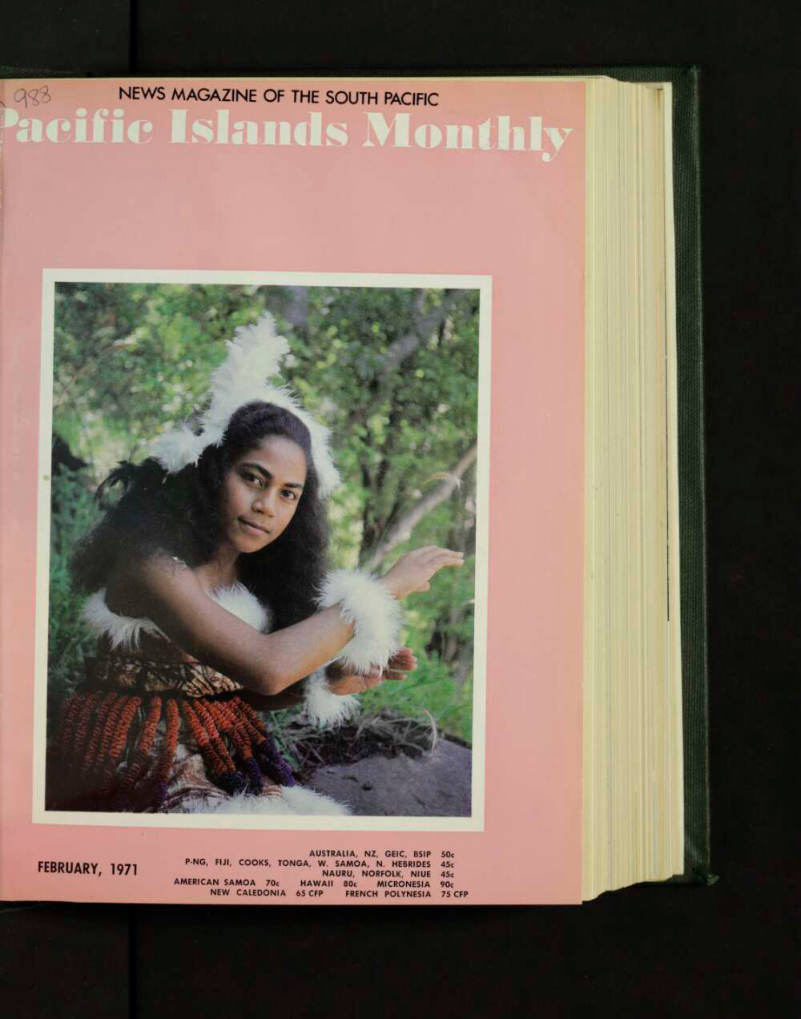 1
1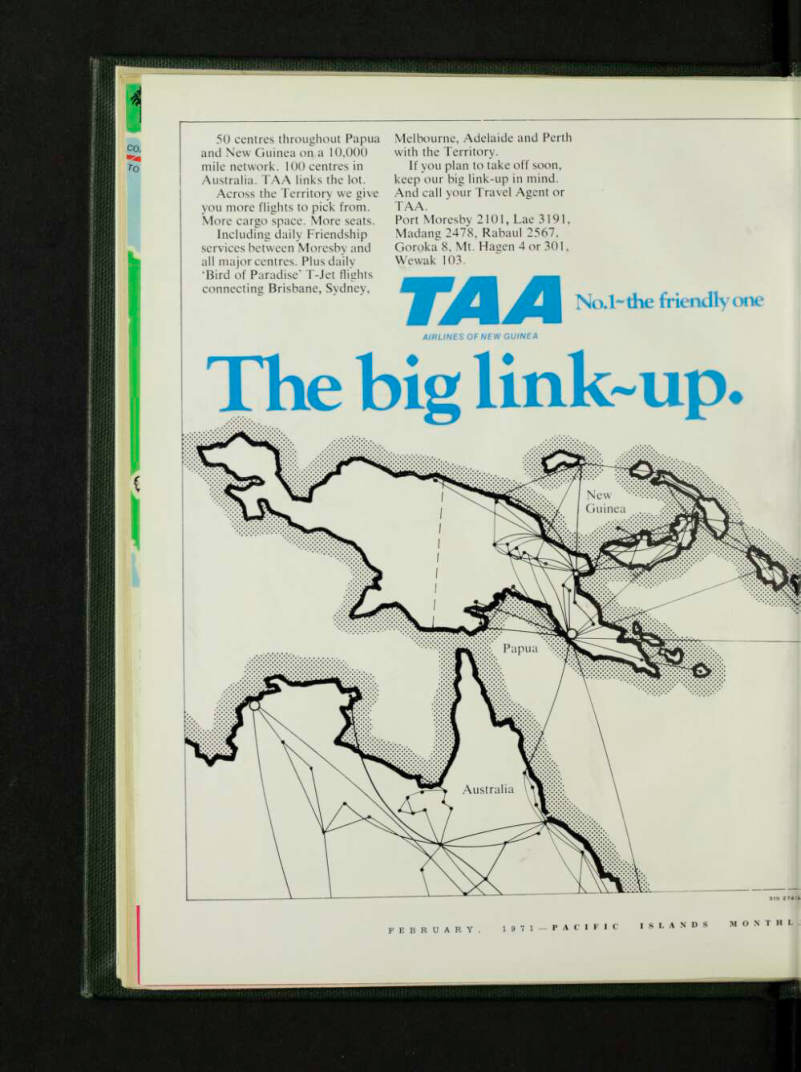 2
2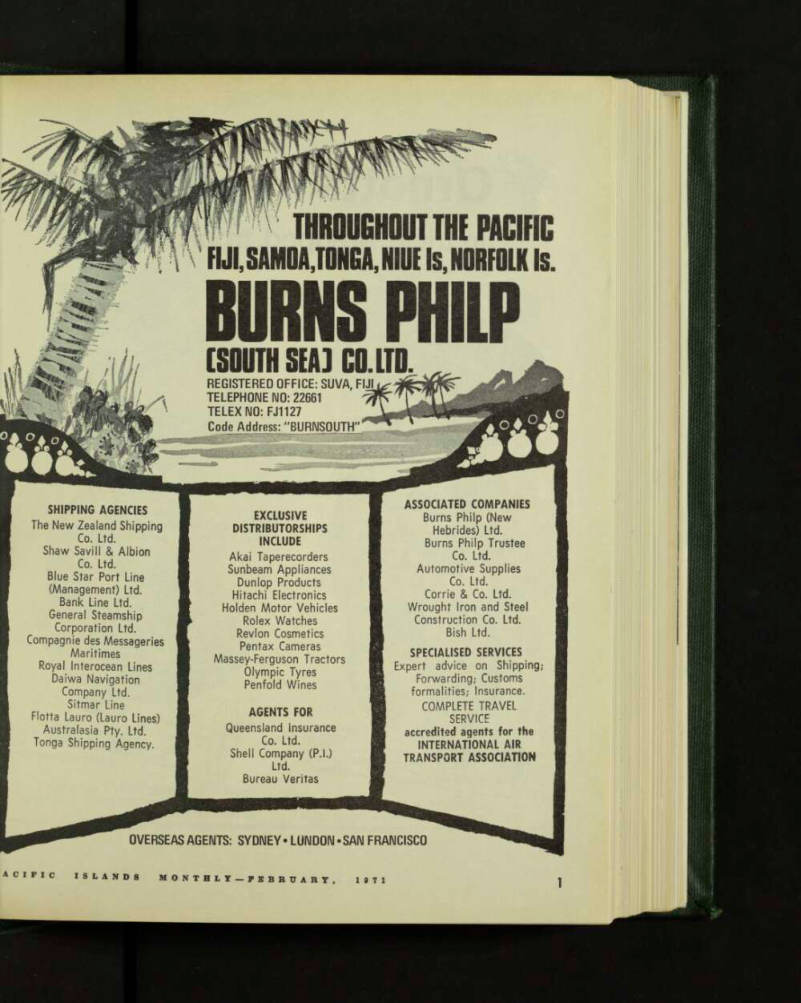 3
3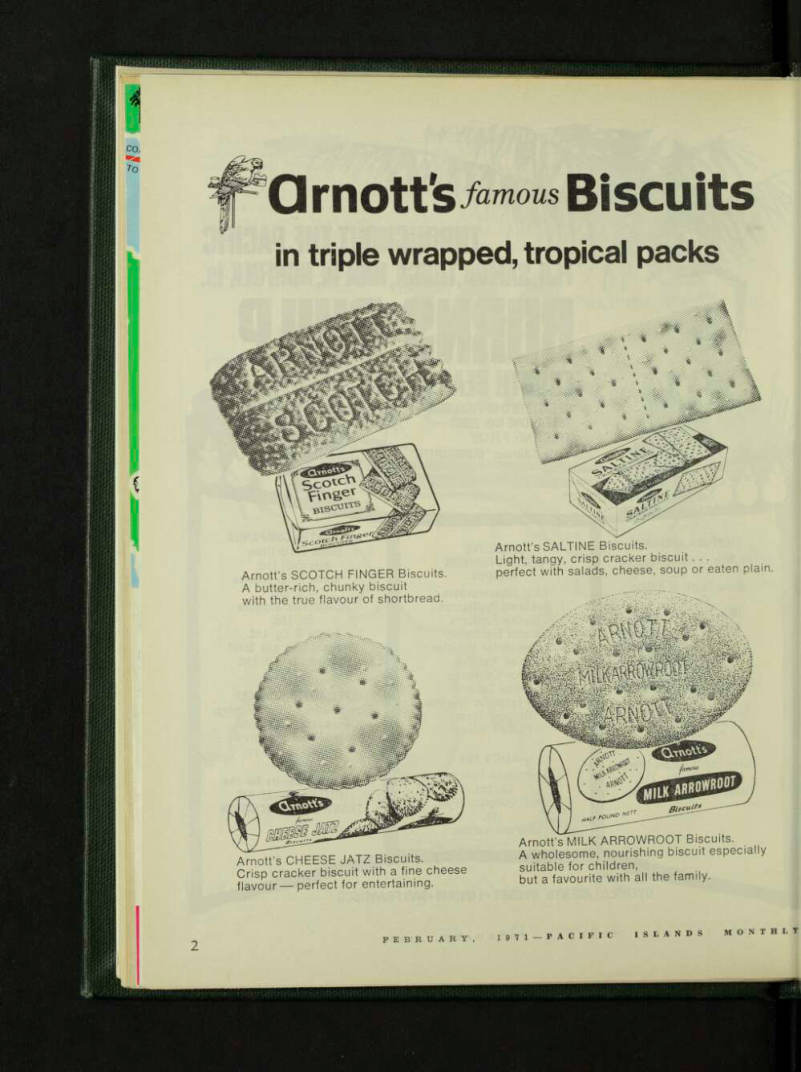 4
4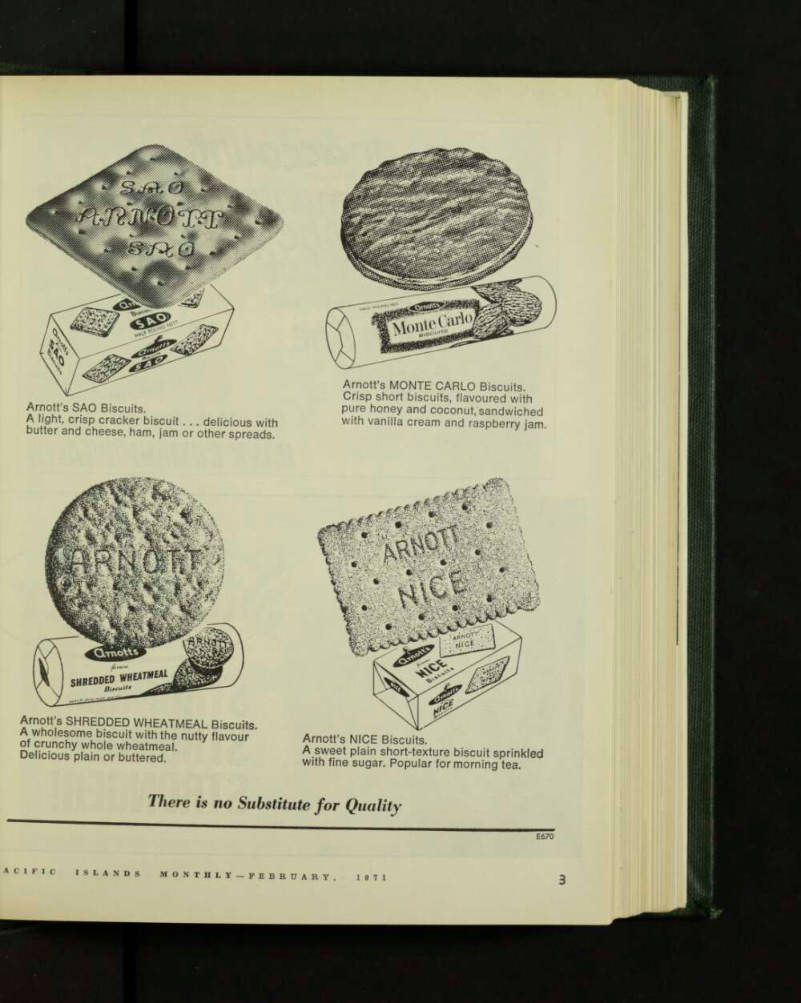 5
5 6
6 7
7 8
8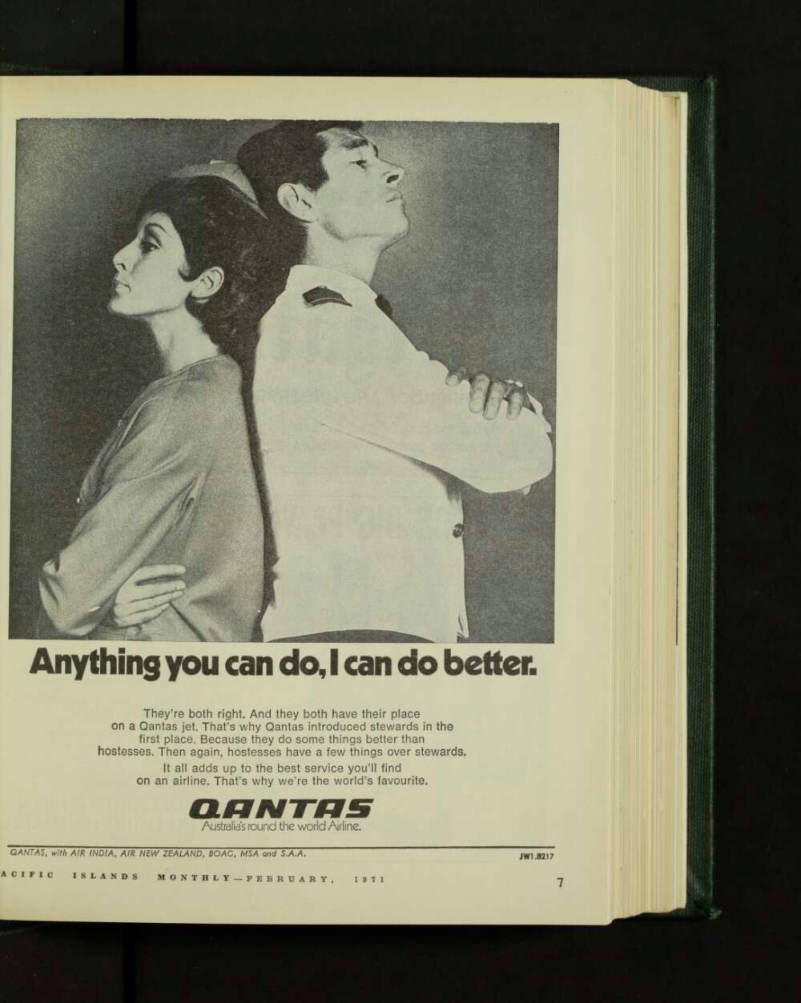 9
9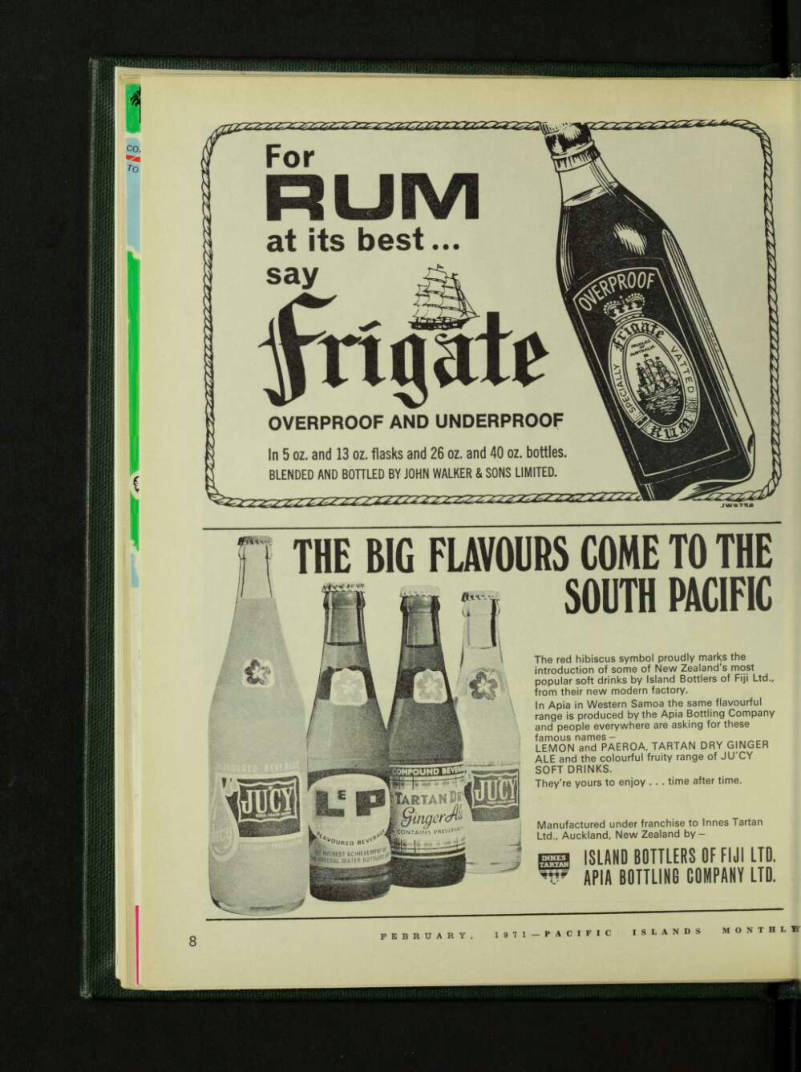 10
10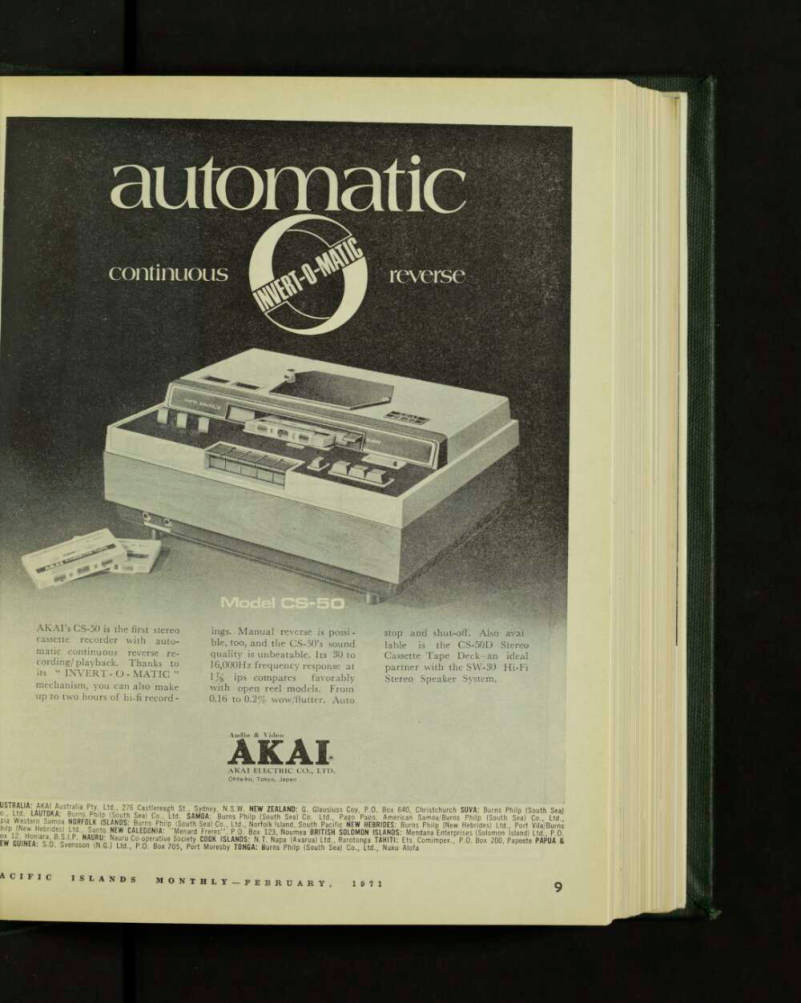 11
11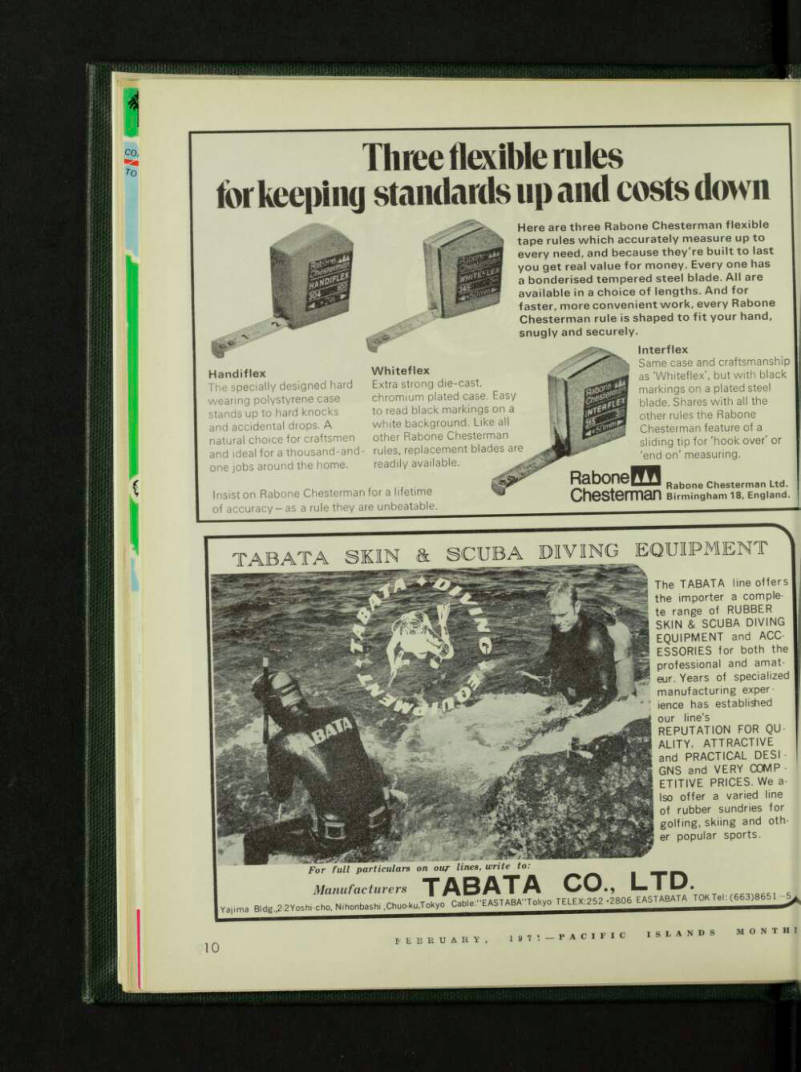 12
12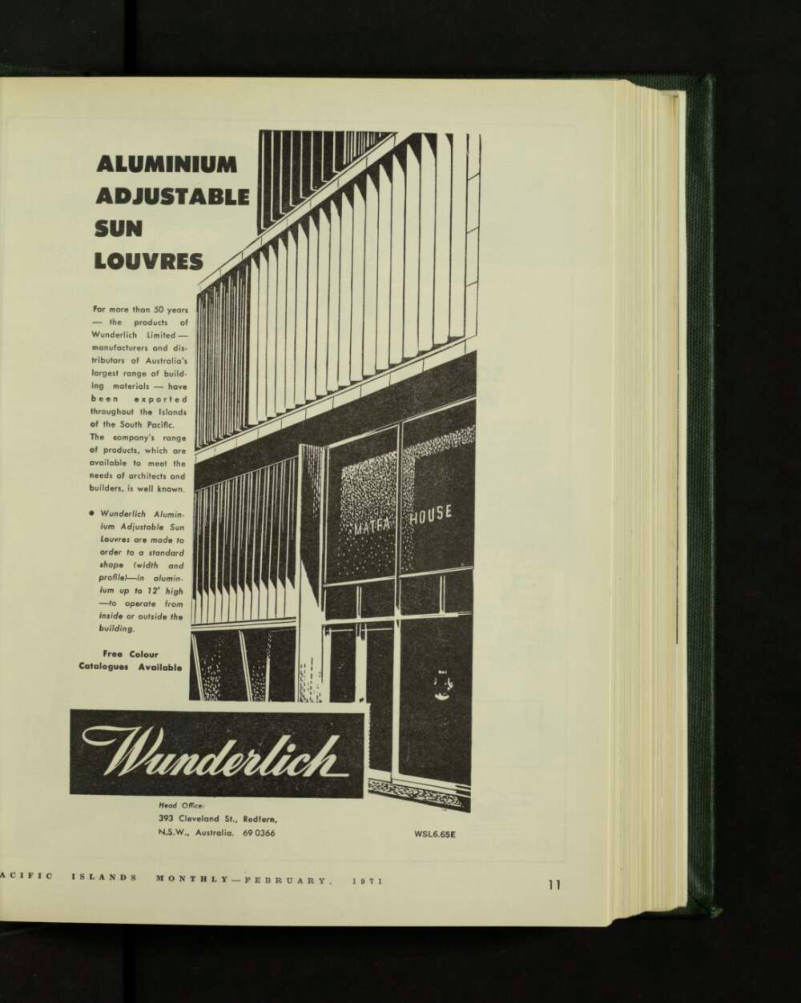 13
13 14
14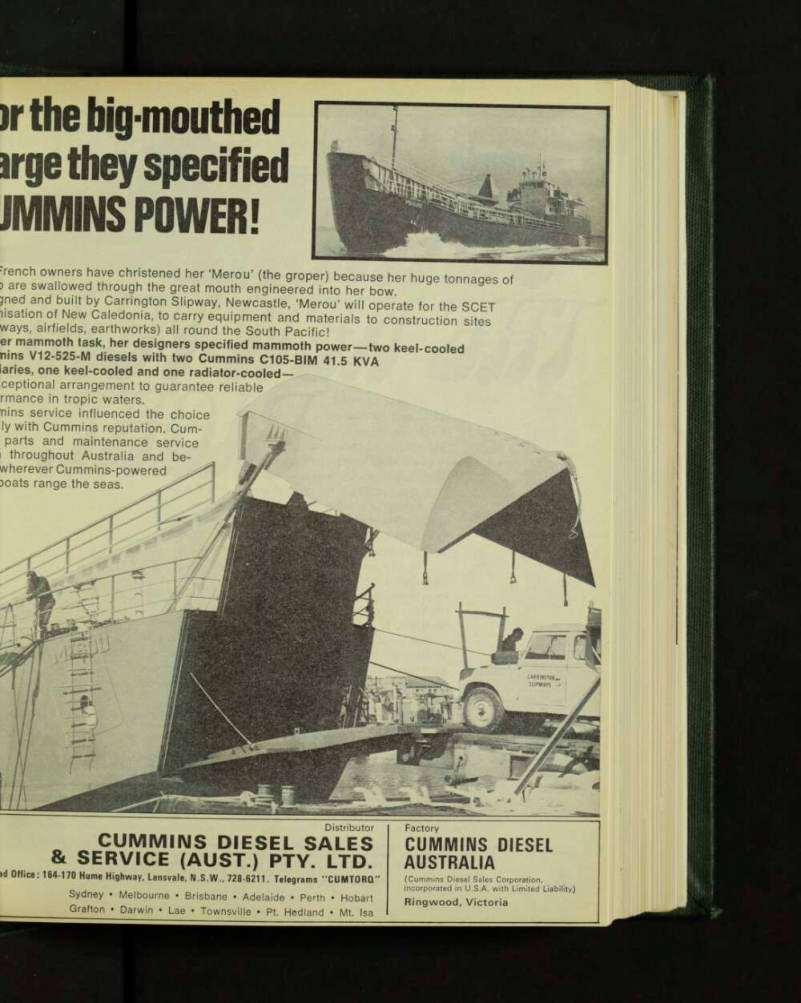 15
15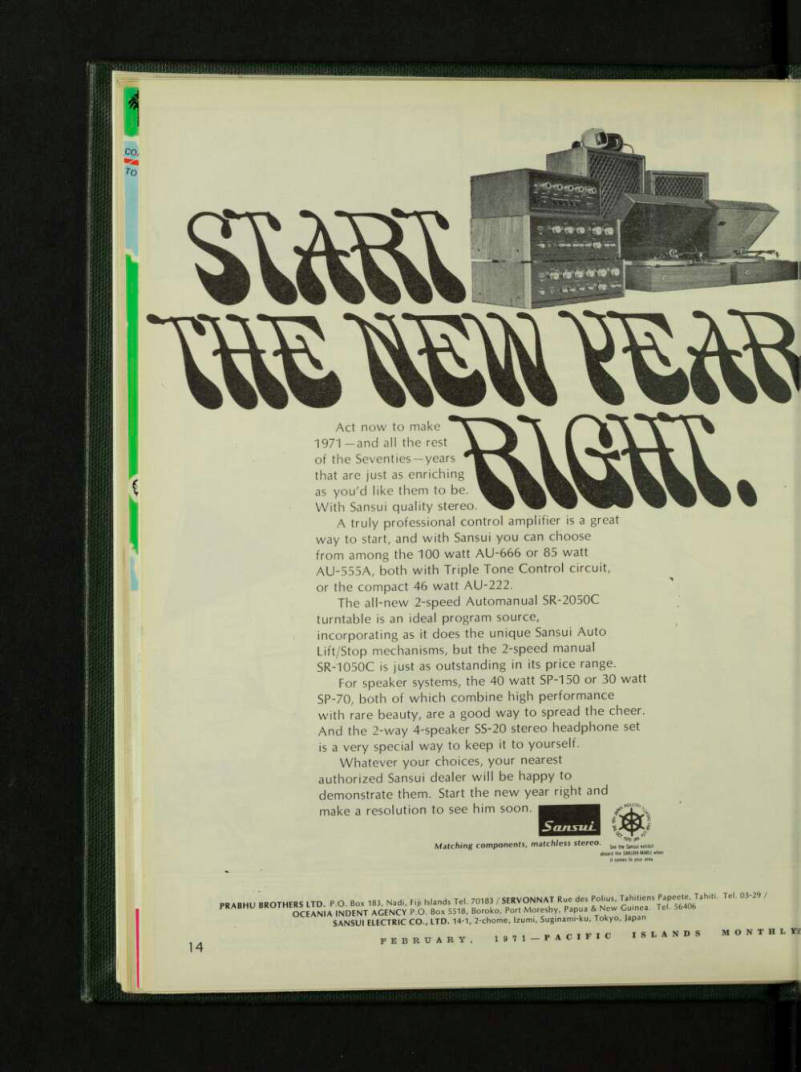 16
16 17
17 18
18 19
19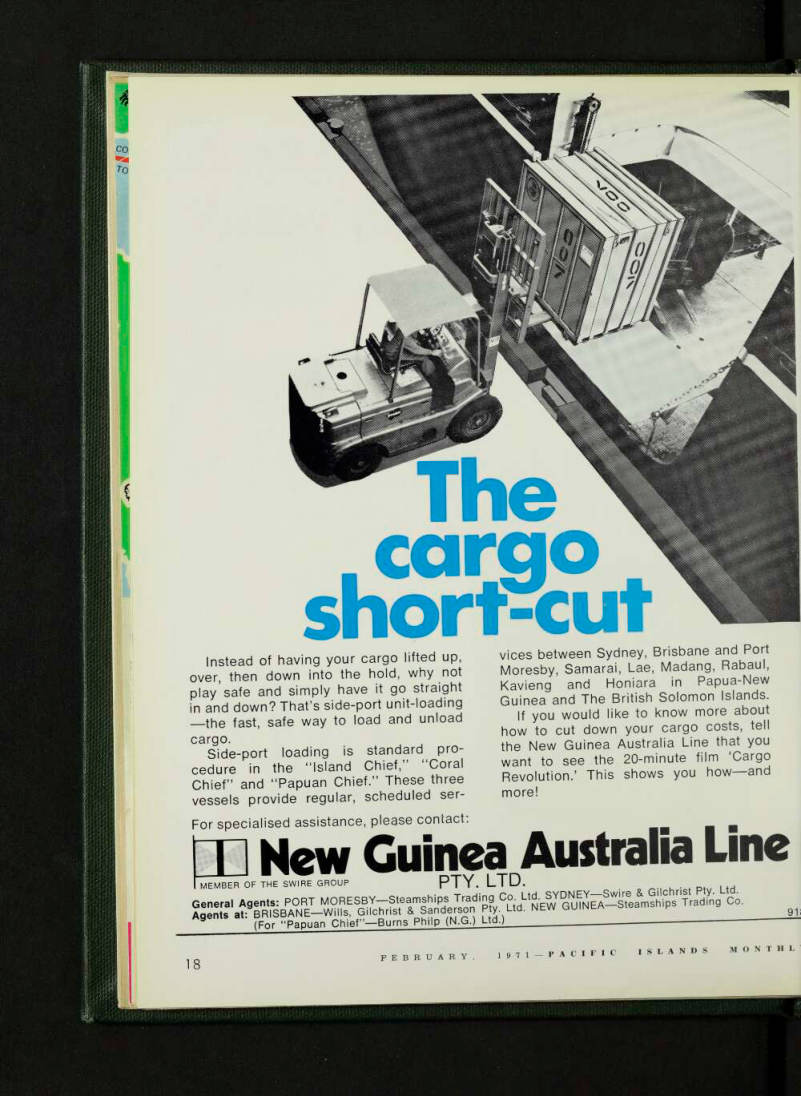 20
20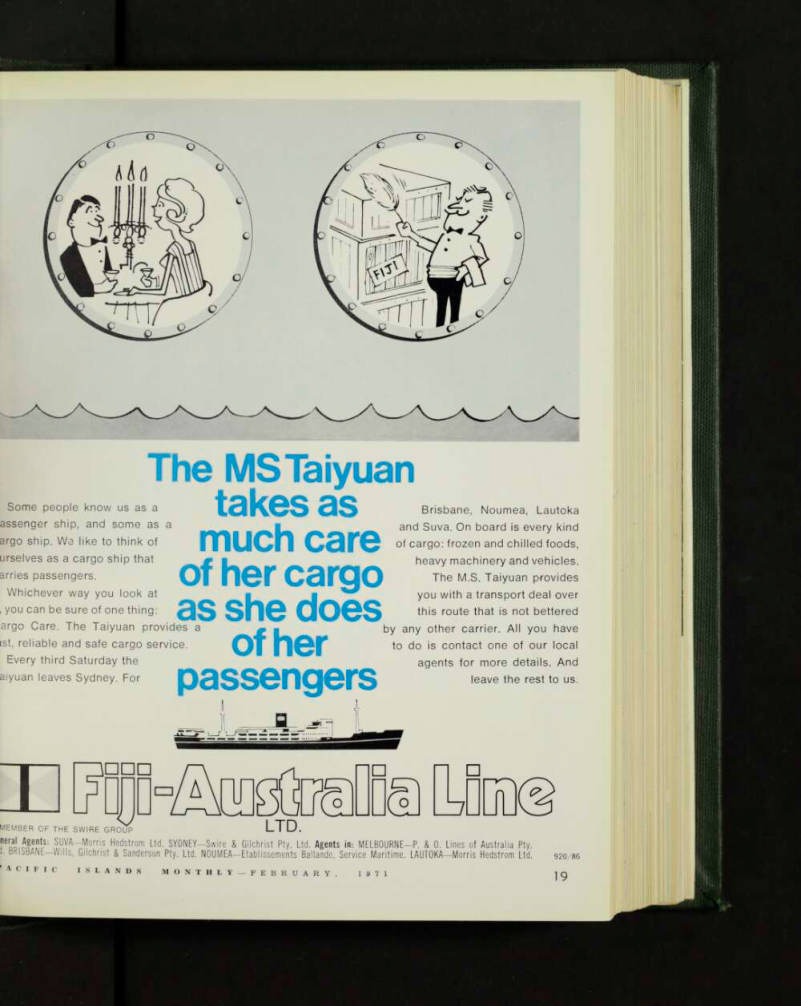 21
21 22
22 23
23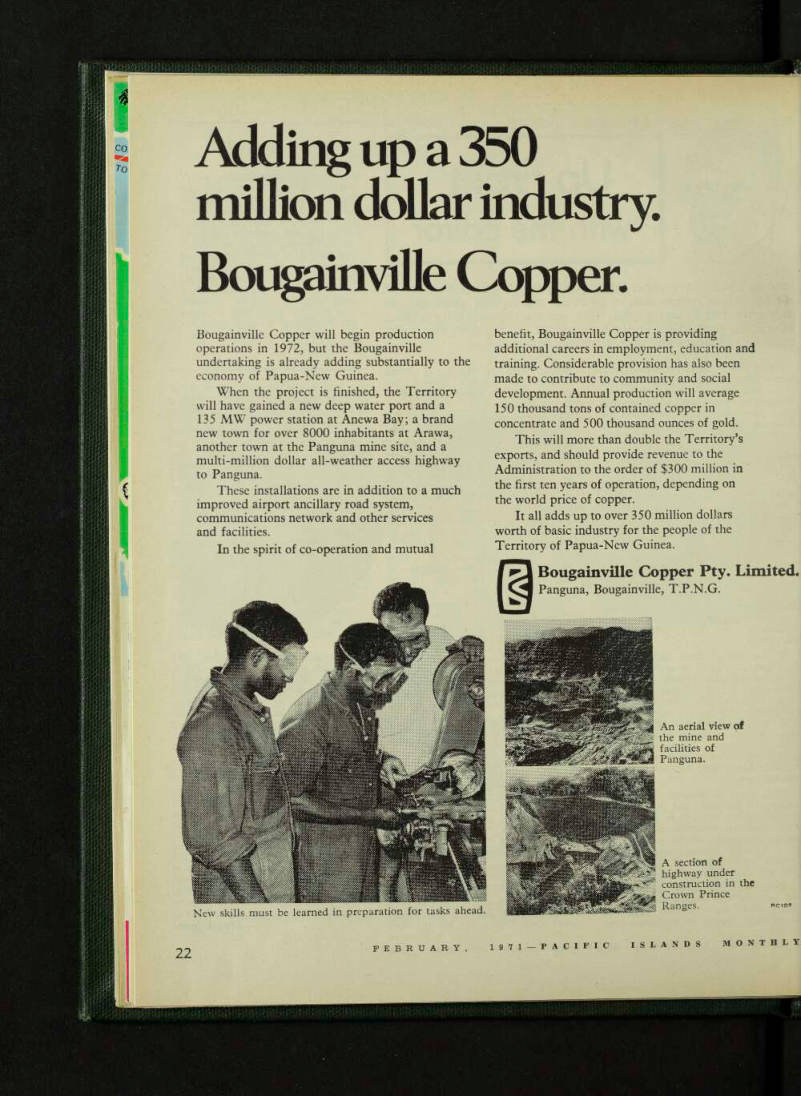 24
24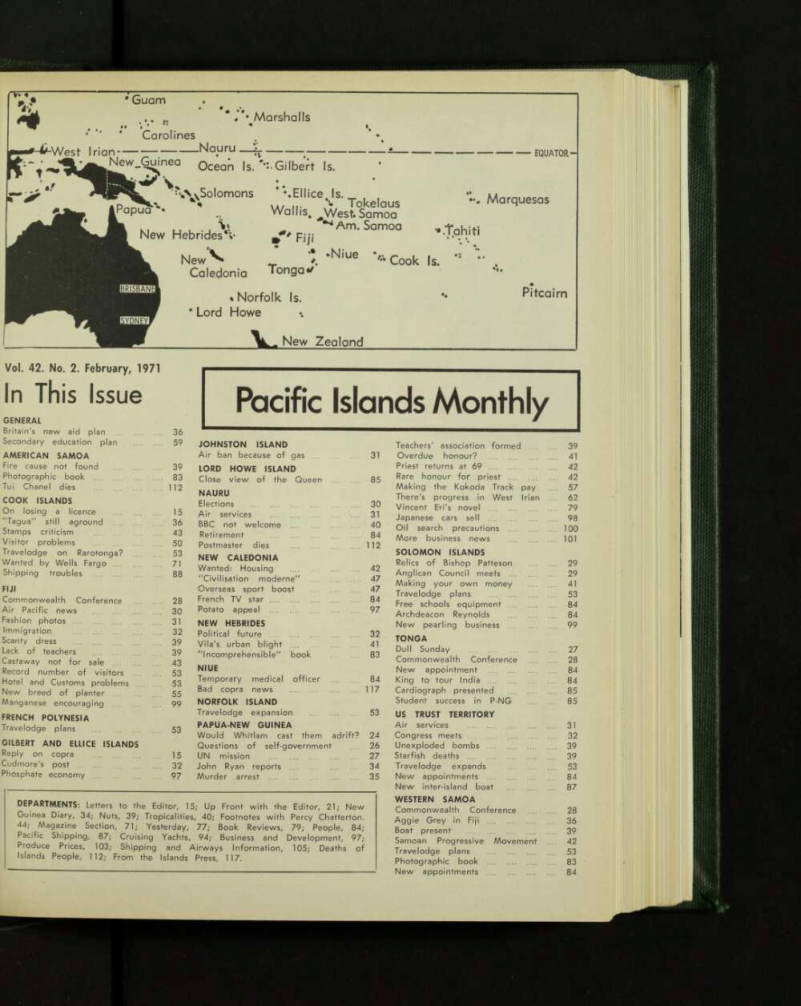 25
25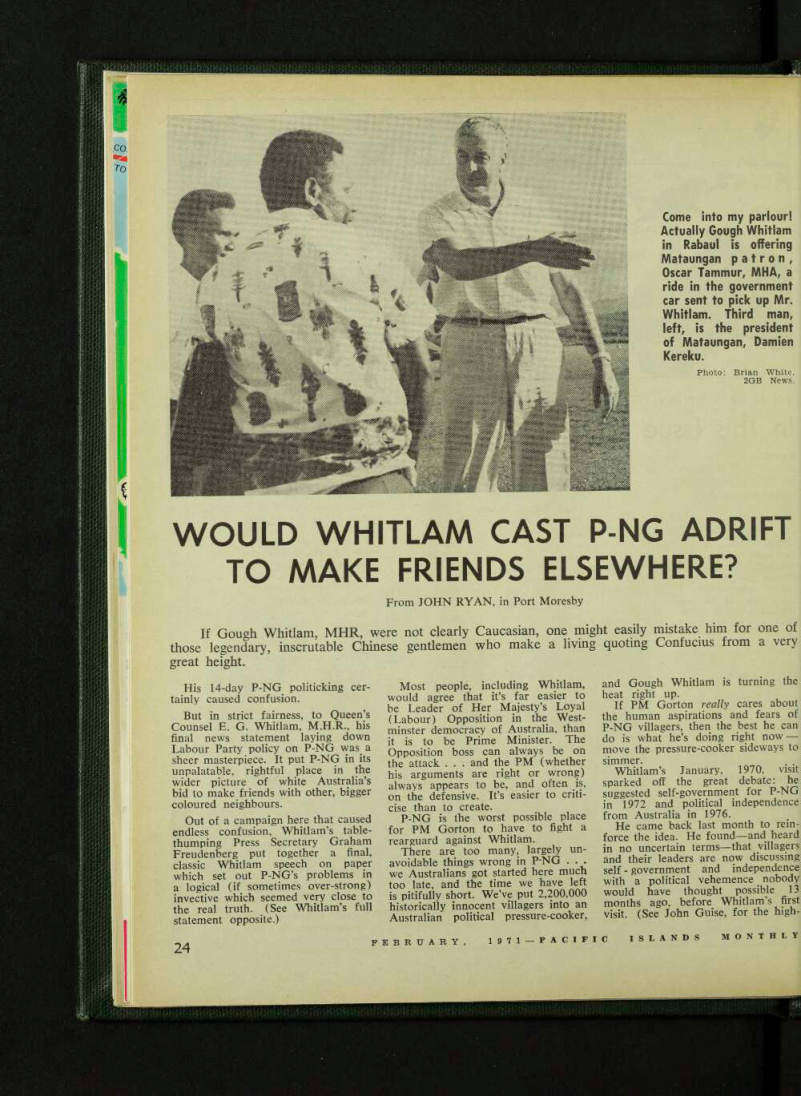 26
26 27
27 28
28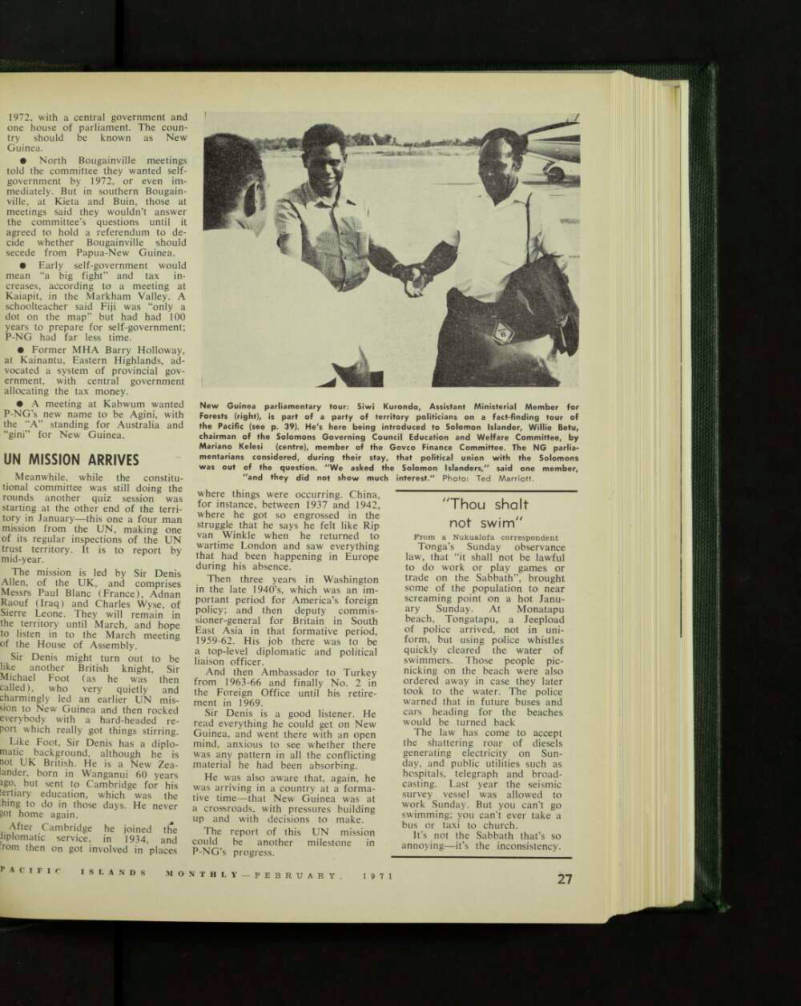 29
29 30
30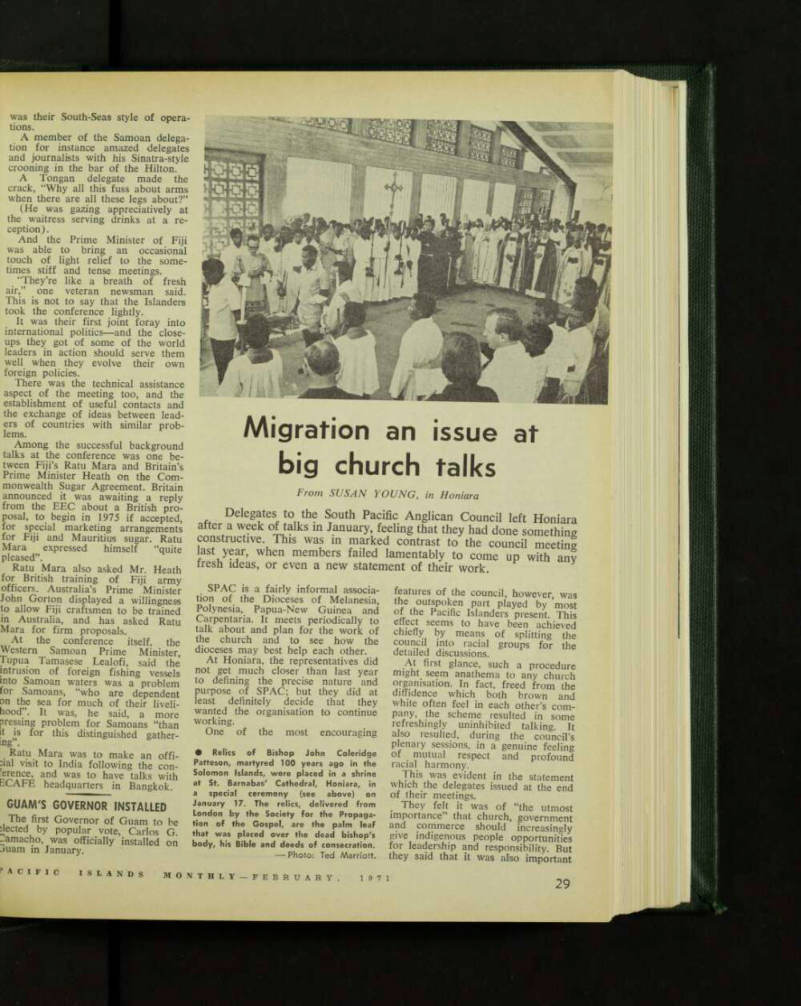 31
31 32
32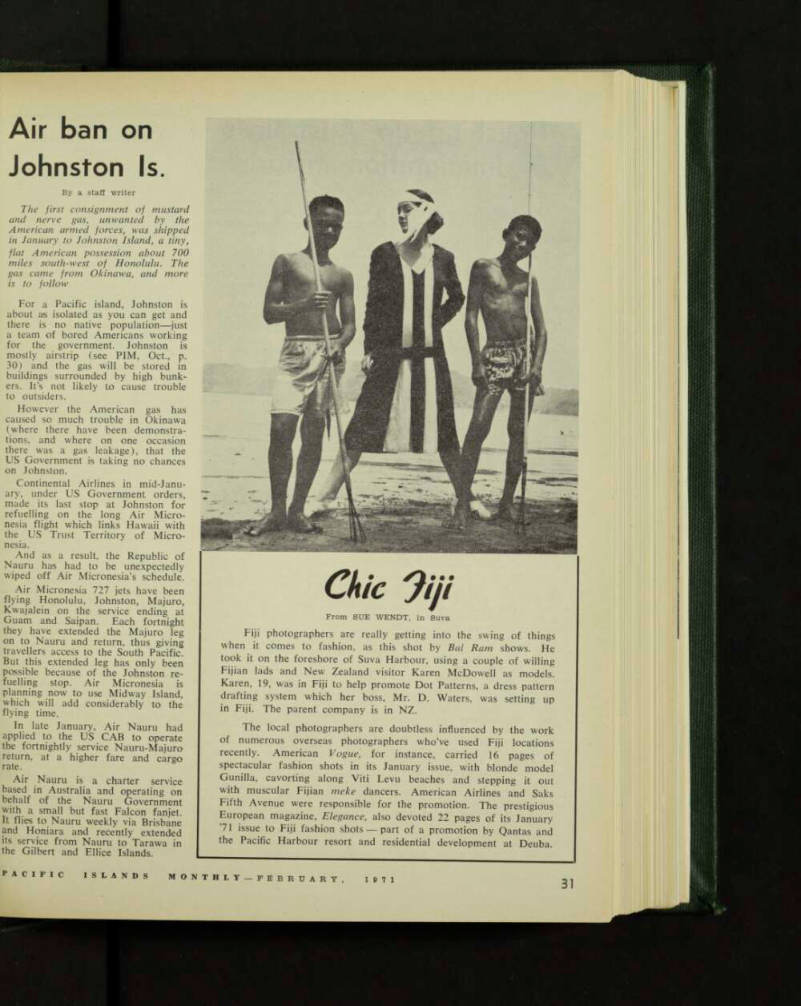 33
33 34
34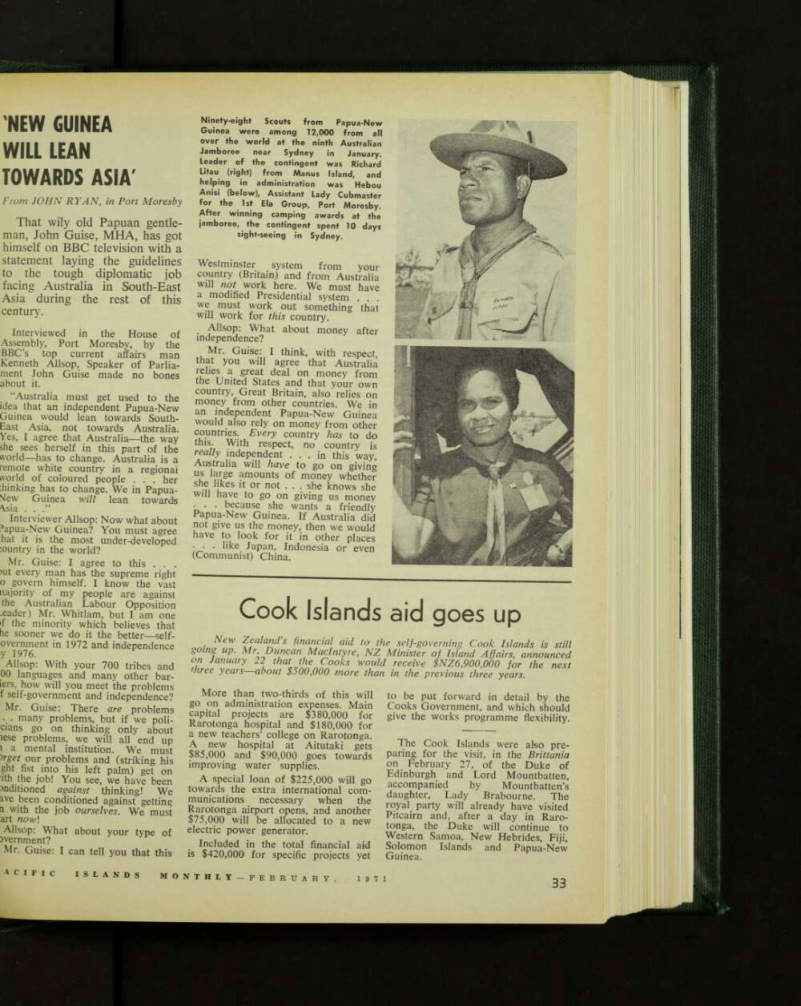 35
35 36
36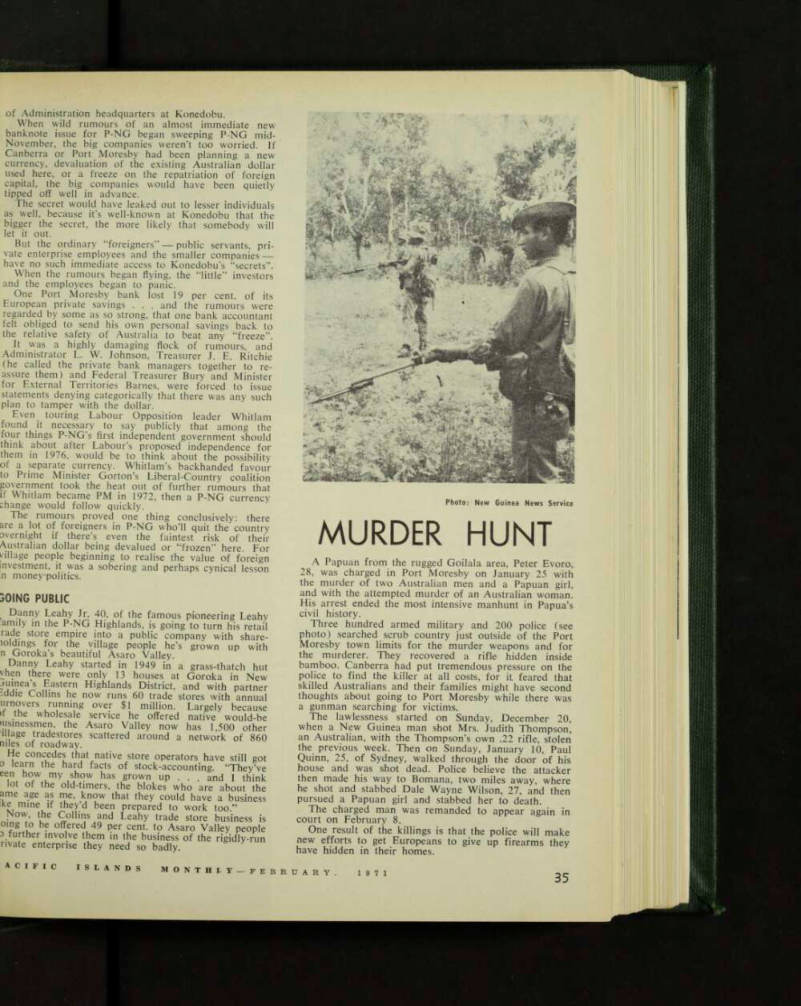 37
37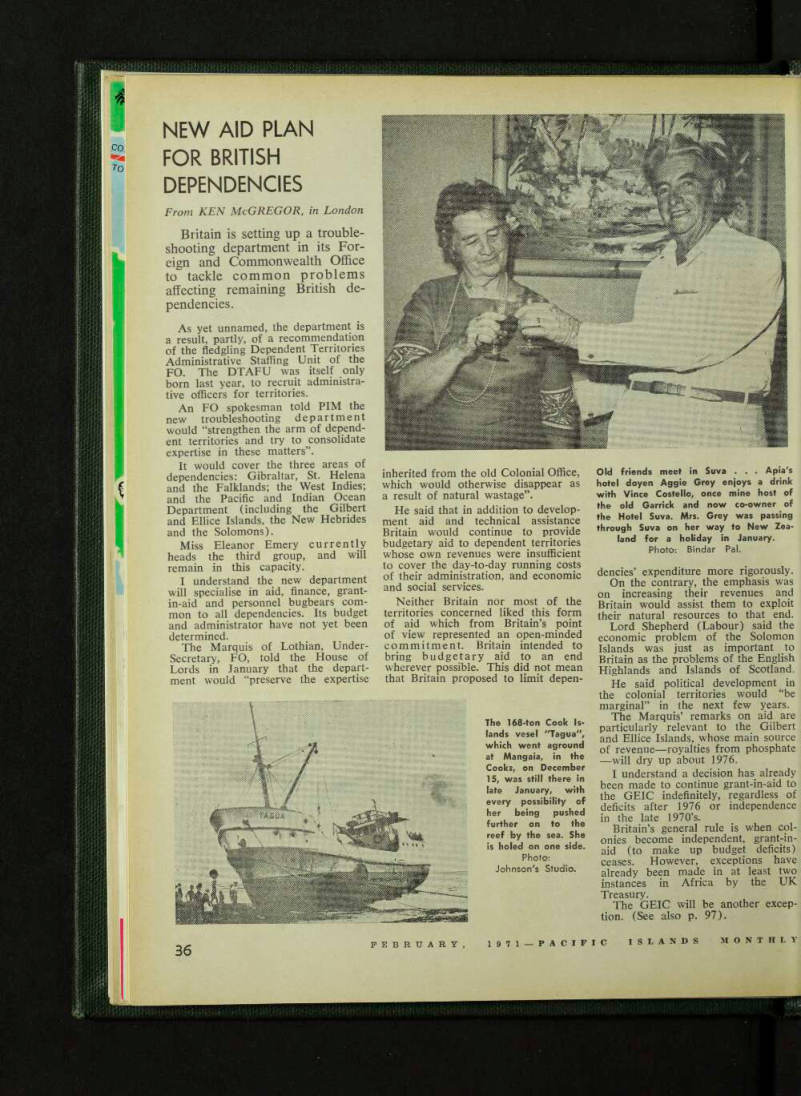 38
38 39
39 40
40 41
41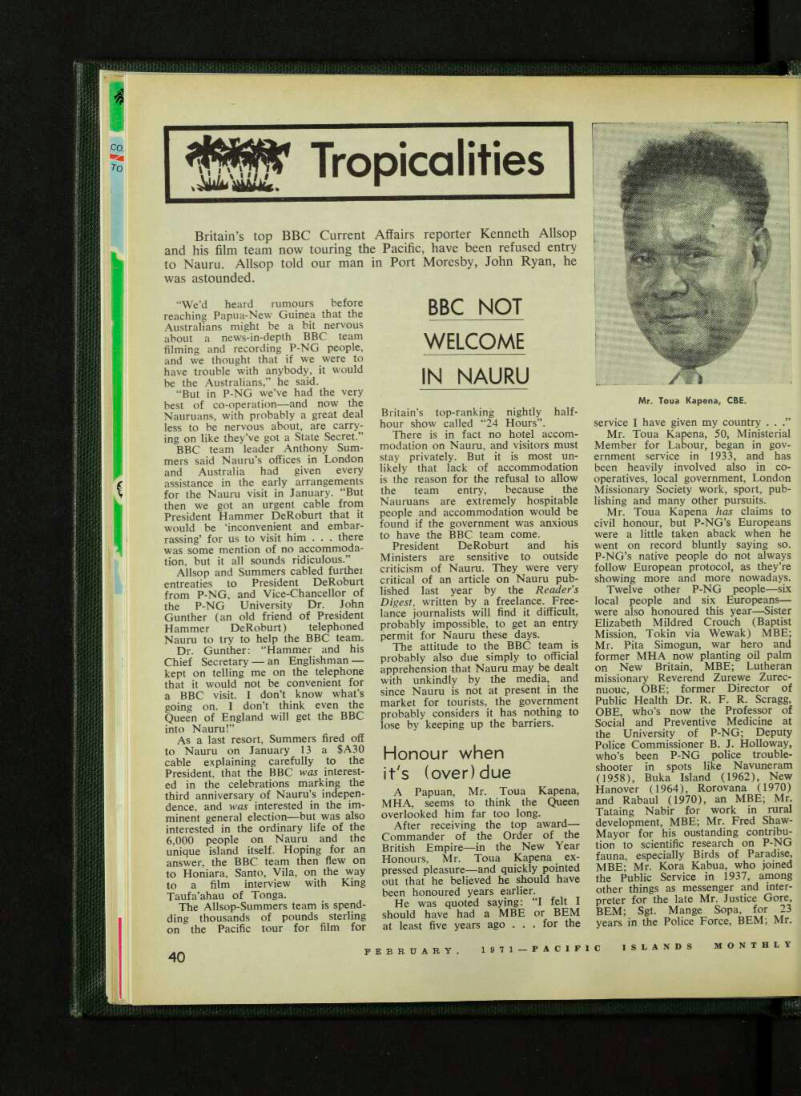 42
42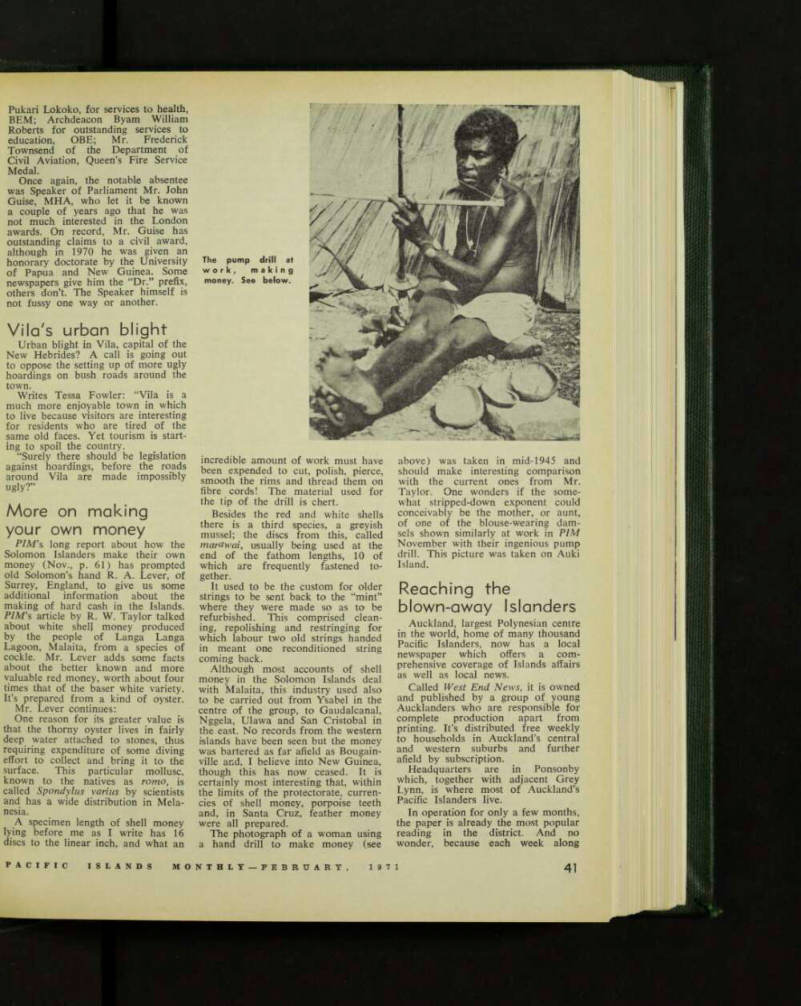 43
43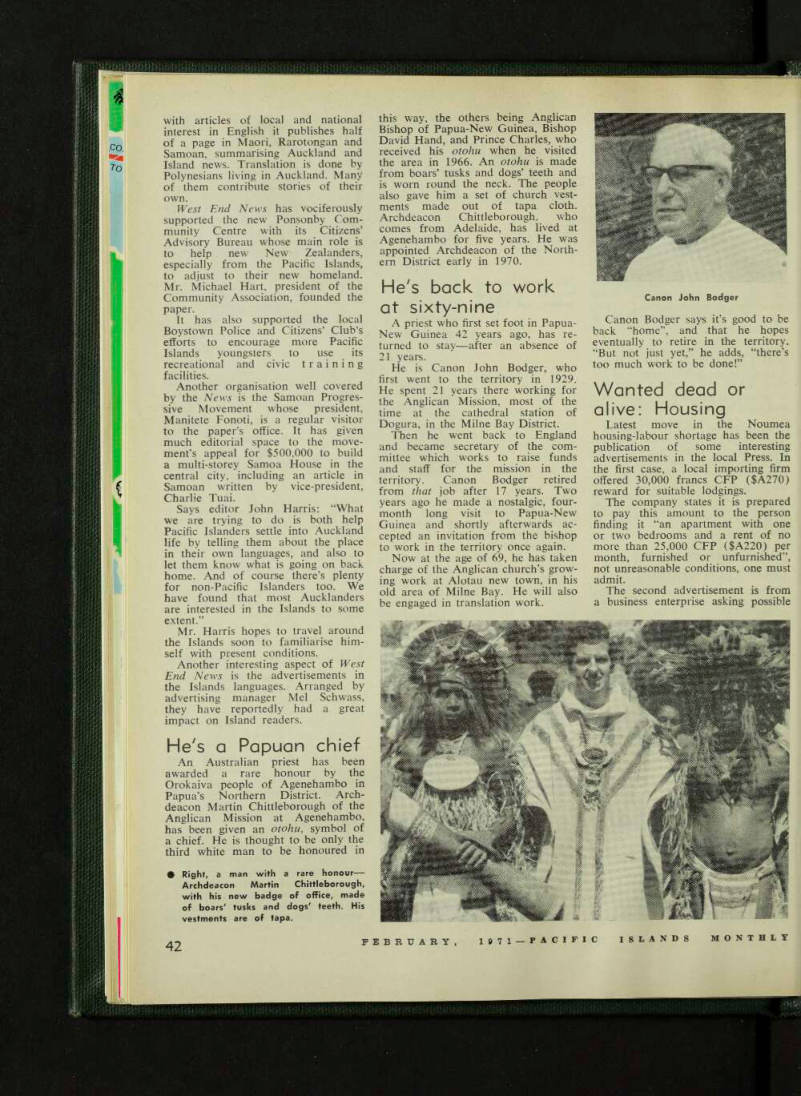 44
44 45
45 46
46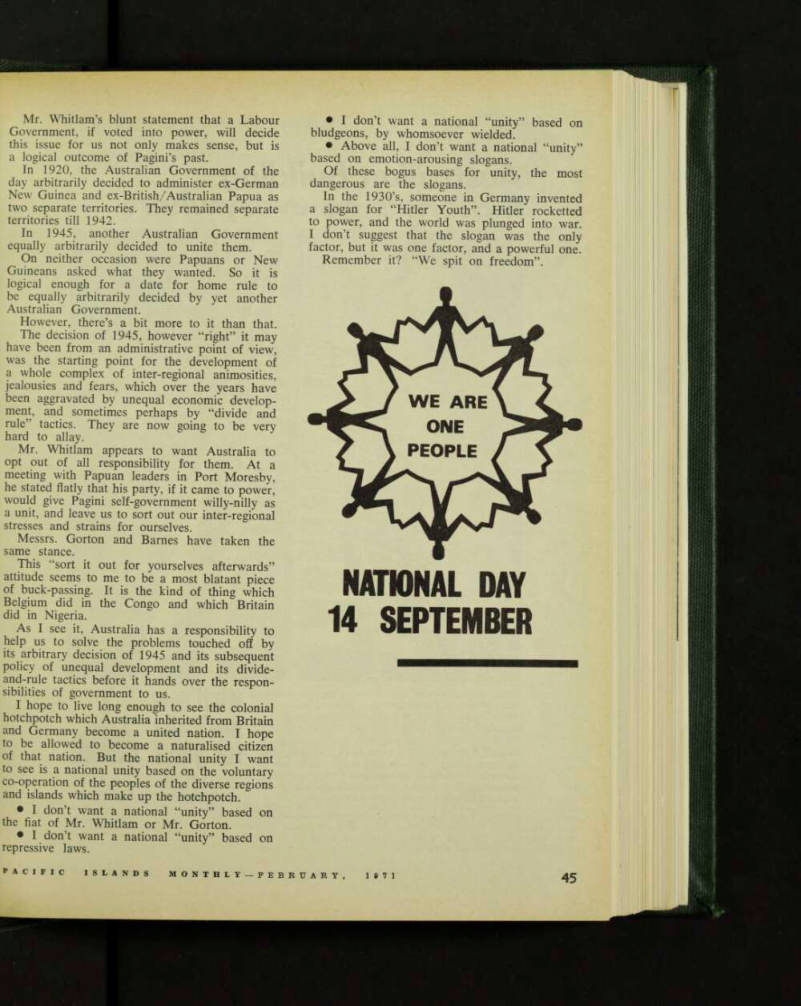 47
47 48
48 49
49 50
50 51
51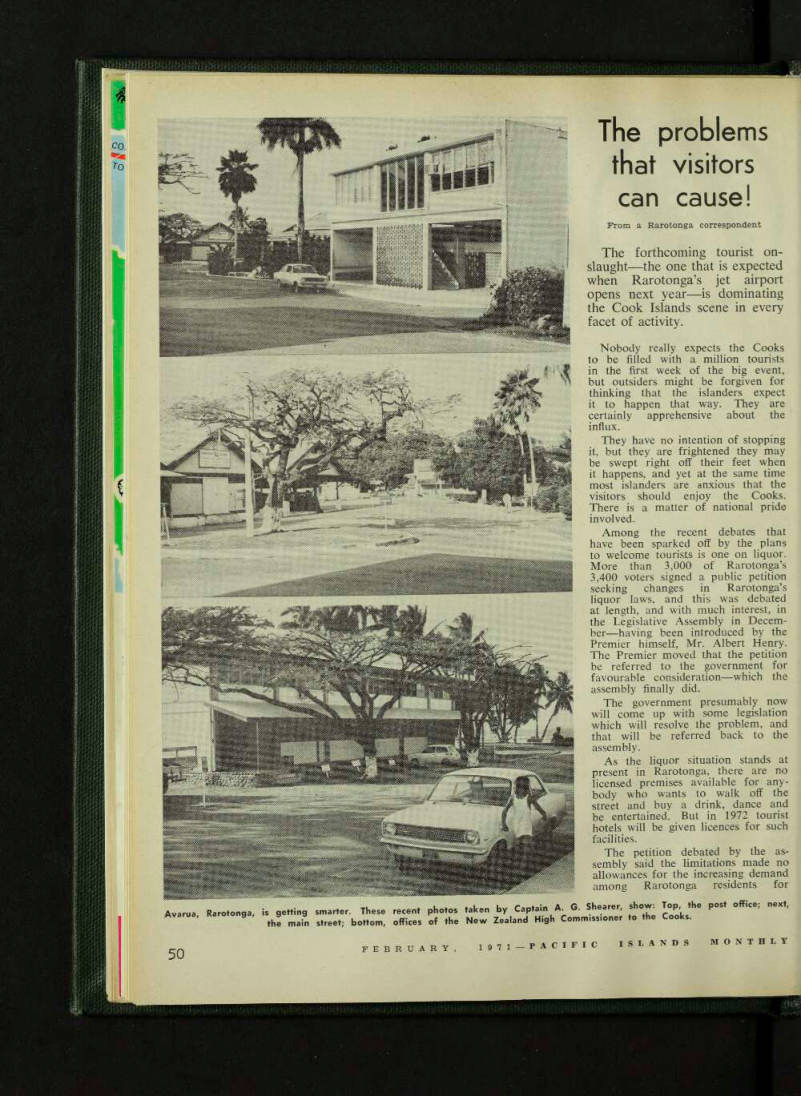 52
52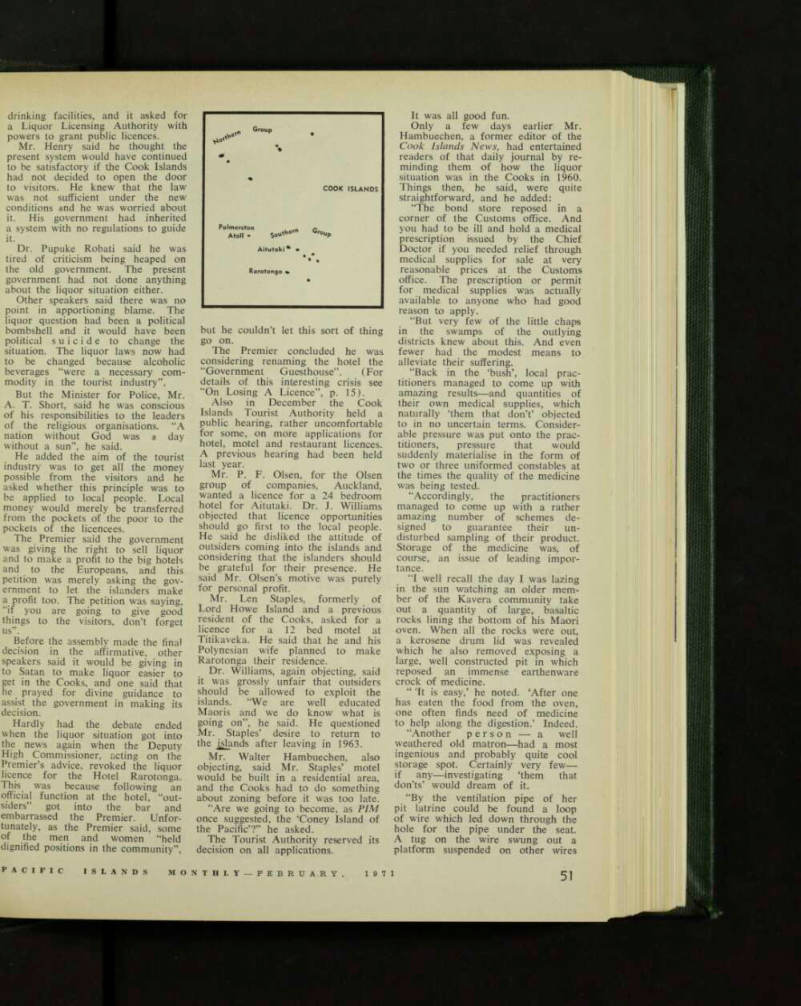 53
53 54
54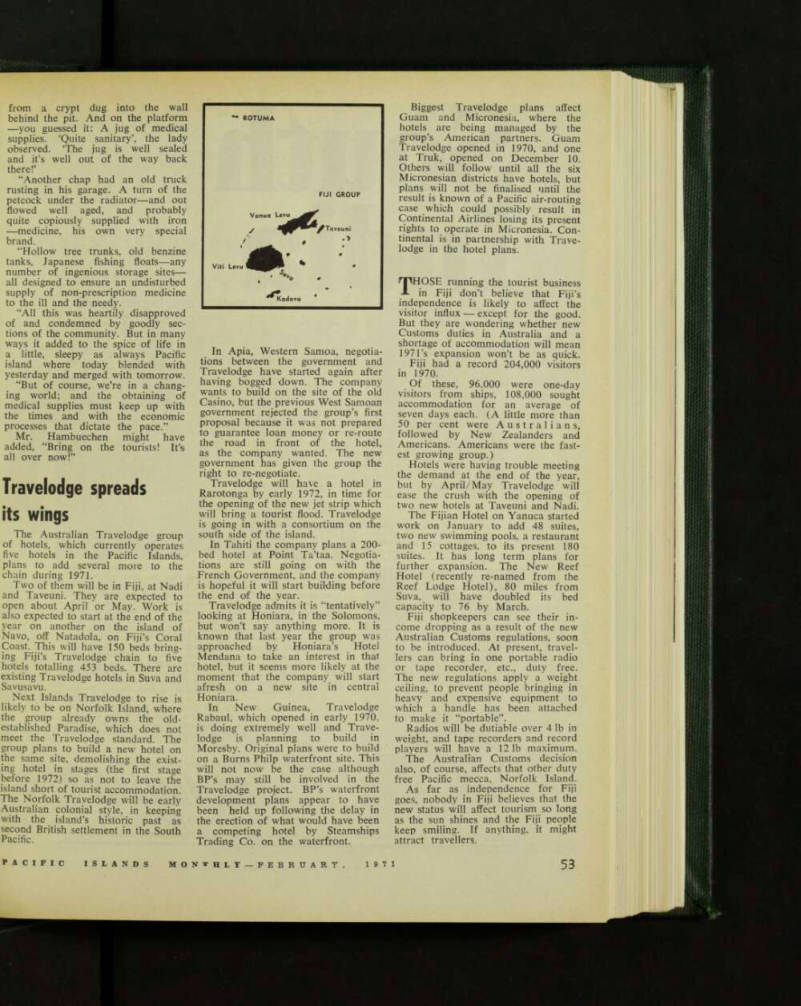 55
55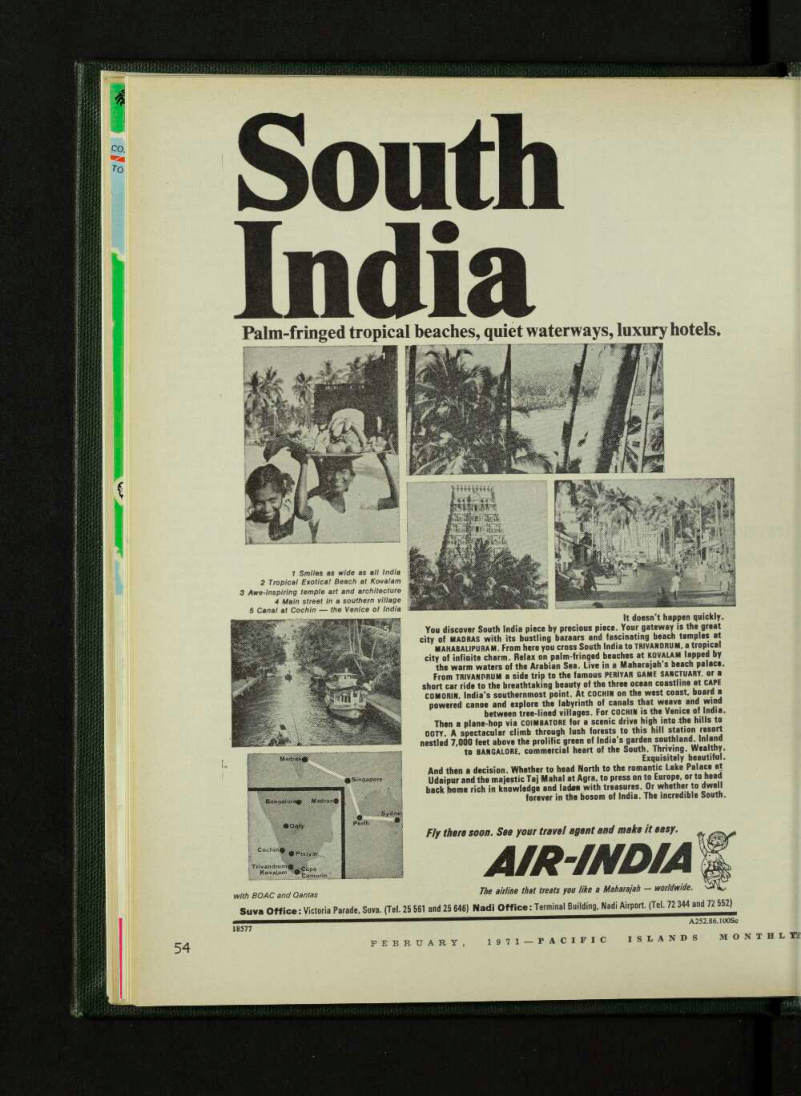 56
56 57
57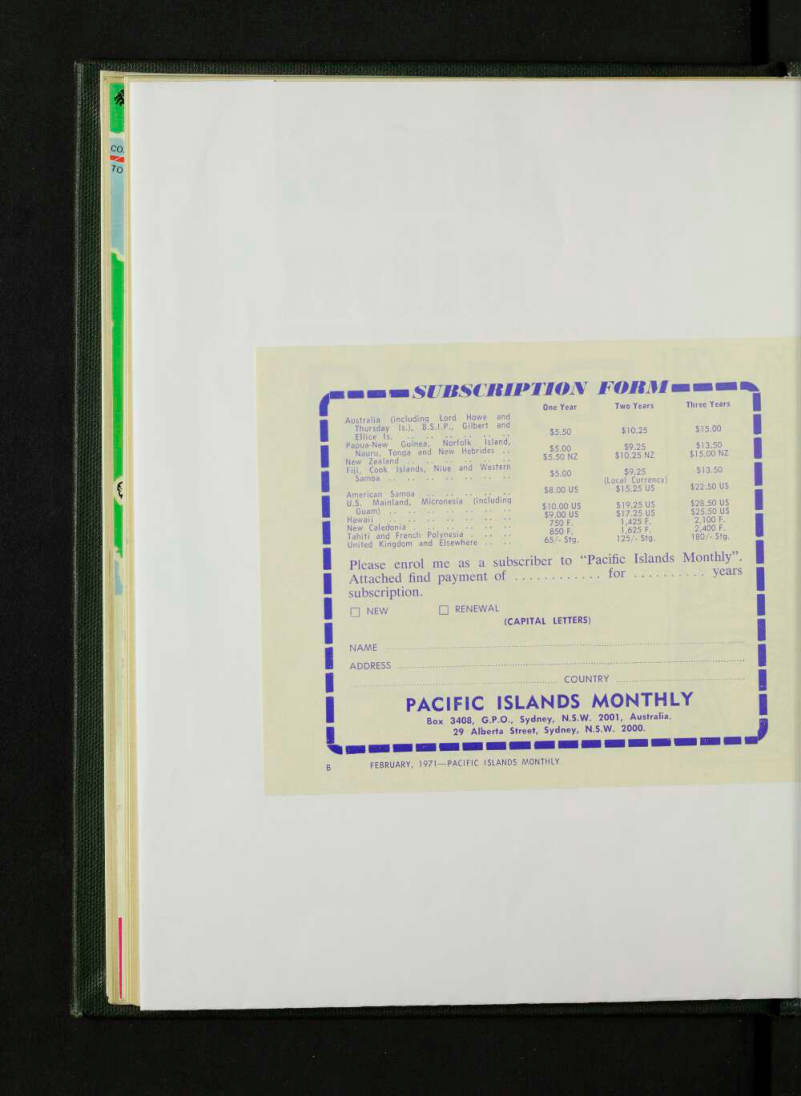 58
58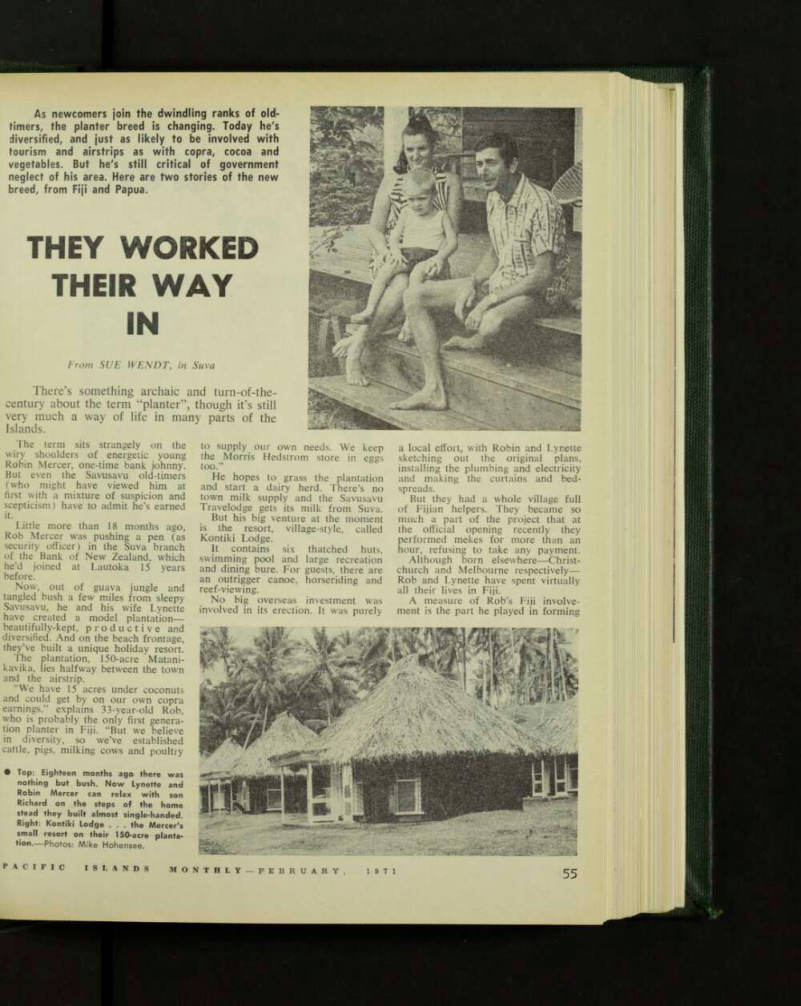 59
59 60
60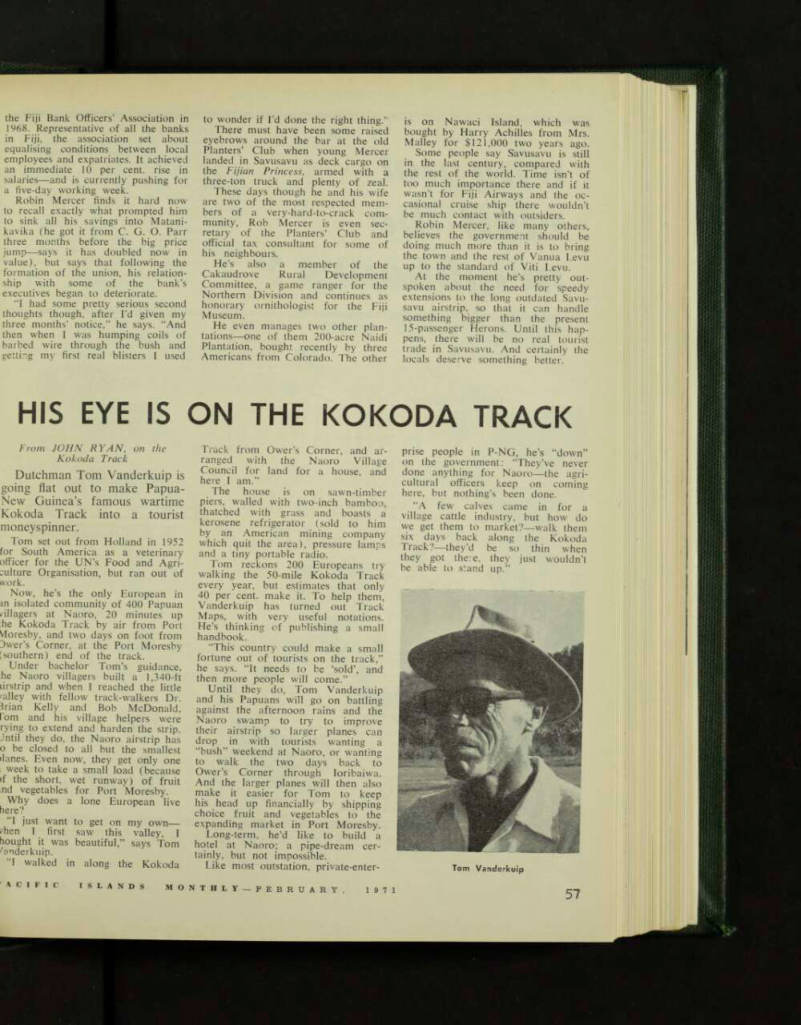 61
61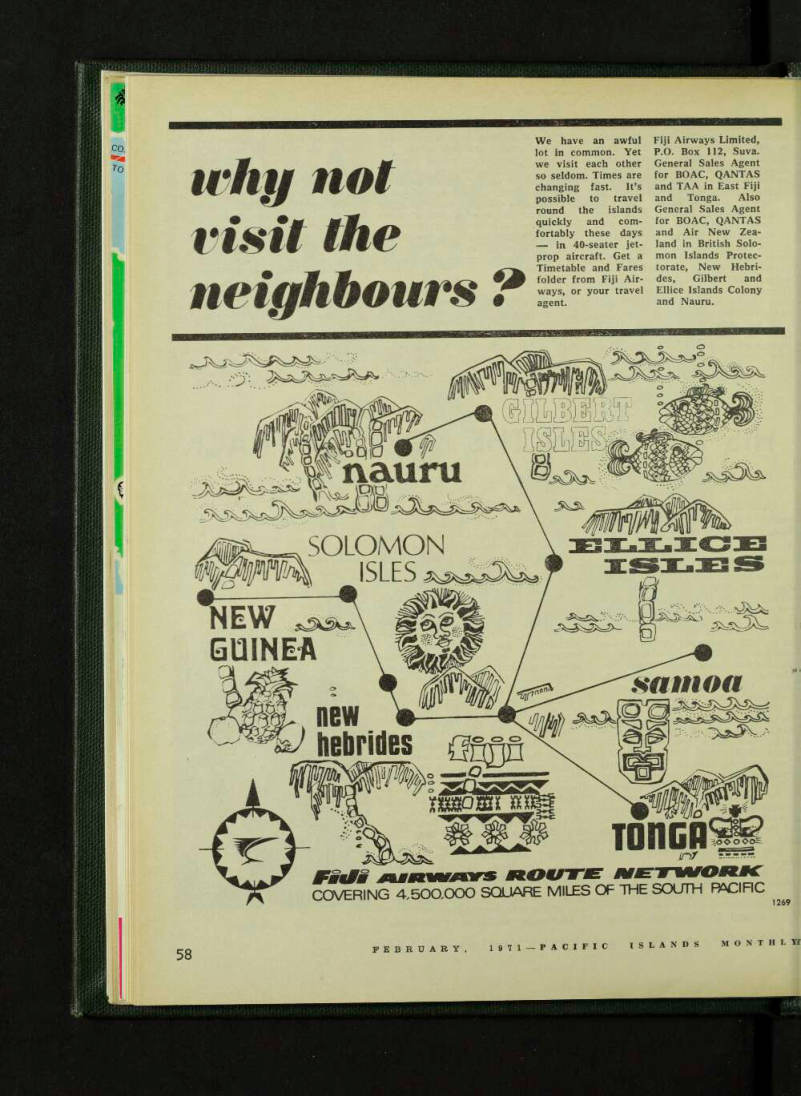 62
62 63
63 64
64 65
65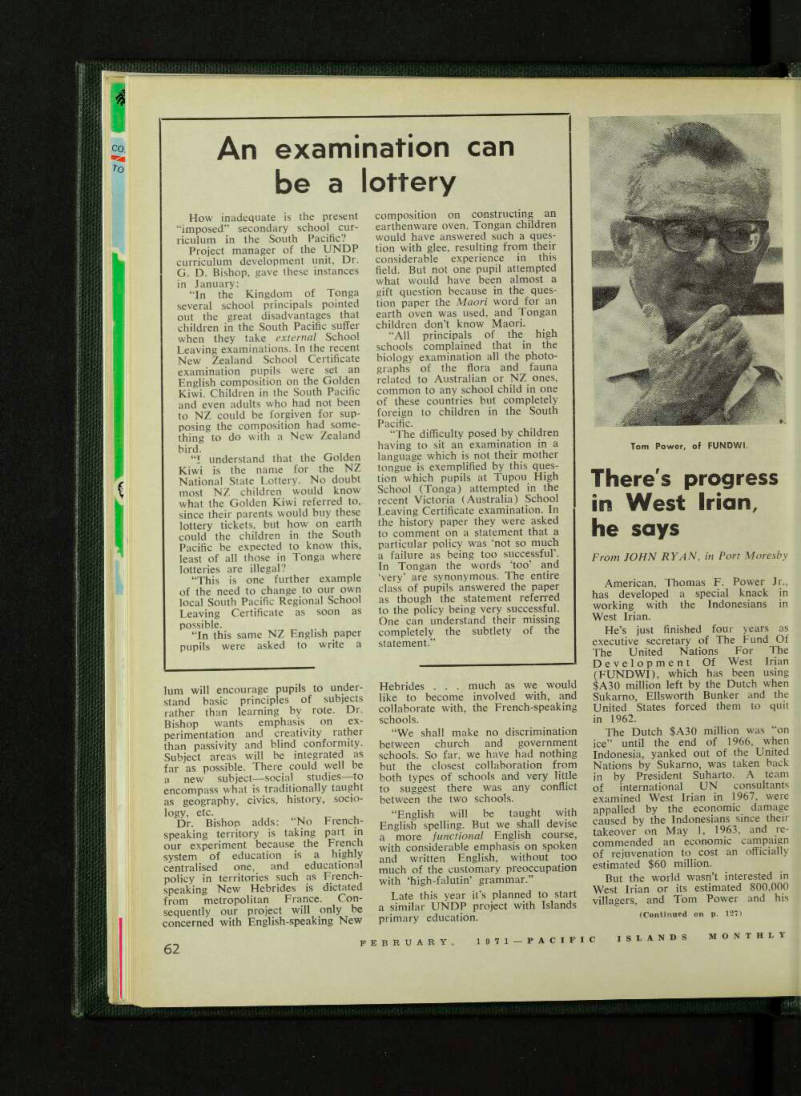 66
66 67
67 68
68 69
69 70
70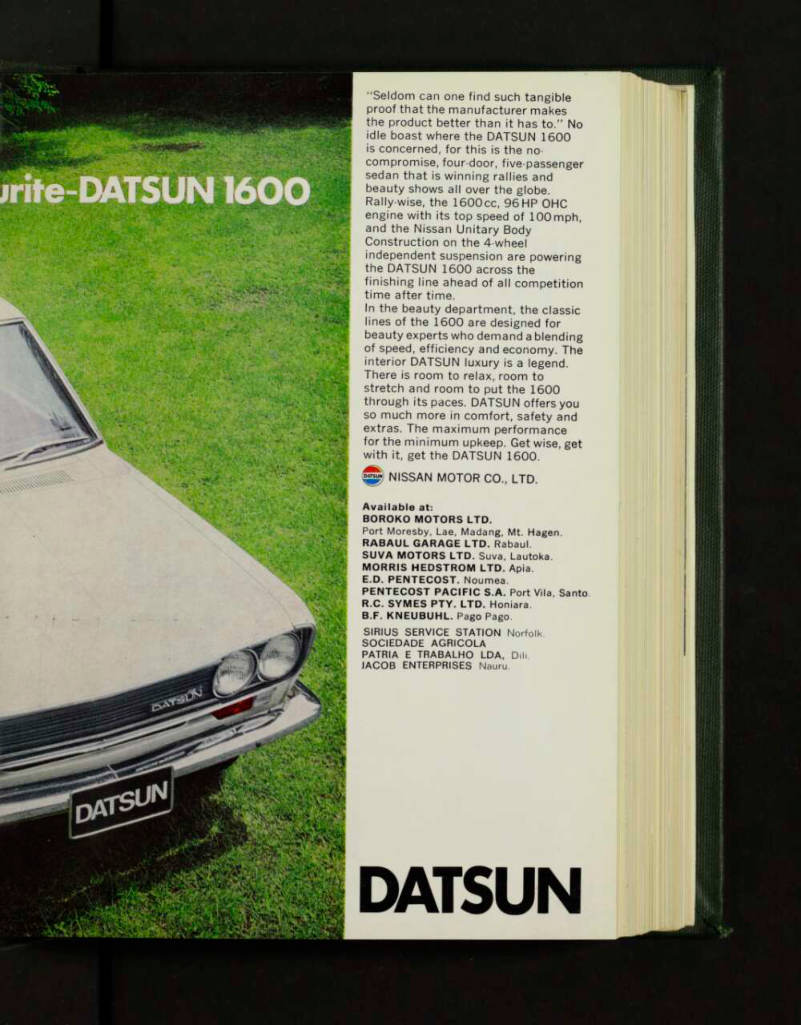 71
71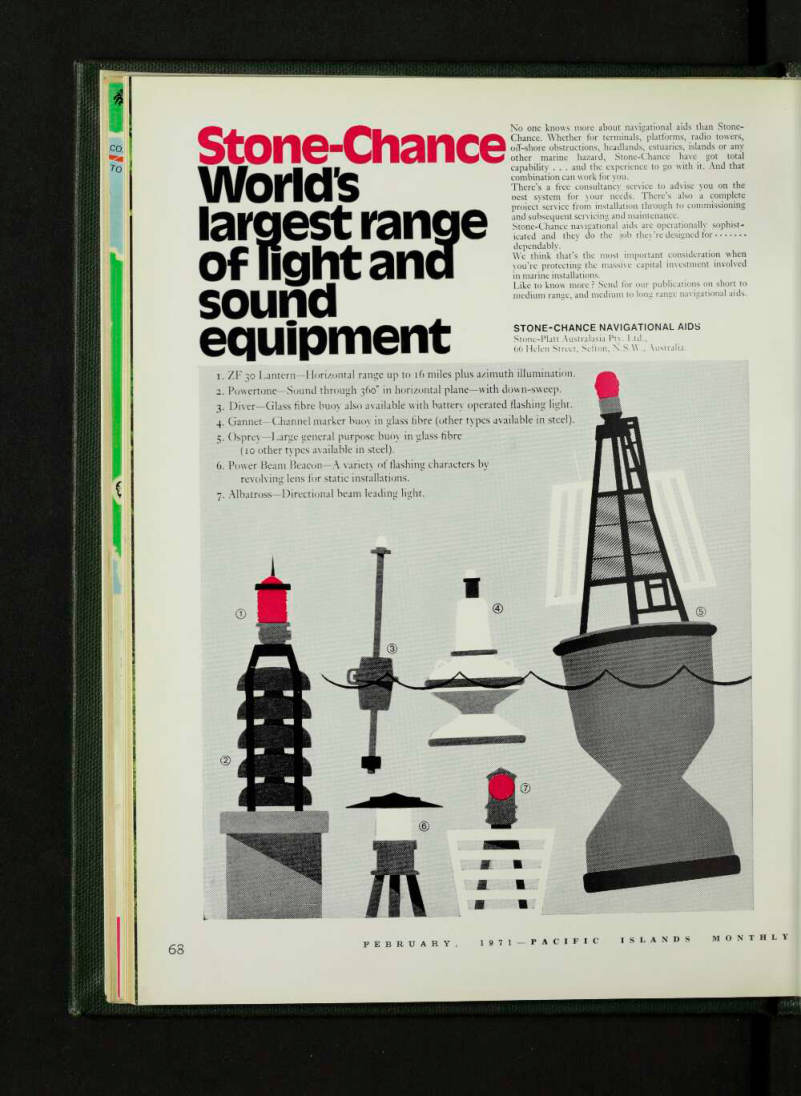 72
72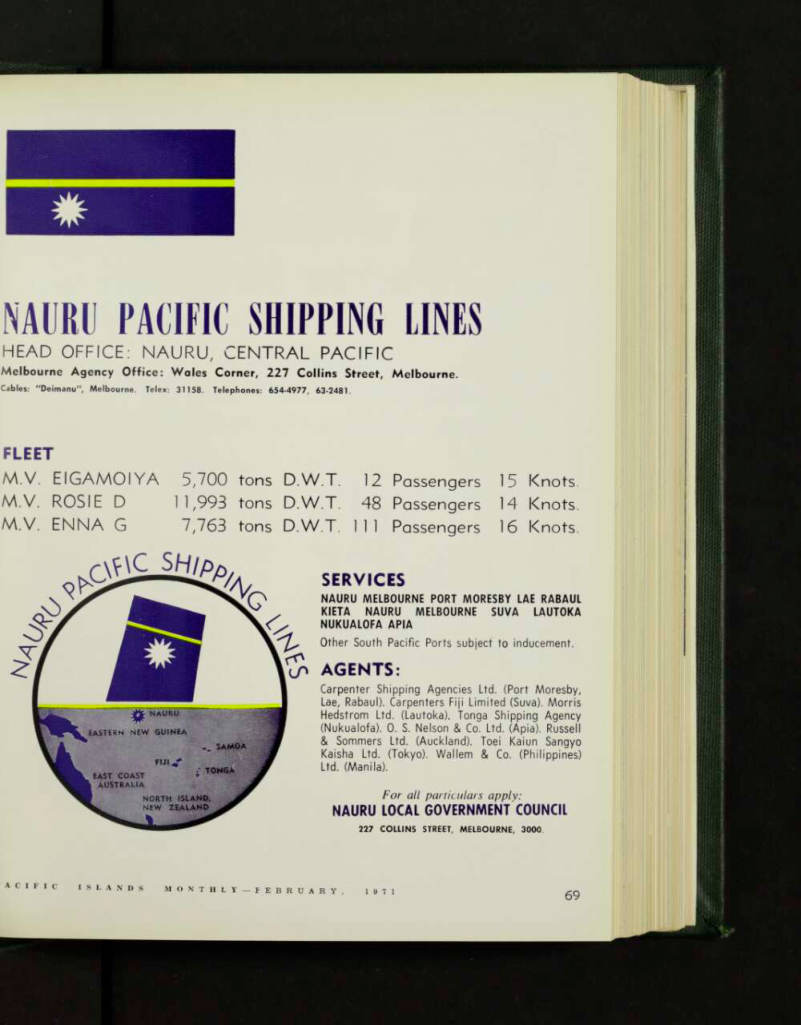 73
73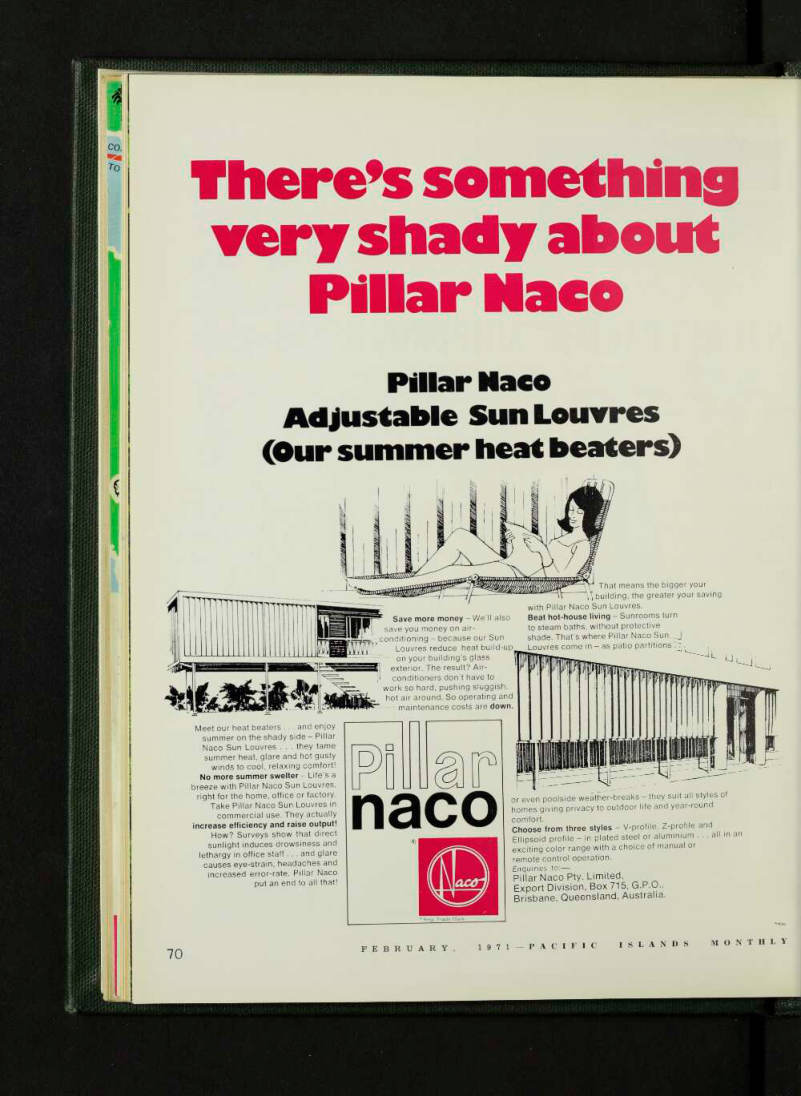 74
74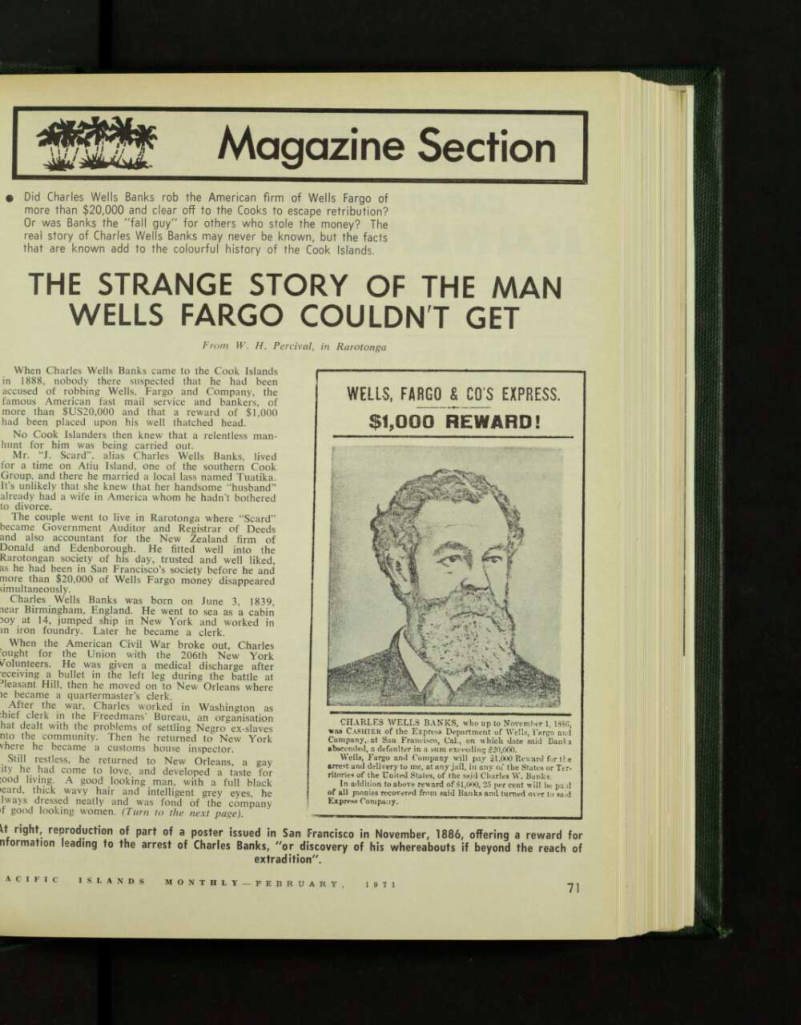 75
75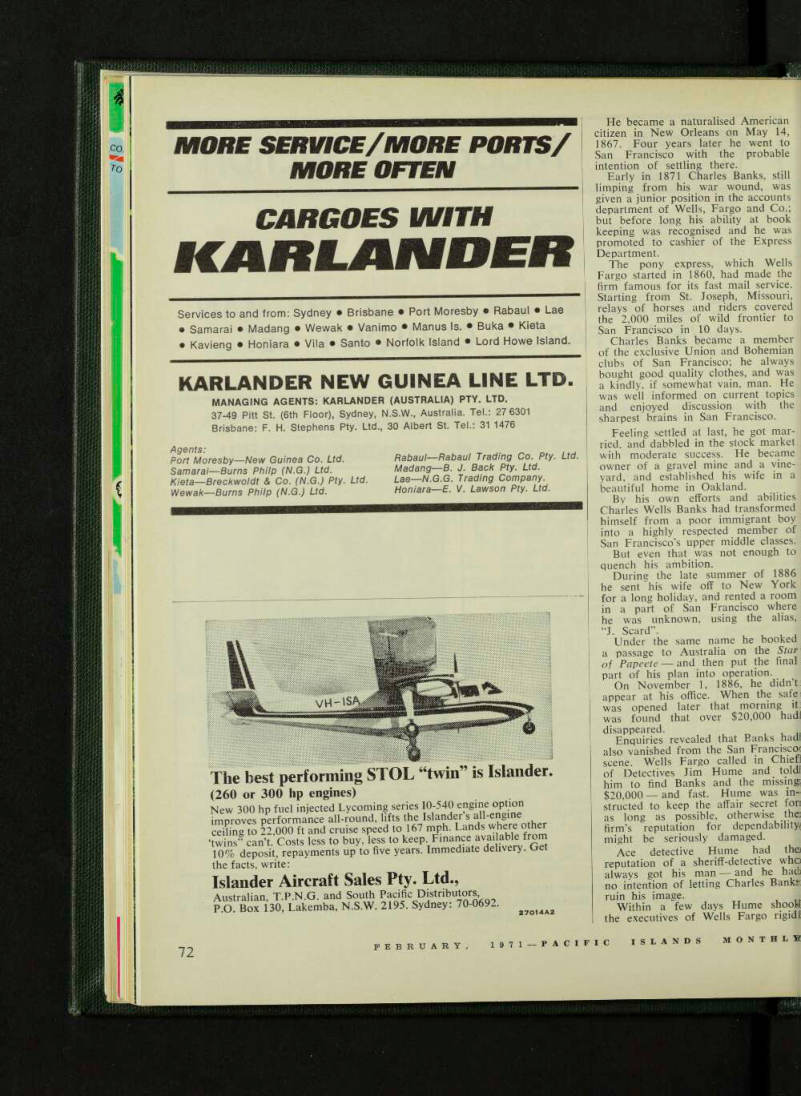 76
76 77
77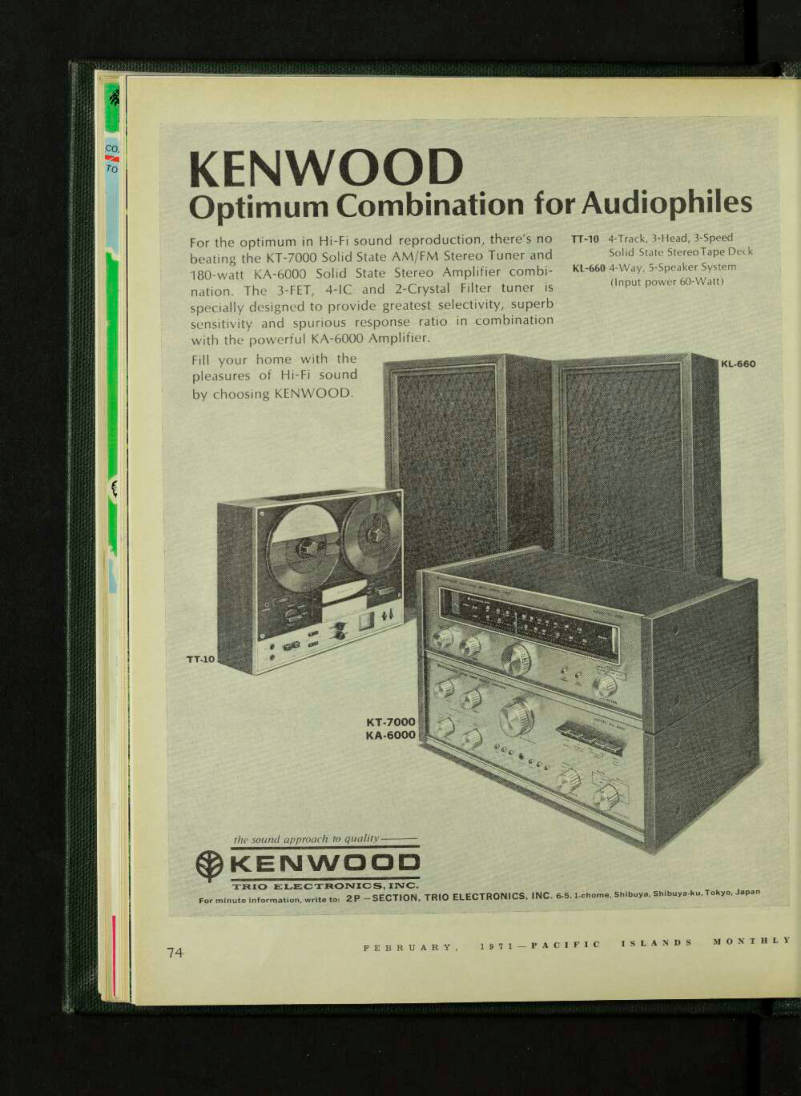 78
78 79
79 80
80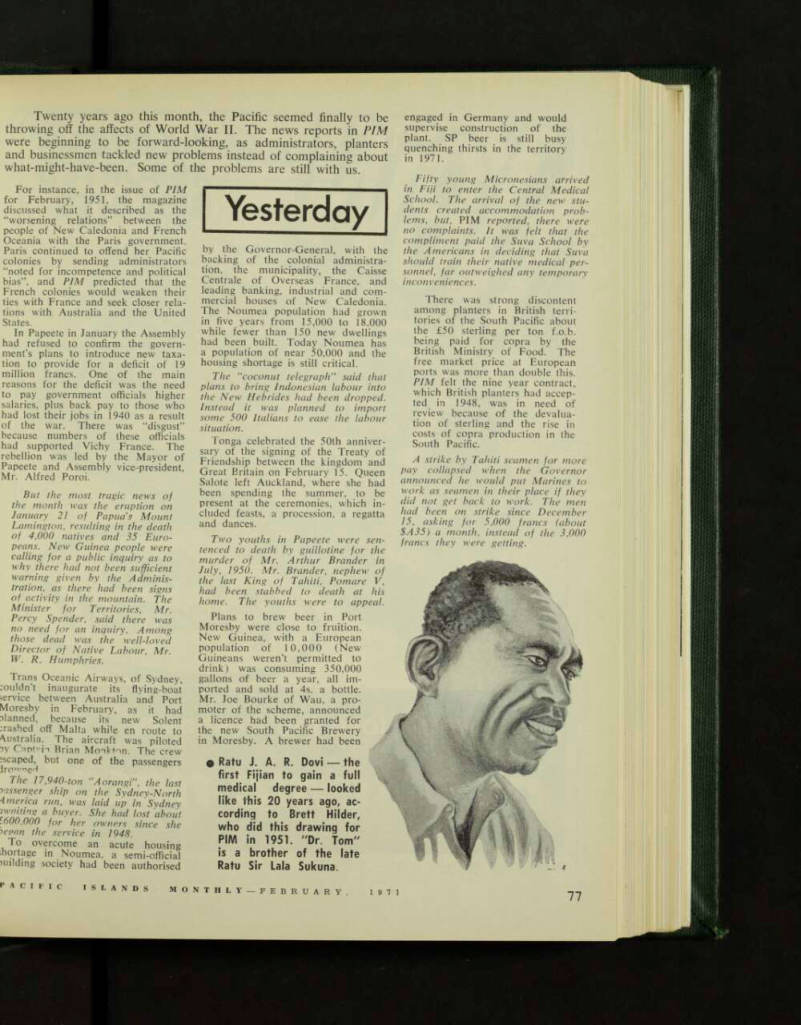 81
81 82
82 83
83 84
84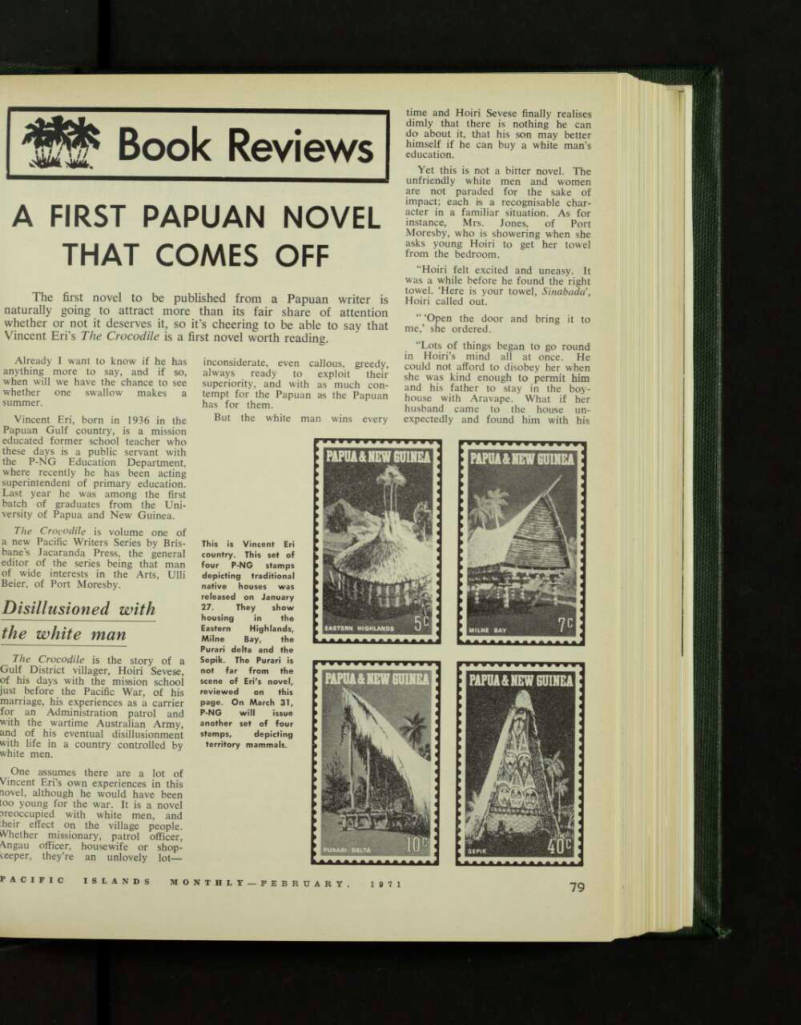 85
85 86
86 87
87 88
88 89
89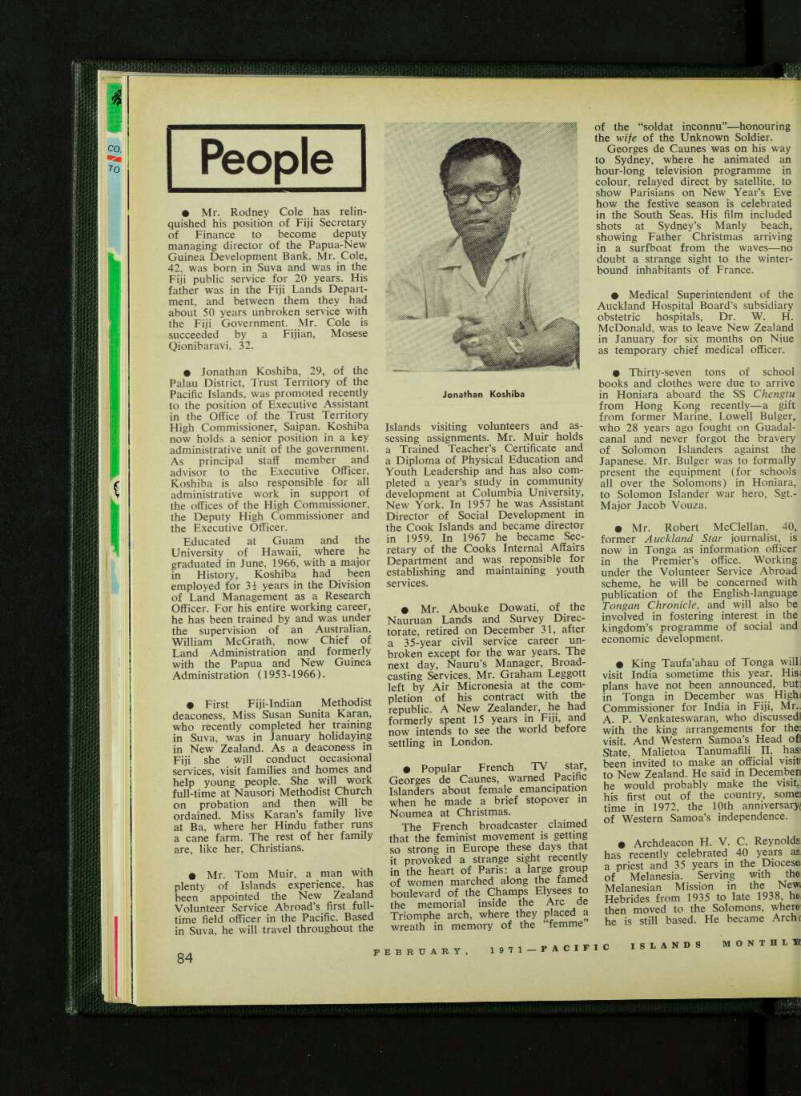 90
90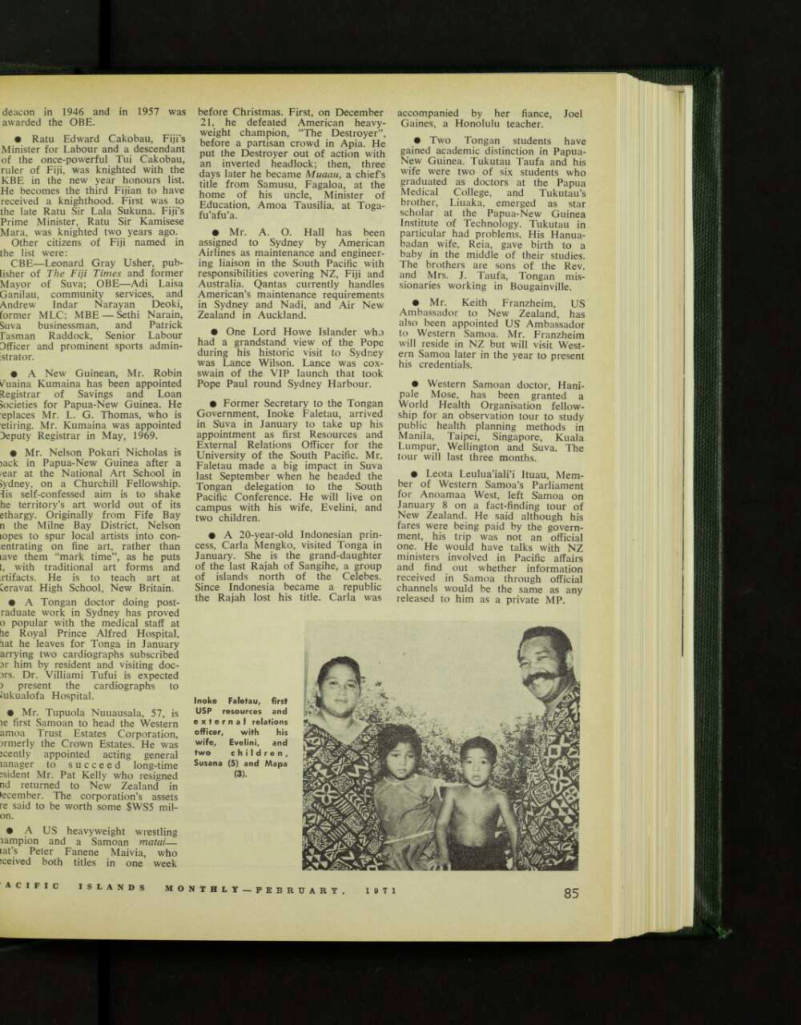 91
91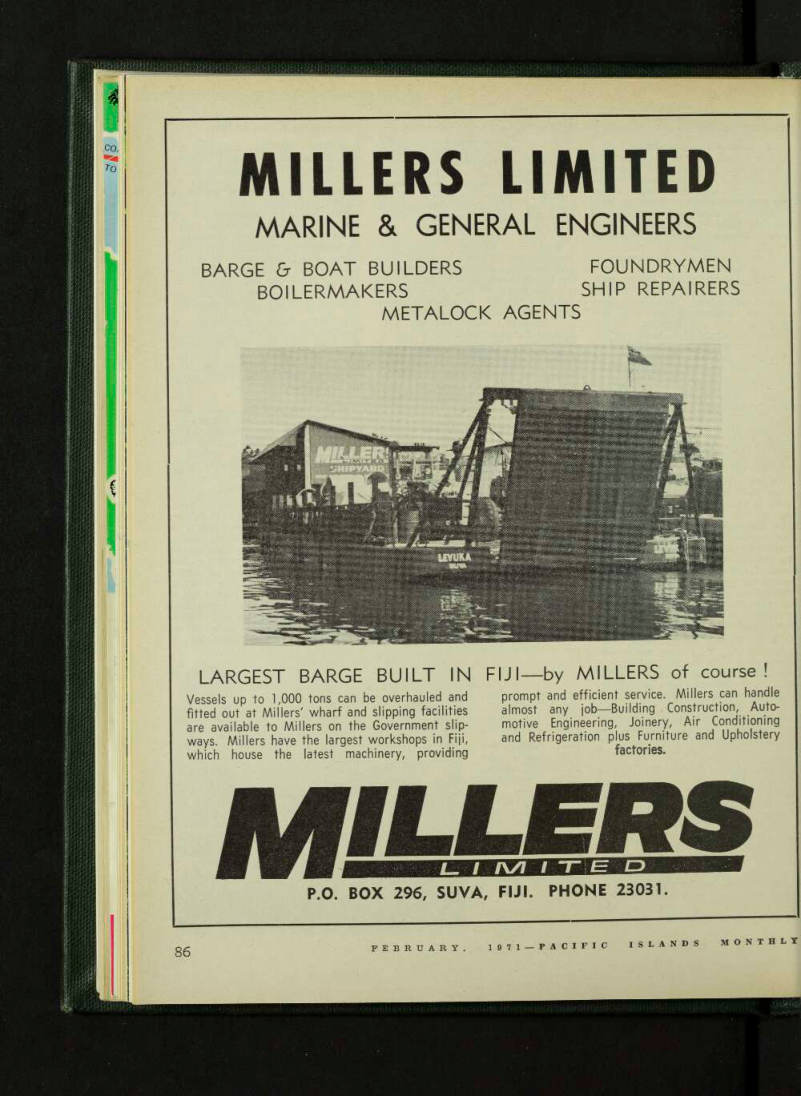 92
92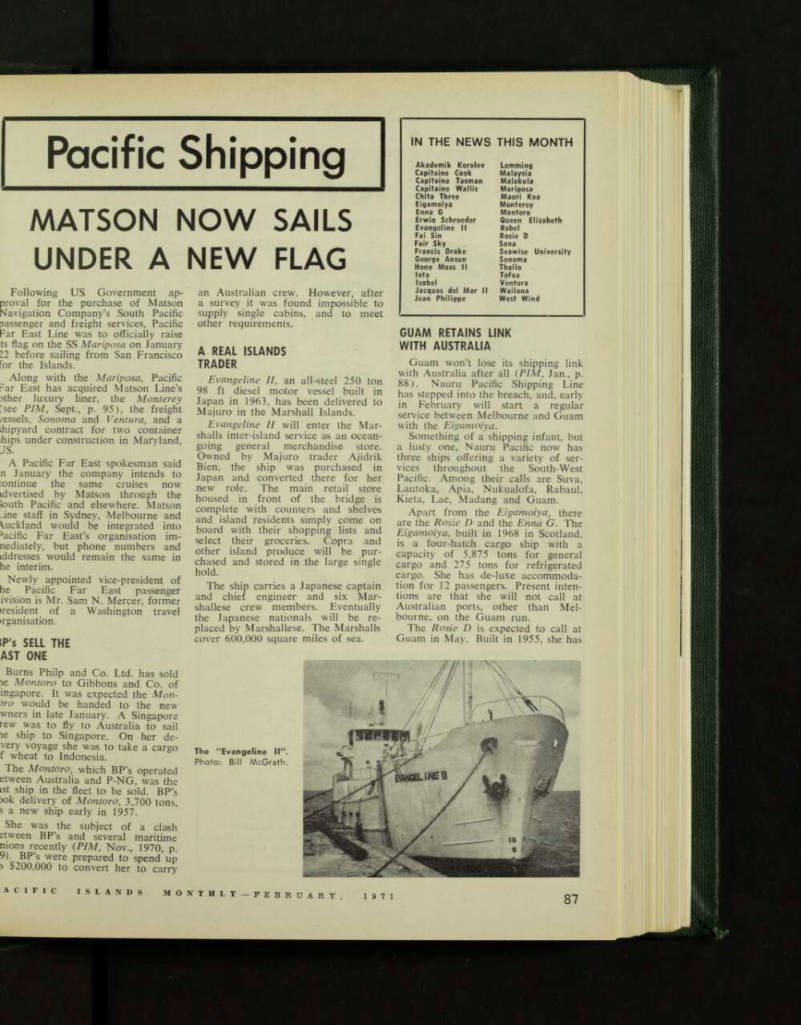 93
93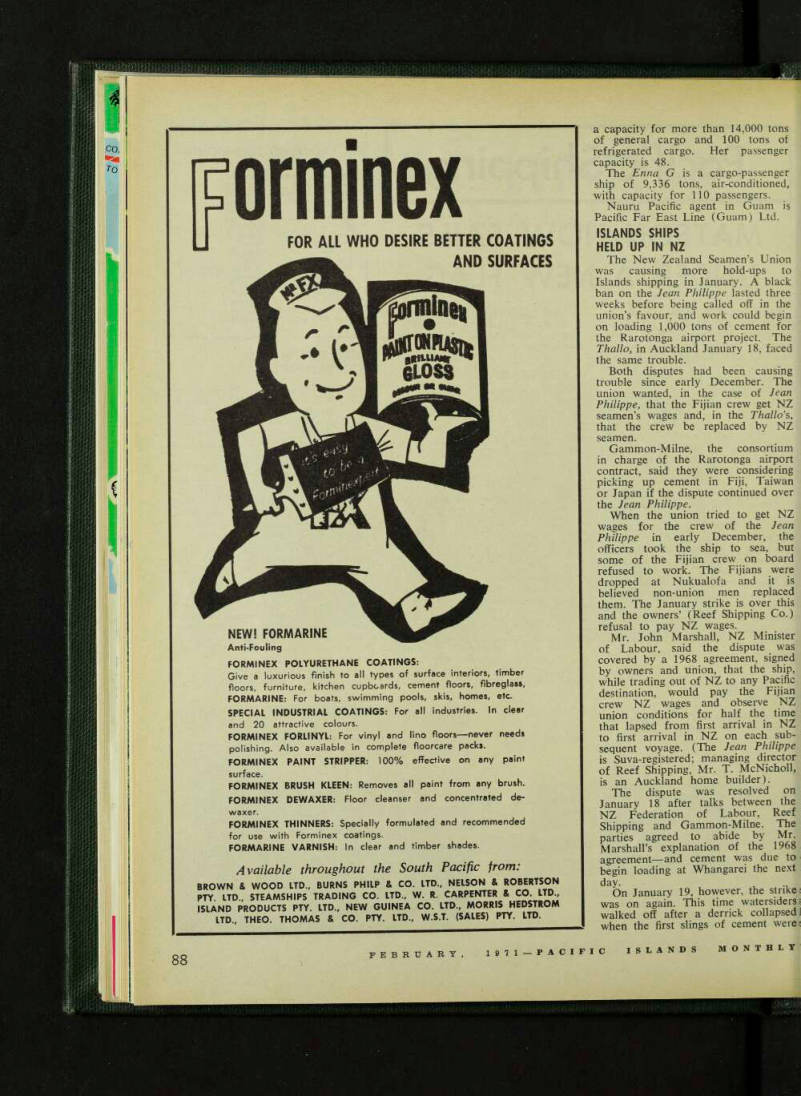 94
94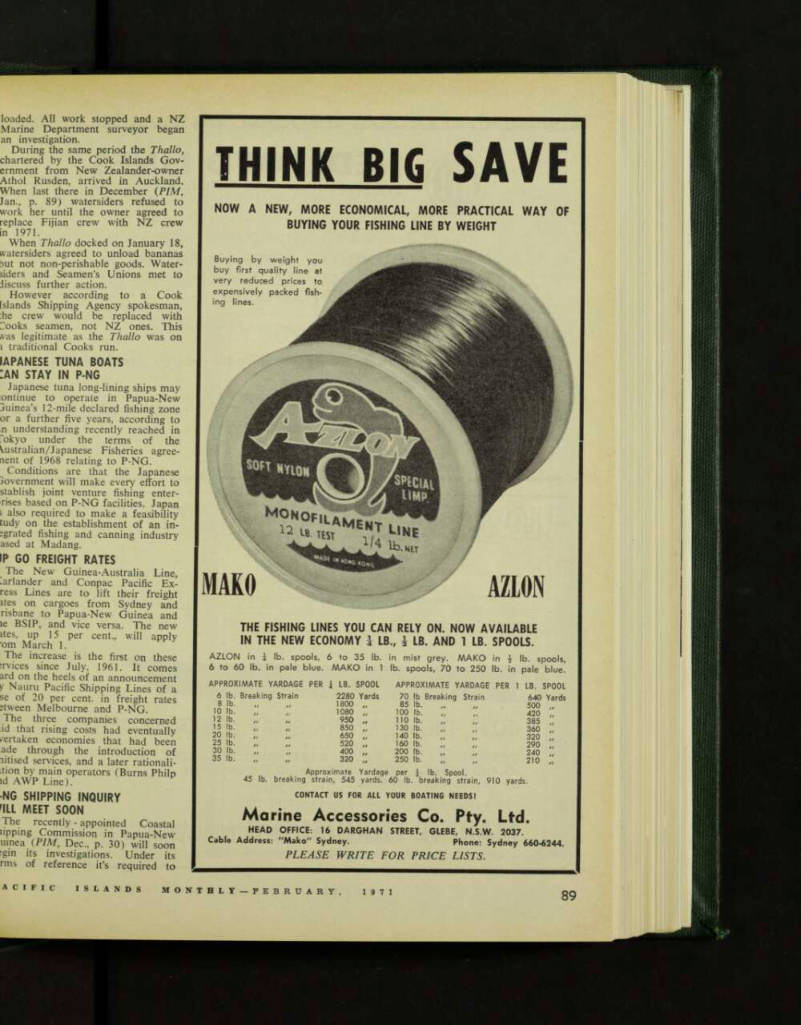 95
95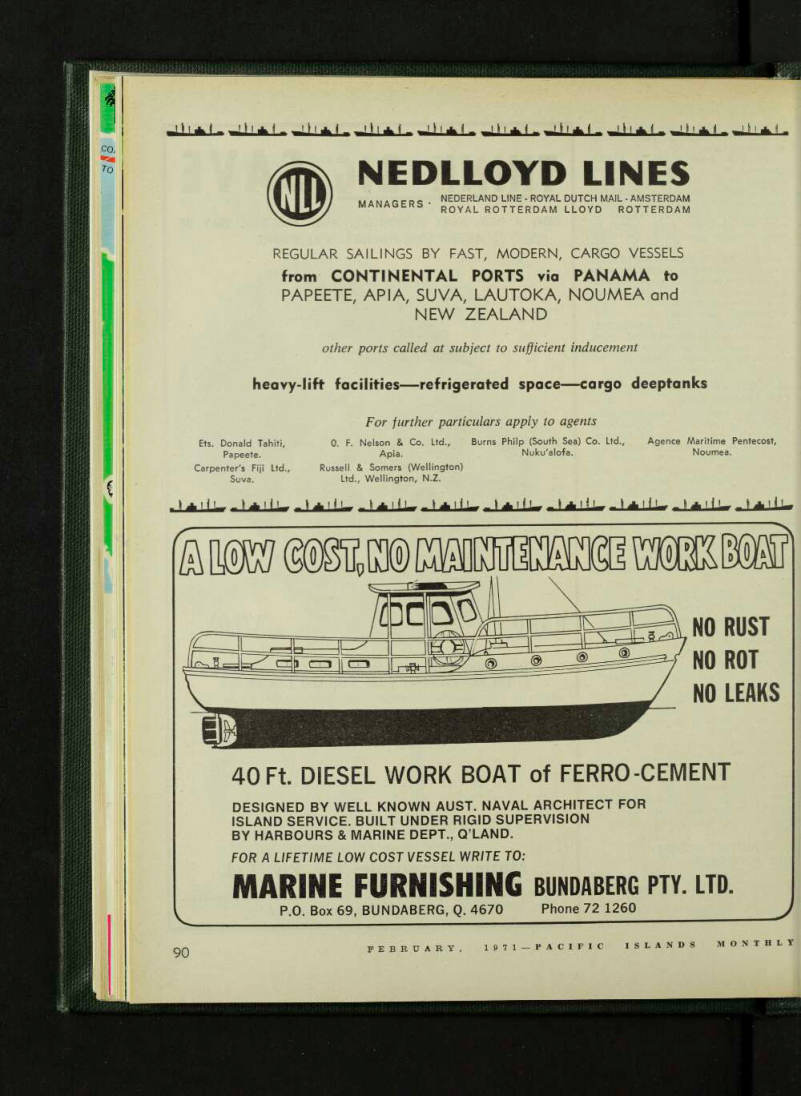 96
96 97
97 98
98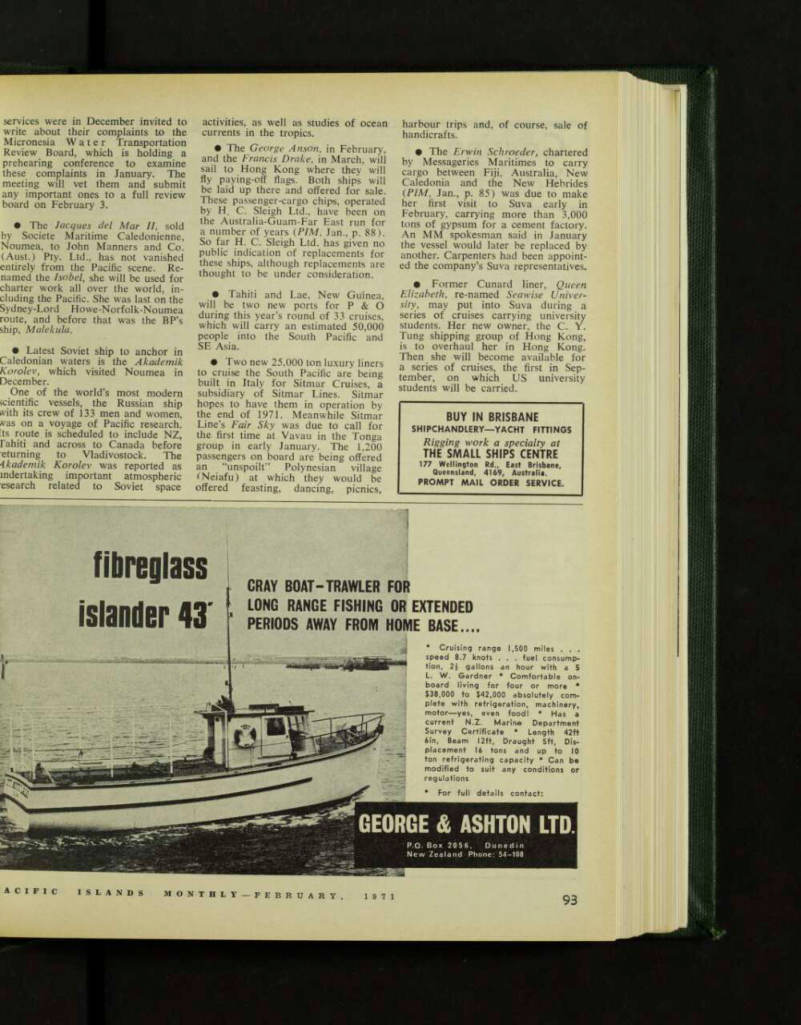 99
99 100
100 101
101 102
102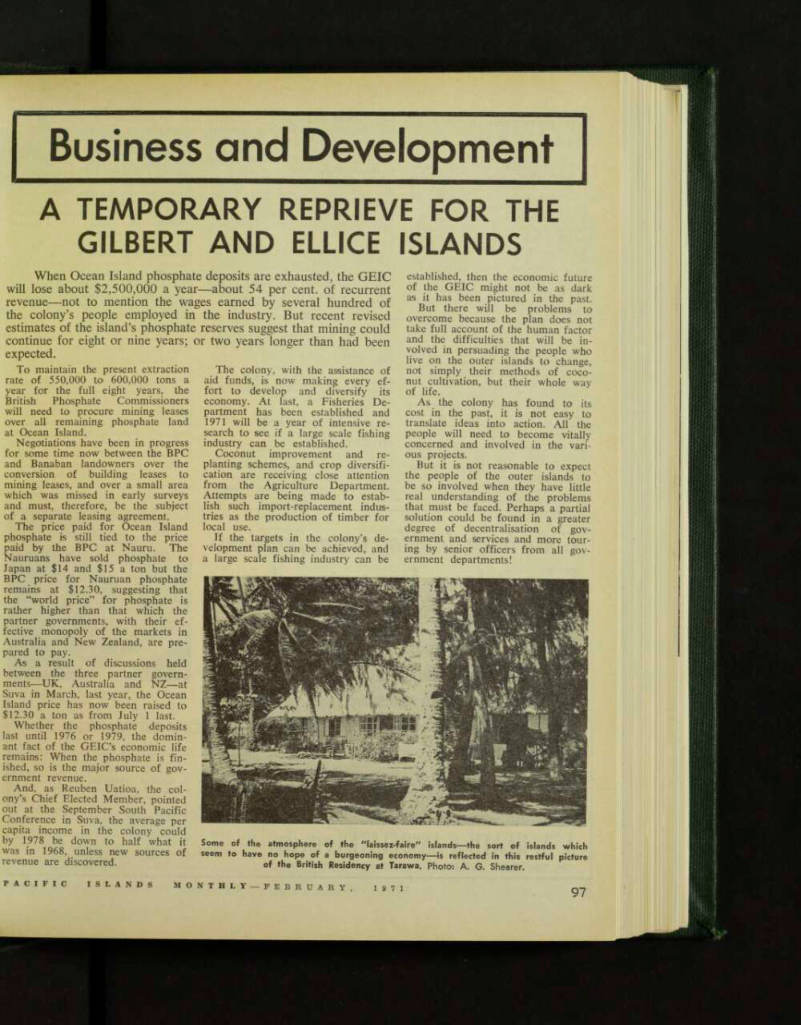 103
103 104
104 105
105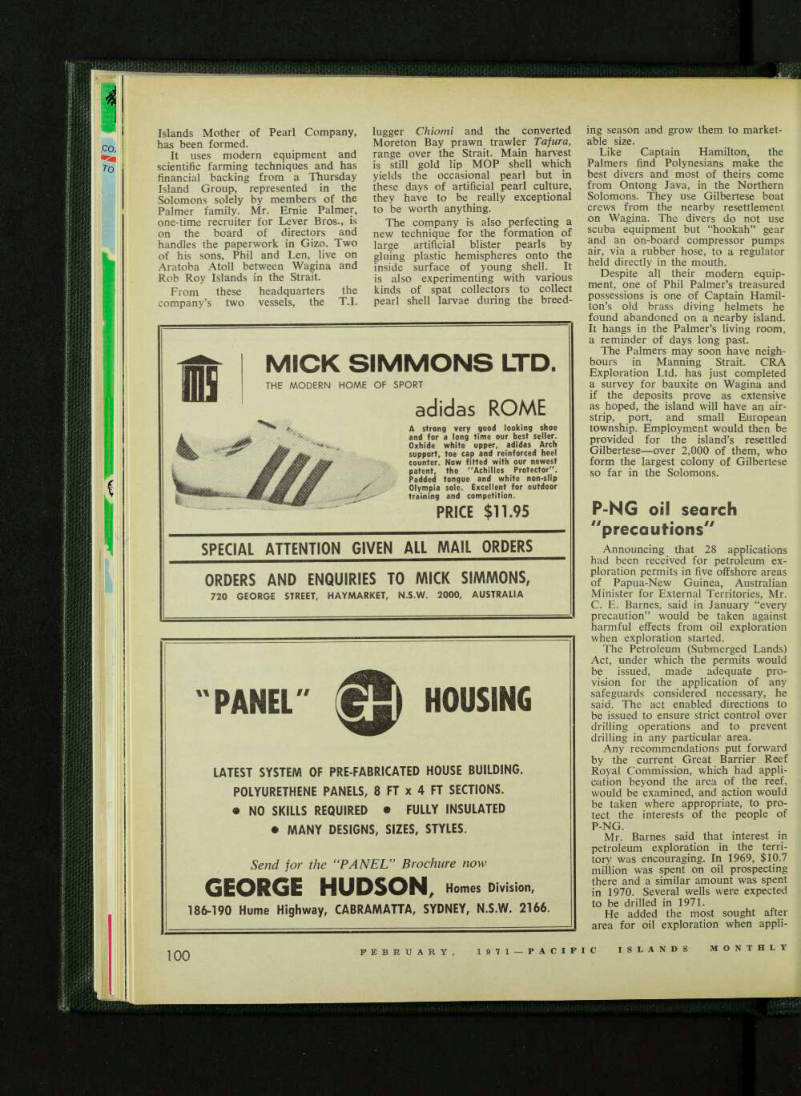 106
106 107
107 108
108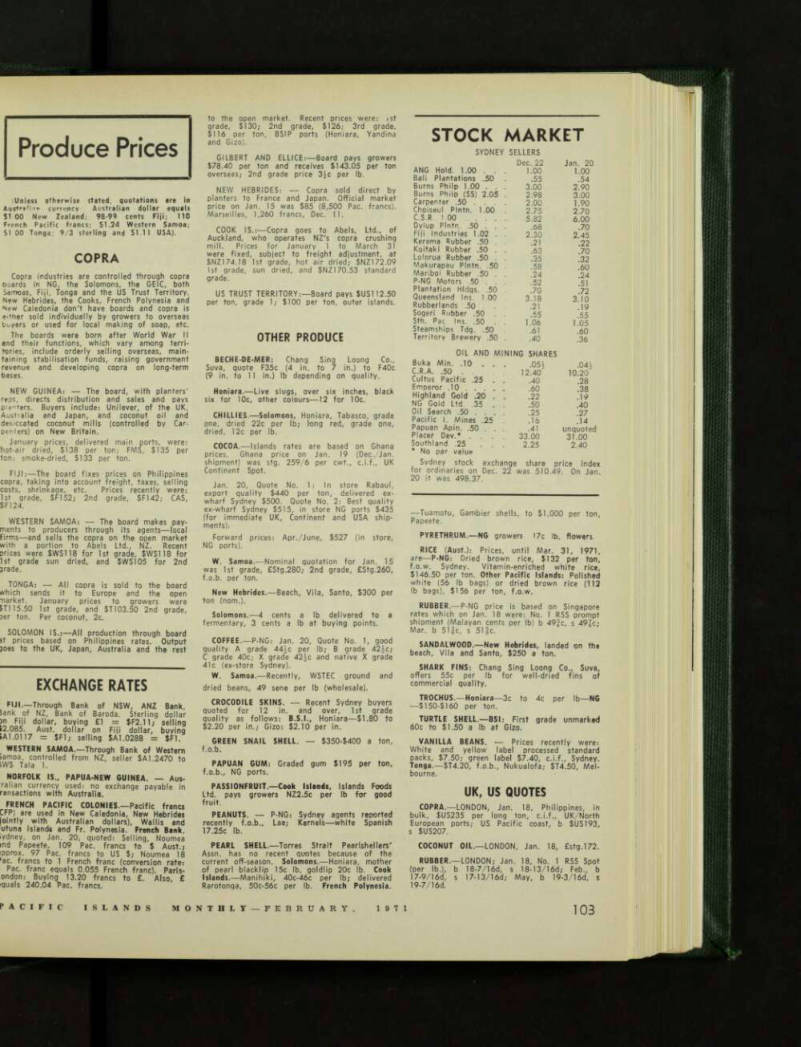 109
109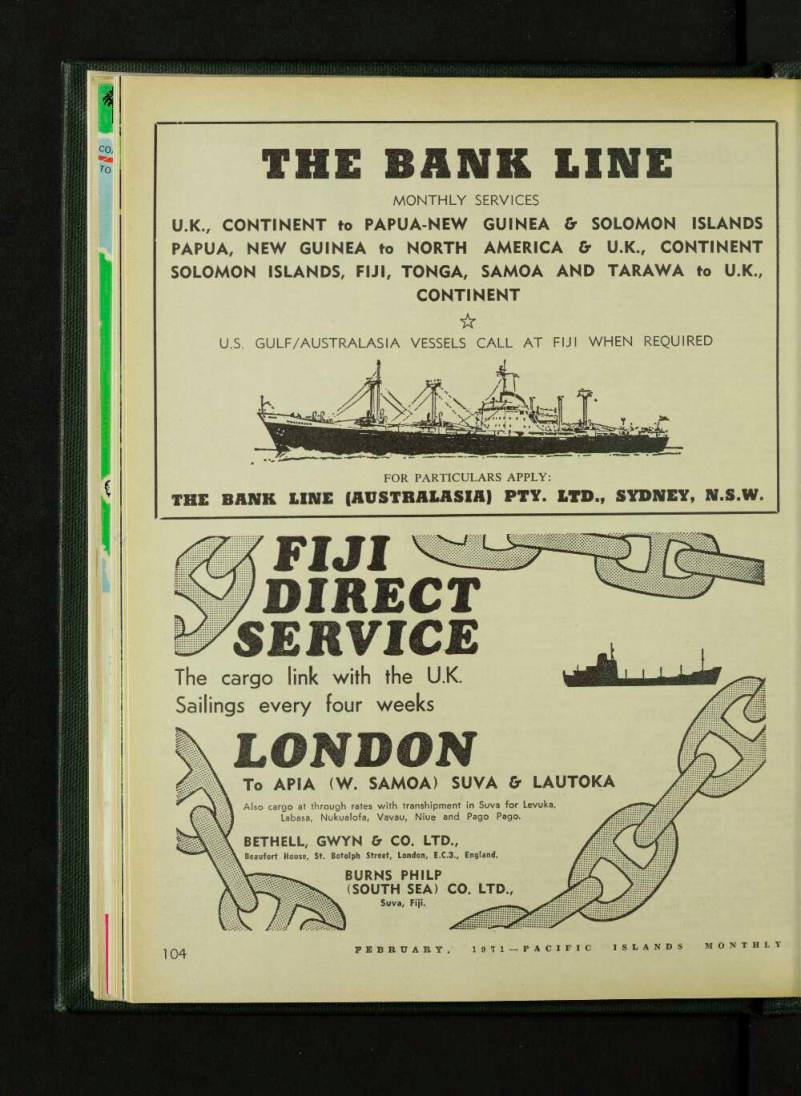 110
110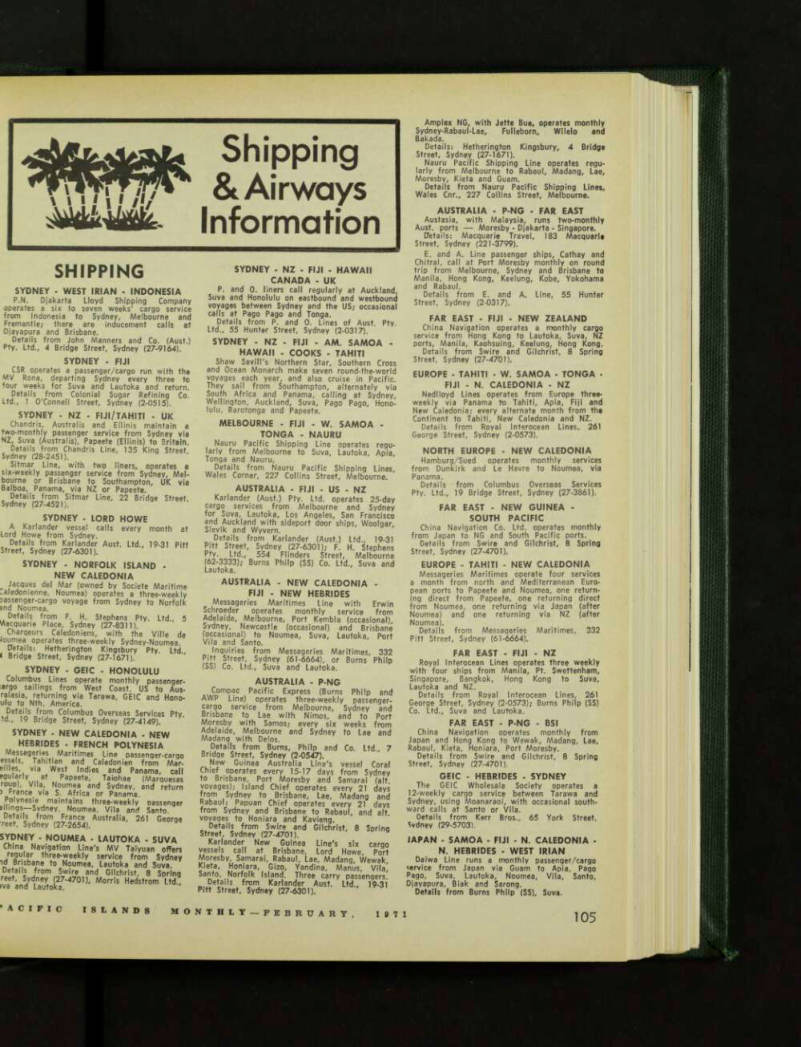 111
111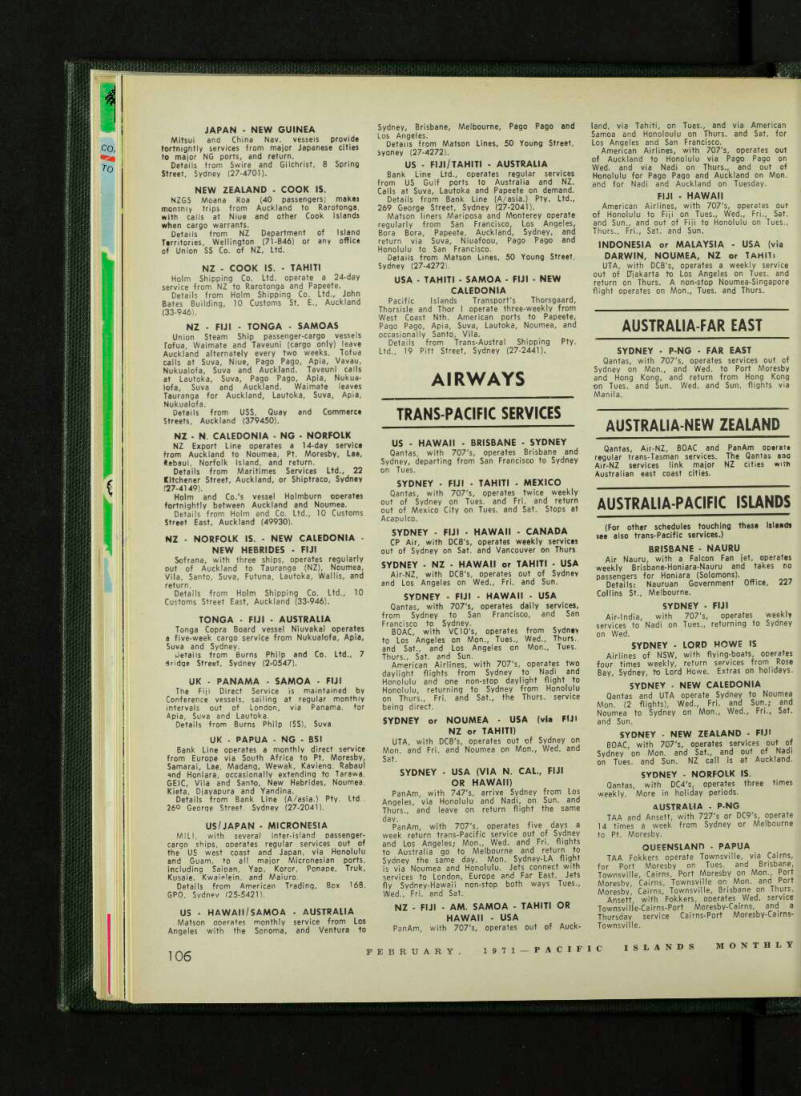 112
112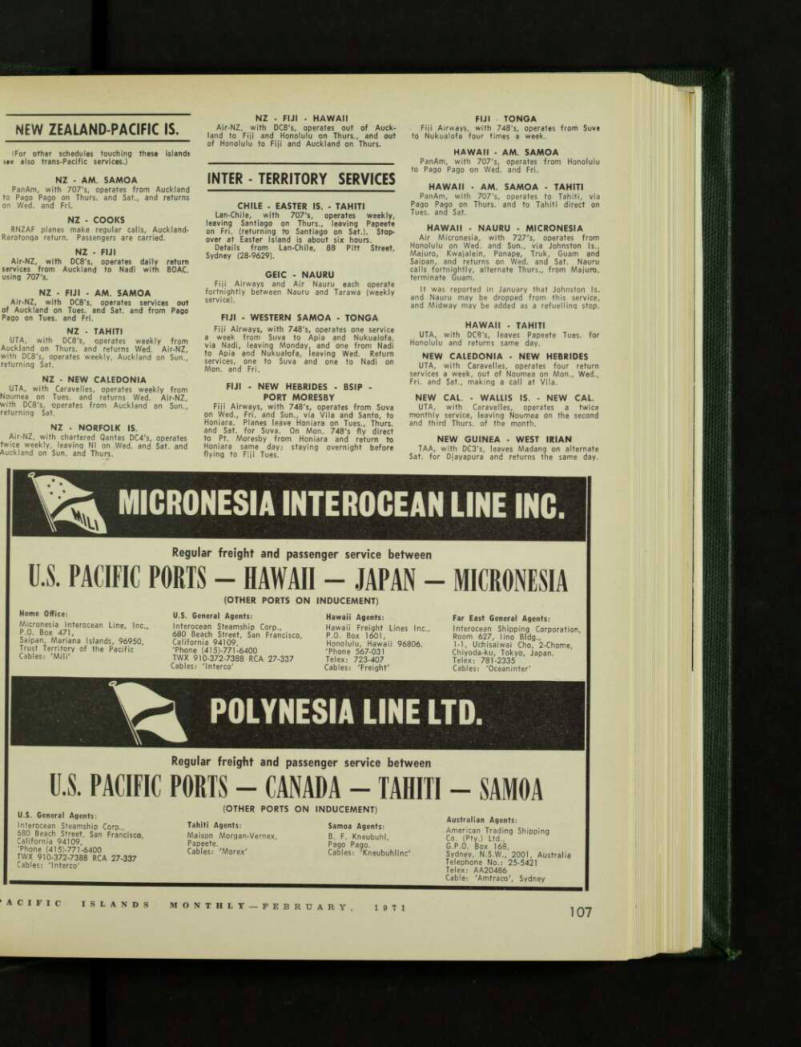 113
113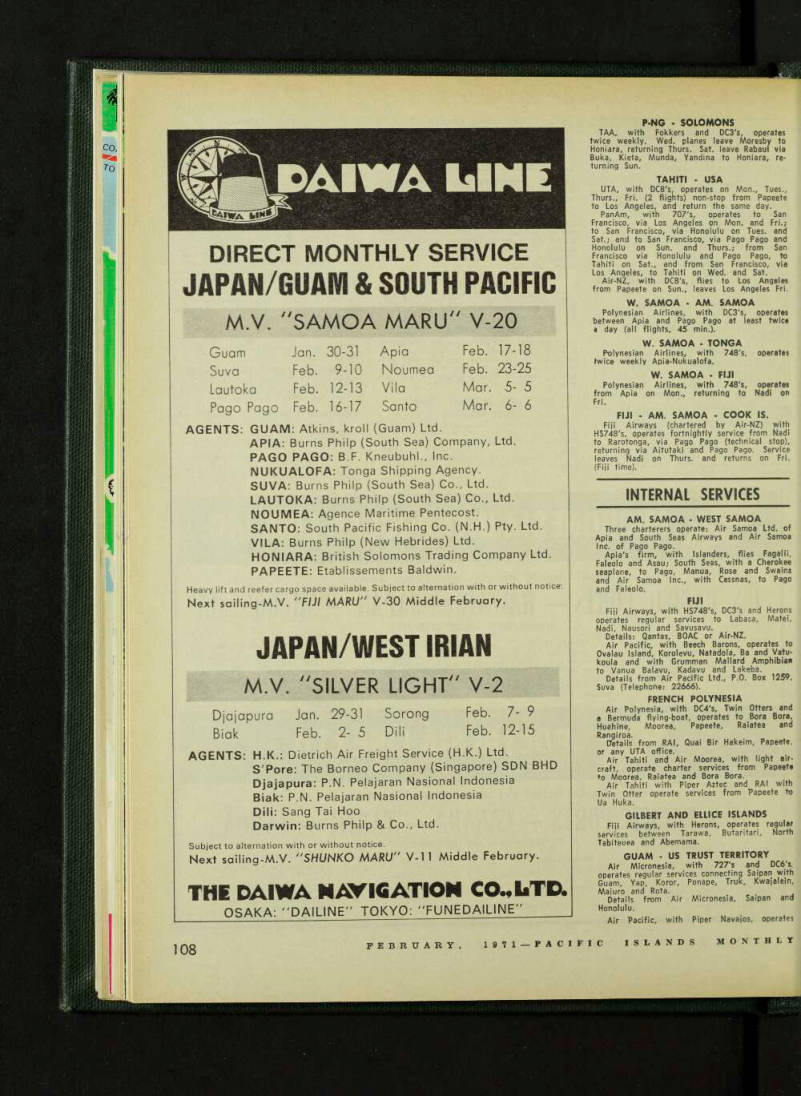 114
114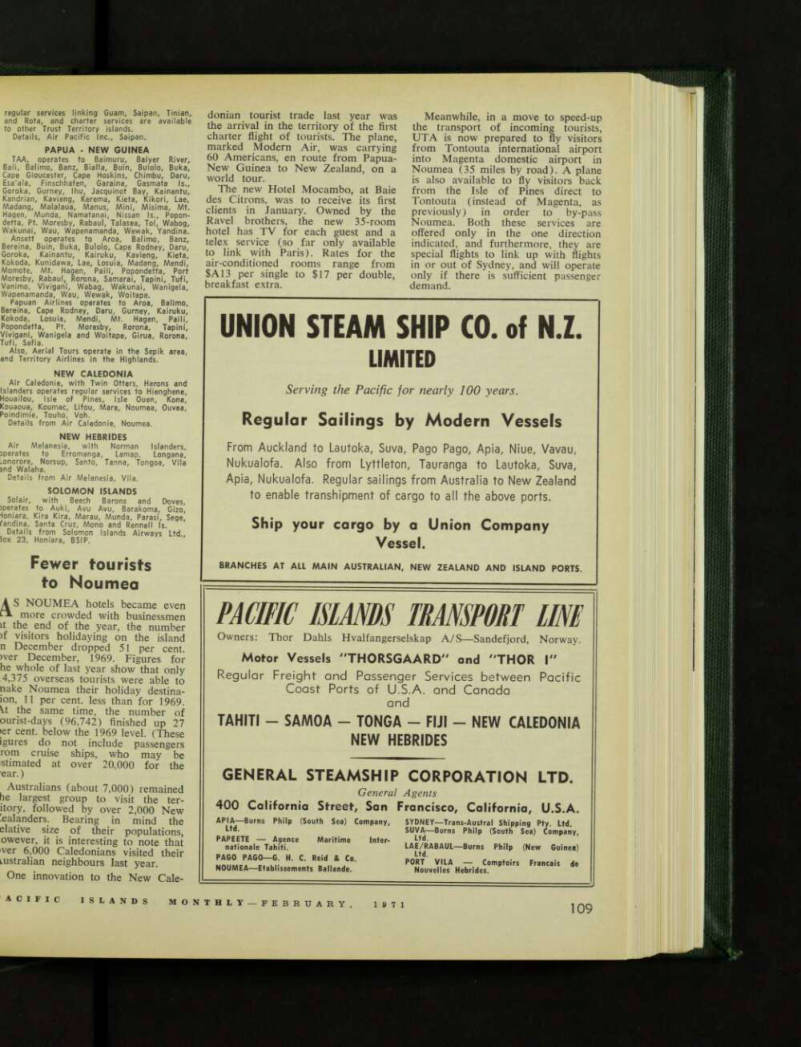 115
115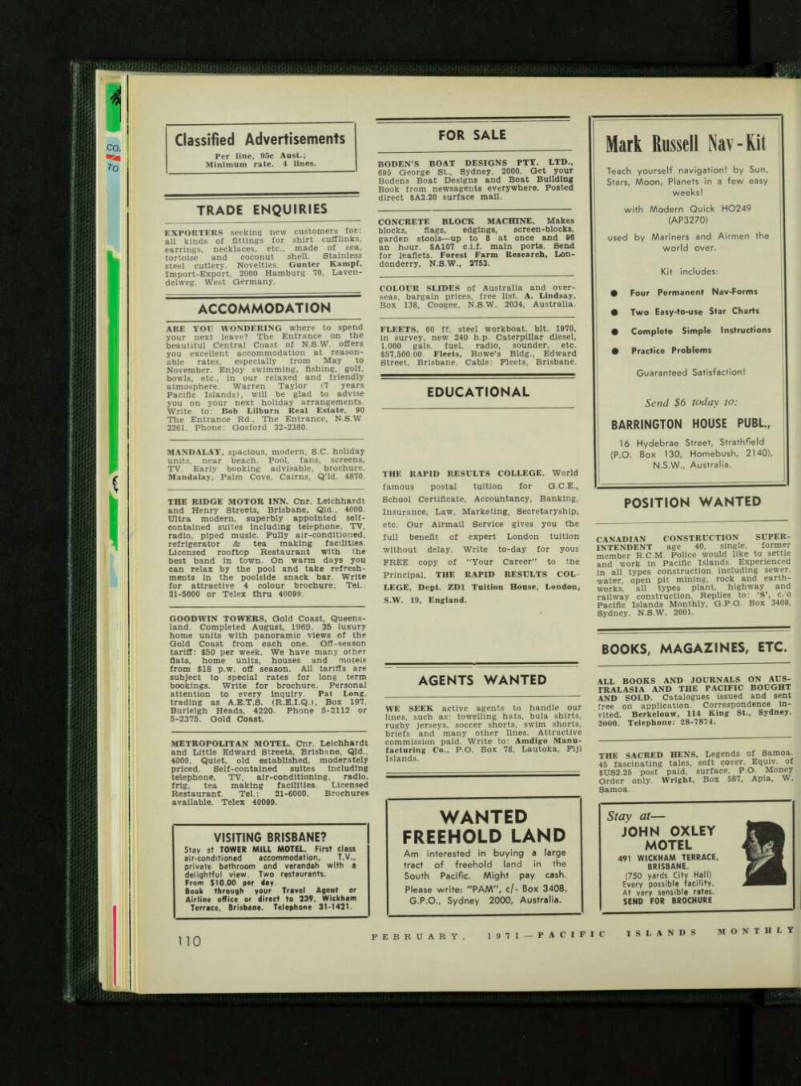 116
116 117
117 118
118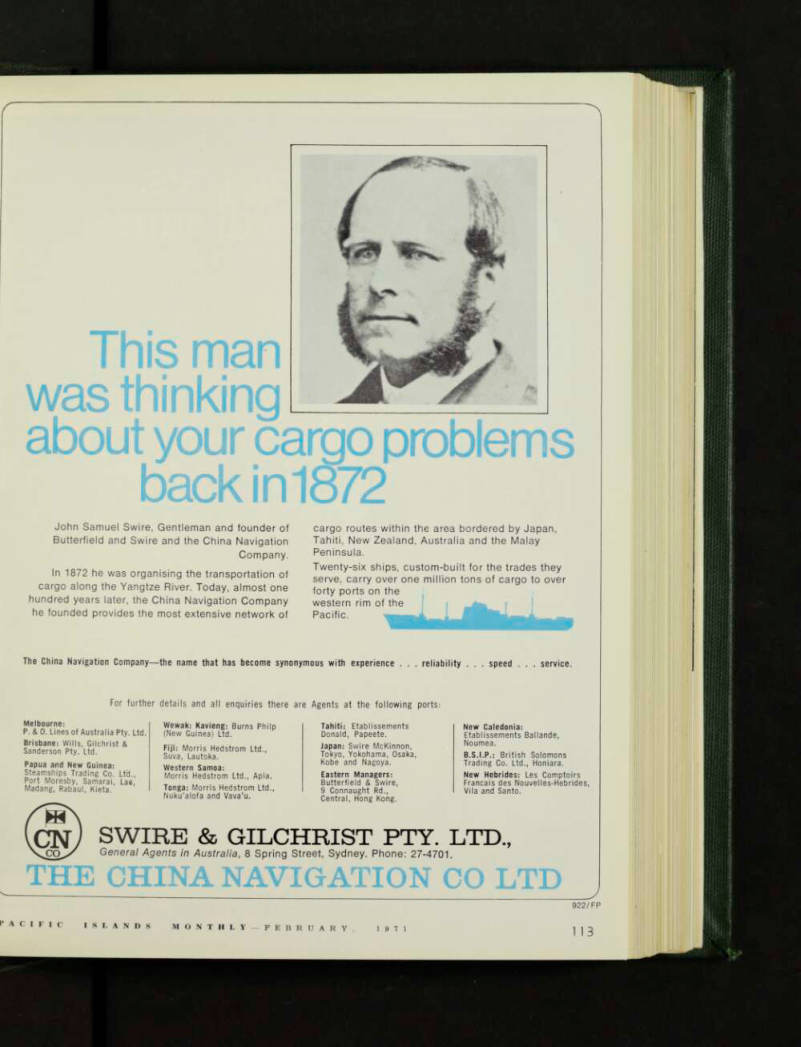 119
119 120
120 121
121 122
122 123
123 124
124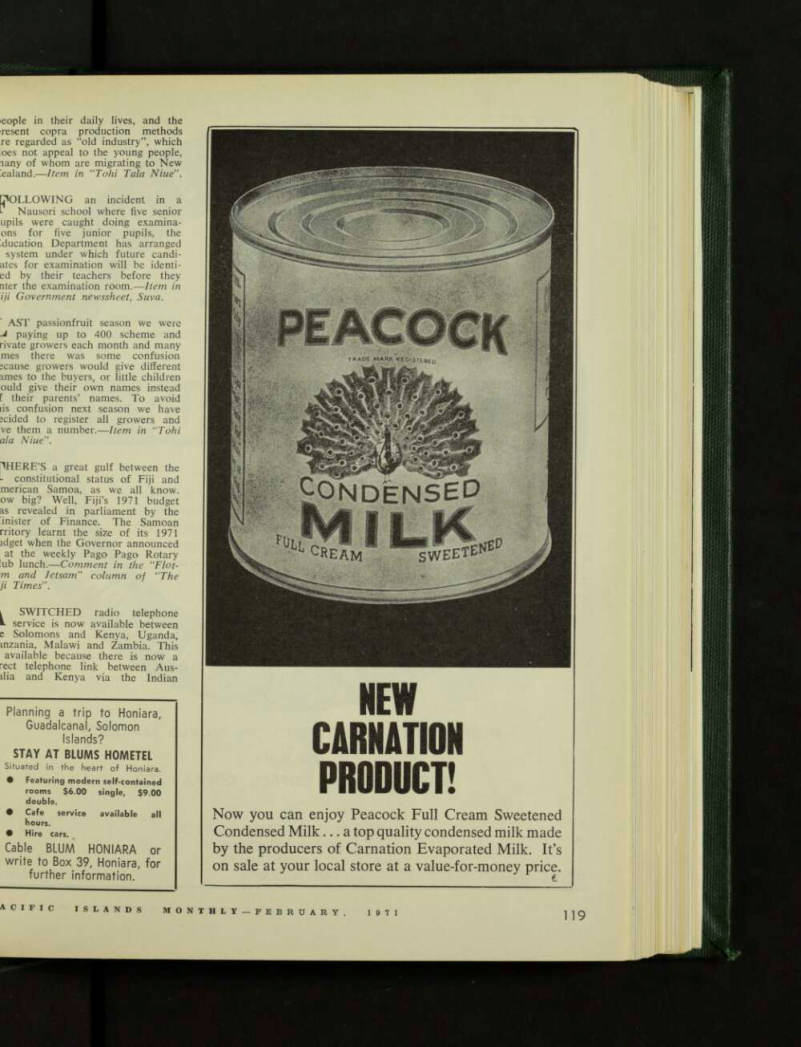 125
125 126
126 127
127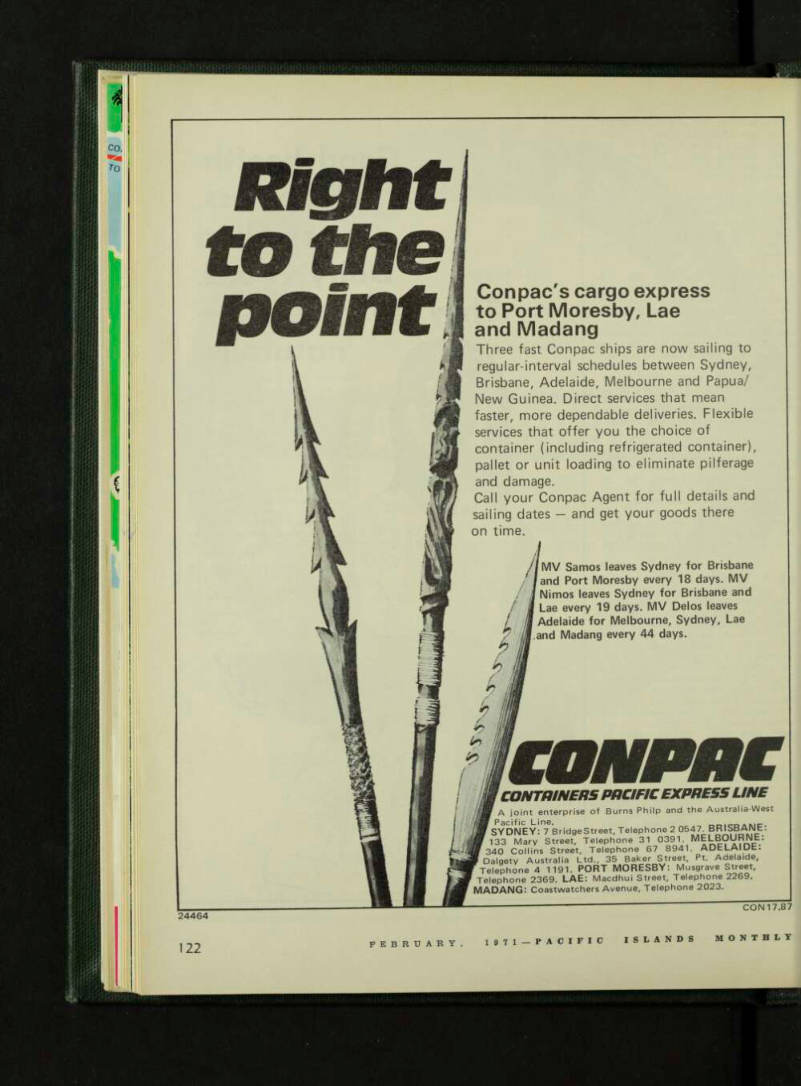 128
128 129
129 130
130 131
131 132
132 133
133 134
134 135
135 136
136 137
137 138
138 139
139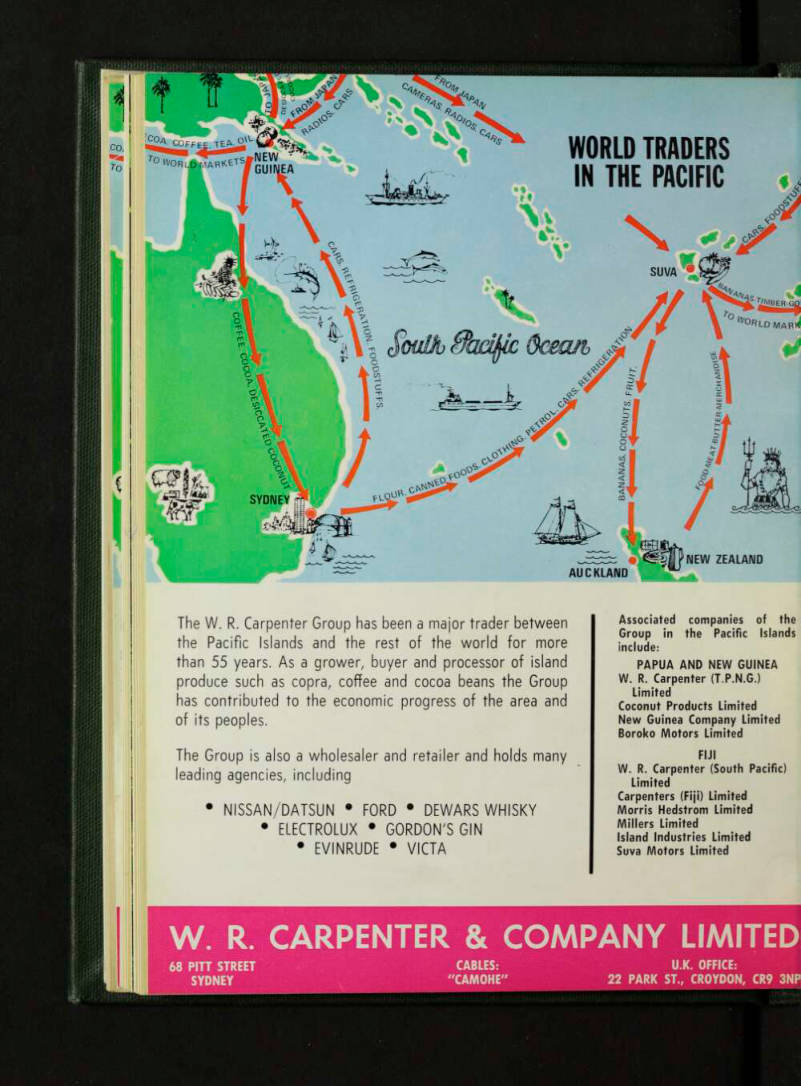 140
140