Pacific Islands Monthly


News Magazine Of The South Pacific
January, 1971
Australia, Nz, Geic, Bsip 50C
P-NG, FIJI, COOKS, TONGA, W. SAMOA, N. HEBRIDES 45c
Nauru, Norfolk, Niue 45C
AMERICAN SAMOA 70c HAWAII 80c MICRONESIA 90c NEW CALEDONIA 65 CFP FRENCH POLYNESIA 75 CFP
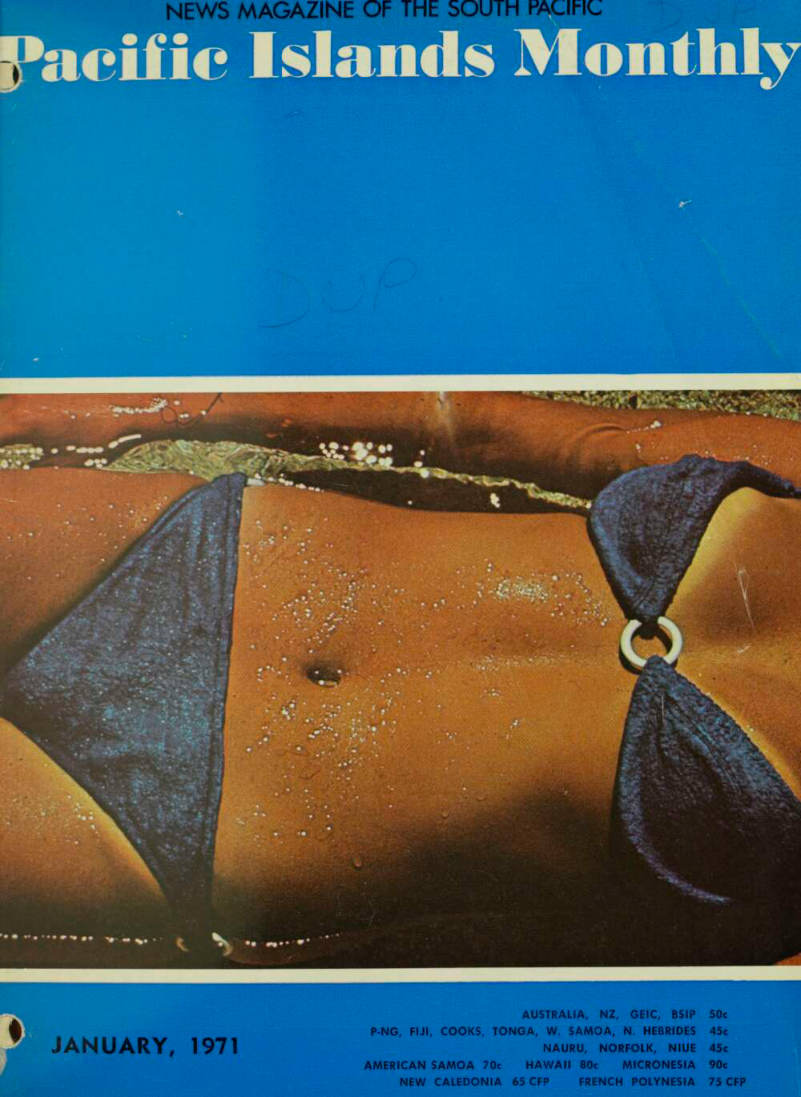
Our Cover
Who is she? We don't know, so let’s just call her an anonymous seeker of the South Seas sun, one who typifies the thousands of sun seekers who are currently filling the hotels, the bars, the swimming pools of the South Seas tourist resorts this hot January. Lee Pearce took the photograph of the young lady’s midriff at the Fijian Hotel, near Sigatoka, although the pho tographer himself this January is far away from the summer he captures so well—in cold London.
Advertisements & other items, pp. 2-16 (2 items)
The long and short of the COLT GALANT
With the Galant, the distance between two points is short, with long intervals between stops for fuel. Low fuel consumption and trouble free performance make the reasonably priced Galant long on economy. The long sloping hood and short deck give the Dyna-wedge Galant a fresh sporty look. Spacious interior, reclining urethane foam seats, tilt steering wheel and multi-use con trol lever are but a few of the features that make the Galant longer on luxury and safety. Choose either of Galants two powerful Saturn engines, 87 or 95 HP. See your dealer today for the long and short of the Colt Galant! s J i
MITSUBISHI
MOTORS CORPORATION
formerly Motor Vehicle Headquarters, of Mitsubishi Heavy Industries, Ltd.
world
quality
I* Only the world’s finest Virginia tobaccos are blended to produce ...
PLAYER’S
GOLD
LEAF
one of the great cigarettes
■x>: I I I mm IK
■■■HMiammi
SI a The colourful asbestoscement wall sheeting—for bathrooms, kitchens and laundries.
E&Svij
3STEW
DURADEC
Comes to you in an exciting new colour range—midnight blue, deep olive, dove grey, tropical sand, carnation. It's a top fashion, net pattern sheet—at a low-cost budget price. It's scrubbable, washable, wear and scratch-proof—highly resistant to soaps, mild acids, alkalis, heat and steam.
A must for new homes, ideal for renovating older homes.
FREE COLOUR CATALOGUE AVAILABLE
LTD
Head Office: 393 Cleveland Street, Redfern, Sydney, N.S.W., Australia. Phone 69-0366.
&.Pf, ' #1 A \LA
THE PACIfIC
HJI,SAMOA,TONGA,NIUE IS,NORFOIK Is.
BURNS PHILP
[SOUTH SEA! CD. LTD.
REGISTERED OFFICE: SUVA, FLU
TELEPHONE NO: 22661
TELEX NO: FJ1127
Code Address: "BUF^OJUW
SHIPPING AGENCIES
The New Zealand Shipping Co. Ltd.
Shaw Savill & Albion Co. Ltd.
Blue Star Port Line (Management) Ltd.
Bank Line Ltd.
General Steamship Corporation Ltd.
Compagnie des Messageries Maritimes Royal Interocean Lines Daiwa Navigation Company Ltd.
Sitmar Line Flotta Lauro (Lauro Lines) Australasia Pty. Ltd.
Tonga Shipping Agency.
EXCLUSIVE
DISTRIBUTORSHIPS
INCLUDE
Akai Taperecorders Sunbeam Appliances Dunlop Products Hitachi Electronics Holden Motor Vehicles Rolex Watches Revlon Cosmetics Pentax Cameras Massey-Ferguson Tractors Olympic Tyres Penfold Wines
AGENTS FOR
Queensland Insurance Co. Ltd.
Shell Company (P.L) Ltd.
Bureau Veritas
ASSOCIATED COMPANIES
Burns Philp (New Hebrides) Ltd.
Burns Philp Trustee Co. Ltd.
Automotive Supplies Co. Ltd.
Corrie & Co. Ltd.
Wrought Iron and Steel Construction Co. Ltd.
Bish Ltd.
SPECIALISED SERVICES
Expert advice on Shipping; Forwarding; Customs formalities; Insurance.
COMPLETE TRAVEL
SERVICE
accredited agents for the
INTERNATIONAL AIR
TRANSPORT ASSOCIATION
OVERSEAS AGENTS: SYDNEY • LONDON • SAN FRANCISCO
Act now to make 1971—and all the rest of the Seventies —year that are just as enrichi as you'd like them to With Sansui quality st( A truly professional control amplifier is a great way to start, and with Sansui you can choose from among the 100 watt AU-666 or 85 watt AU-555A, both with Triple Tone Control circuit, or the compact 46 watt AU-222.
The all-new 2-speed Automanual SR-2050C turntable is an ideal program source, incorporating as it does the unique Sansui Auto Lift/Stop mechanisms, but the 2-speed manual SR-1050C is just as outstanding in its price range.
For speaker systems, the 40 watt SP-150 or 30 watt SP-70, both of which combine high performance with rare beauty, are a good way to spread the cheer.
And the 2-way 4-speaker SS-20 stereo headphone set is a very special way to keep it to yourself.
Whatever your choices, your nearest authorized Sansui dealer will be happy to demonstrate them. Start the new year right and make a resolution to see him soon. stereo.
Matching components, matchless stereo. f.
See the Sansui exhibit aboard the SAKURA MARU when it comes to your area LTD. P.O. Box 183, Nadi, Fiji Islands Tel. 70183 / SERVONNAT Rue des Polius, Tahitiens Papeete, Tahiti OCEANIA INDENT AGENCY P.O. Box 5518, Boroko, Port Moresby, Papua & New Guinea. Tel. 56406 SANSUI ELECTRIC CO., LTD. 14-1, 2-chome, Izumi, Suginami-ku, Tokyo, Japan
The right plough for the job
W *• > m m
the right tractor for the plough
(The iVIFGS disc plough and MFI6S tractor) The MF6S looks as good as it works. Simple lines mean exceptional clearance beneath the beam and between the discs. It’s a fast worker at any depth shallow or deep. And a thorough worker in any condition hard soil, light soil or trash.
A wide variety of discs in 26" and 28" sizes are available to suit all conditions. Once-a-season lubrication is all they ever need. The tubular beam is super-strong. And you can add extra weight when the going gets too tough. The MF6S is easy to set up and easy to adjust.
The right tractor for the MF6S is the MFI6S.
Power has been increased to tackle tough jobs in tough conditions and you can have Multi-Power for 12 forward speeds and change-on-the-move.
Flip the switch to high for a 30% increase in speed. Flip it to low for more pulling power.
Without changing gear. And the 165’s Ferguson System Hydraulics give greater lift and precise implement control.
Put the MF6S disc plough and the MFI6S tractor together and you’ve got a job-matched team.
Use two and three furrow models for the MFI3S tractor.
MASSEY-FERGUSON
See your Massey-Ferguson Distributor now MF1194
Right
to the
point
Conpac's cargo express
to Port Moresby, Lae
and Madang
Three fast Conpac ships are now sailing to regular-interval schedules between Sydney, Brisbane, Adelaide, Melbourne and Papua/ New Guinea. Direct services that mean faster, more dependable deliveries. Flexible services that offer you the choice of container (including refrigerated container), pallet or unit loading to eliminate pilferage and damage.
Call your Conpac Agent for full details and sailing dates and get your goods there on time. / /i MV Samos leaves Sydney for Brisbane and Port Moresby every 18 days. MV Nimos leaves Sydney for Brisbane and Lae every 19 days. MV Delos leaves Adelaide for Melbourne, Sydney, Lae .and Madang every 44 days. f
CONTAINERS PACIFIC EXPRESS LINE
A joint enterprise of Burns Philp and the Australia-West Pacific Line.
SYDNEY: 7 Bridge Street, Telephone 2 0547. BRISBANE; 133 Mary Street, Telephone 31 0391. MELBOURNE: 340 Collins Street, Telephone 67 8941. ADELAIDE: Dalgety Australia Ltd., 35 Baker Street, Pt. Adelaide, Telephone 4 1191. PORT MORESBY: Musgrave Street, Telephone 2369. LAE: Macdhui Street, Telephone 2269.
MADANG: Coastwatchers Avenue, Telephone 2023. 24464
CON 17.8
EQUIPPED Ml Braybon
AHKIUARY POWER UNITS
11% At* Tl *9 m zw 3 » i M n m
hr. .Jfc
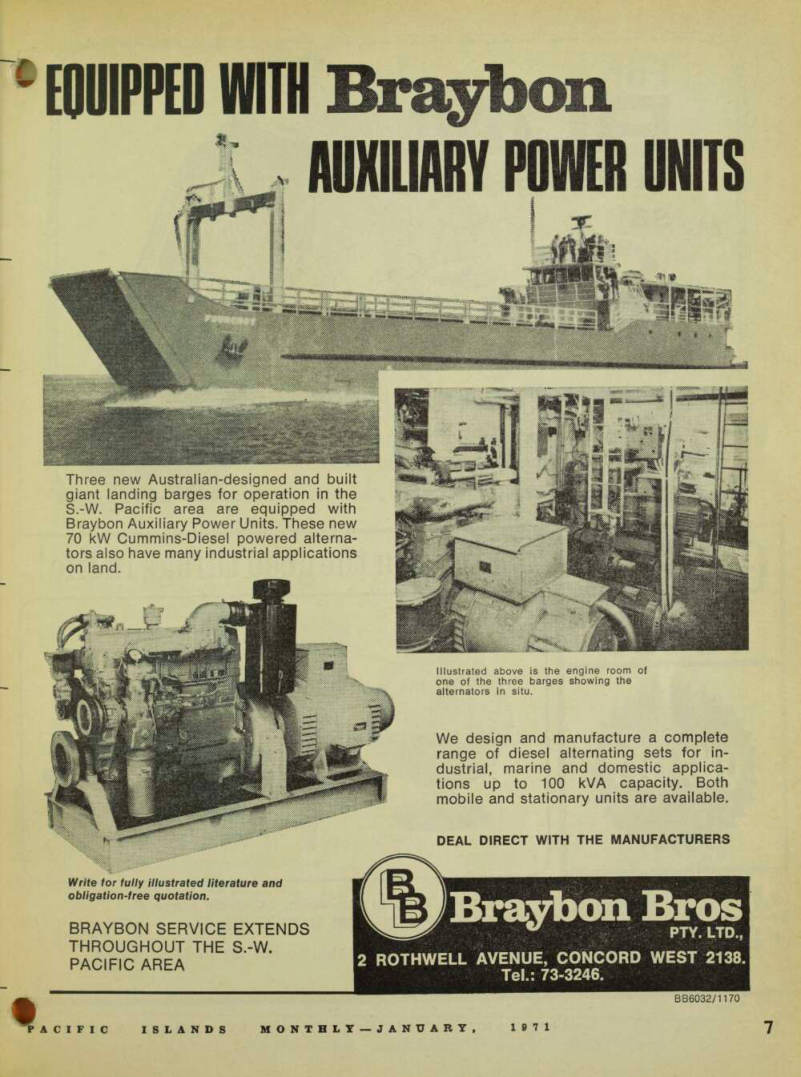
Three new Australian-designed and built giant landing barges for operation in the S.-W. Pacific area are equipped with Braybon Auxiliary Power Units. These new 70 kW Cummins-Diesel powered alternators also have many industrial applications on land. m Write for fully illustrated literature and obligation-free quotation.
BRAYBON SERVICE EXTENDS
THROUGHOUT THE S.-W.
PACIFIC AREA
Illustrated above is the engine room of one of the three barges showing the alternators in situ.
We design and manufacture a complete range of diesel alternating sets for industrial, marine and domestic applications up to 100 kVA capacity. Both mobile and stationary units are available.
DEAL DIRECT WITH THE MANUFACTURERS
Braybon Bros
v PTY. LTD.,
2 ROTHWELL AVENUE, CONCORD WEST 2138.
Tel.: 73-3246. 886032/1170
For
RUM
at its best...
say
OVERPROOF AND UNDERPROOF
In 5 oz. and 13 oz. flasks and 26 oz. and 40 oz. bottles.
BLENDED AND BOTTLED BY JOHN WALKER & SONS LIMITED. 35
JW«7S«
GENERAL
FOODS
...bring you the good things in life! r / V-*' \ ■ \ /; f\ v '• w> * -\>s ■> %£, 4 «V 1 d'i
ICE CREAM
AT> Good things like creamy smooth Tip Top ice cream. A whole range of flavours in take-home packs, in novelties, and in bulk. Tip Top another quality General Foods product.
Trade enquiries to General Foods Corporation (N.Z.) Ltd., P.O Box 722, Auckland, N.Z.
A 4255
■a m
SOME OF THE FIRMS
WE REPRESENT ARE:
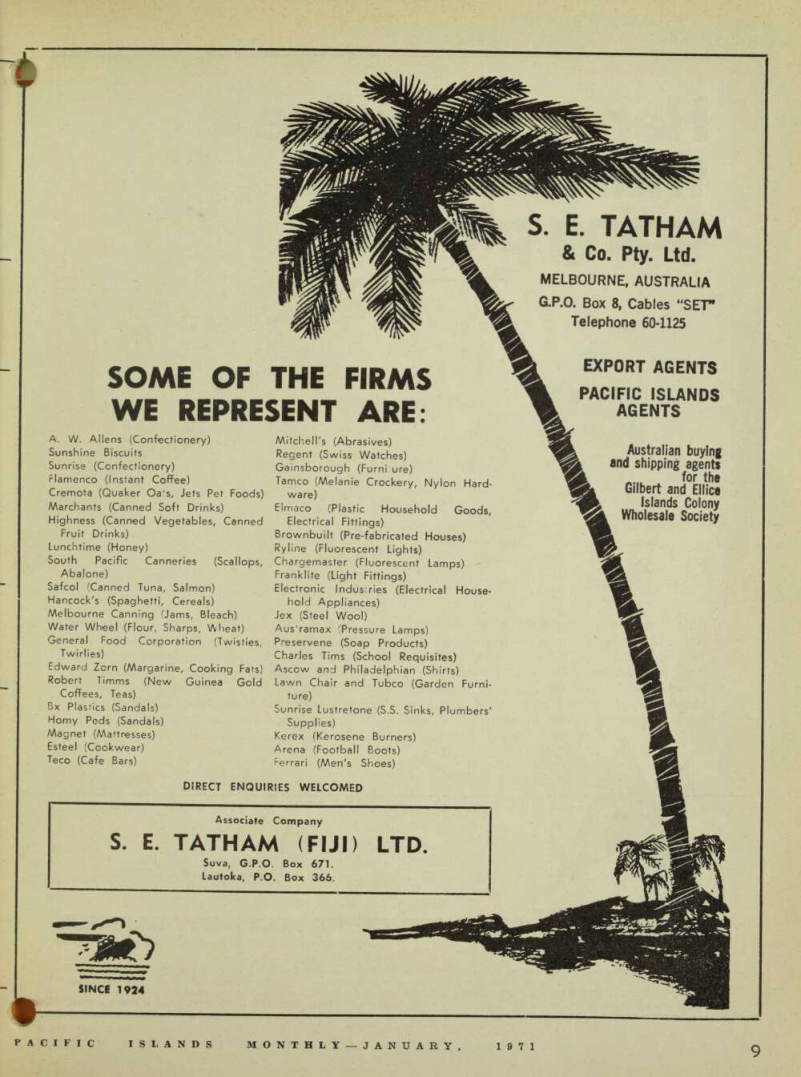
A. W. Allens (Confectionery) Sunshine Biscuits Sunrise (Confectionery) Flamenco (Instant Coffee) Cremota (Quaker Oa‘s, Jets Pet Foods) Merchants (Canned Soft Drinks) Highness (Canned Vegetables, Canned Fruit Drinks) Lunchtime (Honey) South Pacific Canneries (Scallops, Abalone) Safcol (Canned Tuna, Salmon) Hancock's (Spaghetti, Cereals) Melbourne Canning (Jams, Bleach) Water Wheel (Flour, Sharps, Wheat) General Food Corporation (Twisties, Twirlies) Edward Zorn (Margarine, Cooking Fats) Robert Timms (New Guinea Gold Coffees, Teas) Bx Plastics (Sandals) Homy Peds (Sandals) Magnet (Mattresses) Esteel (Cookwear) Teco (Cafe Bars) Mitchell's (Abrasives) Regent (Swiss Watches) Gainsborough (Furni.ure) Tamco (Melanie Crockery, Nylon Hard ware) Elmaco (Plastic Household Goods Electrical Fittings) Brownbuilt (Pre-fabricated Houses) Ryline (Fluorescent Lights) Chargemaster (Fluorescent Lamps) Franklite (Light Fittings) Electronic lndus:ries (Electrical House hold Appliances) Jex (Steel Wool) Aus'ramax (Pressure Lamps) Preservene (Soap Products) Charles Tims (School Requisites) Ascow and Philadelphian (Shirts) Lawn Chair and Tubco (Garden Furni ture) Sunrise Lustretone (S.S. Sinks, Plumbers Supplies) Kerex (Kerosene Burners) Arena (Football Boots) Ferrari (Men's Shoes)
S. E. TATHAM
& Co. Pty. Ltd.
MELBOURNE, AUSTRALIA
G.P.O. Box 8, Cables “SET Telephone 60-1125
EXPORT AGENTS
PACIFIC ISLANDS
AGENTS
Australian buying
and shipping agents for the Gilbert and Ellice Islands Colony 32A Wholesale Society i i
DIRECT ENQUIRIES WELCOMED
Associate Company
S. E. TATHAM (FIJI
Suva, G.P.O. Box 671.
Lautoka, P.O. Box 366.
SINCE 1924
LTD
Here’s an airline
thatfs really
going places
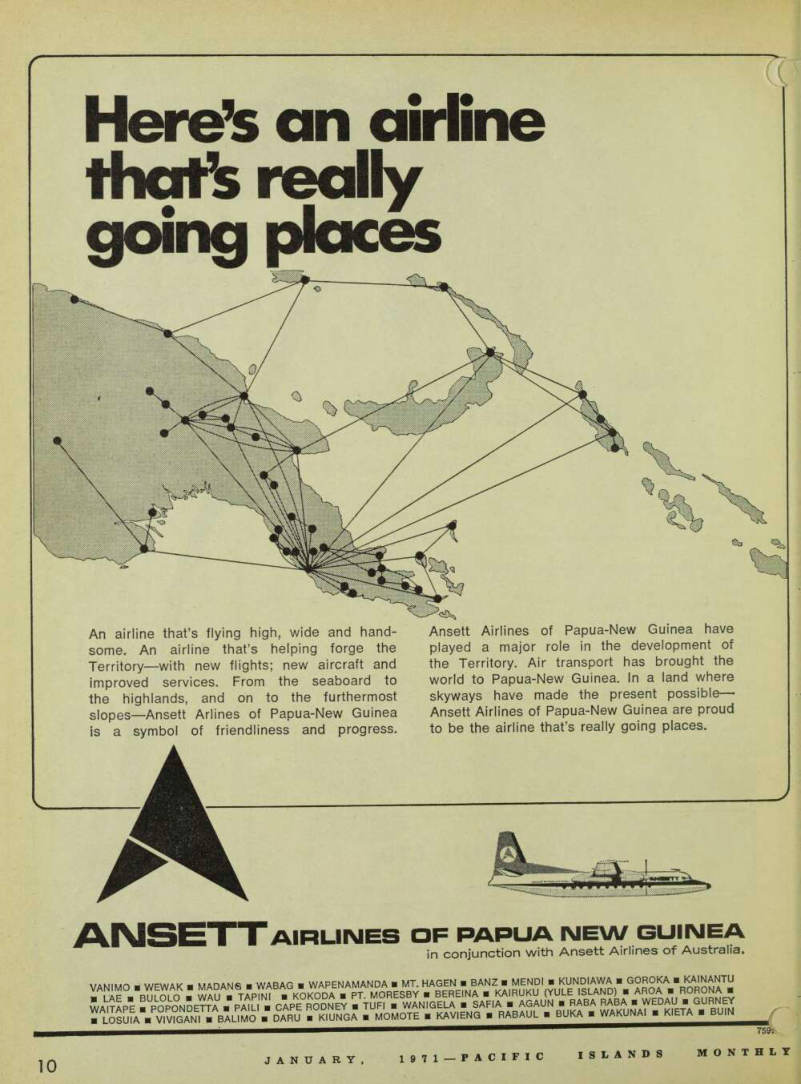
An airline that’s flying high, wide and handsome. An airline that’s helping forge the Territory—with new flights; new aircraft and improved services. From the seaboard to the highlands, and on to the furthermost slopes —Ansett Arlines of Papua-New Guinea is a symbol of friendliness and progress.
Ansett Airlines of Papua-New Guinea have played a major role in the development of the Territory. Air transport has brought the world to Papua-New Guinea. In a land where skyways have made the present possible—• Ansett Airlines of Papua-New Guinea are proud to be the airline that’s really going places.
Eat
mm
OF PAPUA NEW GUINEA
in conjunction with Ansett Airlines of Australia.
VAN IMO ■ WEWAK ■ MADAN® ■ WABAG ■ ■ TUFI ■ WANIGELA ■ SAFIA ■ AGAUN ■ RABA RABA ■ WEDAU ■ GURNEY KAVIENG ■ RABAUL ■ BUKA ■ WAKUNAI ■ KIETA ■ BUIN ■ LAE ■ BULOLO ■ WAU ■ TAPINI ■ KOKODA WAITAPE ■ POPONDETTA ■ PAILI ■ CAPE RODNEY ■ LOSUIA ■ VIVIGANI ■ BALIMO ■ DARU ■ KIUNGA ■ MOMOTE 759 v
COFFEE
CARROT
4
COCOA
BANANA
km
RUBBER
TOMATO
I
ONION
Make every year a bountiful year.
Increase your crop yields with Showa Denko’s fertilizers. And make every year a year of abundant harvests. A leading producer of chemical fertilizers, Showa Denko is prepared to meet all your plant nutrient requirements. Its urea, diammonium phosphate, 15:15: 15 and other N-P-K formulations are your guarantee of bigger, better, more beautiful crops.
For detailed information on how Showa Denko’s fertilizers can help you, we invite your inquiry to Showa Denko or its agents in your area.
SHOWA DENKO K.K. 34, Shiba Miyamoto-cho, Minato-ku, Tokyo Distributed by: THEO THOMAS & CO., PTYLTD. Rabaul Office: P.0.80x 536 TEL: 2261
measure mastei
r / ; gix LAriiliiutmitoxiim ii}i I s ! o ! i rrrtnrSriJtniTti 11111111 li i i j rniiTn Made especially for those who value top craftsmanship and accuracy above everything, the Rabone Chesterman 2 and 3 feet folding boxwood rules are an object lesson in how good all rules should be. Built to last a lifetime, they'll measure up to anything.
Available from Ironmongers and Tool Dealers. §3 §3 & m
Rabone
Chesterman
Rabone Chesterman Ltd.
Birmingham 18, England.
iIQQMHUS
m mmmmm mviv 32 M3?*
A
great bunch
of flours.
Robert Hutchinson makes the greatest bunch of flours in the Pacific. Bakers’ flour.
Superlite cake and sponge flours.
Biscuit flour and cracker flour.
Wheaten sharps and wheaten meal.
We’re particularly proud of our bunch of flours. So we have a technical advisory service to help you use them properly.
So next time you see a Robert Hutchinson flour (or even one of our Hutmill stock feeds), remember it’s just one of the bunch. % & i
ROBERT
HUTCHINSON
LIMITED
flie flour people
Hartington Street, Glenroy, Victoria, Australia. 3046. Telephone Melbourne 306 7261 dH 102
m Po Pt
Milk Arrowroot biscuits
for all-day energy
You and your children use up a lot of energy during the day; but Amott’s Milk Arrowroot biscuits will give you the extra nourishment you need to replace it. The triple-wrapped pack keeps the biscuits crisp and fresh at all times .
Biscuits
There is no Substitute for Quality P 590
5
TACIFIC ISLANDS MONTHLY JANUARY, 1971
Pacific Islands
Monthly
Established 1930: 41st Year of Publication.
Owned And Published By
Pacific Publications (Aust.) Pty. Ltd.,
29 Alberta St., Sydney, N.S.W., 2000.
Postal Address: G.P.O. BOX 3408, SYDNEY,
N.S.W., 2001.
Telegraphic Address: PACPUB, Sydney.
Telephones: 61-9197, 61-7101, 61-4669.
Chief Executives: Managing Director: R. W. Robson.
Executive Director/Publisher: Judy Tudor.
Executive Director/Business Manager: Selwyn Hughes.
Executive Director/Chief Editor: Stuart Inder.
Pacific Islands Monthly
Editor; Stuart Inder.
Advertising Manager: W. A. Gasnier.
Branch Offices
Fiji: Pacific Publications (Fiji) Ltd., Fiji Times Building, 20 Gordon Street, Suva. Tel.: 25601.
Fiji Times Office, Mayfair Building, Namoli Ave., LAUTOKA. Telex: 1144. Tel.: 60-422.
Papua-New Guinea: Pacific Publications (N.G.) Pty. Ltd. Representatives: PORT MORESBY, P.O.
Box 16; LAE, P.O. Box 227; RABAUL, Mr.
Steve Simpson, P.O. Box 433 (c/- Rabaul Photographic. Tel.: 2677).
Representatives
Victoria: Advertising—Wilke & Co. Ltd., 37 Brown's Road, Clayton, Vic., 3168. Tel.; 544-8222.
Queensland; Advertising—Beale Media Services, 232 St. Paul's Terrace, Fortitude Valley, Qld., 4006. Tel.; 51-5827.
New Zealand: General.—J. D. Whitcombe, C.P.O.
Box 2229, Queen St., Auckland. Tel.: 456056.
Advertising.—J. E. Sanders, P.O. Box 25-015, Auckland. Tel.: 583-563.
United Kingdom: S. R. Warman, Park House, 22 Park Street, Croydon, CR9 3NP. Tel.: 01-6884177.
Overseas Newspapers (Agencies) Ltd., Cromwell House, Fulwood Place, London, W.C.I. Tel.; 01-242-0661. Cables: WESNEWS, London, DS4.
Japan: Advertising—Universal Media Corpora tion, C.P.O. Box 46, Tokyo. Tel.: 666-3036.
Agents
All main trading firms and stores in the Pacific Islands.
Pacific Publications Pty. Ltd. is the Australian agent for THE FIJI TIMES.
Subscription Rates:
"Pacific Islands Monthly" is air-freighted to all subscribers and agents in the South Pacific; copies to other areas go by surface mail.
Australia (including Lord Howe and Thursday Is.), 8.5.1. P., Gilbert and Ellice Is.: $5.50 Aust.; Papua-New Guinea, Norfolk Island, Nauru, Tonga and New Hebrides: $5.00 Aust.; New Zealand: $5.50 NZ; Fiji, Cook Islands, Niue and Western Samoa: $5.00 (local currency); American Samoa: $B.OO US; U.S. Mainland, Micronesia (including Guam); $lO.OO US; Hawaii: $9.00 US; New Caledonia: 750 French Pacific francs; Tahiti and French Polynesia: 850 French Pacific francs; United Kingdom and elsewhere: £3/5/- Stg.
Copyright (c), 1971, Pacific Publications (Aust.) Pty. Ltd.
Up Front

with the Editor
A “talent for talking on several levels”, is what a Sydney religious commentator said about the Pope after listening to his addresses during last month’s visit to Sydney and “Oceania”. It was a pertinent comment.
I listened to the Pope, from close up, in Sydney, and I was impressed by this special ability of his. He uses the language of diplomacy. You could, if you wanted, believe he was merely mouthing platitudes; but if you cared to look further you might con vince yourself that he was, perhaps, saying something else.
As a result of seeing this extra ordinary diplomat at work on my own doorstep, I will not again pass over the Papal utterances from far off Rome, when I see them in my newspaper, as bleatings of no prac tical relevance to today’s world. I shall study them for other meanings.
I suspect that if I look hard enough I will find he is directing my atten tion to a specific ill, as well as to the general problem of mankind which is the theme of most of his statements.
The need for peace and unity in the world is always his wider theme.
In Sydney I believe he was pointing to a specific ill when he said at an open-air mass, “Do not close your limited circle of friends for the sake of a selfish satisfaction.”
It was a typical Papal statement. It could be taken as a platitude, not worthy of further attention; or it could be taken as an exhortation to us in our personal daily lives to re pair our friendships; or it could be read as an appeal to the Australian Government to relax the country’s immigration policy for Islanders.
Some people chose to read it as a comment on Australia’s immigration policy, and I am one of them. But the interesting fact is that none of us can be sure our interpretation is correct, for this is an example of the brilliance of Papal diplomacy in a complicated world where the head of a large slice of Christendom must say neither too little nor too much.
I interpret his comment as refer ring to immigration because immigra tion turned out almost to be the theme of the conference of Pacific Catholic
bishops, which took the opportunity to meet in Sydney during the Pope’s visit. The Pope kept abreast of what they said, and spent two hours with them at the conference the same day he made his statement.
As PIM reported last month—and there is something further in this issue—Bishop Rodgers of Tonga had something direct to say on this aspect, and he got much support from his fellow bishops. Basically, what they asked for was a quota of Islanders to be allowed into Australia —preferably Island families.
This is a question I’ve discussed before in this column, and my view is firm on the point. Australia should take in an annual quota of Pacific Islanders as migrants—not merely as students or temporary workers in need of training (and Australia is generous in this way). Furthermore, the world should be told the quota exists.
I could, however, find myself in
argument with some of the bishops on one aspect of this question. If of them believes—and I think som of them do—that Australia should allow in Islands migrants because the Islands need to solve their popu lation problems and syphon off sur plus workers, then I am not on their side.
It’s not Australia’s responsibility to solve other people’s population prob lems by creating some of her own.
Migration to Australia is an easy solution for the Islands. The alterna tive, doing something about keeping down your population and building up your economy, is harder.
In my view Australia can do two things to help herself and the Islands.
The first is allow in a quota of Islanders; the second is to do more than we are doing to build up Islands economies.
If in helping the Islands we have to share our trade, to give less than full protection to our own tropical products, then that’s just too bad for us. We’ll still manage very well.
As the Pope says, we can’t “close our limited circle of friends for the sake of a selfish satisfaction.”
Not that I can swear that he ex pects me to interpret his words that way, but if anybody has a better in terpretation, they’re welcome.
Stuart Inder
Advertisements & other items, pp. 18-22 (1 item)
Happiness.
Good health.
Dairy Foods.
They go together—
naturally.
Australian Dairy Foods provide you with the body-building goodness that you and your children need.
Concentrated energy from Australian butter. Vital protein and calcium from Australian cheese.
Australian Dairy Foods contain the natural health and strength giving properties that all of us need— every day.
Always the best. Australian Dairy Food products include: Butter, Ghee, Cheese, Full Cream, Skimmed and Malted Milk Powders, Baby Food and Invalid Food.
AUSTRALIA
\ • on the label. r % \ m • -A m
FLETCHERS
are exporting
ii it o !T Steel from stock Bars Plate Bright steel Steel sheet Stainless steel Bolts, nuts, turn buckles Further information from:
o*7 FLETCHER
SQ INTERNATIONAL
Private Bag, Auckland, New Zealand.
I Come over to Consulate, enjoy the rich inviting flavour of choice Virginia tobaccos enhanced by a touch of refreshing menthol.
People who know the best insist on Consulate—the world's first For that surprising extra it gives you Virginia menthol cigarette.
COOL CLEAN CONSULATE
take
psst
the side
entrance!
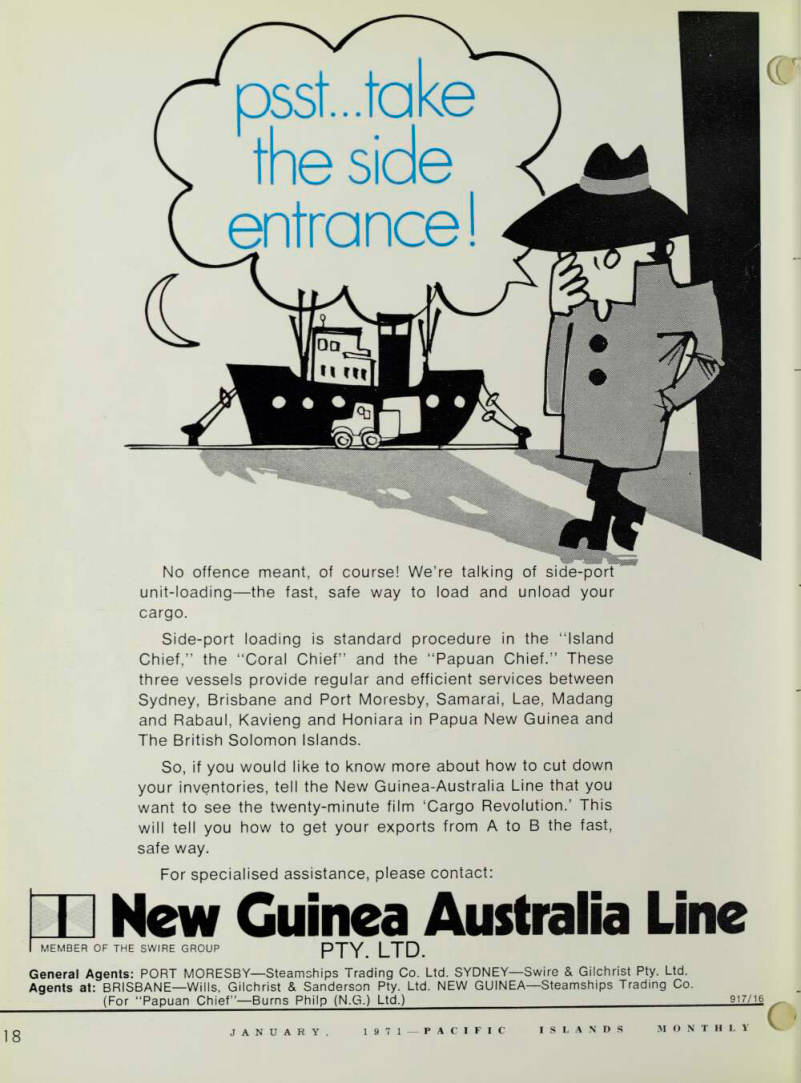
□□ nt Oj No offence meant, of course! We’re talking of side-port unit-loading —the fast, safe way to load and unload your cargo.
Side-port loading is standard procedure in the “Island Chief,” the “Coral Chief” and the “Papuan Chief.” These three vessels provide regular and efficient services between Sydney, Brisbane and Port Moresby, Samarai, Lae, Madang and Rabaul, Kavieng and Honiara in Papua New Guinea and The British Solomon Islands.
So, if you would like to know more about how to cut down your inventories, tell the New Guinea-Australia Line that you want to see the twenty-minute film ‘Cargo Revolution.’ This will tell you how to get your exports from A to B the fast, safe way.
For specialised assistance, please contact: I
New Guinea Australia Line
MEMBER OF THE SWIRE GROUP
PTY. LTD.
General Agents: PORT MORESBY—Steamships Trading Co. Ltd. SYDNEY—Swire & Gilchrist Pty. Ltd.
Agents at: BRISBANE—WiIIs, Gilchrist & Sanderson Pty. Ltd. NEW GUlNEA—Steamships Trading Co. (For “Papuan Chief”—Burns Philp (N.G.) Ltd.) 917/16
iiigliiii
HR Vi*''’"
I" ss# mv: . v "
-‘... fi : i«
The Stylish Seventies
Let's face it, looks are important. When a new car comes out, body styling is the first thing you notice. Note the graceful wave-form body lines of the all-new CAPELLA 1600 Sedan. It's styled for the seventies. Just the right amount of chrome.
But when you have to decide what car is for you, performance, comfort and safety all play a part. Concealed in this stylish family sedan is a quiet 4cylinder OHC powerplant that puts out 104 hp at 6,000 rpm. Effortless ball ancj, nut steering system and a surprising 4.7 meter turning radius make driving a dream. Specially designed seats to fit every driver or passenger, two independent ventilating systems and plenty of leg and shoulder room add up to luxurious comfort.
For safety's sake, you get power-assisted brakes all round with discs up front, laminated safety windshield, hazard warning flasher, padded dash, collapsible interior fixtures. Seat belts (opt.).
All this at a price competitive in its class from the world's first mass producer of the revolutionary rotary engine.
I Hv
ipnn SEDA (
P 0 Box 1344. Tel 60-783 lOTORS LTD. P 0 Box 1394. Boroko Pago Pago. American Samoa 96920 f ij/NIRANJAN S AUTO PORT LTD G P 0 Box 450. Srva
Them
11 4t ftfoo Sauce m Sweet nd a* < *? i Sauce tich Meat i * * S!
gik
m
Brown Onion
Sauce
m w*
MAGGI
f /*
In This Issue
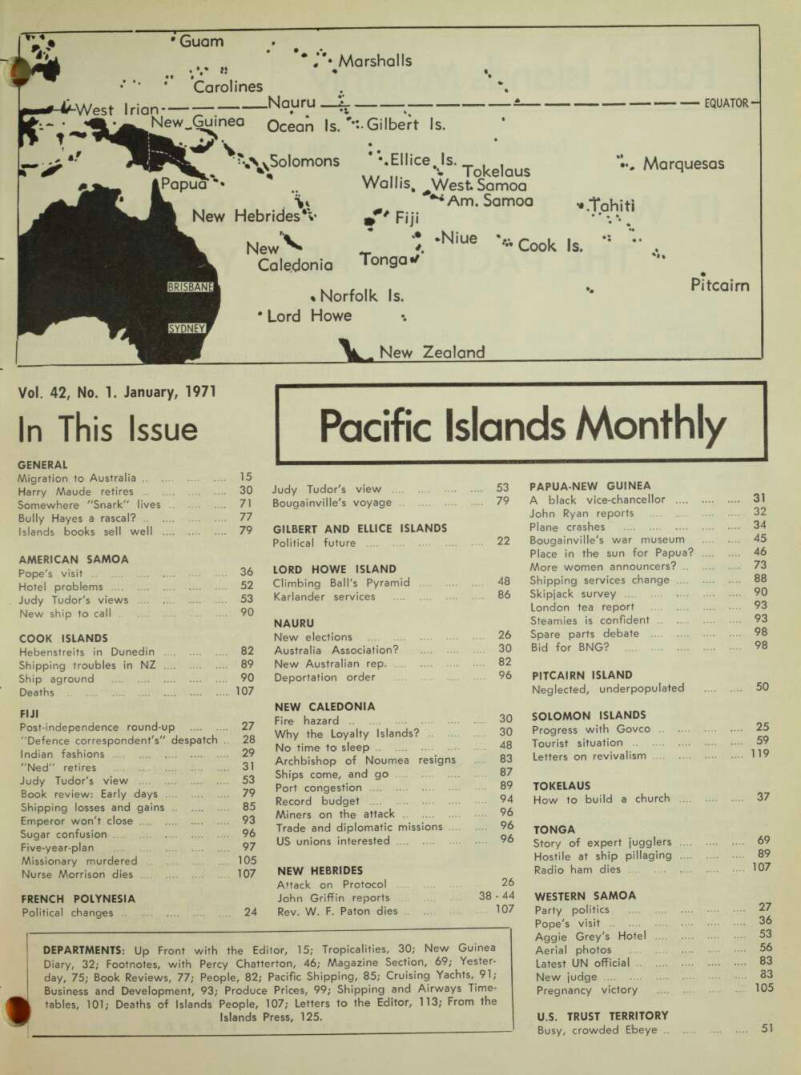
General
Migration to Australia 15 Harry Maude retires 30 Somewhere "Snark" lives 71 Bully Hayes a rascal? 77 Islands books sell well 79
American Samoa
Pope's visit 36 Hotel problems 52 Judy Tudor's views 53 New ship to call 90
Cook Islands
Hebenstreits in Dunedin 82 Shipping troubles in NZ 89 Ship aground 90 Deaths 107
Fiji
Post-independence round-up 27
"Defence correspondent's" despatch .. 28 Indian fashions 29 "Ned" retires 31 Judy Tudor's view 53 Book review: Early days 79 Shipping losses and gains 85 Emperor won't close 93 Sugar confusion 96
Five-year-plan 97
Missionary murdered 105 Nurse Morrison dies 107
French Polynesia
Political changes 24
Judy Tudor's view 53 Bougainville's voyage 79
Gilbert And Ellice Islands
Political future 22
Lord Howe Island
Climbing Ball's Pyramid 48 Karlander services 86
Nauru
New elections 26 Australia Association? 30 New Australian rep 82 Deportation order 96
New Caledonia
Fire hazard 30 Why the Loyalty Islands? 30 No time to sleep 48 Archbishop of Noumea resigns 83 Ships come, and go 87 Port congestion 89 Record budget 94 Miners on the attack 96 Trade and diplomatic missions 96 US unions interested 96
New Hebrides
Attack on Protocol 26 John Griffin reports 38-44 Rev. W. F. Paton dies 107
Papua-New Guinea
A black vice-chancellor 31 John Ryan reports 32 Plane crashes 34 Bougainville's war museum 45 Place in the sun for Papua? 46 More women announcers? 73 Shipping services change 88 Skipjack survey 90 London tea report 93 Steamies is confident 93 Spare parts debate 98 Bid for BNG? ... 98
Pitcairn Island
Neglected, underpopulated 50
Solomon Islands
Progress with Govco 25 Tourist situation 59 Letters on revivalism 119
Tokelaus
How to build a church ... 37
Tonga
Story of expert jugglers 69 Hostile at ship pillaging 89 Radio ham dies 107
Western Samoa
Party politics 27 Pope's visit 36 Aggie Grey's Hotel 53 Aerial photos 56 Latest UN official 83 New judge 83 Pregnancy victory 105
U.S. Trust Territory
Busy, crowded Ebeye 51
DEPARTMENTS: Up Front with the Editor, 15; Topicalities, 30; New Guinea Diary, 32; Footnotes, with Percy Chatterton, 46; Magazine Section, 69; Yester day, 75; Book Reviews, 77; People, 82; Pacific Shipping, 85; Cruising Yachts, 91; Business and Development, 93; Produce Prices, 99; Shipping and Airways Time tables, 101; Deaths of Islands People, 107; Letters to the Editor, 113; From the Islands Press, 125.
Pacific Islands Monthly
Islands parliaments are on the move
It Won't Be Plain Sailing Into
The Pacific's New Year
From a Tarawa correspondent It ended both with a bang and a whimper—the final meeting of the Gilbert and Ellice Islands Colony’s House of Representatives in December. There was conflict over localisation and the lack of effective communication between the government and parliament, but there was also an air of anti climax.
The House of Representatives has now been dissolved.
The Gilbert and Ellice Islands Colony expects in February to hold general elections which will give it a revised Legislative Council and a Ministerial Member system of gov ernment.
A Leader of Government Business, elected from among the elected mem bers by themselves, will be chosen at a short meeting of the new Legislative Council, probably in March, and the GEIC will get down to serious political business by about May (see PIM, Dec., p. 29).
As the final meeting in December drew to a close, the elected members looked to the future, and to their new powers—providing they were re elected.
Little interest was shown in “government” business. Draft legisla tion was debated in a desultory manner, if at all. Supplementary budget provisions, including $93,000 for the Prince of Wales’ visit last October and $20,000 for the Resident Commissioner’s new office, were passed without a murmur.
The 1971 estimates occasioned little comment and capital expenditure of more than $1.2 million was approved, with only a solitary query.
In the GEIC the budget debate has not yet become a forum for general discussion of government policies and expenditure. The elected members have preferred to initiate debate on matters of concern by means of questions and motions. It was clear, too, in December that the elected members were concerned with their own position in the House and with their effect on government.
This issue was raised by Babera Kirata (Onotoa) during the adjourn ment debate. It was his intention, he said, to express the dissatisfaction of all elected members, and many members of the public, over the poor communication which existed between the government and the House of Representatives.
He argued that the government gave low priority to matters brought before the House by elected mem bers. The people believed, Babera declared, that “we cannot do our job, and ... are useless in this House”, and “They regard us as
nothing more than government rub ber-stamps”.
As could be expected, the speech drew support from his elected col leagues and caused some agitation amongst the officials. In reply, the Assistant Resident Commissioner, Mr. Derek Cudmore, said the criticism was unjustified. And the elected members had not, he said, made full use of the information given them in the House.
The whole debate, however, begged a much more important question. If the elected members believed their criticism to be fair, and the govern ment did not believe it so, then surely a basic communication problem must exist?
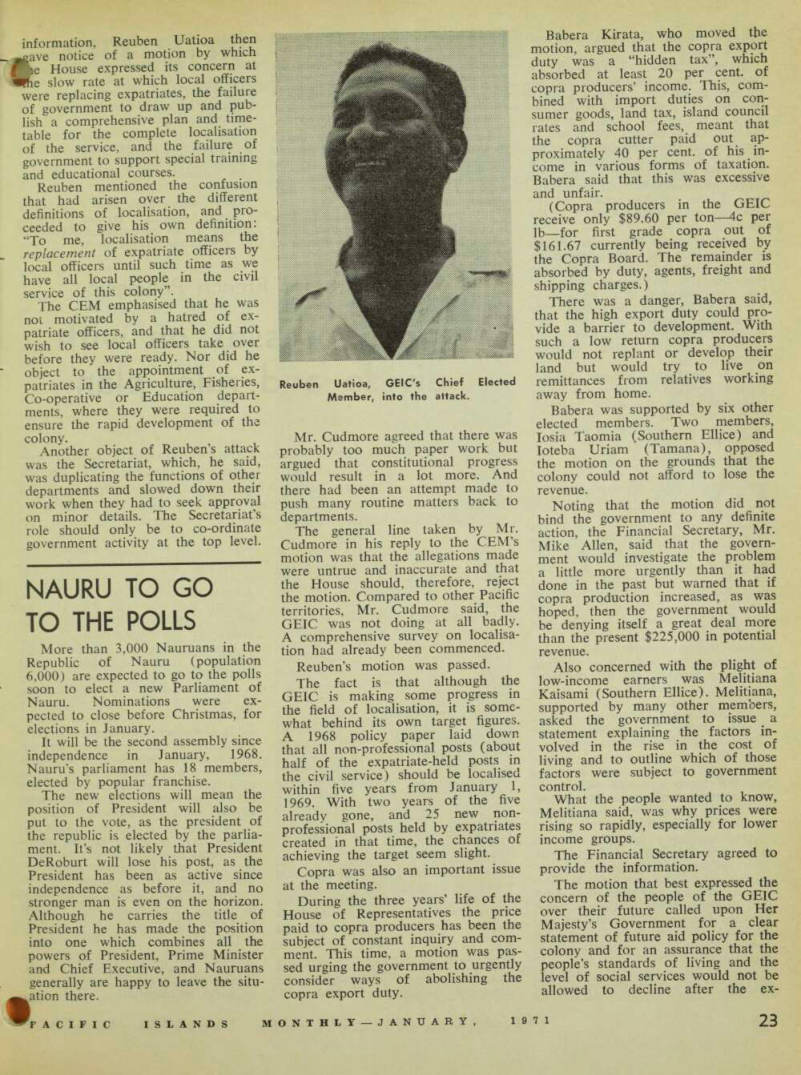
But localisation, perhaps, generated more heat than any other single issue during the meeting. Reuben Uatioa (Urban Tarawa), the Chief Elected Member, started the ball rolling with a series of specific questions designed to elicit basic information from the government.
Replies revealed that seven positions had been localised in the past two years and in the same period, 37 new posts, filled by expatriates, had been created. (The colony now employs about 120 expatriate officers).
Naboua Ratieta (Marakei), implied that some of the seven posts had not been “localised” but simply re presented an expanded establishment.
It was left to the president of the House, Sir John Field, to clarify the government’s position. If the establish ment was expanded, and local officers appointed to positions that could be filled by expatriates, he said, then localisation had taken place. . . .
Having obtained the desired^
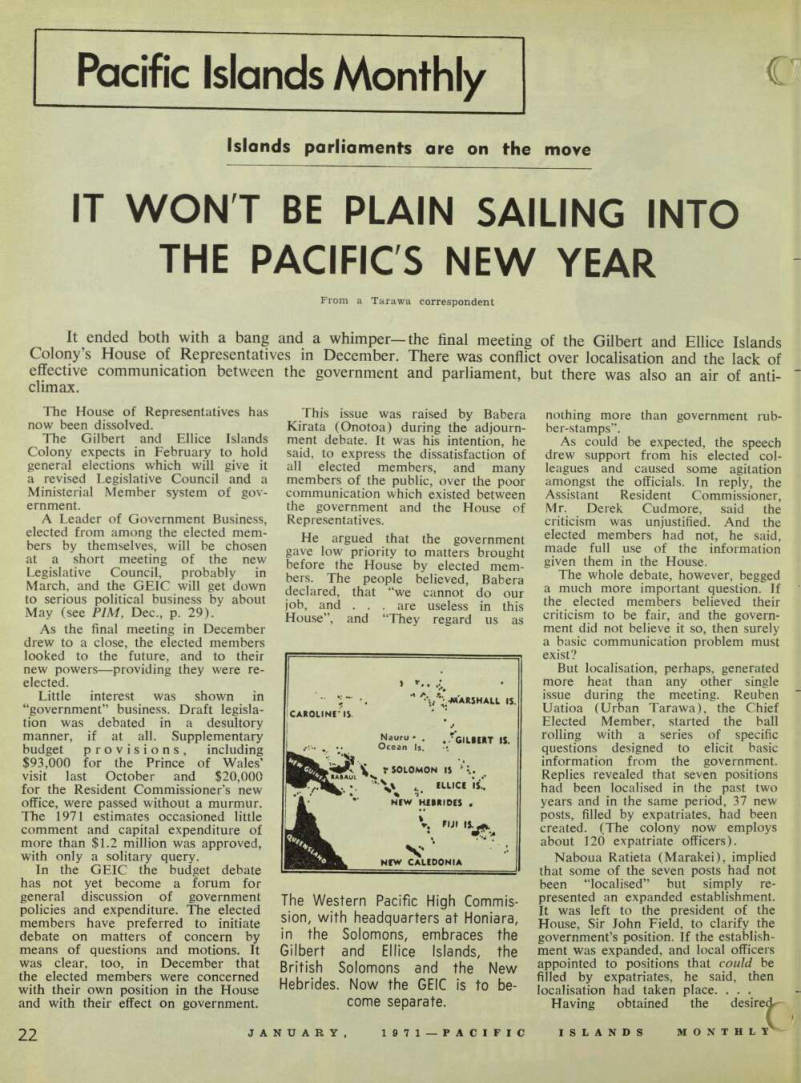
The Western Pacific High Commis sion, with headquarters at Honiara, in the Solomons, embraces the Gilbert and Ellice Islands, the British Solomons and the New Hebrides. Now the GEIC is to be come separate.
information, Reuben Uatioa then Kave notice of a motion by which fte House expressed its concern at le slow rate at which local officers were replacing expatriates, the failure of government to draw up and pub lish a comprehensive plan and time table for the complete localisation of the service, and the failure of government to support special training and educational courses.
Reuben mentioned the confusion that had arisen over the different definitions of localisation, and pro ceeded to give his own definition: “To me, localisation means the replacement of expatriate officers by local officers until such time as we have all local people in the civil service of this colony”.
The CEM emphasised that he was not motivated by a hatred of ex patriate officers, and that he did not wish to see local officers take over before they were ready. Nor did he object to the appointment of ex patriates in the Agriculture, Fisheries, Co-operative or Education depart ments, where they were required to ensure the rapid development of the colony.
Another object of Reubens attack was the Secretariat, which, he said, was duplicating the functions of other departments and slowed down their work when they had to seek approval on minor details. The Secretariat’s role should only be to co-ordinate government activity at the top level.
Mr. Cudmore agreed that there was probably too much paper work but argued that constitutional progress would result in a lot more. And there had been an attempt made to push many routine matters back to departments.
The general line taken by Mr.
Cudmore in his reply to the CEM’s motion was that the allegations made were untrue and inaccurate and that the House should, therefore, reject the motion. Compared to other Pacific territories, Mr. Cudmore said, the GEIC was not doing at all badly.
A comprehensive survey on localisa tion had already been commenced.
Reuben’s motion was passed.
The fact is that although the GEIC is making some progress in the field of localisation, it is some what behind its own target figures.
A 1968 policy paper laid down that all non-professional posts (about half of the expatriate-held posts in the civil service) should be localised within five years from January 1, 1969. With two years of the five already gone, and 25 new non professional posts held by expatriates created in that time, the chances of achieving the target seem slight.
Copra was also an important issue at the meeting.
During the three years’ life of the House of Representatives the price paid to copra producers has been the subject of constant inquiry and com ment. This time, a motion was pas sed urging the government to urgently consider ways of abolishing the copra export duty.
Babera Kirata, who moved the motion, argued that the copra export duty was a “hidden tax”, which absorbed at least 20 per cent, of copra producers’ income. This, com bined with import duties on con sumer goods, land tax, island council rates and school fees, meant that the copra cutter paid out ap proximately 40 per cent, of his in come in various forms of taxation.
Babera said that this was excessive and unfair. (Copra producers in the GEIC receive only $89.60 per ton—4c per lb—for first grade copra out of $161.67 currently being received by the Copra Board. The remainder is absorbed by duty, agents, freight and shipping charges.) There was a danger, Babera said, that the high export duty could pro vide a barrier to development. With such a low return copra producers would not replant or develop their land but would try to live on remittances from relatives working away from home.
Babera was supported by six other elected members. Two members, losia Taomia (Southern Ellice) and loteba Uriam (Tamana), opposed the motion on the grounds that the colony could not afford to lose the revenue.
Noting that the motion did not bind the government to any definite action, the Financial Secretary, Mr.
Mike Allen, said that the govern ment would investigate the problem a little more urgently than it had done in the past but warned that if copra production increased, as was hoped, then the government would be denying itself a great deal more than the present $225,000 in potential revenue.
Also concerned with the plight of low-income earners was Melitiana Kaisami (Southern Ellice). Melitiana, supported by many other members, asked the government to issue a statement explaining the factors in volved in the rise in the cost of living and to outline which of those factors were subject to government control.
What the people wanted to know, Melitiana said, was why prices were rising so rapidly, especially for lower income groups.
The Financial Secretary agreed to provide the information.
The motion that best expressed the concern of the people of the GEIC over their future called upon Her Majesty’s Government for a clear statement of future aid policy for the colony and for an assurance that the people’s standards of living and the level of social services would not be allowed to decline after the ex
Reuben Uatioa, GEIC's Chief Elected Member, into the attack.
haustion of the Ocean Island phos phates.
Reuben Uatioa, speaking to the motion, drew attention to the as surance given the Advisory Council in 1964 that future political develop ment in the colony would not affect the UK Government’s willingness to provide aid. He pointed out that the Mooring Report and the development plan were both designed to make the GEIC economically self-supporting.
But if the targets could not be achieved, what would happen to the people?
Citing examples from other British dependencies and ex-dependencies, Reuben said that there were signs that the UK no longer wished to keep her colonies; that, because of her own financial difficulties, she wished to restrict aid; and that economic independence was being made the price of political indepen dence.
To a developing country, Reuben argued, political stability was more important than economic indepen dence and it was for this reason that he sought an assurance on behalf of the people of the colony.
Babera Kirata, supporting the motion, touched on a delicate and controversial point when he said that in the light of the UK having been a partner to the BPC operation at Ocean Island—a dirty exercise in exploitation—she could not now take her hands away. The BPC had sold phosphate to Australia and New Zealand at cheap prices, and had thus deprived the colony of revenue.
UK had been a party to this business and therefore she had a clear duty to assist the colony in future.
For the government, Mr. Allen pointed out the difficulties involved in asking the UK for an assurance to cover an indefinite period in the future.
Sir John Field announced that he would convey the wishes of the House to the Secretary of State.
In view of the tone of some of the early debates, it was not surprising that the House approved without dis sent a motion calling for the separa tion of the colony from the Western Pacific High Commission.
The machinery for this move is now in motion, and in fact the result won’t affect the colony in any im portant way. Headquarters at Honiara is too far away for decision-making, and communication is already better between Tarawa and London anyway.
The link with the High Commission now serves no real purpose. (PIM, Dec., p. 29).
Other matters covered in this last meeting of the GEIC House of
Representatives included freight and fares on colony ships, airfield con struction, the development plan, the proposed Betio-Bairiki causeway, reef blasting, etc. Some had appeared regularly at previous meetings.
What has the House achieved?
Some GEIC officials have begun to take the attitude that the elected members put forward little in the way of constructive criticism, and tend to ask questions that they already know the answers to.
It is certainly true that parochialism is behind many questions, but it also true that members see the House as
a place where recurring grievances can be aired, and where the dominant. issues in the minds of their cc/T stituents can be raised—and mirsL be raised, even though their con stituents have little understanding of the political process.
Inevitably, elected members have a different scale of priorities than officials. Political progress is a slow and frustrating process—for all con cerned.
But with the new Executive Council getting greater respon sibility it can be expected there will be greater understanding.
Nauru To Go
To The Polls
More than 3,000 Nauruans in the Republic of Nauru (population 6,000) are expected to go to the polls soon to elect a new Parliament of Nauru. Nominations were ex pected to close before Christmas, for elections in January.
It will be the second assembly since independence in January, 1968.
Nauru’s parliament has 18 members, elected by popular franchise.
The new elections will mean the position of President will also be put to the vote, as the president of the republic is elected by the parlia ment. It’s not likely that President Deßoburt will lose his post, as the President has been as active since independence as before it, and no stronger man is even on the horizon.
Although he carries the title of President he has made the position into one which combines all the powers of President, Prime Minister and Chief Executive, and Nauruans generally are happy to leave the situ ation there.
Advertisements & other items, p. 25 (1 item)
23
"fACIFIC ISLANDS MONTHLY JANUARY, 1971
'divide and rule' plan
Communes for French Polynesia France presses on with 'divide and rule' plan
From a Papeete correspondent Despite strong opposition from the pro-autonomy majority co alition in French Polynesia’s Territorial Assembly, the French Government is pressing ahead with its plan to introduce a series of communes in French Polynesia, each of which would have its own budget and handle its own affairs.
The communes plan was announced by the French Minister for Over seas Territories, Mr. Henri Rey, during his visit to Tahiti in Sept ember.
It was during that visit, and after the announcement about the com munes, that the autonomists first raised the old flag of independent Tahiti to dramatise their demands for internal self-government in the territory ( PIM, Oct., p. 17), The autonomists, led by Mr.
Francis Sanford, the territory’s deputy in the French Parliament, have a majority of 18 of the 30 seats in the Territorial Assembly.
They see the communes plan as a scheme to draw some of the teeth from the Assembly itself and to avoid the self-government issue by the celebrated political device of divide and rule.
The conservative minority parties in the Assembly have also expressed some reservations about the com munes; and, as a result, the Assembly sent a combined deputation to Paris early in December to discuss the question with French parliament arians.
The French Chamber of Deputies was due to begin a debate on the communes question on December 18.
Meanwhile, French Polynesia’s Governor, Mr. Pierre Angeli, was making a tour of the territory’s Austral Islands—Rimatara, Rurutu, Tubuai, Raivavae and Rapa—in an effort to persuade the islanders to accept the communes plan.
After landing on Rimatara by helicopter from the French naval vessel Ranee, the Governor told the islanders that they were quite capable of managing their own affairs. He added: “It is neither normal nor just that there should be first-class citizens who have the right to elect a mayor and have a commune [as in parts of Tahiti and Raiatea] and that there should be second-class citizens who do not know that reform.
“Neither is it normal that you should have to count on the good will, great though it is, of the mem bers of the Territorial Assembly.
You should rely on yourselves.
“This is not a revolution we wish to make; it is only the normal evolution of things.”
The Governor and his message were reported to have been well received in all the Austral Islands, although Raivavae’s welcome was not as warm as elsewhere.
Solomons Talk Of 1975 As The
Target For Independence
Prom a Honiara correspondent Patterns are beginning to develop in the Governing Council of the British Solomon Islands Protectorate —the elected legislature which was established here in 1970 as an alternative to the Westminster system of parliament. They have begun to show following the second meeting of the council, which ended in December.
To start with, the Govco moves slowly, not achieving as much as might be expected. One of the reasons may lie in the fact that the Secre tariat, which is the government administration centre, has not been geared to working with committees.
Some changes have now been made since the second meeting, and next April, when the third meeting is held, we should see whether they speed up matters.
Under the constitution, matters are dealt with in private committees before the session starts. At the session the decisions of the com mittees, as shown in the committee’s minutes, are put forward for ratifica tion by the council. In theory this means that when the council deals with committee decisions, it should be a fairly quick process. What in fact seems to be happening is that the issues are being thrashed out afresh at the council. It may be that those council members not on the committee concerned do not find its decisions adequately minuted.
There are no political parties as such, though the council is divided into elected and official members and these are, of course, the two main factions. However, a third group which sometimes splits the elected members is now apparent. This com prises those four (out of 17) elected members who are chairmen of the various committees.
The chairmen are appointed by the High Commissioner and consider themselves answerable to him. In an issue where there is conflict between elected and official members, com mittee chairmen tend to veer to the officials, and this, of course, reduces the elected members’ majority.
The fact that Govco is slow doesn’t mean that there is nothing happening.
A highlight in December was the motion by Peter Thompson on inde pendence. Criticising the lack of con fidence by some of the other mem bers, he proposed a definite timetable for independence, with 1975 as the target.
The motion was carried, although some elected members who expressed reservation about being ready in time ■were dealt with scathingly by Peter
Thompson, who accused them of being out of touch with their people and having no faith in their abilities.
Whether 1975 is in fact to be the date, will depend on the rate of
localisation, the progress of rural development, and the economy generally. Above all, the Governing Council will have to start doing more than talk.
The two newcomers to the council made their presence felt in Decem ber. John Smith, the Financial Sec retary, despite his holding budget, soon showed that he was the most progressive of the official members, especially in the debates on localisa tion, independence and rural develop ment. Mr. Joe Bryan (South East Guadalcanal), claimed that rural development stopped where the road ended, and that thereafter there were just the bush knife and the pointed stick. He advocated more training farms, the cleaning up of rivers to stop flooding, as well as the intro duction of prawn farming. Consider ing that copra is still the main ex port and that copra production is still just over 20,000 tons per year, the same as 50 years ago, rural development is an important subject.
Solomon Mamalone spoke convin cingly on the need for rural develop ment, but it was in the debate on localisation when he came into his own, relating his experience as a former public servant and the dif ficulties he had encountered. Peter Thompson claimed that there should be by now at least one local district commissioner and one local head of department. All the elected members agreed not enough was being done to localise most departments.
The Annual Abstract of Statistics just published shows that, whilst since 1966 the number of Solomon Islanders in government service has increased from 1,130 to 1,660, the number of posts has also been in creased, with the actual result now that there are five more expatriates in government service than in 1966.
It is perhaps significant that a week after the session, Fred Osifelo, who has shown himself to be a skil led administrator in the Lands Department, was appointed Deputy Commissioner of Lands and Surveys.
The elected members will no doubt be more voluble if by the next meeting some definite steps towards localisation have not been taken.
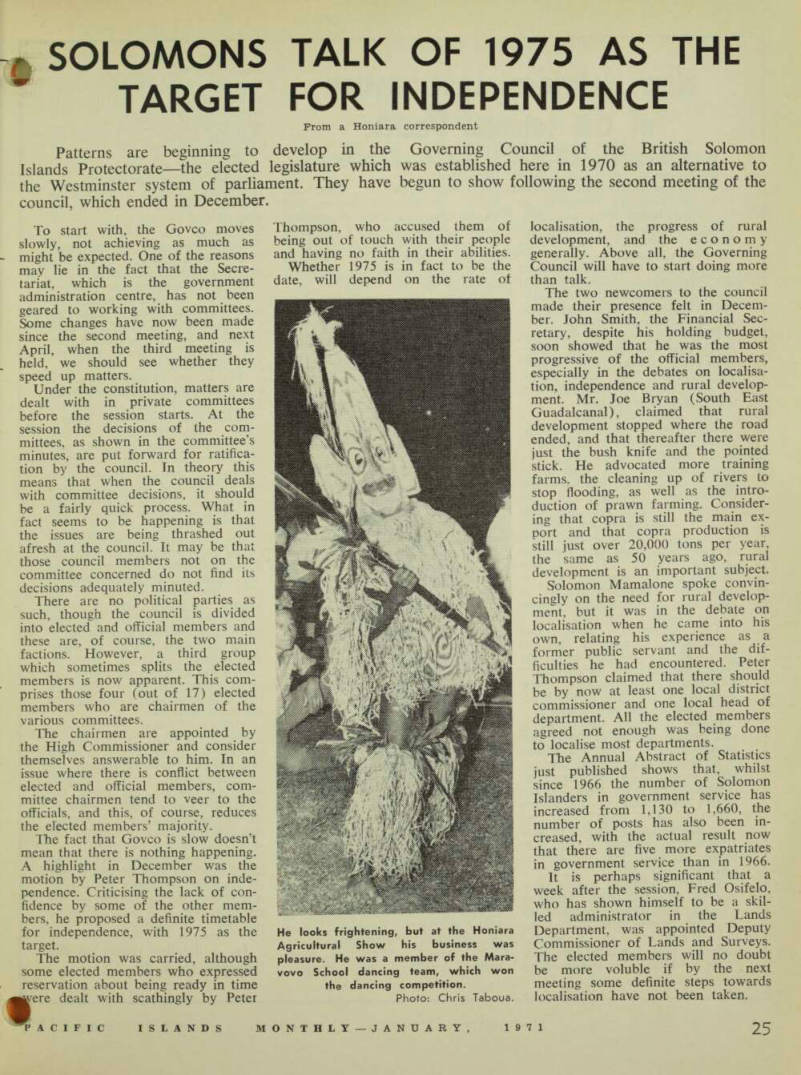
He looks frightening, but at the Honiara Agricultural Show his business was pleasure. He was a member of the Mara vovo School dancing team, which won the dancing competition.
Photo: Chris Taboua.
of the colonial Pacific
New Hebrides: Last bastion of the colonial Pacific
The British and French Resident Commissioners of the New Hebrides and members of the New Hebrides Advisory Council in December heard the most tren chant criticism of the condo minium system. Two New Hebridean members, Father G.
Leymang and lolu Abbil, attacked the “antiquated colonialism” of the New Hebrides constitution— the Protocol of 1914—and asked for its immediate revision.
Father Leymang, of Malekula, is the first and only New Hebri dean priest of the Roman Catholic Church. Mr. Abbil, from Tanna, is a co-operatives inspector with the British administration.
They made their criticism in a motion reading: “In view of the development of the New Hebrides, which creates a need for a new legal structure and orientation; and in view of the fundamentally colonialistic character of the Protocol of 1914; the aspirations of the young generation of New Hebrideans towards greater re sponsibilities; and the uncertain political future of the New Hebrides Condominium, we re quest the two governments to undertake an immediate revision of the Protocol of 1914.”
The motion was passed, and undoubtedly it must be regarded as a political landmark in the New Hebrides; the beginning of pressure by more vocal New Hebrideans for real political de velopment in the condominium.
Father Leymang, who spoke to the motion tabled in both their names, made it clear that it was not intended to ignore the humani tarian contribution of France and Britain in the New Hebrides, but simply “to bring a suffocating situation into relief’ and to “initiate a quest for the New Hebrideans’ identity”. He was aware, he said, that the motion was “Utopian”.
Father Leymang said that despite all the official flowery phrases about entente cordiale, the protocol “oozes from every pore the stench of an antiquated colonial policy which inevitably bears no relation to the aspirations
of the younger generation of New Hebrideans”.
It maintained a “precarious balance between Europeans and Pacific Islanders, where the vertical bonds of superior force are more in evidence than the amicable re lationship among the different racial groups comprising the popu lation of the New Hebrides.
“Whilst the Melanesian New Hebrideans are numerically in the majority, being dominated, they form a silent, not to say apathetic majority.
“This is a situation which westerners have a great deal of difficulty in imagining in the New Hebrides; what it is to be ‘beyond the pale’, to be excluded from society, to be ‘goods left on hand’.
The condominium is unity founded on apathy.”
Father Leymang said the British and French administrations each had their own way of looking at things, and increasingly the two national administrations were being consolidated instead of being inte grated with the joint services.
He said France and Britain had never changed their “fundament ally divergent policies by one iota; this being to annex the New Hebrides to some territory or other which already belongs to them”.
He condemned Article 8 (2) of the Protocol as the “best example of colonial anachronism in the middle of the 20th century, when so much is spoken of the cult of the individual”. [This article says that “no native shall acquire in the group the status of subject or citizen or be under the protection of either of the two signatory powers.”] Millions had been invested by both powers in the New Hebrides, but Father Leymang queried whether at the local level the money was enough, or distributed fairly. He said it was spent in setting up administrative struc tures in the image of the great powers and duplicating them in every district to support “a host of redundant administrators.”
He asked, “With its more highly developed hind quarters,
aren’t the New Hebrides like a monster? Isn’t the condominium a den of intrigue and disorder?
Should we not rather talk about the ‘Pandemonium’ of the New Hebrides whose motto would be ‘divide and rule’?”
The Protocol acted as a stock response to every argument. For British and French administration it was a source document for their work, but it also served as a loop hole, and this was becoming “ludicrous, exasperating and some times even insolent in the eyes of the New Hebridean people”.
He asked whether the prospect of British or French annexation had really disappeared now that Gilbertese, Fijians or other Pacific Islanders were coming from British and French territories into the New Hebrides.
“Let us add to this prospect of annexation, the educational systems in the New Hebrides, which have as their corollary a new genera tion of New Hebrideans divided by two European languages and the formation of an intellectual proletariat, giving a second rate, not to say cut price, education without any openings, and ready for the first chance to revolt and claim their rights?”
The joint powers had both de clared their intention to stay, but he would believe that when they integrated the education systems with the joint services in an attempt “to adapt curricula to the Pacific environment and not with the idea of cultural domination”.
He continued: “What is more, the recent arrival of American capital has set the joint authorities on the alert and it is whispered that a third power is moving into the New Hebrides.”
To require that all decisions should come from the two metro politan governments was colonial infantilism. Changes should not necessarily stem from a decision made in London and Paris, but from “a bilateral confrontation of the two metropolitan governments with all the radical groups of the New Hebridean population”.
Would the New Hebrides go for ward with the rest of the Pacific or would it, he added “be sucked down into the quagmire of the condominium as it was set up by the 1906 convention?”
For a detailed report on the Hebrides, see p. 38.
Pim's Annual
Index
Regular subscribers to PIM will find a comprehensive, 16page index to the 12, 1970 issues of the magazine enclosed separ ately in this number. The index is free to subscribers. A few extra copies of this useful index have been put aside for other readers, who may obtain a copy for 40c Australian currency, post-free, by writing to the Circulation Manager, PIM, Box 3408, GPO, Sydney, 2001.
They're Politicking
In In. Samoa
From an Apia correspondent There are signs that the Wes tern Samoan Parliament is
moving towards a multiple party
system.
Following the ousting of Fiame Mataafa as Prime Minister early in 1970, his supporters are now acting as an opposition. Mataafa supporters these days boldly question and criticise some of the measures of the Tamasese government. They make no effort to hide their disdain of the new govern ment.
This is not personal animosity, but plain politics. The government has yet to prove its efficiency and Mataafa’s supporters are not going to let it do it.
Thus the victory of the Tamasese faction is a disappointment to the old die-hards, but a blessing to the new group of liberals now seen in parliament. These liberals will soon form a nucleus which will be more than a match for the traditionalists.
This development had to come.
After world War II New Zealand planned for Malietoa and the late Tupua Tamasese to be the Joint Heads of State and for Mataafa to be Prime Minister. It was an imposed solution, all right at the time, but Mataafa remained in power too long because it was generally regarded as sacrilege to attempt to depose him.
The significance of the NZ decision was to delay a two party system.
Politicking has now taken over from “predetermination”.
The key word these days is loyalty —loyalty to two individuals—Mataafa and Tamasese—and the two party is thus developing.
The High Cost Of
Parliament faces up to . . .
Fiji Independence
From a Suva correspondent Politics—and the cost of politics—were the vital news in the Dominion of Fiji in December —little more than two months after the independence celebrations.
Enormous interest surrounded the three-way fight for the Rewa-Suva Fijian seat in the House of Repre sentatives.
It was won by the Alliance Party’s candidate Mr. Uraia Koroi, 54, who resigned from his job as Fijian pro gramme organiser of Radio Fiji to contest the election. He polled 2,197 votes —against the 1,637 pulled in by National Federation Party candidate, Ratu Mosese Varesekete Tuisawau.
The third contender, Dockworker and Seamen’s Union leader Mr.
Taniela Veitata, was standing under the National Liberal Party banner.
He polled 229 votes, losing his $lOO deposit because he got less than 10 per cent, of the total votes cast.
Interest in the results derived from the fact that Ratu Mosese, editor of the NFP newspaper Pacific Review, was the first Fijian to represent the party in such an election. Had he won, it would have been a major triumph for the opposition party. As it was, he was not disgraced.
Ratu Mosese is the older brother of the Prime Minister’s wife, Adi Lady Lala Mara, who is paramount chief of the Rewans.
His chiefly status gives him great pull in the Rewa Province, and it’s believed that most of the Rewa people were for him. His supporters included an important chief of the province, Ratu Tone Mataitini, who is now a member of the Senate, nominated by the Great Council of Chiefs.
Votes for Ratu Mosese seem to have been for the man, not the party, while it is felt that Mr. Koroi’s win stems largely from the loyalty most Fijians have for the Fijian Association and the Alliance.
The Senate
The committee appointed to decide the salaries of Fiji’s 22 senators tabled its report in December —and tax payers found that the “watchdog”
Upper House will cost them $53,000 in 1971 in pay and allowances.
The senators, who look like meeting in the mornings only during parlia
mentary sessions (the Lower House will meet in the afternoons and even ings) recommended for themselves a taxable salary of $l,OOO a year.
In addition, they recommended a non-taxable allowance of $12.50 for each day they sit in the Senate. The House of Representatives later ap proved all the recommendations.
The President, Suva solicitor Sena tor R. L. Munro, will receive $1,500 a year, plus the daily sitting allowance and a $5OO-a-year entertainment allowance.
Senators will have free telephones and a 50 per cent, refund on all private telephone calls. Telegrams sent on Senate business will be free.
Other concessions include an $ll --day accommodation allowance for senators who live more than 20 miles by road from Suva, or outside Viti Levu.
The committee suggested a super annuation scheme for senators, gen eral accident insurance cover for them and insurance cover for senators travelling by air on official business.
The report said there could be no parallel between the conditions of senators and members of the House of Representatives, since senators would retain their other jobs.
Salaries received by members of the House of Representatives are meant to encourage them to be full time politicians, it said.
The committee consisted of Senator Munro, as chairman, and Senators Volavola, Ganilau, Inia, Nasilivata and Sarvan Singh.
The Foreign Service
Fiji’s foreign service will cost about $F409,000 this year.
According to the 1971 estimates tabled in the House of Represen tatives, in December, $lOO,OOO has already been spent on setting up the service and opening diplomatic missions in London, Canberra and New York since independence (only in October).
Pay for the staff of the Department
(Continued on p. 29)
(Continued from p. 27) «f Foreign Affairs in Suva will total £9,897.
Fiji’s two high commissioners and its United Nations ambassador will get about $6,000 each in salaries.
Other costs of the missions will total $247,600.
These include $147,000 for office and house rents, $35,000 for the pay of locally-hired staff, $30,000 for communications.
Now a Defence Ministry
Does Fiji really need a Defence Minister? Speculation about the high cost of the newly-created position fol lowed the announcement in December of Ratu Penaia Ganilau’s appointment to the job.
It will command a salary of $F7,000 a year and the Secretary for Defence will receive $6,189.
The Prime Minister’s announce ment received the support of the Leader of the Opposition but Dr.
W. L. Vender, Liberal member, de clared that as Fiji was undefendable, the money should be spent elsewhere —on housing, for instance.
A Minister for Housing should be appointed to provide low-cost accom modation. Housing was a crucial national question, daily growing worse, he said.
Dr, Verrier’s proposal seems un likely to provoke any immediate reaction. (See panel opposite for an other reaction.) In the meantime Ratu Penaia, as one of Fiji’s most distinguished sol diers, seems well equipped for the role of Defence Minister.
During World War II he was a commissioned officer in the Fiji Military Forces. He was on active service for nearly three years in Malaya.
He was ultimately promoted to the rank of lieutenant-colonel, becoming commanding officer of the Ist Bat talion, Fiji Infantry Regiment, and later receiving the Distinguished Service Order.
Cold facts on economics
To coincide with the vice-regal opening of the dominion’s “new era” parliament on November 27, details of the sixth development plan were announced. Implementation of all the projects planned during the next five years will cost the govern ment and private investors a whop ping SF34 million (see p. 97).
The same day, Minister of Finance, Mr. W. M. Barrett, presented his 1971 budget speech, forecasting higher prices for certain luxury items, and warning against “rapacious entre preneurs” in the field of foreign in vestment. revealed that government ex
pected a Si million deficit during 1971, but said this was “in no way due to any extravagance on the part of government,” but had a lot to do with independence, including the “cost of overseas representation and contributions to international agencies, increased expenditure on scholar ships, an increase in the size of the defence force, increased emoluments of members of parliament.”
“It will not be necessary to incur the same order of increases in the following years as these new items will tend to level off,” he declared. (Unimpressed, The Fiji Times commented that the items listed by the Minister would grow in cost in succeeding years. It might have behoved the Finance Minister, said the editorial, to declare intention of seeking “actively for methods of reducing expenditure and of stimu lating a zeal for efficiency and economy among politicians and civil servants. . . ,”) Mr. Barrett said that tax increases on items like liquor, cigarettes, petrol and cars would yield $600,000 in extra revenue. But he warned that if shopkeepers used the increases as an excuse to increase their profit margins, legislation protecting the consumer might be necessary.
The tax increases will put local beer up by 2c a bottle, spirits up by 20 cents a bottle, petrol up by a cent a gallon and private cars up by 5 per cent. Cigarettes will increase by perhaps a cent a packet.
Mr. Barrett saw no reason why the higher price of petrol and private cars should lead to higher bus fares, road transport costs and freight rates, as most public service vehicles operated on diesel fuel.
Cuts on duty on spare parts made earlier in the year had to be offset against the duty increases on petrol and cars.
Although government is budgeting for a $ 1 million deficit, revenue raising measures for 1971 do not include increases in personal and company tax. But these categories could be hit during the next budget. (Continued on p. 108)
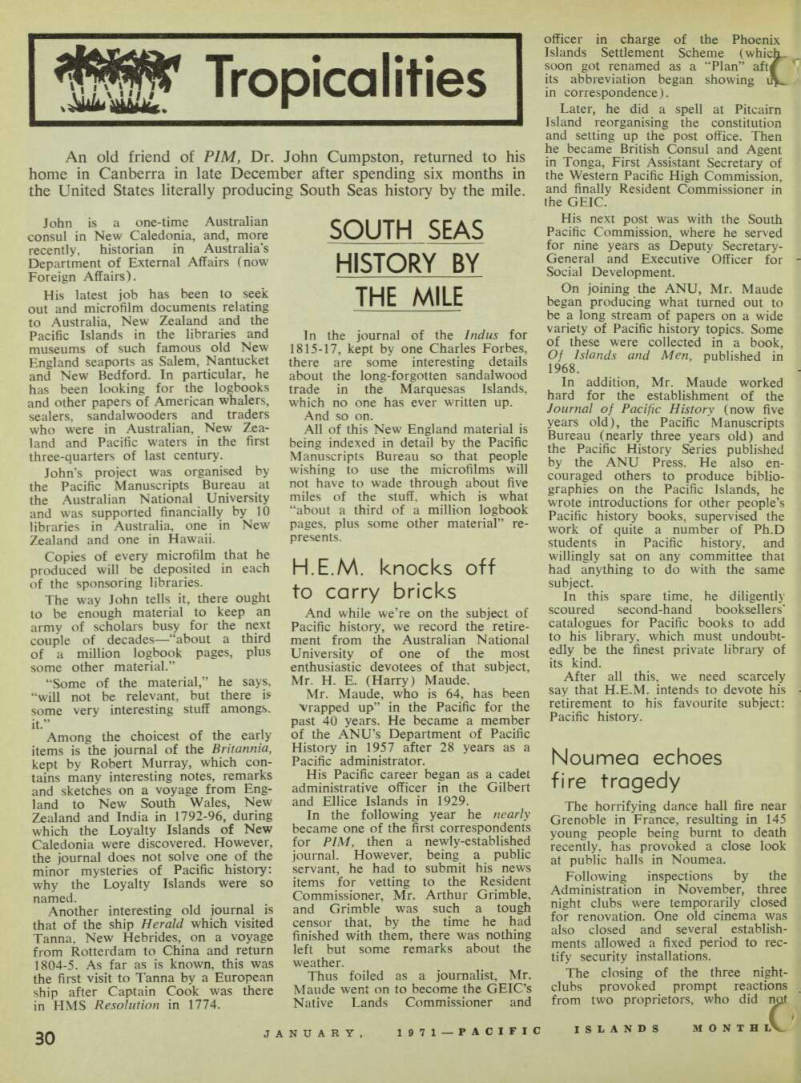
• A pretty girl from Fiji's Indian community models the tradi tional "kurtar" (blouse) and "churidar" (pants) of India. She was seen at the two week Indian Exhibition at Suva Civic Centre, recently, which included parades of Indian saris and traditional clothing, and Pierre Cardin fashions created from Indian made fabrics
Photo: Nitin Lal.
Mr. Barrett revealed they would be the subject of special studies during the next year.
The $59 £ million budget for 1971 provides for a recorded recurrent expenditure of just over $45 mil lion. The capital budget will be $14,400,000, a 26 per cent, increase on this year’s expected figure.
Government anticipates raising just over $44 million in recurrent revenue —an increase of $4.5 million over the revised assessment for the present year.
Mr. Barrett said that at present the major part of revenue was in directly derived from Customs duties and other taxes and charges levied on imported goods. Hopefully, import duties would become less important as Fiji’s own industries developed.
On the question of incentives, Mr.
Barrett said the government re cognised that tax incentives were important to new and expanding industries, and these were available.
But they should not be given without close study of their effect on the Fiji economy.
Mr. Barrett reiterated past gov ernment statements about encouraging foreign investment but warned against the dangers of domination.
Fiji had to be careful that in wel coming foreign investment, it didn’t allow it to reach the proportions where the foreign investor ended by dictating terms.
“To permit lenders to dictate to government would be merely ex changing one foreign power in con trol of our destiny for a number ol rapacious entrepreneurs whose eventual benevolence could inevitably be far less than that shown to us by Her Majesty’s Government in the UK, over the past 96 years,” said Mr.
Barrett.
“Although aid givers are very generous at times, inevitably the day of reckoning must come. Every investor in Fiji, be he an inter national lending agency or a private investor, will require his price at some stage in our development. It is up to your government, and the Minister of Finance in particular, to balance the good of the country against the price which we must be called upon to pay in the future.”
He pointed out it was difficult to exercise control over private foreign investment, because it was govern ment’s policy to impose as little restraint as possible on the develop ment of Fiji’s natural resources and industry.
Mr. Barrett said the trade deficit
for 1970 was expected to be almost $4O million, but this would be more> than offset by tourist receipts I estimated at $26 million and capital inflow of about $l6 million.
The government’s debt situation was relatively healthy, he said. The public debt at the end of 1970 was exjected to be about $4O million, about 25 per cent, of this held ex ternally.
A “relatively low” 8 per cent, of the total revenue would be required to service the public debt during the current year. However, the proportion of external to total public debt would probably rise in coming years—and the servicing of the external debt would absorb an increasing pro portion of Fiji’s foreign exchange receipts.
This development would have to be watched very closely to ensure that Fiji didn’t get into the difficulty experienced by many less developed countries—straining its resources to meet overseas debt commitments.
The growth in government ex penditure was a major factor in the economic upturn from 1967, the minister added. In 1966, the govern ment spent $25.2 million on its re current services and $7.7 million on capital development. In the 1970 budget, a final recurrent expenditure is likely to reach $39.4 million (as against an approved estimate of $35.7 million) and final capital ex penditure of $lO million (as against an approved estimate of $11.4 mil lion).
Fiji Now Has More
Than 520,000 People
An error in migration statistics in 1969 led to an overestimation in Fiji population figures, according to new figures released.
It seems that Fiji has 13,048 fewer people than previously estimated. The population at the end of 1969 should have been officially counted at 513,717, instead off 526,765.
The revised total population estimates for the past four years are: 1966—478,355; 1967—490,716; 1968 502,035; 1969—513,717.
Racial composition at the end of 1969 was: 260,567 Indians; 219,784 Fijians; 9.346 part-Europeans; 6,798 Pacific Islanders; 6.313 Rotumans; 5,600 Eu r opeans; 4,947 Chinese and 362 others.
The 1970 mid-year estimate of population is 520,071.
The reduction in the population total means the birth rate is higher than previously believed. The 1969 rate of 28.97 per thousand of the population has been revised to 29.71 per thousand. m
"We'll fight them on the reefs
reefs and beaches ..."
PIM s brand new Defence Correspondent sends his first despatch from Suva.
No self-respecting nation can afford to be without a Defence Department—a show of strength.
Both the intruder and internal un rest must be fought. Let us take a look at one such new depart ment, filed on the fourth floor.
Names have been changed and any similarity to current government procedure in Fiji is purely co incidental.
SCENE: A modem air conditioned office save for one desk, one chair . . . and one Defence Secretary (ex - Military establishment) looking, not with out interest, at a group of school girls playing softball in the park below. Enter the head of the Defence Ministry.
SECRETARY: ( Jumping to his feet) Good morning, Minister!
MINISTER: Morning! Don’t get up. Oh, well, stand easy, then.
Looks as though we’re in business then. We’ll have to get some maps and things to fill up these walls.
Is this all the furniture we’ve got?
Have to get some memos on the move. We may have to see this British delegation this afternoon.
SECRETARY: Yes, of course, sir. Look, take this chair; I’ll get another from the outer office.
Minister: Yes.
(Secretary re-enters followed by young clerk carrying chair.) SECRETARY: This is John, sir.
We’re sharing him with Resources down the corridor.
MINISTER: Good. Well, he can start by getting us some pads and pens and things. Better get some coloured crayons as well. (Clerk backs out. Secretary sits himself down opposite the Minister, who has taken up position behind desk.) SECRETARY: I thought that survey in today’s paper put us in a favourable light. It is satisfying to know that the layman is conscious of what’s going on. I rather liked that one about a Defence Ministry being necessary
if we are to maintain law and order and to uphold a democratic government, MINISTER: Yes, most impor tant. We WILL do that. But there were a few stabs at the expense involved. Look, if we had had a few upheavals here they'd be screaming for something to be done. You’re satisfied with 6,000, aren’t you? Yes, I’ve asked you that before. It’s the same in the field . . .
SEC RET ARY: ( In terjecting ) What campaign was that, sir?
MINISTER: {Emphatically) The Rugby field. You’ve got to pre pare yourself for every contin gency. Sound in defence. Pre paredness. Have those Land Rovers arrived? Mobile units . . . mobility.
SECRETARY: I don’t think . . . {lnterrupted with the arrival of clerk.) SECRETARY: Good, that was quick! Put them down on the floor over there will you. Now, maps. You said maps, sir? What, of the main islands, the Pacific, and one of the world?
MINISTER: {Staring out of the windows overlooking the park be low) Mmm. Yes. And one of the capital and its environs. And some flags.
SECRETARY: What about books, sir. Any ideas?
MINISTER: Do you think we really ... Yes, I suppose so.
Churchill’s would be a good start.
Mm, the Gathering Storm series.
I’ve read two of the volumes.
Might as well get a paperback edition. Mao’s Thoughts? We can build up as we go along. Rommel’s Tank Warfare ?
Secretary: (As John
scribbles) How about Mein Kampfl K-A-M-P-F. ( John backs out).
MINISTER: You were in Ger many, weren’t you? Anyway you’d better get some shelves up. We must have some models made. Of towns and islands. If we are to
see these English fellows we’d better get together over lunch I think. I’ve had words with the Police Commissioner. Internal security. You can fill me in on the Army side. I think we are all right on internal security. We must tighten up, of course.
SECRETARY: Tighten up, sir?
MINISTER: Yes, on internal security. On the other hand the question of outside agencies be comes a little tricky. We have to ascertain the potential enemy.
SECRETARY; Yes, it is rather difficult, sir.
MINISTER: Process of elimina tion. {Laughing.) I think we can rule out Tonga, don’t you? They’ve stopped their raiding parties!
SECRETARY: Funny you should say that. Someone phoned up this morning, our first call, and said he had three outriggers for hire. Unfortunately he rang off before I had time to ask who it was.
MINISTER: Oh, you are bound to get that sort of thing at first.
You’ll have to have a check made on incoming calls. Now, we are an important base in the Pacific.
Australia and New Zealand appre ciate that. In fact it would be in their own interests, command of the Pacific and all that, that our waters are kept open in time of strife. And the Americans know all about the importance of the Pacific. So can we take it, then, that we could rely on all of them?
You see now that we have a foot in the UN, and if we got more equipment, our voice could be even more representative of the South Pacific. Right, I’m off to see the PM. Don’t forget those figures— men, rifles, and ... oh, no, we haven’t got any of those.
Secretary: No, Sir.
MINISTER: {Walking towards the door ) You staying here?
SECRETARY: Yes, I’d rather clear up a bit.
MINISTER; Can we be careful with the use of “rather”. I think we should be more precise. Good bye then. We’ll fight them on the reefs, eh? {Minister closes the door be hind him. Secretary jumps to his feet and rushes to the door.) SECRETARY: Sir, your brief case!
Advertisements & other items, p. 31 (1 item)
29
ACIFIC ISLANDS MONTHLY JANUARY, 1971
Tropicalities
South Seas
History By
The Mile
An old friend of PIM, Dr. John Cumpston, returned to his home in Canberra in late December after spending six months in the United States literally producing South Seas history by the mile.
John is a one-time Australian consul in New Caledonia, and, more recently, historian in Australia's Department of External Affairs (now Foreign Affairs).
His latest job has been to seek out and microfilm documents relating to Australia, New Zealand and the Pacific Islands in the libraries and museums of such famous old New England seaports as Salem, Nantucket and New Bedford. In particular, he has been looking for the logbooks and other papers of American whalers, sealers, sandalwooders and traders who were in Australian, New Zea land and Pacific waters in the first three-quarters of last century.
John’s project was organised by the Pacific Manuscripts Bureau at the Australian National University and was supported financially by 10 libraries in Australia, one in New Zealand and one in Hawaii.
Copies of every microfilm that he produced will be deposited in each of the sponsoring libraries.
The way John tells it, there ought to be enough material to keep an army of scholars busy for the next couple of decades —“about a third of a million logbook pages, plus some other material.”
“Some of the material,” he says, “will not be relevant, but there is some very interesting stuff amongs, it.”
Among the choicest of the early items is the journal of the Britannia, kept by Robert Murray, which con tains many interesting notes, remarks and sketches on a voyage from Eng land to New South Wales, New Zealand and India in 1792-96, during which the Loyalty Islands of New Caledonia were discovered. However, the journal does not solve one of the minor mysteries of Pacific history: why the Loyalty Islands were so named.
Another interesting old journal is that of the ship Herald which visited Tanna, New Hebrides, on a voyage from Rotterdam to China and return 1804-5. As far as is known, this was the first visit to Tanna by a European ship after Captain Cook was there in HMS Resolution in 1774.
In the journal of the Indus for 1815-17, kept by one Charles Forbes, there are some interesting details about the long-forgotten sandalwood trade in the Marquesas Islands, which no one has ever written up.
And so on.
All of this New England material is being indexed in detail by the Pacific Manuscripts Bureau so that people wishing to use the microfilms will not have to wade through about five miles of the stuff, which is what “about a third of a million logbook pages, plus some other material” re presents.
H.E.M. knocks off
to carry bricks
And while we’re on the subject of Pacific history, we record the retire ment from the Australian National University of one of the most enthusiastic devotees of that subject, Mr. H. E. (Harry) Maude.
Mr. Maude, who is 64, has been trapped up” in the Pacific for the past 40 years. He became a member of the ANU’s Department of Pacific History in 1957 after 28 years as a Pacific administrator.
His Pacific career began as a cadet administrative officer in the Gilbert and Ellice Islands in 1929.
In the following year he nearly became one of the first correspondents for PIM, then a newly-established journal. However, being a public servant, he had to submit his news items for vetting to the Resident Commissioner, Mr. Arthur Grimble, and Grimble was such a tough censor that, by the time he had finished with them, there was nothing left but some remarks about the weather.
Thus foiled as a journalist, Mr.
Maude went on to become the GEIC’s Native Lands Commissioner and
officer in charge of the Phoenix Islands Settlement Scheme (which„ soon got renamed as a “Plan” aft| its abbreviation began showing in correspondence).
Later, he did a spell at Pitcairn Island reorganising the constitution and setting up the post office. Then he became British Consul and Agent in Tonga, First Assistant Secretary of the Western Pacific High Commission, and finally Resident Commissioner in the GEIC.
His next post was with the South Pacific Commission, where he served for nine years as Deputy Secretary- General and Executive Officer for Social Development.
On joining the ANU, Mr. Maude began producing what turned out to be a long stream of papers on a wide variety of Pacific history topics. Some of these were collected in a book, Of Islands and Men, published in 1968.
In addition, Mr. Maude worked hard for the establishment of the Journal of Pacific History (now five years old), the Pacific Manuscripts Bureau (nearly three years old) and the Pacific History Series published by the ANU Press. He also en couraged others to produce biblio graphies on the Pacific Islands, he wrote introductions for other people’s Pacific history books, supervised the work of quite a number of Ph.D students in Pacific history, and willingly sat on any committee that had anything to do with the same subject.
In this spare time, he diligently scoured second-hand booksellers' catalogues for Pacific books to add to his library, which must undoubt edly be the finest private library of its kind.
After all this, we need scarcely say that H.E.M. intends to devote his retirement to his favourite subject: Pacific history.
Noumea echoes
fire tragedy
The horrifying dance hall fire near Grenoble in France, resulting in 145 young people being burnt to death recently, has provoked a close look at public halls in Noumea.
Following inspections by the Administration in November, three night clubs were temporarily closed for renovation. One old cinema was also closed and several establish ments allowed a fixed period to rec tify security installations.
The closing of the three night clubs provoked prompt reactions from two proprietors, who did not
hesitate to pronounce their grievances the local Press. fcThe proprietor of the night club •TLa Grange” protested against a newspaper account of her establish ment which, she claimed, seemed to suggest that “dancers and drinkers are accommodated right in the kitchen . . . thus running the risk of sitting on a bottle of explosive Portagas and being roasted”.
The manager of another establish ment protested against the sudden closing of his cabaret when, he declared, “in the six years that I have been working at the Tahiti Cabaret the Administration has never shown any concern over the risk of a fire. Moreover, many employees and persons in charge of the same Administration have not hesitated to joyfully risk suffocation in my night club”.
The nightclub closings did bring some peaceful nights to Noumea beachside residents. For the tourists, however, it was unhappily quiet, and some locals, in view of the lack of facilities, were obliged to sail out into the harbour to entertain visiting seamen aboard their own ships.
Nauru-Australia
Association?
Mr. John Pilbeam, new Govern ment Representative in Australia and New Zealand for the Republic of Nauru, is giving priority to the formation of an Australia-Nauru As sociation.
Hopefully, a meeting will be held on January 31 (the third anniversary of Nauru’s independence), at which a steering committee will launch the association. A general meeting will be held sometime later.
The idea is President Hammer Deßoburt’s, who feels that com munion between Australia and Nauru will be improved by such an associa tion where people can meet on a social and cultural level.
Mr. Pilbeam (see background, p. 82) said in Melbourne in December that quite a number of Nauruans were living in Australia, including young Nauruans at schools, cadetships and training courses.
And many Australians, directly or indirectly, are associated with Nauru.
Mr. Pilbeam, a pleasant personality, who is making his first visit to Nauru in January, said that although Nauru was one of the smallest independent countries in the world, it was able to take the initiative to provide transportation services of great value to other South Pacific territories Jacking Nauru’s resources.
He made it a
job to be proud of
In the 11 years that genial Nacanieli (“Ned”) Vunibola has stood at the portals of Suva’s Grand Pacific Hotel, he’s posed for thousands of photographs (see above) and made a thousand friends.
Indeed, the historic GPH won’t seem the same now that 57-year-old Ned has given up as commissionaire to go into business on his own.
He and a group of Fijians at Raiwaqa have opened a number of shops, which are already doing well on a co-operative basis. Ned also manages a meke entertainment group, which is one of the attractions at the GPH.
“I had to be coaxed and pushed into this job as commissionaire because I thought that standing at hotel door welcoming guests would be a let-down to my people,” recalled Ned, a former school teacher in the Lau Group. “But gradually I came to realise that I could make it a job to be proud of. I’ve enjoyed meeting people, particularly Prince Charles, the Duke of Kent and the late Queen Salote.”
Colour prejudice
at the university
Although the University of Papua and New Guinea produced its first New Guinean graduates (six of them) last August, there is already pressure for it to get its first black vice chancellor—by 1972 if possible, and certainly by 1975.
Present vice-chancellor is Dr. John Gunther, who launched the univer sity and has got it to its present stage. He has all the qualifications needed for his exacting task except he’s the wrong colour, according to PA Management Consultants, an Australian firm. Dr. Gunther’s con tract expires in May, 1972.
PA, in a report to the university’s council on “Manpower Planning, 1970-1980”, says that “social and political opinion in the territory may prevent the appointment of another European expatriate” (read white man) should Dr. Gunther vacate his post in 1972.
The consultants’ report deals with “localisation” of all positions in the university, but it’s the post of vice chancellor—as the report itself says which is “politically sensitive”.
It says that Dr. Gunther is “undecided as to his future plans while recognising that an indigene may not be available (in 1972) to assume the position”.
The report recommends in that case that Dr. Gunther be asked to stay until 1975, and a white academic of high standing, or “a person of some prestige” at least, be appointed Pro-vice-chancellor before Dr.
Gunther’s successor is appointed.
Apparently this Pro-vice-chancellor would be “a grey eminence”, ad vising and assisting the new man on administrative and academic matters, with his role reducing as the new black vice-chancellor gained ex perience.
The report sees the new vice chancellor as a graduate of Papua- New Guinea’s university, who would be trained for at least three years there and overseas in administration.
Members of the university council aren’t at all keen on the consultants’ plan, which favours putting an in experienced New Guinean in the vice chancellor’s chair for the sake of political expediency.
Dr. Gunther seems unperturbed.
“Council regards the report as a guide rather than a blueprint,” he said, “and doesn’t necessarily accept its recommendations. PA set the date 1975 as a beacon.”
But he said the council had decided, on his suggestion, to form a committee to look for suitable can didates as his successor.
Advertisements & other items, pp. 32-33 (2 items)
30
JANUARY, 1971 PACIFIC ISLANDS MONTH L
31
ACIFIC ISLANDS MONTHLY JANUARY, 1971
New Guinea
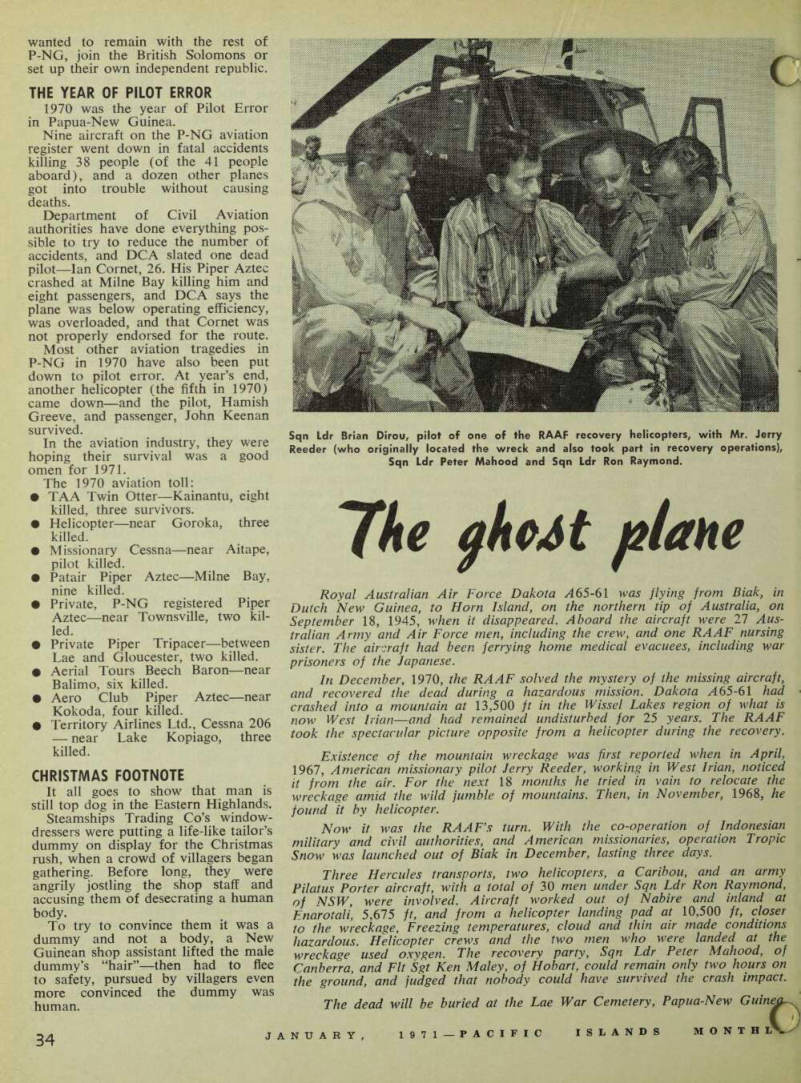
Diary
With John Ryan
Gilbert And Sullivan Year
Gilbert and Sullivan could have made a fortune in Papua-New Guinea, setting politics to music.
In fact, the raw material is getting better every year: • Oscar Tammur MHA dancing in rage in a hospital ward because the government forced him to leave gaol. • Management consultants telling the university to look for a black or brown vice-chancellor. • Chairman of the Public Service Board Gerald Unkles letting his hair down by castigating public servants. • Police snooping around the Public Service on the trail of alleged misappropriations. • Mataungan reject Daniel Rumet angling for a law scholarship. • Constitutional Committee chairman Paulus Arek MHA praying that the villagers will want some constitutional advance this year. • “Rebellion” against Australia and New Guinea by Papuan members of parliament The list is virtually endless.
The old Commonwealth Office gentlemen in London must be politely laughing themselves silly over the fix in which that old colony, Australia, now finds itself in Papua-New Guinea, Biggest of all the 1971 problems is Papua.
In 1883 the Australian colonists in convention at Sydney literally forced Britain into proclaiming the 1884 Protectorate over south-eastern New Guinea (British New Guinea) and it wasn’t until 1906 that Britain fobbed it back to the Australians, and it became Papua.
By unfortunate political accident, the 600,000 modern-day descendants of the 1884 Papuans are British subjects and Australian citizens . . . and they’ve started full-scale political war to find out what their citizenship really means, and why Australia is apparently showing much more interest in the New Guinea Trust Territory than it is in Australian-owned Papua (see Percy Chatterton on the subject, p. 46).
Minister for External Territories Barnes dashed through Papua last month under a veil of official secrecy, apparently to try to find out what Papuans are really thinking. This followed the creation during the November meeting of the P-NG Parliament, of the Papua Action Group under the Member for South Fly, Mr. Niwia Ebia Olewale.
According to my information from nameless, faceless government men in Canberra, the Barnestorm of Papua was simply part of Prime Minister Gorton’s master plan to announce, as soon as possible, the decision that Australia will yield sovereignty over Papua so that it can officially and legally join New Guinea in the gallop towards self-government.
At the moment, the difference in status between New Guinea and Papua is a constant political pin-prick for those native politicians who want to start talking nationalistically about a joint, equal status for New Guinea and Papua.
The decision on Papua must be made. It cannot remain simply a black enclave between a white Australia and a future, independent New Guinea Trust Territory. PM Gorton decided that Papua must go with New Guinea, for joint independence. This is simply the neatest way out of an awkward political-social situation.
Meantime, the Papuans are giving the Australian Administration of P-NG, and the Executive Council, a rough time with arguments insisting that nobody thinks of Papua, no money is spent in Papua, and that the economic and political planners in Canberra and Port Moresby are dazzled by New Guinea alone, and intent on big spending there to try to keep the United Nations General Assembly at bay. Papua is dead unlucky, economically.
The only worthwhile thing on the horizon is the Kennecott copper which, if it reaches mining level, will make the New Guinea Trust Territory people think seriously about letting poor Papua tag along in a joint P-NG independence,
Life (And Death) With
The Mataungans
Oscar Tammur MHA, patron of Mataungan at Rabaul, leaped out of his Nonga Hospital bed and began yelling: “They can’t force me to leave gaol. I’m a prisoner. I demand that the police come back to guard me—l want to finish my time in gaol. . . .”
Mr. Tammur had been sent to gaol for 30 days because he’d re fused to pay his annual $l6 taxmoney to the Gazelle Multi-racial Council at Rabaul, and had refused to pay the $3O fine.
He had a couple of days crack ing rocks at Keravat Gaol, and was then whisked into hospital, under police guard, because of bronchitis.
Mr. Tammur MHA, was determined to become a Mataungan martyr by going to gaol, rather than bending the knee to the hated, Australian sponsored Gazelle Council.
He was only halfway through his gaol term (most of it in hospital) when somebody in Canberra sent $3O to Magistrate Paul Quinlivan at Rabaul to pay the fine, and Quinlivan signed the release papers.
Mr. Tammur MHA was exceed ingly cranky. Nobody had asked him (he claimed) whether he wanted to accept the money. There were some in P-NG who agreed that there had been a lack of courtesy . . . and that the Australians had seemed just a little too anxious to get Mr. Tammur out of gaol, to limit his martyr potential.
At month’s end, Mataungan had hit back at Port Moresby and Can berra by announcing their plan to establish a Mataungan Local Govern ment Council directly opposing the legal Gazelle Council, and in gov ernment circles there were (foi^-
obvious reasons) no strong objections ■ so long as Mataungan people due pay tax to the Gazelle Council so.
It was another month of high politics, all of which failed to change the basic situation: Mataungan supporters still have to pay taxes, and the Gazelle Council is still in business.
And then on December 23, the Administration confirmed reports that the Mataungan Association has made threats to kill several prominent Tolai people who support the Aus tralian Administration.
The Department of Information and Extension Services said in a broadcast that the Mataungan threats of killing were made against— • The member of parliament for Rabaul and Ministerial Member for Education in the Executive Council, Mr. Matthias Toliman; • The president of the Gazelle Council, at Rabaul, Mr. To Wartovo; • The former president of the Gazelle Council Mr. Stanley Tomarita; and • A senior executive of the Gazelle Council, Mr. Henry To Matamatam.
The threats by Mataungan to kill the four men were apparently organised at a Mataungan meeting a few days earlier to celebrate the first anniversary of the attack in December, 1969, when supporters of the Gazelle Council were beaten up, and punches were thrown at the former Administrator of New Guinea, Mr. David Hay.
Christmas Present?
By public reputation, Mataungan’s former Vice-President Daniel Rumet must be one of the most “lawless” native men in P-NG. Mataungan has cost the Australians Si million since May, 1969, in flying police to Rabaul to guard law and order.
Now that he’s been kicked out of Mataungan, Rumet (a former pub lic servant) is scouting around for work. There’s a good chance that he’ll get a government scholarship to study law at the University of Papua-New Guinea!
Public Service Uproar
First chairman of the P-NG Public Service Board, Gerald Unkles, left New Guinea in December in a welter of words, and recriminations all round. Unkles and the rank-and file Public Service Association had sniped at each other for many months —the promotion of Chief Electoral Officer (Papuan) Simon Kaumi to replace Australian Bob Bryant, the yfl|houldering-aside of the traditional
Promotions Appeals Committee, and Unkles’ sharp words at a management seminar about the “second-rate” performance of the Public Service, dis loyalty, etc.
Unkles came to P-NG two years ago, carefully briefed by Canberra to get native public servants into top jobs come what may. It was inevitable that he should run head-on into the PSA, which is now more watchful than ever against political promotions at the expense of white public servants who, for many years, have been footing the union bill.
In fairness to Unkles, he did a good job for Canberra.
Now that he’s gone, PSA hierarchy is looking to new chairman, Papuan Sere Pitoi, 35, to restore the once easy-going relationship between public servants and their employer. With time running out, Sere Pitoi is really in the hot-seat.
Mr. Whitlam's Tour
By the time you read this, Australia’s Labour Opposition Leader Mr.
Gough Whitlam will be on tour again in Papua-New Guinea and, for Canberra, that means real political trouble.
Whitlam toured P-NG January, 1970, and precipitated a July visit by Prime Minister. Mr. Gorton, and an avalanche of government political decisions giving P-NG greater local control.
January 1970, Whitlam bought into most of P-NG’s problems, particularly the Mataungan issue at Rabaul. For years the government has been telling P-NG’s 2,400,000 villagers that they, the people, will decide when P-NG will become self-governing and then independent—but Whitlam on tour January, 1970, cut right across the government, by telling P-NG it would be self-governing in 1972 and independent in 1976.
Now, Whitlam is on tour again, with an even stronger team than last year. Among his companions is president of the Australian Council of Trade Unions Mr. R. J. Hawke, who has been closely interested in P-NG since he came here 1967 to help the Public Service Association argue higher salaries for native public servants.
Whitlam’s other fellow-travellers: Kim Beazley MHR, T. J. Burns (ALP, Queensland), Clyde Cameron MHR, W. L. Morrison MHR, M. J.
Young (ALP), R. D. Williams, federal secretary of the Australian Council of Salaried and Professional Associations.
Whitlam’s itinerary: January 3—Port Moresby; Jan. s—Mount Hagen; Tan. 6—Madang; Jan. B—Lae; Jan. 10 —Rabaul; Jan. 13—Kieta; Jan. 14— Port Moresby; Jan. 17—Sydney.
Speaker of the P-NG House of Assembly John Guise has asked for private discussions with Mr. Whitlam, and the Opposition Leader is breaking away from his itinerary at Rabaul to fly direct Rabaul-Milne Bay to meet Guise.
A notable feature of the Whitlam tour is that his party is not visiting any Papuan centres outside Port Moresby, but is concentrating solely on the New Guinea Trust Territory. MHAs in Papua are already reacting against the Whitlam tourists because of this.
Quiz Of The Populace
Paulus Arek MHA and his 13 companions (four Australians) in the parliamentary Select Committee on P-NG Constitutional Development are on tour (to begin January 4) to confront P-NG’s people with what, for some, will be a frighteningly radical set of ideas. The questions: • When do you want internal self-government? • One House or two? • 100 members in a House of Assembly, including six nominated out siders who don’t have to face the voters? • What educational qualifications for candidates in 1972? • What do you want in the way of national name, flag and emblem?
In 46 days, until February 19, the select committee is visiting 85 centres trying to find out what the villagers want in 1972. Biggest problem is trying to tell the villagers what it’s all about.
Ideally, the select committee should be listening only. With Labour Opposition Leader Gough Whitlam making another P-NG tour, there’s too much po’itical pressure now for the committee, openly, to remain the listener: the villagers are having to be told what is “good” for them. The committee will report to the House in March.
In late December the Kieta Local Government Council and the Napidakoe Navitu (Self-Government for Bougainville) announced they would boycott the select committee’s public meeting at Kieta to get the people’s views.
The Kieta Council and Napidakoe said they wanted to once again demand a referendum allowing Bougainville’s 75,000 people to decide whether they
wanted to remain with the rest of P-NG, join the British Solomons or set up their own independent republic.
The Year Of Pilot Error
1970 was the year of Pilot Error in Papua-New Guinea.
Nine aircraft on the P-NG aviation register went down in fatal accidents killing 38 people (of the 41 people aboard), and a dozen other planes got into trouble without causing deaths.
Department of Civil Aviation authorities have done everything pos sible to try to reduce the number of accidents, and DCA slated one dead pilot—lan Cornet, 26. His Piper Aztec crashed at Milne Bay killing him and eight passengers, and DCA says the plane was below operating efficiency, was overloaded, and that Cornet was not properly endorsed for the route.
Most other aviation tragedies in P-NG in 1970 have also been put down to pilot error. At year’s end, another helicopter (the fifth in 1970) came down—and the pilot, Hamish Greeve, and passenger, John Keenan survived.
In the aviation industry, they were hoping their survival was a good omen for 1971.
The 1970 aviation toll: • TAA Twin Otter —Kainantu, eight killed, three survivors. • Helicopter—near Goroka, three killed. • Missionary Cessna —near Aitape, pilot killed. • Patair Piper Aztec—Milne Bay, nine killed. • Private, P-NG registered Piper Aztec—near Townsville, two kil led. • Private Piper Tripacer—between Lae and Gloucester, two killed, • Aerial Tours Beech Baron—near Balimo, six killed. • Aero Club Piper Aztec—near Kokoda, four killed. • Territory Airlines Ltd., Cessna 206 near Lake Kopiago, three killed.
Christmas Footnote
It all goes to show that man is still top dog in the Eastern Highlands.
Steamships Trading Co’s window dressers were putting a life-like tailor’s dummy on display for the Christmas rush, when a crowd of villagers began gathering. Before long, they were angrily jostling the shop staff and accusing them of desecrating a human body.
To try to convince them it was a dummy and not a body, a New Guinean shop assistant lifted the male dummy’s “hair” —then had to flee to safety, pursued by villagers even more convinced the dummy was human.
Advertisements & other items, p. 35 (1 item)
33
TACIFIC ISLANDS MONTHLY JANUARY, 1971
The ghost plane
Royal Australian Air Force Dakota A 65-61 was flying from Biak, in Dutch New Guinea, to Horn Island, on the northern tip of Australia, on September 18, 1945, when it disappeared. Aboard the aircraft were 27 Aus tralian Army and Air Force men, including the crew, and one RAAF nursing sister. The aircraft had been ferrying home medical evacuees, including war prisoners of the Japanese.
In December, 1970, the RAAF solved the mystery of the missing aircraft, and recovered the dead during a hazardous mission. Dakota A 65-61 had crashed into a mountain at 13,500 ft in the Wissel Lakes region of what is now West Irian —and had remained undisturbed for 25 years. The RAAF took the spectacular picture opposite from a helicopter during the recovery.
Existence of the mountain wreckage was first reported when in April, 1967, American missionary pilot Jerry Reeder, working in West Irian, noticed it from the air. For the next 18 months he tried in vain to relocate the wreckage amid the wild jumble of mountains. Then, in November, 1968, he found it by helicopter.
Now it was the RAAF’s turn. With the co-operation of Indonesian military and civil authorities, and American missionaries, operation Tropic Snow was launched out of Biak in December, lasting three days.
Three Hercules transports, two helicopters, a Caribou, and an army Pilatus Porter aircraft, with a total of 30 men under Sqn Ldr Ron Raymond, of NSW, were involved. Aircraft worked out of Nabire and inland at Enarotali, 5,675 ft, and from a helicopter landing pad at 10,500 ft, closer to the wreckage, Freezing temperatures, cloud and thin air made conditions hazardous. Helicopter crews and the two men who were landed at the wreckage used oxygen. The recovery party, Sqn Ldr Peter Mahood, of Canberra, and Fit Sgt Ken Maley, of Hobart, could remain only two hours on the ground, and judged that nobody could have survived the crash impact.
The dead will be buried at the Lae War Cemetery, Papua-New Guinea.
Sqn Ldr Brian Dirou, pilot of one of the RAAF recovery helicopters, with Mr, Jerry Reeder (who originally located the wreck and also took part in recovery operations), Sqn Ldr Peter Mahood and Sqn Ldr Ron Raymond.
Advertisements & other items, pp. 36-38 (3 items)
34
JANUARY, 1971 PACIFIC ISLANDS MONTHL
Page 37
Five hours in the islands
He was five hours in the South Pacific—on land, that is. But he flew over a lot of it on his flight from Manila to Pago, from Pago to Western Samoa and back, and finally from Pago to Sydney. Never has any dis tinguished visitor covered so much territory so quickly.
The Pope’s arrival in Pago (surrounded by at least 20 security men because of the earlier attempt on his life in Manila) was greeted by 3,000 Samoans, prepared to crush him to death with enthusiasm. The Pope didn’t help much—he accepted hand clasps, despite attempts by his advisers to divert him.
In Western Samoa, which was the main object of his visit, the people greeted the Pope differently. When he got off the Fiji Airways HS74B, there were no enthusiastic shouts. For the most part there was silence, traditionally the highest form of welcome West Samoans give dis tinguished visitors.
There were 2,500 Samoans patiently waiting at the airport, another 5,000 at Leulumoega village, where the Pope said Mass, and many thousands on both sides of the road from the airport to the village, about four miles. There were at least 66 decorated arches along that route, which the Pope followed on a decorated truck. At Leulumoega he changed in the sacristry and celebrated open-air Mass at the front of the church, giving communion to a representative group.
The Pope later presented all his Mass vestments to Bishop Pio Taofinuu, first Polynesian Catholic bishop.
At Mass the Pope appealed to all churches to send more missionaries to the South Pacific.
The public welcome at Pago during his return stop there was just as enthusiastic as the first had been.
In Sydney soon after, the Pope met the Catholic Bishops of Oceania, who had been in conference there.
It had been a stimulating conference. Bishop John Rodgers ; of Tonga, for instance, called for married priests in isolated areas, relief for the burden of church schools in Tonga by sending some children to govern ment schools, and for “paternalistic” expatriate clergy lo speed up their exit from the Pacific, to make room for indigenous clergy.
In Sydney, the Pope consecrated Father Louis Vangeke, 66, of Papua-New Guinea, as the territory’s first native-born Catholic bishop.
The new bishop, bom in Papua, has a coat-of-arms incorporating a number of Mekeo tribal emblems including a spear, club and lakatoi, set on a Papuan shield. He will be auxiliary to Archbishop V. P. Copas, of Port Moresby.
His consecration caused an uproar in some quarters.
The New Guinea fortnightly Catholic newspaper Wantok, published in Pidgin, commented editorially that the Catholic mission were giving too little too late to local people, and asked whether Bishop Vangeke would have been appointed at all if the Pope hadn’t been making his Australian visit. This upset Archbishop Copas, who banned the paper from sale in the churches until further notice, and brought himself into conflict with the editor.
Photo: Stan Ritova.
The Pope in the Pacific: Top, at the consecration of P-NG's first indigenous Catholic bishop, Bishop Louis Vangeke: from left, Archbishop Virgil Copas, Archbishop of Port Moresb[?] Bishop Vangeke, Pope Paul. Below, in Western Samoa, with the Bishop of Western Samoa, Bishop Pio Taofinuu.
36
JANUARY. 1971-PACIFIC ISLANDS MONTHL
Atafu in three months
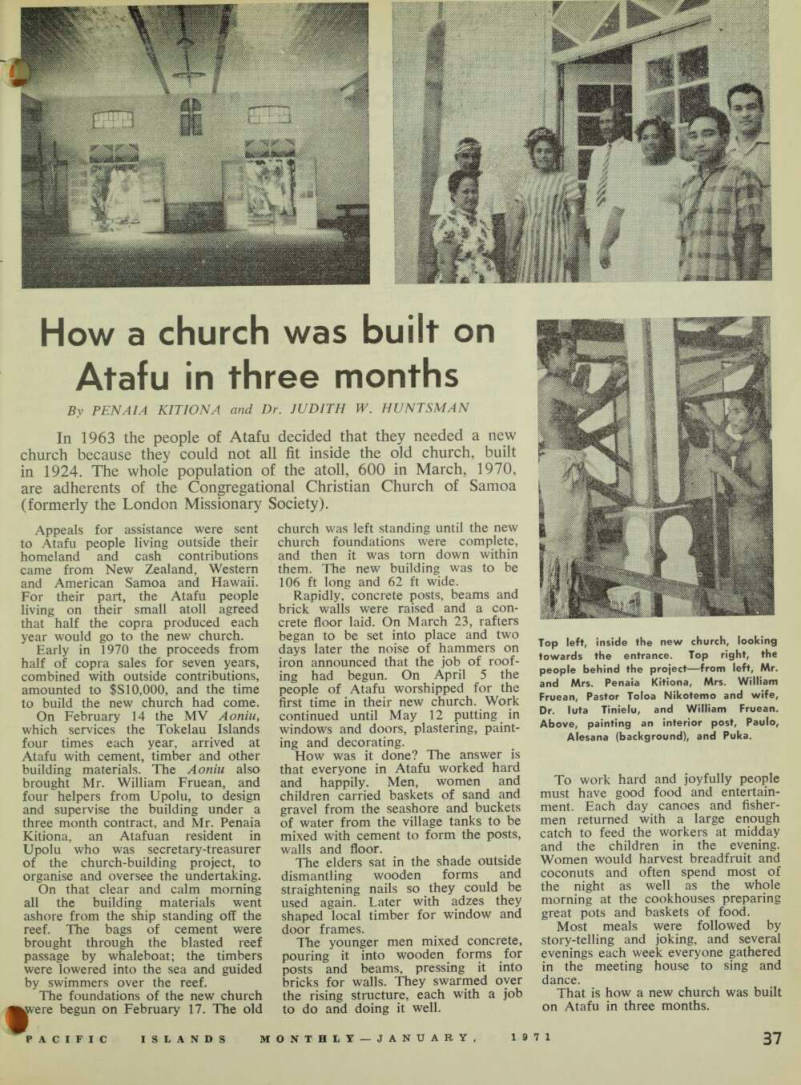
How a church was built on Atafu in three months
By PENAIA KITIONA and Dr. JUDITH W. HUNTSMAN
In 1963 the people of Atafu decided that they needed a new church because they could not all fit inside the old church, built in 1924. The whole population of the atoll, 600 in March, 1970, are adherents of the Congregational Christian Church of Samoa (formerly the London Missionary Society).
Appeals for assistance were sent to Atafu people living outside their homeland and cash contributions came from New Zealand, Western and American Samoa and Hawaii.
For their part, the Atafu people living on their small atoll agreed that half the copra produced each year would go to the new church.
Early in 1970 the proceeds from half of copra sales for seven years, combined with outside contributions, amounted to SSIO,OOO, and the time to build the new church had come.
On February 14 the MV Aoniu, which services the Tokelau Islands four times each year, arrived at Atafu with cement, timber and other building materials. The Aoniu also brought Mr. William Fruean, and four helpers from Upolu, to design and supervise the building under a three month contract, and Mr. Penaia Kitiona, an Atafuan resident in Upolu who was secretary-treasurer of the church-building project, to organise and oversee the undertaking.
On that clear and calm morning all the building materials went ashore from the ship standing off the reef. The bags of cement were brought through the blasted reef passage by whaleboat; the timbers were lowered into the sea and guided by swimmers over the reef.
The foundations of the new church begun on February 17. The old
church was left standing until the new church foundations were complete, and then it was torn down within them. The new building was to be 106 ft long and 62 ft wide.
Rapidly, concrete posts, beams and brick walls were raised and a con crete floor laid. On March 23, rafters began to be set into place and two days later the noise of hammers on iron announced that the job of roof ing had begun. On April 5 the people of Atafu worshipped for the first time in their new church. Work continued until May 12 putting in windows and doors, plastering, paint ing and decorating.
How was it done? The answer is that everyone in Atafu worked hard and happily. Men, women and children carried baskets of sand and gravel from the seashore and buckets of water from the village tanks to be mixed with cement to form the posts, walls and floor.
The elders sat in the shade outside dismantling wooden forms and straightening nails so they could be used again. Later with adzes they shaped local timber for window and door frames.
The younger men mixed concrete, pouring it into wooden forms for posts and beams, pressing it into bricks for walls. They swarmed oyer the rising structure, each with a job to do and doing it well.
To work hard and joyfully people must have good food and entertain ment. Each day canoes and fisher men returned with a large enough catch to feed the workers at midday and the children in the evening.
Women would harvest breadfruit and coconuts and often spend most of the night as well as the whole morning at the cookhouses preparing great pots and baskets of food.
Most meals were followed by story-telling and joking, and several evenings each week everyone gathered in the meeting house to sing and dance.
That is how a new church was built on Atafu in three months.
Top left, inside the new church, looking towards the entrance. Top right, the people behind the project —from left, Mr. and Mrs. Penaia Kitiona, Mrs. William Fruean, Pastor Toloa Nikotemo and wife.
Dr. luta Tinielu, and William Fruean.
Above, painting an interior post, Paulo, Alesana (background), and Puka.
pride—and now American dreams
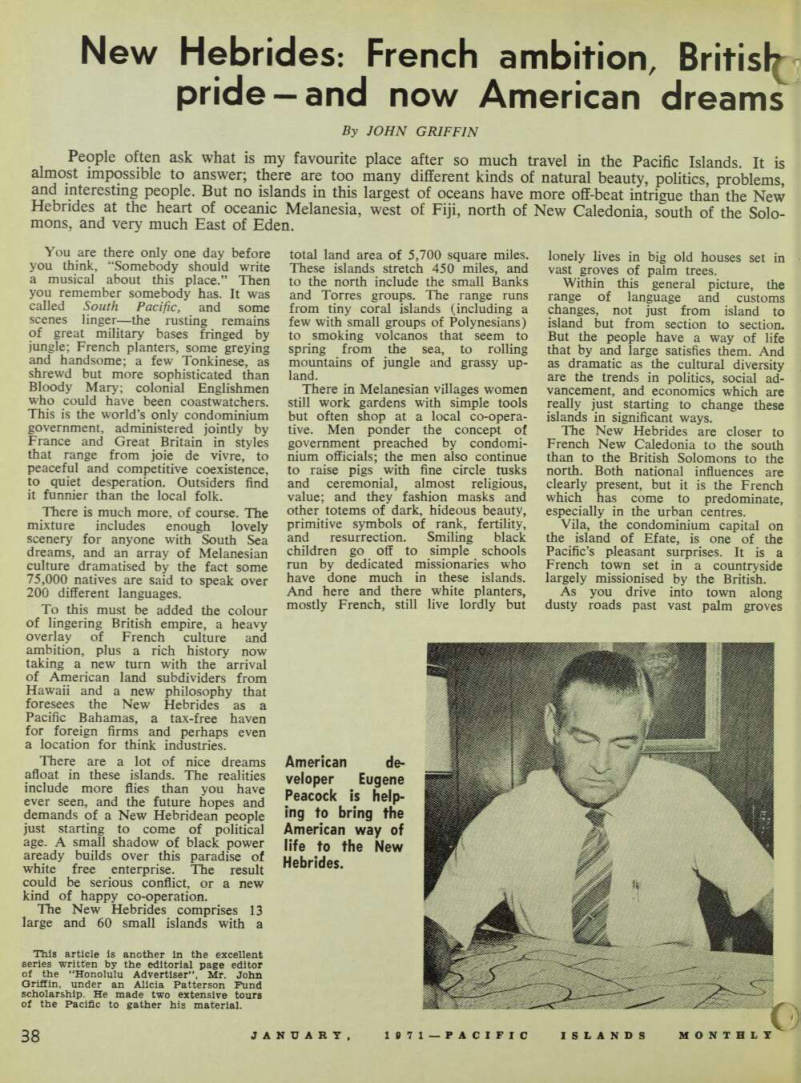
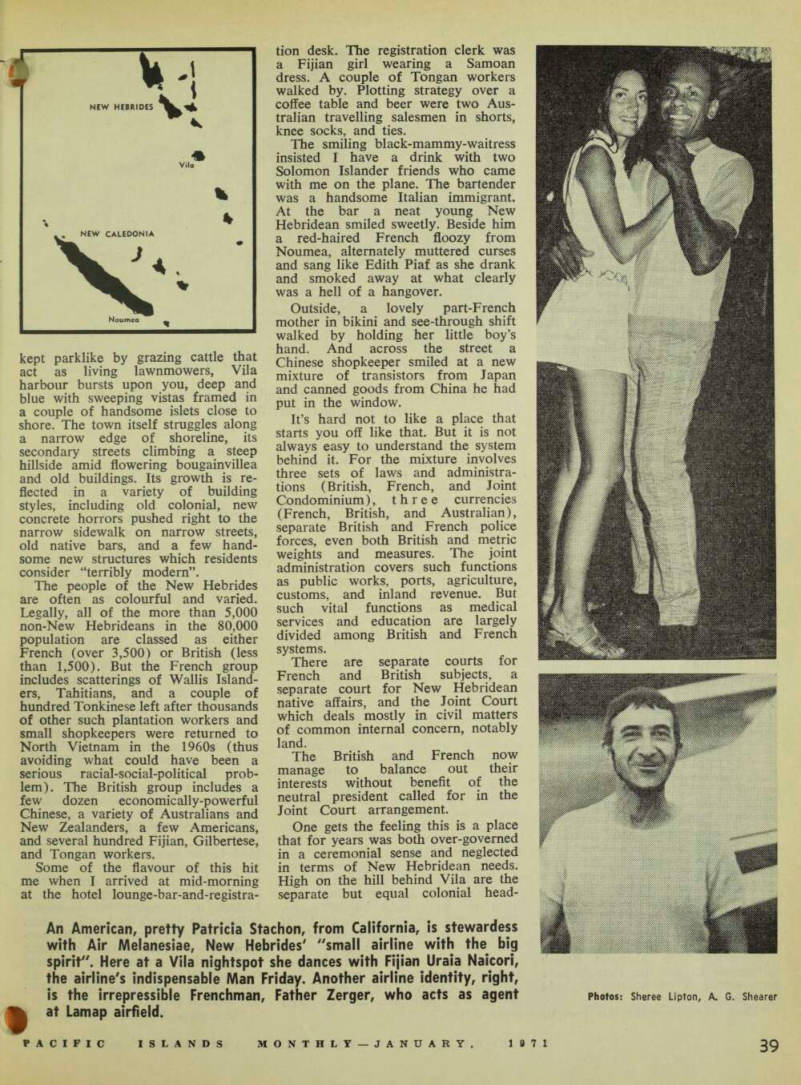
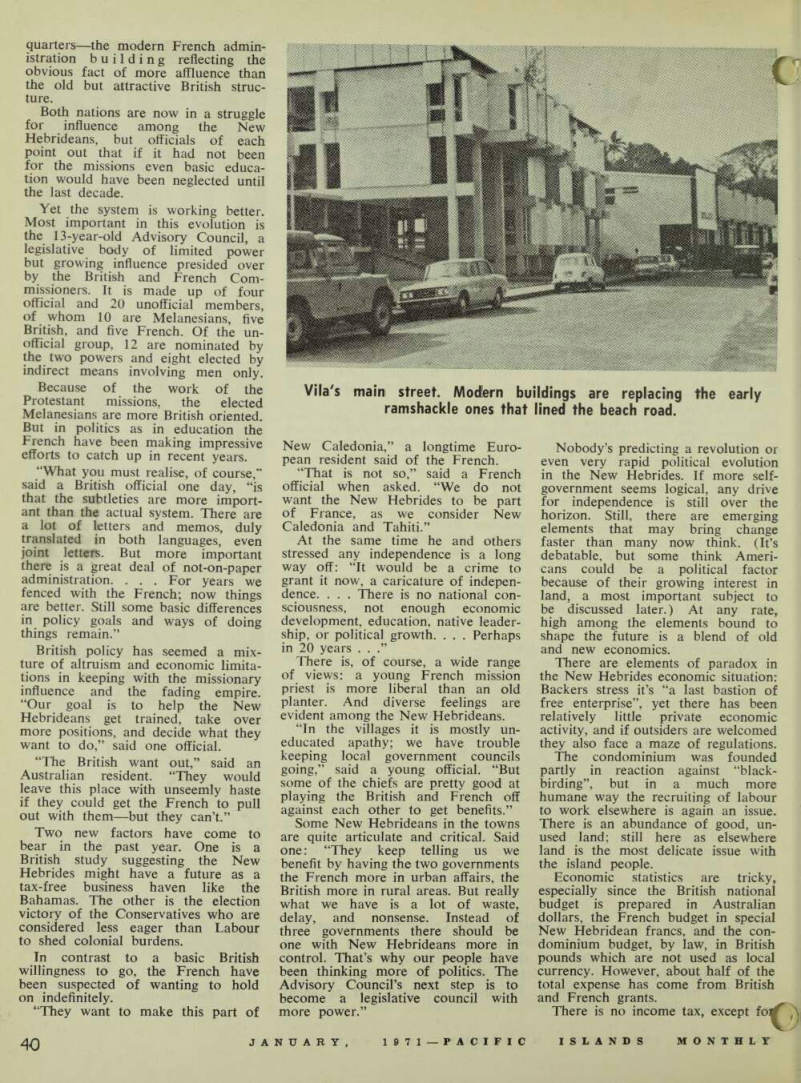
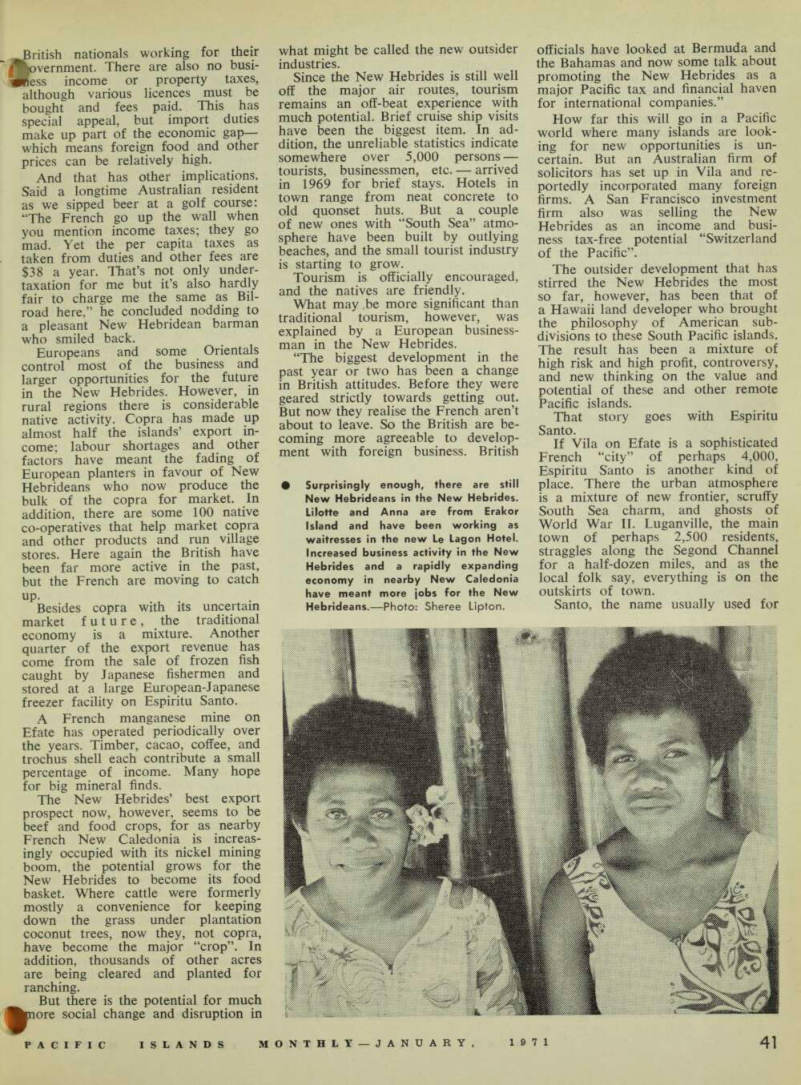
New Hebrides: French ambition, British pride—and now American dreams
By John Griffin
People often ask what is my favourite place after so much travel in the Pacific Islands. It is almost impossible to answer; there are too many different kinds of natural beauty, politics, problems, and interesting people. But no islands in this largest of oceans have more off-beat intrigue than the New Hebrides at the heart of oceanic Melanesia, west of Fiji, north of New Caledonia, south of the Solo mons, and very much East of Eden.
You are there only one day before you think, “Somebody should write a musical about this place.” Then you remember somebody has. It was called South Pacific, and some scenes linger—the rusting remains of great military bases fringed by jungle; French planters, some greying and handsome; a few Tonkinese, as shrewd but more sophisticated than Bloody Mary; colonial Englishmen who could have been coastwatchers.
This is the world’s only condominium government, administered jointly by France and Great Britain in styles that range from joie de vivre, to peaceful and competitive coexistence, to quiet desperation. Outsiders find it funnier than the local folk.
There is much more, of course. The mixture includes enough lovely scenery for anyone with South Sea dreams, and an array of Melanesian culture dramatised by the fact some 75,000 natives are said to speak over 200 different languages.
To this must be added the colour of lingering British empire, a heavy overlay of French culture and ambition, plus a rich history now taking a new turn with the arrival of American land subdividers from Hawaii and a new philosophy that foresees the New Hebrides as a Pacific Bahamas, a tax-free haven for foreign firms and perhaps even a location for think industries.
There are a lot of nice dreams afloat in these islands. The realities include more flies than you have ever seen, and the future hopes and demands of a New Hebridean people just starting to come of political age. A small shadow of black power aready builds over this paradise of white free enterprise. The result could be serious conflict, or a new kind of happy co-operation.
The New Hebrides comprises 13 large and 60 small islands with a This article is another in the excellent series written by the editorial page editor of the “Honolulu Advertiser”, Mr. John Griffin, under an Alicia Patterson Fund scholarship. He made two extensive tours of the Pacific to gather his material.
total land area of 5,700 square miles, These islands stretch 450 miles, and to the north include the small Banks and Torres groups. The range runs from tiny coral islands (including a few with small groups of Polynesians) to smoking volcanos that seem to spring from the sea, to rolling mountains of jungle and grassy upland.
There in Melanesian villages women still work gardens with simple tools but often shop at a local co-operative. Men ponder the concept of government preached by condominium officials; the men also continue to raise pigs with fine circle tusks and ceremonial, almost religious, value; and they fashion masks and other totems of dark, hideous beauty, primitive symbols of rank, fertility, and resurrection. Smiling black children go off to simple schools run by dedicated missionaries who have done much in these islands, And here and there white planters, mostly French, still live lordly but
lonely lives in big old houses set in vast groves of palm trees, Within this general picture, the range of language and customs changes, not just from island to island but from section to section, But the people have a way of life that by and large satisfies them. And as dramatic as the cultural diversity are the trends in politics, social ad vancement, and economics which are really just starting to change these islands in significant ways, The New Hebrides are closer to French New Caledonia to the south than to the British Solomons to the north. Both national influences are clearly present, but it is the French which has come to predominate, especially in the urban centres, Vila, the condominium capital on the island of Efate, is one of the Pacific’s pleasant surprises. It is a French town set in a countryside largely missionised by the British.
As you drive into town along dusty roads past vast palm groves
American de veloper Eugene Peacock is help ing to bring the American way of life to the New Hebrides.
kept parklike by grazing cattle that act as living lawnmowers, Vila harbour bursts upon you, deep and blue with sweeping vistas framed in a couple of handsome islets close to shore. The town itself struggles along a narrow edge of shoreline, its secondary streets climbing a steep hillside amid flowering bougainvillea and old buildings. Its growth is re flected in a variety of building styles, including old colonial, new concrete horrors pushed right to the narrow sidewalk on narrow streets, old native bars, and a few hand some new structures which residents consider “terribly modern”.
The people of the New Hebrides are often as colourful and varied.
Legally, all of the more than 5,000 non-New Hebrideans in the 80,000 population are classed as either French (over 3,500) or British (less than 1,500). But the French group includes scatterings of Wallis Island ers, Tahitians, and a couple of hundred Tonkinese left after thousands of other such plantation workers and small shopkeepers were returned to North Vietnam in the 1960 s (thus avoiding what could have been a serious racial-social-political prob lem). The British group includes a few dozen economically-powerful Chinese, a variety of Australians and New Zealanders, a few Americans, and several hundred Fijian, Gilbertese, and Tongan workers.
Some of the flavour of this hit me when I arrived at mid-morning at the hotel lounge-bar-and-registra
tion desk. The registration clerk was a Fijian girl wearing a Samoan dress. A couple of Tongan workers walked by. Plotting strategy over a coffee table and beer were two Aus tralian travelling salesmen in shorts, knee socks, and ties.
The smiling black-mammy-waitress insisted I have a drink with two Solomon Islander friends who came with me on the plane. The bartender was a handsome Italian immigrant.
At the bar a neat young New Hebridean smiled sweetly. Beside him a red-haired French floozy from Noumea, alternately muttered curses and sang like Edith Piaf as she drank and smoked away at what clearly was a hell of a hangover.
Outside, a lovely part-French mother in bikini and see-through shift walked by holding her little boy’s hand. And across the street a Chinese shopkeeper smiled at a new mixture of transistors from Japan and canned goods from China he had put in the window.
It’s hard not to like a place that starts you off like that. But it is not always easy to understand the system behind it. For the mixture involves three sets of laws and administra tions (British, French, and Joint Condominium), three currencies (French, British, and Australian), separate British and French police forces, even both British and metric weights and measures. The joint administration covers such functions as public works, ports, agriculture, customs, and inland revenue. But such vital functions as medical services and education are largely divided among British and French systems.
There are separate courts for French and British subjects, a separate court for New Hebridean native affairs, and the Joint Court which deals mostly in civil matters of common internal concern, notably land.
The British and French now manage to balance out their interests without benefit of the neutral president called for in the Joint Court arrangement.
One gets the feeling this is a place that for years was both over-governed in a ceremonial sense and neglected in terms of New Hebridean needs.
High on the hill behind Vila are the separate but equal colonial head-
An American, pretty Patricia Stachon, from California, is stewardess with Air Melanesiae, New Hebrides 7 /7 small airline with the big spirit 77 . Here at a Vila nightspot she dances with Fijian Uraia Naicori, the airline's indispensable Man Friday. Another airline identity, right, is the irrepressible Frenchman, Father Zerger, who acts as agent at Lamap airfield.
Photos: Sheree Upton, A. G. Shearer
quarters—the modern French admin
istration building reflecting the
obvious fact of more affluence than the old but attractive British struc ture.
Both nations are now in a struggle for influence among the New Hebrideans, but officials of each point out that if it had not been for the missions even basic educa tion would have been neglected until the last decade.
Yet the system is working better.
Most important in this evolution is the 13-year-old Advisory Council, a legislative body of limited power but growing influence presided over by the British and French Com missioners. It is made up of four official and 20 unofficial members, of whom 10 are Melanesians, five British, and five French. Of the un official group, 12 are nominated by the two powers and eight elected by indirect means involving men only.
Because of the work of the Protestant missions, the elected Melanesians are more British oriented.
But in politics as in education the French have been making impressive efforts to catch up in recent years.
“What you must realise, of course," said a British official one day, “is that the subtleties are more import ant than the actual system. There are a lot of letters and memos, duly translated in both languages, even joint letters. But more important there is a great deal of not-on-paper administration. . . . For years we fenced with the French; now things are better. Still some basic differences in policy goals and ways of doing things remain.”
British policy has seemed a mix ture of altruism and economic limita tions in keeping with the missionary influence and the fading empire.
“Our goal is to help the New Hebrideans get trained, take over more positions, and decide what they want to do,” said one official.
“The British want out,” said an Australian resident. “They would leave this place with unseemly haste if they could get the French to pull out with them—but they can’t.”
Two new factors have come to bear in the past year. One is a British study suggesting the New Hebrides might have a future as a tax-free business haven like the Bahamas. The other is the election victory of the Conservatives who are considered less eager than Labour to shed colonial burdens.
In contrast to a basic British willingness to go, the French have been suspected of wanting to hold on indefinitely.
“They want to make this part of
New Caledonia,” a longtime European resident said of the French.
“That is not so,” said a French official when asked. “We do not want the New Hebrides to be part of France, as we consider New Caledonia and Tahiti.”
At the same time he and others stressed any independence is a long way off; “It would be a crime to grant it now, a caricature of independence. . . . There is no national consciousness, not enough economic development, education, native leadership, or growth. . . . Perhaps in 20 years . . .”
There is, of course, a wide range of views: a young French mission priest is more liberal than an old planter. And diverse feelings are evident among the New Hebrideans.
“In the villages it is mostly uneducated apathy; we have trouble keeping local government councils going,” said a young official. “But some of the chiefs are pretty good at playing the British and French off against each other to get benefits.”
Some New Hebrideans in the towns are quite articulate and critical. Said one: “They keep telling us we benefit by having the two governments the French more in urban affairs, the British more in rural areas. But really what we have is a lot of waste, delay, and nonsense. Instead of three governments there should be one with New Hebrideans more in control. That’s why our people have been thinking more of politics. The Advisory Council’s next step is to become a legislative council with more power.”
Nobody’s predicting a revolution or even very rapid political evolution in the New Hebrides. If more self government seems logical, any drive for independence is still over the horizon. Still, there are emerging elements that may bring change faster than many now think. (It’s debatable, but some think Ameri cans could be a political factor because of their growing interest in land, a most important subject to be discussed later.) At any rate, high among the elements bound to shape the future is a blend of old and new economics.
There are elements of paradox in the New Hebrides economic situation: Backers stress it’s “a last bastion of free enterprise”, yet there has been relatively little private economic activity, and if outsiders are welcomed they also face a maze of regulations.
The condominium was founded partly in reaction against “black birding”, but in a much more humane way the recruiting of labour to work elsewhere is again an issue.
There is an abundance of good, un used land; still here as elsewhere land is the most delicate issue with the island people.
Economic statistics are tricky, especially since the British national budget is prepared in Australian dollars, the French budget in special New Hebridean francs, and the con dominium budget, by law, in British pounds which are not used as local currency. However, about half of the total expense has come from British and French grants.
There is no income tax, except fo^
Vila's main street. Modern buildings are replacing the early ramshackle ones that lined the beach road.
British nationals working for their government. There are also no busi less income or property taxes, although various licences must be bought and fees paid. This has special appeal, but import duties make up part of the economic gap— which means foreign food and other prices can be relatively high.
And that has other implications.
Said a longtime Australian resident as we sipped beer at a golf course: “The French go up the wall when you mention income taxes; they go mad. Yet the per capita taxes as taken from duties and other fees are $3B a year. That’s not only under taxation for me but it’s also hardly fair to charge me the same as Bil road here,” he concluded nodding to a pleasant New Hebridean barman who smiled back.
Europeans and some Orientals control most of the business and larger opportunities for the future in the New Hebrides. However, in rural regions there is considerable native activity. Copra has made up almost half the islands’ export in come; labour shortages and other factors have meant the fading of European planters in favour of New Hebrideans who now produce the bulk of the copra for market. In addition, there are some 100 native co-operatives that help market copra and other products and run village stores. Here again the British have been far more active in the past, but the French are moving to catch up.
Besides copra with its uncertain market future, the traditional economy is a mixture. Another quarter of the export revenue has come from the sale of frozen fish caught by Japanese fishermen and stored at a large European-Japanese freezer facility on Espiritu Santo.
A French manganese mine on Efate has operated periodically over the years. Timber, cacao, coffee, and trochus shell each contribute a small percentage of income. Many hope for big mineral finds.
The New Hebrides’ best export prospect now, however, seems to be beef and food crops, for as nearby French New Caledonia is increas ingly occupied with its nickel mining boom, the potential grows for the New Hebrides to become its food basket. Where cattle were formerly mostly a convenience for keeping down the grass under plantation coconut trees, now they, not copra, have become the major “crop”. In addition, thousands of other acres are being cleared and planted for ranching.
But there is the potential for much Imore social change and disruption in
what might be called the new outsider industries.
Since the New Hebrides is still well off the major air routes, tourism remains an off-beat experience with much potential. Brief cruise ship visits have been the biggest item. In addition, the unreliable statistics indicate somewhere over 5,000 persons— tourists, businessmen, etc. arrived in 1969 for brief stays. Hotels in town range from neat concrete to old quonset huts. But a couple of new ones with “South Sea” atmosphere have been built by outlying beaches, and the small tourist industry is starting to grow.
Tourism is officially encouraged, an^^ e nativ £ s are * n ? n '.y* , What may be more significant than traditional tourism, however, was explamed by a European businessma JL m N f w , Hebndes * .
The biggest development in the past year or two has been a change m British attitudes. Before they were geared strictly towards getting out.
But now they reahse the French aren’t about to leave. So the British are becoming more agreeable to development with foreign business. British
officials have looked at Bermuda and the Bahamas and now some talk about promoting the New Hebrides as a major Pacific tax and financial haven for international companies,”
How far this will go in a Pacific world where many islands are look ing f or new opportunities is un certain. But an Australian firm of solicitors has set up in Vila and re portedly incorporated many foreign firms. A San Francisco investment fi rm a i so was selling the New Hebrides as an income and busi ness tax-free potential “Switzerland G f t fi e Pacific”.
The outsider development that has stirred the New Hebrides the most so far, however, has been that of a Hawaii i an d developer who brought pfiii OSO pfiy G f American sub divisions to these South Pacific islands.
The result has been a mixture of risk and high profit, controversy, ai f d new thinking on t he value and potential of these and other remote p acific i s i an ds t ‘ goes with Espiritu s anto jf y da on gf ate j s a sophisticated French ~d ty„ of perhaps 4>o oo, Espiritu Santo is another kind of place. There the urban atmosphere is a mixture of new frontier, scruffy South Sea charm, and ghosts of World War 11. Luganville, the main town of perhaps 2,500 residents, straggles along the Segond Channel for a half-dozen miles, and as the local folk say, everything is On the Outskirts of town.
Santo, the name usually used for
• Surprisingly enough, there are still New Hebrideans in the New Hebrides.
Lilotte and Anna are from Erakor Island and have been working as waitresses in the new Le Lagon Hotel.
Increased business activity in the New Hebrides and a rapidly expanding economy in nearby New Caledonia have meant more jobs for the New Hebrideans. — Photo: Sheree Lipton.
the entire island and the town, is the biggest in the New Hebrides group.
But Santo is one of those places that adds up to much more than its vital statistics.
One of the reasons is the war.
The boom lasted three years, then faded in a period of postwar surplus property affluence.
Now there are dim memories. The roads are still surprisingly good, and so are parts of the airfields. A few of the old quonset huts and other buildings are still being used. But most are long gone, and what re mains are bits of scrap.
In Santo, the condominium operates on the same dual formula but with somewhat less formality than in Vila.
Separate but equal modest wooden buildings, separated by a pole flying
the two flags, house the French and British residencies. In my visit, the top British official was an urbane veteran South Pacific colonial servant who looked for all the world like a greying movie star. His French counterpart was an attractive, intense young man who spoke with great speed and frankness (“This place has been neglected, but now we are very serious”).
There are few Americans living in the New Hebrides so far.
Some have had mixed fortune or achieved dubious distinction: One couple from Hawaii ran into trouble with New Hebridean villagers on Efate, an unfortunate and perhaps unnecessary mixup over access rights on land they bought. They were virtually forced to leave the islands.
Back in Hawaii now, they urge pro spective buyers to take “a good, strong look” at the land and political
situation, including rising native nationalism.
But the best known American in the New Hebrides is a land developer businessman from Hawaii. He has made a lot of money but invested much of it in further ventures in the New Hebrides where he now lives.
In far more important ways, that, too makes him controversial.
Back in the mid 19605, Eugene Peacock, a little known Honolulu businessman with land development, construction, and securities experience, went to the South Pacific looking for low-cost housing prospects and other investment opportunities. He even tually found a run-down copra plan tation with two spectacular beaches on a beautiful bay with the un romantic name of Hog Harbour,
some 35 miles up the coast from Luganville on Santo.
Peacock and his Hawaii associates, Amalgamated Land, Inc., bought the plantation for a reported SUSB6,OOO.
Most of it has since been subdivided into over 800 lots and sold, largely in Hawaii, for more than S 3 mil lion—minus, of course, sales and development costs. Since then Amalgamated has gone on to sell out another nearby subdivision of more than 700 lots for an additional $2 million at a place called Cape Queiros. Currently it is fast selling an even bigger subdivision, 1,200 house and industrial lots in an area called Palikula about three miles from Luganville.
One result has been to make Peacock a very prosperous man of growing importance in the New Hebrides (where he now lives most of the time and is much better known
than in Hawaii). Besides the Santo, subdivisions, his interests several projects on Efate, including a major cattle ranch, a housing project-subdivision just outside Vila, and various land holdings for later development.
More important is the fact that the American subdivisions have helped trigger a whole range of attitudes about the value of land, tourism and other development pro spects, and the future of these semi forgotten islands. Somebody was bound to come eventually; it just happened to be an American from Hawaii.
There are serious questions that can be raised about the future of land control and political develop ment in the New Hebrides. But first it might be stressed that Peacock and associates are no fly-by-night operators. Nor is this necessarily some latter-day version of the “South Sea Bubble”.
The Santo subdivision sales have been registered as legitimate by the Hawaii State government officials who went to Santo. The land is there. Some of it is now in jungle thick enough to terrorise most Ame ricans. Part of it is hot, ugly scrub or rocky coast. But there is also breath-taking beauty and a range of development possibilities that could be fulfilled.
Some of the first projects were oversold by people no longer as sociated with the operation. There was, for example, talk of a big inter national gambling casino.
Some of the early literature had South Sea Bubble aspects about it, as the New Hebrides were pictured as a bucolic tax and trouble-free paradise on the verge of becoming a jet-age crossroads, “the Pacific’s newest playground” where pleasure to be found was only to be outdone by profits to be made. The newer brochures are naturally bullish but much more modest in projections.
The developers are legally committed to roads, water, and power but they also stress long-range development hopes.
There are those who wonder why Americans would consider buying land they have never seen in the New Hebrides, some 3,000 miles away from tropical Hawaii with its own mythical lures. The answer lies in a mixture of economics, environ mental concerns and escapist desires.
Perhaps the large majority of these original buyers will never see, much less settle in, the New Hebrides; they view it as a Hawaii-type land invest ment, and in three years some choice pieces are selling for over 50 per cent more than the original price.
There is still much evidence of the Pacific War in the New Hebrides. The wreckage of this US Navy Douglas Dauntless dive bomber was uncovered in the scrub recently while Vila's nearby wartime Bauerfield was being upgraded to take jets.
Photo: A. G. Shearer.
Furthermore, the lure of the “unspoiled” South Seas grows as Hawaii, like other areas, faces the crowding and pollution associated with progress. One can predict plan ning problems in parts of the New Hebrides, but the subdivision sales promotion stresses the idea of new communities with strict rules on building size and height, using materials and design in keeping with the area.
It is possible to envision an interesting variety of liberal free spirits, John Birch buccaneers and more simple retired folk being at tracted. But it might not be as simple as they think for a variety of reasons, including still-limited op portunities, various protective regula tions, and items that make the cost of living (not to mention travel) higher than might be anticipated.
Every paradise has a price tag.
The American subdivision at Hog Harbour, named Lokalee Beach, begins beyond a few thatch native huts on a hill thick with underbrush and great vine-covered trees. The good coral road winds down the other side of the hill, and you can see why people dream of tropical isles, and why they buy. For there is a pale green bay with deep blue water and long green islands farther out.
There is no doubt the subdivisions have added a new dimension to the New Hebrides. Some reluctant local Europeans had grudgingly accepted the idea of tourism, only to be hit with the more advanced and com plicated concept of an American colony within a British-French Con dominium, which is itself within a developing native population.
French officials have generally welcomed the potential American in flux personified by Peacock. It is both in tune with their Western business development attitude and with any
political ambition to keep the general status quo and remain.
The British, on the other hand, have been cool. Some suggest that they would have blocked Peacock’s subdivision plans had they realised soon enough what he was up to.
Until recently at least, their goal has been to eventually withdraw, leaving behind a system the native New Hebrideans could handle. The possibility of thousands of American residents, most of them deciding to live under British law, complicates that picture.
Non-official, local European at titudes on incoming Americans vary.
Some welcome the idea of new money.
But more hostile attitudes were ex pressed by a woman who has been to Hawaii and is connected with the travel business: “Why do Ame ricans want to come here? They will ruin this like they have other places.”
For balance, there was this view of an Australian woman at the British mission at Hog Harbour: “There could be problems, I suppose, if too many Americans come. But it could also be a good thing in terms of offering people jobs and in showing them a world they must learn to live with.”
New Hebridean attitudes also vary but generally are less firm. One village chief on Efate was eagerly going off to Fiji to learn how people there market handicrafts to tourists; tourism, he felt, offered more economic hope than digging yams or making copra.
However, when I said to an educated young New Hebridean woman on Santo, “The next time I come here there will probably be thousands of American tourists around,” she looked at me and said gravely. “I hope not because they might crush us like they have the coloured people in the United States.”
Intertwined with the idea of a new American invasion that may or may not come is the problem of land.
Here as elsewhere in the Pacific is the paradox of thousands of empty, potentially rich undeveloped acres owned by natives, yet with land con sidered one of the most pressing problems.
“One of the first things to realise is that 45 per cent, of the land is alienated from native ownership,” says a British official. By far the biggest private owner is a big French corporation, Societe Francaise des Nouvelle Hebrides (SFNH) with some 200,000 acres. Next comes the Australian Commonwealth Govern ment which has control of 50,000 acres. Peacock lists his various developments to date as totalling about 6,000 acres.
The land problem comes in several parts: One involves vague titles and native deeds, some acquired decades ago by unscrupulous Europeans in ex change for alcohol and guns. There was some unhappiness that Joint Court decisions in such cases favoured Europeans and it was felt that a new land commission should decide.
But even where titles are clear— and the American subdivision land seems in this category—there are other questions.
One stems from the fact that large tracts of alienated land, especially that of SFNH, lies undeveloped and attractive to nearby natives, some of whom feel it is basically theirs by natural rights anyway.
Still another side, minor so far but
• Main new American economic activity is taking place on Santo, which was a big American wartime base. This recent aerial picture by Captain A. G.
Shearer shows the expanding wharf area at Luganville.
with potential to grow, centres on the attraction of past development: Europeans on Efate and Santo have some of the best locations in the developed coastal regions.
Mixed in now is a new factor, that land prices on choice parts of the coast on the main isalnds have shot up as owners anticipate either tourism or more American buyers. Some asking prices have gone up five or six times what they were two years ago. This holds dizzying prospects for European owners and speculators, but the benefits to New Hebrideans have yet to be demonstrated.
Taken all together, there is no doubt land concerns present a prob lem with black power political over tones. The fortunate thing is that many Europeans realise this. But those who do also include New Hebrideans.
The darkest cloud on the rosy European horizon in the New Hebrides in recent years has been presented by a native land movement headed by a part-Tongan, part-English New Hebridean with a flair for dramatics and informal organisation.
Now almost 50, Jimmy Stephens wears the greying beard of a prophet
and often a khaki uniform with the insignia of his organisation, “Nagriamel”, derived from native words for two plants used in cere monies and taboos in the northern islands. His followers, whom he numbers at some 15,000 (paying about $1 a year), call him Chief President Moses, Stephens learned his basic English at a British mission school and acquired much of his pleasant savoir faire driving a bulldozer in the Arne rican wartime days and later skip pering an inter-island trading ship, His image as a semi-religious leader is flawed by a reputation of fondness for beer, expensive trips abroad, and numerous young wives, But he has built up an attractive settlement of followers on what was undeveloped SFNH land on a rich plateau behind Luganville, and his message is not taken lightly.
Said Stephens in a talk we had: “We want all the land in nature reserve—what we call black bush— to come back to our people under Nagriamel. We don’t want the land that is planted or fenced, just what was taken and has not been planted.”
In practice this has meant mostly
SFNH land. But in our talk, Stephens mentioned land subdivided Peacock, notably the undeveloped Cape Queiros, as “belonging” to Nagriamel. Some of his followers last year pulled up surveyor’s stakes there and were later arrested.
It is hard to judge Stephens’ im portance. The British draw a difference between his behaviour and political ambitions (which he seems to have) and the significance of Nagriamel as an ideal with appeal.
The French view seems to be that the man can and should be negotiated with, that deals can be made to satisfy all.
Stephens himself expressed interest in negotiating the claims he makes.
He talked well of Americans but added, “They should realise who owns the land.”
Asked about the future, he first said, “I think there will be trouble.
People can’t lose their land and customs for nothing.” He went on to explain he meant at some future date, that the native people now are still more apathetic than upset. “I wish they were more alive,” he said shaking his head. “I think they are dead sometimes.”
That, of course, is only the view of one unusual New Hebridean of possibly diminishing personal import ance. But several others made points like: “Stephens is symptomatic of something general.” . . . “There is some uneasiness. . . .”
Here more than elsewhere you get the feeling that much depends on how things are handled by the small but economically commanding Euro pean minority. There are some reactionary types in the New Hebrides with dreams of “keeping the natives in line” forever. But, despite differences in timing and emphasis, both the dominant British and French government views seem positive.
For his part, Peacock seems to understand and have some progressive ideas: “There is no land shortage, but the people want somebody to guide them on how to use and develop their land. One of our pro jects is to help train them.” To ease the stigma of an all-American in flux, efforts are being made to partly sell his latest subdivision in other parts of the world.
So if the future here as elsewhere is uncertain, it is at least being thought about and worked at. The hope is that French economic ambition, British concern and pride, and American dreams can all be re conciled in a way that promotes native welfare. The alternative is not pleasant.
Jimmy Stephens, or "Chief President Moses", leader of the Nagriamel move ment (seen here with some of his fol lowers), says there will be "trouble about land".
Bougainville
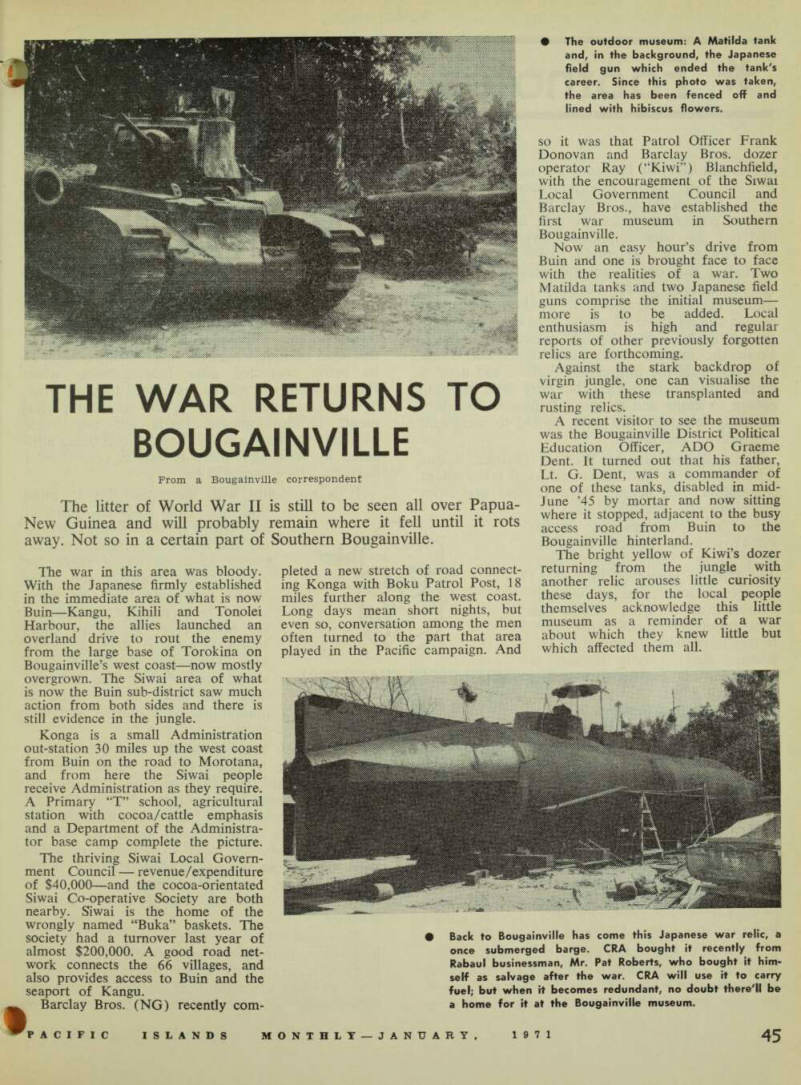
The War Returns To
From a Bougainville correspondent The litter of World War II is still to be seen all over Papua- New Guinea and will probably remain where it fell until it rots away. Not so in a certain part of Southern Bougainville.
The war in this area was bloody.
With the Japanese firmly established in the immediate area of what is now Buin—Kangu, Kihili and Tonolei Harbour, the allies launched an overland drive to rout the enemy from the large base of Torokina on Bougainville’s west coast—now mostly overgrown. The Siwai area of what is now the Buin sub-district saw much action from both sides and there is still evidence in the jungle.
Konga is a small Administration out-station 30 miles up the west coast from Buin on the road to Morotana, and from here the Siwai people receive Administration as they require.
A Primary “T” school, agricultural station with cocoa/cattle emphasis and a Department of the Administra tor base camp complete the picture.
The thriving Siwai Local Govern ment Council revenue/expenditure of $40,000 —and the cocoa-orientated Siwai Co-operative Society are both nearby. Siwai is the home of the wrongly named “Buka” baskets. The society had a turnover last year of almost $200,000. A good road net work connects the 66 villages, and also provides access to Buin and the seaport of Kangu.
Barclay Bros. (NG) recently com
pleted a new stretch of road connect ing Konga with Boku Patrol Post, 18 miles further along the west coast.
Long days mean short nights, but even so, conversation among the men often turned to the part that area played in the Pacific campaign. And
so it was that Patrol Officer Frank Donovan and Barclay Bros, dozer operator Ray (“Kiwi”) Blanchfield, with the encouragement of the Siwai Local Government Council and Barclay Bros., have established the first war museum in Southern Bougainville.
Now an easy hour’s drive from Buin and one is brought face to face with the realities of a war. Two Matilda tanks and two Japanese field guns comprise the initial museum— more is to be added. Local enthusiasm is high and regular reports of other previously forgotten relics are forthcoming.
Against the stark backdrop of virgin jungle, one can visualise the war with these transplanted and rusting relics.
A recent visitor to see the museum was the Bougainville District Political Education Officer, ADO Graeme Dent. It turned out that his father, Lt. G. Dent, was a commander of one of these tanks, disabled in mid- June ’45 by mortar and now sitting where it stopped, adjacent to the busy access road from Buin to the Bougainville hinterland.
The bright yellow of Kiwi’s dozer returning from the jungle with another relic arouses little curiosity these days, for the local people themselves acknowledge this little museum as a reminder of a war about which they knew little but which affected them all.
• The outdoor museum: A Matilda tank and, in the background, the Japanese field gun which ended the tank's career. Since this photo was taken, the area has been fenced off and lined with hibiscus flowers.
• Back to Bougainville has come this Japanese war relic, a once submerged barge. CRA bought it recently from Rabaul businessman, Mr. Pat Roberts, who bought it him self as salvage after the war. CRA will use it to carry fuel; but when it becomes redundant, no doubt there'll be a home for it at the Bougainville museum.
* Footnotes
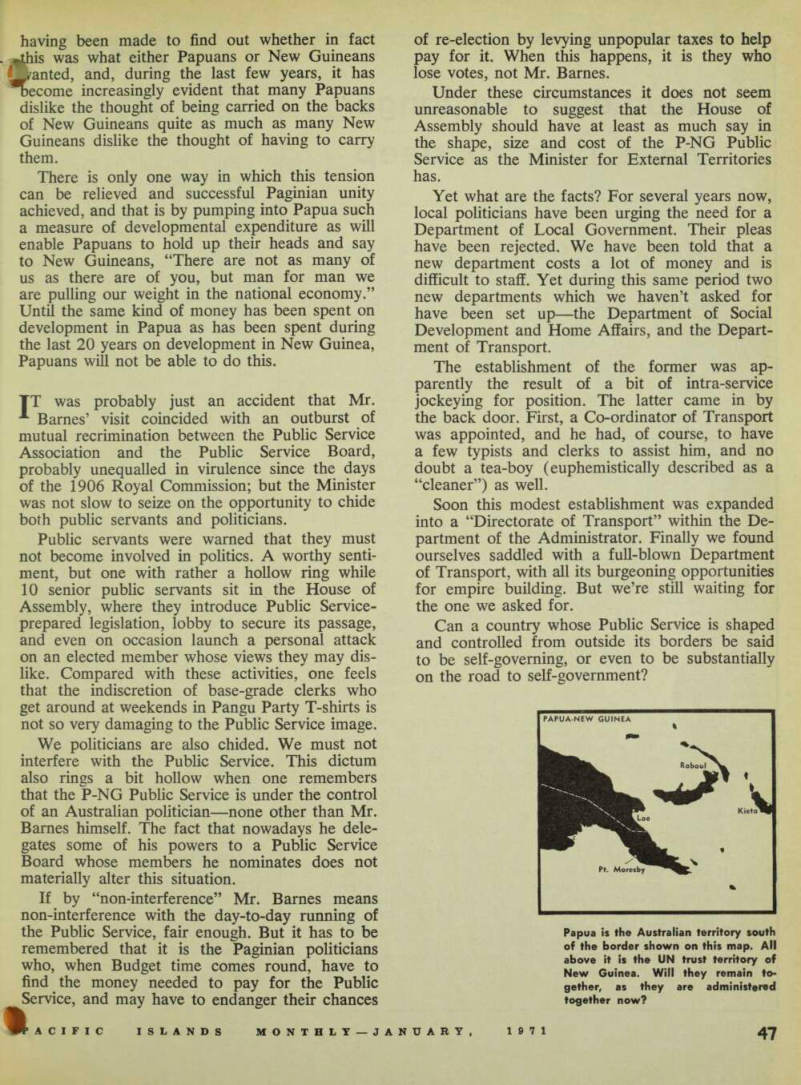
TTiE Minister for External Territories has come A and gone. As no reporters accompanied him on his tour of Papua, and as he refused to hold a news conference before he left, it is difficult to find out just what happened. Even members of the House of Assembly were inadequately briefed; I was one of several who did not even receive a copy of his itinerary. But from the sparse accounts available it would appear that he has chided those of whose behaviour he disap proves in his usual benign avuncular manner.
From the meagre radio news items and Press pars one gets the impression that he has done a certain amount of talking, but very little listening except to kiaps and to those Papuans, no doubt carefully selected, who were invited to meet him
at residency receptions.
From Balimo, in the Western District, it was reported that he had addressed local government councillors, but neither from Balimo nor from
anywhere else has there been any word of meetings at which Papuans were invited to place their views before the minister.
The pattern seems to have been all too frequent one of one-way communication from which we have suffered so much in the past.
If this impression is unfair to Mr.
Barnes, he has only himself to blame for making his trip such a hush-hush affair.
The mere fact that the Minister spent the whole of a 10-day visit
to the territory in touring Papua was in itself remarkable. Normally VlP’s, whether from Can berra or from the United Nations, hurry through Port Moresby with averted eyes on their way to New Guinea.
Mr. Barnes’ unusual behaviour has naturally given rise to speculation. By the time these words appear in print we may know all, but in the meantime it seems not unreasonable to guess that Mr. Barnes’ foray into Papua may have been prompted by the growingly vocal unease among Papuans about their future in a united Pagini.
There are two reasons for this unease. First, since the amalgamation of the two territories in 1946, the lion’s share of developmental expendi ture has gone into the more economically pro-
They Want A
Place In The Sun
For Papua
mising New Guinea territory, leaving the greater part of Papua as a depressed area. Second, if this economic imbalance is allowed to continue this side of independence, there is little hope of its being corrected after independence, when Papuan members will be, as indeed they are now, in a permanent minority in the national parlia ment. If development funds are not made available for Papua while they are still being allo cated by Australia, there is only a very slender hope that they ever will be.
It is no doubt with these thoughts in mind
that Mr. Ebia Olewale, member for South Fly, is currently canvass ing the idea of a “Papua Action” group to press for a place for Papua in the economic sun. It is hardly surprising that this move should be made by the member for South Fly. If Signor Luigi Maria D’Albertis were to revisit Mr. Glewale‘s electorate, he would find that it had changed very little since he terrorised its inhabitants with rockets and fire crackers in 1876.
Mr. Barnes’ reaction to this situation appears to have been to point out, in those tones of sweet reasonableness that become him so well, that development in New Guinea will also benefit Papua. He could hardly have taken a worse line.
This is exactly what Papuans are afraid of. Not unnaturally they shy away from a role in which they will be the perpetual poor relations of the New Guineans, reminded at frequent intervals, as they undoubtedly would be, of their dependent
position.
The amalgamation of Papua and New Guinea in 1946 was an Australian political decision, just as their separation between 1919 and 1942 had been an Australian political decision. The terri tories were amalgamated without any attempt
With Percy Chatterton
in Port Moresby
having been made to find out whether in fact was what either Papuans or New Guineans ®anted, and, during the last few years, it has become increasingly evident that many Papuans dislike the thought of being carried on the backs of New Guineans quite as much as many New Guineans dislike the thought of having to carry them.
There is only one way in which this tension can be relieved and successful Paginian unity achieved, and that is by pumping into Papua such a measure of developmental expenditure as will enable Papuans to hold up their heads and say to New Guineans, “There are not as many of us as there are of you, but man for man we are pulling our weight in the national economy.”
Until the same kind of money has been spent on development in Papua as has been spent during the last 20 years on development in New Guinea, Papuans will not be able to do this.
TT was probably just an accident that Mr.
Barnes’ visit coincided with an outburst of mutual recrimination between the Public Service Association and the Public Service Board, probably unequalled in virulence since the days of the 1906 Royal Commission; but the Minister was not slow to seize on the opportunity to chide both public servants and politicians.
Public servants were warned that they must not become involved in politics. A worthy senti ment, but one with rather a hollow ring while 10 senior public servants sit in the House of Assembly, where they introduce Public Service prepared legislation, lobby to secure its passage, and even on occasion launch a personal attack on an elected member whose views they may dis like. Compared with these activities, one feels that the indiscretion of base-grade clerks who get around at weekends in Pangu Party T-shirts is not so very damaging to the Public Service image.
We politicians are also chided. We must not interfere with the Public Service. This dictum also rings a bit hollow when one remembers that the P-NG Public Service is under the control of an Australian politician—none other than Mr.
Bames himself. The fact that nowadays he dele gates some of his powers to a Public Service Board whose members he nominates does not materially alter this situation.
If by “non-interference” Mr. Barnes means non-interference with the day-to-day running of the Public Service, fair enough. But it has to be remembered that it is the Paginian politicians who, when Budget time comes round, have to find the money needed to pay for the Public Service, and may have to endanger their chances
of re-election by levying unpopular taxes to help pay for it. When this happens, it is they who lose votes, not Mr. Barnes.
Under these circumstances it does not seem unreasonable to suggest that the House of Assembly should have at least as much say in the shape, size and cost of the P-NG Public Service as the Minister for External Territories has.
Yet what are the facts? For several years now, local politicians have been urging the need for a Department of Local Government. Their pleas have been rejected. We have been told that a new department costs a lot of money and is difficult to staff. Yet during this same period two new departments which we haven’t asked for have been set up—the Department of Social Development and Home Affairs, and the Depart ment of Transport.
The establishment of the former was ap parently the result of a bit of intra-service jockeying for position. The latter came in by the back door. First, a Co-ordinator of Transport was appointed, and he had, of course, to have a few typists and clerks to assist him, and no doubt a tea-boy (euphemistically described as a “cleaner”) as well.
Soon this modest establishment was expanded into a “Directorate of Transport” within the De partment of the Administrator. Finally we found ourselves saddled with a full-blown Department of Transport, with all its burgeoning opportunities for empire building. But we’re still waiting for the one we asked for.
Can a country whose Public Service is shaped and controlled from outside its borders be said to be self-governing, or even to be substantially on the road to self-government?
Papua is the Australian territory south of the border shown on this map. All above it is the UN trust territory of New Guinea. Will they remain to gether, as they are administered together now?
have time to sleep
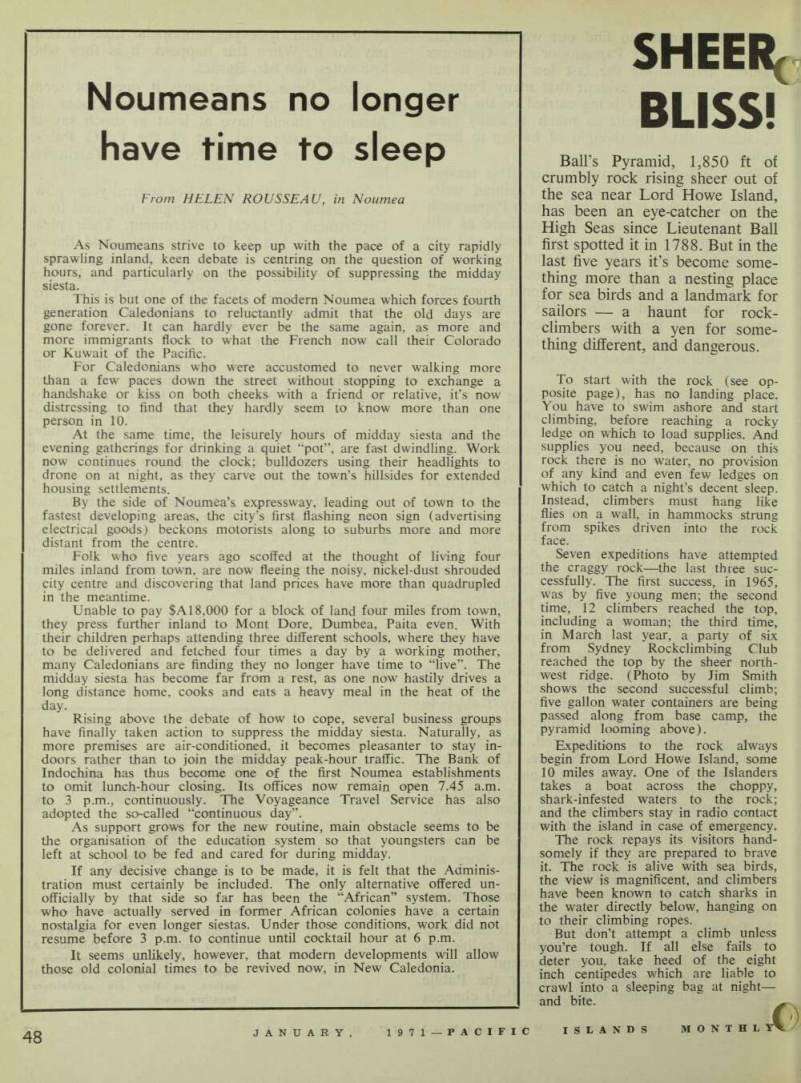
Noumeans no longer have time to sleep
From HELEN ROUSSEAU, in Noumea As Noumeans strive to keep up with the pace of a city rapidly sprawling inland, keen debate is centring on the question of working hours, and particularly on the possibility of suppressing the midday siesta.
This is but one of the facets of modern Noumea which forces fourth generation Caledonians to reluctantly admit that the old days are gone forever. It can hardly ever be the same again, as more and more immigrants flock to what the French now call their Colorado or Kuwait of the Pacific.
For Caledonians who were accustomed to never walking more than a few paces down the street without stopping to exchange a handshake or kiss on both cheeks with a friend or relative, it’s now distressing to find that they hardly seem to know more than one person in 10.
At the same time, the leisurely hours of midday siesta and the evening gatherings for drinking a quiet “pot”, are fast dwindling. Work now continues round the clock; bulldozers using their headlights to drone on at night, as they carve out the town’s hillsides for extended housing settlements.
By the side of Noumea’s expressway, leading out of town to the fastest developing areas, the city’s first flashing neon sign (advertising electrical goods) beckons motorists along to suburbs more and more distant from the centre.
Folk who five years ago scoffed at the thought of living four miles inland from town, are now fleeing the noisy, nickel-dust shrouded city centre and discovering that land prices have more than quadrupled in the meantime.
Unable to pay SAIB,OOO for a block of land four miles from town, they press further inland to Mont Dore, Dumbea, Paita even. With their children perhaps attending three different schools, where they have to be delivered and fetched four times a day by a working mother, many Caledonians are finding they no longer have time to “live”. The midday siesta has become far from a rest, as one now hastily drives a long distance home, cooks and eats a heavy meal in the heat of the day.
Rising above the debate of how to cope, several business groups have finally taken action to suppress the midday siesta. Naturally, as more premises are air-conditioned, it becomes pleasanter to stay in doors rather than to join the midday peak-hour traffic. The Bank of Indochina has thus become one of the first Noumea establishments to omit lunch-hour closing. Its offices now remain open 7.45 a.m. to 3 p.m., continuously. The Voyageance Travel Service has also adopted the so-called “continuous day”.
As support grows for the new routine, main obstacle seems to be the organisation of the education system so that youngsters can be left at school to be fed and cared for during midday.
If any decisive change is to be made, it is felt that the Adminis tration must certainly be included. The only alternative offered un officially by that side so far has been the “African” system. Those who have actually served in former African colonies have a certain nostalgia for even longer siestas. Under those conditions, work did not resume before 3 p.m. to continue until cocktail hour at 6 p.m.
It seems unlikely, however, that modern developments will allow those old colonial times to be revived now, in New Caledonia.
Bliss!
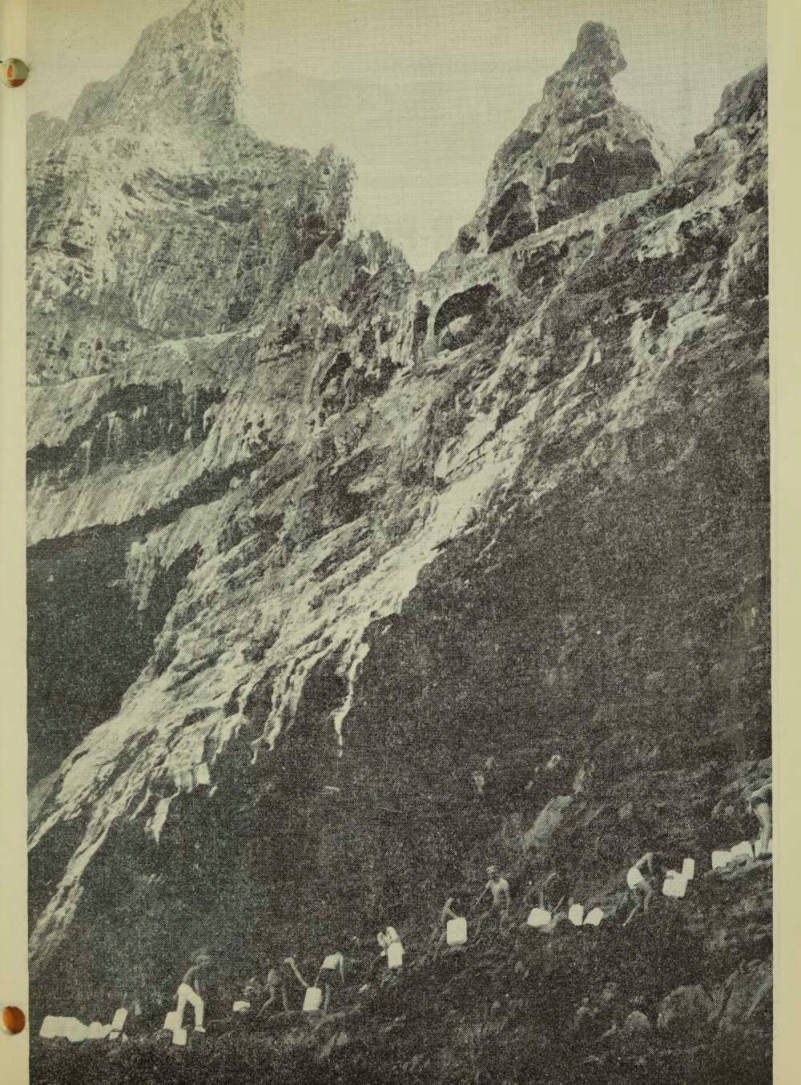
Sheer
Ball’s Pyramid, 1,850 ft of crumbly rock rising sheer out of the sea near Lord Howe Island, has been an eye-catcher on the High Seas since Lieutenant Ball first spotted it in 1788. But in the last five years it’s become some
thing more than a nesting place
for sea birds and a landmark for sailors a haunt for rock climbers with a yen for some
thing different, and dangerous.
To start with the rock (see op posite page), has no landing place.
You have to swim ashore and start climbing, before reaching a rocky ledge on which to load supplies. And supplies you need, because on this rock there is no water, no provision of any kind and even few ledges on which to catch a night’s decent sleep.
Instead, climbers must hang like flies on a wall, in hammocks strung from spikes driven into the rock face.
Seven expeditions have attempted the craggy rock—the last three suc cessfully. The first success, in 1965, was by five young men; the second time, 12 climbers reached the top, including a woman; the third time, in March last year, a party of six from Sydney Rockclimbing Club reached the top by the sheer north west ridge. (Photo by Jim Smith shows the second successful climb; five gallon water containers are being passed along from base camp, the pyramid looming above).
Expeditions to the rock always begin from Lord Howe Island, some 10 miles away. One of the Islanders takes a boat across the choppy, shark-infested waters to the rock; and the climbers stay in radio contact with the island in case of emergency.
The rock repays its visitors hand somely if they are prepared to brave it. The rock is alive with sea birds, the view is magnificent, and climbers have been known to catch sharks in the water directly below, hanging on to their climbing ropes.
But don’t attempt a climb unless you’re tough. If all else fails to deter you, take heed of the eight inch centipedes which are liable to crawl into a sleeping bag at night— and bite. .
Neglected, Under Populated Pitcairn
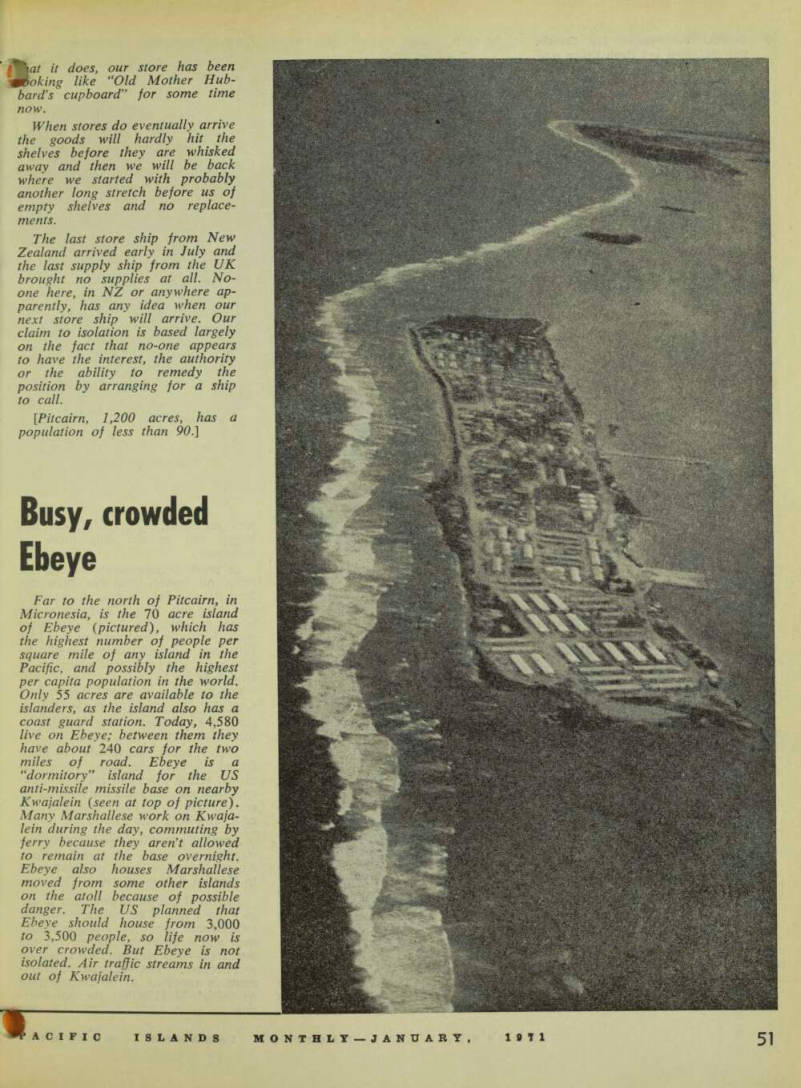
Adapted from an editorial In the October issue of “Pitcairn Miscellany”—just arrived In Sydney
Some time ago we saw an educational film about life at the South Pole. The emphasis was on the isolated and lonely existence of the members of the winter party. Here on Pitcairn we think they have it good down there.
To begin with they know before they start that they will have a long spell with very little contact with the outside world and they plan and cater accord ingly. But what happens when a store ship is expected at six or seven weekly intervals and sud denly there is nothing for three and then four months? Not even word of a ship or a promise of one before five or six months have passed?
The South Pole winter party cannot tell you, but we can. We can also tell you what it is like to receive no mail for four months or so. No doubt many “Pitcairn Miscellany” readers have wondered why their letters, stamp orders, etc. have gone unanswered over recent months. The answer is, we have not received any letters to answer, and apparently cannot hope to do so for some time to come.
Pitcairners have endured long spells between ships in the past but it must be a long time since a scarcity of calling ships was combined with a scarcity of rain.
Consider the odd set of circumstances that have put the people of Pitcairn in the un enviable position of being able to claim, without much fear of contradiction, that they are one of the most isolated groups on earth.
The island is well known for its fertility, moderate tempera tures and ample rainfall, and the people make the most of these
natural blessings by working the soil. The gardens have always produced well. There have always been more than enough fruit and vegetables to meet the needs of everyone, and the local inhabitants have come to rely heavily on their gardens. And one cannot rely too greatly on outside sources when the basic wage is only 28 cents per hour.
The story this year is different.
It's now October and, apart from the odd passing shower, very little rain has fallen since July.
Spells of very dry weather have been experienced in the past.
However this drought coming during the winter months and the planting season is a more serious one, as we cannot expect much relief during the long hot summer months to come.
Most householders have had empty fresh water tanks for over two months and have been cart ing five-gallon lots of water from “Browns Water”—an insignificant but vital trickle in the bush a mile or so from the village—and 500 ft above it.
This is not only a monotonous pastime, but a very time-con suming one.
Entertainment is now at an all time low, as all films have been taken off the island. As no new ones arrived from NZ on the “Manapouri” because of the postal strike in NZ, we are now having to rely on educational films on loan from the school, and games evenings. While the schoolchildren appear to enjoy these evenings, which include volleyball, relays, corner ball and the like, the adults at present seem to prefer to stay at home, no doubt busy on souvenirs for the “big ship” of the year, the "Bergensfjiord”, due
here at the end of November. The schoolboys, however, have been making their own fun, and have been spending a lot of time sailing their canoes under canvas. Its hoped that a sailing race around the island will be organised soon.
Although we have endured a considerable brain-washing pro gramme, some of us still wonder if the bombs in our back-yard have not had something to do with the freak weather conditions.
Cynics and the brain-washed may laugh, but more than one reputable scientist believes that such disturbances do have a con siderable effect on the weather.
Who are we to question the knowledgeable when the proof seems to be on our doorstep?
No water, no garden, no food.
Fortunately the position is not as bad yet as it could be. People who live in out of-the-way places, usually lay in good supplies against hard times and this is just what we have done. However, such sup plies are not inexhaustible, and heavy demands have been made upon them during the past few weeks.
What about all the ships that pass Pitcairn Island? They are of no help. It’s the ones that stop that count —and in particular the scheduled callers carrying mail and supplies. These are becoming fewer and further apart.
The position with mail here would be laughable if it was not so ridiculous and frustrating. We have received no mail from NZ, Australia and the UK since July and none from the US since May.
In 1968 a Co-operative was formed on Pitcairn to help ease the food situation caused by fewer supply ships. However, working on the very small financial margin
fcti/ it does, our store has been I Poking like “Old Mother Hub bard’s cupboard” for some time now.
When stores do eventually arrive the goods will hardly hit the shelves before they are whisked away and then we will be back where we started with probably another long stretch before us of empty shelves and no replace ments.
The last store ship from New Zealand arrived early in July and the last supply ship from the UK brought no supplies at all. No one here, in NZ or anywhere ap parently, has any idea when our next store ship will arrive. Our claim to isolation is based largely on the fact that no-one appears to have the interest, the authority or the ability to remedy the position by arranging for a ship to call.
IPitcairn, 1,200 acres, has a population of less than 90.]
Busy, crowded
Ebeye
Far to the north of Pitcairn, in Micronesia, is the 70 acre island of Ebeye {pictured), which has the highest number of people per square mile of any island in the Pacific, and possibly the highest per capita population in the world.
Only 55 acres are available to the islanders, as the island also has a coast guard station. Today, 4,580 live on Ebeye; between them they have about 240 cars for the two miles of road. Ebeye is a “dormitory” island for the US anti-missile missile base on nearby Kwajalein (seen at top of picture).
Many Marshallese work on Kwaja lein during the day, commuting by ferry because they aren’t allowed to remain at the base overnight.
Ebeye also houses Marshallese moved from some other islands on the atoll because of possible danger. The US planned that Ebeye should house from 3,000 to 3,500 people, so life now is over crowded. But Ebeye is not isolated. Air traffic streams in and out of Kwajalein.
Samoa's
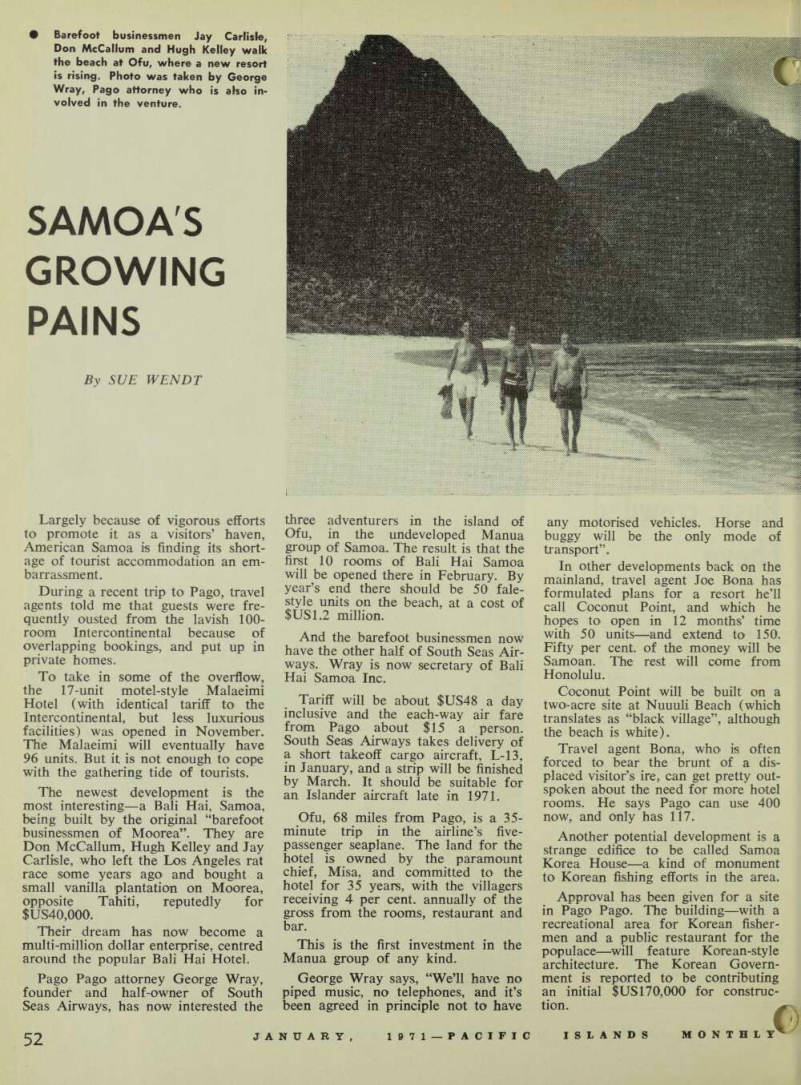
Growing
Pains
By Sue Wendt
Largely because of vigorous efforts to promote it as a visitors’ haven, American Samoa is finding its short age of tourist accommodation an em barrassment.
During a recent trip to Pago, travel agents told me that guests were fre quently ousted from the lavish 100room Intercontinental because of overlapping bookings, and put up in private homes.
To take in some of the overflow, the 17-unit motel-style Malaeimi Hotel (with identical tariff to the Intercontinental, but less luxurious facilities) was opened in November.
The Malaeimi will eventually have 96 units. But it is not enough to cope with the gathering tide of tourists.
The newest development is the most interesting—a Bali Hai, Samoa, being built by the original “barefoot businessmen of Moorea”. They are Don McCallum, Hugh Kelley and Jay Carlisle, who left the Los Angeles rat race some years ago and bought a small vanilla plantation on Moorea, opposite Tahiti, reputedly for
Sus4O,Ooo.
Their dream has now become a multi-million dollar enterprise, centred around the popular Bali Hai Hotel.
Pago Pago attorney George Wray, founder and half-owner of South Seas Airways, has now interested the
three adventurers in the island of Ofu, in the undeveloped Manua group of Samoa. The result is that the first 10 rooms of Bali Hai Samoa will be opened there in February. By year’s end there should be 50 fale style units on the beach, at a cost of SUSI. 2 million.
And the barefoot businessmen now have the other half of South Seas Air ways. Wray is now secretary of Bali Hai Samoa Inc.
Tariff will be about SUS4B a day inclusive and the each-way air fare from Pago about $l5 a person.
South Seas Airways takes delivery of a short takeoff cargo aircraft, L-13, in January, and a strip will be finished by March. It should be suitable for an Islander aircraft late in 1971.
Ofu, 68 miles from Pago, is a 35minute trip in the airline’s five passenger seaplane. The land for the hotel is owned by the paramount chief, Misa, and committed to the hotel for 35 years, with the villagers receiving 4 per cent, annually of the gross from the rooms, restaurant and bar.
This is the first investment in the Manua group of any kind.
George Wray says, “We’ll have no piped music, no telephones, and it’s been agreed in principle not to have
any motorised vehicles. Horse and buggy will be the only mode of transport”.
In other developments back on the mainland, travel agent Joe Bona has formulated plans for a resort he’ll call Coconut Point, and which he hopes to open in 12 months’ time with 50 units—and extend to 150.
Fifty per cent, of the money will be Samoan. The rest will come from Honolulu.
Coconut Point will be built on a two-acre site at Nuuuli Beach (which translates as “black village”, although the beach is white).
Travel agent Bona, who is often forced to bear the brunt of a dis placed visitor’s ire, can get pretty out spoken about the need for more hotel rooms. He says Pago can use 400 now, and only has 117.
Another potential development is a strange edifice to be called Samoa Korea House—a kind of monument to Korean fishing efforts in the area.
Approval has been given for a site in Pago Pago. The building—with a recreational area for Korean fisher men and a public restaurant for the populace—will feature Korean-style architecture. The Korean Govern ment is reported to be contributing an initial SUSI7O,OOO for construc tion. *
• Barefoot businessmen Jay Carlisle, Don McCallum and Hugh Kelley walk the beach at Ofu, where a new resort is rising. Photo was taken by George Wray, Pago attorney who is also in volved in the venture.
It's not much fun as a loner any more
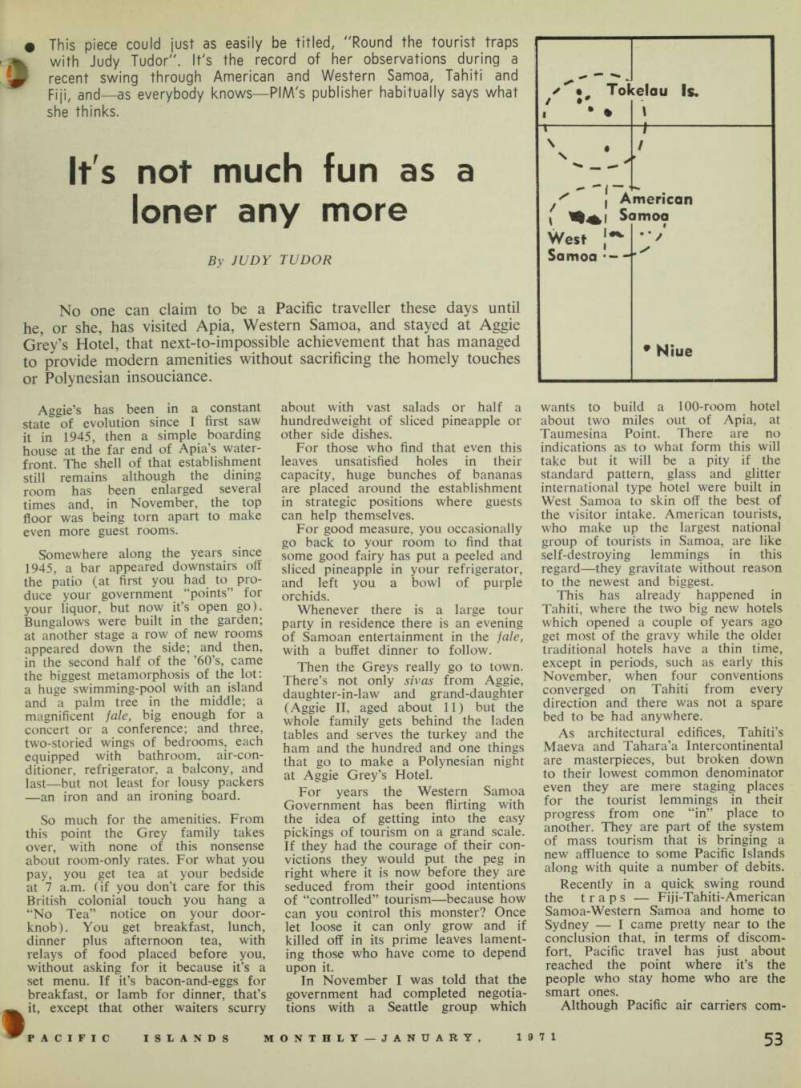
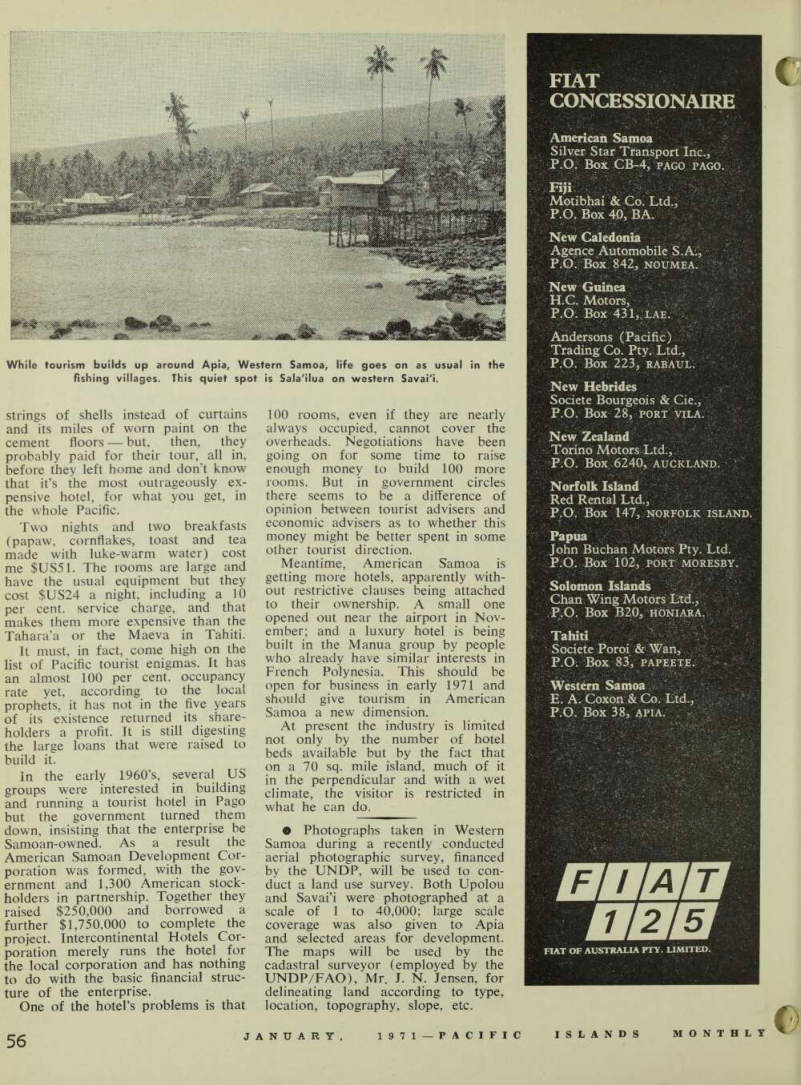
loner any more
By Judy Tudor
No one can claim to be a Pacific traveller these days until he, or she, has visited Apia, Western Samoa, and stayed at Aggie Grey’s Hotel, that next-to-impossible achievement that has managed to provide modern amenities without sacrificing the homely touches or Polynesian insouciance.
Aggie’s has been in a constant state of evolution since I first saw it in 1945, then a simple boarding house at the far end of Apia’s water front. The shell of that establishment still remains although the dining room has been enlarged several times and, in November, the top floor was being torn apart to make even more guest rooms.
Somewhere along the years since 1945, a bar appeared downstairs off the patio (at first you had to pro duce your government “points” for your liquor, but now it’s open go).
Bungalows were built in the garden; at another stage a row of new rooms appeared down the side; and then, in the second half of the ’6o’s, came the biggest metamorphosis of the lot: a huge swimming-pool with an island and a palm tree in the middle; a magnificent fale, big enough for a concert or a conference; and three, two-storied wings of bedrooms, each equipped with bathroom, air-con ditioner, refrigerator, a balcony, and last—but not least for lousy packers —an iron and an ironing board.
So much for the amenities. From this point the Grey family takes over, with none of this nonsense about room-only rates. For what you pay, you get tea at your bedside at 7 a.m. (if you don’t care for this British colonial touch you hang a “No Tea” notice on your door knob). You get breakfast, lunch, dinner plus afternoon tea, with relays of food placed before you, without asking for it because it’s a set menu. If it’s bacon-and-eggs for breakfast, or lamb for dinner, that’s it, except that other waiters scurry
about with vast salads or half a hundredweight of sliced pineapple or other side dishes.
For those who find that even this leaves unsatisfied holes in their capacity, huge bunches of bananas are placed around the establishment in strategic positions where guests can help themselves.
For good measure, you occasionally go back to your room to find that some good fairy has put a peeled and sliced pineapple in your refrigerator, and left you a bowl of purple orchids.
Whenever there is a large tour party in residence there is an evening of Samoan entertainment in the fale, with a buffet dinner to follow.
Then the Greys really go to town.
There’s not only sivas from Aggie, daughter-in-law and grand-daughter (Aggie 11, aged about 11) but the whole family gets behind the laden tables and serves the turkey and the ham and the hundred and one things that go to make a Polynesian night at Aggie Grey’s Hotel.
For years the Western Samoa Government has been flirting with the idea of getting into the easy pickings of tourism on a grand scale.
If they had the courage of their con victions they would put the peg in right where it is now before they are seduced from their good intentions of “controlled” tourism —because how can you control this monster? Once let loose it can only grow and if killed off in its prime leaves lament ing those who have come to depend upon it.
In November I was told that the government had completed negotia tions with a Seattle group which
wants to build a 100-room hotel about two miles out of Apia, at Taumesina Point. There are no indications as to what form this will take but it will be a pity if the standard pattern, glass and glitter international type hotel were built in West Samoa to skin off the best of the visitor intake. American tourists, who make up the largest national group of tourists in Samoa, are like self-destroying lemmings in this regard—they gravitate without reason to the newest and biggest.
This has already happened in Tahiti, where the two big new hotels which opened a couple of years ago get most of the gravy while the oldei traditional hotels have a thin time, except in periods, such as early this November, when four conventions converged on Tahiti from every direction and there was not a spare bed to be had anywhere.
As architectural edifices, Tahiti’s Maeva and Tahara’a Intercontinental are masterpieces, but broken down to their lowest common denominator even they are mere staging places for the tourist lemmings in their progress from one “in” place to another. They are part of the system of mass tourism that is bringing a new affluence to some Pacific Islands along with quite a number of debits.
Recently in a quick swing round the traps Fiji-Tahiti-American Samoa-Western Samoa and home to Sydney I came pretty near to the conclusion that, in terms of discom fort, Pacific travel has just about reached the point where it’s the people who stay home who are the smart ones.
Although Pacific air carriers com-
• This piece could just as easily be titled, "Round the tourist traps with Judy Tudor". It's the record of her observations during a recent swing through American and Western Samoa, Tahiti and Fiji, and—as everybody knows —PIM's publisher habitually says what she thinks.
Just a statistic!
plain that there are now too many in the airline business, I didn’t travel on one plane—UTA, Pan-Am, Air New Zealand or even Polynesian Airlines—that was not filled to capacity.
In terms of tourist-class this means no leg room, long queues for the lavatories, and long waits for some thing to eat or drink, and the crush ing feeling of being only one sardine in a huge, overloaded can. Tourist class has nothing whatever to com mend it except that it is mercifully fast and that it costs a lot less than first class. It is the very negation of travel for fun and, as planes get bigger and bigger, the fun diminishes still further while the ancillary prob lems grow apace. Terminals become madhouses of confusion, frayed tempers and delay.
When I got back to Sydney, for example, by Jumbo-jet, it took exactly one hour from the time I got off the plane until my baggage was regurgitated from the revolving dis penser. The golden age of air travel was away back in the days before anyone had invented tourist-class, and the aircraft were piston-engine powered and sometimes flying-boats.
Then you were an individual and important; now you have been re duced to a number in air-transporta tion statistics.
Another problem, at least for the loner, is that once away from Fiji and into Polynesia proper, the majority of tourists are American and the majority of Americans travel in parties, sometimes 50 or 60 strong.
As a result, the traveller who has the temerity to go it alone, including the few Americans who still do, has to fight for accommodation and at times, almost for the right to exist at all. As an individual you upset the pattern and are probably not worth the dollars and cents you bring in. You are an isolated freak, condemned to swim against the tide.
Sometimes you become a sort of unwilling satellite to a party revolving in the same orbit, and these you either learn to hate with unreasoning gusto or they grow on you as a fascinating study of the strange mania that has gripped all of us in the mid-20th century—the mass urge to leave our comfortable homes and travel the world.
In Tahiti my path crossed a party of old ladies (the colloquial name for them is “Pasadena widows”) shepherded by a bouncy gent who played mother to them morning, noon and most of the night.
They were with me at the hoteL.
in Papeete, flew with me to Pago, occupied the same floor at the hotel and were there, again, at Aggie’s.
Then they disappeared, to God knows where, but somehow I got the idea that they went on to perambulate forever, from one tourist caravan serai to another, as anonymous as the great piles of luggage that festoon every hotel lobby at their arrivals and departures.
Frail, some of them, with sore feet and varicose veins, and pills to ward off this and that, yet they seem, when on safari, to have the stamina of bull elephants. In and out of buses and cars, feverishly determined to do and see everything that is written into their itineraries, they soldier on.
I can only assume that when they do get back home to Kansas or Washington or San Diego, they collapse into a rest home to recover from their holiday, weak with relief that they did this damned, done thing and surmounted all obstacles — the water that they suspect is not fit to drink, the strange food, the fact that everyone else’s dollar seems to be worth more than their own.
For these travellers, Pago Pago and the Intercontinental hotel probably seem like an American oasis in a desert of lingering British and French colonialism. There they can eat hamburgers and soggy apple pie in the basement snack-bar; they can buy duty-free goods in the shop and get more of them back into the States without penalty; and, once a week, for an extra dollar added to the dinner bill, they can see the 1928 version of Somerset Maugham’s Rain with Joan Crawford as Sadie —right there in the place where it all happened. Nine times out of ten, it’s even in the right atmosphere, with the rain outside cascading down as only American Samoa rain knows how.
Most of them think that the Pago Intercontinental is cute, what with its acres of wickerwork and its
strings of shells instead of curtains and its miles of worn paint on the cement floors but, then, they probably paid for their tour, all in, before they left home and don’t know that it’s the most outrageously ex pensive hotel, for what you get, in the whole Pacific.
Two nights and two breakfasts (papaw, cornflakes, toast and tea made with luke-warm water) cost me SUSSI. The rooms are large and have the usual equipment but they cost SUS 24 a night, including a 10 per cent, service charge, and that makes them more expensive than the Tahara’a or the Maeva in Tahiti.
It must, in fact, come high on the list of Pacific tourist enigmas. It has an almost 100 per cent, occupancy rate yet, according to the local prophets, it has not in the five years of its existence returned its share holders a profit. It is still digesting the large loans that were raised to build it.
In the early 1960’5, several US groups were interested in building and running a tourist hotel in Pago but the government turned them down, insisting that the enterprise be Samoan-owned. As a result the American Samoan Development Cor poration was formed, with the gov ernment and 1,300 American stock holders in partnership. Together they raised $250,000 and borrowed a further $1,750,000 to complete the project. Intercontinental Hotels Cor poration merely runs the hotel for the local corporation and has nothing to do with the basic financial struc ture of the enterprise.
One of the hotel’s problems is that
100 rooms, even if they are nearly always occupied, cannot cover the overheads. Negotiations have been going on for some time to raise enough money to build 100 more rooms. But in government circles there seems to be a difference of opinion between tourist advisers and economic advisers as to whether this money might be better spent in some other tourist direction.
Meantime, American Samoa is getting more hotels, apparently with out restrictive clauses being attached to their ownership, A small one opened out near the airport in Nov ember; and a luxury hotel is being built in the Manua group by people who already have similar interests in French Polynesia. This should be open for business in early 1971 and should give tourism in American Samoa a new dimension.
At present the industry is limited not only by the number of hotel beds available but by the fact that on a 70 sq. mile island, much of it in the perpendicular and with a wet climate, the visitor is restricted in what he can do.
• Photographs taken in Western Samoa during a recently conducted aerial photographic survey, financed by the UNDP, will be used to con duct a land use survey. Both Upolou and Savai’i were photographed at a scale of 1 to 40,000; large scale coverage was also given to Apia and selected areas for development.
The maps will be used by the cadastral surveyor (employed by the UNDP/FAO), Mr. J. N. Jensen, for delineating land according to type, location, topography, slope, etc.
While tourism builds up around Apia, Western Samoa, life goes on as usual in the fishing villages. This quiet spot is Sala'ilua on western Savai'i.
Advertisements & other items, pp. 56-60 (1 item)
§€/U*Lai\Ider
AVIATION SERVICE PTY. LTD.
90-7861, After Hours: 338-1436.
HANGER 77, MOORABBIN AIRPORT.
COMPLETE AIR FRAME REBUILDING SERVICE
FOR SALE
1967 CESSNA P 206 (6 place) T.T. 200 Hrs. since new. Twin ADF V.O.R. 300 Nav. Comm. 12 channel H.F., Mag. Compass. Dual Control. Dark Blue and White. Blue Trim. $26,000. 1967 CESSNA 150 G. New C. of A. 1,150 hrs. to run on engine. New Props. Best 150 performer in Schutt Air Race 1970. $5,950. 1968 BEECH MUSKETEER SUPER 111 23-24, 5 place. C.S. prop., fuel injector, new engine, new C. of A. Rotating beacon. Full panel. $16,000. 1968 CESSNA 206 U, 1060 hrs. T.T., 6 place, wide doors, V.H.F. and H.F., dual control. $23,750.
DC3, T.T. 11,000 hours. Price to be negotiated. 1968 CESSNA CARDINAL. New engine 0360. C.S. prop. New C. of A $16,000.
WE FINANCE
Ask about our Wing and Control Service Exchange System.
WANTED TO BUY—DAMAGED FUSELAGES, WINGS, ETC.
Insurance work is our specialty. Consult us for airframe parts and repairs.
MORE SERVICE /MORE
MORE OFTEN
CARGOES WITH
§€/U*LAI\IDER
Services to and from: Sydney • Brisbane • Port Moresby • Rabaul • Lae • Samarai • Madang o Wewak • Vanimo • Manus Is. • Buka • Kieta • Kavieng • Honiara • Vila • Santo • Norfolk Island • Lord Howe Island.
KARLANDER NEW GUINEA LINE LTD.
MANAGING AGENTS: KARLANDER (AUSTRALIA) PTY. LTD.
37-49 Pitt St. (6th Floor), Sydney, N.S.W., Australia. Tel.: 27 6301 Brisbane; F. H. Stephens Pty. Ltd., 30 Albert St. Tel.: 31 1476 Agents: Port Moresby—New Guinea Co. Ltd.
Samarai —Burns Phi ip (N.G.) Ltd.
Kieta —Breckwoldt & Co. (N.G.) Pty. Ltd.
Wewak —Burns Philp (N.G.) Ltd.
Rabaul —Rabaul Trading Co. Pty. Ltd.
Madang — B. J. Back Pty. Ltd.
Lae — N.G.G. Trading Company.
Honiara — E. V. Lawson Pty. Ltd.
I need rest
baby’s exhausted, too
What would you do?
I’ve tried to be an attentive mother but so many times I’ve felt at a loss to know just how to comfort my little one.
Baby, having arrived so much later than Tim and Jen, I’d really forgotten the distressing symptoms that come with teething troubles.
Then, in desperation I remembered Fisher’s Teething Powder.
You’d be amazed what an effective and soothing aid they are to baby’s sore gums, digestive disturbances and intestinal upsets which are natural teething disorders.
Another great virtue of Fisher’s Teething Powders is their safety. They do not contain Calomel, Opiates, Bromides or any harmful substances. Even if the babe by mischance should eat several, they could do no harm.
By giving your baby a Fisher’s Teething Powder as needed, you not only keep the little one happy and well, but save yourself all those upsets and nervous tensions that beset a mother when her baby suffers distress. Be sure to get a supply of Fisher’s Teething Powders from your chemist or store. Only 30 cents for 20 powders. If you have any difficulty buying Fisher’s Teething Powders, write direct to Fisher & Co., Manufacturing Chemists, 17 May St., St. Peters, N.S.W.
Postcode 2044.
in Fiji is not complete without a stay at
KOROLEVU BEACH HOTEL
Korolevu, the South Pacific's most famous resort, is a must for all visitors to Fiji. Situated on the beautiful Coral Coast of Viti Levu, Korolevu is a holiday-maker's dream. The beautiful curving white sand beaches and the shimmering palm fronds make a stay at Korolevu a truly memorable occasion.
Other Northern Hotels at Suva, Sigatoka, Nadi, Lautoka, Ba and Tavua.
KOROLEVU BEACH HOTEL,
KOROLEVU-I-WAI, NADROGA, FIJI.
Sales Representative: Shaul International, Hotel Representatives, 34th Floor, Australia Square, Sydney, N.S.W., 2000, Australia.
Telephone: 27-4601. Cable: "Rephotel", Sydney.
Shaul International, 6th Floor, 330 Collins Street, Melbourne, 3000, Victoria, Australia.
FIAT
CONCESSIONAIRE
American Samoa Silver Star Transport Inc.,
P.O. Box CB-4, PAGO PAGO.
Fiji Motibhai & Co, Ltd.,
P.O. Box 40, BA.
New Caledonia Agence Automobile S.A.,
P.O. BOX 842, NOUMEA.
New Guinea H.C. Motors,
P.O. Box 431, LAE.
Andersons (Pacific) Trading Co. Pty. Ltd.,
P.O. Box 223, RABAUL.
New Hebrides Societe Bourgeois & Cie.,
P.O. Box 28, PORT VILA,
New Zealand Torino Motors Ltd.,
P.O. BOX 6240, AUCKLAND.
Norfolk Island Red Rental Ltd.,
P.O. Box 147, NORFOLK ISLAND.
Papua John Buchan Motors Pty. Ltd.
P.O. Box 102, PORT MORESBY.
Solomon Islands Chan Wing Motors Ltd.,
P.O. BOX 820, HONIARA.
Tahiti Societe Poroi & Wan,
P.O. BOX 83, PAPEETE.
Western Samoa E. A. Coxon & Co. Ltd.,
P.O. Box 38, APIA.
anon
asm
FIAT OF AUSTRALIA PTY. LIMITED.
Everyone should have at least
one Italian love affair.
[With a Rat.)
Of all the cars in your life, you will always remember your Fiat.
Made in Italy for people who love their cars.
Fast, beautiful and responsive.
When will your Italian love affair begin?
Fiat 125; 4 cylinder, 1608 cc, twin overhead camshaft, 90 bhp, 100 mph, disc brakes on all 4 wheels, 4 speed synchro gears, heater/demister.
anna
888
■ 1 I r a i :m A m \ 1 ; rs ■fl ■ 3%: a; Anything you can do, I can do better.
They’re both right. And they both have their place on a Qantas jet. That’s why Qantas introduced stewards in the first place. Because they do some things better than hostesses. Then again, hostesses have a few things over stewards.
It ail adds up to the best service you’ll find on an airline. That’s why we’re the world’s favourite.
aHNTSZS
Australia’s round the world Arline.
QANTAS, with AIR INDIA, AIR NEW ZEALAND, BOAC, MSA and S.A.A. JW1.821?
Do the Solomons need more tourists
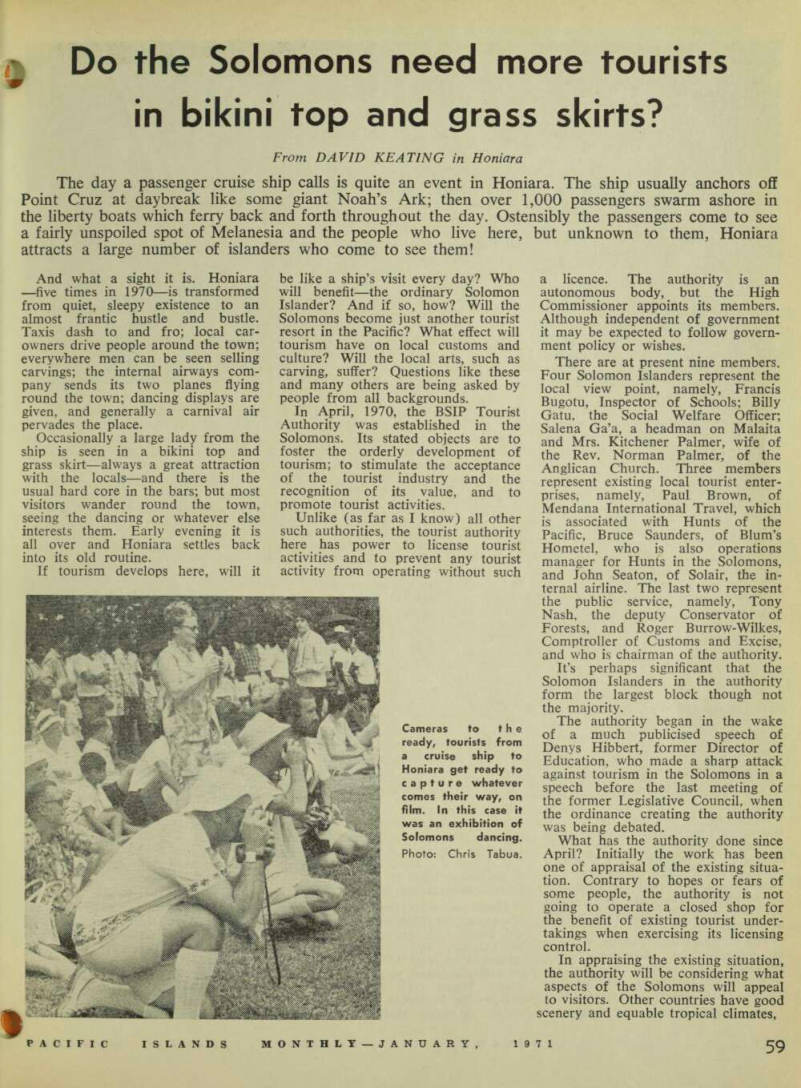
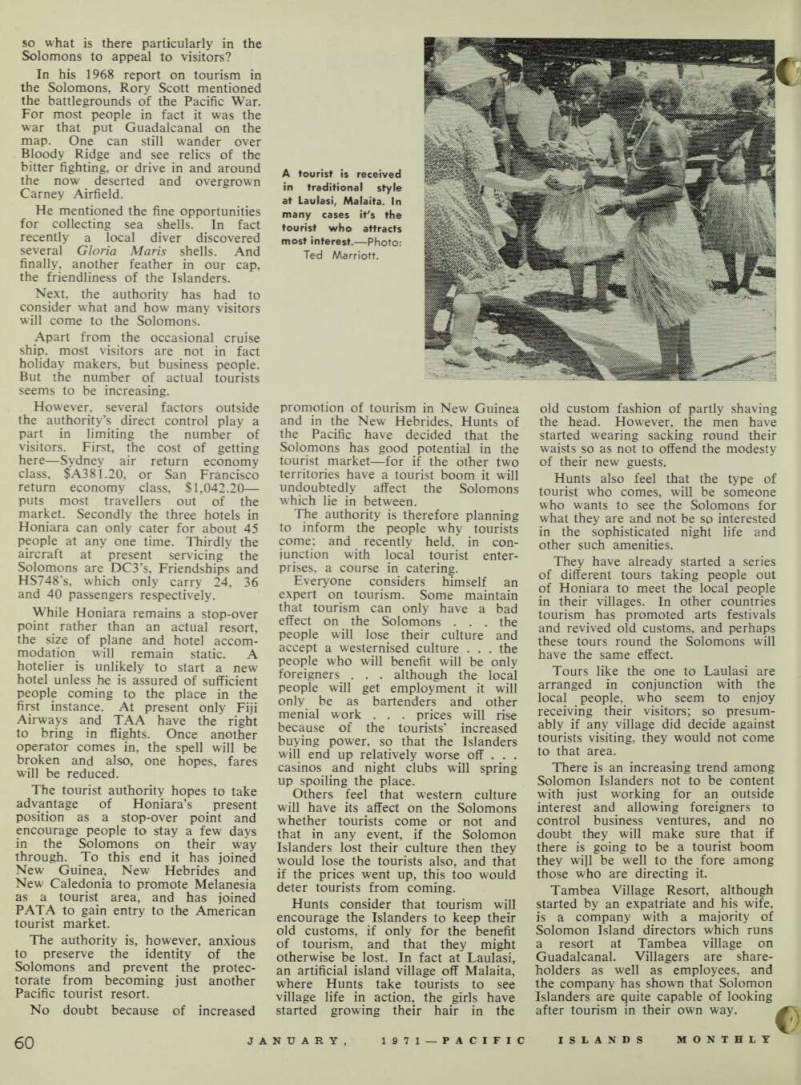
in bikini top and grass skirts?
From DAVID KEATING in Honiara The day a passenger cruise ship calls is quite an event in Honiara. The ship usually anchors off Point Cruz at daybreak like some giant Noah’s Ark; then over 1,000 passengers swarm ashore in the liberty boats which ferry back and forth throughout the day. Ostensibly the passengers come to see a fairly unspoiled spot of Melanesia and the people who live here, but unknown to them, Honiara attracts a large number of islanders who come to see them!
And what a sight it is. Honiara —five times in 1970—is transformed from quiet, sleepy existence to an almost frantic hustle and bustle.
Taxis dash to and fro; local car owners drive people around the town; everywhere men can be seen selling carvings; the internal airways com pany sends its two planes flying round the town; dancing displays are given, and generally a carnival air pervades the place.
Occasionally a large lady from the ship is seen in a bikini top and grass skirt—always a great attraction with the locals—and there is the usual hard core in the bars; but most visitors wander round the town, seeing the dancing or whatever else interests them. Early evening it is all over and Honiara settles back into its old routine.
If tourism develops here, will it
be like a ship’s visit every day? Who will benefit—the ordinary Solomon Islander? And if so, how? Will the Solomons become just another tourist resort in the Pacific? What effect will tourism have on local customs and culture? Will the local arts, such as carving, suffer? Questions like these and many others are being asked by people from all backgrounds.
In April, 1970, the BSIP Tourist Authority was established in the Solomons. Its stated objects are to foster the orderly development of tourism; to stimulate the acceptance of the tourist industry and the recognition of its value, and to promote tourist activities.
Unlike (as far as I know) all other such authorities, the tourist authority here has power to license tourist activities and to prevent any tourist activity from operating without such
a licence. The authority is an autonomous body, but the High Commissioner appoints its members.
Although independent of government it may be expected to follow govern ment policy or wishes.
There are at present nine members.
Four Solomon Islanders represent the local view point, namely, Francis Bugotu, Inspector of Schools; Billy Gatu, the Social Welfare Officer; Salena Ga’a, a headman on Malaita and Mrs. Kitchener Palmer, wife of the Rev. Norman Palmer, of the Anglican Church. Three members represent existing local tourist enter prises, namely, Paul Brown, of Mendana International Travel, which is associated with Hunts of the Pacific, Bruce Saunders, of Blum’s Hometel, who is also operations manager for Hunts in the Solomons, and John Seaton, of Solair, the in ternal airline. The last two represent the public service, namely, Tony Nash, the deputy Conservator of Forests, and Roger Burrow-Wilkes, Comptroller of Customs and Excise, and who is chairman of the authority.
It’s perhaps significant that the Solomon Islanders in the authority form the largest block though not the majority.
The authority began in the wake of a much publicised speech of Denys Hibbert, former Director of Education, who made a sharp attack against tourism in the Solomons in a speech before the last meeting of the former Legislative Council, when the ordinance creating the authority was being debated.
What has the authority done since April? Initially the work has been one of appraisal of the existing situa tion. Contrary to hopes or fears of some people, the authority is not going to operate a closed shop for the benefit of existing tourist under takings when exercising its licensing control.
In appraising the existing situation, the authority will be considering what aspects of the Solomons will appeal to visitors. Other countries have good scenery and equable tropical climates,
Cameras to the ready, tourists from a cruise ship to Honiara get ready to capture whatever comes their way, on film. In this case it was an exhibition of Solomons dancing.
Photo: Chris Tabua.
so what is there particularly in the Solomons to appeal to visitors?
In his 1968 report on tourism in the Solomons, Rory Scott mentioned the battlegrounds of the Pacific War.
For most people in fact it was the war that put Guadalcanal on the map. One can still wander over Bloody Ridge and see relics of the bitter fighting, or drive in and around the now deserted and overgrown Carney Airfield.
He mentioned the fine opportunities for collecting sea shells. In fact recently a local diver discovered several Gloria Maris shells. And finally, another feather in our cap, the friendliness of the Islanders.
Next, the authority has had to consider what and how many visitors will come to the Solomons.
Apart from the occasional cruise ship, most visitors are not in fact holiday makers, but business people.
But the number of actual tourists seems to be increasing.
However, several factors outside the authority’s direct control play a part in limiting the number of visitors. First, the cost of getting here—Sydney air return economy class, 5A381.20, or San Francisco return economy class, $1,042.20 — puts most travellers out of the market. Secondly the three hotels in Honiara can only cater for about 45 people at any one time. Thirdly the aircraft at present servicing the Solomons are DC3’s, Friendships and HS74B’s, which only carry 24, 36 and 40 passengers respectively.
While Honiara remains a stop-over point rather than an actual resort, the size of plane and hotel accom modation will remain static. A hotelier is unlikely to start a new hotel unless he is assured of sufficient people coming to the place in the first instance. At present only Fiji Airways and TAA have the right to bring in flights. Once another operator comes in, the spell will be broken and also, one hopes, fares will be reduced.
The tourist authority hopes to take advantage of Honiara’s present position as a stop-over point and encourage people to stay a few days in the Solomons on their way through. To this end it has joined New Guinea, New Hebrides and New Caledonia to promote Melanesia as a tourist area, and has joined PATA to gain entry to the American tourist market.
The authority is, however, anxious to preserve the identity of the Solomons and prevent the protec torate from becoming just another Pacific tourist resort.
No doubt because of increased
promotion of tourism in New Guinea and in the New Hebrides, Hunts of the Pacific have decided that the Solomons has good potential in the tourist market—for if the other two territories have a tourist boom it will undoubtedly affect the Solomons * ie * n between.
The authority is therefore planning to inform the people why tourists come: and recently held, in conprises 0 " course an re. to o„ r The Ca S„o 0 l y n haVe
1-1 7? „■ ■ th s
ss JssAssr .a
people who will benefit will be only foreigners . . . although the local people will get employment it will only be as bartenders and other menial work . . . prices will rise because of the tourists’ increased buying power, so that the Islanders will end up relatively worse off . , . casinos and night clubs will spring up spoiling the place.
Others feel that western culture will have its affect on the Solomons whether tourists come or not and that in any event, if the Solomon Islanders lost their culture then they would lose the tourists also, and that if the prices went up, this too would deter tourists from coming.
Hunts consider that tourism will encourage the Islanders to keep their old customs, if only for the benefit of tourism, and that they might otherwise be lost. In fact at Laulasi, an artificial island village off Malaita, where Hunts take tourists to see village life in action, the girls have started growing their hair in the
old custom fashion of partly shaving the head. However, the men have started wearing sacking round their waists so as not to offend the modesty of their new guests.
Hunts also feel that the type of tourist who comes, will be someone who wants to see the Solomons for what they are and not be so interested in the sophisticated night life and other such amenities.
They have already started a series of different tours taking people out of Honiara to meet the local people in their villages. In other countries tourism has promoted arts festivals and revived old customs, and perhaps these tours round the Solomons will have the same effect.
Tours like the one to Laulasi are arranged in conjunction with the local people, who seem to enjoy receiving their visitors; so presum ably if any village did decide against tourists visiting, they would not come to that area.
There is an increasing trend among Solomon Islanders not to be content with just working for an outside interest and allowing foreigners to control business ventures, and no doubt they will make sure that if there is going to be a tourist boom they will be well to the fore among those who are directing it.
Tambea Village Resort, although started by an expatriate and his wife, is a company with a majority of Solomon Island directors which runs a resort at Tambea village on Guadalcanal. Villagers are share holders as well as employees, and the company has shown that Solomon Islanders are quite capable of looking after tourism in their own way. a
A tourist is received in traditional style at Laulasi, Malaita. In many cases it's the tourist who attracts most interest.— Photo: Ted Marriott.
Advertisements & other items, pp. 63-70 (1 item)
Carnation your cooking
and he famous iomourime cuisine
i V >* T L° M ja«y w»*p
EVAPORATED
MILK
Carnation is a good cook’s delight-just add water to give pure, fresh dairy milk. Double rich Carnation makes sauces and soups smoother; custards creamier; and desserts lighter. Carnation is the most versatile milk for cooking, creaming fruit and for baking. Use Carnation in any recipe that calls for milk-and be sure you always have a supply on hand. Carnation stays fresh in the unopened can indefinitely-without refrigeration. It's so convenient to Carnation your cooking!
Recipes available on backs of labels.
Carnation-from contented cows’
cO * eA *
fO> °'o't
t«',f <>s-
' l °“> 151
(jilleApie A
&NC
HOR
ANCHOR
FLOUR
MAINTOP HIGH PROTEIN
BISCUIT FLOURS AND WHEATMEALS
Gillespie flours are milled from selected high quality Australian wheats and are entoleted for purity. Their consistent high quality has made them the best-known, most asked-for, brands of flour in the Islands. (Entoletion is a special purification process which reduces the risk of insect infection.)
GILLESPIE BROS. PTY. LTD.
HEAD OFFICE: BRISBANE OFFICE:
52 Union St., Pyrmont, Sydney, N.S.W CABLE ADDRESS: Albion, Brisbane, Queensland. (G.P 0 Box 2518, Sydney, 2001) "GILLESPIE", P.O. Box 8, Albion, Brisbane, 4010).
Phone; 660-4933 Sydney and Brisbane Phone: 6-1121
NAURU PACIFIC SHIPPING LINES
HEAD OFFICE: NAURU, CENTRAL PACIFIC
Melbourne Agency Office: Wales Corner, 227 Collins Street, Melbourne.
Cables; "Deimanu", Melbourne. Telex; 31158 Telephones; 654-4977, 63-2481
FLEET
M.V. EIGAMOIYA
M.V. ROSIE D
M.V. ENNA G
5,700 tons D.W.T. 1 1,993 tons D.W.T. 7,763 tons D.W.T. 12 Passengers 48 Passengers 11 1 Passengers 1 5 Knots. 14 Knots. 16 Knots.
Q <C Sr C 5 x CO LP
. C TONGA
SERVICES
NAURU MELBOURNE PORT MORESBY LAE RABAUL
KIETA NAURU MELBOURNE SUVA LAUTOKA
NUKUALOFA APIA
Other South Pacific Ports subject to inducement.
AGENTS:
Carpenter Shipping Agencies Ltd. (Port Moresby, Lae, Rabaul). Carpenters Fiji Limited (Suva). Morris Hedstrom Ltd. (Lautoka). Tonga Shipping Agency (Nukualofa). 0. S. Nelson & Co. Ltd. (Apia). Russell & Sommers Ltd. (Auckland). Toei Kaiun Sangyo Kaisha Ltd. (Tokyo). Wallem & Co. (Philippines) Ltd. (Manila).
For all particulars apply:
NAURU LOCAL GOVERNMENT COUNCIL
227 COLLINS STREET, MELBOURNE, 3000
:* c % . i #*! 1
"Seldom can one find such tangible proof that the manufacturer makes the product better than it has to." No idle boast where the DATSUN 1600 is concerned, for this is the nocompromise, four-door, five-passenger sedan that is winning rallies and beauty shows all over the globe.
Rally-wise, the 1600 cc, 96HP OHC engine with its top speed of 100 mph, and the Nissan Unitary Body Construction on the 4-wheel independent suspension are powering the DATSUN 1600 across the finishing line ahead of all competition time after time.
In the beauty department, the classic lines of the 1600 are designed for beauty experts who demand a blending of speed, efficiency and economy. The interior DATSUN luxury is a legend.
There is room to relax, room to stretch and room to put the 1600 through its paces. DATSUN offers you so much more in comfort, safety and extras. The maximum performance for the minimum upkeep. Get wise, get with it, get the DATSUN 1600.
@ NISSAN MOTOR CO., LTD.
Available at:
BOROKO MOTORS LTD.
Port Moresby, Lae, Madang, Mt. Hagen.
RABAUL GARAGE LTD. Rabaul.
SUVA MOTORS LTD. Suva, Lautoka.
MORRIS HEDSTROM LTD. Apia.
E.D. PENTECOST. Noumea.
PENTECOST PACIFIC S.A. Port Vila, Santo
R.C. SYMES PTY. LTD. Honiara.
B.F. KNEUBUHL. Pago Pago.
SIRIUS SERVICE STATION Norfolk.
SOCIEDADE AGRICOLA
PATRIA E TRABALHO LDA, Dili
JACOB ENTERPRISES Nauru.
DATSUN
The flavour of g
plus the freshnes
Now you get t
XOS Ijr
hoir
of cigarette in one
■ iMa
ill M . .. s yNvTS* ■ ■ ■■■vYif^W W ■ n . ** •• ■■ A 1 •0
nLiplHo
f I tfES■ I C *€*»t T•£ s i
Its an old custom
shipping goods by
the China Navigation Company
The China Navigation Company commenced operations in 1872 with two paddle steamers, the ‘Glengyle’ (above) and the ‘Tunsin,’ serving the Yangtze River trade.
Today, the Company has a fleet of twenty-six ships serving over forty ports, with an area of operation extending from Japan to New Zealand, and from the U.S.A. to the Malay Peninsula.
The China Navigation Company carries (on a regular liner basis) over a million tons of cargo every year. Live cargoes, refrigerated cargoes, bulk liquids, ore and grain are carried
by ships that are
custom-built for the trades they serve.
The China Navigation Company—the name that has become synonymous with experience . . . reliability . . . speed . . . service.
For further details and all enquiries there are Agents at the following ports: Melbourne; P. & 0. Lines of Australia Pty. Ltd.
Brisbane: Wills, Gilchrist & Sanderson Pty. Ltd.
Papua and New Guinea: Steamships Trading Co. Ltd., Port Moresby, Samarai, Lae, Madang, Rabaul, Kieta.
Wewak: Kavieng: Burns Philp (New Guinea) Ltd.
Fiji: Morris Hedstrom Ltd., Suva, Lautoka.
Western Samoa: Morris Hedstrom Ltd., Apia.
Tonga: Morris Hedstrom Ltd., Nukualofa and Vava’u.
CN co Tahiti: Etablissements Donald, Papeete.
Japan: Swire McKinnon, Tokyo, Yokohama, Osaka, Kobe and Nagoya.
Eastern Managers: Butterfield & Swire, 9 Connaught Rd., Central, Hong Kong.
New Caledonia: Etablissements Ballande, Noumea. 8.5.1. P.: British Solomons Trading Co. Ltd., Honiara.
New Hebrides: Les Comptoirs Francais des Nouvelles-Hebrides, Vila and Santo.
SWIRE & GILCHRIST PTY. LTD.,
General Agents in Australia, 8 Spring Street, Sydney. Phone: 27-4701.
THE CHINA NAVIGATION CO LTD
921/FP
m
Pillar Naco Steel Buildings
m r n
DESIGNED FOR QUICK, EASY ERECTION
No skilled labour required.
Pillar Naco Steel Buildings are available at a cost far lower than you imagined.
For, with Pillar Naco prefabricated Portal Frame Steel Buildings you have all the economies of mass production. Engineerdesigned Pillar Naco Steel Buildings are easily erected by unskilled labour. Sizes up to 100 ft. clear span.
Cladding can be supplied if required.
STANDARD DESIGNS,
OR CUSTOM BUILT
Almost any business can benefit with versatile Pillar Naco Steel Buildings —as examples pictured above demonstrate. Pillar Naco offers standard designs in an unlimited size range, or your new premises may be custom built with the same economy and efficiency.
Pillar Naco will supply all details and materials for your own construction facilities.
Pillar
Naco
Pty.
Limited
Pillar Naco Steel Buildings provide you with new premises faster and at less cost than you thought possible.
Enquiries to Pillar Naco Pty. Limited.
Export Division, Box 715, G.P.0., Brisbane, Queensland, Australia.
Fimr
naco
G 552
Magazine Section
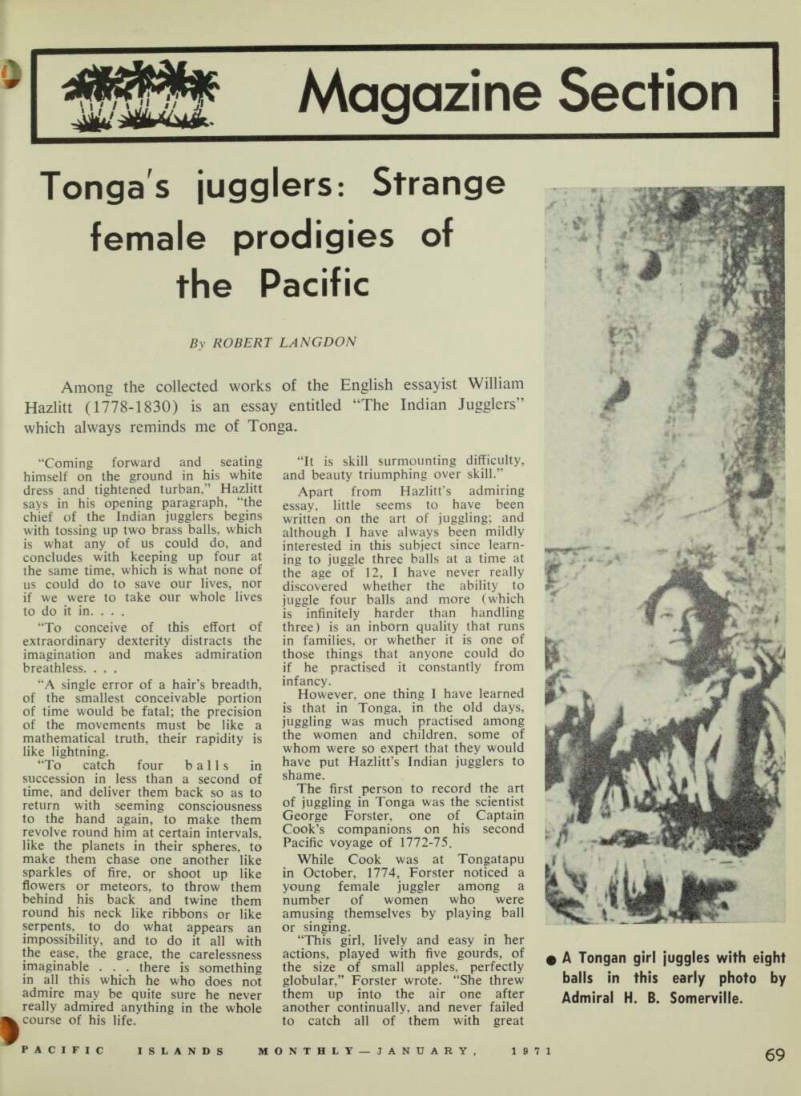
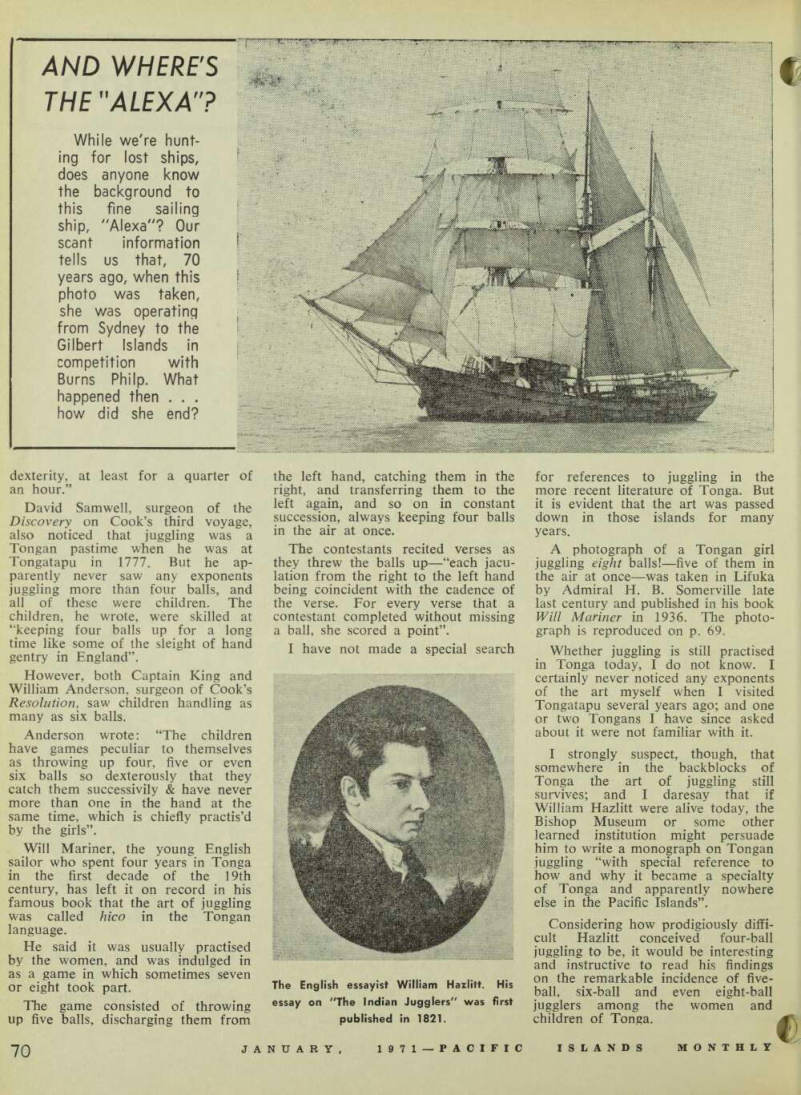
Tonga's jugglers: Strange female prodigies of the Pacific
By Robert Langdon
Among the collected works of the English essayist William Hazlitt (1778-1830) is an essay entitled “The Indian Jugglers” which always reminds me of Tonga.
“Coming forward and seating himself on the ground in his white dress and tightened turban,” Hazlitt says in his opening paragraph, “the chief of the Indian jugglers begins with tossing up two brass balls, which is what any of us could do, and concludes with keeping up four at the same time, which is what none of us could do to save our lives, nor if we were to take our whole lives to do it in. , . .
“To conceive of this effort of extraordinary dexterity distracts the imagination and makes admiration breathless. ...
“A single error of a hair’s breadth, of the smallest conceivable portion of time would be fatal; the precision of the movements must be like a mathematical truth, their rapidity is like lightning.
“To catch four balls in succession in less than a second of time, and deliver them back so as to return with seeming consciousness to the hand again, to make them revolve round him at certain intervals, like the planets in their spheres, to make them chase one another like sparkles of fire, or shoot up like flowers or meteors, to throw them behind his back and twine them round his neck like ribbons or like serpents, to do what appears an impossibility, and to do it all with the ease, the grace, the carelessness imaginable . . . there is something in all this which he who does not admire may be quite sure he never really admired anything in the whole course of his life.
“It is skill surmounting difficulty, and beauty triumphing over skill.”
Apart from Hazlitt’s admiring essay, little seems to have been written on the art of juggling; and although I have always been mildly interested in this subject since learn ing to juggle three balls at a time at the age of 12, I have never really discovered whether the ability to juggle four balls and more (which is infinitely harder than handling three) is an inborn quality that runs in families, or whether it is one of those things that anyone could do if he practised it constantly from infancy.
However, one thing I have learned is that in Tonga, in the old days, juggling was much practised among the women and children, some of whom were so expert that they would have put Hazlitt’s Indian jugglers to shame.
The first person to record the art of juggling in Tonga was the scientist George Forster, one of Captain Cook’s companions on his second Pacific voyage of 1772-75.
While Cook was at Tongatapu in October, 1774, Forster noticed a young female juggler among a number of women who were amusing themselves by playing ball or singing, “This girl, lively and easy in her actions, played with five gourds, of the size of small apples, perfectly globular,” Forster wrote. “She threw them up into the air one after another continually, and never failed to catch all of them with great
• A Tongan girl juggles with eight balls in this early photo by Admiral H. B. Somerville.
dexterity, at least for a quarter of an hour.”
David Samwell, surgeon of the Discovery on Cook’s third voyage, also noticed that juggling was a Tongan pastime when he was at Tongatapu in 1777. But he ap parently never saw any exponents juggling more than four balls, and all of these were children. The children, he wrote, were skilled at “keeping four balls up for a long time like some of the sleight of hand gentry in England”.
However, both Captain King and William Anderson, surgeon of Cook’s Resolution, saw children handling as many as six balls.
Anderson wrote: “The children have games peculiar to themselves as throwing up four, five or even six balls so dexterously that they catch them successivily & have never more than one in the hand at the same time, which is chiefly practis’d by the girls”.
Will Mariner, the young English sailor who spent four years in Tonga in the first decade of the 19th century, has left it on record in his famous book that the art of juggling was called hico in the Tongan language.
He said it was usually practised by the women, and was indulged in as a game in which sometimes seven or eight took part.
The game consisted of throwing up five balls, discharging them from
the left hand, catching them in the right, and transferring them to the left again, and so on in constant succession, always keeping four balls in the air at once.
The contestants recited verses as they threw the balls up—“each jacu lation from the right to the left hand being coincident with the cadence of the verse. For every verse that a contestant completed without missing a ball, she scored a point”.
I have not made a special search
for references to juggling in the more recent literature of Tonga. But it is evident that the art was passed down in those islands for many years, A photograph of a Tongan girl juggling eight balls!—five of them in the air at once—was taken in Lifuka by Admiral H. B. Somerville late last century and published in his book Will Manner in 1936. The photo graph is reproduced on p. 69.
Whether juggling is still practised in Tonga today, I do not know. I certainly never noticed any exponents of the art myself when I visited Tongatapu several years ago; and one or two Tongans I have since asked about it were not familiar with it.
I strongly suspect, though, that somewhere in the backblocks of Tonga the art of juggling still survives; and I daresay that if William Hazlitt were alive today, the Bishop Museum or some other learned institution might persuade him to write a monograph on Tongan juggling “with special reference to how and why it became a specialty of Tonga and apparently nowhere else in the Pacific Islands”.
Considering how prodigiously diffi cult Hazlitt conceived four-ball juggling to be, it would be interesting and instructive to read his findings on the remarkable incidence of five ball, six-ball and even eight-ball jugglers among the women and children of Tonga.
The English essayist William Hazlitt. His essay on "The Indian Jugglers" was first published in 1821.
And Where's
The "Alexa"?
While we're hunt ing for lost ships, does anyone know the background to this fine sailing ship, "Alexa"? Our scant information tells us that, 70 years ago, when this photo was taken, she was operating from Sydney to the Gilbert Islands in competition with Burns Philp. What happened then . . . how did she end?
Somewhere the 'Snark' lives
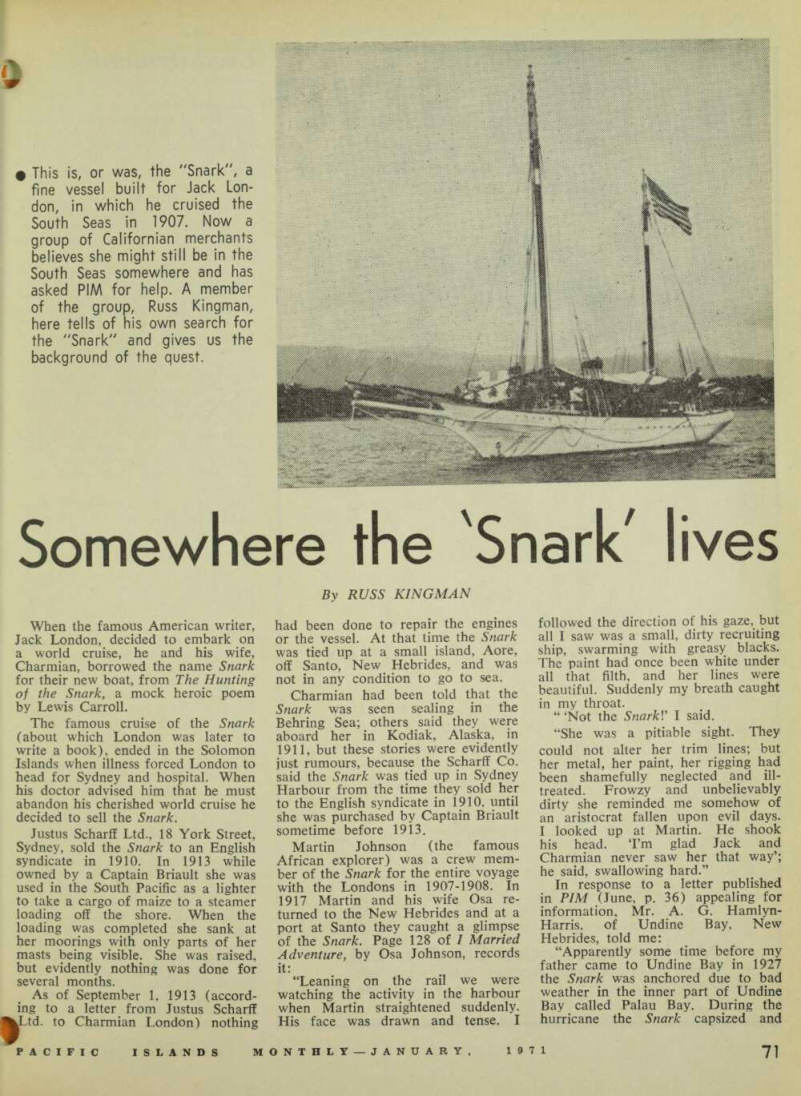

By Russ Kingman
When the famous American writer, Jack London, decided to embark on a world cruise, he and his wife, Charmian, borrowed the name Snark for their new boat, from The Hunting of the Snark, a mock heroic poem by Lewis Carroll.
The famous cruise of the Snark (about which London was later to write a book), ended in the Solomon Islands when illness forced London to head for Sydney and hospital. When his doctor advised him that he must abandon his cherished world cruise he decided to sell the Snark.
Justus Scharff Ltd., 18 York Street Sydney, sold the Snark to an English syndicate in 1910. In 1913 while owned by a Captain Briault she was used in the South Pacific as a lighter to take a cargo of maize to a steamer loading off the shore. When the loading was completed she sank at her moorings with only parts of her masts being visible. She was raised. but evidently nothing was done for several months.
As of September 1, 1913 (according to a letter from Justus Scharff kLtd. to Charmian London) nothing
had been done to repair the engines or the vessel. At that time the Snark was tied up at a small island, Aore, off Santo, New Hebrides, and was not in any condition to go to sea.
Charmian had been told that the Snark was seen sealing in the Behring Sea; others said they were aboard her in Kodiak, Alaska, in 1911, but these stories were evidently just rumours, because the Scharff Co, said the Snark was tied up in Sydney Harbour from the time they sold her to the English syndicate in 1910, until she was purchased by Captain Briault sometime before 1913.
Martin Johnson (the famous African explorer) was a crew mem ber of the Snark for the entire voyage with the Londons in 1907-1908. In 1917 Martin and his wife Osa re turned to the New Hebrides and at a port at Santo they caught a glimpse of the Snark. Page 128 of / Married Adventure, by Osa Johnson, records it: “Leaning on the rail we were watching the activity in the harbour when Martin straightened suddenly.
His face was drawn and tense. I
followed the direction of his gaze, but all I saw was a small, dirty recruiting ship, swarming with greasy blacks.
The paint had once been white under all that filth, and her lines were beautiful. Suddenly my breath caught in my throat.
“ ‘Not the SnarkV I said.
“She was a pitiable sight. They could not alter her trim lines; but her metal, her paint, her rigging had been shamefully neglected and ill treated. Frowzy and unbelievably dirty she reminded me somehow of an aristocrat fallen upon evil days.
I looked up at Martin. He shook his head. T’m glad Jack and Charmian never saw her that way’; he said, swallowing hard.”
In response to a letter published in PIM (June, p. 36) appealing for information, Mr. A. G. Hamlyn- Harris, of Undine Bay, New Hebrides, told me: “Apparently some time before my father came to Undine Bay in 1927 the Snark was anchored due to bad weather in the inner part of Undine Bay called Palau Bay. During the hurricane the Snark capsized and
• This is, or was, the "Snark", a fine vessel built for Jack Lon don, in which he cruised the South Seas in 1907. Now a group of Californian merchants believes she might still be in the South Seas somewhere and has asked PIM for help. A member of the group, Russ Kingman, here tells of his own search for the "Snark" and gives us the background of the quest.
Used dynamite
sank. My uncle went to assist and they had to apparently use dynamite to free the mast as the boat was on its side and could not be righted with the mast intact. It was then apparently salvaged and repaired, and left.”
In 1927, Miss Viola Irene Cooper and Miss Jean Schoen, of Oakland, visited Noumea, and reported that the Snark was in the New Hebrides at that time.
Jack and Charmian London had kept track of the Snark up until World War I. Charmian tried to find traces of her after that but heard no more until the late ’2o’s. An article in the Oakland Tribune on August 6, 1930, carried the headline “Widow Mourns Loss of Jack London’s Lost Yacht”. According to this article the Snark went ashore while trading among the islands and waves tore her to pieces.
Mr. Irving Shenard, Jack London’s nephew, tells me that the Snark caught fire and burned to the water line somewhere near the New Hebrides.
In 1941 the Oakland Tribune carried the story that Jack London’s Snark had shown up in the Behring Sea and was known as the Saucy Lass. She supported a new bow.
In June, 1947, Westway’s Magazine printed an article by Robert Clark entitled “My Hunting of the Snark”.
This story was very similar to the Oakland Tribune article of 1941.
Mr. Clark even traced her down to the mudbanks of the West Basin of the Los Angeles Harbour. He seemed so certain, that I was nearly con vinced, but I traced the history of the Saucy Lass, and it was soon clear that the Saucy Lass and the Snark were not the same boat. The Saucy Lass was about 90 ft with a beam of 23 ft while the Snark was 43 ft long and had a 15 ft beam.
Thus stands the quest for the Snark.
Jack London stated that she would be afloat for 500 years. With only the facts so far discovered and a goodly portion of optimism, I believe as he did. Somewhere in this world the Snark is still afloat. But where?
A study of her construction under scores Jack’s belief in her longevity.
Her garboard strake was 3 in. thick, her planking 2i in. and the deck planking was 2 in. and all of solid oak. There were four watertight bulkheads. She was 43 ft at the water line, 57 ft overall and had a beam of 15 ft with a 7 ft 8 in. draft.
Headroom was 6 ft. The deck wasJ
unbroken except for two companion ways and a hatch for’ard. There was no house and no hold.
In memory of Jack, the city of Oakland, California, named its water front complex of restaurants Jack London Square. The saloon in which Jack London met Johnny Heinold, The First and Last Chance, is still operating at the square and recently the cabin in which he lived while prospecting for gold in the Yukon Territory during the Klondike gold rush of 1897-98 was moved next to it.
Now the merchants of Jack London Square want to sponsor a Sea Scout ship and the only logical boat for them to operate is the Snark. If only someone can come up with her whereabouts, they hope to restore her to her former glory and sail her wherever people have an interest in Jack London—and that is world-wide in scope.
If our search proves fruitless, then we hope to build another. Maybe it will be only possible to find a few remains on some lonely beach in the South Pacific. Even this would be well worth the three years search because these could be built into the new boat and give it a Jack London feeling.
We hope PIM readers will join the search and pictures of any construc tion detail will be eagerly forwarded to anvone who thinks they have found the Snark. The merchants might even fly the discoverer to Jack London Square for the maiden voyage of the restored or new Snark.
Advertisements & other items, p. 74 (1 item)
Think Big Save
NOW A NEW, MORE ECONOMICAL, MORE PRACTICAL WAY OF
BUYING YOUR FISHING LINE BY WEIGHT
Buying by weight you buy first quality line at very reduced prices to expensively packed fishing lines. t ft
Mil
u m 1/4 lb
MAKO
AZION
THE FISHING LINES YOU CAN RELY ON. NOW AVAILABLE IN THE NEW ECONOMY i LB., i LB. AND 1 LB. SPOOLS.
AZLON in i lb. spools, 6 to 35 lb. in mist grey. MAKO in £ lb. spools, 6 to 60 lb. in pale blue. AAAKO in 1 lb. spools, 70 to 250 lb. in pale blue. 6 lb. Breaking Strain 8 lb. 10 lb. 12 lb. 15 lb 20 lb. 25 lb. 30 lb. 35 lb CONTACT US FOR ALL YOUR BOATING NEEDS!
Marine Accessories Co. Pty. Ltd.
HEAD OFFICE: 16 DARGHAN STREET, GLEBE, N.S.W. 2037.
Cable Address: "Mako" Sydney. Phone: Sydney 660-6244.
PLEASE WRITE FOR PRICE LISTS.
Sweet reason
More than 95 per cent, of New Guineans surveyed by the Papua-New Guinea Administra tion in the Madang district in an effort to find out something about their preferences in radio programmes said they wanted to hear women announcers on the air.
Their comments, in Pidgin English, ranged from Nek bilong meri i swit tru (“a woman’s voice is very sweet”) to Toktok bilong meri i isi, toktok bilong man in strongpela tumus (“women’s talk is easy to listen to, man’s talk is too harsh”.) As a result, the Administra tion is going to make greater efforts to introduce women into its broadcasting field.
Madang will have its own government radio station this year. The Morobe district will also get one. There are no commercial stations in P-NG.
Advertisements & other items, pp. 75-76 (1 item)
the sign of Youthful Beauty
A Flawless Complexion
rphe lovely texture and fresh bloom of true skin beauty can now be your most precious asset. Every day your skin can grow a little lovelier, lavishly cared for with a unique tropical moist oil which has the nourishing, revitalising ability to capture and preserve the precious bloom of true complexion beauty.
Smoothed over your face and neck every day and used as a beautifying base beneath makeup, the hygroscopic properties of tropical moist oil of Ulan will enable your skin to benefit from the natural attraction of moisture from the surrounding atmosphere all through the day, overcoming the formation of tiny lines or wrinkle dryness and ensuring that make-up blends beautifully and stays matt.
By regular use of this tropical moist oil of Ulan your complexion will soon become soft, smooth and beautiful.
Conserves frozen foods for weeks.
Capacity up to 100-lh.
Can also be used for fresh meat, fish, vegetables, butter, etc.
Cools beer, minerals and soft drinks quickly and cheaply.
Capacity up to 80 bottles, allowing DAILY service of up to 300 bottles of really cold drinks!
THE ELECTROLUX CBO uses no ice or electricity, operates anywhere by Kerosene, YES ANYWHERE economical
and with high efficiency.
Hjl
Kerosene
Deep Freezer
For better EARNINGS and a NEW way of LIFE
ELECTROLUX CBO KEROSENE FREEZER
DISTRIBUTED BY
W. R. CARPENTER & CO. LTD.
THROUGH
NEW GUINEA CO. LTD., Rabaul, Madang, Lae, Mt. Hagen. COMPTOIR FRANCAIS DES NOUVELLES HEBRIDES, Santo, Vila.
ISLAND PRODUCTS LTD., Port Moresby. BURNS PHILP LTD., Vila, Santo, Norfolk Island.
MORRIS HEDSTROM LTD., Fiji, Western Samoa, Tonga. E. V. LAWSON PTY. LTD., Honiara.
Yesterday
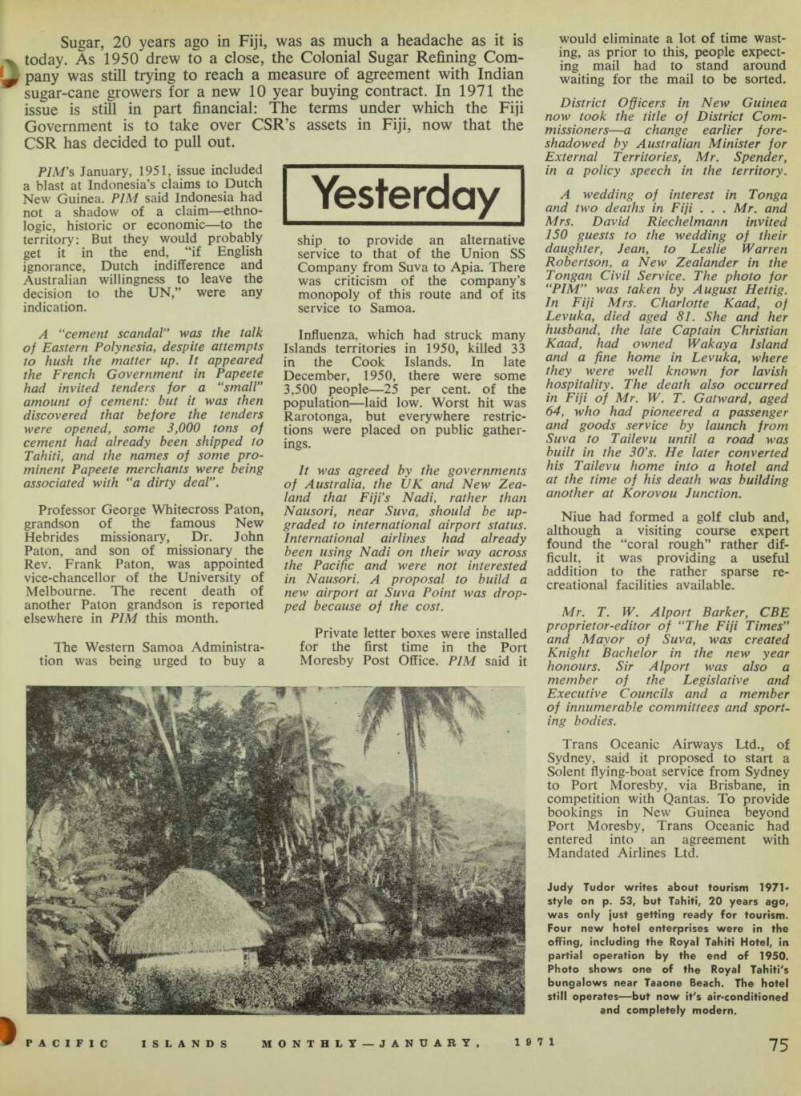
Sugar, 20 years ago in Fiji, was as much a headache as it is today. As 1950 drew to a close, the Colonial Sugar Refining Com pany was still trying to reach a measure of agreement with Indian sugar-cane growers for a new 10 year buying contract. In 1971 the issue is stifi in part financial: The terms under which the Fiji Government is to take over CSR’s assets in Fiji, now that the CSR has decided to pull out.
PlM’ s January, 1951, issue included a blast at Indonesia’s claims to Dutch New Guinea. PIM said Indonesia had not a shadow of a claim —ethnologic, historic or economic—to the territory: But they would probably get it in the end, “if English ignorance, Dutch indifference and Australian willingness to leave the decision to the UN,” were any indication.
A “cement scandal” was the talk of Eastern Polynesia, despite attempts to hush the matter up. It appeared the French Government in Papeete had invited tenders for a “small” amount of cement: but it was then discovered that before the tenders were opened, some 3,000 tons of cement had already been shipped to Tahiti, and the names of some pro minent Papeete merchants were being associated with “a dirty deal”.
Professor George Whitecross Paton, grandson of the famous New Hebrides missionary, Dr. John Paton, and son of missionary the Rev. Frank Paton, was appointed vice-chancellor of the University of Melbourne. The recent death of another Paton grandson is reported elsewhere in PIM this month.
The Western Samoa Administra tion was being urged to buy a
ship to provide an alternative service to that of the Union SS Company from Suva to Apia. There was criticism of the company’s monopoly of this route and of its service to Samoa.
Influenza, which had struck many Islands territories in 1950, killed 33 in the Cook Islands. In late December, 1950, there were some 3,500 people—2s per cent, of the population—laid low. Worst hit was Rarotonga, but everywhere restric tions were placed on public gather ings.
It was agreed by the governments of Australia, the UK and New Zea land that Fiji’s Nadi, rather than Nausori, near Suva, should be up graded to international airport status.
International airlines had already been using Nadi on their way across the Pacific and were not interested in Nausori. A proposal to build a new airport at Suva Point was drop ped because of the cost.
Private letter boxes were installed for the first time in the Port Moresby Post Office. PIM said it
would eliminate a lot of time wast ing, as prior to this, people expect ing mail had to stand around waiting for the mail to be sorted.
District Officers in New Guinea now took the title of District Com missioners—a change earlier fore shadowed by Australian Minister for External Territories, Mr. Spender, in a policy speech in the territory.
A wedding of interest in Tonga and two deaths in Fiji . . . Mr. and Mrs. David Riechelmann invited 150 guests to the wedding of their daughter, Jean, to Leslie Warren Robertson, a New Zealander in the Tongan Civil Service. The photo for “PIM” was taken by August Hettig.
In Fiji Mrs. Charlotte Kaad, of Levuka, died aged 81. She and her husband, the late Captain Christian Kaad, had owned Wakaya Island and a fine home in Levuka, where they were well known for lavish hospitality. The death also occurred in Fiji of Mr. W. T. Gatward, aged 64, who had pioneered a passenger and goods service by launch from Suva to Tailevu until a road was built in the 30’s. He later converted his Tailevu home into a hotel and at the time of his death was building another at Korovou Junction.
Niue had formed a golf club and, although a visiting course expert found the “coral rough” rather dif ficult, it was providing a useful addition to the rather sparse re creational facilities available.
Mr. T. W. Alport Barker, CBE proprietor-editor of “The Fiji Times” and Mayor of Suva, was created Knight Bachelor in the new year honours. Sir Alport was also a member of the Legislative and Executive Councils and a member of innumerable committees and sport ing bodies.
Trans Oceanic Airways Ltd., of Sydney, said it proposed to start a Solent flying-boat service from Sydney to Port Moresby, via Brisbane, in competition with Qantas. To provide bookings in New Guinea beyond Port Moresby, Trans Oceanic had entered into an agreement with Mandated Airlines Ltd.
Judy Tudor writes about tourism 1971style on p. 53, but Tahiti, 20 years ago, was only just getting ready for tourism.
Four new hotel enterprises were in the offing, including the Royal Tahiti Hotel, in partial operation by the end of 1950.
Photo shows one of the Royal Tahiti's bungalows near Taaone Beach. The hotel still operates—but now it's air-conditioned and completely modern.
Advertisements & other items, p. 78 (1 item)
buttered!
Crackers
taste as it
thevre
buttered!
Btockhofl Clix are cnsP. golden crackers 'hat m tender at heart. Eat them 1 i 9. $ fe BB
There’s value, variety and quality in
BROCKHOFF BISCUITS
5541/8 x6 1 /4
Book Reviews
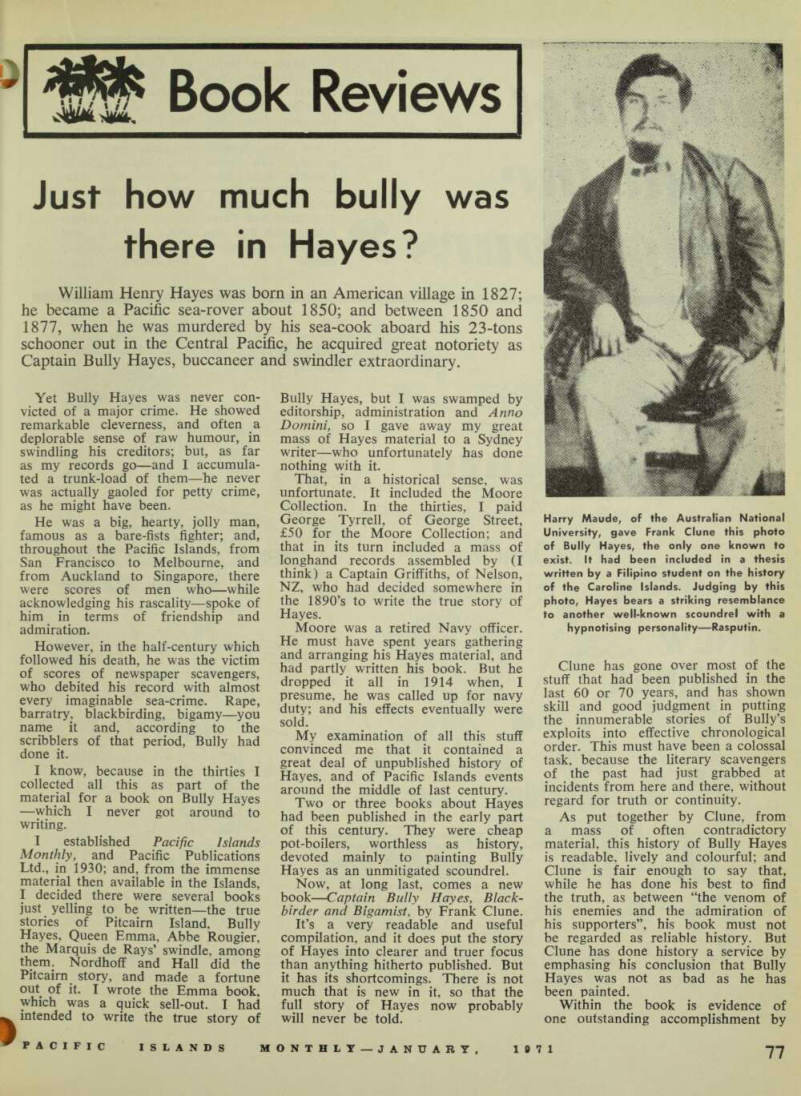
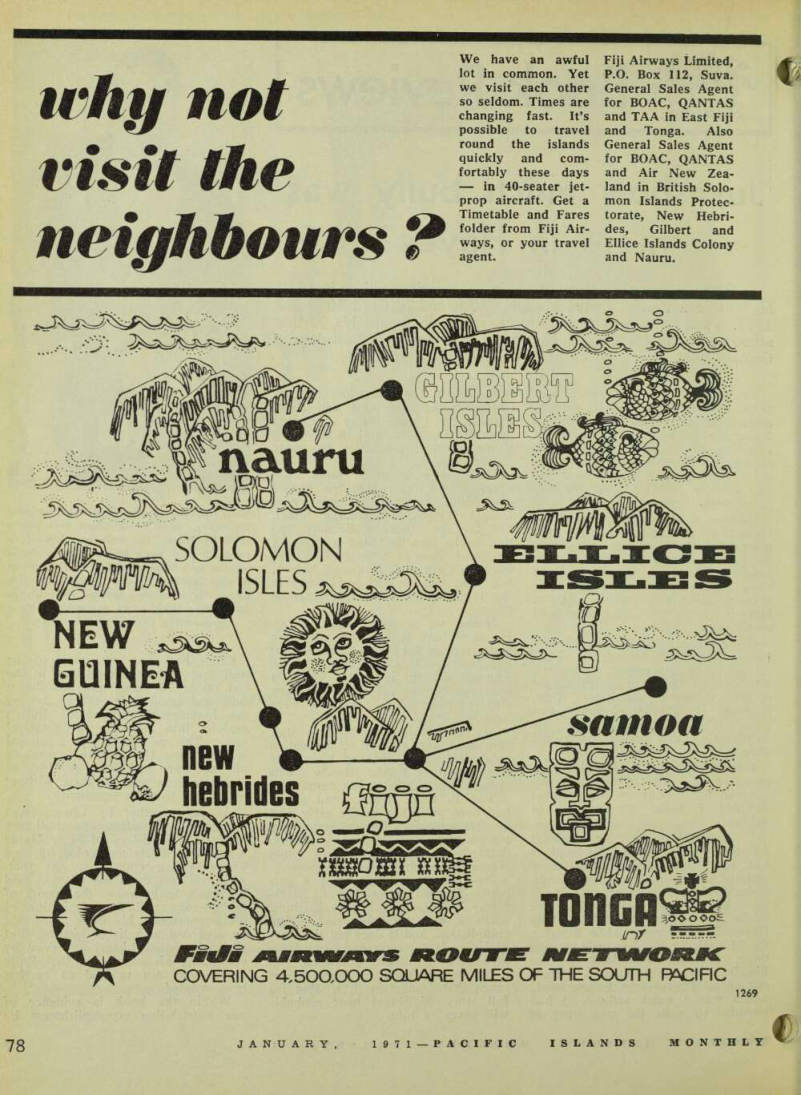
Just how much bully was there in Hayes?
William Henry Hayes was born in an American village in 1827; he became a Pacific sea-rover about 1850; and between 1850 and 1877, when he was murdered by his sea-cook aboard his 23-tons schooner out in the Central Pacific, he acquired great notoriety as Captain Bully Hayes, buccaneer and swindler extraordinary.
Yet Bully Hayes was never con victed of a major crime. He showed remarkable cleverness, and often a deplorable sense of raw humour, in swindling his creditors; but, as far as my records go—and I accumula ted a trunk-load of them—he never was actually gaoled for petty crime, as he might have been.
He was a big, hearty, jolly man, famous as a bare-fists fighter; and, throughout the Pacific Islands, from San Francisco to Melbourne, and from Auckland to Singapore, there were scores of men who—while acknowledging his rascality—spoke of him in terms of friendship and admiration.
However, in the half-century which followed his death, he was the victim of scores of newspaper scavengers, who debited his record with almost every imaginable sea-crime. Rape, barratry, blackbirding, bigamy—you name it and, according to the scribblers of that period, Bully had done it.
I know, because in the thirties I collected all this as part of the material for a book on Bully Hayes —which I never got around to writing.
I established Pacific Islands Monthly, and Pacific Publications Ltd., in 1930; and, from the immense material then available in the Islands, I decided there were several books just yelling to be written—the true stories of Pitcairn Island, Bully Hayes, Queen Emma, Abbe Rougier, the Marquis de Rays’ swindle, among them. Nordhoff and Hall did the Pitcairn story, and made a fortune out of it. I wrote the Emma book, which was a quick sell-out. I had intended to write the true story of
Bully Hayes, but I was swamped by editorship, administration and Anno Domini, so I gave away my great mass of Hayes material to a Sydney writer—who unfortunately has done nothing with it.
That, in a historical sense, was unfortunate. It included the Moore Collection. In the thirties, I paid George Tyrrell, of George Street, £5O for the Moore Collection; and that in its turn included a mass of longhand records assembled by (I think) a Captain Griffiths, of Nelson, NZ, who had decided somewhere in the 1890’s to write the true story of Hayes, Moore was a retired Navy officer.
He . must have spent years gathering ? n j arra| tgmg his Hayes material, and had partly written his book. But he dropped tt all in 1914 when, I Presume he wa called U P f ° r nav y d and hls effects eventually were s *; . .. r „ . . ~. examination of all this stuff convinced me that it contained a great deal of unpublished history of Hayes, and of Pacific Islands events around the middle of last century .
Two or three books about Hayes bad been published in the early part of this century. They were cheap pot-boilers, worthless as history, devoted mainly to painting Bully Hayes as an unmitigated scoundrel, Now, at long last, comes a new book— Captain Bully Hayes, Black birder and Bigamist, by Frank Clune.
It’s a very readable and useful compilation, and it does put the story of Hayes into clearer and truer focus than anything hitherto published. But it has its shortcomings. There is not much that is new in it, so that the full story of Hayes now probably will never be told.
Clune has gone over most of the stuff that had been published in the last 60 or 70 years, and has shown skill and good judgment in putting the innumerable stories of Bully’s exploits into effective chronological order. This must have been a colossal task, because the literary scavengers of the past had just grabbed at incidents from here and there, without regard for truth or continuity.
As put together by Clune, from a mass of often contradictory material, this history of Bully Hayes is readable, lively and colourful; and Clune is fair enough to say that, while he has done his best to find the truth, as between “the venom of his enemies and the admiration of his supporters”, his book must not be regarded as reliable history. But Clune has done history a service by emphasing his conclusion that Bully Hayes was not as bad as he has been painted.
Within the book is evidence of one outstanding accomplishment by
Harry Maude, of the Australian National University, gave Frank Clune this photo of Bully Hayes, the only one known to exist. It had been included in a thesis written by a Filipino student on the history of the Caroline Islands. Judging by this photo, Hayes bears a striking resemblance to another well-known scoundrel with a hypnotising personality—Rasputin.
the author: reproduction of the only known photograph of Hayes. Thirty years ago, I searched the Pacific in vain for something like this. PlM’s old friend, H. E. Maude, of the Australian National University, found this photograph for Clune in a history of the Caroline Islands written by a Filipino student. It’s a pity that this unique picture is not on the front cover of the book, instead of the imaginative drawing (by Norman Lindsay, no less) taken from the cover of a rubbishy book (by Louis Becke) about Hayes that was published more than 50 years ago.
Frank Clune, author of this new book, is himself a literary pheno menon.
About 35 years ago he began writing dinky little books about travel, which were not highly re garded by reviewers, but which com manded readership. Thenceforth, he never stopped travelling and writing; his style improved and his public grew; and now, including this new one on Hayes, he has no less than 64 books to his credit.
He’s a jolly, friendly man in his seventies who has demonstrated how his kind of writing can be made to pay. The last two chapters of this Hayes book have nothing to do with Hayes, but are typically Clune. They describe how Clune wandered at large in New Hebrides and New Cale donia, making friends and influencing
people.
R. W. Robson.
(Captain Bully Hayes, Black
Birder And Bigamist. Angus And
Robertson. $4.95).
Advertisements & other items, p. 80 (1 item)
why not
We have an awful lot in common. Yet we visit each other so seldom. Times are changing fast. It’s possible to travel round the islands quickly and comfortably these days in 40-seater jetprop aircraft. Get a Timetable and Fares folder from Fiji Airways, or your travel agent.
Fiji Airways Limited, P.O. Box 112, Suva.
General Sales Agent
for BOAC, QANTAS
and TAA in East Fiji and Tonga. Also General Sales Agent
for BOAC, QANTAS
and Air New Zealand in British Solomon Islands Protectorate, New Hebrides, Gilbert and Ellice Islands Colony and Nauru.
why not visit the neighbours T
m n □ D
fnauru
SOLOMON
* ISLES *
—^ l 3 a
NEW *3
GUINEA
K sanwa / /^ non .6,
new *
Hebrides
saw
o 3
t SCS*
o o ZQi IfiPffi
SSS
;OOOOOc
io/ ■pro 4grc=> ftm COVERING 4,500,000 SQUARE MILES OF THE SOUTH PACIFIC 1269
High priced Pacificana
The market for secondhand books on the Pacific Islands con tinues its upwards trend in Aus tralia. Some extraordinarily high prices were paid in Melbourne in December when the library of the late Charles Glover, a former Lord Mayor of Adelaide, was auctioned over five days.
Buyers were hesitant over some of the Australiana, possibly because of the large number of lots at the sale, but the Pacific material was much sought after.
Wilfred Beaver, Unexplored New Guinea, 2nd ed. 1920, climbed to a record $B5, the previous Australian auction price being $l6 at a sale in 1969.
Brewster’s Hill tribes of Fiji was sold at $5O.
One of the biggest surprises was
James Chalmers, Pioneer life and Work in New Guinea, which rose to a record $95. It was purchased by a Commonwealth body. The same organisation paid $65 for Codrington, The Melanesians, 1891.
D’Albertis, New Guinea, 2 vols. 1880, reached $l9O, the previous auction price being $45, sold earlier in 1970. Banks, In wild New Britain, not a scarce book, was sold for $32. Two editions of Ellis’ Polynesian Researches, brought $75 and $6O respectively, even though this work is available in reprint. Another surprise was Monckton’s books on New Guinea, which ranged from $l6 to $3O. Landtman, Kiwai Papuans, 1927, and Seligmann, Melanesians of British New Guinea, were each sold for $l4O.
What do these big Pacific prices mean? It takes at least two bidders to take a book to a high price.
With the establishment of new Pacific universities and a greater interest being taken in Pacific history by Australian and Ame rican universities, plus the growth of private collectors, the demand has outgrown the supply. A recent development is the reprinting of many Pacific books, which has helped to make more of them available, but these overseas re prints are still expensive.
How much should collectors pay for a Pacific book? What is a reasonable price? As a guide, Sydney bookseller Margaret Wood house, Macquarie Street, is pub lishing early in 1971 a new reference book called Australian Book Auction Records, 1969-70, which will detail Pacific books, including New Guineana, sold at auction in Australia.
Island Of Love

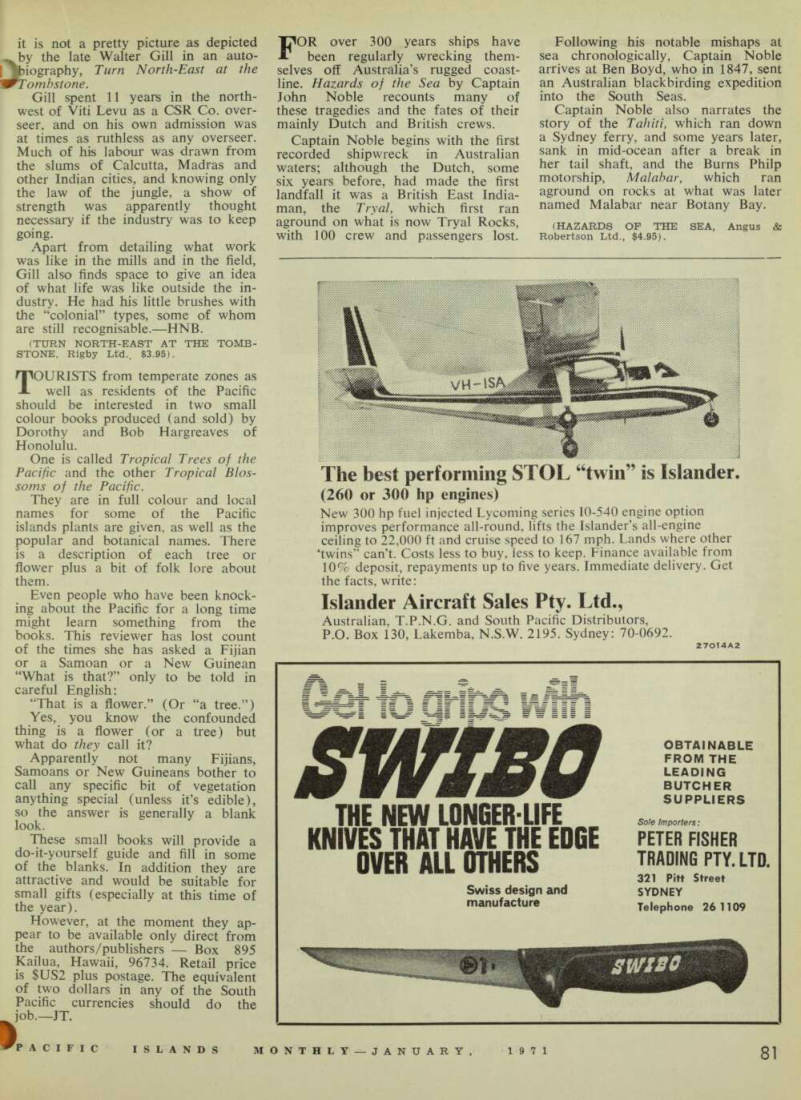
Back in 1769 a leaflet appeared in France which told about Louis de Bougainville's great voyage around the world and of his sensational discovery of an island of beautiful people named New Cythera.
The news fascinated everybody, and all wanted to hear about the new island, so named by Bougainville as a tribute to the goddess of love and beauty. An islander whom Bougain ville brought with him was feted.
It was another two years before they could read the full story in Bougainville’s official account of his voyage, and in the meantime it be came known that Bougainville was not the first European discoverer of New Cythera—the English Captain Wallis had, unknown to Bougainville, come across the island eight months previously. Today it is known as Tahiti.
But the little 1769 newsletter had whetted the public’s appetite for the South Seas, where the women were “very hospitable, very gracious, and quick to caress”, and where the husbands considered the signs of tenderness the French sailors showed towards their beautiful and hospitable women not objectionable but “as a homage and honour”.
On New Cythera there were “no lions, leopards or tigers, nor are there any other savage beasts, snakes or poisonous animals. These people are
by nature vivacious and gay . . . they dance naturally and without any set order”.
Probably never since then has the French public, or any other, lost its interest in the supposed paradise that was Tahiti.
That original newsletter has now been published for the first time in English by the University of Minne sota Press, Minneapolis, in a small limited edition of 750 numbered copies. The translator, Professor L.
Davis Hammond, has included notes, and an introduction which places the newsletter in its historical setting and describes its impact on Bougainville’s countrymen. The original newsletter is also reproduced in facsimile.
Altogether, an attractively produced
oddity.'
SI.
(News Prom New Cythera. Our
copy distributed by Oxford University Press, Australian price, $7.25).
LIFE was pretty feudal in the cane fields of Fiji half a century and more ago, with conditions for the Indian labour bordering on slavery.
It was not a pretty picture then, and
it is not a pretty picture as depicted by the late Walter Gill in an auto biography, Turn North-East at the " Tombstone .
Gill spent 11 years in the north west of Viti Levu as a CSR Co. over seer, and on his own admission was at times as ruthless as any overseer.
Much of his labour was drawn from the slums of Calcutta, Madras and other Indian cities, and knowing only the law of the jungle, a show of strength was apparently thought necessary if the industry was to keep going.
Apart from detailing what work was like in the mills and in the field, Gill also finds space to give an idea of what life was like outside the in dustry. He had his little brushes with the “colonial” types, some of whom are still recognisable.—HNß.
(Turn North-East At The Tomb
STONE. Rigby Ltd.. $3.95).
TOURISTS from temperate zones as well as residents of the Pacific should be interested in two small colour books produced (and sold) by Dorothy and Bob Hargreaves of Honolulu.
One is called Tropical Trees of the Pacific and the other Tropical Blos soms of the Pacific.
They are in full colour and local names for some of the Pacific islands plants are given, as well as the popular and botanical names. There is a description of each tree or flower plus a bit of folk lore about them.
Even people who have been knock ing about the Pacific for a long time might learn something from the books. This reviewer has lost count of the times she has asked a Fijian or a Samoan or a New Guinean “What is that?” only to be told in careful English: “That is a flower.” (Or “a tree.”) Yes, you know the confounded thing is a flower (or a tree) but what do they call it?
Apparently not many Fijians, Samoans or New Guineans bother to call any specific bit of vegetation anything special (unless it’s edible), so the answer is generally a blank look.
These small books will provide a do-it-yourself guide and fill in some of the blanks. In addition they are attractive and would be suitable for small gifts (especially at this time of the year).
However, at the moment they ap pear to be available only direct from the authors/publishers Box 895 Kailua, Hawaii, 96734. Retail price is SUS 2 plus postage. The equivalent of two dollars in any of the South Pacific currencies should do the job.—lT.
FOR over 300 years ships have been regularly wrecking them selves off Australia’s rugged coast line. Hazards of the Sea by Captain John Noble recounts many of these tragedies and the fates of their mainly Dutch and British crews.
Captain Noble begins with the first recorded shipwreck in Australian waters; although the Dutch, some six years before, had made the first landfall it was a British East India man, the Tryal, which first ran aground on what is now Tryal Rocks, with 100 crew and passengers lost.
Following his notable mishaps at sea chronologically, Captain Noble arrives at Ben Boyd, who in 1847, sent an Australian blackbirding expedition into the South Seas.
Captain Noble also narrates the story of the Tahiti, which ran down a Sydney ferry, and some years later, sank in mid-ocean after a break in her tail shaft, and the Burns Philp motorship, Malabar, which ran aground on rocks at what was later named Malabar near Botany Bay.
(Hazards Op The Sea, Angus &
Robertson Ltd., $4.95).
Advertisements & other items, pp. 82-83 (2 items)
International
For your money, you Just can't buy better.
This tractor beats the others hollow on 22 vita! points!
434 TRACTOR
More for your money
-more where it
matters most I
e ass* *ms§.
W y: 43 H.P. maximum engine rating Let's start from the ground up I The International 434 has 13.6 x2B tyres with cast centres as regular equipment, and that gives you a big traction boost to begin with.
Now the gears. The International 434 has 8-speed "no-gap" transmission with a practical gear for every job. There's no over-loading, no power loss and you know what that's worth when you're working against the clock. After the gears, what next ? There's at least 22 vital points on an International 434 that are better than anything you've seen or tried before! Have 434 two ways, with standard transmission or "change-onthe-go" speed amplifier to give you 16 forward speeds, 4 reverse. Have it now your IH dealer can swing an International 434 your way today I H
INTERNAIIONAL FARM EQUIPMENT
INTERNATIONAL HARVESTER COMPANY OF AUSTRALIA PTY. LTD.
FULL DETAILS FROM
FIJI: Niranjan's Auto Port, Suva and Lautoka.
NEW GUINEA; N.G.G. Trading Co., Lae.
Steamships Trading Co. Ltd., Rabaul.
New Guinea Goldfields Ltd., Wau.
Wewak Engineers, Wewak, Govt. Council, Mt. Hagen.
NEW CALEDONIA: Marine Agricole Electrique, Noumea.
TAHITI: Produits Shelltex, Papeete.
PAPUA: Steamships Trading Co. Ltd., Port Moresby.
SOLOMON ISLANDS: Solomon Motors Ltd., Honiara.
NEW HEBRIDES: Kerr Bros. Pty. Ltd., Sydney. 3699/E/32
m
VH-IS
The best performing STOL “twin” is Islander, (260 or 300 hp engines) New 300 hp fuel injected Lycoming series 10-540 engine option improves performance all-round, lifts the Islander’s all-engine ceiling to 22,000 ft and cruise speed to 167 mph. Lands where other ‘twins” can’t. Costs less to buy, less to keep. Finance available from 10% deposit, repayments up to five years. Immediate delivery. Get the facts, write:
Islander Aircraft Sales Pty. Ltd.,
Australian, T.P.N.G, and South Pacific Distributors, P.O. Box 130, Lakemba, N.S.W. 2195. Sydney: 70-0692. 27014A2
SWISO
THE NEW LONGER-LIFE
KNIVES THAT HAVE THE EDGE
OVER ALL OTHERS
Swiss design and manufacture
OBTAINABLE
FROM THE
LEADING
BUTCHER
SUPPLIERS
Sole Importers:
PETER FISHER
TRADING PTY.LTD.
321 Pitt Street
SYDNEY
Telephone 26 1109 .MS
81
NTHLY JANUARY, 1971
PACIFIC ISLANDS M
People
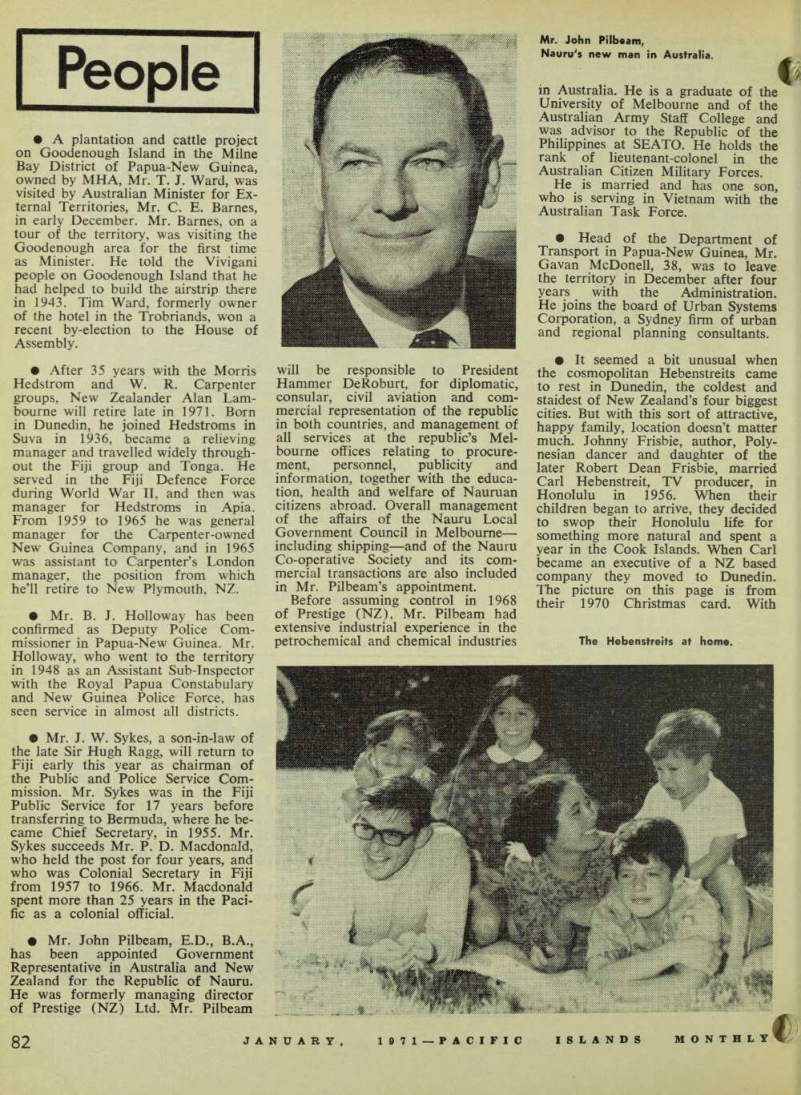
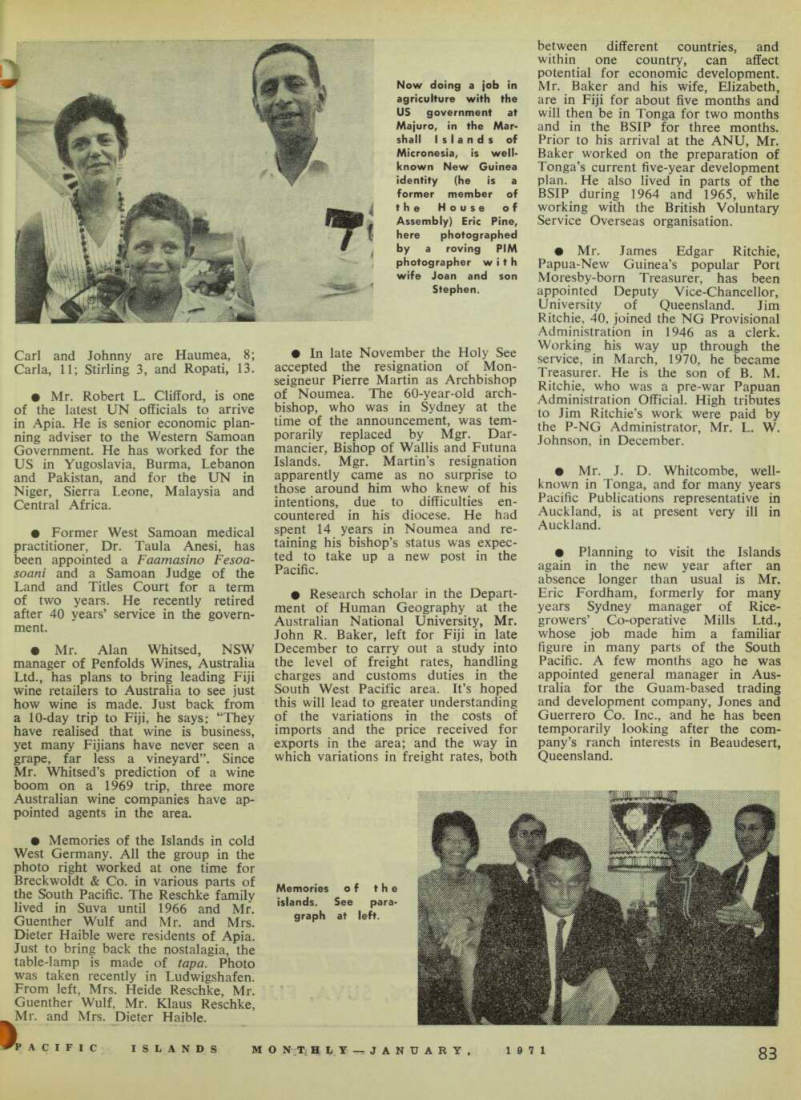
• A plantation and cattle project on Goodenough Island in the Milne Bay District of Papua-New Guinea, owned by MHA, Mr. T. J. Ward, was visited by Australian Minister for Ex ternal Territories, Mr. C. E. Barnes, in early December. Mr. Barnes, on a tour of the territory, was visiting the Goodenough area for the first time as Minister. He told the Vivigani people on Goodenough Island that he had helped to build the airstrip there in 1943. Tim Ward, formerly owner of the hotel in the Trobriands, won a recent by-election to the House of Assembly. • After 35 years with the Morris Hedstrom and W. R. Carpenter groups, New Zealander Alan Lam bourne will retire late in 1971. Born in Dunedin, he joined Hedstroms in Suva in 1936, became a relieving manager and travelled widely through out the Fiji group and Tonga. He served in the Fiji Defence Force during World War 11, and then was manager for Hedstroms in Apia, From 1959 to 1965 he was general manager for the Carpenter-owned New Guinea Company, and in 1965 was assistant to Carpenter’s London manager, the position from which he’ll retire to New Plymouth, NZ. • Mr. B. J. Holloway has been confirmed as Deputy Police Com missioner in Papua-New Guinea. Mr.
Holloway, who went to the territory in 1948 as an Assistant Sub-Inspector with the Royal Papua Constabulary and New Guinea Police Force, has seen service in almost all districts. • Mr. J. W. Sykes, a son-in-law of the late Sir Hugh Ragg, will return to Fiji early this year as chairman of the Public and Police Service Com mission. Mr. Sykes was in the Fiji Public Service for 17 years before transferring to Bermuda, where he be came Chief Secretary, in 1955. Mr.
Sykes succeeds Mr. P. D. Macdonald, who held the post for four years, and who was Colonial Secretary in Fiji from 1957 to 1966. Mr. Macdonald spent more than 25 years in the Paci fic as a colonial official. • Mr. John Pilbeam, E.D., 8.A., has been appointed Government Representative in Australia and New Zealand for the Republic of Nauru.
He was formerly managing director of Prestige (NZ) Ltd. Mr. Pilbeam
will be responsible to President Hammer Deßoburt, for diplomatic, consular, civil aviation and commercial representation of the republic in both countries, and management of all services at the republic’s Melbourne offices relating to procurement, personnel, publicity and information, together with the education, health and welfare of Nauruan citizens abroad. Overall management of the affairs of the Nauru Local Government Council in Melbourne— including shipping—and of the Nauru Co-operative Society and its commercial transactions are also included in Mr. Pilbeam’s appointment.
Before assuming control in 1968 of Prestige (NZ), Mr. Pilbeam had extensive industrial experience in the petrochemical and chemical industries
in Australia. He is a graduate of the University of Melbourne and of the Australian Army Staff College and was advisor to the Republic of the Philippines at SEATO. He holds the rank of lieutenant-colonel in the Australian Citizen Military Forces.
He is married and has one son, who is serving in Vietnam with the Australian Task Force. • Head of the Department of Transport in Papua-New Guinea, Mr.
Gavan McDonell, 38, was to leave the territory in December after four years with the Administration.
He joins the board of Urban Systems Corporation, a Sydney firm of urban and regional planning consultants.
• It seemed a bit unusual when the cosmopolitan Hebenstreits came to rest in Dunedin, the coldest and staidest of New Zealand’s four biggest cities. But with this sort of attractive, happy family, location doesn’t matter much. Johnny Frisbie, author, Poly nesian dancer and daughter of the later Robert Dean Frisbie, married Carl Hebenstreit, TV producer, in Honolulu in 1956. When their children began to arrive, they decided to swop their Honolulu life for something more natural and spent a yea r in the Cook Islands. When Carl became an executive of a NZ based company they moved to Dunedin, The picture on this page is from their 1970 Christmas card. With
Mr. John Pilbeam, Nauru's new man in Australia.
The Hebenstreits at home.
Carl and Johnny are Haumea, 8; Carla, 11; Stirling 3, and Ropati, 13. • Mr. Robert L. Clifford, is one of the latest UN officials to arrive in Apia. He is senior economic plan ning adviser to the Western Samoan Government. He has worked for the US in Yugoslavia, Burma, Lebanon and Pakistan, and for the UN in Niger, Sierra Leone, Malaysia and Central Africa. • Former West Samoan medical practitioner, Dr. Taula Anesi, has been appointed a Faamasino Fesoa soani and a Samoan Judge of the Land and Titles Court for a term of two years. He recently retired after 40 years’ service in the govern ment. • Mr. Alan Whitsed, NSW manager of Penfolds Wines, Australia Ltd., has plans to bring leading Fiji wine retailers to Australia to see just how wine is made. Just back from a 10-day trip to Fiji, he says; “They have realised that wine is business, yet many Fijians have never seen a grape, far less a vineyard”. Since Mr. Whitsed’s prediction of a wine boom on a 1969 trip, three more Australian wine companies have ap pointed agents in the area. • Memories of the Islands in cold West Germany. All the group in the photo right worked at one time for Breckwoldt & Co. in various parts of the South Pacific. The Reschke family lived in Suva until 1966 and Mr.
Guenther Wulf and Mr. and Mrs.
Dieter Haible were residents of Apia.
Just to bring back the nostalagia, the table-lamp is made of tapa. Photo was taken recently in Ludwigshafen.
From left, Mrs. Heide Reschke, Mr.
Guenther Wulf, Mr. Klaus Reschke, Mr. and Mrs. Dieter Haible.
• In late November the Holy See accepted the resignation of Mon seigneur Pierre Martin as Archbishop of Noumea. The 60-year-old arch bishop, who was in Sydney at the time of the announcement, was tem porarily replaced by Mgr. Dar mancier, Bishop of Wallis and Futuna Islands. Mgr. Martin’s resignation apparently came as no surprise to those around him who knew of his intentions, due to difficulties en countered in his diocese. He had spent 14 years in Noumea and re taining his bishop’s status was expec ted to take up a new post in the Pacific. • Research scholar in the Depart ment of Human Geography at the Australian National University, Mr.
John R. Baker, left for Fiji in late December to carry out a study into the level of freight rates, handling charges and customs duties in the South West Pacific area. It’s hoped this will lead to greater understanding of the variations in the costs of imports and the price received for exports in the area; and the way in which variations in freight rates, both
between different countries, and within one country, can affect potential for economic development, Mr. Baker and his wife, Elizabeth, are in Fiji for about five months and will then be in Tonga for two months and in the BSIP for three months.
Prior to his arrival at the ANU, Mr.
Baker worked on the preparation of Tonga’s current five-year development plan. He also lived in parts of the BSIP during 1964 and 1965, while working with the British Voluntary Service Overseas organisation. • Mr. James Edgar Ritchie, Papua-New Guinea’s popular Port Moresby-born Treasurer, has been appointed Deputy Vice-Chancellor, University of Queensland. Jim Ritchie, 40, joined the NG Provisional Administration in 1946 as a clerk.
Working his way up through the service, in March, 1970, he became Treasurer. He is the son of B. M.
Ritchie, who was a pre-war Papuan Administration Official, High tributes to Jim Ritchie’s work were paid by the P-NG Administrator, Mr. L. W.
Johnson, in December. • Mr. J. D. Whitcombe, well known in Tonga, and for many years Pacific Publications representative in Auckland, is at present very ill in Auckland. • Planning to visit the Islands again in the new year after an absence longer than usual is Mr.
Eric Fordham, formerly for many years Sydney manager of Rice growers’ Co-operative Mills Ltd., whose job made him a familiar figure in many parts of the South Pacific. A few months ago he was appointed general manager in Aus tralia for the Guam-based trading and development company, Jones and Guerrero Co. Inc., and he has been temporarily looking after the com pany’s ranch interests in Beaudesert, Queensland.
Now doing a job in agriculture with the US government at Majuro, in the Mar shall Islands of Micronesia, is well known New Guinea identity (he is a former member of the House of Assembly) Eric Pine, here photographed by a roving PIM photographer with wife Joan and son Stephen.
Memories of the islands. See para graph at left.
Advertisements & other items, pp. 85-86 (2 items)
83
'PACIFIC ISLANDS MO NT, HLY JANUARY, 1071
Millers Limited
MARINE & GENERAL ENGINEERS
BOILERMAKERS FOUNDRYMEN
BOAT-BUILDERS SHIP-REPAIRERS
m 4. , w Y V i* m I s# £ W m VESSELS UP TO 500 TONS GROSS CAN BE OVERHAULED AND FITTED OUT AT OUR WHARF. SLIPPING FACILITIES FOR VESSELS TO 1,000 TONS GROSS CAN BE HANDLED AT THE GOVERNMENT SLIPWAY, WHICH IS AVAILABLE TO US.
Modern Machinery Largest Work Shops in Colony Providing Efficient Service L. I A/l / T E= ED
P.O. BOX 296, SUVA, FIJI
Pacific Shipping
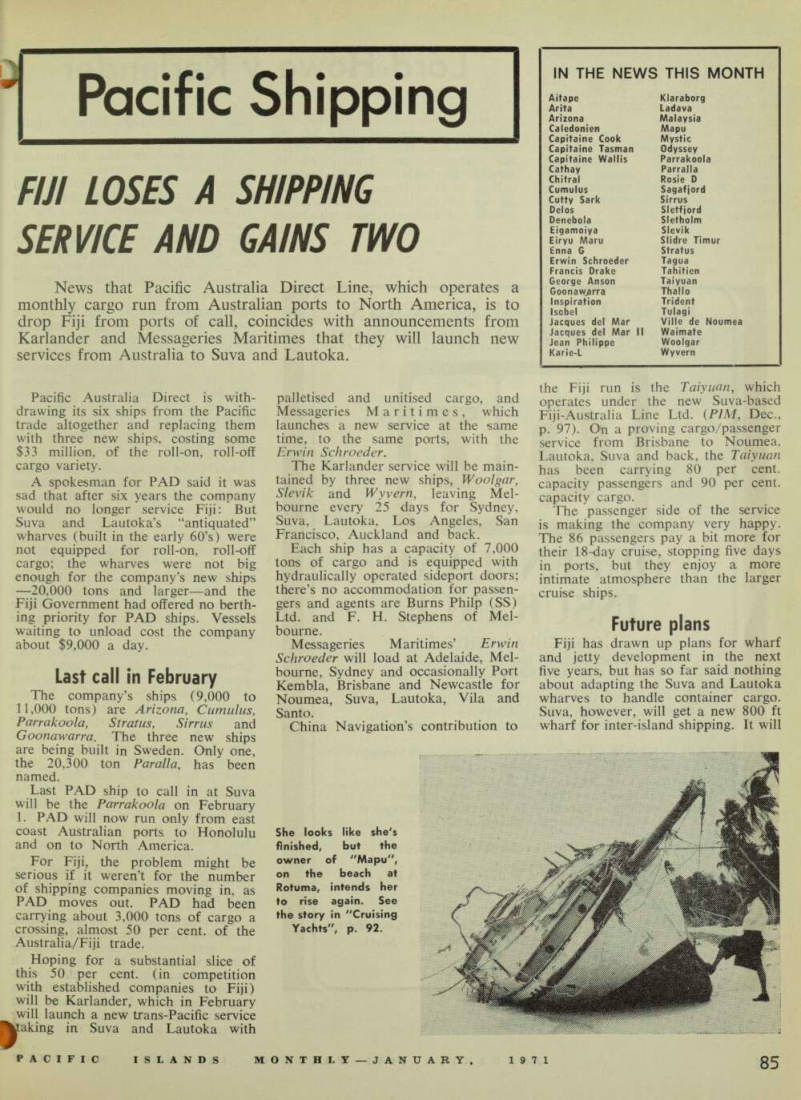
Fiji Loses A Shipping
Service And Gains Two
News that Pacific Australia Direct Line, which operates a monthly cargo run from Australian ports to North America, is to drop Fiji from ports of call, coincides with announcements from Karlander and Messageries Maritimes that they will launch new services from Australia to Suva and Lautoka.
Pacific Australia Direct is with drawing its six ships from the Pacific trade altogether and replacing them with three new ships, costing some $33 million, of the roll-on, roll-off cargo variety.
A spokesman for PAD said it was sad that after six years the company would no longer service Fiji: But Suva and Lautoka’s “antiquated” wharves (built in the early 60’s) were not equipped for roll-on, roll-off cargo; the wharves were not big enough for the company’s new ships —20,000 tons and larger—and the Fiji Government had offered no berth ing priority for PAD ships. Vessels waiting to unload cost the company about $9,000 a day.
Last call in February
The company’s ships (9,000 to 11,000 tons) are Arizona, Cumulus, Parrakoola, Stratus, Sirrus and Goonawarra. The three new ships are being built in Sweden. Only one, the 20,300 ton Par alia, has been named.
Last PAD ship to call in at Suva will be the Parrakoola on February 1. PAD will now run only from east coast Australian ports to Honolulu and on to North America.
For Fiji, the problem might be serious if it weren’t for the number of shipping companies moving in, as PAD moves out. PAD had been carrying about 3,000 tons of cargo a crossing, almost 50 per cent, of the Australia/Fiji trade.
Hoping for a substantial slice of this 50 per cent, (in competition with established companies to Fiji) will be Karlander, which in February will launch a new trans-Pacific service faking in Suva and Lautoka with
palletised and unitised cargo, and Messageries Maritimes, which launches a new service at the same time, to the same ports, with the Erwin Schroeder.
The Karlander service will be main tained by three new ships, Woolgar, Slevik and Wyvern, leaving Mel bourne every 25 days for Sydney, Suva, Lautoka, Los Angeles, San Francisco, Auckland and back.
Each ship has a capacity of 7,000 tons of cargo and is equipped with hydraulically operated sideport doors; there’s no accommodation for passen gers and agents are Burns Philp (SS) Ltd. and F. H. Stephens of Mel bourne.
Messageries Maritimes’ Erwin Schroeder will load at Adelaide, Mel bourne, Sydney and occasionally Port Kembla, Brisbane and Newcastle for Noumea, Suva, Lautoka, Vila and Santo.
China Navigation’s contribution to
the Fiji run is the Taiyuan, which operates under the new Suva-based Fiji-Australia Line Ltd. (F/M, Dec., p. 97). On a proving cargo/passenger service from Brisbane to Noumea, Lautoka, Suva and back, the Taiyuan has been carrying 80 per cent, capacity passengers and 90 per cent, capacity cargo.
The passenger side of the service is making the company very happy.
The 86 passengers pay a bit more for their 18-day cruise, stopping five days in ports, but they enjoy a more intimate atmosphere than the larger cruise ships.
Future plans
Fiji has drawn up plans for wharf and jetty development in the next five years, but has so far said nothing about adapting the Suva and Lautoka wharves to handle container cargo.
Suva, however, will get a new 800 ft wharf for inter-island shipping. It will
She looks like she's finished, but the owner of "Mapu", on the beach at Rotuma, intends her to rise again. See the story in "Cruising Yachts", p. 92.
be located north of the existing King’s Wharf and Walu Bay berths.
Also planned are new cargo sheds at Suva and Lautoka, a $F60,000 jetty for Rotuma, and $250,000 for jetties in the outer islands.
The growing importance of Savu savu as a tourist centre no doubt in fluenced a decision to reclaim land there for future extension of the wharf. Plans envisage Savusavu’s one day becoming a $2,500,000 inter national port.
In The News This Month
Aitape Arita Arizona Caledonien Capitaine Cook Capitaine Tasman Capitaine Wallis Cathay Chitral Cumulus Cutty Sark Delos Denebola Eigamoiya Eiryu Maru Enna G Erwin Schroeder Francis Drake George Anson Goonaw.arra Inspiration Iscbel Jacques del Mar Jacques del Mar II Jean Philippe Karie-L
Klaraborg Ladava Malaysia Mapu Mystic Odyssey Parrakoola Parralla Rosie D Sagafjord Sirrus Sletfjord Sletholm Slevik Slidre Timur Stratus Tagua Tahitien Taiyuan Thallo Trident Tulagi Ville de Noumea Waimate Woolgar Wyvern
Lord Howe v Karlander
Karlander meanwhile has been in the wars in another part of the Pacific—Lord Howe Island, where the islanders are critical of its service. Karlander last year started calling at Lord Howe to replace the service of the Jacques del Mar 11, which had suddenly been withdrawn
from its Sydney-Lord Howe-Norfolk- Noumea run.
The Jacques del Mar 11 provided a three-weekly service carrying general, cooler and refrigerated cargo; she withdrew from the service on economic grounds. The Ville de Noumea then provided one urgently needed service, but the freight rate was $45 a ton, against $37.50 in the Jacques del Mar 11. Neither did the Ville de Noumea have refrigerated space.
Karlander, at the request of the Lord Howe Island Board, agreed to assist, and it apparently has done its best to maintain a regular service, at $37.50, which it finds as unecono mic as did the owners of Jacques del Mar 11. This service is part of the run to Norfolk Island, the New Hebrides and the BSIP, which Karlander took over following BP’s withdrawal of the Tulagi.
Karlander stated at the outset that there would be difficulties in placing a ship on the service. It planned to use the Sletholm, but in the interim, it ran a quick trip to Lord Howe with the Slidre Timur, carrying only dry cargo. The islanders complained that the first Sletholm service called at Brisbane, Weipa, Port Moresby and Samarai before it reached Lord Howe; which ruled out the possibility of its carrying perishable cooler cargo.
Lord Howe Islanders then com plained that the Sletholm was diverted to another service, and that Lord Howe was included in the schedule of the Sletfjord, which called first at Bougainville and BSIP ports. Again, because Lord Howe was last port of call there was no cooler cargo. However, Karlander says it had rescheduled this trip at short notice to include Lord Howe, and there were existing schedules to be honoured. The Slidre Timur was again sent to Lord Howe, substituting for a Sletfjord service, with cooler cargo carried on deck at shipper’s risk. As the trip lasted only two days there was no deterioration of this cargo.
Early in December the Lord Howe Islanders had a final complaint; that the next service after the Slidre Timur would be 42 days away. It was a complaint that could be re medied if the islanders follow a suggestion made by Karlander that they provide holding space for refrigerated goods on the island#
v lt seems that it is just not worth while to put in at Lord pHowe so often with such a small load of cargo.
A recent public meeting on Lord Howe agreed that, “The Karlander service is totally unsatisfactory due to time and pilferage,” and requested the board to call new tenders for the Lord Howe service in January each year for the ensuing year.
Mr. A. G. Kingsmill, chairman of the Lord Howe Island Board, said in Sydney in mid-December that now that Karlander was making Lord Howe the first port of call he hoped that the service would satisfactorily meet the island’s requirements.
He added: “The board has been in close touch with Karlander with a view to ensuring the company provides the best possible service for the needs of the island.”
FOOTNOTE: While on the subject of the Jacques del Mar 11. She has been sold to John Manners and Co., and has been renamed the Isabel.
BP’s Tulagi, bought by Societe Mari time Caledonienne, Noumea, has been renamed Jacques del Mar (without any extra handle to it) and currently is operating a service from Sydney to Norfolk Island and Noumea.
New ships for
New Caledonia...
The Ravel brothers of Sofrana in Noumea have announced the purchase of a new vessel to join the Capitaine Cook and Capitaine Wallis on the New Zealand-Noumea-New Hebrides- Fiji-New Zealand service.
This will permit a speeding up of this service to one vessel every 10 days.
The new ship, 2,500 tons dwt, is the Capitaine Tasman, a 13-year-old vessel purchased in France. It’s ex pected to reach Noumea in February, and be manned by French and Fijian crew.
The Capitaine Tasman offers 70 cubic metres refrigerated cargo space and 3,500 cubic metres for general cargo. Main merchandise carried from NZ to New Caledonia is cur rently wood and prefabricated houses.
At the same time, another Cale donian shipping company, the Com pagnie des Chargeurs Caledoniens, is also planning to have a new ship in service shortly. This will supplement the Noumea-Sydney-Brisbane-Noumea line currently operated by the Wille de Noumea.
. . . And Some Others
Yj\Ll Soon Disappear
Messageries Maritimes will withdraw their two passenger-cargo ships, Ta j litien and Caledonien, from the p rance p ac ifi c islands - Australia service later i n 1971. The Caledonien wd sad f rom sy dney for the last time j n j une and the Jahitien in Se p tem ber Present plans are not to replace these ships, which were built in 1951 and 1952. Each has capacity for about 400 P assen § ers p ac ifi c islands ports serviced by th shi between p France and Au ' *
tralia are Taiohea (Marquesas), Papeete, Vila, Santo and Noumea. 4 ... , - Messagenes will still operate four cargo ships a month from north European ports to the Pacific. One Wlll call only at Papeete and will then return direct; one will call at Noumea and return direct; a third will return via New Zealand after calling at Papeete and New Caledonia, and the fourth will go on to Japan f £ om Pa P eet ®. and Noumea, and will then return direct.
The line will use eight of its own ships on the service, and will charter others,
Services cut to
Port Moresby
Two shipping lines curtailed services in December from Australia to Port Moresby because of serious congestion in Moresby port.
Conpac Pacific Express Line with drew the Delos from a regular run between Melbourne and Port Moresby because of hold-ups (see PIM, Dec., p. 95), and was due to service only Lae and Madang.
Nauru Pacific Shipping Lines also terminated the voyage of the Enna G at Brisbane and cancelled its next voyage from Melbourne to Port Moresby and Kieta.
Ships in Port Moresby Harbour have been facing delays of up to 10 days because of inadequate berthing and storage space, aggravated by the accident of the Malaysia, which ran into the wharf. Although as much as 20,000 tons of cargo can move through the port in any one smooth running week, there is only storage space for 5,000 tons. During December hotels and major stores in Moresby were running out of refrigerated goods, as ships waited to dock.
If present plans are followed Nauru Pacific Shipping Lines’ Enna G will join the Rosie D and the Eigamoiya, on regular runs from Melbourne calling at Fiji, Nauru, Kieta, Port Moresby and return.
Madang and Guam are also being considered as likely ports.
But Some New Ones
To Call At Moresby
The E and A Line ships, Cathay and Chitral, will include Port Moresby in their regular Australia-Japan services from February. One of these ships leaves Australia every month.
Current ports of call are Mel bourne, Sydney, Brisbane, Manila, Hong Kong, Keelung, Kobe, Nagoya, Yokohama and Rabaul.
Each ship will be in Port Moresby from 8 a.m. to 5 p.m. to give passengers ample time to make local tours. Each has a passenger capacity of 274 adults and 16 children.
Australia-Guam
Service Ceases
Two passenger-cargo ships, the George Anson and Francis Drake will be withdrawn from the Aus tralia-Far East-Guam service—the George Anson in February and the Francis Drake in March. The ships, operated by H. C. Sleigh Ltd., are both about 20 years old.
They have been servicing MelM
bourne, Sydney, Brisbane, Manila, VHong Kong, Keelung and Guam.
Jit looks at the moment that as a result of this withdrawal there will be no shipping service between Australia and Guam—and Guam is a growing purchaser of Australian goods.
Nz Seamen Up To
No Good Again
The Cook Islands Government plans to place a Cook Islands crew on the Thallo, which has been plagued with trouble from the NZ Seamen’s Union because it has a Fijian crew and not a New Zealand one on its Auckland-Rarotonga run (see PIM, Dec., p. 95). The Cook Islands Shipping Company, which charters the Thallo from Mr. Athol Rusden, said the ship was on a traditional islands run and was en titled to carry Cooks crew. Latest union comment is that this might contravene an earlier agreement.
Another ship, the Jean Philippe, carrying airport construction equip ment from Rarotonga to Auckland, is also in dispute with the seamen’s union.
The seamen’s union the previous month (PIM, Dec., p. 95) was making life equally difficult for an other Cook Islands chartered vessel,
the Slidre Timur. It looks as though the NZ seamen’s union is bent on doing to islands services in and out of Auckland, what the Australian seamen’s union with its equally short sighted policy did to Burns Philp islands services out of Sydney—ruin them.
Tongans Hostile
At Pillaging
Tonga’s merchants were up in arms recently when the Union Steam Ship Company’s Waimate arrived in Nuku alofa with a third of its Christmas cargo (about 100 tons) damaged or pillaged. It was her last call, after delivering New Zealand goods at Lautoka, Suva, Apia and Pago Pago, before returning to Auckland.
A correspondent says it was the worst case of its kind in recent years and merchants felt justified in refus ing to take delivery, pending claims.
The wharf administration told the carriers that it would not be held responsible for claims.
While Tonga’s watersiders cannot be wholly exonerated, both the harbourmaster and Union Steam manager are certain the trouble hap pened elsewhere.
The mess that greeted importers at the custom shed was “unbelievable”, the correspondent reports. Cartons of
beer and soft drinks, soaked in oil, were disintegrating, cases of children’s toys, fire extinguishers and vacuum flasks had been ripped open and the contents removed. A heavy motor truck was stripped of battery, spare tyre and tool kit. There were empty cartons of biscuits and tinned meats; missing or damaged bolts of material.
Sacks of flour and a lounge suite had been used as a toilet.
The correspondent adds: “With ever-increasing freight rates, and con stant delays due to strikes, it’s no wonder that the wharf administration and merchants of Tonga are annoyed and ready to put the blame on the carrier”.
Still Serious Congestion
In Noumea Port
Boom time in New Caledonia has meant serious congestion in the port of Noumea, where the increase in merchandise has not been coupled with a similar growth in berthing facilities.
A new 150-yard wharf for small inter-island vessels is expected to be completed by next January. But the new deep-water quay, initially planned to take one large liner, will not be ready before March, 1972.
While ships lost 160 days in Noumea harbour last year, it is
feared that over 1,000 days will be wasted this year by ships anchored amidstream waiting for berths. At a cost of $A2,000 per day, this would represent a loss of some $2 million to shipping companies.
While awaiting the completion of
new berSg lenities If porl
authority is enforcing extra measures to speed up the clearance of merchandise from the docks. At the same time, several acres of new land are now equipped to store cumbersome vehicles and earth-moving equipment awaiting clearance.
Shipping briefs
• Two more Japanese-Australian joint venture companies are to con duct surveys for skipjack tuna in Papua and New Guinea waters. The two ventures are in addition to a 12 month survey begun last March by the Gollin Kyokuyo Fishing Com pany off New Ireland.
The two other companies now be ginning surveys are Nichimen Com pany (ANZ) Pty. Ltd. and Kaigai Cyogyo KK which will operate from Rabaul, and C. Itoh (Aust.) Pty.
Ltd. which will be based on Manus Island.
The conditions of survey licences issued to the three companies are the same. Each must put forward pro positions on future commercial opera tions after 12 months.
The C. Itoh fleet will consist initially of a mother ship, Eiryu Maru, and four other vessels.
• Sole Pacific and NSW agents for Gardner diesel, Knox Schlapd Pty. Ltd., of Sydney, are now putting stocks of Gardner spares into the Islands. Henry Chow, of Toboi Ship building Co., Rabaul, are first distri butors appointed under the new arrangements, and they will supply the New Guinea islands and north coast mainland ports. Other agents are being appointed in Port Moresby, Honiara and elsewhere. Spares have never previously been distributed from New Guinea. • The Norwegian American Line’s new vessel, Sagafjord, will pay its first visit to Pago Pago in January, 1972, as a result of efforts by the Governor of American Samoa, John M. Haydon, to attract additional cruise ships. The Governor is now asking other companies to put in at Pago. • A $638,288 contract has been let for the construction of an over seas wharf at Oro Bay in the North ern District of Papua, to Hornibrook Constructions Pty, Ltd The wharf will consist of a 200 ft by 40 ft wharf head designed to berth vessels up to 10,000 tons. A causeway and bridge approach span will extend from the shore to the head. A cargo shed, security storage area, stevedores’ amenities building and customs area will be provided, and the contract, to be completed by September, 1972, also includes the construction of a bridge on the approach road to the wharf. • The Tagua, 168 tons, went aground off Mangaia Island in the Cook group on December 15, and a call went out to the Jean Philippe , crewed by Fijians, to pull her off.
The Tagua ; owned by Silk and Boyd, Rarotonga, was reported to be holed in the cargo hold. The master, Captain Karl Leiwendhal, was slightly injured when caught by spokes of the wheel as the ship grounded. The Jean Philippe was en route to Rarotonga from NZ when she received the call for help. • Papua-New Guinea’s Nautical Training School is to be moved from Napa-Napa, Port Moresby, to Madang. The next class at Napa- Napa, starting in January, will be the last in Port Moresby. Its members will be transferred to Madang as soon as facilities are completed. • Two RAN patrol boats, HMAS Aitape and Ladava, went up and down the Fly River of Papua-New Guinea in December. They sailed a total distance of 944 nautical miles at an average speed of 10 knots. 4
Advertisements & other items, pp. 88-92 (2 items)
Queensland
( BENEFIT FROM 84 YEARS
OF INSURANCE EXPERIENCE
INSURANCE
Company Limited
(INCORPORATED 1886 IN AUSTRALIA)
HEAD OFFICE: 82 Pitt Street, Sydney FIJI —Branch Office, Suva, Manager for Fiji: K, Galloway.
LAUTOKA, BA, LEVUKA, LABASA—Bums Philp
(South Sea) Co. Limited. District Manager at Lautoka: U. Singh.
PAPUA & NEW GUlNEA—Branch Office, Port Moresby: Manager for Papua & New Guinea: D. J. Granter.
SAMARAI, LAE, MADANG, RABAUL, KAVIENG,
MT. HAGEN—Bums Philp (New Guinea) Limited District Manager at Rabaul: J. S. Bell. District Manager at Lae: J. D. Mac Lean. District Manager at Mt. Hagen: G. F. Donnelly.
HONIARA (b.s.i.p.) —Breckwoldt & Company (s.i.) Pty. Limited.
NOUMEA—T. A. Hagen, Ste W.A. Johnston S.A.R.L.
VlLA—Bums Philp (New Hebrides) Limited.
SANTO—Bums Philp (New Hebrides) Limited.
NORFOLK ISLAND—Bums Philp (South Sea) Co. Limited.
OTHER SOUTH SEA ISLANDS—Bums Philp (South Sea) Co. Limited.
Assets exceed $A60,000,000 fcJS.
Luxury Steel
For sale
N
Vessel.
GROSS TONNAGE 827 TONS. L.O.A. 200 ft.
MOULDED BREADTH 31 ft. MOULDED
DEPTH 16 ft. DRAUGHT 12 ft. I'/ 2 ins.
SERVICE SPEED 14.7 knots. FURTHER
DETAILS AVAILABLE. SUITABLE
HYDROGRAPHICAL, FISHING SERVICES
OR TOURIST WORK.
ALSO 45 ft. GAME OR COMMERCIAL
CRAFT AVAILABLE IMMEDIATELY IN
STOCK MODEL DESIGN. CAN BE
COMPLETED TO OWNERS LAY-OUT.
i 26 QUAY STREET BULIMBA BRISBANE
PHONE 95-2771.
NORMAN. R. WRIGHT
and SONS PTY LTD.
©®itm
-j name ©
to be trusted
COMMERCIAL
LAUNDRY EQUIPMENT
Chosen throughout Australia and the Pacific Islands. Every year more and more Laundries and Institutions install Gothic machines and every year these buyers obtain the benefits of better after-sales attention throughout the Pacific.
Used throughout Australia and the Pacific Islands by Government Departments, Hospitals, Institutions, Hotels, Ships, etc.
HEAVY WASHERS FOR LAUNDRIES (Side or Front Loading).
TUMBLER DRYERS (Town Gas, Natural Gas, Electric or Steam
Heated). IRONERS AND HYDRO EXTRACTORS, Etc.
For further information and catalogue.
GOTHIC PTY. LIMITED
40 Antoine Street, Rydalmere, N.S.W., Australia 2116
RAMBLER'S GUIDE
TO NORFOLK ISLAND
A visitor's guide to historic Norfolk Island by an island resident, Mrs. Merval Hoare, who takes the reader with maps and charts on a stimulating tour of every point of interest on this second-oldest British settlement in the South Seas. Price $l.OO Aust., plus 15c postage, or $1.40 U.S. posted.
Available from: Pacific Publications (Aust.) Pty. Ltd. 29 Alberta Street (G.P.O. Box 3408), Sydney.
& W mmmmW CM
□M3 JL TC3 /nr^ @ B ®
NO RUST
NO ROT
NO LEAKS
40 Ft. DIESEL WORK BOAT of FERRO-CEMENT DESIGNED BY WELL KNOWN AUST. NAVAL ARCHITECT FOR
ISLAND SERVICE. BUILT UNDER RIGID SUPERVISION
BY HARBOURS & MARINE DEPT., Q'LAND.
FOR A LIFETIME LOW COST VESSEL WRITE TO:
MARINE FURNISHING BUNDABERG PTY. LTD.
P.O. Box 69, BUNDABERG, Q. 4670 Phone 72 1260
BUY IN BRISBANE
SHIPCHANDLERY—YACHT FITTINGS
Rigging work a specialty at
THE SMALL SHIPS CENTRE
177 Wellington Rd., East Brisbane, Queensland, 4169, Australia.
PROMPT MAIL ORDER SERVICE.
In your business, do you need to keep up with New
Guinea affairs, but haven't the time?
Then INSIDE NEW GUINEA is produced every Wednesday for you. INSIDE NEW GUINEA is Papua-New Guinea's first and only business and political newsletter.
It supplies inside information on what's going on, in capsule form, for busy executives who need to know.
INSIDE NEW GUINEA is airmailed to your desk every week from Port Moresby, SASO for a full year,
INSIDE NEW GUINEA
Published by the New Guinea News Service and
available only by direct subscription.
Write: Box 5050, PO BOROKO, PAPUA-NEW GUINEA
SADDLERY AND RIDING EQUIPMENT
4m m jL Send for FREE illustrated catalogue of:— Saddlery Horse rugs Breaking-in-gear Whips (Stock and riding) Yarding canes (sheep and cattle) Riding clothing Riding boots (elastic-side and Polo) Polo equipment Driza-bone raincoats Pony Club and Hunting Caps
HOME TANNING OUTFITS
For tanning all kinds of skins. Kangaroo, rabbit, sheep, crocodile, bullock hides, etc.
Price $3.50 Post FREE.
JOHN CHARLTON Cr CO. PTY. LTD.
168-170 PACIFIC HIGHWAY, ST. LEONARDS, N.S.W., 2065 Phones: 43-1010, 43-6087. After Hours; 451-4718.
Telegraphic & Cable Address: "CHARLTONS", Sydney.
Cruising
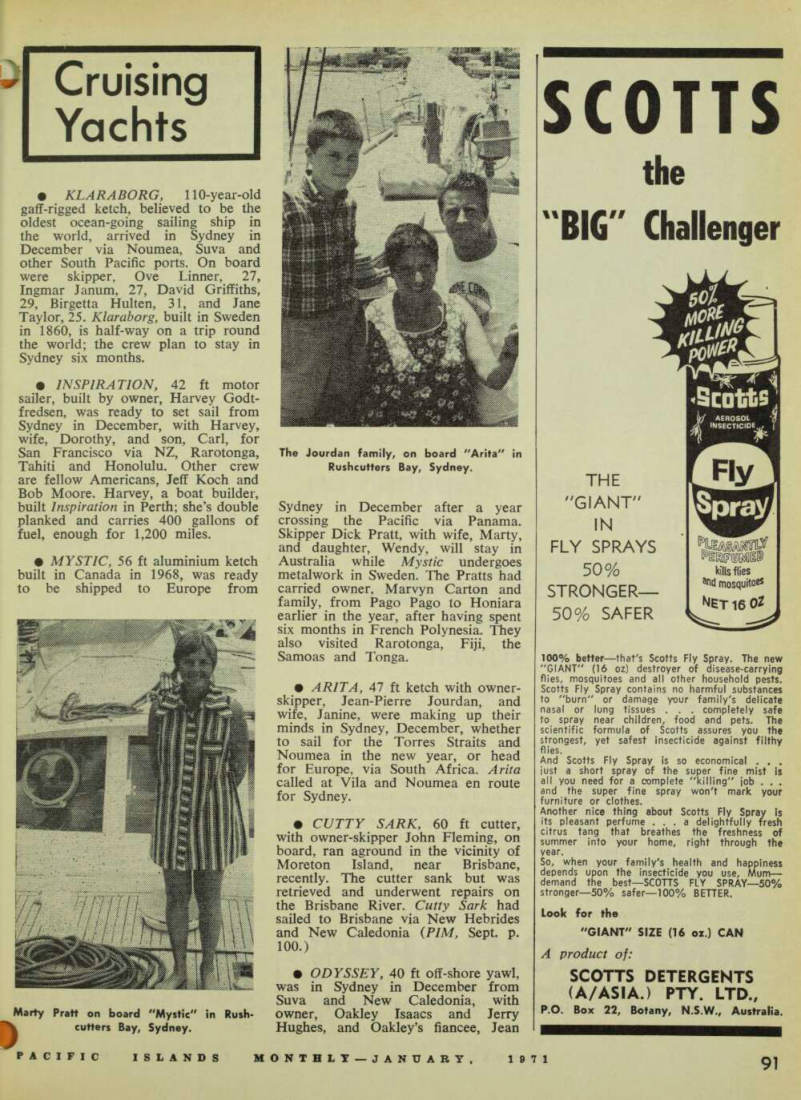
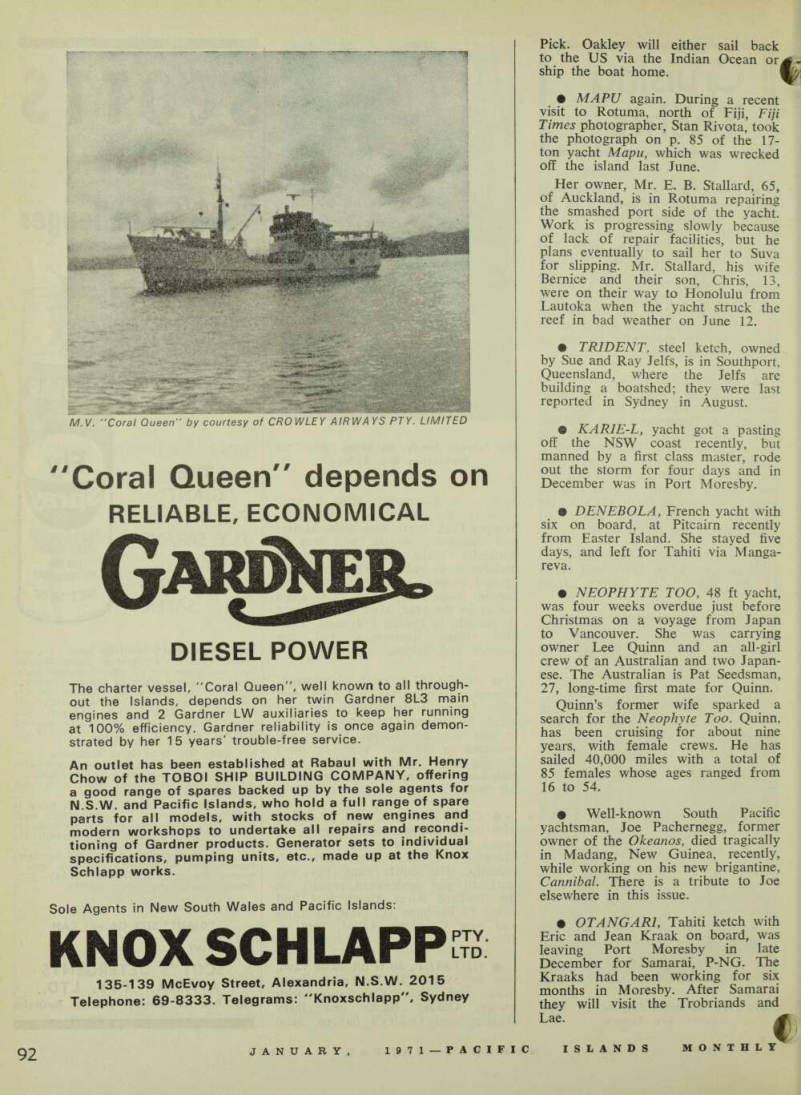
Yachts
• KLARABORG, 110-year-old gaff-rigged ketch, believed to be the oldest ocean-going sailing ship in the world, arrived in Sydney in December via Noumea, Suva and other South Pacific ports. On board were skipper, Ove Tinner, 27, Ingmar Janum, 27, David Griffiths, 29, Birgetta Hulten, 31, and Jane Taylor, 25. Klaraborg, built in Sweden in 1860, is half-way on a trip round the world; the crew plan to stay in Sydney six months. • INSPIRATION, 42 ft motor sailer, built by owner, Harvey Godt fredsen, was ready to set sail from Sydney in December, with Harvey, wife, Dorothy, and son, Carl, for San Francisco via NZ, Rarotonga, Tahiti and Honolulu. Other crew are fellow Americans, Jeff Koch and Bob Moore. Harvey, a boat builder, built Inspiration in Perth; she’s double planked and carries 400 gallons of fuel, enough for 1,200 miles. • MYSTIC, 56 ft aluminium ketch built in Canada in 1968, was ready to be shipped to Europe from
Sydney in December after a year crossing the Pacific via Panama.
Skipper Dick Pratt, with wife, Marty, and daughter, Wendy, will stay in Australia while Mystic undergoes metalwork in Sweden. The Pratts had carried owner, Marvyn Carton and family, from Pago Pago to Honiara earlier in the year, after having spent six months in French Polynesia. They also visited Rarotonga, Fiji, the Samoas and Tonga. • ARITA, 47 ft ketch with owner skipper, Jean-Pierre Jourdan, and wife, Janine, were making up their minds in Sydney, December, whether to sail for the Torres Straits and Noumea in the new year, or head for Europe, via South Africa. Arita called at Vila and Noumea en route for Sydney. • CUTTY SARK, 60 ft cutter, with owner-skipper John Fleming, on board, ran aground in the vicinity of Moreton Island, near Brisbane, recently. The cutter sank but was retrieved and underwent repairs on the Brisbane River. Cutty Sark had sailed to Brisbane via New Hebrides and New Caledonia ( PIM, Sept. p. 100.) • ODYSSEY, 40 ft off-shore yawl, was in Sydney in December from Suva and New Caledonia, with owner, Oakley Isaacs and Jerry Hughes, and Oakley’s fiancee, Jean
Marty Pratt on board "Mystic" in Rush cutters Bay, Sydney.
The Jourdan family, on board "Arita" in Rushcutters Bay, Sydney.
Pick. Oakley will either sail back to the US via the Indian Ocean or. ship the boat home. ( • MAPU again. During a recent visit to Rotuma, north of Fiji, Fiji Times photographer, Stan Rivota, took the photograph on p. 85 of the 17ton yacht Mapu, which was wrecked off the island last June.
Her owner, Mr. E. B. Stallard, 65, of Auckland, is in Rotuma repairing the smashed port side of the yacht.
Work is progressing slowly because of lack of repair facilities, but he plans eventually to sail her to Suva for slipping. Mr. Stallard, his wife Bernice and their son, Chris, 13, were on their way to Honolulu from Lautoka when the yacht struck the reef in bad weather on June 12. • TRIDENT, steel ketch, owned by Sue and Ray Jelfs, is in Southport, Queensland, where the Jelfs are building a boatshed; they were last reported in Sydney in August. • KARIE-L, yacht got a pasting off the NSW coast recently, but manned by a first class master, rode out the storm for four days and in December was in Port Moresby. • DENEBOLA, French yacht with six on board, at Pitcairn recently from Easter Island. She stayed five days, and left for Tahiti via Manga re va. • NEOPHYTE TOO, 48 ft yacht, was four weeks overdue just before Christmas on a voyage from Japan to Vancouver. She was carrying owner Lee Quinn and an all-girl crew of an Australian and two Japan ese. The Australian is Pat Seedsman, 27, long-time first mate for Quinn.
Quinn’s former wife sparked a search for the Neophyte Too. Quinn, has been cruising for about nine years, with female crews. He has sailed 40,000 miles with a total of 85 females whose ages ranged from 16 to 54. • Well-known South Pacific yachtsman, Joe Pachernegg, former owner of the Okeanos, died tragically in Madang, New Guinea, recently, while working on his new brigantine, Cannibal. There is a tribute to Joe elsewhere in this issue. • OTANGARI, Tahiti ketch with Eric and Jean Kraak on board, was leaving Port Moresby in late December for Samarai, P-NG. The Kraaks had been working for six months in Moresby. After Samarai they will visit the Trobriands and Lae. A
Advertisements & other items, pp. 93-94 (1 item)
Scotts
the
“BIG" Challenger
THE
"GIANT"
IN
FLY SPRAYS
50%
STRONGER—
-50% SAFER
Fly
kills flies
mosquiw®*
Net 16 ot
100% better—that's Scotts Fly Spray. The new "GIANT" (16 oz) destroyer of disease-carrying flies, mosquitoes and all other household pests.
Scotts Fly Spray contains no harmful substances to "burn" or damage your family's delicate nasal or lung tissues . . . completely safe to spray near children, food and pets. The scientific formula of Scotts assures you the strongest, yet safest insecticide against filthy flies.
And Scotts Fly Spray is so economical . . . iust a short spray of the super fine mist is all you need for a complete "killing" job . . . and the super fine spray won't mark your furniture or clothes.
Another nice thing about Scotts Fly Spray is its pleasant perfume ... a delightfully fresh citrus tang that breathes the freshness of summer into your home, right through the year.
So, when your family's health and happiness depends upon the insecticide you use. Mum— demand the best—SCOTTS FLY SPRAY—SO% stronger—so% safer—loo% BETTER.
Look for the
"GIANT" SIZE (16 oz.) CAN
A product of:
SCOTTS DETERGENTS
(A/ASIA.) PTY. LTD.,
P.O. Box 22, Botany, N.S.W., Australia.
M.V. "Coral Queen" by courtesy of CROWLEY AIRWAYS PTY. LIMITED
"Coral Queen" depends on
RELIABLE, ECONOMICAL
Gardes.
DIESEL POWER
The charter vessel, "Coral Queen", well known to all throughout the Islands, depends on her twin Gardner BL3 main engines and 2 Gardner LW auxiliaries to keep her running at 100% efficiency. Gardner reliability is once again demonstrated by her 15 years' trouble-free service.
An outlet has been established at Rabaul with Mr. Henry Chow of the TOBOI SHIP BUILDING COMPANY, offering a good range of spares backed up by the sole agents for N.S.W. and Pacific Islands, who hold a full range of spare parts for all models, with stocks of new engines and modern workshops to undertake all repairs and reconditioning of Gardner products. Generator sets to individual specifications, pumping units, etc., made up at the Knox Schlapp works.
Sole Agents in New South Wales and Pacific Islands:
KNOX SCHLAPP^
135-139 McEvoy Street, Alexandria, N.S.W. 2015 Telephone: 69-8333. Telegrams: "Knoxschlapp", Sydney
Business and Development
Ng Tea Is 'Making It'
In London
From KEN McGREGOR, in London In its first 18 months at the London auction rooms of Plantation House, high grade tea from the New Guinea Highlands has more than held its own against the world’s premier crops. Of the 20-odd tea exporting countries, New Guinea now ranks sixth in quality, behind the more ex perienced and better known African and Asian producers.
Quantity, of course, is a different story, and NG’s output, for several years, will be insignificant in world trade.
In the average prices obtained in London auctions, from January 1, to December 1, 1970, Tanzania and Kenya ranked first with over 53 pence per pound; Uganda was third, with 51.68 d, Ceylon fourth with 51.02 d, India fifth, with 50.77 d.
NG’s average was 47.13 d, above Malawi and Mozambique.
A typical sale, on December 9, included about 200 chests (88 lb per chest), of NG tea, to numerous brokers. They sold in five grades, and prices were 47d, 49d, 44id, 50d and 52d. This particular sale all came from crops grown at the W. R.
Carpenter plantation, Kudjip, Mr. Richard Bradshaw, a broker representing all NG teas, told me response to NG teas had been “very good”. Sales had been made to brokers for clients in the UK, Holland, West Germany, Canada, the US and Italy. NG teas, he said, had been separated into several grades, including Broken Orange Pekoe (BOP), Broken Orange Pekoe I (BOPI), Broken Orange Pekoe Fannings (BOPF) —fine, and “Dust” (very fine).
Highest prices so far realised for NG teas in London were 57id
Bopi; 49Id Bop; 60D Bopf; 58D
Orange Fanning; and 58d “Dust”.
Lowest prices were: 37id BOPI; 33d BOP; 40d BOPF; 44d OF; and 22d “Dust”.
Prices last year, Mr. Bradshaw said, had been higher than ’69 because of world under-supply.
Prospects for early this year were “slightly upwards”.
Brokers for NG are introducing their teas in small lots to keep the NG name occurring regularly in small and big sales. They feel this is the way to introduce a new product.
It’s felt in London that the December New Delhi meeting of the UN Food and Agriculture Organisation, which decided to limit world tea exports and secure better prices, will not affect NG tea, which is doing well anyway.
Under control of Australia, which doesn’t export tea, NG has no tea quota. And as its production will remain insignificant by world output standards, it’s unlikely a NG quota will arise, especially if Australia takes a big proportion of NG ex ports.
Independence for NG could how ever, alter this thinking. The NG Government would then have to negotiate for itself. Not that it would have to abide by FAO guidelines—it could follow Kenya’s lead. Kenya has indicated it will not adhere to the FAO decision to maintain the present world quota level of 1970 at 1,311 million pounds, this year. It indicated it would produce and sell as much tea as it could.
Hopes are Kenya will rescind this decision, and, when the consultative committee of the FAO reconvenes, probably this November, this import ant producer, with conditions similar to NG, will sign the first-ever inter national agreement in tea prices and production.
Growers at Banz, Hagen and in the Wahgi Valley, however, can mean while sleep easy; as their production is too small to warrant any action against it.
Steamies confident
about the future
Steamships Trading Co. Ltd. is still trying to correct the wrong impres
sion drawn from its comments in its latest annual report that the com pany’s “future expansion . . . within Papua-New Guinea will of necessity be more limited than the opportuni ties available”.
Steamies’ chairman, Mr. H. D.
Underwood, was very annoyed in deed when this comment, and an other that the company would be looking for opportunities outside the territory, were headlined as “STC cools on our prospects” in the local Press. An editorial making Steamies look like harbingers of gloom didn’t help, either.
What the company was trying to point out, but failed to make clear, was that there was an obvious re luctance by outside investors to finance projects in the territory on a satisfactory long term basis, and this was why expansion would be more limited.
As explained since, the company itself hasn’t lost confidence; some of its backers aren’t enthusiastic for long term P-NG investment, so if the company is to continue expand ing to its capacity it would have to look at outside opportunities. None could be named just now.
In the territory, within the bounds of available finance, Steamies cur rently is nearing completion of a $lOO,OOO revamping of its store at Goroka; a $200,000 new store at Madang is building, and design is well advanced for a store at Mt.
Hagen.
The company isn’t the only one having trouble in attracting money; the government is also getting a poor response to its calls for public money lately.
Emperor Mines won't
close down
In Fiji early in December, the youthful new chairman of Emperor Mines Ltd., Mr. J. L. Reid, assured Vatukoula’s 1,700 mineworkers that their jobs were safe.
He said the new board of directors, which took control at the annual meeting of Emperor Mines in Melbourne in November (PIM, Dec., p. 107), would not close the gold mines. Nor were there plans to reduce the work force, 32-year-old Mr. Reid said.
Emperor Mines is the parent com
pany of Emperor Gold Mining Co.
Ltd., whose mining operations have been substantially subsidised by the Fiji Government in recent years.
Mr. Reid, an Auckland share broker, said the new board believed that the price of gold would rise.
“Our policy is that until the price of gold rises, we don’t think we can do much more than get Emperor Mines to break even,” he said.
Mr. Reid said little about the company’s plans for diversification— or its negotiations with the Fiji Government for further financial help, which have been going on for some months.
The question of subsidising the mines is one which brings cries of
“Nationalise! Nationalise!” from the Opposition. The government is some where between the devil and the deep sea, when c °mes to a choice of letting the mine die, or carrying it at great cost.
The company had a group loss for 1970 of $47,988. The first Fiji Government subsidy was made in 1958—51 million to be spread over three years. In 1967, government gave the company $2 million, to be spread over three years, Despite previous assurances to the contrary, it was reported from Suva in late December that over a hundred Vatukoula mineworkers would be given “extended leave” without pay from early January to March.
Assistant secretary of the Fiji Mine workers Union, Mr. Navitalai Raqina, said it was due to the company’s critical financial position.
At Vatukoula, in fact, there seemed little disappointment. Many of the younger people seemed happy they had received leave pay and could take a long holiday.
Finance Minister Barrett said, however, government was still looking at the question of financial subsidy to keep mines open. He said the question of subsidy had generated a lot of heat in the past, but denied it was just a matter of subsidising a foreign company.
New Caledonia's
record budget
The New Caledonian budget for 1971 is now a record 7,136 million francs CFP (1A63 million). It was debated by the Territorial Assembly in December.
Main expenditure is on adminis tration (salaries, etc.)—s36 million.
Municipal councils have been allo cated over $l2 million, while the investment sector (public works, etc.) accounts for $l4 million.
Since there is no personal income tax in New Caledonia, total expected revenue of $63 million will be de rived mainly from import and ex port tax. Import tax is expected to bring in $27 million; export tax (on nickel ore and metal) about $lB million.
December copra
report
General manager of the P-NG Copra Marketing Board, Mr. K. G.
Oliver, reported in Port Moresby on December 21: The prices offered for oilseeds and oils in the markets of the world generally continued firm during the first half of December although there was some slight weakening in buyers’ bids for the laurics. The main feature of the markets was the continued good rises for ground nuts and groundnut oil, with the markets reacting favourably upon receipt of disappointing reports of the Nigerian crop situation. Sun flower seed oil prices continued to advance on European markets as dealers hastened to remedy short coverings.
Easier conditions on the Chicago markets brought cheaper quotations for soyabeans and buyers were en couraged to take additional ship ments. Soyabean oil was also in fluenced by the Chicago market and prices in Europe were easier, although latterly a steadier tendency developed.
Advertisements & other items, p. 96 (1 item)
in the world
Travel or retire
without a care
With Burns Philp Trustees at your service, getting away for a hardearned rest is easy. No fuss, no worries—simply appoint us to act as your Agents or Attorneys. There's nobody better qualified to handle the day-to-day management of your business, real-estate and other investments and assets. And you'll find nobody to take a more personal and professional interest in your financial affairs.
Then, of course, there are the services we provide to help you do the very most for the security of your family. Services like Will planning; farm, portfolio and business management; action as your Executor. For further information, or for the free (and obligationfree) brochure explaining our services more fully, contact:
BURNS PHILP TRUSTEE COMPANY LIMITED
In Fiji: Mr. A. W. Cooper (Resident Manager), In Papua-New Guinea: Senior Trustee Executives regularly visit main centres.
Write to us at Head Office.
Fiji Board of Directors; Sir Maurice Scott, C.8.E., D.F.C., D. M. N. McFarlane, CB E H. A. Baker. ’
Fiji Manager: A. W.. Cooper. Fiji Office: Rodwell Road, SUVA. Telephone 2-4661.
Directors: J. D. 0. Burns, P. T. W. Black, E. P. Lee, L. N. Stanford, A. H. E. Furze.
Managing Director: A. H. E. Furze. Secretary: J. M. MacCallum.
Head Office: 51 Pitt Street, Sydney, Australia, 2000.
Telephone: 241-1021. Telegrams: "BURNSTRUST", Sydney.
Branch Offices: 446 Collins Street, MELBOURNE. Also Registered Offices at BRISBANE, PORT MORESBY (Papua) and VILA (New Hebrides).
Canberra Agent: BURNS PHILP TRUSTEE COMPANY (CANBERRA) LIMITED, 86 Northbourne Avenue, Canberra City, A.C.T., 2601..
lump it now
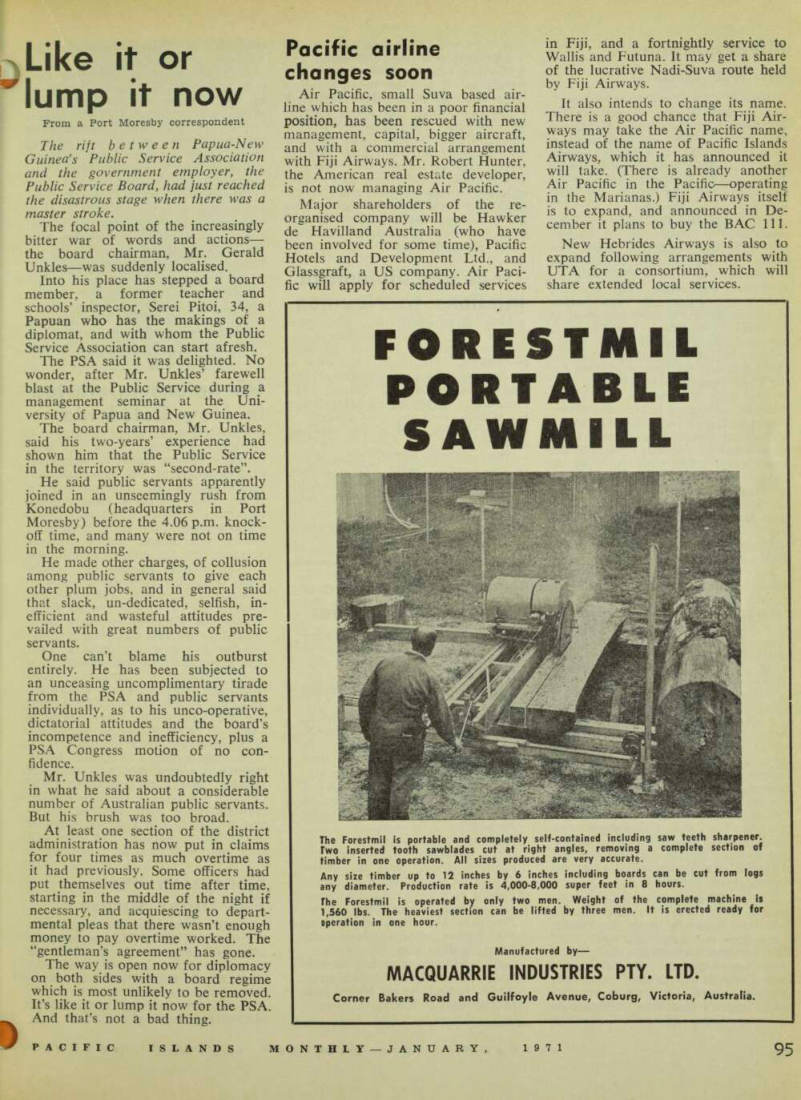
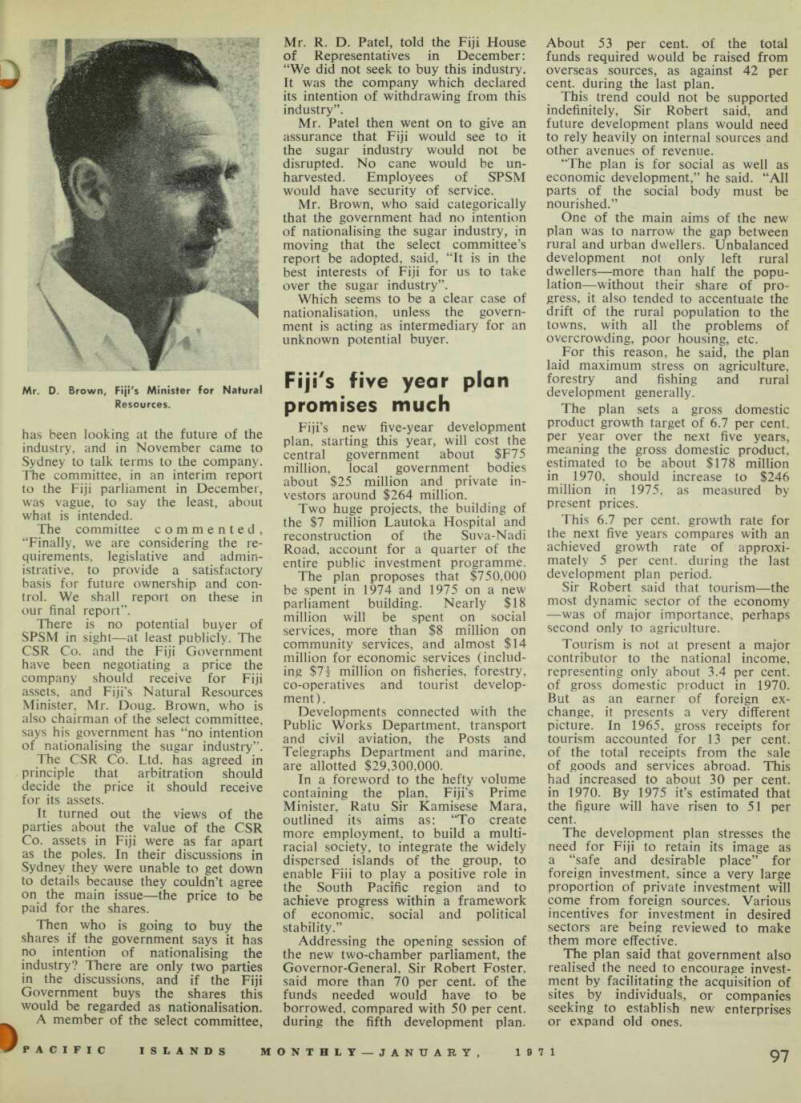
Like it or lump it now
From a Port Moresby correspondent The rift between Papua-New Guinea's Public Service Association and the government employer, the Public Service Board, had just reached the disastrous stage when there was a master stroke.
The focal point of the increasingly bitter war of words and actions— the board chairman, Mr. Gerald Unkles—was suddenly localised.
Into his place has stepped a board member, a former teacher and schools’ inspector, Serei Pitoi, 34, a Papuan who has the makings of a diplomat, and with whom the Public Service Association can start afresh.
The PSA said it was delighted. No wonder, after Mr. Unkles’ farewell blast at the Public Service during a management seminar at the Uni versity of Papua and New Guinea.
The board chairman, Mr. Unkles, said his two-years’ experience had shown him that the Public Service in the territory was “second-rate”.
He said public servants apparently joined in an unseemingly rush from Konedobu (headquarters in Port Moresby) before the 4.06 p.m, knock off time, and many were not on time in the morning.
He made other charges, of collusion among public servants to give each other plum jobs, and in general said that slack, un-dedicated, selfish, in efficient and wasteful attitudes pre vailed with great numbers of public servants.
One can’t blame his outburst entirely. He has been subjected to an unceasing uncomplimentary tirade from the PSA and public servants individually, as to his unco-operative, dictatorial attitudes and the board’s incompetence and inefficiency, plus a PSA Congress motion of no con fidence.
Mr. Unkles was undoubtedly right in what he said about a considerable number of Australian public servants.
But his brush was too broad.
At least one section of the district administration has now put in claims for four times as much overtime as it had previously. Some officers had put themselves out time after time, starting in the middle of the night if necessary, and acquiescing to depart mental pleas that there wasn’t enough money to pay overtime worked. The “gentleman’s agreement” has gone.
The way is open now for diplomacy on both sides with a board regime which is most unlikely to be removed.
It’s like it or lump it now for the PSA.
And that’s not a bad thing.
Pacific airline
changes soon
Air Pacific, small Suva based air line which has been in a poor financial position, has been rescued with new management, capital, bigger aircraft, and with a commercial arrangement with Fiji Airways. Mr. Robert Hunter, the American real estate developer, is not now managing Air Pacific.
Major shareholders of the re organised company will be Hawker de Havilland Australia (who have been involved for some time), Pacific Hotels and Development Ltd., and Glassgraft, a US company. Air Paci fic will apply for scheduled services
in Fiji, and a fortnightly service to Wallis and Futuna. It may get a share of the lucrative Nadi-Suva route held by Fiji Airways.
It also intends to change its name.
There is a good chance that Fiji Air ways may take the Air Pacific name, instead of the name of Pacific Islands Airways, which it has announced it will take. (There is already another Air Pacific in the Pacific—operating in the Marianas.) Fiji Airways itself is to expand, and announced in De cember it plans to buy the BAC 111.
New Hebrides Airways is also to expand following arrangements with UTA for a consortium, which will share extended local services.
Nickel miners
on the attack
New Caledonian “petit mineur”, Jean Claude Berton, turned on the full force of his charm in Sydney in December in an admitted attempt to bring home to sheltered Austra lians the full horror of France’s nickel policy in New Caledonia, and its effects on the territory’s inde pendent mine owners.
But from the lack of space his revelations provoked in the Sydney Press (he did better on radio), one might construe that Australians, far from upset at New Caledonia’s cut in nickel production, will be only too pleased to pursuade Japan, which at the moment buys 90 per cent, of its nickel from New Caledonia, to buy from them instead.
Mr. Berton—lamenting that he could provide no better facilities for the Press than free drinks at 11 a.m. in the lush Wentworth Hotel, be cause of the decree in New Caledonia that travellers can only take SA27O with them out of the country—was in a mood to unburden himself. He said many small miners were in danger of going bankrupt because of France’s sudden decision to slap on them a nickel quota of 4.3 million tons this year (ending March 31), when they had received orders to sell some six million tons to Japan (PIM, Dec., p. 101).
He explained he was in Sydney to bring home to Australians just how France treats New Caledonia. The French, he said, quite simply wanted to stifle New Caledonian miners, so that French-controlled companies could grab the lion’s share of the nickel and take all the profits out of the country.
With the eloquence of a de Gaulle, he declared: “Australians are absorbed in the development of their own country and forget, un fortunately, that New Caledonia is only 2i hours away by jet from Sydney. Australians also seem un aware that Caledonians feel they belong to the Pacific and not to Europe. A striking proof of our attitude was the Caledonians’ re fusal in 1940 to sell nickel to Japan, and our decision to continue the war alongside our Pacific allies after the surrender of France.”
Later, “We have tried without success to get Paris to listen to us.
But Paris is too far from the Pacific.
Paris does not hear our voice . . .
Paris is too busy with the discus sions on Algerian oil. Paris only knows words like ‘non’ and ‘pas possible’, and its representatives have stated that the Caledonian mine operators are but a few, so
why take them into account?”
Mr. Berton warned of social un rest from 600 to 700 workers ex pected to be laid off because mines were shutting down. He said New Caledonians had had about enough of French bureaucracy: French “nickel-plated dreams” had brought on nothing but inflation and a higher cost of living.
To questions, he said that although a lawyer in French Poly nesia had been deported for less, he did not mind speaking out; he was born in New Caledonia and that made the difference.
Trade and diplomatic
missions to Noumea
Mr. Alan Edwards, the new Consul for Australia in New Cale donia, arrived in Noumea in mid- November. Mr. Edwards, who is accompanied by his wife, served pre viously in Paris and Saigon. His predecessor in Noumea, Mr. David G. Wilson, returned to Canberra in October, at the end of his two-year term.
The new Australian Trade Com missioner for Pacific Islands, Mr.
Llewellyn J. Martin, has meanwhile passed briefly through Noumea from his Suva post. Mr. Martin was ex pected to make his first extensive
contacts in New Caledonia by January.
Between times, the first trade mis sion to the Pacific islands organised by the Government of New South Wales, visited Noumea in November.
The 11-man group departed from Sydney on November 1, spending three weeks in Papua-New Guinea, Solomon Islands, Fiji and New Cale donia.
New Zealand is also keen to con solidate its growing trade with New Caledonia. The beginning of Decem ber saw the visit to Noumea of New Zealand’s Trade Commissioner for the Pacific, Mr. Gordon M. McLaren, who is now posted in Suva.
At the same time, the newly arrived first Air New Zealand repre sentative in Noumea, Mr. Graeme Hankins, was officially named as New Zealand’s trade correspondent for the territory.
US unions interested
in New Caledonia
United States labour unions are moving fast to form new ties with overseas unions, and to strengthen existing ones, as US companies be come increasingly international in scope. Their aim is to improve working conditions in US operations overseas until they equal conditions in the US. Lower wages overseas are seen by the unions as a threat to US labour because they could mean less jobs available at home.
Meyer Bernstein, international affairs director of the United Steel workers of America, recently spent three days in New Caledonia arrang ing for his union to help a local fledgling nickel workers’ union. Two North American concerns with which the USW bargains, US-owned International Nickel of Canada, and Kaiser Aluminium and Chemical Corp. are both in on big expansion of Caledonia’s nickel industry.
So, when the Caledonian union negotiates a new labour contract in January, two French-speaking USW officials will provide the new union’s representatives with detailed infor mation on the two firm’s finances and labour contracts. The two will also help with bargaining demands.
Confusion over
Fiji sugar future
There’s a big question mark over the future of the Fiji sugar industry.
Who is going to run it when the CSR Co. Ltd. (or its subsidiary, South Pacific Sugar Mills Ltd.) with draws after the 1972 crush?
A select committee, appointed by the Fiji Legislative Council last June,
has been looking at the future of the industry, and in November came to Sydney to talk terms to the company.
The committee, in an interim report to the Fiji parliament in December, was vague, to say the least, about what is intended.
The committee commented, “Finally, we are considering the re quirements, legislative and admin istrative, to provide a satisfactory basis for future ownership and con trol. We shall report on these in our final report”.
There is no potential buyer of SPSM in sight—at least publicly. The CSR Co. and the Fiji Government have been negotiating a price the company should receive for Fiji assets, and Fiji’s Natural Resources Minister, Mr. Doug. Brown, who is also chairman of the select committee, says his government has “no intention of nationalising the sugar industry”.
The CSR Co. Ltd. has agreed in principle that arbitration should decide the price it should receive for its assets.
It turned out the views of the parties about the value of the CSR Co. assets in Fiji were as far apart as the poles. In their discussions in Sydney they were unable to get down to details because they couldn’t agree on the main issue—the price to be paid for the shares.
Then who is going to buy the shares if the government says it has no intention of nationalising the industry? There are only two parties in the discussions, and if the Fiji Government buys the shares this would be regarded as nationalisation.
A member of the select committee,
Mr. R. D. Patel, told the Fiji House of Representatives in December: “We did not seek to buy this industry.
It was the company which declared its intention of withdrawing from this industry”.
Mr. Patel then went on to give an assurance that Fiji would see to it the sugar industry would not be disrupted. No cane would be un harvested. Employees of SPSM would have security of service.
Mr. Brown, who said categorically that the government had no intention of nationalising the sugar industry, in moving that the select committee’s report be adopted, said, “It is in the best interests of Fiji for us to take over the sugar industry”.
Which seems to be a clear case of nationalisation, unless the govern ment is acting as intermediary for an unknown potential buyer.
Fiji's five year plan
promises much
Fiji’s new five-year development plan, starting this year, will cost the central government about SF7S million, local government bodies about $25 million and private in vestors around $264 million.
Two huge projects, the building of the $7 million Lautoka Hospital and reconstruction of the Suva-Nadi Road, account for a quarter of the entire public investment programme.
The plan proposes that $750,000 be spent in 1974 and 1975 on a new parliament building. Nearly $lB million will be spent on social services, more than $8 million on community services, and almost $l4 million for economic services (includ ing s7i million on fisheries, forestry, co-operatives and tourist develop ment).
Developments connected with the Public Works Department, transport and civil aviation, the Posts and Telegraphs Department and marine, are allotted $29,300,000.
In a foreword to the hefty volume containing the plan, Fiji’s Prime Minister, Ratu Sir Kamisese Mara, outlined its aims as: “To create more employment, to build a multi racial society, to integrate the widely dispersed islands of the group, to enable Fiji to play a positive role in the South Pacific region and to achieve progress within a framework of economic, social and political stability.”
Addressing the opening session of the new two-chamber parliament, the Governor-General, Sir Robert Foster, said more than 70 per cent, of the funds needed would have to be borrowed, compared with 50 per cent, during the fifth development plan.
About 53 per cent, of the total funds required would be raised from overseas sources, as against 42 per cent, during the last plan.
This trend could not be supported indefinitely, Sir Robert said, and future development plans would need to rely heavily on internal sources and other avenues of revenue.
“The plan is for social as well as economic development,” he said. “All parts of the social body must be nourished.”
One of the main aims of the new plan was to narrow the gap between rural and urban dwellers. Unbalanced development not only left rural dwellers—more than half the popu lation—without their share of pro gress, it also tended to accentuate the drift of the rural population to the towns, with all the problems of overcrowding, poor housing, etc.
For this reason, he said, the plan laid maximum stress on agriculture, forestry and fishing and rural development generally.
The plan sets a gross domestic product growth target of 6.7 per cent, per year over the next five years, meaning the gross domestic product, estimated to be about $l7B million in 1970, should increase to $246 million in 1975, as measured by present prices.
This 6.7 per cent, growth rate for the next five years compares with an achieved growth rate of approxi mately 5 per cent, during the last development plan period.
Sir Robert said that tourism—the most dynamic sector of the economy —was of major importance, perhaps second only to agriculture.
Tourism is not at present a major contributor to the national income, representing only about 3.4 per cent, of gross domestic product in 1970.
But as an earner of foreign ex change, it presents a very different picture. In 1965, gross receipts for tourism accounted for 13 per cent, of the total receipts from the sale of goods and services abroad. This had increased to about 30 per cent, in 1970. By 1975 it’s estimated that the figure will have risen to 51 per cent.
The development plan stresses the need for Fiji to retain its image as a “safe and desirable place” for foreign investment, since a very large proportion of private investment will come from foreign sources. Various incentives for investment in desired sectors are being reviewed to make them more effective.
The plan said that government also realised the need to encourage invest ment by facilitating the acquisition of by individuals, or companies seeking to establish new enterprises or expand old ones.
Mr. D. Brown, Fiji's Minister for Natural Resources.
P-NG debate
over spare parts
The failure of numerous native trucking enterprises due to lack of spare parts for the vehicles has be come a hot issue in recent months in Papua-New Guinea.
A House of Assembly motion in November brought the first meeting —just before Christmas—of motor traders, finance companies, and Ad ministration officials, to try to find a fair way of cooling a partially racial issue.
Papuan MHA, Paulus Arek, was one who blamed white garage owners for “tricking” native people out of their money for repairs which take months to complete.
The House motion (it’s just a motion at this stage) called on the Administration “to examine the possibility” of legislating to suspend hire-purchase payments when a vehicle can’t be used because spare parts are not available, or in surance claims are delayed for the same reason.
Finance companies said that if this became law they would simply withdraw finance for vehicles when ever there was danger of this hap pening (the danger is very largely with native buyers, or rather hirers).
If they did continue finance, motor traders would have to bear the losses under a “full recourse” agreement, and they in turn would accept only cash business from native people wanting vehicles.
Some traders have been dishonest or negligent in selling vehicles they could not afford to keep spares for,
but traders aren’t entirely at fault.
Genuine stories are legion of native buyers bringing on premature breakdowns through ignoring ser vicing requirements; the distances and terrible roads between vehicle fran chise holders, in the Highlands par ticularly, makes it quite often impracticable to effect repairs at a village; and no trader can carry every spare in the fluctuating vehicle market in the territory today.
Truck distributors are still very scattered, and breakdowns in remote places cost frightening amounts in mechanics’ time.
The situation is worrying for the traders, as for the hirers and buyers.
Ignoring companies, individual native people buy twice as many trucks as whites at present.
In the not too distant future, native people will be virtually the entire market. They’ll also be largely semi-literate or illiterate for decades, and some way of protecting them and also honest traders is sorely needed.
London bid
for BNG?
UK finance house, Jessel, is con sidering a takeover bid for the 49year-old highly-profitable British New Guinea Development Com pany, Papuan copra and rubber pro ducer, PIM man Ken McGregor re ported from London in December.
Jessel, with its Stgs/- shares sell ing on the London Stock Exchange for about 31/-, has a paid-up capital of about £lO million, but its assets are worth several times this figure.
BNG’s 2/- shares, unlisted in Aus
tralia, but listed in London, have recently been selling for about 3/4 and giving a dividend of nearly 12 per cent.
BNG is one of four overseas plan tation groups Jessel is considering bidding for. It wants to diversify and invest outside the slow moving UK economy. The overall deal would cost Jessel £ll million but terms it would offer BNG aren’t known. BNG shareholders are widely spread, with many smallholders in the UK. Burns Philp and W. R.
Carpenter have small holdings.
Tonga ends stage one
of oil search
The first phase of Tonga’s search for commercial oil deposits ended in late December with the departure from Tongan waters of 237 ton American survey vessel Polaris. Good weather and excellent staff work enabled her to complete a 6,000 sq. mile survey between Tongatapu and Vavau, in less than 30 days.
Polaris, fitted with gravity and magnetometer equipment, is one of the most modern units afloat, and is owned and operated by Geophysical Surveys International, Houston, a division of Texas Instruments.
During a brief ceremony aboard, Capt. K. M. Simpson told King Taufa’ahau the cost of gathering and processing this kind of technical data was between $2OO and $3OO per kilometre.
Shell manager, Alan Jackson, on behalf of the consortium searching for oil said the data collected will first be computerised by GSI, then a final interpretation will be made by Shell experts at the Hague. The information will be passed to each participant—Shell, 8.P., Aquitaine, Gulf, Republic and Ampol—who are free to make their own interpreta tion.
The search for Tongan oil began with the trilateration survey last August by another overseas vessel, Atlantic Shore, to set up the radio location grid system which will pin point all subsequent off-shore activity.
Between September and November, Dr. C. J. Mulder from Shell mounted a widespread geological survey during which he collected for laboratory tests, hundreds of rock samples from the main island groups and re-interpreted a wide range of aerial photographs.
This consolidation of offshore and geological evidence will take several months to process. Only when the results have been integrated and evaluated can a decision be reached by the oil participants as to future action.
Advertisements & other items, p. 97 (1 item)
Portable
FORESTMIL
SAWMILL
•• f. w.
The Forestmil is portable and completely self-contained including saw teeth sharpener.
Two inserted tooth sawblades cut at right angles, removing a complete section of timber in one operation. All sizes produced are very accurate.
Any size timber up to 12 inches by 6 inches including boards can be cut from logs any diameter. Production rate is 4,000-8,000 super feet in 8 hours.
The Forestmil is operated by only two men. Weight of the complete machine is 1,560 lbs. The heaviest section can be lifted by three men. It is erected ready for operation in one hour.
Manufactured by—
MACQUARRIE INDUSTRIES PTY. LTD.
Corner Bakers Road and Guilfoyle Avenue, Coburg, Victoria, Australia.
deportation order
Nauru issues a deportation order
Mr. Dennis Ferrier, Secretary for Finance in the Republic of Nauru since independence, has left Nauru as a result of a de portation order issued against him.
President Hammer Deßoburt, of Nauru, confirmed existence of the order in Sydney in December. President Deßoburt said Cabinet issued the deporta tion order because it decided it was “not in the best interests of the republic that Mr. Ferrier remain”.
He said this was one of the three grounds on which the republic could issue an order.
An order could also be made against certain convicted persons, or against undesirable aliens.
President Deßoburt would give no further details about Mr.
Ferrier’s departure.
Mr. Ferrier, who has a wife and son, carries a British pass port. He took up his Nauru post in February, 1968.
Advertisements & other items, p. 100 (1 item)
Sole Distributor
FOR NEW GUINEA WANTED
TO REPRESENT WORLD FAMOUS RANGE
OF STEAM TRAPS • LIQUID DRAINERS
• GAS VENTS • REFRIGERATING PURGERS,
ETC.
Engineering Company with likely sales outlets most suitable.
Full subject training given.
Excellent opportunity.
Apply: "Australian Representative", C/- Box 3408, G.P.0., Sydney, N.S.W. 2001.
Produce Prices
(Unless otherwise stated, quotations are in Australian currency. Australian dollar equals $l.OO New Zealand; 98-99 cents Fiji; 110 French Pacific francs; $1.24 Western Samoa; $l.OO Tonga; 9/3 sterling and $l.ll USA).
Copra
Copra industries are controlled through copra boards in NG, the Solomons, the GEIC, both Samoas, Fiji, Tonga and the US Trust Territory.
New Hebrides, the Cooks, French Polynesia and New Caledonia don't have boards and copra is either sold individually by growers to overseas buyers or used for local making of soap, etc.
The boards were born after World War II and their functions, which vary among terri tories, include orderly selling overseas, main taining stabilisation funds, raising government revenue and developing copra on long-term bases.
NEW GUINEA; The board, with planters' reps, directs distribution and sales and pays planters. Buyers include: Unilever, of the UK, Australia and Japan, and coconut oil and desiccated coconut mills (controlled by Car penters) on New Britain.
December prices, delivered main ports, were: hot-air dried, $l3l per ton; FMS, $l2B per ton; smoke-dried, $126 per ton.
FIJI;—The board fixes prices on Philippines copra, taking into account freight, taxes, selling costs, shrinkage, etc. Prices recently were; Ist grade, $F157.75; 2nd grade, $F147.75; CAS, $F128.75.
WESTERN SAMOA: The board makes pay ments to producers through its agents—local firms —and sells the copra on the open market with a portion to Abels Ltd., NZ. Recent prices were SWSIIB for Ist grade, SWSIIB for Ist grade sun dried, and SWSIOS for 2nd grade.
TONGA: All copra is sold to the board which sends it to Europe and the open market. November prices to growers were $T112.80 Ist grade and STIOO.BO 2nd grade, per ton. Per coconut, 2c.
SOLOMON IS.; —All production through board at prices based on Philippines rates. Output goes to the UK, Japan, Australia and the rest
Exchange Rates
FlJl. —Through Bank of NSW, ANZ Bank, Bank of NZ, Bank of Baroda. Sterling dollar on Fiji dollar, buying £1 = $F2.11; selling $2,085. Aust. dollar on Fiji dollar, buying $A1.0117 = SFI; selling $A1.0288 = SFI.
WESTERN SAMOA.— Through Bank of Western Samoa, controlled from NZ, seller SAI to SWS Tala 1.2470.
Norfolk Is., Papua-New Guinea. Aus
tralian currency used: no exchange payable in transactions with Australia.
FRENCH PACIFIC COLONIES.— Pacific francs fCFP) are used in New Caledonia, New Hebrides (jointly with Australian dollars), Wallis and Futuna Islands and Fr. Polynesia. French Bank, Sydney, on Dec. 21, quoted: Selling, Noumea and Papeete, 109 Pac. francs to $ Aust.; approx. 100 Pac. francs to US $; Noumea 18 Pac. francs to 1 French franc (conversion rate: 1 Pac. franc equals 0.055 French franc). Paris- London: 13.20 francs to £. Also, £ equals 240.04 Pac. francs.
to the open market. Recent prices were: Ist grade, $130; 2nd grade, $126; 3rd grade, $ll6 per ton, BSIP ports (Honiara, Yandina and Gizo).
GILBERT AND ELLICE; —Board pays growers $78.40 per ton and receives $143.05 per ton overseas; 2nd grade price per lb.
NEW HEBRIDES: Copra sold direct by planters to France and Japan. Official market price on Nov. 26 was $B5 (8,500 Pac. francs).
Marseilles, 1,230 francs, Dec. 11.
COOK IS.: —Copra goes to Abels, Ltd., of Auckland, who operates NZ's copra crushing mill. Prices for October 1 to December 31 were fixed, subject to freight adjustment, at $NZ173.38 Ist grade, hot air dried; $NZ171.30 Ist grade, sun dried, and $NZ169.73 standard grade.
US TRUST TERRITORY:—Board pays $U5112.50 per ton, grade 1; $lOO per ton, outer islands.
Other Produce
BECHE-DE-MER: Chang Sing Loong Co., Suva, quote F3sc (4 in. to 7 in.) to F4oc (9 in. to 11 in.) lb depending on quality.
Honiara. —Live slugs, over six inches, black six for 10c, other colours—l2 for 10c.
CHILLIES. —Solomons, Honiara, Tabasco, grade one, dried 22c per lb; long red, grade one, dried, 12c per lb.
COCOA. —lslands rates are based on Ghana prices. Ghana price on Dec. 18 (Dec./Jan. shipment) was 283/9 per cwt., c.i.f., UK Continent Spot.
Dec. 22, Quote No. 1: In store Rabaul, export quality $5OO per ton, delivered ex wharf Sydney $560. Quote No. 2: Best quality ex-wharf Sydney $570, in store NG ports $530 (for immediate UK, Continent and USA ship ments).
Forward prices: Apr./June, $525 (in store, NG ports).
W. Samoa. —Nominal quotation for Dec. 15 was Ist grade, £Stg.2Bo; 2nd grade, £Stg.26o, f.o.b. per ton.
New Hebrides. —Beach, Vila, Santo, $3OO per ton (nom.).
Solomons. —4 cents a lb delivered to a fermentary, 3 cents a lb at buying points.
COFFEE.— P-NG: Dec. 22, Quote No. 1, good quality A grade 44c per lb; B grade 42c; C grade 40c; X grade 42c and native X grade 39£c (ex-store Sydney).
W. Samoa. —Mid-Sept. W. STEC ground and dried beans, 49 sene per lb (wholesale).
CROCODILE SKINS. Recent Sydney buyers quoted for 12 in. and over, Ist grade quality as follows: 8.5.1., Honiara —$1.80 to $2.20 per in.; Gizo: $2.10 per in.
Green Snail Shell. $350-$4Oo A Ton,
f.o.b. Ij PAPUAN GUM: Graded gum $195 per ton, f.0.b., NG ports.
PASSIONFRUIT. — Cook Islands, Islands Foods Ltd. pays growers NZ2.5c per lb for good fruit.
PEANUTS. P-NG: Sydney agents reported recently f.0.b., Lae; Kernels —white Spanish 17.25 c lb.
PEARL SHELL.— Torres Strait Pearlshellers' Assn, recently quoted these prices for MOP; AA grade, $A1,260 per ton; A, $1,460; B, $2,060; C, $2,100; D, $1,260; E, $910; EE, $635 and EEE, $375, f.0.b., Thurs. Is.
Solomons. —Honiara, mother of pearl blacklip 15c lb, goldlip 20c lb. Cook Islands. —Manihiki,
40c-46s per lb: delivered Rarotonga, 50c-56c per lb. French Polynesia.—Tuamotu, Gambier shells, to $l,OOO per ton, Papeete.
PYRETHRUM.—NG growers 17c lb, flowers.
RICE (Aust.): Prices, until Mar. 31, 1971, are— P-NG: Dried brown rice, $132 per ton, f.o.w. Sydney. Vitamin-enriched white rice, $146.50 per ton. Other Pacific Islands: Polished white (56 lb bags) or dried brown rice (112 lb bags), $156 per ton, f.o.w.
RUBBER. —P-NG price is based on Singapore rates which on Dec. 15 were: No. 1 RSS prompt nominal shipment (Malayan cents per lb) b 51 |c, s 51 eC (nom); Jan. b 52|c, s. 52|c; Feb. b 54ic, s 54|c.
SANDALWOOD.— New Hebrides, landed on the beach, Vila and Santo, $250 a ton.
SHARK FINS: Chang Sing Loong Co., Suva, offers 55c per lb for well-dried fins of commercial quality.
TROCHUS.—Dec. 22 (nom.)—Papua—slBo-$l9O per ton—Honiara—3c to 4c per lb—NG— slso-$ 160 per ton.
TURTLE SHELL— BSI: First grade unmarked 60c to $1.50 a lb at Gizo.
VANILLA BEANS. Prices recently were: White and yellow label processed standard packs, $7.50; green label $7.40, c.i.f., Sydney.
Tonga.—sl4.2o, f.0.b., Nukualofa; $14.50, Mel bourne.
Uk, Us Quotes
COPRA: LONDON, Dec. 18, Philippines, in bulk, $U5233.50 per long ton, c.i.f., UK/Nth.
European ports; US Pacific coast SUSI9O, buyer, $U5203.50, seller.
COCONUT OIL: LONDON, Dec. unquoted.
RUBBER: LONDON: Dec. 15, No. 1 RSS, Spot (per lb), b 19|d, s 19*d; Jan. b 18-7/16d, s 18id; Mar. b 19? d, s 201 d.
Stock Market
Sydney stock exchange share price index for ordinaries on Nov, 24 was 522.10. On Dec. 22 it was 510.49.
Sydney
Sellers
Nov. 24 Dec. 22 ANG Hold. 1.00 . . 1.02 1.00 Bali Plantations .50 .53 .55 Burns Philp 1.00 . . 3.10 3.00 Burns Philp (SS) 2.05 2.90 2.98 Carpenter .50 . . . 1.81 2.00 Choiseul PIntn. 1.00 3.10 2.75
C.S.R. 1.00 ...
6.20 5.82 Dylup PIntn. .50 . . .70 .68 Fiji Industries 1.02 . 2.30 2.30 Kerema Rubber .50 . .20 .21 Koitaki Rubber .50 . .70 .63 Lolorua Rubber .50 . .30 .35 Makurapau PIntn. .50 .64 .58 Mariboi Rubber .50 . .28 .24 P-NG Motors .50 . . .57 .52 Plantation Hldgs. .50 .75 .70 Queensland Ins. 1.00 3.70 3.18 Rubberlands .50 . . .21 .21 Sogeri Rubber .50 . .60 .55 Sth. Pac. Ins. .50 . 1.08 1.06 Steamships Tdg. .50 .65 .61 Territory Brewery .50 .40 .40
Oil And Mining Shares
Buka Min. .10 . . .05* .05*
C.R.A. .50 ... .
13.20 12.40 Cultus Pacific .25 . .41 .40 Emperor .10 ... , 1.08 .60 Highland Gold .20 . .25 .22 NG Gold Ltd. .35 . .50 .50 Oil Search .50 . . . .29 .25 Pacific 1. Mines .25 .24 .16 Papuan Apin. .50 . , .45 .41 Placer Dev.* . . . 31.50 33.00 Southland .25 . . * No par value 2.45 2.25
Advertisements & other items, p. 102 (1 item)
The Bank Line
MONTHLY SERVICES
U.K., CONTINENT to PAPUA-NEW GUINEA & SOLOMON ISLANDS PAPUA, NEW GUINEA to NORTH AMERICA & U.K., CONTINENT SOLOMON ISLANDS, FIJI, TONGA, SAMOA AND TARAWA to U.K.,
CONTINENT
☆ U.S. GULF/AUSTRALASIA VESSELS CALL AT FIJI WHEN REQUIRED V
FOR PARTICULARS APPLY:
THE BANK LINE (AUSTRALASIA) PTY. LTD., SYDNEY, N.S.W
A
NEDLLOYD LINES
MANAGERS • NEDERLAND LINE * ROYAL DUTCH MAIL - AMSTERDAM
ROYAL ROTTERDAM LLOYD ROTTERDAM
REGULAR SAILINGS BY FAST, MODERN, CARGO VESSELS
from CONTINENTAL PORTS via PANAMA to
PAPEETE, APIA, SUVA, LAUTOKA, NOUMEA and
NEW ZEALAND
other ports called at subject to sufficient inducement
heavy-lift facilities—refrigerated space—cargo deeptanks
Ets. Donald Tahiti, Papeete.
Carpenter's Fiji Ltd,, Suva.
For further particulars apply to agents 0. F. Nelson & Co. Ltd., Burns Philp (South Sea) Co. Ltd., Agence Maritime Pentecost, Apia. Nukualofa. Noumea.
Russell & Somers (Wellington) Ltd., Wellington, N.Z.
Shipping
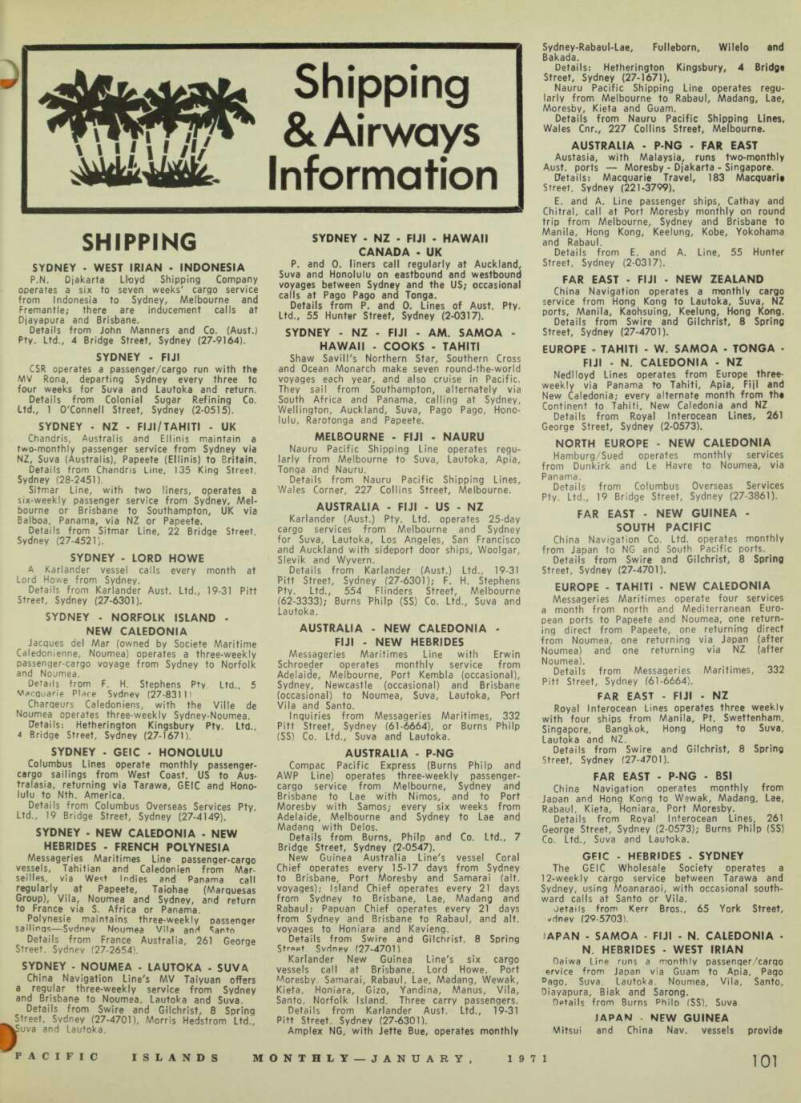
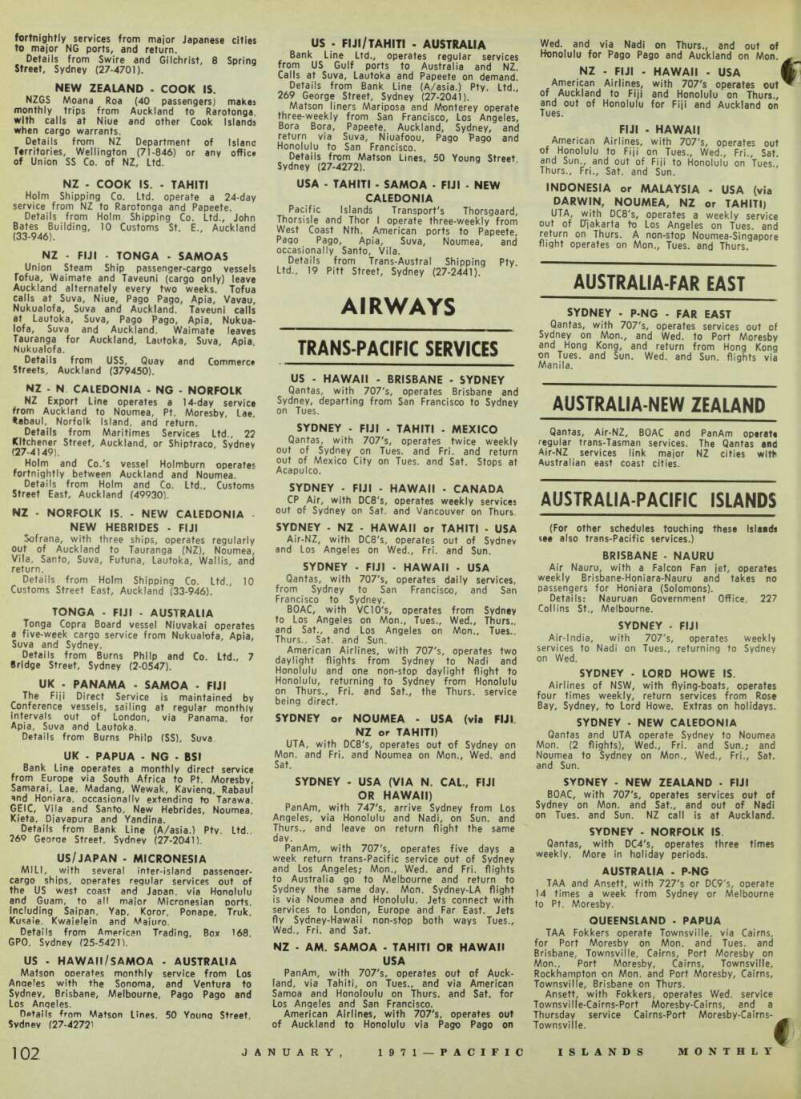
& Airways Information
Sydney ■ West Irian - Indonesia
P.N. Djakarta Lloyd Shipping Company operates a six to seven weeks' cargo service from Indonesia to Sydney, Melbourne and Fremantle; there are inducement calls at Djayapura and Brisbane.
Details from John Manners and Co. (Aust.) Pty. Ltd., 4 Bridge Street, Sydney (27-9164).
Sydney - Fiji
CSR operates a passenger/cargo run with the MV Rona, departing Sydney every three to four weeks for Suva and Lautoka and return.
Details from Colonial Sugar Refining Co.
Ltd., 1 O'Connell Street, Sydney (2-0515).
SYDNEY ■ NZ - FIJI/TAHITI - UK Chandris, Australis and Ell inis maintain a two-monthly passenger service from Sydney via NZ, Suva (Australis), Papeete (Ellinis) to Britain.
Details from Chandris Line, 135 King Street, Sydney (28-2451).
Sitmar Line, with two liners, operates a six-weekly passenger service from Sydney, Mel bourne or Brisbane to Southampton, UK via Balboa, Panama, via NZ or Papeete.
Details from Sitmar Line, 22 Bridge Street, Sydney (27-4521).
Sydney - Lord Howe
A Karlander vessel calls every month at Lord Howe from Sydney.
Details from Karlander Aust. Ltd., 19-31 Pitt Street, Sydney (27-6301).
Sydney - Norfolk Island -
New Caledonia
Jacques del Mar (owned by Societe Maritime Caledonienne, Noumea) operates a three-weekly passenger-cargo voyage from Sydney to Norfolk and Noumea.
Details from F. H. Stephens Pty. Ltd., 5 Macquarie Place Sydney (27-8311) Charqeurs Caledoniens, with the Ville de Noumea operates three-weekly Sydney-Noumea.
Details: Hetherington Kingsbury Pty. Ltd., 4 Bridge Street, Sydney (27-1671).
Sydney - Geic - Honolulu
Columbus Lines operate monthly passenger cargo sailings from West Coast, US to Aus tralasia, returning via Tarawa, GEIC and Hono lulu to Nth. America.
Details from Columbus Overseas Services Pty.
Ltd., 19 Bridge Street, Sydney (27-4149).
Sydney - New Caledonia - New
Hebrides - French Polynesia
Messageries Maritimes Line passenger-cargo vessels, Tahitian and Caledonien from Mar seilles, via West Indies and Panama call regularly at Papeete, Taiohae (Marquesas Group), Vila, Noumea and Sydney, and return to France via S. Africa or Panama.
Polynesie maintains three-weekly passenger sailings—Svdnev Noumea Vila and Santo Details from France Australia, 261 George Street, Sydney (27-2654).
SYDNEY - NOUMEA - LAUTOKA - SUVA China Navigation Line's MV Taiyuan offers a regular three-weekly service from Sydney and Brisbane to Noumea, Lautoka and Suva.
Details from Swire and Gilchrist, 8 Spring Street, Sydney (27-4701), Morris Hedstrom Ltd., |Suva and Lautoka.
SYDNEY • NZ - FIJI - HAWAII
Canada • Uk
P. and 0. liners call regularly at Auckland, Suva and Honolulu on eastbound and westbound voyages between Sydney and the US; occasional calls at Pago Pago and Tonga.
Details from P. and 0. Lines of Aust. Pty.
Ltd., 55 Hunter Street, Sydney (2-0317).
SYDNEY - NZ - FIJI - AM. SAMOA -
Hawaii - Cooks - Tahiti
Shaw Savill's Northern Star, Southern Cross and Ocean Monarch make seven round-the-world voyages each year, and also cruise in Pacific.
They sail from Southampton, alternately via South Africa and Panama, calling at Sydney, Wellington, Auckland, Suva, Pago Pago, Hono lulu, Rarotonga and Papeete.
Melbourne - Fiji - Nauru
Nauru Pacific Shipping Line operates regu larly from Melbourne to Suva, Lautoka, Apia, Tonga and Nauru.
Details from Nauru Pacific Shipping Lines, Wales Corner, 227 Collins Street, Melbourne.
AUSTRALIA - FIJI - US - NZ Karlander (Aust.) Pty. Ltd. operates 25-day cargo services from Melbourne and Sydney for Suva, Lautoka, Los Angeles, San Francisco and Auckland with sideport door ships, Woolgar, Slevik and Wyvern.
Details from Karlander (Aust.) Ltd., 19-31 Pitt Street, Sydney (27-6301); F. H. Stephens Pty. Ltd., 554 Flinders Street, Melbourne (62-3333); Burns Philp (SS) Co. Ltd., Suva and Lautoka.
Australia - New Caledonia -
Fiji ■ New Hebrides
Messageries Maritimes Line with Erwin Schroeder operates monthly service from Adelaide, Melbourne, Port Kembla (occasional), Sydney, Newcastle (occasional) and Brisbane (occasional) to Noumea, Suva, Lautoka, Port Vila and Santo.
Inquiries from Messageries Maritimes, 332 Pitt Street, Sydney (61-6664), or Burns Philp (SS) Co. Ltd., Suva and Lautoka.
Australia - P-Ng
Compac Pacific Express (Burns Philp and AWP Line) operates three-weekly passenger cargo service from Melbourne, Sydney and Brisbane to Lae with Nimos, and to Port Moresby with Samos; every six weeks from Adelaide, Melbourne and Sydney to Lae and Madang with Delos.
Details from Burns, Philp and Co. Ltd., 7 Bridge Street, Sydney (2-0547).
New Guinea Australia Line's vessel Coral Chief operates every 15-17 days from Sydney to Brisbane, Port Moresby and Samarai (alt. voyages); Island Chief operates every 21 days from Sydney to Brisbane, Lae, Madang and Rabaul; Papuan Chief operates every 21 days from Sydney and Brisbane to Rabaul, and alt. voyages to Honiara and Kavieng.
Details from Swire and Gilchrist, 8 Spring Stropt Svrlnev (27-4701).
Karlander New Guinea Line's six cargo vessels call at Brisbane, Lord Howe, Port Moresby. Samarai, Rabaul, Lae, Madang, Wewak, Kieta, Honiara, Gizo, Yandina, Manus, Vila, Santo, Norfolk Island. Three carry passengers.
Details from Karlander Aust. Ltd., 19-31 Pitt Street, Sydney (27-6301).
Amplex NG, with Jette Bue, operates monthly
Sydney-Rabaul-Lae, Fulleborn, Wilelo and Bakada.
Details: Hetherington Kingsbury, 4 Bridge Street, Sydney (27-1671).
Nauru Pacific Shipping Line operates regu larly from Melbourne to Rabaul, Madang, Lae, Moresby, Kieta and Guam.
Details from Nauru Pacific Shipping Lines, Wales Cnr„ 227 Collins Street, Melbourne.
AUSTRALIA - P NG ■ FAR EAST Austasia, with Malaysia, runs two-monthly Aust. ports Moresby - Djakarta - Singapore.
Details: Macquarie Travel, 183 Macquarie Street, Sydney (221-3799).
E. and A. Line passenger ships, Cathay and Chitral, call at Port Moresby monthly on round trip from Melbourne, Sydney and Brisbane to Manila, Hong Kong, Keelung, Kobe, Yokohama and Rabaul.
Details from E. and A. Line, 55 Hunter Street, Sydney (2-0317).
FAR EAST - FIJI • NEW ZEALAND China Navigation operates a monthly cargo service from Hong Kong to Lautoka, Suva, NZ ports, Manila, Kaohsuing, Keelung, Hong Kong.
Details from Swire and Gilchrist, 8 Spring Street, Sydney (27-4701).
EUROPE - TAHITI - W. SAMOA - TONGA ■
Fiji - N. Caledonia - Nz
Nedlloyd Lines operates from Europe three weekly via Panama to Tahiti, Apia, Fiji and New Caledonia; every alternate month from th# Continent to Tahiti, New Caledonia and NZ Details from Royal Interocean Lines, 261 George Street, Sydney (2-0573).
North Europe - New Caledonia
Hamburg/Sued operates monthly services from Dunkirk and Le Havre to Noumea, via Panama.
Details from Columbus Overseas Services Pty. Ltd., 19 Bridge Street, Sydney (27-3861).
Far East - New Guinea -
South Pacific
China Navigation Co. Ltd. operates monthly from Japan to NG and South Pacific ports.
Details from Swire and Gilchrist, 8 Spring Street, Sydney (27-4701).
Europe - Tahiti - New Caledonia
Messageries Maritimes operate four services a month from north and Mediterranean Euro pean ports to Papeete and Noumea, one return ing direct from Papeete, one returning direct from Noumea, one returning via Japan (after Noumea) and one returning via NZ (after Noumea).
Details from Messageries Maritimes, 332 Pitt Street, Sydney (61-6664).
Far East - Fiji - Nz
Royal Interocean Lines operates three weekly with four ships from Manila, Pt. Swettenham, Singapore, Bangkok, Hong Hong to Suva, Lautoka and NZ.
Details from Swire and Gilchrist, 8 Spring Street, Sydney (27-4701).
FAR EAST ■ P NG - BSI China Navigation operates monthly from Japan and Hong Kong to Wewak, Madang, Lae, Rabaul, Kieta, Honiara, Port Moresby.
Details from Royal Interocean Lines, 261 George Street, Sydney (2-0573); Burns Phi Ip (SS) Co. Ltd., Suva and Lautoka.
Geic - Hebrides - Sydney
The GEIC Wholesale Society operates a 12-weekly cargo service between Tarawa and Sydney, using Moanaraoi, with occasional south ward calls at Santo or Vila. details from Kerr Bros., 65 York Street, >»dnev (29-5703).
JAPAN - SAMOA - FIJI - N. CALEDONIA •
N Hebrides - West Irian
Oaiwa Line runs a monthly passenqer/carqo ervice from Japan via Guam to Apia, Pago D ago, Suva, Lautoka, Noumea, Vila, Santo, Oiayapura, Biak and Sarong.
Details from Burns Philo (SS), Suva
Japan New Guinea
Mitsui and China Nav. vessels provide
fortnightly services from major Japanese cities to major NG ports, and return.
Details from Swire and Gilchrist, 8 Spring Street, Sydney (27-4701).
New Zealand - Cook Is.
NZGS Moana Roa (40 passengers) makes monthly trips from Auckland to Rarotonga, with calls at Niue and other Cook Islands when cargo warrants.
Details from NZ Department of Islano Territories, Wellington (71-846) or any office of Union SS Co. of NZ, Ltd.
Nz - Cook Is. ■ Tahiti
Holm Shipping Co. Ltd. operate a 24-day service from NZ to Rarotonga and Papeete.
Details from Holm Shipping Co. Ltd., John Bates Building, 10 Customs St. E., Auckland (33-946).
NZ - FIJI - TONGA - SAMOAS Union Steam Ship passenger-cargo vessels fofua, Waimate and Taveuni (cargo only) leave Auckland alternately every two weeks. Tofua calls at Suva, Niue, Pago Pago, Apia, Vavau, Nukualofa, Suva and Auckland. Taveuni calls at Lautoka, Suva, Pago Pago, Apia, Nukua lofa, Suva and Auckland. Waimate leaves Tauranga for Auckland, Lautoka, Suva, Apia, Nukualofa.
Details from USS, Quay and Commerce Streets, Auckland (379450).
NZ - N CALEDONIA - NG - NORFOLK NZ Export Line operates a 14-day service from Auckland to Noumea, Pt. Moresby, Lae, tabaul, Norfolk Island, and return.
Details from Maritimes Services Ltd., 22 Kitchener Street, Auckland, or Shiptraco, Sydnev (27-4149).
Holm and Co.'s vessel Holmburn operates fortnightly between Auckland and Noumea.
Details from Holm and Co. Ltd., Customs Street East, Auckland (49930).
NZ - NORFOLK IS. - NEW CALEDONIA
New Hebrides - Fiji
Sofrana, with three ships, operates regularly out of Auckland to Tauranga (NZ), Noumea, Vila, Santo, Suva, Futuna, Lautoka, Wallis, and return.
Details from Holm Shipping Co. Ltd, 10 Customs Street East, Auckland (33-946).
Tonga - Fiji - Australia
Tonga Copra Board vessel Niuvakai operates a five-week cargo service from Nukualofa, Apia, Suva and Sydney.
Details from Burns Philp and Co. Ltd., 7 Bridge Street, Sydney (2-0547).
UK - PANAMA - SAMOA - FIJI The Fiji Direct Service is maintained by Conference vessels, sailing at regular monthly intervals out of London, via Panama, for Apia, Suva and Lautoka.
Details from Burns Philp (SS), Suva UK - PAPUA - NG - BSI Bank Line operates a monthly direct service from Europe via South Africa to Pt. Moresby, Samarai, Lae, Madang, Wewak, Kavieng, Rabaul •md Honiara, occasionally extending to Tarawa.
GEIC, Vila and Santo, New Hebrides, Noumea, Kieta, Djavapura and Yandina.
Details from Bank Line (A/asia.) Pty. Ltd., 269 George Street, Sydney (27-2041).
Us/Japan - Micronesia
MILI, with several inter-island passenger cargo ships, operates regular services out of the US west coast and Japan, via Honolulu and Guam, to all major Micronesian ports.
Including Saipan, Yap, Koror, Ponape, Truk, Kusaie, Kwaielein and Maiuro.
Details from American Trading, Box 168, GPO, Sydney (25-5421).
Us ■ Hawam/Samoa - Australia
Matson operates monthly service from Los Angeles with the Sonoma, and Ventura to Sydnev, Brisbane, Melbourne, Pago Pago and Los Angeles.
Details from Matson Lines, 50 Young Street, Sydney (27-42721
Us - Fiji/Tahiti - Australia
Bank Line Ltd., operates regular services from US Gulf ports to Australia and NZ.
Calls at Suva, Lautoka and Papeete on demand.
Details from Bank Line (A/asia.) Pty. Ltd., 269 George Street, Sydney (27-2041).
Matson liners Mariposa and Monterey operate three-weekly from San Francisco, Los Angeles, Bora Bora, Papeete, Auckland, Sydney, and return via Suva, Niuafoou, Pago Pago and Honolulu to San Francisco.
Details from Matson Lines, 50 Young Street Sydney (27-4272).
USA - TAHITI - SAMOA ■ FIJI - NEW
Caledonia
Pacific Islands Transport's Thorsgaard, Thorsisle and Thor I operate three-weekly from West Coast Nth. American ports to Papeete, Pago Pago, Apia, Suva, Noumea, and occasionally Santo, Vila.
Details from Trans-Austral Shipping Pty.
Ltd., 19 Pitt Street, Sydney (27-2441).
Airways
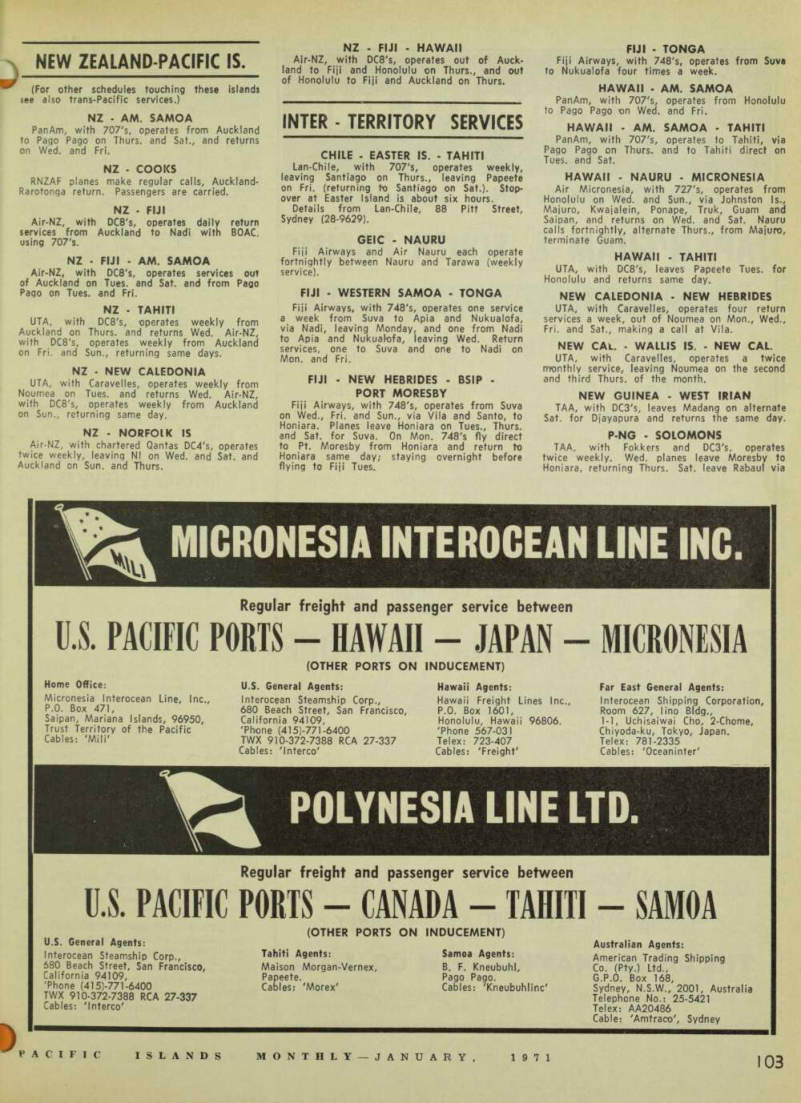
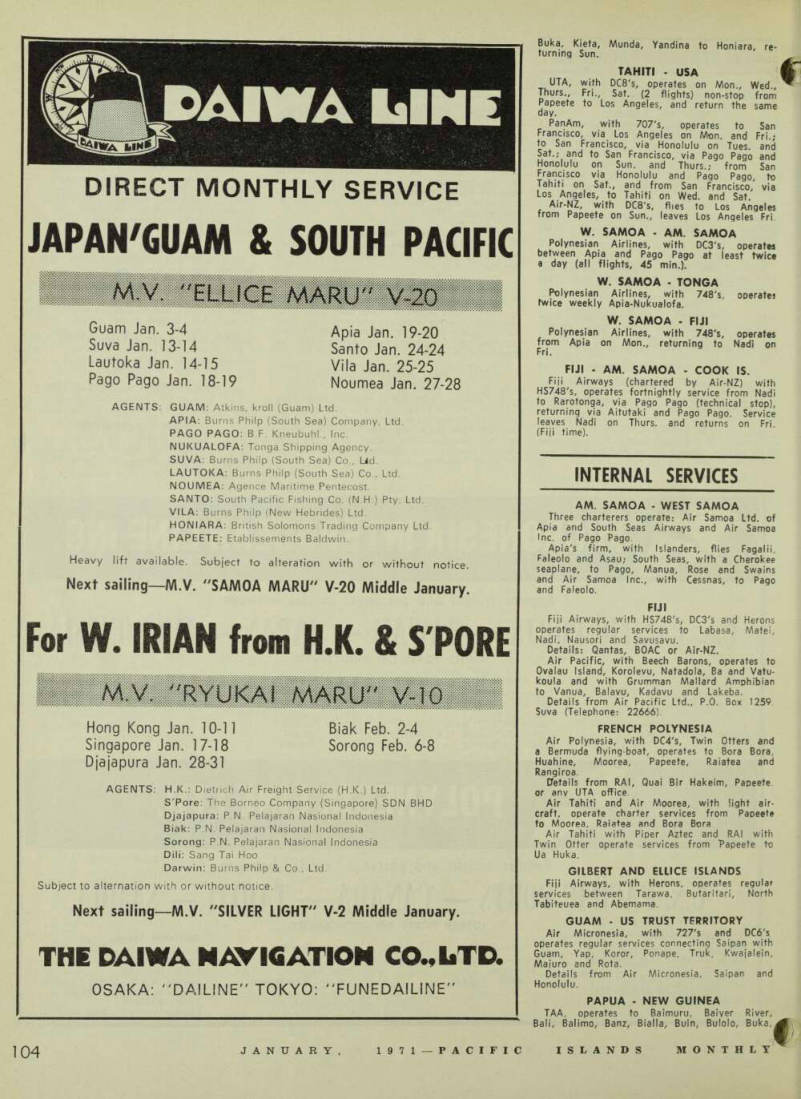
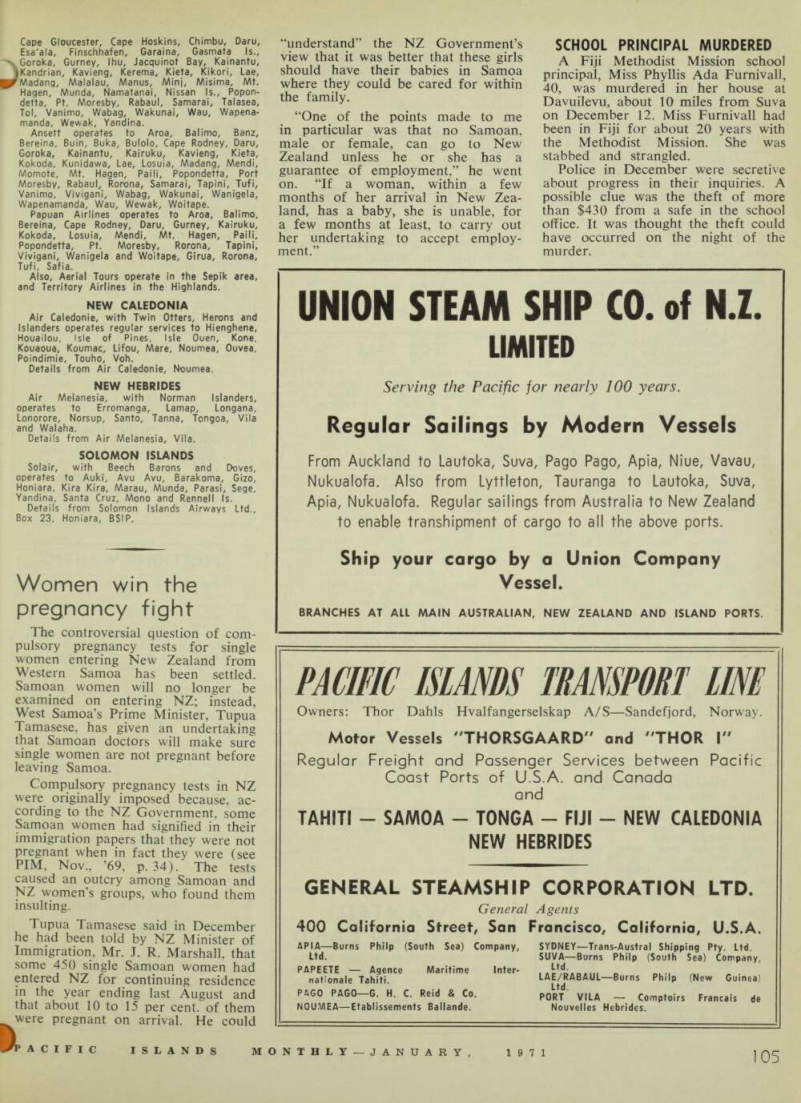
Trans Pacific Services
US - HAWAII - BRISBANE - SYDNEY Qantas, with 707's, operates Brisbane and Sydney, departing from San Francisco to Sydney on Tues.
SYDNEY - FIJI - TAHITI - MEXICO Qantas, with 707's, operates twice weekly out of Sydney on Tues. and Fri. and return out of Mexico City on Tues. and Sat. Stops at Acapulco.
SYDNEY - FIJI - HAWAII - CANADA CP Air, with DCB's, operates weekly services out of Sydney on Sat. and Vancouver on Thurs.
SYDNEY - NZ - HAWAII or TAHITI - USA Air-NZ, with DCB's, operates out of Sydnev and Los Angeles on Wed., Fri. and Sun.
SYDNEY - FIJI - HAWAII - USA Qantas, with 707's, operates daily services, from Sydney to San Francisco, and San Francisco to Sydney.
BOAC, with VClO's, operates from Sydnev to Los Angeles on Mon., Tues., Wed., Thurs., and Sat., and Los Angeles on Mon., Tues., Thurs., Sat. and Sun.
American Airlines, with 707's, operates two daylight flights from Sydney to Nadi and Honolulu and one non-stop daylight flight to Honolulu, returning to Sydney from Honolulu on Thurs., Fri, and Sat., the Thurs. service being direct.
SYDNEY or NOUMEA • USA (via FIJI.
Nz Or Tahiti)
UTA, with DCB's, operates out of Sydney on Mon. and Fri. and Noumea on Mon., Wed. and Sat.
SYDNEY - USA (VIA N. CAL., FIJI
Or Hawaii)
PanAm, with 747'5, arrive Sydney from Los Angeles, via Honolulu and Nadi, on Sun. and Thurs., and leave on return flight the same day.
PanAm, with 707's, operates five days a week return trans-Pacific service out of Sydney and Los Angeles; Mon., Wed. and Fri. flights to Australia go to Melbourne and return to Sydney the same day. Mon. Sydney-LA flight is via Noumea and Honolulu. Jets connect with services to London, Europe and Far East. Jets fly Sydney-Hawaii non-stop both ways Tues., Wed., Fri. and Sat.
NZ - AM. SAMOA - TAHITI OR HAWAII
Usa
PanAm, with 707's, operates out of Auck land, via Tahiti, on Tues., and via American Samoa and Honoloulu on Thurs. and Sat. for Los Angeles and San Francisco.
American Airlines, with 707's, operates out of Auckland to Honolulu via Pago Pago on
Wed. and via Nadi on Thurs., and out of Honolulu for Pago Pago and Auckland on Mon.
NZ - FIJI - HAWAII - USA American Airlines, with 707's operates out of Auckland to Fiji and Honolulu on Thurs., and out of Honolulu for Fiji and Auckland on Tues.
Fiji - Hawaii
American Airlines, with 707's, operates out of Honolulu to Fiji on Tues., Wed., Fri., Sat. and Sun., and out of Fiji to Honolulu on Tues., Thurs., Fri., Sat. and Sun.
Indonesia Or Malaysia - Usa (Via
Darwin, Noumea, Nz Or Tahiti)
UTA, with DCB's, operates a weekly service out of Djakarta to Los Angeles on Tues. and return on Thurs. A non-stop Noumea-Singapore flight operates on Mon., Tues. and Thurs.
Australia-Far East
Sydney - P-Ng ■ Far East
Qantas, with 707's, operates services out of Sydney on Mon., and Wed. to Port Moresby and Hong Kong, and return from Hong Kong on Tues. and Sun. Wed. and Sun. flights via Manila.
Australia-New Zealand
Qantas, Air-NZ, BOAC and PanAm operate regular trans-Tasman services. The Qantas and Air-NZ services link major NZ cities with Australian east coast cities.
Australia-Pacific Islands
(For other schedules touching these Islaadt see also trans-Pacific services.)
Brisbane - Nauru
Air Nauru, with a Falcon Fan jet, operates weekly Brisbane-Honiara-Nauru and takes no passengers for Honiara (Solomons).
Details: Nauruan Government Office, 227 Collins St., Melbourne.
Sydney - Fiji
Air-lndia, with 707's, operates weekly services to Nadi on lues., returning to Sydney on Wed.
Sydney - Lord Howe Is.
Airlines of NSW, with flying-boats, operates four times weekly, return services from Rose Bay, Sydney, to Lord Howe. Extras on holidays.
Sydney - New Caledonia
Qantas and UTA operate Sydney to Noumea Mon. (2 flights). Wed., Fri. and Sun.; and Noumea to Sydney on Mon., Wed., Fri., Sat. and Sun.
Sydney - New Zealand - Fiji
BOAC, with 707's, operates services out of Sydney on Mon. and Sat., and out of Nadi on Tues. and Sun. NZ call is at Auckland.
Sydney - Norfolk Is.
Qantas, with DC4's, operates three times weekly. More in holiday periods.
Australia - P-Ng
TAA and Ansett, with 727's or DC9's, operate 14 times a week from Sydney or Melbourne to Pt. Moresby.
Queensland • Papua
TAA Fokkers operate Townsville, via Cairns, for Port Moresby on Mon. and Tues. and Brisbane, Townsville, Cairns, Port Moresby on Mon., Port Moresby, Cairns, Townsville, Rockhampton on Mon. and Port Moresby, Cairns, Townsville, Brisbane on Thurs.
Ansett, with Fokkers, operates Wed. service Townsville-Cairns-Port Moresby-Cairns, and a Thursday service Cairns-Port Moresby-Cairns- Townsville. A
New Zealand-Pacific Is.
(For other schedules touching these islands see also trans-Pacific services.)
Nz • Am. Samoa
PanAm, with 707's, operates from Auckland to Pago Pago on Thurs. and Sat., and returns on Wed. and Fri.
Nz - Cooks
RNZAF planes make regular calls, Auckland- Rarotonga return. Passengers are carried.
Nz - Fiji
Air-NZ, with DCB's, operates daily return services from Auckland to Nadi with BOAC, using 707's.
Nz - Fiji - Am. Samoa
Air-NZ, with DCB's, operates services out of Auckland on Tues. and Sat. and from Pago Pago on Tues. and Fri.
Nz - Tahiti
UTA, with DCB's, operates weekly from Auckland on Thurs. and returns Wed. Air-NZ, with DCB's, operates weekly from Auckland on Fri. and Sun., returning same days.
Nz - New Caledonia
UTA, with Caravelles, operates weekly from Noumea on Tues. and returns Wed. Air-NZ, with DCB's, operates weekly from Auckland on Sun., returning same day.
Nz - Norfolk Is
Air-NZ, with chartered Qantas DC4's, operates twice weekly, leaving Nl on Wed. and Sat. and Auckland on Sun. and Thurs.
Nz - Fiji • Hawaii
Air-NZ, with DCB's, operates out of Auck land to Fiji and Honolulu on Thurs., and out of Honolulu to Fiji and Auckland on Thurs.
Inter - Territory Services
Chile - Easter Is. - Tahiti
Lan-Chile, with 707's, operates weekly, leaving Santiago on Thurs., leaving Papeete on Fri. (returning to Santiago on Sat.). Stop over at Easter Island is about six hours.
Details from Lan-Chile, 88 Pitt Street, Sydney (28-9629).
Geic - Nauru
Fiji Airways and Air Nauru each operate fortnightly between Nauru and Tarawa (weekly service).
Fiji - Western Samoa - Tonga
Fiji Airways, with 748's, operates one service a week from Suva to Apia and Nukualofa, via Nadi, leaving Monday, and one from Nadi to Apia and Nukualofa, leaving Wed. Return services, one to Suva and one to Nadi on Mon. and Fri.
FIJI - NEW HEBRIDES • BSIP ■
Port Moresby
Fiji Airways, with 748's, operates from Suva on Wed., Fri. and Sun., via Vila and Santo, to Honiara. Planes leave Honiara on Tues., Thurs. and Sat. for Suva. On Mon. 748's fly direct to Pt. Moresby from Honiara and return to Honiara same day; staying overnight before flying to Fiji Tues.
Fiji - Tonga
Fiji Airways, with 748's, operates from Suva to Nukualofa four times a week.
Hawaii - Am. Samoa
PanAm, with 707's, operates from Honolulu to Pago Pago on Wed. and Fri.
Hawaii - Am. Samoa ■ Tahiti
PanAm, with 707's, operates to Tahiti, via Pago Pago on Thurs. and to Tahiti direct on Tues. and Sat.
Hawaii - Nauru - Micronesia
Air Micronesia, with 727'5, operates from Honolulu on Wed. and Sun., via Johnston Is., Majuro, Kwajalein, Ponape, Truk, Guam and Saipan, and returns on Wed. and Sat. Nauru calls fortnightly, alternate Thurs., from Majuro, terminate Guam.
Hawaii - Tahiti
UTA, with DCB's, leaves Papeete Tues. for Honolulu and returns same day.
New Caledonia - New Hebrides
UTA, with Caravelles, operates four return services a week, out of Noumea on Mon., Wed., Fri. and Sat., making a call at Vila.
NEW CAI. - WALLIS IS. - NEW CAL.
UTA, with Caravelles, operates a twice monthly service, leaving Noumea on the second and third Thurs. of the month.
New Guinea - West Irian
TAA, with DC3's, leaves Madang on alternate Sat. for Djayapura and returns the same day.
P-Ng - Solomons
TAA, with Fokkers and DC3's, operates twice weekly. Wed. planes leave Moresby to Honiara, returning Thurs. Sat. leave Rabaul via
Buka, Kieta, Munda, Vandina to Honiara, re turning Sun.
Tahiti - Usa
UTA, with DCB's, operates on Mon., Wed., Thurs., Fri., Sat. (2 flights) non-stop from Papeete to Los Angeles, and return the same day.
PanAm, with 707's, operates to San Francisco, via Los Angeles on Mon. and Fri.; to San Francisco, via Honolulu on Tues. and Sat.,- and to San Francisco, via Pago Pago and Honolulu on Sun. and Thurs.; from San Francisco via Honolulu and Pago Pago, to Tahiti on Sat., and from San Francisco, via Los Angeles, to Tahiti on Wed. and Sat.
Air-NZ, with DCB's, flies to Los Angeles from Papeete on Sun., leaves Los Angeles Fri.
W. Samoa - Am. Samoa
Polynesian Airlines, with DC3's, operates between Apia and Pago Pago at least twice a day (all flights, 45 min.).
W. Samoa - Tonga
Polynesian Airlines, with 748's, operates twice weekly Apia-Nukualofa.
W. Samoa - Fiji
Polynesian Airlines, with 748's, operates from Apia on Mon., returning to Nadi on Fri.
FIJI - AM. SAMOA - COOK IS.
Fiji Airways (chartered by Air-NZ) with HS74B's, operates fortnightly service from Nadi to Rarotonga, via Pago Pago (technical stop), returning via Aitutaki and Pago Pago. Service leaves Nadi on Thurs. and returns on Fri. (Fiji time).
Internal Services
Am. Samoa - West Samoa
Three charterers operate: Air Samoa Ltd. of Apia and South Seas Airways and Air Samoa Inc. of Pago Pago.
Apia's firm, with Islanders, flies Fagalii, Faleolo and Asau; South Seas, with a Cherokee seaplane, to Pago, AAanua, Rose and Swains and Air Samoa Inc., with Cessnas, to Pago and Faleolo.
Fiji
Fiji Airways, with HS74B's, DC3's and Herons operates regular services to Labasa, Matei, Nadi, Nausori and Savusavu.
Details: Qantas, BOAC or Air-NZ.
Air Pacific, with Beech Barons, operates to Ovalau Island, Korolevu, Natadola, Ba and Vatu koula and with Grumman Mallard Amphibian to Vanua, Balavu, Kadavu and Lakeba.
Details from Air Pacific Ltd., P.O. Box 1259 Suva (Telephone: 22666).
French Polynesia
Air Polynesia, with DC4's, Twin Otters and a Bermuda flying-boat, operates to Bora Bora, Huahine, Moorea, Papeete, Raiatea and Rangiroa. details from RAI, Quai Bir Hakeim, Papeete or any UTA office Air Tahiti and Air Moorea, with light air craft, operate charter services from Papeete to Moorea, Raiatea and Bora Bora Air Tahiti with Piper Aztec and RAI with Twin Otter operate services from Papeete To Ua Huka.
Gilbert And Ellice Islands
Fiji Airways, with Herons, operates regular services between Tarawa, Butaritari, North Tabiteuea and Abemama.
Guam - Us Trust Territory
Air Micronesia, with 727's and DC6's operates regular services connecting Saipan with Guam, Yap, Koror, Ponape, Truk, Kwajalein, Majuro and Rota.
Details from Air Micronesia, Saipan and Honolulu.
Papua - New Guinea
TAA, operates to Baimuru, Baiyer River, Bali, Balimo, Banz, Bialla, Buin, Bulolo, Buka,,
Cape Gloucester, Cape Hoskins, Chimbu, Daru, Esa'ala, Finschhafen, Garaina, Gasmata Is., )Goroka, Gurney, Ihu, Jacquinot Bay, Kainantu, Kandrian, Kavieng, Kerema, Kieta, Kikori, Lae, Madang, Malalau, Manus, Mini, Misima, Mt.
Hagen, Munda, Namatanai, Nissan Is., Popon detta. Ft. Moresby, Rabaul, Samarai, Talasea, Tol, Vanimo, Wabag, Wakunai, Wau, Wapena manda, Wewak, Yandina.
Ansett operates to Aroa, Balimo, Banz, Bereina, Buin, Buka, Bulolo, Cape Rodney, Daru, Goroka, Kainantu, Kairuku, Kavieng, Kieta, Kokoda, Kunidawa, Lae, Losuia, Madang, Mendi, Momote, Mt. Hagen, Paili, Popondetta, Port Moresby, Rabaul, Rorona, Samarai, Tapini, Tufi, Vanimo, Vivigani, Wabag, Wakunai, Wanigela, Wapenamanda, Wau, Wewak, Woitape.
Papuan Airlines operates to Aroa, Balimo, Bereina, Cape Rodney, Daru, Gurney, Kairuku, Kokoda, Losuia, Mendi, Mt. Hagen, Paili, Popondetta, Pt. Moresby, Rorona, Tapini, Vivigani, Wanigela and Woitape, Girua, Rorona, Tufi, Safia.
Also, Aerial Tours operate in the Sepik area, and Territory Airlines in the Highlands.
New Caledonia
Air Caledonie, with Twin Otters, Herons and Islanders operates regular services to Hienghene, Houailou, Isle of Pines, Isle Ouen, Kone, Kouaoua, Koumac, Lifou, Mare, Noumea, Ouvea, Poindimie, Touho, Voh.
Details from Air Caledonie, Noumea.
New Hebrides
Air Melanesia, with Norman Islanders, operates to Erromanga, Lamap, Longana, Lonorore, Norsup, Santo, Tanna, Tongoa, Vila and Walaha.
Details from Air Melanesia, Vila.
Solomon Islands
Solair, with Beech Barons and Doves, operates to Auki, Avu Avu, Barakoma, Gizo, Honiara, Kira Kira, Marau, Munda, Parasi, Sege, Yandina, Santa Cruz, Mono and Rennell Is.
Details from Solomon Islands Airways Ltd., Box 23, Honiara, BSIP.
Advertisements & other items, pp. 105-106 (1 item)
Micronesia Interocean Line Inc.
Regular freight and passenger service between
U.S. PACIFIC PORTS - HAWAII - JAPAN -
(OTHER PORTS ON INDUCEMENT)
Home Office: Micronesia Interocean Line, Inc., P.O. Box 471, Saipan, Mariana Islands, 96950, Trust Territory of the Pacific Cables: 'Mili' U.S. General Agents; Interocean Steamship Corp., 680 Beach Street, San Francisco, California 94109, 'Phone (415)-771-6400
TWX 910-372-7388 RCA 27-337
Cables: 'lnterco' Hawaii Agents: Hawaii Freight Lines Inc., P.O. Box 1601, Honolulu, Hawaii 96806.
'Phone 567-031 Telex: 723-407 Cables: 'Freight'
MICRONESIA
Far East General Agents: Interocean Shipping Corporation, Room 627, lino Bldg., 1-1, Uchisaiwai Cho, 2-Chome, Chiyoda-ku, Tokyo, Japan.
Telex: 781-2335 Cables: 'Oceaninter'
POLYNESIA LINE LTD.
Regular freight and passenger service between
D.S. PACIFIC PORTS - CANADA - TAHITI - SAMOA U.S. General Agents: Interocean Steamship Corp., 680 Beach Street, San Francisco, California 94109, 'Phone (415)-771-6400
TWX 910-372-7388 RCA 27-337
Cables: 'lnterco'
(OTHER PORTS ON INDUCEMENT)
Tahiti Agents: Maison Morgan-Vernex, Papeete.
Cables: 'Morex' Samoa Agents; B. F. Kneubuhl, Pago Pago.
Cables: 'Kneubuhlinc' Australian Agents: American Trading Shipping Co. (Pty.) Ltd., G.P.O. Box 168, Sydney, N.S.W., 2001, Australia Telephone No.: 25-5421 Telex: AA20486 Cable: 'Amtraco', Sydney
i«V t>AIWA LIME
DIRECT MONTHLY SERVICE
JAPAN'GUAM & SOUTH PACIFIC
AGENTS: GUAM: Atkins, kroll (Guam) Ltd.
APIA: Burns Philp (South Sea) Company, Ltd.
PAGO PAGO: B.F. Kneubuhl., Inc.
NUKUALOFA; Tonga Shipping Agency.
SUVA: Burns Philp (South Sea) Co., Ltd.
LAUTOKA: Burns Philp (South Sea) Co . Ltd.
NOUMEA: Agence Maritime Pentecost.
SANTO: South Pacific Fishing Co. (N.H.) Pty. Ltd.
VILA: Burns Philp (New Hebrides) Ltd.
HONIARA: British Solomons Trading Company Ltd.
PAPEETE: Etablissements Baldwin.
Heavy lift available. Subject to alteration with or without notice.
Next sailing—M.V. "SAMOA MARU" V-20 Middle January.
For W. IRIAN from H.K. & S PORE
M.V "RYUKAI MARU" V-IO
Djajapura Jan. 28-31 AGENTS: H.K.: Dietrich Air Freight Service (H.K.) Ltd.
S'Pore: The Borneo Company (Singapore) SDN BHD Djajapura; P.N. Pelajaran Nasional Indonesia Biak: P.N. Pelajaran Nasional Indonesia Sorong: P.N. Pelajaran Nasional Indonesia Dili: Sang Tai Hoo Darwin; Burns Philp & Co., Ltd.
Subject to alternation with or without notice.
Next sailing—M.V. "SILVER LIGHT" V-2 Middle January.
ELLIGE MARU" V-20
Guam Jan. 3-4 Suva Jan. 13-14 Lautoka Jan. 14-15 Pago Pago Jan. 18-19 Apia Jan. 19-20 Santo Jan. 24-24 Vila Jan. 25-25 Noumea Jan. 27-28 Hong Kong Jan. 10-11 Singapore Jan. 17-18 Biak Feb. 2-4 Sorong Feb. 6-8
THE DAIWA NAVIGATION CO., LTD.
OSAKA: "DAILINE" TOKYO: "FUNEDAILINE"
pregnancy fight
Women win the pregnancy fight
The controversial question of com pulsory pregnancy tests for single women entering New Zealand from Western Samoa has been settled.
Samoan women will no longer be examined on entering NZ; instead, West Samoa’s Prime Minister, Tupua Tamasese, has given an undertaking that Samoan doctors will make sure single women are not pregnant before leaving Samoa.
Compulsory pregnancy tests in NZ were originally imposed because, ac cording to the NZ Government, some Samoan women had signified in their immigration papers that they were not pregnant when in fact they were (see PIM, Nov., ’69, p. 34). The tests caused an outcry among Samoan and NZ women’s groups, who found them insulting.
Tupua Tamasese said in December he had been told by NZ Minister of Immigration, Mr. J. R. Marshall, that some 450 single Samoan women had entered NZ for continuing residence in the year ending last August and that about 10 to 15 per cent, of them were pregnant on arrival. He could
“understand” the NZ Government’s view that it was better that these girls should have their babies in Samoa where they could be cared for within the family.
“One of the points made to me in particular was that no Samoan, male or female, can go to New Zealand unless he or she has a guarantee of employment,” he went on. “If a woman, within a few months of her arrival in New Zea land, has a baby, she is unable, for a few months at least, to carry out her undertaking to accept employ ment.”
School Principal Murdered
A Fiji Methodist Mission school principal, Miss Phyllis Ada Furnivall, 40, was murdered in her house at Davuilevu, about 10 miles from Suva on December 12. Miss Furnivall had been in Fiji for about 20 years with the Methodist Mission. She was stabbed and strangled.
Police in December were secretive about progress in their inquiries. A possible clue was the theft of more than $430 from a safe in the school office. It was thought the theft could have occurred on the night of the murder.
Advertisements & other items, pp. 107-108 (3 items)
105
NTHLY JANUARY, 1971
PACIFIC ISLANDS MO
Union Steam Ship Co. Of N.Z.
LIMITED
Serving the Pacific for nearly 100 years.
Regular Sailings by Modern Vessels
From Auckland to Lautoka, Suva, Pago Pago, Apia, Niue, Vavau, Nukualofa. Also from Lyttleton, Tauranga to Lautoka, Suva, Apia, Nukualofa. Regular sailings from Australia to New Zealand to enable transhipment of cargo to all the above ports.
Ship your cargo by a Union Company Vessel.
BRANCHES AT ALL MAIN AUSTRALIAN, NEW ZEALAND AND ISLAND PORTS.
PACIFIC ISLANDS IRANSPORT LINE
Owners: Thor Dahls Hvalfangerselskap A/S —Sandefjord, Norway.
Motor Vessels "THORSGAARD" and "THOR I"
Regular Freight and Passenger Services between Pacific
Coast Ports of U.S.A. and Canada
and
TAHITI - SAMOA - TONGA - FIJI - NEW CALEDONIA
NEW HEBRIDES
GENERAL STEAMSHIP CORPORATION LTD.
General Agents
400 California Street, San
APIA —Burns Philp (South Sea) Company, Ltd.
PAPEETE Agence Maritime Inter* nationale Tahiti.
PAGO PAGO—G. H. C. Reid & Co.
NOUMEA —Etablissements Ballande.
Francisco, California, U.S.A.
SYDNEY—Trans-Austral Shipping Pty. Ltd.
SUVA—Burns Philp (South Sea) Company, Ltd, LAE/RABAUL —Burns Philp (New Guinea) Ltd.
PORT VILA Comptoirs Francais de Nouvelles Hebrides.
Classified Advertisements
Per line, 95c Aust.; Minimum rate. 4 lines.
BOOKS, MAGAZINES, ETC.
ALL BOOKS AND JOURNALS ON AUS-
TRALASIA AND THE PACIFIC BOUGHT
AND SOLD. Catalogues issued and sent free on application. Correspondence invited. Berkelouw, 114 King St., Sydney. 2000. Telephone: 28-7874.
THE SACRED HENS, Legends of Samoa. 45 fascinating tales, soft cover. Equiv. of 5U52.25 post paid, surface. P.O. Money Order only. Wright, Box 587, Apia, W.
Samoa.
ACCOMMODATION
SCHOOL HOLIDAYS, unaccompanied children taken for holidays. Sheep property Coonamble, N.S.W. Private home, riding, swimming, tennis and other family activities. Further information: Mrs. J. W.
McLeish, Thurn, Coonamble, N.S.W., 2829.
THE RIDGE MOTOR INN. Cnr. Leichhardt and Henry Streets, Brisbane, Qld., 4000.
Ultra modern, superbly appointed selfcontained suites Including telephone, TV, radio, piped music. Fully air-conditioned, refrigerator & tea making facilities.
Licensed rooftop Restaurant with the best band in town. On warm days you can relax by the pool and take refreshments in the poolside snack bar. Write for attractive 4 colour brochure; Tel.: 21-5000 or Telex thru 40099.
GOODWIN TOWERS, Gold Coast, Queensland. Completed August, 1969. 35 luxury home units with panoramic views of the Gold Coast from each one. Off-season tariff: $5O per week. We have many other flats, home units, houses and motels from $lB p.w. off season. All tariffs are subject to special rates for long term bookings. Write for brochure. Personal attention to every inquiry. Pat Long, trading as A.E.T.S. (R.E.1.Q.), Box 197, Burleigh Heads. 4220. Phone 5-2112 or 5-2375. Gold Coast.
METROPOLITAN MOTEL. Cnr. Leichhardt and Little Edward Streets, Brisbane, Qld., 4000. Quiet, old established, moderately priced. Self-contained suites including telephone, TV, air-conditioning, radio, frig. tea making facilities. Licensed Restaurant. Tel.: 21-6000. Brochures available. Telex 40099.
EDUCATIONAL
THE RAPID RESULTS COLLEGE. World
famous postal tuition for G.C.E., School Certificate, Accountancy, Banking, Insurance, Law, Marketing, Secretaryship, etc. Our Airmail Service gives you the full benefit of expert London tuition without delay. Write to-day for your FREE copy of “Your Career” to the
Principal, THE RAPID RESULTS COL-
LEGE, Dept. ZDI Tuition House, London, S.W. 19, England.
FOR SALE
BODEN’S BOAT DESIGNS PTY. LTD.,
695 George St., Sydney, 2000. Get your Bodens Boat Designs and Boat Building Book from newsagents everywhere. Posted direct $A2.20 surface mall.
CONCRETE BLOCK MACHINE. Makes
blocks, flags, edgings, screen-blocks, garden stools—up to 8 at once and 06 an hour. SAIO7 c.i.f. main ports. Send for leaflets. Forest Farm Research, Londonderry, N.S.W., 2753.
FLEETS. 60 ft. steel workboat, bit. 1970, in survey, new 240 h.p. Caterpillar diesel, 1,000 gals, fuel, radio, sounder, etc. $57,500.00. Fleets, Rowe’s Bldg., Edward Street, Brisbane. Cable: Fleets, Brisbane.
MAURICE CRISP
Ship, Launch, and Yacht Broker.
Huddart Parker Building.
Post Office Square, Wellington,
NEW ZEALAND.
For all types of commercial and pleasure craft, whether buying or selling. For further information, write C.P.O. Box 854, Wellington, or Phone 44-009.
After hours 888-307. Telegrams "Nautilus"
New Zealand and Pacific coverage.
TRADE ENQUIRIES
GUS GOODMAN TRADING CO., Box
4433, Hong Kong. Exporters wide range Hong Kong products and foreign, Japanese radios, electrical appliances, watches, cameras, etc. Order your requirements.
Banker: Wing Lung Bank Ltd. Satisfactory service.
WANTED TO BUY
SMALL HOTEL, preferably freehold and licensed. Any place in the Pacific, under $30,000. Jon. N. Keen, 1665 Bertram St., Honolulu, Hawaii, 96816.
Port Moresby
A Book Collector’s Must The publishers of Canon lan Stuart's new book, "PORT MORESBY: Yesterday and Today", are accepting orders for the limited edition of 250 numbered copies, bound with a Port Moresby tattoo design, and each signed by the author. This handsome limited edition will be allocated in strict order of receipt.
Canon lan Stuart, who is rector of Port Moresby, has researched into Port Moresby's past to produce this valuable and highly-readable first full account of the territory's capital.
Priced at $lO.OO Aust. posted.
Available only from:
Pacific Publications
(Aust.) Pty. Ltd.
29 Alberta St,, Sydney,
N.S.W. 2000.
(Postal Address: Box 3408, G.P.0., Sydney, N.S.W., 2001)
POSITIONS WANTED
A LONG-TIME, happy Fiji resident, cultured, M.A., female—craves return, permanently, to Pacific Islands. Any information regards full/part time, responsible employment, quarters, etc., would typify noted “Island friendliness”.
Flo Parrack, 97-5852, (A.H. 97-0277), or C/o. Alert Agencies, Box 221, P. 0., Manly 2095, N.S.W., Australia.
LADIES desirous returning Pacific Islands, 1971, as 1. Editor-journalist-broadcaster. 2.
Headteacher (Junior High)-education officer, or similar. 3. Youth welfare worker. 4. Manageress-assistant, Tourist Bureau, etc. 5. Librarian. All with wide experience. Exc. refs, knowledge of French, Hindustani, Pidgin. Phone 97-5852. Alert Agencies, Box 221, P. 0., Manly 2095,
N.S.W.
VISITING BRISBANE?
Stay at TOWER MILL MOTEL. First class air-conditioned accommodation, T.V., private bathroom and verandah with a delightful view. Two restaurants.
From $lO.OO per day.
Book through your Travel Agent or Airline office or direct to 239, Wickham Terrace, Brisbane. Telephone 31-1421.
Acquisition, Merger and Feasibility Studies, throughout the Pacific Islands.
INVESTORS' TRUST
LIMITED,
PORT VILA, NEW HEBRIDES.
WANTED
FREEHOLD LAND
Am interested in buying a large tract of freehold land in the South Pacific. Might pay cash.
Please write: "PAM", cl - Box 3408, G.P.0., Sydney 2000, Australia.
Stay at —
JOHN OXLEY
MOTEL
491 WICKHAM TERRACE,
BRISBANE.
(750 yards City Hall) Every possible facility.
At very sensible rates.
SEND FOR BROCHURE
106
JANUARY, 1971 PACIFIC ISLANDS MONTHLIr
Deaths of Islands people
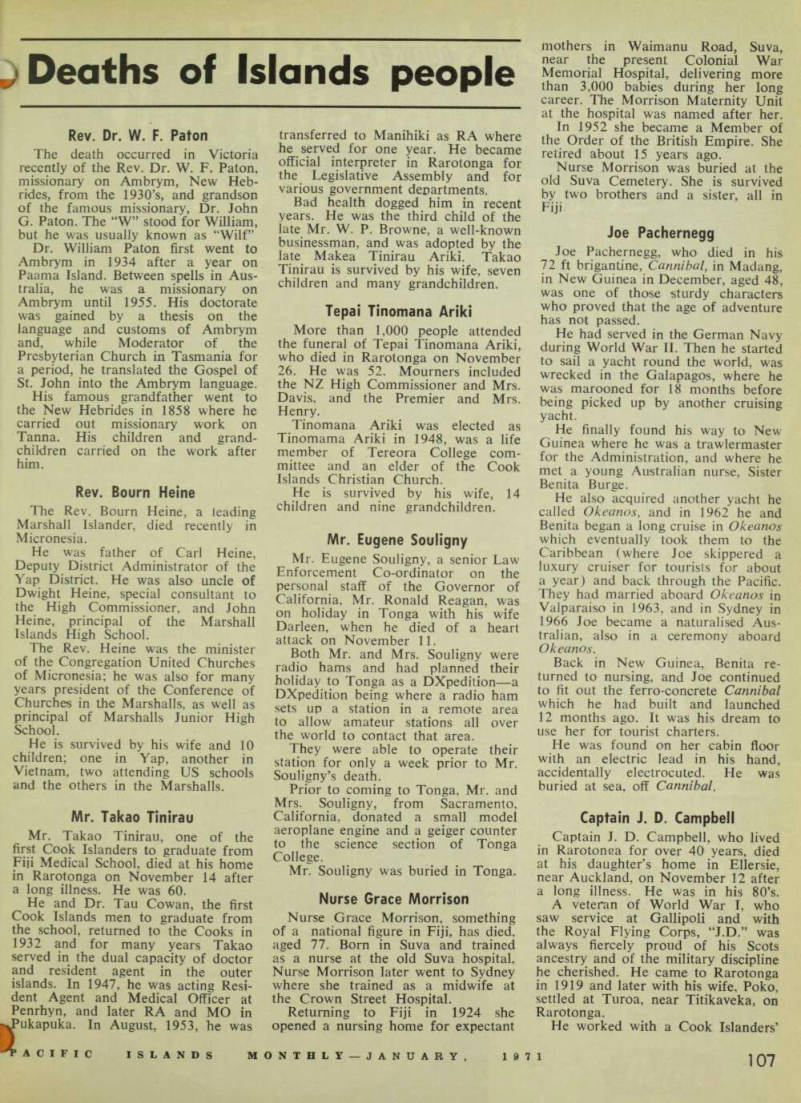
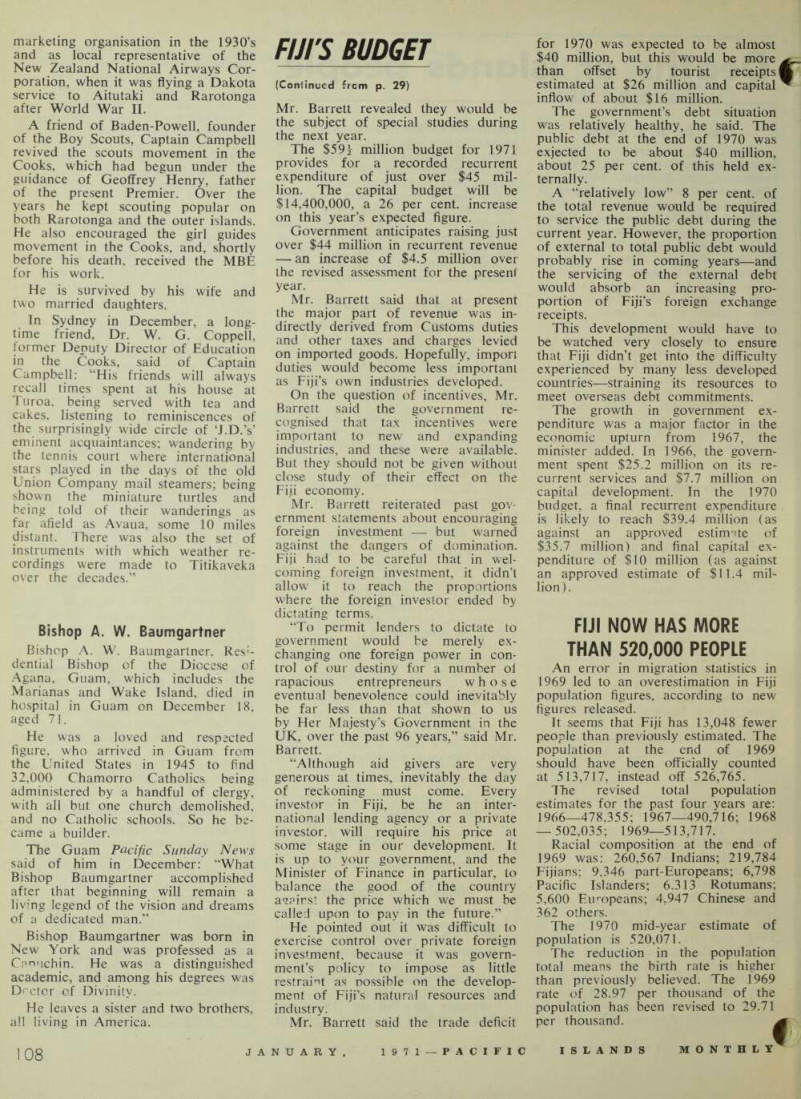
Rev. Dr. W. F. Paton The death occurred in Victoria recently of the Rev. Dr. W, F. Paton, missionary on Ambrym, New Heb rides, from the 1930’5, and grandson of the famous missionary, Dr. John G. Paton. The “W” stood for William, but he v/as usually known as “Wilf”
Dr. William Paton first went to Ambrym in 1934 after a year on Paama Island. Between spells in Aus tralia, he was a missionary on Ambrym until 1955. His doctorate was gained by a thesis on the language and customs of Ambrym and, while Moderator of the Presbyterian Church in Tasmania for a period, he translated the Gospel of St. John into the Ambrym language.
His famous grandfather went to the New Hebrides in 1858 where he carried out missionary work on Tanna. His children and grand children carried on the work after him.
Rev. Bourn Heine The Rev. Bourn Heine, a leading Marshall Islander, died recently in Micronesia.
He was father of Carl Heine, Deputy District Administrator of the Yap District. He was also uncle of Dwight Heine, special consultant to the High Commissioner, and John Heine, principal of the Marshall Islands High School.
The Rev. Heine was the minister of the Congregation United Churches of Micronesia; he was also for many years president of the Conference of Churches in the Marshalls, as well as principal of Marshalls Junior High School.
He is survived by his wife and 10 children; one in Yap, another in Vietnam, two attending US schools and the others in the Marshalls.
Mr. Takao Tinirau Mr. Takao Tinirau, one of the first Cook Islanders to graduate from Fiji Medical School, died at his home in Rarotonga on November 14 after a long illness. He was 60.
He and Dr. Tau Cowan, the first Cook Islands men to graduate from the school, returned to the Cooks in 1932 and for many years Takao served in the dual capacity of doctor and resident agent in the outer islands. In 1947, he was acting Resi dent Agent and Medical Officer at Penrhyn, and later RA and MO in Pukapuka. In August, 1953, he was
transferred to Manihiki as RA where he served for one year. He became official interpreter in Rarotonga for the Legislative Assembly and for various government departments.
Bad health dogged him in recent years. He was the third child of the late Mr. W. P. Browne, a well-known businessman, and was adopted by the late Makea Tinirau Ariki. Takao Tinirau is survived by his wife, seven children and many grandchildren.
Tepai Tinomana Ariki More than 1,000 people attended the funeral of Tepai Tinomana Ariki, who died in Rarotonga on November 26. He was 52. Mourners included the NZ High Commissioner and Mrs.
Davis, and the Premier and Mrs.
Henry.
Tinomana Ariki was elected as Tinomama Ariki in 1948, was a life member of Tereora College com mittee and an elder of the Cook Islands Christian Church.
He is survived by his wife, 14 children and nine grandchildren.
Mr. Eugene Souligny
Mr. Eugene Souligny, a senior Law Enforcement Co-ordinator on the personal staff of the Governor of California, Mr. Ronald Reagan, was on holiday in Tonga with his wife Darken, when he died of a heart attack on November 11.
Both Mr. and Mrs. Souligny were radio hams and had planned their holiday to Tonga as a DXpedition—a DXpedition being where a radio ham sets up a station in a remote area to allow amateur stations all over the world to contact that area.
They were able to operate their station for only a week prior to Mr.
Souligny’s death.
Prior to coming to Tonga, Mr. and Mrs. Souligny, from Sacramento, California, donated a small model aeroplane engine and a geiger counter to the science section of Tonga College.
Mr. Souligny was buried in Tonga.
Nurse Grace Morrison Nurse Grace Morrison, something of a national figure in Fiji, has died, aged 77. Born in Suva and trained as a nurse at the old Suva hospital, Nurse Morrison later went to Sydney where she trained as a midwife at the Crown Street Hospital.
Returning to Fiji in 1924 she opened a nursing home for expectant
mothers in Waimanu Road, Suva, near the present Colonial War Memorial Hospital, delivering more than 3,000 babies during her long career. The Morrison Maternity Unit at the hospital was named after her.
In 1952 she became a Member of the Order of the British Empire. She retired about 15 years ago.
Nurse Morrison was buried at the old Suva Cemetery. She is survived by two brothers and a sister, all in Fiji.
Joe Pachernegg
Joe Pachernegg, who died in his 72 ft brigantine, Cannibal, in Madang, in New Guinea in December, aged 48, was one of those sturdy characters who proved that the age of adventure has not passed.
He had served in the German Navy during World War 11. Then he started to sail a yacht round the world, was wrecked in the Galapagos, where he was marooned for 18 months before being picked up by another cruising yacht.
He finally found his way to New Guinea where he was a trawlermaster for the Administration, and where he met a young Australian nurse, Sister Benita Burge.
He also acquired another yacht he called Okeanos, and in 1962 he and Benita began a long cruise in Okeanos which eventually took them to the Caribbean (where Joe skippered a luxury cruiser for tourists for about a year) and back through the Pacific.
They had married aboard Okeanos in Valparaiso in 1963, and in Sydney in 1966 Joe became a naturalised Aus tralian, also in a ceremony aboard Okeanos.
Back in New Guinea, Benita re turned to nursing, and Joe continued to fit out the ferro-concrete Cannibal which he had built and launched 12 months ago. It was his dream to use her for tourist charters.
He was found on her cabin floor with an electric lead in his hand, accidentally electrocuted. He was buried at sea, off Cannibal.
Captain J. D. Campbell
Captain J. D. Campbell, who lived in Rarotonea for over 40 years, died at his daughter’s home in Ellersie, near Auckland, on November 12 after a long illness. He was in his 80’s.
A veteran of World War I, who saw service at Gallipoli and with the Royal Flying Corps, “J.D.” was always fiercely proud of his Scots ancestry and of the military discipline he cherished. He came to Rarotonga in 1919 and later with his wife, Poko, settled at Turoa, near Titikaveka, on Rarotonga.
He worked with a Cook Islanders’
marketing organisation in the 1930’s and as local representative of the New Zealand National Airways Cor poration, when it was flying a Dakota service to Aitutaki and Rarotonga after World War 11.
A friend of Baden-Powell, founder of the Boy Scouts, Captain Campbell revived the scouts movement in the Cooks, which had begun under the guidance of Geoffrey Henry, father of the present Premier. Over the years he kept scouting popular on both Rarotonga and the outer islands.
He also encouraged the girl guides movement in the Cooks, and, shortly before his death, received the MBE for his work.
He is survived by his wife and two married daughters.
In Sydney in December, a long time friend, Dr. W. G. Coppell, former Deputy Director of Education in the Cooks, said of Captain Campbell: “His friends will always recall times spent at his house at Turoa, being served with tea and cakes, listening to reminiscences of the surprisingly wide circle of ‘J.D.’s’ eminent acquaintances; wandering by the tennis court where international stars played in the days of the old Union Company mail steamers; being shown the miniature turtles and being told of their wanderings as far afield as Avaua, some 10 miles distant. There was also the set of instruments with which weather re cordings were made to Titikaveka over the decades.”
Bishop A. W. Baumgartner
Bishop A. W. Baumgartner, Resi dential Bishop of the Diocese of Agana, Guam, which includes the Marianas and Wake Island, died in hospital in Guam on December 18. aged 71.
He was a loved and respected figure, who arrived in Guam from the United States in 1945 to find 32,000 Chamorro Catholics, being administered by a handful of clergy, with all but one church demolished, and no Catholic schools. So he be came a builder.
The Guam Pacific Sunday News said of him in December: “What Bishop Baumgartner accomplished after that beginning will remain a living legend of the vision and dreams of a dedicated man.”
Bishop Baumgartner was born in New York and was professed as a Canuchin. He was a distinguished academic, and among his degrees was Drctor of Divinity.
He leaves a sister and two brothers, all living in America.
Advertisements & other items, pp. 110-114 (5 items)
Fiji's Budget
108
(Coniinued frem p. 29)
JANUARY, 1971 PACIFIC ISLANDS MONTHLY
Pelebv 1
Heinz made the world’s first rich, thick, full cream soups. So full of cream you only add water.
Homogenized by an exclusive process so the flavour goes right through.
This is just one of the examples of Heinz leadership in product research and development.
In being first to create products to suit all tastes-satisfy all needs.
Try any Heinz product and enjoy the taste that makes them leaders.
Work up? Start With
TOYOTA HI-LU
You get rich upholstery in this one-ton 82HP Hi-Lux pickup. Plenty of legroom, too.
Safe thickly padded dash deck. And a choice of two roomy and rugged cargo beds. Loaded or empty, you hold the road thanks to independent coil springs in the rear!
Ride the big horse pickup.
The Toyota Stout packs a 95HP engine. Plus, the front and rear axles, suspension, and power brakes have the stoutness of those used in heavier duty trucks. Big cab and cargo box, too.
Plenty of legroom in front and space in back.
And the split bench seat features cushion comfort!
TOYOT>
DISTRIBUTORS: TERRITORY OF PAPUA & NEW GUINEA: ELA MOTORS LIMITED: Burns Philp House. Musgrave Street, Port Moresby, Papua/U.S. TRUST TERRITORY: MICROL CORPORATION: P.O. Box 234. Saipan, Mariana Islands, Trust Territory of the Pacific Islands / FIJI ISLAND: AUTOMOTIVE SUPPLIES CO., LTD., P.O. Box 355, Suva / AMERICAN SAMOA: BURNS PHILP (SOUTH SEA) CO., LTD.
the Land Cruiser
Tackle any job. The Toyota Land Cruiser does.
Via 4-wheel drive. 6-cylinder 155 HP engine.
Fantastic gear combinations of six forward speeds and two reverse. Rugged chassis and heavy duty axles. Sturdy body with canvas or vinyl top.
All this, yet it doubles as a versatile family fun car, too.
e your pick of dual rear wheel Dyna licles. Heavy duty pickups. Bigger payload tform trucks. Even double cab and delivery van licles. With a husky 95HP gasoline engine, an economical 70HP diesel job. Heavy duty kes and shock mounts. From body to chassis, -)as are rugged and ready for any type of road j work. With big foam padded seats and sh air ventilation!
You have a choice of six models. Built to take the rough and tough. With either diesel or regular fuel engines under an alligator bonnet.
The 130 HP Toyota diesel boasts a Bosch type fuel injection pump and adjusting mechanism to cut down fuel costs. And the high compression, two barrel carburetor, regular fuel engine displaces an amazing 3,879 cc yet building up a full 1 55HP! m m o Pago/WESTERN SAMOA: BURNS PHILP (SOUTH SEA) LTD., Apia / GUAM: RICKY'S AUTO CO., P.O. Box 1458, Agana A/ HEBRIDES: BURNS PHILP (N.H.) LTD., Vila SOLOMON ISLANDS: ZEPHYR SERVICE STATION PTY LTD., Honiara / NEW CALEDONIA: lIETE DTMPRORTATION AUTOMOBILE DU PACIFIC, Noumea TAHITI ETABLISSEMENTS EMILE A MARTIN & FILS, B.P. 61 Papeete
1
I Lei
■*L
lABTV
El# OH
PK^ sf
KRAFT
I KRAFT
.. Cream Spre a
KRAFT
£hunk style kraft Ba*
\*BAPt)
Hi
HERE’S to
GOOD EATING
Wherever you find good eating, you’ll find foods, fresh from Kraft, Australia. ®KRAF *Reg’d Trade Mark 05?-P- ! 64
110
JANUARY. 1971 PACIFIC ISLANDS MONTH* Yi
111
C I F I C ISLANDS MONTHLY— JANUARY, 1971
112
JANUARY, 1971-PACIFIC ISLANDS MONTH l"
Letters

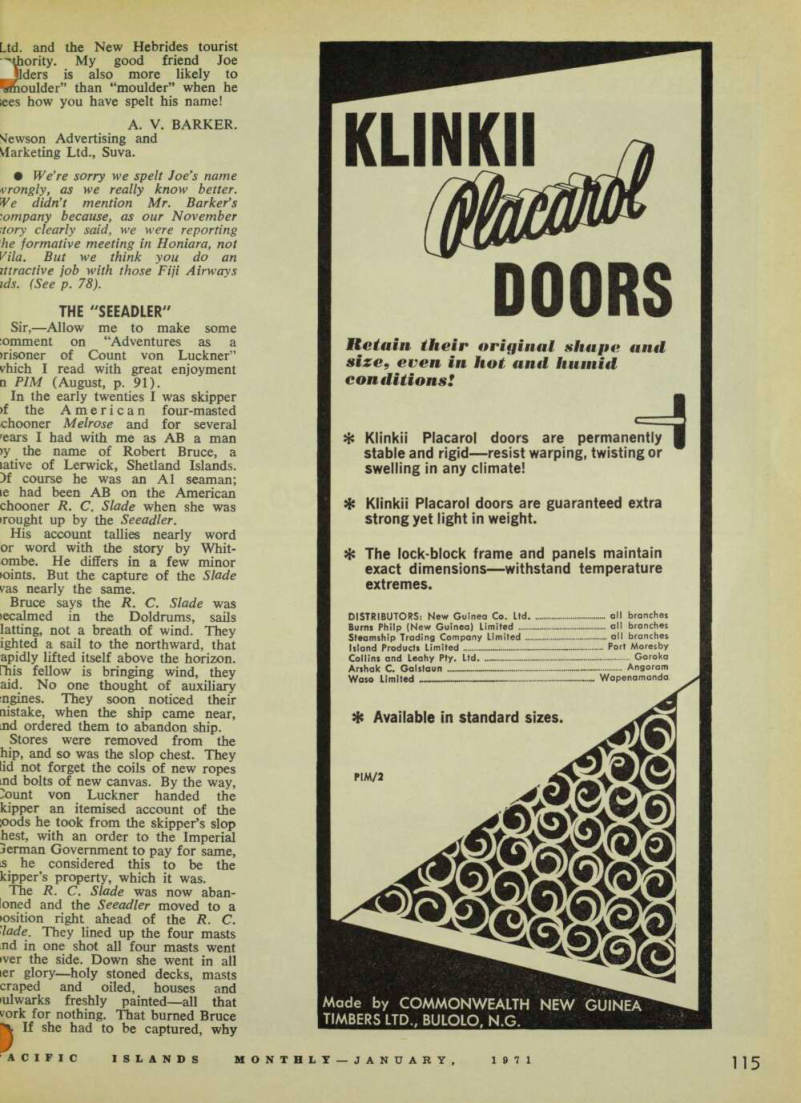
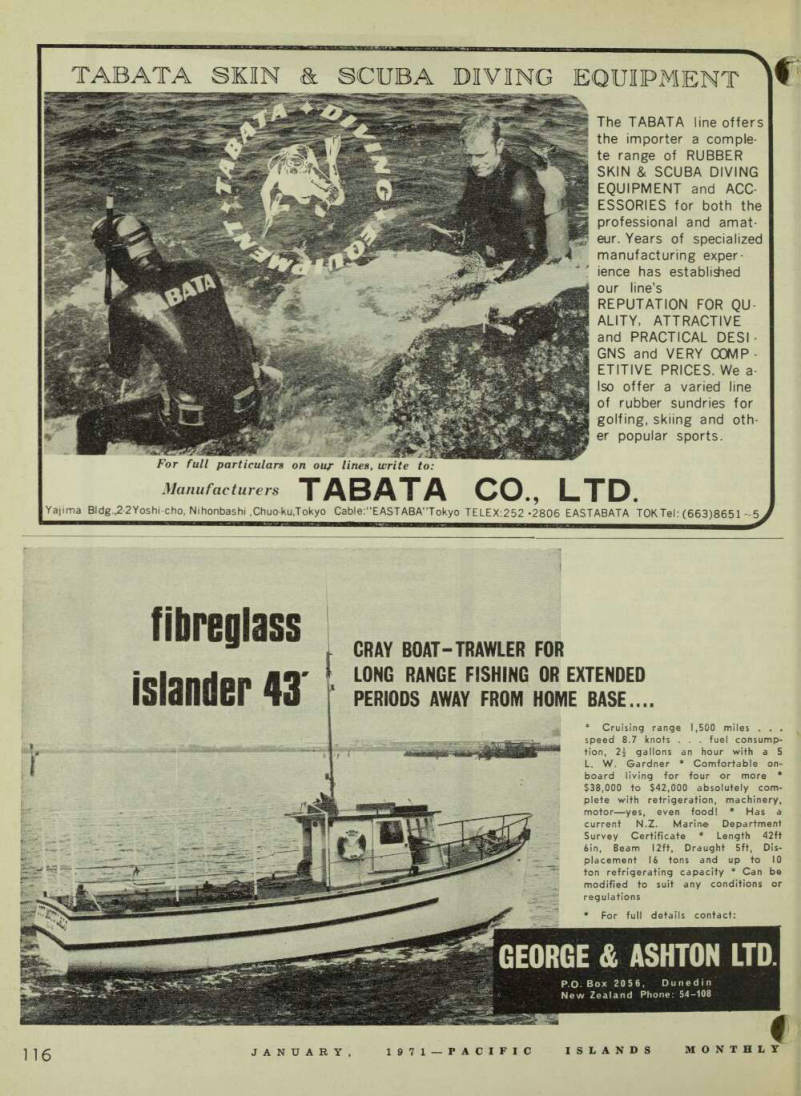
History Of The Henrys
Sir, —On August 26, 1798, in a barn on the banks of Sydney’s Parramatta River at Kissing Point (now Ryde), the Rev. William Hemy preached the first sermon in the district. This event is commemorated annually at the historic church of St. Ann’s at Ryde, where the re mains of William Henry were buried after his death on April 1, 1859.
Together with other missionaries, Henry left England in 1796 in the ship Duff for the Pacific Islands, but the ship was wrecked and Henry found his way to Australia. Whilst awaiting transport to Tahiti he served for a few months in Sydney and it was during this time that the sermon was preached. He served for over 50 years in Tahiti and surround ing areas.
Relatives are known to exist in Hawaii, Auckland and Australia and it is thought that there may perhaps be others in some of the Pacific Islands or that there may be people is those areas who have heard of his ministry. We would be very grateful if any information of his adventures and of his work could be made known to us at the address below.
Headstones in the family grave— restored by members of the family and cared for by St. Ann’s—include the following:— Henrietta Nott, youngest daughter of William Henry, wife of J. Greer, born at Tiarei Island, Tahiti, July 9, 1834.
Ann Moorea, wife of G. F.
Wundenberg, of the Sandwich Islands, died October 30, 1878.
James Shepherd, son of Fev.
William Henry, died February 20, 1891, age 71. Jane, his wife, died May 17, 1898, aged 78.
S. C. G. Moon.
26 Fifth Ave., Eastwood, NSW, 2122. • A revealing chapter on the Rev, Henry is included in a new book (reviewed “PIM”, Nov., p. 85), “Pacific Islands Portraits”, edited by Davidson and Scarr.
Poor Old Joe
Sir, —It was good to read your report of the formation of the Mela nesian Tourist Federation. However, I am sorry that your list of those present at the Vila conference om itted the representative of Newson Advertising and Marketing Ltd., the Fiji-based agency which handles the Mvorld-wide advertising of Fiji Airways
Ltd. and the New Hebrides tourist My good friend Joe Jlders is also more likely to Smoulder” than “moulder” when he ;ees how you have spelt his name!
A. V. Barker.
Advertising and Vlarketing Ltd., Suva. • We're sorry we spelt Joe's name vrongly, as we really know better.
We didn't mention Mr. Barker's company because, as our November 'tory clearly said, we were reporting he formative meeting in Honiara, not Vila. But we think you do an it tractive job with those Fiji Airways ids. (See p. 78).
The "Seeadler"
Sir, —Allow me to make some comment on “Adventures as a >risoner of Count von Luckner” riiich I read with great enjoyment n PIM (August, p. 91).
In the early twenties I was skipper >f the American four-masted chooner Melrose and for several r ears I had with me as AB a man >y the name of Robert Bruce, a lative of Lerwick, Shetland Islands.
Df course he was an A 1 seaman; le had been AB on the American chooner R. C. Slade when she was »rought up by the Seeadler.
His account tallies nearly word or word with the story by Whit ombe. He differs in a few minor •oints. But the capture of the Slade yas nearly the same.
Bruce says the R. C. Slade was tecalmed in the Doldrums, sails latting, not a breath of wind. They ighted a sail to the northward, that apidly lifted itself above the horizon.
Phis fellow is bringing wind, they aid. No one thought of auxiliary ngines. They soon noticed their aistake, when the ship came near, nd ordered them to abandon ship.
Stores were removed from the hip, and so was the slop chest. They lid not forget the coils of new ropes nd bolts of new canvas. By the way, Pbunt von Luckner handed the kipper an itemised account of the ;oods he took from the skipper’s slop best, with an order to the Imperial jerman Government to pay for same, is he considered this to be the kipper’s property, which it was.
The R. C. Slade was now aban loned and the Seeadler moved to a ►osition right ahead of the R. C. lade. They lined up the four masts nd in one shot all four masts went »ver the side. Down she went in all ier glory—holy stoned decks, masts craped and oiled, houses and mlwarks freshly painted—all that vork for nothing. That burned Bruce pV If she had to be captured, why
couldn’t it happen before all this Vork was done.
W The crew of the R. C. Slade were all well treated and they worked in the rigging and did other ship’s work to pass time, for which they were supposed to be paid—he thought in German marks.
Robert Bruce claims that Klinge, the Executive Officer, was the best seaman of them all.
By the way, the French schooner that Klinge captured at Mopelia was the Lettuce, formerly the Gauloise, built in New Zealand and for many years owned by the German Trading Company, Societe Commercial del Oceanic, called SCO for short.
For the life of me, I cannot see why von Luckner would anchor the ship in such a dangerous place as the entrance to the lagoon at Mopelia. There was such a fine place available, Rapa. As the only export was about 30 tons of coffee a year, it was seldom visited by traders out of Tahiti. As shipping was at a premium after the outbreak of the war, ships could not be spared to visit Rapa, and it may have been a year and a half (so I have heard) before the natives of Rapa and its gendarme were informed that a war was going on.
By the way, I am sure that it was Captain Winchester, the father-in-law of James Norman Hall, who com manded the schooner which brought von Luckner’s captives to Tahiti.
Robert Bruce was in the US dredge Culebra when I last saw him. A sail ing ship man at heart, he served in the windships until the very last of that “age of sail”.
Fred K. Klebingat.
Research Associate, San Francisco Maritime Museum, San Francisco.
Who Knows The 'Muritonga'?
Sir, —[ wonder if any of your readers can help me to compile a history of the 38 ft Bermudan stay sail schooner-rigged auxiliary yacht I have recently purchased in Darwin.
I understand she was built in 1948 at the Lyttelton Shipyards, South Island, New Zealand, and was originally named Muritonga. She is said to have sailed at some stage in the area of the Cook Islands.
For the past two years the craft has been known as Red McGregor and has cruised from New Zealand to Sydney and then to Brisbane via the Barrier Reef, along the NE, N, and NW coasts of Australia and around Timor and Indonesia.
Flearsay suggests that she has been involved in a number of colourful and adventures and I would ■ like to confirm some of these stories.
I would also be glad if someone can )tell me what Muritonga means as I 'intend to revert to this name.
I would be very pleased if any information could be sent to me.
With best wishes for the continued success of PIM.
R. H. Timperley.
6 Cooper St., Fannie Bay, Darwin, Northern Territory 5790.
Admiral Nimitz Museum
Sir,—ln Fredericksburg, Texas, birthplace and boyhood home of Fleet Admiral Chester Nimitz, we have under way the Admiral Nimitz Naval Museum, devoted to telling the story of the life of the admiral, and dedicated to all of the fighting men and women of World War 11. It will be one of the finest museums of its kind.
We are seeking objects of all kinds relating to the war in the Pacific (provided they are not too large to be transported to the museum) landing craft, tanks, field guns, objects from ships, aircraft of both the Allies and the Japanese. Especially, we hope to find objects which have stories or legends to go with them, because this will add much to the human interest.
If any of your readers have such things, or know of their where abouts (either above water or below, if they can be salvaged), we will appreciate hearing from them. This could be an opportunity to give a permanent and protected home to objects which will otherwise be lost or destroyed when their present owners pass on.
One example: What about the story of the Coastwatchers—has this been adequately told in any museum? And what of their equipment—radios, personal gear, etc. Has any of this survived? This could be a dramatic exhibit, and we’d like to do it.
I hope that anyone with informa tion or objects to place in the museum will write to us.
Douglas H. Hubbard.
Director, Admiral Nimitz Naval Museum.
Fredericksburg, Texas, 78624.
Malaita's Revival
Sir, —On seeing the report in your paper under the heading “They’re Being Revived on Malaita” ( PIM , Nov., p. 34) I would be grateful if you will give me space to state some real facts concerning this revival. I feel, since the subject has been opened, a movement vitally affecting the lives of over 10,000 people in three months deserves more than a
sketchy, misleading report such as Jas in your November issue.
I have been very closely connected with the revival since it broke out in August and only want to state what I have personally seen and shared in.
One very pleasing feature of this revival has been that very many are being used and not any one particular leader.
As with most spiritual revivals, after the first upheaval there is a steadying down to consistent Christian living, but the movement continues unabated on Malaita and is extending to other islands also, and I believe will eventually have far-reaching effects for good on the whole country.
Personally I have seen hundreds of people delivered from immoral living having been slaves to alcohol and other vices of the white man as well as demon possession, something of which we Europeans know very little, no one having come into contact with such possession would ever think of it as something of a “joke”.
These deliverances are real and only in very isolated instances have I heard of any turning back. Rather are they rejoicing in the joy of coming to know the living God as a mighty reality in their lives.
I have been present when long standing feuds over land and other matters have, I believe, been per manently settled in a spirit of love and forgiveness. As one, I am told, a revived backslider for many years, said to a government officer, “If all Malaita were truly Christian you would have a lot less work to do”.
Yes there are excesses as with all revivals, these are our major prob lems; the enemy is most real and the spiritual warfare intense, at the same time these excesses are grossly exaggerated by some and give mis leading impressions. This applies to your correspondent’s reference to a former mental patient being a local leader.
I hesitate to say anything about miracles of healing; it is easy to ex aggerate so it’s best for those helped to speak for themselves. If your correspondent comes to our house the next time he visits Auki and I happen to be home I will take him to a case where he can see and hear for himself and so get reliable infor mation first hand.
Lastly let me say that attitudes to revivals vary greatly depending on the person to whom one is speaking, it is true what the OLD BOOK says, ‘The natural man receiveth not the things of the Spirit of God for they Ke foolishness unto him. neither can
he know them because they are spiritually discerned”. 1 Cor. 2:14.
George Strachan,
SSEC Missionary.
South Sea Evangelical Church, Auki, Malaita, British Solomons.
Sir, —The signer of this letter, Rev.
John Pasterkamp (from Holland) is the Dutch Pentecostal missionary re ferred to in the article on the Malaita revival. It is clear that your corres pondent who visited Auki recently only heard some of the story but was not well informed at all. This whole article gives a wrong impression of what is happening.
The signer visited the protectorate from June 16 until August 2. Places visited were Tulagi, Honiara and two villages just north of Dala station, North Malaita. At the same time many crusades were held all over the Solomon Islands. These crusades were conducted by Rev. Muri Thomp son, from New Zealand, who was in vited by the SSE Church. What is happening is part of the charismatic movement which is touching many churches in many countries. Through this movement many people have found new realities in their Christian life.
However, we regret that your maga zine associates this movement with a former mental patient and his fol lowers near Auki, which is certainly not the case. TTiis former mental patient was already known in this area long before these revival meet ings were held. He is absolutely not the leader and has no connections whatsoever with this movement, as your magazine likes to state.
If there are any leaders, we like to refer to some pastors and elders of the SSE Church, North Malaita.
Every normal thinking person will abhor the very thought of beating up people.
We would appreciate it very much if you would make rectification of this statement in your magazine as it puts many people in the Solomon Islands and followers of the SSEC in a bad light.
Rev. J. Pasterkamp.
Evangelist, Rabaul, New Guinea, and Dandenong, Vic., Australia. • We’ve had some other letters on the subject besides these. Some of the other letters indicate that the church really is faced with some “excesses” over the revival, and that it has got a lot of unwanted fellow travellers who are doing nobody’s image any good. We hope the church can overcome the problem, but we’re cynical about its chances.
Advertisements & other items, pp. 115-126 (4 items)
Hellaby’S
€ 9 m
CANNED MEATS
ff
CROWN
" PACIFIC
ARROW
11 Nr m ti, m » <"• ff.r m cor nntpt
NOW YOU CAN HAVE A CUMULATIVE INDEX TO THE
FIRST 15 YEARS OF RIM
You can find in a few seconds anything PIAA ever published from issue No. 1, August 1903, to July 1945, on any subject, whether a two-line snippet or a major article. Nearly 10,000 people are listed in the biographical section alone. This valuable, detailed index contains 228 pp. measuring 11 by inches, cloth bound, printed on tough paper.
Price in Australia and P-NG, $25.00, plus 80 cents registered post; elsewhere $1.05 registered post; USA, $30.00 US, including registered post.
PACIFIC PUBLICATIONS (AUST.) PTY. LTD.,
BOX 3408, G.P.0., SYDNEY, N.S.W. 2001.
Our Brushless Alternator power plant
series provides a model for every power
project need
Dunlite offers a choice from the largest range of power plants manufactured in Australia . . . over 200 models, wind-driven and engine-driven, from 1 to 150 KVA ... all available with the superior brushless alternator. Moreover, enginedriven units are supplied with a choice of more than 10 alternative makes of engine.
What makes the Dunlite Brushless Alternator so superior? Because its modern design and safety features have made all others completely out of date and expensive to maintain. With absence of contact brushes the only moving part in the alternator is the heavy duty ball-race. The design is simple, construction rugged and completely self-contained (no separate control panel or switchboard necessary). This Dunlite Brushless Alternator is self exciting, self regulating, self protecting! . . . it's tropic-proofed and is a ready-to-run package unit with no special installation requirements.
For further proof of Dunlite Brushless Alternator superiority see your nearest distributor—he knows!
What other AC power
plant gives you all this
as STANDARD equipment?
★ ENGINE HOUR METER—indicates when to carry out maintenance and oil changes. ★ SINGLE UNIT DESIGN-guaranteeing longer plant life and safer operation.
★ OIL PRESSURE SAFETY SHUT DOWN
—to prevent costly breakdowns.
★ AUTOMOTIVE TYPE STARTER—
eliminates decompressor solenoids, linkages, etc.
★ SIMPLIFIED CONTROL PANELS—for
easy installation. ★ NO D.C. WlNDlNGS—banishes commutator and brush gear problems.
★ STATIC VOLTAGE CONTROL—main-
tains voltage within close limits.
★ 0.8 POWER FACTOR ALTERNATOR
—eliminates costly power factor correction condensers.
DUNLITE ELECTRICAL CO PTY LTD
21-27 FROME STREET, ADELAIDE, SOUTH AUSTRALIA 5000.
Distributed by: — • Rural Services Pty. Ltd., 65 Ipswich Road, Woolloongabba, Brisbane. • New Britain Electrical Co., Rabaul. • N.G.G. Trading Company Ltd., Lae. • Colyer Watson (N.G.) Ltd., Goroka.
KLINKII
DOORS
Retain their original shape and size 9 even in hot and humid conditionsl * Klinkii Placard doors are permanently stable and rigid—resist warping, twisting or swelling in any climate! % Klinkii Placaroi doors are guaranteed extra strong yet light in weight. $ The lock-block frame and panels maintain exact dimensions—withstand temperature extremes.
DISTRIBUTORS: New Guinea Co. Ltd.
Burns Philp (New Guinea) Limited Steamship Trading Company Limited ...
Island Products Limited Collins and Leahy Pty. Ltd.
Arshak C. Galstaun Waso Limited all branches all branches all branches ... Port Moresby Goroka Angoram Wapenamanda % Available in standard sizes.
PIM/2
Made by COMMONWEALTH NEW GUINEA
TIMBERS LTD., BULOLO, N.G.
TABATA SKIN & SCUBA DIVING EQUIPMENT
fpjp.
s A A.
For full particulars on our lines, write to: The TABATA line offers the importer a complete range of RUBBER
SKIN & SCUBA DIVING
EQUIPMENT and ACC-
ESSORIES for both the professional and amateur. Years of specialized manufacturing experience has establidied our line's
REPUTATION FOR QU-
ALITY, ATTRACTIVE
and PRACTICAL DESI-
GNS and VERY COMP -
ETITIVE PRICES. We a-
Iso offer a varied line of rubber sundries for golfing, skiing and other popular sports.
Manufacturers TABATA CO., LTD.
Yajima 81dg..2-2Yoshi-cho, Nihonbashi ,Chuo-ku,Tokyo CabIe:"EASTABA”Tokyo TELEX:2S2 *2806 EASTABATA TOKTeI: (663)8651
fibreglass
islander 43'
CRAY BOAT-TRAWLER FOR
LONG RANGE FISHING OR EXTENDED
PERIODS AWAY FROM HOME BASE...
* Cruising range 1,500 miles . . . speed 8.7 knots . . . fuel consumption, 2? gallons an hour with a 5 L. W. Gardner * Comfortable onboard living for four or more * $38,000 to $42,000 absolutely complete with refrigeration, machinery, motor—yes, even food! * Has a current N.Z. Marin© Department Survey Certificate * Length 42ft 6in, Beam 12ft, Draught sft, Displacement 16 tons and up to 10 ton refrigerating capacity * Can be modified to suit any conditions or regulations * For full details contact:
GEORGE & ASHTON LTD.
P.O. Box 205 6, Dunedin New Zealand Phone: 54-108
Only Pea-Beu Insecticide
guarantees to kill aH
insect pests... FAST!
Pea-Beu is the strongest insecticide
available today
A recent survey, which included laboratory testing, conclusively proved that Pea-Beu aerosol insecticide contained the highest concentration of the world’s most powerful insect-killing ingredients.
Flies, mosquitoes, in fact no insect can survive its powerful fume action. Powerful Pea-Beu penetrates to all corners with devastating effect to all flying and crawling insect pests, even seeking out and destroying those hiding in inaccessible places. Because of its strong concentration, Pea-Beu aerosol insecticide is very economical. You need only short bursts in a room to ensure complete protection from all disease-carrying insect pests.
Pea-Beu kills aM insects
The dangers of diseases spread by insect pests cannot be stressed enough, especially to mothers of young children. Pea-Beu is the only insecticide that will kill all insect pests, even the hardy cockroach. Regular spraying with powerful Pea-Beu aerosol insecticide will eradicate insect pests such as flies, mosquitoes, cockroaches, fleas, ants, moths and silverfish and all insect pests that bring the dangers of disease into your home.
Always remember the health of your family depends on your choice of insecticide. Powerful Pea-Beu is guaranteed to kill all diseasecarrying insect pests before they have a chance to bring illness into your home.
Powerful Pea-Beu—guaranteed the strongest, most
powerful insecticide available today.
MORRIS
HEDSTROM
LIMITED
HEAD OFFICE: SUVA, FIJI
• GENERAL MERCHANTS
• MEAT PROCESSING
FACTORY
• PRODUCE BUYERS
• IMPORTERS AND EXPORTERS
• PLANTATION OWNERS
• COMMISSION AND
INSURANCE AGENTS
LONDON OFFICE:
MORRIS HEDSTROM LTD.,
Park House, 22 Park Street, Croydon,
CR9 BNP
AUSTRALIAN
REPRESENTATIVE:
W. R. CARPENTER & CO. LTD.,
(Merchandise Division) the A, £r N.Z. Building, 68 Pitt Street, Sydney, 2000 Registered Cable Addresses: • DEUBA-SUVA • MORRISHED-LEVUKA • CAMOHE-SYDNEY • SUVAMARK-LONDON • MORRISCO-NUKU'ALOFA • DEUBA-APIA • CODES: ALL
AGENTS AND DISTRIBUTORS FOR:
• Adhesive Tapes Ltd. • Bacardi International • China Navigation Co. • John Dewar £r Sons Ltd. • Electrolux Limited • Evinrude Outboard Motors • Ford Motor Co. • General Electric Co. Ltd. • Glaxo Laboratories • Goodyear Tyre & Rubber Co. • Guinness Exports Ltd. • Imperial Chemical Industries • Matson Navigation Company • Mobil Oil Australia Pty. Ltd. • Max Factor & Co. Inc. • Napier Bros. Ltd. • Parker Pen Company Proctor Cr Gamble • Rootes Ltd. • Rowntree & Co. Ltd. • Smiths English Clocks Ltd. • Tanqueray Gordon £r Co.
Ltd. • Taubmans Ltd. • Yorkshire Imperial Metals Ltd.
Morris Hedstrom Ltd. are LLOYD'S AGENTS in FIJI and SAMOA For friendly service and complete satisfaction it’s Morris Hedstrom Ltd. in
FIJI - SAMOA - TONGA
o /S\
t Vtcia 1
timer 3
TIME TO TURN
GRASS
INTO LAWN!
A model available to suit all conditions and every purpose.
Obtainable from:
SUVA MOTORS LTD.
Suva, Lautoka.
ISLAND PRODUCTS LTD.
Port Moresby.
NEW GUINEA CO. LTD.
Rabaul, Madang, Lae, Mount Hagen, Minj, Goroka.
5® .6>S
SOUTHERN PACIFIC INSURANCE
COMPANY LIMITED
Head Office: The Wales House, 66 Pitt Street, Sydney.
Specialising in Pacific Island Insurance requirements for over 30 years. e FIRE • FIRE AND VOLCANIC ERUPTION • HOUSEHOLD COMPREHENSIVE • MOTOR VEHICLE e COMPULSORY THIRD PARTY • COMPULSORY WORKERS' COMPENSATION
e PUBLIC LIABILITY • MARINE
Enquiries invited for all classes of insurance from special representatives ati RABAUL: Jack T. Ray—Manager for Papua & New Guinea, Mango Avenue. P.O. Box 123.
LAE: Alex B. Barker—Manager at Lae, Kam Hong's Building, Central Avenue. P.O. Box 758. PORT MORESBY: H. A. K. McKee—Manager at Port Moresby, Maloney's Building, Cuthbertson Street. P.O. Box 136. SUVA-FIJI; L. M. Rolls—Manager for Fiji, McGowan's Building, Margaret Street. P.O. Box 521.
♦ SULLIVAN EXPORT SERVICE *
C. SULLIVAN (EXPORT) PTY. LTD.
4th Floor, Kemblo Building,
60 MARGARET STREET, SYDNEY, 2000, N.S.W.
Telephone: 29-8144 (6 lines). Telegrams and Cables: CHASULL, Sydney
MELBOURNE
C SULLIVAN (EXPORT)
PTY. LTD.
59 William Street, Melbourne, 3000, Vic.
Telephone: 62-6600.
Cables and Telegrams: CHASULL, Melbourne.
BRISBANE
C. SULLIVAN (Q'LAND)
PTY. LTD.
Empire House, cnr. Queen & Wharf Sts., Brisbane. 4000
NEW ZEALAND
C. SULLIVAN (N.Z.)
LTD.
Levein Building, cnr. Paul & Airdaie Sts., Auckland, 1 Telephone: 36-0472.
Cables and Telegrams: CHASULL, Auckland.
LONDON • SAN FRANCISCO
Also at: PORT MORESBY • LAE • RABAUL • SUVA • LAUTOKA 9
OFFERING A COMPREHENSIVE BUYING SERVICE
TO ISLANDS CLIENTS
(G.P.O. Box 1697 V, Brisbane, 4001.) Telephone: 24958.
Cables and Telegrams; CHASULL, Brisbane.
OTHER HANOI PRODUCTS!
'Handi' range of quality products also includes: a portable Twin-Burner Stovette and 'Handi' Pumpless Petrol Iron.
I
Keep a
handy!
No need to fumble and fume! Throw light on the subject with a 'Handi'. It's twice as bright as electric light. Completely stormproof. Simple and safe to use.
PRESSURE OPERATED
One filling gives 12 hours of brilliant 300 candle-power lighting. Built to last, with chromed, rust-proofed finish. Petrol or Kerosene models.
Ask for Handi! Everywhere!
HANOI WORKS PTY. LTD,
Compo Rd., Salisbury North - Ph. 472122
BRISBANE, QUEENSLAND, AUSTRALIA
D A gubbay PTY. LTD
ISLAND
BUYING AGENTS
FURNITURE
AGRICULTURAL EQUIPMENT
CONSTRUCTION EQUIPMENT
CANNED FOOD
TOYS & SPORTSGOODS
BUILDERS HARDWARE
HOTEL & MOTEL SUPPLIES
I K * S 3 &sc * Experience and Knowledge Serving the Islands.
D. A. GUBBAY PTY. LTD
149 Castlereagh Street, Sydney, N.S.W., Australia Telephone: 61-9989, 61-8320.
Cables: NANYOTRADE SYDNEY.
The only book telling the vivid history of Tahiti from its discovery to the present day
Robert Langdon’s
TAHITI: ISLAND OF LOVE
HARD COVER; Australia and P.-N.G., $3.30 Aust., plus 25c posted; Pacific Islands and overseas countries, $3.30 Aust., plus 35c posted; U.S.A. $4.15 U.S. posted.
A vailable from.
PACIFIC PUBLICATIONS (AUST.) PTY. LTD.,
29 Alberta Street, Sydney, N.S.W. 2000, Australia. (Postal address; Box 3408, G.P.0., Sydney, N.S.W., 2001, Australia.) PRICE: SOFT COVER; Australia and P.-N.G., $1.95 Aust., plus 25c posted; Pacific Islands and overseas countries. $1.95 Aust., plus 33c posted; U.S.A $2.75 U.S. posted.
W. H. GROVE & SONS LTD.
Established 1896
EXPORTERS
P.O. Box 490, Auckland, New Zealand.
Telegraphic and Cable Address: 'Grove' Auckland. • Entrust your requirements to the firm with more than 70 years' practical experience in exporting to the Pacific Islands.
Accredited Agents for The New Zealand Dairy Board, The New Zealand Apple and Pear Marketing Board and exporters of all classes of New Zealand manufactured goods and produce. • IN FIJI as W. H. GROVE & SONS (FIJI) LTD.
FOR CONSISTENT HIGH QUALITY
USE
FLOUR
akHiw ■ T r\ Terry Road, Dulwich Hill, N.S.W. 2203 PTTt LXW* Cables: "Beacon and Brunlon". Phone: 56-1448.
Established 1868 Australia’s oldest export flour millers.
Particular
about
taste and
quality?
m iili
AIG
This is the pure Scotch.
For three and a half centuries, Haig has preserved in its unique blend a taste that can never be duplicated, a quality that cannot be matched.
don't be
vague
ask for...
Haig
The scotch whisky for particular people.
FLETCHERS
are exporting
o Cold Stores
A complete package in
cold stores now available from New Zealand.
Write for brochure or
specific proposals
Further Information from:
o*7 FLETCHER
INTERNATIONAL
Private Bag, Auckland, New Zealand.
U.K. AND EUROPE
Tour with Maximum Freedom, Comfort and Economy in a Vehicle from
MOTOR CARAVAN CENTRE
"The Friendly Agents"
Over 200 Motor Caravans available.
Generous "Buy-Back" Plan. Rentals arranged. Send now for full details or send $1.30 for our "Book of Motor Caravans".
ACRE LANE, LONDON, 5.W.2,
ENGLAND.
Europe's Biggest Dealers.
Pac. Islands
AIRVIEWS OF
NEW ZEALAND
Photographs of every district . . also pictorial ground scenes. Representative views of South Pacific Islands.
Pictures available for use in books or feature articles —send for price list.
WHITES AVIATION LTD.
C.P.O. Box 2040, Auckland, New Zealand.
AUSTRALIA'S "HOME OF SPORT"
FOR ALL SPORTING REQUIREMENTS AND EQUIPMENT
• Football shorts, guernseys and a wide assortment of football boots • Hunting, shooting and fishing • Scuba diving equipment • Tennis, squash and badminton rackets • Golf clubs, bags, buggies and balls • Boxing gloves • Bar-bells and weights.
SPECIAL BULK BUYING FACILITIES FOR TEAM SUPPLIERS.
ORDERS AND ENQUIRIES TO MICK SIMMONS,
720 George Street, Haymarket, N.S.W. 2000, Australia.
SPECIAL ATTENTION GIVEN ALL MAIL ORDERS.
FLETCHERS
are exporting
A it o w Pre-cut, treated, timber buildings Pressure-treated timber poles and posts Plyco softwood and plywood Plyco particle board Further information from:
FLETCHER
INTERNATIONAL
Private Bag, Auckland, New Zealand.
Established Cable Address:
1870 “ WEYSEAS, SYDNEY "
Place yourselves in the hands of Specialists for your requirements in
FRESH FRUIT & VEGETABLES
POTATOES & ONIONS
★ We invite your enquiries WEYMARK & SON (Overseas) Pty. Ltd.,
14-18 STEAMMILI STREET, SYDNEY, N.S.W. 2000
Introducing
CORRASCOPE FILMS
in Beautiful Colour!
50 ft. (8 mm.) 100 ft. (16 mm.)
200 DIFFERENT SUBJECTS
Japan Hong Kong Philippines Vietnam Bangkok Singapore Borneo Ceylon India Teheran Greece France Italy Spain Switzerland Netherlands England U.S.A. Panama Peru Bolivia Honolulu Tahiti Fiji, Etc.
Catalogues Upon Request
FILMO DEPOT
313 Marina House, Hong Kong.
THE
YORKSHIRE INSURANCE
CO. LTD.
(Incorporated in England)
A MEMBER OF THE GENERAL ACCIDENT GROUP OF COMPANIES
ALL CLASSES OF INSURANCE
AUSTRALIAN HEAD OFFICE; 10-12 Spring Street, Sydney.
Group Manager for Australia; R. M. Trotter.
PAPUA AND NEW GUINEA BRANCH: Douglas Street, Port Moresby.
Manager: J. L. Walters, A.A.1.1.
CHIEF ISLAND REPRESENTATIVES
Port Moresby, James Services Pty. Ltd.; Rabaul, A.S.P. (N.G.) Ltd.; Lae, Radio Cabs (Lae) Pty.
Ltd.; Madang, W. Stokes; Manus, Edgell & Whiteley Ltd.; Honiara, 8.5.1. P., E. V. Lawson, Ltd.; Suva, Williams & Gosling Ltd.; Noumea, R. Laubreaux; Norfolk Island, Martin's Agencies; Apia, E. A. Coxon & Co.
115
ACIFIC ISLANDS MONTHLY JANUARY, 1971
121
PACIFIC ISLANDS M O N T H L Y J A N U A R Y , 1971
124
JANUARY, 1971 PACIFIC ISLANDS MONTHL
Islands Press

From the Islands Press
ACCORDING to a travel writer in the New York Post, “Fijians aren’t yet used to great concentrations of foreigners, so they’re still just about the friendliest people you’ll find anywhere”. So we locals should be able to enjoy quiet weekends at Deuba for a year or two yet before the place starts filling up and some of us presumably go on the warpath.— Note in “The Fiji Times”.
TO those who know that I, with others, have agitated for years to have a strip built on the island, it will perhaps be surprising to hear that I am saddened by the realisation that the flying-boats will soon become a thing of the past. But there is nothing really strange about this. To every island resident it will be truly sad as the realisation dawns that an era is coming to an end. I travelled on “Australis’ ” first scheduled flight to the island. My very living has depended on “Australis”, “Antilles”, “Pacific Chieftain”, “Beachcomber” and “Islander”, and I have probably made as many flights as any resident . . . and certainly no-one has been such a regular visitor to the lagoon to watch them land.— Lord Howe Island's “Signal ” editor, James Whistler, in an editorial.
Examinations seem to be getting tougher all the time.
For example, the question from yesterday’s junior geography paper, which was worth 10 marks: “Explain the reasons for the findings of, and importance of, Lord Denning’s report.” There is scope for some interesting answers to that one.— Comment in “The Fiji Times”.
MICK LEAHY of Zenag has been awarded the 1971 medal for exploring by the American Explorer’s Club and will go to New York next April to receive it. And there he’ll find a jungle in which he’ll need all his bushcraft to survive. Exploring Manhattan in the 1970’s calls for a very intrepid character indeed.— Comment from the “Drum” column of the “Papua-New Guinea Post Courier”.
A WEDDING feast was held at the Roman Catholic Mission Station at Makina, Marau Sound, recently, je which payment of the bride-price
w as made in the church for the first in the area. Our correspondent in a letter that paying a bride pce in a church was a new thing For the people of that area and was matched by everyone who attended he wedding service. The normal procedure is that the bride-price is agreed on by the parents and made according to custom of the people.— Uem in BSIP newssheet.
ON October 16 the Marine Base, Tulagi, reported what appeared o be gas escaping from a cylinder m the deck of a wartime vessel. The ;as came to the surface about 300 rards off the island. The senior fore nan shipwright, Mr. W. Thompson, aid the gas discoloured the water in he area of a known wreck and also ormed a slight haze over the area, le said the same thing happened on everal occasions over the past few 'ears and was thought to be caused •y large bottles of gas breaking away rom the wreck and floating to the urface. —ltem in BSIP newssheet.
A MEMBER of the SIBS staff ■A. recently had an operation at Central Hospital after a garfish /hich leapt out of the sea stuck in is hand while he was fishing. He /as Mr. Paul Beni, who is now at home in Honiara after n operation in which the fish’s pear-like mouth was taken from is hand. The fish entered between vo fingers and stuck out near his /rist. ... A giant coral trout caught y two 12-year-old schoolboys from t. Barnabus School, Dala, Malaita, /as enough to provide a feast 3r the whole school. The fish, aid to be 8 ft long, was caught by loland Mabe and Patrick Uluitalay. -Two fish stories from BSIP news heet. i T the conference of the Cook a. Islands Women’s Federation at dtutaki, Mr. Arthur Helm spoke on tourist support facilities”, with mphasis on the role that women auld take.
In response to questions put to rem, the women wanted good mrists to have an unlimited stay nd bad tourists to be sent away nmediately. They considered that omen can contribute a good deal > making the visitors’ stay enjoy fle, by preparing souvenirs of pical Cook Islands design, for sale ; reasonable prices. They want rices to remain as they are and 3t to rise once the visitors arrive, [any will be looking for part-time Dsitions when the hotels open.— em in the “Cook Islands News”, tes ptonga.
Advertisements & other items, pp. 127-132 (3 items)
&Wmt Cad^mefA
CadSmifA
$ want Cadimcf A
&u/twt Cadiu/ufA
o It’s worth saying over and over again because there’s a glass and a half of pure, fresh, full-cream milk in every half-pound of Cadbury Dairy Milk Chocolate. No other chocolate can possibly give you that creamy, creamy Cadbury taste. Look for the famous purple wrapper.
CADBURY
DAIRY MILK CHOCOLATE
the biggest selling block chocolate in Australia M 04/32/0
inid.iiihr
MADE IN GERMANY
icmßfr
fm 1111 i[|
f relrom a"?
PiTJ.d Petromax products exclusively available from:
Breckwoldt & Co.
Head Office: Hamburg / Germany our branches are: M»1
BRECKWOLDT & CO. (N.G.) PTY. LTD.
P.O. Box 222, RABAUL.
P.O. Box 1549, Boroko, PORT MORESBY.
P.O. Box 185, MADANG.
P.O. Box 557, LAE.
P.O. Box 72, KIETA.
P.O. Box 237, MT. HAGEN.
P.O. Box 178, WEWAK.
BRECKWOLDT & CO.
P.O. Box 47, APIA.
BRECKWOLDT & CO. (5.1.) LTD.
P.O. Box C 5, HONIARA.
Ask for FOUREX—the dear sparkling amber beer... available in BOTTLES, CANS and GLASS CANS
The Popular
‘lts Quality Never * Wholesale Distributors:
C. SULLIVAN
(NEW GUINEA) LTD.,
Rabaul, Lae, Madang and Port Moresby.
Also at Lautoka and Suva, Fiji
aSTLEMAIN
ggSUEMATn|
.xxxx,
•'fTERAt* SO
CASUJMAIHi
*XXX
bitter ale uieato Brewed from the finest Ingredients by Castlemaine Perkins Limited, Brisbane, Queensland, Australia.
D apua new guinea
printing co. ply. ltd.
Supplying the Territory with:
COMMERCIAL JOB PRINTING
PAPER RULING
STATIONERY REQUIREMENTS
RUBBER STAMPS
Mail Orders Invited P.O. Box 633, Port Moresby P.O. Box 759, Lae P.O. Box 30, Mount Hagen Cables & Telegrams: Printer Port Moresby and Lae
SPECIALIST EXPORTERS
POTATOES ONIONS
GARLIC BLUEPEAS
FRESH FRUIT AND VEGETABLES
N.Z. DAIRY BOARD GHEE
GERRARD WIRE TYING EQUIPMENT
GENERAL MERCHANDISE COOLER
FREEZER
Current Quotations from:
Turners Supply Company Limited
P.O. Box 1370, AUCKLAND. Cables "TUSCO" Auckland.
PACIFIC EXPORT DIVISION of TURNERS & GROWERS LTD. Wholesale Fruit and Produce Merchants, Auckland, New Zealand.
YOUR NEXT LEAVI
Modern up to the minute homes at Palm Beach, Avalon, Newport, Church Point, Mona Vale, etc., available to Island Residents for Holidays. Write for information
J. T. STAPLETON PTY. LTD.
ESTATE AGENTS,
133 PITT STREET, SYDNEY, 2000. 25-5305, 25-1737 or any of the Branch Offices located at Newport, Avalon, Palm Beach.
♦ Established 1890 offering merchants in the Pacific, buying service giving prompt, careful and expert attention to all requirements.
For that service with a difference, cable "Success", Sydney.
Sole Distributors in the Pacific for: Tilley lamps, Plastevic antifouling paints, Fulda tyres, Success & Tiara footwear, 4711 Eau de Cologne, Hilite batteries, Woodcemair prefab houses, Ross frozen foods, Balgay jams, Success canned fish, kerosene refrigerators jute sacks, ice cream, torches, textiles, furniture, electric appliances. $ &
HIGHEST PRICES OBTAINED ON WORLD MARKETS
FOR YOUR
SHELL - COCOA - COFFEE - COPRA - ETC.
31 MACQUARIE PLACE, SYDNEY, N.S.W. 2000.
G.P.O. BOX 5315, SYDNEY, 2001.
'SUCCESS'—Sydney
CABLE ADDRESSES
'TAITCO'—Sydney
Head Office:POßT MORESBY PAPUA CabIe:BURPH IL
agents for Burns Philp Trustee Co. Ltd.
Queensland Insurance Co. Ltd.
Lloyds of London Stewarts & Lloyds Distributors Pty. Ltd.
Shell Company (Pacific Islands) Ltd. overseas agents Burns Philp & Co., all Australian States Burns Philp & Co. Ltd., London Burns Philp Co. of San Francisco Inc.
TRADE INQUIRIES INVITED
shipping agents for Austasia Line Bank Line Ltd.
Burns Philp & Co. Ltd.
Cogedar Line Campagnie Des Messageries Maritimes Chandris Line Cunard Steamships Co. Ltd.
Nederland Line Royal Dutch Mail P.&O. Orient Line Royal Rotterdam Lloyd The Indo-China Steam Navigation Co. Ltd.
Union Steamship Co. of N.Z. Ltd. air line agents for Ansett-A.N.A.
Trans-Australia Airlines Qantas Empire Airways International Air Transport Representatives travel department Consult our experienced personnel for planning world wide travel
Hffl
distributorships include Beresford Pumps Briggs & Stratton Engines British Paints Buckingham and Carnatic Textiles Citizen Watches “Cecoco” Machinery Conditionaire Air Curtain Doors Hardie’s Building Products International Majora Paints “John” Valves Joseph Lucas Electrical & C.A.V. Equipment Massey-Ferguson Tractors and Equipment Mikimoto Pearls National Radios & Appliances Noritake Chinaware Rover Power Mowers Sunbeam Appliances Tempair Air Conditioners Vauxhall Cars & Bedford Trucks exporters of Coffee & Cocoa Beans, Peanuts, Rubber & Trochus Shell branches and shopping centres PAPUA; Port Moresby, Boroko, Samarai, Popondetta and Daru NEW GUINEA: Rabaul, Kokopo, Kavieng, Lae, Wewak, Madang, Goroka, Wau, Bulolo, Kainantu and Mt. Hagen
RD BURNS PHILP (NewGuinea)LTD.
J Head Office Port Moresby Telex PM 116 Telegrams all centres Burphil
COFFEETEA
ORLD MARKETS
WORLD TRADERS
IN THE PACIFIC
TT N 9 S EW
GUINEA
ft \ V & HI
SUVA
MARKETS
. % it r : ;
OV3R
SYDNEY
Ft C^3
NEW ZEALAND
AUCKLAND
The W. R. Carpenter Group has been a major trader between the Pacific Islands and the rest of the world for more Associated companies of the Group in the Pacific Islands include: than 55 years. As a grower, buyer and processor of island produce such as copra, coffee and cocoa beans the Group has contributed to the economic progress of the area and
of its peoples.
PAPUA AND NEW GUINEA
W. R. Carpenter (T.P.N.G.) Limited Coconut Products Limited New Guinea Company Limited Boroko Motors Limited The Group is also a wholesaler and retailer and holds many
leading agencies, including
• NISSAN/DATSUN • FORD • DEWARS WHISKY
• ELECTROLUX • GORDON'S GIN
• EVINRUDE • VICTA
FIJI
W. R. Carpenter (South Pacific) Limited Carpenters (Fiji) Limited Morris Hedstrom Limited Millers Limited Island Industries Limited Suva Motors Limited
W. R. CARPENTER & COMPANY LIMITED^
68 PITT STREET CABLES: U.K. OFFICE:
127
ACIFIC ISLANDS MONTHLY JANUARY. 1971
Published by PACIFIC PUBLICATIONS (AUST.) PTY. LTD.. 29 Alberta Street, Sydney, 2000. (Telephone. 61-9197). Wholly set
and printed in Australia bv The Sydney and Melbourne Publishing Co. Pty. Ltd., 29 Alberta Street. Sydney.
REGISTERED AT THE GPO SYDNEY FOR TRANSMISSION BY POST AS A NEWSPAPER — CATEGORY B.