His Eye Is On The Kokoda Track
p. 61 · Read in the full issue
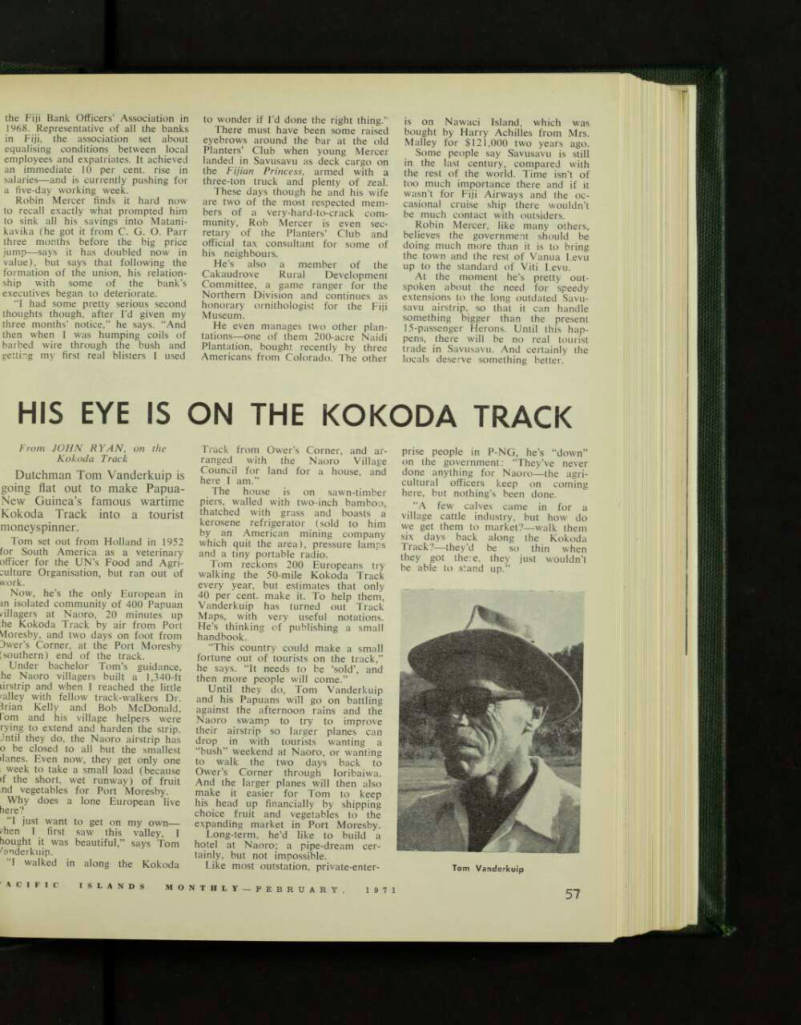
From JOHN RYAN, on the Kokoda Track Dutchman Tom Vanderkuip is going flat out to make Papua- New Guinea’s famous wartime Kokoda Track into a tourist
moneyspinner.
Tom set out from Holland in 1952 for South America as a veterinary officer for the UN’s Food and Agri culture Organisation, but ran out of work.
Now, he’s the only European in in isolated community of 400 Papuan /illagers at Naoro, 20 minutes up he Kokoda Track by air from Port Moresby, and two days on foot from Dwer’s Corner, at the Port Moresby [southern) end of the track.
Under bachelor Tom’s guidance, he Naoro villagers built a 1,340-ft lirstrip and when I reached the little 'alley with fellow track-walkers Dr.
Brian Kelly and Bob McDonald, fom and his village helpers were rying to extend and harden the strip.
Jntil they do, the Naoro airstrip has o be closed to all but the smallest (lanes. Even now, they get only one week to take a small load (because >f the short, wet runway) of fruit nd vegetables for Port Moresby.
Why does a lone European live here?
“I just want to get on my own— /hen I first saw this valley, I bought it was beautiful,” says fom Vanderkuip.
“I walked in along the Kokoda
Track from Ower’s Corner, and ar ranged with the Naoro Village Council for land for a house, and here I am.”
The house is on sawn-timber piers, walled with two-inch bamboo, thatched with grass and boasts a kerosene refrigerator (sold to him by an American mining company which quit the area), pressure lamps and a tiny portable radio.
Tom reckons 200 Europeans try walking the 50-mile Kokoda Track every year, but estimates that only 40 per cent, make it. To help them, Vanderkuip has turned out Track Maps, with very useful notations.
He’s thinking of publishing a small handbook.
“This country could make a small fortune out of tourists on the track,” he says. “It needs to be ‘sold’, and then more people will come.”
Until they do, Tom Vanderkuip and his Papuans will go on battling against the afternoon rains and the Naoro swamp to try to improve their airstrip so larger planes can drop in with tourists wanting a “bush” weekend at Naoro, or wanting to walk the two days back to Ower’s Corner through loribaiwa.
And the larger planes will then also make it easier for Tom to keep his head up financially by shipping choice fruit and vegetables to the expanding market in Port Moresby.
Long-term, he’d like to build a hotel at Naoro; a pipe-dream cer tainly, but not impossible.
Like most outstation, private-enter
prise people in P-NG, he’s “down” on the government: “They’ve never done anything for Naoro—the agri cultural officers keep on coming here, but nothing’s been done.
“A few calves came in for a village cattle industry, but how do we get them to market?—walk them six days back along the Kokoda Track?—they’d be so thin when they got the:e, they just wouldn’t be able to stand up.”
Tom Vanderkuip