Do the Solomons need more tourists
pp. 61-62 · Read in the full issue
in bikini top and grass skirts?
From DAVID KEATING in Honiara The day a passenger cruise ship calls is quite an event in Honiara. The ship usually anchors off Point Cruz at daybreak like some giant Noah’s Ark; then over 1,000 passengers swarm ashore in the liberty boats which ferry back and forth throughout the day. Ostensibly the passengers come to see a fairly unspoiled spot of Melanesia and the people who live here, but unknown to them, Honiara attracts a large number of islanders who come to see them!
And what a sight it is. Honiara —five times in 1970—is transformed from quiet, sleepy existence to an almost frantic hustle and bustle.
Taxis dash to and fro; local car owners drive people around the town; everywhere men can be seen selling carvings; the internal airways com pany sends its two planes flying round the town; dancing displays are given, and generally a carnival air pervades the place.
Occasionally a large lady from the ship is seen in a bikini top and grass skirt—always a great attraction with the locals—and there is the usual hard core in the bars; but most visitors wander round the town, seeing the dancing or whatever else interests them. Early evening it is all over and Honiara settles back into its old routine.
If tourism develops here, will it
be like a ship’s visit every day? Who will benefit—the ordinary Solomon Islander? And if so, how? Will the Solomons become just another tourist resort in the Pacific? What effect will tourism have on local customs and culture? Will the local arts, such as carving, suffer? Questions like these and many others are being asked by people from all backgrounds.
In April, 1970, the BSIP Tourist Authority was established in the Solomons. Its stated objects are to foster the orderly development of tourism; to stimulate the acceptance of the tourist industry and the recognition of its value, and to promote tourist activities.
Unlike (as far as I know) all other such authorities, the tourist authority here has power to license tourist activities and to prevent any tourist activity from operating without such
a licence. The authority is an autonomous body, but the High Commissioner appoints its members.
Although independent of government it may be expected to follow govern ment policy or wishes.
There are at present nine members.
Four Solomon Islanders represent the local view point, namely, Francis Bugotu, Inspector of Schools; Billy Gatu, the Social Welfare Officer; Salena Ga’a, a headman on Malaita and Mrs. Kitchener Palmer, wife of the Rev. Norman Palmer, of the Anglican Church. Three members represent existing local tourist enter prises, namely, Paul Brown, of Mendana International Travel, which is associated with Hunts of the Pacific, Bruce Saunders, of Blum’s Hometel, who is also operations manager for Hunts in the Solomons, and John Seaton, of Solair, the in ternal airline. The last two represent the public service, namely, Tony Nash, the deputy Conservator of Forests, and Roger Burrow-Wilkes, Comptroller of Customs and Excise, and who is chairman of the authority.
It’s perhaps significant that the Solomon Islanders in the authority form the largest block though not the majority.
The authority began in the wake of a much publicised speech of Denys Hibbert, former Director of Education, who made a sharp attack against tourism in the Solomons in a speech before the last meeting of the former Legislative Council, when the ordinance creating the authority was being debated.
What has the authority done since April? Initially the work has been one of appraisal of the existing situa tion. Contrary to hopes or fears of some people, the authority is not going to operate a closed shop for the benefit of existing tourist under takings when exercising its licensing control.
In appraising the existing situation, the authority will be considering what aspects of the Solomons will appeal to visitors. Other countries have good scenery and equable tropical climates,
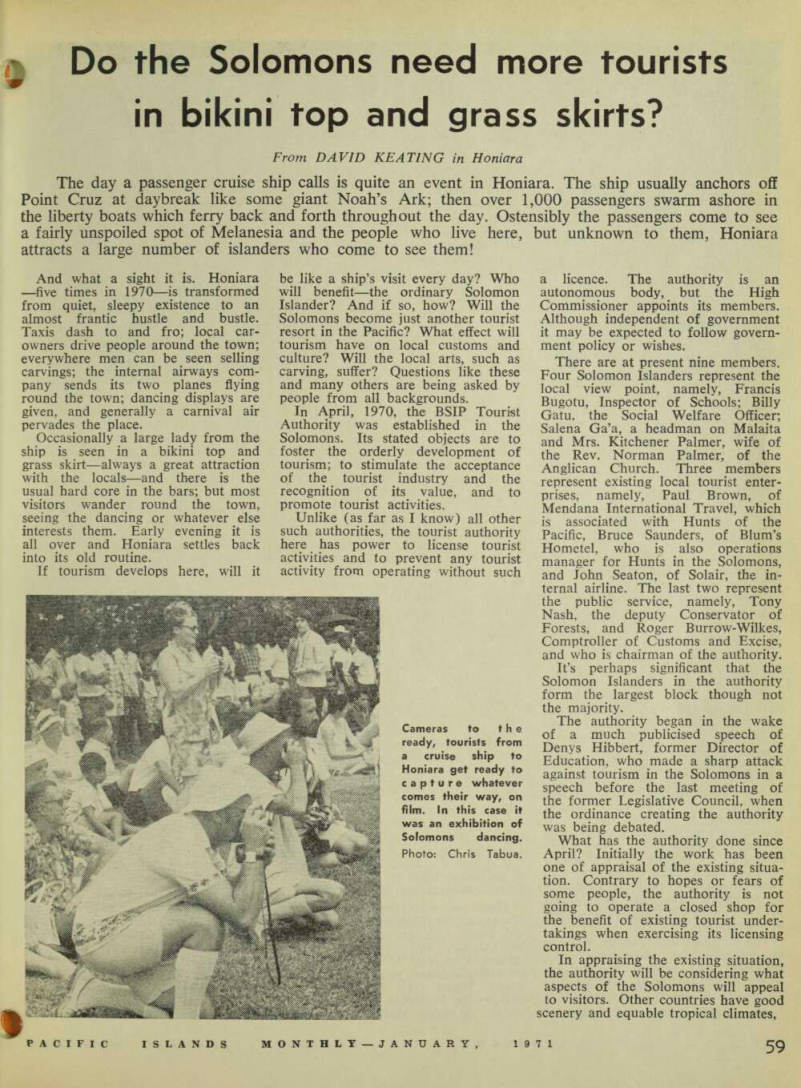
Cameras to the ready, tourists from a cruise ship to Honiara get ready to capture whatever comes their way, on film. In this case it was an exhibition of Solomons dancing.
Photo: Chris Tabua.
so what is there particularly in the Solomons to appeal to visitors?
In his 1968 report on tourism in the Solomons, Rory Scott mentioned the battlegrounds of the Pacific War.
For most people in fact it was the war that put Guadalcanal on the map. One can still wander over Bloody Ridge and see relics of the bitter fighting, or drive in and around the now deserted and overgrown Carney Airfield.
He mentioned the fine opportunities for collecting sea shells. In fact recently a local diver discovered several Gloria Maris shells. And finally, another feather in our cap, the friendliness of the Islanders.
Next, the authority has had to consider what and how many visitors will come to the Solomons.
Apart from the occasional cruise ship, most visitors are not in fact holiday makers, but business people.
But the number of actual tourists seems to be increasing.
However, several factors outside the authority’s direct control play a part in limiting the number of visitors. First, the cost of getting here—Sydney air return economy class, 5A381.20, or San Francisco return economy class, $1,042.20 — puts most travellers out of the market. Secondly the three hotels in Honiara can only cater for about 45 people at any one time. Thirdly the aircraft at present servicing the Solomons are DC3’s, Friendships and HS74B’s, which only carry 24, 36 and 40 passengers respectively.
While Honiara remains a stop-over point rather than an actual resort, the size of plane and hotel accom modation will remain static. A hotelier is unlikely to start a new hotel unless he is assured of sufficient people coming to the place in the first instance. At present only Fiji Airways and TAA have the right to bring in flights. Once another operator comes in, the spell will be broken and also, one hopes, fares will be reduced.
The tourist authority hopes to take advantage of Honiara’s present position as a stop-over point and encourage people to stay a few days in the Solomons on their way through. To this end it has joined New Guinea, New Hebrides and New Caledonia to promote Melanesia as a tourist area, and has joined PATA to gain entry to the American tourist market.
The authority is, however, anxious to preserve the identity of the Solomons and prevent the protec torate from becoming just another Pacific tourist resort.
No doubt because of increased
promotion of tourism in New Guinea and in the New Hebrides, Hunts of the Pacific have decided that the Solomons has good potential in the tourist market—for if the other two territories have a tourist boom it will undoubtedly affect the Solomons * ie * n between.
The authority is therefore planning to inform the people why tourists come: and recently held, in conprises 0 " course an re. to o„ r The Ca S„o 0 l y n haVe
1-1 7? „■ ■ th s
ss JssAssr .a
people who will benefit will be only foreigners . . . although the local people will get employment it will only be as bartenders and other menial work . . . prices will rise because of the tourists’ increased buying power, so that the Islanders will end up relatively worse off . , . casinos and night clubs will spring up spoiling the place.
Others feel that western culture will have its affect on the Solomons whether tourists come or not and that in any event, if the Solomon Islanders lost their culture then they would lose the tourists also, and that if the prices went up, this too would deter tourists from coming.
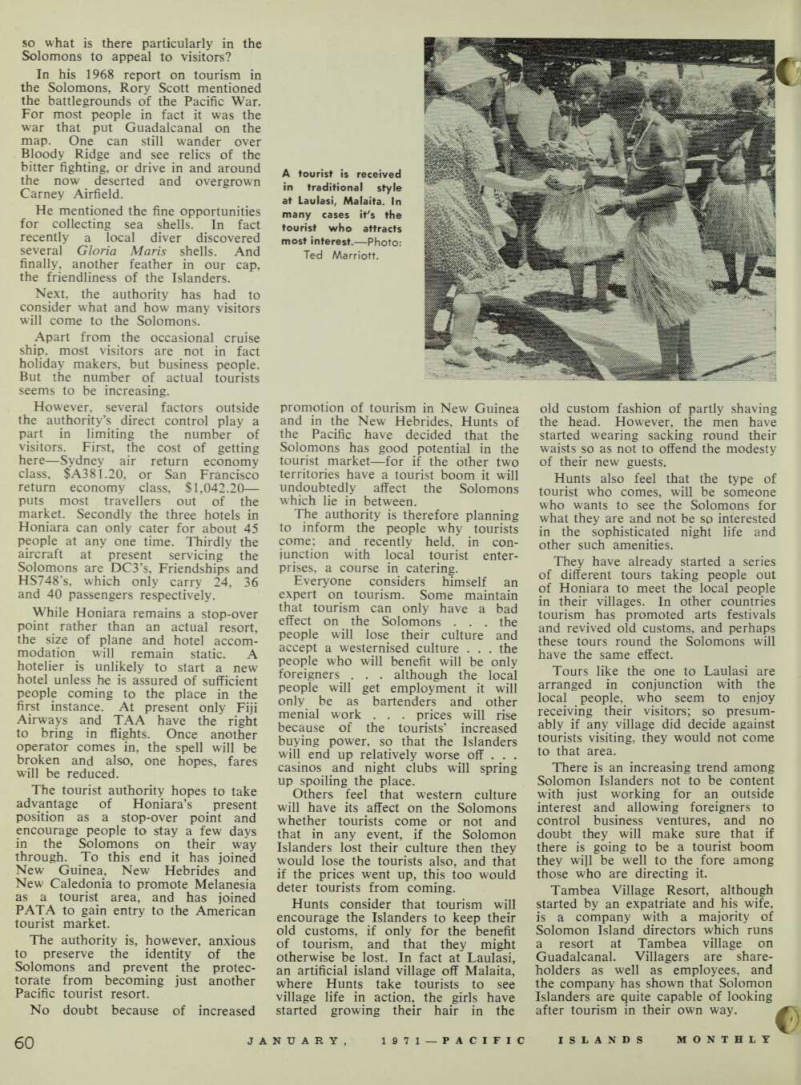
Hunts consider that tourism will encourage the Islanders to keep their old customs, if only for the benefit of tourism, and that they might otherwise be lost. In fact at Laulasi, an artificial island village off Malaita, where Hunts take tourists to see village life in action, the girls have started growing their hair in the
old custom fashion of partly shaving the head. However, the men have started wearing sacking round their waists so as not to offend the modesty of their new guests.
Hunts also feel that the type of tourist who comes, will be someone who wants to see the Solomons for what they are and not be so interested in the sophisticated night life and other such amenities.
They have already started a series of different tours taking people out of Honiara to meet the local people in their villages. In other countries tourism has promoted arts festivals and revived old customs, and perhaps these tours round the Solomons will have the same effect.
Tours like the one to Laulasi are arranged in conjunction with the local people, who seem to enjoy receiving their visitors; so presum ably if any village did decide against tourists visiting, they would not come to that area.
There is an increasing trend among Solomon Islanders not to be content with just working for an outside interest and allowing foreigners to control business ventures, and no doubt they will make sure that if there is going to be a tourist boom they will be well to the fore among those who are directing it.
Tambea Village Resort, although started by an expatriate and his wife, is a company with a majority of Solomon Island directors which runs a resort at Tambea village on Guadalcanal. Villagers are share holders as well as employees, and the company has shown that Solomon Islanders are quite capable of looking after tourism in their own way. a
A tourist is received in traditional style at Laulasi, Malaita. In many cases it's the tourist who attracts most interest.— Photo: Ted Marriott.