It's not much fun as a loner any more
pp. 55-58 · Read in the full issue
loner any more
By Judy Tudor
No one can claim to be a Pacific traveller these days until he, or she, has visited Apia, Western Samoa, and stayed at Aggie Grey’s Hotel, that next-to-impossible achievement that has managed to provide modern amenities without sacrificing the homely touches or Polynesian insouciance.
Aggie’s has been in a constant state of evolution since I first saw it in 1945, then a simple boarding house at the far end of Apia’s water front. The shell of that establishment still remains although the dining room has been enlarged several times and, in November, the top floor was being torn apart to make even more guest rooms.
Somewhere along the years since 1945, a bar appeared downstairs off the patio (at first you had to pro duce your government “points” for your liquor, but now it’s open go).
Bungalows were built in the garden; at another stage a row of new rooms appeared down the side; and then, in the second half of the ’6o’s, came the biggest metamorphosis of the lot: a huge swimming-pool with an island and a palm tree in the middle; a magnificent fale, big enough for a concert or a conference; and three, two-storied wings of bedrooms, each equipped with bathroom, air-con ditioner, refrigerator, a balcony, and last—but not least for lousy packers —an iron and an ironing board.
So much for the amenities. From this point the Grey family takes over, with none of this nonsense about room-only rates. For what you pay, you get tea at your bedside at 7 a.m. (if you don’t care for this British colonial touch you hang a “No Tea” notice on your door knob). You get breakfast, lunch, dinner plus afternoon tea, with relays of food placed before you, without asking for it because it’s a set menu. If it’s bacon-and-eggs for breakfast, or lamb for dinner, that’s it, except that other waiters scurry
about with vast salads or half a hundredweight of sliced pineapple or other side dishes.
For those who find that even this leaves unsatisfied holes in their capacity, huge bunches of bananas are placed around the establishment in strategic positions where guests can help themselves.
For good measure, you occasionally go back to your room to find that some good fairy has put a peeled and sliced pineapple in your refrigerator, and left you a bowl of purple orchids.
Whenever there is a large tour party in residence there is an evening of Samoan entertainment in the fale, with a buffet dinner to follow.
Then the Greys really go to town.
There’s not only sivas from Aggie, daughter-in-law and grand-daughter (Aggie 11, aged about 11) but the whole family gets behind the laden tables and serves the turkey and the ham and the hundred and one things that go to make a Polynesian night at Aggie Grey’s Hotel.
For years the Western Samoa Government has been flirting with the idea of getting into the easy pickings of tourism on a grand scale.
If they had the courage of their con victions they would put the peg in right where it is now before they are seduced from their good intentions of “controlled” tourism —because how can you control this monster? Once let loose it can only grow and if killed off in its prime leaves lament ing those who have come to depend upon it.
In November I was told that the government had completed negotia tions with a Seattle group which
wants to build a 100-room hotel about two miles out of Apia, at Taumesina Point. There are no indications as to what form this will take but it will be a pity if the standard pattern, glass and glitter international type hotel were built in West Samoa to skin off the best of the visitor intake. American tourists, who make up the largest national group of tourists in Samoa, are like self-destroying lemmings in this regard—they gravitate without reason to the newest and biggest.
This has already happened in Tahiti, where the two big new hotels which opened a couple of years ago get most of the gravy while the oldei traditional hotels have a thin time, except in periods, such as early this November, when four conventions converged on Tahiti from every direction and there was not a spare bed to be had anywhere.
As architectural edifices, Tahiti’s Maeva and Tahara’a Intercontinental are masterpieces, but broken down to their lowest common denominator even they are mere staging places for the tourist lemmings in their progress from one “in” place to another. They are part of the system of mass tourism that is bringing a new affluence to some Pacific Islands along with quite a number of debits.
Recently in a quick swing round the traps Fiji-Tahiti-American Samoa-Western Samoa and home to Sydney I came pretty near to the conclusion that, in terms of discom fort, Pacific travel has just about reached the point where it’s the people who stay home who are the smart ones.
Although Pacific air carriers com-
• This piece could just as easily be titled, "Round the tourist traps with Judy Tudor". It's the record of her observations during a recent swing through American and Western Samoa, Tahiti and Fiji, and—as everybody knows —PIM's publisher habitually says what she thinks.
Just a statistic!
plain that there are now too many in the airline business, I didn’t travel on one plane—UTA, Pan-Am, Air New Zealand or even Polynesian Airlines—that was not filled to capacity.
In terms of tourist-class this means no leg room, long queues for the lavatories, and long waits for some thing to eat or drink, and the crush ing feeling of being only one sardine in a huge, overloaded can. Tourist class has nothing whatever to com mend it except that it is mercifully fast and that it costs a lot less than first class. It is the very negation of travel for fun and, as planes get bigger and bigger, the fun diminishes still further while the ancillary prob lems grow apace. Terminals become madhouses of confusion, frayed tempers and delay.
When I got back to Sydney, for example, by Jumbo-jet, it took exactly one hour from the time I got off the plane until my baggage was regurgitated from the revolving dis penser. The golden age of air travel was away back in the days before anyone had invented tourist-class, and the aircraft were piston-engine powered and sometimes flying-boats.
Then you were an individual and important; now you have been re duced to a number in air-transporta tion statistics.
Another problem, at least for the loner, is that once away from Fiji and into Polynesia proper, the majority of tourists are American and the majority of Americans travel in parties, sometimes 50 or 60 strong.
As a result, the traveller who has the temerity to go it alone, including the few Americans who still do, has to fight for accommodation and at times, almost for the right to exist at all. As an individual you upset the pattern and are probably not worth the dollars and cents you bring in. You are an isolated freak, condemned to swim against the tide.
Sometimes you become a sort of unwilling satellite to a party revolving in the same orbit, and these you either learn to hate with unreasoning gusto or they grow on you as a fascinating study of the strange mania that has gripped all of us in the mid-20th century—the mass urge to leave our comfortable homes and travel the world.
In Tahiti my path crossed a party of old ladies (the colloquial name for them is “Pasadena widows”) shepherded by a bouncy gent who played mother to them morning, noon and most of the night.
They were with me at the hoteL.
in Papeete, flew with me to Pago, occupied the same floor at the hotel and were there, again, at Aggie’s.
Then they disappeared, to God knows where, but somehow I got the idea that they went on to perambulate forever, from one tourist caravan serai to another, as anonymous as the great piles of luggage that festoon every hotel lobby at their arrivals and departures.
Frail, some of them, with sore feet and varicose veins, and pills to ward off this and that, yet they seem, when on safari, to have the stamina of bull elephants. In and out of buses and cars, feverishly determined to do and see everything that is written into their itineraries, they soldier on.
I can only assume that when they do get back home to Kansas or Washington or San Diego, they collapse into a rest home to recover from their holiday, weak with relief that they did this damned, done thing and surmounted all obstacles — the water that they suspect is not fit to drink, the strange food, the fact that everyone else’s dollar seems to be worth more than their own.
For these travellers, Pago Pago and the Intercontinental hotel probably seem like an American oasis in a desert of lingering British and French colonialism. There they can eat hamburgers and soggy apple pie in the basement snack-bar; they can buy duty-free goods in the shop and get more of them back into the States without penalty; and, once a week, for an extra dollar added to the dinner bill, they can see the 1928 version of Somerset Maugham’s Rain with Joan Crawford as Sadie —right there in the place where it all happened. Nine times out of ten, it’s even in the right atmosphere, with the rain outside cascading down as only American Samoa rain knows how.
Most of them think that the Pago Intercontinental is cute, what with its acres of wickerwork and its
strings of shells instead of curtains and its miles of worn paint on the cement floors but, then, they probably paid for their tour, all in, before they left home and don’t know that it’s the most outrageously ex pensive hotel, for what you get, in the whole Pacific.
Two nights and two breakfasts (papaw, cornflakes, toast and tea made with luke-warm water) cost me SUSSI. The rooms are large and have the usual equipment but they cost SUS 24 a night, including a 10 per cent, service charge, and that makes them more expensive than the Tahara’a or the Maeva in Tahiti.
It must, in fact, come high on the list of Pacific tourist enigmas. It has an almost 100 per cent, occupancy rate yet, according to the local prophets, it has not in the five years of its existence returned its share holders a profit. It is still digesting the large loans that were raised to build it.
In the early 1960’5, several US groups were interested in building and running a tourist hotel in Pago but the government turned them down, insisting that the enterprise be Samoan-owned. As a result the American Samoan Development Cor poration was formed, with the gov ernment and 1,300 American stock holders in partnership. Together they raised $250,000 and borrowed a further $1,750,000 to complete the project. Intercontinental Hotels Cor poration merely runs the hotel for the local corporation and has nothing to do with the basic financial struc ture of the enterprise.
One of the hotel’s problems is that
100 rooms, even if they are nearly always occupied, cannot cover the overheads. Negotiations have been going on for some time to raise enough money to build 100 more rooms. But in government circles there seems to be a difference of opinion between tourist advisers and economic advisers as to whether this money might be better spent in some other tourist direction.
Meantime, American Samoa is getting more hotels, apparently with out restrictive clauses being attached to their ownership, A small one opened out near the airport in Nov ember; and a luxury hotel is being built in the Manua group by people who already have similar interests in French Polynesia. This should be open for business in early 1971 and should give tourism in American Samoa a new dimension.
At present the industry is limited not only by the number of hotel beds available but by the fact that on a 70 sq. mile island, much of it in the perpendicular and with a wet climate, the visitor is restricted in what he can do.
• Photographs taken in Western Samoa during a recently conducted aerial photographic survey, financed by the UNDP, will be used to con duct a land use survey. Both Upolou and Savai’i were photographed at a scale of 1 to 40,000; large scale coverage was also given to Apia and selected areas for development.
The maps will be used by the cadastral surveyor (employed by the UNDP/FAO), Mr. J. N. Jensen, for delineating land according to type, location, topography, slope, etc.
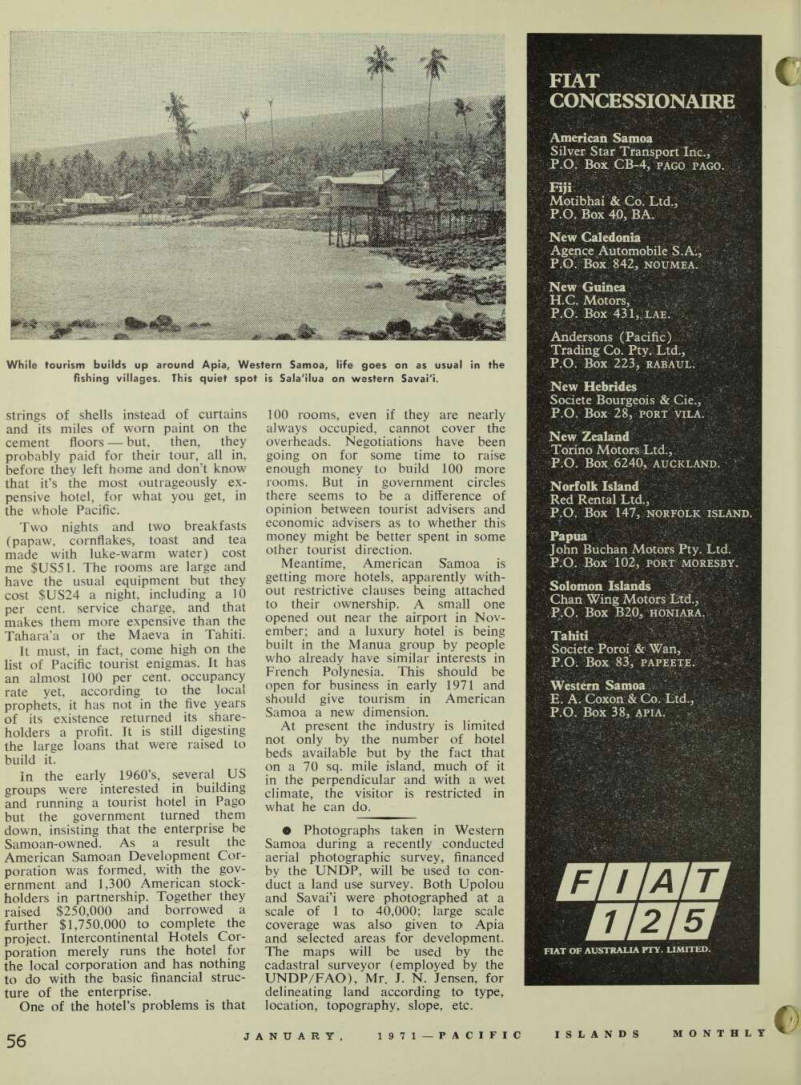
While tourism builds up around Apia, Western Samoa, life goes on as usual in the fishing villages. This quiet spot is Sala'ilua on western Savai'i.