Samoa's
p. 54 · Read in the full issue
Growing
Pains
By Sue Wendt
Largely because of vigorous efforts to promote it as a visitors’ haven, American Samoa is finding its short age of tourist accommodation an em barrassment.
During a recent trip to Pago, travel agents told me that guests were fre quently ousted from the lavish 100room Intercontinental because of overlapping bookings, and put up in private homes.
To take in some of the overflow, the 17-unit motel-style Malaeimi Hotel (with identical tariff to the Intercontinental, but less luxurious facilities) was opened in November.
The Malaeimi will eventually have 96 units. But it is not enough to cope with the gathering tide of tourists.
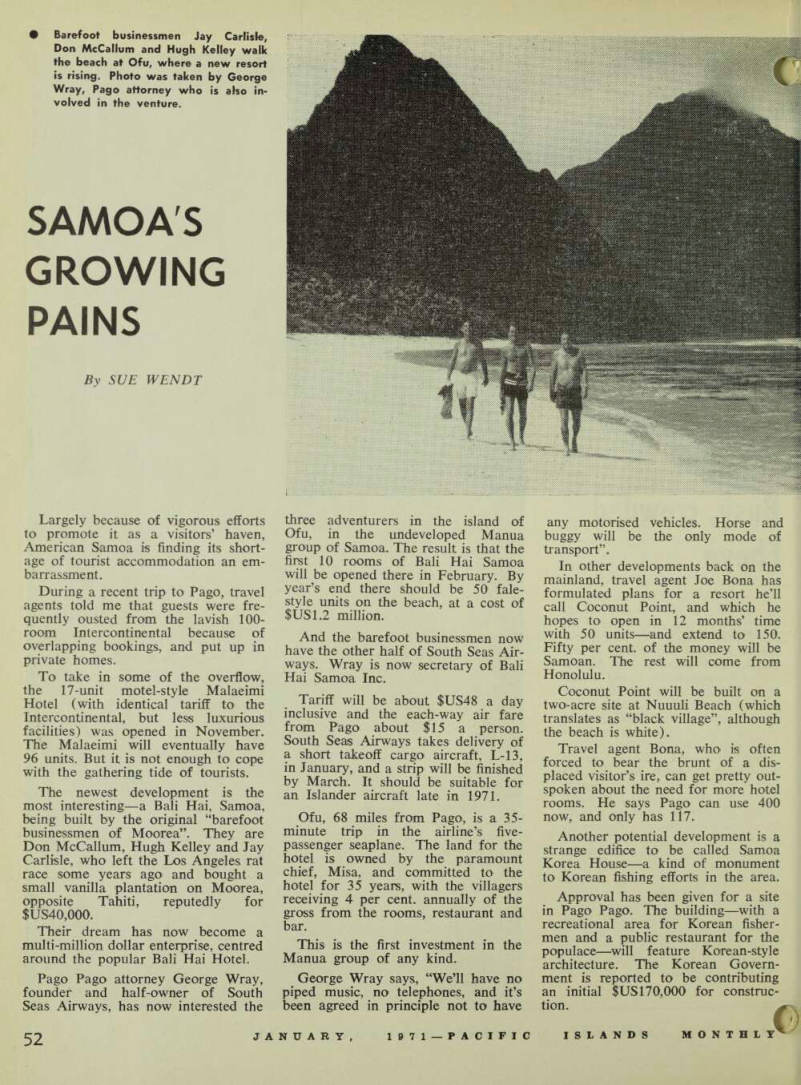
The newest development is the most interesting—a Bali Hai, Samoa, being built by the original “barefoot businessmen of Moorea”. They are Don McCallum, Hugh Kelley and Jay Carlisle, who left the Los Angeles rat race some years ago and bought a small vanilla plantation on Moorea, opposite Tahiti, reputedly for
Sus4O,Ooo.
Their dream has now become a multi-million dollar enterprise, centred around the popular Bali Hai Hotel.
Pago Pago attorney George Wray, founder and half-owner of South Seas Airways, has now interested the
three adventurers in the island of Ofu, in the undeveloped Manua group of Samoa. The result is that the first 10 rooms of Bali Hai Samoa will be opened there in February. By year’s end there should be 50 fale style units on the beach, at a cost of SUSI. 2 million.
And the barefoot businessmen now have the other half of South Seas Air ways. Wray is now secretary of Bali Hai Samoa Inc.
Tariff will be about SUS4B a day inclusive and the each-way air fare from Pago about $l5 a person.
South Seas Airways takes delivery of a short takeoff cargo aircraft, L-13, in January, and a strip will be finished by March. It should be suitable for an Islander aircraft late in 1971.
Ofu, 68 miles from Pago, is a 35minute trip in the airline’s five passenger seaplane. The land for the hotel is owned by the paramount chief, Misa, and committed to the hotel for 35 years, with the villagers receiving 4 per cent, annually of the gross from the rooms, restaurant and bar.
This is the first investment in the Manua group of any kind.
George Wray says, “We’ll have no piped music, no telephones, and it’s been agreed in principle not to have
any motorised vehicles. Horse and buggy will be the only mode of transport”.
In other developments back on the mainland, travel agent Joe Bona has formulated plans for a resort he’ll call Coconut Point, and which he hopes to open in 12 months’ time with 50 units—and extend to 150.
Fifty per cent, of the money will be Samoan. The rest will come from Honolulu.
Coconut Point will be built on a two-acre site at Nuuuli Beach (which translates as “black village”, although the beach is white).
Travel agent Bona, who is often forced to bear the brunt of a dis placed visitor’s ire, can get pretty out spoken about the need for more hotel rooms. He says Pago can use 400 now, and only has 117.
Another potential development is a strange edifice to be called Samoa Korea House—a kind of monument to Korean fishing efforts in the area.
Approval has been given for a site in Pago Pago. The building—with a recreational area for Korean fisher men and a public restaurant for the populace—will feature Korean-style architecture. The Korean Govern ment is reported to be contributing an initial SUSI7O,OOO for construc tion. *
• Barefoot businessmen Jay Carlisle, Don McCallum and Hugh Kelley walk the beach at Ofu, where a new resort is rising. Photo was taken by George Wray, Pago attorney who is also in volved in the venture.