Magazine Section
pp. 71-72 · Read in the full issue
Tonga's jugglers: Strange female prodigies of the Pacific
By Robert Langdon
Among the collected works of the English essayist William Hazlitt (1778-1830) is an essay entitled “The Indian Jugglers” which always reminds me of Tonga.
“Coming forward and seating himself on the ground in his white dress and tightened turban,” Hazlitt says in his opening paragraph, “the chief of the Indian jugglers begins with tossing up two brass balls, which is what any of us could do, and concludes with keeping up four at the same time, which is what none of us could do to save our lives, nor if we were to take our whole lives to do it in. , . .
“To conceive of this effort of extraordinary dexterity distracts the imagination and makes admiration breathless. ...
“A single error of a hair’s breadth, of the smallest conceivable portion of time would be fatal; the precision of the movements must be like a mathematical truth, their rapidity is like lightning.
“To catch four balls in succession in less than a second of time, and deliver them back so as to return with seeming consciousness to the hand again, to make them revolve round him at certain intervals, like the planets in their spheres, to make them chase one another like sparkles of fire, or shoot up like flowers or meteors, to throw them behind his back and twine them round his neck like ribbons or like serpents, to do what appears an impossibility, and to do it all with the ease, the grace, the carelessness imaginable . . . there is something in all this which he who does not admire may be quite sure he never really admired anything in the whole course of his life.
“It is skill surmounting difficulty, and beauty triumphing over skill.”
Apart from Hazlitt’s admiring essay, little seems to have been written on the art of juggling; and although I have always been mildly interested in this subject since learn ing to juggle three balls at a time at the age of 12, I have never really discovered whether the ability to juggle four balls and more (which is infinitely harder than handling three) is an inborn quality that runs in families, or whether it is one of those things that anyone could do if he practised it constantly from infancy.
However, one thing I have learned is that in Tonga, in the old days, juggling was much practised among the women and children, some of whom were so expert that they would have put Hazlitt’s Indian jugglers to shame.
The first person to record the art of juggling in Tonga was the scientist George Forster, one of Captain Cook’s companions on his second Pacific voyage of 1772-75.
While Cook was at Tongatapu in October, 1774, Forster noticed a young female juggler among a number of women who were amusing themselves by playing ball or singing, “This girl, lively and easy in her actions, played with five gourds, of the size of small apples, perfectly globular,” Forster wrote. “She threw them up into the air one after another continually, and never failed to catch all of them with great
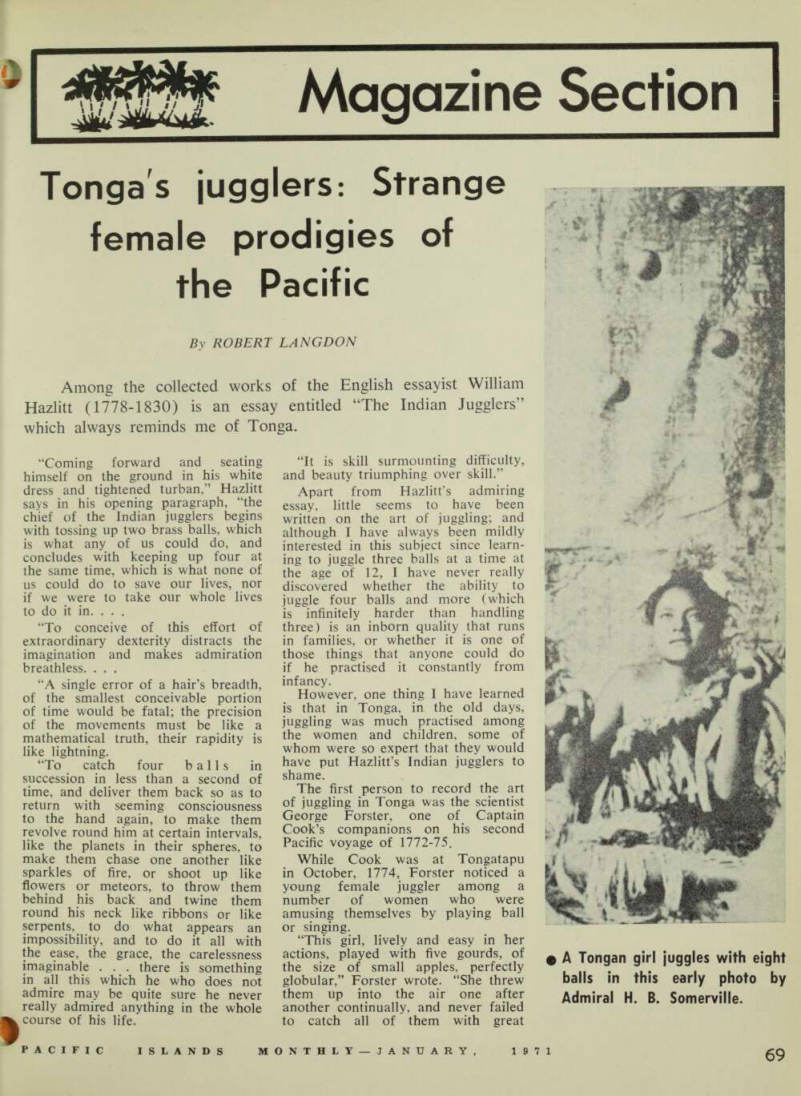
• A Tongan girl juggles with eight balls in this early photo by Admiral H. B. Somerville.
dexterity, at least for a quarter of an hour.”
David Samwell, surgeon of the Discovery on Cook’s third voyage, also noticed that juggling was a Tongan pastime when he was at Tongatapu in 1777. But he ap parently never saw any exponents juggling more than four balls, and all of these were children. The children, he wrote, were skilled at “keeping four balls up for a long time like some of the sleight of hand gentry in England”.
However, both Captain King and William Anderson, surgeon of Cook’s Resolution, saw children handling as many as six balls.
Anderson wrote: “The children have games peculiar to themselves as throwing up four, five or even six balls so dexterously that they catch them successivily & have never more than one in the hand at the same time, which is chiefly practis’d by the girls”.
Will Mariner, the young English sailor who spent four years in Tonga in the first decade of the 19th century, has left it on record in his famous book that the art of juggling was called hico in the Tongan language.
He said it was usually practised by the women, and was indulged in as a game in which sometimes seven or eight took part.
The game consisted of throwing up five balls, discharging them from
the left hand, catching them in the right, and transferring them to the left again, and so on in constant succession, always keeping four balls in the air at once.
The contestants recited verses as they threw the balls up—“each jacu lation from the right to the left hand being coincident with the cadence of the verse. For every verse that a contestant completed without missing a ball, she scored a point”.
I have not made a special search
for references to juggling in the more recent literature of Tonga. But it is evident that the art was passed down in those islands for many years, A photograph of a Tongan girl juggling eight balls!—five of them in the air at once—was taken in Lifuka by Admiral H. B. Somerville late last century and published in his book Will Manner in 1936. The photo graph is reproduced on p. 69.
Whether juggling is still practised in Tonga today, I do not know. I certainly never noticed any exponents of the art myself when I visited Tongatapu several years ago; and one or two Tongans I have since asked about it were not familiar with it.
I strongly suspect, though, that somewhere in the backblocks of Tonga the art of juggling still survives; and I daresay that if William Hazlitt were alive today, the Bishop Museum or some other learned institution might persuade him to write a monograph on Tongan juggling “with special reference to how and why it became a specialty of Tonga and apparently nowhere else in the Pacific Islands”.
Considering how prodigiously diffi cult Hazlitt conceived four-ball juggling to be, it would be interesting and instructive to read his findings on the remarkable incidence of five ball, six-ball and even eight-ball jugglers among the women and children of Tonga.
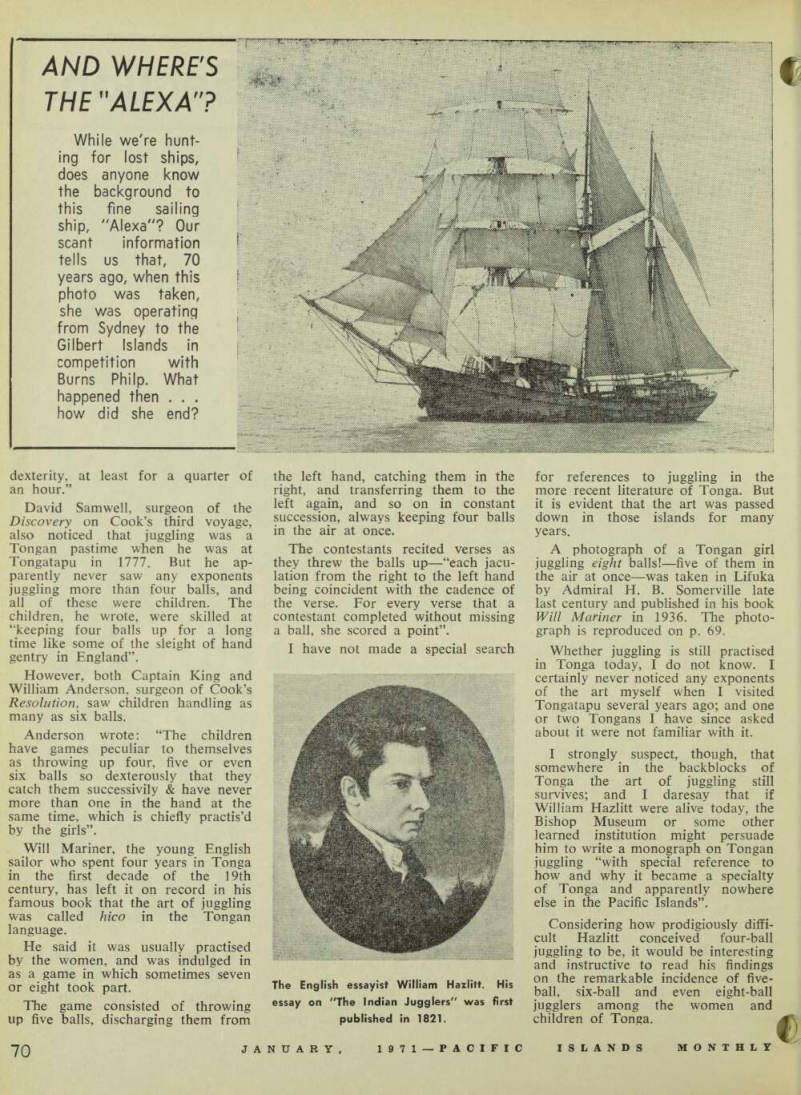
The English essayist William Hazlitt. His essay on "The Indian Jugglers" was first published in 1821.