Atafu in three months
p. 39 · Read in the full issue
How a church was built on Atafu in three months
By PENAIA KITIONA and Dr. JUDITH W. HUNTSMAN
In 1963 the people of Atafu decided that they needed a new church because they could not all fit inside the old church, built in 1924. The whole population of the atoll, 600 in March, 1970, are adherents of the Congregational Christian Church of Samoa (formerly the London Missionary Society).
Appeals for assistance were sent to Atafu people living outside their homeland and cash contributions came from New Zealand, Western and American Samoa and Hawaii.
For their part, the Atafu people living on their small atoll agreed that half the copra produced each year would go to the new church.
Early in 1970 the proceeds from half of copra sales for seven years, combined with outside contributions, amounted to SSIO,OOO, and the time to build the new church had come.
On February 14 the MV Aoniu, which services the Tokelau Islands four times each year, arrived at Atafu with cement, timber and other building materials. The Aoniu also brought Mr. William Fruean, and four helpers from Upolu, to design and supervise the building under a three month contract, and Mr. Penaia Kitiona, an Atafuan resident in Upolu who was secretary-treasurer of the church-building project, to organise and oversee the undertaking.
On that clear and calm morning all the building materials went ashore from the ship standing off the reef. The bags of cement were brought through the blasted reef passage by whaleboat; the timbers were lowered into the sea and guided by swimmers over the reef.
The foundations of the new church begun on February 17. The old
church was left standing until the new church foundations were complete, and then it was torn down within them. The new building was to be 106 ft long and 62 ft wide.
Rapidly, concrete posts, beams and brick walls were raised and a con crete floor laid. On March 23, rafters began to be set into place and two days later the noise of hammers on iron announced that the job of roof ing had begun. On April 5 the people of Atafu worshipped for the first time in their new church. Work continued until May 12 putting in windows and doors, plastering, paint ing and decorating.
How was it done? The answer is that everyone in Atafu worked hard and happily. Men, women and children carried baskets of sand and gravel from the seashore and buckets of water from the village tanks to be mixed with cement to form the posts, walls and floor.
The elders sat in the shade outside dismantling wooden forms and straightening nails so they could be used again. Later with adzes they shaped local timber for window and door frames.
The younger men mixed concrete, pouring it into wooden forms for posts and beams, pressing it into bricks for walls. They swarmed oyer the rising structure, each with a job to do and doing it well.
To work hard and joyfully people must have good food and entertain ment. Each day canoes and fisher men returned with a large enough catch to feed the workers at midday and the children in the evening.
Women would harvest breadfruit and coconuts and often spend most of the night as well as the whole morning at the cookhouses preparing great pots and baskets of food.
Most meals were followed by story-telling and joking, and several evenings each week everyone gathered in the meeting house to sing and dance.
That is how a new church was built on Atafu in three months.
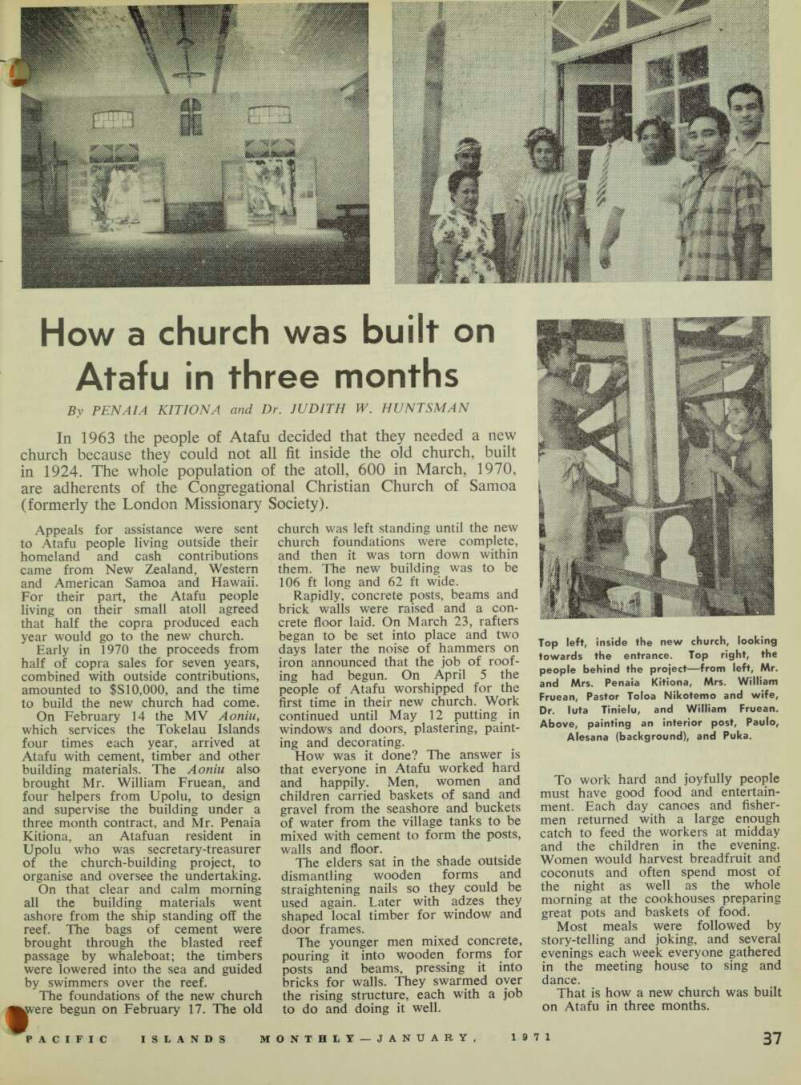
Top left, inside the new church, looking towards the entrance. Top right, the people behind the project —from left, Mr. and Mrs. Penaia Kitiona, Mrs. William Fruean, Pastor Toloa Nikotemo and wife.
Dr. luta Tinielu, and William Fruean.
Above, painting an interior post, Paulo, Alesana (background), and Puka.