pride—and now American dreams
pp. 40-46 · Read in the full issue
New Hebrides: French ambition, British pride—and now American dreams
By John Griffin
People often ask what is my favourite place after so much travel in the Pacific Islands. It is almost impossible to answer; there are too many different kinds of natural beauty, politics, problems, and interesting people. But no islands in this largest of oceans have more off-beat intrigue than the New Hebrides at the heart of oceanic Melanesia, west of Fiji, north of New Caledonia, south of the Solo mons, and very much East of Eden.
You are there only one day before you think, “Somebody should write a musical about this place.” Then you remember somebody has. It was called South Pacific, and some scenes linger—the rusting remains of great military bases fringed by jungle; French planters, some greying and handsome; a few Tonkinese, as shrewd but more sophisticated than Bloody Mary; colonial Englishmen who could have been coastwatchers.
This is the world’s only condominium government, administered jointly by France and Great Britain in styles that range from joie de vivre, to peaceful and competitive coexistence, to quiet desperation. Outsiders find it funnier than the local folk.
There is much more, of course. The mixture includes enough lovely scenery for anyone with South Sea dreams, and an array of Melanesian culture dramatised by the fact some 75,000 natives are said to speak over 200 different languages.
To this must be added the colour of lingering British empire, a heavy overlay of French culture and ambition, plus a rich history now taking a new turn with the arrival of American land subdividers from Hawaii and a new philosophy that foresees the New Hebrides as a Pacific Bahamas, a tax-free haven for foreign firms and perhaps even a location for think industries.
There are a lot of nice dreams afloat in these islands. The realities include more flies than you have ever seen, and the future hopes and demands of a New Hebridean people just starting to come of political age. A small shadow of black power aready builds over this paradise of white free enterprise. The result could be serious conflict, or a new kind of happy co-operation.
The New Hebrides comprises 13 large and 60 small islands with a This article is another in the excellent series written by the editorial page editor of the “Honolulu Advertiser”, Mr. John Griffin, under an Alicia Patterson Fund scholarship. He made two extensive tours of the Pacific to gather his material.
total land area of 5,700 square miles, These islands stretch 450 miles, and to the north include the small Banks and Torres groups. The range runs from tiny coral islands (including a few with small groups of Polynesians) to smoking volcanos that seem to spring from the sea, to rolling mountains of jungle and grassy upland.
There in Melanesian villages women still work gardens with simple tools but often shop at a local co-operative. Men ponder the concept of government preached by condominium officials; the men also continue to raise pigs with fine circle tusks and ceremonial, almost religious, value; and they fashion masks and other totems of dark, hideous beauty, primitive symbols of rank, fertility, and resurrection. Smiling black children go off to simple schools run by dedicated missionaries who have done much in these islands, And here and there white planters, mostly French, still live lordly but
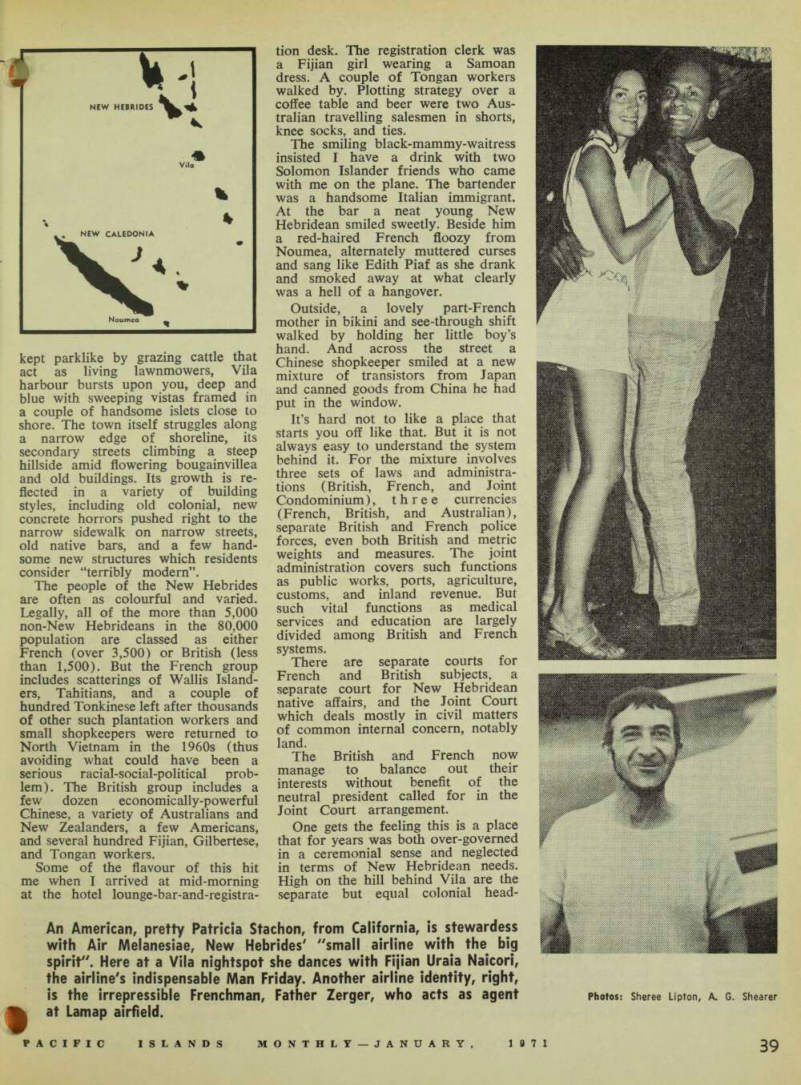
lonely lives in big old houses set in vast groves of palm trees, Within this general picture, the range of language and customs changes, not just from island to island but from section to section, But the people have a way of life that by and large satisfies them. And as dramatic as the cultural diversity are the trends in politics, social ad vancement, and economics which are really just starting to change these islands in significant ways, The New Hebrides are closer to French New Caledonia to the south than to the British Solomons to the north. Both national influences are clearly present, but it is the French which has come to predominate, especially in the urban centres, Vila, the condominium capital on the island of Efate, is one of the Pacific’s pleasant surprises. It is a French town set in a countryside largely missionised by the British.
As you drive into town along dusty roads past vast palm groves
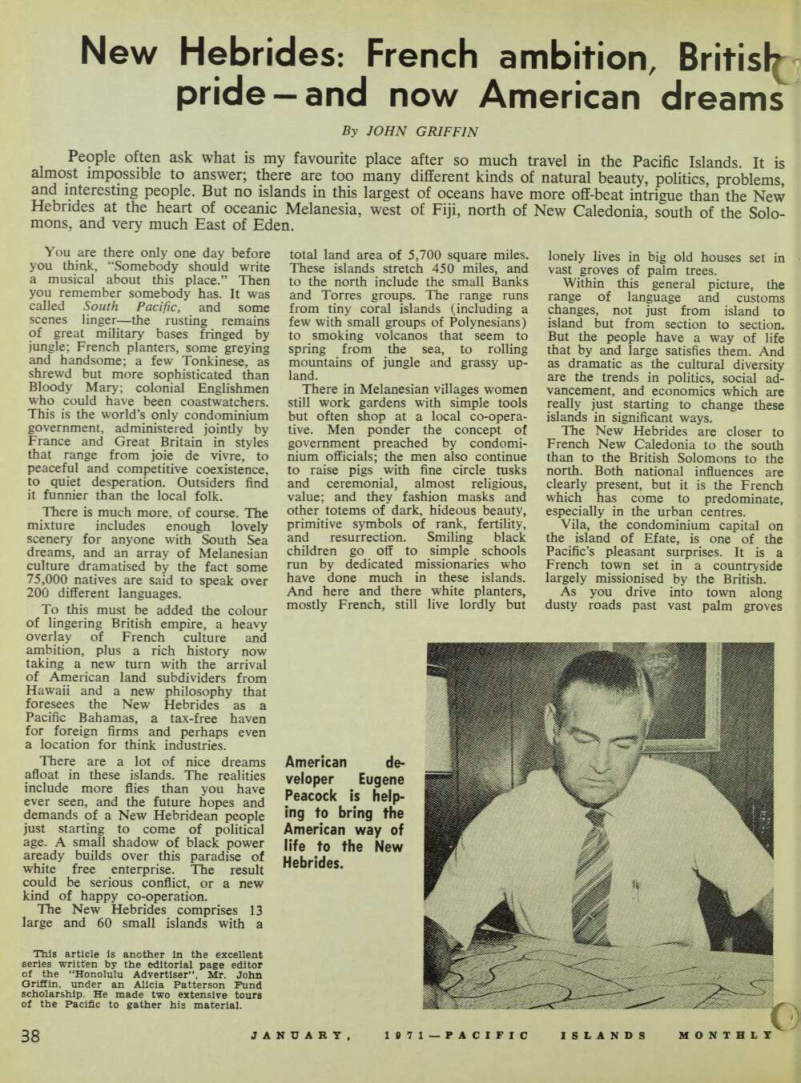
American de veloper Eugene Peacock is help ing to bring the American way of life to the New Hebrides.
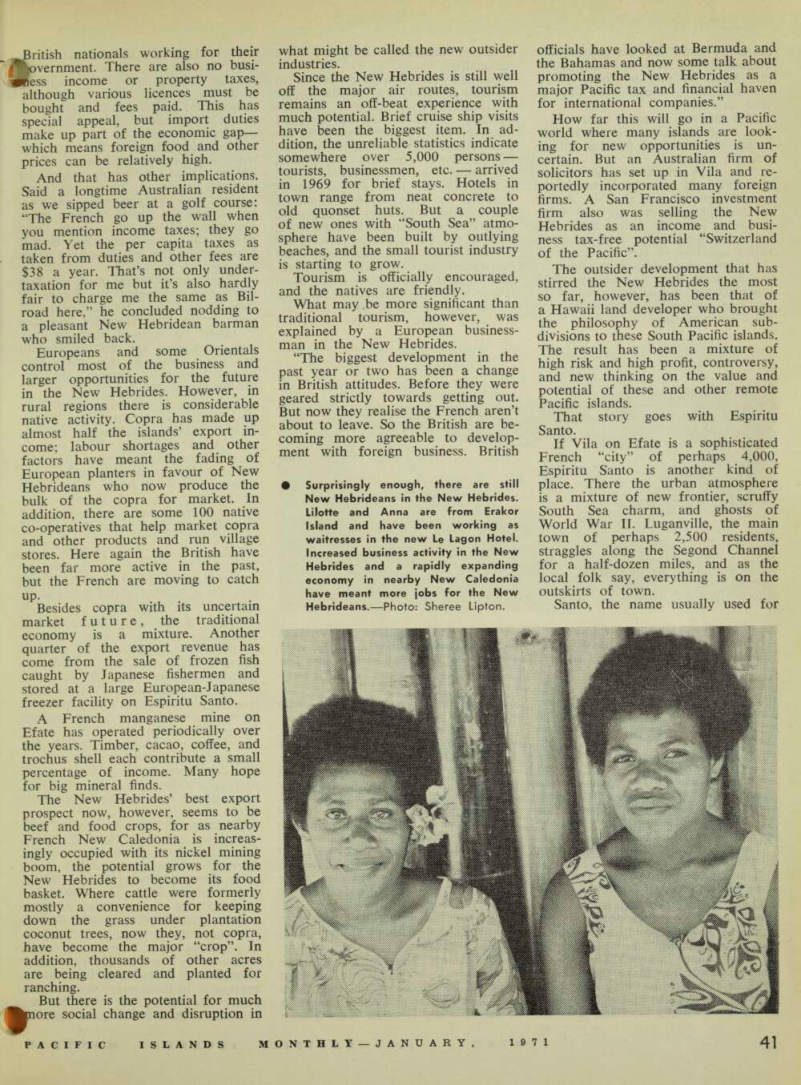
kept parklike by grazing cattle that act as living lawnmowers, Vila harbour bursts upon you, deep and blue with sweeping vistas framed in a couple of handsome islets close to shore. The town itself struggles along a narrow edge of shoreline, its secondary streets climbing a steep hillside amid flowering bougainvillea and old buildings. Its growth is re flected in a variety of building styles, including old colonial, new concrete horrors pushed right to the narrow sidewalk on narrow streets, old native bars, and a few hand some new structures which residents consider “terribly modern”.
The people of the New Hebrides are often as colourful and varied.
Legally, all of the more than 5,000 non-New Hebrideans in the 80,000 population are classed as either French (over 3,500) or British (less than 1,500). But the French group includes scatterings of Wallis Island ers, Tahitians, and a couple of hundred Tonkinese left after thousands of other such plantation workers and small shopkeepers were returned to North Vietnam in the 1960 s (thus avoiding what could have been a serious racial-social-political prob lem). The British group includes a few dozen economically-powerful Chinese, a variety of Australians and New Zealanders, a few Americans, and several hundred Fijian, Gilbertese, and Tongan workers.
Some of the flavour of this hit me when I arrived at mid-morning at the hotel lounge-bar-and-registra
tion desk. The registration clerk was a Fijian girl wearing a Samoan dress. A couple of Tongan workers walked by. Plotting strategy over a coffee table and beer were two Aus tralian travelling salesmen in shorts, knee socks, and ties.
The smiling black-mammy-waitress insisted I have a drink with two Solomon Islander friends who came with me on the plane. The bartender was a handsome Italian immigrant.
At the bar a neat young New Hebridean smiled sweetly. Beside him a red-haired French floozy from Noumea, alternately muttered curses and sang like Edith Piaf as she drank and smoked away at what clearly was a hell of a hangover.
Outside, a lovely part-French mother in bikini and see-through shift walked by holding her little boy’s hand. And across the street a Chinese shopkeeper smiled at a new mixture of transistors from Japan and canned goods from China he had put in the window.
It’s hard not to like a place that starts you off like that. But it is not always easy to understand the system behind it. For the mixture involves three sets of laws and administra tions (British, French, and Joint Condominium), three currencies (French, British, and Australian), separate British and French police forces, even both British and metric weights and measures. The joint administration covers such functions as public works, ports, agriculture, customs, and inland revenue. But such vital functions as medical services and education are largely divided among British and French systems.
There are separate courts for French and British subjects, a separate court for New Hebridean native affairs, and the Joint Court which deals mostly in civil matters of common internal concern, notably land.
The British and French now manage to balance out their interests without benefit of the neutral president called for in the Joint Court arrangement.
One gets the feeling this is a place that for years was both over-governed in a ceremonial sense and neglected in terms of New Hebridean needs.
High on the hill behind Vila are the separate but equal colonial head-
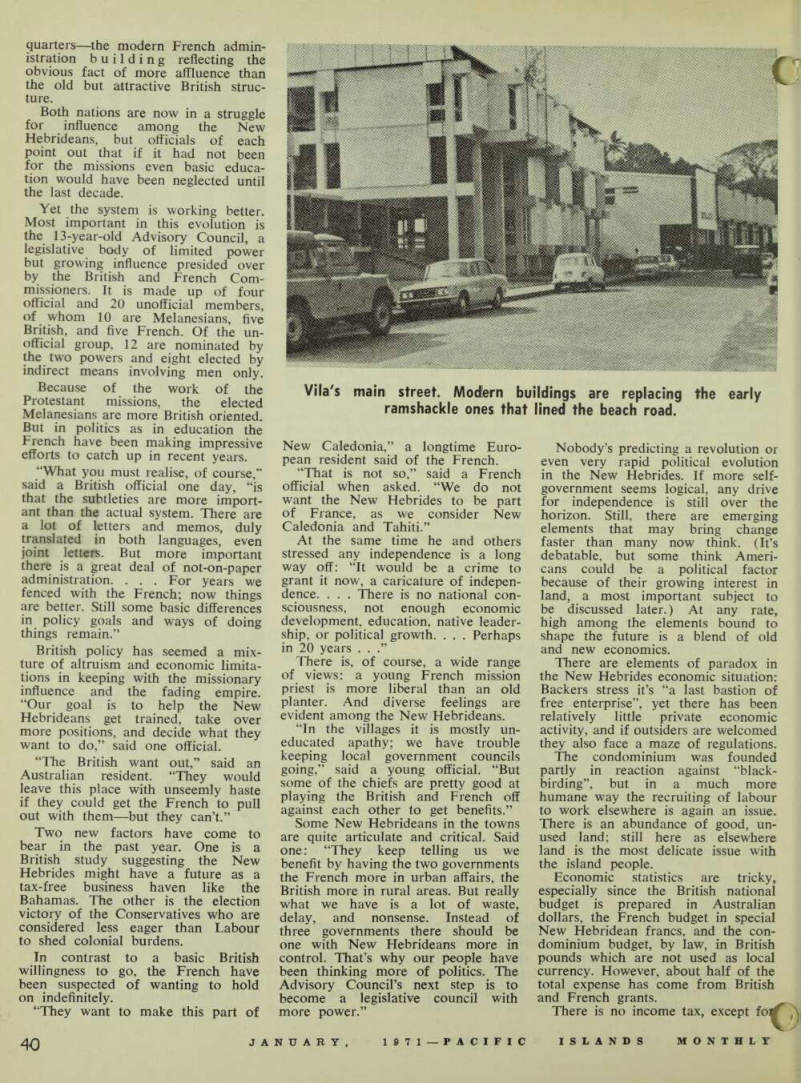
An American, pretty Patricia Stachon, from California, is stewardess with Air Melanesiae, New Hebrides 7 /7 small airline with the big spirit 77 . Here at a Vila nightspot she dances with Fijian Uraia Naicori, the airline's indispensable Man Friday. Another airline identity, right, is the irrepressible Frenchman, Father Zerger, who acts as agent at Lamap airfield.
Photos: Sheree Upton, A. G. Shearer
quarters—the modern French admin
istration building reflecting the
obvious fact of more affluence than the old but attractive British struc ture.
Both nations are now in a struggle for influence among the New Hebrideans, but officials of each point out that if it had not been for the missions even basic educa tion would have been neglected until the last decade.
Yet the system is working better.
Most important in this evolution is the 13-year-old Advisory Council, a legislative body of limited power but growing influence presided over by the British and French Com missioners. It is made up of four official and 20 unofficial members, of whom 10 are Melanesians, five British, and five French. Of the un official group, 12 are nominated by the two powers and eight elected by indirect means involving men only.
Because of the work of the Protestant missions, the elected Melanesians are more British oriented.
But in politics as in education the French have been making impressive efforts to catch up in recent years.
“What you must realise, of course," said a British official one day, “is that the subtleties are more import ant than the actual system. There are a lot of letters and memos, duly translated in both languages, even joint letters. But more important there is a great deal of not-on-paper administration. . . . For years we fenced with the French; now things are better. Still some basic differences in policy goals and ways of doing things remain.”
British policy has seemed a mix ture of altruism and economic limita tions in keeping with the missionary influence and the fading empire.
“Our goal is to help the New Hebrideans get trained, take over more positions, and decide what they want to do,” said one official.
“The British want out,” said an Australian resident. “They would leave this place with unseemly haste if they could get the French to pull out with them—but they can’t.”
Two new factors have come to bear in the past year. One is a British study suggesting the New Hebrides might have a future as a tax-free business haven like the Bahamas. The other is the election victory of the Conservatives who are considered less eager than Labour to shed colonial burdens.
In contrast to a basic British willingness to go, the French have been suspected of wanting to hold on indefinitely.
“They want to make this part of
New Caledonia,” a longtime European resident said of the French.
“That is not so,” said a French official when asked. “We do not want the New Hebrides to be part of France, as we consider New Caledonia and Tahiti.”
At the same time he and others stressed any independence is a long way off; “It would be a crime to grant it now, a caricature of independence. . . . There is no national consciousness, not enough economic development, education, native leadership, or growth. . . . Perhaps in 20 years . . .”
There is, of course, a wide range of views: a young French mission priest is more liberal than an old planter. And diverse feelings are evident among the New Hebrideans.
“In the villages it is mostly uneducated apathy; we have trouble keeping local government councils going,” said a young official. “But some of the chiefs are pretty good at playing the British and French off against each other to get benefits.”
Some New Hebrideans in the towns are quite articulate and critical. Said one: “They keep telling us we benefit by having the two governments the French more in urban affairs, the British more in rural areas. But really what we have is a lot of waste, delay, and nonsense. Instead of three governments there should be one with New Hebrideans more in control. That’s why our people have been thinking more of politics. The Advisory Council’s next step is to become a legislative council with more power.”
Nobody’s predicting a revolution or even very rapid political evolution in the New Hebrides. If more self government seems logical, any drive for independence is still over the horizon. Still, there are emerging elements that may bring change faster than many now think. (It’s debatable, but some think Ameri cans could be a political factor because of their growing interest in land, a most important subject to be discussed later.) At any rate, high among the elements bound to shape the future is a blend of old and new economics.
There are elements of paradox in the New Hebrides economic situation: Backers stress it’s “a last bastion of free enterprise”, yet there has been relatively little private economic activity, and if outsiders are welcomed they also face a maze of regulations.
The condominium was founded partly in reaction against “black birding”, but in a much more humane way the recruiting of labour to work elsewhere is again an issue.
There is an abundance of good, un used land; still here as elsewhere land is the most delicate issue with the island people.
Economic statistics are tricky, especially since the British national budget is prepared in Australian dollars, the French budget in special New Hebridean francs, and the con dominium budget, by law, in British pounds which are not used as local currency. However, about half of the total expense has come from British and French grants.
There is no income tax, except fo^
Vila's main street. Modern buildings are replacing the early ramshackle ones that lined the beach road.
British nationals working for their government. There are also no busi less income or property taxes, although various licences must be bought and fees paid. This has special appeal, but import duties make up part of the economic gap— which means foreign food and other prices can be relatively high.
And that has other implications.
Said a longtime Australian resident as we sipped beer at a golf course: “The French go up the wall when you mention income taxes; they go mad. Yet the per capita taxes as taken from duties and other fees are $3B a year. That’s not only under taxation for me but it’s also hardly fair to charge me the same as Bil road here,” he concluded nodding to a pleasant New Hebridean barman who smiled back.
Europeans and some Orientals control most of the business and larger opportunities for the future in the New Hebrides. However, in rural regions there is considerable native activity. Copra has made up almost half the islands’ export in come; labour shortages and other factors have meant the fading of European planters in favour of New Hebrideans who now produce the bulk of the copra for market. In addition, there are some 100 native co-operatives that help market copra and other products and run village stores. Here again the British have been far more active in the past, but the French are moving to catch up.
Besides copra with its uncertain market future, the traditional economy is a mixture. Another quarter of the export revenue has come from the sale of frozen fish caught by Japanese fishermen and stored at a large European-Japanese freezer facility on Espiritu Santo.
A French manganese mine on Efate has operated periodically over the years. Timber, cacao, coffee, and trochus shell each contribute a small percentage of income. Many hope for big mineral finds.
The New Hebrides’ best export prospect now, however, seems to be beef and food crops, for as nearby French New Caledonia is increas ingly occupied with its nickel mining boom, the potential grows for the New Hebrides to become its food basket. Where cattle were formerly mostly a convenience for keeping down the grass under plantation coconut trees, now they, not copra, have become the major “crop”. In addition, thousands of other acres are being cleared and planted for ranching.
But there is the potential for much Imore social change and disruption in
what might be called the new outsider industries.
Since the New Hebrides is still well off the major air routes, tourism remains an off-beat experience with much potential. Brief cruise ship visits have been the biggest item. In addition, the unreliable statistics indicate somewhere over 5,000 persons— tourists, businessmen, etc. arrived in 1969 for brief stays. Hotels in town range from neat concrete to old quonset huts. But a couple of new ones with “South Sea” atmosphere have been built by outlying beaches, and the small tourist industry is starting to grow.
Tourism is officially encouraged, an^^ e nativ £ s are * n ? n '.y* , What may be more significant than traditional tourism, however, was explamed by a European businessma JL m N f w , Hebndes * .
The biggest development in the past year or two has been a change m British attitudes. Before they were geared strictly towards getting out.
But now they reahse the French aren’t about to leave. So the British are becoming more agreeable to development with foreign business. British
officials have looked at Bermuda and the Bahamas and now some talk about promoting the New Hebrides as a major Pacific tax and financial haven for international companies,”
How far this will go in a Pacific world where many islands are look ing f or new opportunities is un certain. But an Australian firm of solicitors has set up in Vila and re portedly incorporated many foreign firms. A San Francisco investment fi rm a i so was selling the New Hebrides as an income and busi ness tax-free potential “Switzerland G f t fi e Pacific”.
The outsider development that has stirred the New Hebrides the most so far, however, has been that of a Hawaii i an d developer who brought pfiii OSO pfiy G f American sub divisions to these South Pacific islands.
The result has been a mixture of risk and high profit, controversy, ai f d new thinking on t he value and potential of these and other remote p acific i s i an ds t ‘ goes with Espiritu s anto jf y da on gf ate j s a sophisticated French ~d ty„ of perhaps 4>o oo, Espiritu Santo is another kind of place. There the urban atmosphere is a mixture of new frontier, scruffy South Sea charm, and ghosts of World War 11. Luganville, the main town of perhaps 2,500 residents, straggles along the Segond Channel for a half-dozen miles, and as the local folk say, everything is On the Outskirts of town.
Santo, the name usually used for
• Surprisingly enough, there are still New Hebrideans in the New Hebrides.
Lilotte and Anna are from Erakor Island and have been working as waitresses in the new Le Lagon Hotel.
Increased business activity in the New Hebrides and a rapidly expanding economy in nearby New Caledonia have meant more jobs for the New Hebrideans. — Photo: Sheree Lipton.
the entire island and the town, is the biggest in the New Hebrides group.
But Santo is one of those places that adds up to much more than its vital statistics.
One of the reasons is the war.
The boom lasted three years, then faded in a period of postwar surplus property affluence.
Now there are dim memories. The roads are still surprisingly good, and so are parts of the airfields. A few of the old quonset huts and other buildings are still being used. But most are long gone, and what re mains are bits of scrap.
In Santo, the condominium operates on the same dual formula but with somewhat less formality than in Vila.
Separate but equal modest wooden buildings, separated by a pole flying
the two flags, house the French and British residencies. In my visit, the top British official was an urbane veteran South Pacific colonial servant who looked for all the world like a greying movie star. His French counterpart was an attractive, intense young man who spoke with great speed and frankness (“This place has been neglected, but now we are very serious”).
There are few Americans living in the New Hebrides so far.
Some have had mixed fortune or achieved dubious distinction: One couple from Hawaii ran into trouble with New Hebridean villagers on Efate, an unfortunate and perhaps unnecessary mixup over access rights on land they bought. They were virtually forced to leave the islands.
Back in Hawaii now, they urge pro spective buyers to take “a good, strong look” at the land and political
situation, including rising native nationalism.
But the best known American in the New Hebrides is a land developer businessman from Hawaii. He has made a lot of money but invested much of it in further ventures in the New Hebrides where he now lives.
In far more important ways, that, too makes him controversial.
Back in the mid 19605, Eugene Peacock, a little known Honolulu businessman with land development, construction, and securities experience, went to the South Pacific looking for low-cost housing prospects and other investment opportunities. He even tually found a run-down copra plan tation with two spectacular beaches on a beautiful bay with the un romantic name of Hog Harbour,
some 35 miles up the coast from Luganville on Santo.
Peacock and his Hawaii associates, Amalgamated Land, Inc., bought the plantation for a reported SUSB6,OOO.
Most of it has since been subdivided into over 800 lots and sold, largely in Hawaii, for more than S 3 mil lion—minus, of course, sales and development costs. Since then Amalgamated has gone on to sell out another nearby subdivision of more than 700 lots for an additional $2 million at a place called Cape Queiros. Currently it is fast selling an even bigger subdivision, 1,200 house and industrial lots in an area called Palikula about three miles from Luganville.
One result has been to make Peacock a very prosperous man of growing importance in the New Hebrides (where he now lives most of the time and is much better known
than in Hawaii). Besides the Santo, subdivisions, his interests several projects on Efate, including a major cattle ranch, a housing project-subdivision just outside Vila, and various land holdings for later development.
More important is the fact that the American subdivisions have helped trigger a whole range of attitudes about the value of land, tourism and other development pro spects, and the future of these semi forgotten islands. Somebody was bound to come eventually; it just happened to be an American from Hawaii.
There are serious questions that can be raised about the future of land control and political develop ment in the New Hebrides. But first it might be stressed that Peacock and associates are no fly-by-night operators. Nor is this necessarily some latter-day version of the “South Sea Bubble”.
The Santo subdivision sales have been registered as legitimate by the Hawaii State government officials who went to Santo. The land is there. Some of it is now in jungle thick enough to terrorise most Ame ricans. Part of it is hot, ugly scrub or rocky coast. But there is also breath-taking beauty and a range of development possibilities that could be fulfilled.
Some of the first projects were oversold by people no longer as sociated with the operation. There was, for example, talk of a big inter national gambling casino.
Some of the early literature had South Sea Bubble aspects about it, as the New Hebrides were pictured as a bucolic tax and trouble-free paradise on the verge of becoming a jet-age crossroads, “the Pacific’s newest playground” where pleasure to be found was only to be outdone by profits to be made. The newer brochures are naturally bullish but much more modest in projections.
The developers are legally committed to roads, water, and power but they also stress long-range development hopes.
There are those who wonder why Americans would consider buying land they have never seen in the New Hebrides, some 3,000 miles away from tropical Hawaii with its own mythical lures. The answer lies in a mixture of economics, environ mental concerns and escapist desires.
Perhaps the large majority of these original buyers will never see, much less settle in, the New Hebrides; they view it as a Hawaii-type land invest ment, and in three years some choice pieces are selling for over 50 per cent more than the original price.
There is still much evidence of the Pacific War in the New Hebrides. The wreckage of this US Navy Douglas Dauntless dive bomber was uncovered in the scrub recently while Vila's nearby wartime Bauerfield was being upgraded to take jets.
Photo: A. G. Shearer.
Furthermore, the lure of the “unspoiled” South Seas grows as Hawaii, like other areas, faces the crowding and pollution associated with progress. One can predict plan ning problems in parts of the New Hebrides, but the subdivision sales promotion stresses the idea of new communities with strict rules on building size and height, using materials and design in keeping with the area.
It is possible to envision an interesting variety of liberal free spirits, John Birch buccaneers and more simple retired folk being at tracted. But it might not be as simple as they think for a variety of reasons, including still-limited op portunities, various protective regula tions, and items that make the cost of living (not to mention travel) higher than might be anticipated.
Every paradise has a price tag.
The American subdivision at Hog Harbour, named Lokalee Beach, begins beyond a few thatch native huts on a hill thick with underbrush and great vine-covered trees. The good coral road winds down the other side of the hill, and you can see why people dream of tropical isles, and why they buy. For there is a pale green bay with deep blue water and long green islands farther out.
There is no doubt the subdivisions have added a new dimension to the New Hebrides. Some reluctant local Europeans had grudgingly accepted the idea of tourism, only to be hit with the more advanced and com plicated concept of an American colony within a British-French Con dominium, which is itself within a developing native population.
French officials have generally welcomed the potential American in flux personified by Peacock. It is both in tune with their Western business development attitude and with any
political ambition to keep the general status quo and remain.
The British, on the other hand, have been cool. Some suggest that they would have blocked Peacock’s subdivision plans had they realised soon enough what he was up to.
Until recently at least, their goal has been to eventually withdraw, leaving behind a system the native New Hebrideans could handle. The possibility of thousands of American residents, most of them deciding to live under British law, complicates that picture.
Non-official, local European at titudes on incoming Americans vary.
Some welcome the idea of new money.
But more hostile attitudes were ex pressed by a woman who has been to Hawaii and is connected with the travel business: “Why do Ame ricans want to come here? They will ruin this like they have other places.”
For balance, there was this view of an Australian woman at the British mission at Hog Harbour: “There could be problems, I suppose, if too many Americans come. But it could also be a good thing in terms of offering people jobs and in showing them a world they must learn to live with.”
New Hebridean attitudes also vary but generally are less firm. One village chief on Efate was eagerly going off to Fiji to learn how people there market handicrafts to tourists; tourism, he felt, offered more economic hope than digging yams or making copra.
However, when I said to an educated young New Hebridean woman on Santo, “The next time I come here there will probably be thousands of American tourists around,” she looked at me and said gravely. “I hope not because they might crush us like they have the coloured people in the United States.”
Intertwined with the idea of a new American invasion that may or may not come is the problem of land.
Here as elsewhere in the Pacific is the paradox of thousands of empty, potentially rich undeveloped acres owned by natives, yet with land con sidered one of the most pressing problems.
“One of the first things to realise is that 45 per cent, of the land is alienated from native ownership,” says a British official. By far the biggest private owner is a big French corporation, Societe Francaise des Nouvelle Hebrides (SFNH) with some 200,000 acres. Next comes the Australian Commonwealth Govern ment which has control of 50,000 acres. Peacock lists his various developments to date as totalling about 6,000 acres.
The land problem comes in several parts: One involves vague titles and native deeds, some acquired decades ago by unscrupulous Europeans in ex change for alcohol and guns. There was some unhappiness that Joint Court decisions in such cases favoured Europeans and it was felt that a new land commission should decide.
But even where titles are clear— and the American subdivision land seems in this category—there are other questions.
One stems from the fact that large tracts of alienated land, especially that of SFNH, lies undeveloped and attractive to nearby natives, some of whom feel it is basically theirs by natural rights anyway.
Still another side, minor so far but
• Main new American economic activity is taking place on Santo, which was a big American wartime base. This recent aerial picture by Captain A. G.
Shearer shows the expanding wharf area at Luganville.
with potential to grow, centres on the attraction of past development: Europeans on Efate and Santo have some of the best locations in the developed coastal regions.
Mixed in now is a new factor, that land prices on choice parts of the coast on the main isalnds have shot up as owners anticipate either tourism or more American buyers. Some asking prices have gone up five or six times what they were two years ago. This holds dizzying prospects for European owners and speculators, but the benefits to New Hebrideans have yet to be demonstrated.
Taken all together, there is no doubt land concerns present a prob lem with black power political over tones. The fortunate thing is that many Europeans realise this. But those who do also include New Hebrideans.
The darkest cloud on the rosy European horizon in the New Hebrides in recent years has been presented by a native land movement headed by a part-Tongan, part-English New Hebridean with a flair for dramatics and informal organisation.
Now almost 50, Jimmy Stephens wears the greying beard of a prophet
and often a khaki uniform with the insignia of his organisation, “Nagriamel”, derived from native words for two plants used in cere monies and taboos in the northern islands. His followers, whom he numbers at some 15,000 (paying about $1 a year), call him Chief President Moses, Stephens learned his basic English at a British mission school and acquired much of his pleasant savoir faire driving a bulldozer in the Arne rican wartime days and later skip pering an inter-island trading ship, His image as a semi-religious leader is flawed by a reputation of fondness for beer, expensive trips abroad, and numerous young wives, But he has built up an attractive settlement of followers on what was undeveloped SFNH land on a rich plateau behind Luganville, and his message is not taken lightly.
Said Stephens in a talk we had: “We want all the land in nature reserve—what we call black bush— to come back to our people under Nagriamel. We don’t want the land that is planted or fenced, just what was taken and has not been planted.”
In practice this has meant mostly
SFNH land. But in our talk, Stephens mentioned land subdivided Peacock, notably the undeveloped Cape Queiros, as “belonging” to Nagriamel. Some of his followers last year pulled up surveyor’s stakes there and were later arrested.
It is hard to judge Stephens’ im portance. The British draw a difference between his behaviour and political ambitions (which he seems to have) and the significance of Nagriamel as an ideal with appeal.
The French view seems to be that the man can and should be negotiated with, that deals can be made to satisfy all.
Stephens himself expressed interest in negotiating the claims he makes.
He talked well of Americans but added, “They should realise who owns the land.”
Asked about the future, he first said, “I think there will be trouble.
People can’t lose their land and customs for nothing.” He went on to explain he meant at some future date, that the native people now are still more apathetic than upset. “I wish they were more alive,” he said shaking his head. “I think they are dead sometimes.”
That, of course, is only the view of one unusual New Hebridean of possibly diminishing personal import ance. But several others made points like: “Stephens is symptomatic of something general.” . . . “There is some uneasiness. . . .”
Here more than elsewhere you get the feeling that much depends on how things are handled by the small but economically commanding Euro pean minority. There are some reactionary types in the New Hebrides with dreams of “keeping the natives in line” forever. But, despite differences in timing and emphasis, both the dominant British and French government views seem positive.
For his part, Peacock seems to understand and have some progressive ideas: “There is no land shortage, but the people want somebody to guide them on how to use and develop their land. One of our pro jects is to help train them.” To ease the stigma of an all-American in flux, efforts are being made to partly sell his latest subdivision in other parts of the world.
So if the future here as elsewhere is uncertain, it is at least being thought about and worked at. The hope is that French economic ambition, British concern and pride, and American dreams can all be re conciled in a way that promotes native welfare. The alternative is not pleasant.
Jimmy Stephens, or "Chief President Moses", leader of the Nagriamel move ment (seen here with some of his fol lowers), says there will be "trouble about land".