The ghost plane
p. 36 · Read in the full issue
Royal Australian Air Force Dakota A 65-61 was flying from Biak, in Dutch New Guinea, to Horn Island, on the northern tip of Australia, on September 18, 1945, when it disappeared. Aboard the aircraft were 27 Aus tralian Army and Air Force men, including the crew, and one RAAF nursing sister. The aircraft had been ferrying home medical evacuees, including war prisoners of the Japanese.
In December, 1970, the RAAF solved the mystery of the missing aircraft, and recovered the dead during a hazardous mission. Dakota A 65-61 had crashed into a mountain at 13,500 ft in the Wissel Lakes region of what is now West Irian —and had remained undisturbed for 25 years. The RAAF took the spectacular picture opposite from a helicopter during the recovery.
Existence of the mountain wreckage was first reported when in April, 1967, American missionary pilot Jerry Reeder, working in West Irian, noticed it from the air. For the next 18 months he tried in vain to relocate the wreckage amid the wild jumble of mountains. Then, in November, 1968, he found it by helicopter.
Now it was the RAAF’s turn. With the co-operation of Indonesian military and civil authorities, and American missionaries, operation Tropic Snow was launched out of Biak in December, lasting three days.
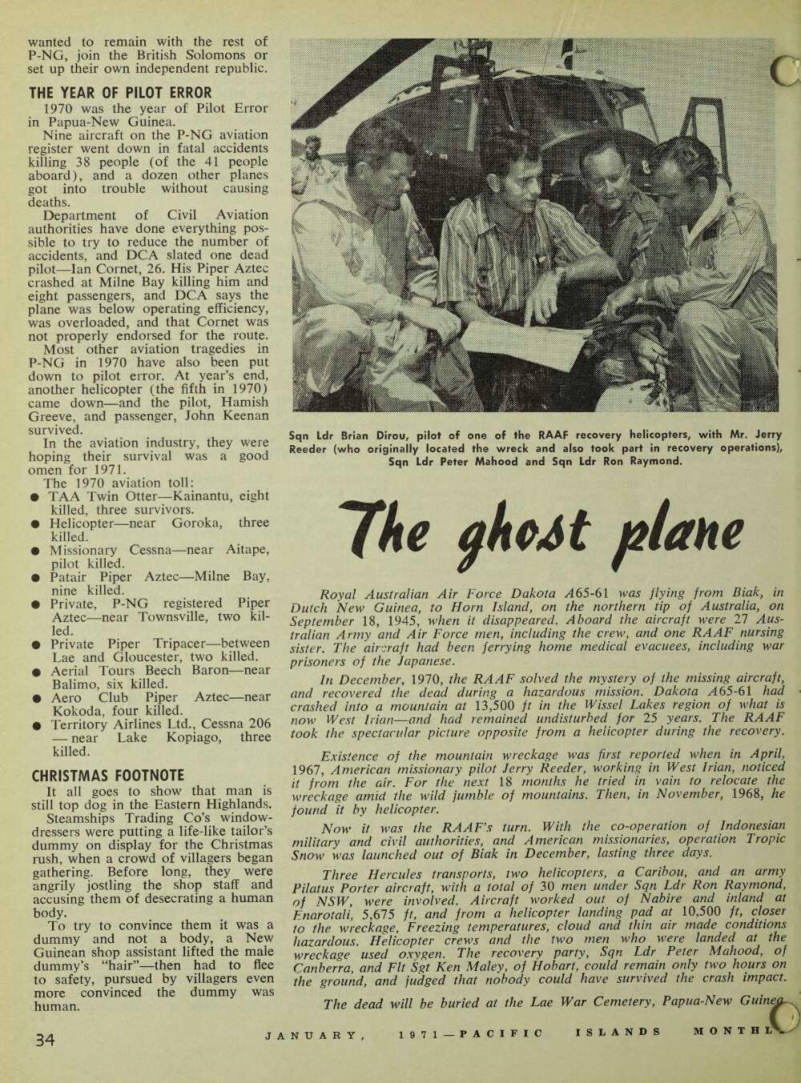
Three Hercules transports, two helicopters, a Caribou, and an army Pilatus Porter aircraft, with a total of 30 men under Sqn Ldr Ron Raymond, of NSW, were involved. Aircraft worked out of Nabire and inland at Enarotali, 5,675 ft, and from a helicopter landing pad at 10,500 ft, closer to the wreckage, Freezing temperatures, cloud and thin air made conditions hazardous. Helicopter crews and the two men who were landed at the wreckage used oxygen. The recovery party, Sqn Ldr Peter Mahood, of Canberra, and Fit Sgt Ken Maley, of Hobart, could remain only two hours on the ground, and judged that nobody could have survived the crash impact.
The dead will be buried at the Lae War Cemetery, Papua-New Guinea.
Sqn Ldr Brian Dirou, pilot of one of the RAAF recovery helicopters, with Mr, Jerry Reeder (who originally located the wreck and also took part in recovery operations), Sqn Ldr Peter Mahood and Sqn Ldr Ron Raymond.