Why whaling
pp. 79-81 · Read in the full issue

men came to the Cooks
Several of the Southern Cook islands were recognised ports of call for the fleet of whaling ships,
principally American, which
operated in the Pacific Ocean for almost a century up until the de cline of the trade after 1860.
The interest of the whalers in Rarotonga, Aitutaki and Mangaia were threefold: rest, refreshment and recruitment.
The buffeting the ships took at sea meant that they often sought shelter and relaxation for their crews; but in this respect, the Cook Islands were not hospitable. The islands were always dangerous places to visit.
There were no sheltered, safe anchor ages and the rigid control exerted by the missionaries did not allow the whalers’ crews to set up the rollicking and licentious havens which existed elsewhere in the Pacific.
But up to 100 whalers called at Rarotonga in a single year, this at a time when few other vessels paid any attention to the island, and the influence of the whalers, their captains and crew, was extensive and sustained.
Contacts with the smaller islands in the Southern Group were rather infrequent and the atolls of the Northern Group offered few attrac tions. However, whaling ships do provide some of the first records of European contact with Manihiki, Rakahanga, Penrhyn and Nassau, The Alexander Turnbull Library in NZ holds a copy of the Market House, regulations and prices for Avarua published in 1849, and this shows the firmness of the control over the ships’ crews: “It is re quested that on the desertion of a man from a vessel, the Captain give immediate information to the chiefs of the station and that the vessel not leave the island until the deserter be apprehended. That for every deserter delivered by the natives to the Captain, two pieces of cloth be paid, one to the chief of the station and the other to the parties who secured his apprehension.
“That in the case a deserter not be found until after the vessel has left the island, when apprehended he shall become a prisoner and be
Whalers had to obey local rules
employed in public work until he leave the island.”
Indigenous products and the food crops introduced by the missionaries were of great value to the whalers and trading was carried on briskly, but again under the supervision of the missionaries. All trading was carried out at market places.
Normally the sailors were not per mitted to leave it and as the Avarua instance shows, prices were stabilised in Chilean specie.
The range of articles included potatoes at a Chilean dollar a barrel, taro S 1 a barrel, bananas three bunches $l, dried bananas 10 bundles for $l, fowls four for $l, turkeys $1 each, hats 25c to SI each.
These control measures were often negated by the wrecks which occurred on the island reefs. In 1847, two whalers, one French and one Ameri can, came to grief on Aitutaki and the Rev. Henry Royle complained to the London Missionary Society about the debauchery and violence taking place on the island and of the economic burden placed upon its resources for almost a year by 70 destitute sailors.
It appears, however, that to the captains, above all else, these islands offered the opportunity to recruit crew members to take the place of those who died or were killed at other hazardous islands.
The New England newspapers of Boston, Salem, New Bedford, Nantucket and Essex report the wrecks of a substantial number of American whale-ships at Rarotonga, Aitutaki and Mangaia and, in most instances, it is reported that the disasters happened while recruiting was under way.
The Tacitus went ashore at Raro tonga in March, 1845, while recruit ing, before going on to the north-west coast of the US. The Rev. Buzacott reported that the sailors set a bad example ashore with their immoral conduct and that the captain, who was sailing under temperance principles and pledges, had given a 36 gallon barrel of rum to a chief.
The Sarah Francis in 1850 joined the Tacitus in the long list of Raro tongan wrecks, when, after complet ing her recruiting, she set sail, but was found to be leaking badly and was driven onto the reef to stop her sinking.
It seems that some captains called regularly to seek Maori sailors. The Frances was wrecked on Mangaia on Christmas Day, 1852. The captain reported to the New England papers on the hospitable and Christian recep-
he heeds not that Storm that chants a requiem o’er the trouble ocean.” tion his castaways had received and commented favourably on the character of the Mangaians. He knew them well, as he had recruited crew members there in March, 1851.
Young men went in large numbers from the relatively small island populations. Sometimes they were attracted by the pay, but it seems that greater attractions were the desire for adventure and novelty and the chance to escape from the authority of the chiefs and the repressions of the missions.
In 1849, 100 young men were absent from Ngantangiia on Rarotonga and in 1853 between 60 and 70 men were serving as whaling crew members. Many were encouraged to leave by the return of the few who were enriched to the extent of $3O to $5O. But this was soon dissipated among friends and relations and, often, the men went off to sea again.
Some chiefs tried to stop the practice of joining whalers by forbidding their young men to go to sea, while other chiefs sought to control the recruiting as they did trading. The Avarua market rules say that “Captains are not to engage natives for crew in secret”.
In his book, Na Motu: Reef rovings in the South Seas, Perkins, who served in the crews of whalers, gives a graphic picture of what must have been the fate of many of these Polynesian sailors. He tells us of Little Henry, a Rarotongan who is returning to his home island, a sufferer from tuberculosis:
“About 8 o’clock the steward informed me that Henry was dying.
I was at his bedside in a moment and beheld at a glance that the destroying angel was there. Though speechless, he was sensible of my approach, his Bible was at his side, but he no longer needed its con solations, for he was already at the threshold of that house his faith had built.
“Death came not to him amid the groves of his native isle where the drooping plumes of the palms rustle in the breeze like the whispered converse of the spirits, and where, amid the harmonies of nature he might breathe a last farewell to weeping friends, but in his narrow room where the rays of light through the cabin window shone faintly upon the bulkhead, and surrounded by hardy seamen in whose feeling hearts his suffering touched a chord of sympathising response.”
Four years later Perkins sailed past Rarotonga in the night and says his thoughts encompassed visions of Henry’s family: “How often has she (Henry’s mother) counted the breadfruit harvests and scanned the distant horizon for the faint glimmering of a sail! In vain has the sister woven garlands of flowers plucked from her native hills for her truant brother.
But grieve not for him. Holier fingers have twined for him chaplets of amaranth where, in brighter realms,
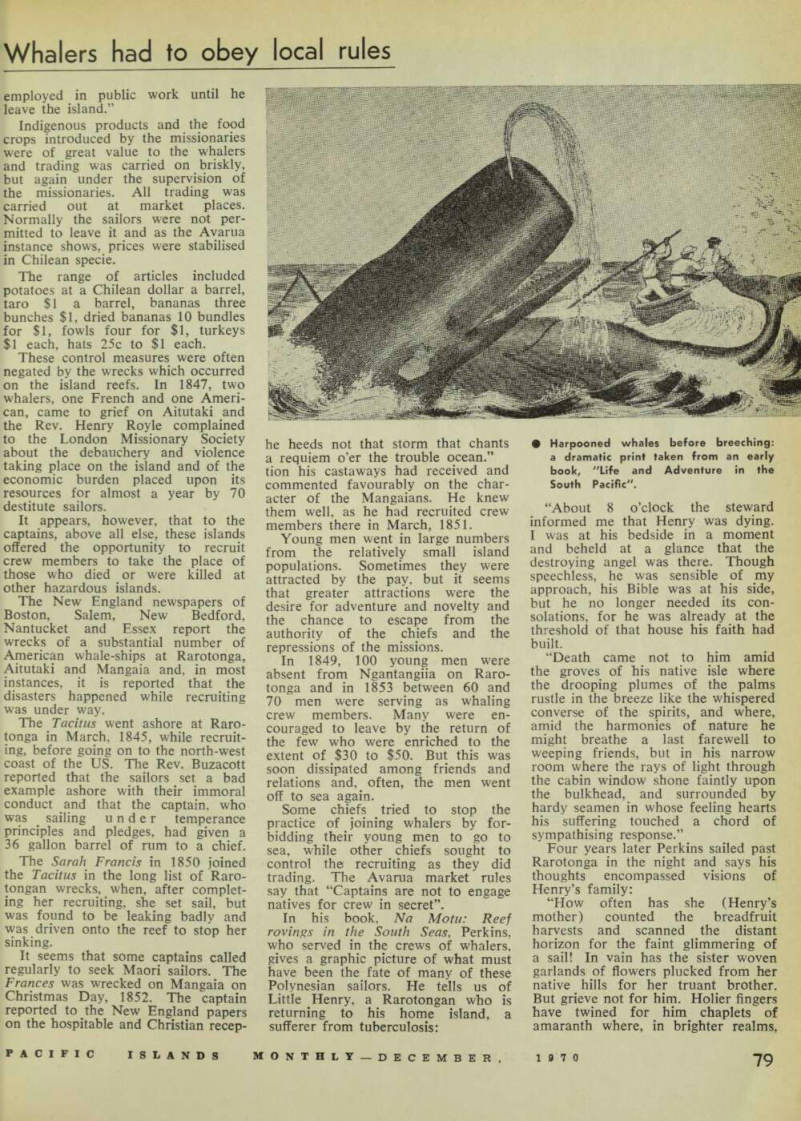
Harpooned whales before breeching: a dramatic print taken from an early book, "Life and Adventure in the South Pacific".