Magazine Section
pp. 77-79 · Read in the full issue
First Visitors To Mangaia
Why Captains Cook And Reibey
Turned And Sailed Away
By DR. W. G. COPPELL, a former Deputy Director of Education in the Cook Islands.
The first two recorded encounters with the inhabitants of Mangaia in the Cook Islands were hardly likely to make European explorers feel at home. Captain Cook, who arrived during his third Pacific voyage, decided discretion was the better part of valour when faced with armed natives and a dangerous reef. Thomas Reibey of the Mercury departed hastily in 1808 taking a crew member with a Mangaian spear through his groin.
The island, about six miles across and the most southerly of the Cook group, was first sighted on February 29, 1777, when Cook, on board the Resolution, received a signal from the Discovery that land had been seen.
This was the first discovery of new land on this voyage.
People were seen on the shore, most of them armed with long spears or clubs and making threatening gestures or, as some on board the ships preferred to think, inviting the ships’ people to go ashore.
Cook gives us a clear description of the Mangaians. “Most of them appeared naked except having a girdle which, being brought up between the thighs, covered that part of the body.
Some of them had pieces of cloth of different colours, white, striped, or checkered, which they wore thrown about their shoulders. Almost all of them had a white wrapper about their heads, not much unlike a tur ban or high conical hat. The people were a tawny colour, of middling stature, but robust and inclined to corpulence.”
Through his interpreter, Omai, Cook was able to communicate with two of the islanders, who came out from the shore in small, one-man canoes, and from them he learnt the island was called “Mangeea”. Cook launched two of the ship’s boats but was persuaded to abandon the attempt at landing by the sight of the extremely dangerous reef, in which there seemed to be no opening, and by the fact that several of the Mangaians had swum out to the
boats, climbed on board and it was “difficult to prevent them carrying off everything they could lay their hands on”.
When the Englishmen returned to their ships, Cook was accompanied aboard by Mourooa, one of the two men who had first paddled out to the ships, and it was from him that Cook and his men were able to learn much of the language and customs of the place.
The second recorded visitor to Mangaia had very direct links with Australia as it was brought about by the trade in salt pork, which had
been built up between the infant colony at Sydney Town and Tahiti and other islands in the neighbour hood. lft 10A0 .
On Sunday, July 10, 1808, the colonial schooner, Mercury, Thomas Reibey, master, arrived at Sydney from Tahiti, with an account of an extended voyage which affords an insight into conditions on a number of Pacific Islands, The ship had left her home port
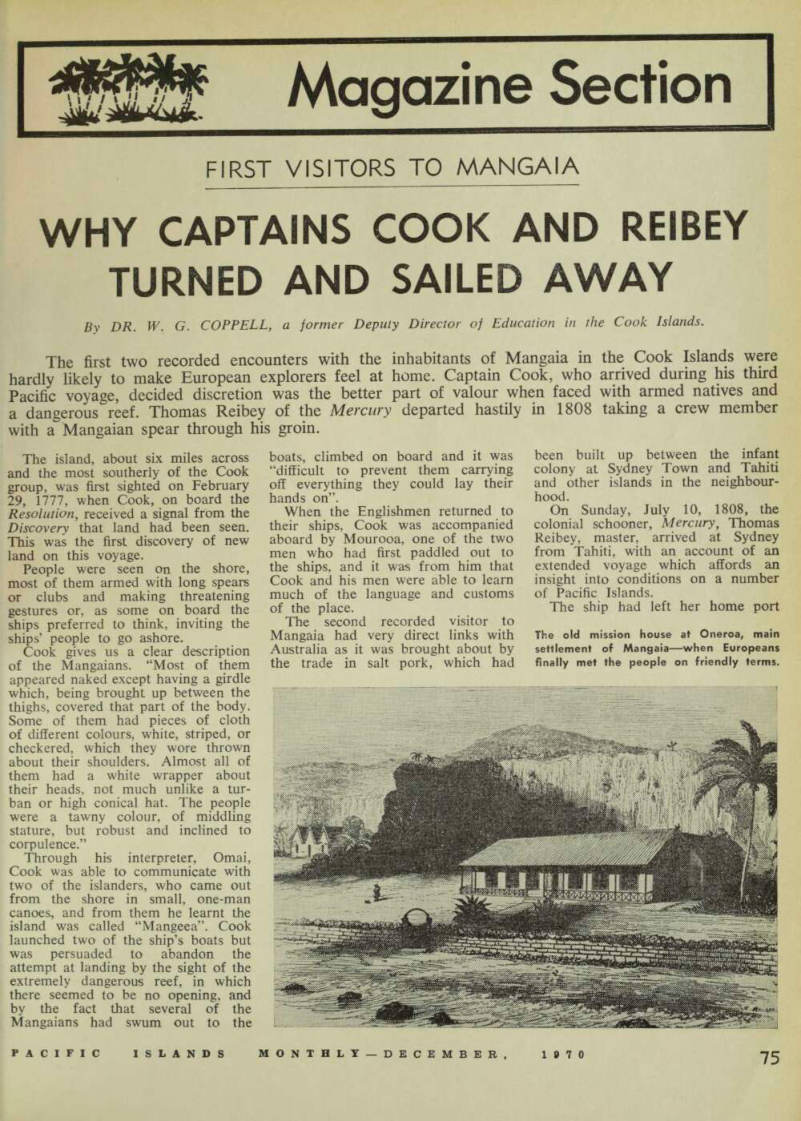
The old mission house at Oneroa, main settlement of Mangaia—when Europeans finally met the people on friendly terms.
an December 10 the previous year in the company of the King George, aoth ships seeking food supplies for Sydney town, principally salt pork.
On January 3 the ships parted company and while the King George set her course for Fiji, the Mercury continued on to Matavai Bay, arriv ing there on February 24.
Until April 25 the crew were busy trading for pigs and salting them down. The Mercury then stood to the south-west until she reached Mangaia and there the crew found that the people “seemed perfect strangers to svery race but their own”.
They were described as being similar to the Friendly Islanders in dress and colour, but above average in size, robust and very muscular.
As the ship neared the island, 50 to 60 canoes came out to meet her, each occupied by a single man armed with one long spear and several short ones. When the ship hove to about two miles from the shore the canoes surrounded her and their occupants entreated the sailors to go ashore and invited them to get into the canoes.
However, the Mercury’s people be came suspicious of the Mangaians’ intentions, particularly as their num bers increased rapidly. Accordingly measures were taken for the defence of the ship.
The islanders, as they seemed to have no prior knowledge of firearms, were little affected by the weapons held by the Europeans, and they began to demand everything that was to be seen on the ship’s deck, the sailors having little difficulty in understanding these demands as the dialect differed only slightly from that of Tahiti.
The crew understood the frequent demands for the pigs penned on the ship and that the Mangaians were impressed with the size of the ship and were puzzled as to to whom this “canoe” belonged.
Eventually the patience of the islanders was exhausted and several grappled with the bowsprit and attempted to tow the ship towards the island while others tried to pull the bolts from the ship’s hull, for “the sake of the iron, with the value of which metal they were doubtless made acquainted by Captain Cook”.
Captain Reibey tried to capitalise on the situation, as, still having some of his trade goods left, and observing that the Mangaians seemed to have few articles suitable for barter, he offered to trade for the intricately carved Mangaian spears, but none of the islanders could be induced to part with their weapons.
Then, while the attention of most of the crew was diverted, one of the
Mangaians who had been pretending to barter with David Clarke, one of the seamen, made a “sudden plunge at the belly of Clarke; who received the spear through his right hand and into the left groin about an inch.
The unfortunate man fell upon re ceiving the wound and was with great difficulty got in”.
It was now obvious that a general attack was about to be mounted and self defence became the main interest of the Europeans. Two musketoons were fired at the nearest canoes and “we were not sorry to observe that the whole contents of one were lodged in the body of Clarke’s un provoked assailant”.
The men in the canoes did not wait to find out the cause of the explosions but “taking to their paddles, in a few minutes reached the shore, where an immense number were assembled”. The Mercury then left.
According to Mangaian tradition, only three ships had called at the island before the arrival of the mis sionary John Williams in 1823. H. E.
Maude, in his Of Islands and Men, produces a substantial amount of evidence that one of the three, in fact the second visitor, after Cook, was the Bounty, under Fletcher Christian, as the mutineers searched for a sanctuary where they would be safe from inevitable pursuit and vengeance from the British Navy.
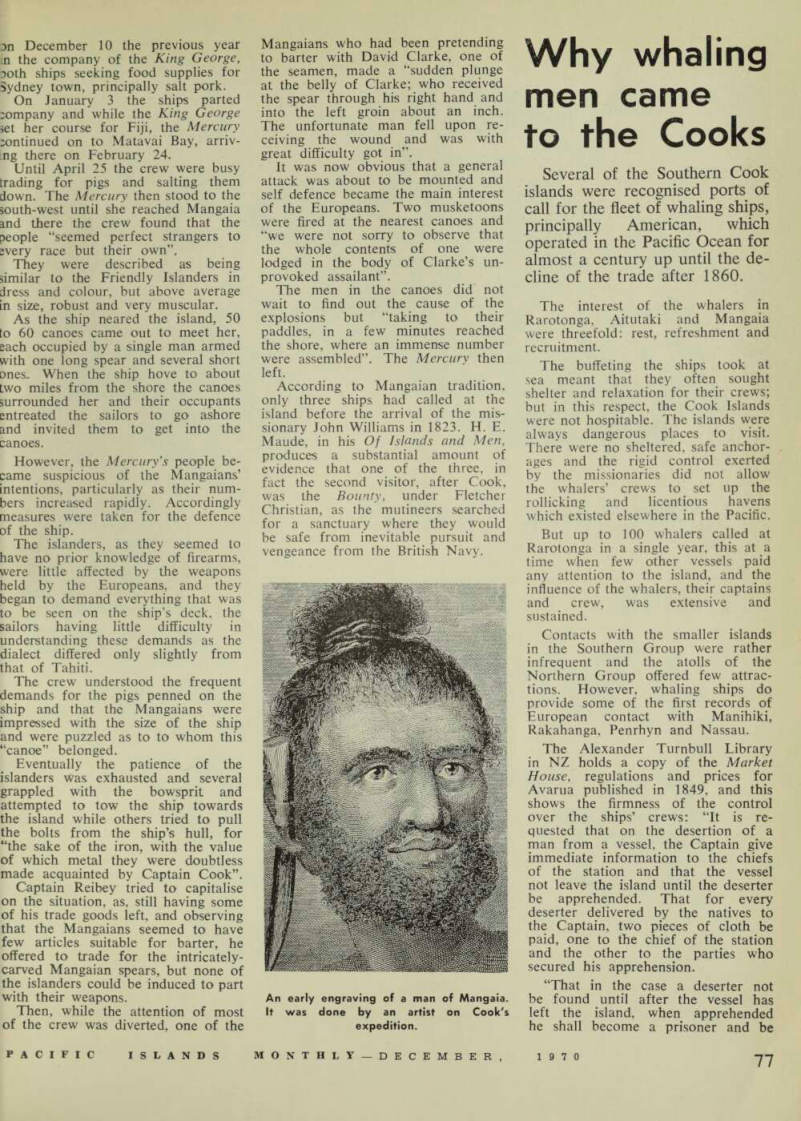
An early engraving of a man of Mangaia.
It was done by an artist on Cook's expedition.