Yesterday
p. 83 · Read in the full issue
Although PIM, editorially speaking, didn’t like what was hap pening in the rest of the world, life in the Pacific at least was full of interest 20 years ago this month. One big event was the arrival in Brisbane of the 37 ft cutter, Fetu Moana, skippered by Jack Morris, of Lautoka, Fiji, crewed by five Fijians, and carrying one unfortunate passenger. Unlike the raft La Balsa, which in November arrived in Queensland after a 161 day drift from Ecuador, the Fetu Moana wasn’t aiming for Australia. The cutter was sailing between islands in Fiji’s Koro Sea, was blown away and took four weeks to drift the 1,500 miles to Queensland.
PIM for the first time took to the air. Copies of the magazine were to be flown by Qantas to points in Papua-New Guinea. And arrange ments were being made to extend this service to Fiji and the New Hebrides.
Cost per copy in Port Moresby was 2/9d, and a little more away from the capital.
Western Samoa had its worst ever air crash when a New Zealand Air Force Catalina plunged into the lagoon immediately after taking off from Faleolo Airport. Seven of the crew of eight were killed. The other crew member and five passengers (Samoan Administration officials on a routine visit to the Tokelau Islands) were injured.
The notice of the Secretary of Fijian Affairs had been drawn to the plight of a group of 280 Fijians who had been landless since their descendants took part in a rebellion against King Cakobau about 1870.
The descendants, living in a village on Ovalau, were dependent on another small land-owning group. The gov ernment now made land available to them nearby.
PIM reported that the last steam ship on a regular trans-Pacific service was to be sold. The Aorangi, owned by the Union SS Co. Ltd. had con nected North America with Australia and New Zealand. PIM said the introduction of plane services and the “imposition of intolerably expensive conditions for shipping services by the socialist authorities” were responsible for the demise. Before World War II there were three other liners crossing the South Pacific—the Niagara, the Monterey and the Mariposa —and these had all gone. (The gap remained for some years).
Tonga, with a population of about 50,000, was about to embark on a birth control programme. Birth con trol was discussed at the Legislative Assembly, and it was decided there should be public debate as the best means of bringing word to the people.
The first debate took place before a packed house in the Government College hall; main speakers were the Premier, Prince Tungi (the present King Taufa’ahau) and his brother, Prince Tu’ipelehake. Today Tonga is still concerned about birth control, and the population is up to 84,000.
The paper-thin walls of some of New Guinea’s hotels had caused some bother. PIM reported a wife deserted her planter husband after he had been heard talking to a blonde from “up the coast” late into the night. The wife refused to believe that he had been talking through the thin walls to the blonde, and last report was that she was living with her mother in Sydney.
Drought in the Gilbert and Ellice Islands was worsened by lack of
transport to carry emergency water.
The “Nimanoa” was lying in Tarawa with a broken tail shaft, the “Margaret” was stuck on the Nanumea reef, and only the little “Kia Kia” was serviceable.
Sir Alan Burns, member of a UN Trusteeship Council delegation to Micronesia, Western Samoa and New Guinea, spoke in London of his im pressions. He said he was surprised by the number of American officials working in the US Trust Territory, and felt the people themselves should be encouraged to do more towards their own development. Of New Guinea, he said priority should be given to building roads (or rail) and bettering the living conditions of New Guinea public servants. Of Western Samoa he said the leaders were too devoted to long-drawn-out ceremonies and oratory, but the people were happy.
An appeal was published by the History Department of the University of Melbourne for unpublished manu scripts, letters or diaries about life in New Guinea’s early days. Printed works there were a-plenty; what was needed were the personal notes of people who had lived in the territory when history was being made.
Annual reports of the New Zealand Department of Island Territories on territories under NZ control revealed that many Islanders were being drawn to the bright lights of Auckland.
There were already 2,000 living in NZ, and once more sea and air transport was available (added PIM), the drift would become a flood.
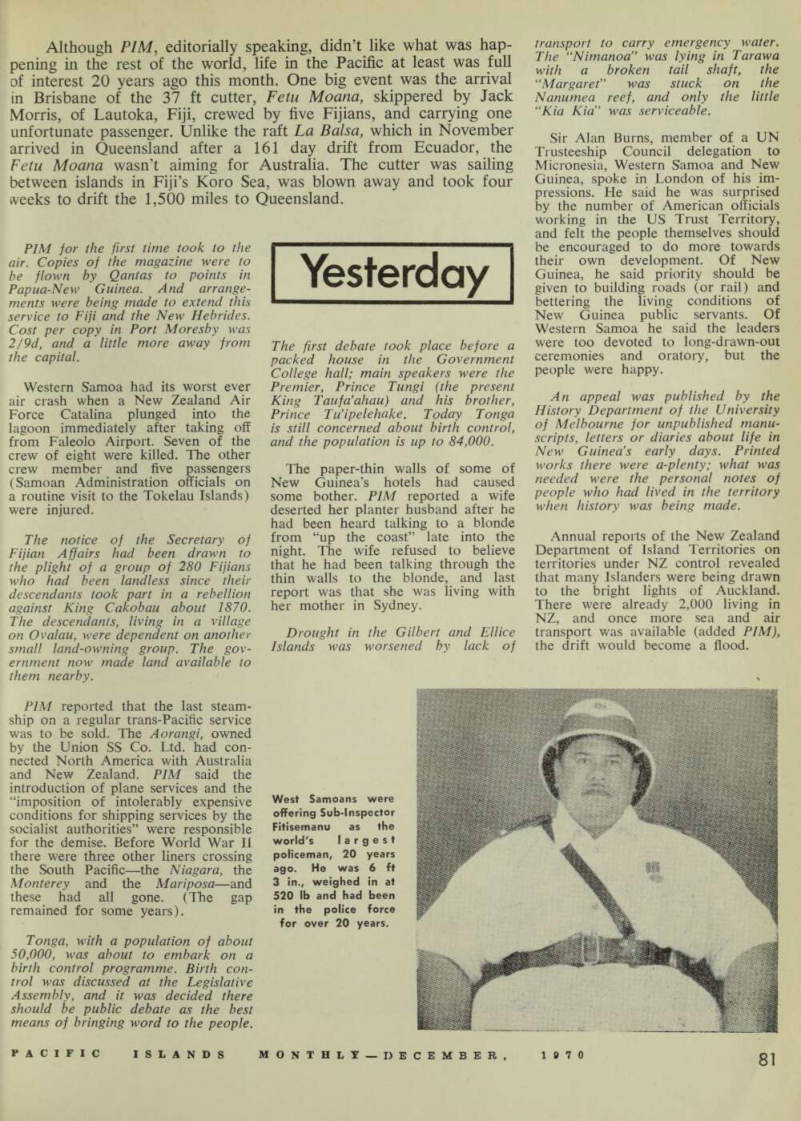
West Samoans were offering Sub-Inspector Fitisemanu as the world's largest policeman, 20 years ago. He was 6 ft 3 in., weighed in at 520 Ib and had been in the police force for over 20 years.