Tropicalities
pp. 41-42 · Read in the full issue
The isolated Marquesas Islands —dubbed “the Forgotten Islands of the South Seas” by the Swedish author Bengt Danielsson — can now be reached by air. On November 4, a Piper Aztec of Air Tahiti and a Twin Otter of RAI inaugurated what will become a commercial service between Tahiti’s Faaa Airport and the island of Ua Huka, the third largest of the 10 islands in the Marquesas.
The Piper Aztec, with four pas sengers, plus the pilot and co-pilot, made the trip non-stop in a little over five hours. The Twin Otter, with eight passengers and a crew of three, touched down en route at Rangiroa Atoll in the Tuamotus, and took about eight hours.
The inaugural passengers included the Governor of French Polynesia, Mr. Pierre Angeli, the President of the Territorial Assembly, Mr. Jean Millaud, and the Bishop of Tahiti, Monsignor Coppenrath. However, a regular commercial service won’t start until early 1971.
The people of Ua Huka travelled on horseback to the airstrip to wit ness the arrival of the two planes, which stayed overnight and returned to Tahiti next day.
Ua Huka’s airstrip is about 2,600 ft long and cannot be enlarged. A steep cliff prevents its extension at one end; at the other are some low hills.
The inauguration of the service to the Marquesas means that all major island groups in the Pacific are now linked with the rest of the world by air.
In time, the new service could lead to the revitalisation of the Mar quesas, which now have a population of only about 4,000 compared with perhaps 60,000 a century and a half ago. The islands are about 470 miles north-east of Tahiti and have a total area of 492 square miles.
Many of the islands in the group are extremely fertile and could be developed agriculturally. Their rugged and sometimes forbidding scenery should make them of interest to tourists.
The French Government first an nounced plans to open up the Mar quesas to aviation in July, 1965, when the then Governor of French Poly nesia, Mr. Jean Sicurani, visited the group and inspected proposed sites for airstrips on Nukuhiva and Hiva Oa, the two largest islands (PIM, Aug., 1965, p. 11).
The site on Nukuhiva, near
Air Link Opens
To "Forgotten"
Marquesas
Taiohae, the main port in the group, was reported to be suitable for a strip nearly 10,000 ft long. A jet strip will eventually be built at Hiva Oa, near where Paul Gaugin is buried.
On the trail
of Mendana
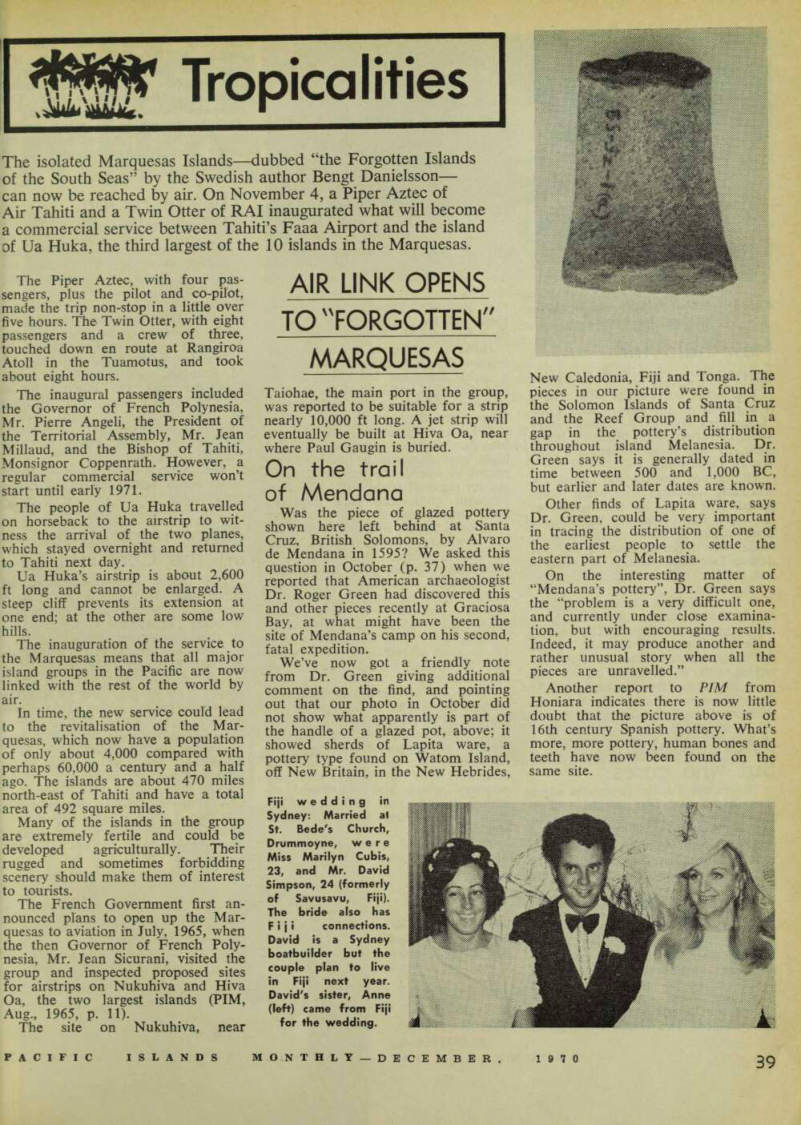
Was the piece of glazed pottery shown here left behind at Santa Cruz, British Solomons, by Alvaro de Mendana in 1595? We asked this question in October (p. 37) when we reported that American archaeologist Dr. Roger Green had discovered this and other pieces recently at Graciosa Bay, at what might have been the site of Mendana’s camp on his second, fatal expedition.
We’ve now got a friendly note from Dr. Green giving additional comment on the find, and pointing out that our photo in October did not show what apparently is part of the handle of a glazed pot, above; it showed sherds of Lapita ware, a pottery type found on Watom Island, off New Britain, in the New Hebrides,
New Caledonia, Fiji and Tonga. The pieces in our picture were found in the Solomon Islands of Santa Cruz and the Reef Group and fill in a gap in the pottery’s distribution throughout island Melanesia. Dr.
Green says it is generally dated in time between 500 and 1,000 BC, but earlier and later dates are known.
Other finds of Lapita ware, says Dr. Green, could be very important in tracing the distribution of one of the earliest people to settle the eastern part of Melanesia.
On the interesting matter of “Mendana’s pottery”, Dr. Green says the “problem is a very difficult one, and currently under close examina tion, but with encouraging results.
Indeed, it may produce another and rather unusual story when all the pieces are unravelled.”
Another report to PIM from Honiara indicates there is now little doubt that the picture above is of 16th century Spanish pottery. What’s more, more pottery, human bones and teeth have now been found on the same site.
Fiji wedding in Sydney: Married at St. Bede's Church, Drummoyne, were Miss Marilyn Cubis, 23, and Mr. David Simpson, 24 (formerly of Savusavu, Fiji).
The bride also has Fiji connections.
David is a Sydney boatbuilder but the couple plan to live in Fiji next year.
David's sister, Anne (left) came from Fiji for the wedding.
that the SPC should find out the views of the territories and get a date for possible commencement.
However, earlier at the same con ference, South Pacific territories took a verbal thick ear for having in the past displayed enthusiasm for projects at the conference table, and ignoring them when they got home.
SPC secretary-general, Afioga Afoa fouvale Misimoa, pointed out that high level participants had been ex pected to attend one important meet ing on regional trade, after the 1969 Noumea conference had displayed great enthusiasm for it. But there were only replies from two territories to invitations—both received after the deadline date.
Dr. Guy Loison, programme direc tor (health), rubbed salt in the wound when he announced the ter ritories’ response to the work programme before the Suva con ference. Only four territories out of 19, in spite of reminders and cables, had forwarded their comments on the programme.
“Why do we have no answer to urgent last-minute cables asking for the names of participants? When, for a certain conference, we specially invite high responsible personalties, why do you send us unknown delegates? Why do we have to cancel meetings which you considered es sential during your conference?” he asked. The replies were not forth coming.
The proposed tourism campaign which the territories (one hopes) are
New halo for
Samoa's politicians
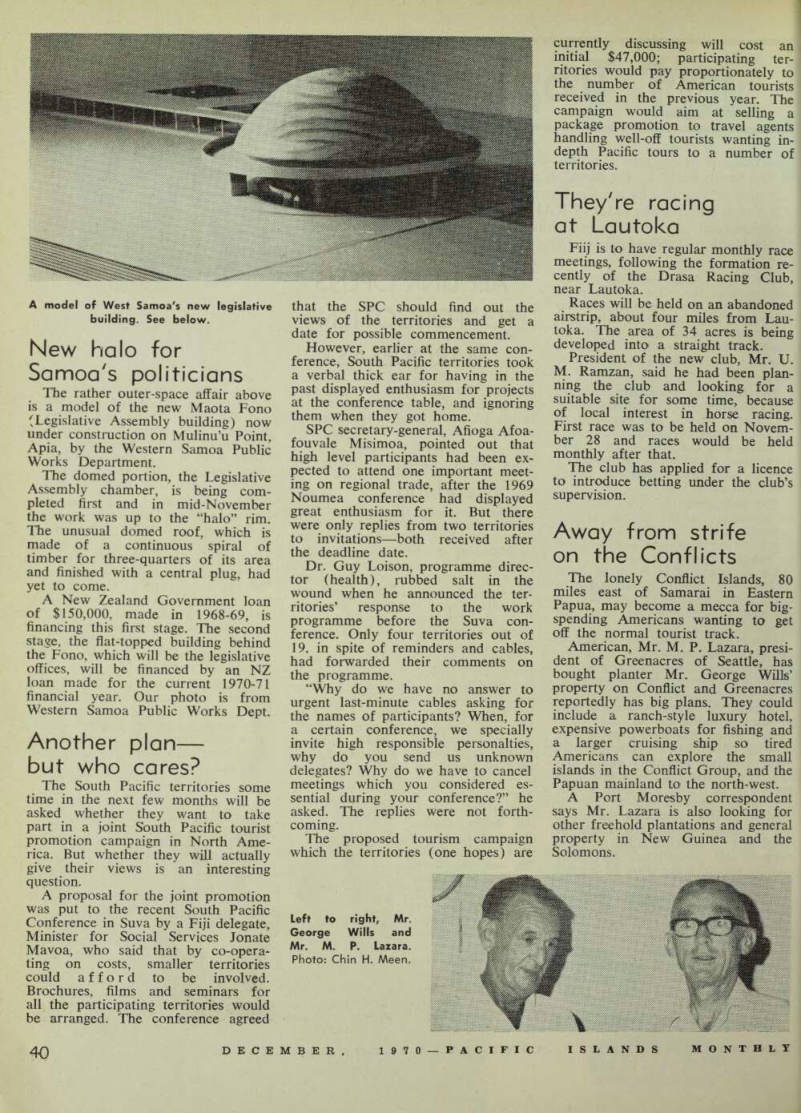
The rather outer-space affair above is a model of the new Maota Fono (Legislative Assembly building) now under construction on Mulinu’u Point, Apia, by the Western Samoa Public Works Department.
The domed portion, the Legislative Assembly chamber, is being com pleted first and in mid-November the work was up to the “halo” rim.
The unusual domed roof, which is made of a continuous spiral of timber for three-quarters of its area and finished with a central plug, had yet to come.
A New Zealand Government loan of $150,000, made in 1968-69, is financing this first stage. The second stage, the flat-topped building behind the Fono, which will be the legislative offices, will be financed by an NZ loan made for the current 1970-71 financial year. Our photo is from Western Samoa Public Works Dept.
Another plan—
but who cares?
The South Pacific territories some time in the next few months will be asked whether they want to take part in a joint South Pacific tourist promotion campaign in North Ame rica. But whether they will actually give their views is an interesting question.
A proposal for the joint promotion was put to the recent South Pacific Conference in Suva by a Fiji delegate, Minister for Social Services Jonate Mavoa, who said that by co-opera ting on costs, smaller territories could afford to be involved.
Brochures, films and seminars for all the participating territories would be arranged. The conference agreed
currently discussing will cost an
initial $47,000; participating ter
ritories would pay proportionately to the number of American tourists received in the previous year. The campaign would aim at selling a package promotion to travel agents handling well-off tourists wanting in depth Pacific tours to a number of territories.
They're racing
at Lautoka
Fiij is to have regular monthly race meetings, following the formation re cently of the Drasa Racing Club, near Lautoka.
Races will be held on an abandoned airstrip, about four miles from Lau toka. The area of 34 acres is being developed into a straight track.
President of the new club, Mr. U.
M. Ramzan, said he had been plan ning the club and looking for a suitable site for some time, because of local interest in horse racing.
First race was to be held on Novem ber 28 and races would be held monthly after that.
The club has applied for a licence to introduce betting under the club’s supervision.
Away from strife
on the Conflicts
The lonely Conflict Islands, 80 miles east of Samarai in Eastern Papua, may become a mecca for big spending Americans wanting to get off the normal tourist track.
American, Mr. M. P. Lazara, presi dent of Greenacres of Seattle, has bought planter Mr. George Wills’ property on Conflict and Greenacres reportedly has big plans. They could include a ranch-style luxury hotel, expensive powerboats for fishing and a larger cruising ship so tired Americans can explore the small islands in the Conflict Group, and the Papuan mainland to the north-west.
A Port Moresby correspondent says Mr. Lazara is also looking for other freehold plantations and general property in New Guinea and the Solomons.
A model of West Samoa's new legislative building. See below.
Left to right, Mr.
George Wills and Mr. M. P. Lazara.
Photo: Chin H. Meen.