politics, get along?
pp. 45-49 · Read in the full issue

Can those who make the money and those who make the politics, get along?
From JUDY TUDOR, in Suva
Right on schedule on October 10, 96 years after his great great-great-grandmother Victoria had accepted it from the first Cako bau and the chiefs, Prince Charles, on behalf of Queen Elizabeth 11, gave Fiji back to the people who now inhabit it.
What Victoria had accepted was a savage country, bedevilled by its first contact with western civilisation and Cakobau’s own entanglements.
What has been returned is a fair land, a generation ahead of any of its Pacific neighbours in most respects, reasonably prosperous, with plenty of problems but plenty of promise for the future, too. In short, a going concern.
It’s fashionable to quibble about an ex-colonial administration’s deficiencies but Britain has nothing to be ashamed of in the sort of Fiji it now leaves.
Although there were one or two Indian utterances about “breaking the chains of colonialism”, there has been little feeling here of sudden liberation; nothing equivalent to the uhuru of East Africa. Independence has come painlessly; no one ever went to gaol for their anti-British activities.
Politically, for the moment and on the surface, it is very much the mixture-as-before. The present elec ted members of the old Legislative
Council (that is, minus the 11 gov ernment members) will continue as the House of Representatives until a new election is held in about a year’s time.
Names of Senate members have already been announced.
After next year’s election, Indian and Fijian members of the House of Representatives will be greatly increased (Fijian from 11 to 22 and Indian from nine to 22) but the number of so-called General mem bers, now mainly European, will re main the same, at eight. A Con stituency Boundaries Commission has been set up to delineate the new constituencies.
Voting will be on the communal roll principle for 27 communal con stituencies and the remaining 25 members will be elected from national constituencies.
Ten of the national constituencies will each return one Indian and one Fijian; and each of these 10 con stituencies will then be grouped in pairs, each pair returning one General member.
Everyone now on the electoral rolls, whether he has taken Fiji citizenship or not, will be entitled to vote at next year’s election. At subsequent elections, only citizens will vote.
The business of taking new citizen ship affects the European population mainly, but also those Chinese who have retained their original citizen ship. Predominantly, the Indian population of Fiji is now locally born which automatically makes them citizens.
Europeans who were born here are, of course, citizens, and so are those who were registered as citizens of the United Kingdom and colonies before May 5, 1970. On October 10 they automatically became citizens of the new Dominion of Fiji.
All other non-citizens, who fulfil other residential qualifications, may apply for citizenship within two years of independence and, if this is granted, they will be expected to renounce other citizenship.
In this matter of citizenship and voting rights, Fiji has departed from other British countries that have taken dominion status. For example, a New Zealander going to live in Australia does not need to take out nationality papers; as he is a British subject he has the same citizen rights
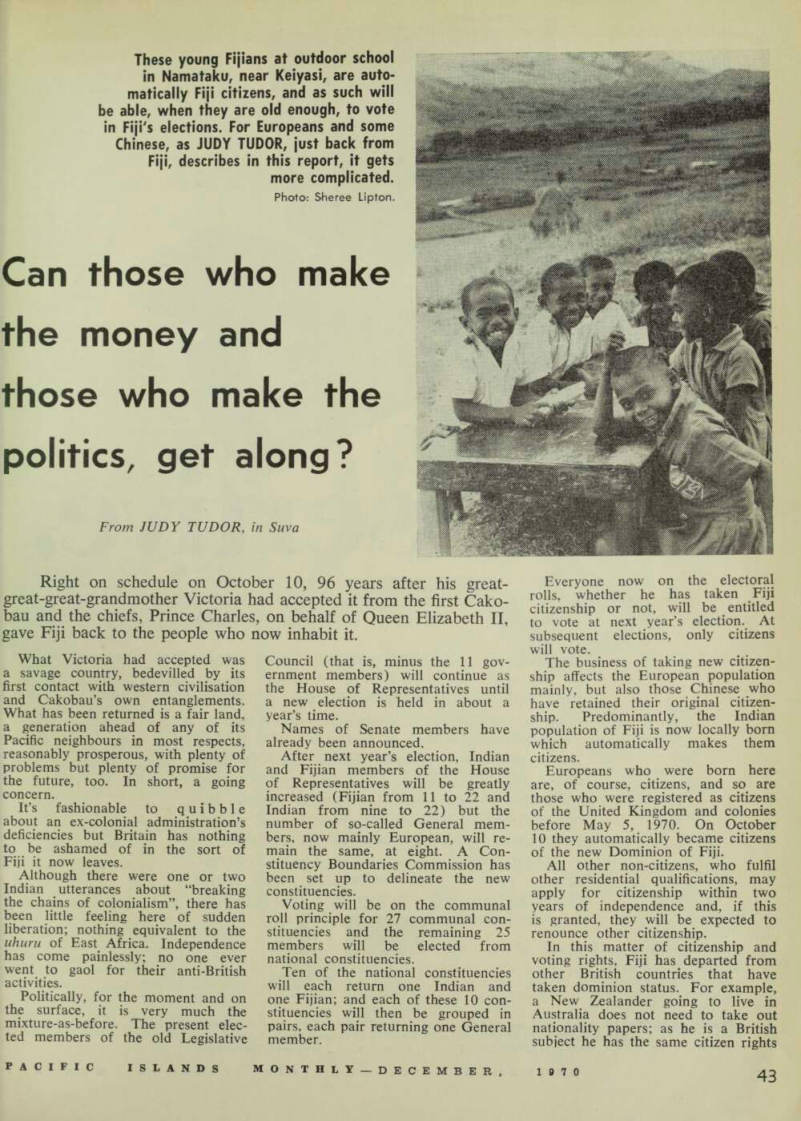
These young Fijians at outdoor school in Namataku, near Keiyasi, are auto matically Fiji citizens, and as such will be able, when they are old enough, to vote in Fiji's elections. For Europeans and some Chinese, as JUDY TUDOR, just back from Fiji, describes in this report, it gets more complicated.
Photo: Sheree Lipton.
is an Australian, including that of 'oting at elections.
As Fiji citizens will continue to >e British subjects, presumably they vill be able, if they fulfil other Aus ralian immigration requirements, to ake up residence in Australia and to rote with other British subjects; but he converse will not hold good hat is, an Australian citizen will lot be able to come to Fiji and to ake part in elections.
As things are at the moment, Australians, New Zealanders and ither Britishers who have lived here he required seven years will probably lot have too many qualms about aking out local citizenship in two rears, everything else being equal. have more to consider.
But whether those who are eligible io take citizenship or not, the Euro >ean from this time on loses much if his political influence although ipon European enterprise and con inued investment much of the jconomic health of the country must continue to rely. The two things ihould cancel each other out—those vho invest having due regard for hose who make the politics; and hose in parliament having an ear ; or those who provide the money md the industry. Should —but not lecessarily will.
Therein lies the million dollar question for some of the solidest •esidents of Fiji who, with the lessons )f other promising ex-colonial countries fresh in mind, can only idopt a policy of wait and see— aossibly until any trends that develop luring next year’s elections; probably for a year or so after that.
Economically Fiji still depends on ts sugar industry, and how this is ;o function after the Colonial Sugar Refining Co. subsidiary pulls out in 1972 is still unresolved.
Second string to the bow is tourism, which is booming and appears to be developing into a never mding bonanza. Tourism, nonethe less, is a delicate plant which could wither and die if politicians and Ihose in high places leave off being wise and sensible men and become arrogant, self-seekers who turn a deaf jar to all but their own opinions.
Fiji at independence has a lot going for it but it still buys a great leal more than it sells, and depends an continuing overseas investment to take up the slack. It needs also a stable political and social background if Fiji is to remain the holiday mecca of the South Pacific. In addition, it needs basic industries that require large pools of manpower to cure the continuing unemployment problem.
None of these troubles are in soluble and exercise the minds and
doubts of only a minority of the population.
Among this section of the com munity it is often felt that if Fiji gets itself into trouble anywhere, it is likely to be financial trouble. Already independence has produced a huge bill of additional costs —the celebra tions themselves; the setting up of diplomatic missions overseas where sums of $250,000 are tossed about as though they were peanuts; and a very much enlarged legislature, with largely increased salaries all around.
Apart from tourism there is nothing much to indicate where the extra revenue to pay for these luxuries is to come from.
In a situation of overspending, most new nations have almost invariably looked greedily to the bigger, estab lished corporations, especially if they are foreign owned; or have sought to restrict the outflow of funds and the repatriation of capital. If Fiji ever follows suit, overseas investment which at present is a large factor in balancing its trade deficit, will dry up, and the seemingly mild measures introduced in the legislature in early November, under which it is pro posed to limit overseas investment to specific industries, seemed to some to be the first cool breeze of other controls that might be expected to follow.
At grass-roots level, independence has brought simpler and more definite expectations.
For the Indians it is the expecta tion of getting a bigger slice of the cake. For a very large proportion of Fijians it’s a belief that now they will have a bigger share in running their own country and that they can still dispose of the Indians by sending them back to India should the need arise.
Expostulations that this sort of nonsense is out —interred at the last London conference—and that multi racialism and partnership, as ex pounded by Prime Minister Mara, is in, gets the reply that: “Ratu Mara speaks from his mouth—not from his heart”.
Fundamental conceptions die hard, and racial bias, apparently decently buried by the elite, is still a big problem that new, independent Fiji has to lick.