New Guinea
pp. 38-39 · Read in the full issue
Diary
With John Ryan
At last! Two party government is just around the corner in New Guinea.
“Party” is no longer a thoroughly dirty, misunderstood word. The key Highlanders who thought it had something to do with birth, marriage, death or fighting feasts have been “educated”.
For population and size. New Guinea has probably reared more political parties than anywhere else in the world, since Pangu (“immediate home rule”) got off the ground in March, 1967. In the 3i intervening years, 22 parties and political groupings have been formed—and 18 aborted—without counting the unofficial Administration Party which has been running the New Guinea Parliament since the first House of Assembly in 1964.
At the beginning of November, Pangu with nine Parliamentary Members and as many as 1,500 claimed financial supporters, was the only survivor from among the first 19 parties since 1967.
Now, there are three more parties with a good chance of long life: • Compass (Combined Political Association) headed by the Ministerial Member of Parliament for Agriculture, Stock and Fisheries, Tei Abal (from Wabag, Western Highlands) and claiming nearly 40 Parliamentary members —and a “go-slow” policy on constitutional development. • People’s Progress Party led by MHA Julius Chan-Sungmen from New Ireland, making no grandiose claims at all. • Niugini National Party led by that very bright young man from the Jimi Valley in the Western Highlands, Thomas Kavali.
A political party in the Highlands! A lot of people thought it would never happen. It has, and it’s gathering strength, especially among Highlands students at the University of Papua-New Guinea and the Institute of Tech nology.
Why the sudden burst of political activity, the new parties and the un mistakable signs of political determination?
There seems no doubt that it can all be sheeted home to Australia’s Labour Opposition leader Gough Whitlam who toured here January, 1970, followed in July by Prime Minister John Gorton.
The million new Highlanders have been developing fast since the first real developmental contacts began in 1946. The Highlanders control the New Guinea food-bowl. They are going to be crucially influential in an independent New Guinea, by sheer weight of numbers, seats in Parliament and because of their growing dollar-affluence.
But, like peasant farmers the world over, they are conservative. They honour the status quo, and have been showing signs of increasing nervousness about coastal development, coastal education, and the pre-eminence of coastal men in government jobs.
Despite the very clear economic and political divisions between Highlands and coastal communities, Australia’s Labour leader Whitlam showed in January that he didn’t give a damn. New Guinea, he said, had to take self government in 1972 and independence in 1976. The Highlanders, and the European planters living among them, were appalled.
In July, when Prime Minister Gorton ordered significant changes, giving local people more governmental power, it clearly reinforced the Highlands fear that self-government had become an unstoppable political snowball.
Faced with an inescapable set of political ground-plans from outside, the latent, unorganised political groups in the 94-seat House of Assembly had to organise quickly: Pangu began its own monthly newspaper and, much more importantly, began lobbying the Highlanders to start their own party and to ally it eventually with Pangu—hence Thomas Kavali’s new Niugini National Party. When Kavali’s platform is published there will be clear links with Pangu’s.
Also in the Highlands, MHA, J. R. Watts was handed the job of trying to weld together a loose group of parliamentary political thinkers into a party
that would be moderate, careful, ac ceptable: a party based on Highlands economics. The result: Compass.
The very title of the party is designed as something that will appeal to Highlanders—appeal to their sense of status quo, for almost every white man they saw in the initial-contact stages carried a compass.
In the New Guinea Islands, MHA, Julius Chan-Sungmen wanted a party to link those island Members of Parliament who want progress with out pain—something sensibly radical and progressive without reaching the lawlessness of Mataungan. Chan- Sungmen invented the People’s Pro gress Party.
With just one year of the 1968 House of Assembly left to run, the new party alliances are expected to shape up for the 1972 (February- March) general election like this: Pangu-Niugini National parties, Compass-Administration-People’s Pro gress Parties, with People’s Progress possibly swinging from one alliance to the other depending on its member ship, and the issue in debate.
Whitlam and Gorton laid the ground plan for two party govern ment, and the New Guinea Adminis tration has been kicking the idea into being for the past nine months, simply by withdrawing its own in fluence from debates.
Now, the new House is no longer an amorphous hodge - podge of parochial MHA’s. They’re now in the front-line of government whether they like it or not.
For anti - government, anti parliamentary Mataungan at Rabaul, the rot has set in. In many ways, a sad thing.
Mataungan rank and filers are de manding to know what their Tolai tribal executive has been doing with large chunks of the 5A43,000 re portedly collected this year from sup porters. In another attack, the rank and file got rid of Mataungan vice president, Daniel Rumet, for “loaf ing”.
Top man, John Kaputin, has been mder pressure about his trips to Australia, his refusal to accept any advice whatsoever from Port Moresby government men, his close friendship vith another white girl following his Black Power pronouncements, and :he sluggishness, so far, of the much /aunted New Guinea Development Corporation which, the Tolai Mataungans had hoped, would solve heir economic problems.
At month’s end. Administrator Les lohnson had apparently talked Mataungan patron, Oscar Tammur, VIHA, and Kaputin, into allowing he government to help Mataungan •egister the proposed corporation as i legal company, so that everything the money collected) will ?e accountable in businesslike fashion.
And then Tammur ended up in »aol —for not having paid his coun :il tax. The tax was $16, and Fammur was fined $30 in a Rabaul :ourt. He elected to go to gaol for 10 days rather than pay the $30. ☆ Two years ago Indonesia’s former Military Commander in West Irian rad unexpectedly toured Australian Slew Guinea and it seemed only right, n October, that the head of govern nent in Australian New Guinea— Administrator Les Johnson —should lave been invited to look around West Irian.
Everybody was happy . . . except he remnants of the Free Papua VIovement which has been fighting a xflitical and guerilla war since 1963 o kick the Indonesians out of the ? ormer Dutch territory.
The native guerillas on Biak, iround Manokwari and near Pro vincial capital Djajapura, became so ictive that Djakarta abruptly called iff Johnson’s visit, while Indonesian roops went to work 2,300 miles iway in Djakarta’s New Guinea colony. Johnson and Canberra prob ibly didn’t need to be given an official reason for the cancellation, >ut they got one anyway: “Sorry,” said Djakarta. “We’d forgotten an mportant Moslem celebration co nciding with the Johnson visit, and lohnson will have to wait.”
And on October 24 the real story iegan filtering out: Free Papua men raised the banned Free Papua flag at Sentani airport near Djajapura, raided the airport buildings, and raced off ahead of Indonesian bullets.
Later reports suggested that four “rebels” had been captured, taken into an airport building and shot dead.
Chasing fleeing rebels, the Indonesians crossed into Australian New Guinea near Sekotiau Village (12 miles from Pagei Patrol Post) and burned refugee bush houses; and, according to missionaries, belly-shot a native lay missionary at Waris (in Indonesian territory) so badly that he died in hospital. It was the third major incursion by Indonesian troops into Australian territory in 18 months, but Canberra played it cool.
A government patrol found no evidence of killings on the Australian side of the border. Canberra and Djakarta settled the problem privately. ☆ Mick and Danny Leahy were among the first white men to walk into the populous Western Highlands in 1933, keeping an eye open for gold. Now, in 1970, the Leahy family has gone back into the Western Highlands in a bigger way . . . heading a new business empire built on coffee.
The mushrooming Collins and Leahy complex in the Eastern Highlands crossed the border into the Chimbu District not long ago, by spending a reported $380,000 to get hold of a string of Brian Heagney’s Chimbu trade stores and to set up a coffee processing factory at Kerowagi.
Now, Collins and Leahy have crossed another border—into the tre mendously rich Western Highlands District to take over (reportedly for about $150,000) the 10-year-old Hagen Coffee buying-processing company. Hagen Coffee was the first in the Western Highlands with native shareholders, but it’s been suffering of late from bitter price-wars in roadside coffee buying.
The sell-out to Collins and Leahy was negotiated privately by its major European shareholders, then announced (with Government Business Advisory Officer help) to native shareholders.
Collins and Leahy are keeping the native shareholders, but a few native leaders were highly uncomplimentary about the “sell-out” and said some rather defamatory things in public. But that’s the way things go in New Guinea. Business nowadays is very much a black and white issue.
Meantime, the Collins and Leahy business empire has become the most influential single non-government force in the entire Highlands. It has all the earmarks of a winning combination, especially with nephew T. J. Leahy able to bring such first-hand knowledge of New Guinea private enterprise problems with him to meetings of the Administrator’s Executive Council, and to hammer them home in parliament as spokesman there for the executive council. ☆ It’s unbelievable!
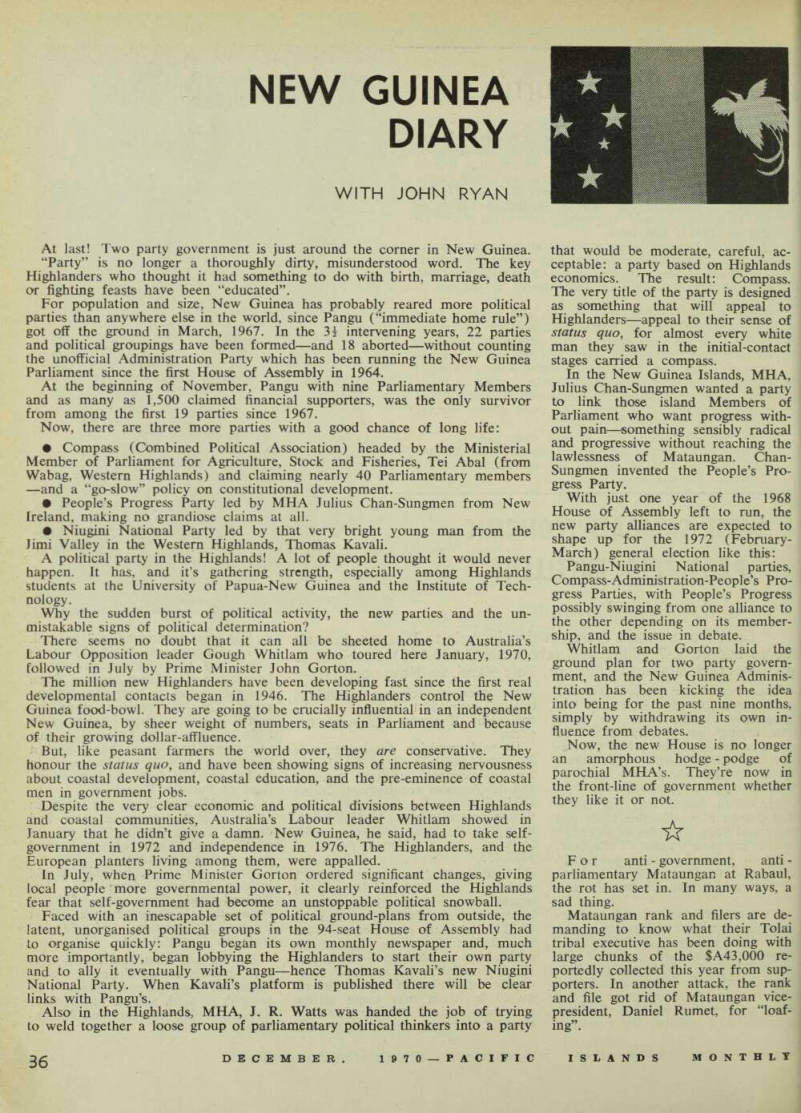
In a “black” country learning English as a foreign language and trying hard to develop a Public Service and working rules that can be understood, we still have gibberish like this— From the Extension Manual of the Department of Agriculture, Stock and Fisheries (October, 1966, and still in force), these instructions showing native and European agricultural officers how to interview illiterate farmers: “Inter viewing technique: preamble—Interviewing is the verbalisation of communi cation interaction within a social situation wherein the interviewer elicits responses or replies from the respondent.” And another one: “Orientated socio-metric interviews are easier to implement than socio-emotional orientated ones.” I can think of 15,000 native public servants who wouldn’t have a clue . . . and 15,000 Europeans who’d be in the same boat! ☆ Just in case you’re wondering about the illustration at the top of the previous page. . . . It’s the new national flag recommended by New Guinea’s Parliamentary Select Committee on Constitutional Development. The flag has three vertical bands: royal blue, with the Southern Cross superimposed to show where New Guinea is in the world; a yellow band in the centre, and the third band is in green with a bird of paradise superimposed.
Chairman of the Select Committee, Paulus Arek MHA, says the royal blue represents the islands of New Guinea and Papua and the surrounding sea; yellow represents the coastal areas of Papua and New Guinea, and is supposed to be symbolic of mineral wealth; and green represents the Highlands.
Other flags: from 1884 to 1906 the Union Jack flew over Papua when it was British New Guinea, and the Australian flag has flown ever since.
In the New Guinea territory, the German flag flew from 1884 to 1914 when the Australians captured it, and Australia’s flag was introduced. It’s now up to Papua-New Guinea’s 2,400,000 village people to say what they think of the recommended flag, and whether they have a better design.
The committee also suggested a name for Papua-New Guinea, and is asking people what they think. It’s “Pagini”.