After 200 years, Tahitian
p. 93 · Read in the full issue
is far from dead
By Robert Langdon
Although more than two centuries have passed since Euro peans discovered Tahiti, and although the French have ruled the island for more than five generations, there is still no sign that the Tahitian language is dying out.
Far from it. Unlike the languages of the Maoris and Hawaiians, both of which are almost extinct, the tongue of Tahiti seems to become more strongly entrenched as time goes on and contact with the Western world increases.
Four recent events that sub stantiate this are: • The publication by the Aus tralian National University Press, Canberra, of a book entitled Conver sational Tahitian, designed especially for English - speaking visitors to Tahiti. • The publication in Tahiti of a new grammar for French readers, Initiation a la langue tahitienne. • A decision by the Synod of the Eglise Evangelique de Polynesie Francaise (Protestant Church of French Polynesia) to nominate a commission to study the question of establishing an Academy of the Tahitian language. • The publication of a paper by an American scholar in a French journal urging the teaching of Tahitian in French Polynesian schools to help preserve Tahitian culture.
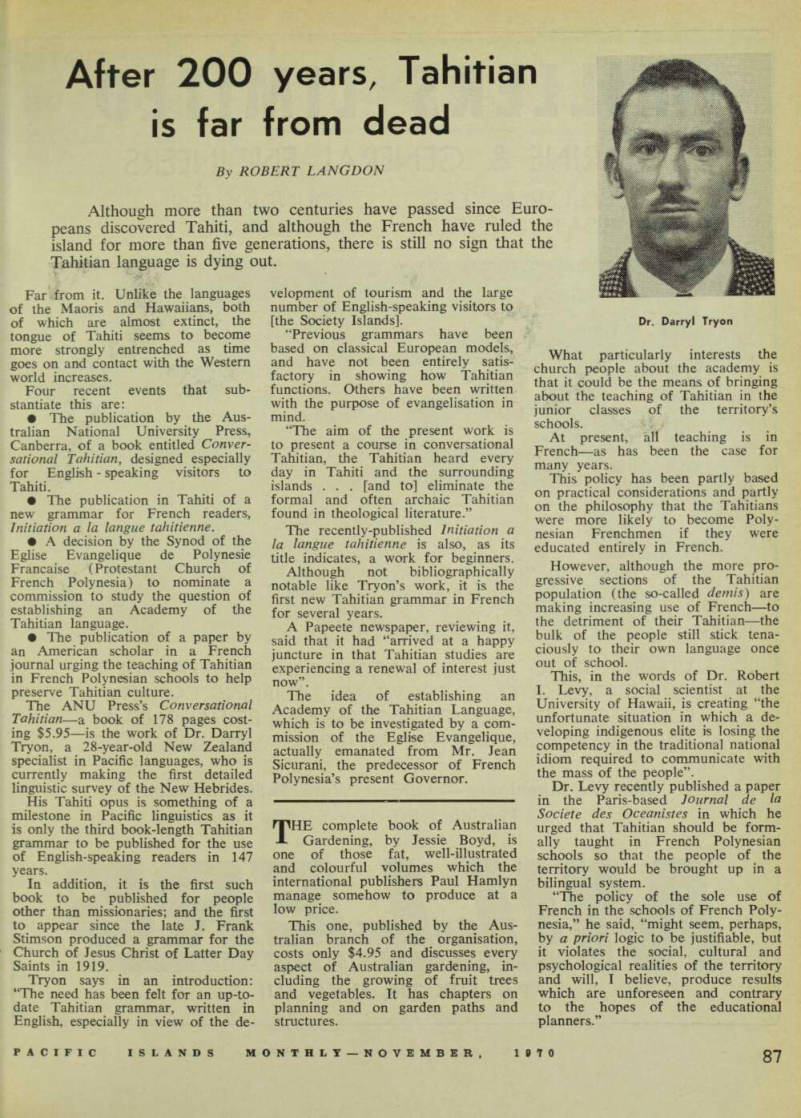
The ANU Press’s Conversational Tahitian —a book of 178 pages cost ing $5.95 —is the work of Dr. Darryl Tryon, a 28-year-old New Zealand specialist in Pacific languages, who is currently making the first detailed linguistic survey of the New Hebrides.
His Tahiti opus is something of a milestone in Pacific linguistics as it is only the third book-length Tahitian grammar to be published for the use of English-speaking readers in 147 years.
In addition, it is the first such book to be published for people other than missionaries; and the first to appear since the late J. Frank Stimson produced a grammar for the Church of Jesus Christ of Latter Day Saints in 1919.
Tryon says in an introduction: “The need has been felt for an up-to date Tahitian grammar, written in English, especially in view of the de
velopment of tourism and the large number of English-speaking visitors to [the Society Islands].
“Previous grammars have been based on classical European models, and have not been entirely satis factory in showing how Tahitian functions. Others have been written with the purpose of evangelisation in mind.
“The aim of the present work is to present a course in conversational Tahitian, the Tahitian heard every day in Tahiti and the surrounding islands . . . [and to] eliminate the formal and often archaic Tahitian found in theological literature.”
The recently-published Initiation a la langue tahitienne is also, as its title indicates, a work for beginners.
Although not bibliographically notable like Tryon’s work, it is the first new Tahitian grammar in French for several years.
A Papeete newspaper, reviewing it, said that it had “arrived at a happy juncture in that Tahitian studies are experiencing a renewal of interest just now”.
The idea of establishing an Academy of the Tahitian Language, which is to be investigated by a com mission of the Eglise Evangelique, actually emanated from Mr. Jean Sicurani, the predecessor of French Polynesia’s present Governor.
THE complete book of Australian Gardening, by Jessie Boyd, is one of those fat, well-illustrated and colourful volumes which the international publishers Paul Hamlyn manage somehow to produce at a low price.
This one, published by the Aus tralian branch of the organisation, costs only $4.95 and discusses every aspect of Australian gardening, in cluding the growing of fruit trees and vegetables. It has chapters on planning and on garden paths and structures.
What particularly interests the church people about the academy is that it could be the means of bringing about the teaching of Tahitian in the junior classes of the territory’s schools.
At present, all teaching is in French—as has been the case for many years.
This policy has been partly based on practical considerations and partly on the philosophy that the Tahitians were more likely to become Poly nesian Frenchmen if they were educated entirely in French.
However, although the more pro gressive sections of the Tahitian population (the so-called demis ) are making increasing use of French—to the detriment of their Tahitian—the bulk of the people still stick tena ciously to their own language once out of school.
This, in the words of Dr. Robert I. Levy, a social scientist at the University of Hawaii, is creating “the unfortunate situation in which a de veloping indigenous elite is losing the competency in the traditional national idiom required to communicate with the mass of the people”.
Dr. Levy recently published a paper in the Paris-based Journal de la Societe des Oceanistes in which he urged that Tahitian should be form ally taught in French Polynesian schools so that the people of the territory would be brought up in a bilingual system.
“The policy of the sole use of French in the schools of French Poly nesia,” he said, “might seem, perhaps, by a priori logic to be justifiable, but it violates the social, cultural and psychological realities of the territory and will, I believe, produce results which are unforeseen and contrary to the hopes of the educational planners.”
Dr. Darryl Tryon