Pacific Shipping
pp. 95-99 · Read in the full issue
Aftermath of the "Tulagi"
The Islands trader Tulagi ended an era in October when she sailed into Sydney from her usual round trip to Norfolk Island, the New Hebrides and the BSIP. Her owners, Burns Philp, announced they had sold her to the Societe Maritime Cale
donienne, New Caledonia, and
will not be replacing her. She had been scheduled to make her last
trip leaving Sydney about Octo
ber 21.
Her withdrawal from this service marks the end of 75 years of shipping services on the NI-NH-BSIP route, ex Sydney, interrupted only by two world wars, operated by Burns Philp (PIM, Oct., p. 38).
While no plans have yet been an nounced for the future of the Tulagi, it seems likely that she will be re named, as was a former BP ship, the Malekula, which is also owned by Societe Maritime Caledonienne, and is now the Jacques del Mar 11.
The service previously operated with the Tulagi will be taken over by Karlander, which plans to split it into two services and extend it.
Karlander’s Sletholm will service Lord Howe, Norfolk Island, Vila, Santo and Honiara, with the first service leaving Sydney about Decem ber 8. She has general and freezer cargo space and accommodation for eight passengers. She will sail from Sydney every five weeks.
The Slidre Timur will do one quick trip before then to fill in the gap caused by the withdrawal of the Tulagi and the first Sletholm service.
Another Karlander ship, the Slet ffo/d, will service Brisbane, Honiara, Gizo, Yandina and Ringi Cove from Sydney.
Norfolk Island also has a service from Onehunga (Auckland) by the Auckland-based Holm Shipping Co.
Ltd., with the Holmdale.
Thf Holm Co. is also expanding its NZ-New Caledonia service, with the regular ship, the Holmburn, supple mented by others as required. Re cently two of the Holm ships were in Auckland and both sailed the same day for New Caledonia, followed by a third ship two days later.
Meanwhile, BP’s Montoro, the only other ship the company now owns, [cxjks like being sold. A number of maritime unions have agreed in
principle to release BP’s from an undertaking to convert her to carry an Australian crew.
BP agreed to convert the Montoro because of a dispute over the Moresby, since sold by BP’s. The Moresby was held up in Sydney for about two months with her holds full of cargo for the Islands. Seamen refused to take her to sea because Australian seamen were losing their work with fewer Australian ships operating to the Islands.
This dispute was settled when BP’s agreed to give every consideration to converting the Montoro to carry an Australian crew. However, after a thorough survey the unions have had to admit she is unsuitable for con version. Next step, presumably, is a sale.
Eight Dead In
Pago Sinking
Eight Korean seamen were drowned in a disaster off Fatumafuti village, American Samoa, on Septem ber 19, during darkness. Their fishing sampan, Nam Hae 255, hit the reef and overturned. It was American Samoa’s worst shipping disaster.
Rescuers working under search lights, recovered 16 of the 24-man crew. The bodies of the remaining eight were not recovered.
The Nam Hae 255 had arrived in port after a fishing cruise. She un loaded fish at Star Kist and returned to sea to clean the hatches. On the way back at about 7.30 p.m. she hit the reef and went over on one side, about 300 yards from the shore.
Confusion among the crew led
officials to believe that all men had been removed from the wreck. They were not disillusioned till two more, who had been thrown into deep water, managed to struggle ashore about 1 o’clock next morning.
It was not till later that morning it was realised that eight men were missing. Searchers failed to recover any of the bodies.
The Nam Hae 255 was built in France and arrived in the Samoan area in 1966. The ship was valued
At Sus2Bo,Ooo.
"Betty Lou" Blame
On Three Parties
After months of investigation, the commission of enquiry into the sink ing of the Betty Lou in March, which resulted in the deaths of two people, has placed blame squarely on Captain Asotau, owners, O, F. Nelson and Co. Ltd., and the Western Samoan Government.
The Betty Lou sank in the strait between Salelologa, Savaii, and Muli fanua, Upolu, in the evening of March 26. Besides two persons drowned, all other property, includ ing the Betty Lou, was lost.
The commission’s report stated that the sinking of the Betty Lou in rough seas was due to “overloading, failure to secure the hatch covers and render them water-tight and the inability of the bulkheads separating the holds and engine room, by reason of their not being water-tight, to prevent water flowing freely from hold to hold”.
The commission found that Captain Asotau, owners, O. F. Nelson and Co. Ltd., and the government, should shoulder the blame for the tragedy in which at least 40 more persons would have drowned had it not been for the timely arrival of another vessel.
The report said that Captain Asotau had permitted the vessel to sail with almost twice the number of passengers permitted under the vessel’s licence and that he had acted rashly in not returning to Salelologa wharf when the Betty Lou began to list more than 45 degrees.
O. F. Nelson “failed to ensure that the vessel was equipped with essential gear. There were no tar paulins, no proper clips to secure them to the hatches and no radio equipment”.
The report added that the Marine
Department had acquired a bad habit of back-dating the Certificates of Survey and the licence; and that the police officer at Salelologa wharf should have stopped the Betty Lou from sailing.
It asked that costs of the inquiry be borne by Captain Asotau, O. F.
Nelson and the government in the amounts of $2OO, $l,OOO and $l,BOO respectively. The report has been submitted to the Western Samoan cabinet.
Cook Islands Charter
The "Thallo"
Premier of the Cook Islands, Mr.
A. R. Henry, has finalised chartering of the MV Thallo for a year, to operate a regular cargo service be tween New Zealand and the Cook Islands. The vessel was due to make its first voyage in October.
MV Thallo is 499 tons gross, 228 ft long with a draught of 11 ft 7 in. and a top speed of 12i knots. Her length and draught should enable her
offer”. TNT had made no offer yet but its full-time investigating team would complete its report by the end of October. It was not a question of what the New Zealand Government or TNT wanted, but who would be prepared to invest in the company in New Zealand.
“I don’t think there is a great urge in the New Zealand investing public to invest in the company in New Zealand,” Mr. Abeles said. “But we have to find somewhere someone who picks up the tab.”
Mr. R. A. Owens, chairman of RAO Holdings Ltd., says that if his company is not successful in its bid for the USS Co., it will form a New Zealand shipping line. A new public company, to be known as New Zea land Sea Transport Ltd., would be floated to make an offer and if un successful, it would be used to form a national shipping line. The capital required for this sort of operation could be found in New Zealand, He said he would like the maritime unions to have a share in the ven ture. See PIM, Oct., p. 105.
Extension For
Columbus Ships
Columbus Line services from the US west coast to Australia will in crease in April, 1971. Up to six ships at present operating from the US east coast will be released when they are replaced then by three container ships, the Columbus Australia, the Columbus New Zealand and Colum bus America.
Looking even further ahead, Columbus expects in about three years to introduce a fully contain erised service from the US west coast for Australia. As Tarawa is one of two Pacific ports serviced by the line (the other is Honolulu),
to load and discharge cargo in Avatiu Harbour, Rarotonga, which is being deepened to 16 ft to allow oil tankers, and other vessels up to 230 ft long, to tie up at the eastern wharf.
The vessel has refrigeration equip ment which will enable it to trans port Cooks’ primary produce to New Zealand, and its cargo capacity is about 1,000 tons.
The finalising of the charter ended a lengthy period of negotiations be tween the Cooks Government and shipping companies and agents.
Latest On Union Ss
There have been no further con crete developments in moves to ac quire the Union Steam Ship Co., an almost wholly-owned subsidiary of the P & O group.
The managing director of Thomas Nationwide Transport Ltd., of Aus tralia, Mr. E. H. P. Abeles, said TNT first got in touch with P & O directors last January to see if they were interested in selling the USS Co.; they were “interested in an
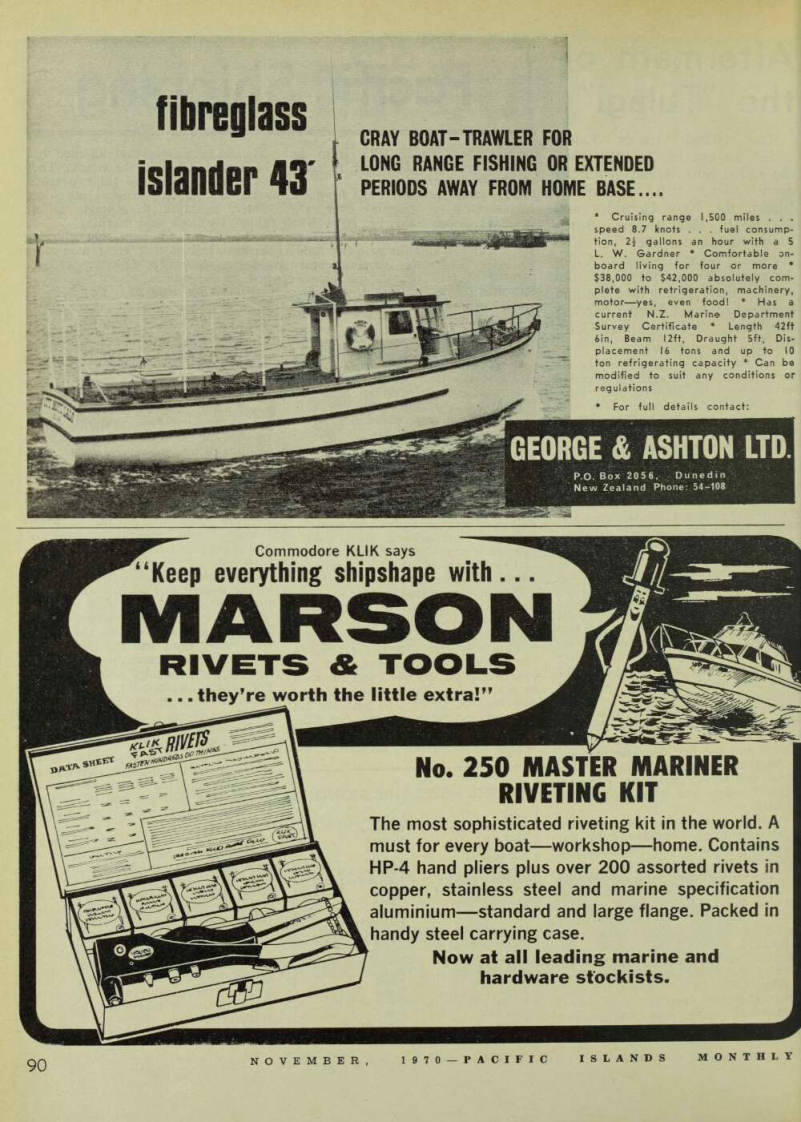
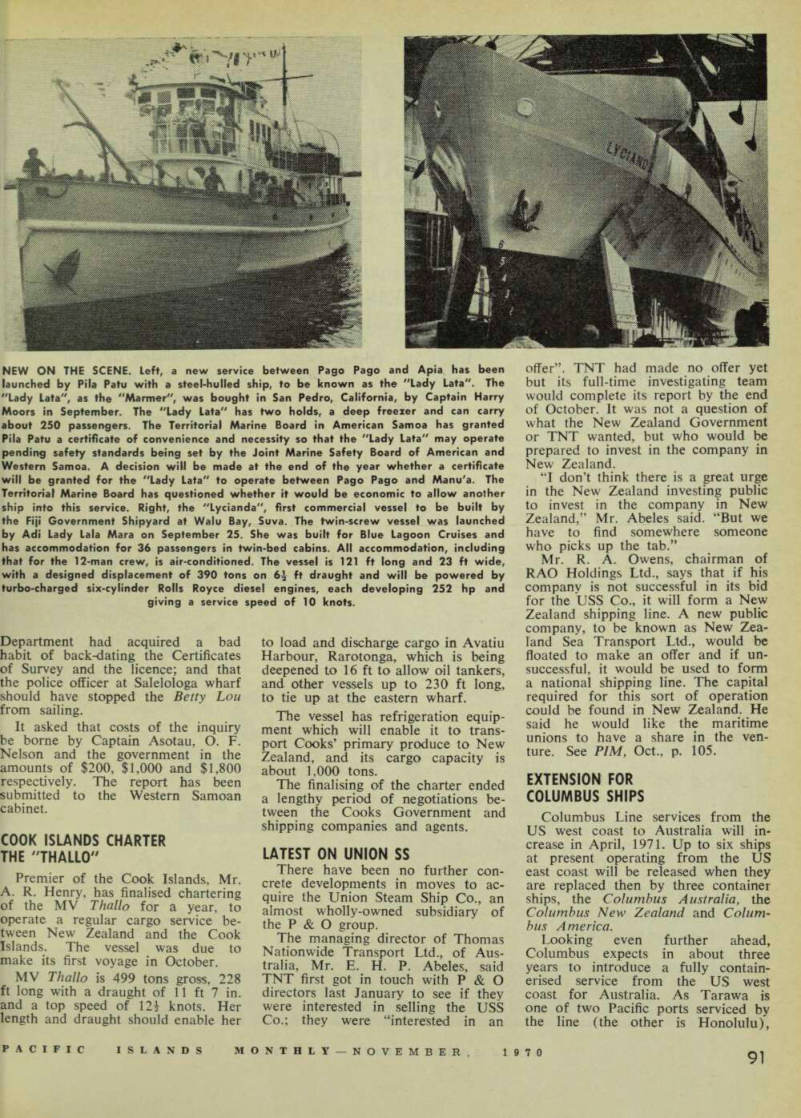
NEW ON THE SCENE. Left, a new service between Pago Pago and Apia has been launched by Pila Patu with a steel-hulled ship, to be known as the "Lady Lata". The "Lady Lata", as the "Manner", was bought in San Pedro, California, by Captain Harry Moors in September. The "Lady Lata" has two holds, a deep freezer and can carry about 250 passengers. The Territorial Marine Board in American Samoa has granted Pila Patu a certificate of convenience and necessity so that the "Lady Lata" may operate pending safety standards being set by the Joint Marine Safety Board of American and Western Samoa. A decision will be made at the end of the year whether a certificate will be granted for the "Lady Lata" to operate between Pago Pago and Manu'a. The Territorial Marine Board has questioned whether it would be economic to allow another ship into this service. Right, the "Lycianda", first commercial vessel to be built by the Fiji Government Shipyard at Walu Bay, Suva. The twin-screw vessel was launched by Adi Lady Lala Mara on September 25. She was built for Blue Lagoon Cruises and has accommodation for 36 passengers in twin-bed cabins. All accommodation, including that for the 12-man crew, is air-conditioned. The vessel is 121 ft long and 23 ft wide, with a designed displacement of 390 tons on 6½ft draught and will be powered by turbo-charged six-cylinder Rolls Royce diesel engines, each developing 252 hp and giving a service speed of 10 knots.
Columbus is hoping that some arrangements will be made to drop container cargo off there.
Early in October, 14 Gilbertese seamen flew to New York to join the Cap Roca, one of a number of Columbus Line ships bearing the prefix “Cap”. The Cap Roca at present operates from the US east coast to Australia and NZ via Panama.
This ship will be one of those released for the US west coast trade, and on her service to Australia is expected to call frequently at Tarawa.
Two Columbus ships, the Cap Colville and the Cap Melville, both semi-container ships, visit Tarawa during their trans-Pacific voyages.
The Cap Colville, a Danish ship of 10,000 tons under charter, arrived in Sydney in October on her maiden voyage, 16 days out from Los Angeles. She carries six passengers.
Wharf Plans For
Kieta And Alotau
A firm of engineering consultants has recommended over $3 million worth of expansion for two Papua- New Guinea ports—Kieta, on Bou gainville, and Alotau, Milne Bay.
The firm, Nedeco, has recom mended that a wharf complex, com prising an overseas wharf 300 ft long, a sheltered small ships basin, a general cargo shed and a copra storage shed, should be constructed north of Gopi Point, at Alotau.
Estimated cost is $1,300,000.
At Kieta the main recommenda tions include the construction of a large new transit shed and relocation of existing Copra Marketing Board, Bougainville Trading Company and general cargo sheds; construction of a coaster berth and small craft facili ties; and extension of the deepwater berth to a total length of 500 ft.
However, before design can pro ceed at Kieta, wave observations, soil investigations, bathymetric and topographic surveys are to be carried out over about 12 months. Pre liminary costs are $1,720,000.
Briefs
• American Samoa now has a Coast Guard Auxiliary. It is the only one south of the Line. The auxiliary has 14 members, who own four boats, one seaplane and one amateur radio station. • HMS Minerva, a Royal Navy frigate, and a Royal Fleet Auxiliary tanker, Olmeda, visited Banks and Torres Islands in September, but it didn’t all go according to plan.
The Olmeda, a huge ship (648 ft long with displacement of more than
33,000 tons) was scheduled to call at Port Patteson, Vanua Lava, but because of the reefs she could not enter the bay. The Olmeda carried 132 officers and men of the royal and merchant navies.
As if to compensate for the in ability of the Olmeda to get in, the Minerva, accompanied by her heli copter, called at Port Patteson, after an earlier visit to Lo Island.
The two ships earlier made informal visits to the BSIP while they were on their way from Singa pore to New Zealand to take part in combined exercises. • Regina Maris, Norwegian three
masted clipper-barquentine, arrived unexpectedly at Pitcairn recently.
She had been expected in January but on the way was struck by a thunderbolt and demasted. After repairs in Norway, the Regina Maris sailed to Australia for the Captain Cook bicentenary celebrations, and called in at Pitcairn on her way back to Norway. • Burns Philp and the Australia West Pacific Line have introduced a direct Australia-Port Moresby service with the Samos. The service, cover ing Sydney, Brisbane and Port Moresby will operate out of Sydney about every two and a half weeks.