Pacific Characters
p. 91 · Read in the full issue
Come To Life
There’s no shortage of Pacific legends and stories of the men who loved, pirated or made war in the days before foreign govern ments imposed the rule of western law. Yet more often than not, as persons, they remain shadowy figures.
A new book, Pacific Islands Portraits, now brings some of these people to life. Edited by J. W.
Davidson, Professor of Pacific History at the Australian National University, and a colleague, Deryck Scarr, Fellow in Pacific History at the university, this book is 300 pages of history and entertainment on Pacific personalities of yesterday.
The book includes sketches on Peter Dillon and Lauaki Namulau’ulu Mamoe (by J. W. Davidson), Cakobau and Ma’afu (Deryck Scarr), the Henrys of Tahiti (Niel Gunson), King George Tupou I (Sione Latu kefu), Xavier Montrouzier (Hugh M. Laracy), John Coleridge Patteson (David Hilliard), Baiteke and Binoka of Abemama (H. E. Maude) and Kwaisulia of Ada Gege (Peter Corris).
There are also general sketches of life in the beach communities (Caroline Ralston), planters of Fiji (John Young) and the labour trade (Peter Corris). In all it adds up to a Pacific portrait that spans a hundred years of South Seas history.
Two stories of particular interest; Hugh M. Laracy’s sympathetic look at Xavier Montrouzier, missionary in Melanesia, and Deryck Scarr’s dispassionate evaluation of the re cruiting trade—its good and bad effects.
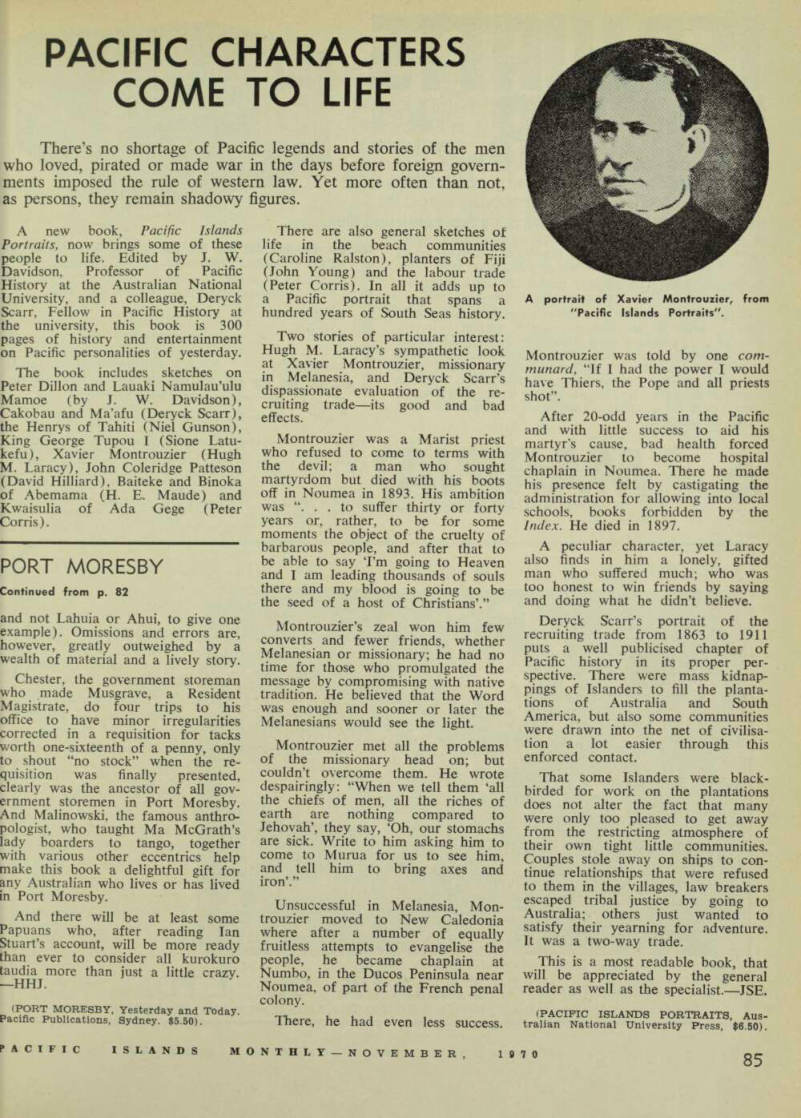
Montrouzier was a Marist priest who refused to come to terms with the devil; a man who sought martyrdom but died with his boots off in Noumea in 1893. His ambition was “. . . to suffer thirty or forty years or, rather, to be for some moments the object of the cruelty of barbarous people, and after that to be able to say ‘l’m going to Heaven and I am leading thousands of souls there and my blood is going to be the seed of a host of Christians’.”
Montrouzier’s zeal won him few converts and fewer friends, whether Melanesian or missionary; he had no time for those who promulgated the message by compromising with native tradition. He believed that the Word was enough and sooner or later the Melanesians would see the light.
Montrouzier met all the problems of the missionary head on; but couldn’t overcome them. He wrote despairingly: “When we tell them ‘all the chiefs of men, all the riches of earth are nothing compared to Jehovah’, they say, ‘Oh, our stomachs are sick. Write to him asking him to come to Murua for us to see him, and tell him to bring axes and iron’.”
Unsuccessful in Melanesia, Mon trouzier moved to New Caledonia where after a number of equally fruitless attempts to evangelise the people, he became chaplain at Numbo, in the Ducos Peninsula near Noumea, of part of the French penal colony.
There, he had even less success.
Montrouzier was told by one com munard, “If I had the power I would have Thiers, the Pope and all priests shot”.
After 20-odd years in the Pacific and with little success to aid his martyr’s cause, bad health forced Montrouzier to become hospital chaplain in Noumea. There he made his presence felt by castigating the administration for allowing into local schools, books forbidden by the Index. He died in 1897.
A peculiar character, yet Laracy also finds in him a lonely, gifted man who suffered much; who was too honest to win friends by saying and doing what he didn’t believe.
Deryck Scarr’s portrait of the recruiting trade from 1863 to 1911 puts a well publicised chapter of Pacific history in its proper per spective. There were mass kidnap pings of Islanders to fill the planta tions of Australia and South America, but also some communities were drawn into the net of civilisa tion a lot easier through this enforced contact.
That some Islanders were black birded for work on the plantations does not alter the fact that many were only too pleased to get away from the restricting atmosphere of their own tight little communities.
Couples stole away on ships to con tinue relationships that were refused to them in the villages, law breakers escaped tribal justice by going to Australia; others just wanted to satisfy their yearning for adventure.
It was a two-way trade.
This is a most readable book, that will be appreciated by the general reader as well as the specialist.—JSE.
(Pacific Islands Portraits, Aus
tralian National University Press, $6.50).
A portrait of Xavier Montrouzier, from "Pacific Islands Portraits".