distinguished exile
p. 83 · Read in the full issue
When Samoans lived in distinguished exile
In 1909 Lauaki Namulau’ulu Mamoe and nine other Samoan chiefs and orators were exiled to Saipan, in the Marianas. They were accompanied by their wives, other members of their families, and a Samoan pastor of the Lon don Missionary Society. The Samoans remained in Saipan till 1915, when, following the military occupation of the German islands in Micronesia by Japan, they were permitted to return home.
By J. W.
Davidson
IHAVE written of Lauaki’s long and distinguished career as “a traditionalist in Samoan politics” in Pacific Islands Portraits (Australian National University Press, 1970) —a career that had reached its climax in his campaign of opposition to the administration of German Samoa in 1908-09, and its end in his subse quent exile.
Before they left Samoa the exiles had been told by the Governor, Dr. Solf, that they would be received in Saipan as distinguished visitors. And, from the time they landed at the town of Garapan, this undertaking was faithfully carried out.
For a time, they were accommodated in the town itself, where they made friends with many of their Chamorro neighbours.
Later, they were given the use of a piece of land at Puntan Flores, on the coast, several miles further north. This is an attractive spot, facing the beach and the lagoon, looking outwards towards the reef islet of Managaha, to the south-west, and landwards towards the main range. A stream bounds the land to the northward, beyond which, at a distance of about a quarter of a mile, lies the village of Tanapag.
At Puntan Flores the exiles built a village in Samoan style. Their land was well planted with coconuts and breadfruit, and a Chamorro neighbour gave them the use of an adjacent area for growing taro and other vegetables. They were provided with ox-carts to bring in supplies from Garapan, and they provided them selves with canoes for fishing. Every evening the tolling of a bell called the community, led by the dignified Lauaki, to church.
The Samoans had many contacts with the local people. They exchanged fish for bananas and pine apples. Some of the children attended school in Garapan. The young matai, Tiga Pisa, also went to school to learn German before becoming interpreter for the community.
On recent visits to Saipan I enjoyed the guidance
of Mr. Peter Tali Coleman, Deputy High Commissioner of the Trust Territory of the Pacific Islands, in seeking evidence regarding the Samoans’ years of exile. A former Governor of American Samoa, and himself of Samoan birth, Mr. Coleman had already talked to men who remembered Lauaki and his party, and he had visited the place where they lived.
One of those who remembers the Samoans most clearly is Mr. Vicente D. Leon Guerrero. As a school boy he was in the same class as Tiga. He knew Felise, the son of Asiata Taetoloa, and a girl named Pe’a; and he remembers the commanding figure of Lauaki. He can still speak a few words of Samoan and sing at least one Samoan song.
Mr. Guerrero remembers being taken to feasts at Puntan Flores, where the Chamorro guests were served with food baked in an umu —fish, pork, taro and bananas—and with palusami.
For some of the Samoans, the association with Saipan was not limited to their presence as distinguished visitors. A few died there and were buried beneath their houses, in traditional Samoan style. One girl married a Chamorro, Crisanto Tobes, who became fluent in the Samoan language.
Lauaki himself died of dysentery, at Tarawa, in the Gilbert Islands, on the journey home. Tiga, who made his way to Guam by canoe, remained abroad till 1919 ( PIM, Feb., 1969, p. 38).
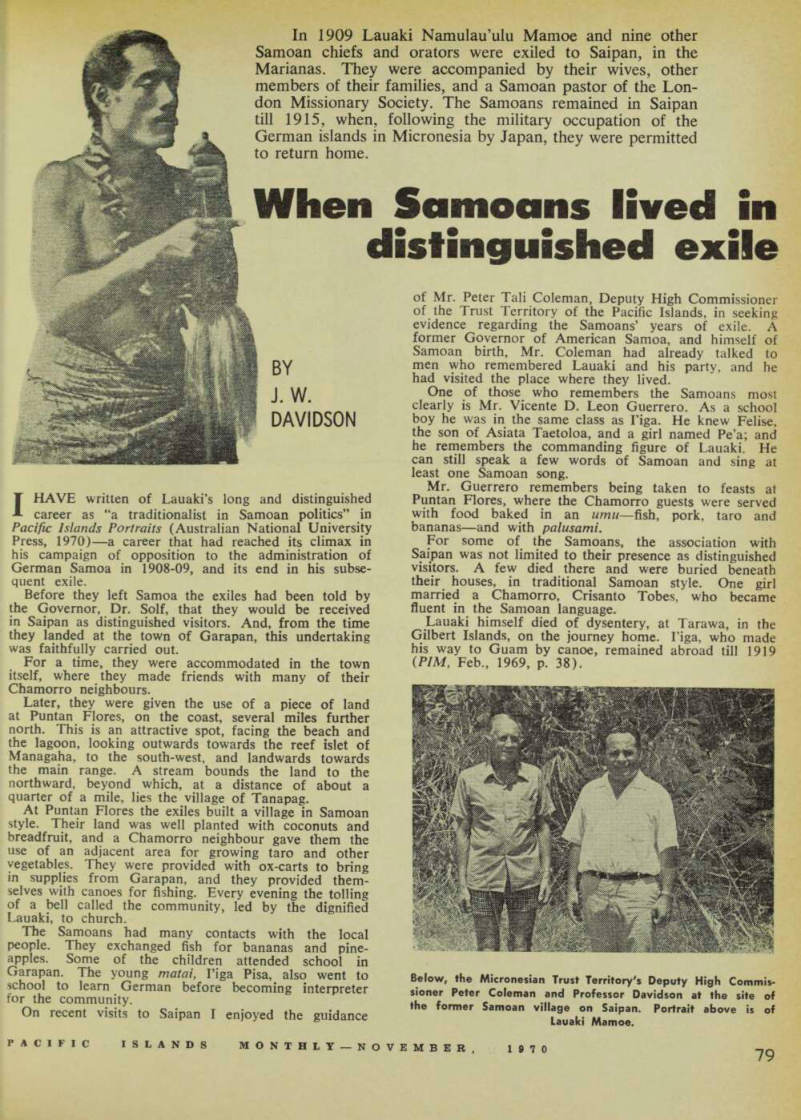
Below, the Micronesian Trust Territory's Deputy High Commis sioner Peter Coleman and Professor Davidson at the site of the former Samoan village on Saipan. Portrait above is of Lauaki Mamoe.