Magazine Section
pp. 77-139 · Read in the full issue

How the Tahitians got their flag
• Since the autonomist movement in French Polynesia recently adopted the red, white and red flag of old Tahiti as its emblem, that flag—as described in this and last month's PlM—has been the centre of several dramatic incidents, not to mention some lively debates. As a result, PIM has asked Robert Langdon, author of a history of Tahiti, to tell the story of. . .
Tahitians have been conscious of the symbolism of flags almost from the day that Europeans first discovered them; and it is one of the ironies of their history that the first flag that they could call their own was one left on shore by a British naval officer to show that he had taken possession of their island for the British Crown.
It was also a British naval officer who gave the Tahitians the red, white and red flag that has now become the emblem of French Polynesia’s auto nomists.
Tahiti’s first flag was a white en sign—the predominantly red and white flag of the Royal Navy, which has the Union Jack in the top left hand corner.
This flag was taken ashore from HMS Dolphin on June 26, 1767, and planted on the beach at Matavai Bay barely a week after the Dolphin's men had become the first Europeans to set eyes on Tahiti.
Relations with the Tahitians were rather uncertain at that time as a fierce battle had been raging in the bay only 24 hours before. This battle, known to history as the Battle of One Tree Hill—the hill on which the luxurious Hotel Taharaa now stands —gave the Tahitians their first lesson in the destructiveness of European firearms.
However, the Dolphin’s comman der, Captain Wallis, was still not sure if the lesson had been well learned when he sent his second officer.
Lieutenant Tobias Furneaux, to plant the symbol of British sovereignty on Tahitian soil. As a result, he ordered every precaution to be taken against
a renewed attack from the Tahitians.
George Robertson, the Dolphin's sailing master, recorded that before Furneaux set out for the shore, the Dolphins broadside was brought to bear on the head of Matavai Bay, and that all hands on board were
“Quarterd ... at the Great Guns, to be ready to fire upon the natives if they attempted to prevent our Boats from Landing.”
Furneaux then went off in three boats carrying three midshipmen, a sergeant, 12 marines and 18 able seamen under the command of Robert Molyneux, the master’s mate.
Molyneux had orders to “keep four men in Each boat ready to fire the musquetoons upon the natives if they attact our men” and to “take care to keep the boats in about four feet of water so that the men could quickly jump into them if they got into any trouble,”
As it turned out, Furneaux was able to get ashore without difficulty, and within a few minutes his men were formed up on the beach ready for him to take formal possession of the island in the name of Britain’s King George TIL Shortly afterwards, Furneaux had a long pole fixed in the ground and a British pennant was hoisted on it “in token of our having taken Possession of that place.”
Meanwhile, about 400 or 500 Tahitians had assembled within musket shot, each bearing a plantain frond as an emblem of peace, Fur neaux exchanged presents with a number of these people, shook hands cordially with an elderly chief, and finally returned on board with a good supply of pigs, fruit and fresh water.
Robertson, who had remained on board, watched what happened next through his spy glass. First, two old men, each carrying plantain fronds.
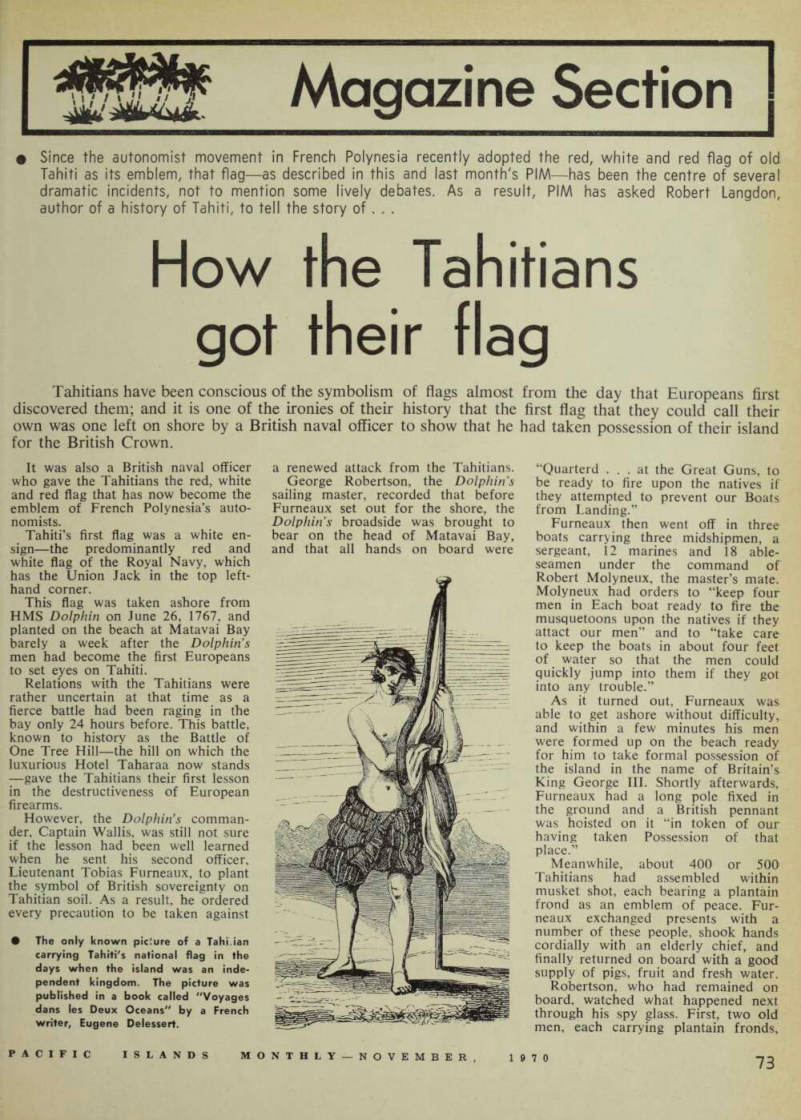
The only known picture of a Tahitian carrying Tahiti's national flag in the days when the island was an inde pendent kingdom. The picture was published in a book called "Voyages dans les Deux Oceans" by a French writer, Eugene Delessert.
cautiously approached the flag, using “as mutch ceremony as if it had been a Demi God”. Then, when they were within two or three yards of the foot of it, they fell down on their knees and “seemingly made a long prayer”.
Finally, they laid their green fronds below the flag and marched back to where the rest of their people stood.
“After that,” Robertson wrote, “some hundreds of them Went up to the Pendant in Mutch the same manner as the first two old men, and they all carried green bows which they laid doun at the foot of the pendant.”
Robertson said that on one occa sion about 20 natives were kneeling down below the flag when a fresh breeze suddenly sprang up and blew the end of it over their heads. This frightened them so much that they all ran off “as if a Great Gun had been fired at them”.
Some time later, two old men deposited two fat pigs beneath the flag. But after some ceremony, they took them up again and carried them out to the Dolphin in a canoe.
Using sign language, they invited the Dolphin's men to hoist the pigs aboard with a rope; but when this was done, they refused to accept any of the toys or nails that the English sailors offered in exchange for them.
Instead, they kept talking excitedly and pointing to the British flag on shore.
It was not long before their mean ing became plain, for as soon as they landed again, they lowered the British symbol of sovereignty and “caried it clear off”.
Thus it was that the Tahitians acquired their first flag, and it was possibly because that flag was largely red and white that those colours were eventually adopted as the colours of Tahiti.
The Dolphin's flag did, at any rate, become a symbol to the Tahitians.
Ten years later, when Captain Cook visited Tahiti during his third Pacific
voyage, he found that the flag had become part of the Tahitians’ sacred feather girdle, or maro, with which, he said, “they invest their Kings with Royalty.”
In 1789, Wallis’ flag was replaced by another British flag which was given to the Tahitians by Captain Cox of the brig Mercury.
However, it was not until the early 1820’s that the Tahitians began using a European-style flag of their own design and in the European fashion.
By that time Tahiti had been christianised by missionaries of the London Missionary Society and some of its chiefs had acquired a brig to carry pork, coconut oil, arrowroot and other island produce to Sydney.
Details of a flag which Tahiti’s regency council decided to adopt to facilitate trade are given in a letter of August 26, 1822, which the chief Hitoti, who acted as regent for the infant King Pomare 111, wrote to the British Foreign Secretary, the Mar quis of Londonderry. This flag, Hitoti said, was basically red, but it had a white, seven-pointed star in the top corner near the staff.
The flag was made on board the brig Queen Charlotte, which Captain Samuel Pinder Henry, the son of one of Tahiti’s missionaries, commanded on behalf of the Tahitian chiefs. Ac cording to a statement he made years later, it was first raised on the beach at Papeete and saluted from both the Queen Charlotte and the brig Dragon (Captain R. S. Walker). The Tahi tians also saluted the flag with a salvo of muskets and passed the rest of the day in feasting and amusements.
Although the new flag gave the Tahitians a sense of identity, it gave them no protection from the foreign pirates, escaped convicts and riff-raff seamen who descended on them from here and there from time to time.
As a result, the LMS missionaries persuaded the chiefs to write to the British sovereign. King George IV, to ask for both British protection and
the right to fly the British flag. A petition to this effect was concocted on October 5, 1825, and signed in the name of young Pomare 111. As translated by the missionaries, it read in part as follows: May it be agreeable to you, O King, to listen to this petition. We wish you to be our friend, and for you to protect us. Let not our land be molested by British subjects, now or at any future time; and should we be invaded by any others, do you then defend us. Should it be agreeable to you to grant this peti tion, we then wish to use the English flag. . . .
In the course of a year or so, Pomare’s petition reached the hands of George Canning, the British Foreign Secretary, who wrote back on March 3, 1827, that he had “hastened” to lay it before the King.
However, Canning said that whereas His Majesty felt “every dis position to comply” with Pomare’s wishes, it would have been improper —in accordance with the usages established in Europe—to grant per mission to use the British flag, although the King was happy to
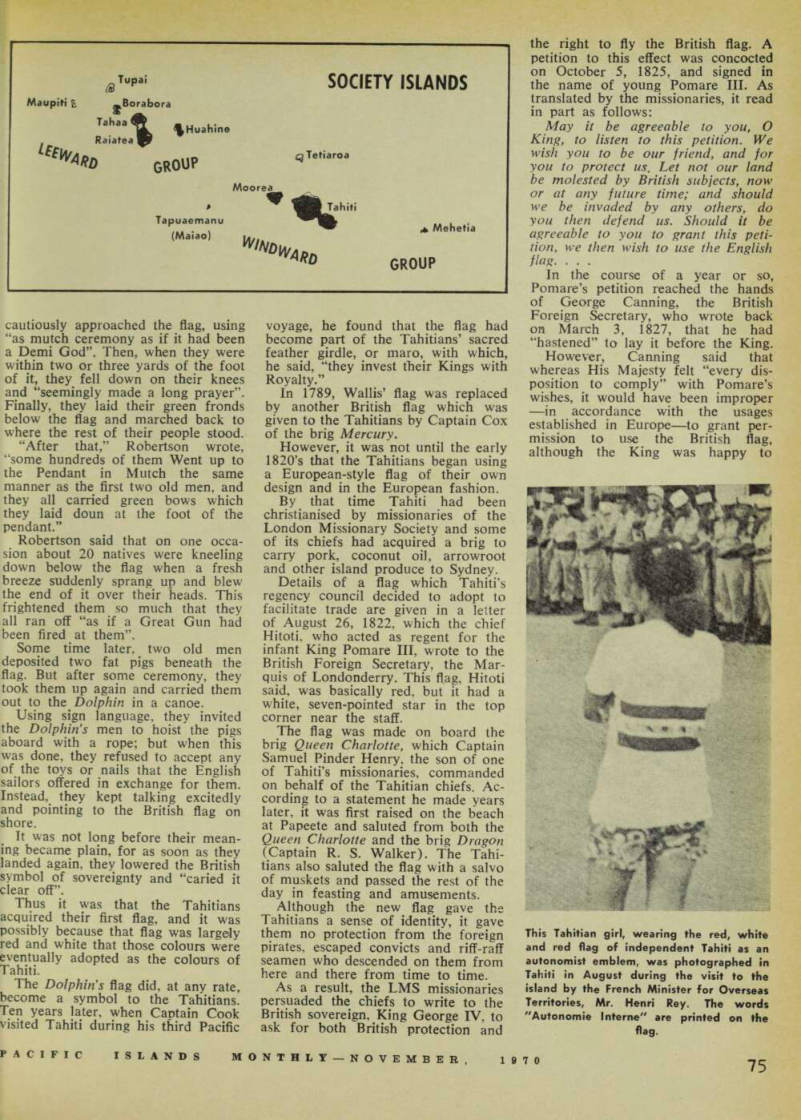
This Tahitian girl, wearing the red, white and red flag of independent Tahiti as an autonomist emblem, was photographed in Tahitiain August during the visit to the island by the French Minister for Overseas Territories, Mr. Henri Rey. The words "Autonomie Interne" are printed on the flag.
afford Pomare and his dominions “all such protection as could be given” to “a friendly Power at so remote a distance from his own dominions”.
Canning’s somewhat disappointing reply was taken back to Tahiti by the missionary Henry Nott in August, 1827. Shortly afterwards, an event occurred which—combined with Britain’s attitude on the flag question —led the Tahitians to adopt a second flag of their own.
The event was the escape from Shoalhaven, New South Wales, in December, 1827, of 15 convicts in a 25-ton brig called Phoebe.
The Phoebe had been loading a cargo of sawn cedar for Sydney when the convicts seized it, together with a good supply of food and water, and set sail for America.
However, as most of the convicts were lowly farm workers from Ireland, with no knowledge of navigation or seamanship, the Phoebe did not make the speedy passage that her captors hoped; and after several months she had only got as far as the westernmost Society Islands.
By that time, the provisions on board were so short that the convicts began to draw lots to decide who should be put ashore. Several of those who drew short straws were off-loaded at Maupiti; three were dumped on the island of Tahaa;
while another was “heaved over board” at Riatea, as he himself put it.
This left the Phoebe in possession of the most ruthless and reckless of the convicts, who, in the meantime, had relieved themselves of food worries by bartering their cargo of sawn cedar with the people of Maupiti.
However, the Phoebe’s voyage across the Pacific was not destined to last. A few days after leaving Raiatea, the convicts accidentally wrecked her on the island of Maiao, some 60 miles west of Tahiti. But this was not journey’s end, for soon the convicts contrived to make their way to the island of Huahine.
For some time, they quietly ac cepted the hospitality that the Huahineans accorded them. Then the evil side of their natures was revealed again.
First, they stole a boat belonging to the missionary Charles Barff; then they broke into a house belonging to the chief Mahine and stole six muskets, a cask of powder and other things.
With this booty, they lit out for the high seas again. But they had not gone far before a hue and cry went up, and Mahine sent a boat with 13 men to go after them.
The Huahineans overhauled their quarry on the open sea. But the convicts opened fire on their pursuers, killing two and wounding six, and so made their escape.
On hearing news of this outrage, Maihara, the queen of Huahine, wrote a letter to Governor Darling, of New South Wales, pleading for help. “This is our word unto you,” she wrote, “. . . send one of your Ships, Darling, and fetch these thieves and take them back to Botany Bay; they are a set of evil doers . . . they are Murderers; they are ungrateful; we have behaved kindly to them and they have behaved ill to us”.
The queen’s letter was taken to Sydney by the missionary Robert Bourne, who was travelling to England on furlough. Governor Darling’s response was typical of the soldierly fellow he was. He forth with asked Commander J. M. Laws, of HMS Satellite, who was visiting Sydney, to proceed to the Society- Islands to try to round the convicts up.
The Satellite left Sydney on December 28, 1828, made a brief call at New Zealand, and dropped anchor in Papeete on March 1, 1829. Laws soon learned that two of the convicts had made their way to Tahiti, and he lost no time in seeking them out and arresting them.
Laws also learned that several others were living on Moorea,
Huahine and Raiatea, and he let it be known that he would soon have them in custody, too. As for the desperadoes who had fired on the Huahineans, they were said—wrongly as it turned out—to have headed for Tongatapu, so Laws made plans for calling at that island on his way back to Sydney.
The Tahitians were so grateful for his speedy and decisive intervention in their affairs that they asked him to attend a meeting so that they could publicly express their thanks.
At this meeting, the question of the British Government’s refusal to allow them to use the British flag was again brought up. This, it seems, led Laws to suggest that the Tahitians should have a flag of their own; and as they were apparently too polite to tell him that they already had one, it came to pass that they adopted a new one, consisting of three horizontal red, white and red bands of equal width.
In a letter which Laws wrote to the Admiralty from Papeete on March 11, 1829, he gave the impres sion that the new flag was the Tahitians’ idea. However, Queen Pomare IV (successor to the infant Pomare III) later referred to the flag as one that had been “given to us by Captain Laws”. So the probability is that it emanated from Laws.
Whatever the actual genesis of the flag was, it remained the official emblem of Tahiti and its depen dencies until September 9, 1842, when
Continued on p. 133
Queen Pomare IV was Tahiti's sovereign when Commander Laws of HMS "Satellite" gave Tahiti its own flag in 1829. After France declared a protectorate over her island in 1842, she added a crown to the flag and continued to fly it—until the French landed a contingent of troops and hauled it down.
King Pomare V, Tahiti's last king, who ceded his island and its dependencies to France.
Rear-Admiral Du Petit-Thouars de clared the islands a French protec torate.
On the following day, Du Petit- Thouars proposed that the French colours should be added to the Tahitian flag in the top left-hand corner in recognition of the protec torate. This proposal was accepted by the Tahitian chief Paraita, who was acting as regent for Queen Pomare during her absence on Moorea for the birth of a child.
However, the queen herself did not accept the new flag, and to show that she was still sovereign of Tahiti, she added a crown to the one she already had.
The addition of this crown greatly offended the French authorities; and finally, in November, 1843, they told her that if she did not remove it from her flag, they would haul the flag down and dispossess her of her kingdom.
When the queen continued to refuse, the French landed 500 men, surrounded the queen’s flagstaff, and hauled the flag down.
The queen subsequently fled to the British consul’s house; then to a British warship in Papeete harbour; and eventually to Raiatea. For three and-a-half years, she obstinately re fused to have anything to do with the French or to accept their protec torate. However, in February, 1847, she finally accepted the advice of the chiefess Arii Taimai, and returned to Papeete in a French warship under the protectorate flag.
The protectorate flag remained in use in Tahiti until 1880, when the queen’s son, Pomare V, abdicated from the sovereignty and declared Tahiti and its dependencies “united to France”.
Since then, the French flag alone has been Tahiti’s only flag.
However, during World War 11, when France itself had fallen, the old red, white and red flag of independent Tahiti had a brief airing when it was resurrected to serve— with the Cross of Lorraine of Free
France—as the battle colours for the Tahitian soldiers who volunteered to fight in the Free French Army.
As PlM’s Papeete correspondent reported at the time, the flag was specially made from silk and was presented to the Tahitian contingent by Princess Terii-Nui-o-Tahiti, eldest daughter of King Pomare V, shortly before it embarked for overseas in April, 1941.
Fourteen months later, that flag was captured by the enemy at Bir- Hacheim, Libya, after the Free French forces had made an heroic, but unsuccessful, stand in one of their most notable battles of the war.
Now, after the passage of 28 more years, Tahiti’s flag has emerged again.
And this time, it seems, it will be seen around for somewhat longer.