Yesterday
p. 87 · Read in the full issue
As 1950 came to an end, PIM editorially took a gloomy view of the world. Internationally, said PlM’s editor, we were all faced with the danger of a World War 111, and this threat was over shadowing events in the Pacific Islands.
Nevertheless, life still went on in the islands, despite the international picture, and here are some items from that issue of PIM of November, 1950 —20 years ago.
Tonga’s Crown Prince Tungi, now King Taufa’ahau, left Sydney in mid- November after a busy month in Aus tralia. PIM described him as “the most enlightened and progressive Polynesian in the Pacific today”.
There was a stir in French Oceania (as French Polynesia was then called) at the recall of the Governor, Mr.
Anziani, to Paris. It was suggested that he was officially out of favour.
He was the 57th governor Tahiti had had in 80 years.
Apia businessman Eugene Paul had brought out the first issue of a new bi-lingual weekly paper for Western Samoa —the “Samoa Times”. The territory’s previous newspaper, the “Western Samoa Mail”, had gone out of existence early in World War 11.
Representatives of the Netherlands and Indonesia were meeting at the
Hague in November in an attempt to settle the Dutch New Guinea problem. When the Indonesian delegation left Djakarta en route to the conference, they were farewelled by more than 100,000 children parading with banners reading “No peace without Irian”, and the leader declared the delegation would con vince the world that “Irian was by right a part of Indonesia”.
The decision to appoint a Samoan as the Apia postmaster was hailed in Western Samoa as a step in the right direction, and there was pres sure by Samoans for more such positions to be held by local people instead of by New Zealanders.
Big news in Lae, New Guinea, was that Mrs. Stewart’s new Hotel Cecil was almost finished and would be ready for occupation in early 1951.
Some people, though, said she should never have built it down on the flat.
From Suva, a correspondent reported that imported foodstuffs were getting steadily dearer and the price of locally-grown produce at the Suva markets was reaching “a fantastic level’. Price control had been off since July 1 and people were being “exploited”, the cor respondent said. Baskets of tapioca, which cost If- under price control, now cost from 3/- to 5/- at the markets.
The South Pacific Commission met in its sixth session in Noumea and took a look at the activities of the first South Pacific Conference held in Suva a few months previously. It apparently got short shrift, because the PIM correspondent dismissed it in the following paragraph: “The Commission dealt with resolutions passed at the First South Pacific Conference in Suva when native delegates from Pacific territories met to discuss some of their problems. It was decided that a second South Pacific Conference would be held in 1953”.
PIM gave a lot of space to the golden wedding celebration in Apia of Pacific identities, Mr. and Mrs.
A. G. Smyth. Meanwhile the same issue reported the death of a Samoan woman, Fau Patu, at the age of 102, who remembered clearly the great hurricane in Apia in 1889, which wrecked German and American war ships.
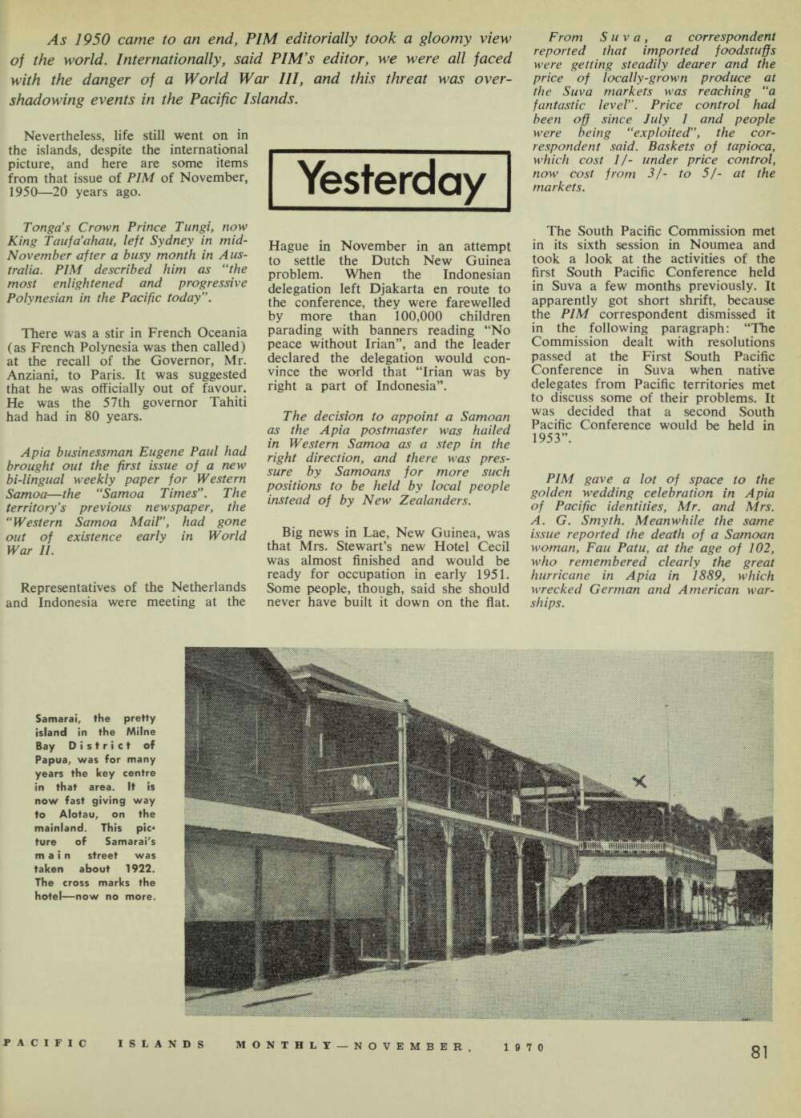
Samarai, the pretty island in the Milne Bay District of Papua, was for many years the key centre in that area. It is now fast giving way to Alotau, on the mainland. This pic ture of Samarai's main street was taken about 1922.
The cross marks the hotel—now no more.