. . . a place to live in
pp. 49-52 · Read in the full issue
Each enumerator who was an nhabitant of the area for which he was responsible, was expected to account between 300 and 500 people, but this depended on the nature of the terrain.
The questions asked on the census schedule were: name, relationship to head of household, sex, age. Then for married women, number of children born, number still living, age at birth of first child, number of years since last child was born, marital status, council area of birth, ethnic origin, religion (voluntary) educational status.
Publicity on all aspects of the census began in August, 1968, and went on unabated until January, 1970.
Broadcasts, talks, newsletters in 16 dialects. Pidgin and English, a census song in Pidgin played over the broadcasting network and continual discussion by census officials with their people, all helped to explain what was intended.
The census was divided up into a preliminary round between January 17 and 31 this year, during which the enumerators and supervisors visited their areas and recorded the details of everyone in them. The
moment of census was midnight on February 1 and the second or checking round began on the morning of February 2, and finished on February 7.
During this period the enumerators and supervisors recorded precisely who had been in each household at midnight on February1—and the results were then checked and for warded by the superintendents of census (the District Commissioners) to the census office in Honiara, where 15 checkers and coders, recruited locally, took three months to pre (Continued over)
pare the schedules for tabulation by IBM Sydney.
This tabulation was to be finished by the end of August and the demographer was then to prepare the interpretive analysis of the results.
They, together with the other sections of the report, will be printed as a whole in England and should be ready towards the middle of 1971.
Numerically the census is thought to have a reasonable degree of ac curacy, but the main difficulty was to find the ages of the people, especially the middle aged and elderly. To help in this a historical calendar was devised which related, in each district, notable events to various years. People uncertain of their ages were asked if they remembered a particular event and if so that was used to calculate their ages as nearly as possible.
For instance, people remembered World War II and such bizarre incidents as the sighting of a strange sea monster off Santa Cruz in 1933.
The census was only made possible by the whole hearted co operation of the people and its finding should form a sound basis for future censuses and for the pre paration of development plans for the Solomons.
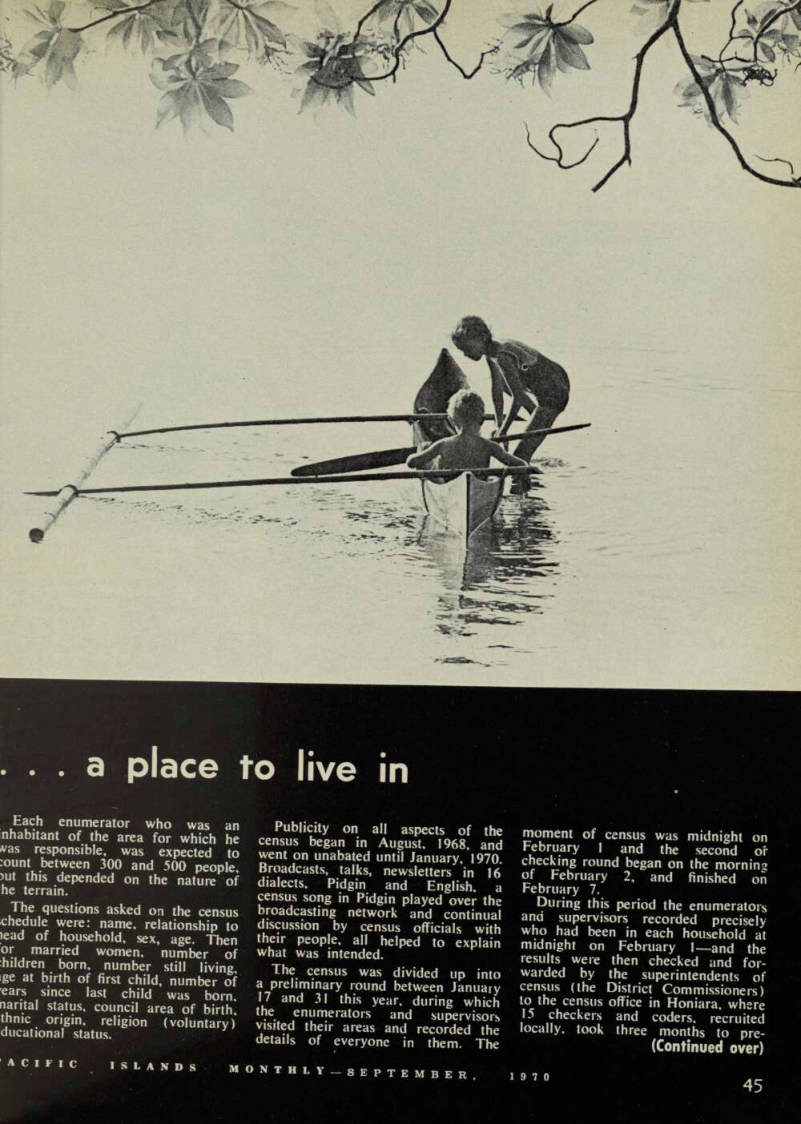
People are what count in any territory. And in the Solomons they come in all colours. First page, two European children investigating the art of canoeing in an island lagoon.
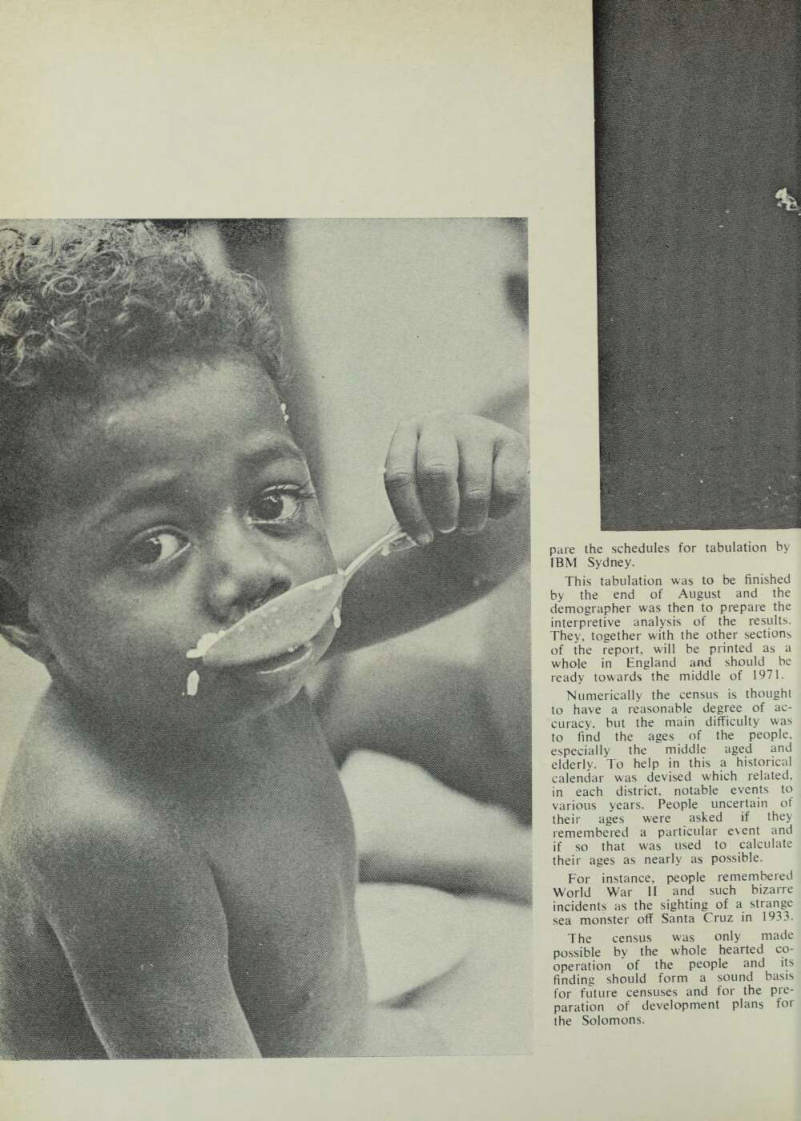
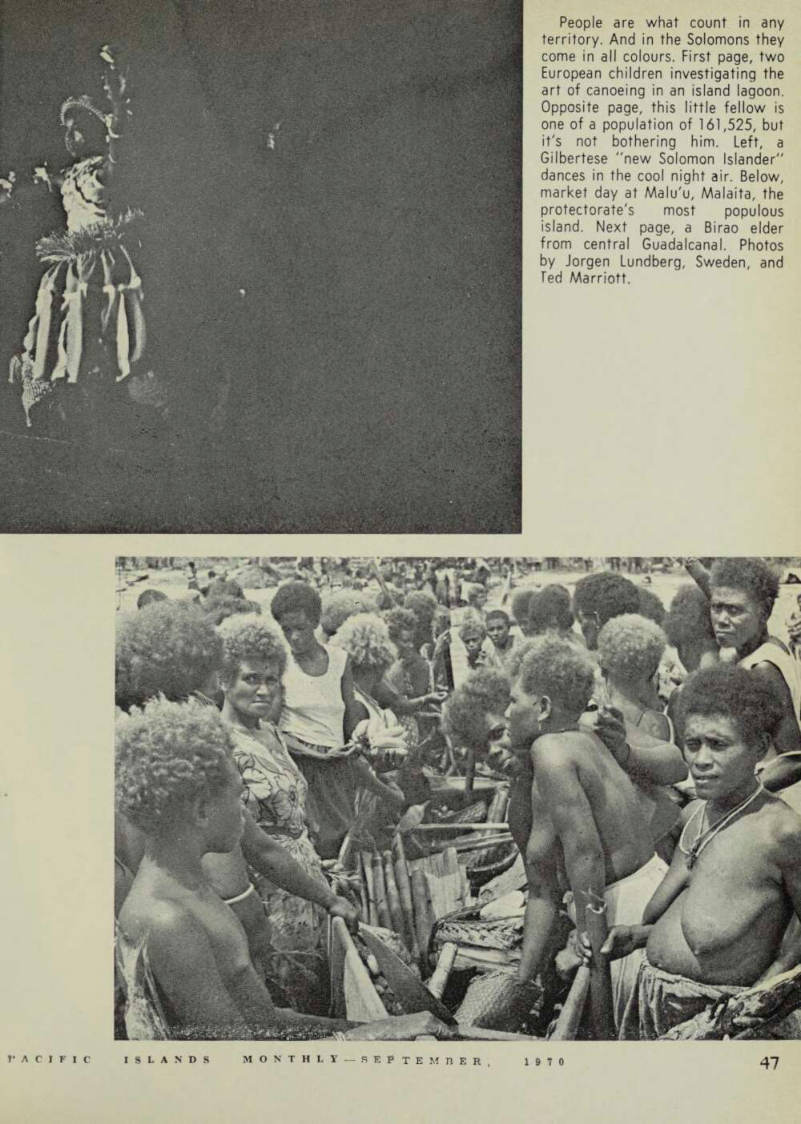
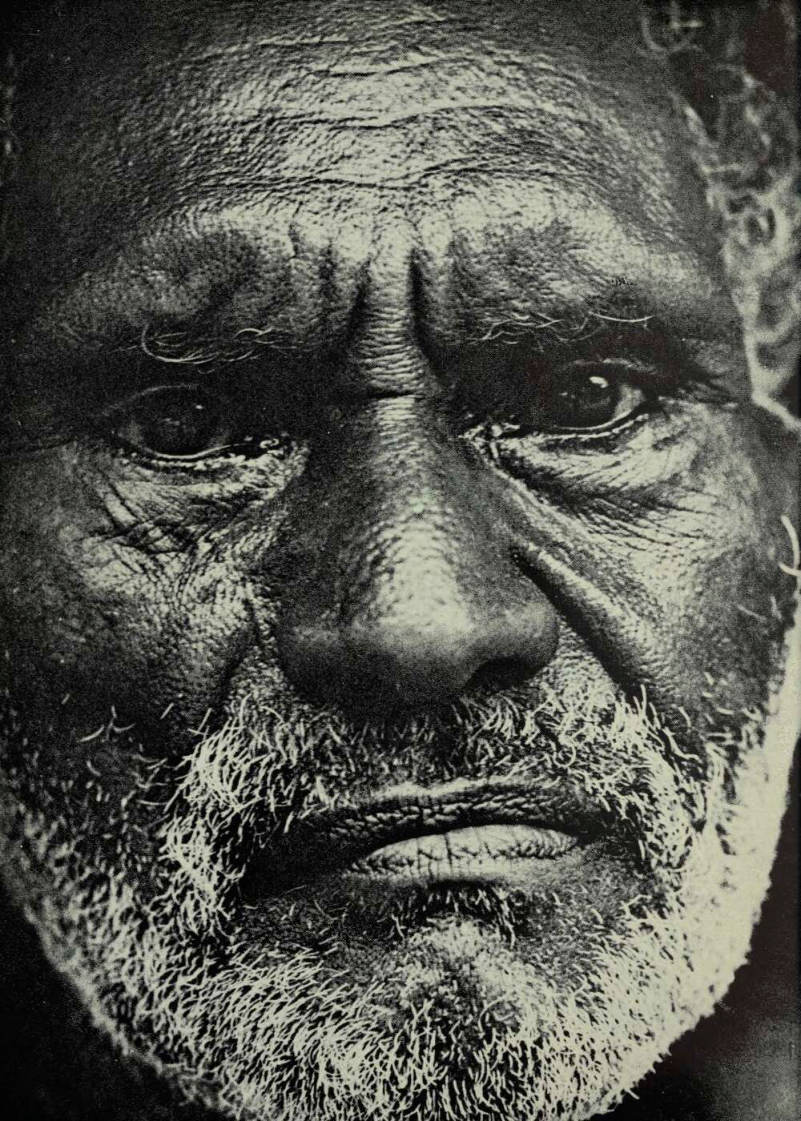
Opposite page, this little fellow is one of a population of 161,525, but it's not bothering him. Left, a Gilbertese "new Solomon Islander" dances in the cool night air. Below, market day at Malu'u, Malaita, the protectorate's most populous island. Next page, a Birao elder from central Guadalcanal. Photos by Jorgen Lundberg, Sweden, and Fed Marriott.