Advertisements & other items, pp. 1-16 (10 items)
Pacific Islands Monthly
ghfghĝ
SEPTEMBER, 1970
AUSTRALIA 40c NEW ZEALAND 45c:?
U.S. PACIFIC TERRITORIES 70c
FRENCH PACIFIC ISLANDS (FRCS. CFP.) 65
P.-N.G., FIJI, OTHER PACIFIC TERRITORIES 35c
September. 1970 Pacific Islands Mon T H L
Anchor
CO * EA * S
(jilleApie
f^NC
HOR
ANCHOR
FLOUR
MAINTOP HIGH PROTEIN
BISCUIT FLOURS AND WHEATMEALS
Gillespie flours are milled from selected high quality Australian wheats and are entoleted for purity. Their consistent high quality has made them the best-known, most asked-for, brands of flour in the Islands. vEntoletion is a special purification process which reduces the risk of insect infection.)
GILLESPIE BROS. PTY. LTD.
HEAD OFFICE:
52 Union St., Pyrmont, Sydney, N S W (G.P.O. Box 2518, Sydney, 2001).
Phone: 660-4933
CABLE ADDRESS;
"GILLESPIE",
Sydney and Brisbane
BRISBANE OFFICE:
Albion, Brisbane, Queensland, p 0. Box 8, Albion, Brisbane, 4010) Phone: 6-1121
s
■ THROUGHOUT THE PACIFIC
FIJI,SAMOA,TONGA, NIUE Is, NORFOLK Is.
BURNS PHILP
(SOUTH SEAT CO. LTD.
REGISTERED OFFICE: SUVA, FIJI
TELEPHONE NO: 22661
TELEX NO: FJ1127
Code Address: ''BURNSOUTH'
SHIPPING AGENCIES
The New Zealand Shipping Co. Ltd.
Shaw Savill & Albion Co. Ltd.
Blue Star Port Line (Management) Ltd.
Bank Line Ltd.
General Steamship Corporation Ltd.
Compagnie des Messageries Maritimes Royal Interocean Lines Daiwa Navigation Company Ltd.
Sitmar Line Flotta Lauro (Lauro Lines) Australasia Pty. Ltd.
Tonga Shipping Agency.
EXCLUSIVE
DISTRIBUTORSHIPS
INCLUDE
Akai Taperecorders Sunbeam Appliances Dunlop Products Hitachi Electronics Holden Motor Vehicles Rolex Watches Revlon Cosmetics Pentax Cameras Ferguson Tractors Olympic Tyres Penfold Wines
AGENTS FOR
Queensland Insurance Co. Ltd.
Shell Company (P. 1.) Ltd.
Bureau Veritas
ASSOCIATED COMPANIES
Burns Philp (New Hebrides) Ltd.
Burns Philp Trustee Co. Ltd.
Automotive Supplies Co. Ltd.
Corrie & Co. Ltd.
Wrought Iron and Steel Construction Co. Ltd.
Bish Ltd.
SPECIALISED SERVICES
Expert advice on Shipping; Forwarding; Customs formalities; Insurance.
COMPLETE TRAVEL
SERVICE
accredited agents for the
INTERNATIONAL AIR
TRANSPORT ASSOCIATION
OVERSEAS AGENTS: SYDNEY • LONDON • SAN FRANCISCO
world
quality
m m P. ¥ v (Jptt' t* ft
one
Only the world’s finest Virginia tobaccos are blended to produce ...
PLAYER’S
GOLD
LEAF
of the great cigarettes
8593/2/70
■• s - •# O' m* ■--■
Expert advice
for your sick
swimming pool
Green slime in your swimming pool?
Trouble keeping accurate chlorine levels?
For sound advice on the best way to deal with all your swimming pool problems, contact ICI in Lae.
ICI have been dealing with swimming pool treatment and care for many years. We’ll tell you how to tackle your pool troubles whether they’re backyard or Olympic size.
ICI
ICI (N.G.) Pty. Ltd., Box 1105 Post Office, Lae.
Telephone: Lae 3301.
Cables: ‘lmpkemix’.
R 1315
Mini Cost Houses
and Bulldings^^^l
WtT
»'K‘, t&t ~i uk □ I □ □
Easily assembled pre-fab units
from $2.50 per sq.ft,
according to size and finish
The new Brownbuilt mini-cost, modular, pre-fab unit concept was specially developed to provide practical housing for the tropics and remote communities.
Look at these advantages: □ Metal framed to take high wind loadings eliminates warping. □ Metal walled and roofed to take ‘clip-in’ linings and ceiling panels (which can be added later). □ Designed for packing for delivery to remote and hilly locations and for assembly by unskilled labour. □ Maximum durability.
Fire resistant, rust proofed, eliminates dry rot and termites. □ 12” modular construction for flexibility of design and size. □ Adaptable to many uses besides homes: churches, schools, stores, messes, offices, dormitories, hospitals, community halls, warehouses, workshops, weekenders.
Send for our detailed illustrated brochure.
Brownbuilt
limited ■■
ALSO: ROOF DECKING • WALL CLADDING
FEATURE GUTTER • CEILING SYSTEMS
U FOAM • SHEET PILING
BUILDING PRODUCTS DIVISION 6 Brunker Road, Chullora, N.S.W. 2190, Australia. Phone: 709-4511 RESIDENT REPRESENTATIVE John Dwyer Saraga street Six Mile Port Moresby Telephone 53144
DISTRIBUTORS:
PORT Morobo Constructions RABAUL: Rabaul Metal Industries MORESBY: Pty. Limited. John Stubbs Pty. Limited. & Sons (Papua) Limited. LAE: Lae Plumbing Limited.
D. C. Watkins Limited. Watkins (Overseas) Limited.
FIJI: Reddy Construction Company Limited.
Narain Construction Company Limited.
MADANG: Madang Building Supplies.
MT. HAGEN: South Pacific Hardware Distributors.
HONIARA: Tischler Constructions Pty. Limited 8:P22
A
great bunch
of flours.
Robert Hutchinson makes the greatest bunch of flours in the Pacific. Bakers’ flour.
Superlite cake and sponge flours.
Biscuit flour and cracker flour.
Wheaten sharps and wheaten meal.
We’re particularly proud of our bunch of flours. So we have a technical advisory service to help you use them properly.
So next time you see a Robert Hutchinson flour (or even one of our Hutmill stock feeds), remember it’s just one of the bunch
Jim s
* * eT.
I- «?■cm i > m / i % . m
ROBERT
HUTCHINSON
LIMITED
the flour people
Jffartington Street, Glenroy, Victoria, Australia. 3046. Telephone Melbourne 306 7261
Hi w
Wunderlich
set modern
The trend today is for modern design —low-cost maintenance-free building materials. The answer lies with asbestos-cement manufactured and supplied by Wunderlich Limited.
The vast range of asbestos-cement products includes flat sheets for walls and ceilings—profile sheets for
materials—
design trends
carports, gable ends, feature walls and garages—and corrugated sheets for roofing, walling and fencing.
Construction of economical flats, home units and residences demands modern design trends —in asbestoscement —by Wunderlich Limited.
Write for free , informative literature on asbestos-cement building products.
Wunderlich Limited Head Office: 393 Cleveland Street, Redfern, 2016. Australia.
Telephone 69 0366.
ASBESTOS-CEMENT
AVAILABLE FROM AUTHORISED
PRODUCTS
DISTRIBUTORS
EXP.B3
Mix
Crackers
taste as H
thev’ia
UlUf iv
buttered!
r.llx are crisp Brockhoff Clix are crisp, golden crackers that are tender at heart. Ea just as they are, straight from the pack. N«P sh into dips, nibble with drinks or top with savoury spreads- Oven-crisp Brockhoff Chx Crackers are ready for anything, they taste as it they’re already buttered m m m I * i w m 0 m
There's value, variety and quality in
BROCKHOFF BISCUITS
5541/8 X 6V4
When the best beer is called for, New Zealand’s favourite lager.. a
STEIN LAGER
GENERAL
FOODS
...bring you the good things in life! ■it
ICE CREAM
▲Va Good things like creamy smooth Tip Top ice cream. A whole range of flavours in take-home packs, in novelties, and in bulk. Tip Top another quality General Foods product.
Trade enquiries to General Foods Corporation (N.Z.) Ltd., P.O Box 722, Auckland, N.Z.
A 425
& €> fS
eye-P
The eyes have it with AKAI's new portable video tape recorder, VT-100. But so do the ears as that unique, true-to-life, AKAI sound also brings you all the exciting actual-tone depth of whatever you choose to record. An exciting experience in itself, AKAI's amazingly new yet versatile VT-100 has demonstrated a wide-wide range of uses.
More and more satisfied AKAI's VT-100 users have achieved successful results in areas as different as education and business. Teachers have supplemented instruction with AKAI's portable VTR because it is so handy to carry on field trips.
AKAI's VT-100 produces sharp, bright, clear images with AKAI's Yi* video tape. There's just as much lifelike quality as in twice-as-large, ordinary YY tape. AKAI's VTR has been praised by business leaders, people in sports, fashigns and cosmetics, 100.
With AKAI's marvelous engineering device the instant see-it-again, TV-type monitor with immediate stop mechanism—government and community recreation training programs have also been significantly aided. Thousands of other uses are possible with the VT-100.
Thanks to its modern engineering techniques, AKAI has its eye on the world with you in perfect focus. ® AKAI's portable VT-100 is smaller than others and takes much less storage space. The VT-100 offers ultimate clarity with AKAI's exclusive Y<” tape—half the size of ordinary tape but capable of producing images exactly as sharp and clear. Twin rotating heads (180° spacing).
Twenty minutes non-stop use with 1,200 feet of tape. D.C. 12 volts. A.C. 10* x 10.3*x 4.4* (255X263 X 112 mm) dimensions. (D Monitor shows subjects brightly, clearly, exactly as-it-ison 3* screen 50 deflection. Dials for vertical and horizontal adjustment, brightness, contrast and volume will help you determine any possible changes in your taping technique. ® Video camera with super-sensitive lens catches subjects in true-to-life depth with a circular target spot centered on image area to assist in accuracy. Zoom lens conveniently located.
E-E system has manual 2-point change system.
Changeable F-1 8 and F-5.6, weighs 1.9 kg (4.1 pounds), including grip. Size 7.3*x3*X 4.4* (187x75x 113 mm) body only. ® Microphone captures all the sound you want because it's just above the lens. This handy location allows the VTR operator to speak, using his voice for narration or announcement purposes. (D Charger resupplies battery for 40-minutes operation after 8-hour connection using AC adaptor.
AKAI
mmm
4
Model VT-lOQ
Co ST Lfd IA UUTOKA : S BuJn a s P RhiIp L \South 6 Sef) St Co eag Ltd St SAMOAeJJnl' 'ph ikf'fSo^th'^ o s rWT C °l P - Box 640 ' Christchurch SUVA: Burns Philp (South Se a Western Samoa NORFOLK ISLANDS; Burns Philo (South Sea) CoI M Ph N P Jf«Kt£?? J L d ' P ( aeo u i gt llr ß n^ rican Samoa/ Burns Philp (South Sea) Co., Ltc •■■■lp (New Hebrides) Ltd., Santo NEW CALEDONIA P “Menard Freres’’’ pn' S °o t D h ir^cu l cm DES: Burns Ph ilp (New Hebrides) Ltd., Port Vila/Bur Box 12, Honiara, 8.5.1. P NAURU - Nauru Co-ooerative Societv rnnK ki 4Nnc- B N X r l2 w ’ No^. mea BPITISH SOLOMON ISLANDS; Mendana Enterprises (Solomon Island) Ltd., P NEW mm: S,O. Svensson P - PA ™
MORRIS
HEDSTROM
LIMITED
HEAD OFFICE: SUVA, FIJI
LONDON OFFICE:
MORRIS HEDSTROM LTD.,
Park House, 22 Park Street, Croydon,
CR9 BNP
• GENERAL MERCHANTS
• MEAT PROCESSING
FACTORY
• PRODUCE BUYERS
• IMPORTERS AND EXPORTERS
• PLANTATION OWNERS
• COMMISSION AND
INSURANCE AGENTS
AUSTRALIAN
REPRESENTATIVE;
W. R. CARPENTER & CO. LTD.,
(Merchandise Division) the A. £r N.Z. Building, 68 Pitt Street, Sydney, 2000 Registered Cable Addresses: • DEUBA-SUVA • MORRISHED-LEVUKA • CAMOHE-SYDNEY • SUVAMARK-LONDON • MORRISCO-NUKU'ALOFA • DEUBA-APIA • CODES: ALL
AGENTS AND DISTRIBUTORS FOR:
• Adhesive Tapes Ltd. • Bacardi International • China Navigation Co. • John Dewar & Sons Ltd. • Electrolux Limited • Evinrude Outboard Motors • Ford Motor Co. • General Electric Co. Ltd. • Glaxo Laboratories • Goodyear Tyre & Rubber Co. • Guinness Exports Ltd. • Imperial Chemical Industries • Matson Navigation Company • Mobil Oil Australia Pty. Ltd. • Max Factor & Co. Inc. • Napier Bros. Ltd. • Parker Pen Company • Proctor Gr Gamble • Rootes Ltd. • Rowntree &Co Ltd. • Smiths English Clocks Ltd. • Tanqueray Gordon & Co. Ltd. • Taubmans Ltd. • Yorkshire Imperial Metals Ltd.
Morris Hedstrom Ltd. are LLOYD'S AGENTS in FIJI and SAMOA For friendly service and complete satisfaction ids Morris Hedstrom Ltd. in
FIJI - SAMOA - TONGA
r I’ve got one lighter made out of two Victorian pennies.
It’s never worked.
I’ve got another that I bought as a holiday souvenir. That went for a week.
I’ve got three other jobs that only need a new little ratchet thingummy.
I’ve got a lighter with a wick like a pyjama cord that lights in a gale and nowhere else.
Lighters ?
I’ve got a drawer full of them.
And a sore thumb.
Somebody
please give me
a Ronson
One of these will do nicely
Premier top-selling gas lighter Adonis slim gas lighter 31 Windmaster gas lighter Comet gas lighter To of Ronson gas lighters. A filling lasts for months. Re-fuelling lasts 5 seconds. The lighter-with RONSON its adjustable flame - could easily last forever. ** '
&5 m m m $ m &e
measure master
iiimuj i r' 9 11 I«» ¥ laNoaysgii-... giT I 1! O’l inj.i 1111 ]j u.itmiJ 11 i t ini rl:i']'iil;i-n-iti-inlTra.rTTi-| tiri rtoiiliiTilni Made especially for those who value top craftsmanship and accuracy above everything, the Rabone Chesterman 2 and 3 feet folding boxwood rules are an object lesson in how good all rules should be. Built to last a lifetime, they'll measure up to anything.
Available from Ironmongers and Tool Dealers.
Rabone
Chesterman
Rabone Chesterman Ltd.
Birmingham 18, England.
fibreglass
islander 43
CRAY BOAT-TRAWLER FOR
LONG RANGE FISHING OR EXTENDED
PERIODS AWAY FROM HOME BASE...
mm * Cruising range 1,500 miles . . . speed 8.7 knots . . . fuel consumption, gallons an hour with a 5 L. W. Gardner * Comfortable onboard living for four or more * $38,000 to $42,000 absolutely complete with refrigeration, machinery, motor —yes, even food! * Has a current N.Z. Marine Department Survey Certificate * Length 42ft 6in, Beam 12ft, Draught sft, Displacement 16 tons and up to 10 ton refrigerating capacity * Can be modified to suit any conditions or regulations * For full details contact: ,
GEORGE & ASHTON LTD
P.O. Box 205 6, Dunedin New Zealand Phone: 54-108
Eat W' a J^‘g„ c j energV* for health ana o\\ need Vou"9.a" d a , Vitamin B, ev , n \ he most deny 9 iveS cnread it on hot watei Stir 'V'2!°h better Vou it to us -,” 0 n toast and water
sandwiches
much drink. See how ion as a yOUnQ Like ieei m * r. <0 v ' 0 • U I=^=3 D Sx 5. -J 0 5, £5 I m lilTTTrtt& M4020/9
Lunch size, snack size
SAO biscuits
are the right size!
Crisp, fresh Arnott’s Sao biscuits ... right size to satisfy, right size for snack foods, too! Cheese for lunch? A big slice fits just right on Sao. So does a slice of ham or salami.
Prefer jam or spread? Or how about tomato? Simply serve with Sao—the right-size biscuit that makes all the crisp difference to lunches at home and at school or outof-doors. The triple-wrapped pack keeps the biscuits crisp and fresh.
Qrnott's/™ 0 ® Biscuits
There is no Substitute for Quality
1
ACIFIC ISLANDS MONTHLY_s E P T E M B E R , 1970
2
SEPTEMBER, 1970 PACIFIC ISLANDS MONTHL
3
’ACIFIC ISLANDS MONTHLY_s E P T E M B E R . 1 970
5
PACIFIC ISLANDS MONTHLY— S E P T E M B E R , 1970
Pacific Islands Monthly_ S E P T E M B E R . 1 970
Pacific Islands Monthly_ B E P T E M B E E , 197 „
13
PACIFIC ISLANDS MONTHLY_s E P T E M B E R . 1 970
Pacific Islands
Monthly
Established 1930: 40th Year of Publication.
Owned And Published By
Pacific Publications (Aust.) Pty. Ltd.,
29 Alberta St., Sydney, N.S.W., 2000.
Postal Address: G.P.O. BOX 3408, SYDNEY,
N.S.W., 2001.
Telegraphic Address: PACPUB, Sydney,
Telephones: 61-9197, 61-7101, 61-4369.
Chief Executives: Managing Director: R. W. Robson.
Executive Director/Publisher: Judy Tudor.
Executive Director/Business Manager: Selwyn Hughes.
Executive Director/Chief Editor: Stuart Inder.
Pacific Islands Monthly
Editor: Stuart Inder.
Advertising Manager: W. A. Gasnier.
Branch Offices
Melbourne; Newspaper House, 247 Collins St., Victoria, 3000, Tel.: 63-7053.
Fiji: Pacific Publications (Fiji) Ltd., Fiji Times Building, 20 Gordon Street, Suva. Tel.; 25601.
Fiji Times Office, Mayfair Building, Namoli Ave., LAUTOKA. Telex: 1144. Tel.: 60-422.
Papua-New Guinea: Pacific Publications (N.G.) Pty. Ltd. Representatives: PORT MORESBY, P.O.
Box 16; LAE, P.O. Box 227; RABAUL, Mr.
Steve Simpson, P.O. Box 433 (c/- Rabaul Photographic, Tel.: 2677).
Representatives
aueensland; Advertising—Beale Media Services, 232 St, Paul's Terrace, Fortitude Valley, Qld., 4006. Tel.: 51-5827. <ew Zealand; General.—J. D. Whitcombe, C.P.O. iox 2229, Queen St., Auckland. Tel.: 456056.
Advertising.—J. E. Sanders, P.O. Box 25-015, Auckland. Tel.: 583-563.
Jnited Kingdom: S. R. Warman, Park House, !2 Park Street, Croydon, CR9 3NP. Tel.: 01-6884177.
I. A. Mackenzie, 4A Bloomsbury Square, London, W.C.I. Tel.: Holborn 3779. apan: Advertising—Universal Media Corpora tion, C.P.O. Box 46, Tokyo. Tel.; 666-3036.
Agents
All main trading firms and stores in the Pacific Islands. ’acific Publications Pty. Ltd, is the Australian agent for THE FIJI TIMES.
Subscription Rates:
Pacific Islands Monthly" is air-freighted to II subscribers and agents in the South Pacific; copies to other areas go by surface mail, ustralia (incl. Lord Howe Is., and Thursday 5.): $4.50 Aust.; Papua-New Guinea, Norfolk >., Nauru, 8.5.1., G. & E. Group, Tonga and Hebrides: $4 -°° Aust - New Zealand: ,s -' Niue and Western Samoa: 4.00 (local currency); Fiji $4.00 (local jrrency); American Samoa and U.S. Pacific erritories: $B.OO (local currency); French ac |f ic Territories—New Caledonia, Tahiti, etc.; 50 French Pacific francs; United States of menca; $9.00 U.S.; United Kingdom and elsewhere: £2/15/- Stg. irmail postage to USA, UK and elsewhere is additional. opyright ©, 1970, Pacific Publication* (Aust.) Pty. Ltd,
Up Front
with the Editor
Just before Mr. David Hay took up the post of Administrator of Papua-New Guinea in January, 1967, the late Eric Feldt, of Coastwatchers fame, wrote what you might like to describe as an ode about the sort of things the new man was likely to encounter.
After it was published in PIM (Dec., 1966) I set up a special copy of it on card and sent it up to the Administrator as a keepsake. He was delighted with it, and when occasion ally I saw him at his office in Port Moresby he would comment that Eric Feldt was making more sense every day.
David Hay has now completed his term in the hot seat, and much of what Eric Feldt had to say in 1966 still applies in 1970 to Mr. Les Johnson. I won’t repeat the “ode” here, but I’ll give you my favourite passages: “WE CAN WISH him only years of onerous toil in a climate which makes hard work harder, facing problems which cannot be solved to the satisfaction of everybody.
“AS HE LEADS the native people towards prosperity in the modern world, may he be able to overcome some _of the inertia of the great majority, at the same time mollifying the vehemence of the educated few, and when what he has said has been twisted to mean the exact opposite, may he hear of it early and so be able to correct it.
“AS HE MOVES from one imperfect solution to the next in soluble problem, with the results falling short of his hopes, may his strength hold and his nerves remain calm.
“And When He Steers A
commonsense course between those who clamour to sacrifice the present to some ideal, unworkable future and those who would neglect all for present gain, we would like to wish him their gratitude, but we cannot, for those who are too thick in the head to see what they have been saved from will give him no thanks.”
I’ve said that many things that Eric wrote about the New Guinea Administrator’s job in 1966 still apply today. But not all of them do, and even the far-sighted Eric might have been surprised to see the pace at which New Guinea developments are moving in Mr. Johnson’s day. More importantly, he might have been surprised to see how little control of events an Administrator now has in New Guinea.
The visits to New Guinea of Aus tralia’s Labour Opposition Leader, Mr. Whitlam, and Prime Minister, Mr. Gorton, have both underlined this, in my view.
No revolt
New Guinea is not on the point of revolt—nor are its two million people bitter at the ineptitude and lack of sympathetic treatment of the Australian Administration, as the publicity surrounding Mr. Whitlam’s tour might have had us believe. But nor will a policy of controlled uni form development, and appeals for unity and commonsense, solve the problems that New Guinea now faces, as Mr. Gorton’s words might have led us to think.
Neither Labour nor Liberal will influence the game now being played in New Guinea by shouting at each other from the sidelines, because of the vital fact that it is the New Guineans who are carrying the ball.
New Guinea politics have finally achieved their own momentum and I personally believe that the Aus tralian Administration can from now on only follow events, shaping and appealing where and when it can, seeing fair play wherever possible.
It’s my personal opinion certainly,
but it’s a strong personal view which has forced itself upon me in the last 12 months.
The Mataungan organisation of the Tolais is not an isolated movement.
John Kaputin is not an isolated spokesman. There are men and or ganisations like them right throughout the territory, with varying degrees of influence and various methods of approach.
And why not?
It’s embarrassing to those of us who like to see orderly development, yet it’s a situation we can only expect in an emerging country of two million people with minds of their own.
To get the whole picture into focus, one has only to take a look at the remarkable, recent political developments in other areas of the Pacific Islands.
Only three years ago the exponents of orderly development were sorely strained by the tactics of Head Chief Deßoburt, who wanted far too much for the tiny island of Nauru; but today Deßoburt is President of the republic, which has everything they told him he couldn’t get.
Not long before, a Maori called Albert Henry was in great disfavour with the New Zealand Government because of his radical views on the future of the Cook Islands—today Henry is Premier of the self-govern ing Cook Group.
In Fiji, Ratu Mara —a radical product of the London School of Economics—was being treated with suspicion by some of the forces of orderly development, but in October he leads Fiji’s half-million people into Dominion status, and now has a British knighthood from the Establishment.
I could go on, but the point they help me make is that political events are moving swiftly in the Pacific, and today you just can’t guarantee that the timetable you’re following will connect with the bus .
ONE learns some surprising things.
I was talking the other day to Victor Carrell and Beth Dean about the Cook Islands National Arts Theatre, which they brought to Aus tralia at Easter for a most successful tour in support of the Commonwealth bi-centenary celebrations for Cook.
My wife and I saw the performance in Sydney at Her Majesty’s Theatre (since, unfortunately, razed to the ground by a disastrous fire) and never had we seen Islands dancing like it.
This was the real thing, yet carefully selected and sharpened up for the theatre in such a way that the Islands flavour was enhanced, not cheapened.
No chance
The Carrells (they have been married 25 years) gave the same skilled and sympathetic staging to the display of Australian Aboriginal dancing which shared the same pro gramme.
What I didn’t know is that the Carrells were never in a position where they could have made any money from the tour. Victor Carrell gave himself a contract under which profits were to be shared 50-50 by the Cook Islands Theatre and the Aboriginal dancers of Australia.
Any losses were his.
The pair put 12 months of their own time into arrangements—speak ing to at least 200 groups to drum up publicity—and took no expenses.
Their tour with the group was at their own expense.
Notwithstanding, their losses on the staging amounted to $11,500.
You’d think the Australian bi centenary people or the Common wealth-supported Australian Council for the Arts would make up the difference in view of the purpose for which the Cook Islanders were brought to Australia.
Stuart Inden[?]
Advertisements & other items, p. 17 (1 item)
15
ACIFIC ISLANDS MONTHLY_ S E P T E M B E R . 1970
Our Cover
Banking seems as though it could be fun at this Savings Bank at Ambunti, Sepik Dis trict, New Guinea. The decor is local "Haus Tambaran" style and the customer is Nauwi Saunambi, MHA for Ambunti-Yangoru. Photo is from Dept, of External Terri tories.
Advertisements & other items, pp. 18-20 (2 items)
quality?
Particular
about
taste and
quality?
This is the pure Scotch.
For three and a half centuries, Haig has preserved in its unique blend a taste that can never be duplicated, a quality that cannot be matched.
don’t be
vague
ask for...
The scotch whisky for particular people.
HAI26
News magazine of the South Pacific
TON
. . . with concise reporting on the significant news of the South Pacific, penetrating background stories, bright informative magazine articles, big picture features, Pacific travel, profiles of Pacific personalities, a cruising yachtsman's department, Islands' business and development, reviews of the latest books and a special section for planters.
Take out a subscription and dip yourself each month into the real South Pacific.
USE THE FORM OVERLEAF TO BECOME A REGULAR READER
Attached find payment of for
subscription.
□ NEW □ RENEWAL
years
(CAPITAL LETTERS)
NAME
ADDRESS
COUNTRY
PACIFIC ISLANDS MONTHLY
Box 3408, G.P.O., Sydney, N.S.W. 2001, Australia. 29 Alberta Street, Sydney, N.S.W. 2000. ■■ I I
SEPTEMBER, 1970 —PACIFIC ISLANDS MONTHLY
Pacific Islands Monthly
In This Issue
Vol. 41. No. 9, September, 1970
General
Airlines war 58 Peruvian slave traders 82 Australian budget 105
American Samoa
Mew education director 93 Health funds 133
:Ook Islands
delations with NZ 27 nfluenza 29 theatre 32 Missing skeleton 57 reight fuss 98
Iji
ndependence eve 20 oreign Service appointments 20 Australian aid 21 Ministers' pay rises 21 outh Pacific Conference 26 fadi-Suva Road 55 astaway Island 61 listory of sugar 79 lational song 89 Altair" lost 97 itibank opens 109 Immodest" tourists 123
Rench Polynesia
Jr Tahiti 23 jhiti's nature man 73
Gilbert And Ellice Islands
Birth rate 29 Tabiteuea Island 63 Early traders 64 Broadcasting officer returns 93 First bank 109
New Caledonia
Nickel profits 22 Troubled farmers 22 SPC dispute 27 Student freedom 31 Work for Tongans 99
New Hebrides
Games preparations 49 Boutique owner .. 92 Scout visit 93 Tuna venture ... 97 Money and Big Nambas 113 Gospel translations 131
Niue
"Should retain character" 29
Norfolk Island
Aunt Jemima 31 Tourism controversy 59
Papua-New Guinea
Inside New Guinea 24 University graduates 25 Crown of thorns starfish 41 Games preparations 49 Origin of names 53 In colour 88 Freight costs 99 Australian aid IQS
Sugar industry? 106
Pitcairn Island
Coat-of-arms .. 19
Solomon Islands
Governing Council session 19 Administrative changes 19 Population census 44 Games preparations 49 War experiences 87
Tonga
Book review 87 Work on ships 99 Smelly stamps 133
U.S. Trust Territory
Political status debate 18 Papal visit? 133
Western Samoa
Crown of thorns starfish 41 Peter Creevey 93 Interpretation system 131
Tokelau Islands
No gaol 133
DEPARTMENTS: Up Front with the Editor, 15; Editor's Mailbag, 28; Tropicalities, 30; Footnotes with Percy Chatterton, 37; From the Islands Press, 57; Magazine vl! on ',™ Y D 6Sterday ' 81; Book Reviews ' 87; People, 93; Shipping, 95; Cruising Yachts, 100; Business and Development, 105; Produce Prices, 111; Shipping and Airways Schedules, 113; Deaths, 120; Nutshell, 131.
Micronesia is confused
Pacific Islands Monthly
Micronesia is confused about what it wants
By Carl Heine
In presenting the report of the Political Status Delegation to the Congress of Micronesia, the chair man of the Status Delegation, Senator Lazarus E. Salii said, “Discussions so far with the United States reveal profound differences between the positions of the two sides.”
The report itself must be com mended. It is a very well written document on the present position of the Micronesian people as seen and presented by the political status delegation. The report also presents the position of the United States.
Both positions are clearly analysed.
However, the report is far from complete. There is nothing in it that will satisfy any average Micronesian voter. It offers nothing conclusive nor recommends anything concrete in terms of a political choice. The report simply summarises the results of the recent talks between Washington and the Congress of Micronesia’s Status Delegation, and reiterates the latter’s insistence on free association and/or independence.
The two sides came to a deadlock on several crucial issues, but most important was the use of land—who shall control it and how future acquisition of land in terms of United States military interest in Micronesia would affect the Micronesian people.
At present there is “an impasse”.
There is much distance to be travelled before any meaningful goal is reached in the Micronesian quest for a viable political future.
The status delegation was directed to negotiate with the United States on the basis of “free association” as the first choice of the Micronesian people. In the first round of talks held in Washington in October, 1969. the Micronesian Status Delegation presented 11 points which were con sidered to be of paramount im portance to the Micronesian people.
The US delegation at that time seemed willing to go along on all 11 points. However, during the second round of talks held on Saipan in May of this year, the US delegation put forward its own proposal for a Commonwealth status for Micronesia.
This caught the Micronesian delega
tion by surprise. It had come to the May talks hoping that the US delegation would pursue the same issues and principles that were on the agenda earlier in Washington.
The Micronesian delegation saw no reasons why the Micronesian constitution should have to be modified by the US Congress and why it should have to be inconsistent with the US rnnsfihuinn ™ ’ , ..
The report goes on in great detail on the procedures of terminating the present Trusteeship agreement; and further discusses the advantages and disadvantages of independence. While these may be reasonable, they are unnecessary as far as the present issues are concerned.
In view of the present impasse, what is needed is to open further negotiation rather than resort to the issue of independence. Independence should be the final act of the Micronesian people only if and when the chips are down.
The issue that is central to both sides in the negotiations is land.
How will it be controlled? It is a well-known fact that the only interest on the part of the United States in Micronesia is Micronesia’s land, and Micronesia’s stategic location in the Central Pacific-ocean area. The Americans are losing money by being m Micronesia. By the same token, land is considered by Micronesians foremost asset and their only form of social security. If the control of land is taken away from the Micro nesia then , heir who|e cultu custo and a of life are also taken a Taking the con trol f , h thin that the Micronesians have been B ; to preserve, has b ht de!ay in the negotiations. To Micr ' nesianSi land represents not only soc j a j security, but also identity a nd self-respect. To them land is more than just a piece of real estate, i t represents a way of life. To Ame ricans, land is where a tall building can be erected; its value is based on how much wealth can be accumulated from it.
The Micronesian choice of free association placed complete and un
conditional control of land in the hands of the Micronesians themselves; the US offer of Commonwealth status gives the US Federal Government certain rights and strong control over the use of land in Micronesia. The terms stipulated under the offer of Commonwealth status were not acceptable to the political status delegation. In the expression of the chairman, Senator Lazarus E. Salii, they were “well below the minimum standard of self-government ac ceptable to the Congress of Micro nesia”, and “the United States offer was a disguised offer of outright ter ritorial status”.
Micronesians are very sceptical of the US offer, and perhaps they have some justification. They have learned much from American history, and of its dealing with minority groups. The recent uprising of the American Negroes, the plight of the American Indians, and the status of the native Hawaiians are all bad indications of unfortunate historical happenings that speak very negatively against the United States. In this regard the Micronesians are determined to see that history does not repeat itself in these islands, small and insignificant though they may be.
Contributing to the present impasse is the fact that both Washington and Micronesia want to have their cake and eat it too. Washington wants to maintain its strategic military position in Micronesia, yet is not willing to grant a full measure of true internal self-government to the Micronesian people. On the other hand, Micro-
Continued on p. 118
nesia wants to have full control of its destiny, with a large amount of US economic aid and other assistance, yet is not willing to bargain when the question of land is an issue.
Some degree of compromise and perhaps sacrifice will have to be made by both sides. It is on this issue that the report of the political status delegation is lacking.
Any discussion towards obtaining full independence for Micronesia at this stage in time and development should be considered premature and
untimely. The US government has the upperhand in this negotiation, whether it is toward a permanent political settlement, a semi-political settlement, or for maintaining the present form. Whether Micronesia likes it or not, the present trusteeship agreement is very much in force and still binding on both parties.
The United States negotiating team will attempt to use it to its full extent possible. If free association is unacceptable to the United States in view of its military and other inter national commitments in the Western Pacific, an independent Micronesia would be less acceptable.
United Nations pressure and feel
ings might be a force to reckon with,, but the UN is also in a dilemma ofl its own. It is doubtful whether the UN would want to put too muchr pressure on the United States —“aE very present help in time of trouble”.
On the other hand, if the primary, goal for Micronesia is for full internal self-government, with United States funding and external protection, then further negotiation is called for to reconsider the offer of a Common wealth, or to further study the con cept of free association. Any attempt toward making Micronesia completely independent at this time would be irrational and irresponsible.
The dilemma of poverty, hunger, ignorance and lack of proper medical care faced by these islands is the gap between expectation and reality Under an independent Micronesia, these long standing problems are likely to increase, not decrease.
Yet there are those in Micronesia, both Micronesian and non-Micro nesian, who are willing to surrendei anything to regain that mythologica: absurdity called “Micronesian dig nity”. Is life so cheap, and “Micro nesian dignity” so important thai human hunger, ignorance, povert) and poor medical care can bf deleted from the agenda of the statu delegation? Can true dignity be con ferred if the soul is hopeless and the body destitute?
Certainly, there is nobility in th( Micronesian quest to manage its owi internal affairs and thus regain it lost sense of dignity. But Micronesk should be awakened to the reality o change. Life in Micronesia has evei changed too. Is it necessary fo Micronesia to live in the simplicity of yesterday? If the present system i unrealistic and undesirable, can ai independent Micronesia remedy tb situation? These questions will haw to be satisfactorily answered befor any plebiscite is held.
Micronesia should prepare itsel for the coming challenge of tomorrov and try to attain a new freedom au an improved sense of dignity. 1 would be a mistake for Micronesi to return to the nobility of it obsolete past where only a few shard honor and dignity and the multitud lived in bondage.
The quest for a new status by th Congress of Micronesia’s Politics Status Delegation reflects the geners sentiment of the Micronesian peopl and their regard for freedom. How ever, such an important issue as thi should not be settled without public referendum.
The status delegation will have t assure the majority of the Micrc nesian people that there will be n new status for Micronesia withoi their participation and consent.
Congress continues discussion
The Congress of Micronesia, meeting in Saipan, in late August was still discussing implications of the report on Micronesia’s earlier presented to Congress by its Political Status Delegation (“PIM”, Aug., p. 27). The report was critical of US attitudes on Micronesia, and said a stalemate had arisen because the US had rejected the delegation’s proposals for either a free association with the US, or independence, and the delegation had itself rejected a US proposal for Commonwealth status. By month’s end it looked as if the Micronesian Congress would set up another delegation, mainly with the same members, to continue discussions. Congressmen seemed agreed Micronesia had to have some sort of self-government and that Commonwealth, or colonial status, was not acceptable in the form offered. In this commentary for “PIM”, a leading Micronesian, Carl Heine, who is Deputy District Administrator, Yap District, discusses the implications of the report.
Islanders feel their way in
the new Solomons council
From DAVID KEATING, in Honiara.
The first session of the new Governing Council in July was for just over a fortnight—sufficiently long enough to get the new con stitutional procedure under way in the Solomons. The real effect of the Governing Council will not be felt until after the next session when the various committees will have been at work hammering out matters that come before them.
The real test is therefore yet to come and it remains to be seen how the committees cope.
In the first session the committees had not, of course, got into opera tion, so the proceedings on some issues were more drawn out. But once the elected members settled in and realised that they were in control if they voted together, things began to happen. A motion was passed calling upon the High Commissioner to revoke charges for medical services to Solomon Islanders which had just come into force before the new Governing Council had commenced to operate.
With one exception all the elected members voted in favour of the motion, thereby outnumbering the Public Service members. The excep tion was William Betu, chairman of the Education and Social Welfare Committee. His committee had not been able to deal with this item as this was the first session of Governing Council. Consequently he was not obliged to take any particular stand on the motion, so one must assume that he was simply in favour of the charge scheme. In any event he certainly was not popular with the other elected members.
In view of objections to mining operations by various Solomon Islands landowners, a bill was put through by Archdeacon Peter Thomp son to pay a 5 per cent, royalty to landowners affected, instead of a 5 per cent, royalty to the respective local council. This was done in the hope that it would satisfy the objectors. Whether it will or whether they will now want a larger royalty remains to be seen.
On the Public Service side, a much needed Public Health Bill was put through. Until this bill was passed there was no local legislation covering this important social aspect. Up to now English public health law applied wherever possible; it did not of course, cover many particular problems of the Solomons.
Motions proposed by Peter Salaka were passed to make workmen’s compensation insurance compulsory in some cases and for a minimum wage rate to be fixed for some classifications of workers.
In a lighter vein, Alfred Maeke, member for West Guadalcanal, pro posed the motion that members should not need to wear suits in the council. This was rejected by elected members as well as Public Service members—perhaps because as they had already bought them they did not want to be denied the opportunity of wearing them.
On August 10, Joseph Bryan’s election petition was heard in the High Court. It was unopposed by Leone Laku, the member declared to have been elected, and the returning officer, Stuart Harbinson, for the East Guadalcanal District.
The petition stated that the votes at two polling stations had been rejected because they had been marked with the names of the voters and at one station with the voters’ registration numbers as well by the polling assistants. The petition was granted and Leone Laku’s election was declared void. A new election is now to be held, and it’s anybody’s guess at the result, even though Joseph Bryan would have won in the last election if these votes had not been rejected.
Pitcairn Island, population 80, now has its own coat-of-arms. The Queen has issued a royal warrant approving the design, which incorporates the "Bounty" Bible, the "Bounty" anchor, a Pitcairn wheel barrow and a sprig of miro—the wood used by the islanders for carving.
New Chief
Secretary Named
Mr. Tom Russell, Financial Sec retary of the Western Pacific High Commission (he’s been in the Solo mons since 1948), has been appointed Chief Secretary to succeed Mr. L. M, Davies, who has been named Deputy Governor of the Bahamas ( PIM , Aug., p. 26). Succeeding Mr. Russell is Mr. I. H. Smith, Permanent Sec retary, Ministry of Finance, Benue State, Nigeria, who arrives in Honiara in early September.
Advertisements & other items, p. 23 (1 item)
19
PACIFIC ISLANDS MONTHLY- S E P T E M B E R . 1 970
Headaches among hurrahs
Fiji on eve of independence: Headaches among hurrahs
By R. W. Robson
When Prince Charles, acting for the Queen, breaks out Fiji’s new flag on October 10, the fledgling dominion will receive warm greetings and good wishes from all the nations of the four continents washed by the Pacific Ocean—and especially from its immediate neighbours, Australia and New Zealand.
Fiji was ceded by its high chiefs to the British Crown on October 10, 1874. Until about 1950, it was a remote, sugar-growing colony of three big islands, and hundreds of small ones which, like most of the islands of the Pacific, rarely made world headlines.
The winds of political change, which swept away the British Colonial Empire soon after World War 11, and turned colonies and dependencies into innumerable unprepared and fumbling “independent democracies”, were slow in reaching the South Pacific.
Then in the 1960’s the new nations of West Samoa, Nauru and Cook Islands made their bow to an indifferent world, and in June, 1970, the hitherto British-protected kingdom of Tonga moved to a higher status of independence.
Now Fiji joins the happy concourse. Papua-New Guinea and the Solomon Islands are close behind.
These are not formidable new nations. Leaving New Guinea’s two millions out, the populations of all the South Pacific Islands would not add up to half the population of Sydney.
But they have strategic, political and economic importance and they expect to enjoy steady growth and national freedom under the protection
of Britain, United States, Australia and New Zealand.
Rain or shine, the prevailing spirit at the elaborate ceremonies planned for Fiji next month will be one of friendliness and optimism, Fiji will need a full measure of both. The new nation faces some problems of peculiar complexity, There is the racial problem, arising out of the fact that the Indians (over 250,000) out-number the Fijians (some 220,000), and Indian political policy is shaped by a small, influential group which is anti-European, and land-hungry.
There is the social problem, created mostly because the popula tion growth has out-stripped the development of natural resources, There are not enough jobs for the oncoming generation, There is a finance problem because Fiji needs more and more capital from abroad to encourage or create new industries, so as to pro vide employment and food for a steadily growing population, There is a politico-economic prob lem, insofar that unless political harmony is maintained between Fijians and Indians, overseas investors will not be encouraged to enter Fiji and an inflow of overseas capital is vital to the new nation’s future, There is an extra-special economic
problem in the fact that the Colonial Sugar Company, which has conducted the country’s chief industry for 50 years, is withdrawing from Fiji in 1972; and there is no indication yet of how the industry will be carried on in the future.
There is a property problem. A very large proportion of Fiji’s land belongs “irrevocably” to the indi genous race. The immigrant race naturally seeks much greater land rights.
A very large proportion of Fiji’s industries is owned by Australian corporations. A small but vociferous group of Indian politicians insists that the operations of overseas cor porations be curtailed by govern ment action, in favour of local traders. They hope to achieve this by introducing the common roll, for the election of the parliament. A real problem lies in the fact that the common roll idea is resisted by Fijians and Europeans, for obvious reasons.
But, while the outlook is beset by headaches, it is not all gloom.
New Prime Minister will be Ratu Sir Kamisese Mara. In the last three years, as Chief Minister, Mara has disclosed an impressive degree of leadership. He has brought com promise and unity to a Fijian-Indian
The names of the first—and most senior— members of Fiji's new Foreign Service were announced in August. They are, from left, Semesa Sikivou, who will head Fiji's mission to the UN; Raman Nair, High Commissioner to Canberra; Josua Rabuka waqa, High Commissioner to London; and Ken Bain, who will probably be No. 2 man in London. Other diplomatic staff include Suva barrister Satya Nandan.
Further names are to be announced.
Wives of some mission members with suitable qualifications will also be given positions. Mrs. Nandan, for instance, is a barrister and solicitor, and Mrs. Bain is a highly-qualified confidential secretary.
situation that seemed impossible of reconciliation, and the way in which he has attacked his young nation’s peculiar problems suggests that he has vision, and no delusions about the difficulties immediately ahead of his government. His team of ministers (European, Fijian and Indian) have been very loyal to him sometimes in awkward situations and have developed considerable talent in administration.
So long as they do not lose their heads in the rosy clouds of dominion status, they should give Fiji what it needs, in this critical time of change over.
The other factor, plainly there to comfort us, is the truly remarkable speed and volume of tourism development.
We get only vague estimates of the amount of real money that tourism is taking into Fiji, but there is no doubt that it has already ac complished a great deal. Millions of dollars have gone into Fiji in the last two or three years for the capital development (especially the construction of tourist resorts) of the tourist industry. Superficially, at any rate, Fiji is enjoying a large measure of prosperity.
If the members of Fiji’s new Administration can keep their heads, and avoid racial tensions, and adjust their outlook so that the start lingly different conditions surround ing dominion status can take care of their country’s peculiar problems, then Fiji’s future can be a happy one.
But it will need, for some little time, all the goodwill and practical help it can get from the English speaking nations with interests in the South Pacific.
Mara: Thankful
Over Aid
From SUE WENDT, in Suva Fiji’s Chief Minister, Ratu Sir Kamisese Mara, exercised ad mirable restraint when ques tioned in August about Austra lian aid to the South Pacific and Australian economic involvement
in Fiji.
Asked whether he thought Aus raha’s 1970-71 South Pacific Aid s rogramme allocation of $A700,000 vas “realistic”, he replied that those ‘on the receiving end” had little choice but to be thankful for such lid. “I am not the one to judge
whether it is realistic from their end,” he commented.
From the new Australian alloca tion, Fiji is expected to receive about $200,000 in equipment, $27,000 in expert services and part of $147,000 set aside for the provision of tech nical training for Pacific Islanders.
Last year, Fiji received Australian aid worth $31,000 in equipment, $21,000 for expert services and $35,000 for training.
Part of the $200,000 equipment allocation this year includes equip ment overflowing from last year’s programme. The increase was an nounced in the Australian budget, announced in mid-August by the Federal Treasurer, Mr. Leslie Bury (see p. 105).
Ratu Mara is noticeably reticent about committing himself publically on the question of Australian involve ment in Fiji. He declares himself “somewhat diffident about saying what Fiji should expect” from Aus tralia.
At an August news conference, he said Australian financial control in Fiji was rapidly decreasing. What he would like to see was the establish ment in Fiji of subsidiaries of com panies which now supply goods directly from Australia. “It’s a question of mutual agreement with Australia,” he said.
The Chief Minister outlined gov ernment plans to strengthen the police force by between 200 and 300 men and the Fiji Military Forces by about 150 men, mainly in the officer cadre.
Defence discussions in London, he said, had included the question of getting some up-to-date rifles instead of the 303 s now in use and acquiring uniforms, tents, Land Rovers and other vehicles.
Asked whether Fiji would be getting ships or aircraft, he replied that his present concern was in “finding out what I get for nothing”.
He was asking for a grant from Britain for the “military hardware” and other equipment.
The Chief Minister said an an nouncement would be made soon about the possibility of the Governor of Fiji, Sir Robert Foster, continuing to serve in Fiji as the first Governor- General.
On the question of an independent chairman of the sugar industry, he said that he very much hoped that the present Administrator of the British Virgin Islands, Mr. J. S.
Thomson, would return to Fiji to take up the post. A former Acting Colonial Secretary and Acting Gov ernor in Fiji, Mr. Thomson left Fiji in 1967 after 25 years in the Fiji civil service.
Promises and pay rises
pay rises
In August, Fiji’s Chief Minister, Ratu Sir Kamisese Mara, and the Leader of the Opposition, Mr. S. M. Koya, secured in London further promises of British aid after independence on October 10.
At the same time, Fiji politicians received encourag ing news about their own security—in the form of big pay rises.
Reports from London said that, during four days of talks with members of the new Con servative Government, Fiji’s leaders received pledges of continued technical aid and other assistance given by the previous Labour administration.
The position of the Fiji sugar industry should Britain enter the European Common Market was also “satisfactorily” discussed.
At home, most government ministers, assistant ministers and Legislative Council mem bers must have been experienc ing a fair degree of satisfaction too, regarding their own financial lot, when an eight man committee appointed in January, to examine parlia mentary salaries, recommended substantial rises.
The Legislative Council, on August 24, unanimously ap proved the rises for members and ministers, to apply from January 1.
The new salaries and ex penses, with the old figures in brackets, are: Chief Minister, $10,500, $2,000 ($7,002, $1,002); ministers, $7,000, $750 ($6,000, $240); assistant ministers, $4,750, $250 ($4,002, _); members, $3,500, ($960, —); Speaker, $6,000, ($960, —); Leader of Opposition, $6,250, $750 ($2,004, $100); Government and Opposition whips, $3,700, $2OO.
In making its recommenda tions the committee took as its guideline salary levels and standards applying generally in Fiji.
Advertisements & other items, p. 25 (1 item)
21
■ACIFIC ISLANDS MONTHLT_s E P T E M B E B , 1 970
Who should get the nickel profits,
France or New Caledonia?
From GERALD ROUSSEAU, in Noumea The New Caledonian nickel export issue—whether to sacrifice “local” Caledonian ore export expansion now for the benefit of “national” French companies, which will not be fully operative before 1975 —is seriously disturbing the Noumea Gaullist party.
Following the failure of leading Caledonian independent miner, Edouard Pentecost, to back down on the issue, the Gaullist paper Le Drapeau has severely chastised (with out naming) him for his anti administration stand.
Mr. Pentecost is also reported as being tossed out of the Union Democratique Party for having failed to pay his dues—a mere S3OO per month as far as Mr. Pentecost was concerned, plus the use of his private planes for propaganda purposes.
At the same time the New Cale donian mining union Syndicat Independant des Mines has also continued its struggle to have quotas abolished on the export of nickel ore to Japan.
Since its formation in June and the despatch of its protest tele gram to President Georges Pompidou, the SIM union has been growing in numbers.
The union leaders have held dis cussions with the Secretary-General (in charge of the French Admin istration), Director of the Noumea Mines Department and with heads of the Governor’s Confidential Information Service.
In a bid to assess future op portunities for Caledonian mine operators and contractors, the union has also been in contact with all four large Paris-based mining companies which operate or plan to operate in the territory.
For their part, representatives of Japanese smelters, anxious to fulfil the original contracts signed with Caledonian mine operators, were ex pected to visit Paris in September, at the end of the French parliamen tary summer recess.
Meanwhile, Mr. T. Muto, in charge of the European desk at the Ministry of Foreign Affairs in Tokyo, visited Noumea in early August. It was believed to be the first visit of a Japanese foreign affairs ministry official in three years.
The Japanese have been trying
since at least 1967 to establish a consular agent in Noumea. Paris, however, seems reluctant to grant its approval, evidently eyeing with suspicion any foreign power that tries too much to deal directly with the Caledonians in business matters.
On the other hand, Caledonian independent miners have expressed concern at reports of the French Administration having refused either replacement or extension of stay for two Japanese mining engineers work ing in the territory.
The fate of six more such engineers has now become open to question.
The men are engaged in helping independent Caledonian miners who sell nickel ore to Japan. Members of the Territorial Assembly have queried the Administration on this matter.
Finally, Mr. Bourrelier, head of the Paris Mines Department (Ministry of Industrial and Scientific Develop ment) visited Noumea in August for talks with the local authorities as well as the independent miners.
The SIM sought a meeting with Mr. Bourrelier. It was hoped the Paris official’s visit would open a way to the lifting of the nickel ore export quotas and allow the Cale donians to work their mines as planned.
The French Government attitudes on the exploitation of Caledonian: nickel was outlined in Noumea onr August 14, during an expose on thes forthcoming five-year plan.
At a meeting in the chamber off commerce, the Administration out lined the principal objectives of thise sixth plan as far as New Caledonian is concerned.
Main target will be the production: of 160,000 tons of nickel metal byv 1975. This is four times last year’se production from the sole current! metal producer, the Societe Les Nickel. The 1975 output target is toe be achieved by the combined efforts of four Paris-based mining com panies, the SLN having a controlling interest in three of them.
It’s in order to give priority to thes needs of these four Paris-based com-j panics, the Administration explained,] that quotas have been imposed om the Caledonian miners’ exportation] of unprocessed nickel ore to Japan.: It’s estimated that the export oi< 160,003 tons of nickel metal (120,000 tons going to foreign markets) will! earn about SUS3SO million fou France in 1975.
At the time of the French financial crisis resulting in the devaluation ol( the franc in August, 1969, thei Administration explained, France’s' foreign reserves had dropped to $l,OOO million.
New Caledonia’s annual of from SUS3SO million, it was: pointed out, will provide France witH; one-third the value of its foreign; currency holdings of August, 1969 a considerable contribution to France from this Pacific territory.
Farmers In Trouble
Agricultural equipment going to rust out in the sun . .
Caledonian oranges rotting under the trees while imported citrui fruit is sold in Noumea shops . . . graziers paid 35 cents a pouno for beef carcases, while prepared beef sells for over a dollar ; pound in Noumea . . . local cauliflower crops left to be fed to tha pigs.
These were some of the grievances voiced by nearly 200 Caledonian farmers and graziers at a meeting of the newly-formed Union for the Defense of Caledonia Agricultural and Pastoral Interests, on August 8, at Pouembout, on the west coast.
Among the audience were Cale donian Deputy to the French
Assembly, Mr. Rock Pidjot, Presiden of the Territorial Assembly, Mil Yann Celene Uregei, eight other Ter, ritorial Councillors and several in land mayors.
The meeting urged that a five-pagg list of grievances moulded into thi union’s programme of action shoull be presented to Governor Louh
Verger and to the Territorial Assembly.
President of the union, Mr. Thierry Schmidt of La Foa (west coast) received repeated urging from his audience, as he raised the problems of imported fruit, vegetables and other primary products being sold so easily in Noumea, while Cale donian produce was often unable to find a market.
The union’s document urged the men of the inland to defend their properties, otherwise, it warned, “tomorrow, maybe within 10 years, the nickel will belong to the Rothschilds and the Caledonian land to a few big miners or companies”.
Concerning the problem of guaranteeing wages to rural workers md insurance against natural cala uities, the document urged the a loca :ion of funds for this purpose. This inance would be derived partly by i 1 per cent, tax on nickel exports ‘our Caledonian heritage”.
At the same time, farmers ex jressed apprehension at the inceasing lamage being done to their land hrough mine pollution—mineral oil washed down to the plains from nountains being bulldozed away for heir nickel.
Graziers were particularly con emed about the low price paid for •eef carcasses, while the 10 butchers i Noumea retailed at such a price hat “they own villas and apartments verywhere,” while meat has become “luxury inaccessible to large amilies”.
Fruit and vegetable growers ex ressed their opposition to the massive imports of foreign produce”, diile Noumea shops refuse to handle le local foodstuffs. One farmer rged that “only those who buy local mils and vegetables should have a cence to import foreign produce”.
The countrymen listed numerous rejects as a means of overcoming )me of these problems.
They proposed the holding of a >cal show and also suggested that J or 15 farmers and graziers be ;nt each year to the Royal Easter how in Sydney.
The union envisages the formation f a co-operative among Caledonian irmers to assure the sale of their roduce. It also urged that the im- Drtation of foreign potatoes, maize id citrus fruit should cease, as, ith the building of adequate faci ties, these products could be con ;rved to meet local needs.
All in all it appears that as the aledonian economy races ahead the aledonian man on the land is ffermined not to be left out of his tare in the bonanza.
Advertisements & other items, p. 26 (1 item)
22
SEPTEMBER, 1970 PACIFIC ISLANDS MONTHLT
Air Tahiti "swindled”
One of the most remarkable success stories in the field of Pacific Islands aviation in recent times has been the air taxi service between Tahiti and its sister island, Moorea, run by two local airlines, Air Tahiti and Air Moorea.
Since early last year, when Air Tahiti began the service, the two companies have carried approximately 100,000 pas sengers. In so doing, they have considerably boosted tourism on Moorea and have reduced the travelling time between the two islands from H hours in the fastest inter-island ferry to a mere seven minutes.
Yet on August 11, the president of Air Tahiti, Mr.
Bertrand Jaunez, called a Press conference at Faaa Air port to announce that the two airlines had ceased operations that morning and were going into immediate liquidation.
The reason for this extra ordinary action, Mr. Jaunez said, was that the French Government had blocked the importation of two Britten- Norman aircraft which were essential for the companies’ continued operations.
Without mincing words, Mr.
Jaunez then proceeded to tell the story of his company’s unsuccessful two-year battle against what he described as “administrative trickery”, “swin dling”, and a number of similar things.
The story began, he said, in March, 1968, when Air Tahiti proposed the Tahiti- Moorea air taxi service, using a Britten-Norman aircraft from Libreville, which was adjudged the ideal plane for a flight of seven minutes.
The airline’s investment programme which Mr. Jaunez said had so far cost 82 mil lion Pacific francs (about 5A750,000) was approved by officialdom; the airline took an option on four Britten- Norman planes; and it began recruiting personnel, printing tickets, buying ground equip ment, etc. Finally, with several light aircraft hired locally, the air taxi service was inaugurated.
However, difficulties were encountered as soon as Air Tahiti showed that it meant business and would be a serious competitor for RAI, the inter island airline owned by the French company, UTA.
Whereas Air Tahiti’s applica tion for a licence to import the Britten-Norman aircraft was refused, delayed and pigeon holed, RAI was allowed to im port a Twin Otter which it put on to the Tahiti-Moorea run.
Subsequently, RAI reduced the fare on that service by 30 per cent., although its fare to Bora Bora was put up by 28.6 per cent.
“And now,” Mr. Jaunez, added, “RAI is about to im-
Continued over
Above, Air Tahiti's Britten-Norman in flight.
port Britten-Norman aircraft for its own use in order to asphyxiate Air Tahiti, while our own Britten-Normans are still waiting in vain to leave the Isle of Wight. We have thus been forced to cease operations from this morning, August 11, 1970.”
In a circular to clients issued at the same time as the Press conference, Air Tahiti and Air Moorea stated that they had made numerous appeals to the highest authorities, that the local parliamentarians had intervened on their behalf in the public interest, and that the Territorial Assembly had made a unanimous protest to the French Government. How ever, nothing had broached the veto of Paris against the two airlines.
The cessation of the air taxi service came at a time when RAl’s Twin Otter was out of service with an engine break down. So there was an im mediate increase in the number of passengers travelling on the Tahiti-Moorea ferries.
However, Mr. Pierre Sachet, the owner of one of the ferries, the Keke 11, was not especially pleased about the increased business.
He told the Press that the problem of Air Tahiti was his also in that the French Gov ernment had refused to grant him foreign exchange to acquire a bigger, faster, more comfortable boat—a British hydrofoil. They wanted him to buy a French model which was a little faster than the British one, but much more expensive and noisy.
He added that tourism in French Polynesia was “the affair of UTA” and that that company, with RAI, wanted to establish a monopoly in the territory.
When PIM went to press, the latest news on what one Tahiti newspaper called “a scandalous affair” was that the territory’s Governor, Mr.
Pierre Angeli, had cabled Paris in a last-ditch attempt to allow Air Tahiti to import its Britten-Normans from the Isle of Wight.
Advertisements & other items, p. 27 (1 item)
23
ACIFIC ISLANDS MoNTHLY_s E P T E M B E R . 1970
Guinea
Inside New
With John Ryan
John Guise is going up the hill again for small-talk at Government House.
The Administrator is sitting down, physically, to talk to the villagers. And 10 government departments and seven ministerial members of parliament are being given more administrative-political power.
That’s the August story from New Guinea—an August that got off badly with the 1,000-man police action near Rabaul against Mataungan . . . a legal sortie that almost turned into a political debacle when somebody pressed the panic-button and yelled for military help.
Transcribed into military Pacific Islands Regiment parlance, the state of readiness reached Red Plus before the army started back-checking, to find that somebody in New Guinea’s civil administration had panicked too early.
It all began in July with the Gorton tour, and the departure of David Hay and the arrival of his successor as Administrator, L. W, Johnson. At his airport departure, Hay was given a shoddy, showery farewell. Red Cross Society native girls were there because they’d been told to go, but the weather kept everybody else away: except departmental and service chiefs there for protocol.
I couldn’t help feeling a little sorry for Mr. and Mrs. Hay. They knew they were unpopular in New Guinea, but they weren’t quite sure of the real reasons. Their critics were probably in the same boat.
There’s no doubt the New Guinea atmosphere took a boost with Les Johnson’s return. Within three hours of arriving, he was telling the Press more than Hay had told in the past year.
Then Johnson was off to Rabaul for a look-see, despite Mataungan’s published determination to refuse him an audience. Eventually, Johnson reached enough of the Mataungan middle-rank men, to make his personal impact. He physically sat down with Mataungan, and at month’s end (after some very direct talking by Johnson) Mataungan was talking about having (at last) a private conference with 12 of the 34 native members of the hated Gazelle Multi-racial Council.
Only three weeks earlier, 1,000 policemen were in the Rabaul area, and 560 of them were near Keravat, to confront and kick Mataungan squatters off government land there. The Mataungans went home one weekend to go to church and play football—and when they came back to squat again on the Monday morning, they found the police were there first.
Acting Police Commissioner Brian Holloway has simply out-generalled John Kaputin and Oscar Tammur, MHA. The basic issue between Mataungan and the Gazelle Council is still land —land that once belonged to the Bainings tribes now hiding out in the Bainings Mountains.
This point was raised in a letter to the Post-Courier —and promptly answered by a Tolai who conceded the original Bainings ownership, but pointed to the legality of “conquest” and the unshakeable “truth” that the land now belongs to the Tolai conquerors.
I suppose the 1914 Australian troops who captured the Gazelle from the Germans should get into the act now, by claiming the entire Gazelle as a “conquest”.
Seriously though, the Tolais are going to have to start doing some straight, unemotional thinking oyer the land question. They’re going to have to compromise, whether they like it or not. And the foreigners now con trolling 40 per cent, of the Gazelle are going to have to compromise, too; not perhaps by giving the land back, as the Australian Labour Party leaders would have it, but by selling to the government all acres not essential or not being fully used.
Legislation allowing the government to take this land is already on the books, but the government will use it only in the last resort.
During the confrontation, Mataungan had set ambush positions for the police. They couldn’t use them, because the police found them too soon.
But during the excitement, somebody at Rabaul convinced somebody at Port
Moresby that 1,000 policemen were not enough. Gorton had given Hay the green light to use native troops of the PIR to help out, and somebody asked for them quicktime. When the panic subsided, the army started asking for the name of the man who pressed the button. No names, no pack-drill.
But to have actually sent the army against the Mataungans— to have established a precedent in using troops—would have been political disaster; it would have set another precedent of the very type this country, politically, should never countenance.
The police came out of the confrontation with the battle honours— md demanding more power to nip trouble in the bud, long before it reaches Vlataungan-level. So Secretary for Law Lindsay Curtis obliged with a draft nil giving police power to grab those inciting others, those inciting intimida lon (it s been going on at Rabaul for a year) and various other measures, ill aimed at Mataungan and potentially dangerous situations in public places, was to debate it from August 31.
And to close an exciting month, Governor-General Sir Paul Hasluck ;ave Administrator Johnson written authority to turn over to departments ,nd ministerial members some of the power Prime Minister Gorton promised >n July 6: control over departments by the seven ministerial members of arliament; and control over a large slice of the new budget by the Admini trators Executive Council. , The tw ° positions of Assistant Administrator were abolished, and former £?f Ur s: ,/* J ; Newr P an > was sent upstairs as Deputy Administrator.
Jnder the old system with Assistant Administrators, each Assistant had ve departments responsible to him. They took the “hard” departmental stuff ito the Administrator. As well, the Administrator held the reins individually n six other departments. J , N° w ;. tl?e 10 m^ or “ ser V ice " departments will start looking after much 10re th^ ir own affairs, going to Tony Newman only when in real trouble. v l6 channels of communication to the Administrator and Canberra Ztr? I SJ dir S: ted: • Way . from the Pu !> lic Service and into the political mere, because the major departments will now have direct access to the ■mtrnllimf § Pxec J^ tive Council through ministerial members ostensibly It . s .S° l1 ?g to throw a lot more work on the x native and one European ministerial members.
One member of the Executive Council, Toni Leahy, MHA went into le council m July, 1968, as the Administrator’s nominee, and he’s now been nnl nf A eat M H A Tore Lokoloko) Executive Council spokesman"n the ouse of Assembly. This allows the Government Leader in the House (A t 0 - take of a political back-seat, and thrusts Leahv Council. “ ,UStlfying ° F eXplainin * all measures in “by the a ! ! P, art of the Canberra-Port Moresby decision months aeo to start government influence during parliamentary debate. 8 The time L 7ead for aTI conce e rne^ rS *° Bt3rt governin S- « critical, demanding
The old style planters and do-gooders of the Pacific Island v mpletely out of place in the new environment, Dr. B. S Saini of Melbourne n 'nri Sl l ? ld l he II nd con B ress °f Australian and New Zealand r Saini I f dva 7 cemen J of Science in Port Moresby in August q u^7a%%: h Te7 P a^Te deS ° f ** ° f “ What is wanted are the mercenary types who are able tn temper e> Li7n feSS ‘ o!ta i ap u° ach sufficiently include some positive aspects missionary work. He must be a professional, who is honest abmt tentions of making money, puts a price on it and does it without wtional attachment to either the place or the people who live in it He a new phenomenon in the islands brought about by the specialised Lture .programmes and the need for skilled people I pefior a t d o de tha’t h 7f TheZonZt' W ,h own culture was mge things or to his mindf nThngZ pua-New Guinea, dispelling fears that the rapidly growing town
rceZZ h he°ar, h sTf
Advertisements & other items, p. 28 (1 item)
Air Tahiti
(from previous page)
produces its
New Guinea produces its first graduates
From JOHN RYAN, in Port Moresby When he was handing out de grees in August at the Uni
versity of Papua-New Guinea,
Governor-General Sir Paul Hasluck must have wondered what Lord Caradon would be thinking when he heard about it in New York.
Sir Paul and Lord Caradon “dis cussed” Papua-New Guinea’s ter tiary local education in May, 1962, when Sir Paul was plain P.M.C.
Hasluck, Minister for Territories, and Lord Caradon was Sir Hugh Foot, leader of the United Nations Visiting Mission.
Lord Caradon had what some describe as a “stand-up brawl” with Sir Paul over the apparent Australian sluggishness about establishing a university in New Guinea, and turn ing out fast a cadre of graduates for top jobs in a localised Public Service.
So, in 1966, Vice-Chancellor Dr.
John Gunther got the university started in bush-huts on the Port Moresby showground.
In August when Sir Paul came as Governor-General for the first gradua tion ceremony, the controversial university had turned into a gigantic concrete structure; had mushroomed into an impressive kind of thing that only John Gunther (with swearing, politicking and hard work) could have built.
Starting in 1964 with Papuan John Natera, Papua-New Guinea got five graduates (including a girl) from universities in Australia, and from the University of Hawaii. In August Sir Paul, Vice-Chancellor Gunther and hundreds of the delegates in Port Moresby for the 42nd ANZAAS Congress, watched six more native people graduate:— the very first from Papua-New Guinea’s own university. They were Vincent Serei Eri (BA) who’s tipped for big things m the Department of Education, and is in Australia now recruiting Aus tralians; Kohn Kadiba (BA), Renagi Renagi Lohia (BA), Rabbie Langanai Namahu (BA), Kas Magari (BSc) and John Kondra Pulu (BSc). The first five from universities overseas: John Natera, Bachelor in Agricultural Science; Henry To Robert (Econo mics), Joseph Aoae (Law), Kipling (over)
Uari (BA), and Mrs. Dowa Lynch.
In its fifth year of struggle against building and staffing problems and government hold-downs on intakes, the university is turning out the vitally-needed final product. But, as Vice-Chancellor Gunther told the annual conference of the Local Gov ernment Association only a few days beforehand, Papua-New Guinea won’t get all the native graduates it needs until well after the end of this century.
Europeans are going to be needed for a long time yet, and that’s why the Department of External Ter ritories is battling against severe criticism in trying to win favour for Prime Minister Gorton’s ASOC: the “new deal” called Australian Service for Overseas Co-operation.
Between 800 and 1,500 of the ter ritory's exisiting 6,800 European public servants will be selected for ASOC and offered job-guarantees here or elsewhere, to stay in New Guinea during the testing period between self-government and indepen dence. But the public servants don’t like Gorton’s ASOC: they prefer the “golden handshake” scheme —legislation on the books but not yet activated, which offers a comparable alternative job in Australia or lump sum cash for Europeans “localised” as more native officers go into the Public Service. The battle continues.
Advertisements & other items, p. 29 (1 item)
25
1 C I F I C ISLANDS MONTHfV
mufiT H L Y SEPTEMBER, 1970
South Pacific Conference
Nothing will be sacred at South Pacific Conference
From GERALD ROUSSEAU in Noumea Delegates to this month’s South Pacific Conference in Suva are likely to provoke some fairly lively proceedings, even before they try the local kava or palm toddy.
SPC headquarters in Noumea reports that some 130 participants are expected at this 10th conference, with a record number of observers from international aid organisations.
Chairman of the conference is likely to be Mr. S. M. Koya, leader of the Opposition Party in Fiji.
The Islanders’ attitude towards the recommendations of the Review Committee on possible changes to the Canberra Agreement, (commis sion’s constitution) will be an indica tion of how far their plans have
gene towards setting up an indepen dent political forum outside the SPC.
If the French Commissioner main tains his resistance to change, as in the past years, this may well add impetus to the formation of a second Pacific body.
The creation of such an organisa tion, from which France would be absent, is regarded favourably in certain Caledonian political circles, as it would allow them to establish direct contact with their islands neighbours.
This year’s move to Suva, after the last three South Pacific Con ferences having been held in Noumea, has once more raised queries as to whether the SPC headquarters too may not be better located in Suva.
While everyone keeps talking, it may ultimately be found that the termites have the last word how ever: the day they stop holding hands, the whole pentagon head quarters may well collapse. Build ing costs are soaring in Noumea, so even modest new staff quarters would cost around $30,000 per unit.
This housing crisis cannot last forever, and even so, as other islands boom, their position may not be much different. At the same time it can be noted that for educational and other reasons, certain specialists and/or families working for the SPC have already begun moving out into English speaking islands nearby.
Another result of the con ference’s move to Suva is the prompting of the question: Who will host the next conference?
Following the July visit of SPC Sec retary-General, Afoafouvale Misi moa, to Guam, it is believed that this island is particularly keen to wel come its neighbours.
At the same time French Poly nesia has apparently been sending out feelers in the same direction, remembering that it will already be hosting the South Pacific Games, next September.
Finally, commissioners in Suva, if not before, will probably decide the
successor to the SPC post of Programme Director (Social), tc replace Dr. John de Young of the US who is retiring from Noumea Coffee-break whispers have named as candidates two Pacific personalities well-known at conferences —one froir diplomatic, the other from ecclesias tical, circles.
Mr. S. M. Koya, Leader of Fiji's Opposition Party, who is expected to be chairman of this year's SP Conference.
Commission May
Have Less To
Spend
The South Pacific Commission will have some $23,000 less to spend in the coming year if the September South Pacific Con ference accepts a proposed budget of just under SAI million in Suva.
Last year’s approved budget was $1,022,730 and this year’s is expected to contain the same amount contributed from parti cipating governments —$890,000 plus approximately $lOO,OOO from other sources.
The total divides into Admin istration expenses (last year $179,815) and Work Programme, (last year $842, 915); the work programme for the coming year has been pruned slightly.
SPC officials are believed to be unhappy over the budget, as at least another 10 per cent, in crease is needed to keep pace with rising costs, especially in salaries.
Advertisements & other items, p. 30 (1 item)
P-Ng Graduates
26
SEPTEMBER. 19 7 0 -PACIFIC ISLANDS MOHI B L 1
Continued from p. 25
Nominates Who
Row In Caledonia
Over Who
From a Noumea correspondent Members of New Caledonia’s
Territorial Assembly have
threatened that they will not vote : unds from their next budget to inance projects at the South 3 acific Commission. This follows he failure of the French Admin stration to allow the Territorial \ssembly to nominate New Caledonia’s delegate to the 10th Jouth Pacific Conference.
At the request of the Assembly to lave a choice in this matter, the Ldministration first declared that this /as a matter involving foreign affairs nd thus had to be handled by Paris.
Tie Administration however later romised to study the matter and Jovernor Louis Verger subsequently 'rote to the Assembly proposing that nominate two of its members to be bservers at Suva.
The Assembly however turned own this offer, as such observers ave no voting power. The territory’s fficial delegate, it pointed out, is ominated by Paris and has this □wer, even though he is not elected y the population.
The Assembly claimed that it has equently requested the right to loose who should represent the rritory at the South Pacific Com iission, without insisting that such :presentatives would be Territorial ouncillors.
The Assembly thus requested the dministration to take its desires to consideration in the future.
Meanwhile, New Caledonia will be presented at Suva in September, as the last conference, by a jovial Melanesian priest, Father Jacob apea.
It will be remembered that New aledonia’s delegate last year pro ised a $1,500 contribution to the *C budget, earmarked for a minar on educational broadcasts in hools.
This seminar was recently held in iva, but no Caledonian delegate tended. In fact there was only one ench-speaking participant from s New Hebrides.
With top-level interpreters being id up to $lOO per day, it was timated that the transport of equip mt and translation of proceedings :o French cost the SPC budget well er $2,000.
marriage (albeit
It's a happy marriage (albeit a tense one)
Premier of the Cook Islands, Mr. A. R. Henry, likened his nation’s relationship with New Zealand to a marriage partnership while speaking on the fifth anniversary of internal self-government on August 4.
However, although he was com plimentary on that occasion, later developments in Rarotonga and New Zealand showed that it was a marriage with more than the usual amount of tension.
He said the constitution was “the most unusual, the most unique form of agreement or contact established in the world between two countries...”
“The Cook Islands has exercised her constitutional right as wife—the right to pester and demand, to worry and continually nag New Zealand,” the Premier said. “. . . this day I solemnly express the Cook Islands’ gratitude to New Zealand for this form of contract . . . which has been strained at times. But the fact that we are still together and happy says much for our partnership.”
Reviewing progress made during five years of internal self-govern ment, the Premier noted that “there are visible signs that people have more money to spend”.
The number of Cook Islands tax payers rose from 213 in 1966 to 1,200 in 1969. There were 34 busi nesses in 1965 and over 40 today, and of these, nine were European owned.
“Internal revenue increased from a few hundred thousand dollars to over S 2 million per annum,” said Mr. Henry. “Import and export values have increased tremendously, in fact to such an extent that urgent priority consideration must be given to immediate changes in the shipping services to remedy the defects revealed. My government is con vinced that increased freight rate is not the correct remedy and that such action only tends to prolong the
painful uneconomic and unrealistic situation.”
One of the major problems facing the new Cook Islands Party Govern ment in 1965 was that of uniting Cook Islanders, and Mr. Henry said he was “happy and very touched, not only as a politician, but also as a Cook Islander,” at the progress made in that direction.
But within a few days of the sth birthday speech, Premier Henry was hinting at constitutional change for the Cooks—a local Head of State instead of the New Zealand represen tative Mr. L. Davis, who at present combines the functions of Queen’s representative with those of being High Commissioner for New Zealand.
According to some Cook Islands opinion, Mr. Davis “uses his power to push NZ interests”.
Cook Islands government feelings were exacerbated in July when the NZ government raised shipping freights on the Moana Roa, without prior notice (see shipping section).
Because of this and other matters there is a move to have a Cook Islander appointed permanent representative in New Zealand.
It was thought in Rarotonga in August that because of New Zea land’s “high handed” actions, that Premier Henry might not attend the triennial negotiations in Wellington at the end of the month in which the Cl subsidy from NZ is fixed.
However, as the Cooks hope to be getting $4 million a year from New Zealand by 1973—about twice as much as at present—boycotting negotiations seems a peculiar way to go about it. The increase is essential, it’s said, to develop tourist ancillary services, when the famous airport is a going concern.
Tourism, which was once a dirty word in the Cooks, is now regarded as the industry that is going to solve most of the Group’s economic problems.
ABOVE: The Cook Islands' four stamps commemorating the fifth anniversary of internal self-government are previously issued stamps marking the tour of the Pacific of the Royal Family overprinted with a message.
Advertisements & other items, p. 31 (1 item)
Acific Islands Monthly_ S E P T E M B E R , 1970
The Editor's Mailbag
Islanders discuss birth control
“From their pulpits Catholic priests have turgidly denounced any interference with ‘God’s plan’”. . . The Bishop of Tonga, the Most Rev. J. H. M. Rodgers, assures us that this is not true in Tonga. And replying to Sio Magisi’s July article on Tonga’s birth control programme in which the allegation of “turgidity” was made, Bishop Rodgers has given us a revealing report on the Catholic Church’s view on the subject of birth control. He says:
Even granting for the sake of argu ment that the manner of rhetoric employed by the Catholic priests has smacked of turgidity, surely no be lieving Christian would hold it against a minister of religion who denounces any interference by man, the creature, with the plan of God, his creator?
Is this not what we know as sin?
Of course, by the use of inverted commas on the words God’s plan it is clear that Magisi and Tatola intend to ridicule what they consider to be the Catholic priests’ conviction about God’s plan. I would have thought that elementary Christian courtesy demands of us that we re spect the religious views held in all sincerity by others, even though they should differ from our own.
It would seem, nevertheless, that these two gentlemen are sadly de ficient in their understanding of the Catholic doctrine under discussion.
The church is not opposed to the prudent regulation of births, usually termed “responsible parenthood.”
Granted that there be reasons of sufficient weight, such as emanate from the state of health of either the wife or husband, or from economic circumstances, such as poverty, lack of sufficient resources to cope with yet another child and so on, then the Catholic Church approves the wise decision of parents to space or even limit their family.
The church merely states what she believes to be the moral law govern ing the general principles in this matter. The actual decision as to what constitutes the prudent regula tion of births here and now for this particular couple is their own personal decision, made according to the dictates of their rightly formed conscience.
But while the church approves family planning for solid reasons and even insists that in certain cases a married couple may well be obliged to regulate their family, when it comes to the question of what means should
be used to achieve this prudent regulation of births, the church cer tainly parts company with the ex ponents of most family planning pro grammes.
In the legitimate exercise of her teaching office on behalf of her chil dren, she declares that all artificial, mechanical and unnatural means of contraception including therefore any mutilation of healthy organs pre cisely to prevent conception—are opposed to the law of God and hence immoral. Note that such practices are considered to be immoral and hence forbidden, not because the church says so but rather because the law of God says so and this the church merely announces.
Any pulpit denunciation would be concerned only with means of con traception deemed to be immoral by Catholic teaching.
It may possibly interest your readers to know that with the warm approval of the medical department (and, incidentally, with the enthusi astic blessing also of the “Man behind Tonga’s Family Planning” Dr.
Mumui Tatola himself), we have now set up in this diocese a Catholic family planning centre in order to assist those couples, whether Catholic or not, who wish to regulate their families by the use of natural methods regarded by us as licit, such as the ovulation method of Dr. J. Billings which is proving so successful in Melbourne.
A final comment may not be en tirely without relevance lest any reader impute an undue authority to certain statements purported to have been made by Dr. Tatola. The title of “Doctor” is extended by courtesy here to Tongan assistant medical
officers who have successfully com pleted the course at the central medical school in Suva and so qualified to practise medicine in Tonga. It does not indicate the possession of a full medical degree from any approved university. This is not to cast any reflection on the devoted work of our AMO’s who serve their people with efficiency and dedication in often very difficult circumstances.
Book On Birth Control
Sir, —After reading Sio Magisi’s article “Man Behind Tonga’s Family Planning” in PIM (July, p. 69) I felt impelled to send him a copy of my booklet “Family Planning and Christian Marriage”, published by Collins in the Fontana Religious Paperback series. It might be an encouragement and a help in his programme.
A second thought was to send you a copy. As it sold extremely well in Rarotonga, you might find it worth while to give it a review in your magazine.
A. M. J. Kloosterman.
Rarotonga.
In his book Family Planning and Christian Marriage”, Dr. Kloosterman tries to explain the Roman Catholic viewpoint on contraception and the reason for its stand against some forms of contraception. He also suggests that couples can satisfy both the church and their own demands by following their own consciences in this matter; if couples believe they are doing right, then there is no sin.
Fiji's Birth Rate
Sir, — PIM (June, p. 29) reported that Professor W. D. Borrie had said at the Cook Bi-centenary Symposium in Sydney that, “Fiji had the most dangerous population situation in the Islands. It was com plex and potentially explosive. The decline in Fiji’s birthrate in recent years was due, not so much to the colony’s family planning scheme, but to later and fewer marriages among Indian women, following cessation of the immigration of Indian males”.
In 10 years Fiji has cut its birth' rate from 41.78 per 1,000 people to 28.97. Is that explosive?
Professor Borrie, Professor of Demography at the the Australian National University, has either got his facts wrong or he has been mis reported, and I would suspect the latter.
On p. 49 of the same PIM the American journalist, John Griffin, who knows Fiji at first-hand, wrote of Fiji, “Along with economic growth,, one bright spot in this situation hasi
Letters
been one of the most dramatic birth control programmes in the Pacific”.
Statistics show no “fewer marriages” among Indian women. On the contrary, there has been a rising trend, and the consistent number of marriages and relatively more marriages at a younger age than in the recent past, should have main tained a rising birth-rate.
The Fijian birth rate has in the last two years come down at a rate greater than the Indian one—and immigration of Fijian males is not a factor in this phenomenon!
Fiji has its population growth rate under control and its notable success has been mainly due to the desire of all races for fewer children; the steadily increasing proportion of ivomen in the child-bearing age group who are protected by one method or mother; the vastly increased con sumption of contraceptive devices; he enormous increase in attendances it family planning clinics; and the ncreasing willingness of the whole immunity to accept family planning idvice.
The statements attributed to ’rofessor Borrie are grossly incorrect.
R. L. Munro,
President, The Family Planning Association of Fiji.
Member Governing Body of the International Planned Parenthood Federation. luva.
A copy of Mr. Munro’s letter was ent to Professor Borrie who has eplied as follows: “Your [PIM] report was substan ally correct. My reference to the ffect of the cessation of the immigra on of Indian males was out of ontext in my paper as delivered, as re demographic consequences of this vplied to the previous generation, ot the present. In revising my paper n publication I have eliminated this tference.”
Professor Borrie went on to say lat Mr. Munro had sent him the 1 test birth-rates and that these slighted him. However, he did not tel that there was yet room for ~>mplacency because of the educa onal and employment problems hich were a legacy of the demo 'aphic events in Fiji prior to the id-60’s. Latest reports, he said, dicated that Fiji’s present popu tion would double by the year HO and that was “still pretty ex 'osive in human growth terms”.
Gilberts" Birth Rate
Sir, —I would like you to know how much I always enjoy PIM. Re turning to the South Pacific for a SPC conference in Tahiti, after an absence of almost five years, and meeting there many old friends from the Islands, I was astonished to find how much the reading of PIM had kept me in the Pacific picture during all these years, so that I could dis cuss problems and situations as if I had just been there.
In connection with my present assignment in Indonesia for the In ternational Planned Parenthood Fed eration, you will understand that your article on the Gilberts in June (p. 54), was of particular interest to me. However, allow me to correct a slight error. You write: “It has a birth rate of 2.9 per cent, (one of the highest in the world)” but what you clearly mean to say is “rate of increase” rather than “birthrate”. In fact the birth rate in the Gilberts must be con siderably higher than 2.9 per cent.
To be among the “highest in the world” it would have to be at least between 4.5 and 5 per cent., which it might well be.
However, according to the opinion of most “family planners” the term “highest birth rate in the world” is used too often to have very much effect any more. It is sufficient to state that birth rates are, in general, and with too few exceptions, “too high”, and to act accordingly.
I want to thank PIM for giving us monthly such a wealth of informa tion about such a fascinating part of the world. More power to you!
H.M.C. Poortman.
Djakarta.
Unique Niue
Sir, —I hope that both J. Edward Brown and the people of Niue will discount entirely the comments made by Able Seaman Anaki in July’s PIM (p. 35).
As one who lived for four years on Niue Island and who will never cease to regard it as one of the most fascinating islands in the Pacific, I have always enjoyed reading Mr.
Brown’s articles, which capture the exact spirit of the place and people.
Far from “Spoiling Niue’s Name”, his articles in PIM and elsewhere have surely made the outside world re alise what a unique and charming little community Niue is.
As for the impact of the article itself or the circumstances it de scribes on prospective tourists, let me beg the people of Niue not to try to make their cinemas or any other aspect of their way of life into a slick replica of conditions in
a small American, Australian or New Zealand community.
After all, if tourism has any justi fication at all, it is precisely that the tourists can see in what diverse ways the human race can find its happiness and its daily bread. I am quite sure that if the people of Niue have changed nothing at all of their way of life such as I knew it 12 years ago, tourists to Niue will enjoy every moment of their stay, and will go away determined, as I am, to come back again if at all possible.
Angus Mcbean.
Matakana Island, New Zealand.
American Rule
Sir, —I consider it most alarming that America should propose taking over her trust territories in the Pacific as a part of her Common wealth.
At a time when colonial powers are giving independence to their colonies, it is amazing that America should exert herself to enlarge her colonial possessions and expand her external territories and colonial power in this way.
America, always jealous of the might of the British Commonwealth and empire, thoroughly approved of the break-up and subsequent indepen dence of the British colonies, yet now herself seeks to impose on free nations of the Pacific an American Commonwealth ruled by Washington.
It has always shocked me that America should as boldly refer to Eastern Samoa as American Samoa, as if it was indeed her own territory and not that of the people of East Samoa.
c .
Sydney.
G. Kirwan.
the Cooks
Serious 'flu hit's the Cooks
Rarotonga was in the grips of a serious influenza outbreak in mid-August. Seven people, two of them babies, had died and about 70 per cent, of the popu lation sick, when a RNZAF aircraft made an emergency parachute drop of 250 lbs of penicillin and other antibiotics on August 14.
Because the Cook Islands are so rarely in contact with ’flu the population had built up little resistance to it, according to one of the island doctors. The present epidemic had probably been brought from New Zealand by the liner Northern Star three weeks earlier.
Advertisements & other items, p. 33 (1 item)
29
ACIFIC islands monthly-september, 1970
Tropicalities
Gilberts on their best behaviour
When the Duke and Duchess of Kent saun tered through the New Hebrides and Solomons last year following their attendance at the opening days of the South Pacific Games in Port Moresby, New Guinea, the GEIC missed out on
seeing the Royals.
The couple sent a telegram of regrets to the Gilbert and Ellice Islands—sorry we couldn’t fit you in our itinerary, it said.
Now, the GEIC will make up and even do better with the heir to the British throne, Prince Charles, paying a four-day, flying visit to the GEIC immediately following his attendence at the Fiji independence cele brations, October 10 to 14.
On Tarawa in mid-August even the highest government officials didn’t know much more than just that about the prince’s proposed stay.
Prince Charles is supposed to be going to the GEIC “for a break”, but he can forget any thoughts of lying carefree on the sands of a Pacific atoll, taking in the sun.
It will be the second royal visit ever to the GEIC. The Duke of Edinburgh, Prince Charles’ dad, spent two weeks in the GEIC in 1959. Tarawa, the GEIC atoll capital, is being turned upside down already for the prince.
A three-man committee, headed by none less than the GEIC’s top executive, Sir John Field, has been formed to plan the prince’s “break”, and several subsidiary committees are also in gear to cover such weighty subjects as entertainment, security and catering.
The dusty 20-mile Bonriki-Bairiki road will be upgraded; resthouses will be built at Bonriki Airport and at least two outer atolls. The huge maneabas (meeting houses) of Bairiki and Betio will be re-thatched; land ing pontoons will be refurbished and supplies and mini-mokes hastily delivered to outer islands where the prince might visit for an hour or two.
At the Government Residency, Bairiki, Sir John and Lady Field will relinguish their living quarters for
the prince and a friend. They will move into the Residency guestrooms nearby. The Residency will be re decorated. Lady Field was in Mel bourne in August selecting new curtains, lamps and two new beds.
Two new cars are being imported for the prince’s travels around Tarawa and sentries will be ap pointed, presumably to guard him during his stay at reefside Residency.
And then there’s the rumours currently flying about: Expatriate wives are said to be ordering dresses from France, for cocktail parties they haven’t yet been invited to, and talk is of young attractive female relatives of higher-up officials flying out from London for the occasion.
It’s impossible to get any idea of the total cost of the preparations— sso,ooo is a conservative guess. How ever, it’s fair to add that many of the improvements for the prince were needed in Tarawa anyway.
Fiji has a JP
in Australia
The first Fiji Indian to be sworn in as an Australian Justice of the Peace is Mr. Satyendra Pretap Sharma, 28, who is studying arbitra tion, trade unionism and labour re lations part-time at Sydney University Law School.
Mr. Sharma, formerly president of Fiji Transport Workers’ Union, has been in Australia a year. In 1968 he was awarded a scholarship to study at Moscow State University, another first for a Fiji resident.
A graduate in economics, political science, trade unionism and inter national law, he told PIM, “While this honour has delighted me it has also added a new page in the political history of Australia and Fiji.”
A statue for
a president
American chaplain, the Rev. David Bush, is back in the Solomons after carrying out a mission in the US for Solomon Islanders.
He had been travelling aboard the British malaria control boat Tevai last year when some islanders recognised him as an American. They gave him a stone statue of the late President John F. Kennedy whom they remem bered as the man they saved from capture by the Japanese during the Pacific War.
Kennedy, on board the PT-109, had been rammed by a Japanese destroyer and had taken refuge on Plum Pudding Island. A young native carried a message from Kennedy to Rendova to get help. Kennedy and
Mr. Sharma being sworn in as a JP.
his men were duly rescued but his memory, it appears, lived on.
Late last year Chaplain Bush had an audience with Senator Edward Kennedy and presented him with the statue in memory of his brother John. It depicts a headhunter (Ken nedy) holding the head of a defeated enemy. Since then the islanders have received letters of thanks from Senator Kennedy, and Chaplain Bush has taken his family to live among the people of Munda in the Solomons.
Appeal for
'Midnight Mover'
Lost somewhere between Auck land and Tahiti—the Chinese junk, Midnight Mover, disappeared on May 16 and hasn’t been heard from since.
The wife of the captain/owner of the 65 ft vessel, Mrs. Marguerite Riviere, has written to PIM to appeal for in formation on the boat and its five occupants.
She writes: “Can you help us please? Will everybody look for a Chinese junk or a dinghy. It is possible that they were forced to escape the boat in a hurry. They were navigating by sail only. Per haps the gales pushed them far off flieir route and threw them on an isolated little place where they mav still be.”
The Midnight Mover had remained in radio contact with Auckland for 10 days on its route to Tahiti and then on May 16, stopped. Last con tact said they were becalmed and had rudder trouble. Mrs. Riviere’s address (she was to have met her husband m Tahiti): 2433. C.Cleghorn Street, Honolulu, Hawaii 96815.
Brett Hilder will
be back soon
Brett Hilder, one of the South Pacific’s best known sea captains, has completely severed his connection with Burns Philp, the company he served for 42 years.
Captain Hilder left the firm after the Braeside was sold to a Liberian based group for an undisclosed sum and, dissatisfied with his severance award, he took the firm to the arbitration court. He told PIM in sarly August that his final award by the court was $22,000.
Bums Philp, he said, had offered severance pay for only 17 years of the 42 he had served with the com pany. The court had awarded him a good deal more than that. A Bums Philp spokesman, asked to comment, said the company was happy about ;he award.
Captain Hilder, 58, has not been
idle during the arbitration period.
He has been skippering the Ore Regent, carrying bauxite between Weipa and Gladstone, Qld., for Clutha Co. Ltd.
Now he can’t wait to get back to the South Pacific.
Captain Hilder joined BP’s as a cadet in 1928; he became master in 1937, extra master in 1938 and took his first command for BP, the Maiwara, in 1939. His commands have included the Muliama, Mangold, Morinda, Malaita and Bulolo, all in the South Pacific.
He has made charts and plans of coastlines, harbours and anchorages all over the New Guinea area and a small group of islands near Bougain ville have been named after him.
During the war Captain Hilder took to the air and after teaching navigation in the RAAF, became a Wing Commander and piloted Cata linas, laying magnetic mines in enemy harbours.
Other talents include the designing of several postage stamps for Islands territories and a reputation as a watercolour artist and sketcher. His sketches have been appearing in PI M’s pages for many years. His two books are Navigator In The South Pacific, and The Heritage Of J. J.
Hilder.
It now looks as though Captain Hilder’s talents will not be lost to the South Pacific. His dispute with BP’s is now patched up and it looks as though he will be taking a com mand with one of the other Pacific shipping lines in the near future.
Caledonian students
have freedom
A group of 15 student teachers from Auckland Teachers’ College spent three weeeks in New Caledonia through July, studying language teaching methods at the Noumea High School.
The student teachers stated they were impressed by the modern tech niques of language teaching at the high school and much appreciated their experience there.
Some of the New Zealanders how ever expressed their surprise at the freedom enjoyed at the high school, where they observed that students were free to smoke, the boys per muted to grow beards, while dress seemed far from regimented: girl students’ attire ranges from brief mini-skirts and high heels to smart pantsuits.
The behaviour of these young people also showed a surprising degree of independence and self assurance, away beyond that of their southern neighbours of the same age, the New Zealanders noted.
Aunt Jemima
is 100 Norfolk Island was to take a public holiday on September 13 to celebrate the 100th birthday of Aunt Jemima Robinson, grand-daughter of Matthew Quintal, one of the original Bounty mutineers.
Aunt Jemima lives with her daughter, Mrs. Celia Nobbs, in Rocky Point Road near the sea. She can still read without glasses, plays the piano and likes most of all to sing.
Although Aunt Jemima didn’t know it, the island has been planning her celebration for some time and Government House is being used to give her a memorable centenary.
Pacific people at
food congress
Several South Pacific representa tives were among the 1,600 delegates attending the 2nd World Food Con gress in Holland in July.
Australian and New Zealand mem bers of the Freedom From Hunger Campaign committees were there, as well as Tofa Lauofo Meti of West ern Samoa and Mr. Kilipati from the GEIC (he had just completed a course on co-operatives management).
Australian Mrs. Elizabeth Silver stein, promotor of the Foundation for the Peoples of the South Pacific, flew up for a few days from Nice.
Father Hosie of the same foundation was also there from New York, together with fellow Australian Mr.
Alan Harris, economic programme director of the South Pacific Com mission.
According to Mr. Harris, the
Aunt Jemima
Pacific representatives made a special plea for aid organisations to con sider the particular problems of small developing countries.
During talks outside the conference hall, Mr. Harris reports that at least one major aid-giving foundation ex pressed an interest in coming into the Pacific.
Nerve gas again
It was meant for Oregon, US; then it was due to go to Alaska. Finally they decided on Guam. Now the nerve gas causing the Americans much embarrasment on Okinawa is to be shipped “probably” to Johnston Island, 2,000 miles north of Ameri can Samoa.
The nerve gas is highly unpopular wherever it is planned to be taken.
Having no natives, Johnston was once involved in American nuclear testing programmes. US authorities obviously hope that they can store the gas on Johnston and perhaps forget about it. But Johnston is only 800 miles from Hawaii!
Big money from
Nauru
Few countries can have contributed so well to the Peruvian earthquake disaster relief fund as the inhabitants of little Nauru. By the end of August the people themselves had raised $A 11,100 for the fund and the gov ernment was expected to add a further grant to it.
Advertisements & other items, p. 35 (1 item)
Pacific Islands Montbly_ B > P T E M B E B , , 970
Sister Raphael, 34
years in the GEIC
A veteran of the GEIC is Sister Mary Raphael, teacher with the Sacred Heart Mission, in her 34th year in the colony. She arrived in the GEIC in 1936, and has spent 12 years at Abaiang, eight years at Butaritari and five years at North Tabiteuea with shorter stints at Marakei, Nonouti, Abemama and Maiana in the central and northern Gilberts.
Twenty-one Australian sisters are now working with the mission in the Gilberts. With several other sisters and Catholic priests, Sister Raphael was assumed dead for about eight months in 1942-43 during the Jap ance occupation of the Gilberts. All were thought to have died in the Jap anese execution of 25 Europeans on Betio, but in fact only one missionary, a London Missionary Society pastor, the Rev. Saad, died.
Advertisements & other items, pp. 36-40 (3 items)
Complexion
Advertisement-
Add Beauty
to your
Complexion
The soft, youthful splendour of your completion is only fully revealed when you are conscientious about the simple rules of basic daily care. The processes for making skin look more beautiful are not difficult yet they can> bring you a complexion of rarest loveliness and perfection.
The Peaches and Cream Look We all envy the lovely English countryside complexion enjoyed by women who live in moist cool climates. A hint to give the complexion cool climate moisture is to dampen a cloth with cold water from your refrigerator and press it over your face for a few minutes once or twice a day. Then to give the skin soft loveliness and help in softening away lines, smoothe on a film of moist tropical oil of Ulan. Besides protecting and softening your complexion this oil will ensure your final make-up has a perfect matt finish.
Give Lasting Beauty to Your Skin Saturate you complexion every day with a tropical moist oil that has remarkable skin-beautifying properties. When this oil of Ulan is smoothed over your face and neck it is able to maintain the natural oil and moisture balance within your skin and prevent the development of dryness and wrinkles. A light film of Ulan oil should also be used as an invisible powder-base to ensure that your make-up will stay matt and flawless all through the day.
Beauty Facial for Dry Skin A beauty mask or face pack is the classical method for improving the texture of the skin. One of the best for a dry skin is the egg pack. Beat the egg well until it is fluffy, like light cream and then add two teaspoons of isotonic moist oil of Ulan and spread the mixture thickly over your face and neck.
Allow the pack to remain on the skin for fifteen minutes and then rinse it off with cold water. Finally, smoothe a film of the moist oil over the complexion after your face pack to hold the nourishment imparted to the skin.
ac.fic islands monthl y-septembeb, 1970
a
If you liked the first 57
you’ll love the rest
fey * * nsio>‘
WEI
TO
WEWZ
ke n± bit Wang o , ChutneV
J^UCftTtSSEK
to TAT 0
SAL" 0
[VtWNZ*
Mayonnais 6
Petable j BK
VfltlN*
Piccal*^
HORS!
RADIS
■ **s, Remember those good old Hein: 57 varieties? Of course you do.
They’re still available.
But now they’ve got company.
World-wide company. Hundreds of other tasty Heinz products from American Hamburger Dill Pickles and British Stuffed Manzanilla Olives to toothsome Australian Salads. From Mango Chutney to Green Tomato Piccalilli Relish.
In fact Heinz now make one of the world’s largest ranges of foods. And they’re all as good as the good old 57 that made our name famous.
& m ml. i Si •- Sporty or sensible? Extras or economy? Or a smashing new sedan that lets you forget about
decisions like this-the Mazda 1300.
Look at it from any angle: speed and sporty style,
safety, extra economy.
Whatever it is you’re looking for in a car the Mazda 1300’s got it, and so much more.
A car for the whole family, for the years to come.
Mazda 1300.
■ MAZDA 130
From the world's most creative automaker Toyo Kogyo Ca,Ltd., Hiroshima , Japan
Milk and cream
all rolled Into one
It whips into thick, creamy toppings — ideal for desserts, fruit pies !
It pours straight from the can — into tea or coffee, over cereals, whenever you cook !
It stores without refrigeration — protected in its gold-lined can !
EVAPORATED
MILK
MFr 14 Vi oz AUSTRAL
NESTLES
Ideal
Evaporated milk
NLS9178
36
SEPTEMBER 1970 — PACIFIC ISLANDS MONTHLY
* Footnotes
“WeTe all cargo culters at heart,” said the new Administrator, Mr. L. W. Johnson, according to New Guinea News Service. He was looking back at his work as Director of Education and Assistant Administrator for Services at the time when he thought, and we all thought, that he was leaving Niugini for good.
He was defending the Administra tion’s “all English” education policy.
He continued, “We’re all looking for the key that unlocks the cargo door, and there is no doubt that English is one of the keys that unlocks one of the cargo doors”.
So it is. But the increasing numbers of Niuginian youngsters who graduate from our primary schools but fail to gain entrance to high school soon discover that their all-English primary education is a key that doesn’t fit any of the cargo doors. There was a time when it did unlock the doors of one or two of the lesser treasure rooms. But not now. And alas, it doesn’t even fit the door that leads back to village contentment, which was, in its time, quite a good sub stitute for cargo.
AFTER I had written July’s “Foot notes” and before they appeared in print, Mr. Johnson, by now back in Niugini and ensconced in the Administrator’s chair, indicated the Government’s acceptance of a three tier, or as he called it a three layer, system. His proposed Local Govern ment Area Authorities are very similar to what I had suggested might be called “provincial councils”.
What’s in a name.
But I would be sorry to see “areas” created at lower than district level.
And I would hope that, though he doesn’t seem to have mentioned it, he intends to associate the MHAs for the area with local government council representatives in forming an “area authority”. This is very im portant if the Authority is to be an effective link between local and central government.
I would hope, too, that the establishment of “area authorities” will halt, and perhaps even reverse, the tendency to amalgamate small councils into bigger ones. The natural organisational unit in Niugini is the village. Ideally, local govern ment should be in the hands of village councils and, indeed, the first councils to be formed in post war Papua-New Guinea were village
councils, set up under an ordinance called the “Native Village Councils Ordinance”. If this approach is no longer possible, then there should be village committees in every village, operating as “ward committees” under the present Local Government Ordinance.
in Port Moresby
With Percy Chatterton
THERE has been much blowing of Gortonian trumpets over the transfer of control of the Papua- New Guinea Budget from Canberra to Niugini. But this “control” is pretty meaningless unless control of the Public Service is also transferred to Niugini.
At present Canberra decides how many and what departments there shall be. Canberra decides how many and what positions there shall be in each department, and how they shall be classified. Canberra decides what the salary rates and ranges shall be.
Even when Canberra’s powers are delegated Niuginiwards, they are delegated, not to the Administrator and his Executive Council, but to a Canberra-appointed and Canberra controlled Public Service Board.
To raise the bogey of political control does not make sense to me.
Is the Minister for Territories, who at present controls P-NG’s Public Service, not a politician?
In the meantime, we are now to have the privilege of budgeting for the cost of Canberra’s decisions. And Public Service salaries make up a
very substantial part of the total budget which we are allegedly going to control.
No one here grudges the local officers their recent salary increases.
Indeed, if the Public Service had been controlled locally, these increases would probably have been granted much sooner. But the fact remains that, until there is local control of the Public Service, local control of the Budget is largely illusory.
THE Reverend Jack Sharp, Moderator of the United Church of Papua, New Guinea and the Solomon Islands, recently wrote: “The Administration cannot seem to hear, let alone understand, what the people are saying and what they want.
“It is still only really concerned with getting its point of view to the people”.
Not only the Administration, but all of us—including, if as a retired minister I may say so, the Church— need to grasp more firmly the dif ference between explanation and con sultation. When things go wrong in Niugini, we are liable to assume that it is because we have not explained our point of view clearly enough. If Niuginians only understood our ex planations, surely they would bow to cur superior wisdom, we think.
Too often it does not occur to us that perhaps they have understood our explanations but reject our point of view.
I once tried to reconcile a group of Papuans to a magisterial decision which they felt to be unfair. I ex plained very carefully to them the law on which the magistrate had based his decision. They understood my explanation alright; and their response was, “Well, if that’s the law it’s a bad law”.
Niuginians no longer believe that we Europeans are all-wise. I doubt if, in their hearts, they ever did. It’s just that, after nearly a century, they’ve got tired of being polite to us.
Continued on p. 39
I UNDERSTAND that in Paris mini-skirts are “out”. I hope that this news will take a long time to filter through to Niugini’s young womanhood, or that it will be ignored by them.
I like mini-skirts. Not, of course, when the legs which protrude from them look like hunks of raw beef.
But many young Niuginian women have just the right figures for mini skirts.
As a matter of fact, mini-skirts are a Papuan invention. Long, long before Europe thought of them, the sturdily built damsels of the Mekeo plain were getting around in mini-grass skirts.
How relative all this business of propriety in dress is! Mekeo was an exception. Along most of the southern Papuan coast, women and girls wore their grass-skirts down to, or below, the knee, but thought nothing of going bare-topped. Their grand-daughters think nothing of letting us see their shapely legs, but would be acutely embarrassed by the exposure of their breasts.
Advertisements & other items, pp. 41-42 (2 items)
37
PACIFIC ISLANDS M O N T H L Y S E P T E M B E R . 1970
Some Of The Firms
ii
WE REPRESENT ARE:
A. W. Allens (Confectionery) Sunshine Biscuits Sunrise (Confectionery) Flamenco (Instant Coffee) Cremota (Quaker Oats, Jets Pet Foods) Merchants (Canned Soft Drinks) Lunchtime (Honey) South Pacific Canneries (Scallops, Aba lone) Safcol (Canned Tuna, Salmon) Hancock's (Spaghetti, Cereals) Melbourne Canning (Jams, Bleach) Water Wheel (Flour, Sharps, Wheat) General Food Corporation (Twisties, Twirlies) Edward Zorn (Margarine, Cooking Fats) Robert Timms (New Guinea Gold Coffees, Teas) Rodd (Cutlery) Palm (Mattresses) Esteel (Cookware) Vendolux (Cafe Bars) Mitchell's (Abrasives) Regent (Swiss Watches) Gainsborough (Furniture) Tamco (Melanie Crockery, Nylon Hardware) Elmaco (Plastic Household Goods, Electrical Fittings) Brownbuilt (Pre-Fabricated Houses) Ryline (Fluorescent Lights) Jex (Steel Wool) Austramax (Pressure Lamps) Preservene (Soap Products) Charles Tims (School Requisites) Ascow and Philadelphian (Shirts) Lawn Chair and Tubco (Garden Furniture) Sunrise Lustretone (S.S. Sinks, Plumbers' Supplies) Electronic Industries (Electrical Household Appliances)
DIRECT ENQUIRIES WELCOMED
Associate Company
S. E. TATHAM (FIJI)
Suva, G.P.O. Box 671.
Lautoka, P.O. Box 366.
LTD.
S. E. TATHAM
& Co. Pty. Ltd.
MELBOURNE, AUSTRALIA
G.P.O. Box 8. Cables “SET Telephone 60-1125
EXPORT AGENTS
PACIFIC ISLANDS
AGENTS
Australian buying and shipping agents for the Gilbert and Ellice Islands Colony Wholesale Society
SINCE 1924
"Formidable"
Judy Tudor
I was astounded to learn from Dr. John Gunther’s tribute on PlM’s 40th birthday (August, p. 87) that either he or Colonel J. K. Murray found me “formid able” in 1946. I’m sure I was then young, innocent and willing to be impressed—virtues I’ve since shed along the way.
I can’t remember what the Administrator and I talked about but I’m sure I didn’t tell him that I’d been at Maprik in 1928.
Fair go—l was then still at school in NZ. I saw Maprik first in 1936, when it was still in— or, anyway, on the fringe of— uncontrolled territory. The people were primitive, naked and dis
tinctly unfriendly.
What I remember most from my 1946 call at Port Moresby was that the Administrator sent a junior officer, with his compli ments and a car, to meet me at the airport. Such things still happen occasionally in out-of the-way British territories but it certainly has never happened to me again in Port Moresby. I see now that it was probably part of Colonel Murray’s campaign to flatten me with psychology. And all these years I’ve cherished the incident as a “kind thought” f
—Judy Tudor.
Advertisements & other items, pp. 43-44 (3 items)
39
ACIFIC ISLANDS MONTHTV
wiUNTHLY SEPTEMBER, 1970
Continued from p. 37
Guarantees Extermination
Pea-Beu Cockroach Powder
of Cockroaches and All
Crawling Insect Pests
4 The recommended method to completely eliminate cockroaches and all crawling insect pests from your home is to use safe, powerful Pea-Beu cockroach powder.
Cockroaches are notorious carriers of dangerous diseases, and it is for this reason that they should be destroyed.
Cockroaches gather in warm areas of the house such as radios, refrigerator motors, hot water systems and around kitchens. To effectively eliminate these pests sprinkle these areas with odourless, everlasting Pea-Beu powder.
Cockroaches and other crawling insects will unsuspectingly walk on the Pea-Beu powder and either die instantly or else carry the powder back to their nests to kill off the rest of the colonies.
Pea-Beu powder should also be used in drawers and cupboards in the home for effective cockroach proofing. Sprinkle the powder freely in drawers, line with crinkled crepe paper to allow the roaches easier access to the powder. Roaches walk unsuspectingly over the odourless powder and die.
Safeguard Your
Family
Your family’s health depends on their protection against the diseases brought by flies, ants, cockroaches, mosquitoes and all insect pests. Pea-Beu aerosol insecticide is your safeguard.
It has no poisonous irritants that can be harmful to lungs or delicate nasal tissues and yet is completely effective in wiping out all insect pests. So you can spray Pea-Beu aerosol insecticide from kitchen to bedroom with complete safety.
The Most Economical Insecticide Available The powerful long-lasting action of Pea-Beu aerosol insecticide makes it the most economical insecticide available today. Because it is so strong—so% stronger than any insecticide available short bursts only are required to ensure complete eradication of all insect pests, even those hiding in inaccessible places.
The long-lasting action of Pea-Beu continues to work killing all insects long after spraying.
PROTECT YOUR FAMILY'S HEALTH WITH PEA-BEU—THE SAFESI
MOST POWERFUL INSECTICIDES AVAILABLE TODAY.
the simple art of being a good mixer internationally
SEPTEMBER, 1970 — PACIFIC ISLANDS MONTHLY
40
Schweppes
is the start of 'Schweppesmanship'
Even Worse
Starfish Problem
In Australia
The crown-of-thoms starfish, killer of reef coral, made the
news in Australia, Papua-New
Guinea and Western Samoa in
August.
In Australia, Dr. Bruce W. Hal stead, director of the World Life Research Institute, spent some time diving in Queensland’s Great Barrier Reef and confirmed the worst fears of the small band of academic/divers who have tried to win public aware ness about the dangers of the starfish (Acanthaster planci ) menacing the reefs of the Pacific.
He said, after diving at three reefs: “I saw more starfish in one dive than I have seen in 20 years all through the Pacific. There is a population explosion of starfish and they are damaging and finishing off the reefs.
It is very clear cut.”
He announced that the WLRI would establish a marine laboratory at Magnetic Island on the Barrier Reef to carry out research on the crown-of-thorns. He also confirmed deeper fears that the incidence of starfish is only an early symptom of a greater problem—the growing incidence of cancerous fish. In some fishing grounds of America, 50 per cent, of fish caught were unconsum able because they were ulcerated, contaminated with cancer-producing agents or had other defects. Aus-
Continued on p. 44
That spiny starfish.
Continues from p. 41 tralia, with continuing pollution, could expect the same results.
He added that if the Australian Government permitted oil drilling off the coast, they would be signing the death warrant of the Barrier Reef.
To combat the starfish he intends labelling them to follow their move ments and introducing a giant shrimp with a reputation as a starfish devourer.
In Papua-New Guinea there is growing belief that it could be next in line for a starfish population explosion. According to the Assistant Director for Research and Surveys, Mr. G. K. Graham, starfish are already found well above normal population level near Port Moresby, Samarai, in the Siassi and Manus groups and near Wewak. At Umbukul village on New Hanover starfish had completely destroyed the reef.
Mr. Graham said it was feared that by destroying the reefs, starfish were placing the livelihood of hundreds of fishing villages in jeopardy. He ap pealed for people to notify the Department of Research and Surveys if starfish were seen in their area so that the extent of the starfish danger could be felt.
In Western Samoa the results of a survey into the starfish plague early this year are now known. The star fish, it was found, had been well known to the villagers for some time under the name of Alamea. Villagers cured the poisonous wound of the starfish spine by placing the suckers on the underside of the starfish over the wound and allowing them to suck the poison back.
Infestations were found at several points on the south coast of Upolu and a bounty of 5 sene per starfish was offered on four separate hunts carried out by five villages over two weeks on a stretch of five miles.
A total of 13,847 starfish were collected and it was found later that this means of collecting was very effective, only a few starfish being sighted in this area again for some time. Most effective collecting, it was found, was during one tidal period followed by four or five days rest.
The infestations seemed to be localised at points directly opposite villages, indicating that normally clean areas of coral growth dis couraged starfish and that DDT, de tergents and sewage had a weakening effect on the reef.
Although there were not adequate funds available for the project, carried out by the fisheries department and the college of tropical agriculture, it was demonstrated that a small South Pacific community can deal effectively with starfish with their own resources.
Advertisements & other items, pp. 45-47 (2 items)
41
PACIFIC ISLANDS MONTHLY—S E P T E M B E R , 1970
Million
When a sweep is run on the
world's most famous horse race
—it has to be big. And it is!
TATTERSALLS
MILLION
DOLLAR
MELBOURNE CUP
CONSULTATION
FIRST PRIZE
$250,000
Australia's greatest lottery on the
world's most famous handicap race
The 1970 Melbourne Cup could mean $250,000 to you. Take a ticket now and give yourself a chance to win the $250,000 1st prize or any of the other 4,465 prizes totalling $350,000. 200,000 tickets at $5 each.
Don’t miss out! Tickets now available.
TATTERSALL'S SWEEP CONSULTATION,
c/- Geo. Adams, 244 Flinders St., Melb., 3000, Australia.
Office use only pLease allot tickets @ $5 (Aust.) ea. Herewith $... (Add postage or send 2 stamped addressed envelopes for return of tickets and result slips).
SYNDICATE NAME (Optional) NAME: Mr., Mrs., Miss ...
ADDRESS ...
Call it ACCO for short. Drive it long, drive it hard, anywhere !
INTERNATIONAL ACCOD-1820
is made for men who like to make money These big International ACCOD-1820s are the toughest, most profitable trucks you'll ever lay your hands on. They'll handle any kind of load, haul up to 46,000 lb. GCW and never miss a beat. They're tough like a tank, in fact they're developed from a vehicle built to military specifications. Up front, a big 131 h.p. Perkins diesel gives you more pull on less fuel and the 5-speed synchro transmissions (with overdrive or direct in fifth) makes it a dream to drive There's no sweat, no strain on you or your ACCOD-1820. It's the big tough truck that makes big money for the men who own them.
Have your International dealer show you how
INTERNATIONAL TRUCKS
INTERNATIONAL HARVESTER COMPANY OF AUSTRALIA PTY. LTD.
Full details from: SOLOMON ISLANDS: Solomon Motors Ltd., Honiara.
NEW HEBRIDES: Kerr Bros. Pty. Ltd., Sydney.
FIJI: Niranjan's Auto Port, Suva and Lautoka.
NEW CALEDONIA: Marine Agricole Electrique, Noumea.
TAHITI: Ets Bredin Freres, Papeete.
NEW GUINEA: N.G.G. Trading Co., Lae.
Steamships Trading Co. Ltd., Rabaul New Guinea Goldfields Ltd., Wau Wewak Engineers, Wewak.
Govt. Council, Mt. Hagen.
PAPUA: Steamships Trading Co. Ltd., Port Moresby. 3580/E/32 42
SEPTEMBER, 1970 — PACIFIC ISLANDS MONTHLY
Now you can
keep it all in the family.
Now, with the introduction of the new SD-7000 stereo tape deck, you can keep it all in the family. You can own a complete, no-compromise all-Sansui quality system and forget the lesser breeds.
The 3-motor 4-head, FET-equipped 4-track 2-channel deck, perhaps the most advanced ever marketed in its power and price range, offers unprecedented performance, outstanding versatility and ease of operation, and is years ahead of the field in tape protection devices.
Compatible with any number of Sansui quality components, it is never more effective than in this family circle: The powerful FET and 1C equipped 180 watt 5000A AM/FM Multiplex stereo receiver, the 80 watt 5-way 6-speaker SP-3000 speaker systems with Sansui's hand-carved "Kumiko" fretwork grilles, the all-new SR-2050C 2-speed belt-driven professional "Automanual" turntable with Sansui's unique Auto Lift/Stop mechanisms, and the 2-way 4-speaker SS-20 stereo headphone set.
If you're in the market for a tape deck to round out your present Sansui system —or if you're interested in a complete new system drop in at your nearest authorized Sansui dealer shop and ask about the Sansui family of superb stereo components.
Sansui.
Matching components, matchless stereo.
See the Sansui exhibit aboard the SAKURA-MARU when it comes to your area.
The 9th Japan Industry Floating Fair Oct., 1970-Jan., 1971 PRABHU BROTHERS LTD. P.O. Box 183, Nadi, Fiji Islands Tel. 70183 / SERVONNAT Rue des Polius, Tahitiens Papeete, Tahiti. Tel. 03-29 SANSUI ELECTRIC CO., LTD. 14-1, 2-chome, Izumi, Suginami-ku, Tokyo, Japan
PACIFIC ISLANDS MONTHLY — SEPTEMBER, 1970
the Solomons . . . . .
People of all races make the Solomons . . . . .
Prom a Honiara correspondent The first full census of the BSIP is nearing completion. Pro visional figures reveal a substantial increase in population and show that there are nearly 10,000 more men than women in the Solomons.
Results are now being processed by computer in Sydney and the full report is expected to be available towards the middle of 1971.
The census reveals a total population of 161,525, of whom 85,631 are males and 75,894 are females.
Central District has the greatest population with 55,000.
The Solomons, stretching nearly 1,000 miles south-east from Bougainville and some 500 miles north and south from the atoll of Ontong Java (the largest in the world) to the coral atolls of Rennell and Bellona far to the south of Guadalcanal, had never had a full census before 1970.
In 1931 a census was carried out by the district officers but was taken over a period of months and some areas were uncounted. At that time the population was estimated to be 94,066 made up as follows: Europeans, 478, Melanesians, 89,568; Polynesians, 3,847; Japanese, 8; Malays, 1; Chinese, 164.
In 1949 a census was planned and enumeration was carried out in the Western and parts of the Eastern and Central Districts. However, on Malaita and elsewhere opposition by leaders and supporters of the Marching Rule movement caused the census to be abandoned.
In 1959 a census of selected areas of the Solomons was carried out by Dr Norma McArthur, who was then Senior Fellow in Demography at the Australian National University, and Mr J. L. O. Tedder, an adminfstrative officer of the BSIP Government seconded for that purpose.
A full census could not be carried
out owing to the lack of persons sufficiently qualified to see it through, Instead, a sample of the Melanesian population was taken, although all other components of the population were enumerated completely.
The figures released were: Popu lation, 124,076; Melanesians, 117,620; Polynesians, 4,625; Europeans, 781; Chinese, 366; Micronesians, 459; Part Europeans, 139; others, 86.
Then in 1967 the government decided to carry out a full census for 1959/70. The South Pacific Commission offered the services of a demographer, Dr. F. H. A. Zwart, who was later succeded by Dr. K.
Groenewegen.
Mr. D. C. Horton, a former district officer of the BSIP and wartime Coastwatcher, was selected for the post of Census Commissioner and took up his duties on August 15, 1968, m Honiara.
That year was spent in assessing the situation and organising supplies, The whole of 1969 was spent m training the 711 enumerators and supervisors, made up of private individuals, missionaries, commercial employees and government servants.
Owing to the vast area of land to be covered—11,500 square miles— and the time taken m travelling it, it was only possible to visit each district three times and to give each enumerator and supervisor 12 days training.
. . . a place to live in
Each enumerator who was an nhabitant of the area for which he was responsible, was expected to account between 300 and 500 people, but this depended on the nature of the terrain.
The questions asked on the census schedule were: name, relationship to head of household, sex, age. Then for married women, number of children born, number still living, age at birth of first child, number of years since last child was born, marital status, council area of birth, ethnic origin, religion (voluntary) educational status.
Publicity on all aspects of the census began in August, 1968, and went on unabated until January, 1970.
Broadcasts, talks, newsletters in 16 dialects. Pidgin and English, a census song in Pidgin played over the broadcasting network and continual discussion by census officials with their people, all helped to explain what was intended.
The census was divided up into a preliminary round between January 17 and 31 this year, during which the enumerators and supervisors visited their areas and recorded the details of everyone in them. The
moment of census was midnight on February 1 and the second or checking round began on the morning of February 2, and finished on February 7.
During this period the enumerators and supervisors recorded precisely who had been in each household at midnight on February1—and the results were then checked and for warded by the superintendents of census (the District Commissioners) to the census office in Honiara, where 15 checkers and coders, recruited locally, took three months to pre (Continued over)
pare the schedules for tabulation by IBM Sydney.
This tabulation was to be finished by the end of August and the demographer was then to prepare the interpretive analysis of the results.
They, together with the other sections of the report, will be printed as a whole in England and should be ready towards the middle of 1971.
Numerically the census is thought to have a reasonable degree of ac curacy, but the main difficulty was to find the ages of the people, especially the middle aged and elderly. To help in this a historical calendar was devised which related, in each district, notable events to various years. People uncertain of their ages were asked if they remembered a particular event and if so that was used to calculate their ages as nearly as possible.
For instance, people remembered World War II and such bizarre incidents as the sighting of a strange sea monster off Santa Cruz in 1933.
The census was only made possible by the whole hearted co operation of the people and its finding should form a sound basis for future censuses and for the pre paration of development plans for the Solomons.
People are what count in any territory. And in the Solomons they come in all colours. First page, two European children investigating the art of canoeing in an island lagoon.
Opposite page, this little fellow is one of a population of 161,525, but it's not bothering him. Left, a Gilbertese "new Solomon Islander" dances in the cool night air. Below, market day at Malu'u, Malaita, the protectorate's most populous island. Next page, a Birao elder from central Guadalcanal. Photos by Jorgen Lundberg, Sweden, and Fed Marriott.
It will be tight on pockets-but
games fever is mounting
From DON BARRETT, in Rabaul With the Fourth South Pacific Games just over a year off, competing countries are starting to re view budgets and team sizes. And already it appears that in the enthusiasm that followed the Port Moresby Games some countries were a little over-optimistic when submitting provisional entries.
New national sports bodies sprouted in Papua-New Guinea and the Solomons all anxious to field teams for the 17 sports in Papeete. Now the cold hard facts of finance are catching up fast with some of the super-optimists.
New Guinea’s South Pacific Games Association has set a figure of 5A425 for each competitor and team official, to be raised by the individual sporting bodies.
The newly formed P-NG Amateur Cycling Association has had second thoughts about sending a team to Tahiti; other sports have cut team size, while the exclusion of netball from the Games will reduce the overall size of the P-NG team.
Archery is another new sport in the territory. The archers are still hoping to send a men’s team, but a lot may depend on form shown over the next six months.
The swimmers are all smiles since their successful “swimathon” when 55,000 was raised in one night. With a planned team of 12 they are literally home and dry.
The athletes face the biggest task of financing a team of 30 plus man ager and coach; a big crowd-pleaser at Games time, athletics is perenni ally poor at other times.
All sports bodies in New Guinea are worried about coaching and com petition for their Games aspirants.
These things cost money and the added cost of providing them—as well as the Tahiti travel budget—is the main tropic of conversation among sportsmen.
The Administration is likely to grant a subsidy to assist the team as it has in the past three Games 7 —and the P-NG Games Association is counting on this aid to balance its Tahiti budget.
In the Solomons, talk is of what assistance may be forthcoming not only from the High Commission for the West Pacific, but also the British Government.
The experiment of moving a team by sea to Port Moresby was a suc
cess in that it made possible the inclusion of youngsters to gain ex perience. But it’s not an experiment likely to be repeated. Bad weather and distance daunted the best sailors among the BSIP team on their re
turn trip.
Its air or nothing for Tahiti.
Swimming is emerging as a new sport in the Solomons while judo, volleyball, boxing and underwater spear fishing all now have national associations. Sport is booming and this poses problems for officials of the BSIP Amateur Sports Associa tion.
New facilities are urgently needed.
Fund raising over the last 12 months has been beamed towards provision of new sports facilities—mainly at the proposed Honiara Community Centre.
This is good thinking as the centre will meet many needs. But an over severe restriction in team size for Tahiti will mean disappointment and could affect sports development in the Solomons.
The New Hebrides South Pacific Games Council is perhaps the happiest—if not the smuggest— national sports body in the Pacific right now. The French Government has guaranteed the cost of moving 35 of the New Hebrides team from Vila to Tahiti and additionally will
contribute 25 per cent, of the cost of a further 35.
With its own fund raising activities already successful and with hopes that the British Government will make some gesture, the biggest yet team of 70 plus from New Hebrides is sure to make the trip to the Games.
Main topic of talk among Hebridean sportsmen is what will the British Government do. There’s a rather hopeful air since the British general election.
Since the British part of New Hebrides administration comes under the High Commisson for the West Pacific it could be that both Hebrides and Solomons will get help.
Neither the Solomons nor the Hebrides will send a Rugby Union team and Papua-New Guinea is do ing some soul searching on this score. With Tonga and Fiji both non-starters for Rugby it now seems doubtful if this sport will be staged at the Games.
There is some support for a regional Rugby competition at a venue other than Tahiti but the politics of this are a little obscure. New Guinea’s successful tour of north Queensland has whetted the local Rugby Unions’ appetite for tours. Fiji, of course, is off to England, and Tonga would like a tour similar to their 1970 visit to New Zealand.
It would not surprise if the Coun cil meeting at the time of the Tahiti Games produces a move to limit the number of sports to be staged at any Games. Some smaller countries cannot hope to enter in more than six or eight sports while the burden of staging a 20-event programme would be beyond the scope of those same countries.
The planned build-up of sports facilities in Honiara, including an Olympic swimming pool, could mean a bid from the Solomons to stage the Games towards the end of the decade—but not if there is to be a continual escalation of the number of sports.
The Port Moresby Games had a real South Pacific flavour and the
Tahiti Games will follow suit. This is what the people of the Games’ countries want.
Standards will rise. They should and must. Those individual athletes, swimmers, boxers and weightlifters who are good enough will go on to compete in British Commonwealth or Olympic Games—as is their right.
This need not break up the spirit of the South Pacific Games. For the big majority of sportsmen and women, these Games will be the goal to which they aspire.
The fever is rising—in Port Moresby, Rabaul, Honiara, Vila and Santo. And doubtless in all those other towns in the Pacific where “Tahiti September 1971” are the magic words that hard-pressed sports administrators hope will separate from the public much needed dollars.
The sweet smell of victory. There will be many successes at Tahiti; let's hope every territory at least has a few of them.
This particular happy lady is M. Kadavu who took the gold long jump medal for Fiji at Port Moresby last year.
Advertisements & other items, pp. 53-56 (2 items)
49
PACIFIC ISLANDS MONTHLY_g E P T E M B E R , 1970
Hawker de Havilland
I * Come i double ew Baron SB twin m m ver built
two hu .Mvtv.aqe areas, seats out. the Baron 58 is wide open for With Ididnd, W.A.; ParafteJd, S.A,; Air Pacj ■ ! s V*:
loeechcraft
Hebrides; Auckland, 4 HH
SYDNEY
FLORIDA HARBOUR-SIDE
HOLIDAY MOTEL APARTMENTS,
2A HENRY LAWSON AVENUE, McMAHONS POINT.
All units have modern kitchens —phone—TV—radio—piped music. Modern laundries with washing machines, driers. Child's playground, cots, high chairs, baby sitter service available. Off-street under cover car parking. Most units have beautiful views of harbour and city. Complimentary tray of tea, coffee, milk and sugar in all units.
FLORIDA HARBOUR-SIDE
S ns != *• m vTH E » 3
FERRY
WHARF
TO
CITY
♦ a £
RIGHT
ON
SYDNEY
HARBOUR
HOLIDAY APARTMENTS
One and two bedrooms.
Modern kitchen-bathroom.
Phone, T.V., radio—pipe music. 1 bedroom from $56 weekly. 2 bedroom from $7O weekly.
2 BEDROOM SERVICED APARTMENTS
TARIFF: From $9O per week—2 persons.
Accommodation up to 7 persons.
Full kitchen, bathroom, studio lounge—all with magnificent views of harbour and city.
NOTE: No animals permitted.
Tariff increases during Christmas and School Holiday periods.
EXECUTIVE OR SERVICED ONE
BEDROOM APARTMENTS
Accommodation up to s—consisting of 1 bedroom (including bath), studio lounge, kitchen.
TARIFF:
Daily Weekly Double $13.00 $78.00 3 persons .. .. $15.50 $BB.OO 5 persons .. .. $20.50 $llO.OO Florida Harbour-side, situated right on Sydney Harbour with swimming pool.
Only 7 minutes by ferry to Circular Quay or 5 minutes by electric train to Wynyard or Town Hall.
PHONE 92-90399 Telex Florida 21128 Post Code 2060
A holiday in Fiji is not complete without a stay at
KOROLEVU BEACH HOTEL
Korolevu, the South Pacific's most famous resort, is a must for all visitors to Fiji. Situated on the beautiful Coral Coast of Viti Levu, Korolevu is a holiday-maker's dream. The beautiful curving white sand beaches and the shimmering palm fronds make a stay at Korolevu a truly memorable occasion.
Other Northern Hotels at Suva, Sigatoka, Nadi, Lautoka, Ba and Tavua.
NORTHERN HOTELS LIMITED,
BOX 285, SUVA, FIJI.
Sales Representative: Shaul International, Hotel Representatives, 34th Floor, Australia Square, Sydney, N.S.W., 2000, Australia.
Telephone: 27-4601. Cable; "Rephotel", Sydney.
Shaul International, 6th Floor, 330 Collins Street, Melbourne, 3000, Victoria, Australia.
South
India
Palm-fringed tropical beaches, quiet waterways, luxury hotels. £ I mm, m 1 Smiles as wide as all India 2 Tropical Exotica! Beach at Kovalam 3 Awe-inspiring temple art and architecture 4 Main street in a southern village 5 Canal at Cochin the Venice of India
It doesn't happen quickly.
You discover South India piece by precious piece. Your gateway is the great city of MADRAS with its bustling bazaars and fascinating beach temples at MAHABALIPURAM. From here you cross South India to TRIVANDRUM, a tropical city of infinite charm. Relax on palm-fringed beaches at KOVALAM lapped by the warm waters of the Arabian Sea. Live in a Maharajah's beach palace.
From Trivandrum a side trip to the famous perlyar game sanctuary, or a short car ride to the breathtaking beauty of the three ocean coastline at CAPE COMORIN, India's southernmost point. At COCHIN on the west coast, board a powered canoe and explore the labyrinth of canals that weave and wind between tree-lined villages. For COCHIN is the Venice of India.
Then a plane-hop via COIMBATORE for a scenic drive high into the hills to OOTY. A spectacular climb through lush forests to this hill station resort nestled 7,000 feet above the prolific green of India’s garden southland. Inland to BANGALORE, commercial heart of the South. Thriving. Wealthy.
Exquisitely beautiful.
And then a decision. Whether to head North to the romantic Lake Palace at Udaipur and the majestic Taj Mahal at Agra, to press on to Europe, or to head back home rich in knowledge and laden with treasures. Or whether to dwell forever in the bosom of India. The incredible South.
Fly there soon. See your travel agent and make it easy.
AIR‘INDIA
With BO AC and Qantas The airline that treats you like a Maharajah - worldwide.
Suva Office : Victoria Parade, Suva. (Tel. 25 561 and 25 646) Nadi Office : Terminal Building, Nadi Airport. (Tel. 72 344 and 72 552) Smgapofe 18577
A 252.86. IOOSc
Where Do You Live
And What
Does It Mean?
What’s in a name. One man in Papua-New Guinea who thinks there’s more than meets the eye is Mr. Malcolm McLauchlan of the Post and Telegraph College in Port Moresby. He’s been delv ing into place names of sur rounding areas and has arrived at the following conclusions: For an easy start, many readers will know that Hanuabada means “Big Village” (bada = big, hanua = village). But what about Iduabada and Porebada? Idu is probably from iduka, a cape or point; so we have “big cape” which describes the pro minent point at Iduabada.
Porebada, a large coastal village to the west of Port Moresby, derives its name from the Motu word for a sandbank, probably of considerable importance to fishermen in the old days.
Although most people think of Konedobu today as the “place of public servants”, the Motu speaker once recognised it by a geographical feature; a beach ( kone ) where there was deep water ( dobu ) for boats.
Taikone is a small village under the palms, built on a sandy beach, and may be reached by a road which branches off near the golf course at Kaugere. As we have learned, kone is a beach, and tai is from taina, meaning “little”.
It is likely that Tuaguba (more correctly Touaguba in the Motu language) has its name connected with the guba or strong north westerly squall which strikes along the coast during the wet season.
Toua means “to strike”, among other things, so with a little imagina tion we can see the connection: the sudden strike of a squall over the exposed hill behind the House of Assembly—the hill we now call Tuaguba.
Boroko does not have such a story associated with its name; it is simply
Corruption
the name of a species of eucalyptus tree, common in the area.
Many readers will have been to Paga Hill and Paga Point. The name Paga apparently originated as a mistake by early Europeans. The Motu name for the area is Era kurukuruna (turtle snout) so it is understandable that this name was not adopted (although Era has been corrupted to Ela for use in the title of well known Ela Beach). The story has it that an early European asked a Papuan the name of the hill, at the same time touching him on the shoulder. The Papuan thought he was being asked the word for shoulder and answered Paga.
Boera, a water-village west of Porebada derives its name from the Motu “tired”. Briefly, it may have received its name when its founders, who were tribes people from the direction of the Gulf, decided to settle there, being so “tired” of travelling. If you want a great deal more information on this, read Mr.
Percy Chatterton’s excellent article in Journal of the Papua and New Guinea Society (Vol. 2, No. 2, 1969).
Koki (more correctly Koke) was probably derived from a Koitapu word kogi, which is the tree the leaves of which were used for rolling cigarettes. These grew at Koke and were visited by those wishing to collect their supply of cigarette “papers”.
Here are some literal translations of Motu place-names, and your guess is as good as anyone’s as to how these came to be used as place names:— Tatana: from tata meaning “to run” or “to sail”; Lea Lea: more correctly Rea Rea —to forget, lose, miss, or fail; Vabukori: vabu = widow or widower; kori = true; Pari: wet; Tubusereia: Tubu grandparent, or verb “to grow”.
That’s how far one man has got with his digging into derivations. It’s an interesting exercise and one we would be glad to hear more about.
Come to think of it, how did the Pacific get such an unlikely name?
Advertisements & other items, pp. 57-58 (1 item)
Davara
IN PORT MORESBY
It's So Easy to Mix Business with Pleasure When You Stay At The . . .
£L S' £ New five-storey EXTENSION. 80 Luxurious Suites, wall-to-wall carpets.
New whisper-quiet, centrally-controlled air-conditioning system.
Special Features: O All suites equipped with instant dialling P.A.B.X. System telephones. • Refrigerator in each suite. • Fully licensed motel. • Swimming pool and poolside bar. Same-day laundry service. • Sun deck and entertaining area on roof. • Five minutes walk from main business centre.
DAAARA MOTEL
ELA BEACH ROAD, PORT MORESBY, PAPUA/NEW GUINEA
P.O. BOX 799, PORT MORESBY.
Cables: "DAVARA". Phones: 2474, 2669.
MORE SERVICE/MORE PORTS/
MORE OFTEN
CARGOES WITH
UARLJUVOER
THE SEVENTH SHIP JOINS THE
KARLANDER FLEET
mi J
M.V. SALAMAUA. Incorporating the side-port loading technique. 345 feet 1 inch, bale capacity 219,560 cu. ft.
M.V. Slott 290 feet bale capacity 160,640 cu. ft. p* L
JL.-fl tit,
M.V. Slidre 258 feet bale capacity 97,900 cu. ft. ¥ M.V. Saidor 264 feet bale capacity 114,000 cu. ft.
M.V. Sletholm 264 feet bale capacity 127,443 cu. ft. ■M M.V. Slidre Timur 240 feet bale capacity 71,000 cu. ft.
M.V. Sletfjord 264 feet bale capacity 127,443 cu. ft.
Specialising in container services to and from: Melbourne • Sydney • Brisbane • Port Moresby • Rabaul • Lae • Samarai • Madang • Alexishafen • Wewak • Manus Is. • Buka • Kieta • Kavieng • Honiara
KARLANDER NEW GUINEA LTD.
MANAGING AGENTS: KARLANDER (AUSTRALIA) PTY. LTD.,
37-49 Pitt St. (6th Floor), Sydney, N.S.W., Australia. Tel.: 27-6301. MELBOURNE—F. H. Stephens (Vic.) Pty. Ltd., off 544 Flinders St. BRISBANE—F. H. Stephens Pty. Ltd., 30 Albert St.
Agents: Port Moresby—Steamships Trading Co. Ltd Samarai —Steamships Trading Co. Ltd.
Kieta —Breckwoldt & Co. (N.G.) Pty. Ltd.
Wewak—Breckwoldt & Co. (N.G.) Pty. Ltd.
Rabaul —Rabaul Trading Co. Lto Madang — B. J. Back Pty. Ltd.
Lae — N.G.Q. Trading Co. Ltd.
Honiara — E. V. Lawson Ltd.
Independence Spells
Road Delay
From SUE WENDT in Suva
Tenders won’t be called for fbp rproncfrnrtinn of the Nadithe reconstruction oi me rsacn Suva road in September as had been expected. This set-back to
Fiji’s biggest road project is one
indirect but important result of np W rVmctifntirm the country s new Constitution which also gives it Dominion status.
Under the old set-up, the Fiji Government had the right to acquire land for public purposes although landowners had the right to dispute the amount of compensation paid.
Under the new constitution the goveminent needs to come to agreement with landowners before acquisition and, in the event of disagreement, the matter must be taken to the Supreme Court.
The new measure is clearly designed to protect the landowners —and, one suspects, the Fiji landowner particularly—from the worst
excesses of bureaucracy, but in the case of the i m P ortant redevelopment Qf the Nadi . Suva highway where m any landowners are concerned it could cause costly delays.
The existing Nadi-Suva road carries more traffic than any other in the Colony, but it was built in the pick and.sh y 0 ’ ve| days of the , 920 . s and 1930’5; it follows the contours of a winding coast, it is surfaced in gravel that turns to slush in the wet and asphyxiating clouds of dust in the dry, and it beats cars to death in about 40,000 miles of use.
The sealing and rehabilitating of this road has long been a Fiji dream and only in recent months a dream that seemed as though it might at last come true. The route surveys have been completed, specifications prepared and the World Bank has indicated that it is prepared to lend the money required to complete the work.
Now, it seems, as an unexpected
backlash from independence and a new Constitution, there could be long delays in starting the vital job—
Continued p. 57
It's not necessary to drive along Queens Road to Nadi to experience bad roads.
Mud and pot-holes pave the way in this street in Suva, capital of the soon-to-be dominion of Fiji.
Cost goes up
with the risk that the World Bank may not keep its offer open in definitely and the certainty that with every month that passes the cost of the project will go up. The estimate in August, 1970, was $l5 million.
Meantime, although Fiji motorists don’t need experts to enlighten them about the wear and tear involved in travelling frequently along the Queens Road, between Suva and Nadi, a team of London consultants has completed a survey to show how many dollars will be saved when the new road is built.
Every mangled mudguard, tattered tyre and shattered windscreen ex perienced along the road’s 130 miles of gravel and potholes costs the motorist real money so that the statistics relating to how much money motorists might save if the road were paved made frustrating—if interesting —reading in August.
According to the consultants, Rendell, Palmer and Tritton, the cost of driving a medium-sized car, at 30 mph on a paved Queens Road would be cut from the present 9.99 cents a mile to 9.06 cents.
The cost of driving a medium sized truck at the same speed would be cut from 16.45 to 11.74 cents a mile.
At 30 mph on a sealed road, say the consultants, the driver of a medium-sized car would get 23.25 miles of travel from a gallon of fuel, compared with 19.35 miles a gallon when driving on gravel as at present.
The tyres would last for 16,000 miles, instead of 8,000.
At 40 mph, running costs per mile would be cut from 8.83 to 7.73 cents; at 50 mph from 8.5 to 7.18 cents; and at 60 mph, from 8.77 to 7.07 cents.
For medium trucks, running costs at 40 mph would be cut from 17.88 to 11.69 cents a mile, and at 50 mph from 20.61 to 12.49 cents a mile.
The report said that resort invest ment and promotion would rise sharply if the road were paved and that the number of beds available to tourists on the Coral Coast would be doubled. There would also be fewer accidents—4.2s per million vehicle miles, instead of 6.75 as at present.
The consultants concluded that, regardless of the effect increased resort development might have on the character of Fijian life, the :ountry’s level of income would un loubtedly rise because of it.
Advertisements & other items, pp. 59-60 (1 item)
Duraply
KLINKII
1 i i Choose a tough, pressure-treated Plywood that protects against Termites, KUMKU Decay, Weather, fe 811 bW.I & Insects and all Vermin! ee6itet
PIM/3
A PRODUCT OF COMMONWEALTH NEW GUINEA TIMBERS LIMITED, BULOLO, NEW GUINEA DISTRIBUTORS: NEW GUINEA CO. LTD ALL BRANCHES ISLAND PRODUCTS LIMITED PORT MORESBY BURNS PHILP (NEW GUINEA) LIMITED ALL BRANCHES COLLINS AND LEAHY PTY. LTD - GOROKA STEAMSHIP TRADING COMPANY LIMITED ALL BRANCHES ARSHAK C. GALSTAUN - ANGORAM
WASO LIMITED WAPENAMANDA
PROTECTED AGAINST TERMITES, FUNGUS, INSECTS, WEATHER, DECAY
NEDLLOYD LINES
MANAGERS
NEDERLAND LINE - ROYAL DUTCH MAIL - AMSTERDAM
ROYAL ROTTERDAM LLOYD ROTTERDAM
REGULAR SAILINGS BY FAST, MODERN, CARGO VESSELS
from CONTINENTAL PORTS via PANAMA to
PAPEETE, APIA, SUVA, LAUTOKA, NOUMEA and
NEW ZEALAND.
other ports called at subject to sufficient inducement
heavy-lift facilities —refrigerated space—cargo deeptanks
For further particulars apply to agents Ets. Donald Tahiti, Papeete.
Carpenter's Fiji Ltd., Suva.
O. F. Nelson & Co. Ltd., Sums Philp (South Sea) Co. Ltd., Agence Maritime Pentecost, Apia. Nukualofa. Noumea.
Russell & Somers (Wellington) Ltd., Wellington, N.Z.
For
RUM
at its best...
say
OVERPROOF AND UNDERPROOF
In 5 oz. and 13 oz. flasks and 26 oz. and 40 oz. bottles.
BLENDED AND BOTTLED BY JOHN WALKER & SONS LIMITED. 4?
J WO 7Rfi
From the Islands Press
CIN has a difficult path to tread.
It is the official mouthpiece of government but it also publishes readers’ opinions which must sometimes represent a different point of view. The government says that it agrees to this but that it objects to unsigned letters and pseudonyms because their publication makes it seem that CIN itself supports them and because such letters tend to be wilder and less reasonable than those that have names on them. So there it is.—tditorial comment in “Colony Information Notes', Tarawa, GEIC.
Qt tcot-' .
UESTION: Why didn’t all the villages take part in working voluntarily at the airport project?
Editors answer: The sun is too hot (the heat killed me). — Honest answer in Tohi Tala Niue”.
rpHE Aitutaki Tere Party went on A a tour round the island of Rarotonga on Saturday and collected $394.84, three tins of cabin bread, two tins of paua and one carton of Pacific meat.— ltem from “Cook Islands News”.
IV/¥Y affection for your wonderful island is, I think, obvious in these programmes and certainly in colour it looks absolutely glorious.
It’s curious that, with all these new settlers you’re getting, I. as your principal publicist, should not have a piece of Norfolk ... but I am sure I shall one of these days.— Letter from Alan Whicker, after making a film on the island, in “The Norfolk Islander”.
MONDAY, Maka Campbells badly injured dog had an eye operation at Dr. Thomson’s residence.
The operation was undertaken by Dr. Thomson, Dr. Nemaia and Mrs.
A. Blanch. It was reported that the operation was successful and the dog is recovering fast even though it has lost one eye for good. This might have been the first successful opera tion on a dog on the island .—“Tohi Tala Niue” story.
"Thresh Meat! Fresh Meat!
X 1 We have just found at the bottom of our freezer several cartons of frozen meat and fish. Hurry in tonight as this will sell very quickly with the island short of meat.— Advertisement in the “Cook Islands News”.
A USTRALIANS must be mad» We could be home in our own beautiful country—yet we stay up here where we are forced to listen to political ravings, as Oscar Tammur’s talk of “reprisals” so clearly indicates.
Independence for people who can talk of reprisal killing! Someone’s surely joking. Let’s go home and leave them to it, I say.— A Letter from “Fed-up Wife” in “Papua New Guinea Post Courier”.
men were fined $5 each in * a Solomon Islands’ court recently for assaulting a man when they found his name written on a girl’s ukulele. —Report in “The Fiji Times”.
T PERSONALLY feel that people in the mini dresses look very horrid and uncivilised. With all our modern education and good culture, we should appear more cultured and civilised.
On the surface of things we are receding into the stone age and tree civilisation when people had a mini mum or no clothes at all. It is high time now we should teach our children to dress decently so that they may look more respectable.— Letter from Jai Narayan, in “The Fiji Times”. |P|NCE upon a time Mr. Peel had human skeletons in the science department (plastic of course). Now there are none. It is suspected that someone small might have crawled through the ventilators which for two years have not been fixed with covers. We need those bones. Have you a skeleton in your cupboard*?
Plea for help in the “Cook Islands News”.
Advertisements & other items, p. 61 (1 item)
57
PACIFIC ISLANDS MONTHLY_ S E P T E M B E R . 1.970
War in the air
“A real slogging match, all out „ pniiicinn ” war, a head-on collision. . .
These are some of the expressions being used to describe Qantas’ decision to increase its passenger flight frequency across the South Pacific from 10 to 13 a week to match the US challenge.
With the arrival of American Airlines—president, George Spate, was in Sydney for the first flight
across the Pacific in early August —US carriers total 13 flights across t jj e p ac ifi c a week. American has three G f them, PanAm the rest, Qantas has now followed suit by utilising its full rights under the latest Australia-US air agreement and 13 fl.ghts, all but two of them P George Spate in Sydney gave fair warning that American was not pre pared to continue accepting only And so the battle continues with three flights a week across the Pacific.
US airlines perhaps trying to top Qantas’ 13.
Qantas appears to be more con cerned about control and develop ment of the South Pacific route rather than making immediate profits.
General manager, Captain Ritchie, admitted this when announcing the new schedules: “We expect unprofit able operations on the Pacific for at least a year until the passenger loading builds up . . . this is a decision by us to match the competitive effort of the other side.” Later Qantas chair man, Sir Roland Wilson, said: “I foresee a real slogging match with our efforts to maintain Australia’s share of this very valuable foreign exchange market.”
The increased services would “provide many more seats than any of us can profitably use. This will mean a loss in operation on the Pacific for most operators for some time. But we are confident our plans for expanded Qantas will provide the most competitive pattern for the trans-Pacific service”.
Qantas also expects to make up for these losses with profits on its other routes. All these increased services will at least benefit the Pacific generally; every flight stops at least once somewhere in the Pacific whether it be Honolulu, Hawaii or Nadi.
Qantas is also relying predomin antly on a tourist market rather than a business one for its loading. And with the arrival of its Jumbo jets next year it will be able to reduce its frequencies, at the same time retaining seating capacity.
BOAC appears unperturbed by the whole fracas. A spokesman told us the company had confidence that “Hushpower” would retain sufficient passenger appeal to sustain profit ability.
BOAC however will be affected by the increased services. PanAm, UTA and Air New Zealand operate to Los Angeles, where BOAC fly from Sydney, and the company is expecting lower pay loads “for the time being”.
Later in August Air New Zealand announced that it will add another flight a week across the Pacific to bring its allocation to four. It has been estimated that with all these increased frequencies, the eight air lines operating across the Pacific will carry about 2.000 empty seats a week.
Increased frequency is also inevit ably going to intensify the demands of some aviation companies foi lower fares across the Pacific (good news, of course, for the passenger) and Qantas is suggesting a “circle_ Pacific” inclusive tour fare giving 2( to 30 per cent, discounts, at a Sep tember international air fares con ference in Honolulu.
Advertisements & other items, p. 62 (2 items)
58
SEPTEMBER. 19 7 0 -PACIFIC ISLANDS MONTHLI
baby’s exhausted, too
I need rest
What would you do?
I’ve tried to be an attentive mother but so many times I’ve felt at a loss to know just how to comfort my little one.
Baby, having arrived so much later than Tim and Jen, I d really forgotten the distressing symptoms that come with teething troubles.
Then, in desperation I remembered Fisher’s Teething Powder.
You’d be amazed what an effective and soothing aid they are to baby’s sore gums, digestive disturbances and intestinal upsets which are natural teething disorders.
Another great virtue of Fisher’s Teething Powders is their safety. They do not contain Calomel, Opiates, Bromides or any harmful substances. Even if the babe by mischance should eat several, they could do no harm.
By giving your baby a Fisher’s Teething Powder as needed, you not only keep the little one happy and well, but save yourself all those upsets and nervous tensions that beset a mother when her baby suffers distress. Be sure to get a supply of Fisher’s Teething Powders from your chemist or store. Only 30 cents for 20 powders. If you have any difficulty buying Fisher’s Teething Powders, write direct to Fisher & Co., Manufacturing Chemists, 17 May St., St. Peters, N.S.W.
Postcode 2044.
Boring Norfolk
By John Eccles
Norfolk Islanders were told the facts of life as far as tourism is concerned in no uncertain manner by a Sydney firm of public relations consultants in August. The islanders had com missioned the tourist board to have a pamphlet prepared and printed extolling the virtues of their “paradise” home. But the
finished job sported the following
message on the front page: “The most boring place in the whole wide world.”
When they opened the pages they were confronted with a view of Norfolk which in their opinion portrayed them as a hard drinking, lazy crowd. It also gave unwelcome publicity to fish which produce a drugged effect similar to LSD.
No wonder they were upset.
Some extracts from the pamphlet on which complaints are based: “If you ask a Norfolk islander what he does he will almost always answer: ‘As little as possible. . .
“An island drinking party is fun, but a prolonged affair with songs, reminiscences about the olden days, straight out exaggerations, an un believable fellowship and about a thousand drinks. . . .”
“. . . It might be wise to avoid the one known as the dream fish. It is said to give LSD-type hallucina tions during sleep. But then again, at least it’s legal.”
“At night you can dance or sing or dine out. Or sit around swapping drinks and lies with the islanders.”
Following the mixed reception the pamphlet received on Norfolk, the tourist board sent a letter to the Norfolk Islander from their public relations firm, Etcetera, which had commissioned the brochure. Trying to be as nice as possible, this is what it said in extract: “• • • I think you must accept the fact that you are competing for trade in a highly competitive and sophisticated market. The people you are trying to attract as tourists don’t think the way you do—thev are different—and they have different pressures put on them.
“Millions of dollars of advertising are spent on all media throughout Australia annually to try and attract
people to different resorts. Little Norfolk hasn’t much money so it has to use what it has in the most dramatic and effective way. Hence the headline—‘the most boring place in the whole wide world’. It attracts attention. That’s what it is supposed to do as well as carrying a message.
“It is saying a tired message in a fresh way and in a way which you can’t deny attracts EVERYBODY’S
attention. Who is to say it is right or wrong? In advertising terms it is lesson number one—shock first.”
One can sympathise with the islanders who feel they have been made to look like something they are not. What this incident reveals is that if any territory wants to attract tourists in a big way it must be pre pared to accept modern channels of communication with the general public. If the islanders don’t like it, then it’s up to them to drop high powered tourist promotion.
And that wouldn’t please TraveL odge who are believed to be spend ing big money in refurbishing their latest acquisition, the Paradise Hotel.
Hotel.
Advertisements & other items, pp. 63-64 (1 item)
Motor Yacht "Stardust"
FOR SALE
WITH FIJI CRUISE BUSINESS INCLUDING HEAVY ADVANCED BOOKINGS i ■r gw it Stardust Cruises is the oldest established three-day cruise in Fiji !nS ra ic' n ?ni or i,i OV .i r eight years. The Stardust has just completed an and is undoubtedly the finest cruise vessel in the South Pacific It has been extensive refit Accommodation: Refrigeration: Above Decks: Power: Electrics: Auxiliary: Fresh Water: Diesel Fuel: Radio; Life Saving Equipment; Boats: Galley: 6 Cabins and 1 Suite, all with adjoining bathrooms (sleeps 16 persons). K 3 Electrolux Gas, 1 Leonard 22 cu. ft Deep Freeze.
Dining Room, separate Lounge and Bar.
Twin 6.71 GM Diesel (completely rebuilt 1970) Batteries' 1396 throu9hout 24 and 240 AC Twin Bank Marshall 1-1.5 KVA Lister Diesel AC Plant (1969). 1-6 KVA Lister Diesel AC Plant (New). 1-1.25 Honda Emergency Plant Petrol (New) 1,200 gallons. 600 gallons.
AWA Radio Telephone. 2 Miller/Seacraft Whalers with 18 HP Outboards (1970) 12-Man Beaufort Inflatab'e (1969) 2 6-Man Rafts. 1 Seacraft Whaler (not life boat).
FuMy equipped for catering for 24 people. H and C Water throughout—twin gas stoves.
PRICE: $lOO,OOO. FINANCE COULD BE ARRANGED.
PHONE: AAR. SMITH 60545 OR MRS. BATEAAAN 61677, LAUTOKA.
STARDUST CRUISES LTD., P.O. BOX 269, LAUTOKA, FIJI.
m ■i ■ ' ..:. ■ ;is U Now you can pick and choose when you fly - and how long you stay at your destination. Fiji Airways has added yet another HS 748 40-seater jet prop to its fleet.
In the smooth, sophisticated comfort of a Fiji Airways HS 748, you can fly the three thousand mile highway of the sky that links the territories of the South Pacific.
Now Fiji Airways flies a regular four times a week service from Suva to Tonga; three times a week service to Vila, Santo and Honiara; and weekly to Port Moresby, Apia, Funafuti, Tarawa and Nauru.
For details of routes, timetables and fares, etc. contact Fiji Airways, P.O. Box 112 Suva, Fiji, or your Travel Agent.
I
WINGS OF THE SOUTH PACIFIC”
Victoria Parade, Suva. Offices at Nadi Airport and throughout the South West Pacific.
General Sales Agent for BOAC and Qantas in East Fiji and Tonga.
Now take your pick!
Castaway
for sale
Fiji’s famous Castaway Island re sort for sale? The rumours had been rife for months—and in August, owner Dick Smith, announced that he’d received an offer of $600,000 from an Australian firm.
He’d given the firm a verbal option for three weeks, he said. He would know in a couple of weeks whether the deal would be completed.
Castaway, which occupies a 16acre site on Qalito Island, is Fiji’s most successful island resort. Mr.
Smith reports that since it opened in 1966, business has been increasing at about the rate of 100 per cent, a year.
The occupancy rate was averaging out at a highly satisfying 85 per cent, per year.
Some 12,000 visitors had stayed at the resort and about 25,000 people had been there during day trips in the cruising schooner Seaspray, which operates out of Lautoka.
Mr. Smith said six or seven buyers had shown interest in Castaway, which currently has accommodation for 66 people. There is a plan to develop it to a total of 120 beds.
The land, with its fine sand beach and scores of coconut palms, was leased from the Solevu mataqali on a 25-year basis, of which about 20 years remain. The owners have given an option, said Mr. Smith, for a further 25 years.
As well as relinquishing Castaway.
Sydney-born Mr. Smith—who, at 39,’ is believed to be one of the few with millionaire-status in Fiji—plans to sell his Stardust cruise business. He’s asking $lOO,OOO for the operation, which he began eight years ago.
The Castaway Hotel.
Advertisements & other items, pp. 65-66 (1 item)
Brisbahe
The greatest and safest investment . . . ever ! ! be with the strength and buy
LAND
in and around
BRISBAHE
anything from home sites 1 2 5 10
50 acres
See your local Representative or contact;
BARRY JONES REAL ESTATE
170 ALBERT ST.,
BRISBANE, QUEENSLAND. 4000.
■ m X w m m Anything you can do, I can do better.
They’re both right. And they both have their place on a Qantas jet. That’s why Qantas introduced stewards in the first place. Because they do some things better than hostesses. Then again, hostesses have a few things over stewards.
It all adds up to the best service you’ll find on an airline. That’s why we’re the world’s favourite.
Australia’s round the world Arline.
QANTAS, with AIR INDIA. AIR NEW ZEALAND, BOAC, MSA and SAA.
JW1.8217
Colonial outpost, Tabiteuea: Grand for tourists, if not
tourists, if not for residents
By KEN McGREGOR, Travelling in the GEIC.
Tabiteuea, a mere 200 miles south of Tarawa, could well be 2,000 miles away (or seven hours by jet instead of the current two hours flight by Heron aircraft) for all the similiarity there is between development on these two islands of the Gilbert and Ellice Islands Colony.
In July I spent nine days on North Tabiteuea, at the Catholic Sacred Heart Mission, Tanaeang Village, The last time I visited the atoll was for a few hours briefly in December, 1968, off the inter-island 70-tonner Temauri.
To get a good idea of how much really hasn’t happened in the GEIC, visitors must put in a few days on an outer atoll. Any atoll—Abemama, Kuria, Bern, Nonouti, Onotoa—but not the capital, Tarawa.
For the tourist this untouched nature of things can be very pleasant.
But for the villagers, lack of pro gress means insufficient schooling, medicine, social advice and the sort of advancement which, even if tourists and idealists decry, should at least be a matter of choice for the people of the atoll.
The changes that have accompanied nearly 80 years of the British rule are negligible. Lack of development there is “appalling”, I was told by the British, Australian and New Zea land civil servants who have ventured outside Tarawa.
For the tourist there’s the scenery, with everything au naturel, wide placid lagoons and beautiful sunsets.
And the islanders, shy but friendly and courteous. Tremendous fishing, with schnapper and turtles delicious and easy to catch. Peace and quiet there is, too, and the pace of work almost nil.
Sounds great for the jaded business man who doesn’t mind roughing it for the price of peace of mind. He doesn’t even have to trouble speaking English.
On North Tabiteuea there are no Europeans except a Father and Sister m the mission. English is not spoken outside of six government and mission schools. Education for most children ends at 12 years of age. Exceptions go to high schools at Tarawa and Abaiang but everyone else goes back to their village.
The girls marry at 16 or 17 and the boys who don’t marry become exponents of a Gilbertese national sport—drinking potent sour toddy.
There’s no electricity, no water
system, no wharf, no cinema, no operating car or truck, no street lamps and, of course, telephones and tele vision are unheard of. .
The island’s one narrow, dusty road along the length of the atoll is pot-holed and untidy. The hospital is modest, and staffed by a Fiji-trained Ellice Islands doctor, whose supply of medicines at least, has been greatly enhanced by twice-weekly Tarawa air services since last year.
North Tabiteuea’s four Wholesale Society and Co-op. stores are ugly, tiny and pretty bare (blame here must partly be put on the inter island government shipping services).
The Sister of the mission says ship ping was better before 1939!
At the government station, there is a 20-prisoner gaol frequently full with drunks, pig stealers, toddy stabbers (the island is infamous for its stabbings resulting from drunken brawls), owners of ill-equipped bicycles and trespassers.
Under the direction of Mr. R. E, N.
Smith, District Commissioner, Gilberts, North Tabiteuea is, as other atolls, governed by an island execu tive officer (government-appointed) and an elected island council. In most spheres, the lEO has the say, but on big disputes between the council and the lEO, the problem is re ferred to Mr. Smith or his depart ment.
Financing is more involved. If council wants to spend $2O to build a new flagpole, for example, per mission has to be granted from Tarawa.
The $2O request is forwarded to the District Office, Betio, Tarawa, which in turn makes its comment and re-addresses it to the GEIC’s Secretariat, Bairiki. Often it is many weeks before that final OK returns to Tabiteuea.
One councillor told me it took 11 months to receive permission to spend $lO on three ledgers.
While council is supposed to run outer islands, I understand each of
Children of Tabiteuea.
the several villages on every atoll handles affairs much as they always did. North Tabiteuea would definitely be in the maneaha, or village club.
The council, with little respect and its accounts years out of date, is a figurehead.
Britain then, to North Tabiteuea means a modest clinic or hospital, a doctor, maybe, an lEO, a toothless council, a police station and several pathetic stores. And —oh, yes—they have whacked up a lagoon-mud air strip for tiny planes to land. Waiting for tourism?
Advertisements & other items, p. 67 (1 item)
63
PACIFIC ISLANDS MoNTHLT-s E P T E M B E R , 1970
Poor "John"
Scots trader “John” wasn’t liked. His trade store-home at Tanaeang Village, North Tab iteuea, Gilberts, was sur rounded by a high wooden fence and villagers were for bidden to enter.
John punished trespassers with a leather whip. So the villagers resolved to kill him.
One night, early in 1896, they stormed the trade store and stabbed and punched the Scot to death.
So not to alert the atoll’s numerous European and Chinese traders living to the south, and also the govern ment ships calling from Tarawa and Butaritari to North Tabiteuea, the villagers chopped up the body and dropped it at sea. John’s possessions were buried near his home.
The story of the Scot’s dis appearance, at the time, was that he must have fallen off a canoe in the lagoon and drowned.
True or not, Tabiteuea’s current-day version of one of its more unfortunate traders is typical of the tit-bits still cir culating about the first traders to settle on the atoll, the name of which means “no kings”.
Outside North Tabiteuea, the atoll’s best-known trader was Alfred Kicking (P/M, July, p. 87). But there were at least 10 other traders, six of them Chinese, and scores have de scendents living now on Tab iteuea.
Tradition on Tabiteuea says Butaritari hosted the first Euro pean in the Gilberts. A Scot, Nam Baoba (Robert), he landed off a ship in 1934 and left seven years later on a sailing vessel, Peacock, they say.
Advertisements & other items, pp. 68-76 (3 items)
Novelty Watches
Ideal gifts
>" a
KEY RING WATCH
PENDANT WITH CHAIN
FOB WATCH
• FULLY GUARANTEED ONLY
VARIOUS • SHOCK-PROTECTED rr
COLOURS • WATER-PROTECTED vH-.OQ
• ANTIMAGNETIC
GO-GO Wrist Watch
Red, ONLY
Green. $5.65
Post now to: — Caversham Distributors P.O. Box 487, North Sydney,
N.S.W. 2060
i ■■■ ■mm Please send to the address below: Key ring watch Q Pendant watch Fob watch Q GO-GO watch il enclose money order/postal note for: $ , I
NAME ...
ADDRESS
Pleaie PRINT clearly 7
POST CODE
U.K. AND EUROPE
Tour with Maximum Freedom, Comfort and Economy in a Vehicle from
MOTOR CARAVAN CENTRE
“The Friendly Agents"
Over 200 Motor Caravans available.
Generous “Buy-Back" Plan. Rentals arranged. Send now for full details or send $1.30 for our "Book of Motor Caravans".
ACRE LANE, LONDON, 5.W.2,
ENGLAND.
Europe's Biggest Dealers.
Pac. Islands
A PRIMER OF
POLICE MOTU
by Percy Chatterton, LCP, MHA.
Price is 60c, plus 5c postage within P-N6 10c airmail to Australia.
Sole distributor; Percy Chatterton, P.O. Bo» 572, Port Moresby, Papua.
65
PACIFIC ISLANDS MONTHLY- S E P T E M B E R , 1970
cooking!
Someone’s
favourite cook
uses
Carnation Milk
for all her
cooking!
i-t t) r
vW'V
? ■ i It’s good, sound housekeeping sense to keep Carnation Evaporated Milk in the cupboard ready to use at any lime.
So will you, once you’ve discovered that Carnation Milk is the most convenient milk to cook with.
This wise housewife knows that Carnation Evaporated Milk is the most versatile milk for cooking. The handiest, too. For, unopened. Carnation keeps fresh without refrigeration ready to use at any time.
She uses it in all recipes calling for milk. Just mixes concentrated liquid Carnation Milk with an equal quantity of water and she has dairy fresh milk ready for cooking.
Be a wise housewife. Cook with Carnation Milk. Always keep some cans in your cupboard—ready to use at any time.
Di (amation ... H
EVAPORATED \
MILK
KT WtfGHT 14 V, at. (13 ot FlS** Look for the series of picture-recipes on labels Carnation . . . the milk from contented cows
Horseshoe Bar
Menzies Hotel, Sydney
Another installation
by O’Briens
FRANK G. O BRIEN LTD.
223-231 Botany Road, Waterloo Sydney, Australia 2017 Phone; 69-0466 Cable: FOBRON—Sydney
UIIUNUI
ft’s like having the
milkman call each
■ 5s SS 5S ' a ♦
morning.
You could have your own private jetstrip, and airlift daily supplies of pasteurised milk. And have fresh, real milk for cuppas and coffee and breakfast cereals.
OR you could transfer a couple of cartons of PAULS LONGLIFE MILK from the cupboard to the refrigerator each night—and have the same fresh, real milk in the morning. Take your pick.
Costs a lot less with PAULS LONGLIFE MILK, that keeps weeks and weeks without refrigeration, opens up like ordinary pasteurised milk. k' i f *6 m / nothing taken away nothing added —just safe, high quality dairy milk for baby and the up and coming. Ideal for infant feeding, PAULS LONGLIFE MILK is completely safe because it comes out of the container entirely germ-free.
IN PINTS AND HALF PINTS
available throughout the Pacific Islands
TRADE ENQUIRIES TO:
PAULS FOOD LTD
LONGLIFE MILK DIVISION
P.O. BOX 12
SOUTH BRISBANE 4101
AUSTRALIA.
SoMEThINq TO COME RUNMNq OUT foR!
DATSUN s new Biq UttLe Car !
h \ » : hi A--?
V "r. ■ «5^ *W<? 3,4 fl Starting today, there's a new sedan for you to get into! Specially designed inside for more big car room, more big car extras, and more big car power. Yet outside, it's DATSUN's all-new 1200 4-door peppy compact with amazingly economical performance!
Passengers relax in spacious, wellappointed interior. And you get more room on the road, too, from exceptional maneuverability.
Including a turning circle under 27 ft., and an impressive sports car power/ weight ratio. Over 90mph speeds from 69 powerful horses. Horses so efficient that the petrol savings will just amaze you!
Big car comfort options include disc brakes, door-to-door carpeting, deluxe console box and tandem master cylinder. Standard are whitewalls, package tray, cigarette lighter and special safety refinements.
Big in performance! Gratifyingly low in upkeep! It's the all new, all good DATSUN 1200 deluxe!
NISSAN MOTOR CO., LTD.
Available at:
BOROKO MOTORS LTD.
Port Moresby, Lae, Madang, Mt. Hagen.
RABAUL GARAGE LTD. Rabaul.
SUVA MOTORS LTD. Suva, Lautoka.
MORRIS HEDSTROM LTD. Apia
E.D. PENTECOST. Noumea.
PENTECOST PACIFIC S.A. Port Vila, Santo.
R.C. SYMES PTV. LTD. Honiara.
B.F. KNEUBUHL. Pago Pago.
CetYourselF J)
INsidE /■
Thsßiq / /
Uttle Car..(
DATSUNI2OO
X \
The finest Flours and Sharps]
in the South Pacific/^"'
x w \% »/ V s * Seafoam Mills at Brisbane, Toowoomba, Roma, Maryborough, Rockhampton
SEAFOAM FLOUR MILLS
Queensland's Largest Flour Milling Organisation a division of
The Queensland Co-op Milling Assn. Limited
Head office-Box 7 P 0. South Brisbane, Qld. Cable Address: "Seafoam", Brisbane. manufacturers of High Quality Products from Queensland Hard Wheats SEAFOAMthigh protein baker's flour) TOPIC (protein rich) EXCELSIOR x
SILVERSPRAY SHARPS x MEALS
All products packed under Agents brands Flours and sharps manufactured to suit your requirements—Enquiries welcome.
Serving the South Pacific
for thirty years...
i * m 2 ■ * ¥ * ✓ r E m ■J)
..active service
For more than thirty years AIR NEW ZEALAND has served the people of the South Pacific. From wherever you are, to wherever you want to go- AIR NEW ZEALAN D knows the South Pacific best. So call your Travel Agent or AIR NEW ZEALAND for more information about our big. comfortable, friendly DCS services. AIR NEW ZEALAND services connect New Zealand with Australia, Hong Kong, Singapore, America and the islands of the South Pacific, and to anywhere else in the world with BOAC and QANTAS. & sa
AIR NEW lEAIAND
KNOWS THE SOUTH PACIFIC BEST
Two great ways with PHILLY!
If you’d like another 42 write to Kraft.
Spread it. Top with it. Let your imagination run wild with it. Light, fresh PHILADELPHIA BRAND' Cream Cheese from rich farm cream, Delicious on scones with your favourite KRAFT Conserve. Downright dreamy in our new chocolate cheese cake. Make it soon.
DEVONSHIRE SCONES
Split warm scones and spread with a fresh fruit KRAFT Conserve - Strawberry, Apricot, Raspberry or any flavour you fancy. Top with Philadelphia brand Cream Cheese whipped with a little milk to a rich creamy consistency.
NO BAKE CHOCOLATE CHEESE CAKE
Crumb Crust: iy 4 cups chocolate biscuit crumbs 2 oz. butter, melted Filling: 8 oz. Philadelphia BRAND Cream Cheese, softened at room temperature 4 oz. dark chocolate (semi-sweet), melted
y 2 teaspoon vanilla essence
2 teaspoons gelatine 1 /4 cup sugar 2 eggs, separated 1/2 cup milk 1 tablespoon castor sugar Crumb Crust: Combine biscuit crumbs and melted butter, press into a buttered 9 inch pie plate. Chill.
Filling: Beat the PHILADELPHIA BRAND Cream Cheese until smooth, gradually add melted chocolate and vanilla essence, beating constantly.
Combine gelatine and sugar in the top of a double boiler or in a small basin. Beat egg yolks and milk together and add to gelatine.
Cook over boiling water, stirring constantly until mixture thickens, about 10 to 15 minutes.
Gradually beat thickened mixture into cream cheese mixture.
Beat egg whites until stiff but not dry. gradually add castor sugar and continue beating until stiff peaks form. Fold into cream cheese mixture. Pour into prepared crumb crust.
Chill until firm. If liked decorate with whipped cream and grated chocolate or chocolate curls. 8 servings.
Free PHILO" Recipe Book
44 wonderful
ways with
Phi I ly in this
full colour
16 page
recipe book.
nu 44 pmuy 1, Write to: Dept. P. Kraft Foods Limited,
Box 5065, G.P.0., Melbourne,
Victoria, Australia, 3001.
More good food ideas from
Magazine Section
Tahiti's "Nature Man'-Symbol
Of A Revolution
By Robert Lang Don
When the American novelist Jack London and his wife Charmian arrived in Tahiti in 1907 in their yacht Snark, one of the first people they met was Edward Darling, the Nature Man.
The Snark had barely entered the pass into Papeete’s lagoon when the Londons saw Darling’s “startlingly Biblical figure” standing in a small outrigger canoe which a native was paddling towards them. He was wav ing a blood-red flag, which, he ex plained to Jack as his canoe came closer, was a symbol of socialism.
The Nature Man was a magnificent bronzed figure with long brown hair which fell over his shoulders in luxuriant curls and a shaggy, golden beard. When he came over the side of the Snark wearing only a scarlet loin cloth, and bearing gifts of man goes, pineapples, bananas, limes and oranges, he seemed to Jack like a sun god.
Jack London and the Nature Man were old acquaintances. Jack had first noticed him in Market Street, San Francisco, several years previously.
It was a wet and drizzly afternoon, yet he was striding along, with a score of excited urchins at his heels, clad solely in “a pair of abbreviated knee-trousers and an abbreviated shirt, his bare feet going slick-slack through the pavement slush.”
Some time later, Jack saw the Nature Man again while staying with friends in the Piedmont hills over looking San Francisco Bay. They had caught him up a tree which he was apparently using for a bed. Jack accompanied his friends to meet the Nature Man, and found that he was living up a steep hill, in a rickety shack in the midst of a eucalyptus grove.
The Nature Man delivered Jack and his friends a message, which, he said, would save the world. It was twofold. First, mankind should strip off its clothing and run wild in the mountains and valleys. Second, it should adopt phonetic spelling. . .
At that time in his early 30’s, the Nature Man had originally picked
up his creed after surviving the cold winters of Oregon and contracting tuberculosis at San Francisco’s Stanford University. Noticing that Red Indians go naked and appear in perfect health, he had decided to emulate them. It worked.
He regained his health and began marching towards California preach
ing nudity and simple foods. To
avoid trouble he wore knicker bockers, sandals and a singlet made of fishing mesh. It didn’t do him any good—he was arrested 11 times be tween Arizona and California.
Having found that the US was rather stony ground for his creed, the Prophet of Nudity stowed away on a ship bound for Hawaii where the tropical climate seemed to offer
better prospects. Here he was ad judged an undesirable citizen, and given the choice of a year in prison or deportation. He chose deportation.
It was from Hawaii that Darling reached Tahiti, and it was from the purser of the ship that took him there that he picked up the notions of socialism which he incorporated into his philosophy. In Tahiti, Darling found that the authorities looked on him with a more tolerant eye than he had previously experienced; and he proceeded to seek out a piece of land where he could establish him self as a full-time nature man.
Meanwhile, he earned some money as a boxing instructor.
After several weeks, he found a spot that suited him—about 80 acres of guava-covered scrub at a height of about 1,500 ft in the mountains behind Papeete. According to the authorities, it was ownerless.
Darling spent several weeks clear ing the scrub for a plantation and building a road to make it accessible.
He planted trees and vegetables; but soon found that the area was in fested with rats and wild pigs, and that these tore up and ate his plants as soon as they began to sprout. He declared war on these pests, shoot ing the pigs and trapping the rats, and at one period he caught 1,500 rats in a single fortnight.
Gradually, he began to get ahead.
He built a hut five yards long by five wide, and before long he had 500 coconut trees, 50 pawpaws, 300 mangoes, and many breadfruit and avocado trees, besides vines, bushes and vegetables.
The arid shoulders of the hills, where formerly the blazing sun had parched the jungle and beaten it close to earth, blossomed into trees and shrubs and flowers. Not only had the Nature Man became self-supporting, but he was now a prosperous agri-
Darling: Picture is reproduced from a "San Francisco Examiner" photo in 1914.
culturist with produce to sell to the city-dwellers of Papeete.
Darling then discovered to his dismay that his land did, in fact, have an owner-no less a person than ex-Queen Marau, the divorced wife of Tahiti’s last king, Pomare V. All of his work seemed in danger of being lost. In some consternation, he went down to Papeete to confront the ex-queen; but the good lady was remarkably accommodating, and agreed to sell him the land for an almost nominal sum, 200 francs.
Thp cnr.- a n«t \i Q t,irp u came one Of Sor, R,» hU over tA the Tahitians to discard thdr Mothe Hubbards and other white men’s garments, Darling fell foul of the French Protestant missionaries through whose property the road to his plantation ran The result was that the road he had built with so much labour was barricaded with triple barbed-wire fences, and his easy access to the Papeete market destroyed. From then on the Nature Man’s only means of reaching the town was by a wild pig trail.
This was so steep that most people could only negotiate it by crawling on all fours.
Rut the Mntiin. A-A 4- Re h Nature Mai ? d! d not care.
be ieve h Tn t ?
Durnose of h ini nH f ? r moment tn d he as Jack London said a " y pursuit, jack London said.
The English writer George Calderon, who visited Darling at his plantation shortly before the Londons, found it was part of the Nature Man’s philosophy to “emit wild cries of de light whenever he entered sunshine or water, or reached the top of a hill.” If the take-off was suitable he would also fling a pirouette. It was the Nature Man’s practice also to about “ as naked a * Isaiah”; and one report has it that he erected a not,ce on his P r °P er *y saying: U R free 2 D ' nude rite now ”
According to Calderon, Darling’s hu < was open back and front like a , trud-sellers booth, with walls of P lai( ed coconut leaves, and a floor ° bare earth. A big bunch of P'antams was suspended in the gap of the back wall; a ban jo la V across the tie-beams of the roof; while cut- L m ?s fr ° m Amencan .newspapers, Wlth mntastic portraits of the Nature Man and articles about him”, were on the walls. Beside the news- P a P er sticks was a copy of the Nature Man’s “Ten Commandments”, which he had had printed as a pamphlet. Two of the Ten Com mandments were “Thou shalt not f‘ m f, et ” an u d “ vizit tro PPMe yuntra :,\ Other commandments co H n ?? lled nakedness, non-acid foods, no religion, no drugs, and simplified spelling.
Calderon spent several days with the Nature Man at his plantation.
At , ™B ht > Darling made a bed of sacking on the floor for his visitor, climbed into a hammock himself, and talked and talked until Calderon tell asleep. Among other things, he said: “What we want is faith, brother, we have faith we can perform miracles. With a little more faith ? float out of this hammock I the air and sail right around this house.
In the morning, the Nature Man bounded out of his hut with “a wild cry of exaltation and threw another pirouette into the air.” He and Calderon then worked for an hour ? r ‘*° in ,he . e f ar| y sunsh j“ ™8 .‘he ground for new plantations, A simple breakfast of frait and coco out milk followed. While the Nature Man ni'lked the cococow (i.e., ex ‘racted the liquid from the coconut) he uttered simple rhyming couplets such as: If you don » t eet meet Y ou won’t get sore feet, The COC onut cow Can’t pull a plow According to Calderon, Darling expected to “create a sort of religious and social revival among the Tahitians.” However, most of the natives regarded him as something of a joke; and he himself said that those who joined him on his planta tion robbed his hut. On the other hand, other would-be Nature Men
Papeete in the 1880's. Darling, arriving just a few years later, would have appre ciated such an idyllic scene. The photo grapher is not known.
‘Live simply,work
were attracted to Tahiti from time to time by the publicity that Darling 1 earned himself abroad. One such was : an American called Betts, whose ideal, according to Calderon, was “to live simply and work furiously, when the mood is on him, in order to live at ease at other times.” Others of similar ilk were a German called Gus Kromer and a Frenchman, Eugene Dufour. Dufour, in time, became something of a bete noir in Darling’s eyes, for he got possession of the Nature Man’s land, and eventu ally sold it, pocketing (if a nudist can do such a thing) the proceeds.
It seems that towards the end of 1912, the Nature Man decided to leave Tahiti and return to the United States. His reason for doing this is not clear, although the Press in San Francisco claimed that it was be cause he was lonely and wanted a wife to share his existence. At any rate, the newspaper reporters enjoyed themselves hugely at his expense, and did their best to help him find a Nature Woman.
One reporter wrote: “He has no preference in the matter of race or colour. She must be in good health.
She must be willing to dispense with raiment except in such places as are burdened with a chief of police of conventional ideas. And she must be willing to subsist on uncooked food.
In return for these sacrifices she gets
Darling, .
Meanwhile, Darling had left his property in the hands of Dufour, and had had the title to it transferred to him on the understanding that the land would be used to found a colony of nudist Frenchmen. The idea of the nudist colony was apparently a pet scheme of Dufour’s, but the scheme ran into difficulties (probably not difficult to imagine) and eventually it came to nothing. Mean while, Dufour let Darling’s planta tion go to ruin, and consistently neglected to answer the plaintive letters that Darling wrote him from California.
Indeed, with one exception.
Darling’s Tahiti friends all proved to be remarkably poor correspondents.
The one exception was Alexandre Drollet, the government interpreter, who not only replied to Darling’s letters and cards to him—whether they were in phonetic English, more or less plain English, or Esperanto— but he had the foresight to preserve them all for posterity. The Darling correspondence is now in the Papeete Museum. It was recently discovered
there with whoops of delight by the Pacific Manuscripts Bureau and copied on microfilm for the Bureau’s mem ber libraries.
The earliest item is a postcard posted in Berkeley, California, on June 5, 1913. It reads: “My dear Drollets: After my picnic trip on Tahiti I landed in dead old Cal. & seemed to b welcomed by even the happy robins. Took my blankets up to foothills first nite & slept under eucalyptus. My short pants and sleeves pass police OK.
Few will beleev that I gave my place
to Dufour. Vizited Jack [London], such a happy time. I rode up mts with him.”
Other items among the Drollet correspondence show that, in addition to tree planting. Darling did some lecturing in California, and also took up the study of Esperanto. A card advertising one of his lectures in Patterson’s Hall, 5432 East 14th Street, Melrose, Oaklands, says that, for an admission fee of 10 cents, the Nature Man would briefly describe the climate, natives and home-setting possibilities in Tahiti, that he would devote part of his lecture to answer ing questions from the audience, that
he would be dressed in native costume, and would “show how rich milk is made from the coconut.”
Darling never did see Tahiti again.
But he did get back to the South Seas. On June 21, 1918, he wrote to Drollet from Suva, Fiji: “Helo my dear Alexandr and all that’s left ov the family: I’ve had quite a trip round the Pacific, visit ing Japan, China. Philippines, Java 4 mos., Singapore, India, Aust., NZ & Fiji, and never saw a better place than dear old Tahiti. O that I had kept that plase in my name. Please find out all you can about it & what it looks like. I might come to see it again after I visit Samoa & Tonga.
What do you think.
“How r the social & politikl kondishunz. Likely 2 b eni chanjez?
“Climate here is lovely. Rather much rain, but fruit & nuts are hard to get, variety limited, quality in ferior 2 that of dear old Tahiti.
Peepl heer liv mostly on bred, meet, fish, taro, kandy & kow’s milk. Bah!
Maa Tahiti mea maitai ai, roa!
I bot a gd set tool here, planted kokanuts, bans, utas, pines, &c., all over our lot. Meni nice peeple here, English, Fijian & Indian. Am with Indian lawyer, Dr. Manilal, fine man.
“Am trying to persuade the peeple 2 live more on nature fdz, stop send ing 1,000,000 fr. a year out of this produktiv country for foodstuffs.
Konserv that money. Biid swimming pools, jimnazioums, publik skoolz for all the brown peepls, teeching horti kulchure, hijiene, sanitashun, ekon omix, demokrasy, vejetarianizm, thus bringing permanent, substanshal, uni sarsaly satisfactory world peace.”
As part of his campaign for living reform, Darling had a set of post cards printed at the Fiji Times office, which he distributed to anyone in terested at threepence per pair. On one side of each card was a picture of himself with a very woolly beard, and the caption: Nature Man— Ernest Darling, student Stanford University, California. 7 yrs on hiz plantashun on Tahiti, Society lies, working mostly nude and mostly on unkookt fd (froots & nts, best quality), now touring Pacific, riting a bk; teeching a gradual return to nature for helth, hapiness & true prosperity (2 krds 3d).” On the other side was a similar message in Fijian.
Darling was still dreaming of re turning to Tahiti when he wrote his last letter to Drollet from Fiji at the end of August, 1918. “Am anxious 2 no if I mite do as wel by returning 2 Tahiti as I did before,” he said. “Iz the plase all run down
Darling counselled the Tahitian women to discard their Mother Hubbards and other white man's garments. A contemporary of his would have been this lovely Tahitian girl.
Refused drugs
or iz there enuf left for me 2 start it agen if I were willing 2 buy it bak?” He went on: “I may not return, but should like 2 no kondishunz. Many fine lokashunz here & fine nativz, gd government ofiserz, &c. . . I was thinking of taking an island here (leasing a small one), but first wish to look around. Next Friday hope to visit Samoa for four weeks, then Tonga. . . Feel fine and happy. . .”
Darling was 47 years old at that time, but he was still so fit that he could turn hand-spring somersaults with the agility of a youth. However, his robust good health was no proof against the virulent influenza epidemic that was then sweeping the world.
Towards the end of 1918, he was stricken by it. A doctor who attended him, prescribed drugs. But the Nature Man was true to his faith to the last and, refusing to take them, died on December 9, 1918.
He was buried in Suva Cemetery.
Friends erected a tombstone over his grave bearing the inscription: Beloved Natura Sleepeth Here Ernest W. Darling Born Aug. 5, 1871 Died Dec. 9, 1918 American
Advertisements & other items, pp. 78-82 (4 items)
74
SEPTEMBER. 19 7 0 -PACIFIC ISLANDS MONT H L 1
Braybon
[pORTABLi /
Diesel electric set—For site illumination, AC
appliances,
power tools, etc. m Powered by Lister, Fetter or Honda air-cooled Diesel Engines, 2 kVA to 5 kVA, 240 volt, 50 cycle AC output.
Braybon Bros
97 PTY. LTD.,
ROTHWELL AVENUE, CONCORD WEST 2138.
Tel.: 73-3246. 885677/770
Braybon
INBUSTRIHI Hsa
AIIERNAM SETS
We manufacture a complete range of Diesel Alternating Sets for industrial application to 100 kVA capacity.
Construction to Lloyd’s requirements, where required, with either brushless or revolving armature type alternators.
Diesel prime movers are available air cooled, heat exchange water cooled, or radiator cooled.
iQQO
Q □ir m Telephone for quotation.
Braybon Bros
V nr\# i rn
w PTY. LTD.,
2 ROTHWELL AVENUE, CONCORD WEST 2138.
Tel.: 73-3246. 885673/770Q
Cleans Shines Protects
Johnson
Beautiflor
CLEANSER POLISH
Wipes out
black heel marks
and ground-in dirt
from wood, lino
& cork floors.
15 FL OZ
The old and the not
so old — a product
to satisfy your every
floor care need
A lot of housewives like to stick to Johnson products they know. One of the oldest, and most favoured Johnson Paste Wax—a protective floor wax that polishes to a mirror-like sheen. It's been around since Grandma was a child . . . and looks like remaining.
Johnson Beautiflor—for busy women who prefer to do things a little faster. It's both floor cleaner and polisher combined. It shifts grease, dirt, heel marks and mildew, while it protects your wood and lino floors with a lasting shine.
Johnson wax
FLOOR POLISH
POLISH
Let our know-how,
show you how!
The maintenance and cleaning of motels, hotels, office blocks, factories, hospitals, clubs, restaurants, in fact any institution or commercial premises can be tedious and time consuming to the point of being uneconomical.
Johnson Wax have thoroughly trained representatives in Trevor Kendall (Suva-Fiji) and Glenn Rigg (Port Moresby) awaiting the opportunity to examine the areas of difficulty in your establishment. Based on extensive experience in each of the following fields, they will provide you with practical and money-saving solutions. • Floor Maintenance. * General Cleaning (including disinfection and odour control procedures). * Washroom Maintenance. • Kitchens and Mess Halls. * Insect Control.
Profit by our obligation free advice.
Service Products Division
FIJI: Trevor Kendall, Post Office Box 1174, SUVA.
PAPUA-NEW GUINEA: Glen Rigg, Post Office Box 3204, PORT MORESBY.
JW2.8290
SEPTEMBER, 1970 — PACIFIC ISLANDS MONTHLY
76
Put a twinkle
on your toes.
4 Oil m ?v The best way to keep shoes looking great is with Meltonian Colour Change for ladies and Nugget Shoe Polish for men.
Meltonian Colour Change comes in thirty nine different fashion shades to match any outfit, perfectly. It can make last year’s shoes look like new again too, and is ideal for restoring men’s and children’s shoes. Nugget Shoe Polish does more than just give shoes a lustrous shine. It contains special waxes that prevent shoe leather from drying out and cracking.
It also waterproofs leather.
Keep Meltonian Colour Change and Nugget Shoe Polish at home and you’ll always keep a twinkle on your toes.
Trade enquiries Reckitt and Colman Pty. Ltd., Wharf Road, West Ryde, N.S.W., Australia.
Cables: Reckitts, Sydney.
Reckitt and Colman products
75
PACIFIC ISLANDS M O N T H L Y S E P T E M B E R . 1970
77
PACIFIC ISLANDS MONTHLY— S E P T E M B E R . 1970
industry started
How Fiji's sugar industry started
A valuable source book on the sugar industry of Fiji, which is now nearly a century old, was recently made available to the Pacific Manuscripts Bureau for microfilming, by Mr. J. C. Potts, an official of the Colonial Sugar Refining Co.
The book, 85 typewritten fool scap pages, is a compilation of extracts on the sugar industry from The Fiji Times from 1869 to 1886.
Mr. Potts made the extracts some years ago in preparing a paper on the early history of Fiji’s sugar industry for the Fiji Society. The paper was pub lished in the society’s transac tions for 1959.
Advertisements & other items, pp. 83-84 (1 item)
Of Erinmore
\ L Nothing can tempt you away... once you experience the unique flavour and distinctive aroma
FINE
r m TOBACCOS
H SINCE 1810
CLEAN modern SAFETY
is YOURS with L.P. GAS
a
Electrolux
REFRIGERATORS
DISTRIBUTED BY
NOW not only do you gel ELECTROLUX'S economical new cooling unit and the most modern storage providing an abundance of clean, fresh food, and a steady supply of ice cubes and cool drinks.
YOU get safety. YES the
ELECTROLUX LP. Gas re-
frigerator has incorporated in the burner equipment a proven safety cut-off device which prevents gas escaping if the burner is accidentally extinguished.
Only ELECTROLUX
is Good Enough for You
W. R. CARPENTER & CO. LTD.
and their agents NEW GUINEA CO. LTD., Rabaul, Madang, Lae, Mt. Hagen. COMPTOIR FRANCAIS DES NOUVELLES HEBRIDES, Santo, Vila ISLAND PRODUCTS LTD., Port Moresby. BURNS PHILP LTD., Vila, Santo, Norfolk Island.
MORRIS HEDSTROM LTD., Fiji, Western Samoa, Tonga. E. V. LAWSON PTY. LTD., Honiara.
Yesterday
The death, at 82, was reported of Mr. P. A. Morris, co founder of the Pacific Islands trading firm of Morris Hedstrom Ltd.
Although American-born, he was educated in Australia and when in his early 20’s became associated with Maynard Hedstrom who was four years his junior. The two young men began trading at Levuka, Fiji, as Morris Hedstrom and Co. but subsequently moved their headquarters to Suva, on the way absorbing the firms of Miller Hedley and R. Bentley and Co. in Levuka, Arthur Joske in Suva and, some time later, Henry Marks & Co. Ltd. Mr. Morris retired from active management in 1921 to live in Sydney but remained a director of the Big Firm until his death.
Other news in PIM for September 1950, 20 years ago, included: A RNZAF Catalina was badly smashed when landing in Vila Harbour, New Hebrides. On board were the Resident Commissioner of the BSIP, Mr. H. G. Gregory Smith, Mr. L. G. Usher, Fiji Government Public Relations Officer, Mr. R. A.
Derrick, chief of technical education in Fiji and seven other passengers, none of whom was seriously injured.
Who was making huge profits out of rice exported from Australia to Papua-New Guinea, asked PIM?
Australian growers were getting £23 per ton for rice but the planter in New Guinea paid something like £7O per ton when it was landed on his plan tation. Government controls, a hang over from war-time restrictions, were blamed for the huge gap between what the producer got and what the consumer paid. It was suggested that it was all part of an Australian bureaucratic plot to make P-NG cost-of-living as expensive as possible.
Western Samoa was enjoying con :inued prosperity and even the government was doing very nicely in a financial sense. The budget that lad just been presented estimated a £60.000 surplus, plus £500,000 in its general reserve and a substantial sum n its capital development reserve.
The death, on August 22, of Mrs. lessie Fitch was reported from -ondon. She was the wife of Captain \. S. Fitch, founder of Steamships fradmg Co. Ltd., of Papua. They lad been on a world tour.
There was an unofficial conference n Sydney between representatives of ’apua-New Guinea “Big Firms” and he Australian Government as to whether copra marketing in the ter
ritory could be taken out of the hands of the Production Control Board (set up during the war) and returned to private enterprise. It was eventually agreed that no change was currently feasible and that the board should continue to market copra while a system in operation in Fiji was examined.
The new Suva market building opened for business, with some regret for passing of the open-air market beside Nubukalou Creek which was said to be “one of the Colony’s most picturesque institutions”. The new markets were built on reclaimed land behind King’s Wharf and there was
a local controversy as to whether the vacant land round the new build ings should be turned into a car park or a public park. (The car park won and was later joined by an extensive bus station).
About 90 overseas and interstate visitors, including some from the United States, South Africa, India, Mauritius, Hawaii, Java, Fiji and China, met at a sugar conference in Brisbane. Although there were no delegates from Papua-New Guinea, there was much comment on how New Guinea had helped world sugar production.
“I have great respect for the New Guinea natives as horticulturists,” said a US delegate. Dr. E. W.
Brandes. “They have simply hundreds of varieties of cane which they have developed by their catch-as-catch-can methods”. He recalled how one cane taken from New Guinea to Hawaii in 1928 had had the highest yield of any commercial cane—l3o tons to the acre. Queensland sugar techno logists intended to make further field investigations of New Guinea sugar cane in early 1951.
Old Levuka, where the big Islands firm of Morris Hedstrom Ltd. originated in 1892. MH's outgrew Levuka, acquired other companies and, in 1956, was acquired in its turn. Although W. R.
Carpenter and Co. Ltd. now has a con trolling interest, Morris Hedstrom Ltd still operates as a separate entity.
Advertisements & other items, p. 85 (1 item)
81
'ACIFIC ISLANDS MONTHLY_S E p T E M B E R . 1970
Peruvian slave-traders
of the Pacific
By Dr. W. G. Coppell
Among the many direct human influences which brought about the depopulation of many isolated Pacific Islands communities during the last century, none was more cruelly devastating than that of the Peruvian slave-raiders. From 1860 to 1863 several thousand people were removed from the small populations of scattered atilliers and atolls from Easter Island to the Marquesas, the Tua motus, the Cooks, Niue, the Tokelaus, ’Ata in the Tonga Group and as far west as Gilbert and Ellice Islands.
Their fate was to become slave labourers on sugar, cotton and rice plantations in Peru or to work as guano diggers on the harsh Chincha Islands off the Peruvian Coast.
Leading figures in this trade were the Englishmen I. C. Byrne and Higginson of Callao. The Rev.
William Wyatt Gill in 1863 reported that Higginson had undertaken to furnish 10,000 Pacific Islanders for work in the Peruvian mines and that 20 ships were engaged in this trade.
This slave trade was short-lived as the British and French Govern ments put pressure upon the Peruvian authorities, who in 1863 prohibited the further entry into Peru of Pacific Islanders. However, few of those un fortunate enough to have been trans ported, ever returned to their home islands.
The Rev. William Wyatt Gill in a report to the London Missionary Society in 1863 described the methods used by the slavers.
For instance when he visited Puka puka in February of that year he was surprised at the non-appearance of the fleet of canoes which had surrounded the mission vessel on his previous visit. He soon found that this was caused by the absence of many of the adults and by the fear of the remaining people.
The year before, a brig from Callao had called at the island and the Spanish speaking captain had enlisted the support of “Paddy” who was living on the island and whom Gill describes as a notoriously bad fellow. As a result of his intervention 80 Pukapukans—77 men and 3 women —left on the brig. They had been told that they would work in Callao for two years on wages and would then be returned to Pukapuka.
Eight fathoms of cloth were paid in advance to each but left with their friends and the transactions were facilitated by the giving of liberal presents to the island’s chiefs.
Among those who went was Ngati
moari, one of the mission teachers.
As Gill surmises: “He doubtless thought it to be his duty to go and take spiritual charge of them”. The effect of these visitations can be gauged from the fact that of one group of 100 Pukapukans who went to Peru, only one, the ariki or paramount chief, is known to have returned.
Other islands in the Cook Group, Rakahanga, Manihiki, Mauke and Mangaia were visited by the raiders and only the Manihikians were able to completely repel the blandishments of these nefarious visitors.
Probably the most savagely decimated of the Cook Islands was Penrhyn. In 1865 the Rev. Henry Royle reported to the London Mis sionary Society that the population had been reduced from 700 to 60 persons. This may be an exaggerated estimate as some of the people were away in Tahiti, as labourers recruited by the French Government, but there can be no discounting the overall toll of the total loss of several hundred Penrhyn people.
Unfortunately for their charges the Maori mission teachers on these islands were often totally ignorant of the real purposes of the raiders and they often helped to persuade the people to embark and also went with the ships themselves, as Gill says of Tairi, one of the teachers: “Tairi, like the other natives, had no idea whatever respecting the true character of these slavers. Herein, the Directors may perceive one serious drawback in these excellent men, our native teachers. 'Hieir sim plicity of character, their kindness to visitors, their utter ignorance of the depths of depravity and deceit in the hearts of wicked white men, render them the easy dupes of designing characters.”
The people of Manihiki were fortunate that they had wiser leaders. They were visited by three
vessels, one of which went on to Raka hanga where some of the people were enticed on board. The remaining vessels were wrecked on Manihiki without loss of life.
When the third ship returned it rescued the two crews but no Manihikians could be coerced to bDard this vessel. Later two other vessels called with many Penrhyn people aboard, including two Maori mission teachers, one of whom was brought ashore to help persuade the Manihikians to join the party.
Money and presents were also offered to the chief but despite all the enticements he remained firm and kept his people on the island. However, it was good fortune which protected the people. As Gill said, “These islanders do not appear to have suspected the true character of these men stealers. The distance and their ignorance of the place deterred them. ...”
They were the lucky ones.
This historic ceremony took place in Rarotonga in October, 1900, when the Cook Islands were handed over to the administration of New Zealand. Formerly this group was under British protection—a role Britain assumed in many parts of the Pacific, not for power or material gain but literally to protect islanders from un scrupulous adventurers, slavers and blackbirders from Peru and elsewhere.
Advertisements & other items, pp. 86-90 (4 items)
82
SEPTEMBER, 19 7 0 -PACIFIC ISLANDS MONTHLI
ansa
FIAT
CONCESSIONAIRE
American Samoa Silver Star Transport Inc.,
P.O. Box CB-4, PAGO PAGO.
Fiji Motibhai & Co. Ltd.,
P.O. Box 40, BA.
New Caledonia Agence Automobile S.A.,
P.O. BOX 842, NOUMEA.
New Guinea H.C. Motors,
P.O. Box 431, LAE...
Andersons (Pacific) Trading Co. Pty. Ltd.,
P.O. Box 223, RABAUL.
New Hebrides Societe Bourgeois & Cie.,
P.O. Box 28, PORT VILA.
New Zealand Torino Motors Ltd.,
P.O. BOX 6240, AUCKLAND.
Norfolk Island Red Rental Ltd.,
P.O. BOX 147, 'NORFOLK ISLAND.
Papua John Buchan Motors Pty. Ltd.
P.O. Box 102, PORT MORESBY.
Solomon Islands Chan Wing Motors Ltd.,
P.O. Box 820, HONIARA.
Tahiti Societe Poroi & Wan,
P.O. BOX 83, PAPEETE.
Western Samoa E. A. Coxon & Co. Ltd.,
P.O. Box 38, APIA.
ansa
BBS
'A i % % * fV. , > l; »■ >^v sf s *
Eveiyone should have at least
one Italian love affair.
(With a Hat.)
?/ j CarS ln y° ur e > y° u always remember your Fiat.
Made in Italy for people who love their cars.
Fast, beautiful and responsive.
When will your Italian love affair begin?
Fiat 125: 4 cylinder, 1608 cc, twin overhead camshaft, 90 bhp, 100 mph, disc brakes on all 4 wheels, 4 speed synchro gears, heater/demister.
anna
63*9
* i , 4. € mz KZ m u ■ When we at Sansui decided to throw ou into the tape recorder manufacturing ring knew we'd have to come up with somel better if we were to be successful.
So we put a premium on tape protec one ensuring a longer life for your vah collection. The new 4-track 2-channel SDwith 3 motors, 4 heads and a relay/solc controlled tape transport section, has any ber of devices that help provide such insur Too many to list them all here. But amon most important is a time delay circuit v precludes breaks in going from Fast Forwa Rewind to Stop and then to Play.
This very advanced FET-equipped dec puts special emphasis on ease of oper with such hard-to-find features as Auto Rewind and Repeat in addition to Auto Reverse, all by either recorded 20Hz sign attached sensing strips. It's got a Mono/J L + R Recording Mode switch, Source;Pla Monitor switch, automatically resetting clampers, self-locking Pause switch, switch and much, much more.
And when it comes to performance, th 7000 is unexcelled, attaining a 15 to 25, frequency response, limiting distortion to at 7% ips, and offering a S/N ratio of than 60dB.
See your nearest authorized Sansui and ask about the better tape deck.
The SD-7000.
Matching components , matchless stereo.
It had to be bettei
and it is.
PRABHU BROTHERS LTD. P.O. Box 183,
Nadi, Fiji Islands Tel. 70183 / SERVONNAT Rue des Polius, Tahitiens Papeete, Tahiti Tel.
SANSUI ELECTRIC CO., LTD. 14-1, 2-chome, Izumi, Sugmami-ku, lokyo,
Look what crammond have designed
The New SUPER 70 MARINE TRANSCEIVER
incorporating latest components and developmental techniques
MODEL CTR7OA, 24 VOLT
• Full reverse polarity protection • Low battery drain. • Aerial tuning control for peak transmitter output under all conditions. • Loads efficiently into whip aerials. • Field effect transistors and ceramic filters provide high receiver performance, and excellent selectivity and reliability. • Weight 30 lbs; Height 9 in ; Depth 13 in.; Width 17 in. 0
TYPE APPROVED BY P.M.G. LABORATORIES TO
MEET MARINE TRANSCEIVER SPECIFICATION RB2OB.
MODEL CTR7O, 12 VOLT
Features: • Two tone colour styling. • Single knob channel selection.
No dip and load controls. • Dynamic microphone for clear crisp voice. • Tuning meter plus tuning light. • 10 channel crystal locked plus 3 tuneable band transceiver. • 10 channels—6s watts input. • Broadcast band. • Other well tried and reliable Crammond marine transceivers are Models CTR66A—IO channel; and Model CTR66—S channel; and for 25 watt land based services Model
CTR66L.
Crammond Radio
a MNFG. CO. PTY. LTD.
VULTURE STREET
EAST BRISBANE
V OLD., AUSTRALIA
ALL ENQUIRIES DIRECT, OR SEE
YOUR LOCAL AGENT.
For sales & service in the NEW GUINEA area, contact:
AMALGAMATED ELECTRONICS
LIMITED,
PO. BOX 193 PORT MORESBY.
Please forward complete literature
NAME
ADDRESS
1 .
M 4 ■ ■
He needs it—and so do you.
The blooming good health of
Australian Dairy Foods.
Growing children need the body-building goodness of Australian Dairy Products: concentrated energy from Australian butter, vital protein and calcium from Australian Cheese. Children need the natural health and strength that Australian Dairy Foods give and so do you.
Top quality Australian Dairy Products include: Butter, Ghee, Cheese, Full Cream, Skimmed and Malted Milk Powders, Baby and Invalid's Food.
Trade enquiries to: Your resident Australian Trade Commissioner or
AUSTRALIAN DAIRY PRODUCE BOARD,
G.P.O. Box 1657 N, Melbourne, Victoria, 3001. Australia.
Always look
for the word
‘AUSTRALIA’
on the label.
V
AUSTRALIA
Pacific
Publications...
HAS BEEN PUBLISHING
BOOKS FOR 40 YEARS,
TOO. OUR FIRST BOOK
WAS PACIFIC ISLANDS
YEAR BOOK, NOW IN ITS
10TH EDITION. IT SELLS
FOR $8 IN THE BRITISH
COMMONWEALTH (PLUS
90 CENTS POSTED).
OUR NEWEST BOOK WILL
BE OUT IN SEPTEMBER.
IT'S CALLED PORT
MORESBY; YESTERDAY
AND TODAY, BY lAN
STUART, AND IT IS THE
FULL HISTORY OF
PAPUA-NEW GUINEA'S
CAPITAL. WE'LL GIVE
YOU MORE INFORMATION
SOON.
* Write for our free catalogue of Pacific titles.
•Acific Islands M O N T H L Y _ S E P T E M B E R . 1970
•ACIFIC ISLANDS M O N T H L Y S E P T E M B E R . 1970
86
SEPTEMBER, 1970 PACIFIC ISLANDS MONTHLI
Book Reviews
Short Stories About
The South Pacific
Fact is stranger than fiction is a cliche thrown up by every book cover blurb that offers a story based on a real happening.
That fact can be stranger than fiction is a known truth, but it’s the manner of telling that makes it palatable.
Journalist and author, Keith Willey, in a collection of five short stories, has taken a number of events that happened, more or less happened or might have happened, and with author’s license created a book which not only makes fruitful reading but adds the true grit of personal ex perience.
Don’t be fooled by the title, Naked Island. It is the title of the major story in the book and offers no lurid reading. Keith Willey covered the story of the amazing exile of six shipwrecked Tongans on the deserted island of (they were later told) ’Ata, as a news story. He later realised its possibilities as a short story and by visiting the island and re-enacting the 13 month exile with the boys, found the material for this book.
Shipwrecks and castaways are as old as Robinson Crusoe but Willey has taken the subject in depth and written it as though he was one of those Tongans who used their wits and their traditions to overcome danger.
Willey also provides an insight into just why Tongans have become the best Islanders of the Pacific at stowing away. He writes: “The principal was tolerant and easy going. But even so, his discipline proved onerous for the six boys— descendants of a people who once were the most daring warriors and voyagers in the South Pacific; and among whom the confines of a tiny island group have proved so restrict ing that it is said the favourite sport of Tongan youth is to stow away on boats bound for New Zealand or Australia”.
The rest of the short stories have :he added interest of being largely about the South Pacific. Nym and t he Crocodile is based on a story told to Willey by Aborigines when
he was a professional crocodile shooter in the Northern Territory.
The Diary of Ginger Palmer re counts the life and loves of a “latter day pirate”. Ginger, whom Willey actually met, was one of those Aus tralians you can’t help admiring and liking, even though he was a thorn in the side of the authorities and probably did a great deal more harm than good in his occasional forays into the South Pacific. Ginger stole a boat and piloted it single handed to Dutch New Guinea. There he led a life of easy-going debauchery until his final capture.
Damper tells of a Northern Ter ritory cattledog that, having lost its master, survived for 10 months in the cruel out-back. Here Willey, much in the style of Jack London, has
taken a yarn, filled in the gaps and created a minor epic about the com plex business of living in the animal world.
The last story, The Massacre on the “Young Dick”, tells of a bloody battle between Queensland recruiting men and Malaita men of the Solo mons who tried to take their ship and kill the crew.
In short, this book makes plain good reading. It also has the ad vantage, from the South Pacific point of view, of being one of the few books that is about life in the Islands, written by an extremely gifted author.
—J.E.
(NAKED ISLAND, Hodder and Stough ton, $3).
The six Tongans after rescue from 'Ata.
With them is the crew of the "Just David", which picked them up.
Solomons during
the war
Ex-wartime Coastwatcher and Census Commissioner in the recently completed population count in the Solomon Islands, Mr. Dick Horton, is having his second book published soon by A. H. and A. W. Reed. Called Fire Over the Islands, it’s about the fighting in the Solomons during the Pacific War.
Mr. Horton, who played a large part in Coastwatching activities during the war, emphasises particularly the part played by the Solomon Islanders in the battle. His first book, The Happy Isles, told of life in the Solomons between 1937 and 1942 and a last book in his Solomons triology, still in preparation, is about post-war life in the protectorate.
Hawaiian myths
A long introduction by Katherine Luomala the noted Hawaiian anthro pologist has been added to a new edition of Martha W. Beckwith’s Hawaiian Mythology which has been out of print for many years and become a literary rarity.
Although Miss Beckwith was born in the eastern states of America she spent her girlhood in Maui where her parents were schoolteachers. Her book was originally published in 1940 for the Folklore Foundation of Vassar College to which she was then attached.
But although written for the foundation it was immediately ac claimed by a far wider audience as the first scholarly work on the myths, legends, and folktales of the Hawaiian people. It has remained the only work of its kind, reflecting her early association with the people of the Islands and her life-long interest and involvement with them.
It is a scholarly book, over 500 pages long, with the usual supply of footnotes. It is not, however, so academic that the general reader interested in this type of literature will not find something of interest.
Nor is its interest confined to Hawaii.
Readers brought up in New Zealand — or Tahiti or Rarotonga — will recognise the same stories and the same gods and near-gods and their legendary behaviour and accomplish ments.
Although the author does not deal with the Polynesian migrations as such, she does give the various versions of myths and legends and thus has produced a book that has
a Pacific-wide application. —J.T.
(HAWAIIAN MYTHOLOGY. This edition published by University of Hawaii Press; $US12).
Potting
Pottering around the Islands is an accepted way of life. But potting around the Islands has yet to make an impression. However if readers get a hand to The Australian Pottery Book, by Harry Memmott, the hobby could spread like wildfire.
Not that there isn't any pottery in the Islands at the moment. What would be a fascinating exercise would be to take this excellent A-to-Z of pottery —Western-style—and relate it to the indigenous pottery styles of the Pacific.
Harry Memmott, an Australian potter of some fame, has produced
a pottery book for the amateur who wants to become something more than a clay-slinger. It has a clear text and plenty of pictures to show how various pottery styles are carried out. It also give the lowdown on glaze preparation and how to build your own kiln; in short, how to
become a potter. —J.S.E.
(The Australian Pottery Book,
Paul Hamlyn Pty. Ltd., $4.50).
Historic news
A Sydney firm is microfilming for universities and research bodies, some of Australia’s earliest news papers. The Sydney Gazette, first begun as an official government news paper in 1831, and which lasted until 1842, has been completely covered, as have all copies of the Sydney Morning Herald, first published in 1831 and still going.
Other newspapers and similar docu ments are to be microfilmed in the near future by the firm, W. & F.
Pascoe Pty. Ltd.
Colour
There are about as many photo graphic books about the South Pacific around at the moment as there are PIM’s. What makes Papua and New Guinea in Colour so dif ferent is its price. At $1.95 it’s a happy surprise.
In fact Colin Freeman and David Holdsworth’s little book, published by Rigby, is as good as a great many massive coffee-table tomes we’ve received recently. This little book, with advantage of small size and price, is worth buying. Its pictures are good and the text is as it should be—short.
It’s a pleasant little effort and the fact that it doesn’t go out of its way to throw Highland warriors in plumage at you from every page (except the front one) is a nice change.
Advertisements & other items, p. 92 (1 item)
Captain Cook
The Journals of
Edited by
J. C. BEAGLEHOLE
With the re-issue of Volume II and the Portfolio of Charts and Views, the complete and definitive Hakluyt Society edition is now available.
I The Voyage of the Endeavour, 1768-1771. £l5 net II The Voyage of the Resolution and Adventure, 1772-1775. £l5 net 111 The Voyage of the Resolution and Discovery, 1776-1780.
In two parts, £15 15s. net the set.
Charts and Views
Drawn by Cook and his Officers and Reproduced from the Original Manuscripts.
Edited by R. A. SKELTON £7 10s. net U.K. prices Please order from your bookseller
CAMBRIDGE
UNIVERSITY PRESS
P.O. Box 91, Albert Park, Victoria, Australia. P.O. Box 562, Auckland, New Zealand.
love!
Land of love!
The gentleman on the right is sing ing the song seen in pianoforte form below. He's Fiji Police bandsman, Con stable Emani Naivanawalu, singing "Hail to Fiji-Land of Love", the work of Russell Garcia, a Hollywood com poser-arranger who spends a lot of time in Fiji.
It has been suggested that if Fiji replaces "God Save the Queen" (which seems unlikely at the moment), Mr.
Garcia's anthem might be the first choice.
The Fiji Police Force's Director of Music, Superintendent J. H. Hemp stead, says that it is the best by far of the many suggested anthems he has heard in recent months.
The lyrics are all about love, brotherhood and liberty. Sceptics (and there are still plenty in Fiji) will be prepared to forgive Mr. Garcia his sentimentality if what he says about his Land of Love turns out to be true, right into the dim, dim future.
Rabaul, New Britain, has always been a place of alarms and explosions —some of them, in the past, from the volcanoes that ring the town. The Mother Mountain, Matupi and South Daughter, shown (above) from Tunnel Hill, are, however, quiescent at present, while all the angry action seems to be coming from the Mataungan and anti-Mataungan groups. In spite of politics, a lot goes on unchanged in the town. The market or "bung" (opposite page bottom), still makes Saturday the big shopping day for brown and white townspeople alike, just as it has since German days. Mango Avenue (opposite top) Rabaul's main street was named after the huge German-planted mango trees that once lined its length but which were declared unsafe and cut down some years back. All Mango now has is a parking problem like any other town has of its size, any where. Stuck in the sand just outside Rabaul this ship (right) sails no more but is used by Tolais as a residence.
Note connection to the electricity supply and what like a young forest sprouting amidships.
Advertisements & other items, pp. 93-96 (4 items)
89
fA Cl tic ISLANDS MONTHLY—SEPTEMBER, 1970
90
sEPT E M B . R , 1970 PACIFIC .S..A N D S MONTHLY
Rabaul:
Quiet life amid alarm
Photos by Bruce Adams.
91
1* A C I * I C ISLANDS MONTHLY -SEPTEMBER, 1970
People
• Milton de Mello has been named American Samoa’s new direc tor of education following the con troversial “release” of Richard Balch in June. Former deputy district superintendent for the Windward District of the Hawaii State Depart ment of Education, Mr. de Mello has been under a 19 month contract with the University of Hawaii which calls for extensive university participation in improving the education system of American Samoa. He is 42 and married with four children. • Bwebwetake Areieta, 26, as sistant broadcasting officer for Radio Tarawa, Gilbert and Ellice Islands, has returned to Tarawa after success fully completing a BBC overseas pro ducers’ course in the UK. Originally from Maiana, Bwebwetake and his wife, Matereti, of Onotoa and the Redfern-Kwong family, live on Bairiki but he commutes to Betio Islet by ferry each day as the station is based on Betio. He spent a period in Suva, Fiji, in 1966, work ing for the Fiji Government’s Public Relations Office. • Bert Bolt, secretary of the Gilbert and Ellice Islands Copra Board and assistant registrar of the GEIC Co-operatives Societies since February, 1966, left Tarawa in August with his wife, Susan, for retirement at Albany, Western Aus tralia. Bert is originally from London and when in the GEIC he was based at Betio, Tarawa; in Tarawa, Mrs.
Bolt put in a lot of her time fund raising for the local Red Cross. • New Zealander Keith Singleton, during his two-year stint as electrical supervisor on Tarawa to the GEIC’s Public Works Department, was, in his own words, “driven to poetry”, so he became the popular “Zob the Slob” correspondent to the colony’s newsheet, CIN. He returns to NZ,
Blonde Monica Penfeunteun (opposite) is a beautiful arrival from France to Vila. She’s just opened up a small boutique in the Hebridean capital—and it looks as though she’s her own best model: Photo by Sheree
Lipton.
via Australia, in October, but the tip is it isn’t the last the Islands will see of the wiry, grey-haired Kiwi (a return, in some capacity to Funa futi or Aitutaki, Cooks?).
From 1963 to 1966 Keith was based in Nadi as electrical overseer for the then NZ Civil Aviation, and he travelled widely, including Raro tonga, Funafuti, Aitutaki, Pago Pago and Apia. • Mr. Ted Shaw arrived in Vila on July 26 to take a job as chief pilot with New Hebrides Airways, replacing Mr. Gary Ogg who has joined Qantas. Mr. Shaw served in the RAAF during World War II and for the past 20 years has worked as a test pilot, most recently for Hawker de Havilland of Australia. • Three Fijian couples have been picked to work among the aborigines of Australia’s Northern Territory as missionary agriculturists for the Methodist Church. Due to leave Suva at the end of July for four years in the Territory were Samuela Saurara Vateitei, Taione Peraki Leweniqila and Joviisi N. Ragata. They were to take their wives. • Mr. Peter Creevey, managing editor of the Samoa Times resigned at the end of July, following major divisions on policy and management, particularly in regard to the Ameri can Samoa branch of the company.
Mr. Creevey went to Samoa in 1963 as managing editor of the old Samoa Bulletin. In 1966 he shifted to the young Samoa Times and guided the newspaper through a merger with the Bulletin to become a Samoa-wide publication.
• Dr. G. Lindsay Lockley took over on July 1 as secretary in Australia and New Zealand of the Congregational Council for World Mission, successor body to the old London Missionary Society. He takes the place of the Rev. Norman Cocks who has retired after 25 years in the position, and during whose term many of the Island congregations under his care have emerged as independent churches or become engaged in wider church unions.
Dr. Lockley was ordained in 1932, and for the past 20 years has been principal of Cromwell College in the University of Queensland. For much of that time he was principal of the Congregational Theological College.
An active member of LMS boards and committees. Dr. Lockley brings to the office of mission secretary a wide knowledge of and love for Pacific peoples. • Commonwealth Scout Travelling Commissioner, Mr. George F. Wit chell, arrived in Vila on August 7 to visit scout groups in the New Hebrides; he was also to assist scout leaders in advanced training courses.
Later in the month he was due to visit Fiji, Tonga, the BSIP, Papua- New Guinea and New Zealand. • Mr. Walter O. Cernohorsky, expert on marine shells and author of Marine Shells of the Pacific, was to visit the New Hebrides at the end of August looking for unusual specimens for scientific study. • Mr. Fred J. Muhleman Jr. of the International Labour Organisa tion arrived in Apia recently to begin a 12 month assignment as Vocational Training Adviser for the South Pacific. Mr. Muhleman, Deputy Director of Education for the US Trust Territory for the last six years, will be based in Western Samoa, and will travel to the other territories of the region as and when requested.
The main purpose of the mission is to advise and assist the various governments in developing their vocational training programmes. • The South Pacific Commission health section’s Dr. Archie Guinea and his wife, Kura, left Noumea recently to return to work in the New Zealand Health Department at Hutt City. Far from his native Scotland, Archie had spent four years in the Cooks and New Caledonia. Noumea cocktail-goers used to be amused at his attending social functions in his tartan kilt.
“This old Caledonian dress” Archie would tell the locals, “is not so different from your New Caledonian (native style) manou”.
Dr. G. Lindsay Lockley.
Advertisements & other items, p. 98 (1 item)
Millers Limited
MARINE & GENERAL ENGINEERS
BOILERMAKERS FOUNDRYMEN
BOAT-BUILDERS SHIP-REPAIRERS
v Sites*#*?' m ■ VESSELS UP TO 500 TONS GROSS CAN BE OVERHAULED AND FITTED OUT AT OUR WHARF. SLIPPING FACILITIES FOR VESSELS TO 1,000 TONS GROSS CAN BE HANDLED AT THE GOVERNMENT SLIPWAY, WHICH IS AVAILABLE TO US.
Modern Machinery Largest Work Shops in Colony Providing Efficient Service l_ I A/7 / / E CD
P.O. BOX 296, SUVA, FIJI
Pacific Shipping
Matson departs South Pacific but its ships sail on
The announcement in San Francisco on August 13 (August 14 in the western Pacific), that Pacific Far East Line Inc. had purchased Matson Lines’ Pacific passenger and freight service came as a sur prise, even to those connected with Matson in the South Pacific.
The deal awaits the necessary US governmental approval although it was expected in Sydney that this would be pretty much of a formality.
Matson services from San Francisco to Sydney via Islands ports are sub sidised; and the two container ships at present under construction for Matson-Oceanic were also being subsidised.
The container ships are part of the PFEL deal and should go into service in 1972. The US Government was to pay 46.5 per cent of their cost to keep the work in US shipyards— in the yards of Bethlehem Steel Corp. at Sparrows Point, Maryland, in this case.
Because of these subsidies as well as the matter of routes, approval of a number of US maritime instrumen talities is necessary but it is expected that the change of ownership will be effective from October 1.
The purchase, the terms of which were not disclosed, includes the two luxury liners Mariposa and Monterey as well as the freighters Sonoma and Ventura, all of them well known in Pacific and Australasian ports.
The acquisition by PFEL will not affect Matson services—for example, the schedules of Mariposa and Monterey will be as already advertised for at least the next 18 months. The new owners will also retain Matson freight and passenger agents for the time being.
Not much was known in Sydney in mid-August about PFEL except that it operates container ships and passenger/freighters from the US West Coast to the Far East.
It is understood that Matson will in future concentrate on its container
services from the US West Coast to Hawaii. With the sale of Mariposa and Monterey it is now right out of passenger services.
China Navigation's New
Ships For Tourists
The China Navigation Company has purchased another liner to com pete for a share of the growing Pacific tourist trade.
The 10,700 ton Princess Leopoldina has been bought from a Brazilian national line and is a sister ship of the Dominion Far East Line’s Marco Polo, which arrived in Sydney in July on its maiden voyage.
The China Navigation Company took delivery of the Princess Leopol dina on June 30. In July she was in Hong Kong for conversion at Taikoo Dockyard. She will be a one class liner with a capacity of about 500 passengers.
The company intends to operate the ship on service and charter work with Japan as her base.
Passenger manager, Mr. G. C. H.
Shakerley of Hong Kong said the purchase of the ship was made in line with the company’s policy to “diversify more into the tourist trade”.
Another new South Pacific venture by The China Navigation Company is the introduction of a passenger cargo service by the Taiyuan to Noumea, Lautoka and Suva, which commenced on August 29.
The round trip by the Taiyuan will take 18 days with sailings from Sydney every third Saturday with five days being spent in ports-of-call.
Captain Peter Fleming of Swire & Gilchrist Pty. Ltd., managing agents for The China Navigation Company said that since the announcement of the new service there had been con siderable interest by passengers and shippers and he believed the venture would be very successful.
China Navigation Co's "Taiyuan" which is already well known in parts of the Pacific but which will take on a new route —and tourists.
Rusden's "Altair" Lost
Off Malekula
Captain A. R. Rusden has been unlucky again. On August 1, the 260 tons Altair sank off the coast of Malekula, New Hebrides, apparently after springing a leak in a storm when about 14 miles off the island.
All on board, one Australian and 12 New Hebridean crew members, spent 12 hours in a small launch before they reached safety on the south coast of the island. Before Altair foundered she was battered by 25 ft waves. The crew cut loose the ship’s boats and then jumped into the sea to swim to them. They all ended up in what the first reports described as “one small launch”.
Altair, of 260 tons, was built in Melbourne in 1944 and was owned and operated for many years in Fiji waters by Morris Hedstrom Ltd. She was sold in 1955 to Captain Rusden.
When she sank she was carrying a cargo that included objects of primitive art—said to be worth thousands of dollars but uninsured.
Export Prospects
But No Shipping
Various attempts by shipping com panies to start a trade link between Townsville, Qld and Port Moresby have never eventuated despite the efforts of the Townsville District Development Association.
A regular shipping service was to have been started in 1969 by a Danish company. The vessel did arrive in Australia but the company behind the venture experienced internal problems that forced them to withdraw from the charter.
The Assn, says that while a number of shipping companies have indicated positive interest, all insist on guaranteed base loads before commencing the service.
Manager of the Assn., Mr. K. M.
Fitzpatrick, said that the tonnage that is available ex-North Queensland is fragmented and no single item offers sufficient tonnage, although products are available that could provide this base load. However, to have these products exported from North Queensland would require a major change in the marketing pattern of the companies concerned.
Mr. Fitzpatrick said that it has been proved that products can be landed in P-NG from Townsville at competitive prices. With only 2i days sailing from Townsville, a ship ping company needs to give the trade six months to build up.
Among the products that can be ex ported are fabricated steel, industrial gases, metals, salt, roof decking, timber, freezer cargoes, fruit and vegetables, bituman and so forth.
New Tuna Venture
In Melanesia
An American 730-ton tuna seiner, Espirito Santo of United Continental Tuna Corporation Pty. Ltd. (Bris bane) will purse-seine for tuna start ing during September in the waters of the South Pacific, including Solomon Sea, around the New Hebrides and Fiji.
Townsville is the vessel’s first Aus tralian base and tuna will be trans shipped to Japan and America. A crew of New Guineans has been taken on to learn the art of tuna fishing. (Note: It is not named after the island Espiritu Santo, which is spelt differently).
Raw Shipping Deal
For Nz Exporters
Exporters in New Zealand who have explored and built up a large volume of trade to the Pacific Islands since devaluation in 1967 have been expressing, in no uncertain terms, their discontent with NZ shipping services.
Shipping services out of NZ ports have never recovered from the ship ping strike at the end of last year and, it was reported in early August, there was a three months backlog of cargo consigned to Fiji, Samoa and Tonga.
In late July representatives of the NZ Importers and Exporters Bureau
were critical of the Union Steam Ship Company which they said was slower to develop new trade routes for NZ exports than had been the Holm Line and the New Zealand Export Line.
Other exporters said that since the ship that called at Lyttleton had been cut out early this year, South Island exporters had to tranship at Auckland, with subsequent delays from that port. Cargo booked for Fiji, Samoa or Tonga had to wait three months for space.
Exporters were of the opinion that a great deal more could be done in building up trade with the South- West Pacific, if there were shipping services to carry the goods. It had been calculated that New Guinea alone buys goods to the value of $1 million that NZ was capable of supplying; and that the giant Panguna copper project on Bougainville offered a tremendous opportunity for traders.
Exporters were urged to support the German-owned New Zealand Export Line which had been servicing the British Solomons and New Guinea for two years but which had sustained big losses and had to withdraw one of its two ships on the run.
Following the barbed comment about NZ shipping services, or lack of them, exporters and executives of the Union Steam Ship Co. met in late July and during discussions the USS Co. announced that it had chartered a 5,000 ton freighter to go into the Pacific trade to shift the backlog of cargo that had built up. But matters were not helped when the Taveuni was damaged by fire and had to be replaced by the smaller Karamu.
A spokesman for the company said that it has experienced great difficulties in getting officers and crews for its ships—in late July three company ships were laid up in Auckland because of the manpower shortage.
Backloading was another problem.
Rumpus Over Cl
Freight Increase
A 15 per cent, increase on freight carried by Moana Roa, the New Zealand Government vessel that services the Cook Islands, was causing a fuss in Rarotonga in July.
Telegrams passed back and forth between the Cook Islands Premier, Mr. Albert Henry (who said that freight rates should not rise without a consultation between his and the NZ Governments), and NZ’s Minister of Maori and Islands Affairs (who said that the NZ cabinet had already made up its mind and the 15 per cent, increase stayed).
Mr. Henry then said that it was unfair to expect the ordinary Cook Islander to pay for the increase and
that the business community should absorb it.
If the business community refused and the vessel arrived at Rarotonga carrying freight at the new rate, she would be sent back to NZ and another vessel sought for the Cook Islands run.
Mr. Henry was later reassured by a personal telegram from the NZ Prime Minister and said that he “now saw no reason why the Moana Roa should not call at Rarotonga in July”.
She was due to leave Auckland on July 22 and presumably departed.
“But freight rates will still be in creased,” said Premier Henry.
He said that his cabinet would soon meet to take steps to ensure that increased costs of imported goods and export fruit were not passed on to the people and growers.
He was also going to ask the NZ Government to review all shipping services to the Cooks.
"Tulagi" Is Uneconomic
Bums Philp’s cargo-passenger ship, Tulagi, is expected to be taken off the Sydney-Norfolk-New Hebrides- Solomons run within the next three or four months because it is no longer a money-making proposition, ac cording to a Burns Philp spokesman.
Tulagi will not be replaced until a more streamlined type of ship is found for the run. When Tulagi’s replacement is found, she will call only at Vila and Santo in the Hebrides.
Nauru Ship Takes
Tongan Stewards
In August, 21 Tongans were in training at the Dateline Hotel, Nukualofa, in the hope of being selected as stewards on the Nauruan passenger-cargo vessel Emma Gadabu.
The President of Naum made the offer to employ Tongans on the Nauruan ship when he was in Tonga for independence celebrations in June. Applications were called and 81 would-be stewards replied. The number of applicants was finally reduced to 21 and of these 15 will be chosen at the end of August to work on Emma Gadabu.
It is hoped in Tonga that this is only the beginning of a scheme that could give employment to many more young Tongans.
The response in Tonga is only one indication of the pool of under employed young people in the Islands who are crying out for work op portunities. The Gilbert and Ellice Islands Colony started a training scheme for seamen some years ago but so far it has scarcely made a dent on the number of Gilbertese
who are available for this sort of employment.
Hundreds of Islanders are willing and, with some training, would be able to man ships. Yet, in another item in this section this month it is reported that three Union Steam Ship Co. vessels are tied up in Auckland for want of crew. cdciput datcc cad
MirilrA J mirlrn rmr
Wewak Under Fire
Like the Cook Islands, some of the outports of New Guinea have also been hit recently with rises in shipping freight rates.
The Karlander Line raised rates for cargo between Australian ports and Wewak, Manus and Kavieng in New
Guinea. Freight is now $36 per ton from Australia to Wewak—sll more than cargo shipped to Lae.
One reason that shipping corn panics would no doubt give for this differential is that at Wewak there is no wharf although this reason doe sn't hold good for the other , ports, A new wharf is expected to open at Wewak in 1971 when, it is h °P ed > there will be a reduction in freight rates.
If there is not, it won’t be for lack of local effort. A committee, under the chairmanship of Mr. F. Martin, has been set up to look into ways of improving shipping services from Australia, in general, and freight rates in particular.
In The News This Month
Altair Arita Cutty Sark Emma Gadabu Espirito Santo Fairwind Finnisterra Galleon IT Hummingbird II La Mouette Marco Polo Mariposa Mistral Moana Roa Monterey
Mystic Nexus Plumbelly of Bequia Princess Leopoldina Queequeg Raireva Snoris Sonoma Spirit Svanen Taiyuan Te Mariner Tulagi Ventura Westwind
Advertisements & other items, pp. 100-104 (1 item)
Bougainville Copper.
Adding up a 350
million dollar industry.
Bougainville Copper will begin production operations in 1972, but the Bougainville undertaking is already adding substantially to the economy of Papua-New Guinea.
When the project is finished, the Territory will have gained a new deep water port and a 135 MW power station at Anewa Bay; a brand new town for over 8000 inhabitants at Arawa, another town at the Panguna mine site, and a multi-million dollar all-weather access highway to Panguna.
These installations are in addition to a much improved airport ancillary road system, communications network and other services and facilities.
In the spirit of co-operation and mutual benefit, Bougainville Copper is providing additional careers in employment, education and training. Considerable provision has also been made to contribute to community and social development. Annual production will average 150 thousand tons of contained copper in concentrate and 500 thousand ounces of gold.
This will more than double the Territory’s exports, and should provide revenue to the Administration to the order of $3OO million in the first ten years of operation, depending on the world price of copper.
It all adds up to over 350 million dollars worth of basic industry for the people of the Territory of Papua-New Guinea.
New skills must be learned in preparation for tasks ahead.
Bougainville Copper Pty. Limited.
Panguna, Bougainville, T.P.N.G.
An aerial view of the mine and facilities of Panguna.
A section of highway under construction in the Crown Prince Ranges. bcioi
ss &
Learn Navigation
Easily
By Post
CORRESPONDENCE COURSE IN
NAVIGATION
BY CAPTAIN G. W. DUNSFORD
New Revised Edition Especially Suitable for Small Craft Owners Fishermen and Island Traders Our course in navigation which is handsomely bound in bronze blue and gold is complete with practice chart and instruments.
The course which is posted to all parts of the Pacific is divided into two sections. Ocean and Coastal. With Martellis tables you should be able to work your sight in 12 minutes using only addition and subtraction.
Write now for full information:
TRANS PACIFIC MARINE LTD.,
31 Fort Street, Auckland, P.O. Box 3269 Auckland, New Zealand
FOR ALL WHO DESIRE BETTER COATINGS
AND SURFACES
|omjjnen
rr
(AiHTONPUSte
rr* .(iiiiMtr '<«
gloss
'•t
NEW! FORMARINE
Anti-Fouling
FORMINEX POLYURETHANE COATINGS:
Give a luxurious finish to all types of surface interiors, timber floors, furniture, kitchen cupboards, cement floors, fibreglass, FORMARINE: For boats, swimming pools, skis, homes, etc.
SPECIAL INDUSTRIAL COATINGS: For all industries. In clear and 20 attractive colours.
FORMINEX FORLINYL: For vinyl and lino floors—never needs polishing. Also available in complete floorcare packs.
FORMINEX PAINT STRIPPER: 100% effective on any paint surface.
FORMINEX BRUSH KLEEN: Removes all paint from any brush.
FORMINEX DEWAXER: Floor cleanser and concentrated dewaxer.
FORMINEX THINNERS: Specially formulated and recommended for use with Forminex coatings.
FORMARINE VARNISH: In clear and timber shades.
Available throughout the South Pacific from:
BROWN & WOOD LTD., BURNS PHILP & CO. LTD., NELSON & ROBERTSON PTY. LTD., STEAMSHIPS TRADING CO. LTD., W. R. CARPENTER & CO. LTD., ISLAND PRODUCTS PTY. LTD., NEW GUINEA CO. LTD., MORRIS HEDSTROM LTD., THEO. THOMAS & CO. PTY. LTD., W.S.T. (SALES) PTY. LTD.
For sale...
Luxury Steel
Vessel.
GROSS TONNAGE 827 TONS. L.O.A. 200 ft.
MOULDED BREADTH 31 ft. MOULDED
DEPTH 16 ft. DRAUGHT 12ft. I'/ 2 ins.
SERVICE SPEED 14.7 knots. FURTHER
DETAILS AVAILABLE. SUITABLE
HYDROGRAPHICAL, FISHING SERVICES
OR TOURIST WORK.
ALSO 45 ft. GAME OR COMMERCIAL
CRAFT AVAILABLE IMMEDIATELY IN
STOCK MODEL DESIGN. CAN BE
COMPLETED TO OWNERS LAY-OUT.
NORMAN. R. WRIGHT
and SONS PTY LTD.
26 QUAY STREET BULIMBA BRISBANE
PHONE 95-2771.
Introducing
CORRASCOPE FILMS
in Beautiful Colour!
50 ft. (8 mm.) 100 ft. (16 mm.)
200 DIFFERENT SUBJECTS
Japan Hong Kong Philippines Vietnam Bangkok Singapore Borneo Ceylon India Teheran Greece France Italy Spain Switzerland Netherlands England U.S.A. Panama Peru Bolivia Honolulu Tahiti Fiji, Etc.
Catalogues Upon Request
FILMO DEPOT
31 3 Marina House, Hong Kong.
BUY IN BRISBANE
SHIPCHANDLERY—YACHT FITTINGS
Rigging work a specialty at
THE SMALL SHIPS CENTRE
177 Wellington Rd., East Brisbane, Queensland, 4169, Australia.
PROMPT MAIL ORDER SERVICE.
RAMBLER'S GUIDE
NORFOLK ISLAND
MERVAt HOARE
All you'll want to know
about Norfolk Island,
including maps and
illustrations.
PRICE: Australia, P-NG, and overseas to countries. $l.OO Aust., plus 15c posted; USA, $1.40 U.S. posted.
PACIFIC PUBLICATIONS
(AUST.) PTY. LTD.
29 Alberta St., Sydney, Sydney, 2001)
Cruising
Yachts
• WESTWIND, of Sydney, was to return to home port in August. She has been moored in Tulagi, BSIP, for several months. • TE MARINER was sold in the Solomons in late July. The new owner is from New Guinea. 9 MYSTIC, 56 ft ketch, arrived in Honiara, BSIP, on August 5 from the New Hebrides. On board were skipper Richard Pratt, his wife and daughter Wendy and Mr. and Mrs.
M. Carton and son John. She has sailed trans-Pacific from Panama and is bound for New Guinea and Sydney
• Finnisterra, 75 Ft New
Zealand ketch, left Honiara in August for Fiji. Previously on charter work in Papuan waters she arrived in Honiara on July 20. Before mooring there she rescued a Chinese-owned cutter which had been blown onto Point Cruz reef. o GALLEON TT, once owned by actor Errol Flynn and now owned and skippered by Mr. J. Liddiard of Rhodesia, arrived at Pago Pago in late July. Also aboard was South African Jean Gobi. The cruise started from Durban in 1965 and on their way round the world, the two men previously called at Galapagos, Tahiti and Rarotonga. They plan to fly back to South Africa where Ken will skipper a yacht in the Cape Town- Rio race due to begin in January, 1971.
• Hummingbird 11, 40 Ft
Trinidad ketch, left Suva in July on next leg of round-world trip. Owner skipper Harold Laßorde, his wife Kwailan and sons Andre and Pierre have been popular additions to the local scene for about nine months.
Mike Hart, who sailed to Fiji in Bluebird of Thorne, signed on as crew. • SNORIS, with Swiss owner skipper R. Haymoz and his wife Claire, was scheduled to sail for Reunion and the Seychelles in August after spending a few months in Mauritius. • CUTTY SARK, 60 ft cutter, with owner-skipper Basil Fleming and a crew of nine, left Vate, New
Hebrides, on June 18 for New Cale donia and Brisbane. • MISTRAL, with owner-skipper Julio Villar of Spain, left Vate, New Hebrides, on July 22 for a cruise around the archipelago. From Santo she will sail for Port Moresby and Torres Strait. • ARITA, 47-ft ketch with her owner-skipper Jean-Pierre Jourdan and his wife Janine, arrived at Vila on August 17 from New Zealand.
Jean-Pierre is the former owner of the 30-ft ketch SCHNOUF, which he sold recently in Noumea. Children, Catherine and Philippe, were to join their parents from school in Noumea at the end of August and the whole family sail to Noumea in September. • SPIRIT, 33 ft racing sloop, arrived at Rarotonga on July 25 from Bora Bora with American G. C. Kis kaddon, his wife and family. They had taken part in the Los Angeles- Tahiti yacht race, and left Rarotonga, on July 27 for Pago Pago via Aitutaki and Palmerston Islands. Plans were to visit New Zealand and be in Australia in time to take part in the Sydney-Hobart yacht race on Boxing Day. • SVANEN, left Thursday Island in late July for Durban. On board were owner-skipper Alan Batty-Scott, his wife Louise and five crew. • News is required of PLUM BELLY of BEQUIA, 25 ft gaff cutter, skippered by Klaus Alver mann. She was last reported in Papeete in May. • LA MOUETTE, 36 ft gaff ketch, skippered by Len Foxcraft has been at Thursday Island for some considerable time. Len was last re ported fitting a square topsail. Last January, Len delivered Aloha to Fiji via Port Moresby, Solomons and New Hebrides. • QUEEQUEG, 35 ft tri, arrived in Townsville in August from lyne Island, New Hebrides. With Quen Cultra, Jack Downs and Don Travers aboard, she is bound for New Guinea and Java. • FAIRWIND, 33 ft motor sailei was, in August, touring the Queens land coast with Tom and Laura Head, formerly of Tongoa, Ne\* Hebrides, and now living in Queens land. • RAIREVA, with John and Len Muller, arrived at Thursday Islanc in July for a stopover en route tc the Far East.
Advertisements & other items, pp. 105-108 (1 item)
Toyota
The Corona Mark II has a new engine.
A new front grille. New tail lights.
New exterior styling. A new steering wheel. New air vents.
But the same old first name.
Toyota. Beautiful!
TOYOTA
U TERRITORY OF PAPUA & NEW GUINEA; ELA MOTORS LIMITED: Burns Philp House, Musgrave Street, Port Moresby, Papua /U.S. TRUST TERRITORY: MICROL CORPORATION miDKicnun » ,cl a ' Pan ' Mariana lslands ' Trusf Terri,orY ° F the Pacific Islands / FIJI ISLAND: AUTOMOTIVE SUPPLIES CO. LTD., P.O. Box 143, Laufoka / AMERICAN SAMOA- BURNS PHILP (SOUTH SEA) CO., LTD., Pago Pago / WESTERN SAMOA: BURNS PHILP (SOUTH SEA) CO., LTD., Apia / GUAM: RICKY'S AUTO CO., P O Box 1458 Agana
A>-
BACARDI
f/u/uiM-
sms*. «Ac*«oi»f2: w ' rnm**m am ♦< *♦*
iiiiii&i :
Bacardi rum does more for all the mixer drinks than any other spirit ever did.
Bacardi rum is the mixable one.
And tonic. And lemonade .And dry
And soda. And ice.
goes.
With Bacardi rum
Tlk worlds jywit rum: "Coca-Cola" and "Coke" are registered trade marks of The Coca-Cola Company Limited Bacardi and Bat device ate registered trade marks ol Bacardi & Company Limited. 8AC9509/70
LAUTOKA
SUVA
-N
NOUMEA
so 10 & .
BRISBANE
SYDNEY
It 's New
It s Fast
It 's Every 21 Days
It ’s the M.S. TAIYUAN
PASSENGER CARGO
SERVICE
The M.S. “Taiyuan” offers shippers in the South West Pacific area and Australia a new, fast, reliable cargo service.
The “Taiyuan” handles all types of cargo — large or small including vehicles. Also hard frozen, chilled and cooler cargo. “Taiyuan” is fully mechanised, too! She carries her own fork lifts for speedy loading and unloading of unitised cargo including wiretainers, seatainers and miniflats.
Contact your local agent for further details.
THE SOUTH WEST PACIFIC SERVICE OF
THE CHINA NAVIGATION CO.
m CN CO General Agents: SWIRE & GILCHRIST Pty. Ltd., 8 Spring St., Sydney, 2000.
Cargo Bookings: SYDNEY: 27-4701. BRISBANE: 31-1551. MELBOURNE: 60-0381.
Agents in: MELBOURNE: P. & O. Lines of Australia Pty. Ltd. BRISBANE: Wills Gilchrist & Sanderson Pty. Ltd.
NOUMEA: Etablissements Ballande, Service Maritime. LAUTOKA/SUVA: Morris Hedstrom Ltd.
PAPUA/NEW GUINEA: Steamships Trading Co. Ltd. KAVIENG & WEWAK: Burns Philp (N.G.) Ltd.
TAA’s got you covered,
and Dulux hasTAA covered
More flights. More places. More comfort.
That’s why more people fly TAA to fifty centres in the Territory and islands.
Wherever you fly, TAA has you covered.
And keeping TAA covered: Dulux paint.
TAA chose Dulux for their exciting new ochre and blue colour scheme. Dulux protects their airline fleet. . . running a daily schedule through the elements of nature. Sub-freezing temperatures at high altitudes. 120 degrees or
the ground. 300 mile-per-hour airspeeds.
TAA chose Dulux because Dulux paint meet the rigorous standards demanded by our airline industry.
TAA
AIRLINES OF NEW GUINEA
No.l-the friendly one
I made and proved in mwi*l IIWJw)l 1 WJw) the Territory. ‘Dulux is a registered trade mark of BALM Paints Ltd.
Business and Development
Australia Gives A Bit More To
THE PACIFIC (A LOT TO P NG)
The Australian budget, presented by the Federal Treasurer, Mr.
Bury, on August 18 had implications for the South Pacific, and especially New Guinea, as well as for Australian taxpayers.
Australia will spend $2OO million on foreign aid in 1970-71 and the lion’s share of this will go, once more, to Papua-New Guinea, which will get $126,100,000 in direct aid, plus $148,000 for “practical training for Papuans and New Guineans.”
Payments to the South Pacific Commission are estimated to be $276,000 —and no doubt the com missioners hope that estimated is the operative word in this case.
Australia’s actual contribution to the SPC in 1969-70 was $283,200.
The commission prepares its budget for presentation in September—and this will be one of the main items on the agenda at the conference in Suva. It is a pretty safe bet that the commission, like every other organ isation in these times of galloping inflation, is expecting in 1970-71 to get more out of those who support it, not less.
Australia’s South Pacific Aid Pro gramme is expected to take $700,000 this year. This is a substantial rise from the $205,000 of 1969-70 but still not anything to cause excitement when grants to projects very remote from the South Pacific area also come in for substantial handouts.
Something called the “Special Com monwealth African Assistance Scheme” is to get $500,000 of Aus tralian taxpayers’ money.
On a different plane, grants under the Colombo Plan are $26,397,000, including $8.5 million in special aid to Indonesia.
Papua-New Guinea will be directly affected by the Australian budget. It has been customary in the territory, where the P-NG budget is usually presented within weeks of the Aus tralian Treasurer’s effort, to increase internal revenue when the Australian grant is increased. This usually means that the P-NG Treasurer slaps on extra taxes, either in customs and
excise or through the Post Office, etc.
He has plenty of precedents this year in the Australian budget. ... . . , , Australian postage rates, already among the highest in the world, have risen again. An extra cent has been put on most items including letters and postcards which are now to be a basic 6c for surface carriage.
Telegram rates have gone up from 36c to 48c for the first 12 words; telephone rentals have gone up by $7 ner vear J * u ’ x U U P-NG Post Office charges have never lagged behind those m Australia and sometimes have been in advance of them.
In Australia, company tax has been increased but there has been some relief in personal taxation. At the same time, through sales tax and excise duties, motor cars, radio and
TV sets, tape recorders photographic goods, watches and fancy goods, cosmetics, cigarettes, petrol and tobacco will all cost more.
For the first time excise duty has been levied on Australian wine. P-NG doesn’t produce wine but it does pro duce beer and cigarettes, two items regarded as milch-cows by all Treasurers with budgets to balance.
This year, for the first time, there will be changes in the method of making Australia’s grant to P-NG.
Instead of a single, all-purpose grant, it will make a basic grant of $33 million to supplement local revenues and the responsibility for spending this (plus locally raised revenue) will be assumed by P-NG’s Government, through the Administrator’s Executive Council.
Another s37i million is earmarked for development, which the Aus tralian Government will oversee; and $29 million provides extra salaries and allowances for expatriate public servants.
These three items make up what
is regarded as the usual Australian annual grant to the territory—it is the amount that appears in the P-NG budget, to be presented this year on August 31, after this section of PIM is printed. In total the three items represent $lOO million, which is just $4 million more than last year.
However, there always have been other Australian expenditures in Papua-New Guinea and these in 1970-71 are estimated to cost Australian taxpayers a further $26 million.
One of these items is $8 million which will go towards financing the new town cf Arawa and other capital
costs involved in the Bougainville copper project. Another $3,600,000, new taken into budget accounting, has already been made available by the Commonwealth to the P-NG Administration as a first installment on the latter’s 20 per cent, equity in the copper project (P-NG’s share will cast $12,500,000 in all). Expen dim, es by Commowealth Depts. in P-NG in 1970-71 are estimated to be another $14.5 million.
The whole expenditure adds up to $126 million and this, according to Mr. Bur>, is over $ll million more than the Commowealth expended on the territory last year.
Sugar from P-NG
in 1975?
Reports in some sections of the Australian Press that Australia was “preventing” P-NG from starting a sugar-growing industry brought a swift retort from Minister for Ex ternal Territories, Mr. C. E, Barnes.
Mr. Barnes said that studies had been going on for some time and then went on to instruct the would be economists on the facts of life sur rounding a sugar industry.
It is, in fact, extremely unlikely that P-NG will ever become a sugar exporting country—the world is over supplied with sugar already and those countries that depend on it have many headaches. These head aches will grow worse for British Commonwealth producers when, or if, Britain enters the Common Market.
However, it has been thought for years that sugar will eventually be produced in places like the Markham Valley for territory home consump tion. This must wait until local con sumption is 30,000 tons per annum at which point a sugar industry would become a viable proposi tion. This rate might be reached about 1975 although in 1969 it was still only 17,000 tons.
Cheap fresh water
from the ocean
Fresh water at less than a dollar per 1,000 gallon should be of interest to many areas in the Pacific which were plagued by periodic droughts.
Although the situation has been coped with by local inhabitants in the past, even to the extent of fall ing back on the liquid in coconuts, the coming of tourism which fre quently establishes itself in dry areas, has brought problems the übiquitous coconut can’t solve.
Distilled sea-water is one way out but until recently this was a costly business. Now a South Australian company is manufacturing an outfit for under $4,000 that will produce 800 to 1,000 gallons of pure water a day.
No outside heat, no chemicals are required as the principal of operation is “flash distillation”.
The machine is the brain-child of Mr. Norman Foley, bom in Scot land, who was a ship’s engineer. He once saw the top of a main seawater valve explode. Water turned to steam and condensed as pure water on the bulkhead. Foley mulled over the in cident for a long time and when he
migrated to Australia four years ago, decided to test his theories.
A tower was built behind a small South Australia factory and in it was housed a lengthy “U” tube filled with salt water and designed to create enough vacuum at its top for the ordinary heat of the sun to do the rest. The thing worked.
Mr. Foley has been joined by others and the desalinator that has resulted consists basically of a blower like those used in an air compressor, a small drive motor and two small pumps.
The machine is now being manu factured by Water Desalination Pty.
Ltd. of Adelaide.
Exporters out to
woo Islands trade
Government and semi-govern mental instrumentalities in both Aus tralia and New Zealand are making a concerted effort to increase their export trade with Pacific Islands but both are limited to more or less traditional markets by available shipping services.
NZ exporters would like to have a piece of the New Guinea trade (see p. 97) but inadequate shipping makes this difficult. Australia, at the same time, is trying to preserve and extend its traditional markets in Papua-New Guinea and Fiji but finds it more difficult to build up in other Pacific territories, again because of shipping.
The NZ Trade Commissioner for the Pacific, Mr. Gordon McLaren, visited Tonga for discussions with Tongan officials and merchants in July. In Nukualofa he said that “vigorous marketing, competitive prices and a regular shipping service” were factors in NZ’s increasing two way trade with the kingdom. NZ now supplies nearly 35 per cent, of Tonga’s total imports and takes all of Tonga’s export bananas as well as other fruit and vegetables.
Mr. McLaren said that when a NZ diplomatic mission is established in Fiji at independence, it will include a trade office with the view of building up NZ exports.
An Australian trade survey mis sion, sponsored by the Export Development Council, was in Papua- New Guinea in early August. The council is concerned that Australia must maintain its position in the growing P-NG market. Supremacy it still has, of course, but this is steadily being whittled down. In 1955 Austra lia supplied 65 per cent, of ter ritory imports. In 1969 this had fallen to less than 55 per cent.
Fiji sugar quota
increased for 1970
On the sugar scene, there was news that Fiji’s sugar export quotas for this year had been boosted by a further 10,000 metric tons.
The Minister for Natural Resources, Mr. D. W. Brown, an nounced this after receiving advice from London that the increase had been recommended by the Hardship Relief CommiLee of the International Sugar Organisation.
As a result, Fiji is expected to market a total of 336,000 long tons of sugar this year, compared with
313,000 long tons in the 1969 calendar year.
South Pacific Sugar Mills Ltd. showed a profit of $F 1,471,690 dur ing the year ended March 31—a drop of more than $750,000 compared with the previous year’s profit.
A directors’ report released in August said that despite the smaller profit, the annual dividend would not be affected. “The lower profit was mainly due to the very low produc tion and once again there was in sufficient cane to fully utilise our plant capacity,” the report said.
“Fortunately, the financial effects of the low production were offset to some extent by a higher income per
ton of sugar than in the preceding year.”
The directors have again recom mended a dividend of 7i per cent., amounting to a payment of $1,387,500 to shareholders. The same dividend has been paid since SPSM, Fiji’s only sugar miller, was formed in 1961.
The directors anticipate a “serious reduction” in the company’s share of the return from the current year’s earnings. This is due to the fact that the Denning contract will come into operation for the first time.
Copra down but
still lucrative
The Papua-New Guinea Copra Marketing Board adjusted copra prices downward from August 1.
Including the bounty of $3 per ton, the prices payable now are $136 per ton for hotair; $133 for FMS grade; and $l3l for smoke-dried.
Reason for the adjustment was the gradual fall of prices fixed by the London Copra Assn, and Nether land interests over the month of July.
Reports from London at the end of July indicated a dull market for copra, with a downward trend. This follows easier prices for all alternative edible oils.
The P-NG Copra Marketing Board has made a final price adjustment for copra delivered to its stores during 1969 and this was distributed to producers on August 14. The adjustment was at the rate of $28.08 per ton—with the result that P-NG copra producers became richer by a total of $3,296,503 on pay-out day.
Tarawa's first bank
opens in November
The Gilbert and Ellice Islands will get its first commercial banking ser vice when the Bank of New South Wales Ltd. opens its doors in a modest, leased building on Bairiki, Tarawa, in November.
The Wales, which has been doing some shrewd Islands expansion in re cent years in Nauru, Fiji, Norfolk Island and New Guinea, will start with excellent prospects in the GEIC.
To start, the Wales takes over the government savings bank, which has deposits of about $400,000. It also takes over many of the functions of the GEIC Government Treasury but does not immediately cut into the functions of the British Govern ment-owned Crown Agents, which re ceives commission for investment of GEIC reserves.
Then there’s the accounts of an
estimated 100 expatriate families, mainly on Tarawa, and the business of the Wholesale Society, governmentowned main trader, shipper and diversified importer. . , , The Wales s biggest potential cash inflow, however, is the money sent back by trained GEIC seaman working aboard Hong Kong or German ships. The estimate is that each sends back an average of $4O per month to relatives etc in the GEIC riv- SUO 000 this year $llO,OOO this year.
Long-term GEIC business prospects are, of course, at best, hazy. after the Ocean Island phosphate deposits are worked out, about 1975.
C,| V/ ,' iUVQ S '-ItlDOnk OpCHS
foi* buSIIIGSS
With a certain amount of fanfare and after many weeks of intensive preparation, the First National City Bank of New York opened its lavish new Suva office—the first in the South Pacific—on August 15. , , w . . . f ,-,Fms M'n.ster for Labour > Ratu Edward Cakobau, as an enterprise which would provide new avenues of employment. Of the initial staff of 26, all but the three executives are locals.
In Fiji, it is offering a full service operation, including a range of trading and savings bank functions.
Advertisements & other items, pp. 109-114 (1 item)
Arson
The original
SEAL BRAND
WATERPROOF
RIVET
DISTRIBUTED BY
ARSON
(AUSTRALIA) PTY. LIMITED
"0 rter fiiUttalia u 102 May Street, St. Peters. N.S.W. 51-2285
WHY DON'T YOU BECOME AN
EXPERT CAKE DECORATOR??
It's a high income field where a woman can excell. The demand for Cake Decorating is at a peak and opportunities are unlimited —even if you only use part of your time. You can train at home without interrupting your other duties.
If you cannot come to our classes—we can come to you, through the medium of our recently completed HOME STUDY COURSE.
This course is as near to attending actual classes as possible and is written in a simple friendly manner. It takes you step by step, with the aid of hundreds of illustrations, and paper patterns, from elementary to professional standard —also included is an exclusive section on making Wedding arch tops for re-sale.
If you are interested in the opportunities offered in Cake Decorating—either as a money-maker or an artistic hobby— write now for full details of our special introductory offer, including the full HOME STUDY COURSE and all basic equipment required during the course. We also carry the largest range of Cake Decorating supplies in Aust. Mail Order catalogue may be obtained by completing the order-form below.
To: Cake Decorating Schools of Australia (Correspondence Division), 282 Oxford Street, Paddington, N.S.W. 2021. Tel.: 31-1571. P.O. Box 177, Paddington, 2021. [A] Please send me free details of your Home Study Course. [B] I enclose 70c for your Mail Order Catalogue. (Tick appropriate square) Name Post Code Address
BENEFIT FROM 84 YEARS
OF INSURANCE EXPERIENCE
QUEENSLAND
INSURANCE
Company Limited
(INCORPORATED 1886 IN AUSTRALIA)
HEAD OFFICE: 82 Pitt Street, Sydney FIJI —Branch Office, Suva, Manager for Fiji: K. Galloway.
LAUTOKA, BA, LEVUKA, LABASA—Bums Philp
(South Sea) Co. Limited. District Manager at Lautoka: U. Singh.
PAPUA & NEW GUlNEA—Branch Office, Port Moresby: Manager for Papua & New Guinea: D. J. Granter.
SAMARAI, LAE, MADANG, RABAUL, KAVIENG,
MT. HAGEN—Bums Philp (New Guinea) Limited.
District Manager at Rabaul: J. S. Bell. District Manager at Lae: J. D. Mac Lean. District Manager at Mt. Hagen: G. F, Donnelly.
HONIARA (b.s.i.p.) —Breckwoldt & Company (s.i.) Pty. Limited.
NOUMEA—T. A. Hagen, Ste W.A. Johnston S.A.R.L.
VlLA—Burns Philp (New Hebrides) Limited.
SANTO—Bums Philp (New Hebrides) Limited.
NORFOLK ISLAND—Bums Philp (South Sea) Co. Limited.
OTHER SOUTH SEA ISLANDS—Bums Philp (South Sea) Co. Limited.
Assets exceed $A60,000,000
A3OSA
Just about the only thing
we don’t make for offices
- Im But Brownbuilt do manufacture Australia’s largest range of steel office equipment.
Brownbuilt make the most fashionable, efficient and colourful range of executive, typist, clerical desks, tables and credenzas, cupboards, wardrobes, card cabinets, vertical files, plan files, Compactus office file and storage units . . . phew!
Even waste paper bins.
And every piece of Browbuilt office equipment is tropic proofed to resist rust.
Call your Brownbuilt distributor now.
He can save you space, time and money.
Brownbuilt
liiiiititiiiiiiiiiiiiiiiiiimimiimiiimiiiiiiiiiiiiiiinmtiiiiiimiiiiiiii u MITED miiiiiiiiiiiiiiiiuii*
STEEL EQUIPMENT DIVISION
Resident Representative for TPNG: John Dwyer, Saraga Street, Six Mile, Port Moresby. Phone: 53144.
Distributed by:
TERRITORY OF PAPUA AND NEW GUINEA
Steamships Trading Company Limited, Port Moresby. Phone: 2221; and at Goroka, Lae, Madang, Mt. Hagen, Popondetta, Rabaul and Samarai.
Rabaul Metal Industries Pty. Ltd., Rabaul. Phone: 2062.
Reddy Construction Company Ltd., G.P.O. Box Suva 80.
Phone: 25643, and at Samabula and Lautoka.
NEW CALEDONIA
Ideal Meuble Metallique, Noumea. Phone: 37-82. 884084.FP
m
D A gubbay PTY. LTD.
ISLAND
BUYING AGENTS
FURNITURE
AGRICULTURAL EQUIPMENT
CONSTRUCTION EQUIPMENT
CANNED FOOD
TOYS & SPORTSGOODS
BUILDERS HARDWARE
HOTEL & MOTEL SUPPLIES
an m mm < K=Sr!2 : Il
■ftfeS-O
Experience and Knowledge Serving the Islands.
D. A. GUBBAY PTY. LTD.
149 Castlereagh Street, Sydney, N.S.W., Australia Telephone: 61-9989, 61-8320. Cables: NANYOTRADE SYDNEY.
Need Need Need Need Need Need ACCURATE electric power? - you need DUNLITE DEPENDABLE electric power? - you need DUNLITE ECONOMICAL electric power? - you need DUNLITE SAFE electric power? - you need DUNLITE MAINTENANCE-FREE electric power? - you need DUNLITE EASILY INSTALLED electric power? - you need DUNLITE The Dunlite policy of continuous research and development, prolonged field testing, coupled with strict manufacturing control and the use of very specialised machinery has produced features in all power plant models that guarantee accurate regulation, long operating, trouble-free life. Each is a tropic-proofed, ready-to-run package unit with no specialised installation requirements. Over 200 models . . . single and three-phase ... 1 to 150 KVA. Ask your nearest distributor for full information.
DUNLITE ST.
21-27 Frome St., Adelaide, Sth. Aust. 5000 Cables/Telegrams: "DUNLITECO".
DISTRIBUTED BY:
• Rural Services Pty. Ltd., 65 © N.G.G. Trading Com- • New Britain Electrical • Colyer Watson (N.G.) Ipswich Road, Woolloongabba, ©any Ltd., Lae. Co., Rabaul. Ltd., Goroka, Brisbane.
Produce Prices
(Unless otherwise stated, quotations are in Australian currency. Australian dollar equals $l.OO New Zealand; 98-99 cents Fiji; 110 French Pacific francs; $1.24 Western Samoa; $l.OO Tonga; 9/3 sterling and $l.ll USA).
Copra
Copra industries are controlled through copra boards in NG, the Solomons, the GEIC, both Samoas, Fiji, Tonga and the US Trust Territory.
New Hebrides, the Cooks, French Polynesia and New Caledonia don't have boards and copra is either sold individually by growers to overseas buyers or used for local making of soap, etc.
The boards were born after World War II and their functions, which vary among terri tories, include orderly selling overseas, main taining stabilisation funds, raising government revenue and developing copra on long-term bases.
NEW GUINEA: The board, with planters' reps, directs distribution and sales and pays planters. Buyers include: Unilever, of the UK, Australia and Japan, and coconut oil and desiccated coconut mills (controlled by Car penters) on New Britain.
August prices, delivered main ports, were; hot-air dried, $136 per ton; FMS, $133 per ton; smoke-dried, $l3l per ton.
FIJI: —The board fixes prices on Philippines copra, taking into account freight, taxes, selling costs, shrinkage, etc. Prices recently were: Ist grade, $F149.25; 2nd grade, $F139.25; CAS, $F119.75.
WESTERN SAMOA: The board makes pay ments to producers through its agents—local firms—and sells the copra on the open market with a portion of Abels Ltd., NZ. Recent prices were SWSII7 for Ist grade, SWSII7 for Ist grade sun dried, and SWSIO4 for 2nd grade.
TONGA: All copra is sold to the board which sends it to Europe and the open market. August prices to growers were STIOB Ist grade and ST96 2nd grade, per ton. Per coconut, 1.7 sen.
SOLOMON IS.: —All production through board at prices based on Philippines rates. Output goes to the UK, Japan, Australia and the rest to the open market. Recent prices were: Ist grade, $130; 2nd grade, $126; 3rd grade, $ll6 per ton, BSIP ports (Honiara, Yandina and Gizo).
Exchange Rates
FIJI. —Through Bank of NSW, ANZ Bank, Bank of NZ, Bank of Baroda. Sterling dollar on Fiji dollar, buying £1 = $F2.11; selling $2,085. Aust. dollar on Fiji dollar, buying $A1.0117 = SFI; selling $A1.0288 = SFI.
WESTERN SAMOA. —Through Bank of Western Samoa, controlled from NZ, seller SAI to SWS tala 1.2470.
Norfolk Is., Papua-New Guinea. Aus
rralian currency used: no exchange payable in transactions with Australia.
FRENCH PACIFIC COLONIES.— Pacific francs CFP) are used in New Caledonia, New Hebrides (jointly with Australian dollars), Wallis and Futuna Islands and Fr. Polynesia. French Bank, Sydney, on August 25, quoted: Selling, Noumea and Papeete, 110.86 Pac. francs to $ Aust.; approx. 100 Pac. francs to US $; Noumea 18.18 Pac. francs to 1 French franc (conversion rate: 1 Pac. franc equals 0.055 French franc). Paris- London: Buying 13.18 francs to £. Also, £ equals 239.67 Pac. francs.
GILBERT AND ELLICE:—Board pays growers $78.40 per ton and receives $143.05 per ton overseas; 2nd grade price 3£c per lb.
NEW HEBRIDES:—Copra sold direct by planters to France and Japan. Official market price on Aug. 23 was $72 (7,200 Pac. francs).
Marseilles, 1,060 francs, Aug. 23.
COOK IS.: —Copra goes to Abels, Ltd., of Auckland, who operates NZ's copra crushing mill. Prices for Apr., May and June were fixed, subject to freight adjustment, at $NZ189.27 Ist grade, hot air dried; $NZ187.20 Ist grade, sun dried, and $NZ185.63 standard grade.
US TRUST TERRITORY:—Board pays $U5112.50 per ton, grade 1; $lOO per ton, outer islands.
Other Produce
BECHE-DE-MER: Chang Sing Loong Co., Suva, quote F2oc (4 in. to 7 in.) to F3oc (9 in. to 11 in.) lb for "Sucuwalu" and "Loaloa" varieties.
Honiara. —Live slugs, over six inches, black six for 10c, other colours—l2 for 10c.
CHILLIES.—SoIomons, Honiara, Tabasco, grade one, dried 22c per lb, wet, 6c per lb; long red, grade one, dried, 12c per lb, long red, wet, 3c per lb.
COCOA. —lslands rates are based on Ghana prices. Ghana price on Aug. 4 was £291/3/- per ton, c.i.f., UK Spot.
On Aug. 25, Quote No. 1: In store Rabaul, export quality $605 per ton, delivered ex wharf Sydney $550. Quote No. 2: Best quality ex-wharf Sydney $660, in store NG ports $605 (for UK, Continent and USA shipments).
W. Samoa. —Latest price quoted in Sydney in July was Ist grade, £230; 2nd grade, £215, f.o.b. per ton, and unchanged.
New Hebrides. — beach, Vila, Santo, $3OO per ton.
Solomons. —4 cents a lb delivered to a fermentary, 3 cents a lb at buying points.
COFFEE.— P-NG: On Aug. 25, Quote No. 1, good quality A grade 51c per lb; B grade 48c; C grade 45c; X grade 47£c and native X grade 46c (ex-store Sydney).
CROCODILE SKINS. Recent Sydney buyers quoted for 12 in. and over, Ist grade quality as follows: P-NG —s3.os per in., f.o.b. main ports, small scale (salt water); large scale (fresh water] $2.10 per in. 8.5.1., Honiara: $l.BO to $2.20 per in.; Gizo: $2.10 per in.
GREEN SNAIL SHELL.— At present there is no market for green snail shell.
PAPUAN GUM: Graded gum $195 per ton, f.0.b., NG ports.
PASSIONFRUIT.—Cook Islands, Islands Foods Ltd. pays growers NZ2.5c per lb for good fruit.
PEANUTS. P-NG: Sydney agents reported recently f.0.b., Lae; Kernels —white Spanish 17.25 c lb.
PEARL SHELL.— Torres Strait Pearlshellers' Assn, recently quoted these prices for MOP: AA grade, $A1,260 per ton; A, $1,460; B, $2,060; C, $2,100; V, $1,260; E, $910; EE, $635 and EEE, $375, f.0.b., Thurs. Is.
Solomons. —Honiara, mother of pearl blacklip 15c lb, goldlip 20c lb. Cook Islands. —Manihiki, 40c-46s per lb: delivered Rarotonga, 50c-56c per lb. French Polynesia. —Tuamotu, Gambier shells, to $l,OOO per fon, Papeete.
PYRETHRUM.—NG growers 17c lb, flowers.
RICE (Aust.): Prices, until Mar. 31, 1971, are — P-NG: Dried brown rice, $132 per ton, f.o.w. Sydney. Vitamin-enriched white rice, $146.50 per ton. Other Pacific Islands; Polished white (56 lb bags) or dried brown rice (112 lb bags), $156 per ton, f.o.w.
RUBBER. —P-NG price is based on Singapore rates which on Aug. 25 were: Prompt nominal shipment 521 Malayan cents per lb; Aug., M 53 cents per lb and Sept., Ms3£ cents per lb (all about 19£ Aust. cents per lb).
SANDALWOOD.—New Hebrides, landed on the beach, Vila and Santo, $250 a ton.
SHARK FINS; Chang Sing Loong Co., Suva, offers F4sc per lb for well-dried fins of commercial quality.
TROCHUS.— Aug. 27— Papua— $180-$l 90 per ton — Honiara —$170-$lBO per ton, f.o.b. Islands port—direct shipment overseas—NG —slso-SI6O per ton — Hebrides —$100 per ton— US Territory —World Trading, Hong Kong, after sellers, TURTLE SHELL.—BSI: First grade unmarked 60c to $1.50 a lb at Gizo.
VANILLA BEANS.— Victor Karp Tulk & Co., Sydney, buy mainly from Tahiti for Sydney and Melbourne essence makers. Prices recently were: White and yellow label processed standard packs, $7.60; green label $7.50, c.i.f., Sydney. Tonga. —sT4.2o, f.0.b., Nukualofa; $T4.50, Melbourne.
Uk, Us Quotes
COPRA: LONDON, Aug. 21, Philippines, in bulk, $U5198.50 per long ton, c.i.f., UK/Nth.
European ports; US Pacific coast SUSI 67, buyer, SUSI6B£, seller.
Coconut Oil: London, Aug. 21, Ceylon,
1% in bulk, £l5O per ton, c.i.f., UK/Nth.
European ports.
RUBBER: LONDON, Aug. 21, Spot 193 d Stg. lb; July 18]d Stg. lb; Oct. 20£d Stg.
Stock Market
Sydney stock exchange share price index for ordinaries on June 27 was 563.58. On Aug. 25 it was 579.07.
Last Sales Sydney
July 27 Aug. 25 ANG Hold. 1.00 . . . 1.03 1.04 Bali Plantations .50 .56 .60 Burns Philp 1.00 . . . 3.28 3.30 Burns Philp (SS) 2.05 . 3.05 3.10 Carpenter .50 ... . 2.25 2.22 Choiseul Plntn. 1.00 2.95 2.95
C.S.R. L 00
7.18 7.10 Dylup Plntn. .50 . . . .53 .65 Fiji Industries 1.02 . . 2.30 2.35 Kerema Rubber .50 . . .21 .20 Koitaki Rubber .50 . . .65 .65 Lolorua Rubber .50 . . .32 .32 Makurapau Plntn. .50 . .60 .63 Mariboi Rubber .50 . . .21 .21 P-NG Motors .50 .63 .63 Plantation Hldqs. .50 . .71 .72 Queensland Ins. 1.00 . 3.80 3.50 Rubberlands .50 . . . .21 .21 Sogeri Rubber .50 . . .50 .50 Sth. Pac. Ins. .50 . . 1.40 1.40 Steamships Tdq. .50 .64 .65 Territory Brewery .50 . .40 .39
Oil And Mining Shares
Buka Min, .10 . . , .07 .06^
C.R.A. .50
16.50 19.30 Cultus Pacific .25 . . .70 .40 Emperor .10 . . . .85 .70 Highland Gold .20 . . .30 .30 NG Gold Ltd. .35 . . .52 .55 Oil Search .50 ... . .32 .28 Pacific 1. Mines .25 .32 .39 Papuan Apin. .50 . . . .30 .30 Placer Dev * . . . . 34.00 34.00 Southland .25 . . . * No par value 2.20 2.20
Advertisements & other items, p. 116 (1 item)
Shaw Savill
THE BANK LINE
MONTHLY SERVICES
U.K., CONTINENT to PAPUA-NEW GUINEA & SOLOMON ISLANDS PAPUA, NEW GUINEA to NORTH AMERICA & U.K., CONTINENT SOLOMON ISLANDS, FIJI, TONGA, SAMOA AND TARAWA to U.K.,
CONTINENT
☆ U.S. GULF/AUSTRALASIA VESSELS CALL AT FIJI WHEN REQUIRED &
FOR PARTICULARS APPLY:
BANK LINE (AUSTRALASIA) PTY. LTD., SYDNEY, N.S.W.
two words to
freedom-loving
travellers; -show Savill"
m Ww m ft The Shaw Savill World is six, one-class adventure ships. "One-class” means the ship is yours . . . from stem to stern. It’s the freedom feeling!
The ships? You know them well: Southern Cross, Northern Star, Aranda, Akaroa, Arawa and Shaw Savili's latest, the S.S. Ocean Monarch. While Shaw Savill introduce you to the world, they'll also show you their special kind of shipboard life. A life of endless entertainment, fun-loving friends, and sunshine decks for crazy games or quiet dreams.
So how about London with an exciting taste of Africa or Panama on the way? Or faraway pblm tree islands and sunburnt beaches? Or maybe Expo '7O and the fabulous Far East?
If you're ready to introduce yourself to the world (or part of it) there's a ship waiting Let Shaw Savill be your chaperone.
CONTACT YOUR TRAVEL AGENT OR SHAW
SAVILL FOR BOOKING AND FULL ITINERARIES.
A world of your own.
Shaw Savill
Shipping
& Airways Information
Australia - Fiji • North America
Pacific-Australia Direct Line operates once every three weeks, leaving east coast Australian ports for Nth. America, via Lautoka and Suva and Honolulu.
Details from Trans-Austral Shipping Pty. Ltd., 19 Pitt Street, Sydney (27-2441).
Sydney - West Irian - Indonesia
P.N. Djakarta Lloyd Shipping Company operates a monthly cargo service from Indo nesia to Sydney, Melbourne and Fremantle; there are inducement calls at Djayapura and Brisbane.
Details from John Manners and Co. (Aust.) Pty, Ltd., 4 Bridge Street, Sydney (27-9164).
Sydney - Fiji
CSR operates a passenger/cargo run with the MV Rona, departing Sydney every three to four weeks for Suva and Lautoka and return.
Details from Colonial Sugar Refining Co.
Ltd., 1 O'Connell Street, Sydney (2-0515).
SYDNEY - NZ - FIJI/TAHITI - UK Chandris, Australis and Ellinis maintain a two-monthly passenger service from Sydney via NZ, Suva (Australis), Papeete (Ellinis) to Britain.
Details from Chandris Line, 135 King Street, Sydney (28-2451).
Sitmar Line, with three liners, operates a monthly passenger service from Sydney, Mel bourne or Brisbane to Southampton, UK via Balboa, Panama, via NZ or Papeete.
Details from Sitmar Line, 22 Bridge Street, Sydney (27-4521).
Sydney - Lord Howe
A Karlander vessel now calling every month at Lord Howe from Brisbane after first calling at P-NG ports.
Details from Karlander Aust. Ltd., 37-49 Pitt Street, Sydney (27-6301).
Sydney - Norfolk Island -
New Caledonia
Jacques del Mar II (owned by Societe Maritime Caledonienne, Noumea) operates a mree weekly passenger-cargo voyage from Sydney to Norfolk and Noumea, Details from F. H. Stephens Pty. Ltd., 5 Macquarie Place, Sydney (27-8311).
Chargeurs Caledoniens, with the Ville de Noumea, operates three-weekly Sydney-Noumea.
Details: Hetherington Kingsbury Pty. Ltd., 4 Bridge Street, Sydney (27-1671).
Sydney - Geic - Honolulu
Columbus Lines operate monthly passenger cargo sailings from West Coast, US to Aus tralasia, returning via Tarawa, GEIC and Hono lulu to Nth. America.
Details from Shiptraco Sea Transport Services Pty. Ltd., 19 Bridge Street, Sydney (27-4149).
Sydney - New Caledonia - New
Hebrides • French Polynesia
Messageries Maritimes Line passenger-cargo vessels, Tahitian and Caledonien from Mar seilles, via West Indies and Panama, call regularly at Papeete, Taiohae (Marquesas Group), Vila, Noumea and Sydney, and return to France via S. Africa or Panama.
Polynesie maintains three-weekly passenger sailings—Sydney, Noumea, Vila and Santo.
Details from France Australia, 2 Young Street, Sydney (27-2654).
SYDNEY - NZ - FIJI - HAWAII
Canada • Uk
P. and 0. liners call regularly at Auckland, Suva and Honolulu on eastbound and westbound voyages between Sydney and the US; occasional calls at Pago Pago and Tonga.
Details from P. and 0. Lines of Aust. Pty.
Ltd., 55 Hunter Street, Sydney (2-0317).
SYDNEY/NZ - FIJI/COOKS - TAHITI ■ UK Shaw Savill's six passenger vessels each make four round-the-world voyages per year, from Southampton, UK, alternatively via South Africa and Panama, calling at Sydney, Welling ton, Auckland, Rarotonga, Suva, and Papeete.
Details from Shaw Savill Line, 8a Castlereagh Street, Sydney (28-1828).
SYDNEY - NORFOLK - HEBRIDES - BSI MV Tulagi (passenger-cargo) leaves Sydney about every six weeks for Norfolk Is., Vila, Santo, Honiara and BSI ports.
Details from Burns, Philp and Co, Ltd., 7 Bridge Street, Sydney (2-0547).
Melbourne - Fiji - Nauru
Nauru Pacific Shipping Line operates regu larly from Melbourne to Suva, Lautoka and Nauru.
Australia - P-Ng
The Compac Service formed by Burns Philp and Co. Ltd. and the Australia-West Pacific Line operates a three weekly cargo passenger service from Sydney and Brisbane to Port Moresby, Lae and Madang with MV Delos and MV Nimos. MV Marsina sails every three weeks from Sydney to Rabaul and Kavieng and return. On alternate trips she calls at Honiara instead of Kavieng.
MV Montoro is at present undergoing a refit in Sydney and is due to depart Melbourne for Lae, Madang, Rabaul and Port Moresby in September.
Details from Burns, Philp and Co. Ltd., 7 Bridge Street, Sydney (2-0547).
NG Aust.'s Coral Chief operates every 17/18 days from Sydney to Brisbane, Port Moresby and Samara!,* Island Chief operates every 21 days from Sydney to Brisbane, Lae, Madang and Rabaul.
Details from Swire and Gilchrist, 8 Spring Street, Sydney (27-4701).
Karlander New Guinea Line's six cargo vessels call at Brisbane, Lord Howe, Port Moresby, Samarai, Rabaul, Lae, Madang, Wewak, Kieta, Honiara, Manus. Three carry passengers.
Details from Karlander Aust. Ltd., 37-49 Pitt Street, Sydney (27-6301).
Amplex NG, with Jette Bue, operates monthly Sydney-Rabaul-Lae, Fulleborn, Wilelo and Bakada.
Details: Hetherington Kingsbury, 4 Bridge Street, Sydney (27-1671).
Nauru Pacific Shipping Line operates regu larly from Melbourne to Rabaul, Lae and Moresby.
Details from W. R. Carpenter and Co., Pitt Street, Sydney (25-5421).
Australia - P-Ng - Far East
Austasia, with Malaysia, runs two-monthly Aust. ports Moresby - Djakarta - Singapore.
Details: Macquarie Travel, 183 Macquarit Street, Sydney (221-3799).
FAR EAST - FIJI - NEW ZEALAND China Navigation operates a monthly cargo service from Hong Kong to Lautoka, Suva, NZ ports, Manila, Kaohsuing, Keelung, Hong Kong.
Details from Swire and Gilchrist, 8 Spring Street, Sydney (27-4701).
EUROPE - TAHITI - W. SAMOA - TONGA -
Fiji - N. Caledonia - Nz
Nedlloyd Lines operates from Europe three weekly via Panama to Tahiti, Apia, Fiji and New Caledonia; every alternate month from th# Continent to Tahiti, New Caledonia and NZ.
Details from Royal Interocean Lines, 261 George Street, Sydney (2-0573).
Germany - London - Panama -
New Caledonia
Columbus Line operates monthly from Europe through Panama to Noumea.
Details from Breckwoldt & Co. Pty. Ltd., 276 Pitt Street, Sydney (26-6893).
FAR EAST - NEW GUINEA - AUSTRALIA China Navigation Co. Ltd. operates monthly from Japan to NG ports and Australian ports.
Details from Swire and Gilchrist, 8 Spring Street, Sydney (27-4701).
EUROPE - TAHITI - NEW CALEDONIA .
Australasia
Messageries Maritimes' eight vessels (three cargo only) run monthly between France and Australasia, via Panama and South Africa, calling at Noumea and Papeete.
Details from France Australia, 2 Young Street, Sydney (27-2654).
Far East - Fiji - Nz
Royal Interocean Lines operates three weekly with four ships from Manila, Pt. Swettenham, Singapore, Bangkok, Hong Hong to Suva, Lautoka and NZ.
Details from Royal Interocean Lines, 261 George Street, Sydney (2-0573).
FAR EAST ■ P-NG - BSI - NEW HEBRIDES -
New Caledonia - Tahiti - American
Samoa • Fiji
China Navigation vessel Chengtu operates monthly from Japan and Hong Kong to Rabaul, Kavieng, Madang, Lae, Samarai, Moresby, with regular calls at Wewak, Honiara, Santo, Papeete, Pago Pago, Apia, Suva, Lautoka and Noumea returning to Japan direct.
Details from Swire and Gilchrist, 8 Spring Street, Sydney (27-4701).
Geic - Hebrides - Sydney
The GEIC Wholesale Society operates a 12-weekly cargo service between Tarawa and
Sydney, using Moanaraoi, with occasional south ward calls at Santo or Vila. The Moanaraoi will not be operating on this run for the next three months but will resume in November.
Details from Kerr Bros., 65 York Street, Sydney (29-5703).
JAPAN - SAMOA - FIJI - N. CALEDONIA •
N. Hebrides • West Irian
Daiwa Line runs a monthly passenger/cargo service from Japan via Guam to Apia, Pago Pago, Suva, Lautoka, Noumea, Vila, Santo, Djayapura, Biak and Sarong.
Details from Burns Philp (SS), Suva.
Japan • New Guinea
Mitsui and China Nav. vessels provide fortnightly services from major Japanese cities to major NG ports, and return.
Details from Swire and Gilchrist, 8 Spring Street, Sydney (27-4701).
New Zealand - Cook Is.
NZGS Moana Roa (40 passengers) makes monthly trips from Auckland to Rarotonga with calls at Niue and other Cook Islands when cargo warrants.
Details from NZ Department of Islano Territories, Wellington (71-846) or any office of Union SS Co. of NZ, Ltd.
NZ - FIJI - TONGA - SAMOAS Union Steam Ship passenger-cargo vessels Fofua, Waimate and Taveuni (cargo only) leave Auckland alternately every two weeks. Tofua calls at Suva, Niue, Pago Pago, Apia, Vavau, Nukualofa, Suva and Auckland. Taveuni calls at Lautoka, Suva, Pago Pago, Apia, Nukua lofa, Suva and Auckland. Waimate leaves Tauranga for Auckland, Lautoka, Suva, Apia, Nukualofa.
Details from USS, Quay and Commerce Streets, Auckland (379450).
NZ - N. CALEDONIA - NG - NORFOLK NZ Export Line operates a 14-day service from Auckland to Noumea, Pt. Moresby, Lae, Rabaul, Norfolk Island, and return.
Details from Maritimes Services Ltd., 22 Kitchener Street, Auckland, or Shiptraco, Sydney (27-4149).
Holm and Co.'s vessel Holmburn operates fortnightly between Auckland and Noumea.
Details from Holm and Co. Ltd., Customs Street East, Auckland (49930).
Nz Norfolk Is. - New Caledonia
New Hebrides • Fiji
Sofrana, with two ships, operates regularly out of Auckland to Tauranga (NZ), Noumea, Vila, Santo, Suva, Futuna, Lautoka, Wallis, and return.
Details from Trans Pacific Marine Ltd., 29 Fort Street, Auckland (31-873).
NTH AMERICA - TAHITI - AM. SAMOA Polynesia Line vessel Graziella Zeta operates seven-weekly from Los Angeles, San Francisco, Coos Bay (Tritish Columbia) to Papeete and Pago Pago and return.
Details from American Trading, Box 168, GPO, Sydney (25-5421).
Tonga - Fiji ■ Australia
Tonga Copra Board vessel Niuvakai operates a five-week cargo service from Nukualofa, Apia, Suva and Sydney.
Details from Burns Philp and Co. Ltd., 7 Bridge Street, Sydney (2-0547).
UK - PANAMA - SAMOA ■ FIJI The Fiji Direct Service is maintained by Conference vessels, sailing at regular monthly
intervals out of London, via Panama, for Apia, Suva and Lautoka.
Details from Burns Phi Ip (SS), Suva.
UK - PAPUA - NG - BSI Bank Line operates a monthly direct service from Europe via South Africa to Pt. Moresby, Samarai, Lae, Madang, Wewak, Kavieng, Rabaul and Honiara, occasionally extending to Tarawa, GEIC, Vila and Santo, New Hebrides, Noumea, Kieta, Djayapura and Yandina.
Details from Bank Line (A/asia.) Pty. Ltd., 269 George Street, Sydney (27-2041).
Us/Japan - Micronesia
MIL), with several inter-island passenger cargo ships, operates regular services out of the US west coast and Japan, via Honolulu and Guam, to all major Micronesian ports, including Saipan, Yap, Koror, Ponape, Truk, Kusaie, Kwajelein, and Majuro.
Details from American Trading, Box 168, GPO, Sydney (25-5421).
Us ■ Hawaii/Samoa - Australia
Matson operates monthly service from Los Angeles with the Sonoma, and Ventura to Sydney, Brisbane, Melbourne, Pago Pago and Los Angeles.
Details from Matson Lines, 50 Young Street, Sydney (27-42721.
Us - Fiji/Tahiti - Australia
Bank Line Ltd., operates regular services from US Gulf ports to Australia and NZ.
Calls at Suva, Lautoka and Papeete on demand.
Details from Bank Line (A/asia.) Pty. Ltd., 269 George Street, Sydney (27-2041).
Matson liner Mariposa operates monthly from San Francisco, Los Angeles, Bora Bora, Papeete, Rarotonga, Auckland, Sydney, and return via Suva, Niuafoou, Pago Pago and Honoloulu to San Francisco.
Details from Matson Lines, 50 Young Street, Svdney (27-4272).
USA - TAHITI - SAMOA - FIJI - NEW
Caledonia
Pacific Islands Transport's Thorsgaard and Thor I operate monthly from West Coast Nth.
American ports to Papeete, Pago Pago, Apia, Suva, Noumea, and occasionally Santo, Vila.
Details from Trans-Austral Shipping Pty.
Ltd., 275 George Street, Sydney (29-2551).
Advertisements & other items, p. 117 (1 item)
Pacific Islands M O N T H L Y _ S E P T E M B E R , 1970
PACIFIC ISLANDS M O N T H L Y S E P T E M B E R , 1970
Airways
Trans Pacific Services
SYDNEY - BRISBANE - HAWAII - US Qantas, with 707's, operates weekly from Brisbane and Sydney, departing on Fri., and from San Francisco to Sydney on Tues.
SYDNEY - FIJI - TAHITI - MEXICO Qantas, with 707's, operates weekly services out of Sydney on Thurs. and return out of Mexico City on Sat. Stops at Acapulco.
SYDNEY - FIJI • HAWAII - CANADA CP Air, with DCB's, operates weekly services out of Sydney on Sat. and Vancouver on Thurs.
SYDNEY • NZ - HAWAII or TAHITI • USA Air-NZ, with DCB's, operates out of Sydney and Los Angeles on Wed., Fri. and Sun.
SYDNEY • FIJI ■ HAWAII . USA Qantas, with 707's, operates daily services, from Sydney to San Francisco, and from San Francisco daily.
BOAC, with VClO's, operates from Sydney to Los Angeles on Mon., Tues., Wed., Thurs., and Sat., and Los Angeles on Mon., Tues., Thurs., Sat. and Sun.
NOTE: Services ex-Melbourne started July.
American Airlines, with 707's, operates services from Sydney to Honolulu non-stop on Mon. and Sat., and to Fiji and Honolulu on Sun., and from Honolulu to Sydney non-stop on Thurs. and Fri., and Honolulu to Fiji and Sydney on Sat.
SYDNEY or NOUMEA - USA (via FIJI
Nz Or Tahiti)
UTA, with DCB's, operates out of Sydney on Fri. and Sun. and Noumea on Mon. and Thurs.
SYDNEY - USA (VIA N. CAL., NZ, FIJI,
Am Samoa Or Hawaii)
PanAm, with 707's, operates daily return trans-Pacific service out of Sydney and Los Angeles. Also, extra Wed. and Sat. flights out of Sydney terminate at Hawaii and Wed. and Sat. flights out of Hawaii terminate at Sydney.
Jets connect with services to the Far East, New York and London.
Jets fly Sydney-Hawaii non-stop both ways Sun., Mon., Wed. and Fri.
NOTE: Services ex-Melbourne started July.
NZ ■ AM. SAMOA - TAHITI OR HAWAII
Usa
PanAm, with 707's, operates out of Auck land on Tues., Thurs., Sat.; out of San Francisco on Wed. and Sat. Mon flights departs Hono lulu for Auckland, via Pago Pago.
American Airlines, with 707's, operates out of Auckland to Honolulu via Pago Pago on Tues., and out of Honolulu for Pago Pago and Auckland on Sun.
NZ - FIJI - HAWAII - USA American Airlines, with 707's operates out of Auckland to Fiji and Honolulu on Thurs., and out of Honolulu for Fiji and Auckland on Tues.
Fiji - Usa
American Airlines, with 707's, operates out of Honolulu to Fiji on Mon., Tues. and Wed., and out of Fiji to Honolulu on Wed. and Fri.
Indonesia Or Malaya - Usa (Via
Darwin, Noumea, Nz Or Tahiti)
UTA, with DCB's, operates a weekly service out of Djakarta to Los Angeles on Mon. and return on Sun. A non-stop Noumea-Singapore flight operates on Thurs.
Australia-Far East
SYDNEY ■ P NG - FAR EAST Qantas, with 707's, operates services out of Sydney on Mon., and Wed. to Port Moresby and Hong Kong, and return from Hong Kong on Tues. and Sun.
Australia-New Zealand
Qantas, Air-NZ, BOAC and PanAm operate regular trans-Tasman services. The Qantas and Air-NZ services link major NZ cities with Australian east coast cities.
Australia-Pacific Island''
(For other schedules touching these Islanot see also trans-Pacific services.)
Brisbane - Nauru
Air Nauru, with a Falcon Fan jet, operates weekly Brisbane-Honiara-Nauru and takes no passengers for Honiara (Solomons).
Details; Nauruan Government Office, 227 Collins St., Melbourne.
Sydney - Fiji
Air-1 ndia, with 707's, operates weekly services to Nadi on Tues., returning to Sydney on Wed. Qantas, with 707's, operates weekly on Sat. to Nadi, returns Sydney same day.
Sydney - Lord Howe Is.
Airlines of NSW, with flying-boats, operates twice weekly, return services from Rose Bay Sydney, to Lord Howe. Extras on holidays.
Sydney • New Caledonia
Qantas/Uta, with 707's, DCB's and Caravelles, operates return services on Mon., Thurs., Fri. and Sun., returning Sydney Mon., Thurs., Fri. and Sat. Qantas operates Mon. and Thurs., UTA on Fri., Sat. and Sun.
Sydney - New Zealand - Fiji
BOAC, with 707's, operates services out of Sydney on Mon. and Sat., and out of Nadi on Tues. and Sun. NZ call is at Auckland.
Sydney • Norfolk Is.
Qantas, with DC4's, operates three times weekly. More in holiday periods.
Australia - P Ng
TAA and Ansett, with 727'5, operate 11 times a week from Sydney or Melbourne to Pt. Moresby. Ansett doesn't operate on Tues. or Thurs.
Queensland - Papua
TAA and Ansett, with Fokkers, operate weekly services. TAA leaves Townsville, via Cairns, for Pt. Moresby on Tues. and Mon. and returns on Mon. and Thurs. Ansett leaves Cairns on Wed. for Moresby and returns on Fri.
New Zealand-Pacific Is.
(For other schedules touching these islands see also trans-Pacific services.)
Nz ■ Am. Samoa
PanAm, with 707's, operates from Auckland to Pago Pago on Wed. and Thurs., and returns on Mon and Wed.
Nz - Cooks
No commercial services but RNZAF planes make regular calls, Auckland-Rarotonga return.
Passengers are carried.
Nz - Fiji
Air-NZ, with DCB's, operates daily return services from Auckland to Nadi with BOAC, using 707's.
Nz ■ Fiji ■ Am. Samoa
Air-NZ, with DOS's, operates services out of Auckland on Tues. and Sat. and from Pago Pago on Tues. and Fri.
Nz - Tahiti
UTA, with DOS's, operates from Auckland on Thurs. and from Papeete on Thurs. Air-NZ, with DOS's, operates from Auckland on Sun. and from Papeete on Sat.
Nz • New Caledonia
UTA, with Oaravelles, operates weekly from Auckland on Wed. and return. Air-NZ, with DOS's, operates weekly from Auckland on Sun., returning same day.
Nz • Norfolk Is.
Air-NZ, with chartered Qantas DC4's, operates a weekly service, leaving Nl on Sat. and Auckland on Sun.
Nz - Fiji - Hawaii
Air-NZ, with DOS's, operates out of Auck land to Fiji and Honolulu on Thurs., and out of Honolulu to Fiji and Auckland on Thurs.
Inter ■ Territory Services
Chile - Easter Is. - Tahiti
Lan-Chile, with 707's, operates weekly, leaving Santiago on Thurs., leaving Papeete
on Fri, (returning to Santiago on Sat.). Stop over at Easter Island is about six hours.
Details from Lan-Chile, 88 Pitt Street, Sydney (28-9629).
Fiji • Geic - Nauru
Fiji Airways, with 748's, operates weekly return services to Nauru, leaving Nadi on Sat. and making stops en route at Funafuti and Tarawa. Planes return from Nauru on Sun.
Fiji - Western Samoa
Fiji Airways, with 748's, operates from Fiji on Thurs., returning on Sun. from Apia.
Fiji Airways, with 748's, operates from Nadi on Wed., Fri. and Sun., via Vila and Santo, to Honiara. Planes leave Honiara on Tues., Thurs. and Sat. for Nadi. On Mon. 748's fly direct to Pt. Moresby from Honiara and return to Honiara same day; staying overnight before flying to Fiji Tues.
Fiji • Tonga
Fiji Airways, with 748's, operates from Suva to Nukualofa four times a week.
Hawaii - Am. Samoa
PanAm, with 707's, operates from Honolulu on Mon., Wed., Thurs., Sat., and Sun. and operates from Pago Pago on Mon., Wed., Thurs., Fri. and Sat.
Hawaii - Am. Samoa ■ Tahiti
PanAm, with 707's, operates from Honolulu on Sun. and Sat. and from Papeete on Tues. and Sat. A Sun. flight from Papeete overflies Pago.
Hawaii - Nauru - Micronesia
Air Micronesia, with 727'5, operates from Honolulu on Wed. and Sun., via Johnston Is., Majuro, Kwajalein, Ponape, Truk, Guam and Saipan, and returns on Thurs. and Sat. Nauru calls fortnightly, alternate Thurs., from Majuro.
New Caledonia - New Hebrides
UTA, with DC4's, operates two return services a week, out of Noumea on Wed. and Fri., making calls at Santo and Vila.
NEW CAL. - WALLIS IS. - NEW CAL.
UTA, with DC4's, operates a fortnightly service, leaving Noumea on the second Thurs. of the month.
New Guinea - West Irian
TAA, with DC3's, leaves Madang on alternate Wed. for Djayapura and returns the same day.
P-Ng - Solomons
TAA, with Fokkers and DC3's, operates twice weekly. Fri. planes leave Moresby via Munda to Honiara, returning Sat. Tues. leave Rabaul via Buka, Kieta, Munda, Yandina to Honiara, returning Wed.
Tahiti - Usa
UTA, with DCB's, operates on Mon., Thurs., Fri., Sun. non-stop from Papeete to Los An geles, and return, the same day. The same flight on Sat. out of Papeete makes an extra call, at Honolulu, PanAm, with 707's, operates to Los Angeles from Papeete on Mon., Tues., Fri. and Sat.
The Thurs. flight takes in Pago Pago and Honolulu; the Sun. flight is via Honolulu.
Planes return from San Francisco on Wed., Thurs., Sat. and Sun.
Air-NZ, with DCB's, flies to Los Angeles from Papeete on Sun., leaves Los Angeles Fri.
W. Samoa - Am. Samoa
Polynesian Airlines, with DC3's, operates between Apia and Pago Pago at least twice a day (all flights, 45 min.).
W. Samoa - Tonga
Polynesian Airlines, with 748's, operates twice weekly Apia-Nukualofa.
W. Samoa - Fiji
Polynesian Airlines, with 748's, operates from Apia on Mon., returning to Nadi on Fri.
Internal Services
Am. Samoa - West Samoa
Three charterers operate: Air Samoa Ltd. of Apia and South Seas Airways and Air Samoa Inc. of Pago Pago.
Apia's firm, with Islanders, flies Fagalii, Faleolo and Asau; South Seas, with a Cherokee seaplane, to Pago, Manua, Rose and Swains and Air Samoa Inc., with Cessnas, to Pago and Faleolo.
Fiji
Fiji Airways, with Herons, DC3's and HS74B's operates regular services to Labasa, Matei, Nadi, Nausori and Savusavu.
Details: Qantas, BOAC or Air-NZ.
Air Pacific, with Beech Barons, operates to Ovalau Island, Korolevu, Natadola, Ba and Vatu koula and with Grumman Mallard Amphibian to Vanua M'Balavu, Kadavu and Lakeba.
Details from Air Pacific Ltd., P.O. Box 1259, Suva (Telephone: 22666).
French Polynesia
Air Polynesia, with DC4's, Twin Otters and a Bermuda flying-boat, operates to Bora Bora, Huahine, Moorea, Papeete, Raiatea and Rangiroa.
Details from RAI, Quai Bir Hakeim, Papeete, or any UTA office.
Air Tahiti and Air Moorea, with light air craft, operate charter services from Papeete to Moorea, Raiatea and Bora Bora.
Gilbert And Ellice Islands
Fiji Airways, with Herons, operates regular services among Tarawa, Butaritari, North Tabiteuea and Abemama.
Guam - Us Trust Territory
Air Micronesia, with 727's and DC6's. operates regular services to Guam, Koror, Kwajalein, Majuro, Ponape, Rota, Saipan and Yap.
Details from Continental Airlines, Inter national Airport, Los Angeles, California.
Papua - New Guinea
TAA, operates to Baimuru, Balimo, Banz, 3uin, Bulolo, Buka, Cape Gloucester, Cape Hoskins, Chimbu, Daru, Jacquinot Bay, Kainantu, Kandrian, Kavieng, Kerema, Kieta, Kikori, Lae, Madang, Malalau, Manus, Minj, V.isima, Mt. Hagen, Munda, Nanatanai, Nissan Is., Popondetta, Pt. Moresby, Rabaul, Talasea, l/alimo, Wabag, Wakunai, Wau, Wapenamanda and Wewak, Gasmata, Tol, Bali, Ihu, Kikori.
Ansett, operates to Aitape, Ambunti, Angoram, Banz, Buin, Buka, Bulolo, Erave, Goroka, Hay field, lalibu, Kainantu, Kagua, Kavieng, Kieta, Kundiawa, Lae, Lumi, Madang, Mendi, Minj, Mt Hagen, Momote, Nuku, Pt. Moresby, Rabaul, fari, Telefomin, Vanimo, Wabag, Wapenamanda, Wau, Wewak and Yangoru.
Papuan Airlines operates to Aroa, Balimo,
Bereina, Cape Rodney, Daru, Gurney, Kairuku, Kokoda, Losuia, Mendi, Mt. Hagen, Paili, Popondetta, Pt. Moresby, Rorona, Tapini, Vivigani, Wanigela and Woitape, Girua, Rorona, Tufi, Safia.
Also, Aerial Tours operate in the Sepik area, and Territory Airlines in the Highlands.
New Caledonia
Air Caledonie, with Twin Otters, Herons and Islanders operates regular services to Hienghene, Houailou, Isle of Pines, Isle Ouen, Kone, Kouaoua, Koumac, Lifou, Mare, Noumea, Ouvea, Poindimie, Touho, Voh.
Details from Air Caledonie, Noumea.
New Hebrides
Air Melanesia, with Piper Aztec and Navajo aircraft, operates to Erromanga, Lamap, Longana, Lonorore, Norsup, Santo, Tanna, Tongoa, Vila and Walaha.
Solomon Islands
Solair, with Beech Barons and Doves, operates to Auki, Avu Avu, Barakoma, Gizo, Honiara, Kira Kira, Marau, Munda, Parosi, Sege and Yandina.
Details from Solomon Islands Airways Ltd., Box C 25, Honiara, BSIP.
Advertisements & other items, pp. 119-123 (4 items)
Micronesia Interocean Line Inc.
Regular freight and passenger service between
U.S. PACIFIC PORTS - HAWAII
(OTHER PORTS ON
Home Office; Micronesia Interocean Line, Inc., P.O. Box 471, Saipan, Mariana Islands, 96950, Trust Territory of the Pacific Cables: 'Mili' U.S. General Agents: Interocean Steamship Corp., 680 Beach Street, San Francisco, California 94109, 'Phone (415)-771-6400
TWX 910-372-7388 RCA 27-337
Cables: 'lnterco'
- JAPAN -
INDUCEMENT)
Hawaii Agents; Hawaii Feight Lines Inc., P.O. Box 1601, Honolulu, Hawaii 96806.
'phone 567-031 Telex: 723-407 Cables: 'Freight'
MICRONESIA
Far East General Agents: Interocean Shipping Corporation, Room 627, lino Bldg., 1-1, Uchisaiwai Cho, 2-Chome, Chiyoda-ku, Tokyo, Japan.
Telex: 781-2335 Cables: 'Oceaninter'
POLYNESIA LINE LTD.
U.S. PACIFIC
U.S. General Agents: Interocean Steamship Corp., 680 Beach Street, San Francisco, California 94109, 'phone (415)-771-6400
TWX 910-372-7388 RCA 27-337
Cables: 'lnterco'
Regular freight and passenger service between
PORTS - CANADA - TAHITI - SAMOA
(OTHER PORTS ON INDUCEMENT)
Tahiti Agents: Maison Morgan-Vernex, Papeete.
Cables; 'Morex' Samoa Agents: B. F. Kneubuhl, Pago Pago.
Cables: 'Kneubuhlinc' Australian Agents: American Trading Shipping Co. (Pty.) Ltd., G.P.O. Box 168, Sydney, N.S.W., 2001, Australia Telephone No.: 25-5421 Telex: AA20486 Cable: 'Amtraco', Sydney
DAIWA LINE
DIRECT MONTHLY SERVICE
JAPAN/GUAM & SOUTH PACIFIC
M.V. "TAHITI MARU" V-28
Guam Aug. 18-19 Lautoka Sept. 2-4 Suva Aug. 29-30
M.V. "FIJI MARU" V-28
Guam Aug. 28-29 Suva Sept. 10-11 Lautoka Sept. 12-13 Pago Pago Sept. 16-17
Apia Sept. 17-18
Noumea Sept. 23-24 Vila Oct. 2-2 Santo Oct. 3-4 AGENTS: GUAM; Atkins, kroll (Guam) Ltd.
APIA: Burns Philp (South Sea) Company, Ltd.
PAGO PAGO: B.F. Kneubuhl., Inc.
NUKUALOFA: Tonga Shipping Agency.
SUVA: Burns Philp (South Sea) Co., Ltd.
LAUTOKA; Burns Philp (South Sea) Co., Ltd.
NOUMEA: Agence Maritime Pentecost.
SANTO: South Pacific Fishing Co. (N.H.) Pty. Ltd.
VILA: Burns Philp (New Flebrides) Ltd.
HONIARA: British Solomons Trading Company Ltd.
PAPEETE: Etablissements Baldwin.
Heavy lift and reefer cargo space available. Subject to alternation with ar without notice.
Next sailing—M.V, "ELLICE MARU" Voy. No. 19, Middle September.
FOR W.IRIAN & DARWIN SERVICE
M.V. "SHUNKO MARU" V-9
Singapore Sept. 10-11 Sorong Sept. 27-28
Djajapura Sept. 21-22 Darwin Sept. 30-31 Biak Sept. 24-25 Dili Oct. 2-3 AGENTS: H.K.: Dietrich Air Freight Service (H.K.) Ltd.
S'Pore: The Borneo Company (Singapore) SDN BHD Djajapura: P.N. Pelajaran Nasional Indonesia Biak: P.N. Pelajaran Nasional Indonesia Sorong: P.N. Pelajaran Nasional Indonesia Dili. Sang Tai Hoo Darwin: Burns Philp & Co., Ltd.
Subject to alternation with or without notice.
Next sailing—M.V. "SHUNKO MARU" Voy. No. 10, Middle November.
THE DAIWA N/BTIGATION CO., LTD.
OSAKA: "DAILINE" TOKYO: "FUNEDAILINE"
UNION STEAM SHIP CO. of N.Z.
LIMITED
Serving the Pacific for nearly 100 years.
Regular Sailings by Modern Vessels
From Auckland to Lautoka, Suva, Pago Pago, Apia, Niue, Vavau, Nukualofa. Also from Lyttleton, Tauranga to Lautoka, Suva, Apia, Nukualofa. Regular sailings from Australia to New Zealand to enable transhipment of cargo to all the above ports.
Ship your cargo by a Union Company Vessel.
BRANCHES AT ALL MAIN AUSTRALIAN, NEW ZEALAND AND ISLAND PORTS.
PACIFIC ISLANDS TRANSPORT UNI
Owners: Thor Dahls Hvalfangerselskap A/S —Sandefjord, Norway.
Motor Vessels "THORSGAARD" and 'THOR I"
Regular Freight and Passenger Services between Pacific Coast Ports of U.S.A. and Canada and TAHITI - SAMOA - TONGA - FIJI - NEW CALEDONIA
NEW HEBRIDES
GENERAL STEAMSHIP CORPORATION LTD.
General Agents 400 California Street, San Francisco, California, U.S.A.
APlA—Burns Philp (South Sea) Company, SYDNEY—Trans-Austral Shipping Pty. Ltd.
LTd- SUVA —Burns Philp (South Sea) Company, PAPEETE Agence Maritime Inter- . Ltd - LAE/RABAUL—Burns Philp (New Guinea) nationale Tahiti.
PAGO PAGO—G. H. C. Reid & Co.
NOUMEA—Etablissements Ballande.
Ltd.
PORT VILA Comptoirs Francais de Nouvelles Hebrides.
FORESTMIL
PORTABLE
SAWMILL
The Forestmil is portable and completely self-contained including saw teeth sharpener.
Two inserted tooth sawblades cut at right angles, removing a complete section ot timber in one operation. All sizes produced are very accurate.
Any size timber up to 12 inches by 6 inches including boards can be cut from logs any diameter. Production rate is 4,000-8,000 super feet in 8 hours.
The Forestmil is operated by only two men. Weight of the complete machine is 1,560 lbs. The heaviest section can be lifted by three men. It is erected ready tor operation in one hour.
Manufactured by—
MACQUARRIE INDUSTRIES PTY. LTD.
Corner Bakers Road and Guilfoyle Avenue, Coburg, Victoria, Australia.
Classified Advertisments
Per Line, 85c Aust.; Minimum rate. 4 lines.
ACCOMMODATION
HE RIDGE MOTOR INN. Cnr. Leichhardt nd Henry Streets, Brisbane, Qld., 4000.
Qtra modern, superbly appointed selfontained suites including telephone, TV, adio, piped music. Fully air-conditioned, efrigerator & tea making facilities, icensed rooftop Restaurant with the est band in town. On warm days you an relax by the pool and take refreshlents in the poolside snack bar. Write >r attractive 4 colour brochure; Tel.: 1-5000 or Telex thru 40099. [ETROPOLITAN MOTEL. Cnr. Leichhardt id Little Edward Streets, Brisbane, Qld., (00. Quiet, old established, moderately riced. Self-contained suites including lephone, TV, air-conditioning, radio, ig, tea making facilities. Licensed estaurant. Tel.; 21-6000. Brochures railable. Telex 40099.
OR FIRST CLASS ACCOMMODATE,.
ooloolaba. Alexandra Headland on ueensland's sunshine coast. Contact; W. , Perraton, Esplanade. Mooloolaba. Qld., >57.
GODWIN TOWERS, Gold Coast, Queensnd. Completed August, 1969. 35 luxury )me units with panoramic views of the old Coast from each one. Off-season riff: $5O per week. We have many other its, home units, houses and motels om $lB p.w. off season. All tariffs are bject to special rates for long term •okings Write for brochure. Personal tention to every inquiry. Pat Long, adine as A.E.T.S. (R.E.1.Q.), Box 197, irleieh Heads. 4220. Phone 5-2112 or 2375. Gold Coast.
JARFIEI.D” OCEAN FRONT UNITS.
irfield Terrace—Surfers Paradise. 10 areyed (2 lifts) overlooking patrolled ach magnificient hinterland views, itremely well equipped units, each squares TV. Music, Pool. Underground rking. Manager: Bob Kerrigan Tel.: -9081.
FOR SALE
CONCRETE BLOCK MACHINE. Makes
blocks, flags, edgings, screen-blocks, garden stools —up to 8 at once and 96 an hour.
SAB3 c.i.f. main ports. Send for leaflets.
Forest Farm Research, Londonderry,
N.S.W., 2753.
BODEN’S BOAT DESIGNS PTY. LTD..
695 George Street, Sydney, 2000. Get your New Boden’s Boat Building Books from Newsagents and Booksellers everywhere. Posted direct $3.40. $3.95 airmail.
FLEETS. Flying Bridge luxury sports cruiser, profess, bit. 1968, 145 h.p. diesel, twin controls, refrig. cabinet, radio sounder, big fishing cockpit, $22,500.
Fleets, Rowes Bldg., Edward St., Brisbane.
Cable: Fleets, Brisbane.
LODESTAR 36 FT. TRIMARAN. As new,
fitted for ocean cruising, S. S. Staunchings, pulpits and wire, aluminium mast. $8,500, delivery arranged. For details: 75 West St., Crows Nest, Sydney, N.S.W., 2065.
MAURICE CRISP
Ship, Launch, and Yacht Broker.
Huddart Parker Building.
Post Office Square, Wellington,
NEW ZEALAND.
all types of commercial and pleasure craft, whether buying or selling. For further mrormation, write C.P.O. Box 854, Wellington, or Phone 44-009.
After hours 888-307. Telegrams "Nautilus"
New Zealand and Pacific coverage.
SITUATION WANTED
AUTOMOTIVE/AGRICULTURAL ENGIN-
EER fully qualified, aged 40, married, wide experience fitting, welding, machining, repair and maintenance of vehicles, tractors, earthmoving equipment, agricultural machinery, generating plant, etc., in many parts of the world. Requires responsible postition with prospects. New Guinea preferred, but any location carefully considered. Available October. Please reply: G.D. C/- Box 3408, G.P.0., Sydney. 2001.
BUSINESS WANTED
PREFERABLY FIJI but would consider other Island Groups. Net return vicinity $lO,OOO p.a. If interested in trade, advertiser has 3 b/room home in one of Auckland’s better suburbs with mag. views of harbour and handy to several beaches, in addition 2 factories returning $5,000 plus p.a. Principals or Agents please reply to: P.O. Box 33226, Takapuna, Auckland, N.Z.
TRADE ENQUIRIES
MAIL ORDER. Whatever you might want from Hong Kong (Photographic and Cine Equipment. Transistor Radios. Household Appliances. Chinese Brocades. Plastic Flowers, Cultured Pearls, etc.) we can supply you. Right prices and personal care assured. Please write us for quotations. Filmo Depot Ltd,. 313 Marina House, Hong Kong. Established in Hong Kong since 1936.
JINGSING & CO., Box 15792. Hong Kong, Manufacturers Representatives and Shippers: kerosene stoves, lanterns, seagrass mats, rattan furniture, baskets, aluminium/enamelled ware, torch batteries, plastic flowers and toys.
GUS. GOODMAN TRADING CO., Box
4433, Hong- Kong. Exporters wide range Hong Kong products and foreign, Japanese radios, electrical appliances, watches, cameras, etc. Order your requirements.
Banker: Wing Lung Bank Ltd. Satisfactory service.
BOOKS, MAGAZINES, ETC.
ALT BOOKS AND JOURNALS ON AUS-
TRALASIA AND THE PACIFIC BOUGHT
AND SOLD. Catalogues issued and sent free on anplication. Correspondence invited. Berkelouw, 114 King St., Sydney. 2000. Telephone: 28-7874.
RAMBLER'S GUIDE TO
NORFOLK ISLAND
$l.OO at bookstalls or from Pacific Publications Pty. Ltd., Box 3408, G.P.0., Sydney (plus 15c postage).
STAMPS, SHELLS, COINS
TOP PRICES PAID FOR ISLAND
STAMPS. Current issues, old accumulations (used or unused), covers, collections.
Seven Seas Stamps Pty. Ltd., Sterling Street, Dubbo, N.S.W., 2830, Aust.
TAHITI SHELLS
We buy, sell and exchange specimen shells for collection (actual and fossils).
Free list on request.
P.O. BOX 1610, PAPEETE, TAHITI
VISITING BRISBANE?
Stay at TOWER MILL MOTEL. First class air-xonditioned accommodation, T.V., private bathroom and verandah with a delightful view. Two restaurants.
From $lO.OO per day.
Book through your Travel Agent or Airline office or direct to 239. Wickham Terrace, Brisbane. Telephone 31-1421.
WANT TO LIVE IN AUCKLAND, N.Z.?
You'll need a HOAAE! For full particulars of Sections Designs and Costs, wrile to: —
KENNETH WILLIAMS & CO. LTD.
Registered Master Builder 169 Great South Road, Papakura, Auckland, N.Z.
WANTED
FREEHOLD LAND
Am interested in buying a large tract of freehold land in the South Pacific. Might pay cash.
Please write; "PAM", c/- Box 3408, G.P.0., Sydney, 2000, Australia.
117
ACIFIC ISLANDS MONTHLY SEPTEMBER, 1970
Micronesia's Future
118
SEPTEMBER, 1970 PACIFIC ISLANDS MONTHL
(Continued from p. 19)
119
ACIFIC ISLANDS MONTHLY SEPTEMBER, 1970
Deaths Of Islands People
Mr. John Snell The death occurred in the Norfolk Island Hospital on July 30 of Mr.
John Snell, aged 88, a link with the island’s old whaling days.
Mr. Snell, born on the island in 1881, married Mrs. Blanche Quintall in 1905 and had three daughters. A farmer for most of his life, he was in his early days a whaling man.
Mr. R. B. Worden Mr. R. B. Worden, formerly of Bums Philp, died on August 13. Mr.
Worden joined Burns Philp in Sydney in 1925, was transferred to New Guinea in the late 1920’5, then in 1938 went to Vila as depot manager.
In August, 1940 he was transferred as manager of the Wallis Island branch and before leaving Bums Philp to join the army, was depot manager at Misima, Papua. He leaves a wife Beverly and daughters Sabita and Susan.
Mr. Sid Moore Mr. Sid Moore, the first executive director of the Papua-New Guinea Tourist Board, died recently in Queenland aged 44.
Mr. Moore was in tourist circles in New South Wales and Queens land before taking over the post of executive director in the territory in 1967. For health reasons he left the posting and went into private business back in Queensland in 1969.
Commander Andrew Veitch Bunyan Commander Andrew Veitch Bunyan, former ship’s master both with the British Phosphate Com missioners and the French Phosphate Company, died in Manly, NSW, on July 11 aged 68.
Commander Bunyan during the war was in command of HMAS Swan and Kanimbla in Pacific amphibious landings. He was awarded the DSC for bravery, skill and devotion to duty in numerous amphibious assaults in the South West Pacific and the Philippines.
William Millar Reid Mr. William Millar Reid, well known South Pacific businessman, died in New South Wales at the age of 91 on August 7.
As a youth he entered the service of Robert Reid and Co. Ltd., a family concern, and eventually became a leading director, a position he held until recently. It was his proud boast that he was the holder of one of the
earliest motor car driver’s licences to be issued in New South Wales.
In the mid-30’s he realised the potential of trade with the Pacific Islands, Tahiti in particular. He obtained agencies for many well known brands of Australian, New Zealand and overseas goods and went to Tahiti, where he and his wife lived for three years.
Having established a prosperous connection with Australia he re turned to Sydney and formed a com
pany, Exporters Pty. Limited, which was taken over in 1939 by Robert Gillespie, who carried on under the trading name of Robert Gillespie Pty. Ltd.
His homestead, Heather Brae, at North Spring wood, NSW, soon be came a rendezvous for business asso ciates from the Islands who enjoyed his hospitality while on business trips to Australia. In addition, he under took the duties of guardian to numer ous Chinese children sent to Aus tralia for their education.
He is survived by his widow, two daughters, four grandchildren and 14 great-grandchildren.
Advertisements & other items, pp. 124-126 (1 item)
Hellaby’S
m
CANNED MEATS
CROWN
" PACIFIC
ARROW
2* WO aK m m tn HELMey mm CORHtt#**
The most comprehensive reference book
published on Papua and New Guinea
i.v
HANDBOOK of
PAPUA and NEW GUINEA
6th edition The current edition is a reference book for businessmen, travellers, schools, universities and libraries, Government departments, tourists and territory residents. Details of structure of the administration and a summary of recent political developments. Other sections cover the Territory's history, geography, commerce, trade and banking,- law and justice; finance and taxation, etc.
The 6th edition has a greatly expanded list of companies, businesses; enlarged classified indexes; plus a gazetteer for quick reference to "where is it", or "what is it"; and a new, threecolour folding map of the Territory.
USE THE FORM OVERLEAF WHEN ORDERING
ihihhhi IwmMmMMUMM WUMtlWM mmmmmmmmi "HANDBOOK OF PAPUA AND NEW GUINEA" sells in Australia and P.-N.G. for $3.50 Ausf., plus 38c posted; Pacific Islands and overseas countries, $3.50 Aust., plus 45c posted; U.S.A., $4.25 U.S., posted.
Please send copy(ies) “HANDBOOK OF PAPUA
AND NEW GUINEA ” to
NAME
ADDRESS
(BLOCK LETTERS, PLEASE)
for which payment of is enclosed.
Pacific Publications (Australia) Pty. Ltd.
£ 29 Alberta Street, Sydney, N.S.W. 2000. (Postal address: Box 3408, G.P.O., Sydney, N.S.W. 2001) When ordering ask for our Pacific book catalogue
D SEPTEMBER, 1970— PACIFIC ISLANDS MONTHLY
Cash (even for Nambas) talks
Both the Big Nambas, remotest of primitive peoples living in windowless and chimneyless huts on the ridges of jungle-clad mountains in the New Hebrides, and fat self-satisfied government em ployees in Vila, who have just reached the level of pay (until very recently reserved for expatriates) which enables them to drive a car, are alike in that they are on the threshold of a cash economy. They are just finding out about money matters, and some of their reactions are not what the money-conscious outsider would expect.
The first problem that they had to solve on entering the money economy was how to price what they had for sale.
An early solution, their sales of land, is generally admitted to have been pretty disastrous. However that experience, although they have learnt from it never to sell land, has not been sufficient to put them really in touch with their markets.
In the 1950’s when the Big Nambas made some of their first contacts with Europeans, they learnt two words in English “one pound” and “ten pounds” and the unwary visitor had to pay one or the other to take photographs, to drink kava, to talk about native customs or to buy carvings.
Unfortunately some one then earned instant success by teaching them the words “one hundred pounds” and quite soon that was the price of most of the activities possible in Big Nambas country.
The market women of Vila have found a simple solution to the prob lem of pricing: Prices are fixed ac cording to size. Pawpaws which are about as scarce as water in these raindrenched islands, are big and expensive; grapefruit and passion fruit are fairly cheap although very hard to come by.
Of course this pricing policy is hardly likely to be the high road to success but at least Vila’s market women have avoided competition and have not driven the price down to the point where only the people who make an effort can make a living.
Vila market is a jolly experience for buyers and sellers, the market women sit under the trees beside the sea, smiling, plump, placid and motionless and so lazy that Vila market, held out of doors in the most primitive conditions, is extremely modern in being completely self service.
Oddly enough prices are also in variable. Price is an essential
characteristic: in the New Hebrides, oranges are always three for a shilling just as they are always round.
Money is so new a custom that New Hebrideans have not learnt to
From TESSA FOWLER, in Vila
distinguish price and value. It’s simply meaningless to say that any com modity is overpriced and this notion cannot be expressed in pidgin.
The idea that one might want something at one price and refuse it at another price is simply incompre hensible. Either you want it or you don’t. And if you want it you pay the price, and price, like colour and shape, is fixed quite independently of supply and demand.
In these circumstances, bargaining is impossible. It’s like talking in order to make oranges square.
What a picture of bewildered frustration is a Fiji-Indian newly arrived in Vila! For him, bargaining is an innocent pastime and a way of life. He would find it unthinkable to pay the first price asked, yet none of the market women will play his game.
General agreement that prices cannot change does not make it easier for New Hebrideans to accept the alienation of land.
The first Europeans to arrive in the New Hebrides were able to buy hundreds of acres for a few yards of cloth, some axes and some tobacco.
It was probably a fairly just bargain if one remembers that it took three months to make a stone axe, a day to make half a yard of matting, many days to make a grass skirt and that virgin jungle is not very ex pensive. Even today there are places
Even Big Nambas, in the most primitive conditions, are being drawn into the cash economy. Photo by Sheree Upton.
The idea is to sell a little for a lot
where one can buy a square mile of virgin jungle for about $lOO.
Today, land in Vila is worth about $lO a square foot in a good com mercial location. The difference between the price and the few yards of calico paid to the original owner, makes a strong contrast if the des :endant of the original owner also believes that prices cannot change.
Then, in his view, buyers knew in 1870 the land was worth $lO a sq. ft, is in 1970, which makes him feel ;hat the original sellers were out rageously cheated.
The only reason for not buying ;omething you want is that you have 10 money. Price is not a factor in he decision. The only gambit that a Hebridean will put forward if le does attempt to bargain is that he las no money. If the buyer does not >uy something he apparently wants, t must be because he has not enough noney. Then what triumph for the rader. He has something so rare nd wonderful that even the white nan has not money enough to buy it.
In the Western world, where money 5 the standard of success, a trader an only triumph if he succeeds in laking a sale. In the New Hebrides e only boasts if he has something o marvellous that no one will buy —at the price he has set. The real bject of a commercial deal in fact » NOT to make a sale.
The traveller who visits the islands f the New Hebrides to buy objects f primitive art will find this point mply illustrated. For instance, the eople of Ambrym had some trouble itting on the right price to ask for le very beautiful slit gongs and tree jrn figures which are their tradi onal symbols of rank.
One of the local chiefs, finally riced a slit gong at $l,OOO, which ven the owner of a gallery of rimitive art in New York refused to ay. His triumph was not yet com lete, he reached the peak of prestige y giving the gong to the Queen.
In fact, to most New Hebrideans loney simply means power. In the Id days pigs, which are usually escribed by Europeans as wealth, r ere really latent power, which be ame real power when the pigs were illed.
Economic textbooks tell us that eonomic man tries to maximise his
profits or his income. It’s another way of saying high turnover and low profits will make you rich.
Purchasers and government officers go blue in the face trying to persuade New Hebrideans that they would make more money if they reduced their prices.
Most New Hebrideans would much rather sell one carving for £2O than three for £55. The carver is perfectly consistent in his preference because, of course, he does not want to get rich, he wants to obtain the very small money income he needs with the minimum effort—a choice show ing great good sense.
Most New Hebrideans only visit the money economy for brief periods, which usually gives them a rather different point of view on how to spend their money. They come to the money economy to buy clothes, get drunk and go to the cinema and find some one of the other sex who doesn’t have a father to breathe down a young couple’s neck.
If all your life you had the amount you want of the food you like best and a nice cool leaf village on a beautiful site without spending money, you would grudge money spent on mere food and lodging. Most people spend a quarter of the family in come on clothes, another quarter at
least on high living (such as it is in Vila), leaving only about $lO a month for the family’s food, and the only way to avoid hunger is to live on nothing but rice.
If all New Hebrideans returned home at the end of a few weeks for a decent meal there would be nothing wrong with this pattern. Un fortunately the white community— both business and government—is making serious efforts to ensure permanent residents in the towns. The results are obvious in the slums of Vila and in the first cases, reported recently, of malnutrition amongst the children of Vila.
New Hebrideans have understood the Western world well enough to believe that money is the beginning and the end of Western culture. It’s generally agreed that the chief dif ference between life today and life in traditional times is that now one needs money—and this is definitely a deterioration.
Advertisements & other items, p. 128 (1 item)
Turn wild country into productive land
a i 4'. . vi
with a Massey-Ferguson slasher
When Kunai grass, tropical undergrowth and crop residue are a problem, cut them down to size.
There’s a range of Massey- Ferguson Slashers to suit the MF 135 Tractor (mounted and trailed), so pick the model to suit your own operation, for superior performance.
Here are six reasons why you should prefer a Massey-Ferguson slasher to any other: 1. They feature a rugged one piece hull of formed steel plate rigidly braced. 2. Precision engineered gear boxes have accurately lapped bevel gears that operate in an oil-bath for quiet operation, extra long life and trouble-free service.
Gearboxes are sized to match the width of cut of each model. 3. Replaceable skid plates guide the slasher over undulations.
They are reversible so you can even-up wear. 4. Steel gauge roller or pneumatic castor wheel for rear cutting height adjustment. Extra equipment. 5. Shielded PTO shafts ensure safe operation. 6. The swing back blades can cut through heavy regrowth without stalling. When they meet a solid obstacle they swing back, thus lessening shock loading.
The MF 145 is a medium duty slasher with a 4 ft. width of cut: For a 5 ft. cut the MF 150 is ideal in most plantations, or wherever clearing operations are needed.
There’s a trailed as well as a mounted model.
Both models match with the MF 135 tractor.
The MF 150 trailed model incorporates an adjustable drawbar and screw crank levelling device for positive control of cutting height.
Ask your nearest MF distributor for more information.
Distributors: South Pacific Area Ela Motors Ltd. P.O. Box 75, Port Moresby, Papua. Branches throughout Papua-New Guinea Burns Philp (South Seas) Co. Ltd., P.O. Box 61, Lautoka, Fiji.
Branches throughout Fiji, Tonga, Western Samoa and other South Pacific Territories Pacific Motors S.A. 9 Rue Jean Jaures, Noumea, New Caledonia Pentecost Pacific S.A.
Port Vila & Santo, New Hebrides R. C. Symes Pty. Ltd. P.O. Box 83, Honiara, Guadalcanal, British Solomon Islands Protectorate Etab Donald Tahiti, P.O. Box 131.
Papeete, Tahiti w
Life Brings Problems
And In Fiji Modern
Should women visitors to Fiji’s outer islands and villages be advised to dress modestly, lest they offend their Fijian hosts?
The question came up at a recent Fiji Visitors Bureau board meeting.
Members felt it deserved serious consideration. After all, tourism is spreading now to once-remote islands, where the villagers are not so accustomed to the brevity of some West ern dress.
Mr. T. O’Neill, representing the Department of Tourism on the board, said villagers had sometimes complained about what they felt was immodest dress, particularly among women.
In the Yasawas, for instance, visitors sometimes went ashore from cruise ships wearing only very brief swimsuits. He con sidered the bureau had a responsibility in law to ensure that the sensibilities of local people were not offended.
Mr. Sharda Nand suggested that cruise operators provide scantily dressed tourists with grass skirts and sulus when they go ashore in the Yasawas.
“Tourists feel that because we have bright sunshine, they should be able to wear what we might consider unconven tional dress,” he said. “But in the outer islands, this might require a degree of delicacy— why not give them grass-skirts”
Mr. Sakiasi Waqanivavalagi said there should be no thought of dictating standards of dress to visitors. “The Fijian people themselves must change their attitudes as time passes—the foreigners are not to blame,” he said.
He suggested that the FVB employ an officer to go into the islands, meet villagers and explain to them that they should not be offended by the customs of visitors.
The managing director, Mr.
Rory Scott, pointed out that the bureau could guide, but it could not control dress. “There is no specific suggestion from the FBC on what to wear—we feel we’ve got to be tactful,” he remarked.
Advertisements & other items, pp. 129-130 (2 items)
123
ACIFIC ISLANDS MONTHLY SEPTEMBER, 1970
W. H. Grove & Sons Ltd
Established 1896
EXPORTERS
P.O. Box 490, Auckland, New Zealand.
Telegraphic and Cable Address: 'Grove' Auckland. • Entrust your requirements to the firm with more than 70 years' practical experience in exporting to the Pacific Islands.
Accredited Agents for The New Zealand Dairy Board, The New Zealand Apple and Pear Marketing Board and exporters of all classes of New Zealand manufactured goods and produce. • IN FIJI as W. H. GROVE & SONS (FIJI) LTD.
NISSO SERVING All INDUSTRIES THROUGH CHEMICAIS
NISSO PESTICIDES
Technical products (WHO-Specification) DDT 100% BHC T- 15, Lindane 99.0%
DDVP 99% PCP-Na 91%, PCP-OH 96%
BCPE (DMC) FAM CPCBS
Formulated pesticides (Wettable Powder, Dust, Granule, Liquid) DDT. Wettable powder 75%, 50% DDT Emulsifiable Concentrate 25%, 20% Lindane Wettable Powder 50%, 25% Lindane Emulsifiable Concentrate 25%, 20% DDT-Lindane E. C.
Phosvit 100E.C., 50% E. C. (DDVP E. C.) Gamma Granule 6% PCP-Na Granule 91%, 86%, 25%
Newly Developed Pesticides.
Amiphos : Low toxic organic phosphorous compound.
Effective in killing spider mites, aphids and scales injuring fruit trees, vegetables and flowers. Also effective on cattle ticks.
Milbex : Outstanding ovicidal and miticidal activity with longlasting effectiveness. Suggested use : Miticide for fruits, vegetables and flowers.
Nissol : A new flouline compound effective in control of scales, resistant mites and aphids.
CERCOBIN (TOPSIN) :
Systemic fungicide with broad spectrum.
Specially to Cercospora, powdery mildew , Botrytis. and Banana leaf disease, Apple and Pear scab.
Feed Additives. dl-Methionine (feed grade) 99%
LTD.
NIPPON SODA CO
Head Office:No.4,2-chome Ohtemachi,Chiyoda-ku,Tokyo, Japan Cable Address: SODANIPPON TOKYO Telex: 0222-2379
Letters
Worry About Na-Griamel
Dear Sir, —Gooday to you. I like i say something, I am old man worry jout our islands.
Many native people from my unity busy with Na Griamel they ;en plant six tons Peanuts.
Maybe three years ago English an from agriculture show Na riamel how to plant these Peanuts it he not fix up Market and Peanuts e waist.
One leader prophet Moses, he half an Tonga, half english and a little t native, he start Na Griamel like le companie but he true name mmy Stevens.
I worry for young people of my imily waist money to help this an, he spend plenty money air anes many times Noumea and Suva, e say he want find Peanuts Market. r e fraid he bring back many ouble for New Hebrides because ; mix with india people, and trouble ith india men in Fiji. We not want me trouble hear.
Many people hear very happy we e good news in Vila papers about r. Dupertuis. He make one copra mble before war start. I help ime trees and find bad coconut fly id they die when Mr. Depertuis treading small insects, he call irsites over many plantations and ve our copra. He work hard for is.
We sorry Mr. Dupertuis he die he as good frend. We thanks to him, id now we worry about this man i think his name prophet Moses, e come big man and want to make >ss on us. He’s write in Fiji paper id make flash talk.
Thank you. Goodbye.
Sam Massin.
into, ew Hebrides.
Editor’s note: On June 10 Jimmy ephens returned from Suva where ? had been since March looking r a market for agricultural produce 2 behalf of the people of Vanofo llage on Santo.
Early Ng Pilots
Sir, —I would like to contact or ;ar from anyone who has informa m about any of the early New uinea pilots, such as E. A. Mustar, . J. P. Parer, A. S. Cross, L. Shaw,
. S. Shoppee, and others, and who as any photographs of these early lots and machines and particulars F the flights and the mails and >vers carried on these flights.
Living as I do so far from the ene of operations I find it exceed gly difficult to get any of this in irmation, and am hopeful that some ! your readers may be able to assist e.
I have just been offered two bums of photographs of the pilot en Garden, and of the various ghts up the Sepik and Fly Rivers >36-37 by J. Ward Williams, Stuart ampbell, Ken Garden prospecting r gold and other payable minerals, ave you any information on J. ard-Williams or Stuart Campbell, pecially the latter; I have several vers carried and autographed by m, but neither a photograph or y information about him; do you iow if he is still alive?
Any help which you can give me procure any of this information flights and pilots and photographs them will be greatly appreciated.
William C. Huston,
Chairman, Papua Philatelic Society (GB).
Southern Lane, ;w Milton, Hants. 8H25 7JA
Zero-Hunter
Sir, —For the past several years u have periodically carried stories out Japanese Mitsubishi Zero air ift which have been found in rious former Pacific war zone areas.
A copy of this letter is going to larles H. Gebhardt, Chief of Air ift Restoration, Air Force Museum, right-Patterson Air Force Base, lyton, 0hi0—45433, USA, because obviously does not read your :ellent magazine.
Zero-hunter Gebhardt was last re rted at Saipan in the Marianas ining down some hot tips. He s been quoted as saying that a itored Zero fighter is worth FS50;000. Perhaps some of your iders would like to contact him?
Bertram F. Rudolph, Jr.
) Box 2302, rmel, California, 93921.
They Are "Tormented"
Sir, —In answer to M. Van nder’s reply ( PIM , June, p. 37) Mr. Kinza Clodumar’s letter from luru ( PIM , March, p. 44), M. n Tender seems to picture only e side of the story in South Africa. [ certainly agree with him that the uth African Government is helping 5 black man, materially. This is great thing, but what about the
tier side of the problem? That is, the South African Government nng to improve the moral situation?
The Bantu and other coloured oples are denied political rights and sic human freedoms: they are slaved, exploited, stripped of every stige of human dignity.
As a rational thinking individual, really can’t see how you could ply that the Africans are not living i torment and terror” in “a universe nightmare and horror”.
Brendan Diema
imilton, Vic.
When I Go To S.A.
Sir, —In replying to my letter, Mr. ,n Tender (PIM, June, p. 37) com tely missed the point. He un tifiably quoted me out of context t has kindly invited me to visit nth Africa. \s I have absolutely no intention visiting South Africa, nor have ntertained the slightest wish to do while an oppressive and immoral /eminent is in office, I must admit t I find his reply quite irrelevant, hly presumptuous and in an scure way flattering. That Mr. Van nder puts forth irrelevant counter ims makes him a propagandist for policies of the present regime and > indicates the extent to which naging material against the govern nt is deemed a realistic threat to stability of the apparently power- South African Government. }f course the time will come when shall visit South Africa: a time en the government’s decrees are te useless. Perhaps Mr. Van nder would like to know the South ica I shall see: shall talk freely with whom I •ose, ride upon the bus of my a choice and make use of public iveniences that happen to be rest to me. I shall eat where I ! and dwell where I like.
Christianity, where practised, will free from blatant hypocrisy and t recognise Christ for the dark aite .he would have been.
Kinza Clodumar
uru.
An Endurance Record?
an item in PIM (July, p. 99) r informant is quite correct when says that the 19-year-old Brian Hams is a member of the All Black iby team touring South Africa, as Frank Solomon played in v Zealand in 1931 and 1932 and Solomon in 1935, they would h be a little old now for con ;ration for the present team.
W. L. Mcconnell
:kland. editor: Our faces are red.
Advertisements & other items, pp. 131-136 (6 items)
125
ACIFIC ISLANDS MONTHLY SEPTEMBER, 1970
all girls are not alike...
nor are swimming pool treatment plants.
When it comes to efficiency, simple operation, lowest running costs and a long and trouble free life, P.C.I. equipment is without equal no one ever regretted buying quality and to insist on P.C.I. plant is to secure value second to none. The latest P.C.I. permanent sand media ranges include stainless steel ”C Series” plants for the smaller pools, the ”H Series” for medium to large pools and horizontal or gravity filters suitable for even the largest complexes.
Write to us for all water supply or industrial fluid treatment needs:-
WATER AND FLUID TREATMENT SPECIALISTS
Telephone 50-173. P.O. Box 9065, Auckland 1.
A member of the Portals Holdings group Pressure or Gravity Filters, Softeners, Deionisers, Metering pumps. Chlorinators, Stellameta Precoat filters, Airpe / strainers. Disposable-cartridge filters, Berkefeld filters. Test sets. Swimming poo! equipment, Chemicals, Houseman ft Thompson boiler treatment. Corrosion control and Cleaning, etc., etc.
S 69
gyMTD.*
Established 1890 offering merchants in the Pacific, buying service giving prompt, careful and expert attention to all requirements.
For that service with a difference, cable "Success", Sydney.
Sole Distributors in the Pacific for: Tilley lamps, Plastevic antifouling paints, Fulda tyres. Success & Tiara footwear, 4711 Eau de Cologne, Hilite batteries, Woodcemair prefab houses, Ross frozen foods, Balgay jams. Success canned fish, kerosene refrigerators, jute sacks, ice cream, torches, textiles, furniture, electric appliances.
HIGHEST PRICES OBTAINED ON WORLD MARKETS
FOR YOUR
SHELL - COCOA - COFFEE - COPRA - ETC.
31 MACQUARIE PLACE, SYDNEY, N.S.W. 2000
G.P.O. BOX 5315 SYDNEY 2001
'SUCCESS'—Sydney
CABLE ADDRESSES
'TAITCO'—Sydne
m o A
tvJcta \
turner 3
TIME TO TURN
GRASS
/NTO LAWN!
A model available to suit all conditions and every purpose.
Obtainable from:
SUVA MOTORS LTD.
Suva, Lautoka.
ISLAND PRODUCTS LTD.
Port Moresby.
NEW GUINEA CO. LTD.
Rabaul, Madang, Lae, Mount Hagen, Minj, Goroka.
SOUTHERN PACIFIC INSURANCE
COMPANY LIMITED
Head Office: The Wales House, 66 Pitt Street, Sydney.
Specialising in Pacific Island Insurance requirement! for over 30 years. • FIRE • FIRE AND VOLCANIC ERUPTION • HOUSEHOLD COMPREHENSIVE • MOTOR VEHICLE • COMPULSORY THIRD PARTY • COMPULSORY WORKERS' COMPENSATION
• PUBLIC LIABILITY • MARINE
Enquiries invited for all classes of insurance from special representatives at: RABAUL: Jack T. Ray—Manager for Papua & New Guinea, Mango Avenue. P.O. Box 123.
LAE: Alex B. Barker—Manager at Lae, Kam Hong's Building, Coronation Drive. P.O.
Box 758. PORT MORESBY: John L. Pardey—Manager at Port Moresby, Maloney's Building, Cuthbertson Street. P.O. Box 136. SUVA-FIJI: L, M. Rolls—Manager for Fiji, McGowan's Building, Margaret Street, P.O. Box 521,
COFFEE
w
CARROT
RUBBER
Make every year a bountiful year.
Increase your crop yields with Showa Denko's fertilizers. And make every year a year of abundant harvests. A leading producer of chemical fertilizers, Showa Denko is prepared to meet all your plant nutrient requirements. Its urea, diammonium phosphate, 15:15; 15 and other N-P-K formulations are your guarantee of bigger, better, more beautiful crops.
For detailed information on how Showa Denko's fertilizers can help you, we invite your inquiry to Showa Denko or its agents in your area.
34, Shiba Miyamoto-cho, Minato-ku, Tokyo
Distributed by: THEO THOMAS & CO., PTYLTD. Rabaul Office; P.O. Box 535 TEL: 2261
Wenger Swiss Army
unique in precision
P=T* Sole Importers:
PETER FISHER
TRADING PTY.LTD
88 Liverpool Street
SYDNEY
Telephone 261109 o
Knives,
and efficiency
WENGER
Established Cable Address:
1870 “WEYSEAS, SYDNEY ”
Place yourselves in the hands of Specialists for your requirements in
FRESH FRUIT & VEGETABLES
POTATOES & ONIONS
★ We invite your enquiries
WEYMARK & SON (Overseas) Pty. Ltd.,
14-18 STEAMMILL STREET, SYDNEY, N.S.W. 2000
THE
YORKSHIRE INSURANCE
CO. LTD.
(Incorporated in England)
A MEMBER OF THE GENERAL ACCIDENT GROUP OF COMPANIES
ALL CLASSES OF INSURANCE
AUSTRALIAN HEAD OFFICE: 10-12 Spring Street, Sydney.
Group Manager for Australia: R. M. Trotter.
PAPUA AND NEW GUINEA BRANCH: Douglas Street, Port Moresby.
Manager: J. L, Walters, A.A.1.1.
.. . CHIEF ISLAND REPRESENTATIVES
. P ® rt Moresby, James Services Pty. Ltd.; Rabaul, A.S.P. (N.G.) Ltd.; Lae, Radio Cabs (Lae) Ptv i L JS" Madan 9» W- St ? k l s; ~M anus' Edgell & Whiteley Ltd,; Honiara, 8.5.1. P., E. V. Lawson Ltd.; Suva, Williams & Gosling Ltd.; Noumea, R. Laubreaux; Norfolk Island, Martin's Agencies’
Apia, E. A. Coxon & Co.
* SULLIVAN EXPORT SERVICE *
C. SULLIVAN (EXPORT) PTY. LTD.
4th Floor, Kembla Building,
60 MARGARET STREET, SYDNEY, 2000, N.S.W.
Telephone; 29-8144 (6 lines). Telegrams and Cables: CHASULL, Sydney.
MELBOURNE
C. SULLIVAN (EXPORT)
PTY. LTD.
59 William Street, Melbourne, 3000, Vic.
Telephone; 62-6600.
Cables and Telegrams: CHASULL, Melbourne.
BRISBANE
C. SULLIVAN (Q'LAND)
PTY. LTD.
Empire House, cnr. Queen & Wharf Sts., Brisbane. 4000 (G.P.O. Box 1697 V, Brisbane, 4001.) Telephone: 24958.
Cables and Telegrams: CHASULL, Brisbane.
NEW ZEALAND
C. SULLIVAN (N.Z.)
LTD.
Levein Building, cnr. Paul & Alrdale Sts., Auckland, 1.
Telephone: 36-0472.
Cables and Telegrams: CHASULL, Auckland.
Also at: PORT MORESBY • LAE • RABAUI • SUVA • LAUTOKA • LONDON • SAN FRANCISCO
OFFERING A COMPREHENSIVE BUYING SERVICE
TO ISLANDS CLIENTS
Felling, cutting,
parting, carpentering
DOLMAR
solves your problems Distributors:
BRECKWOLDT & CO. (N.G.) PTY. LTD
P.O. Box 222, RABAUL.
P.O. Box 1549, Boroko, PORT MORESBY.
P.O. Box 185, MADANG
P.O. Box 557, LAE.
P.O. Box 72, KIETA.
P.O. Box 237, MT. HAGEN.
P.O. Box 178, WEWAK.
BRECKWOLDT & CO.,
P.O. Box 47, APIA.
BRECKWOLDT & CO. (5.1.) LTD
P.O. Box C 5. HONIARA.
DOLMAR
Hamburg/Germany Guide Bar Saw Type CL i Hipping Saw Type S 150/200 C For big trunks of tropical hard wood with diameter up to 80"
September, 1970 Pacific Islands Monthl
127
A. C I F I C ISLANDS MONTHLY SEPTEMBER, 1970
September, 1970 Pacific Islands Month
130
SEPTEMBER, 1970 PACIFIC ISLANDS MONTHI
Nutshell a
• The translation of four New jstament Gospels into New Hebri an Pidgin is expected to be ready r publication by the British and >reign Bible Society before the end the year. Translators are at pre tit checking the work with col igues in the Hebridean Anglican d Roman Catholic churches and ; Church of Christ. • Nine students were to graduate the first graduation ceremony held the University of Papua-New linea on August 18. They are: Messrs: V. Eri, F. Hiob, J. tdiba, R. Hohia, R. Namiliu and iss C, C. Pamaby. BSc: Mrs. G. F. nner, Mr. J. Pulu and Mr. S. J. K. gley. Master of Laws: Mrs. R. S.
Ptegan. Master of Science: Mr. G.
Chaplin and R. M. Leigh. • Father John Nilles won the imbu by-election for the Papua w Guinea House of Assembly on y 14 with a total of 18,496 votes, unst 6,084 for his nearest rival, bakey Okuk. • A simultaneous interpretation tern has been ordered by the •vemment of Western Samoa from New Zealand firm for the new iota Fono (House of Parliament Iding) at Apia. fhe three-channel system will pro e for the two basic languages, glish and Samoan, and also for a mch translation on occasions en the South Pacific Commission fitting there. rhe installation, with facilities for lultaneous interpretation, broad ting, recording and sound re- Drcement, will comprise 75 multi mnel listening positions, 52 micro be positions, control desk and lipment, a rack of professional orders and four interpreters’ itions. t has been ordered from Philips ctrical Industries and is custom igned to give a very flexible tern which will be easy for mem s to operate and will require the limum number of interpreters.
Tie installation is expected to be npleted about the end of the year. ) Fiji’s civil servants, most of Dm have been on the same salaries le since 1964, are to get increases ging from 23 per cent, at the tom of the scale to 10 per cent, the higher ones. Maximum in ase for any salary is $F365 a
/ear. The increases are to be back dated to January 1 this year and :he estimated cost $3 million a year.
Chief Secretary, Mr. G. P. Lloyd, jaid this was a large amount of noney but the government was satisfied they were justified and could De absorbed. • The Pope has been invited to /isit Saipan in the US Trust Territory md Guam during his visit to the Pacific in October. He is definitely dsiting Australia and is believed to :>e considering invitations also to dsit American and Western Samoa. • Tonga, never noted for the con icrvativeness of its postage stamp ssues, is now playing with the idea )f producing stamps that smell. The dan is to fix a tiny capsule of banana »il to the back of a non-lick stamp; vhen the sender places the stamp igainst an envelope he then gets a vhiff of banana.
The recipient of the letter might ust be able to join the stamp-sniffing ict. according to Tongan sources, ►y unpeeling the stamp and having . sniff in the hope that some of the mell had been retained. The stamp tself, of course, would be in Tonga’s iow famous banana shape.
Stamps were big business in Tonga everal years ago before other islands ot in the act. It’s been estimated hat 5 per cent, of the export income ras derived from stamps; now it’s Topped to about two-thirds that mount. Profit isn’t the only card in "onga’s stamp pack. When people sceive the stamps (it’s thought) they light wish to visit the land of such dented people. • Thanks to American Samoa’s irector of Medical Services, Dr. .owell Wiese, the territory may have U 5150,000 to spend on planning ow to spend a further $215,000 on ealth improvements. Dr. Weise from San Francisco with le money to aid Samoa’s ailing ledical and health services. He had 71,000 for immediate planning to nprbve the health programme, with hopeful promise of another $82,000 iter. Also probably coming in the iture was another $215,000 to ctually improve the service. That leant, if all the money came through, e would have found almost as much > spend on planning as on action. • During a discussion in the New ealand Parliament in the middle of uly about the Tokelau Islands, it as brought to light that there is no aol in the group. Minister for Islands affairs, Mr. Maclntyre, said there as, however, provision in the islands’
Dnstitution for a gaol to be built lould it prove necessary.
Advertisements & other items, pp. 137-144 (7 items)
131
CIFIC ISLANDS MONTHLY SEPTEMBER, 1970
Turners Supply Company Limited
SPECIALIST EXPORTERS
POTATOES ONIONS
GARLIC BLUEPEAS
FRESH FRUIT AND VEGETABLES
N.Z. DAIRY BOARD GHEE
GERRARD WIRE TYING EQUIPMENT
GENERAL MERCHANDISE COOLER
FREEZER
Current Quotations from:
Turners Supply Company Limited
P.O. Box 1370, AUCKLAND. Cables "TUSCO" Auckland.
PACIFIC EXPORT DIVISION of TURNERS & GROWERS LTD. Wholesale Fruit and Produce Merchants, Auckland, New Zealand.
1
PRINTING &
STATIONERY
Supplying the Territory with:
• COMMERCIAL JOB PRINTING
• PAPER RULING
• STATIONERY REQUIREMENTS
• OFFICE EQUIPMENT
Mail Orders Invited P.O. Box 633, Port Moresby Cables & Telegrams: P.O. Box 759, Lae Printer Port Moresby P.O. Box 30, Mount Hagen and Lae
YOUR NEXT LEAVI
Modern up to the minute homes at Palm Beach, Avalon, Newport, Church Point, Mona Vale, etc., available to Island Residents for Holidays. Write for information
J. T. STAPLETON PTY. LTD.
ESTATE AGENTS,
133 PITT STREET, SYDNEY, 2000. 25-5305, 25-1737 or any of the Branch Offices located at Newport, Avalon, Palm Beach.
FIGHT GLARE
STRAIN WITH
ZEISS UMBRAL
"ZEISS UMBRAL" sunglasses absorb irritating rays (infrared and ultraviolet). They protect and soothe the eyes in conditions of extreme glare strain. Their sherry-like lens tint goes particularly well with sun tan. They do not distort colour values.
They increase the visual sharpness of the eyes in glare conditions. Latest style Ladies' and Gents' Frames.
BRECKWOLDT & CO.
PTY. LIMITED
RABAUL • SYDNEY • KIETA
• WEWAK • PORT MORESBY • LAE
• MADANG • MT. HAGEN
• HONIARA (8.5.1. P.)
PROUDS (FIJI) LIMITED
The Triangle, Suva, Fiji Distributing Agents for
CARL ZEISS PTY. LTD.,
Sydney.
AUSTRALIA'S "HOME OF SPORT"
FOR ALL SPORTING REQUIREMENTS AND EQUIPMENT
• Football shorts, guernseys and a wide assortment of football boots • Hunting, shooting and fishing • Scuba diving equipment • Tennis, squash and badminton rackets • Golf clubs, bags, buggies and balls • Boxing gloves • Bar-bells and weights.
SPECIAL BULK BUYING FACILITIES FOR TEAM SUPPLIERS.
ORDERS AND ENQUIRIES TO MICK SIMMONS,
720 George Street, Haymarket, N.S.W. 2000, Australia.
SPECIAL ATTENTION GIVEN ALL MAIL ORDERS.
A TOTAL JOB
BY HUNGERFORD REFRIGERATION PTY. LTD.
PORT MORESBY 56033, LAE 3472.
• Refrigeration and air conditioning engineers and contractors. • Rudnev pre-fabricated freezers and cold rooms. • Rudney pre-fabricated freezers and cold rooms. • Westinghouse air conditioning. • "Bitzer" refrigeration plant. • Hussman self-service cases. • Refrigerated cabinets for all applications.
DESIGN • INSTALLATION • MAINTENANCE • SERVICE
The only book telling the vivid history of Tahiti from its discovery to the present day
Robert Langdon’s
TAHITI; ISLAND OF LOVE
PRICE: SOFT COVER; Australia and P-N.G., $1.95 Aust., plus 25c posted; Pacific Islands and overseas countries, $1.95 Aust., plus 33c posted; U.S.A. $2.75 U.S. posted.
Available HARD COVER; Australia and P.-N.G., $3.30 Aust., plus 25c posted; Pacific Islands and overseas countries, $3.30 Aust., plus 35c posted; U.S.A. $4.15 U.S. posted. from:
PACIFIC PUBLICATIONS (AUST.) PTY. LTD.,
29 Alberta Street, Sydney, N.S.W. 2000, Australia. (Postal address: Box 3408, G.P.0., Sydney, N.S.W., 2001, Australia.)
AIRVIEWS OF
NEW ZEALAND
Photographs of every district . . also pictorial ground scenes. Repre sentative views of South Pacif Islands.
Pictures supplied for use in book or feature articles —send for pric list.
WHITES AVIATION LTD.
C.P.O. Box 2040, Auckland, New Zealand.
. . . because only Cadbury Dairy Milk Chocolate has a glass and a half of pure, fresh, full-cream milk in every half-pound. It’s so smooth . . . so creamy. A good reason for
always saying C I want Cadbury’s’.
CADBURY
DAIRY MILK CHOCOLATE
the biggest selling block chocolate in Australia
SHE
w\
Ntt
i 1 y
OTHER HANOI PRODUCTS!
'Handi' range of quality products also includes: a portable Twin-Burner Stovette and 'Handi' Pumpless Petrol Iron.
I
Keep a
handy!
No need to fumble and fume! Throw light on the subject with a 'Handi'. It's twice as bright as electric light. Completely stormproof. Simple and safe to use.
PRESSURE OPERATED
One filling gives 12 hours of brilliant 300 candle-power lighting. Built to last, with chromed, rust-proofed finish. Petrol or Kerosene models.
Ask for Handi! Everywhere!
HANOI WORKS PTY. LTD.
Compo Rd., Salisbury North - Ph. 472122
BRISBANE, QUEENSLAND, AUSTRALIA
FOR CONSISTENT HIGH QUALITY
USE
FLOUR
ITVN Terry Road ' Dulwich Hill, N.S.W. 2203 BRUNTON & CO. PTY. LTD. Cables: "Beacon and Brunton". Phone: 56-1448.
Established 1868 Australia’s oldest export flourmillers.
ovvepi
LIFOV
MARE
umeue-cmepoNie
ILF
ves pins
GROUPE
GROUPE PENTECOST
34, RUE DE L'ALMA.
TELEPHONE: 21 14/NOUMEA.
fu AG n NCE ALMA / 2 ' rue de I'Alma—Tel. 30 02 / Distributor for: Citroen Nissan Jeep Willys Vespa Velosolex Clark John Deere Evmrude Topper Craft General Tire Dymo CRC etc. ... • AGENCE CALEDONIENNE DE G.F.A. / 34, rue de Ti»VT a lnsuranc e Agents; fire, accident, burglary, motor, transport—Marine and Life insurance arranged. • AGENCE MARI- TIME PENTECOST / Shipping Agents / 26, rue Georges Clemenceau Tel. 21 14 / Agents for: Nedlloyd Lines Mitsubishi Shipping Co. Shinwa Kaiun Kaisha Daiwa Navigation Co. Ltd. ■ — Lloyd Triestino Flotta Lauro Royal Inter Ocean Line Holm Co, Ltd. • CALTRAC /7& 9, rue Jean Jaures—Tel. 34 60 / Caterpillar dealer, o CLAUDE FRANCE / 34, rue de I'Alma—Tel. 34 51 / Everything n dc S Fasb ionwear for Ladies, Children and Babies Garment Lux lingerie Christofle glassware • Novelties. • C. 0.8.5. CINE OPTIC BUREAU SERVICE / 24, rue de I'Alma—Tel. 38 14 / Distributor for: Japy and Hermes typewriters—Facit—Friden—3M— Gestetner—Kodak—Zeiss Ikon Rollei—Werk—Bolex. • ELECTRIC RADIO / 35, rue de I'Alma —Tel. 48 24 / Everything dealing with radio and IV—Electric supplies—Fittings—lnstallations and repairs / Distributorsfor: Norge Sanyo Ray-O-Vac Onan Ignis Calor Silex etc - V ESTATE DEPARTMENT / 34, rue de I'Alma—Tel, 21 14 / Real estate—Builders and Contractors. •LI BRA I R IE PENTECOST / / r lUeoo/1 Ue oo/ r a “~ T . el - / Magazines—Books—School and office requisites—Stationery. • L'UTILE ET L'AGREABLE / 33, rue de I'Alma ' ujrn / o « Complete kitchenware—Crockery—Cutlery—Plated ware—Pottery Ornamental brass ware—Garden furniture—Elna sewing machines. nr ii 2 “n ' . rue d® I Alma—Tel. 34 84 / Repair workshops—Motor cars—Tractors —Boat engines / Distributors for: Mercedes —Auto Union —Daf—Hyster—Dunlop—Subaru—Bosch—etc. ... • MINING, GROUPE MINIER PENTECOST / 34, rue de I'Alma—Tel. 21 14 / Nickel—Chrome Manganese—Tungstene—Copper—etc.—Exportation of Nickel ore to Japan—Agents of Mitsubishi Shoji Kaisha Ltd. (Tokyo) and of Sumitomo Shop Kaisha Ltd. (Tokyo). • PACIFIC MOTORS S.A. /9, rue Jean Jaures —Tel. 34 75 / Distributor for: Chrysler—Massey-Ferguson—Kohler— Hyster—Johnson— Lawn Boy —Rust—Oleum—Feather Craft—De Havilland boats—etc. • PENTECOST AVIATION / Magenta Airport—Tel. 41 19 o rt DT S c n / dlstribu ]or— Cessna 150, 172, 185, 206, 310 D, 310 P— Aircrafts for hire. • SCAT. SERVICE CALEDONIEN D'ACCONAGE ET DE TRANSctDuirc 7' o r Je de £ Republique—Tel. 27 91 / Stevedoring—Transport on the whole territory—Cartage. o VOYAGENCE, PENTECOST TRAVEL stKViCc / 26, rue Georges Clemenceau—Tel. 20 85 / Travel agents: UTA —Air France —Air Caledonie—Air New-Zealand—Qantas—Pan American iß»*rrAl , W t te.* a .i s £ nfl / er ,, s 2 les agents. • PENTECOST PACIFIC S.A. / In Port—Vila and Santo—New Hebrides. • SAT NUI. 50CIETE D ACCONAGE TAHITIEN / 613, rue des Remparts—Papeete, Tahiti / Stevedoring—Transport on the whole territory—Cartage.
PENTECOST §
sm m
Industrial Gases
Comweld Gas welding and cutting, Plants, Rods and Fluxes.
Flame cleaning. Flame hardening and flame heating equipment EMF Electric
Welding Equipment
Arc welding machines Automatic welding machines Automatic wires and fluxes •Electrodes
Arnold-DeVilbiss spray
painting equipment
including spray guns, air filters and compressors, multi-purpose units with spray booths, and a full : range. of - automatic equipment. •,
CIG FOR ALL
YOUR WELDING &
SPRAY PAINTING
EQUIPMENT
CIG
CIG supply centres throughout Papua-New Guinea
WEWAK: B & 6 Motors Pty Ltd, GOROKA: Collins and Leahy Pty Ltd, KAINANTU: Kainantu Trading Co Ltd, KUNDIAWA: Collins & Leahy Pty Ltd,
MT. HAGEN:
Kala Motors Pty Ltd, CIG Fiji Ltd. Cnr. Vetaia & Nukuwatu Streets Lami Suva LAE: CIG New Guinea Pty Ltd, Phone 2641
PORT MORESBY;
CIG New Guinea Pty Ltd, Boroko Phone 5 3870 MADANG: Madang Slipways Pty Ltd, RABAUL: Rabaul Metal Industries Pty Ltd, SAMARAI: Belesana Slipways Pty Ltd, BANZ: Kamarl Coffee Plantation
LORENGAU:
Edged & Whiteley Ltd, KIETA: Breckwoldt & Co (NG) Pty. Ltd,
Head Office;POßT MORESBY/PAPU A CabIe:BURPH IL
agents for Burns Philp Trustee Co. Ltd.
Queensland Insurance Co. Ltd.
Lloyds of London Stewarts & Lloyds Distributors Pty. Ltd.
Shell Company (Pacific Islands) Ltd. overseas agents Burns Philp & Co., all Australian States Burns Philp & Co. Ltd., London Burns Philp Co. of San Francisco Inc.
TRADE INQUIRIES INVITED
shipping agents for Austasia Line Bank Line Ltd.
Burns Philp & Co. Ltd.
Cogedar Line Campagnie Des Messageries Maritimes Chandris Line Cunard Steamships Co. Ltd.
Nederland Line Royal Dutch Mail P.&O. Orient Line Royal Rotterdam Lloyd The Indo-China Steam Navigation Co. Ltd Union Steamship Co. of N.Z. Ltd. air line agents for Ansett-A.N.A.
Trans-Australia Airlines Qantas Empire Airways International Air Transport Representatives travel department Consult our experienced personnel for planning world wide travel HU distributorships include Beresford Pumps Briggs & Stratton Engines British Paints Buckingham and Carnatic Textiles Citizen Watches “Cecoco" Machinery Conditionaire Air Curtain Doors Hardie’s Building Products International Majora Paints “John” Valves Joseph Lucas Electrical & C.A.V. Equipment Massey-Ferguson Tractors and Equipment Mikimoto Pearls National Radios & Appliances Noritake Chinaware Rover Power Mowers Sunbeam Appliances Tempair Air Conditioners Vauxhall Cars & Bedford Trucks exporters of Coffee & Cocoa Beans, Peanuts, Rubber & Trochus, Shell branches and shopping centres PAPUA. Port Moresby, Boroko, Samarai, Popondetta and Daru NEW GUINEA: Rabaul, Kokopo, Kavieng, Lae, Wewak, Madang, Goroka, Wau, Bulolo, Kainantu and Mt. Hagen BR BURNS PH lIP (New Guinea) LTD.
J Head Office Port Moresby Telex PM 116 Telegrams all centres Burphil
W. R. CARPENTER SCO. LTD
imm m OF m «S> V s> U
GENERAL MERCHANTS
For more than 50 years the W. R. Carpenter Group has brought progress and service to the Pacific Islands—as wholesalers and retailers; as buyers of island produce such as copra, coffee and cocoa beans; and by creating industries and facilities which have contributed to the economic development of the area.
The Group is a buyer of merchandise from world markets, and holds many valuable agencies. These include • ELECTROLUX • NISSAN/DATSUN • DEWARS WHISKY • FORD • GORDON'S GIN • VICTA MOWERS
• EVINRUDE OUTBOARD MOTORS CHRYSLER
Associated companies of the Group in the Pacific Islands include:
PAPUA/NEW GUINEA
Island Products Limited New Guinea Company Limited Coconut Products Limited Boroko Motors Limited
FIJI
Carpenters Fiji Ltd.
Morris Hedstrom Limited Island Industries Limited Suva Motors Limited
W. R. CARPENTER & CO. LTD.
HEAD OFFICE: 68 PITT STREET, SYDNEY, N.S.W., AUSTRALIA
CABLE ADDRESS:
"CAMOHE"
TELEPHONE:
25-5421.
U.K. OFFICE:
22 PARK ST., CROYDON, CR9 3NP.
132
SEPTEMBER, 1970 PACIFIC ISLANDS MONTH
133
ACIFIC ISLANDS MONTHLY SEPTEMBER, 1970
134
SEPTEMBER, 1970 PACIFIC ISLANDS MONTHL
135
ACIFIC ISLANDS MONTHLY SEPTEMBER, 1970
136
SEPTEMBER, 1970 PACIFIC ISLANDS MONTHL
Page scans (144)
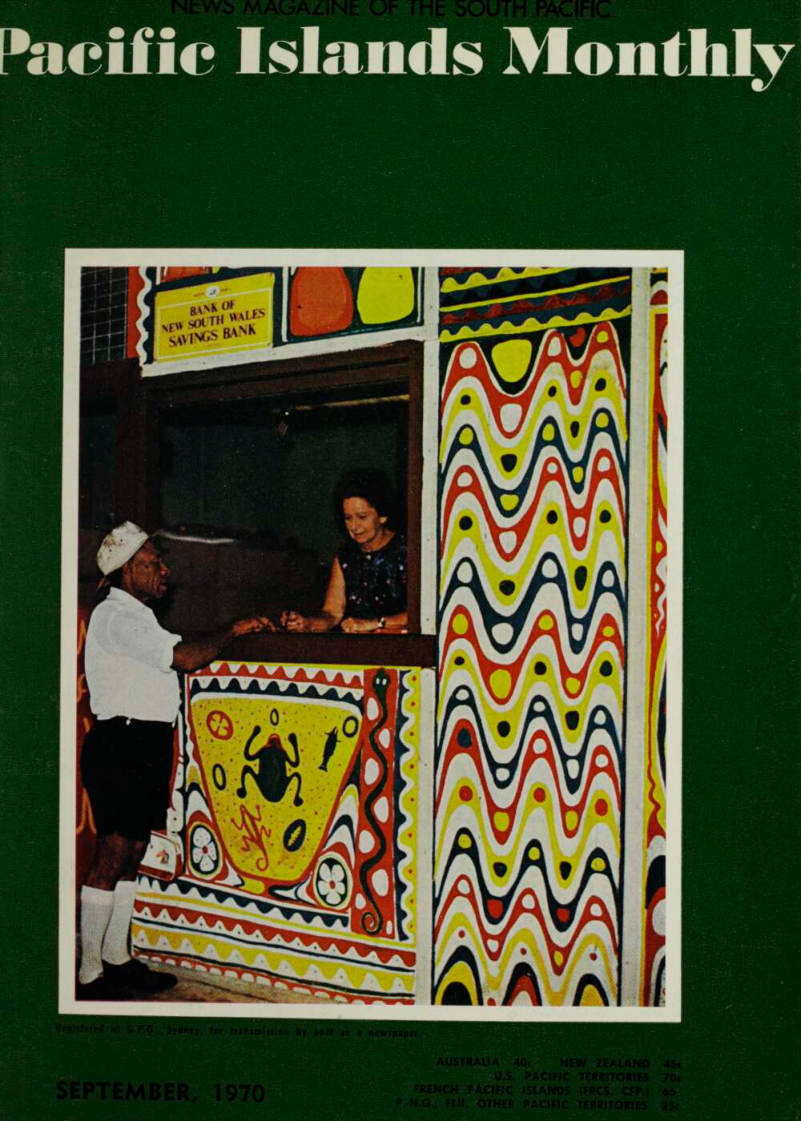 1
1 2
2 3
3 4
4 5
5 6
6 7
7 8
8 9
9 10
10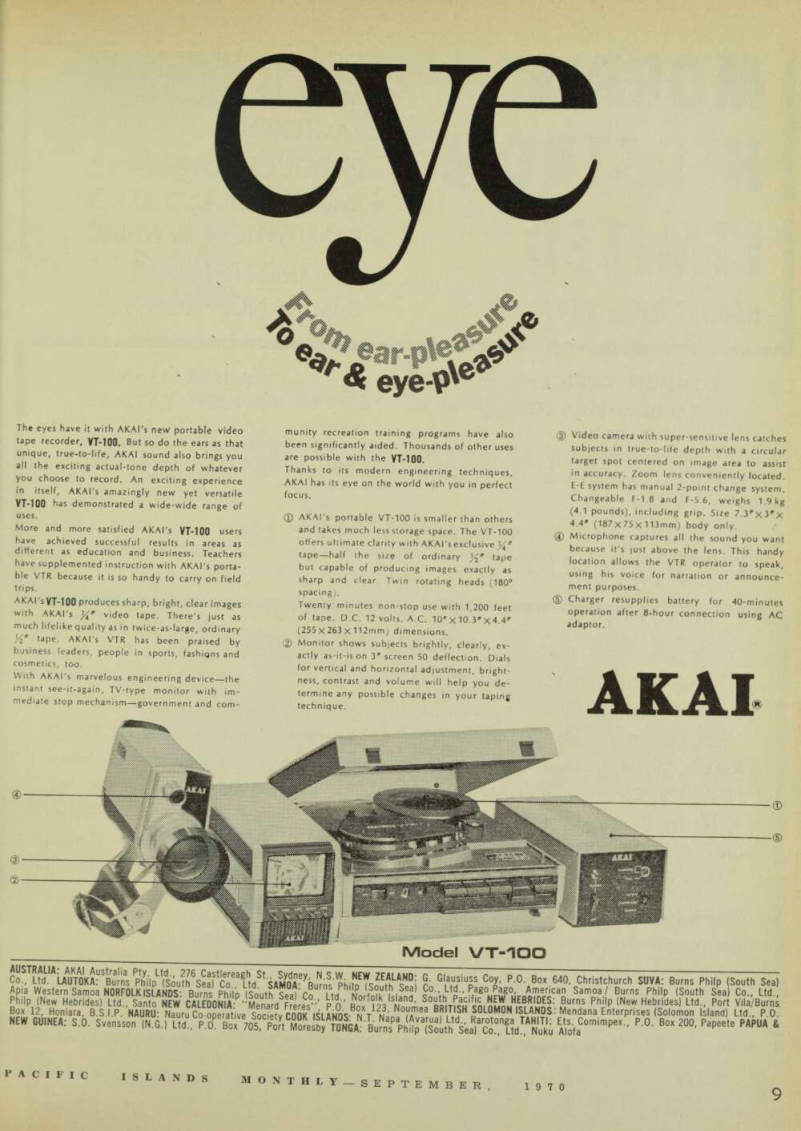 11
11 12
12 13
13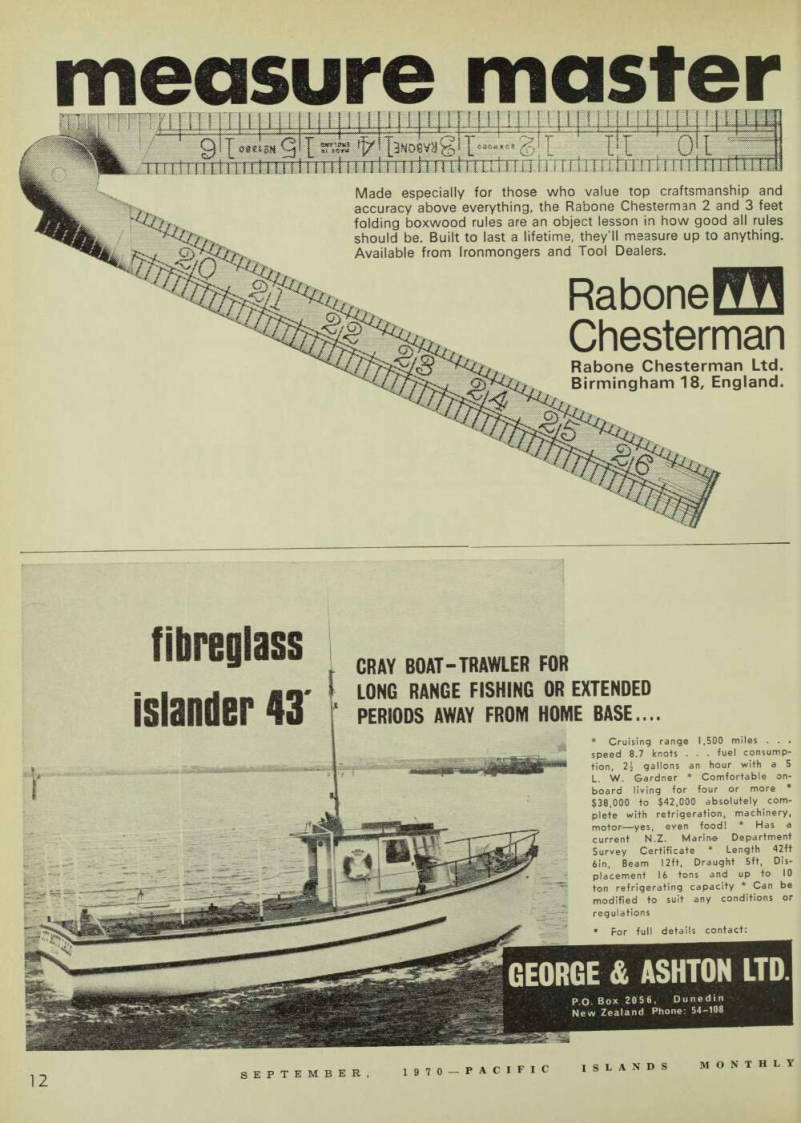 14
14 15
15 16
16 17
17 18
18 19
19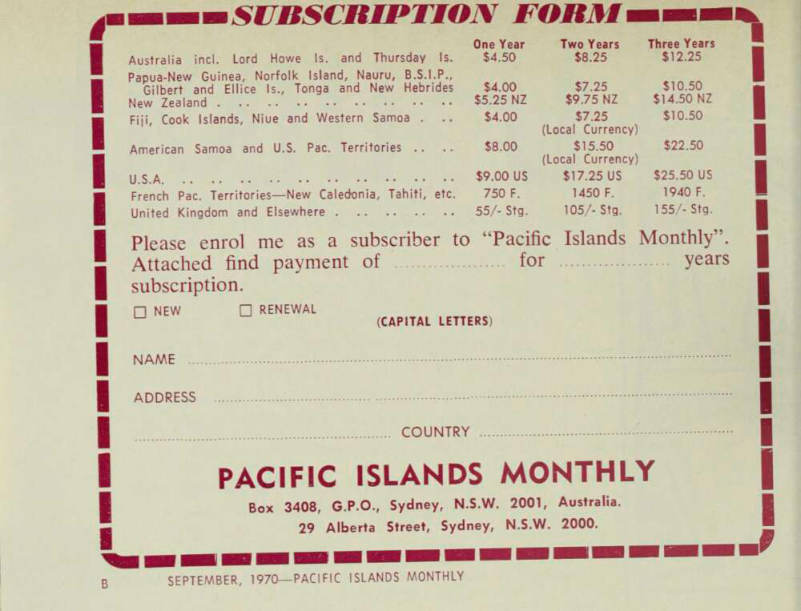 20
20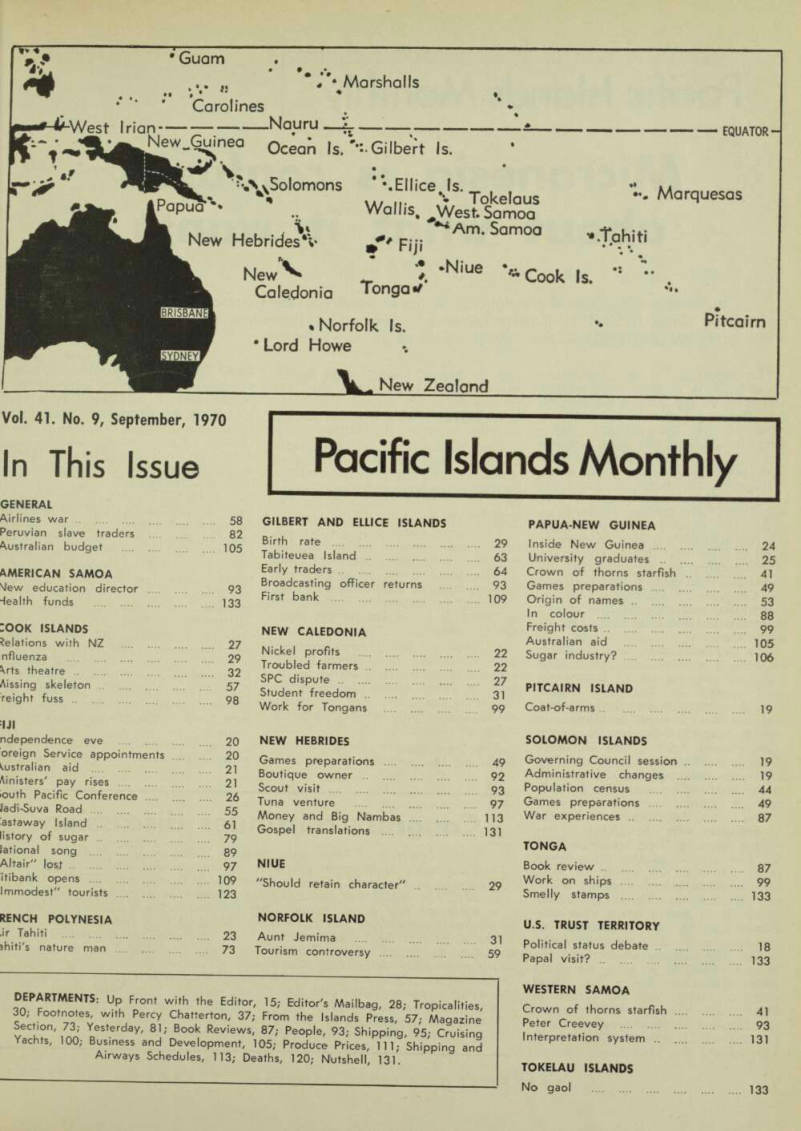 21
21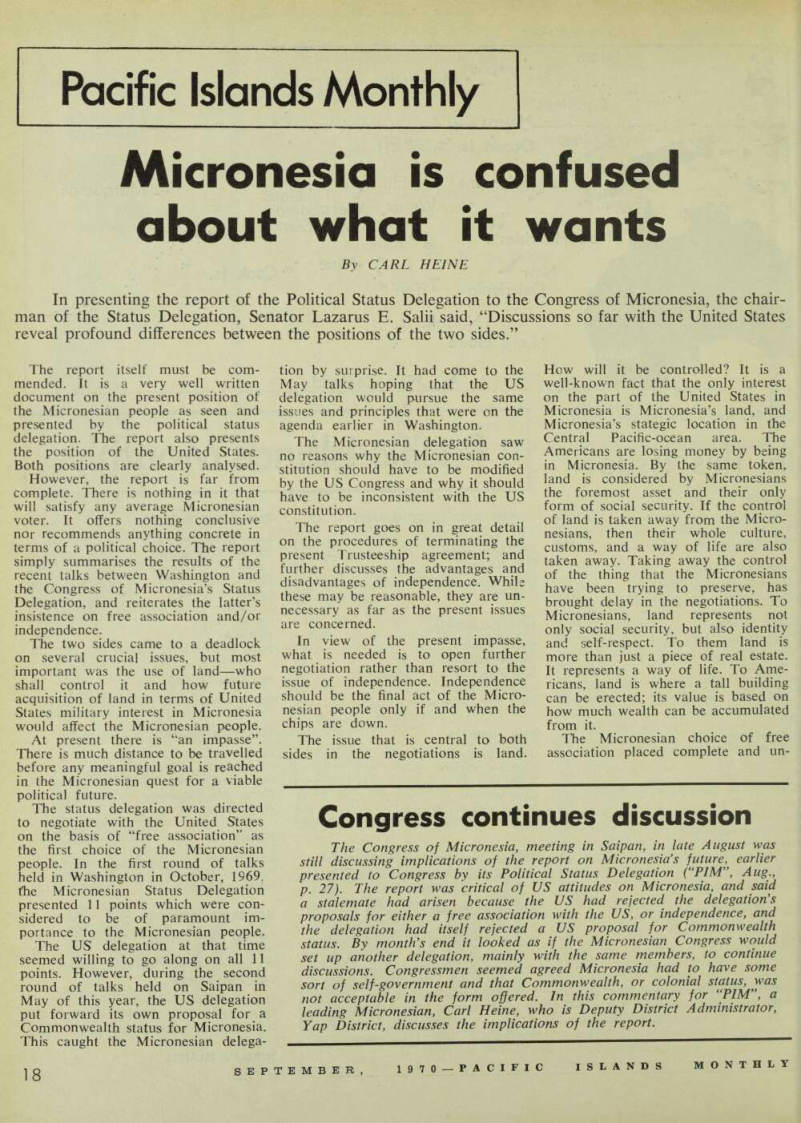 22
22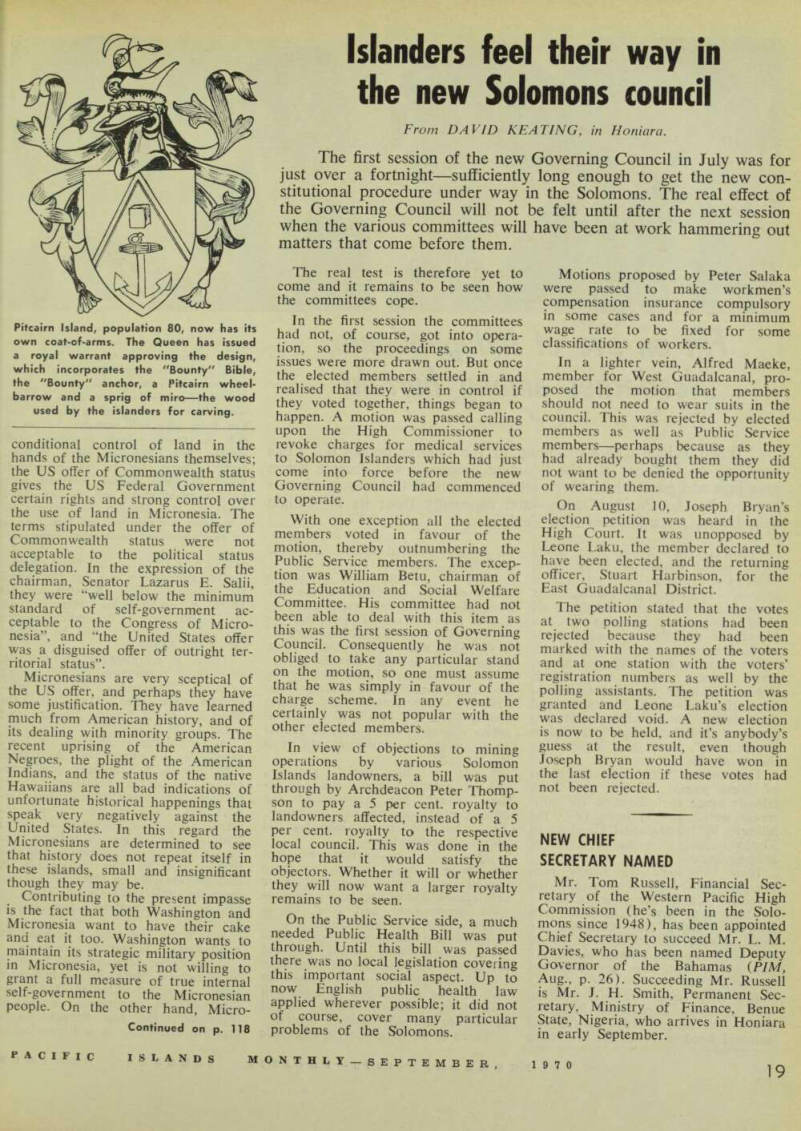 23
23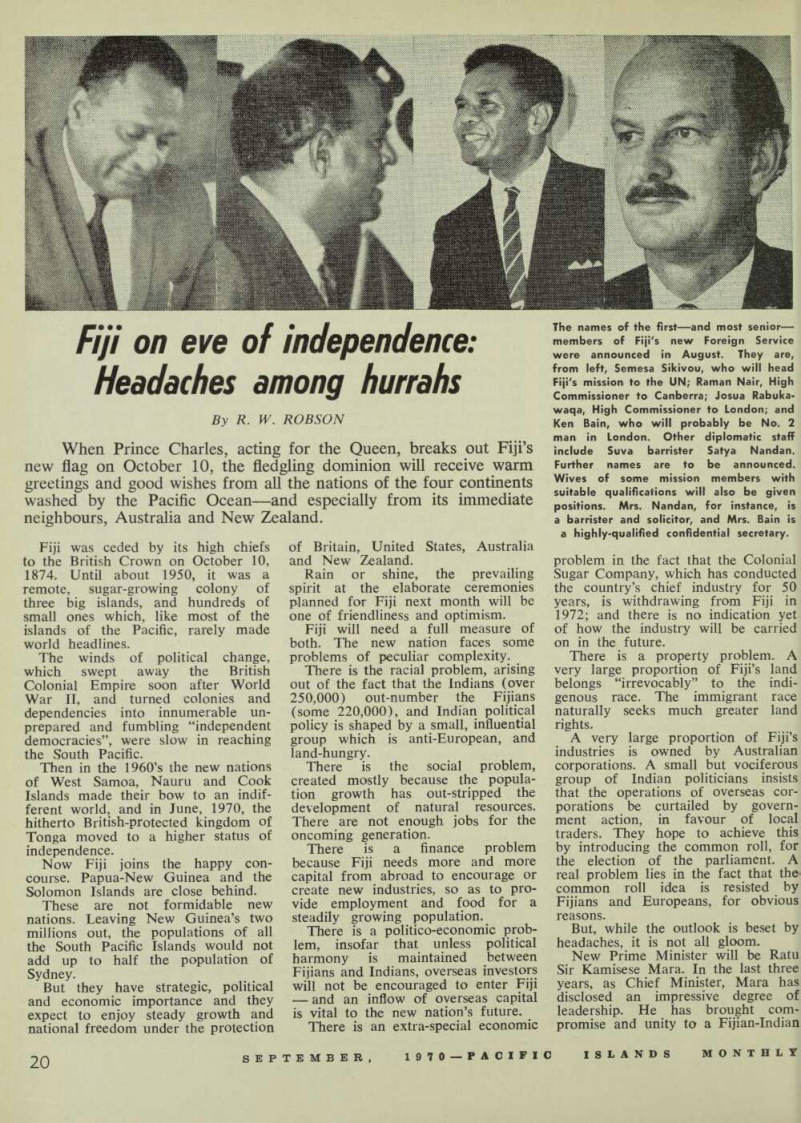 24
24 25
25 26
26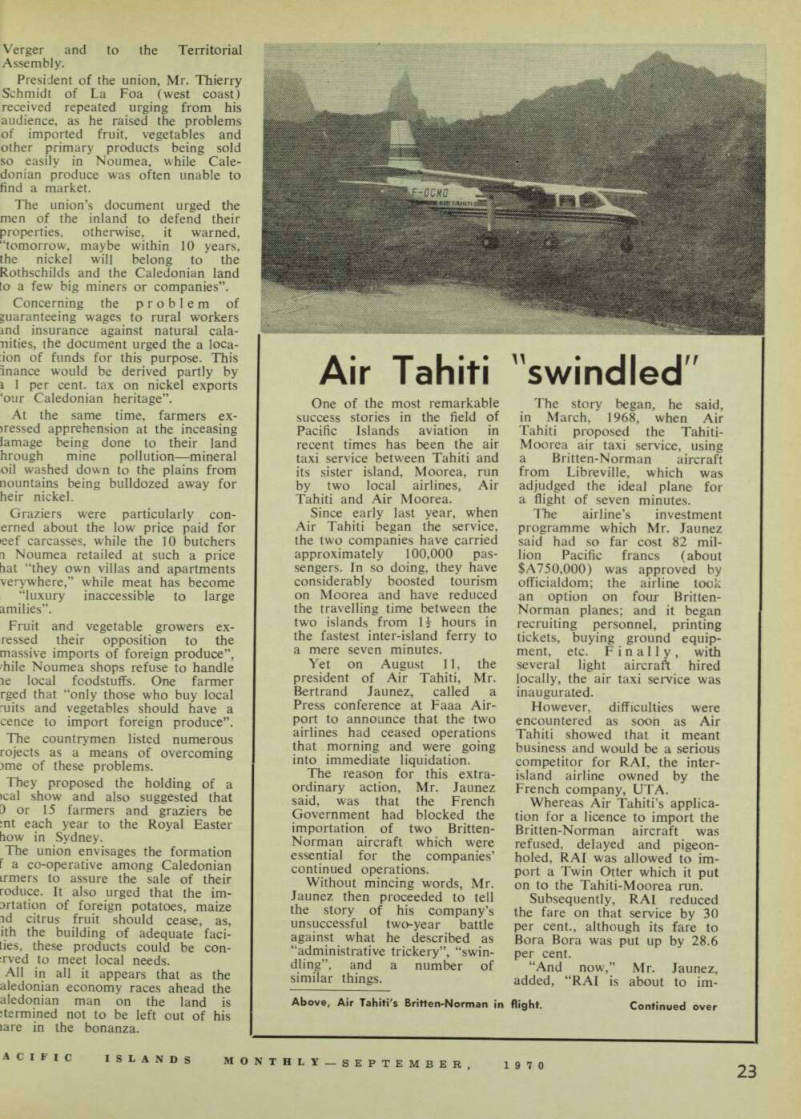 27
27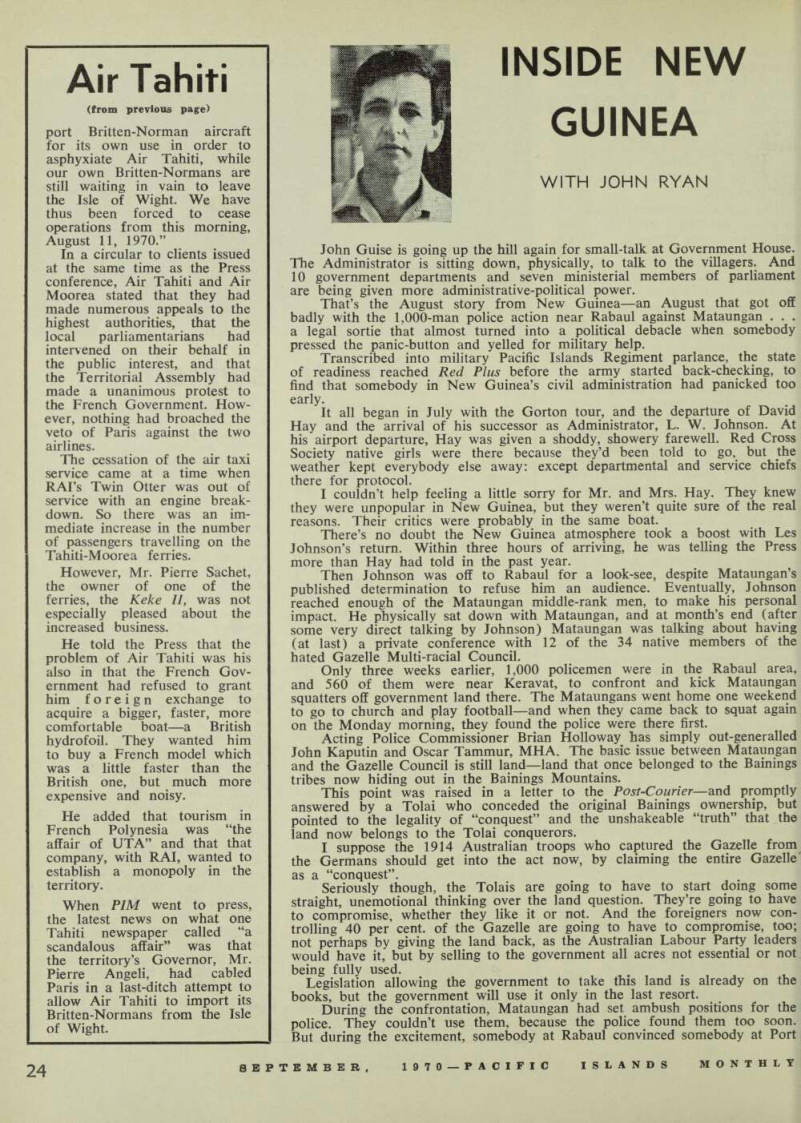 28
28 29
29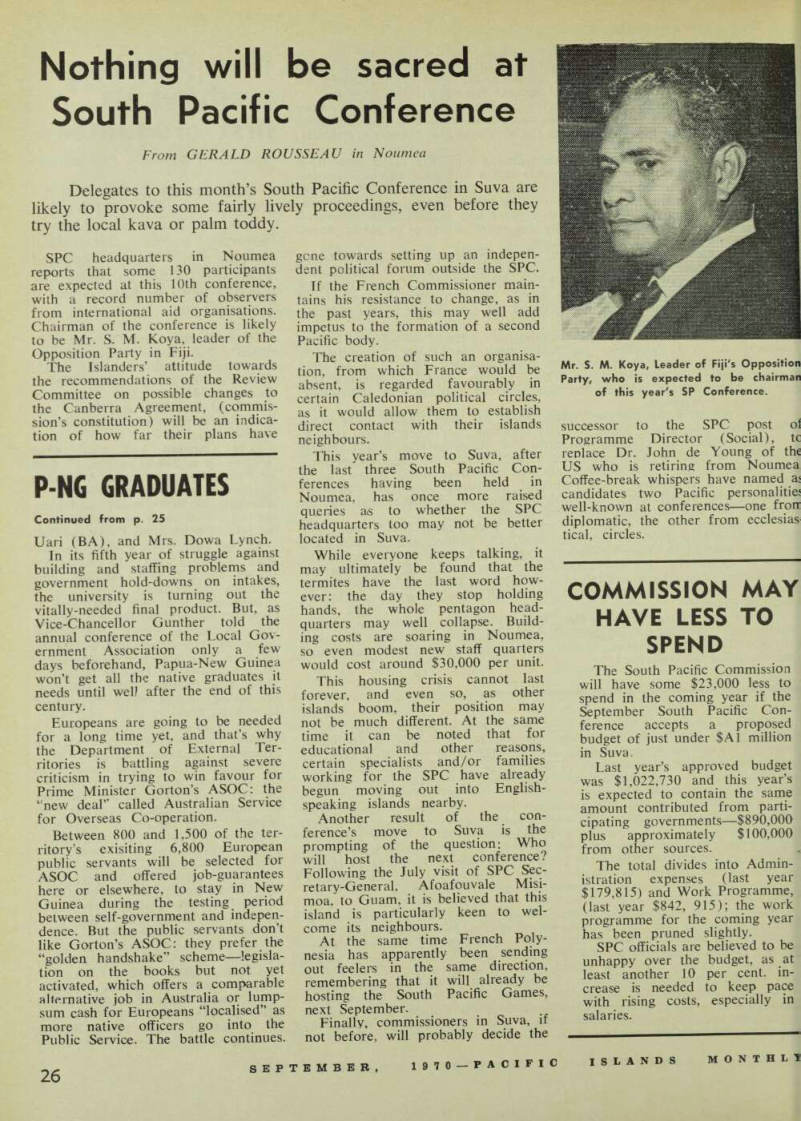 30
30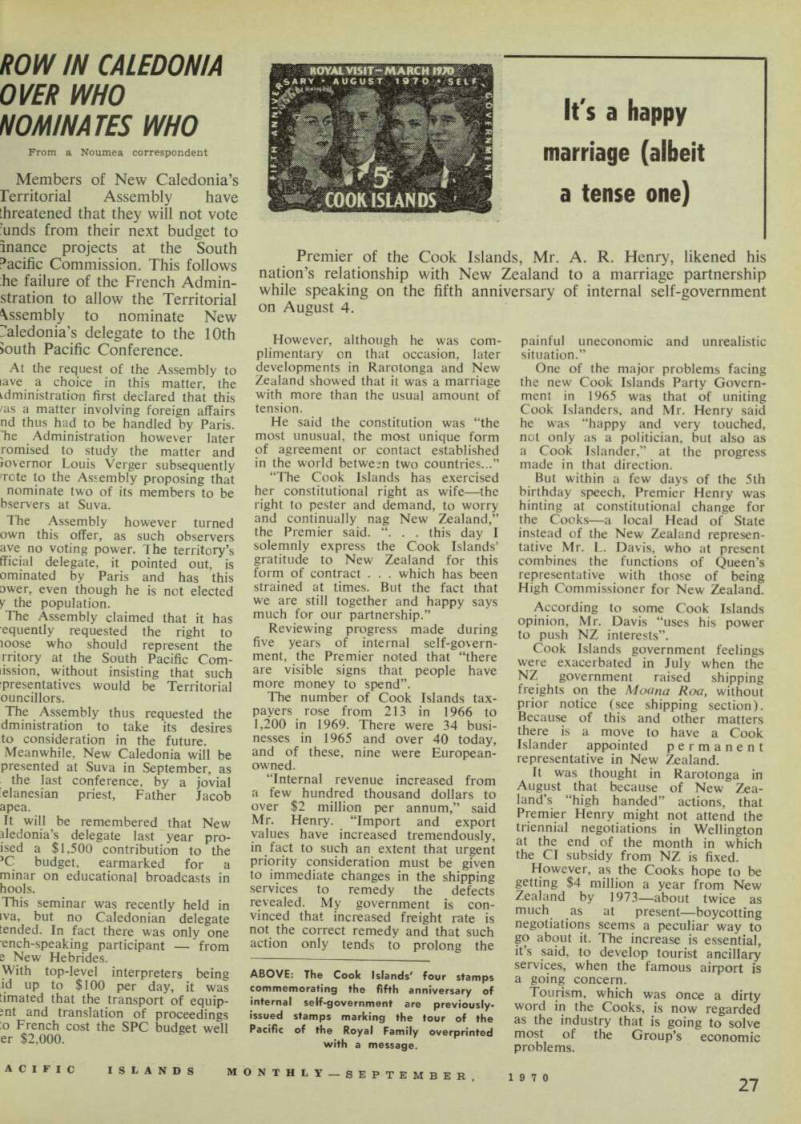 31
31 32
32 33
33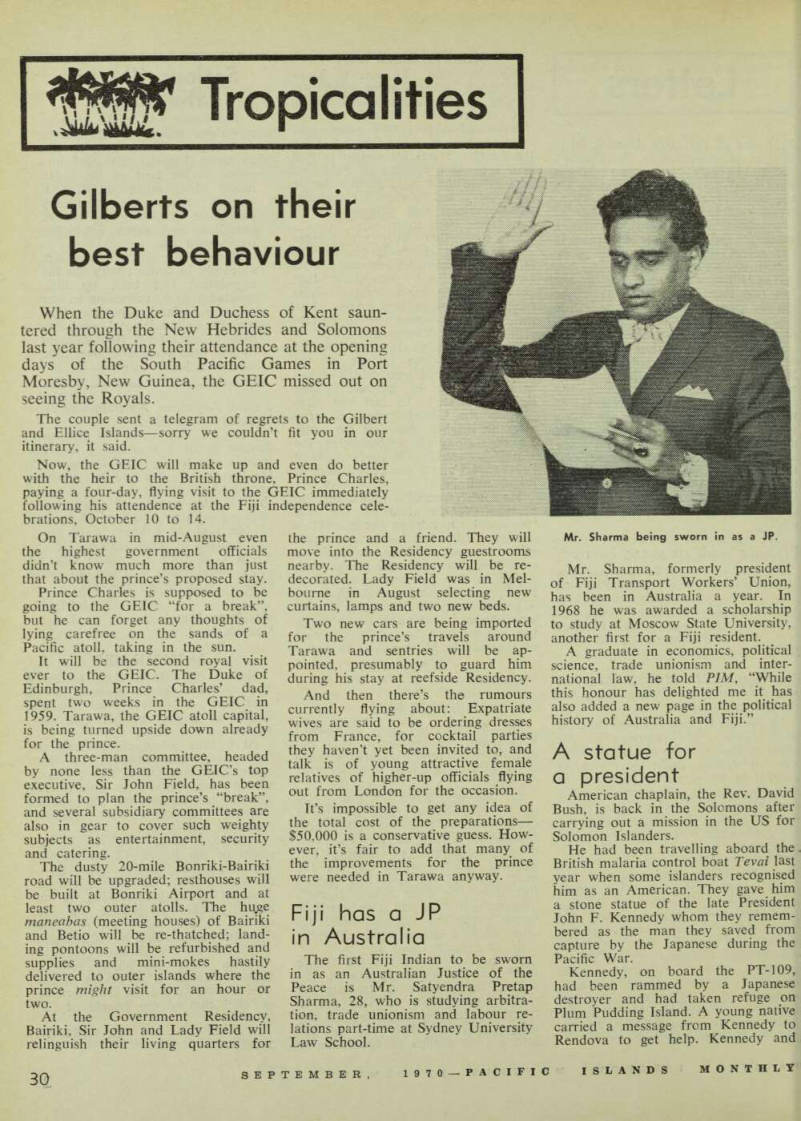 34
34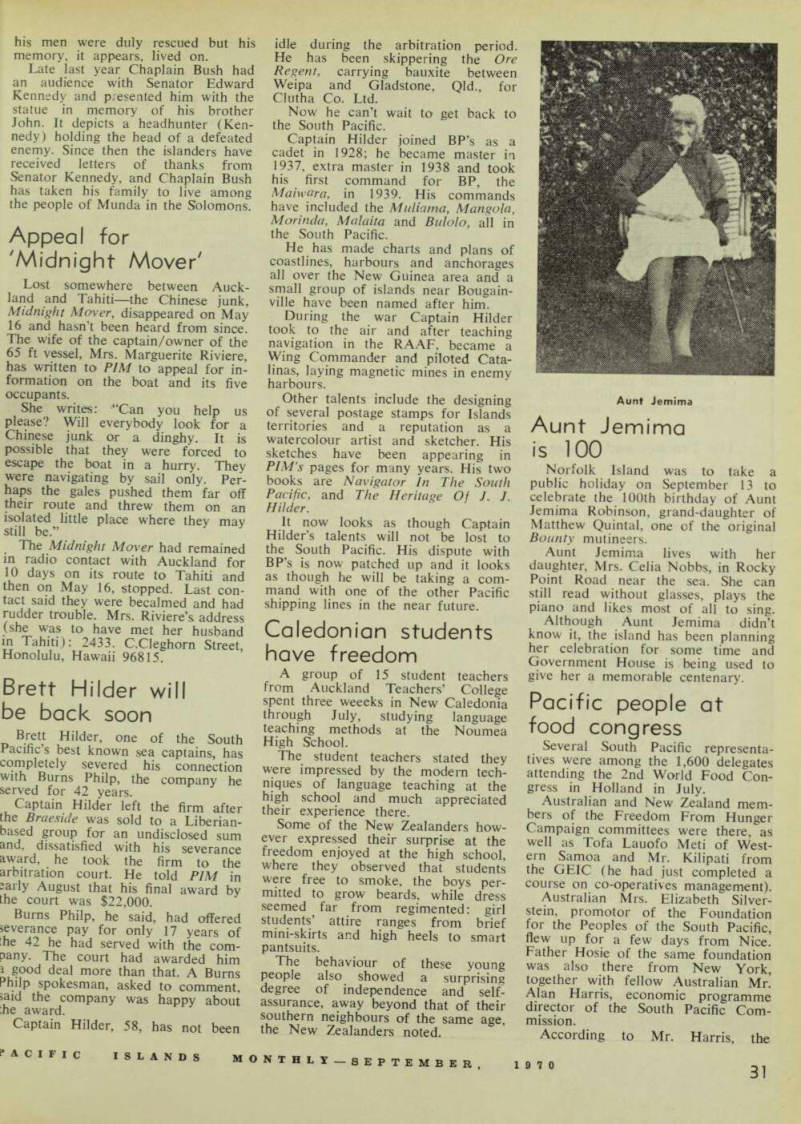 35
35 36
36 37
37 38
38 39
39 40
40 41
41 42
42 43
43 44
44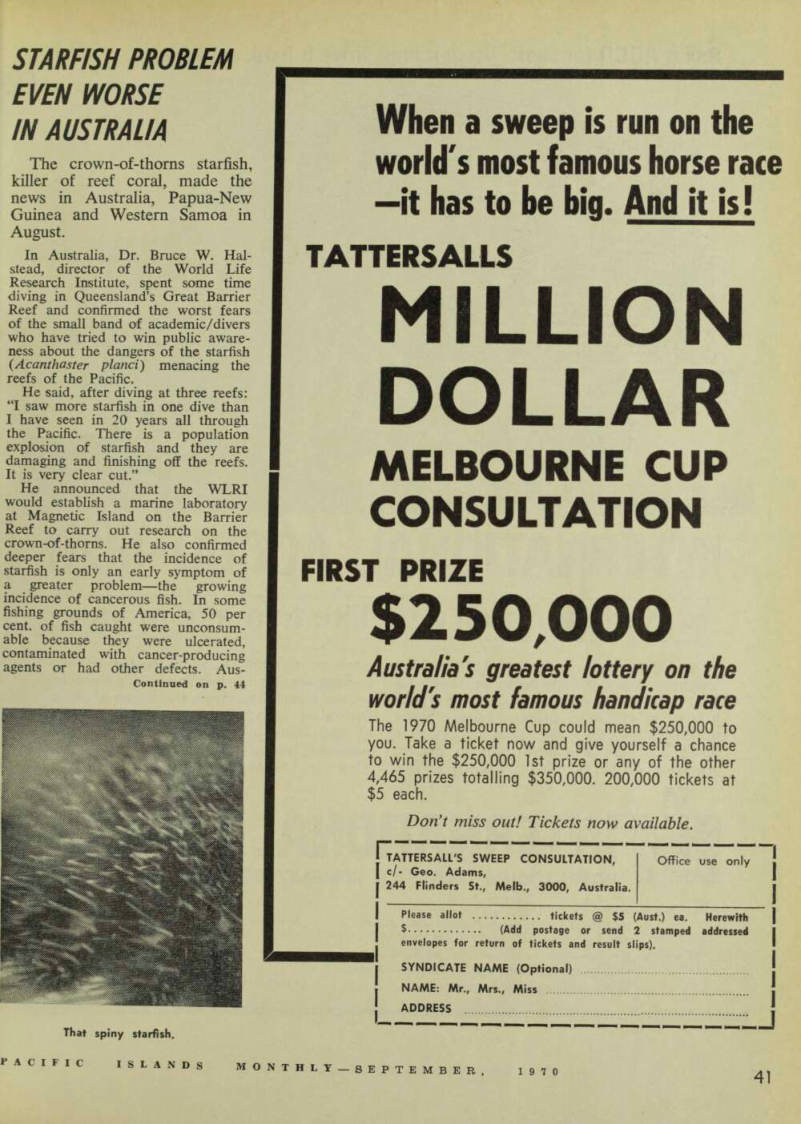 45
45 46
46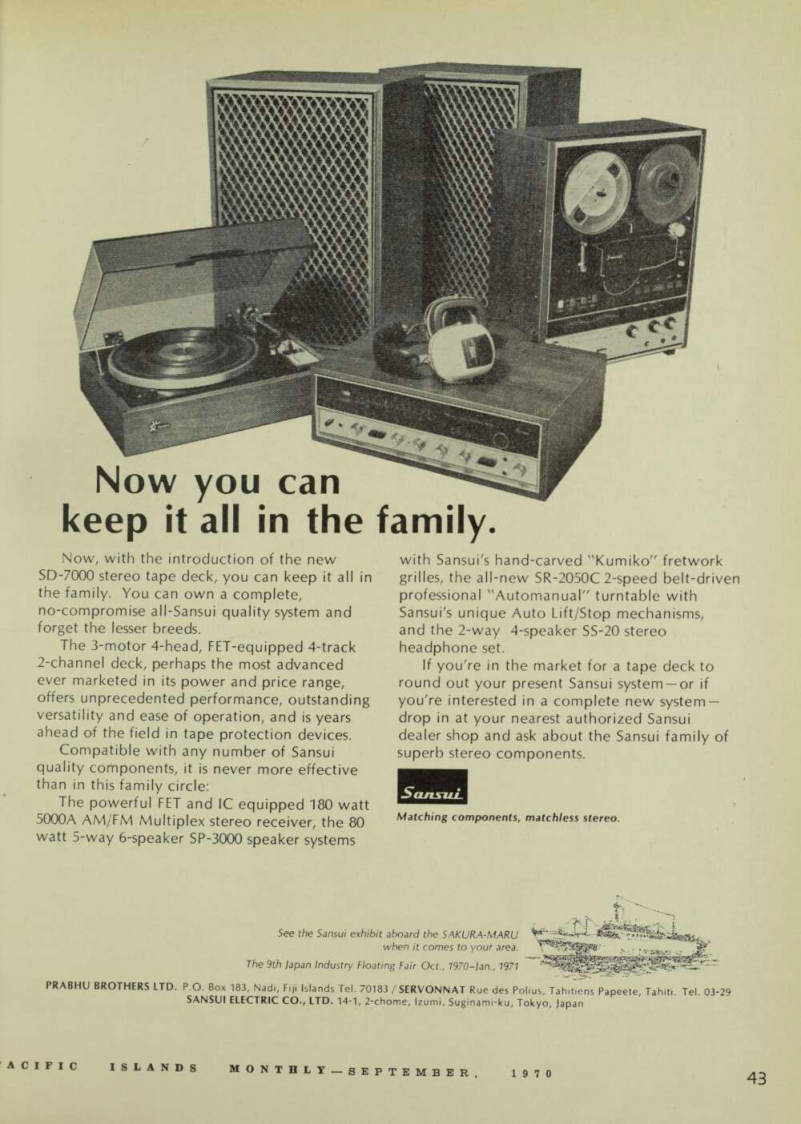 47
47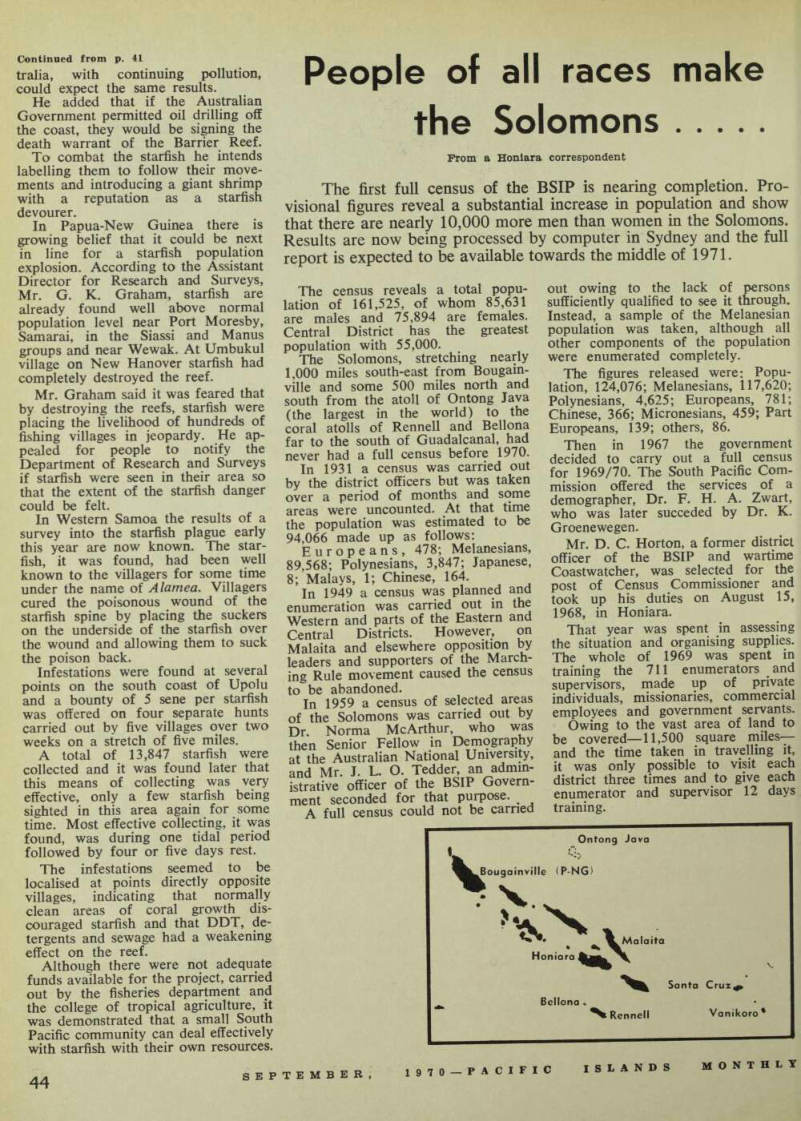 48
48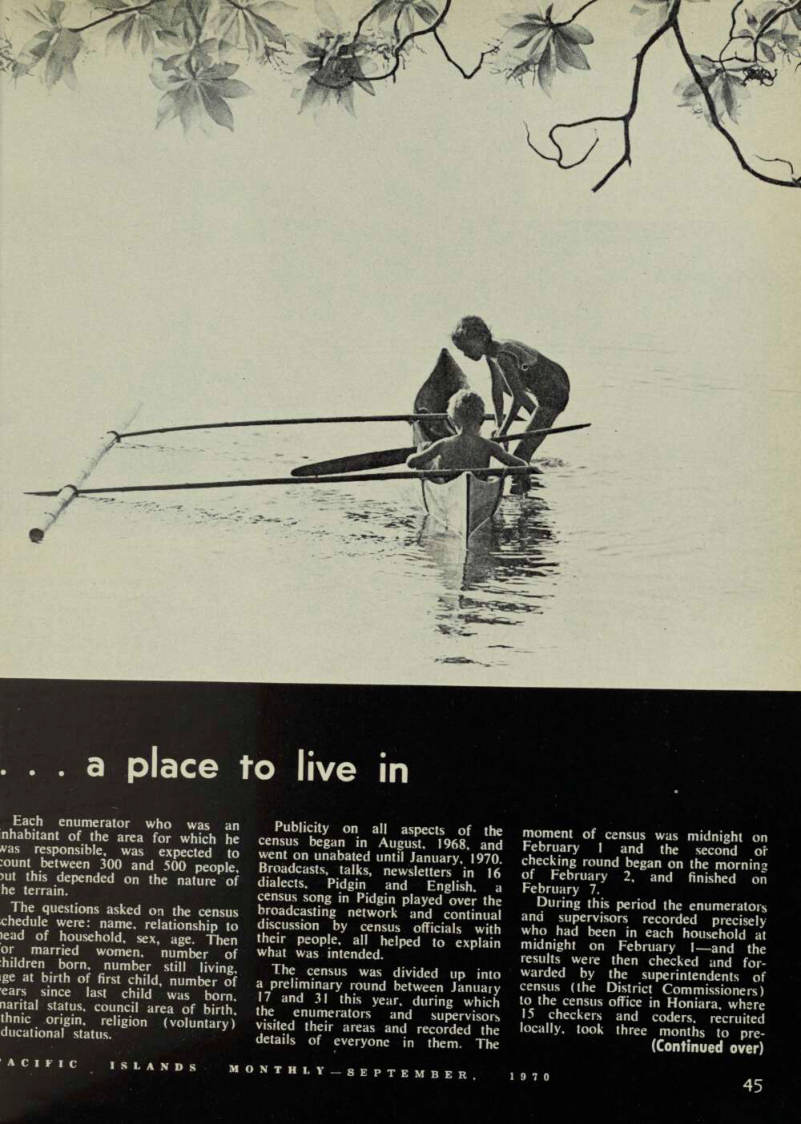 49
49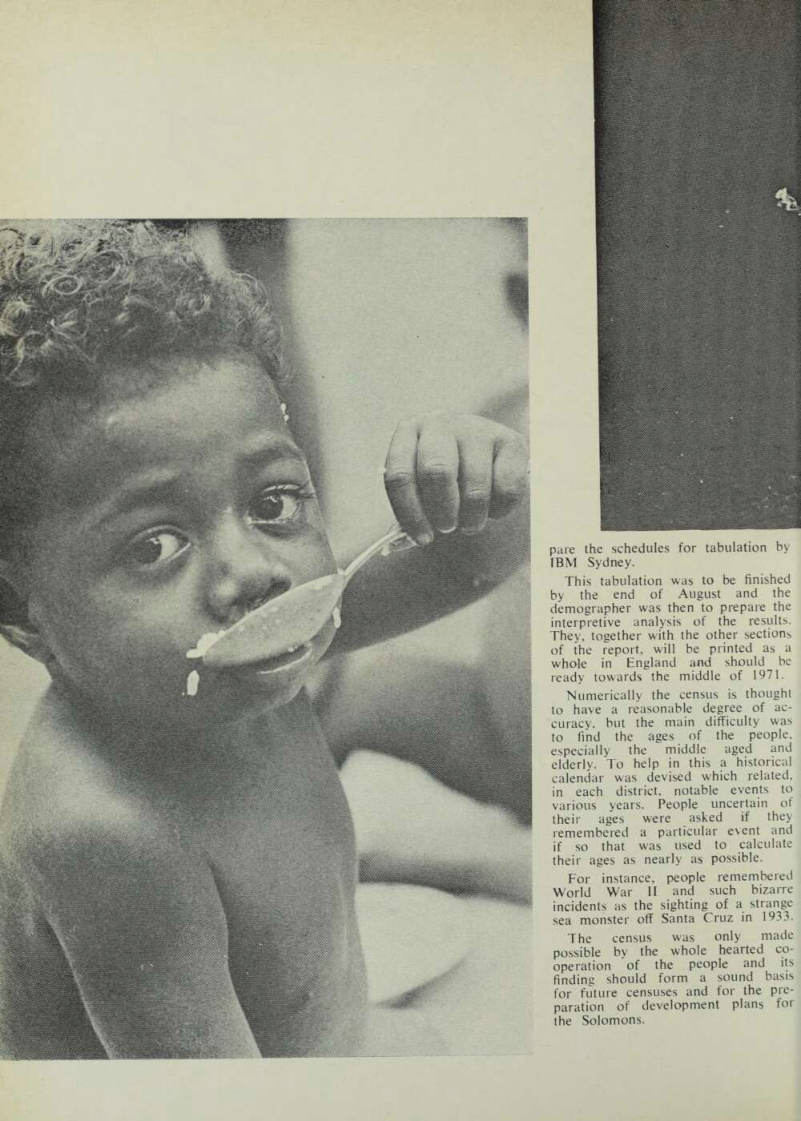 50
50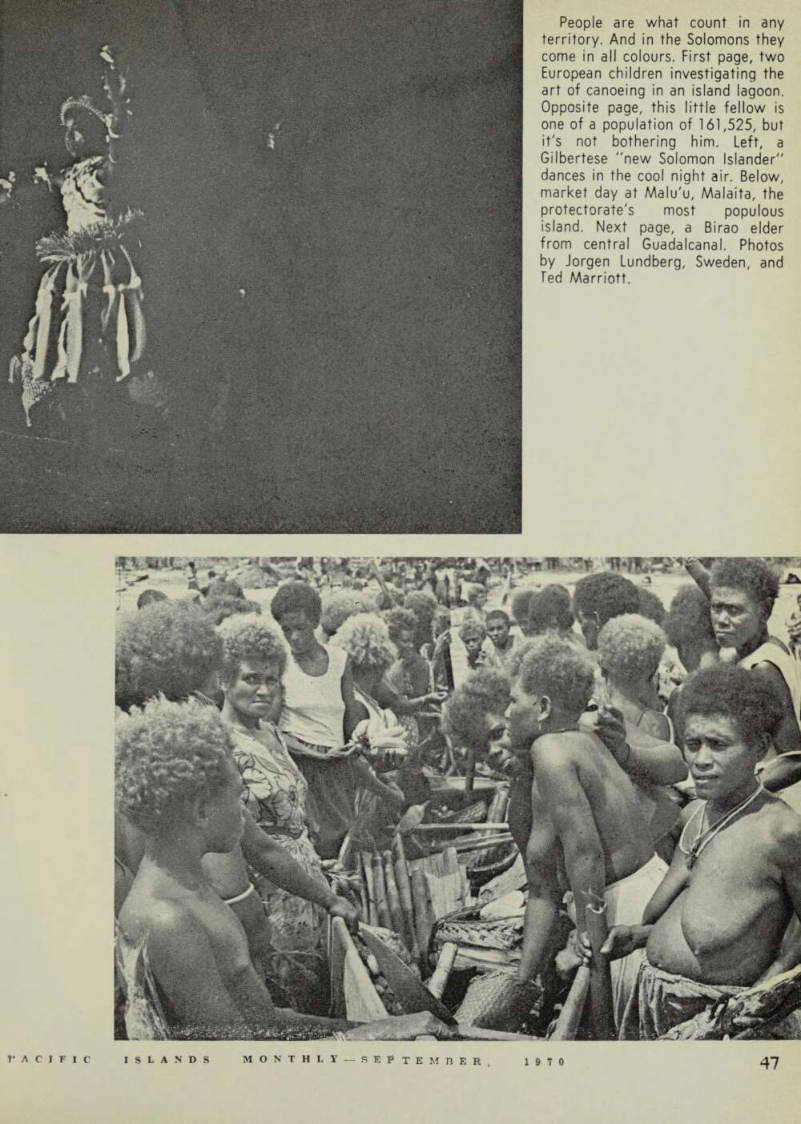 51
51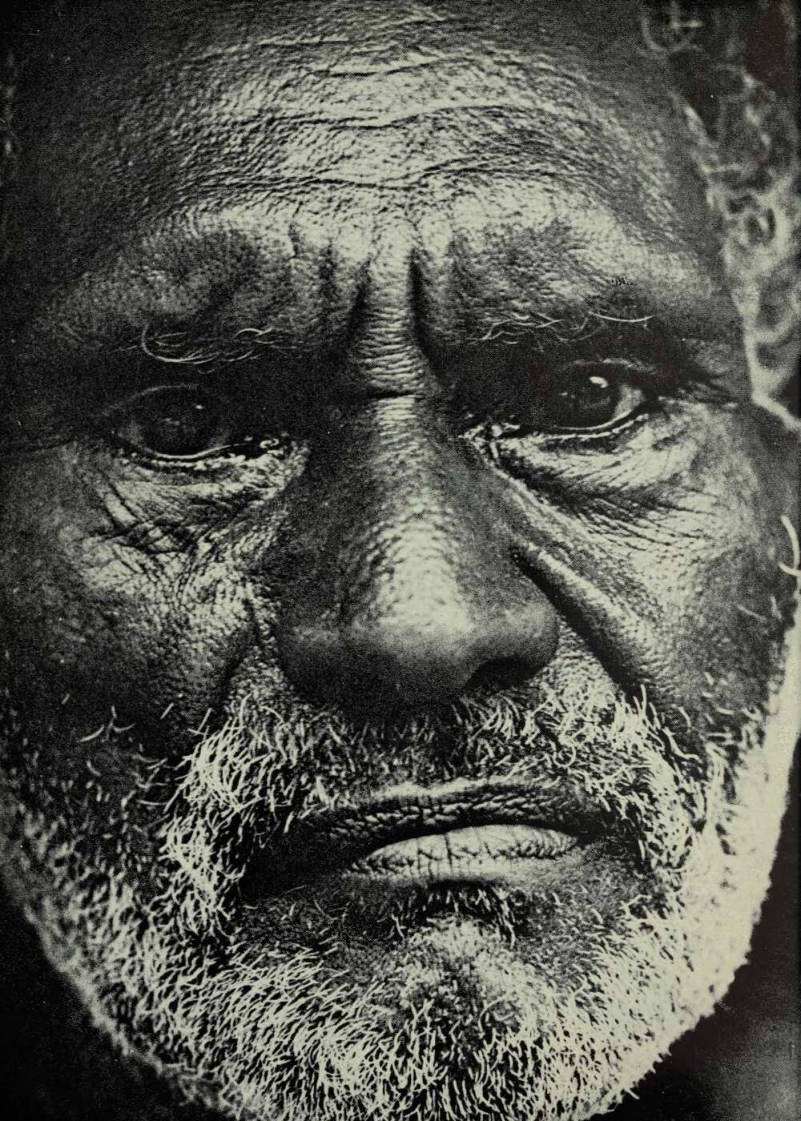 52
52 53
53 54
54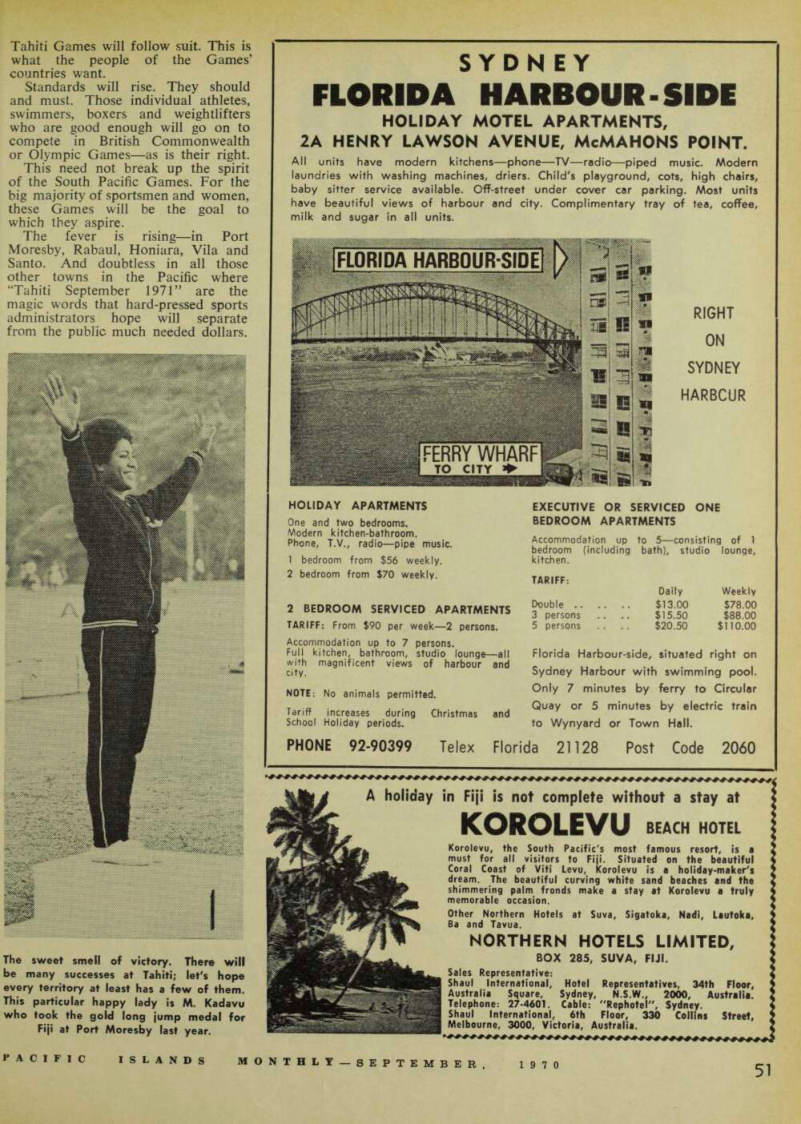 55
55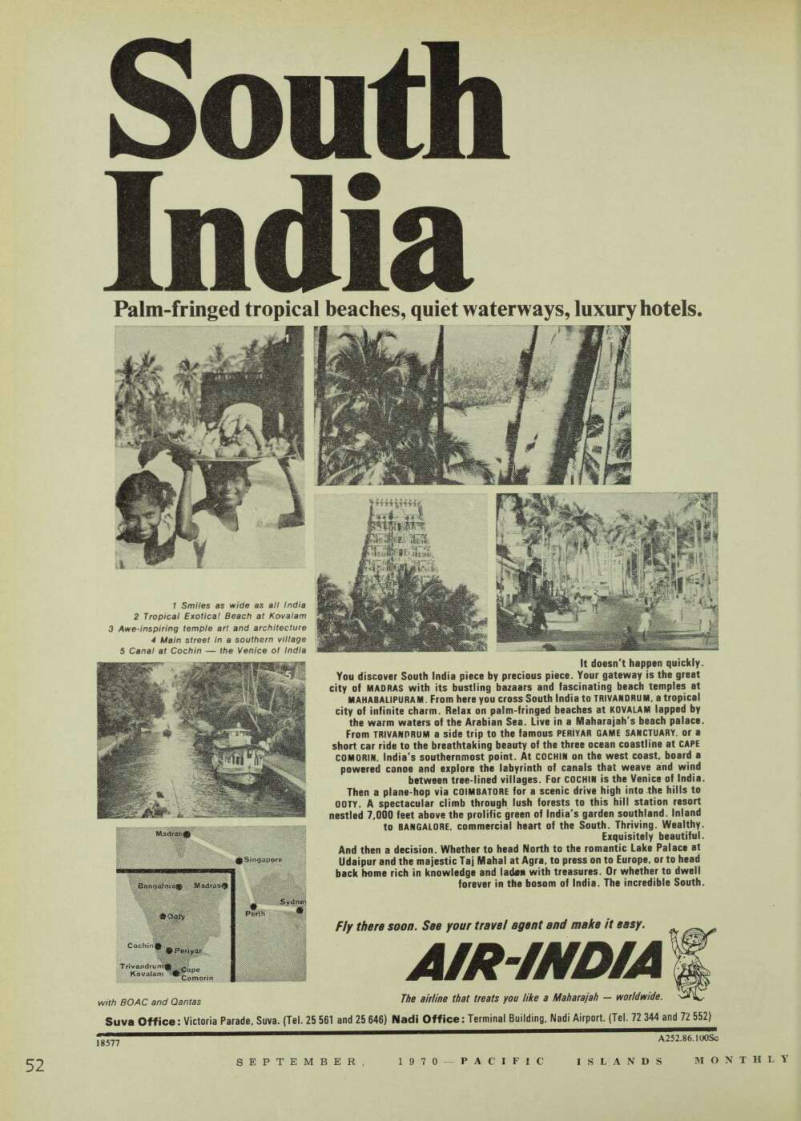 56
56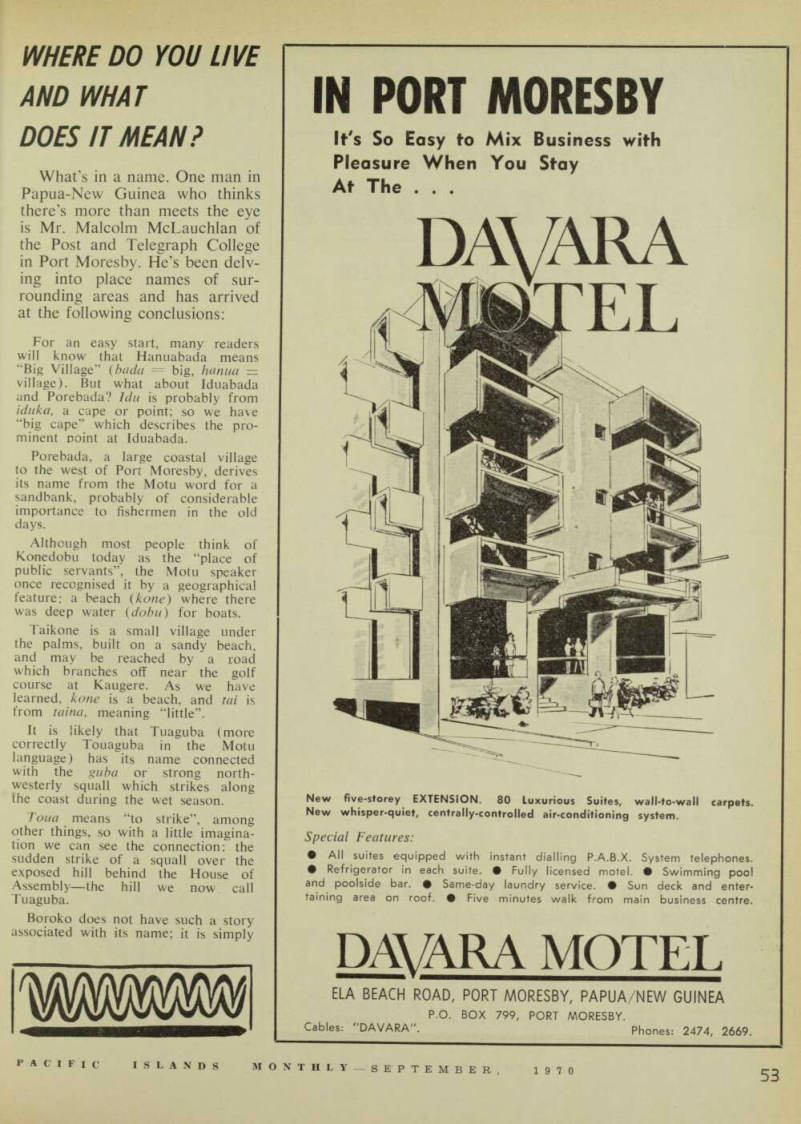 57
57 58
58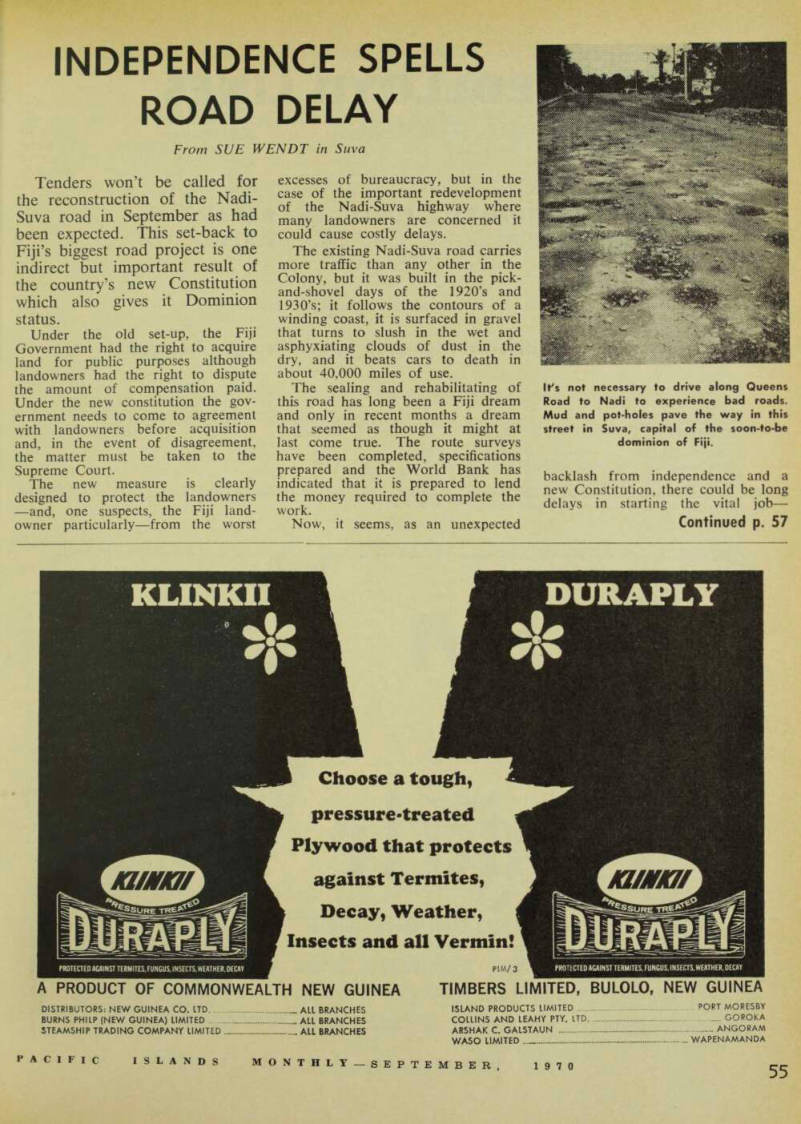 59
59 60
60 61
61 62
62 63
63 64
64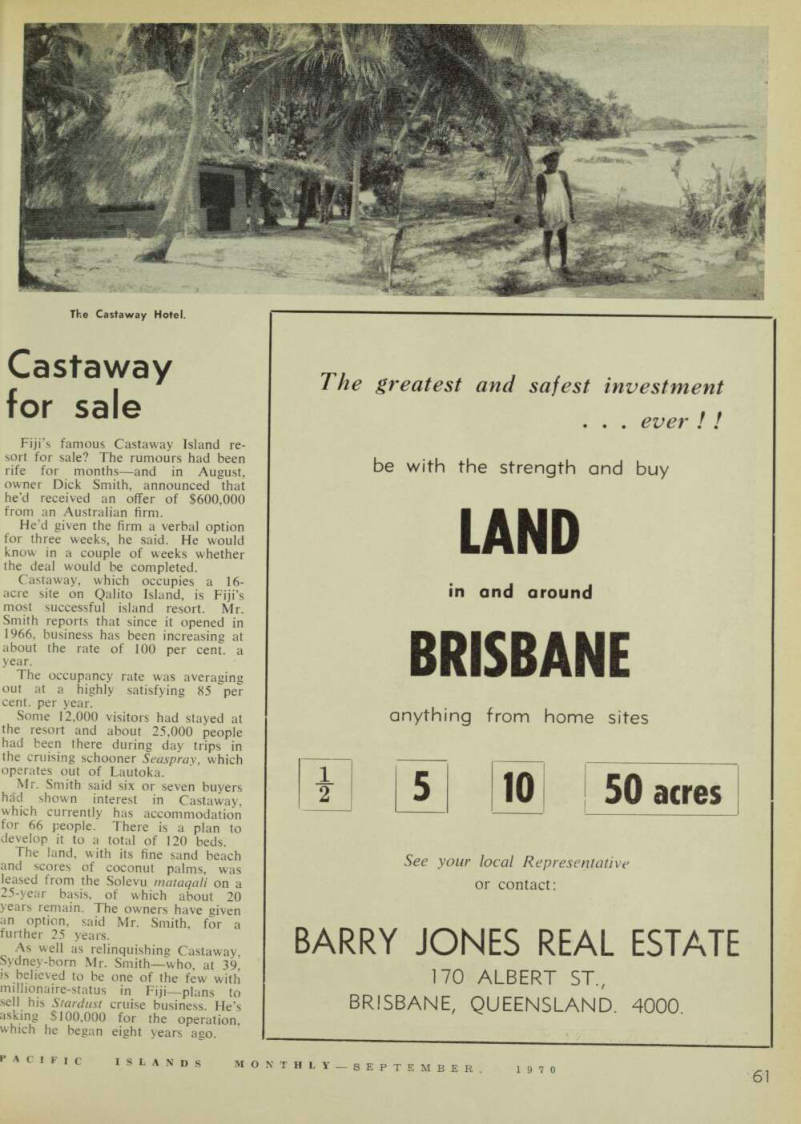 65
65 66
66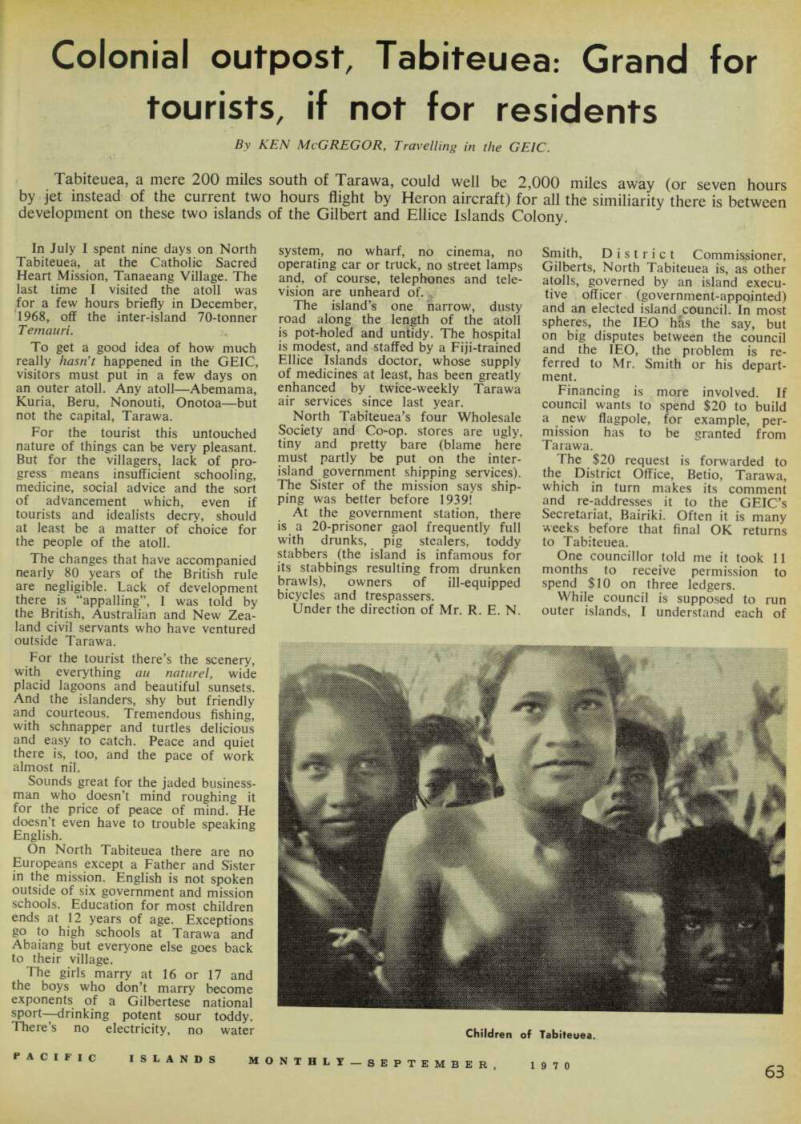 67
67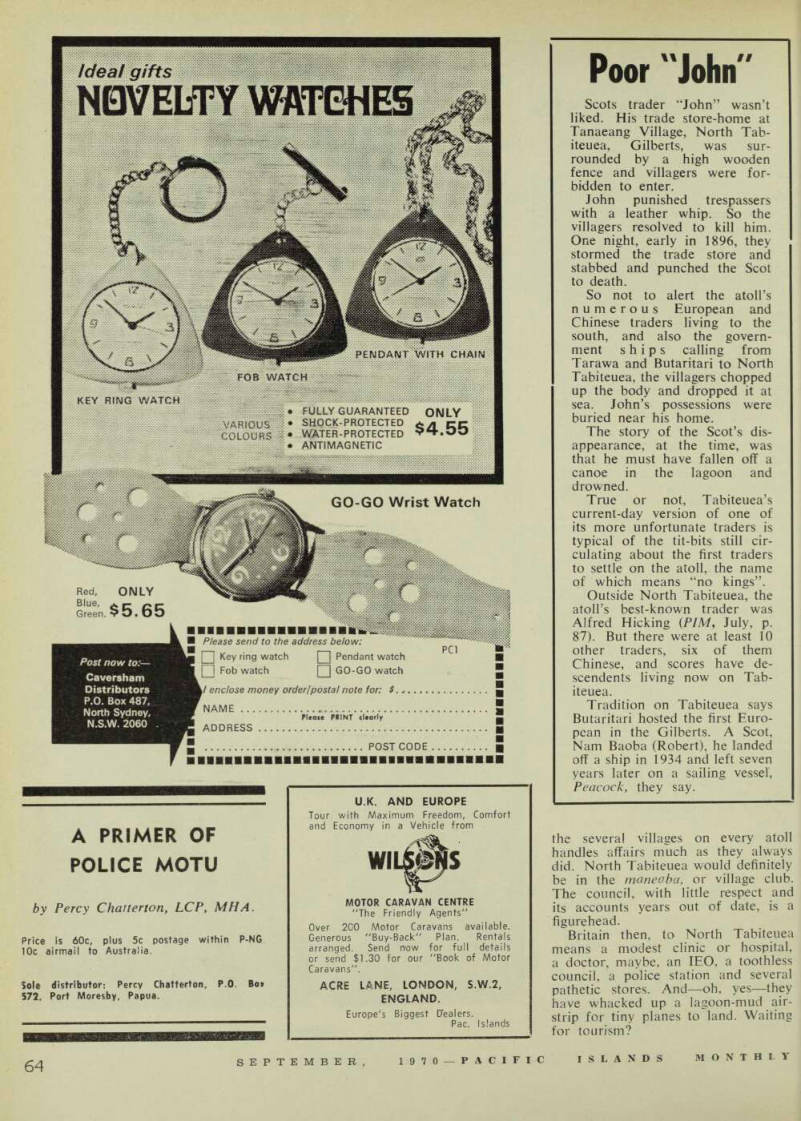 68
68 69
69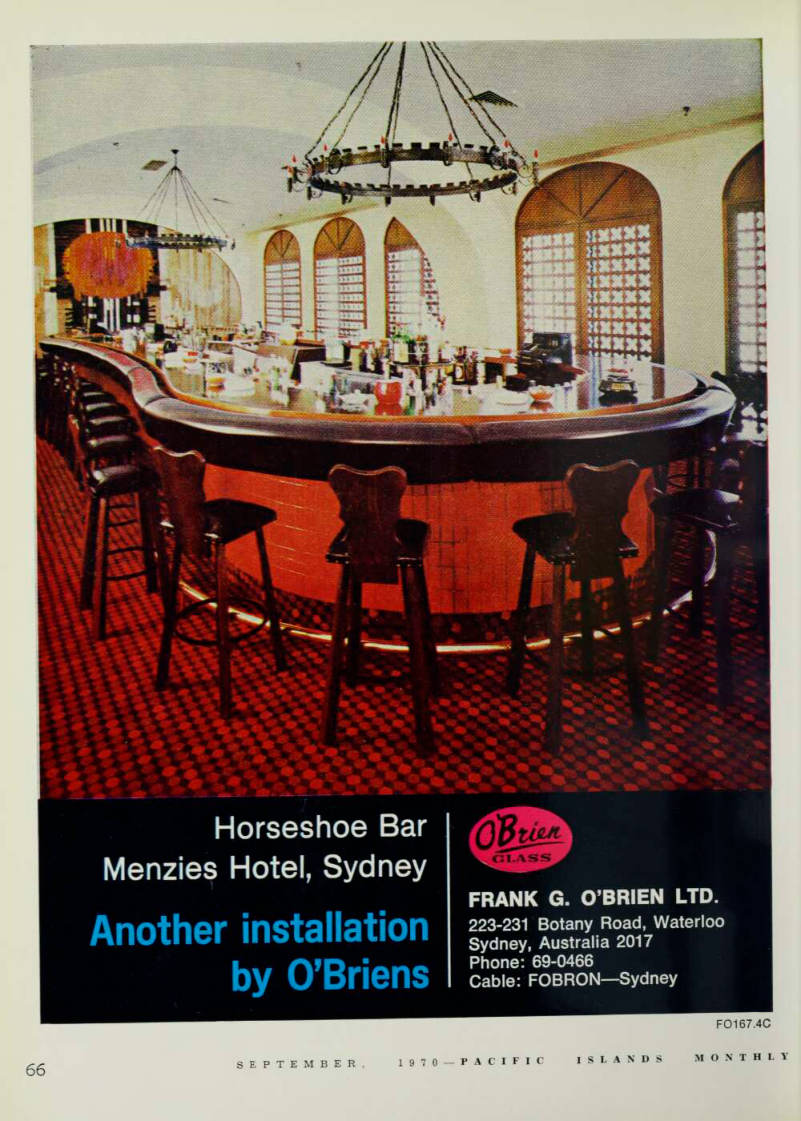 70
70 71
71 72
72 73
73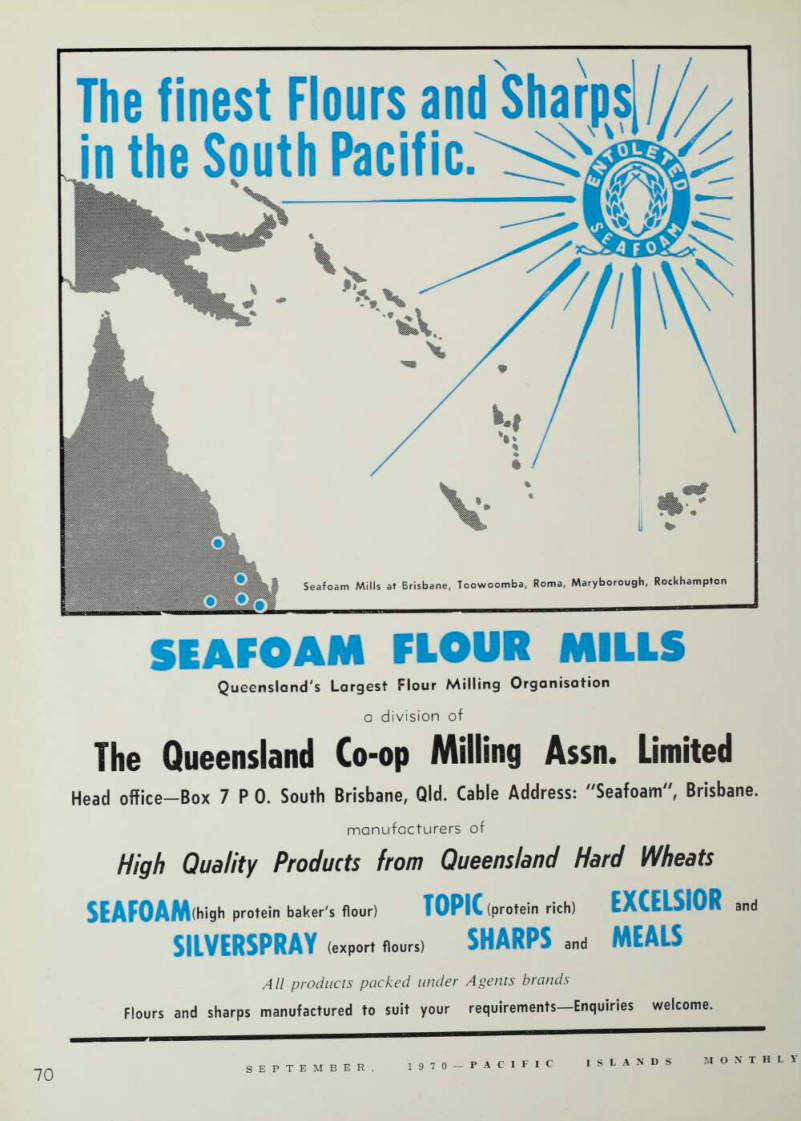 74
74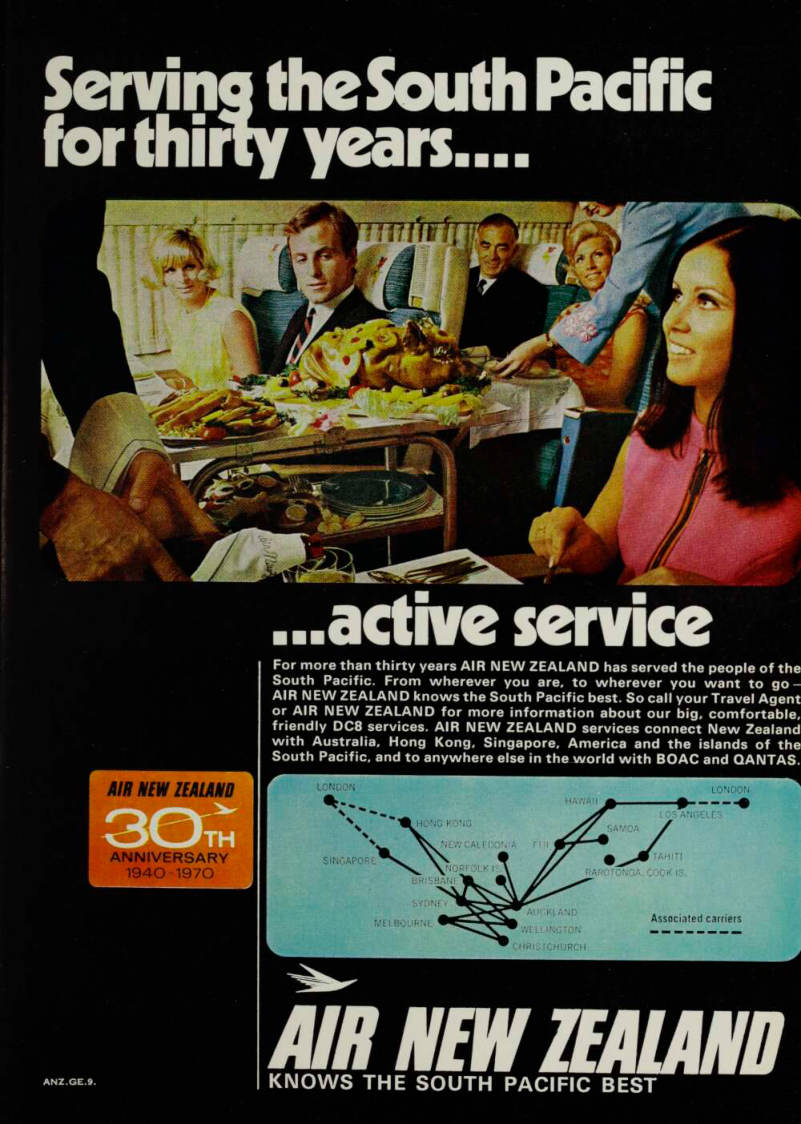 75
75 76
76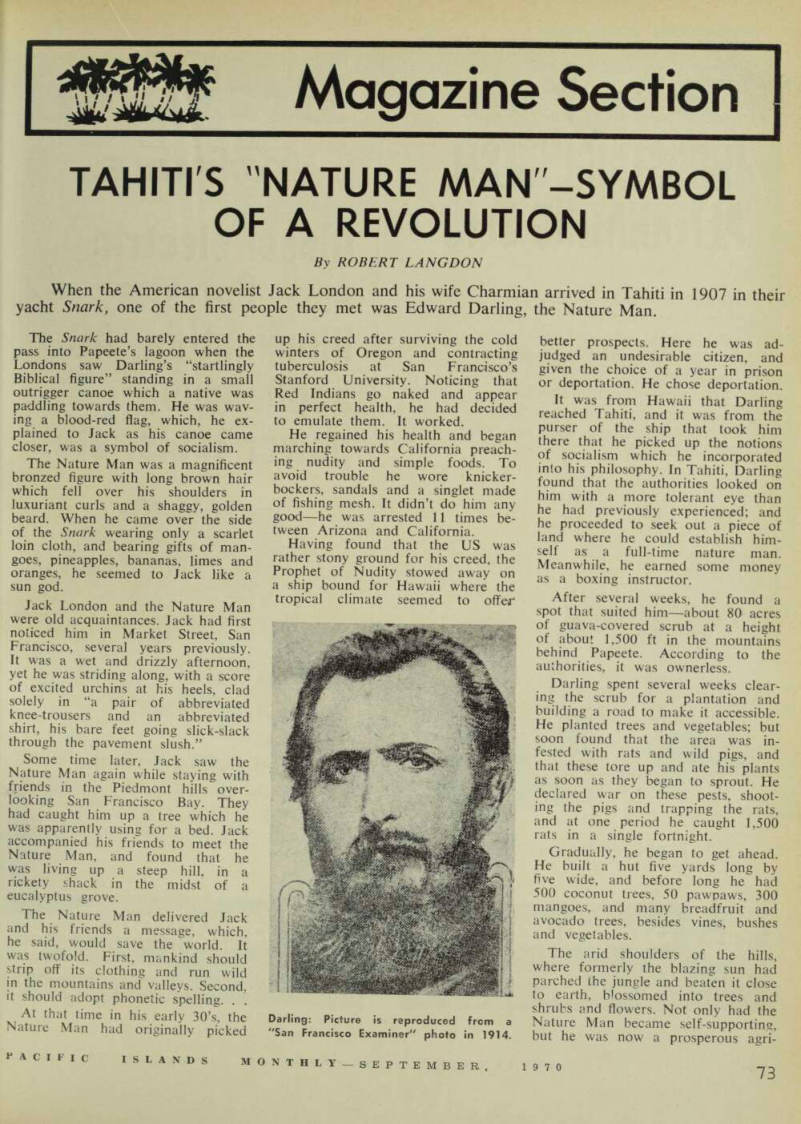 77
77 78
78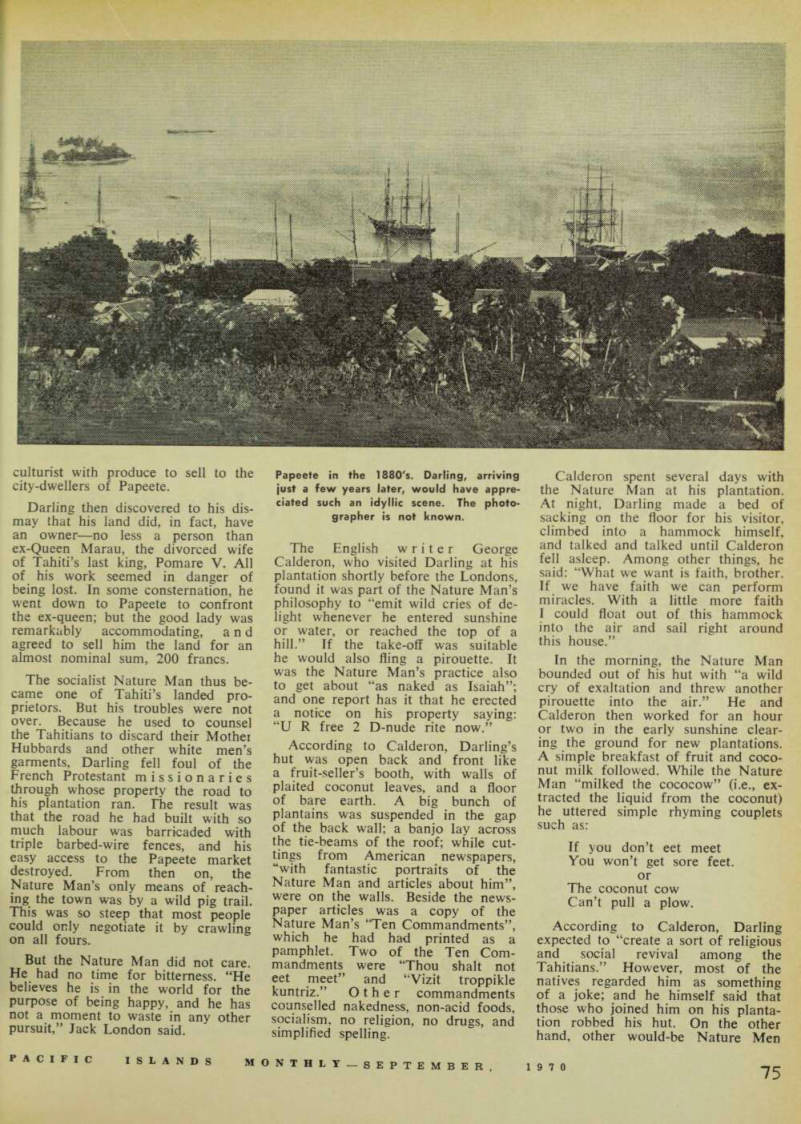 79
79 80
80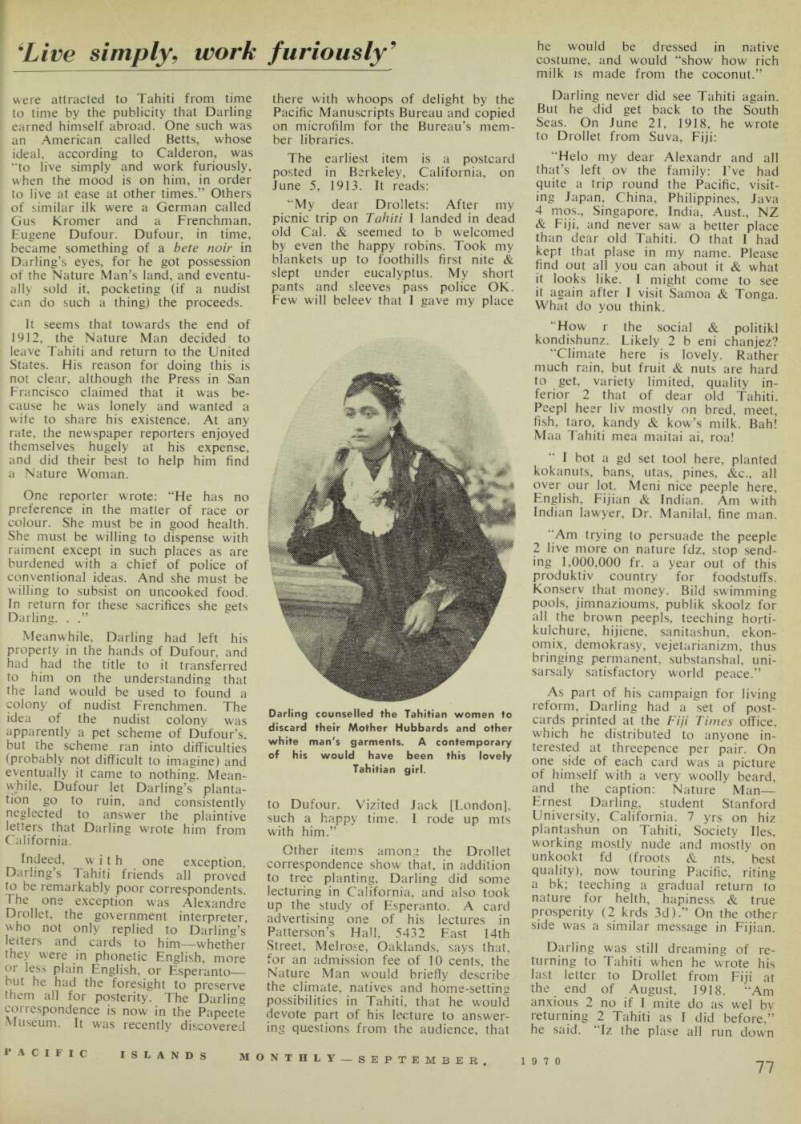 81
81 82
82 83
83 84
84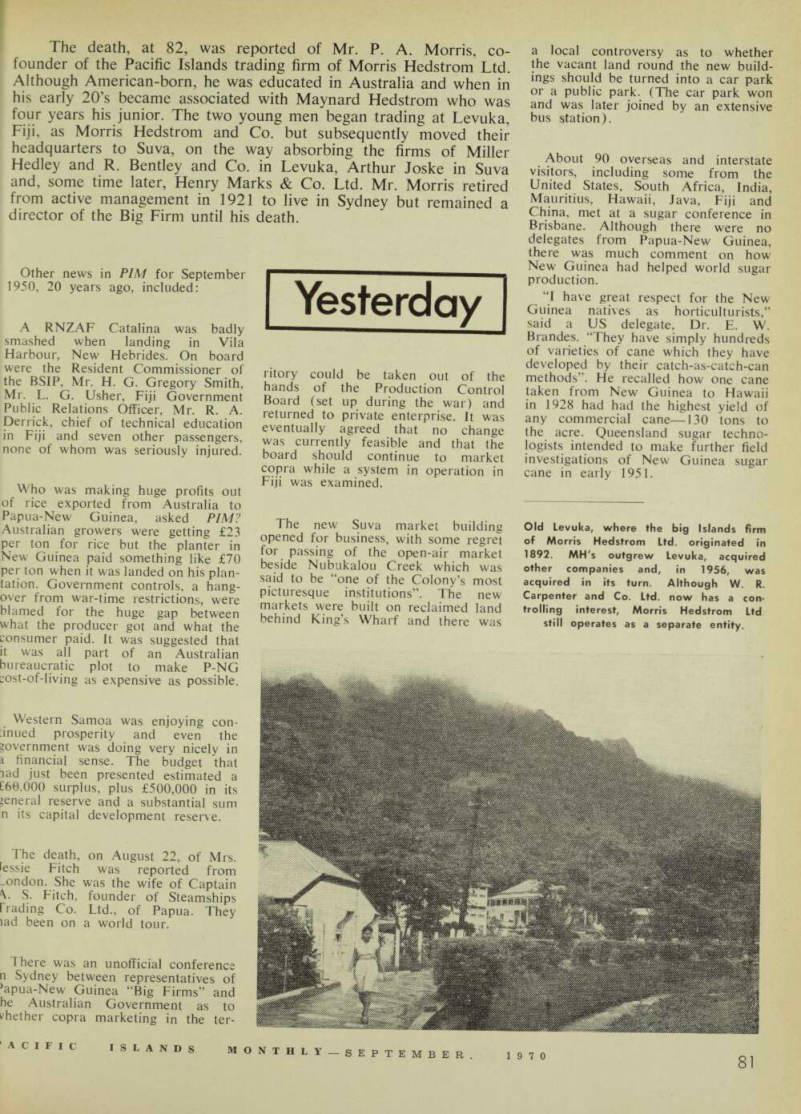 85
85 86
86 87
87 88
88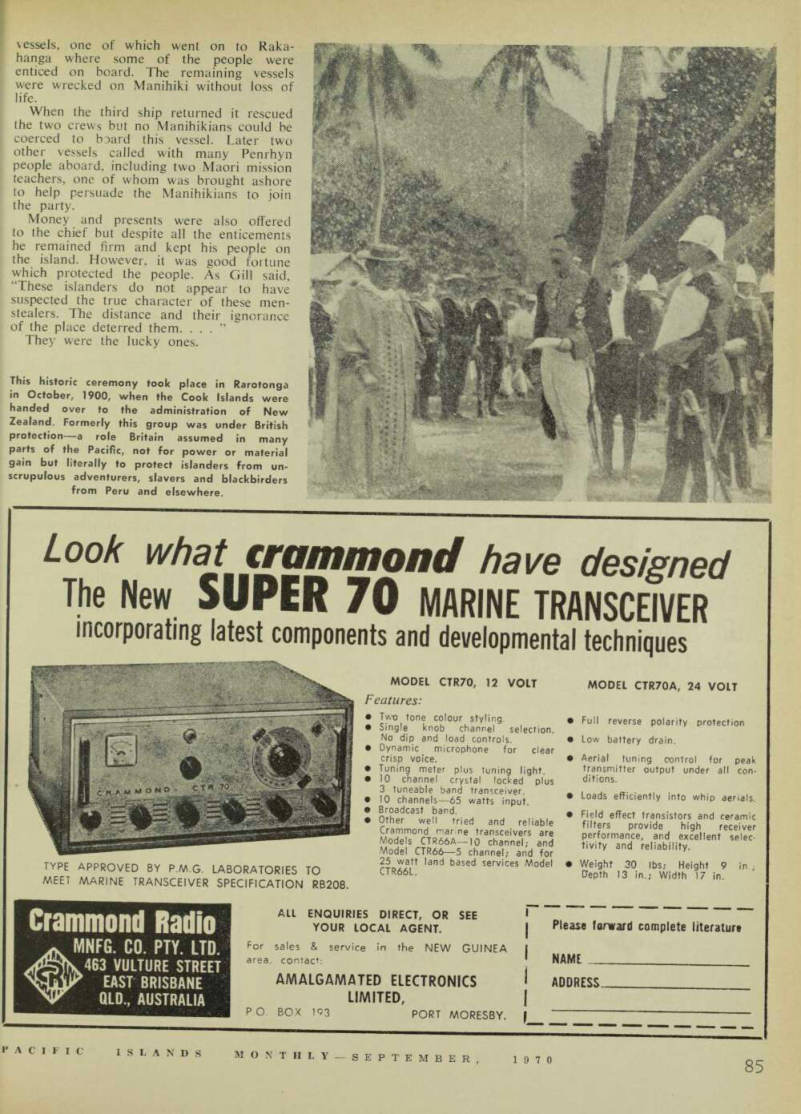 89
89 90
90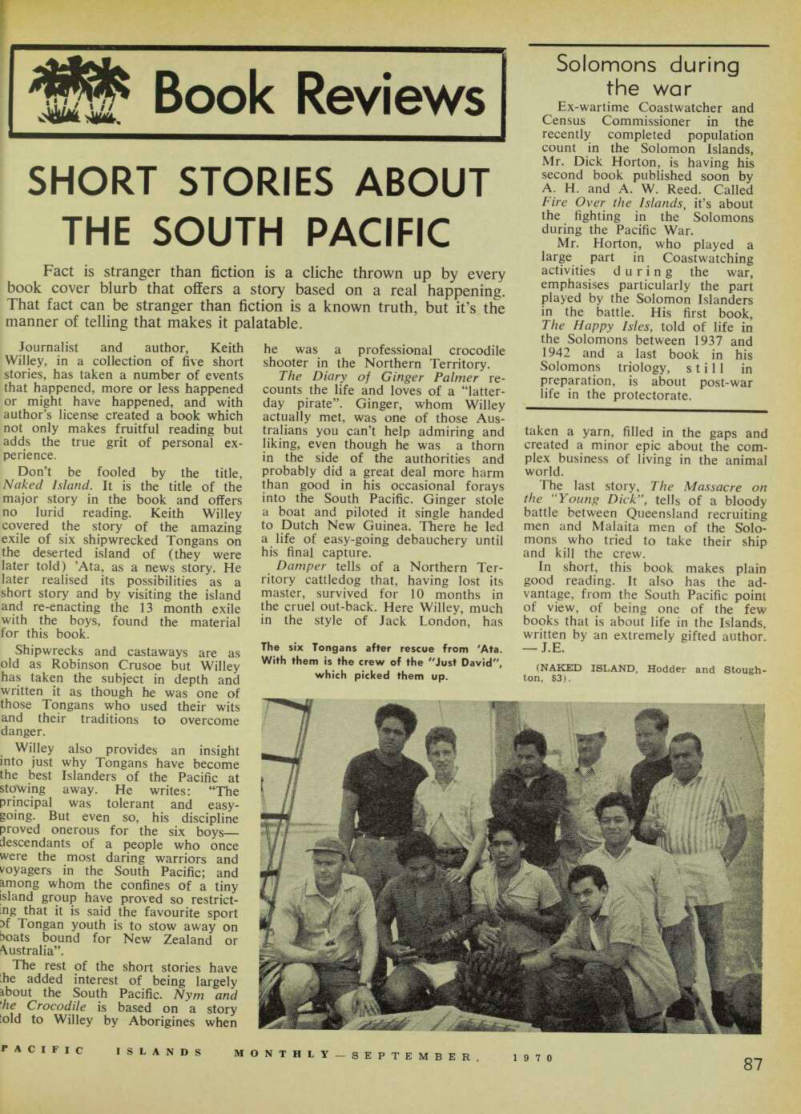 91
91 92
92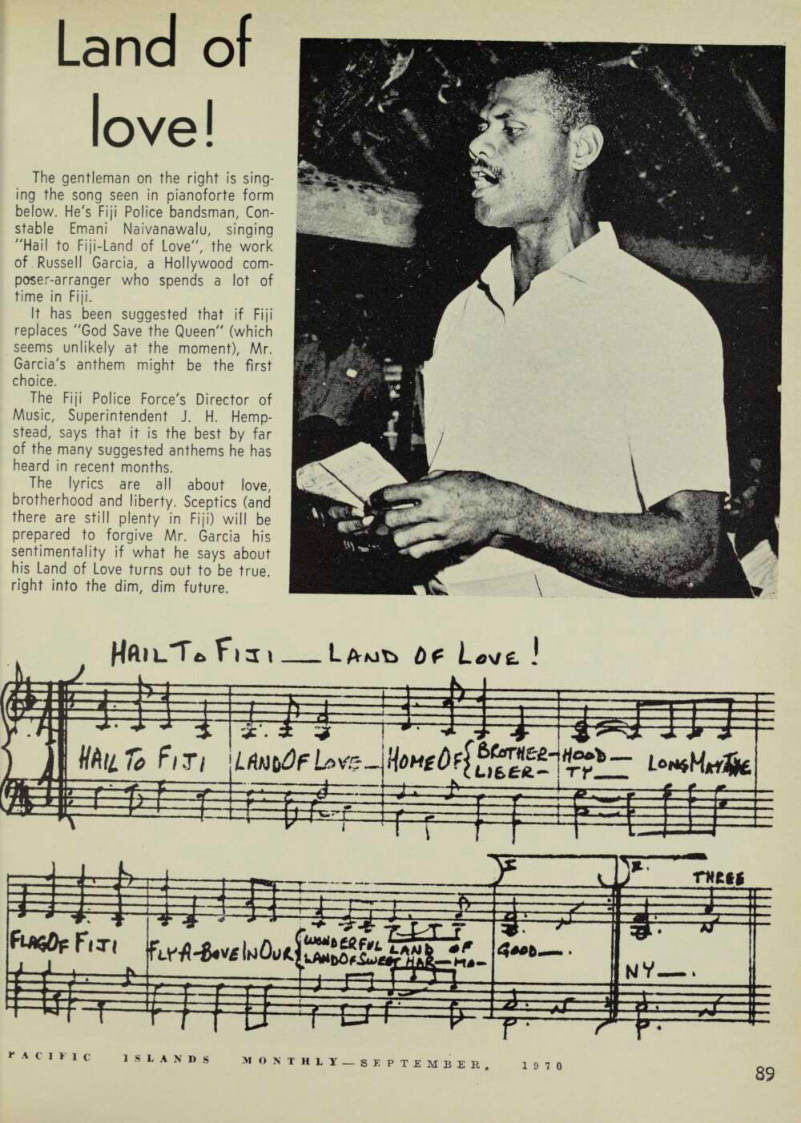 93
93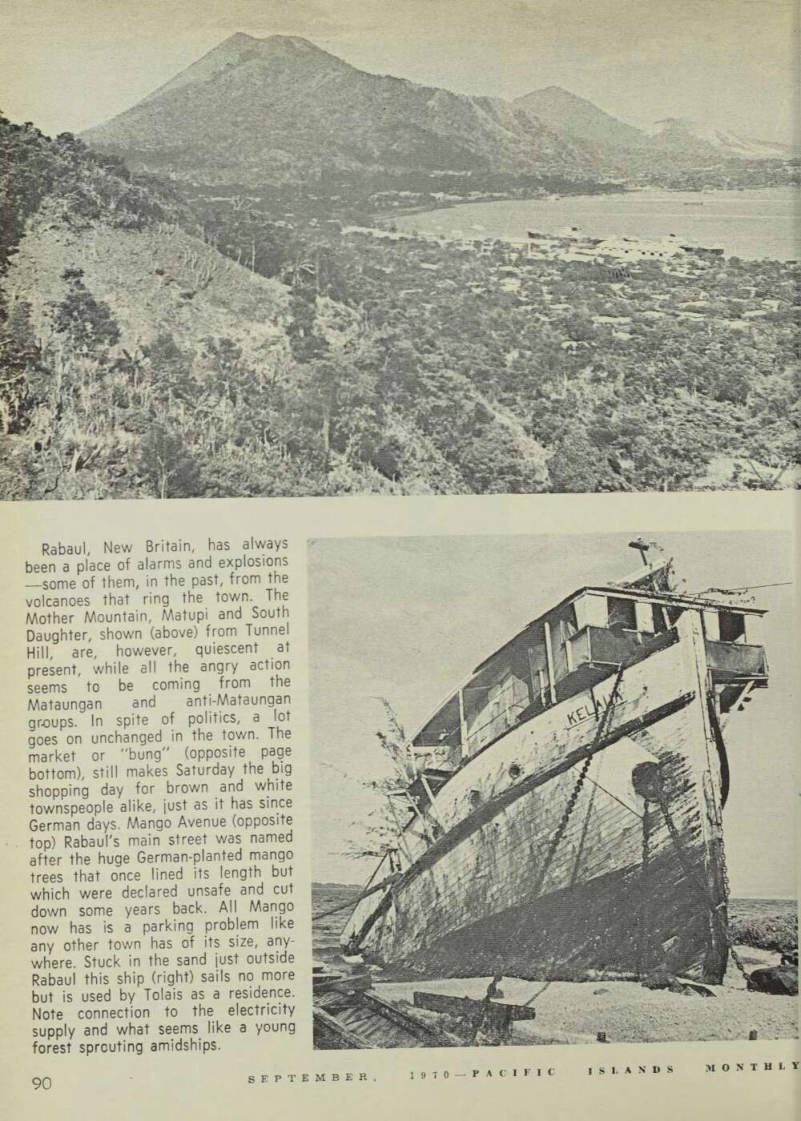 94
94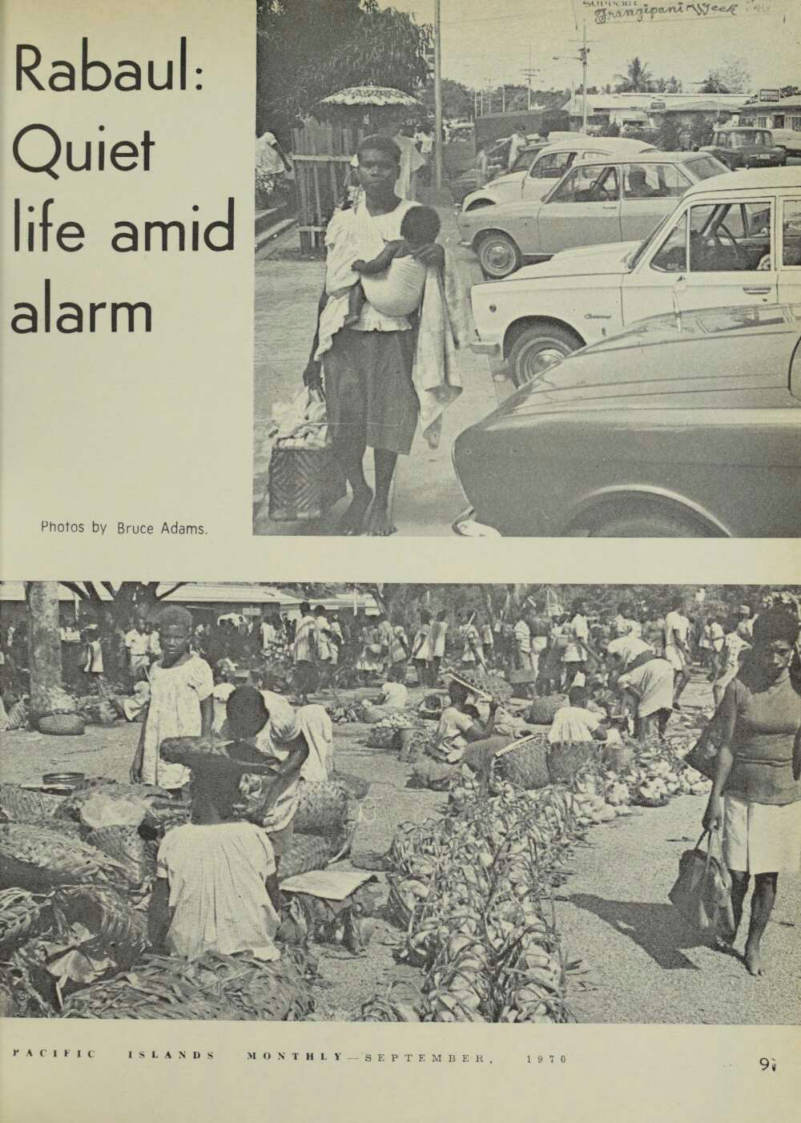 95
95 96
96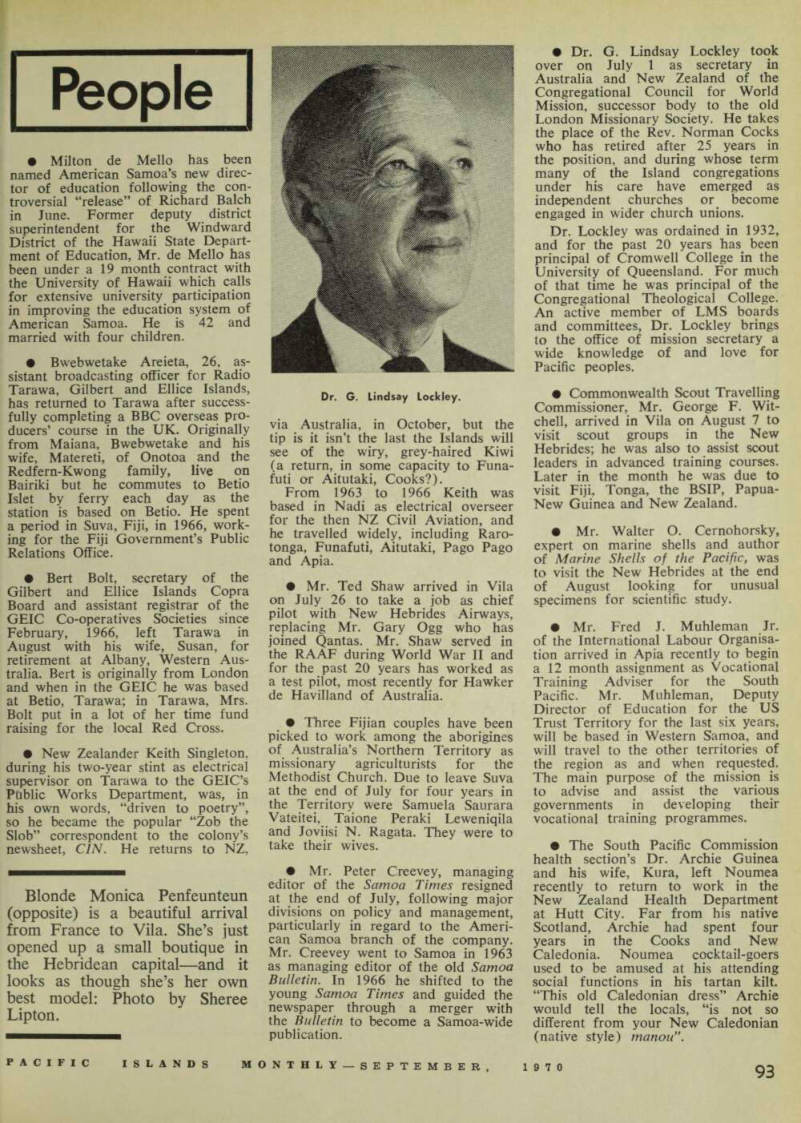 97
97 98
98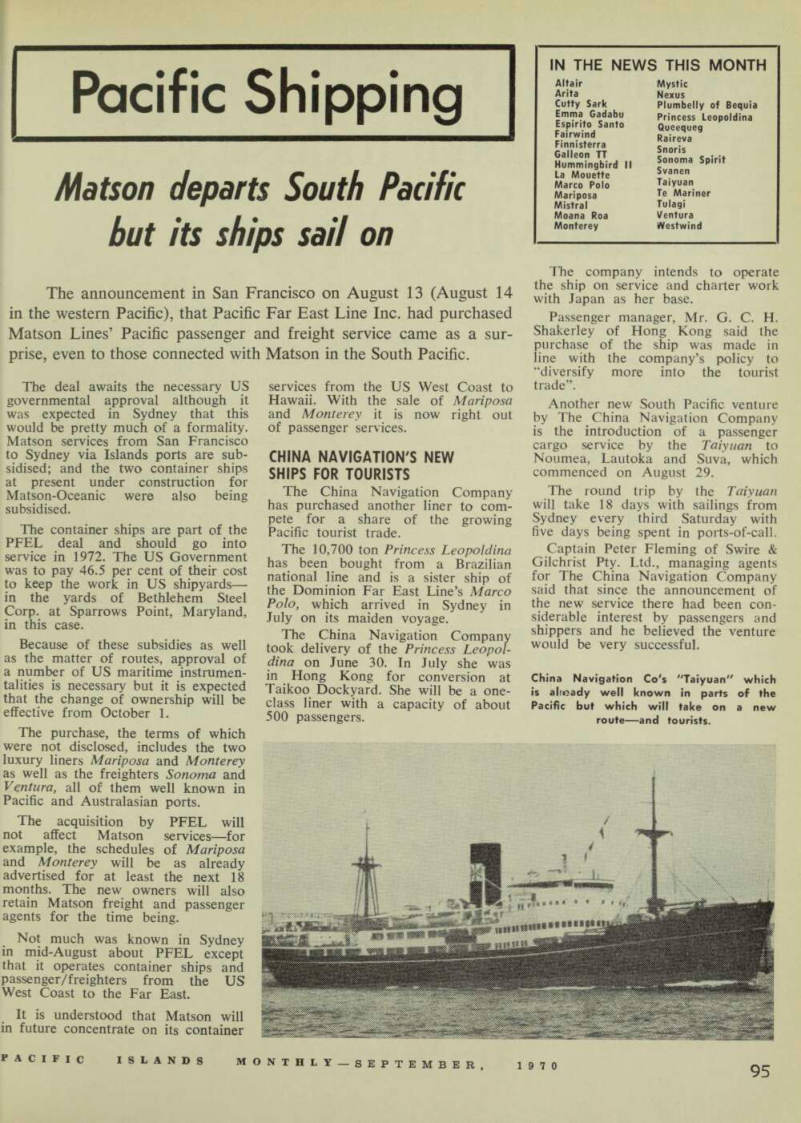 99
99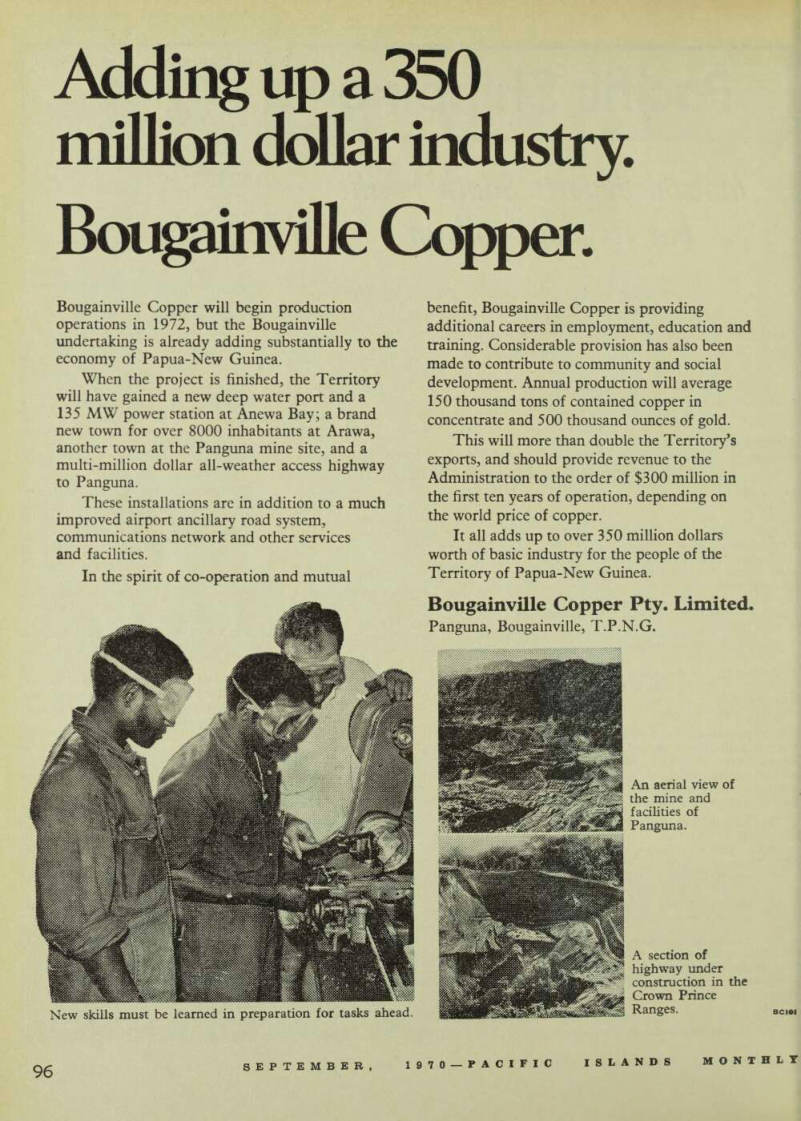 100
100 101
101 102
102 103
103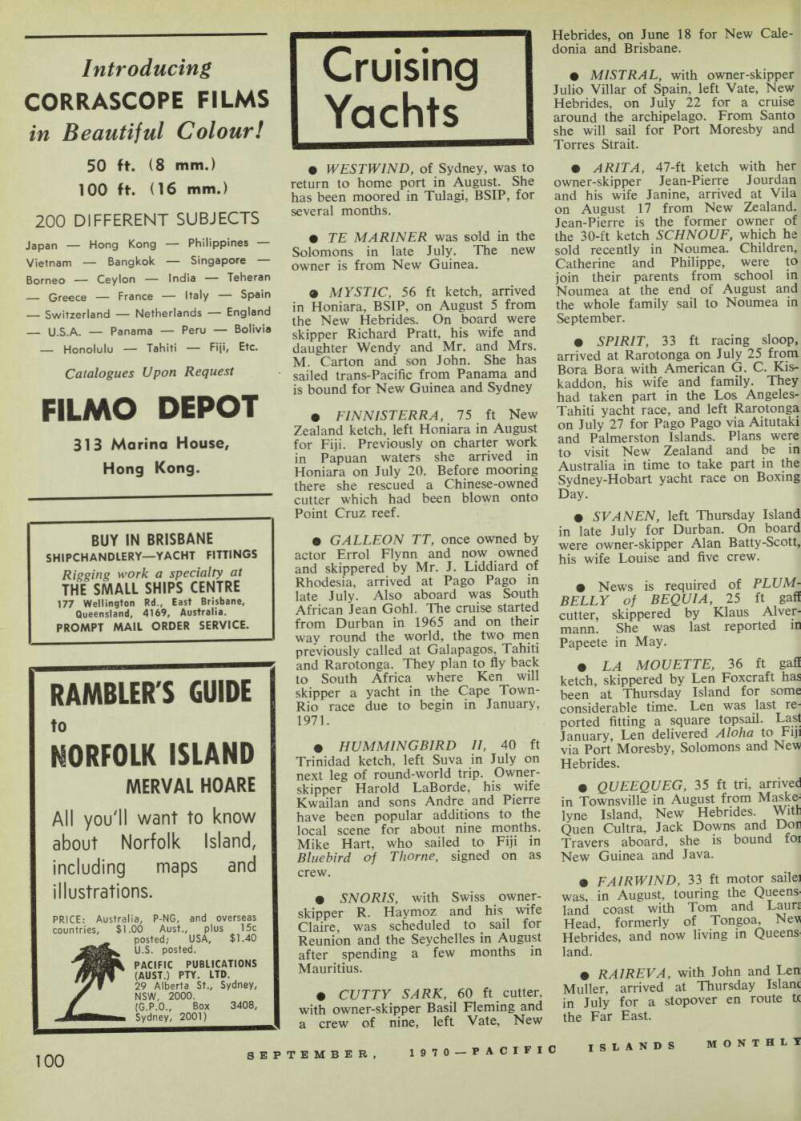 104
104 105
105 106
106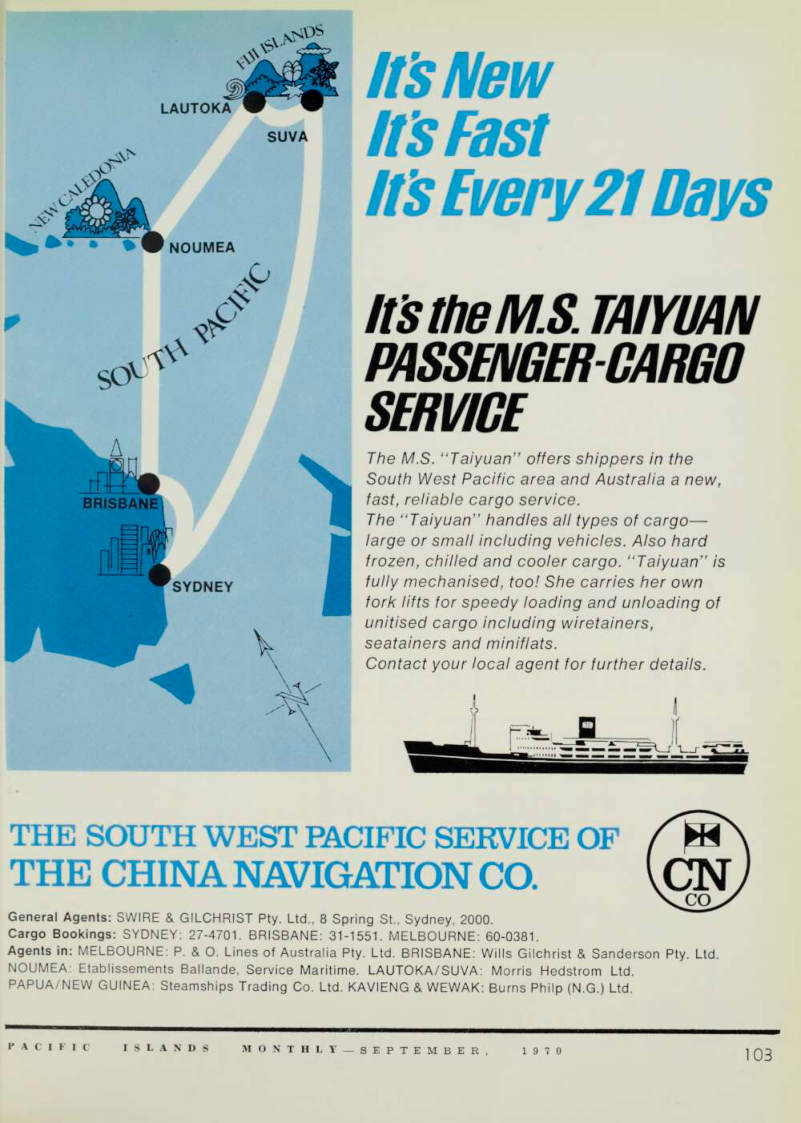 107
107 108
108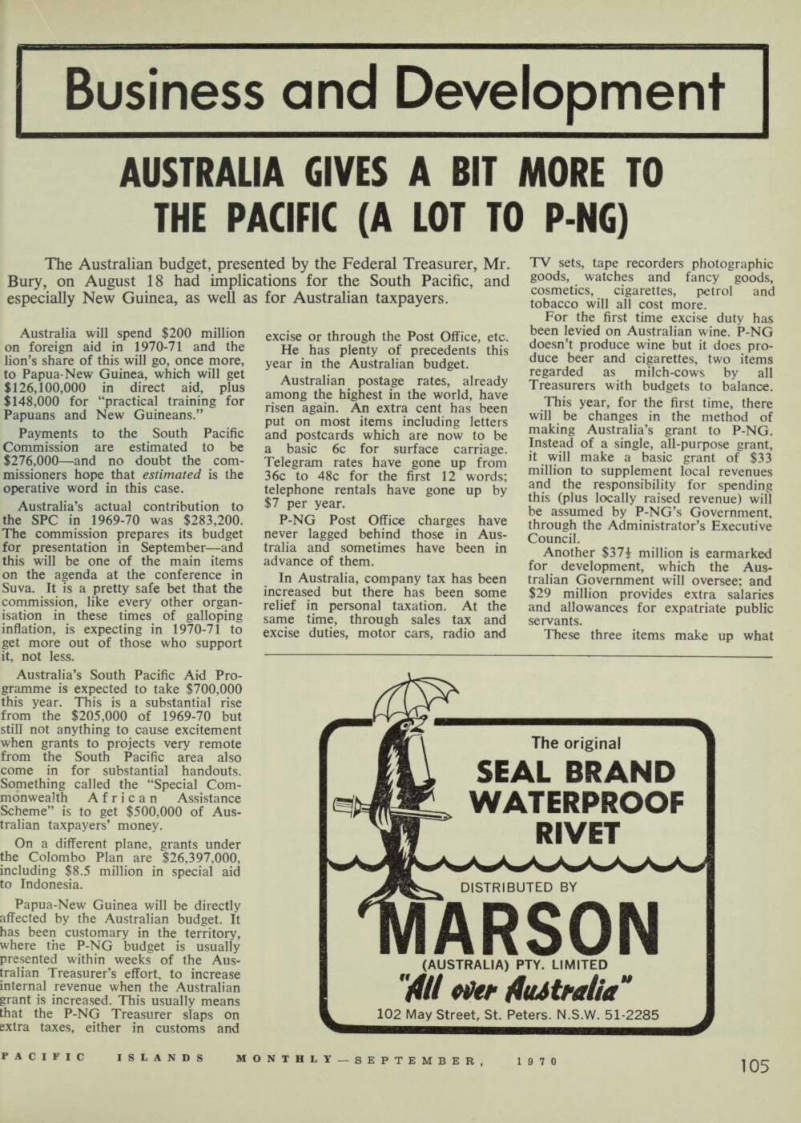 109
109 110
110 111
111 112
112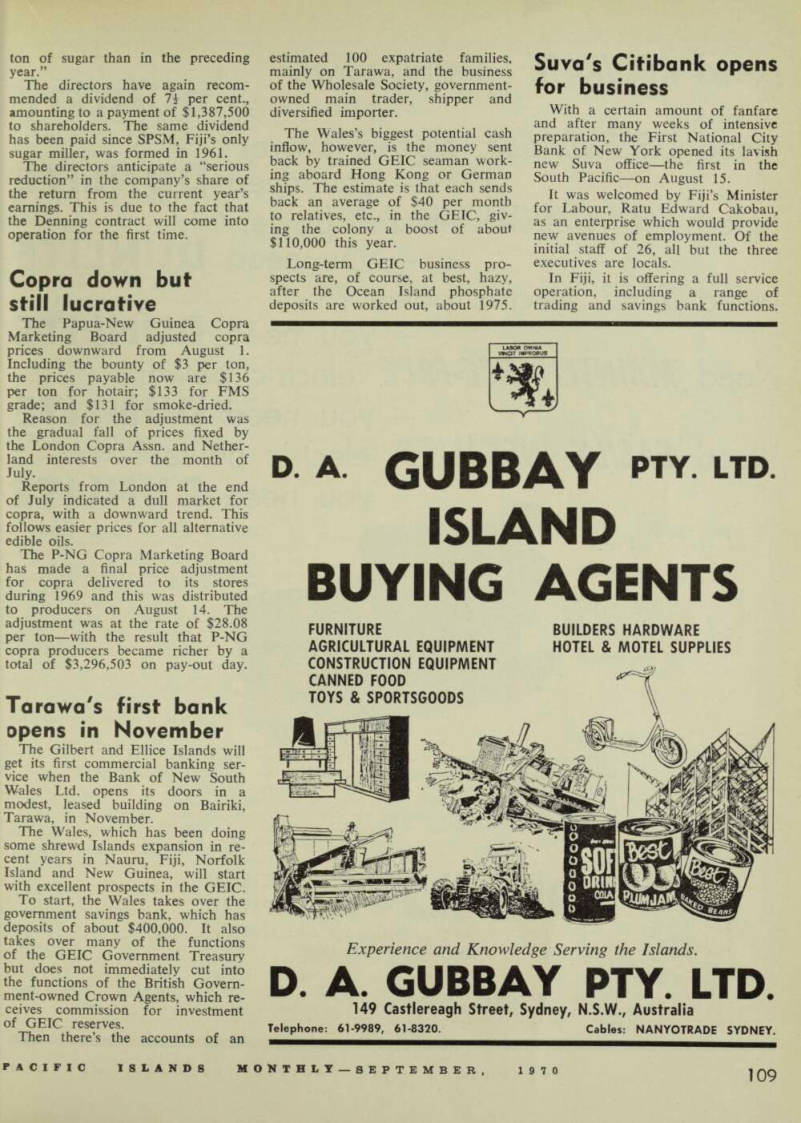 113
113 114
114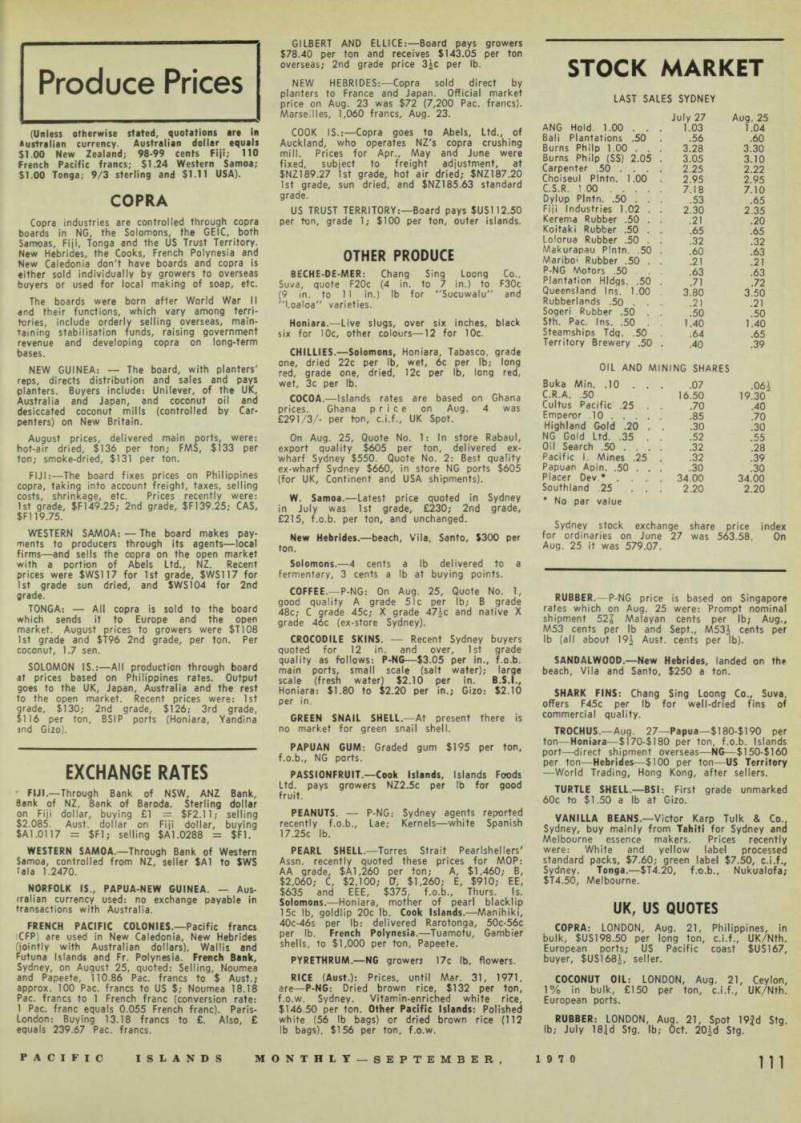 115
115 116
116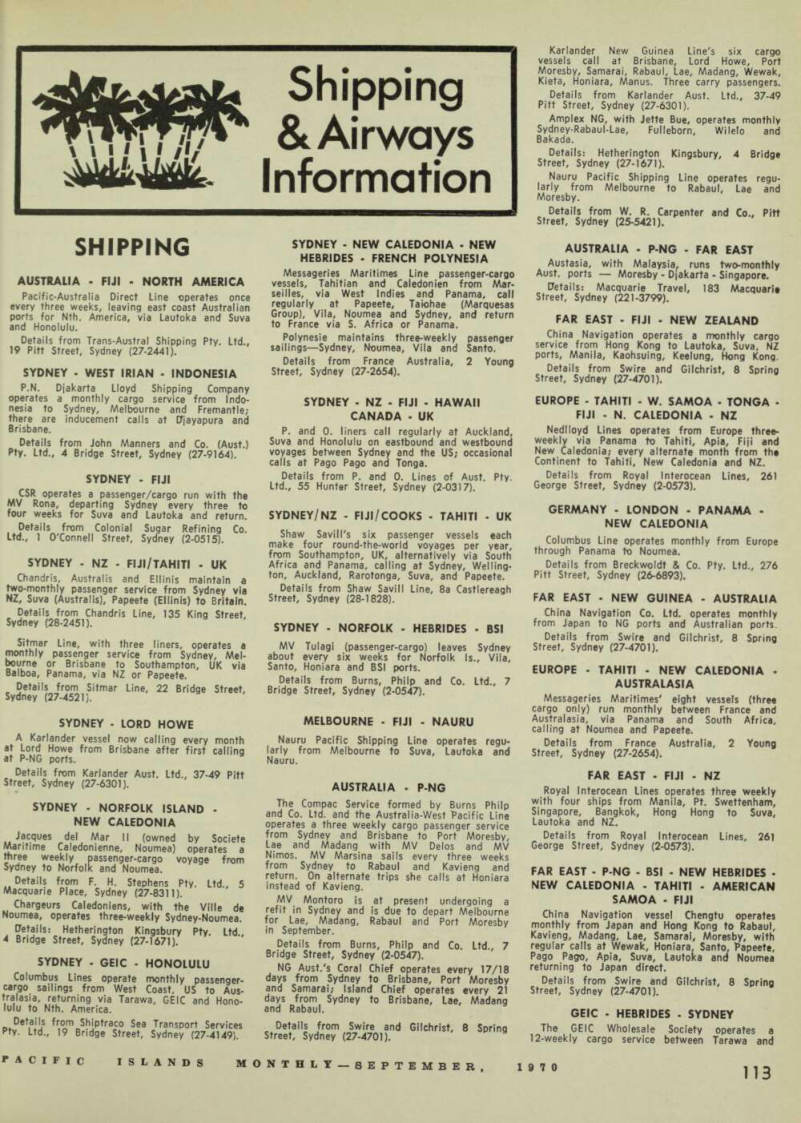 117
117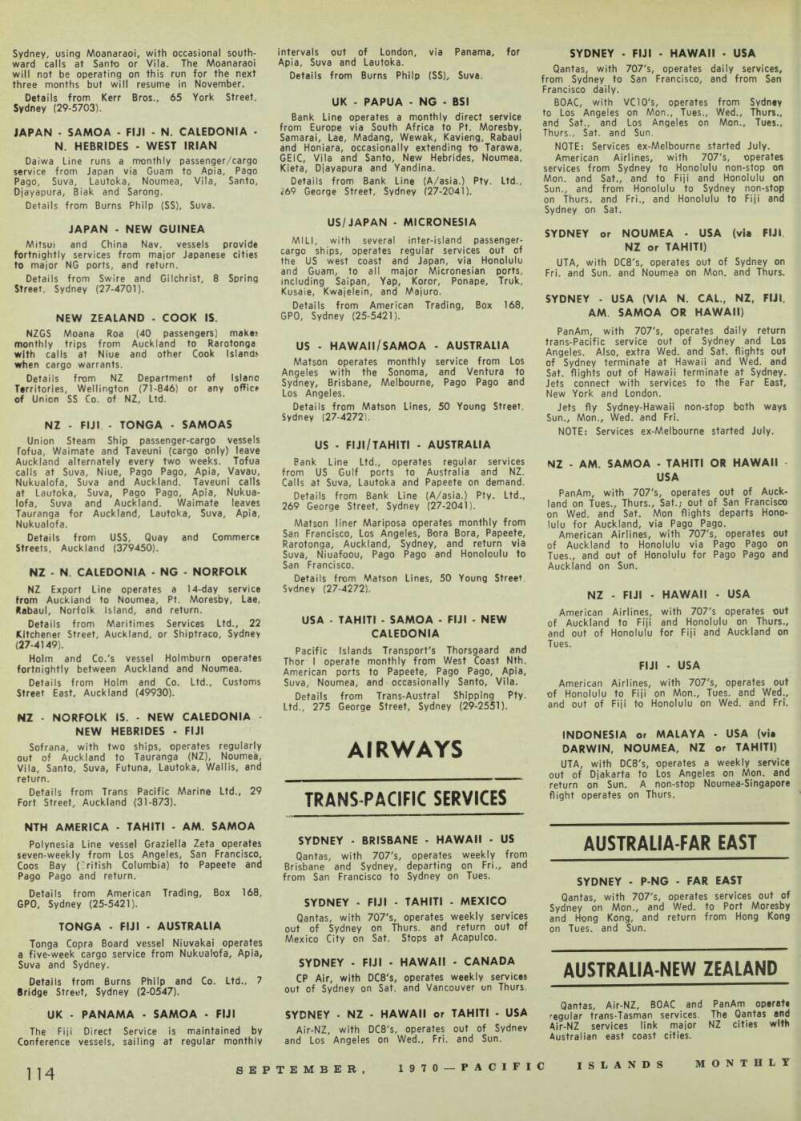 118
118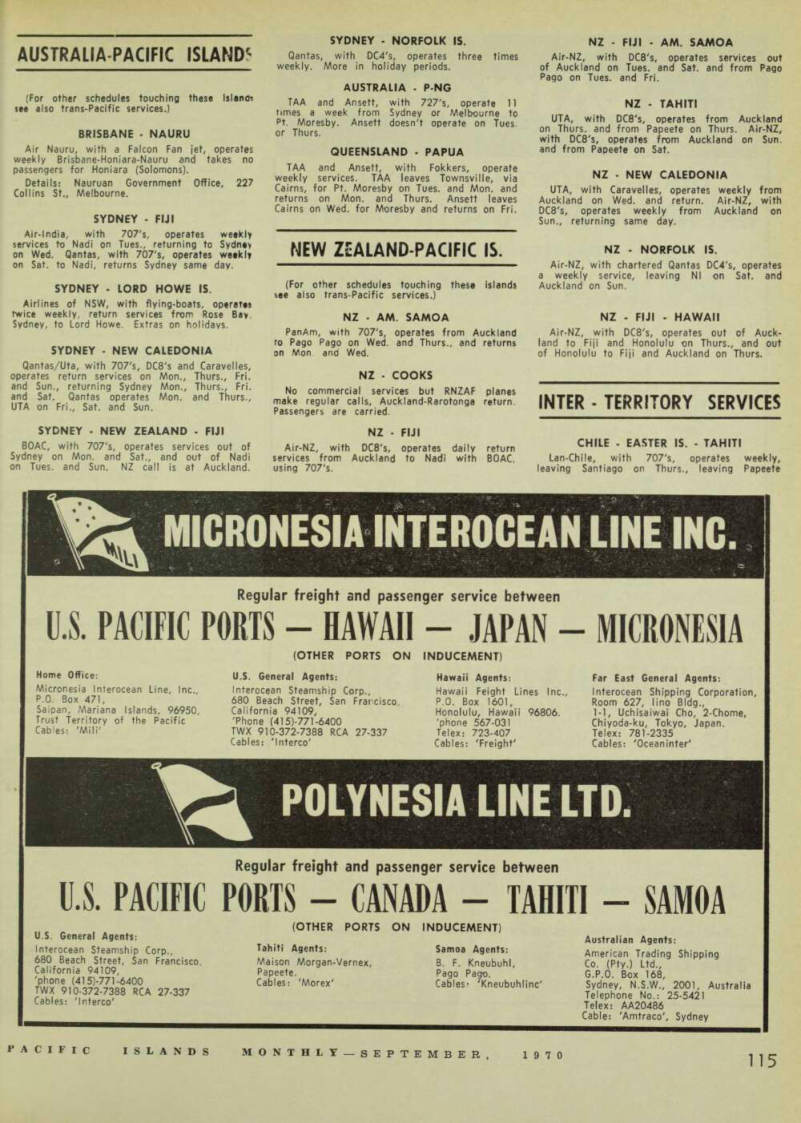 119
119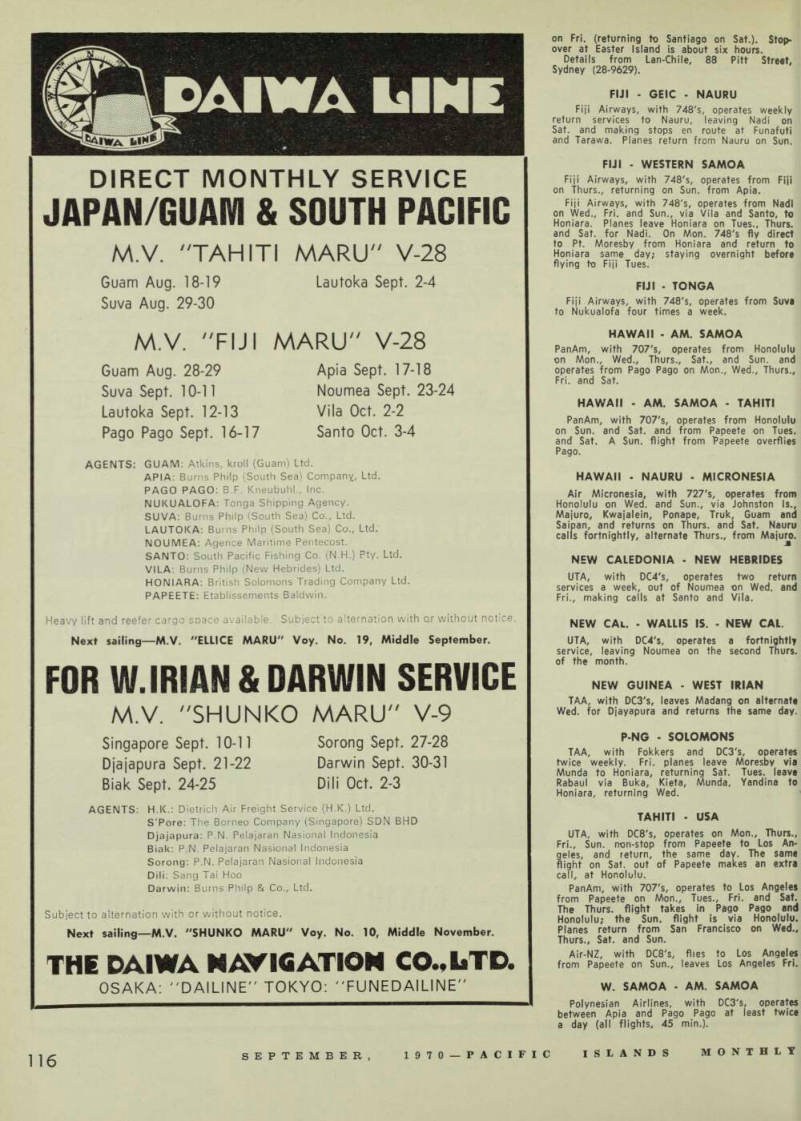 120
120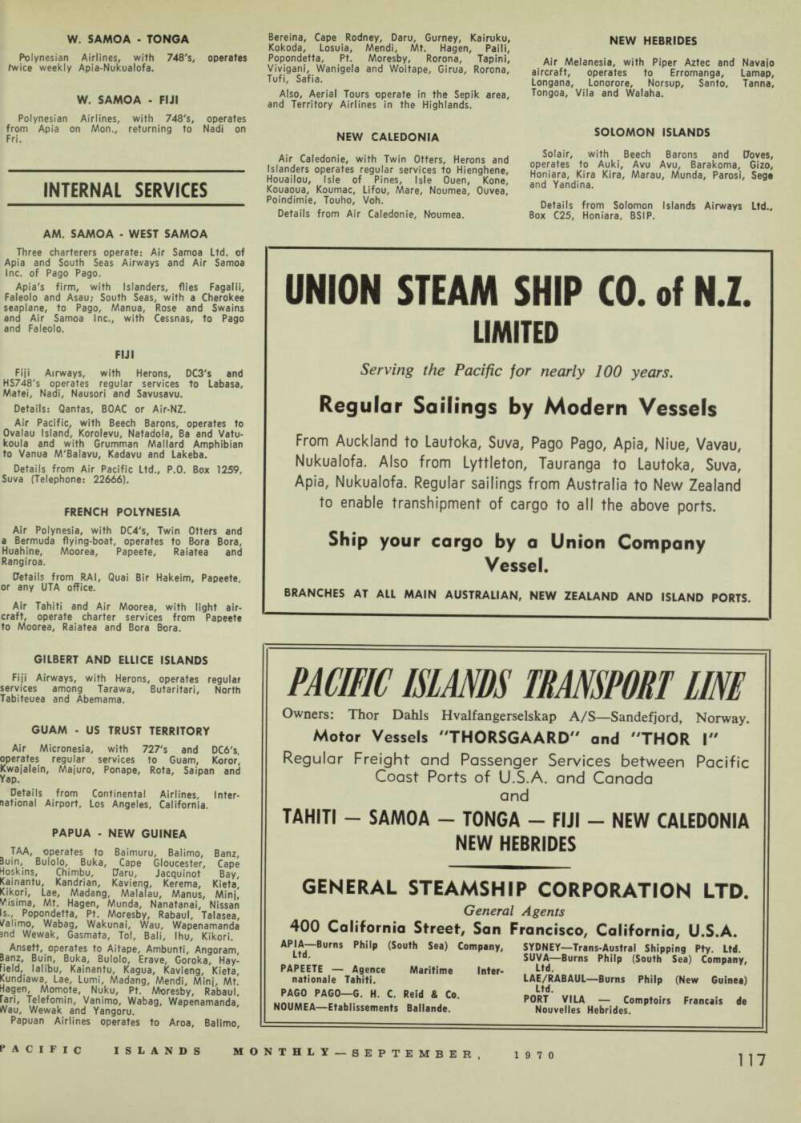 121
121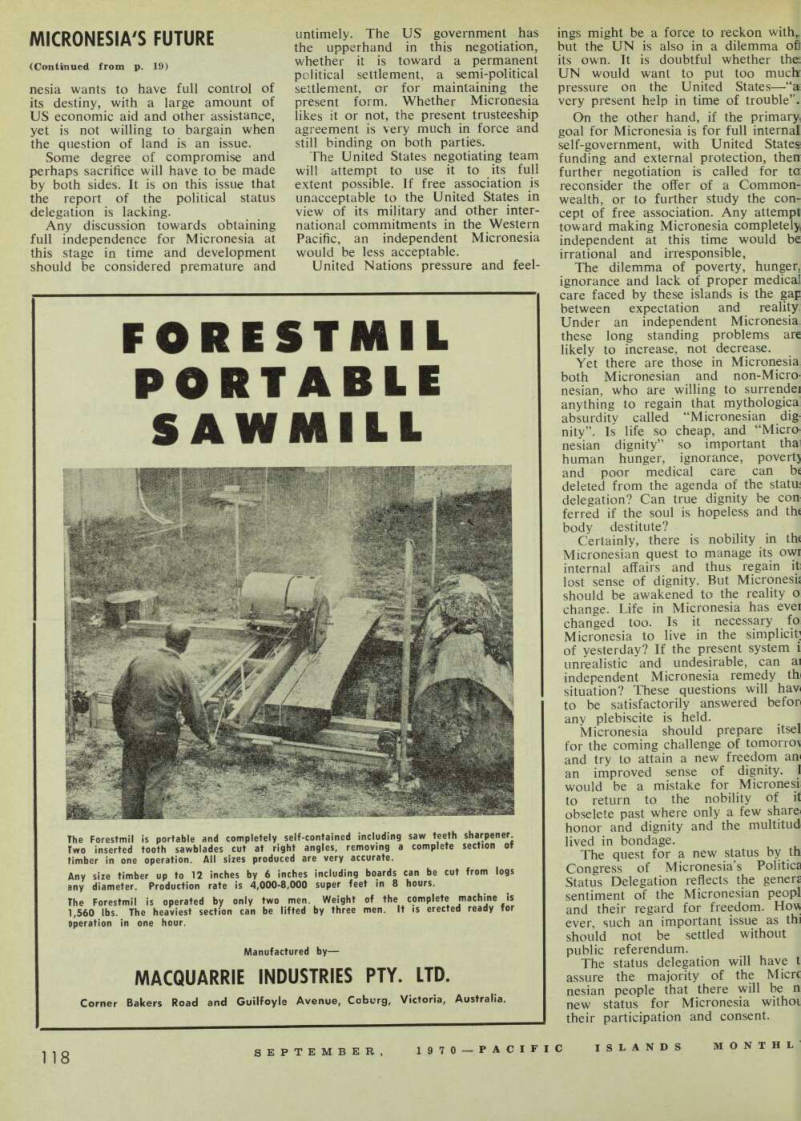 122
122 123
123 124
124 125
125 126
126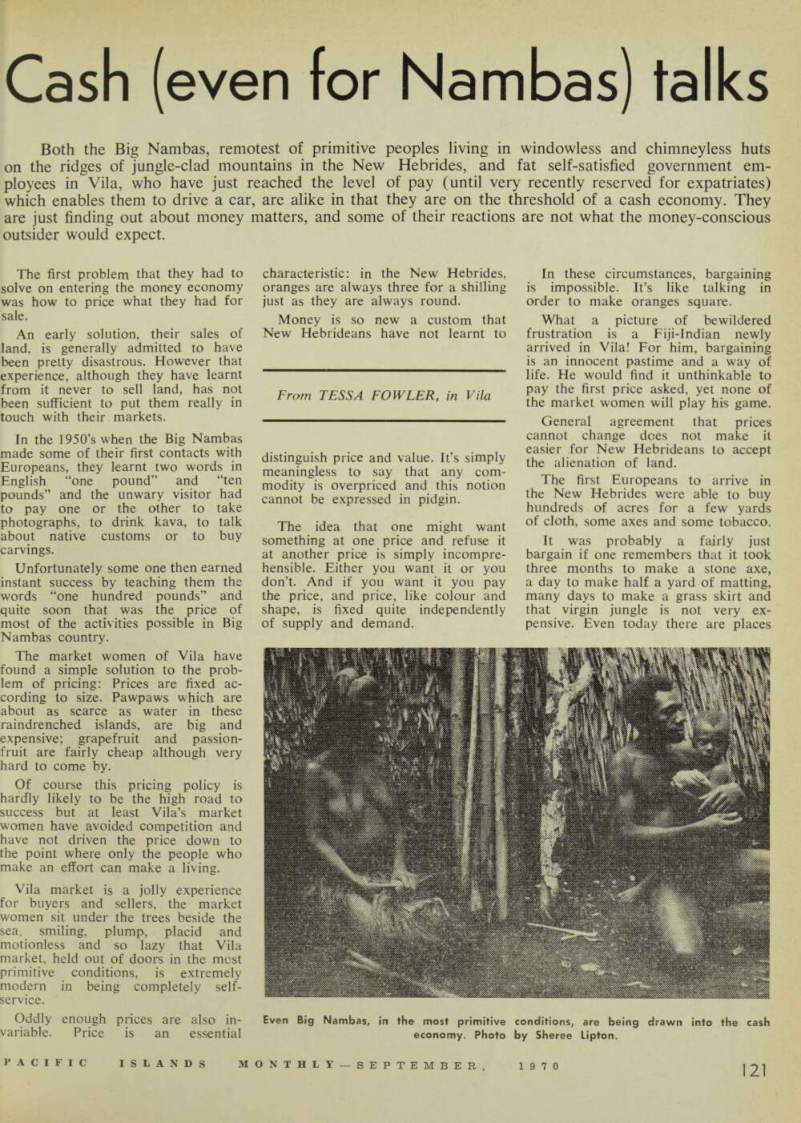 127
127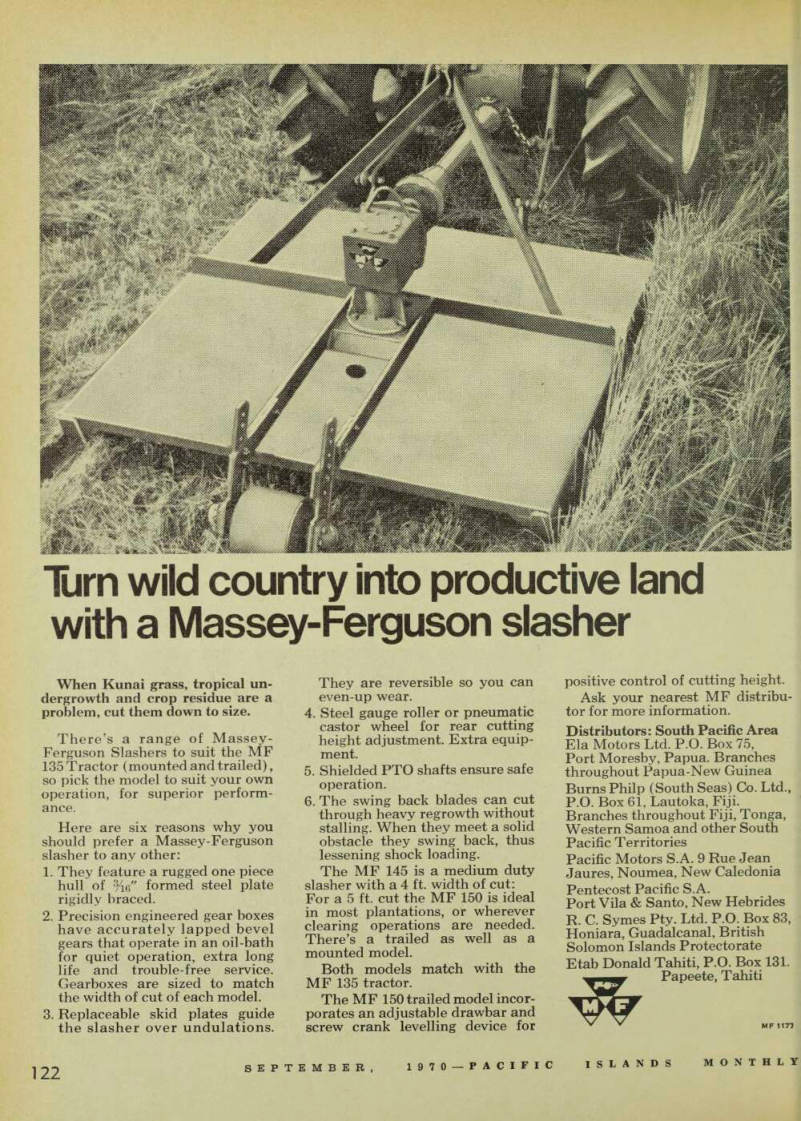 128
128 129
129 130
130 131
131 132
132 133
133 134
134 135
135 136
136 137
137 138
138 139
139 140
140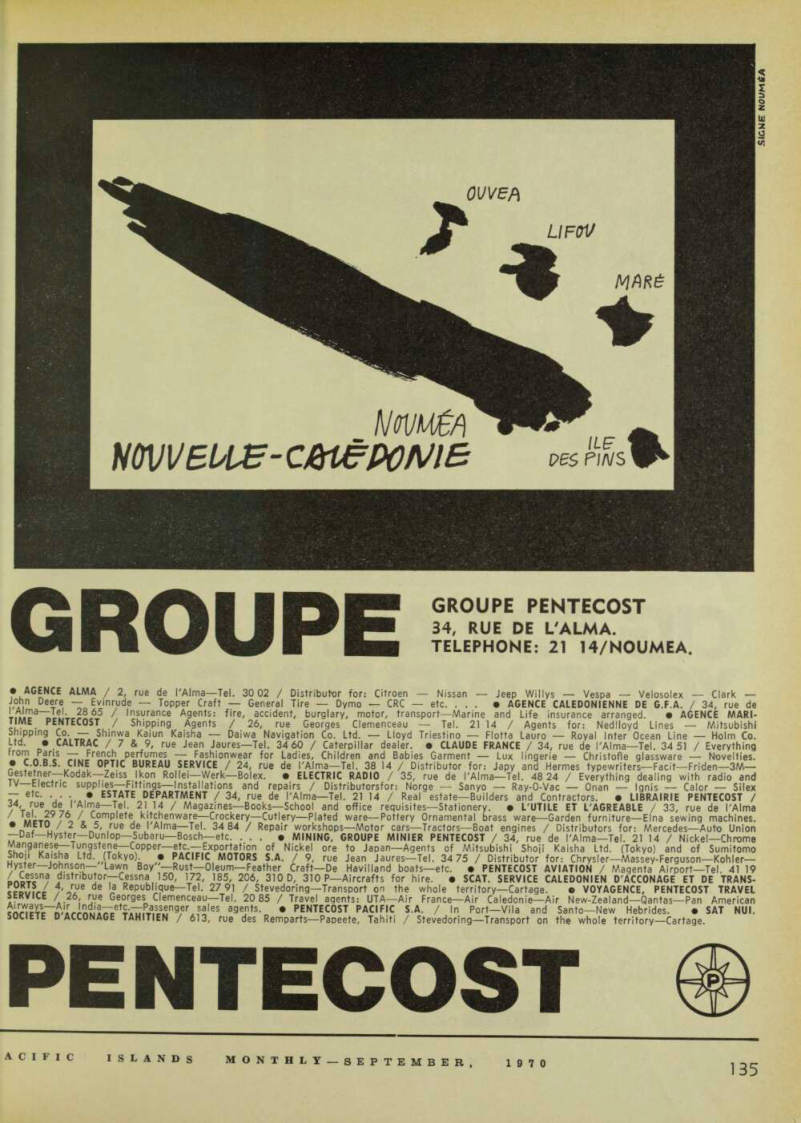 141
141 142
142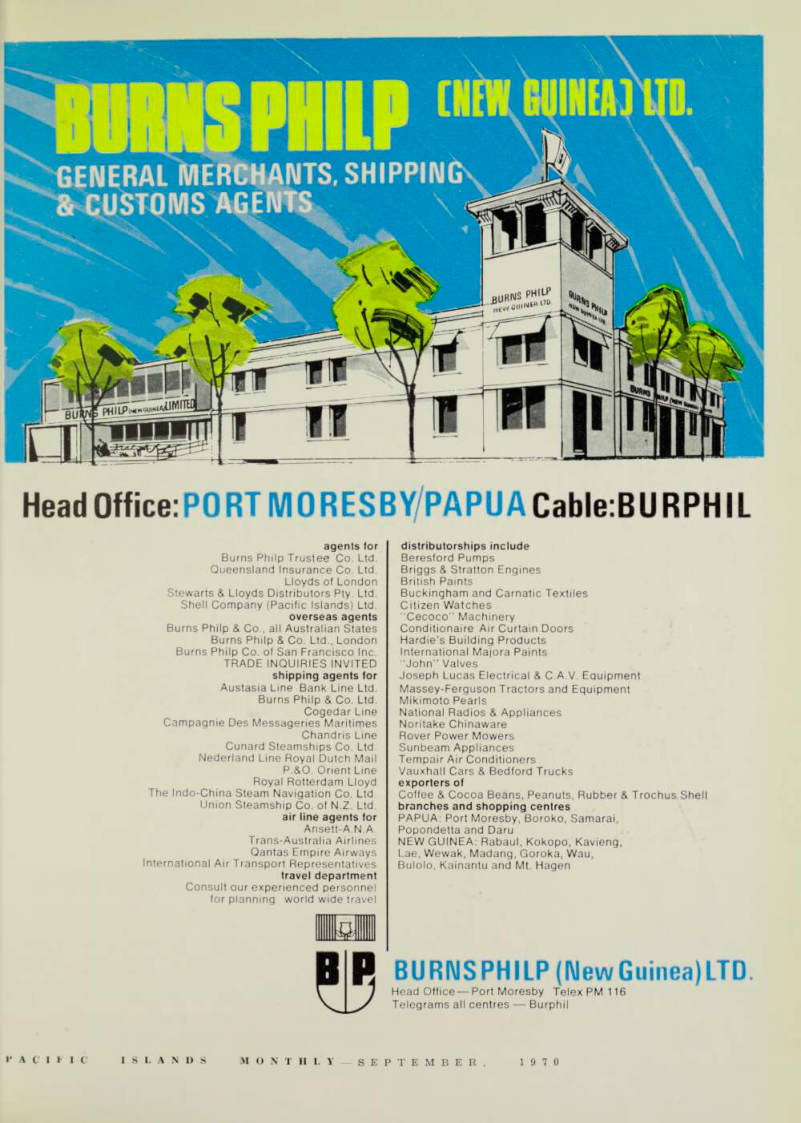 143
143 144
144