the Solomons . . . . .
p. 48 · Read in the full issue
People of all races make the Solomons . . . . .
Prom a Honiara correspondent The first full census of the BSIP is nearing completion. Pro visional figures reveal a substantial increase in population and show that there are nearly 10,000 more men than women in the Solomons.
Results are now being processed by computer in Sydney and the full report is expected to be available towards the middle of 1971.
The census reveals a total population of 161,525, of whom 85,631 are males and 75,894 are females.
Central District has the greatest population with 55,000.
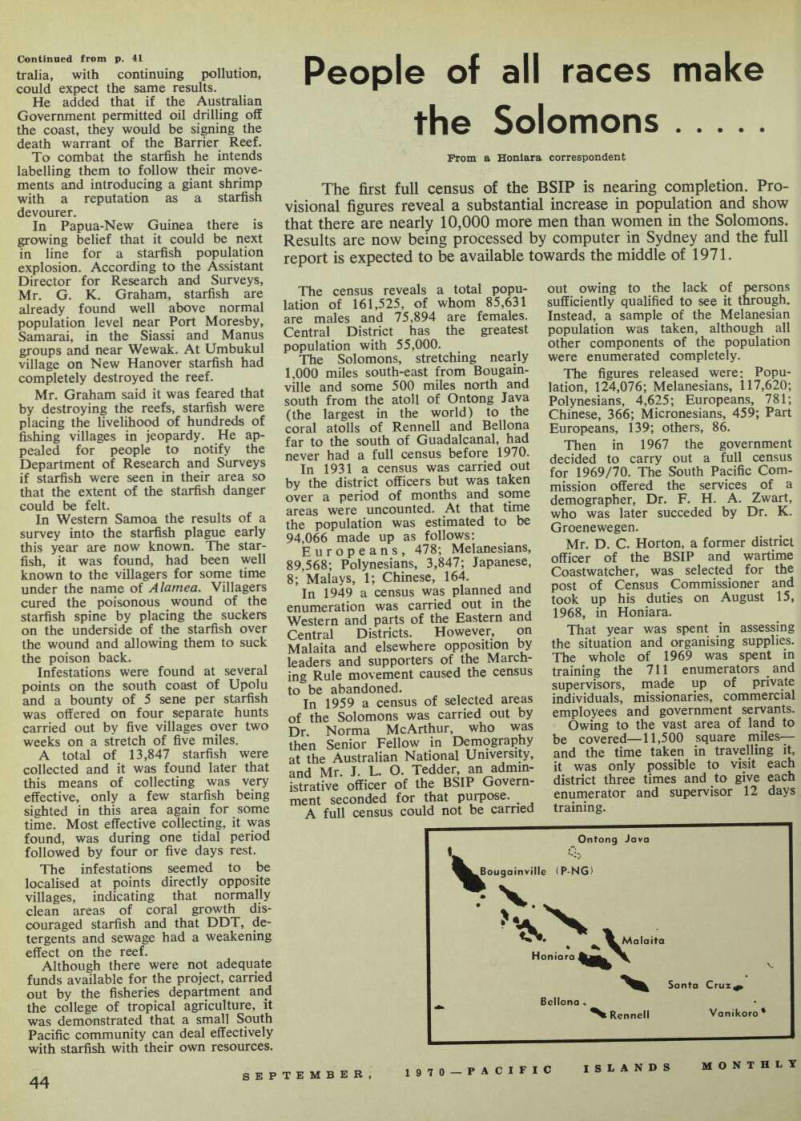
The Solomons, stretching nearly 1,000 miles south-east from Bougainville and some 500 miles north and south from the atoll of Ontong Java (the largest in the world) to the coral atolls of Rennell and Bellona far to the south of Guadalcanal, had never had a full census before 1970.
In 1931 a census was carried out by the district officers but was taken over a period of months and some areas were uncounted. At that time the population was estimated to be 94,066 made up as follows: Europeans, 478, Melanesians, 89,568; Polynesians, 3,847; Japanese, 8; Malays, 1; Chinese, 164.
In 1949 a census was planned and enumeration was carried out in the Western and parts of the Eastern and Central Districts. However, on Malaita and elsewhere opposition by leaders and supporters of the Marching Rule movement caused the census to be abandoned.
In 1959 a census of selected areas of the Solomons was carried out by Dr Norma McArthur, who was then Senior Fellow in Demography at the Australian National University, and Mr J. L. O. Tedder, an adminfstrative officer of the BSIP Government seconded for that purpose.
A full census could not be carried
out owing to the lack of persons sufficiently qualified to see it through, Instead, a sample of the Melanesian population was taken, although all other components of the population were enumerated completely.
The figures released were: Popu lation, 124,076; Melanesians, 117,620; Polynesians, 4,625; Europeans, 781; Chinese, 366; Micronesians, 459; Part Europeans, 139; others, 86.
Then in 1967 the government decided to carry out a full census for 1959/70. The South Pacific Commission offered the services of a demographer, Dr. F. H. A. Zwart, who was later succeded by Dr. K.
Groenewegen.
Mr. D. C. Horton, a former district officer of the BSIP and wartime Coastwatcher, was selected for the post of Census Commissioner and took up his duties on August 15, 1968, m Honiara.
That year was spent in assessing the situation and organising supplies, The whole of 1969 was spent m training the 711 enumerators and supervisors, made up of private individuals, missionaries, commercial employees and government servants.
Owing to the vast area of land to be covered—11,500 square miles— and the time taken m travelling it, it was only possible to visit each district three times and to give each enumerator and supervisor 12 days training.