It will be tight on pockets-but
pp. 53-55 · Read in the full issue

games fever is mounting
From DON BARRETT, in Rabaul With the Fourth South Pacific Games just over a year off, competing countries are starting to re view budgets and team sizes. And already it appears that in the enthusiasm that followed the Port Moresby Games some countries were a little over-optimistic when submitting provisional entries.
New national sports bodies sprouted in Papua-New Guinea and the Solomons all anxious to field teams for the 17 sports in Papeete. Now the cold hard facts of finance are catching up fast with some of the super-optimists.
New Guinea’s South Pacific Games Association has set a figure of 5A425 for each competitor and team official, to be raised by the individual sporting bodies.
The newly formed P-NG Amateur Cycling Association has had second thoughts about sending a team to Tahiti; other sports have cut team size, while the exclusion of netball from the Games will reduce the overall size of the P-NG team.
Archery is another new sport in the territory. The archers are still hoping to send a men’s team, but a lot may depend on form shown over the next six months.
The swimmers are all smiles since their successful “swimathon” when 55,000 was raised in one night. With a planned team of 12 they are literally home and dry.
The athletes face the biggest task of financing a team of 30 plus man ager and coach; a big crowd-pleaser at Games time, athletics is perenni ally poor at other times.
All sports bodies in New Guinea are worried about coaching and com petition for their Games aspirants.
These things cost money and the added cost of providing them—as well as the Tahiti travel budget—is the main tropic of conversation among sportsmen.
The Administration is likely to grant a subsidy to assist the team as it has in the past three Games 7 —and the P-NG Games Association is counting on this aid to balance its Tahiti budget.
In the Solomons, talk is of what assistance may be forthcoming not only from the High Commission for the West Pacific, but also the British Government.
The experiment of moving a team by sea to Port Moresby was a suc
cess in that it made possible the inclusion of youngsters to gain ex perience. But it’s not an experiment likely to be repeated. Bad weather and distance daunted the best sailors among the BSIP team on their re
turn trip.
Its air or nothing for Tahiti.
Swimming is emerging as a new sport in the Solomons while judo, volleyball, boxing and underwater spear fishing all now have national associations. Sport is booming and this poses problems for officials of the BSIP Amateur Sports Associa tion.
New facilities are urgently needed.
Fund raising over the last 12 months has been beamed towards provision of new sports facilities—mainly at the proposed Honiara Community Centre.
This is good thinking as the centre will meet many needs. But an over severe restriction in team size for Tahiti will mean disappointment and could affect sports development in the Solomons.
The New Hebrides South Pacific Games Council is perhaps the happiest—if not the smuggest— national sports body in the Pacific right now. The French Government has guaranteed the cost of moving 35 of the New Hebrides team from Vila to Tahiti and additionally will
contribute 25 per cent, of the cost of a further 35.
With its own fund raising activities already successful and with hopes that the British Government will make some gesture, the biggest yet team of 70 plus from New Hebrides is sure to make the trip to the Games.
Main topic of talk among Hebridean sportsmen is what will the British Government do. There’s a rather hopeful air since the British general election.
Since the British part of New Hebrides administration comes under the High Commisson for the West Pacific it could be that both Hebrides and Solomons will get help.
Neither the Solomons nor the Hebrides will send a Rugby Union team and Papua-New Guinea is do ing some soul searching on this score. With Tonga and Fiji both non-starters for Rugby it now seems doubtful if this sport will be staged at the Games.
There is some support for a regional Rugby competition at a venue other than Tahiti but the politics of this are a little obscure. New Guinea’s successful tour of north Queensland has whetted the local Rugby Unions’ appetite for tours. Fiji, of course, is off to England, and Tonga would like a tour similar to their 1970 visit to New Zealand.
It would not surprise if the Coun cil meeting at the time of the Tahiti Games produces a move to limit the number of sports to be staged at any Games. Some smaller countries cannot hope to enter in more than six or eight sports while the burden of staging a 20-event programme would be beyond the scope of those same countries.
The planned build-up of sports facilities in Honiara, including an Olympic swimming pool, could mean a bid from the Solomons to stage the Games towards the end of the decade—but not if there is to be a continual escalation of the number of sports.
The Port Moresby Games had a real South Pacific flavour and the
Tahiti Games will follow suit. This is what the people of the Games’ countries want.
Standards will rise. They should and must. Those individual athletes, swimmers, boxers and weightlifters who are good enough will go on to compete in British Commonwealth or Olympic Games—as is their right.
This need not break up the spirit of the South Pacific Games. For the big majority of sportsmen and women, these Games will be the goal to which they aspire.
The fever is rising—in Port Moresby, Rabaul, Honiara, Vila and Santo. And doubtless in all those other towns in the Pacific where “Tahiti September 1971” are the magic words that hard-pressed sports administrators hope will separate from the public much needed dollars.
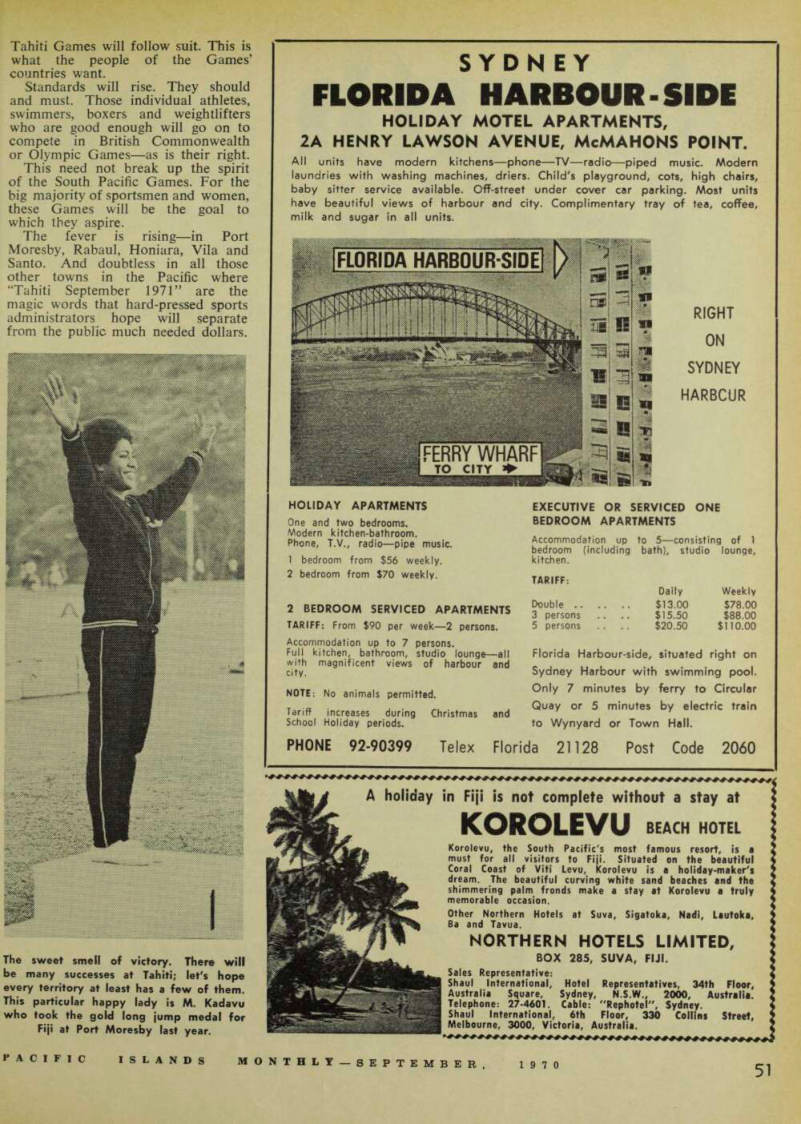
The sweet smell of victory. There will be many successes at Tahiti; let's hope every territory at least has a few of them.
This particular happy lady is M. Kadavu who took the gold long jump medal for Fiji at Port Moresby last year.