The princess' new marriage: (that last
pp. 35-37 · Read in the full issue

one was just 'social suicide')
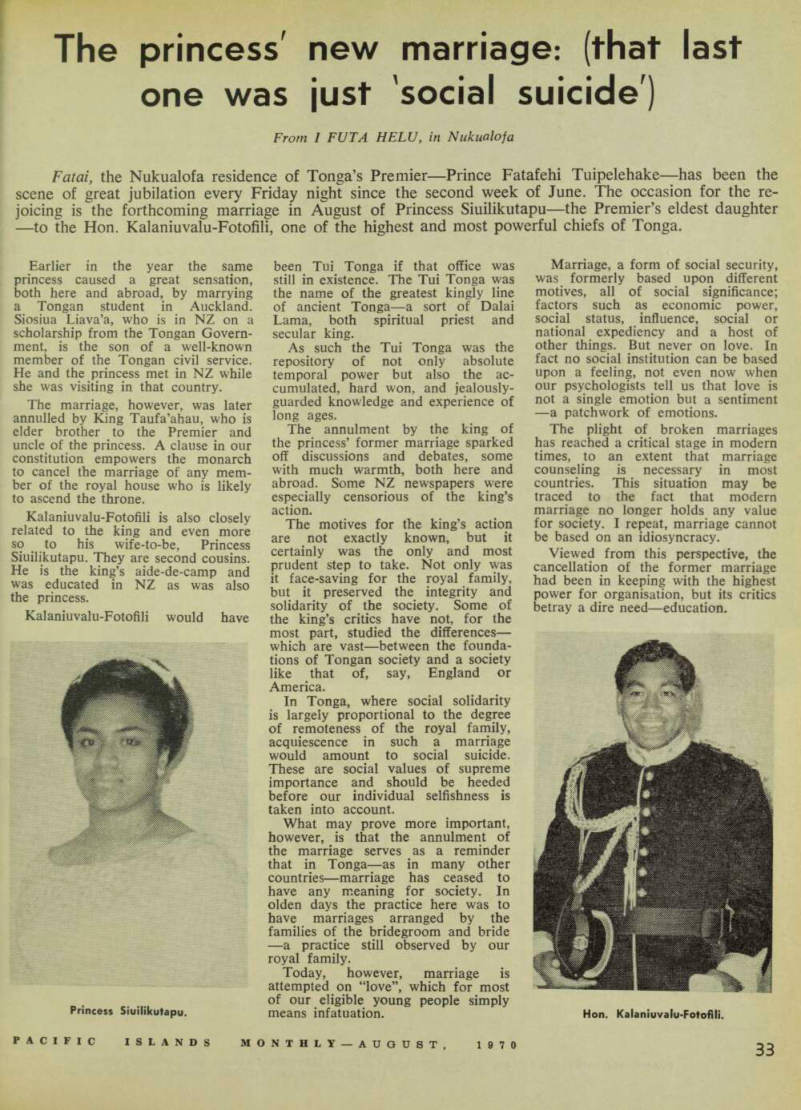
From I FUTA HELU, in Nukualofa Fatal, the Nukualofa residence of Tonga’s Premier —Prince Fatafehi Tuipelehake—has been the scene of great jubilation every Friday night since the second week of June. The occasion for the re joicing is the forthcoming marriage in August of Princess Siuilikutapu—the Premier’s eldest daughter —to the Hon. Kalaniuvalu-Fotofili, one of the highest and most powerful chiefs of Tonga.
Earlier in the year the same princess caused a great sensation, both here and abroad, by marrying a Tongan student in Auckland.
Siosiua Liava’a, who is in NZ on a scholarship from the Tongan Govern ment, is the son of a well-known member of the Tongan civil service.
He and the princess met in NZ while she was visiting in that country.
The marriage, however, was later annulled by King Taufa’ahau, who is elder brother to the Premier and uncle of the princess. A clause in our constitution empowers the monarch to cancel the marriage of any mem ber of the royal house who is likely to ascend the throne.
Kalaniuvalu-Fotofili is also closely related to the king and even more so to his wife-to-be, Princess Siuilikutapu. They are second cousins.
He is the king’s aide-de-camp and was educated in NZ as was also the princess.
Kalaniuvalu-Fotofili would have
Marriage, a form of social security, was formerly based upon different motives, all of social significance; factors such as economic power, social status, influence, social or national expediency and a host of other things. But never on love. In fact no social institution can be based upon a feeling, not even now when our psychologists tell us that love is not a single emotion but a sentiment —a patchwork of emotions.
The plight of broken marriages has reached a critical stage in modern times, to an extent that marriage counseling is necessary in most countries. This situation may be traced to the fact that modern marriage no longer holds any value for society. I repeat, marriage cannot be based on an idiosyncracy.
Viewed from this perspective, the cancellation of the former marriage had been in keeping with the highest power for organisation, but its critics betray a dire need—education.
been Tui Tonga if that office was still in existence. The Tui Tonga was the name of the greatest kingly line of ancient Tonga—a sort of Dalai Lama, both spiritual priest and secular king.
As such the Tui Tonga was the repository of not only absolute temporal power but also the ac cumulated, hard won, and jealously guarded knowledge and experience of long ages.
The annulment by the king of the princess’ former marriage sparked off discussions and debates, some with much warmth, both here and abroad. Some NZ newspapers were especially censorious of the king’s action.
The motives for the king’s action are not exactly known, but it certainly was the only and most prudent step to take. Not only was it face-saving for the royal family, but it preserved the integrity and solidarity of the society. Some of the king’s critics have not, for the most part, studied the differences— which are vast—between the founda tions of Tongan society and a society like that of, say, England or America.
In Tonga, where social solidarity is largely proportional to the degree of remoteness of the royal family, acquiescence in such a marriage would amount to social suicide.
These are social values of supreme importance and should be heeded before our individual selfishness is taken into account.
What may prove more important, however, is that the annulment of the marriage serves as a reminder that in Tonga—as in many other countries—marriage has ceased to have any meaning for society. In olden days the practice here was to have marriages arranged by the families of the bridegroom and bride —a practice still observed by our royal family.
Today, however, marriage is attempted on “love”, which for most of our eligible young people simply means infatuation.
Princess Siuilikutapu.
Hon. Kalaniuvalu-Fotofili.
• Last month a Tongan schoolteacher outlined his objections to a school curriculum which turned out "fishermen and farmers". Now a correspondent in the British Solomon Islands looks at education in his part of the South Pacific—and sees the church as a plain educator of Melanesians to live in Melanesia, the government as an educator of people to serve the country's particular needs.