education policy
pp. 37-38 · Read in the full issue

Church v Government on education policy
From DAVID KEATING, in Honiara A recent event in the Solomons which has gone more or less unnoticed, but which will have a significant effect on the Solomons and secondary education in particular, was a manpower survey.
Although the results are not yet known, it is expected that they will say that far more students with school certificates will be needed [last year there were 13) as well as i larger number completing four years secondary education, if localisation is :o be at all realistic.
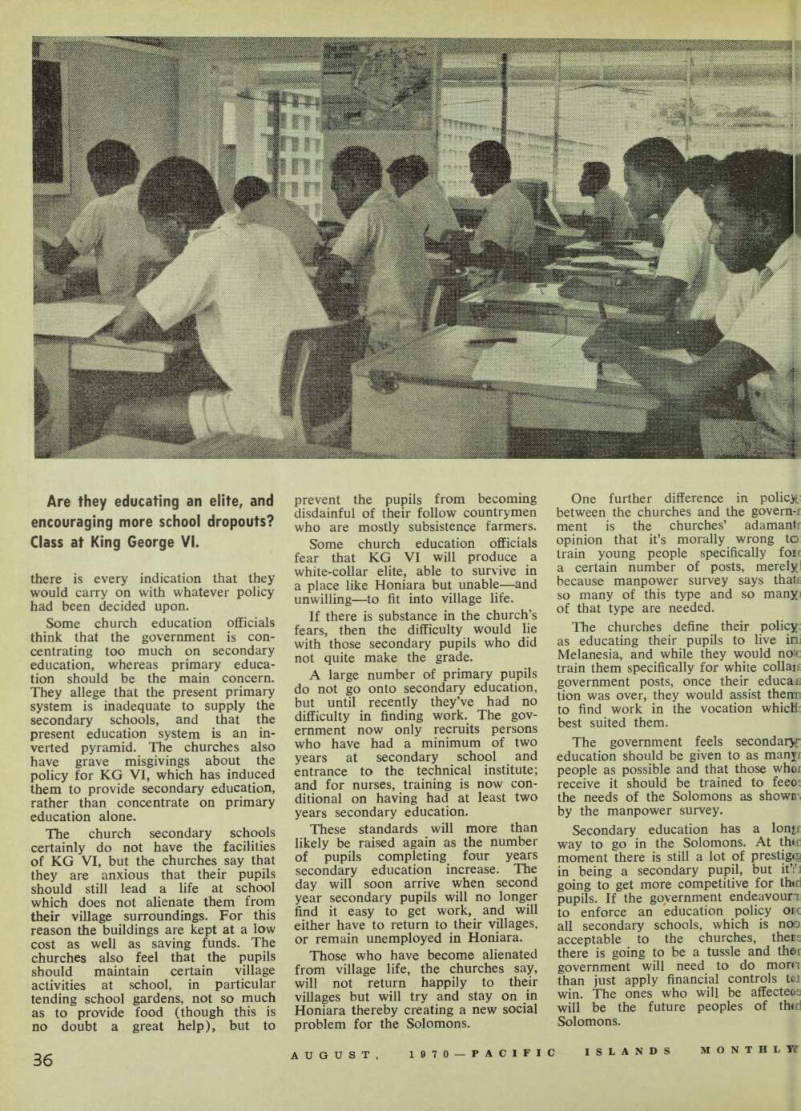
Secondary education is provided iy the government and the churches, The government has one secondary ichool which serves the whole Solonons, the King George VI school on he outskirts of Honiara on the road )ut to the airfield. At a cost of over Si million it accommodates 320 jupils with an ultimate capacity of 140-350. It has an annual intake of 100 pupils. They each stay on for wo years; at the end of two years, i°me 60 go on to complete the final wo years and take the school certificate.
In February, the Anglican church >pened Selwyn College, 16 miles east )f Honiara, which will also provide i four year secondary course, al though not yet complete, it will >e a completely different establishnent to King George VI school.
Jnhke the former, which starkly ronts the coast road with a neat asortment of concrete buildings, >elwyn College is approached by a r ery quiet back track and spreads >ut oyer a fairly large campus. The chool buildings are all one storey and ire scattered in among the trees on he site. At present there are 195 mpils but it is planned to have an innual intake of 90 who will stay or two years, and of whom 60 each fear will go on for a further two ♦ io -i 4 , tt • mile i of Homara s tne Roman Catholic Secondary
School, St. Pauls, which has 90 pupils.
The Seventh-day Adventist School, Betikama, which is close to King George VI, provides two years of secondary education but is going to extend its course for the full four years. , On Malaita, the South Sea Evangel leal Church provides two years secondary education at Sala.
In the Western Solomons, there is Goldie College, which provides two years of secondary education.
The manpower survey will no doubt say that so many persons should be trained in this field and so many in that and so on. It is the governments aim that King George VI and the other schools will produce the re quired numbers for the different vocations and trainings. When I asked how the government would achieve the co-operation of the churches if they were otherwise minded, I was told by financial con trol—presumably meaning the with drawal of subsidies if a church school was unco-operative, or the in crease in extension of subsidies if they were co-operative, However, even now the govern ment subsidies only apply to the first two years of secondary education.
Some church education officials inter pret this as a government attempt to limit church schools to the first two years of secondary education and for King George VI to provide all subsequent education, This is however, denied by the Director of Education. As the church schools have decided to go ahead with a full secondary education programme, despite the lack of gov eminent subsidies above second year
there is every indication that they would carry on with whatever policy had been decided upon.
Some church education officials think that the government is con centrating too much on secondary education, whereas primary educa tion should be the main concern.
They allege that the present primary system is inadequate to supply the secondary schools, and that the present education system is an in verted pyramid. The churches also have grave misgivings about the policy for KG VI, which has induced them to provide secondary education, rather than concentrate on primary education alone.
The church secondary schools certainly do not have the facilities of KG VI, but the churches say that they are anxious that their pupils should still lead a life at school which does not alienate them from their village surroundings. For this reason the buildings are kept at a low cost as well as saving funds. The churches also feel that the pupils should maintain certain village activities at school, in particular tending school gardens, not so much as to provide food (though this is no doubt a great help), but to
prevent the pupils from becoming disdainful of their follow countrymen w h o are mostly subsistence farmers, Some church education officials fear that KG VI will produce a white-collar elite, able to survive in , Honiara hut unable and t o fltllva™ge liCe If substance fa (he church . s fears, then the difficulty would lie wj(h those secondary pupils w h o did ite make the gra( j e> , f nr ; mnrv nlin ;ic A large number of primary pupils do not go onto secondary education but until recently k ve T^ d no difficulty in finding work. The gov eminent now only recruits persons who have had a minimum of two years at secondary school and entrance to the technical institute; and for nurses, training is now con ditional on having had at least two y ears secondary education.
These standards will more than likely be raised again as the number of pupils completing four years secondary education increase. The day will soon arrive when second y^ a r secondary pupils will no longer find it easy to get work, and will either have to return to their villages, or remain unemployed in Honiara.
Those who have become alienated from village life, the churches say, will not return happily to their villages but will try and stay on in Honiara thereby creating a new social problem for the Solomons.
One further difference in policy; between the churches and the govera-i ment is the churches’ adamantr opinion that it’s morally wrong to train young people specifically foie a certain number of posts, merely because manpower survey says thafi so many of this type and so many, of that type are needed.
The churches define their policy: as educating their pupils to live in: Melanesia, and while they would noic train them specifically for white collar government posts once t h e ir educas f i(m was ove] P they would assist therm to find work in the vocation which su jted them, , The government feels secondary education should be given to as many: people as possible and that those whoi receive it should be trained feeoi the needs of the Solomons as showni by the manpower survey.
Secondary education has a lon«r way to go in the Solomons. At thtr moment there is still a lot of prestige i n being a secondary pupil, but itV: go i ng to get more competitive for thid pupils. If the government endeavour* to enforce an education policy ore aU secondary schools, which is noo acceptable to the churches, there there is going to be a tussle and ther government will need to do morn than just apply financial controls tot win. The ones who will be a ff ect £ ( '3 will be the future peoples ot ttwri Solomons.
Are they educating an elite, and encouraging more school dropouts?
Class at King George VI.