Tropicalities
pp. 33-34 · Read in the full issue
"Bubuti" May Be Dying On Tarawa
A fascinating side-effect of the Gilbert and Ellice Islands’ new judicial policy of fining court offenders where possible rather than imprisoning them, is that the bubuti system—whereby an offender often relies on his relatives and friends to pay his fine—might be on the way out.
Up to now many islanders con victed of minor offences, especially drunkenness, have proved that crime DOES pay by not only expecting their relatives and friends to cough up for the fine by right of bubuti, but for more drink as well! Now there’s just not enough money around to pay for all these fines.
Bubuti means that if a man asks a relative or friend for something, he is honour bound to give it to him.
As Joyce Summers said in a July issue of the Colony Information Notes : “The question is now how fast is the bubuti system dying out.
Dying, it undoubtedly is on Tarawa, probably hurried along by the higher court fines which must increase a relative’s reluctance to ‘foot the bill’.”
The judicial policy, however, has had one excellent effect. The prisons are less crowded with minor offenders and government revenue is increasing.
Drunks in fact are helping the economy. Half the crimes on Tarawa
are due to drinking and in the past six months of the new system, $9,584 in fines have been levied. Last year a total of only $339,5 was levied in fines, according to the C1N report.
In 1969, 28 per cent, of the cases appearing before the Senior Magis trate’s Court on Tarawa paid fines.
For the first six months of this year (the new system started in January), 71 per cent, of people have paid fines.
And the fines have been higher.
Offenders can choose imprisonment or a fine.
The new policy is based on the theory that if a man can find the money to get drunk he can find the money to pay a fine.
Although it’s too early to say defi nitely yet, there appear to be fewer minor offenders in the courts because people are aware of the severity of the fines.
BSIP Christmas stamp
— a world winner
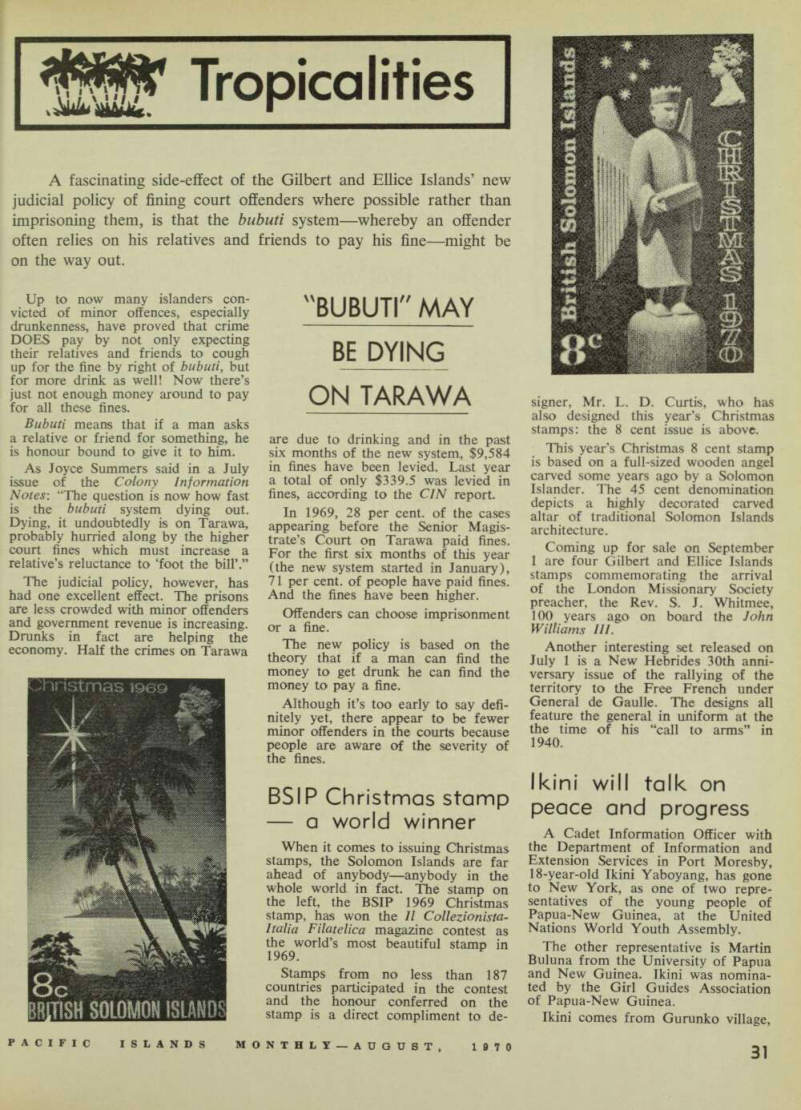
When it comes to issuing Christmas stamps, the Solomon Islands are far ahead of anybody—anybody in the whole world in fact. The stamp on the left, the BSIP 1969 Christmas stamp, has won the 11 Collezionista- Italia Filatelica magazine contest as the world’s most beautiful stamp in 1969.
Stamps from no less than 187 countries participated in the contest and the honour conferred on the stamp is a direct compliment to de-
signer, Mr. L. D. Curtis, who has also designed this year’s Christmas stamps: the 8 cent issue is above.
This year’s Christmas 8 cent stamp is based on a full-sized wooden angel carved some years ago by a Solomon Islander. The 45 cent denomination depicts a highly decorated carved altar of traditional Solomon Islands architecture.
Coming up for sale on September 1 are four Gilbert and Ellice Islands stamps commemorating the arrival of the London Missionary Society preacher, the Rev, S, J. Whitmee, 100 years ago on board the John Williams 111.
Another interesting set released on July 1 is a New Hebrides 30th anni versary issue of the rallying of the territory to the Free French under General de Gaulle. The designs all feature the general in uniform at the the time of his “call to arms” in 1940.
Ikini will talk on
peace and progress
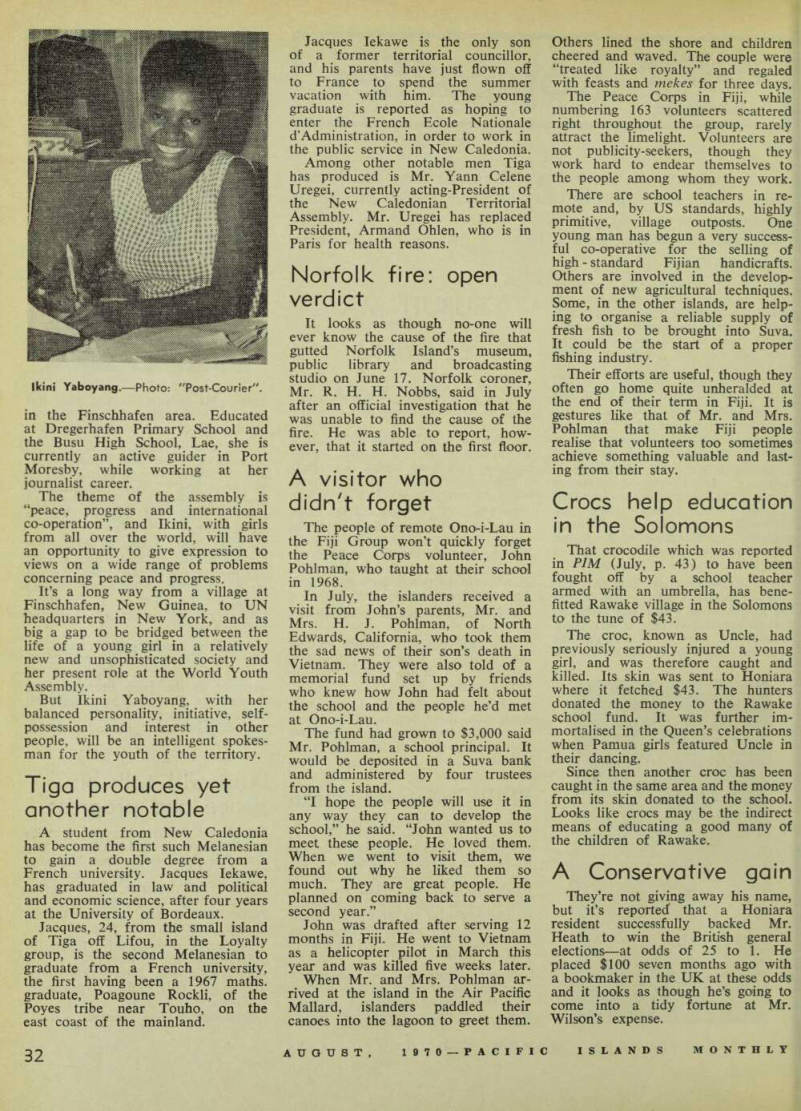
A Cadet Information Officer with the Department of Information and Extension Services in Port Moresby, 18-year-old Ikini Yaboyang, has gone to New York, as one of two repre sentatives of the young people of Papua-New Guinea, at the United Nations World Youth Assembly.
The other representative is Martin Buluna from the University of Papua and New Guinea. Ikini was nomina ted by the Girl Guides Association of Papua-New Guinea.
Ikini comes from Gurunko village,
in the Finschhafen area. Educated at Dregerhafen Primary School and the Busu High School, Lae, she is currently an active guider in Port Moresby, while working at her journalist career.
The theme of the assembly is “peace, progress and international co-operation”, and Ikini, with girls from all over the world, will have an opportunity to give expression to views on a wide range of problems concerning peace and progress.
It’s a long way from a village at Finschhafen, New Guinea, to UN headquarters in New York, and as big a gap to be bridged between the life of a young girl in a relatively new and unsophisticated society and her present role at the World Youth Assembly.
But Ikini Yaboyang, with her balanced personality, initiative, self possession and interest in other people, will be an intelligent spokes man for the youth of the territory.
Tiga produces yet
another notable
A student from New Caledonia has become the first such Melanesian to gain a double degree from a French university. Jacques lekawe, has graduated in law and political and economic science, after four years at the University of Bordeaux.
Jacques, 24, from the small island of Tiga off Lifou, in the Loyalty group, is the second Melanesian to graduate from a French university, the first having been a 1967 maths, graduate, Poagoune Rockli, of the Poyes tribe near Touho, on the east coast of the mainland.
Jacques lekawe is the only son of a former territorial councillor, and his parents have just flown off to France to spend the summer vacation with him. The young graduate is reported as hoping to enter the French Ecole Nationale d’Administration, in order to work in the public service in New Caledonia.
Among other notable men Tiga has produced is Mr. Yann Celene Uregei, currently acting-President of the New Caledonian Territorial Assembly. Mr. Uregei has replaced President, Armand Ohlen, who is in Paris for health reasons.
Norfolk fire: open
verdict
It looks as though no-one will ever know the cause of the fire that gutted Norfolk Island’s museum, public library and broadcasting studio on June 17. Norfolk coroner, Mr. R. H. H. Nobbs, said in July after an official investigation that he was unable to find the cause of the fire. He was able to report, how ever, that it started on the first floor.
A visitor who
didn't forget
The people of remote Ono-i-Lau in the Fiji Group won’t quickly forget the Peace Corps volunteer, John Pohlman, who taught at their school in 1968.
In July, the islanders received a visit from John’s parents, Mr. and Mrs. H. J. Pohlman, of North Edwards, California, who took them the sad news of their son’s death in Vietnam. They were also told of a memorial fund set up by friends who knew how John had felt about the school and the people he’d met at Ono-i-Lau.
The fund had grown to $3,000 said Mr. Pohlman, a school principal. It would be deposited in a Suva bank and administered by four trustees from the island.
“I hope the people will use it in any way they can to develop the school,” he said. “John wanted us to meet these people. He loved them.
When we went to visit them, we found out why he liked them so much. They are great people. He planned on coming back to serve a second year.”
John was drafted after serving 12 months in Fiji. He went to Vietnam as a helicopter pilot in March this year and was killed five weeks later.
When Mr. and Mrs. Pohlman ar rived at the island in the Air Pacific Mallard, islanders paddled their canoes into the lagoon to greet them.
Others lined the shore and children cheered and waved. The couple were “treated like royalty” and regaled with feasts and mekes for three days.
The Peace Corps in Fiji, while numbering 163 volunteers scattered right throughout the group, rarely attract the limelight. Volunteers are not publicity-seekers, though they work hard to endear themselves to the people among whom they work.
There are school teachers in re mote and, by US standards, highly primitive, village outposts. One young man has begun a very success ful co-operative for the selling of high - standard Fijian handicrafts.
Others are involved in the develop ment of new agricultural techniques.
Some, in the other islands, are help ing to organise a reliable supply of fresh fish to be brought into Suva.
It could be the start of a proper fishing industry.
Their efforts are useful, though they often go home quite unheralded at the end of their term in Fiji. It is gestures like that of Mr. and Mrs.
Pohlman that make Fiji people realise that volunteers too sometimes achieve something valuable and last ing from their stay.
Crocs help education
in the Solomons
That crocodile which was reported in PIM (July, p. 43) to have been fought off by a school teacher armed with an umbrella, has bene fitted Rawake village in the Solomons to the tune of $43.
The croc, known as Uncle, had previously seriously injured a young girl, and was therefore caught and killed. Its skin was sent to Honiara where it fetched $43. The hunters donated the money to the Rawake school fund. It was further im mortalised in the Queen’s celebrations when Pamua girls featured Uncle in their dancing.
Since then another croc has been caught in the same area and the money from its skin donated to the school.
Looks like crocs may be the indirect means of educating a good many of the children of Rawake.
A Conservative gain
They’re not giving away his name, but it’s reported that a Honiara resident successfully backed Mr.
Heath to win the British general elections—at odds of 25 to 1. He placed $lOO seven months ago with a bookmaker in the UK at these odds and it looks as though he’s going to come into a tidy fortune at Mr.
Wilson’s expense.
Ikini Yaboyang.—Photo: "Post-Courier".