"A quiet Englishman
pp. 91-93 · Read in the full issue
of the best type" -a rarity in the Gilberts of 1880
KEN McGREGOR is building up quite a fund of knowledge on the early traders of the Gilbert and Ellice Islanders. He's been researching in Tarawa, Sydney and Canberra on two odd characters, Alfred Nicking and Peter Grant. This is what he has found out.
How did trader Alfred Kicking survive the savage Tabiteuea war of 1880 and what was life like in the same period on desolate Marakei Atoll for American Peter Grant?
Alfred Francis Kicking certainly won’t be forgotten for a long time, for well over 20 of his descendants live today in the GEIC and others can be found in Sydney and the Mariana Islands.
Born in 1848 in Sydney, the son of a Derbyshire migrant to Australia, he arrived in the Gilberts aboard a trader in the late 1870’s, settling on Tabiteuea.
Tabiteuea had, and still has, the worst reputation of the Gilberts. It was the driest atoll and little grew.
Droughts were common as were wars between neighbouring villages over food supplies, land and women.
Today Tabiteueans still carry two foot coconut knives concealed beneath their waist cloths.
Kicking, whose contemporaries described as an honest, “quiet Englishman of the best type”, survived and traded on the atoll because he remained impartial on all parochial disputes. How he did
it, and if he had any close shaves, will probably never be known.
He did, however, with another Tabiteuean trader, James Garstang, write a letter to the British Consul in Apia, describing the Tabiteuea war of 1880. The letter was dated March 7, 1881.
There is also a report that, shortly, after his arrival on Tabiteuea, Hicking’s younger brother, James, joined him, but died soon after.
The store
burnt down
Alfred was aboard a trader at Tabiteuea anchorage, leaving James alone in the Kicking store. 'Die store burned down with James uninjured.
Five days later James took a small canoe out to sea and was never seen again.
Alfred Kicking remained on Tarawa until his death, in his late
*, n ° ermai }. trading associations, he had competition from five traders. They an £ mcn S“. Tom Linehan, a Chinese ’ Kum On. Hawaiians Kapur and Charlie Komalolai and a Gilbert ese Tieutica I , ’ TT . , . ,. A Kf e . n gardener, Kicking grew at t l ?,, VV roa , Vl , llag€ l P r °P e rty the Gilberts only oleander and fig trees.
Kicking married a local lass, Teraibo, and they had four children, Charles, whose sons leave several descendants, Obaia, who married but left no children, Sarah, whose sons leave at least 19 descendants nnH Hannah, who remained a spinster and Sr- “
js srrrA.fir.u
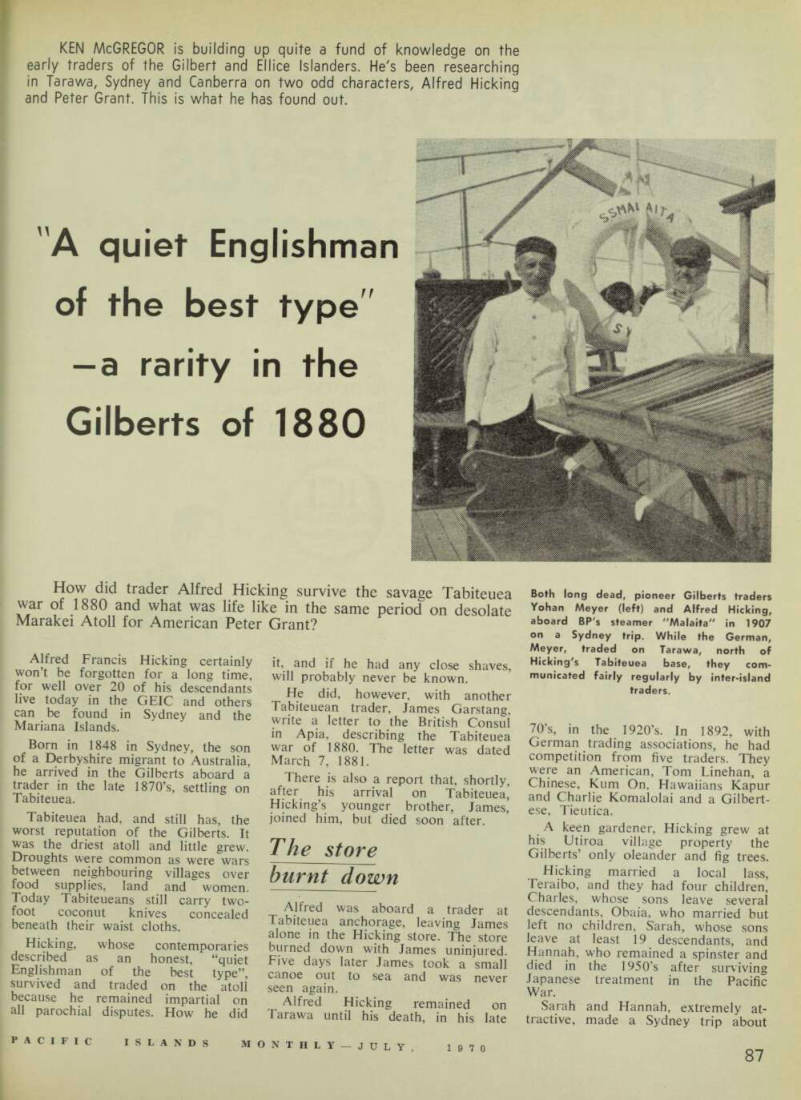
Both long dead, pioneer Gilberts traders Yohan Meyer (left) and Alfred Hicking, aboard BP's steamer "Malaita" in 1907 on a Sydney trip. While the German, Meyer, traded on Tarawa, north of Hicking's Tabiteuea base, they com municated fairly regularly by inter-island traders.
1908, but didn’t receive formal education. They carried on the family business after their father died, but government encouragement of cooperatives finished their trading in the 1930’s . ‘ , A great-grandson of Alfred Hicking, Henry Kicking, who is a clerk in the colony’s Public Works Department at Bainki, Tarawa, has had only partial success in attempts to glean more information on early Tabiteuea days, At North Tabiteuea the old house and two foot thick walled copra shed of the Kicking estate remains. A Vi™, sto [ e . rt^? er . lec * ger °f 1890 s and 1900 s is kept by a local Kicking, Grants story is a similar one; he came ashore at northerly Marakei sometime during the early 1880’s and set up a small trading station.
He lived with a Gilbertese girl and they had a son, Jack.
VV ent to Sydney
T~ , „ • i
to get married
° n . Marakei ’
Sydney by trader woman from d C^lff^f n a iu Ame J lcan settled at Tamwa where Gram bought a small property called Tabonimate, at the lagoon entrance to a tidal passage that separated two islets. , i VF ant enlarged the property by budding dry-stone wahs and filling m behind them with sand and debris.
He erected a store dwelling of im ported hardwood and roofed with corrugated iron. A large copra store shed went up behind the main store, rpont . 0 , , , .
Grant traded on his own account, buying copra and shark skins. In 1892 he was prospering, with the help of a Gilbertese, Karauia, against six other traders on Tarawa a Chinese, Nai Yong, a German, Yohan Meyer, an American, Albert Kustell, an Austrian, Anton Kaofa roafa, a Swede, Carl Johnson and a Cook Islander, Fino.
About 1904 the Grants had a daughter, who was sickly—and died, reportedly “in pitiful circumstances”,’ in 1910.
Grant himself died, at Tabonimata, in 1911. Mrs. Grant stayed on, run ning the business with a recently purchased lagoon-cutter around Tarawa, buying copra from outlying villages. e . , , , , She heard of Grants son, Jack, on Marakei, and in 1912 travelled by trader to Marakei, setting up a branch of Grant’s business there and leaving Jack in charge. The branch, however, did not prosper.
In 1917 Mrs. Grant sold out the business to Burns Philp and Co. Ltd., who were at that time expanding in the QEIC with their own stores and Zns. ° f eXiSting ° pera ' C u c 0 j f She sail f or Sydney on aBP f teamer > w . lth i nt entions of returning to ner native California, never to be heard of again in the GEIC. Jack Grant died many years later, leaving a son called Gilbert, Peter Grants’ only-known survivor in the colony.
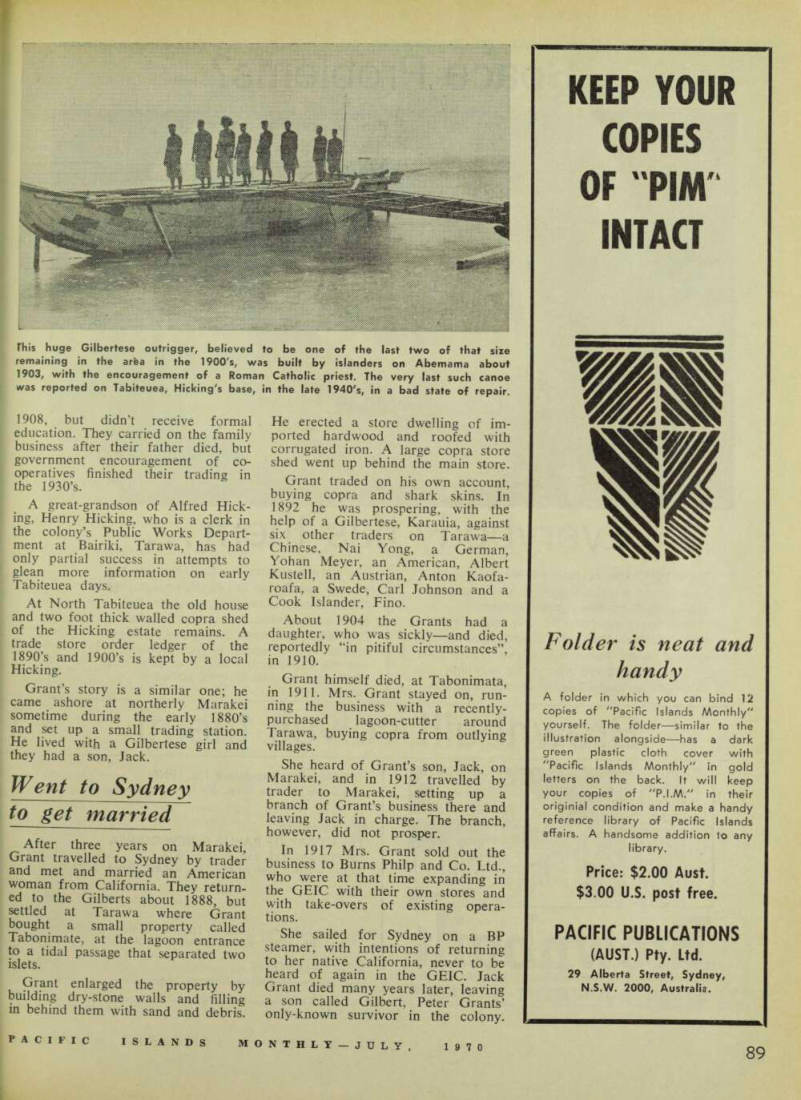
This huge Gilbertese outrigger, believed to be one of the last two of that size remaining in the area in the 1900's, was built by islanders on Abemama about 1903, with the encouragement of a Roman Catholic priest. The very last such canoe was reported on Tabiteuea, Hicking's base, in the late 1940'5, in a bad state of repair.