Yesterday
p. 95 · Read in the full issue
New Caledonia was saddened 20 years ago by the deaths of four members of the local Catholic Church in an Air France Constellation air crash on June 13 in the Persian Gulf. Dead were Mother Guy, with 20 years in Noumea, Sister Marguerite, who nursed lepers in Caledonia for four years, Father Luneau, with 20 years in Caledonia, and Father Luc Amoura, the first New Caledonian to be ordained a priest.
Other news in PIM for July, 1950, 20-years-ago included: After an absence of eight years, Colyer Watson (NG) Ltd., returned to the mainland of NG with the takeover of the trading business and property of Mr. Roy McGregor, at Madang. Colyer had re-established previously after World War II at Kavieng and Rabaul, not re-opening its pre-war bases at Madang and Wau.
Captain Sandy Campbell, former master of BP’s Neptune, Bulolo and Macdhui, was lost when the naval vessel Fairwind went down in a cyclone off the north New South Wales coast about June 24.
NG’s first commercial bulk petrol terminal at Lae, was opened in July 8. It cost £150,000 and was built by Vacuum Oil Co. Pty. Ltd. (now Mobil).
The opening, on Australia’s Barrier Reef, of the resort hotel at Hayman Island drew comment that “Mr. (now Sir) Reg Ansett was showing the Islands a thing or two, and Fiji in particular”. Said a writer: “Fiji has great attractions to offer the tourists but although millions of words have been spilled on the subject, neither public nor private enterprise there has yet done the one thing that would make it possible—that is, provided the accommodation. Maybe Fiji does want a tourist industry, but it obviously does not want it enough”.
Another writer wrote to PIM asking “why Press and politicians do not do something to compel the big companies to give up some of their grip on the New Hebrides land, and thus encourage new settlement and production”.
The Fiji Council of Chiefs was under fire as a result of what a cor respondent described as “the im placable Fijian opposition in the Legislative Council to any change in the colony’s constitution”.
The correspondent said that certain European and Indian groups had made no secret of their ambition to force “some sort of democratic system” on to the Fijians, “whether the mass of the Fijians want it or
not”, and the Council of Chiefs was taking the brunt of it. Legislative Council elections were imminent at the time.
HMNZ Rotoiti made a call at Mangaia, Cook Islands, and a cor respondent reported that immediately before the call “much time was spent by some of the villagers in preparing large supplies of bush beer for sale at 1/- a bottle” but unfortunately “the brew was not always of praiseworthy vintage”.
West Samoan cocoa had been sold to English buyers at an f.0.b., price £WS26O per ton. Fiji sugar was selling for £F3I per ton.
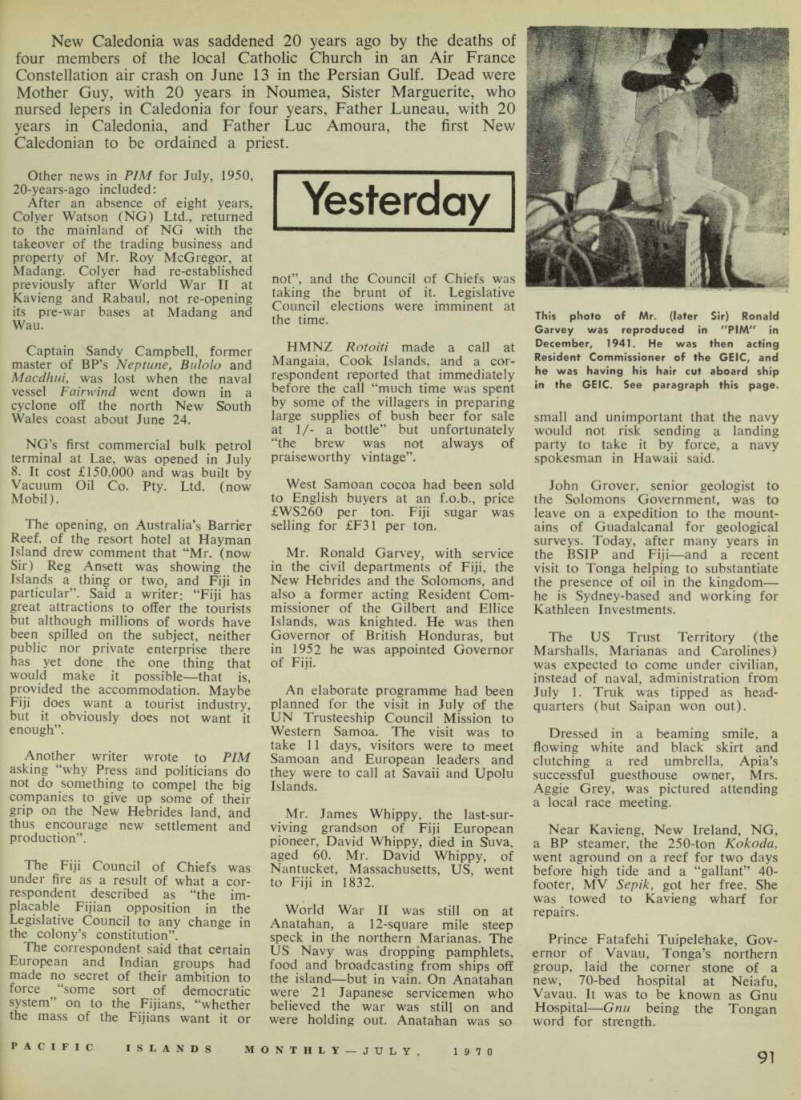
Mr. Ronald Garvey, with service in the civil departments of Fiji, the New Hebrides and the Solomons, and also a former acting Resident Com missioner of the Gilbert and Ellice Islands, was knighted. He was then Governor of British Honduras, but in 1952 he was appointed Governor of Fiji.
An elaborate programme had been planned for the visit in July of the UN Trusteeship Council Mission to Western Samoa. The visit was to take 11 days, visitors were to meet Samoan and European leaders and they were to call at Savaii and Upolu Islands.
Mr. James Whippy, the last-sur viving grandson of Fiji European pioneer, David Whippy, died in Suva, aged 60. Mr. David Whippy, of Nantucket, Massachusetts, US, went to Fiji in 1832.
World War II was still on at Anatahan, a 12-square mile steep speck in the northern Marianas. The US Navy was dropping pamphlets, food and broadcasting from ships off the island—but in vain. On Anatahan were 21 Japanese servicemen who believed the war was still on and were holding out. Anatahan was so
small and unimportant that the navy would not risk sending a landing party to take it by force, a navy spokesman in Hawaii said.
John Grover, senior geologist to the Solomons Government, was to leave on a expedition to the mount ains of Guadalcanal for geological surveys. Today, after many years in the BSIP and Fiji—and a recent visit to Tonga helping to substantiate the presence of oil in the kingdom— he is Sydney-based and working for Kathleen Investments.
The US Trust Territory (the Marshalls, Marianas and Carolines) was expected to come under civilian, instead of naval, administration from July 1. Truk was tipped as head quarters (but Saipan won out).
Dressed in a beaming smile, a flowing white and black skirt and clutching a red umbrella, Apia’s successful guesthouse owner, Mrs.
Aggie Grey, was pictured attending a local race meeting.
Near Kavieng, New Ireland, NG, a BP steamer, the 250-ton Kokoda, went aground on a reef for two days before high tide and a “gallant” 40footer, MV Sepik, got her free. She was towed to Kavieng wharf for repairs.
Prince Fatafehi Tuipelehake, Gov ernor of Vavau, Tonga’s northern group, laid the corner stone of a new, 70-bed hospital at Neiafu, Vavau. It was to be known as Gnu Hospital —Gnu being the Tongan word for strength.
This photo of Mr. (later Sir) Ronald Garvey was reproduced in "RIM" in December, 1941. He was then acting Resident Commissioner of the GEIC, and he was having his hair cut aboard ship in the GEIC. See paragraph this page.