
Pacific Islands Monthly
registered at G.P.0., Sydney, for transmission by post as a newspaper.
July, 1970
Australia 40C New Zealand 45C
U.S. Pacific Territories 70C
French Pacific Islands (Frcs. Cfp.) 65
P.-N.G., Fiji, Other Pacific Territories 35C
Advertisements & other items, pp. 2-22 (10 items)
July, 1 9 7 0 -Pacific Islands Month!
TAA's got you
covered
S 3 All the way from Port Moresby to Lae, Madang, Rabaul, Goroka, Mt. Hagen fifty centres in all The best connections in the Territory. More coverage of Papua/New Guinea, flying air-conditioned twin prop-jets, than any other major airline. Plus the best connections to Australia flying Bird of Paradise’ T-Jets. Mote comfort, more flights, more places. That’s why more people fly TAA Contact your Travel Agent or TAA; Port Moresby 2101.
Lae 2311. Madang 2478. Rabaul 2567. Goroka 8. Mt. Hagen 4 or 301. Wewak 103.
No.l-the friendly one
319 2267/69
TAA’s got you covered,
and DuluxhasTAA covered
More flights. More places. More comfort.
That’s why more people fly TAA to fifty centres in the Territory and islands.
Wherever you fly, TAA has you covered.
And keeping TAA covered: Dulux paint.
TAA chose Dulux for their exciting new ochre and blue colour scheme. Dulux protects their
airline fleet... running a daily schedule
through the elements of nature. Sub-freezing temperatures at high altitudes. 120 degrees on the ground. 300 mile-per-hour airspeeds.
TAA chose Dulux because Dulux paint meets the rigorous standards demanded by our
airline industry.
TAA
AIRLINES Of NEW GUINEA
No.l-the friendly one
made and proved in the Territory. *Dulux is a registered trade mark of BALM Paints Ltd,
IE CBEAIESI
HAME IN
CIGARETTES
All over the world, on six continents, in 160 countries, on 100 airlines and 150 shipping lines, the swing is to Rothmans, the world’s largest-selling King Size Virginia. Rothmans choice mild tobaccos and finer filter are known throughout the world for the cooler, smoother, more satisfying taste they give. Try them now and you’ll agree, Rothmans King Size.really satisfies.
WORLD'S LARGEST SELLING KING SIZE VIRGINIA
From the
Islands Press
J J \ MERICAN SAMOA is
■ ■** preparing to send a ■ ■strong team of government officials, sportsmen and sports fans to Western Samoa for Indepen dence Day celebrations. This visit, coming so soon after the mass arrival of Western Samoans to Pago for the Flag Day celebrations last month, [emphasises the strong bonds of friendship, as well as of language, trade and culture, which exist between our two groups of neighbouring
[islands.
It is strange, therefore, that the [matter of improved communications between American and Western Samoa continues to remain un resolved despite the obvious good !will of the two governments. The [question of the selection of an Ame rican airline for the Pago-Apia route, the question of reciprocal air taxi llanding permits for Air Samoa Ltd., [Air Samoa Inc., and South Seas Air ways seem to have been shelved, in
practice.
I And here’s a few more suggestions: [how about a teletype service (between the two capitals, and a 24hour telephone service, and special cut-rate telegraphic rates, and postage [rates? — Editorial in “The Samoa I Times’", Apia.
T HAVE read with interest quite a few comments on tipping in PFiji. I would like to say those people |\vho receive tips are usually on a [low wage. They are the porters, gaiters and waitresses. I do not understand why tipping should be banned in Fiji when it is even com pulsory in some countries overseas.
L Why do rich people want to stop tipping when a poor man can make f bet *er living out of tips? I feel the subject of tipping should be left to tourists to decide for themselves. If they wish to tip they should be allowed to.
Tipping generally means that the person concerned is happy with the Service he has received.— N. Taj Mohammed, in a letter to “The Fiji Times”. f AM certain that in the style of J" s . ome newspapers overseas, our Premier was misquoted in pointing >ut that even if one of the islands vas to suffer from multi-storey hotels stc., there were always other islands
where people could see how Cook Islanders used to live”.
Our Premier has repeatedly said, even before the South Pacific Com mission, that no hotel higher than a coconut tree will be built. It must be a newspaper misquote, because the Premier doesn’t go back on his word. Letter from Walter H.
Hambuechen, editor of “Cook Islands Review”, in the “Cook Islands News”.
HAS anyone tried using hot water to kill ants and cockroaches in thousands? Many of you were told before so try it now. Hunuki killed thousands of ants in his dispensary with hot water. Wani killed thousands of cockroaches inside bores at home with hot water.
Please try this method instead of asking for insecticides which will cost us dollars and dollars to import. Hot water and general cleanliness is the answer.— ltem in “Tohi Tala Niue”.
IT is with sympathy and regret that one reads of the sad event which occurred between Makin and Butaritari costing the lives of two women [who drowned when a canoe overturned]. Can the government do something about this sort of thing?
If the canoes, for instance, have some kind of life-jacket (which wouldn’t take up much space or add any noticeable weight) those poor women would have had a better chance of survival.
Our people will never stop travel ling by canoes, hence their lives are virtually always at risk. It’s a bit surprising that seaworthy vessels are obliged to be equipped with life jackets (which are never used) while our fragile, less reliable, canoes are not. Surely the lives of passengers in both types of vessels are of equal worth. Or would it be better to leave things as they are as another method of checking our population ex plosion?—Michael Tebano in a letter to the GEIC “Colony Information Notes”.
ONE bag and a little toil equals 30c.—They’re getting into the copra business young in Ovalau these days. Leone Mocelutu, 11, of Tokou village, walked into Morris Hedstrom’s office and asked that his bag of copra be weighed. Shown where to go, he duly arrived back at the office with his chit for pay ment of the proceeds of the sale.
The chit read: One only paper bag of copra; weight, 5 lb; grade, first; gross proceeds, $0.34, less cess, .04.
The net proceeds: 30 cents in pocket money for young H ■■ Leone.— ltem from “The Bf S Fiji Times ”, Suva. Jf J
Pacific Publications Pty. Ltd.
CUMULATIVE INDEX
to the
PACIFIC ISLANDS
MONTHLY
(Volumes 1-15)
The index covers the 15 vital years from August, 1930, to July, 1945, when many of the events which shaped the Pacific of today took place. But PIM in those years (as is the case today) did not only concern itself with current affairs. It abounded also in articles on every aspect of Islands life both past and present—from agriculture, anthropology and aviation to shipping, tourism, vulcanology and the weather. Islands history was (as it still is) a PIM specialty.
Now, with the aid of the new cumulative index, you can find in a few seconds everything PIM ever published from 1930 to 1945 on any subject, whether it was a two-line snippet or a major article.
The index is one of the most detailed productions of its kind ever published. It is divided into nine sections—aircraft, authors of articles, biographical entries, book reviews, companies, letters to the editor, poems and short stories, ships, and territories. Nearly 10,000 people are listed in the biographical section, and there are some 200,000 entries relating to them.
The territories section, which deals with Islands groups such as the Cook Islands, Fiji, French Oceania, Papua, etc., is equally minutely indexed and cross-indexed under a wide range of headings.
The index contains 228 closely-printed, but easy-to-read pages measuring 11 by inches. It is cloth-bound and printed on tough, long-lasting paper.
PRICE: Australia and P-NG, $25.00 Aust., plus 80c posted (includes registered postage); elsewhere, $25.00 Aust., plus $1.05 posted (includes registered postage); USA, $30.00 U.S. posted (includes registered postage).
Pacific Publications Pty. Ltd.
29 Alberta St., Sydney, N.S.W. 2000 (Box 3408, G.P.0., Sydney, N.S.W. 2001)
Milk Arrowroot biscuits
for all-day energy
You and your children use up a lot of energy during the day; but Amott’s Milk Arrowroot biscuits will give you the extra nourishment you need to replace it. The triple-wrapped pack keeps the biscuits crisp and fresh at all times .
Qrnott's/«~> Biscuits
There is no Substitute for Quality
. . . because only Cadbury Dairy Milk Chocolate has a glass and a half of pure, fresh, full-cream milk in every half-pound. It’s so smooth . . . so creamy. A good reason for
always saying C I want Cadbury’s’.
CADBURY
DAIRY MILK CHOCOLATE
the biggest selling block chocolate in Australia
3H 'Vi
NIUE IS
SAMOA.TONGA
U h*.
THROUGHOUT THE PACIFIC
ls. :sm ■Ly\
[SOUTH SEA] CO. LTD.
REGISTERED OFFICE; SUVA, FIJJ[
TELEPHONE NO: 22661
TELEX NO: FJ1127
Code Address:BURNSOUTIT
SHIPPING AGENCIES
The New Zealand Shipping Co. Ltd.
Shaw Savill & Albion Co. Ltd.
Blue Star Port Line (Management) Ltd.
Bank Line Ltd.
General Steamship Corporation Ltd.
Compagnie des Messageries Maritimes Royal Interocean Lines Daiwa Navigation Company Ltd.
Sitmar Line Flotta Lauro (Lauro Lines) Australasia Pty. Ltd.
Tonga Shipping Agency.
EXCLUSIVE
DISTRIBUTORSHIPS
INCLUDE
Akai Taperecorders Dunlop Products Hitachi Electronics Holden Motor Vehicles Rolex Watches Revlon Cosmetics Pentax Cameras Ferguson Tractors Olympic Tyres Penfold Wines
AGENTS FOR
Queensland Insurance Co. Ltd.
Burns Philp Trustee Co. Ltd.
Shell Company (P. 1.) Ltd.
Bureau Veritas
ASSOCIATED COMPANIES
Burns Philp (New Hebrides) Ltd.
Automotive Supplies Co. Ltd.
Corrie & Co. Ltd.
Wrought Iron and Steel Construction Co. Ltd.
Bish Ltd.
SPECIALISED SERVICES
Expert advice on Shipping; Forwarding; Customs formalities; Insurance.
COMPLETE TRAVEL
SERVICE
accredited agents for the
INTERNATIONAL AIR
TRANSPORT ASSOCIATION
OVERSEAS AGENTS; SYDNEY • LONDON • SAN FRANCISCO
n
Jr- t 5?
Johnson
Mod,lino andcorkfloors
15FLOZ
Wax in protection
against mildew...
with Johnson Durosil
Johnson Durosil . . . liquid or paste wax . . . means lasting protection against mildew in your home. Protection which comes from the seven waxes plus silicone in Durosil . . . protection that lasts for keeps. Durosil's dry cleaning action on wood and lino surfaces remove the grease and dirt and waxes to a brilliant shine.
tslohnson wax
Let our know-how,
show you how!
The maintenance and cleaning of motels, hotels, office blocks, factories, hospitals, clubs, restuarants, in fact any institution or commercial premises can be tedious and time consuming to the point of being uneconomical.
Johnson Wax have thoroughly trained representatives in Trevor Kendall (Suva-Fiji) and Glenn Rigg (Port Moresby) awaiting the opportunity to examine the areas of difficulty in your establishment. Based on extensive experience in each of the following fields, they will provide you with practical and money-saving solutions. • Floor Maintenance. • General Cleaning (including disinfection and odour control procedures). • Washroom Maintenance. • Kitchens and Mess Halls. • Insect Control.
Profit by our obligation free advice.
Service Products Division
FIJI; Trevor Kendall, Post Office Box 1174, SUVA.
PAPUA-NFW GUINEA: Glen Rigg, Post Office Box 3204, PORT MORESBY.
FIJI: Trevor Kendall, Post Office Box 1174, SUVA.
PAPUA-NEW GUINEA: Glen Rigg, Post Office Box 3204, PORT MORESBY. wm JW2.8286
FAST, BARGE
OUT OF DARWIN
MB I wm
diesel powered
by CUMMINS*
the new 500-ton Fourcroy,
biggest modern barge built in Australia
Where Fourcroy operates, her engine's have got to be better than good.
Fully loaded with supplies, she makes more than 10 knots out of Darwir to Gove, Groote Eylandt, Weipa and other project areas to Australia's north —barging in strongly through shoals and shallows to land her carg right on the beach.
Fourcroy's owners specified Cummins to ensure a tough, dependable engine for a tough, critical job—and because the full weight of Cummin! service is right there to back it.
Cummins parts and maintenance service reaches right round Australia s coastline and beyond, keeping every Cummins-powered workboat permanently and profitably on the job. * These fast, modern landing barges now opening up important new shipping lanes around Australia and New Guinea are 80% Cummins-powered.
DESIGNERS: Ekon & Doherty BUILDERS: Carrington Slipway OWNERS: Beagle Shipping Co.
POWER: Two Cummins Vl2-525-M diesels with two Cummins C-105-BIM 41.5KVA auxiliaries.
Distributor
CUMMINS DIESEL SALES
& SERVICE (AUST.) PTY. LTD.
Head Office: 164-170 Hume Highway. Lansvale, N.S.W., 72-6211. Telegrams "CUMTORO”
Sydney: 728-6211 • Melbourne: 546-8699 • Brisbane: 68-2146 • Adelaide: 62-5211 • Perth: 65-1144 • Hobart: Bridgewater Junction 381 • Grafton: South Grafton 255 • Darwin: 4-3166 • Lae: 2692 • Townsville: 9-5624 • Pt. Hedland: 2-1333 • Mt. Isa: 3-3985 Factory
CUMMINS DIESEL
AUSTRALIA
(Cummins Diesel Sales Corporation, incorporated in U.S.A. with Limited Liability) Ringwood, Victoria
A
great bunch
of flours.
Robert Hutchinson makes the greatest bunch of flours in the Pacific. Bakers’ flour.
Superlite cake and sponge flours.
Biscuit flour and cracker flour.
Wheaten sharps and wheaten meal.
We’re particularly proud of our bunch of flours. So we have a technical advisory service to help you use them properly.
So next time you see a Robert Hutchinson flour (or even one of our Hutmill stock feeds), remember it’s just one of the bunch. ’ % > .1 Ss 3^ & 4 m
ROBERT
HUTCHINSON
LIMITED
the flour people
Hartington Street, Glenroy, Victoria, Australia. 3046. Telephone Melbourne 306 7261
SOME OF THE FIRMS
WE REPRESENT ARE:
A. W. Allens (Confectionery) Sunshine Biscuits Sunrise (Confectionery) Flamenco (Instant Coffee) Cremota (Quaker Oats, Jets Pet Foods) Merchants (Canned Soft Drinks) Lunchtime (Honey) South Pacific Canneries (Scallops, Abalone) Safcol (Canned Tuna, Salmon) Hancock's (Spaghetti, Cereals) Melbourne Canning (Jams, Bleach) Water Wheel (Flour, Sharps, Wheat) General Food Corporation (Twisties, Twirlies) Edward Zorn (Margarine, Cooking Fats) Robert Timms (New Guinea Gold Coffees, Teas) Rodd (Cutlery) Nylon Palm (Mattresses) Esteel (Cookware) Vendolux (Cafe Bars) Mitchell's (Abrasives) Regent (Swiss Watches) Gainsborough (Furniture) Tamco (Melanie Crockery, Hardware) Elmaco (Plastic Household Goods, Electrical Fittings) Brownbuilt (Pre-Fabricated Houses) Ryline (Fluorescent Lights) Jex (Steel Wool) Austramax (Pressure Lamps) Preservene (Soap Products) Charles Tims (School Requisites) Ascow and Philadelphian (Shirts) Lawn Chair and Tubco (Garden Furniture) Sunrise Lustretone (S.S. Sinks, Plumbers' Supplies) Electronic Industries (Electrical Household Appliances)
S. E. TATHAM
& Co. Pty. Ltd.
MELBOURNE, AUSTRALIA
G.P.O. Box 8, Cables "SET Telephone 60-1125
EXPORT AGENTS
PACIFIC ISLANDS
AGENTS
Australian buying and shipping agents for the Gilbert and Ellice Islands Colony Wholesale Society
DIRECT ENQUIRIES WELCOMED
1 1 Associate Company
S. E. TATHAM (FIJI) LTD,
Suva, G.P.O. Box 671.
Lautoka, P.O. Box 366.
SINCE 1924
, te drink W« mite
SSSSS*"”-
gives x ° £it on toa st ® t water waV- Stir \t be tter V oU an dNA/\cn e hON/v/ muon - o drink. bee ion \\on. A as young UK© iee\
.j6s&£/D
V / V ' P • c* vj D /■ A 0 u as £/l UiTrrrrrrrSJ M4020/9
VILLABOARD
WALLS
THE NEXT BEST THING
TO PAINT AND PAPER
mm** You may have heard that line before somewhere.
It means that what goes underneath is every bit as important as what's on top. This applies to walls, too.
If the walls are going to peel then the wall paper is going to do a strip as well. Or if they're not waterproof your feature wall could change its features overnight. The answer is to use a wallboard that's really tough: Villaboard.
It’s fire resistant, water resistant and childproof. It won’t warp or buckle or perform a slow peel in front of your friends. But for something so tough, Villaboard is very accommodating. It takes all kinds of surface finishes, even tiles.
So you can use it all over the house if you wan to. It's ideal for ceilings, too. Ask your buildei what’s the next best thing to paint and paper He knows.
Or send in to us for free colourful and informa tive literature.
Villaboard
Wunderlich Limited —Head Office and Showroom: 393 Cleveland St., Redfern, N.S.W. Australia, 2016. Tel.: 69 0366
world
quality
??• m m sM.
Y § P v A M mm **■ t* lY
one
Only the world’s finest Virginia tobaccos are blended to produce ...
PLAYER’S
GOL
LEAF
of the great cigarettes
8593/2/70
When the best beer is called for, New Zealand’s favourite lager ...
STEINLAGER
Ideal for tropical conditions . . . .
George and Ashton refrigerated fibreglass truck unit
f natural cheese at itsbest'
DISTRIBUTORS
BACON HAMS
ASMAUfiOODS
These refrigerated truck units are fully approved by the New Zealand Departments of Health and Agriculture. They can be designed for use with any type of vehicle from pick-ups to semitrailers or they can be used as static storehouses using their own refrigerating units.
These units are made from moulded fibreglass tough, hygienic, colourful. There are no joints to harbour vermin and cleaning is guick, easy and efficient.
Enguiries welcomed.
P.0.80x 2056, Dunedin New Zealand Phone:42-779
.V * * i 3 > \td !Z3 Zjl At loose ends with your present tape deck?
Meet the Sansui SD-7000.
Until now, owning a decent tape deck meant a willingness to suffer certain inconveniences—broken tapes, excessive slack, stretching and stresses. Not any more.
Sansui, after three years and ten experimental models, has just brought out the all-new SD-7000, a 3-motor 4-head deck that puts special emphasis on tape protection devices, more than you'll find on any comparably priced model you can name.
They include circuits that preclude breaks in going from Fast Forward or Rewind to Stop and then to Play, and which minimize resistance during Fast Forwarding or Rewinding; a Tape Tension switch to prevent tape stretching, a tape speed-governing device, and built-in safeguards against accidental erasing or reversing.
Sansui engineers also devoted special attention to giving the SD-7000 superior tone quality, as reflected in a frequency response of 15 to 25,000 Hz, a better than 60dB S/N ratio and very low distortion.
And ease of operation is ensured through such advanced features as Automatic Rewind, Repeat and Reverse, either by recorded 20Hz signals or by attached sensing strips; convenient push button controls, automatically resetting reel clampers, Stereo/Mono L-fR Recording Mode switch, self-locking Pause switch, tape travel direction lamps, Sleep switch and much more' If your present taping unit has you at loose ends these days, your nearest authorized Sansui dealer will soon be able to show you the SD-7000, the stereo investment with the built-in protection.
Matching components , matchless stereo.
ar
transarc
CSPI f *
Industrial Gases
Comweld
Gas welding and cutting.
Plants, Rods and Fluxes, Flame cleaning. Flame hardening and flame heating equipment
EMF Electric
Welding Equipment
Arc welding machines Automatic welding machines Automatic wires and fluxes Electrodes
Arnold-DeVilbiss spray
painting equipment
including spray guns, air fitters and compressors, multipurpose units with spray booths, and a full range of automatic equipment.
dG FOR ALL
YOUR WEEDING &
SPRAY PAINTING
EQUIPMENT
CIG
CIG supply centres throughout Papua-New
LAE: CIG New Guinea Pty Ltd, Phone 2641
PORT MORESBY:
CIG New Guinea Pty Ltd, Boroko Phone 5 3870 MADANG: Madang Slipways Pty Ltd, RABAUL: Rabaul Metal Industries Pty Ltd, WEWAK: B & G Motors Pty Ltd, GOROKA: Collins and Leahy Pty Ltd, KAINANTU: Kainantu Trading Co Ltd, KUNDIAWA: Collins & Leahy Pty Ltd,
MT. HAGEN:
Kala Motors Pty Ltd, Guinea SAMARAI; Belesana Slipways Pty Ltd, BANZ: Kamarl Coffee Plantation
LORENGAU:
Edged & Whiteley Ltd, KIETA: Breckwoldt & Co (NG) Pty. Ltd, CG2993/69
Mini Cost Houses
and Buildings^^^l
*5
Easily assembled pre-fab units
from $2.50 per sq.ft,
according to size and finish
is □ □ □ The new Brownbuilt mini-cost, modular, pre-fab unit concept was specially developed to provide practical housing for the tropics and remote communities.
Look at these advantages: □ Metal framed to take high wind loadings eliminates warping. □ Metal walled and roofed to take ‘clip-in’ linings and ceiling panels (which can be added later). □ Designed for packing for delivery to remote and hilly locations and for assembly by unskilled labour. □ Maximum durability.
Fire resistant, rust proofed, eliminates dry rot and termites. □ 12” modular construction for flexibility of design and size. □ Adaptable to many uses besides homes: churches, schools, stores, messes, offices, dormitories, hospitals, community halls, warehouses, workshops, weekenders.
Send for our detailed illustrated brochure.
Brownbuilt
ALSO: ROOF DECKING • WALL CLADDING
FEATURE GUTTER • CEILING SYSTEMS
U FOAM • SHEET PILING
BUILDING PRODUCTS 1 DIVISION
6 Brunker Road, ChuNora, N.S.W. 2190, Australia.
Phone: 709-4511 RESIDENT representative John Dwyer Saraga Street Six Mil
DISTRIBUTORS:
PORT Morobe Constructions MORESBY: Pty. Limited. John Stubbs & Sons (Papua) Limited.
D. C. Watkins Limited.
FIJI: Reddy Construction Company Limited.
Narain Construction Company Limited.
RABAUL: Rabaul Metal Industrie Pty. Limited.
LAE: Lae Plumbing Limited.
Watkins (Overseas) LimiteC Port Moresby Telephone 53144 MADANG; Madang Building Supplies.
MT. HAGEN: South Pacific Hardware Distributors.
HONIARA: Tischler Constructions Pty. Limited. 8:P22
Which one is the new Akai M-10?
They all are!
We get carried away every time we turn one on.
Ten years ago we introduced the “Big M“ series.
Since then, thanks to you, these fine stereo tape recorders have sold as fast as they could be produced.
The new M-10 is the finest of the series. Features include AKAI's world famous cross-field head system, 3-speed direct drive capstan hysteresis synchronous motor, separate torque motors and continuous automatic tape reverse.
These coupled with a 40 watt all solid state amplifier, give exceptionally wide frequency response with negligible distortion and extremely low wow and flutter.
The M-10 can be used with its own inbuilt loudspeakers or with your choice of external speakers. Ask to see the AKAI range.
The M-10 is available in either oiled wood or vinyl cabinets.
AKAI
AUSTRALIA; AKAI Australia Pty. Ltd., 276 Castlereagh St., Sydney, N.S.W. NEW ZEALAND: G. Glausiuss Coy, P.O. Box 640, Christchurch SUVA; Burns Philp (South Sea) Co., Ltd. LAUTOKA: Burns Philp (South Sea) Co.. Ltd. SAMOA: Burns Philp (South Sea) Co., Ltd., Pago Pago, American Samoa/Burns Philp (South Sea) Co., Ltd., Apia Western Samoa NORFOLK ISLANDS: Burns Philp (South Sea) Co., Ltd., Norfolk Island, South Pacific NEW HEBRIDES: Burns Philp (New Hebrides) Ltd., Port Vila/Burns Philp (New Hebrides) Ltd., Santo NEW CALEDONIEA: “Menard Freres", P.O. Box 123, Noumea BRITISH SOLOMON ISLANDS; Mendana Enterprises (Solomon Island) Ltd., P.O.
Box 12, Honiara, 8.5.1. P. NAURU; Nauru Co-operative Society COOK ISLANDS; N.T. Napa (Avarua) Ltd., Rarotonga TAHITI: Ets. Comimpex., P.O. Box 200, Papeete PAPUA & NEW GUINEA: S.O. Svensson (N.G.) Ltd., P.O. Box 705, Port Moresby TONGA: Burns Philp (South Sea) Co., Ltd., Nuku Alofa
PACIFIC ISLANDS MONTHLY
IS A FASCINATING PACIFIC
PACKAGE. . .
• . . with concise reporting on the significant news of the South Pacific, penetrating background stories, bright informative magazine articles, big picture features. Pacific travel, profiles of Pacific personalities, a cruising yachtsman's department, Islands' business and development, reviews of the latest books and a special section for planters.
Take out a subscription and dip yourself each month into the real Sooth Pacific.
USE THE FORM OVERLEAF TO BECOME A REGULAR READER
News magazine of the South Pacific
Please enrol me as a subscriber to “ Attached find payment of
subscription.
□ NEW □ RENEWAL
(CAPITAL LETTERS)
Pacific Islands Monthly”, for years
NAME
ADDRESS
COUNTRY
PACIFIC ISLANDS MONTHLY
Box 3408, G.P.0., Sydney, N.S.W. 2001, Australia. 29 Alberta Street, Sydney, N.S.W. 2000.
JULY, 1970—PACIFIC ISLANDS MONTHLY
6
JULY, 1970 PACIFIC ISLANDS MONTHL
7
ACIFIC ISLANDS MONTHLY JULY, 1970
10
JULY, 1970 PACIFIC ISLANDS MONTHL
12
JULY, 1870 PACIFIC ISLANDS MONTHL
13
ACIFIC ISLANDS MONTHLY JULY. 1970
14
JULY, 1970 PACIFIC ISLANDS MONTHL
Up Front
with the Editor
When Fiji attains dominion status just a few months from now, she will be entitled to some high level representation in overseas capitals. She will be appointing High Commissioners to London and Canberra as a starter, and a representative in the UN, and naturally a number of people would like to get those plum jobs should Ratu Mara and his cabinet decide on them.
After all, the post of Fiji High Commissioner in Canberra (a High Commissioner being equivalent of an Ambassador among Common wealth countries) could carry con siderably more perks than onerous duties.
But it would also cost consider ably more to run than does the office of the present Fiji Representative in Australia, who is based in Sydney.
In the past there has been enough belly-aching in Suva at the cost of the modest Sydney office, and the expense of full-scale High Com missions here and elsewhere would surely give both the Fiji Finance Minister and the electors apoplexy.
Despite this, one shouldn’t be un sympathetic to Fiji’s problem.
Diplomatic representation abroad is a problem in the South Seas, and it is going to be faced more and more as the territories “emerge”, as the current phrase has it.
On the one hand it’s natural that they should want to underline their new status by flying their flags abroad; on the other, they know they have to watch costs and be practical, for no South Pacific ter ritory is rich enough to dissipate its budget on empty gestures.
In that regard, the South Pacific has shown more commonsense than some of the African States, with their large and expensive diplomatic representation in London, New York and Washington. But commonsense is an attribute of the South Sea Islander.
Tonga has been criticised, I think rightly, for having established an ex pensive office in London when it might have been more practical to set up a trade office in Sydney or Auckland first. I hope that now she has joined the “comity of nations”
she doesn’t get too exuberant about establishing unproductive overseas representation. King Taufa’ahau has been talking about joining that ex pensive club, the UN.
The Republic of Nauru, to be sure, now also has an office in London— started in May—but it’s fairly modest, operated by former Government Secretary Q. V. L. Weston, and Nauru set an example of common sense by establishing not an Embassy in Canberra following independence two years ago, but a business office in Melbourne. The Melbourne office is still the only overseas representa tion the republic has got, apart from the new London office. There were some pressures on President Deßoburt to establish a diplomatic mission in Canberra, but he wisely considered the expense unnecessary.
Nauru's position
Nauru’s Melbourne office has been searching for a new Official Repre sentative for Australia—the last one, Mr. L. J. Lockie, having recently been dismissed. As it probably causes less reaction to dismiss a represent ative than an Ambassador there are additional advantages in having this style of representation! President Deßoburt has said he doesn’t intend to join the UN, for the time being anyway.
Western Samoa, independent longer than any other South Seas territory, has set a better example still— Samoa has no diplomatic representa tion of her own anywhere. If she wants anything done at diplomatic level she has the right to use Com monwealth channels just as if she were a member of the Common wealth—which she hasn’t been up till now. New Zealand has been keeping an eye on things for her. Under the
Treaty of Friendship with New Zealand she is represented overseas through NZ diplomatic posts, and through British offices where there is no NZ post. She can, however, make overseas diplomatic approaches direct if she chooses.
West Samoa has only two overseas representatives, an honorary consul in Los Angeles, Mr. J. G. Rough, and a trade commissioner in Auck land, Mr. Eddie Stehlin.
West Samoa has been an “as if” member of the British Common wealth—that is, she has been treated as if she were a member—and former Prime Minister Fiame Mata’afa deserves credit for getting the best of both worlds with this system.
Mata’afa was opposed to Samoa join ing the UN, but saw to it that Samoa joined some UN agencies and profited by membership.
Tupua Tamasese Lealofi and his cabinet take a different view, and I should imagine that the system of overseas representation will be changed following Commonwealth membership.
The Cook Islands, being part of New Zealand with her people New Zealand citizens, is in a different situation. Premier Albert Henry would certainly like to see more direct representation in Australia.
He made it clear on his recent first visit to Sydney, in a conversation with me, that Australia had never heard of the Cooks. That direct con tact was to be preferred to indirect representation through the New Zea land High Commission. While he was here, Mr. Henry certainly tem porarily bridged the gap officially (and, incidentally, with his many public appearances, won a great many Australian friends for the Cooks).
Mr Henryk dilemma
Mr. Henry’s dilemma underlines the dilemma of his neighbouring terri tories: that is if you don’t have direct representation, how can you get your point of view across? And if you do have representation, how much should you spend on it? Should you estimate its worth on what you can get out of it immediately or what you can get long term?
The unhappy fact is that Australia will help the South Pacific Islands only if the Islands remind her con stantly they are there. There is money to be got, and in Australia’s case I think there are migration advantages to be won. Diplomatic and/or trade representation will more quickly apply the pressure where it will do most good.
I would like to think there was an opportunity here for the South Pacific
Our Cover
When Bruce Adams, whose work often appears in “PlM’s” pages, found this pretty 15year-old Trobriand Islands girl working in food gardens on Kiriwina, she was complete with colourful ornaments. Apparently she and some of her friends had just been taking part in some minor festivities, and, Islands like, they hadn't troubled to re move the baubles. But it all made a very nice picture. The marks on the pretty islander's cheek and forehead are tattoo marks. Tattooing is still practiced in many parts of Papua.
to develop a kind of diplomatic repre sentation suited for her needs. The Islands have already shown that the Westminster system of parliamentary democracy is not necessarily the system suited to the South Seas, so why shouldn’t they also develop their own diplomatic style—one which will have the most effect for the least cost?
Why not indeed? But unfortun ately the Vienna Convention laid down by the West, dictates the pro cedures of diplomatic protocol, and if the Islands want full representation they must follow the accepted pro cedures, and hope that these will not stifle the Islanders’ reputation for friendly ease and natural dignity.
I am prepared to admit that high level representation in Canberra can achieve results, through contact with representatives of other governments besides the Australian Government.
But I question the Islanders’ need for the type of expensive empire building seen in Canberra, Welling ton and London among the High Commissions and Embassies of this world.
One High Commissioner in Canberra, with a couple of typists, plus a big Fijian or two, in sulu and sandals, or a friendly Indian with administrative know-how, based in Sydney or Auckland as supporting troops—could be a more effective diplomatic staff in this corner of the world.
THE “in” route to Europe is via the Gilbert and Ellice Islands— according to Ken McGregor. Ken, aged 25, a valued PIM staff writer since 1966, left us in June to further his journalistic career in Europe. But as he’ll spend a few months in the GEIC en route, writing for us, his byline won’t disappear immediately from our pages.
Stuart Inder
Pacific Islands
Monthly
Established 1930; 40th Year of Publication.
Owned And Published By
Pacific Publications (Aust.) Pty. Ltd.,
29 Alberta St., Sydney, N.S.W., 2000.
Postal Address: G.P.O. BOX 3408, SYDNEY,
N.S.W., 2001.
Telegraphic Address: PACPUB, Sydney.
Telephones: 61-9197, 61-7101, 61-4369.
Chief Executives; Managing Director: R. W. Robson.
Executive Director/Publisher: Judy Tudor.
Executive Director/Business Manager: Selwyn Hughes.
Executive Director/Chief Editor: Stuart Inder.
Pacific Islands Monthly
Editor: Stuart Inder.
Advertising Manager: W. A. Gasnier.
Branch Offices
Melbourne: Newspaper House, 247 Collins St., Victoria, 3000, Tel.: 63-7053.
Fiji: Pacific Publications (Fiji) Ltd., Fiji Times Building, 20 Gordon Street, Suva. Tel.: 25601.
Fiji Times Office, Mayfair Building, Namoli Ave., LAUTOKA. Telex: 1144. Tel.: 60-422.
Papua-New Guinea: Pacific Publications (N.G.) Pty. Ltd. Representatives: PORT MORESBY, P.O.
Box 16; LAE, P.O. Box 227; RABAUL, Mr.
Steve Simpson, P.O. Box 433 (c/- Rabaul Photographic. Tel.: 2677).
Representatives
Queensland: Advertising—Beale Media Services, 232 St. Paul's Terrace, Fortitude Valley, Old., 4006. Tel.: 51-5827.
New Zealand; General.—J. D. Whitcombe, C.P.O.
Rnv 7729, Queen St.. Auckland. Tel.: 456056.
Advertising.—J. E. Sanders, P.O. Box 25-015, Auckland. Tel.: 583-563.
United Kingdom: S. R. Warman, Park House, 22 Park Street, Croydon, CR9 3NP. Tel.: 01-6884177.
H. A. Mackenzie, 4A Bloomsbury Square, London, W.C.I. Tel.; Holborn 3779.
Japan: Advertising—Universal Media Corpora tion, C.P.O. Box 46, Tokyo. Tel.: 666-3036.
Agents
AH main trading firms and stores in the Pacific Islands.
Pacific Publications Pty. Ltd. is the Australian agent for THE FIJI TIMES.
Subscription Rates:
"Pacific Islands Monthly" is air-freighted to all subscribers and agents in the South Pacific; copies to other areas go by surface mail.
Australia (incl. Lord Howe Is., and Thursday Is.): $4.50 Aust.; Papua-New Guinea, Norfolk Is., Nauru, 8.5.1., G. & E. Group, Tonga and New Hebrides; $4.00 Aust.; New Zealand: $5.25 NZ; Cook Is., Niue and Western Samoa: $4.00 (local currency); Fiji $4.00 (local currency); American Samoa and U.S. Pacific Territories: $B.OO (local currency); French Pacific Territories —New Caledonia, Tahiti, etc.: 750 French Pacific francs; United States of America: $9.00 U.S.; United Kingdom and elsewhere: £2/15/- Stg.
Airmail postage to USA, UK and elsewhere is additional.
Copyright (5), 1970, Pacific Publications (Aust.) Pty. Ltd.
Fiji Times ' group
Wilke buys into 'PIM ' and 'The Fiji Times ' group
THE board of Pacific Publication Pty. Ltd. made the followint statement in Sydney on June 22: By purchasing, for cash, 40 pei: cent of the ordinary shares of Paciff Publications Pty. Ltd., of Sydne: Wilke & Company Ltd. of Me"; bourne, have acquired substantia ownership in the following ole established newspapers, periodical and reference books.
The Fiji Times, the century-oli daily newspaper published in Suva Pacific Islands Monthly, published ii Sydney and circulating chiefly in thi Pacific Islands, as well as in Aus tralia, New Zealand, and Unite* States. Shanti Dut and Nai Lalakai respectively Indian language anc Fijian language weekly newspapers published in Suva.
Ni Bula Mai, a journal publishec regularly for visitors to Fiji.
Power Farming, a monthly tech nical journal circulating in Australij and New Zealand.
Australasian Baker, Australasiai Confectioner, Australasian Footwear Australasian Soft Drink Journal— well-known old-established technica monthly publications, servicing tht Australian and New Zealanc industries indicated.
Fiji Sport, published monthly ii Suva.
Power Farming Technical Annual Pacific Islands Year Book, Hand bool of Papua-New Guinea, Handbook o\ Fiji, and other reference books.
Pacific Publications Pty. Ltd. wa; registered nearly 40 years ago, tc own and publish Pacific Islandi Monthly, which was established b> Mr. R. W. Robson, in 1930. Aftei World War 11, in 1949, that company purchased Sydney & Melbourne Publishing Co. Pty. Ltd., whict owned several trade publications, and its printing factory at 29 Alberta Street, Sydney.
In 1956, Mr. Robson formed Pacific Publications (Fiji) Ltd., registered in Suva, to wholly own and manage Fiji Times & Herald Ltd., a company which he had purchased from the late Sir Alport Barker.
In a subsequent reorganisation.
Pacific Publication Pty. Ltd. became a holding company, owning all the shares of Pacific Publications (Aus tralia) Pty. Ltd., Sydney & Mel bourne Publishing Co. Pty. Ltd., and
(Continued on p. 127)
Pacific Publications (Fiji) Ltd. Forty per cent, of the shares of the holding company, giving a minor ownership of whole group, have now been bought by Wilke & Co Ltd.
Wilke & Co. Ltd., which is one of Australia’s most powerful and profit able printing corporations, with a high rating on the Australian stock exchanges, now is entering the periodical publishing industry, in a novel way. It is developing a creative marketing policy which involves the planning, testing and marketing of
publications and other printed material.
Its new magazine-management department recently launched two specialised Australian periodicals, School Family and Dinstinction; and further similar enterprises shortly will extend into the areas serviced by Pacific Publications.
Wilke now operate mainly from a very large, modernly equipped prin ing and publishing establishment in Clayton, Melbourne, and from a similarly new factory in Brisbane.
The Wilke Board has just completed a reorganisation of its company structure under which half of its
subscribed capital is being returned to shareholders.
Wilke & Co. Limited, operating through their new association with Fiji Times & Herald Ltd., propose to introduce to Fiji a new industry connected with book production.
This is a long-term plan and steps already are being taken to tech nically train the necessary local labour. To a degree, this develop ment will be contingent on some as sistance being given by the Fiji Government in relation to tech nical training and Customs tariff.
The capital structure of FT&H Ltd. has been rearranged, with a view to making this company’s shares available to Fiji investors. A new issue of 100,000 $1 shares at a premium has been authorised, for sale in Fiji only.
Until now, the ordinary share holders of Pacific Publications Pty.
Ltd.—who thereby have been the owners of the whole group—have been the Robson Family Trust, Mr.
S. C. Hughes, Mrs. Judy Tudor, Mr.
Stuart Inder and Mrs. T. C. Read, and the ownership change outlined above has been effected by those shareholders selling 40 per cent, of their holdings to Messrs. Wilke.
Wilke & Co. Ltd. have also bought outright a small number of pre ference shares, issued many years ago, and an option under which they may acquire the remainder of the issued ordinary shares (60 per cent.) within a certain number of years. Certain Wilke directors will join the board. In the meantime, there will be no change in executive or in present management control policies. Mr. Robson will remain as managing director.
Wilke & Co. Ltd. was established in Melbourne originally as a printing firm, in 1896. It was registered as a private company in 1921 and, fol lowing growth and development, it became a public company in 1948.
Its growth continued, with con sequent rearrangement of its capital structure to take care of expansion and the purchase or organisation of subsidiaries.
Its 50 cent shares were quoted at between $1.35 and $1.45 up to mid- June; then a board decision to return half the subscribed capital to share holders was given effect to; and on June 18, following the rearrange ment of capital, the first offers for the new stock were over $2.60.
The paid-up capital of Wilke after the reduction, is now $1,486,041; its total assets, as officially stated, are $9,334,069; and its employees are over 800.
In This Issue
General
New stamp issues 23 Chemicals cause deaths 45 Aerial views of the Pacific 51 -53 Land sales—"political poison" 59 Sydney, 1970 95-98
American Samoa
Pope may visit 24
Cook Islands
Tuna development 105
Fiji
Independence preparations 22 Rotuma's future 24 Flag chosen 24 Ban the bomb! 33 Internal Peace Corps .. 43 Training courses for waiters 47 Repair dock 101 Anglican bishop 143
French Polynesia
Tiki returned 29 Ban the bomb protests from Fiji ... 33 Connection with Peru earthquake ... 37 Island for $27,000 42 General strike fizzles 119 Economy's downward turn 119
Gilbert And Ellice Islands
Alfred Hicking of the 1880's ... 87 Capt. Ward due back 103 Grants for copra and ferries 120
Nauru
History of the phosphate find ... 30, 31
New Caledonia
New school hours ... 42 New and old Noumea 47 Tontouta plans 47 How to lure New Caledonians 50 Steam-engine plaque found 107 New brewery 115 Uproar over nickel quota 116
New Hebrides
The mask makers 54 Slit gongs of Ambrym 55 New Hebrides Airways' anniversary .. 63 Beating Jon Frum cult 141 Pastor goes to New Caledonia 143
Niue
Spoiling Niue's name 35
Norfolk Island
Fire destroys museum 29 Overdevelopment and other faults .. 35 Delegation in Sydney ... 135
Papua-New Guinea
House of Assembly sitting 32 The Warmaram affair 40 Trials of a tooth plucker 43 Education in Australia 43
Constitutional Development Committee 44 Black Power 45 Computer company 49 Ansett wants Patair 65 Shortage of qualified church teachers 69 Headhunters up the Bensbach 79 Book review of "Vunamami" 93 Exports and imports well up 115 Crude oil rights 118 Bougainville copper profits 118 Snails eat snails 135 Compulsory unionism 139 Franciscans move out 139
Pitcairn Island
New stamps 133
Solomon Islands
Election results 25 C. M. Woodford papers 37 Hungry animal life! 43 Descendants in Queensland 44 Help for polio victims 44 Mineral search 117
Tonga
Independence celebrations 26 Tonga's first baron 28 Population growth critical 69 Outside investment invited 112 View of education 131
U.S. Trust Territory
Political future 30 Micronesians in US 37 Ownership of land 39 Nerve gas stores 40 Mill interested in cruises 101
Western Samoa
To join the Commonwealth 25 Huge hotel venture 59
DEPARTMENTS: From the Islands Press, 3; Up Front with the Editor, 19; Editor s Mailbag, 35; Inside New Guinea, with John Ryan, 40; Tropicalities, 42; Footnotes, with Percy Chatterton, 48; Magazine Section, 79; Yesterday/ 91- Book Reviews, 93; People, 99; Shipping, 101; Cruising Yachts, 110; Business and Development, 112; Produce Prices, 121; Shipping and Airways Schedules, 123; Deaths, 128; Classified Advertisements, 130.
Pacific Islands Monthly
A colony in search of a dominion sized pot of gold
From a Suva correspondent The colony of Fiji is involved to the hilt with the paraphernalia of independence. There is sc much to be done before the new flag goes up on October 10 and Fiji becomes a Commonwealth dominion.
Part of the independence celebra tions will be an ecumenical service in which all religions will take part.
This is just one of the ideas being worked out by a committee set up to plan the events.
The committee also has to fix such problems as accommodating all the official guests from overseas and pro viding transport for them.
The committee has decided that the precedent followed by most ex colonies in hoisting their flags at midnight will not be followed by Fiji.
Prince Charles?
Instead, the flag will be broken some time during October 10, but the actual time has still to be decided.
The general form of the celebra tion is also incomplete and will re main so until the identity of the Queen’s representative—everyone is expecting Prince Charles—is known.
However the committee has re commended that they should be spread over three days, October 10 to 12, with the main ceremony at Suva.
Fiji Government Ministers have been returning individually from the London constitutional conference, some of them holding out prospects of millions of dollars worth of new investment of loan finance for Fiji in the early stages of independence.
The Governor, Sir Robert Foster, announced that Fiji’s next five-year development plan, to be launched next year, is aimed at a 6 per cent, increase in the national income.
And Sir Robert added that “measures are being taken” to en sure that a viable and efficient solu tion is found to the problems of the sugar industry. An expert adviser is expected soon from Britain.
Sir Robert, in the Legislative Coun cil, outlined the Alliance Govem
ment’s plans for the next 12 months.
His address, the equivalent of the opening of parliament in Westminster by the Queen, was historic, because Sir Robert is the last in a long line of colonial Governors to make a once-a-year call on the Legislative Council to deliver a review of the past year and a preview of the next one. Next year the speech will be given by a Governor-General (who will probably be Sir Robert).
His speech disclosed the govern ment’s intention to establish a national marketing authority and to press on with the rapid expansion of
agriculture, fisheries, forestry, in
dustry and tourism.
Tourism was expected to gross $32 million this year and by the end of 1971, 700 extra hotel bed
rooms would have been built at a cost of $7 million.
Consultants would be hired to draft a master development plan for tourism, work on the $5 million ex pansion of Nadi Airport would start this year and a master plan for the development of Nausori Airport to handle jets would be prepared.
New industries
New industries in prospect in cluded leather-tanning, shipbuilding, fruit and vegetable processing and a jute bag manufacturing plant, and to aid exports taxes on them would be lifted.
Legislation to facilitate oil ex ploration would be enacted, and the government would expand teacher
Under the new plans for a viable economy after independence the industrial section of Suva, shown in this aerial photo by A. G. Shearer, will have even more significance. For other bird's eye pictures by Captain Shearer of Pacific reference points see pages 51-53.
training and begin the design of a school curriculum based on Fiji, in stead of New Zealand and English examinations.
After Sir Robert’s speech, the legis lature started a two-day debate on a motion asking Britain to establish Fiji as an independent sovereign State on October 10 this year.
The resolution, moved by the Chief Minister, Ratau Sir Kamisese Mara, and seconded by Opposition Leader Mr. S. K. Koya, also asked Britain to support Fiji’s application for Com monwealth membership.
Approved unanimously, it sealed the report of the conference at Marlborough House, London, in May, at which terms for a new constitu tion and independence were worked out by all members of the legislature in negotiation with Lord Shepherd, British Minister for Commonwealth and Foreign Affairs.
New investment
Returned from the constitutional talks, Minister for Commerce, In dustry and Co-operatives, Mr. Vijay R. Singh, reported (outside the council) that in New York he had met officials of the Chase Man hattan Bank, which was interested in putting over $1 million into the manufacture of desiccated coconut in Fiji.
Another US trading corporation would take the product on a 15-year contract basis.
Mr. Singh said a Chicago group of investors was contemplating the start of a manufacturing business which would involve investment of several million dollars.
If this came to fruition, it would be the biggest industry in Fiji outside of sugar, Mr. Singh said.
He added that the United Nations Industry Development Organisation in Vienna would send a mission to discuss the setting up of a rum manufacturing plant, and another factory using sugar by-products for a process which, for the time being, he did not want to specify.
Finance Minister Mr. Wesley Barrett, arrived from London, New York and Washington to report that a multi-million dollar loan from the World Bank to finance the recon struction of the 150-mile-long road between Suva and Nadi Airport should be arranged by the end of the year. He had been told that the loan was conditional on Fiji becom ing a member of the International Monetary Fund.
Membership of the IMF would put a “stamp of approval on Fiji currency, an important factor in gaining the confidence of other
potential loan sources”, Mr. Barrett added.
His talks with Bank of England officials concerning Fiji’s currency system would probably lead to the creation of a Reserve Bank. Future financial policy would definitely not include restrictions on repatriation of profits or capital by overseas in vestors.
Such restrictions would only frighten investors off, and the country needed all the overseas investment it could get.
Mr. Barrett said the Crown Agents in London had advised that $2O million Fiji had invested abroad in long-term loans should stay where it was.
Work on the $5 million extension of Nadi Airport to enable it to cope efficiently with 350-passenger Boeing 747’s and supersonic Concorde air
liners might be brought forward by several months, reported Mr. Charles Stinson, Minister for Communica tions, Works and Tourism.
Britain, Australia and New Zea land have agreed in principle to pay for the work and Mr. Stinson said his talks with British and Australian officials on the subject had been “most satisfactory”.
In London, a firm of road consult ants engaged by the Fiji Government told Mr. Stinson that it should be possible to invite tenders for the Suva-Nadi road project in October.
In India, Mr. Stinson learnt that the big Tata industrial group of companies wanted to invest in Fiji’s hotel industry after a recent visit to Suva by the group’s chairman, Mr.
J. R. Tata.
Back from London, via Rome, Kenya and Mauritius, Minister for
Natural Resources, Mr. Douglas Brown, was hopeful mainly for United Nations Food and Agricultural Organisation aid.
This might cover a skipjack tuna fishing project, a school running short-term courses on farm mechanics, help in fighting banana diseases and in developing livestock raising, and a programme involving the mixing of intensive dairy farming with rice culture.
Another set of statements relevant to the future after independence comes from the Fiji Public Service Com mission, in its 1969 report. It de scribes some 60 “shortcomings” in the administration of Fiji civil ser vice staff affairs.
It said the cases it picked on were not mentioned in any spirit of “carp ing criticism.” It just hoped that de partmental heads would be more thoughtful when recording the qualities, or lack of them, of their subordinates, and that they would re member to check back on personal files in recommending the advance or otherwise of those treading Suva’s corridors of power.
For instance, one department head had said of a junior in February, “an excellent year’s work”, and five months later had condemned the same bright young man as “not qualified for promotion.” Another junior’s record was described as “very poor” by one superior, but in “glowing” terms by two other superiors.
Several department heads had given their juniors top marks in re spect of all 13 questions relating to the qualities under assessment.
“While there may conceivably be such paragons of virtue, they are
very rare indeed” the commission says drily. “Such markings are un likely, to say the least, to be the product of a seriously considered judgment”.
The commission describes the localisation of the civil service as proceeding at “surging speed”. While the number of short-term expatriate officials, around 430, had not changed much, the number of permanent ex patriates had dropped from 235 in 1962 to 128 at the end of 1969.
The proportion of overseas officials in the service as a whole had in the same period dropped from 9.1 to 5.4 per cent.
Britain's new office
“There should now be little doubt about the degree of localisation which has taken place in the civil service,” the commission says.
“Whether the speed with which it has taken, or is taking place is adequate is open to some argument; some think it should be faster while others think that it should be slower; yet others think that it is proceeding at about the right pace.”
Britain has taken over a former Suva night club for its future High Commission office in Fiji.
The UK Government will pay rent of $F8,500 a year to the Suva City Council for the lease of the premises, in Suva’s “Opera House”, the new town hall.
The mayor, Councillor L. G. Usher, said although there was no firm commitment, there was a chance of Britain helping to finance the cost of building the third stage of the city’s civic centre project, including offices which the commission would use.
The Deputy High Commissioner designate, Mr. J. R. W. Parker, has already arrived in Suva and until in dependence, is acting as an adviser
to the Governor, Sir Robert Foster, from the UK Foreign and Com monwealth Office.
Mr. Parker, formerly holder of the post in Nigeria and most recently an assistant head in the defence depart ment of the Foreign and Common wealth Office, said the commission would have a diplomatic staff of about four.
The High Commissioner had not yet been named, but New Zealand’s High Commissioner has been. Sir John Te Herekieki Grace, associated with the Maori Affairs Department, will move into what will be New Zealand’s first diplomatic commission in Fiji of any kind.
The opening of the commission will occur about October and it will operate in conjunction with the New Zealand Pacific Island Trade Com missioners office, which will be moved from Auckland to Suva.
Aircraft of the islands
Western Samoa has just begun its first internal air service—from Apia to Asau and has issued a set of four definitive stamps featuring aviation.
Papua-New Guinea at the same time has issued a set of six stamps showing aircraft which have played an important part in P-NG development. Samoa's stamps are: 3 sene. Sir Gordon Taylor's Bermuda flying boat, "Frigate Bird III", a regular visitor to Samoa in the 1950'5, now flying in French Polynesia; 7 sene, Polynesian Airlines Ltd's DC 3 at Apia; 30 sene. Air Samoa's Britten- Norman Islander; 20 sene, PanAm "Samoan Clipper", the four-engined flying boat which flew the first mails from the US to Samoa. The P-NG set, all 5 cents, DC 68, TAA, with Mt. Wilhelm in background; Boeing 727, TAA, with Mt!
Giluwe in the background; Electra, Ansett-ANA, with Mt. Yule in background; Fokker Friendship, Ansett-ANA, with Manam Island in background; 25 cents, DC 3, Qantas, with Matupi volcano in background; and 30 cents, Boeing 707, Qantas, with Hombrom's Bluff, near Port Moresby.
Pope May Visit
The Samoas
The Pope may visit Western and American Samoa during his visit to Australia in November. This surprise development occurred as the result of a visit by the Secretary to the Pope, Bishop Paul C. Marginkus, and his assistant, Monsignor Easquale Macchi, to the two territories in June.
The purpose of their visit was to find possible places for the Pope to visit on his trip and generally pre pare his way. The informal visit took in a look at colleges and plantations at Moamoa in Western Samoa and a trip to Leone in American Samoa.
At Leone, after ceremonies, the two visitors were told by Chief Tuiteleleapaga Napoleone, that the Pope was most welcome in the Samoas.
The Rotumans aren't happy
The 4,000 people of Rotuma don’t want to be a “mere colony” of Fiji after Fiji’s independence in October—they want some autonomy of their own as a federal part of the new nation. A petition to this effect has been presented to the Governor of Fiji, Sir Robert Foster, from the chiefs of Rotuma.
Rotuma, 300 miles north-west of the Fiji group, whose population have a Polynesian background, was ceded to Britain in 1881 and is a dependency of Fiji Under the new Fiji Constitution, Rotumans get a seat in the Senate but have no specific guarantee for a House of Representatives’ seat. They are not happy about this. The petition asks that federal status, as “part of the new independent nation consisting of Fiji and Rotuma” be guaranteed, and that there be provision for a seat in the lower house.
The petition said this was necessary “in order to protect and perpetuate our identity, our birthright, customs and traditions”.
Fiji Chooses
Its Flag
Fiji has chosen its new flag.
It will have an air-force blue field with a Union Jack in the top left hand corner and the Fiji coat-of-arms in the fly.
The $lOO prize (there were 410 designs for the flag) was shared by commercial artist, Mr. Robi Wilcock and house wife, Mrs. Murray Mackenzie, both of whom submitted the same design.
There will also be a special flag for the Governor-General.
It will probably be dark blue with the crest of a crown and a lion over it and the word “Fiji” below. This is understood to be the standard design in the Commonwealth.
Vote 1, 'Slim' Dusty
In The Solomons It Was
Prom a Honiara correspondent The bus company put on a special service to the airfield and the road into Honiara was lined with people eagerly waiting for his car to pass by. If it were not for the absence of Union Jacks one might have thought it was a royal visit, but instead it was a visit by that hero of the Solomons, “Slim” Dusty, an Australian country and western singer.
Slim’s appearance in the Solomons was part of the Solomon Islands’ community centre appeal. Slim, who made no charge for his performances appeared before enthusiastic audiences at Honiara, Yandina and Auki.
If Slim had stood for the new BSIP Governing Council, without a shadow of a doubt he would have got in with a landslide vote. The excitement shown during his visit in the weekend he was here, com pletely overshadowed any feelings for the elections in Honiara on the following Tuesday.
Although the three candidates for Honiara held an occasional public meeting, there was little to show that an election was forthcoming. The three candidates were Peter Keni lorea, a teacher at King George VI school and originally from Malaita, Peter Salaka from the Shortlands and vice-president of the town council, and Peter Smith who has been in the Solomons some 24 years, and who retired from the post of Accountant- General last year.
Peter Kenilorea had the support of his school “old boys”, and much of the European community, but not of the Chinese community,, who feared that he would be too nationalist. He seemed the least vigorous of the candidates in campaigning.
Peter Salaka, who campaigned vigorously, had the support of the large community of workers from Malaita, and some Chinese and Europeans.
Peter Smith discounted the Euro pean voters and lost the support of the Chinese, who thought that he would not protect them from any nationalist move. With placards around the town saying “Vote for Salaka, your colour” or “vote for your own colour” it was clear that the day of the European repre sentative was over.
It was Peter Salaka who won overwhelmingly, 874 votes to Keni lorea, 327, and Smith, 308.
Two other well-known personalities
were elected: Mr. Mariano Kelesi (North East Malaita), a member of the old Legislative Council (he was first elected in 1961, and is a former President of Malaita Council) and Archdeacon Peter Thompson (North Central Malaita). Archdeacon Thompson was first elected to the Legislative Council in 1967 and has
held several positions within the Diocese of Melanesia.
Other results: South Guadalcanal, Mr. George Pugeya; Choiseul/Short lands, Mr. Remisio Joseph Eresi; North Malaita, Dr. Clement Ofai; West Guadalcanal, Mr. Alfred Maeke; East Guadalcanal, Mr. Leone Laku; Vella Lavella/Kolombangara, Mr. Gordon Siama; Makira, Mr.
Solomon Mamaloni; Eastern Outer Islands, Dr. David Dawea; Gela/ Savo/Russells, Father Edmund Kiva.
Results to come are from Santa Isabel, Central Malaita, South Malaita, New Georgia and South Central Malaita.
The date of the first meeting of the Governing Council has yet to be announced, but there will be interest in it, because for the first time elected members will outnumber official members, 17 to nine.
It’s a new South Pacific experiment in a system other than the West minster system (PIM, Feb,, p. 25, and June, p. 26).
Samoa joins the Commonwealth
From an Apia correspondent The independent state of Western Samoa is to join the British Commonwealth. Western Samoa’s new prime minister, Tupua Tamasese Lealofi, in announcing this in Apia in June, said support of cabinet for the decision was unanimous.
He commented, “Our country has enjoyed many of the benefits of Commonwealth membership on an ‘as if basis in past years, and it is not fitting that we should continue to enjoy these benefits without committing ourselves to full membership”.
Cabinet’s decision has passed without a ripple in Apia.
Samoa has been independent for eight years and as the Prime Minister says, she has had all the advantages membership entails.
She has received considerable educational assistance under Commonwealth auspices with teachers coming from UK, Australia and Canada (apart from the special arrangements with NZ) and has had a number of Commonwealth scholarships offered.
In addition a tree crops specialist has been made available under the Overseas Development Ministry of the UK.
Parliamentarians have had particularly close relationships with the Commonwealth, Samoa is a member of the Commonwealth Parliamentary Association and sends a delegate to the annual meetings of the association. Parliamentary procedure is modelled on Westminster.
The move to join the Commonwealth is merely aimed at formalising a relationship that Samoa has enjoyed informally for the past eight years. The delay in making formal application is attributed to the cautious conservatism that has typified the attitude of Samoan leaders to all major questions since independence. » -i, UThe main result of l . he acti on,” said one top Samoan official, will be to remove any possible doubts in the minds of other Common wealth members as to the sincerity of Samoa’s attitude towards the Commonwealth. It will make little or no difference to Samoa.”
Parliament has not yet met since the elections earlier this year, but there soon will be a meeting to pass the supplementary estimates.
The delay in calling parliament together has probably been a wise m °ve K the new Prime Minister and his Cabinet because it has enabled the people to accept the change in the leaders, and if, anything, support for Lealofi is stronger.
Advertisements & other items, p. 29 (1 item)
25
PACIFIC ISLANDS M O N T H L T J U L Y . 1870
Gargantuan Is The Word For
Tonga's Latest Celebration
From 7 FUTA HELU, in Nukualofa Scouts of distant rain pitched their cloud-tents on the eastern horizon during the early hours of June 4, but a cool and moderately strong breeze wafted them over to the western ocean and left one excited nation to celebrate its independence in peace and fine weather.
It was the first of four days, crammed full with ceremonies, feasting, dancing, in which the King of Tonga, Taufa’ahau Tupou IV, and his people, celebrated Tonga’s independence and joining with the Commonwealth.
The four days and nights were blessed with fine warm weather and clear skies such as had never been known in any previous katoanga (celebration) of such prolonged duration.
Cnmmred to thp nrevinm katoanea everything at the independence celebrations was planned on gargantuan dimensions. The element of time was also sometimes waived m true Tongan style.
There were other minor differences, The quality, number, and beauty of archways appreciably fell, primarily because the two katoangas were too close to each other, with the undesirable result that schoolchildren, who are always responsible for these
things, were still smarting from finger bruises received through not hitting the nail on the head during archway construction on the royal visit.
Celebrations opened with a flag raising ceremony at Mala’e Pangai, a large rectangular green, lined at the sides with great pine trees, adjoining the royal palace. After the flag was raised to the masthead there was a 21 gun salute from the shore battery and HMS Whitby, King Taufa’ahau inspected the Royal Guards and ToSga Defence Fork Then the Secretary to Government Mr. I. Faletau, read the official communication of the two governments — Britain and Tonga — during of negotiations that led to in ep n .
R was , evident from these that the negotiations were earned out in a spirit of complete goodwill and that Britain played a major part in initiating the independence.
The king in delivering the official
address of the day, stressed the significance of three years—lB62 (the year in which George Tupou I emancipated the people from serf dorn), 1875, granting of the present constitution, and 1970.
The king observed that different nations acquire independence through different processes. In Britain, liberty wa s an outcome of parliamentary action, whereas in Tonga it was the re\erse that took place. Tupou I without pressure from any quarter had liberated the people in 1862 and tadl grown both conshtu- The “ n P ko told his people that tfa word indeP endence did not do just f ce £ fhis histor i c occasion . J t u at tprm re ferred to a
created Sonthathadkst
freed itself from external control. anc j WO uld have to choose a head of state, new flag, and national anthem, Tonga was merely reverting to her former status, which she had to forgo temporarily because of some international political emergency.
King Taufa'ahau, in the uniform of Commander-in-Chief, inspects a Tonga Defence Force guard of honour during the celebrations in Nukualofa.-Photo: "Fiji Times".
Memories of one man, George Tupoul
The king pointed out that although Tonga was in a way a member of the Commonwealth (represented by Britain) it was now a voting member, and this would make all the dif ference.
The next ceremony was laid out at Mala’ekula, the royal tombs, situated right in the middle of the town. At one time, the royal cemetery was on ’Uiha in the Ha’apai Group, but due to the foresight of the Rev.
S. Baker, Tonga’s second Premier, last century, new royal tombs were erected at Nukualofa. It would have been somewhat inconvenient if Baker’s vision had not been realised.
Wreaths were laid at the tombs and the memory of one man was on everybody’s mind—George Tupou I.
The Tupou dynasty has had a long and arduous history and Tonga’s history is the history of its three distinct kingly lines.
The first period may be called the “ ’Uvean Age”. Its principal feature was intensive artistic activity, for it was during this period that the distinctively Polynesian musical and dance forms were introduced to Tonga.
Hawaiian Age
The second period is the “Hawaiian (or Lo’au) Age”. The presence on Tongan soil of two people—the ’Uveans and the Hawaiians who came later—became progressively problematic, but a brilliant solution was reached when the king of one line took the princess of the other to wife. The result of this marriage was Tu’itatui—who united in his sacred person the two lines of kings.
But in doing so he put an end to the benign ‘Uvean civilisation and initiated the second great age of Tongan history—the Hawaiian or Lo’au Age.
This period saw tribal strife and the introduction of the art of warfare to a level which had never been attained before or after in the whole of Polynesia and Melanesia.
It enabled the Tonga kings to institute a great age of conquests and imperialism. This characteristic of the Hawaiian Age—the elevation of war and its extensive use as an in dispensable organ of progress, points to a probable link between the Lo’au people of ’Eua and ’Eueiki (The Tongan Hawaiki), and the Maoris of New Zealand. In fact a very strong case can be made out for ‘Eua and ’Eueiki as the last ‘refuelling station’ of the Maoris before settling down in Tiritiri-o-te-Moana.
This chapter of Tongan history
closed at the advent of the greatest warrior the Tongan people has ever produced—George Tupou I, who invaded Tonga in a series of victories and battles resulting in the unification of Tonga. He is to the modern age what Tu’itatui is to the Hawaiian Age.
Tupou's era was the third great period of Tonga’s history—the “Christian Period”. It did not mark the coming of a new people. But in it Tupou I set the wheels of the new civilisation rolling. It was mainly to the memory of this great and heroic man that the Mala’ekula ceremony was conducted.
Cheering children
After the ceremony, cheering and shouting school children marched down the main street of the town, and around the palace.
In the afternoon, lakalaka and ma’ulu’ulu dances were presented at the palace. One lakalaka performed by the people of ’Eua Is was a representation in ballet of the round ing up and catching of wild horses which were plentiful in Tonga 50 years ago.
In the evening, a grand concert was held at Pangai. Local talent was a feature including ’Sioni ’Aleki the boy with the magic ukulele, who earlier this year enthralled Sydney crowds at the Captain Cook bi centenary. Featured also were some very ancient Polynesian dances, which can be monotonous but very,
very graceful. Unlike the European ballet, the taste and sensibility embodied by these dances lean more to the sedate rather than the athletic.
These ancient dances are Asiatic in origin—akin to the legong and the Bharata Natyam —are based on dif ferent principles from the Western ballet and also embody a profounder aesthetic sense.
And while the concert was pro ceeding, torches were blazing away along the shore of Nukualofa in a Tupakapakanava ceremony, another contribution of the school children of Tongatapu. It was a magnificent spectacle but had to be viewed from a distance because of the heat.
The next day’s royal banquet was perhaps the most lavish ever given in the kingdom. Some 4,000 sucking pigs and the same number of chickens were on the menu. The king thanked Britain for her friendship to Tonga and Sir Arthur Galsworthy, the UK High Commissioner for Tonga, replied. Messages of goodwill were read from the heads of England, the US, Russia. Australia, the Vatican, Holland, India, West Germany, New Zealand, Korea, Sweden, Czecho slovakia, Taiwan and Malta. The banquet finished with a ma’lu’ulu, a sitting pantomime, by the girls of Queen Salote College.
The full day wound up with a State Ball, and the next day was devoted to sports. The Fijians ex-
• After the pomp and ceremony, came the feasting! This group has already become mightily involved in Nukua lofa.-Photo: August Hettig.
celled in the athletics section witlw Fijian girl L. Tuiquinu beating the; “golden-footed”, Keta longi, in the; 100 metres.
On Sunday, services were heldl throughout Tonga and at the Methodist Centenary Church, the; Rev. S. A. Havea, preached before: a huge congregation including the; Tongan royalty and overseas guests..
Dr. Havea, secretary-general of the; Methodist Conference, the only' Tongan to have acquired a doctorate; in divinity, compared the similarity l in the development of three nations— the Israelites, Great Britain andl Tonga.
They had all, he said embraced the tradition of devotion to God. They were unified races, freedom-loving; people and all possessed of a vision for the future.
He ended his sermon with an ex hortation to historians to give the title of Tupou the Great to the creator of Tonga as a nation. What ever students of history may say of Dr. Havea’s views, it was a fitting climax to four days of celebrations.
And now what?
The celebrations over, attitudes of people towards independence are still as varied as there are social types.
Some describe the move as the result of ignorance and miscalculation, and some praise it as far-sighted and timely.
Among the large number of VlP’s at the celebrations was Prince William of Gloucester, representing Queen Elizabeth. Islands leaders in cluded Hammer Deßoburt, President of Nauru; Tupua Tamasese Lealofi, Prime Minister of Western Samoa; Ratu Sir Kamisese Mara, Chief Minister of Fiji; Mr. Albert Henry, Premier of the Cook Islands; Afoa fouvale Misimoa, Secretary-General of the SPC; Reuben Uatioa, Chief Elected Member, GEIC.
Sir Arthur Galsworthy, UK High Commissioner in New Zealand, be came non-resident UK High Com missioner in Tonga on June 4. Mr.
A. C. Reid, British Commissioner and Consul in Tonga since 1965, became Deputy High Commissioner, resident in Tonga.
The New Zealand High Com missioner in Western Samoa, Mr.
R. B. Taylor, will become NZ’s first High Commissioner in Tonga, and will live in Apia.
• Tonga's development plan,
p. 112. Education, p. 131.
Tonga gets
its first baron
From a special correspondent Tonga’s High Commissioner in London, the Hon. Vaea, has been elevated to the rank of baron and will be known henceforth as Baron Vaea of Houma (a village of Tongatapu).
The new title, which has been created by King Taufa’ahau Tupou IV of Tonga, is one of the first innovations to follow Tonga’s attainment of full independence from Britain.
Tonga severed its last protective links with Britain on June 4, and it was from that day that Baron Vaea’s new title took effect.
A three-sentence announcement about the barony in the Tonga Chronicle of June 12 stated simply that the title was to Baron Vaea personally and would not be passed on to his heirs.
The title honours a man who has done much for Tonga and is highly popular in the kingdom.
However, no reason was given to Chronicle readers for the creation of the new title; nor was it explained that this was the first change in the nature of Tonga’s unique nobility (in the context of the South Seas) for nearly half a century.
The Tongan nobility dates back to 1875 when King George Tupou I gave his people their first Constitution. Originally, there were 20 nobles or nopele —nine for Tongatapu, five for Ha’apai, four for Vava’u, one for Niuafo’ou and one for Niuatoputapu. How ever, the numbers were augmented in 1880, 1894, 1903 and 1921, and the total is now 33.
The titles of nobility were con ferred on the chiefs of the kingdom’s three royal lines, but most of the nobles, are, in fact, descended from the first Tui Kanokupolu, a temporal king, who is estimated to have lived in the early 17th century.
The titles are hereditary and are now regulated according to the principles of primogeniture.
The nobility is a privileged aristocracy, which has extra ordinary power in the economic
and social life of the kingdom through its possession of vast estates which are handed down with each title.
The nobles lease their land to the commoners, who, by custom, are obliged to render “the first fruits of the soil” to their land lords, and in other ways are sub servient to them.
Some critics have claimed that the system of land tenure has greatly retarded Tonga’s agri cultural development; that it tends to create a servile peasantry which is subject to the personal whims of the landlords; and that it can produce lethargy and lack of initiative among the nobles.
It is, perhaps, to give the nobles some new status to strive for that Tonga’s king has now created the rank of baron, and has bestowed the title on one of his most outstanding nobles. Another very probable reason is that the king wishes to provide his High Commissioner in London with a title commensurate with his traditional ranking in Tonga.
Baron Vaea, who is 49, has had a distinguished career. He was educated at Wesley College, Auckland; served as a pilot in the RNZAF during the war; worked in various Tongan Government departments from then until 1953; and then became aide to Queen Salote.
In 1959, he was appointed Governor of Ha’apai, and sub sequently he acted as Minister of Lands and Minister of Police.
He took up his post of com missioner and consul in London, as the position was called before recent independence, in September last year. He’s pictured above.
An Islands' Treasure
Comes Home...
Prom a Papeete correspondent A party of American scientists, who carried off an ancient wooden tiki from the island of Uahuka in the Marquesas in March, were obliged to re turn the object to the Governor of French Poly nesia in June following an outcry in the Tahiti Press over the tiki’s disappearance.
The scientists, who were from the American Museum of Natural History in New York, included the museum’s director, Dr. Gardner Stout, and Dr. Harry L. Shapiro, head of the museum’s department of anthropology.
The scientists visited Uahuka on board the 165 ft motor yacht Aletta 11, owned by a US newspaper pub lisher, Mr. Ralph Ingersoll, in the course of an extensive tour of French Polynesia.
While at Uahuka, the scientists discovered four badly-weathered “carved wooden posts” in the Hananai Valley, one of which was considered ‘“intact enough to warrant professional restoration and continued study”.
"Neglected"
The tikis were completely neglected by the local people, so the scientists, with Mr. Ingersoll’s approval, decided to take the best-preserved one with them in the interests of science.
Subsequently, in Tahiti, Mr.
Ingersoll announced the discovery of the tikis to the English-language Papeete Bulletin, a daily give-away paper for tourists, without the subject raising any particular stir.
Some time after the Aletta 11 left French Polynesia, the local French Press reported that the tiki had been “stolen” from Uahuka, and Le Journal de Tahiti quoted a Tahitian sailor from the Aletta as saying that he had seen the scientists take the tiki aboard their ship. Le Journal said the tiki had been carved before the arrival of the European explorers and was “of very great value”.
In mid-May, the director in Tahiti of the French scientific organisation ORSTOM wired Dr. Stout asking that the tiki be returned. Dr. Stout replied with a letter to the French Governor, Mr. Pierre Angeli, ex plaining why the tiki had been re moved.
Mr. Angeli’s answer to this was
that an ancient Polynesian object of art had been removed from its site without authorisation; that this was completely illegal; that if the tiki needed to be restored there were French experts who could do this just as well as Americans; and that if the American scientists wished to avoid legal action, they should return the tiki by air promptly.
The tiki, which is nearly 7 ft high, arrived in Tahiti in a wooden crate by air from Honolulu on June 8 and was taken for the time being to the Governor’s residence.
A day or two later the local French newspapers received a letter from Mr. Ingersoll in which he accused them of inventing sensations over the Uahuka affair, and in which he taxed local journalists, govern ment officials and scientists with hypocrisy on the question of the territory’s cultural artifacts.
Mr. Ingersoll said that in island after island from the Tuamotus to the Marquesas and all the way to Rapa, he had been shocked by the “flagrant negligence” of the inhabitants towards their historic treasures.
Maraes were abandoned and covered with vegetation; carved wooden tikis had been overturned and were lying half-buried and abandoned.
The famous fortress at Rapa had never been properly explored.
Mr. Ingersoll said that if the news papers wanted sensations, they should try to awaken the people to the value of these things.
In replying to Mr. Ingersoll’s attack, Le Journal de Tahiti wondered what the American newspapers would have said “if we had acted the same way in America towards the Indian tombs, for example”.
Le Journal added: “You have, however, reason to deplore that abandonment which causes us to lose our relics, and we expect that after this recent adventure our authorities will be a little more solicitous about our maraes and tikis”.
The gutted museum and broadcasting studio.
Has Gone
...But This One
Forever
The equivalent of London Bridge burning down on Norfolk Island would be a fire at the convict era public library, con
taining also a newly completed
museum and broad casting studio.
And that’s exactly what hap
pened early in the morning of
May 27.
When Islanders awoke on May 27 they found only four blackened walls and a caved-in roof for their public library. Within lay the remains of the public library’s books, newly bought broadcasting equipment, police office records and the museum.
Luckily most of the exhibits destined for the museum had been placed in the prison cells for safety while the museum was renovated.
The Sirius and Bounty canons were also safe.
The museum had in it at the time, a shell collection valued at $2,000 and a relief plaster map of the island made in 1956. A room down stairs used by the Norfolk Historical Society, containing a restored convict table and a handsome wooden lectern, was also badly damaged.
An iron hand crank from the old mill and a hand drawn plough of the convict period survived the flames.
Rumour had it that a lighted cigarette end might have started the fire. However on June 16, at an inquest into the fire evidence was
taken from 14 people. The results of the inquest are not yet known.
But the historic building will never be the same again, even though fate spared the main part of the historic relics it was meant to house.
Built in 1836, the building was originally the officers’ mess for the regiments stationed on the island in the convict era. In later years it served as the liquor bond store and the residence of the Official Sec retary. Now it is a burnt out shell.
It’s expected that a substantial grant will be forthcoming from the Commonwealth Government to re build the library. But it will never be the same again. An appeal for funds within the island has already met with much support and the energetic Norfolk Islander has already set October 10, 1974, as a date for completion, the bi-centenary of Captain Cook’s discovery of the island.
A boost for the fund came from the Governor-General of Australia, Sir Paul Hasluck, and Lady Hasluck, who visited Norfolk on June 7 to celebrate Bounty Day, the day when 194 Pitcairners landed on the island from the Morayshire in 1856. They offered the islanders their sympathy and left a personal cheque for $lOO.
They were to have officially opened the new museum.
Sir Paul Hasluck, as Minister for Territories, had done much to help conserve Norfolk Island’s historic buildings. • Brigadier N. A. M. Nicholls, has been appointed Commissioner of Police, Royal Papua and New Guinea Constabulary. He succeeds Mr. R. W.
Whitrod who resigned earlier this year and takes his appointment on August 14.
Debate On
Micronesia
The Congress of Micronesia in late July is expected to receive and debate the report of Micronesia’s Political Status Delegation. The re port, contents of which have not yet been disclosed, follows talks between the delegates and members of the executive branch of the US Govern ment in May.
Previously, the Micronesians have pushed for a separate political identity, with some ties to the US, and it is not expected the report will change this attitude.
End of a Nauruan era
The control of Nauru’s economy—its phosphate industry— finally passed into the republic’s hands on June 30 for the first time since the phosphate was discovered on the island in 1900.
The end of an era was marked at a brief ceremony that day at the Melbourne office of the British Phos phate Commissioners, and after wards at a news conference called by Nauru’s president, Hammer De- Roburt.
It was the opportunity for the President to comment on the past and make predictions for the future.
Nauru’s phosphate was discovered as a result of a chance inspection of a lump of “fossilised wood” used as a doorstop. [For new light on that historic incident, see the panel on the opposite page.] Today Nauru produces two million tons of phosphate a year, and Presi dent Deßoburt estimated at his news conference that at the present rate of extraction the phosphate will be exhausted in about 20 years. In the meantime Nauru had given priority to establishing alternative source of income for the 3,000 Nauruans.
He said shipping was the repub lic’s first venture. The 6,000-ton Eigamoiya, named after a Nauruan queen of the old days, was now “profitably employed” on the Aus tralia-New Guinea route carrying cargo. The Rosie D., formerly the bulk phosphate carrier Triaster, was now in service between Melbourne and Nauru, and the recently pur chased 9,335 ton Princess Margriet, renamed Emma G., after the wife of a former Head Chief, the late Raymond Gadabu, would go into service later this year between Aus
tralia and South Pacific ports. She carries 100 passengers.
The President said there were good possibilities of a fishing industry being established on Nauru, if a port could be created. The Japanese Mit subishi company was interested in the fishing scheme, which needed further investigation.
He said Nauru could not afford to become a tourist centre, but it could benefit as a transit house for tourists, and a plan for an international air port, to be built over the worked out phosphate pinnacles, was high on the government’s list. Several Aus tralian enterprises had tendered for the lease of the partly built hotel, left after the football scheme col lapsed. The airport could also act as a watershed and reservoirs would be built. Water would still have to be imported during dry periods.
But the main income for Nauru after the phosphate deposits were worked out, said President Deßoburt, would be from investment dividends.
While declining to give an exact figure, he said that “millions of dollars” were invested in Australia.
The return would maintain the island’s income at its present rate.
President Deßoburt said Nauru will have repaid within seven years the loan it required to purchase for cash the plant and facilities of the BPC. BPC would continue to sell most of the phosphate, as before.
He could foresee future difficulties in the marketing of phosphate, but the Nauruans “could meet the challenge”.
This is worked-out phosphate. One-third of Nauru looks like this.
Comes To Light
AS THE BPC LEAVES NAURU . . .
... An Historic Letter
By Robert Langdon
A letter written 71 years ago, but which has only just come to light, has revealed for the first time the full story of how Nauru’s immensely valuable phosphate deposits were found.
The letter was written by H.
E. Denson, the manager in Sydney of the Pacific Islands Co., about 18 months after he took from Nauru what he thought was a piece of fossilized wood, but which was subsequently identified as high-grade phosphatic rock.
The Denson letter was un earthed by the Australian writer Maslyn Williams, who is prepar ing a book to mark the 50th anniversary of the British Phos phate Commissioners.
The anniversary coincides more or less with the transfer of managerial responsibility for Nauru’s phosphate industry from the BPC to the Nauru Phosphate Corporation, which is wholly Nauru-owned.
This transfer took place on June 30 and represents the third change in the management of Nauru’s phosphate deposits—the first body to work the deposits being the Pacific Phosphate Co., which began operations in 1907.
The Pacific Phosphate Co. was the successor of the Pacific Islands Co., a firm formed in May, 1897, with planting, trading and guano interests in the Pacific.
It was while H. E. Denson was making a tour of the Western Pacific to report on various trad ing stations for his company that he called at Nauru, then known as Pleasant Island, and discovered the piece of “fossilized wood”.
Denson described the discovery in a letter dated July 10, 1899, to his company’s vice-chairman, J. T. Arundel, who was then in London. He referred secretively to the site of his discovery as Frezzent Island in case his letter should fall into the wrong hands.
Denson said that in visiting Frezzent Island he had been “so struck by the peculiar formation of the place” that he had devoted most of the time at his disposal,
which was only one day, “to in specting and exploring the Island”.
In particular, he had visited a cave called Orakar.
Denson quoted from his diary for January 12 (1898) in which he had written: “Went ashore at 9 a.m. with Mr. Halstead and Mr. Smith, visited ‘Orakar’ Cave, evidently an old crater, almost circular in shape and about 60 ft deep by about 10 to 12 ft wide.
“The sides are pitted and scored in places, but otherwise polished smooth with Convolvulous creepers and Tamna Trees grow ing in and out of the rocks and creeping inside and outside of the crater. The rocks everywhere showed signs of fire.
“Around the large crater are numerous small ones, but only a few feet deep, but the bottoms are probably false, creepers and dead leaves choking up the entrance in a solid mass. In one of these small craters, I found
The Full Story,
After 71 Years!
wedged in between two boulders a fossilized tree. This tree was evidently in situ, and had been about 2 ft in diameter. The fact of it being fossilized shows that it must have been many years since these volcanoes were active. . . .”
Denson said (not quoting from his diary) that the “fossilized tree” was “buried among rocks of strange and fantastic shapes”.
He went on: “The fossil was irregularly round and foliated, or more properly speaking of circular stratified appearance, and I fancied I could trace the sections of an ancient tree from the core, ring by ring, until the outer bark was reached.
“The fossil bore evidence of a very great age.
“With the implements carried by our party, a crowbar and
pickaxe, we broke off two blocks of this supposed fossil and re moved it from the rim of the crater. . . .
“The two blocks . . . were carried down some four miles to the boat. The specimens weighed about half a cwt.”
Denson said that he had later shown the specimens to Professor Edgeworth David, Professor of Geology at the University of Sydney, and to another geologist.
Father Curran, and they had both confirmed his opinion that they were parts of a fossilized tree.
They had both been “very anxious” to obtain his specimens for a Sydney museum.
Denson went on: “Mr. G. C. Ellis [a director of the Pacific Islands Co., then in London] will remember the speci mens, they were on the floor of my laboratory and were used to keep the door open.
“The first time Mr. A. F. Ellis [G. C. Ellis’ son, and later Sir Albert Ellis] saw the stone, he was struck with its appearance, and said it looked like Rock Guano, as he had seen specimens very much like it.
“Last week Mr. Ellis chipped off a piece and after applying the usual rough test, found Phosphate present and he at once put it through a quantitive analysis, and proved it to contain 78 per cent, of Phosphate of Lime.
“Now as to the quantity of this deposit, I would not attempt to go into figures, the amount on Frezzent Island is simply enormous, the whole Island is one mass of rock of this nature.”
Denson said he could not suggest how the phosphate could be worked because the island was under German jurisdiction and German laws, and the Jaluit Gesellschaft had the sole right to work its guano deposits.
He added: “There is no doubt about the stuff being what we say it is, and to verify the foregoing, I enclose a small sample with this letter, and as regards quantity, I think the matter need not be con sidered, it is simply enormous”.
Footnote: Eight months after Denson’s letter was written, Albert Ellis was sent to Ocean Island, which was known to be similar in formation to Nauru, to confirm his laboratory findings. He also visited Nauru,
New Guinea's
House begins to get up and go
From a Port Moresby correspondent Liberal thinking and support for principles gained a sudden spurt in the June sitting of the House of Assembly.
The formerly government dominated house on the hill in Port Moresby this time showed more than just signs of independent thought, and actually supported the once despised “radical” Pangu Party in defeating the government on a motion which was not, perhaps, so important in itself, but which released a surprising amount of desire to put the government in its place for once.
Not that the government didn’t have things mostly its way as usual.
The government appointed Leader of the House, the Assistant Admin istrator, Mr. Tony Newman, is still running things behind the scenes, and manipulating the House quite blatantly when it suits his more urgent purposes.
One constant observer commented that his hamfisted approach would lose the government considerable sympathy in the next few meetings, unless modified drastically to allow members time to think and under stand, and vote according to consci ence, as well as be influenced the government’s way. (Newman stepped up into the Leader’s position when Administrator-elect, Mr. Les John son, moved out earlier this year).
A sight in the House is still watch ing one of the government-appointed Official Members (there are 10) work ing the strings on his half-dozen Highlands puppets, physically pull ing them down or pushing them to their feet in divisions when they un certainly vote the “wrong” way.
The Pangu motion, introduced by Mr. Joe Paul Langro (West Sepik) to change the name of the Public Ser vice Training Centre back to the Administrative College, received con siderable Highlands support when the government, after debating hard, stayed mum during the vote which came out 37 to 23 in favour Pangu’s nine members, which along
with the Rev. Percy Chatterton (Moresby), Mr. Ebia Olewale (South Fly), and Mr. Peter Johnson (An goram), provide the only consistent opposition of substance to the gov ernment point of view among the 94 members, have now come in out of the cold to find, at least, that the fire had been lit, even if its not par ticularly warm yet.
The Mataungan Association’s name this sitting was not greeted by the usual rumble of disapproval—per haps its sparking capacity had been worn in the hot debate on the War waram Affair. Ebia Olewale was able to argue Mataungan’s right to exist and expand in a democratic society, and added that the way to fight Mataungan if anyone disagreed was to form opposition groups.
Both Olewale and Pangu Parlia mentary leader, Michael Somare, de fended the rights of free speech and association, in particular for the Australian secretary of Bougain ville’s Napidakoe Navitu political society, which, among other things, advocates secession from the terri tory for Bougainville.
The secretary, Barry Middlemiss, was the subject of a motion by Bougainville Regional member, Joseph Lue, to have the government de port him on the grounds that he was trying to take the place of the elected members as the people’s leader, Lue was supported by Bougainville North MHA, Donatus Mola, who
was also annoyed at Middlemiss’! activities, including the Navitu’s at tempt to extend its unofficial refer endum, on whether Bougainvilh should secede, into Mola’s area.
However, fellow Navitu executiv< member Paul Lapun (Bougainvilk South), said Middlemiss was in fac doing for the people things whicl the two members had failed to do and the two members were afrak they would not be re-elected. H< added that Middlemiss was not seek ing membership of the House, anc had already turned down the presid ency of a local government council Lue’s motion was watered dowi by himself in the end to ask for at investigation of Middlemiss’s activities and this was passed.
Ebia Olewale, among Papuan anc New Guinean MHA’s, showed prob ably the biggest improvement in de bating ability this year. His obvious intelligence and searching, deep con cern for bigger issues make him £ man to watch closely during the re maining half-dozen meetings of the House before the next elections.
The Chairman of the House’s
These pretty Port Moresby girls modeled bikini fashions in June at a successful swimming carnival in Port Moresby to raise funds to send a swim team to the Fourth South Pacific Games in Papeete[?] They are, from left, Mrs. Bronwy[?] Atkins, Miss Vicky Morland, and Miss Jenny Folkes. -Photo: Chin H. Meen.
Select Committee on Constitutional Development, Paulus Arek, who is touring the Pacific in July as part of the committee’s investigations, also stood up for the House’s right to make decisions on major consti tutional changes. He said that in future, any constitutional changes in volving amendments to the Papua- New Guinea Act (of the Australian Parliament) could come only after recommendations from the com mittee.
This may have stolen some thunder from the Australian Prime Minister, Mr. John Gorton, who was due in Papua-New Guinea in July in answer to the dramatic tour of the Australian Labour Party Opposi tion leader, Mr. Gough Whitlam, early this year.
Mr. Arek also echoed several lead ing citizens when he told the House that the government had been in effectual in educating the people about politics, as evidenced by the committee’s recent lengthy tours of the countryside, gathering opinions about the territory’s constitutional future.
Farewell speech
The retiring Administrator, Mr.
David Hay, made a farewell speech to the House, notable mainly for his emphasis on the need for a strong central government for a self-govern ing Papua-New Guinea, his determin ation to refrain from commenting on his successor’s way of doing things (unlike the former Administrator, Sir Donald Cleland, and former Assist ant Administrator, Dr. John Gunther, he obviously inferred), and his pleasure at being able to do even more for the territory as the new Secretary of the Department of Ex ternal Territories in Canberra work ing in liaison with the new Admini strator, Mr. Les Johnson.
Mr. Peter Johnson called for a House committee to enquire into practically all aspects of malaria eradication and control. It was a timely call, considering the woeful state of the malaria services, which have been losing ground in their fight because of insufficient funds, possible lesistance to DDT spraying, and lack of the dedicated staff neces sary to be effective. The Health Department told him that an internal investigation on what was needed to reform malaria services was going on, and he was promised that the report on the investigation would be tabled in the House before the end of this year. He reserved the right to call again for a committee if this wasn’t satisfactory.
Death Of President Soekarno
Former President Soekamo, of Indonesia, died on June 21, aged 69.
He was president for nearly 22 years —from the time of Indonesian in dependence in 1945, till he was re moved from power in March, 1967.
Soekarno was the man mainly responsible for Indonesia taking West Irian from Dutch control.
"Ban that French bomb"
There's 'Danger' In Fiji's Rainwater
From a Suva correspondent French delegates attending the South Pacific Conference at Suva in September could be in for a barrage of ban-the-bomb barracking from university students and others who think that radio active fallout from Mururoa Atoll is not conducive to an ideal environment.
The French might even hear a sharp word or two from Fiji’s Chief Minister, Ratu Sir Kamisese Mara and other Pacific Island leaders on the subject of the present series of nuclear explosions, which are to be continued by them next year.
Any discomfort the French are made to feel will be due to Dr.
Graham Baines, acting head of biology in the School of Natural Resources at the University of the South Pacific, in Suva.
Early in May he caused a stir in Fiji by telling The Fiji Times that since the last Mururoa tests in 1968 the amount of Strontium 90 in Suva’s rainfall had increased fivefold.
He urged people to become con cerned with this fact, for, he said, Strontium 90 was a substance which built up in calcium, and in particular it was absorbed by the growing bones of young children.
Once absorbed by bones the long lived element became for years the source of constant irradiation of body organs, and in particular body cells.
Baines claimed that 75 per cent, of Strontium 90 in Suva’s rainwater was due to the 1968 tests, and that as tests were continued the levels of the element present to be absorbed would build up.
He emphasised that despite all French, and for that matter Austra lian, New Zealand and British Gov ernment assurances that fallout levels were “insignificant”, scientists were entirely ignorant about the long term affects of radiation on human health. Particularly, there was no guarantee that such radio-activity, no matter how small the level, would
not cause gene mutations which would have “unpleasant conse quences” for children born in 30 years time—the next generation.
Referring to “safety” levels quoted by the French, Baines said it was these levels which scientists were increasingly bringing into question.
Ordinary folk in Fiji, unused to direct exposure to unadulterated ban-the-bomb propaganda, were suitably horrified by the biologist’s disclosures.
Australian-born Dr. Baines had joined the USP’s staff in January, after work in Canadian Government laboratories on Strontium 90, and work in Britain on the way radio activity is transmitted through the atmosphere.
He got his figures for Strontium 90 in rainwater from data analysed and published by the United Kingdom Atomic Energy Research Establish ment.
First reaction to his published statements was an invitation from the USP’s Student Christian Movement to address it.
He told the movement’s members that although the 1970 series of tests at Mururoa could not be stopped, something might be achieved in the case of the planned series next year if all South Pacific territories, including Australia and New Zealand, acted together.
“Even a small amount of dissent can grow,” he said, and added that personally he would be writing about the tests to London newspaper editors and the British Conservation Society.
A week later the USP’s Students’
Association, the Fiji Council of Churches and the Fiji YWCA together announced that they would sponsor a public meeting in the Suva Town Hall in an effort to launch a campaign against the French tests on a wider basis.
Among those invited to attend the meeting were the Governor of Fiji, Sir Robert Foster, and the Chief Minister, Ratu Sir Kamisese Mara.
Over 500 people university students, churchmen, and a surpris
ingly big number of European resi dents of the class and status not normally seen at protest meetings of any sort—packed the town hall for the meeting.
Sir Robert sent his regrets, saying he did not think a person in his position ought to involve himself in protest movements.
Ratu Sir Kamisese also offered his regrets—he was away in Lau—but he sent Ratu Edward Cakobau, Minuter for Labour, to deputise.
Some time earlier the Chief Minister had stated that as Fiji was still a colony it could lodge protests about the tests only through Britain.
He did not say if any complaint had gone from his government through British channels, or for that matter whether the Fiji Government was opposed to the tests at all.
At the public meeting Ratu Edward said he would report to the Chief Minister the feelings demonstrated.
He added that the Chief Minister’s difficulty was that a contingent of the Fiji Military Forces had been at Christmas Island to assist with the British nuclear tests conducted there in the 1950’5.
Unfortunately some of the popu lated islands closest to the Christmas
Island blasts had been those of French Polynesia.
“The Chief Minister has asked me to say that he will be quite willing to arrange that any representations made to the Government of Fiji in connection with the current French series of tests shall be forwarded on,” Ratu Edward said.
Radiation effects
An attentive audience heard Dr.
Bains repeat his earlier warning, illustrating his talk with the help of a busily ticking geiger counter.
Then Dr. Felix Emberson, vice president of the Fiji Medical Associa tion gorily described the effects of radiation on the human body and ended by declaring his association’s support for the protest movement.
Solomon Islander Francis Saemala, president of the USP’s Students’
Union, outlined the history of the Ban-the-Bomb movement, starting with the CND demonstrations which swept England 10 years ago.
He also recalled the words of the former Premier of Western Samoa, Fiame Mata’afa, at the time of the first French tests in 1968, when Samoa, then the South Pacific’s only
fully independent state, had com plained about the tests.
Mr. Mata’afa admitted that his? small country’s lone voice would notl much affect the French, but that ai thousand small voices raised ini unison, might do so.
Mr. Saemala said his association! would write to all South Pacific: leaders, urging them to take a standi against the further radioactive poison ing of their region’s atmosphere.
The president of the Fiji Council! of Churches, the Reverend P. K..
Davis, said his organisation would) use the Pacific Council of Churches* to urge churches in other territories* to put anti-test pressure on their territorial governments.
When the meeting’s chairman, Dr..
D. J. Lancaster, a Fiji Medical!
Department gynaecologist, invited! ideas for measures to discourage: further tests at Mururoa or anywhere; else in the South Pacific, there were; suggestions that for a start UTA,, the French airline, should be stopped! from flying through Nadi Airport.
Fiji’s first popular protest meeting: of its type ended with three un animous resolutions asking for 1 protests from all sources against the: tests, and the appointment of a com mittee to further the work of pro testing.
Rim's Covers Uncovered
Sir, —Why is it that a re spectable high-quality magazine like Pacific Islands Monthly displays native girls naked on its front cover (April, 1970)?
One would hope that an Australian publication would set a higher stan dard than this.
Nigel Cooper.
Port Moresby,
P-Ng.
Sir, —I give you greeting, and hope all goes well with PIM. But—as a long-time subscriber—l have a grumble about the cover of the May issue.
Those girls look to me to be only about octoroons, not true Islanders.
The brassieres depress me. What’s wrong with bare breasts? The skirts look like shredded nylon, the flowers seem more like plastic than anything out of nature’s garden, the belt ornaments a product of Czecho slavakia, the males like poorly trained chorus boys; not to speak of the billiard tabley lawn. In short the sort of put-on for gullible tourists who are spending six hours ashore.
I hope you’re not offended at what you may consider carping. Others say the same.
Goya Henry.
Harbord, Sydney.
Spoiling Niue's Name
Sir, —I was up in Rabaul last week and bought my PIM for May. I didn’t like the article, “Tarzan the Apeman” by J. Edward Brown (p, 85). He sure spoilt Niue’s name, and with a new hotel for “1,000 tourists” a year coming.
Why didn’t Mr. J. E. Brown ask the assembly to look at the way the film society is running things. But not just sit there and yak away about how the people behaved, and the pro jectionist in shiny, orange, cheap, Hong Kong trousers, and barefooted.
And the censor’s chair removed from some European expatriate’s residence.
And the big, fat, old woman.
It won’t help anything to say all these funny remarks. The Govern ment Inspector should see to it that the owner builds a real building with everything in it, before he gives him the licence to run it.
In my travels I have seen worse places. I don’t have to mention any places, but I have been around the world a bit. So anyway Mr. King Edward Brown VI, let’s try to put Niue up a step, not down.
Able Seaman Dean Anaki.
MV Auckland Exporter , Brisbane.
Advertisements & other items, p. 38 (1 item)
For
RUM
at its best... say
OVERPROOF AND UNDERPROOF
In 5 oz. and 13 oz. flasks and 26 oz. and 40 oz. bottles.
BLENDED AND BOTTLED BY JOHN WALKER & SONS LIMITED. £
Letters
What's Wrong With Norfolk?
Sir, —Your article on Norfolk Is land, by Ken McGregor ( PIM , April, p. 29), interested me.
As an ignorant outsider, who has spent only two weeks on NI (this was two years ago), I endorse the opinion of a local councillor that unrestricted development on NI has reached saturation point and gone far enough.
I fear that NI will eventually pay dearly for the wave of artificial “progress” which engulfed it during the 1960’5, this being simply a cycle of cause and effect. During my visit, I clearly saw the writing on the wall and was then apprehensive regarding the future of NI. My impressions were: A small, once-beautiful island, over populated, being rapidly and ruth lessly despoiled by the steamroller of “progress”, some of whose inhabitants were more interested in commercial ism and the exploitation of tourists than in anything else.
Motor vehicles (which now total more than 1,000, not including motor cycles), already too numerous, threatening to inundate the island.
One wonders exactly how many motor vehicles can be stacked on to NI before they topple off into the sea.
Wild life (other than fish) tenuously established and engaged in a struggle for survival in a despoiled environment rendered inhospitable by an excess of hostile humanity.
Township of Burnt Pine depress ingly ugly and untidy, suggestive of a semi-shanty town in outback Aus tralia. Unrestricted and unsupervised jerry building, excessive and alarming.
Garbage disposal system primitive, deplorable and short-sighted. Super fluous roads, in excess of actual re quirements, consuming potentially useful land and precipitating soil erosion. Pine forest resources rapidly
diminishing.
Soil erosion plainly apparent.
Agriculture neglected. Catering for tourists mediocre. Climate and scenery delightful. Residents friendly, hospitable and co-operative.
I was surprised that there was such brisk activity in non-essential road construction, and the destruction of natural flora and landscape, in which earth-moving machinery was engaged, when the urgent need for the pre paration of a communal rubbish tip was so blatantly apparent. For
example, NI appeared to me to need Prince Philip Drive as urgently as Sydney needs another Opera House.
The slovenly, barbaric manner in which the island’s garbage was then being dumped over the cliff at Head stone Point (a once-beautiful locality, prior to the advent of “progress”), to be regularly and reliably deposited, by the tide, along the west coast, was depressing and astonishing to me, as it must be to any conservationist and admirer of natural beauty. After two years, this impression lingers in my mind as the most depressing spectacle I have ever witnessed.
W. S. Hall.
North Sydney,
Nsw.
Stop Smoking!
Sir, —I refer to the encouraging news that the P-NG Administration is to embark on an anti-smoking edu cation campaign. As an expatriate Australian worker in the territory, I have observed the obvious enjoy ment and satisfaction the natives get from smoking.
They seem to really relish the foul tasting and smelling toxic fumes. To watch a European guiltily inhale and quickly exhale, knowing he is shorten ing his life every time he does, makes me hope we will soon smell the last of this obnoxious habit. It is amazing to me that the missionaries have not done more to curb smoking. If any thing, they seem to encourage it.
The blame for what must be thousands and thousands of prema ture cancer deaths, must lie squarely on the European (especially Aus tralian) expatriate who used twist tobacco as a much sought after pay ment for service. I would like to see the Australian Government recognise this and extend their extensive cam paign to the territory.
Neil Campbell.
Panguna, Bougainville.
Coastwatcher, Yauwika
Sir, —The well-known New Guinea coastwatcher, Yauwika, had a lot of publicity in Brisbane, when he visited here in May. Yauwika came to Aus tralia to meet the Queen. I was able to spend an enjoyable afternoon with him and we swapped reminiscences going back many years. He is still full of humour and good sense.
Meanwhile I was particularly pleased to read {PIM, May) about the editor’s meeting with Miss Wood ford, granddaughter of the famous first Resident Deputy Commissioner of the Solomons.
C. M. Woodford came to Australia as a passenger on the same ship as
my father, (it was my father’s second trip out, about 1880 or 81 I think) and they became great friends. When I first went to the Solomons in 1927 my father wrote to tell me that I would probably meet a lot of people who knew Mr. Woodford. I met many of the old timers who knew him well and thought the world of him. I have always regretted that I did not take notes of these people and what they told me of Mr. Wood ford.
As my father and Mr. Woodford wrote to each other for many years it may be possible that the present Mr. Woodford has some of my father’s old letters among his collec tion. I think that it would be worth inquiring.
E. W. Seton.
Sunnybank, Queensland.
Micronesians In San Fran.
Sir, —Recently in my studies of Pacific cultures I have been trying to locate any Micronesians living in the San Francisco Bay area or else where in California.
I called the San Francisco office of the Trust Territory of Micronesia, but much to my surprise the people there did not know of a single Micronesian living here. Indirectly, however, I have learned that some Micronesians are definitely in this area, though I have no way of con tacting them.
Could you be kind enough to run this letter in PIM so that anyone knowing of Micronesian friends or relatives in the Bay area or else where in California could send me their names and addresses? I would very much like to contact these people, wherever they are.
Richard A. Goodman.
Box 9385, Berkeley, California 94709 US.
Wrong Song
Sir, —Regarding the PIM (May, p. 28) article, “7,000 say welcome back the Samoan way”, telling of the welcome to the astronauts at Tafuna Airport in American Samoa, it is worth mentioning that the “traditional song of welcome” that was sung was a Maori song, “Haeremai”.
We watched the doings on TV, and were surprised to hear this song.
No doubt other, Samoan songs were given as well, but “Haeremai” was given pride of place.
F. H. E. King.
Takaka, New Zealand.
Advertisements & other items, p. 40 (1 item)
MF presents:
lough reliable construction
machinery for the Pacific Islands.
Each of these MF machines
will outperform anything else
you’ve ever owned. A demonstration will prove it. f/ tractors. Hydraulic shift boom for centre or offset digging. 18" and 24" trench buckets. Max. digging depth 12', with extension 13' 4".
Also available: MF252 Backhoe. Matches 3303/5 tractors. Power shift boom to any position without leaving the seat. Digging depth (lEMC) with high capacity bucket 14' 5". Max. digging depth with H.C. bucket 16' 4". Wide choice of buckets.
MFSOO Crawler Loader. 2 1 /a cu, yd.
Powered by a V 8 diesel engine, 134 flywheel HP. Payload is 6375 lb.
Breakout force 39000 lb. Torque converter. Power Shift. Independent controls of tracks enables full counterrotating turns to be made.
Also available: MFSOO Crawler Dozer. Powered by a V 8 diesel engine developing 134 flywheel HP, the MFSOO Dozer features blade 11'9" wide x3' 4" high. Blade can be angled 25° either way, tilt is ±7° and max pitch adjustment ±lo°.
C MF44 Four Wheel Drive Loader. 2 cu. yd. Max lift to full height 12000 lbs.
Payload 6000 lbs. Breakout force 17300 lbs. All-wheel or rear-wheel steer options. 97 flywheel HP diesel engine. Wide range of optional buckets.
MF22O Backhoe. Matches 2203/5, 3303/5 wheeled and 2244 Crawler MF3366 Crawler Loader. 1.5 cu. yd. 4-in-1 or skid buckets. Max. lift 6100 lb. 76 flywheel HP diesel engine. Torque converter and hydraulic shuttle transmission. Power steering. Power brakes.
Also available: MF3366 Crawler Dozer. 76 flywheel HP diesel engine. Wide 161/2" grouser tracks and extra big blade 10' 4" wide and 2' 10" high. Blade angle 27 £ either left or right. Vertical pitch ±lo° Lateral tilt ±7°. Will dig down to 1' 6"
Tractor-Loader-Backhoe Rigs Choose from: MF4OS Rig (MF2203 or MF2205 Tractor, MF2O7 Loader, MF22O Backhoe).
MF4OR Rig As per 40S but with Instant Reverse and Torque Converter.
MFSOS Rig (MF3303 or MF3305 Tractor, MF2O7 or MF2SO Loader, MF22O or MF252 Backhoe).
MFSOR Rig As MFSOS but with Instant Reverse and Torque Converter.
Loader buckets from % to IV2 cu. yds. Up to 3700 lb. lifting capacity.
Backhoes manual or hydraulic. Shift boom. Digging depth (max.) from 12' to 16'4".
See your Massey-Ferguson Distributor now Distributors: South Pacific Area Ela Motors Ltd.
P.O. Box 75, Port Moresby, Papua Branches throughout Papua/ New Guinea Burns Philp (South Sea) Co. Ltd.
P.O. Box 61, Lautoka, Fiji. Branches throughout Fiji, Tonga, Western Samoa, and other South Pacific Territories Pacific Motors S.A. 9 Rue Jean Juares, Noumea, New Caledonia Pentecost Pacific S.A.
Port Villa & Santo, New Hebrides R. C. Symes Pty. Ltd.
P.O. Box 83, Honiara, Guadalcanal British Solomon Islands Protectorate Etab Donald Tahiti P.O. Box 131, Papeete, Tahiti
MFII7I
France: Not Guilty'
While the French continued their nuclear bomb tests in French Polynesia’s Tuomotu Islands during June, the French Government was busy denying allegations by some scientists that the bomb tests might have been the cause of the earthquake disaster in Peru that has killed an estimated 50,000 people. A disgruntled French Embassy in Canberra issued a communique that underground tests, a common occurrence in the deserts of Nevada in the US, would be a more likely cause of the earthquakes.
Over Radio Australia, reporting from Paris, Elizabeth Bower, commented on June 8: “French Government officials were taken by surprise here by the suggestion that there could possibly be any link. Although the French Press and radio have given day-by-day coverage of the Peruvian disaster, and there are many French correspondents on the spot, none as yet has made any reference to the rumours believed to be circulating about the possibility of a connection between the two events.
“The general impression here is that the idea is too far-fetched to be even worth any serious consideration, and a Defence Ministry spokesman limited himself to the curt comment: ‘There is no possible link. There is no question of cause and effect’.
“The French have always prided themselves that their tests in the Pacific have not been nearly as dirty as those carried out in earlier years by the Americans, and they have developed the technique of exploding their nuclear devices suspended from balloons nearly 2,000 ft above sea-level.
“In the present series three out of the eight experiments planned have already taken place. The first, a low-powered atomic device was set for May 15, the second on May 22, and the third more powerful on Saturday, May 30. The earthquake was on Monday, June 1.
“The object of the present series is twofold: to test improvements in the firing device for thermo-nuclear bombs, and to test the effect of the considerable work done by French scientists on the miniaturisa tion of nuclear weapons, particularly in the missile field.
“The series is due to end with a hydrogen bomb test on July 3 which will, of course, be far more massive than anything which precedes it.”
The next day, Canberra’s French Embassy, had this to say; “At a time when several scientific personalities, both Australian and South American, have already made known through Press and radio the improbability of a correlation between the French nuclear aerial tests in the Pacific and the recent catastrophe in Peru, 6,000 kilometres away, it may seem opportune to emphasise certain facts: Since 1963, France has not undertaken any underground nuclear tests whereas other great powers have for many years followed a programme of important underground explosions at a rate which surpasses one explosion a month.
“No one can affirm that these underground explosions of high intensity can cause seismic shocks, thousands of kilometres away. But one can affirm that the recent French aerial explosions which were of low intensity and whose energy is greatly reduced when reaching ground level could certainly not cause such movements.”
Meanwhile, French Polynesia’s two representatives in the French parliament, Senator Alfred Poroi and Mr. Francis Sanford, were among those who witnessed the May 30 nuclear explosion in the Pacific which was France’s 17th.
The explosion took place over Fangataufa Atoll. It was the first time that any of French Polynesia’s political representatives had been invited to see a nuclear explosion. Mr. Sanford is a member of the majority coalition in the local Territorial Assembly which has been strongly opposed to the French nuclear tests in the Pacific.
Can The U.S. Resist Micronesian
Demands On Land Ownership?
• F. T. ULUDONG, acting clerk of the House of Representatives, Congress of Micronesia, views the US Trustl Territory's search for documents in Japan, New Guinea and Australia to authenticate "public land" ownership in Micronesia, as a means by which the IT Government can hang on to land it is not entitled! to. In this article for RIM he gives his point of view. RIM has invited the Trust Territory Governmenti to reply in a later issue.
What is the history of the 2,000-odd islands which make up Micronesia? It’s a turbulent one, made all the more com plicated from the land tenure point of view by the fact that four foreign powers have con trolled the islands at different times.
In earliest times the land was split into estates owned by chiefs, families or clans. The Spanish arrived in the 1500’s but they were more interested in acquiring souls than land.
The Germans were the first to realise the potential value of the Marshalls and the Caro lines. By 1885 Germany had declared a protectorate over the islands and in 1899 Spain formally sold her the Carolines, Marshalls and Marianas for $4 million. The island of Guam (not a part of the Trust Ter ritory) was ceded to the US by Spain as early as 1898.
Immediately after World War I broke out in 1914 Japan took possession of all these islands.
The German way was to claim all land not in actual use by the inhabitants as “public land” and this practise was continued by the Japanese, who were given a League of Nations mandate.
Japanese population grew from 3,500 in 1920 to about 70,000 in 1940—and most of these people were per manent settlers, many of them owning land.
At the end of World War II the Americans were in control of the islands, and the UN gave the US trusteeship in 1947.
Since then, lengthy in vestigations have been held to determine what is public land (claimed by the government) and what is private.
As a new five-year, $5 million land registration programme be gins in Micronesia, the US Government is preparing to meet: challenges to the validity of its own ownership of “public lands”. It’s almost certain that many Micronesians will attempt to challenge the US Trust Territory Administration’s right to title of “public lands”, which comprise over 69 per cent, of Micronesian land.
The challenge will probably be made on the basis that foreign gov ernments prior to the present foreign government did not purchase most of the so-called public lands, that most of the public land was taken by the Spanish, the Germans and the Japanese without just com pensation and therefore that any claim to such land by the US Trust Territory Administration is without foundation.
Many people have hoped that the quasi-judicial land commissions will settle once and for all who have titles to the “public lands”. Most observers are confident that the historical fact of Japanese land acquisition without just compensation will be recognised by the land commissions, and most “public lands” will be returned to the owners from whom the lands were unjustly taken, or to their descendants.
However, it has been recently re vealed that the United States has been sending certain of its Trust Ter ritory Administration employees to Japan, New Guinea, Australia, Hawaii and other parts of the Pacific and Asia to search for old records con cerning the “public lands” in Micro nesia.
The United States, of course, views such explorations as being in the benefit of all landowners in Micro nesia, for any records discovered, whether they support or dispute Trust Territory Administration’s claims to land, it is said, will be available to all parties in the process of deter mining title.
It is with the purported “object ivity” and impartiality of the search for documents that some Micronesian leaders find real cause for concern.
For one thing, the explorations have been relatively quiet and cert
ainly not announced to landowners or interested Micronesian legislators or congressmen. It is only recently that such investigations have been dis covered by people outside the Trust Territory Administration, although the investigations have been going on for some time.
Further, it was only after the “discovery” of certain documents which were claimed by the Trust Territory Administration to support its claims of land ownership in Truk Islands that such explorations were disclosed.
It’s only too easy to suspect that the Trust Territory Administration is carrying on the intensive search for documents to support its claim to title of public lands because it’s aware that its claim is extraordinarily weak.
Unjust sales
Anthropologists such as those hired by the United States commercial company right after the war to study aspects of Micronesian cultures, con sistently stated that the Japanese method of acquiring land for gov ernment use was unjust, and recom mended that most public lands be returned to the Micronesians.
This position was disregarded by the Trust Territory Administration and it appears that it is struggling hard to come up with support for its claim to ownership of most Japanese held land, despite the acknowledged facts of history.
In the Marshall Islands, the United States (the trustee for the Micro nesians under the UN Trusteeship Agreement) is becoming openly worried about the increasing clamour by the local people for reversion of their islands now used by the US Defence Department.
Such a reversion could lead to a loss of multi-million dollar military installations on these islands. The cause of the concern is that the US granted its military, land uses to these islands despite the fact it was told by the Micronesians themselves and its own anthropologists and gov ernment officials that the lands belonged to the Micronesians.
Roi Namur, for example, clearly belongs to the Marshallese, yet there is over $4OO million worth of tech nical military equipment on the island. Many American officials knew this fact when Roi Namur was given to the military.
U.S. may lose
If Roi Namur is returned to its rightful owners during the land registration programme, the US stands to lose all of its $4OO million, as improvements made knowingly on land owned by another, belong to the owner and not to the one making the improvements.
As the land registration programme (it’s really a “cadastre” programme) nears, the United States’ search for documents seems to be accelerating.
When a Micronesian Congressman
from Truk recently repudiated Japan ese documents turned up by the Trust Territory Administration in one of its “impartial” searches as being worthless, because they were un signed, undated, unaccompanied by receipt of payment by Trukese land owners, and of doubtful authenticity, the Administration came up with some “new” documentation to show that the Japanese had title to the land in question in the representa tive’s district.
This particular case is similar to many in Micronesia—the land in dispute has not been used by the Trust Territory since the war and no use is planned for it in the future, yet the Trust Territory Administration is now attempting to support its claim to title.
Micronesians have been asking for many years why all “public lands” which are not presently used, or
which will not be used in the forsee able future, are not turned back to the rightful owners. The Administra tion’s motives are clear in some cases—certain areas are retained because the US may want them for military use.
U.S. to benefit
The land cadastre is thought by some to be designed to secure the title claims of the government to the “public lands”. Benefits to individual Micronesians would be secondary.
Further, if the US succeeds in its desire to make Micronesia a US Ter ritory, the more “public lands” which are securely held at the time ter ritorial status begins, the greater the capability of the US in meeting its land needs in the Pacific for establishment of bases.
Thus, as the cadastre gets under
Micronesia is more water than land—its 2,000-odd islands cover just 706 square miles, dotted over some 3 million square miles of blue ocean—but land is the politics of the territory. Land, and who owns it, more than anything else are the governing factors in Micronesia's relationship with the US, and as tourism now begins its entry into the area, the issue becomes even more controversial. These tranquil hills dropping into a quiet cove are typically Micronesian. They are in fact part of the Rock Islands of Palau District.
way, Micronesians have good cause for concern. The Micronesians have no resources with which they can ensure themselves that the wide-rang ing document searches being carried on by the Administration are im partial and objective.
They must wait until the title determination, to put forth their case to rebut the “findings” of the TT Administration investigators. If they are unprepared to meet whatever documents the TT Administration puts forth with contrary documentary proof, they may lose ownership of their land for the second (or third) time to a foreign government.
While it’s a well-known historical fact that the Japanese Government and previous colonial powers took lands unjustly to meet their needs, it’s only becoming apparent now that another foreign government is at tempting to do the same thing, only under the guise of a democratic system, where the landowner has his “day in court”.
The taking of Bikini, Eniwetok, Kwajalein, the Mid-Corridor, Roi Namur and parts of Saipan for military use was only a thinly veiled form of robbery.
America’s hanging on to land for possible future use rates a close second. Now America has assured the Micronesians that it is straighten ing out the land problems in Micro nesia for the benefit of the Micro nesians. If the Trustee had looked at the facts after the war, if it had listened to its anthropologists, and, (although it is barely possible to suppress a sigh) if it had listened to the Micronesians the people who knew and still know who legitimately owned what land at the end of the war the land problems would not exist.
Nerve Gas For Guam?
New York reports say Micronesia may become a storage base for GB and VX nerve gas, which can kill or incapacitate whole areas in seconds.
The gas is stored on Okinawa, Japan, where 12 months ago the colourless and odourless gas leaked out and hospitalised 24 people. The US agreed to move the gas from the island, and since then has been look ing for a new home for it.
It was to be transhipped to Oregon, US, but the government was forced to back down in face of a 200,000 signature petition. Guam is now favourite for the gas as Alaska has also refused it.
Inside New
Guinea
With John Ryan
Tropical New Guinea is a very chilly place when one is off-side with the government. And when elected Members of Parliament turn on the heat as well, New Guinea is definitely sub-zero.
All because of the Warmaram affair ... a political debacle sparked off by publication of a confidential government letter showing how a substantial group of Tolais, with help from Kone dobu and Canberra, are trying to reduce the effectiveness at Rabaul of Tolai, John Kaputin, and his aggressive Mataungan Association.
Abominable Snowman in the latest government snap-freeze is the New Guinea News Service and yours truly.
In warmer, more comfortable days, when I was gathering news for the ABC, there were a few cool periods: They followed a journalistic “sneak preview” in 1964 of the government decision to reduce native public service salaries; the discovery of plans to establish a police special branch; Canberra’s secret decision to give political asylum to the first im portant refugee from West Irian —Joni Jakadewa; details of the huge military expansion project; stories about the Public Service Association’s strongly anti-govern ment activity, leading to arbitra tion of native salaries; the ‘dis covery’ (on foot patrol) of refugees hiding on our side of the border; first independent eye-witness account of the Nomad (Western Papua) cannibals in 1968; etc.
Each time a story broke, Kone dobu and Canberra reacted as though the publishing of these, and other public-interest stories, had no place in print; that the public had no right to be told of such things.
Konedobu paid the supreme
compliment in 1968: Reacting to a story about a border security conference at Konedobu, it built a chain-wire fence around the Administrator’s Department to keep nosey journalists out of the ‘secret’ backrooms.
The Australian Journalists’ As sociation code of ethics requires journalists to not reveal their sources of information . . . other wise one could throw the cat among the pigeons by naming the man who leaked the security story, and the man who built the security fence so as to cover his tracks with his government employers.
There could be many such ex amples of deliberate ‘leaks’ to journalists by public servants who, when the witch hunts start, throw up their hands in righteous horror that such a leak should have occurred.
Why do some public servants ‘leak’ news to journalists?
In nine years in New Guinea, Tve met some who leak stories simply to embarrass their em employers. Most, however, leak news because (as individuals) they hold certain principles and are angered when they see their em ployer breaking them . . . secretly, politically, and for what sometimes are the most obscure reasons.
The confidential letter sparking off the Warmaram crisis was leaked to the New Guinea News Service by a public servant who risks his substantial career by trusting journalists to ‘forget’ his name: And there’s no way in the world anybody is going to get his name. It’s a question of ethics.
The background; The emotional, angry Rabaul situation has been bubbling over for more than a year now, with the 70,000 Tolai people split (apparently) between the pro-government Gazelle Coun
cil, the anti-council and anti- gov ernment Mataungan Association (reputedly 20,000 supporters) and the old (1934) Kivung Group.
Early in May, Acting Director of Lands, Tolai, Paulias Matane, told Administrator D. O. Hay he was desperately worried over the psychological civil war among his Tolai people. With an influential group of other ‘expatriate’ and senior Tolai, he wanted time off to go to Rabaul to try to mediate.
So Warmaram (the mediation group) was bora, and chaired by the manager of the government’s radio station on Bougainville, Tolai, Sam Piniau.
Others in the group: Robin Kumaina, of the Reserve Bank Savings and Loans Society, Lae; John Vue, of the Department of Agriculture, Lae; Dr. Himson Mulas (Rabaul), Dr, Alan Tarutia (based at Kavieng), Stanley Vuai (Rabaul), the Rev. I. Puipui (Rabaul), Father Paivu (Rabaul), Alkan Tololo (Public Service Board, Port Moresby).
Warmaram was a fine idea, get ting the immediate green light from Konedobu and Canberra.
Kaputin’s breakaway Mataungan group at Rabaul had been seri ously affecting existing and potential investment, had split the Tolai community, and had set village groups in other parts of New Guinea thinking along the same lines.
With nation-building and unity, the keynote in the march towards 1972 self-government, breakaway thinking like Rabaul and Bougain ville were disastrous portents.
Anything mediated at Rabaul would be worthwhile. Konedobu and Canberra felt compelled to bend the rules a little, to give Warmaram a fighting chance.
Then the balloon went up.
A public servant unhappy with the way his government-employer was involving itself, presented to New Guinea News Service an ex act copy of a letter written by the government’s Director of Infor mation and Extension Services, L. R, Newby, to his radio station manager at Rabaul, and others.
From the letter: “. . . . it was mentioned [during a conference between Newby, one of his senior officers, and the Administration on May 8] that Warmaram could be regarded as a scheme devised by Robin Kumaina to improve his position if he should wish to
stand for the next House of As sembly election (in 1972). The Administrator said this was a risk to be taken. He said a major concern of the Warmaram Group was to reduce and destroy Kaputin’s standing.”
And later. “Warmaram was not to be regarded as a political party ... while we (Department of Information) might allow War maram members to speak on the radio (Rabaul) and give maxi mum publicity to their statements, this is not to be taken as a pre cedent for other groups who might want time on air ... . the position with regard to Mataungan was unchanged; as a group with political ambitions, the normal re strictions (about time on air) applied to them.
“If Mataungan or any other group approached the manager (of Radio Rabaul) he should refer to headquarters ... our policy for political groups is clear: activities and (Press) releases would be dealt with in news bulletins according to news value ... Warmaram was in a different category in that it wasn’t a political organisation,”
Administrator Hay was aghast when he learned Newby’s letter had found its way out of Kone dobu. Aghast that government thinking should have been com mitted to paper, aghast (It’s re ported) that the real government thinking had been misinterpreted by Newby. . . .
The letter was published be cause Mataungan asd Warmaram and the associated politics stretch right back to ministerial level in Canberra, and because the man who pays the bills—the ordinary man in the villages—should know what part his government is play ing in domestic politics—and why.
Konedobu and Canberra dis agree vehemently with this line of journalistic thinking: They believe still that New Guinea should be told only what Konedobu and Canberra believe New Guinea should know. This sort of think ing (with big constitutional changes just around the comer) appears in need of urgent overhaul.
In Canberra, Minister Barnes explained that Warmaram had full government support in trying to bring peace to the Tolai. In Port Moresby, the Public Service Asso ciation demanded to know why the government was paying senior native public servants to go to
Rabaul (on public money for three months) to play politics, when for years all public servants had been told to stay out of politics.
In the House of Assembly, the debate on the Warmaram sortie (and the ‘scurrilous’ publishing of the confidential government letter) reached a tirade of abuse against yours truly and, unfairly, against the Press in general. Outcome was a motion commending the govern ment for supporting Warmaram ... and a very reasonable out come, because Warmaram was and remains a good idea.
Clearly through the debate came the message: John Kaputin is to be destroyed ... his Mataungan followers are to be ‘educated’ to realise (as one gov ernment man explained carefully to me in private) that there are much better Tolai leaders avail able, if the Tolai really want to go out on their own.
One can well understand the government’s distraction that the letter found its way into the Press; one can understand the dismay among Warmaram members; the current security purge is more than reasonable.
But it’s hard to understand why the government’s extraordinary political thinking was ever put on paper; why it was misinterpreted by Newby (if it was misinter preted); why the government de cided so blantantly to break its own public service regulations by allowing (and paying) senior native public servants to play politics.
And throughout the long public and parliamentary debate on the Warmaram affair, the government studiously avoided any confirma tion that such a letter existed, or that the New Guinea News Service copy was anything like the “non existent” original.
Whichever way you look at it, the Rabaul situation is largely unchanged by the fuss. Mataungan knew exactly what Warmaram was, how it was financed, and what its aims were, long before the gov ernment’s confidential letter was published. In a nutshell, it means that Mataungan and Warmaram have the Australian Government by the nose.
A Sydney journalist once told me he was convinced there was no politics at village level in New Guinea. Sometimes, the govern ment seems to think the same way.
How wrong they are.
Advertisements & other items, p. 45 (1 item)
41
PACIFIC ISLANDS M O N T H L Y J U L Y , 1970
Going home
Mother Blanche, head of the nursing staff at Ducos Hansen sanatorium in New Caledonia, who is a mem ber of the Catholic Sisters of St. Joseph de Cluny, is headed for France on holiday and to seek medical treatment.
It’s 14 years since Mother Blanche last visited France and it will be only the third time during her 48 years service at Ducos. There have been canonisations for less!
In comparison with other diseases, treatment for Han sen’s disease has seen little progress. A non - medical supervisor of Ducos Sanatorium some years ago went on record as saying that one of the reasons for lack of progress in treatment was that the disease was not a “commercial” one.
That’s to say, it did not im mobilise a great number of people as heart diseases and TB do. Thus funds were not forth coming for the concentrated research into leprosy as for the more “popular” diseases.
Tropicalities
Three million French Pacific francs, or approximately $A27,000, was the asking price for an away-from-it-all Pacific island, replete with white sandy beaches, which came on the market recently.
The island, which is in the remote Tuamotu Archipelago of French Polynesia, was advertised in the “classifieds” of the Papeete Press over a period of several weeks.
The advertisement (translated from French) read: “Tuamotu, south-east of Hao, island 26 kilometres in circumference, beaches of white sand, fresh water tank, small solid house.
Price 3 million French Pacific francs.
Possibility of credit”.
Although the island was unnamed, there seems little doubt that it is Ahunui Atoll, about 100 miles south east of Hao and some 600 miles from Tahiti. There is no other eligible island in that direction.
Ahunui is one of those Pacific Islands which is so far away from it all that virtually nothing has ap peared about it in print since its first discovery by Europeans.
Its discoverer was Captain F. W.
Beechey, of HMS Blossom, who came upon it in late February, 1826, and named it Byam Martin Island.
He had quite a story to tell about what he found there.
“As we neared the shore,” he wrote, “the natives made several fires.
Shortly afterwards three of them launched a canoe, and paddled fearlessly to the barge, which brought them to the ship. Instead of the deep coloured uncivilised Indians inhabit ing the coral islands in general, a tall well-made person, comparatively fair, and handsomely tattooed, ascended the side, and, to our surprise, familiarly accosted us in the Otaheitean manner. The second had a_ hog and a cock tattooed upon his breast—animals almost unknown among the islands of Eastern Poly nesia; and the third wore a turban of blue nankeen. Either of these were distinctions sufficient to excite considerable interest. . . .”
Inquiry revealed that the three men, together with a dozen other islanders on shore, were natives of Anaa Atoll, who had set off in a 30 ft double canoe two years earlier to go to Tahiti to pay tribute to Queen Pomare. Instead, they had been
Away From It All
-And Only
$27,000 caught in a storm and blown to Vanavana Atoll, about 500 miles in the opposite direction. After living on Vanavana for a year, the islanders had repaired their boat and had sailed homewards as far as Ahunui, a distance of about 100 miles, where they again temporarily settled.
They had been on Ahunui about a year when Captain Beechey arrived, and they begged him to take them home. Beechey half promised to do so, and next morning the islanders were waiting expectantly on the beach with their belongings.
However, Beechey finally consented to take only their chief and his family—the rest being left to find their own way home, to await the arrival of another ship (a fairly un likely occurrence), or simply to stay where they were.
History does not reveal whether the islanders ever did get home; but the Pacific Islands Pilot states that the island is now “uninhabited except during the copra harvest”.
As for whether anyone recently managed to raise the money to buy their island, we have no positive in formation about that, either.
After several weeks of regular appearances, the “for sale” notice in the Papeete newspapers quietly dis appeared without editorial comment.
Noumea tries new
school hours
A serious dispute between teachers and the Education Department over primary school hours in New Cale donia (PIM, May, p. 33) has resulted
in the trial of a new system. It follows a democratic consultation between authorities and parents.
Of the three systems proposed, the authorities have decided to test the so-called “Polynesian week”, begin ning in June. Primary children will attend classes every morning Monday- Friday until 11 a.m. They then return every afternoon except Wed nesday. This means the traditional Thursday holiday is replaced by a free Wednesday afternoon, with no more Saturday morning classes either.
The reverse is however maintained for high school pupils.
It’s a relief for the youngsters and parents who like to be free to travel inland on Saturdays, says a Noumea correspondent.
Fiji may start its
own Peace Corps
Fiji may have its own internal Peace Corps if an idea raised at the recent Student Christian Movement conference is followed up. Further discussions are taking place at the moment on the setting up of the student volunteer movement to give service to the community in Fiji.
Proposals for raising money in clude the suggestion that students give 1 per cent, of their pocket money to help get the scheme off the ground.
Rose and Eva,
two bright girls
Both doing very well at school in New South Wales are Rose and Eva Arni, the first Wuvuluvians ever to come to Australia for their educa tion.
Rose and Eva belong to Wuvulu Island, away in the Western Islands group, north east of Wewak, New Guinea, and well out in the blue— a beautiful coral island with waving palms and white beaches and all that goes with these Pacific beauty spots.
They attend Our Lady of Mercy College, as boarders, in Goulburn, where they are now in third form.
Before coming to Australia they went to Court Street “A” School in Rabaul for five years.
Rose is now 17 and Eva, 15; both have done very well in their class exams and in sport, and both have been captains in their classes. They are very keen on music and are members of the school choir, and have also competed at the annual Goulburn Eisteddfods—in solo and in group singing with success.
In 1969 Rose Arni was actually the first girl student in Australia to sit for a classical guitar examination under the Australian Board of Music, and gained 89 per cent, with honours.
The girls were born on Fred Archer’s Yame Island plantation off the coast of Buka, Bougainville— their Wuvulu Is. father being a long time native foreman on the planta tion. Their aunt, Giwa Arni, is a personality in Buka, Rabaul and Wuvulu areas, and lives in Rabaul.
The girls are to remain at their Goulburn college for the fourth year and gain their Leaving Certificates and then decide on a career. Their music examiners have predicted
further success for both in due course. An elder brother, Paul Soma, is in the Pacific Islands Regiment and is presently in training at the Portsea Officers Training School in Victoria, and expects to graduate as 2nd Lieutenant in June.
Animal life
in the Islands
The animal world seems to have a grudge against the local population in the British Solomon Islands at the moment. A Marovo Lagoon pupil had a coconut crab fastened to his backside with such persistence that it took the combined strength of two grown men to pull them apart, and a local teacher fought off a maraud ing crocodile with her umbrella.
The crocodile attacked a canoe in Wairaha River near Pamua, San Christobal, containing the Diocese of Melanesia education adviser. Miss Joan Beglen, and a number of Pamua teachers and pupils.
The BSIP official newssheet con tinues: “The incident happened in the same part of the river where a small child was attacked and injured a few weeks before. The crocodile came up from underneath the canoe, put its head and kneck over the canoe’s side, and opened its mouth.
Miss Nesta Kafefuria, a teacher from Pamua, was sitting nearest to the crocodile. Bravely she hit the cro codile on the nose with her umbrella and the reptile then disappeared.”
The crocodile was not seen for some time after, hiding its shame no doubt, until Mr. Albert Kuper of Kira Kira set out with friends to catch it and using a prize rooster as a bait, the team caught it.
“According to Mr. Kuper,” con tinued the newssheet, “the crocodile was well known in the Wairaha River
Eva and Rose, at school.
and had been called ‘Uncle’ by the Rawake school girls, who considered him harmless until this year’s attacks.
The girls became angry with him after his unfriendly behaviour and so they ate heartily of the crocodile steaks given them by Mr. Kuper.”
In the case of the poor lad taken from behind by a coconut crab, the newssheet reports: “Education Week at Putukau Junior Primary School, Marovo Lagoon, was not without its excitement. One of the pupils, Berven Senu, was hunting coconut crabs with his friends for a feast to be held at the end of the week, when a large crab fell on his back and fastened his nippers into the boy’s buttocks.
“Poor Berven was in great pain and called for help. He tried to get rid of the crab by running this way and that through the bush, but the crab still hung there. Eventually after some minutes Mr. Green Jino, the head teacher, and our correspon dent, helped Berven to tear the front of his trousers and managed to pull both trousers and crab away at the same time.
“Apart from spoiling his trousers, there was no permanent damage to Berven, and he managed to enjoy the feast at the end of Education Week when 100 coconut crabs (including the one that bit him) and many other good things were eaten.”
A family search in
the Solomons
A young Queenslander is making inquiries throughout the Solomon Islands to find out if any of his relatives are still alive. The Queens lander is one Charlie Bobongi, who claims to be the grandson of people blackbirded from the Islands to work on the Australian canefields.
Charlie, said to look like a Malai taman, doesn’t know what part of the Solomon his people came from, but recalls that people called Fat nouna were friends of his family.
Charlie’s home is now Seaforth, near Mackay, Queensland, where, he says, there are several hundred descendants of Solomon Islanders living. Most of them are still cane cutters and fruit-pickers, but quite a number of the young girls work in the district hospital.
They are the descendants of people who stayed on in Australia after re cruiting for labour stopped in 1904.
The only clue Charlie has to his back ground is his name. Any Solomon Islanders who might help Charlie trace his lineage can contact the BSIP Newssheet, Honiara. We wish him luck.
Help for Solomons'
polio victims
A man who could bring new hope to the hundreds of Solomon Islanders who suffer from polio, arrived in Honiara recently. Professor Huck step, a world expert on polio, made a week’s visit during which he saw more than 600 patients, performed several operations and gave advice to medical staff on treatment for the disease.
He said that many of the Islanders who hitherto were crippled would be able to walk again after operations if they were provided with simple callipers or supports. He hoped to
set up a workshop at the central hos pital for the manufacture of such supports, once a cheap type suitable for use in the Solomons had been developed. Polio patients themselves could produce them.
Professor Huckstep said over 1,000 of the supports would be needed as in his experience twice the number of patients who had already presented themselves would come forward once the supports were available..
He said the Solomon Islands were lucky to a certain extent because at least polio vaccine was available in the protectorate. Many developing countries couldn’t afford to pay for it and the number of cases was in creasing, especially in the tropics.
Saying what you
think on NG
Black power in Papua-New Guinea? Black power in the Pacific?
It’s not so far off, and, in fact, there have been signs of its adherents in Papua-New Guinea for some time now.
They’re not advocating violence necessarily, although it appeals to some privately as the simplest way to overthrow the white who dom inate this country in every field at present.
It’s only a small ground swell at present, and its rise won’t be rapid.
A political forum at the University of Papua-New Guinea recently heard black power philosophy expounded by the Trobriand Islands’ most politically active student, John Kasaipwalova, although he didn’t give it that name. But he made no bones about his intentions in the title he gave to his subject, “Why We Should Hate Whites”.
Before more than 200 students and staff of all races, Kasaipwalova fluently and rationally declared that whites in the territory should be hated in the sense that they should be re jected, and their dominating power structure with them, so the native people could stand up with pride as members of their own race.
He rejected outright the colonial attitude that a good New Guinean could only be so if he was “a brown Australian”.
Dressed in a bright tunic-like garment made of a material printed with a native design, over trousers and thongs, Kasaipwalova said the acceptance by most New Guineans of this “brown Australian” idea was obvious in their apeing of Australian dress, manners and customs.
Meanwhile, a dapper, outspoken East African professor of political science has shaken to its foundations the acceptance by many involved in Papua-New Guinea’s future that the territory must adopt either the West minster or United States systems of government.
Professor Ali Mazrui, from Uganda, blew apart the contention put forward only the day before by eminent judge of the Australian Commonwealth Industrial Court, Mr. Justice Kerr, that the territory was moving with “implacable” force towards the Westminister form of government.
Professor Mazrui was the main guest speaker at a seminar on con stitutional development in Papua-
New Guinea, run at the end of May at the territory’s university in Port Moresby by the Council on New Guinea Affairs, a private group of people interested in P-NG’s develop ment.
The professor said he felt he owed it to his sponsors to comment positively, and he did just that. He opened up by saying that the prob lems of African countries approach ing independence (disunity, lack of polical parties, uneven development, poorly developed or undeveloped institutions such as trade unions and so on) were grotesquely illustrated in P-NG. New Guinea was at once a miniaturisation of Africa and an exaggeration, and was the one place in the world he knew of which was really relevant to Africa. (Years ago it was popular to try to compare P-NG’s problems with Africa’s to find solutions, but this lost popularity in favour of looking inwards).
The professor thought it would be Anglo-centric to discuss only the British and United States forms of government in trying to come up with a form for P-NG, especially as these two were more alike than different.
He urged there be a national language to help cultural integra tion. Pidgin was the obvious language to promote; but it needed to be re named to get away from the implica tion that it was a “broken” language, its rules needed to be set down and the language left to solidify and
become part of the country’s culture (through translations of Shakespeare, for example, and local writings), with English remaining a complementary language.
The professor was not kind to Australia as a colonial power. At least, he said, the British in Africa had contributed to national unity by their exploitative attitude to the colonies. But Australians took the only attitude that could be worse— they were indifferent, thus denying New Guineans even the shared anti colonial feeling that had been such an important contribution to nation hood in Africa.
There was practically nothing of this long tradition of exploitation to help P-NG combine its 700-odd separate cultures into a national feeling, there was no flag, no anthem or national song, no unifying cause.
The Australian Administration had in fact perpetuated differences through the artificial line between Papua and New Guinea, and the 18 districts which brought about un equal progress, and you had to add to these the linguistic differentiation, and the geophysical break-up of the peoples between Highlanders and coastal peoples.
But his main bombshell probably was his acceptance that the West minster system would be just as likely to fall apart because strong political parties were unlikely to develop. One party rule was now either current, or virtually so, in East African countries because of this “weakness”
tooth plucker
Trials of a tooth plucker
The trials of bringing the science of dentistry to Papua- New Guinea were amply demon strated in early June when a well-meaning tooth-plucker was lucky to escape from a Gulf District village with his life.
At Mei’i village an Admin istration dental assistant extracted several teeth from the children.
When he finished, the villagers demanded money in exchange for their children’s teeth.
Deciding that discretion was the better part of valour, the dental assistant packed his things and got out while the going was good. Gulf District Health Officer, Dr. Walker, later said it might be ,{ a long time” before a dentist went that way again.
He also said the dental assistant was partly to blame—he should have asked the parents’ per mission before extracting the teeth.
P-NG Committee on Pacific tour
Having completed its tour of the territory to consider peoples’ views on self-government, Papua-New Guinea’s Select Committee on Constitutional Development, chaired by Paulus Arek, was to leave on a fact-finding tour of the Pacific and across the world at the end of June.
The committee has been split into two six-man groups. One group is visiting Guam, Saipan, Honolulu, Pago Pago, Apia, Suva and Honiara. The other is going round the world taking in Sydney, Singapore, Colombo, Nairobi, Rome and Calcutta.
The South Pacific group will be in the US Trust territory and Guam from June 30 to July 8, from July 9 to 12 in American Samoa, from July 12 to 15 in Western Samoa, from July 15 to 22 in Fiji, and from July 22 to 27 in the Solomons.
Above are chairman, Paulus Arek (with briefcase), and John Middleton, with natives at Telefomin, in the remote West Sepik, at the end of the committee's New Guinea tour.
Chemicals and death
Agricultural chemicals have caused sickness and death to both humans and fish in the South Pacific recendy A child in Western Samoa is dead, and his mother and three other children were in hospital gravely ill, after possibly having eaten some weed-killer with their evenmg meah The mother and her children of Faleasui-uta had begun their evening meal when the children started to vomit. Their sickness struck the whole family, When the mother tried to attract the attention of a passer-by two days later, her child was dead while she and the other children could hardly move. They had been without food for two days and rs 0 nights. They were rushed to hospital and given blood trans- T t °° s * , - - It s strongly suspected that the
water used for cooking the meal had been tainted by a weedkiller used by the neighbour, from whose water-drum the water was drawn, A general warning has gone out that great care should be taken by those using weedkillers and other chemicals to ensure that they don’t get into food, water and cooking utensils, At the same time, agricultural chemicals were reported as having killed thousands of fish in Truk Lagoon in the US Trust Territory and the illnesses of several villagers. TT officials say the cause of the contamination of the lagoon is not yet fully known but samples have been flown to Hono lulu and Manila for close study A strong smell in the area sug gests that powerful agricultural chemicals are responsible.
Advertisements & other items, p. 50 (1 item)
B^ssn
a a
ILJi*
i m 3 l I * if Wild Dl 10A IR-Aiming Head on the Wild T 2 Universal-Theodolite Wild Dl 10A IR-Aiming Head set on the Wild GWI Tilting base.
Within seconds... distances
of up to 1,000 metres
to the centimetre
with the new Wild DUO Distomat Infra-red Distancer
WILD
HEERBRUGG
Its aiming head can be placed on the telescope of the Wild T 2 Universal Theodolite as well as on a tilting base.
Advantages: digital read-out of the distance...continuous distance measurement and display in setting-out work... low power consumption...internal battery ...no warm-uptime, therefore immediately ready for measurement...simple operation ... sturdy construction.
Please ask for brochure G 1322
B^ssn
WILD (AUSTRALIA) PTY. LTD.
291-295 SUSSEX STREET, SYDNEY, N.S.W. 26-6945
5 ERROL STREET, EAST PRAHRAN, VICTORIA. 51-9101
INTERSTATE AGENTS
S.A.: E. Treliving & Son Pty. Ltd., Adelaide. W.A.: Henderson Inst. Co. Pty. Ltd., Subiaco.
TAS.; J. Walch & Sons Pty. Ltd., Hobart. N.T.: J. R. Roe & Co. Ltd., Darwin.
OLD.: Watson Victor Ltd., East Brisbane. T.P.N.G.: B. Bell & Co. Pty. Ltd., Boroko.
Tontoua plans
Old and new Noumea
Noumea's latest and most luxurious building is the new headquarters of the Banque de I'lndochine, below.
But just three blocks away, is the building at left, one of the town's oldest. In the heart of the town and on one of Noumea's busiest corners it's just across the street from the Australian Consulate. The building is still occupied by a family. This "colonial" type of architecture is fast disappearing in Noumea, there now being only about a dozen examples left in the main part of Noumea. The style charmed the tourists visiting Noumea in the first cruise ships before World War 11.
in the countries’ development, and for reasons of national security.
From what he knew of P-NG’s culture and traditions, the country seemed hospitable to liberal values under which a one-party system could well operate without descend ing into autocracy.
Professor Mazrui also pressed the government to assist in establishing institutions, such as trade unions and other bodies, which would help create national feeling, and not to suppress any natural political groups.
He said that while some of these groups might be opposed to what the Administration today was trying to do, there must be what he called “conflict resolutions” coming out of the clash of ideas between these institutions so as not to “petrify” disputes.
Fiji hotel
courses soon Fiji’s first training courses for hotel and restaurant waiters are due to begin in Suva on August 10, with an initial 16 students. To be held at the Derrick Technical Institute, Suva, the courses are the first step towards the proposed establishment of a hotel school at the institute.
Mr. E. J. Beckley, head of the in stitute’s School of Catering Services, said that eventually, the school hoped to be turning out 50 to 60 qualified waiters a year.
“This should satisfy all our de mands,” he said.
Training for the proposed 50 to 60 chefs a year will not begin until the school is opened, possibly next year.
Under the two - year leamership scheme, waiters will attend three three-week courses at the institute.
On-the-job training will be carried out as well.
If at the end of the first year a learner is considered worthy of further training, it will be possible to
convert him to the three-year ap prenticeship course.
It is expected that those who graduate from the school—so to 60 a year—will be the future head waiters of Fiji’s hotels and restaurants.
Tourism promoters are hoping that while the training turns out a new, more efficient stamp of waiter in Fiji, it won’t rob him of his spon taneous good humour. For that, above all, is Fiji’s number one attrac tion.
Tontoua plans
Major pre-occupation of airlines servicing Noumea currently, is the future development of Tontouta international airport.
For two years plans for a new $3 million passenger terminal have been “in the air”, but they now seem to have made a forced landing.
Governor Louis Verger, on his return from top-level Paris talks in March, on the future exploitation of
Caledonian nickel, declared that work on the new airport would begin in July.
Since then, it has been disclosed that Paris is not prepared to pro vide the full finance necessary for the S 3 million project. The Noumea Chamber of Commerce, which has had charge of the airport since last year, has stated that there is only enough finance to complete two thirds of the project.
It was thus decided to increase the area of the extremely inadequate current facilities. These extensions were to begin in June and be com pleted in four months.
When the new terminal can be built, about 120 yards away, the present facilities are to be retained as a freight-baggage hall, where arriving passengers will go across and fetch their luggage.
It is in fact expected that in future the freight and baggage will increase more than passenger traffic, at the airport.
Footnotes
THE way in which “self-government” has become a dirty word in Niugini has been entertainingly illus trated by the case of a Niuginian who felt so strongly on the subject that he smashed his radio when it uttered the hated word. He bought another one, but it too started to talk about self-government and was similarly bashed to pieces. When he acquired his third radio, someone was able to persuade him that it would be simpler and cheaper just to switch it off when it uttered the 14-letter word.
“Home Rule,” oddly enough, has not acquired this stigma, though no one seems very clear as to what the difference is.
Surprisingly, few people seem to realise how close we have in fact got to home rule. Since 1964 there has been not only an unofficial majority but also an indigenous majority in the House of Assembly. At any time during the last six years the Niuginian members could have combined to defeat the expatriates.
Yet the skies have not fallen on us; and that final bulwark of white supremacy, the Governor-General’s veto, has been used, as far as I can remember, only twice. In both these cases the unacceptable legislation
had been initiated by European, not by indigenous, elected members; and in one of them the proposal which was vetoed in 1965 was re-activated by the Government itself in 1968.
True, wide powers are still vested in the Minister for External Territories, but many of them are now delegated to the Administrator in Council or to Ministerial Members, and the pace of this process of delegation is accelerat ing.
What more is needed before we can be said to have achieved home rule?
First, full ministerial responsibility to the House of Assembly for all depart ments of the Administration. The present distinction between ministerial
and assistant ministerial members, could be replaced by a distinction between senior ministers who would be members of Cabinet (i.e., the Administrator’s Executive Council) and junior ministers who would not. But all must accept full responsibility for their several depart ments.
If at the start this leaves ministers very heavily dependent on the advice of their permanent depart mental heads, is that a situation so unknown in Australia as to be repulsive to us?
Second, formal transfer of the Minister’s already delegated and still undelegated powers to the appropriate authorities within Niugini, including, most importantly, his powers in relation to the Public Service Board.
TTie Government’s present unwillingness to reveal how far this delegation has gone in respect of the Public Service Board shows what appears to be an unnecessary secretiveness, and is certainly bad for public relations.
Third, local control of the budget, subject only to such checks as may be reasonably conceded to safe guard the proper use of Australian financial aid.
And that’s about the lot. I have come round to the view that it might be a very good thing to retain
the Governor-General’s power of veto during an initial period of home rule. Its retention would do a lot to allay the fears of those who are still afraid of self government; it would be unlikely to be frequently invoked; and it would be much cheaper than an Upper House.
The question of a review chamber could then be postponed till the time for independence draws near. * * ♦ NIUGINIANS are not by tradition tolerant people.
In the small, vulnerable communities in which they lived before the coming of the white man they could not afford to be tolerant of dissenters. Moreover, it was their belief, as it has been the belief of many peoples throughout the ages, that the failure of a single individual to conform to traditional customs and rituals could bring down the vengeance of gods or spirits on the whole community.
One might have hoped that nearly a century’s contact with the more democratic manifestations of western democracy would have produced an atmosphere of
With Percy Chatterton
in Port Moresby
tolerance among Niuginians, but I am afraid that this has not happened to any great extent.
For this state of affairs the mis sionaries must take some of the blame; the growth of tolerance between churches is a fairly recent phenomenon, and many of the earlier missionaries in Niugini were as fiercely intolerant as the tribesmen they sought to convert.
The Administration must also take its share. A “Native Regulation” of pre-war Papua ran: “If any native appears on reasonable grounds to a magistrate—to be engaged, or about to engage, in any act which is likely to prejudicially affect the good govern
ment and well being of the natives, the Magistrate may order him to desist”.
The magistrate had apparently unfettered freedom to decide what was prejudicial to good government, and penalties for disobedience to such an order were prescribed. And it should be noted that “magistrate in pre-war Papua meant what we would now call kiaps, not legally trained magistrates.
There were, of course, some tolerant magistrates, just as there were some tolerant missionaries. But the general atmosphere was not one of tolerance of dissent, and we cannot be surprised that Niuginians have been slow to learn a lesson which we have been slow to teach them. Can we now inculcate the lesson before it is too late?
This question was provoked in my mind by a debate during the recent meeting of the House of Assembly on a motion advocating the deportation of Mr. Barry Middlemiss, who has recently been active in promoting a public opinion poll or unofficial referendum on Bougainville on the secession issue. A fiery debate led to a watering down of the motion by deleting the reference to deportation and settling for “investigation”.
From New Guinea, with love
But this did not satisfy Peter Johnson, member for Angoram on the Sepik, who declared: “I do not like Mr. Middlemiss. I do not like his political views neither do I respect them, but I do respect his right to have and to express these views. This motion, even in its watered down form, that this House set in vestigations afoot to victimise an individual for his political views and the fact that he expresses them outspokenly reeks of the possible establishment of a police state within this country, and I hope that mem bers will think again and now reject this motion”.
Mr. Johnson’s hopes were ill-founded.
Only 15 of the 43 members who were in the House when, a few minutes later, a division was taken, agreed with him. True, 43 is less than half the total voting strength of the House, but I do not think that he would have been supported by a bigger proportion of members if the attendance had been larger.
There are some people who say that a newly independent nation, like the old Niuginian village communities, cannot afford to be tolerant. I respect the sincerity of those who hold this view, but I believe that they are wrong.
We sure need that Bill of Rights.
From DENIS FISK, in Port Moresby
in ?h D e worm hM^? compuS E r “attet o h r g ame en n . * T ., r Com P. u *f rs Pt y- td *» P °* ore . whlc *J ™us the only c^m P fii ter m Pa P ua-New Guinea, has firm* 6 P ro S ra J*J mes t 0 United States twen C^o^ Ul fn^\^ e o^^AnA tle^ and s l2o>°°o.out0 >°°0.out of eas it farst developed for its own u e ' The Port Moresby firm only began in March, 1967, with a staff of two, and an IBM-1130 computer which rn^ ded . t 0 oil and other mineral searcn data.
But the firm’s biggest market turned out to be in the commercial/ business field. The IBM company dnint “support” the computer well enough for this type of work, and afford develop its own programmes V ge° the performance it wanted from the Its programmes—or “software” as they are called inThe computer industry—turned out to be wav ahead of anything developed in theVnUed
SSj?" 4 ’° o ° ° f the U 30 ’ S .Th- programmes were written by the firm s tec hmcal wizard—Englishman David Lee who migrated to Australia 10 years ago and to Papua four years ago. One, a sorting programme, was found to operate eight - ime A S fa ? ter than an Vthing in use in America; a second increased the speed of the computer’s printer six times; and the input-output system for disc records was improved to 10 times its original speed of operation.
Australian, David Podger 34 of is the manager of the firm which now employs 14 people, made up of nine analysts, computer operators and programmers, and five keypunch machine operators.
Podger is proud of the fact that already four of his staff are Papuans f Milne Bay who m^ ch . lne J S3I kev are also T 5)n I t he Be” Y ule MSd^wh^b/^ 106 , la ? d w + ho L has g iven c^mpm^Togrammer. ‘° h* o ™ 3
coffi
£ word about the new programmes and signed an agency agreement with DNA Systems Inc. of Flint, Michigan.
The royalties he expects would come f rom only the normal shallow pene tration of the software market in the United States—between 2 per cent, and 5 per cent, of the computer users with IBM 1130’s.
Credibility dan
gap
He had to go over, to get around the credibility gap, which he calls “the Tibet complex” . . . “you know, say, two Tibetan monks ring you up with an offer ’ y° u wouldn’t believe lt > would y° u? ”
The first sale of the programmes * as made t 0 a P la f which couldn't
Spts&R *S3S?
Alas^ a - A computer firm there wants L° ' mprove , its Performance in hand mg oil search and mineral LTaiSh otf fields" “ b °° m -
The computer girls: Left to right standing, Pauline Beni, Eunan Ani of Pari village, and Kaikanu Eai from the Gulf District.
Seated is the firm's second key-punch operator, Mea Mallard.
It's Budget
Travel For New
Caledonians
From Helen Rousseau,
in Noumea “We don’t have a barrel of money, But we’ll travel along, singing a song, Side by side . .
This is one of the songs being used on the French radio, perhaps unwittingly, to lure New Caledonian travellers overseas, on their tight foreign currency budget.
The song has been played to adver tise UTA French Airlines latest (pay in-francs) overseas travel—the Ame rica tour.
Biggest problem for Caledonians flying overseas is to arrange their trip with the minimum of foreign currency expenditure. Since the French franc devaluation last August, Caledonian tourists’ allowance has been reduced from SA27O to $237 for one year’s travel.
The greatest effort to overcome this problem has been made by UTA, which is offering prepaid all-inclusive overseas excursions. By this means, three groups of Caledonians have been able to plan visits to Expo ’7O in Japan, on a four-week air ex cursion.
Other group travel is regularly organised to neighbouring islands such as New Hebrides, New Zealand, Norfolk and Fiji.
However, more distant horizons are now opening up, particularly fol lowing canvassing among the nickel plated or cattle-rich of the inland.
In June, the first group of nineteen inhabitants of the Bourail region flew off for the USA.
Their three-week tour had been carefully planned so that the precious foreign currency would only be re quired for meals and personal ex penses.
Visitors agree that the capital, Noumea, looks bustling and free spending enough these days, but UTA has organised publicity films inland, where the airlines representatives have sniffed out millions of francs stowed away in modest villages.
Francs earned from mountains of nickel, acres of cattleland or shop keepers thriving from both.
It looks as if the overseas airlines —PanAm, Qantas and Air New Zealand—will have to work up some good foreign-currency saving tours too, if they want to keep the Cale donians moving.
Advertisements & other items, p. 54 (1 item)
An Affair of the Heart
Whether Sydney comes hut once a year, once a month or a week, stay close to everything that matters. Browse the Bonython Gallery (and a dozen others), and still be handy to nine gourmet restaurants. Tonight the Kings Cross night clubs. Tomorrow dine at the Summit and see if the Opera House is finished yet. You couldn’t do and see all there is to do and see without a central base like one of the Cosmopolitan Motor Inns at Double Bay or uptown Edgecliff, in the big heart of Sydney.
The harbour’s a street away (and a luxury cruise is yours for the asking).
The leading fashion houses and boutiques are all around you, with a Parisian sidewalk cafe to visit and be seen at. This is the centre of Sydney society. This is the place to stay. You’ll be pampered with an air-conditioned room or suite, a rooftop pool, magnificent views, covered parking while you’re not gadding further afield. Relax if you like. Or walk out the door into the middle of Sydney life at its most exciting level.
Its inn-keeping with charm,
in the Heart of Sydney
ditm
• • COSMOPOLITAN MOTOR INN, Knox Street, Double Bay, Sydney 2028. TEL: 36-6871 (10 lines) • Telegraphic address: COSINN, Sydney • Telex: 211 87 ••COSMOPOLITAN NOVA MOTOR INN, 230-238 New South Head Road, Edgecliff, Sydney 2027. TELEPHONE. 32-7977.
MA544 C/ A
A bird's eye view
They look like a row of discarded match boxes,- in fact it's Hanuabada village in Port Moresby harbour. Captain A. G. Shearer, Fiji pilot, took this bird's eye view of a familiar South Seas landmark and there are others from his camera on the following two pages.
Seen from the air: Top, Bonriki Airport, Tarawa Atoll, GEIC; above, Fiji School of Medicine, Suva; right, Forari manganese mines, Efate, New Hebrides, operated by Southland Mining Ltd. Opposite page top, Honiara, the circular building is the High Court and the Legislative Assembly building; BSIP administrative headquarters is in the oblong building opposite.
Right: Tonga's International Dateline Hotel, facing the waterfront at Nukualofa.
At the same time as the carving of traditional figures and ceremonial gongs. New Hebrideans, following the same pattern as throughout the Pacific, are turning out more and more items for the tourist market. Whether or not they can produce their magnificent slit gongs, at the same time carving lesser works for tourists, remains to be seen. Certainly these mask carvings show no con cession to the second-rate—yet.
Slit gongs, the prestige item
prestige item of the New Hebrides
Gongs of various types are found throughout the New Hebrides, from small, hand-held undecorated bamboo gongs to large, elaborately carved varieties of Malekula and Ambrym.
Ambrym gongs are distinctively carved and the Fanla gong is a particularly fine example of the style.
Small gongs with or without the carved face are owned by most Big Men and there is at least one in every ceremonial ground.
The smaller gongs are played with hard wood sticks and have a lighter tone than the large ones, which are played with the trimmed end of a dried coconut spathe. Unlike Male kula, where gongs may be left lying on the ground, in Ambrym they are always set upright, a portion of the base being shaped for the purpose, and it is in this position that they are always played.
Communication system
The gongs are an extremely effect ive inter-village communication system and gongs the size of the Fanla ones are audible for many miles; gong rhythms also play an integral part in all rituals and ceremonials.
Gongs are individually owned and since acquiring one entails consider able expenditure, it is usually only Big Men, that is those men who have achieved the higher ranks in the graded society, who possess them.
The gongs are not regarded as
sacred; however, a certain amount of a Big Man’s power and prestige ac crues to all his personal possessions and the slit-gongs are no exception.
They have a definite ritual signifi cance and, as in Malekula, the erec tion of a new gong may entail con siderable ceremonial.
A gong is acquired in the follow ing way: the prospective buyer ap proaches a man who already pos sesses one of the kind that he wants and requests that he make one for him. If the “seller” agrees, he gives the buyer a pig, a debt which will be cancelled by the return of a slightly larger pig when the actual payment for the gong is made.
The pig returned is called the kukubu or pay-back pig and the transaction is common to the many rituals entailing payments for parti cular rights and paraphernalia in both Ambrym and Malekula.
The seller’s first task is to negotiate for a suitable tree, if he does not have one of his own, and to pay the owner of the breadfruit in compensation for his loss of its fruit.
The felled tree is usually carved on the spot but if it is in or near a frequented spot it may be dragged further into the bush to ensure that only those with rights to carve the
particular kind of gong will have access to it.
Women are strictly excluded from the site and it is believed that should a woman see a gong before it is finished its tone will be spoiled. If the seller does not wish to carve the gong himself he may commission men who have reputations as skilful carvers provided that they or their fathers had previously purchased the right to carve such gongs.
The buyer visits the site from time to time to check the progress of the carving and, if he has never cut a gong himself, to learn the techniques.
Trunk hollowed out
The trunk is first hollowed out, leaving only a narrow slit, the right hand “lip” of which is the only one beaten. The upper part of the gong is then carved into the stylised face or faces that characterise Ambrym gongs.
When the carving and decoration are complete, the buyer arranges a day for payment and erection of the gong with the seller.
On the appointed day the buyer sends a party of men to transport the gong to his ceremonial ground where it will be set up. A long pole is lashed by the men to haul the gong. The pole juts out over the base of the gong and is used as a rudder by the team organiser who steers and calls out the hauling chants used by the team. (Over)
• Miss Mary Patterson, a post-graduate research student at the School of Anthropology, Univer sity of Sydney spent some months in the New Hebrides recently studying the unique slit gongs of Ambrym Island. In this article she describes the gongs and their significance in New Hebri dean culture. Her picture (right) shows slit gongs being played on Fona village beach on Ambrym.
Face carvings cost pigs
When the gong has been erected, the buyer makes his payments to the sel'er, beginning with the kukubu.
Once basic items have been ac counted for, the payment may vary
depending on the ambitions of the buyer and status of the seller.
Particular features, such as the carving of the face, are paid for in live pigs of specified grades, but the buyer may also kill one or mere pigs which he presents to the seller and to the men who hauled the gong to the ceremonial ground and erected it there.
The pigs are cut up and distributed with the yams, taro and banans that accompany all such presentations. If the man holds a particularly high rank he may arrange for dances to be made in honour of his new acquisition and the dancers will also receive pieces of pork and vege tables.
How big an affair the erection of a new gong becomes depends entirely on the individual, his prestige and ambition.
Gongs may also be the focal point of a ritual called tobuan in which a man kills pigs and presents them to his wife’s kinsmen. Only a man who has previously made many presenta tions of this kind can perform the rite, since it is not only a means of achieving status and power, but a statement of that already achieved.
Each rung a pig
The ritual entails the purchase of several items from the wife’s kins men by the donor of the pigs. The actual performance centres around a ladder built so that each rung re presents a pig killed or donated live in the past.
The donor climbs the ladder or rather walks along it as it is not elevated very high, calling out at each rung the name of the recipient of the pig represented by the particular rung until he reaches the final rungs and calls out the names of the men waiting to receive the pigs.
The ladder may finish at a circular pile of stones called a wor or if the donor owns a fine gong it may rest halfway up the body of this.
The pigs are held up to the donor by his kinsmen while he stands on the last rung of the ladder and kills them with a carved wooden pig hammer called an atata. This item, together with the ladder and certain flowers and leaves used to decorate it, will have been provided by the recipients of the pigs and they will be paid for their service with live pigs of specified grades.
A gong that features in such a rite achieves renown as one over which many pigs have been killed and gives status, not only to its owner, but to the ceremonial ground in which it stands.
Advertisements & other items, p. 60 (1 item)
seven
•>: r
p Come aboard ~, it was never as easy as this. Huge Remember that Beecher aft is backed By the entire double rear doors open almost 4 feet wide on the sales, service and avionics support facilities of new Baron 58 twin .., biggest, most versatile Baron Hawker de Havilfand—the only nation-wtde, airheldever built. based aerospace organisation of its kind in Passengers stretch out in comfortable easy chairs Australia. . each has his own big Baron window, and each T"*~ ■ ■ . with his own luggage securely stowed in one of the two huge luggage areas.
With the seats out, the Baron 58 Is wide open for cargo ... 108 cu ft for cumbersome crates to bulky boxes, golf carts, machinery, poultry or perishables.
Performance is big, too. Even with full load, the 58 moves out at speeds up to 242 mph. With new Branches: Arched optional 168 gallon tanks, maximum range can be Iff 0 * as far as 1,380 miles non-slop ~. with a 45-minute &
Hawker de Havilland
General Aviation Division Sole Bescficraft Distributors for Australia and New, Guinea P.O. Box 90. Yagoona. Located at Bankslown Aerodrome reserve.
Make a date to meet the big Baron now. See what the new combination of speed, payload, economy and utility can do for you.
Ml. Isa, Old.; Bankstown, f*.
Hediand, W,A.; Parafield, cair Chapters' Pty.
Ka. T.P.N.G.; British Solomon Air- ‘ways Ud., Honiara, S.S.UL; R. U. Paul, Tana island.' Hen Hebrides; Alexander Heh- Limited, Auckland. N.Z. 5.W.: Moorafcbm, I, A.; Air Pacjßc ' .gl l i
IHli
WSm :■ < ..Jf "■
..HAWKgR S?DD£LEY COMPANY , ...
A Queen's Gong
A 12-ft high Fanla slit gong was presented to Queen Elizabeth during her March tour of the Pacific. According to Miss Patter son, it was owned by the highest ranking man on North Ambrym in the New Hebrides, called Tain Mai. It's of the "Atingting Gelan" type (meaning beautiful slit gong) and the hands carved on either side of the face are the personal insignia of Tain Mai and his sons, who possess the only right to use them. The gong has a long history.
It is said to have come from a man from West Ambrym, who settled in Pangim and put it up in the ceremonial ground. From there it was bought by men of an inland village, who finally sold it for many pigs to Tain Mai. When in Tain Mai's possession, the gong took part in the "Tobuan" rite described in the article, the ladder leading up to the gong starting well outside the ceremonial ground and consisting of over 100 rungs.
The gong was famous throughout North Ambrym, and its sounds could be heard in many of the coastal villages.
Advertisements & other items, pp. 61-62 (1 item)
Glare Strain
FIGHT
with
ZEISS
UMBRAL
"ZEISS UMBRAL" sunglasses absorb irritating rays (infrared and ultraviolet). They protect and soothe the eyes in conditions of extreme glare strain. Their sherry-like lens tint goes particularly well with sun tan. They do not distort colour values.
They increase the visual sharpness of the eyes in glare conditions. Latest style Ladies' and Gents' Frames.
Distributing Agents for
CARL ZEISS PTY. LTD.,
Sydney.
BRECKWOLDT & CO.
PTY. LIMITED
RABAUL • SYDNEY • KIETA
• WEWAK • PORT MORESBY • LAE
• MADANG • MT. HAGEN
• HONIARA (8.5.1. P.)
PROUDS (FIJI) LIMITED
The Triangle, Suva, Fiji
SPECIAL
ANNOUNCEMENT
AWPL AND BURNS PHILP
COMBINE ON
AUSTRAL!A-PAPUA-NEW GUINEA-SERVICE
NEW ARRANGEMENTS TO COMMENCE DURING JULY
Australia West Pacific Line and Burns Philp and Co. Ltd., are to combine their operations on the Australia-Papua-New Guinea service.
The move is a step to rationalise sailings and thereby improve services to shippers and con-
signees.
As a result of the new arrangement AWPL has appointed Burns Philp as agents in Australia, and Burns Philp (New Guinea) Ltd., as agents in Papua-New Guinea.
LAE SERVICE RABAUL SERVICE
The fully containerised AWPL vessel NIMOS The Burns Philp side port, pallet loading, vessel will maintain a regular 15 day direct service MARSINA will continue to operate its direct to Lae.
PORT MORESBY AND MADANG SERVICE
The AWPL ship DELOS, also containerised, will operate a direct service to Port Moresby and Madang on about an 18 day round voyage. service to Rabaul.
NEW SYDNEY AND BRISBANE DEPOTS
Arrangements are under way to establish complete New Guinea cargo depots in Sydney and Brisbane in association with Mayne Nickless. Ltd.
THE NEW SERVICE WILL BE KNOWN AS:
CONTAINERS PACIFIC EXPRESS LINE
(COMPAQ
P.O. Box 871 K, Melbourne, Telephone 67-8941.
SYDNEY
Burns Philp and Co. Ltd., 7 Bridge Street, P.O. Box 543, Sydney, Telephone 2-0547.
BRISBANE
Burns Philp and Co. Ltd., 133 Mary Street, P.O. Box 221, Brisbane, Telephone 31-0391.
MELBOURNE
Burns Philp and Co. Ltd., 340 Collins Street,
ADELAIDE
Burns Philp and Co. Ltd., 1 King William Street, P.O. Box 371 D, Adelaide, Telephone 85-902.
PORT MORESBY
Burns Philp New Guinea Ltd., Musgrave Street, P.O. Box 75, Port Moresby, Telephone 2-202.
LAE
Burns Philp New Guinea Ltd., 4th Street, P.O. Box 79, Lae, Telephone 2-093.
MADANG
Burns Philp New Guinea Ltd., Coastwatchers Avenue, P.O. Box 50, Madang, Telephone 2,023.
RABAUL
Burns Philp New Guinea Ltd., Mango Avenue, P.O. Box 87, Rabaul, Telephone 2-414.
are 'political poison'
Land sales for tourism are 'political poison'
By Ken Mcgregor
“They’re committing political poison, you know.” The travel consultant gestured with his hands across his shiny new desk at his Sydney headquarters.
“I was in Kenya for many years and I saw it happen there. The year before Kenyan independence Euro peans and overseas residents bought up most of the freehold land. After independence, Kenya’s leaders found that the best land in their country was not owned by Kenyans.
“Kenya had to borrow a huge amount from her former colonial master, Britain, to buy this good land back from outsiders. It hardly helped European-Kenya relations. And, of course, when most other African countries became independent, any land their leaders wanted, they ap propriated. . . .”
We weren’t talking about Kenya to start with at all. I had dropped in for a talk about travel and the increasing lists of land sales to over seas residents of Fiji islands, planta tions and properties.
However, the consultant was anxious to point out that while his firm was generally highly confident about Fiji’s tourism prospects, he couldn’t understand why so much land was being allowed to pass into overseas hands on the eve of the colony’s independence.
Nor can several other people I talked to.
In May and June The Fiji Times produced a wealth of stories on local land sales. Savusavu land sold. , . .
US-backed company buys land. . . .
Rakiraki land deal. ... 89 sections from new subdivision. ... Resort plan by NZ investors . . .”, and so the headings poured out.
The biggest sale of all, of course, was the buy for about SFI million of some 7,500 acres of freehold at Deuba, 30 miles from Suva, on Viti Levu.
Canadian and British were the purchasers and Indians and several Europeans, the vendors (PIM, June, p. 116).
Other sales have included: • A 505-acre plantation at Buca Bay, Vanua Levu, to American backed Nukudamu Estates Ltd., for about $50,000.
• 495 acres of land formerly owned by Mrs. Sarah Florence Barrack to Nukudamu Estates for $20,000 (Nukudamu’s two directors are Mr. Brian Larsen, now a resident of Suva but formerly of Hawaii, and Mr. Henry Achilles, a US naval officer who also owns Nawavi Island, near Savusavu). ’ • 87 acres of coastal land at Nadroga to American Investments Ltd. for $31,600. American is a holding company which controls American Pacific Corporation Ltd., which owns a sawmill at Deuba. • 921 acres of freehold on the
outskirts of Savusavu township to General Investment Corporation (Fiji) Ltd., for $65,000. This land was from the estate of Mr. Peter Derbyshire. General also owns a small island off Labasa. • 3,791 acres of land near Raki raki, northern Viti Levu, to Kappock Investments Ltd., for $250,000. Kap pock bought the land from Mrs.
Harriet Burness and co-owners.
Registered in Suva, Kappock has British directors and was formed in Nassau, Bahamas, in 1967. • Yanuca Island, off Rakiraki, to South Seas Lands Ltd. for $28,575.
Sold by Mrs. Moira Therese Micheal, of Suva, the island lies between two bigger islands, Nananu-i-ra and Nananu-i-cake. South Seas is the operation of American, Mr. Bob Hunter, perhaps the best-known buyer of land in the colony. Mr.
Hunter had had an option on the island for several months. • Four acres of land in Savusavu township to Travelodge Fiji Ltd. and Burns Philp (South Sea) Ltd. for $39,500.
These land sales—and many others
still going on—have sent values spiralling in Fiji especially around Suva and the Coral Coast area, from Suva to Nadi. Many owners of small blocks who would have been happy to have received $lO,OOO for their property two years ago are now asking double—and they will prob ably get it.
Mr. Jim Mair, managing director of J. H. Mair Ltd., of Suva, paid a Sydney visit in May and said real estate values in Fiji were booming.
He expressed surprise that more Australians weren’t participating in the boom.
Mr. Mair said American investors, both individuals and companies, were buying large tracts of Fiji land for residential sub-division, confident that independence would see an expansion of the country’s economy.
“There is also the advantage of no land tax, and both company tax and individual income tax are at a low level,” he said.
However, many in Fiji see the big land prices pushing up a wide variety of prices, with current investments in land based on long-term potential, rather than on immediate returns in the next two years. And then there’s Fiji’s land shortage ratio to popu lation with the political intangibles of independence. Has anyone con sidered those?
Mr. Robert Hunter
Huge hotel venture for Apia
“Agreement in principle” was reached in May between the Western Samoan Government and a Seattle businessman, Mr. R. H. Hadley, and American investors for construction of a SUSIS million hotel-resort complex at Taumesina, one mile east of Samoa’s capital, Apia, on the island of Upolu.
Mr. Hadley was in Apia discussing with government officials details of the project, which would be by far Samoa’s biggest tourism venture.
He returned after the talks to the US to “proceed with plans to finance the plan”.
First stage of the project would be a 100-room hotel, costing $1.5 million. Government offered a 60-year lease on the hotel site, with an additional 20 years available should the hotel reach a size of 250 rooms within the first 20 years.
This initial hotel investment would rise to $l5 million over 20 years with money going into associated tourist projects nearby. PIM understands no actual agreement has yet been signed between Mr.
Hadley and the government.
And if Western Samoa continues to receive the kind of increase in numbers of tourists it has been getting lately, there should be no trouble in filling those rooms in the Apia hotel venture.
Western Samoa in the first month of this year increased its tourist arrivals by almost 50 per cent, from 696 in January 1969, to 1,022 this year. With last year’s totals for both Samoas at around 14,000 each, predictions are that by 1972, Western Samoa will have about 27,000 a year and American Samoa, about 34,000.
Average age of those staying in Western Samoa during January was a low 47.3 years. From the US came 537 people; from Europe, 108; from NZ, 88; the UK, 67 and from Australia a surprisingly low 64.
Advertisements & other items, pp. 64-66 (1 item)
Anything you can do, I can do better.
I .V 1 ' ■ "' ■.v»g Mi . . s ;; m ■
ItL-
% 1 >1 i ' Anything you can do, I can do better.
They’re both right. And they both have their place on a Qantas jet. That’s why Qantas introduced stewards in the first place. Because they do some things better than hostesses. Then again, hostesses have a few things over stewards.
It all adds up to the best service you’ll find on an airline. That’s why we’re the world’s favourite.
Australia’s round the world Arline.
QANTAS, with AIR INDIA, AIR NEW ZEALAND, BOAC, MSA and S.A.A.
JW1.8217
all girls are not alike...
nor are swimming pool treatment plants.
When it comes to efficiency, simple operation, lowest running costs and a long and trouble free life, P.C.I. equipment is without equal no one ever regretted buying quality and to insist on P.C.I. plant is to secure value second to none. The latest P.C.I. permanent sand media ranges include stainless steel "C Series" plants for the smaller pools, the "H Series" for medium to large pools and horizontal or gravity filters suitable for even the largest complexes.
Write to us for all water supply or industrial fluid treatment needs
WATER AMD FLUID TREATMENT SPECIALISTS
Telephone 50-173. P.O. Box 9065, Auckland 1.
A member of the Portals Holdings group Pressure or Gravity Filters, Softeners, Deionisers, Metering pumps, Chlorinators, Stellameta Precoat filters, Airpel strainers, Disposable-cartridge filters, Berkefeld filters. Test sets. Swimming poo! equipment. Chemicals, Houseman Ft Thompson boiler treatment, Corrosion control and Cleaning, etc., etc.
S 69
RUB NOSES
WITH A
FRIENDLY
NEW ZEALANDER
KNOWS THE SOUTH PACIFIC BEST
LOS ANGELES
HAWAII
HONG KONG
SINGAPORE
\ NEW CALEDONIA FIJI-^-/-
\w Tv
BRISBANE • NORFOLK IS
SYDNEY>s/\ A uQ KLA iyi
SAMOA
COOK ISLANDS
TAHITI'
WELLINGTON
HRISTCHURCH
The Hongi, or nose-rub greeting, is a friendly tradition of our Maori people ... only one of the many friendly traditions we have in New Zealand.
When you fly AIR NEW ZEALAND, you don't just get jet-age comfort, superb food and a fast smooth flight. You get the friendliest folk in the air to look after you!
Serving you is their pleasure. Let AIR NEW ZEALAND take you where your heart wants to fly ... New Zealand, then on to Tahiti, Hawaii and Los Angeles or to Australia, Hong Kong and Singapore.
The whole Pacific belongs to you when you fly with the airline that lives here.
Hongi anyone ?
With BOAC and Qantas. See your travel agent or AIR NEW ZEALAND at Suva oMNadL
since that first
A lot has happened since that first New Hebrides flight
On May 31, 1960, the first
New Hebrides internal flight, from Vila to Tanna and return, took off. It was flown by an Australian-born Hebrides planta tion owner, Bob Paul, and a New South Wales pilot, the late Paul Burton.
On May 31 the condominium’s internal operator, Air Melanesia, cele brated the 10th anniversary of that historic flight.
Bob Paul and Paul Burton had bought a de Havilland Dragon Rapide (a former aerial ambulance in Queensland) and Burton flew it to Vila, via Port Moresby, Rabaul and Honiara. They then flew from Vila to Tanna, and landed on a new air strip constructed by the Tannese people.
But, after landing, Mr. Burton de cided Tanna strip was not long enough for a take-off. He asked the people to make it longer and it was two weeks before the extension was completed and the aircraft was able to take off to return to Vila.
It was hard going in those early days. Money was short, and the French Administration made life diffi cult for the new airline. But there
Bob Paul, with the New Hebrides Air ways' first aircraft, in 1960.
was much goodwill among the flying public.
Messrs. Paul and Burton called their operations New Hebrides Air ways, and about a year later they received some competition when a French group, Hebridair, started up with its own plane.
In June, 1966, these two companies combined to form Air Melanesia, but individual and involved British, French and Hebridean shareholdings in the two original companies re mained.
October, 1966, was New Hebrides aviation’s darkest hour when Air Melanesia’s three-engined Drover air craft crashed into rugged country in South Tanna. All eight aboard were killed, including NHA’s co-founder Burton.
Burton was mourned widely, and the crash was a shattering blow to Air Melanesia. Time, the perse verence of Mr. Paul and a few new shareholders, helped operations get back on their feet.
In the late 1960’5, Air Melanesia emerged as one of the promising Islands internal airlines, with its worth rather in goodwill and licence rights than in aircraft equipment.
The French made take-over ad vances, a New Zealand-backed, Suva based charter group showed interest and then the international Common wealth carriers, Qantas and BOAC, moved in.
Qantas bought up a controlling in terest in NHA, and resold about half its share to BOAC. And then Islands trader, BP’s took up a minor stake.
Mr. Paul kept his interest but it remains to be seen if Qantas and BOAC have bought in merely to stop someone else or to upgrade services and equipment. So far, their presence hasn’t been greatly felt.
The fact that New Hebrides has any service at all today is due to the tenacity and far-sightedness of planter Paul and the late Captain Burton.
New Pacific Cruises
Westours Inc., Seattle-based travel firm, has a new Pacific cruise service due to begin in November, with the firm’s ship, the MV West Star, in augurating operations between Tahiti and Fiji.
Westours is extending its one-way cruise programme to the South Pacific service by offering 11 and six day cruises operating in both direc tions between Suva and Papeete. In termediate cruise stops will include Tonga, American and Western Samoa, Bora Bora and Moorea.
Am. Airlines Start August
Perhaps Without Aust.
With its flights to Australia still undetermined, American Airlines will begin its flights to New Zea land, American Samoa and Fiji from August 1.
From Hawaii, American will fly its Boeing 707’s twice a week to NZ (once via Nadi, Fiji, and once via Pago Pago, American Samoa).
Also, from Hawaii, American will operate three terminating flights a week to Nadi and return.
To connect with Hawaii* from August 1 also, American will operate daily 707 non-stop flights from New York, Chicago and St. Louis to Hawaii, as well as daily one-stop (probably a West Coast US point) flights from Boston and Detroit to Hawaii.
From New York, American an nounced it planned a daily service out of Hawaii to “points in the South Pacific”, indicating at least two more flights south of Hawaii a week.
The initial American flights in dicate the airline’s confidence in Fiji as a destination tourist area and its determination to promote NZ, Fiji and Samoa, regardless of its proposed Australian flights.
Australia’s Department of Civil Aviation hasn’t yet agreed to an Aus tralian touch down because it thinks American is initially wanting too high a frequency, and that other Pacific airlines would suffer. • Mr. Tony Pinto, who left Air India as Australasian manager last year ( PIM , Dec., 1969, p. 45), has been appointed manager, schedule services, in the marketing depart ment of Nordair, one of Canada’s regional airlines. Mr. Pinto was first engaged with Nordair last October, developing new 727 services.
Talks Drag On Between
Ansett And Patair
Talks between directors of Papuan Airlines Pty. Ltd, NG’s biggest locally-owned airline, and Ansett Air lines, on a merger into the Ansett empire continued to their fourth week in late June.
Conferring in Port Moresby, neither airline’s directors indicated what had happened. The secretary of Mr. G. H. Ross Jones, Patair’s group executive director, told PIM it was expected the talks could con tinue for “quite a while” before any decision was reached.
Meantime, in Moresby and Mel bourne, Mr. Cliff Jackson (Patair) and Sir Reginald Ansett, principals
of the two groups, gave informal Press statements.
Mr. Jackson said Ansett had not made a takeover approach to Patair.
The approach had been more related to a “merger”, and it had come from Patair.
In a statement which the Melbourne Stock Exchange queried as it was not an official one, Sir Reginald said Ansett would take over Patair and “clean up Patair’s mess of aircraft and lift profitability to viable levels.”
Ansett would exchange its 50 cent shares for 240,000 $2 units in Patair at par, transforming Patair into an Ansett subsidiary.
Ansett would dispose of many of Patair’s aircraft to outside interests and possibly use others elsewhere in its business. By gaining Patair’s NG concessions, Ansett would challenge its competitor, TAA, in all areas.
Patair’s profitability, Sir Reginald said, had been “patchy” for several years, with recent operations produc ing little more than break-even earn ings.
Mr. Jackson’s and Sir Reginald’s statements were followed by silence all round, but should the deal eventu ate, it could be a major step for Ansett’s case as THE independent NG airline (and overseas routes?).
Advertisements & other items, pp. 67-70 (1 item)
Uarlmioer
MORE SERVICE /MORE
MORE OFTEN
CARGOES WITH
UARLMiOER
THE SEVENTH SHIP JOINS THE
KARLANDER FLEET
M.V. SALAMAUA. Incorporating the side-port loading technique. 345 feet ] inch, bale capacity 219,560 cu. ft. d M.V. Slott 290 feet bale capacity 160,640 cu. ft.
M.V. Slidre 258 feet bale capacity 97,900 cu. ft. r x M.V. Saidor 264 feet bale capacity 114,000 cu. ft.
M.V. Sletholm 264 feet bale capacity 127,443 cu. ft.
M.V. Slidre Timur 240 feet bale capacity 71,000 cu. ft.
M.V. Sletfjord 264 feet bale capacity 127,443 cu. ft.
Specialising in container services to and from; Melbourne • Sydney • Brisbane • Port Moresby • Rabaul • Lae • Samarai • Madang • Alexishafen • Wewak • Manus Is. O Buka • Kieta • Kavieng • Honiara
KARLANDER NEW GUINEA LTD.
MANAGING AGENTS: KARLANDER (AUSTRALIA) PTY. LTD.,
fvk Pt'I 1 ftH y !? ney 'c N ’ S ' W- ' Australia - Tel - : 27-6301. MELBOURNE—F. H. Stephe (Vic.) Pty. Ltd., off 544 Flinders St. BRISBANE—F. H. Stephens Pty. Ltd., 30 Albert St.
Agents: Port Moresbv—Steamships Trading Co. Ltd Samarai—Steamships Trading Co. Ltd.
Kieta—Breckwoldt & Co. (N.G.) Pty. Ltd.
Wewak—Breckwoldt & Co. (N.G.) Pty. Ltd.
Rabaul —Rabaul Trading Co. Ltd Madang—B. J. Back Pty. Ltd.
Lae—N.G.G. Trading Co. Ltd.
Honiara — E. V. Lawson Ltd.
IN PORT MORESBY
It's So Easy to Mix Business with Pleasure When You Stay At The . . .
DAVARA
EL 3 6 New five-storey EXTENSION. 80 Luxurious Suites, wall-to-wall carpets.
New whisper-quiet, centrally-controlled air-conditioning system.
Special Features: • All suites equipped with instant dialling P.A.B.X. System telephones. • Refrigerator in each suite. • Fully licensed motel. • Swimming pool and poolside bar. • Same-day laundry service. • Sun deck and entertaining area on roof. • Five minutes walk from main business centre.
DAVARA MOTEL
ELA BEACH ROAD, PORT MORESBY, PAPUA/NEW GUINEA
P.O. BOX 799, PORT MORESBY.
Cables: "DAVARA". Phones: 2474, 2669.
TRAVEL
js
LET US BOOK YOU
ANYWHERE
ANY WAY
ANY TIME
FOR ALL TRAVEL ARRANGEMENTS
N. S R. TRAVEL AGENCY PTY. LTD.
197 CLARENCE STREET,
SYDNEY, N.S.W. 2000
Phone: 29-2871 Cables; "IVAN", Sydney New Guinea Representatives:
RABAUL TRADING CO. PTY. LIMITED
MADANG, LAE, RABAUL
South
India
Palm-fringed tropical beaches, quiet waterways, luxury hotels. /? * m r»»I
RfMiN:
mEgssk
1 Smiles as wide as all India 2 Tropical Exotica! Beach at Kovalam 3 Awe-inspiring temple art and architecture 4 Main street In a southern village 5 Canal at Cochin the Venice of India * Singapore ; V ; with BO AC and Qantas It doesn’t happen quickly.
You discover South India piece by precious piece. Your gateway is the great city of madras with its bustling bazaars and fascinating beach temples at MAHABALIPURAM. From here you cross South India to Trivandrum, a tropical city of infinite charm. Relax on palm-fringed beaches at kovalam lapped by the warm waters of the Arabian Sea. Live in a Maharajah's beach palace.
From Trivandrum a side trip to the famous PERIYAR GAME SANCTUARY, or a short car ride to the breathtaking beauty of the three ocean coastline at CAPE COMORIN, India's southernmost point. At COCHIN on the west coast, board a powered canoe and explore the labyrinth of canals that weave and wind between tree-lined villages. For COCHIN is the Venice of India.
Then a plane-hop via COIMBATORE for a scenic drive high into the hills to OOTY. A spectacular climb through lush forests to this hill station resort nestled 7,000 feet above the prolific green of India's garden southland. Inland to BANGALORE, commercial heart of the South. Thriving. Wealthy.
Exquisitely beautiful.
And then a decision. Whether to head North to the romantic Lake Palace at Udaipur and the majestic Taj Mahal at Agra, to press on to Europe, or to head back home rich in knowledge and laden with treasures. Or whether to dwell forever in the bosom of India. The incredible South.
Fly there soon. See your travel agent and make it easy.
AIR-INDIA
The airline that treats you like a Maharajah worldwide.
Suva Office : Victoria Parade, Suva. (Tel. 25 561 and 25 646) Nadi Office : Terminal Building, Nadi Airport. (Tel. 72 344 and 72 552) 18577
A 252.86. IOOSc
Fiji Travel Service
moves into other Pacific territories
Fiji Travel Service, with UK
financing, will expand from Fiji
operations to travel agency busi ness in nearby territories, such as the Samoas, Tonga and the New Hebrides, early next year.
Fiji Travel was recently taken over for an undisclosed sum by the London-based, United Touring Com pany. UTC, with some £Stg.27 million invested in tourism facilities in Africa, was the party last year which made an unsuccessful attempt to take up an interest in Fiji’s major travel agency, Hunts.
Now, with its Fiji Travel acqui sition, UTC has an alternative vehicle for operations in the Islands. It has kept on Fiji Travel’s part-owner, Miss Terry Atkins, as manager of FTS, and has set up offices of UTC at Nadi and Suva to assist Fiji Travel in Fiji.
From Sydney, UTC has set up a telex booking system for Fiji ac commodation, and hopes are to ex tend this system to other Islands.
Meantime, it aims to consolidate itself in Fiji.
Big resorts needed
One of Britain’s major travel opera tors, UTC has closely examined Islands markets over the past 24 months. It feels the Islands lack a major resort areas such as Miami or Hawaii, where several big resorts are adjacent to each other.
When resorts are close, UTC feels, many complementary tourist facili ties are set up. Transport operators, boat charterers, nightclubs, restau rants, native villages and marinas spring up, giving visitors a variety of activities from several resorts, in stead of just those from the resort they may happen to be at.
Fiji in particular needs a Club Mediterranee resort badly, UTC feels, with cut-price package tours from Sydney. Such a Fiji resort, would, as at Moorea and Bora Bora, in French Polynesia, attract single people in the 20 to 40 years age group, looking for a lively time on an all-inclusive price basis.
UTC feels a British, Australian or American group could set up such an operation in Fiji, but they could learn much first by examining the French effort, particularly on Moorea.
Advertisements & other items, pp. 71-72 (2 items)
67
PACIFIC ISLANDS MONTHLY - J u L Y . 1970
Florida Harbour-Side
SYDNEY
HOLIDAY MOTEL APARTMENTS,
2A HENRY LAWSON AVENUE, MeMAHONS POINT.
All units have modern kitchens —phone—TV—radio—piped music. Modern laundries with washing machines, driers. Child's playground, cots, high chairs, baby sitter service available. Off-street under cover car parking. Most units have beautiful views of harbour and city. Complimentary tray of tea, coffee, milk and sugar in all units.
RIGHT
ON
SYDNEY
HARBOUR
HOLIDAY APARTMENTS
One and two bedrooms.
Modern kitchen-bathroom.
Phone, T.V., radio—pipe music. 1 bedroom from $5O weekly. 2 bedroom from $7O weekly.
2 BEDROOM SERVICED APARTMENTS
TARIFF: From $9O per week—2 persons.
Accommodation up to 7 persons.
Full kitchen, bathroom, studio lounge—all with magnificent views of harbour and city.
NOTE: No animals permitted.
Tariff increases during Christmas and School Holiday periods.
PHONE 92-90399 Telex Florida 21128 Post Code 2060
EXECUTIVE OR SERVICED ONE
BEDROOM APARTMENTS
Accommodation up to s—consisting5—consisting of 1 bedroom (including bath), studio lounge, kitchen.
TARIFF:
Daily Weekly Double $11.50 $66.00 3 persons .. .. $14.50 $78.00 5 persons $19.50 $90.00 Florida Harbour-side, situated right on Sydney Harbour with swimming pool.
Only 7 minutes by ferry to Circular Quay or 5 minutes by electric train to Wynyard or Town Hall.
D
FLORIDA HARBOUR-SIDE
m & □B -H ■ is Sit &
m is
B *33
FERRY
WHARF
»« TO
CITY
♦ 5 £
A holiday in Fiji is not complete without a stay at Korolevu, the South Pacific's most famous resort, is a must for all visitors to Fiji. Situated on the beautiful Coral Coast of Viti Levu, Korolevu is a holiday-maker's dream. The beautiful curving white sand beaches and the shimmering palm fronds make a stay at Korolevu a truly memorable occasion.
Sales Representative: Shaul International, Hotel Representatives, 34th Floor, Australia Square, Sydney, N.S.W., 2000, Australia.
Telephone: 27-4601. Cable: "Rephotel", Sydney.
Shaul International, 6th Floor, 330 Collins Street,
KOROLEVU BEACH HOTEL
Other Northern Hotels at Suva, Sigatoka, Nadi, Lautoka, Ba and Tavua.
NORTHERN HOTELS LIMITED,
BOX 285, SUVA, FIJI.
Melbourne, 3000, Victoria, Australia.
Great news
about
a great
m IS VH
Islander’s AXJ.W.
j
now up to
6300 lbs.
' fill
: ■ : ■■ . ■ I i Now Islander operators get an even better return on their investment —300 extra pounds of revenue-earning payload—D.C.A. approved VFR. This short haul, ten-place “twin” carries up to nine passengers plus pilot comfortably. Or up to 2,400 lb of cargo with seats stowed. Bigger doors and more doors speed loading and unloading. Full S.T.O.L. performance. Stall speed flaps down is 43 KTS at maximum A.U.W. Normal cruise, 156 m.p.h.—maximum 168 m.p.h. Rugged dual wheel, fixed gear, proven Lycoming Engines and readily accessible airframe. You can save big money by buying an Islander. And your return on your investment will be higher. (The Islander costs considerably less to maintain and operate than any comparable plane.) Like tangible proof? Send the coupon for free literature on the outright winner of the London-Australia Air Race.
Seats 10 in comfort
C xMddd^
Carries one ton of freight send free colour brochure and independent report from “Aircraft” magazine.
Islander Aircraft Sales Pty. Ltd.
Distributors for Aust., T.P.N.G. and the South Pacific PO Box 130, Lakemba.
NSW 2195 (Cables; “islander" Sydney) Name Company Name 770 PM 27008
Desperate shortage
of qualified church teachers in P-NG
From SUSAN YOUNG, in Port Moresby
The Anglican Bishop of
Papua-New Guinea has sharply
criticised the Australian “mother church” for failing to supply the
territory church’s only boys’ high
school with enough qualified
teachers.
In a special statement, Bishop David Hand said that unless the staffing situation soon improved dramatically, the Anglican church in Papua-New Guinea might be forced to close the Martyrs’ School, near Popondetta, in the Northern District of Papua. The present staff is 15, six unqualified, for just over 330 boys.
“Martyrs’ School is the only boys’ secondary school run by the Anglican church in the territory,” said Bishop Hand. “Yet the Australian church is apparently incapable of keeping it adequately staffed. It’s pathetic and disgraceful.
“The Australian Board of Mis sions has done its best to find us the teachers, but the Australian church people themselves just aren’t responding.
“It’s amazing that there are not in the Australian church enough trained men teachers with sufficient sense of dedication and vocation, or mere sense of adventure, to ccme up here and help these people who will soon have to be running their own country.
“Every year we have the same trouble. We scratch around and make frantic appeals for staff and somehow manage to make do. Then at the end of the year most of them leave and we are back to square one.”
Bishop Hand said that so far the church had kept the school’s staff up to strength by employing a lot of unqualified volunteers. “However”, he went on, “with the new system of education now being introduced here, unqualified staff are no longer acceptable.
“This means that Martyrs’ School is now in an extremely critical situation and unless we can very soon find more fully trained teachers we shall have to give serious consideration to closing the school.”
A pub near a burial ground
There aren't too many Islands pubs which can boast nearby limestone caves used for centuries by locals as protection from the enemy and as burial places for the dead. But, one New Guinea hotel—Chimbu Lodge Motel, at Kundiawa, in the Eastern Highlands—has its own transport to show guests these revered caves. Also, near the two-storey 14-suite hotel, are primitive New Guinea markets, spectacular mountains and the busy Kundiawa airstrip outside guests' windows. Accessible by road from Goroka or Mt. Hagen, the lodge is owned by Mr. Paul Mason, of Inus, Bougainville; Mr. Fred Archer, now of Rabaul; and Inus Plantation Pty. Ltd.
Family Planning
Man Behind Tonga's
By Sio Magisi
Land shortage and overpopulation are undoubtedly the primary causes of the discontent one finds in Tonga today. One man who might hold the key to its eventual solution is Dr. Mumui Tatola, chief of the kingdom’s government-backed family planning pro gramme, headquartered in Nukualofa.
I asked him how his birth-control programme was faring. He told me: “The situation we have got into is frightful, almost unthinkable. A lot of people oppose our programme.
They say it’s against the will of God, some even say it’s a form of Communism, just how, I don’t know.
“Tonga has a higher poulation density than India. By the turn of the century, regardless of how productive our agriculture will be, the land will not support our projected population.
“There are already 88,000 in Tonga,” said Dr. Mumui. “A population of 160,000 is the maximum we can hold for survival. Beyond that we will have to starve.”
He said that an expert from
Hawaii considered the government, Tonga’s biggest and most powerful employer, could only give 70 more jobs between now and 1976. Other employers, such as stores, could add only a few more, “There should only be 80 high school graduates a year if we are t 0 maintain our level of living now, low as !t 18 ” said Dr - Mumui. “But we are already faced with 2,000 secondary school graduates a year who are out after jobs. Where will they all work?” ,Mumui sa y s . onl y half * he 20,000 Tongan males eligible for Au d ,he ° ,tS ha ™ ‘hem. the land a .‘ ea ln the K 25 ? ? q “ ar ® ™‘ es > ~c an b , e dlvlded only into 20,175 allotments or apis of Si acres, and that includes road
space, town areas, uninhabited islands and all tofia’s (royal and nobility estates) . . . and you know who will be against that.
“Family planning here started in 1958 virtually on the quiet. I became involved personally two years ago, and I have been blowing the whistle everywhere since. It’s been a definite success.”
There were now at least 2,000 Tongan couples practising birth con trol, “but a lot of the records have been lost because of frequent staff changes since the programme was started”.
Aged 42, Dr. Mumui is a dynamic man who pulls no punches when he gives radio talks on the need for birth control in Tonga.
He warns listeners why Tongans today seem to have less respect for human life; why supplies of fish and shellfish in the coastal areas have markedly diminished in recent years; why local food prices have soared; why children suffer from insufficient nutrition; why there are so many heated rows over land ownership; why crimes increase yearly; why there is begging in the streets; why classrooms are overcrowded and why Nukualofa has “drifters” sleeping on the cold hard floors of shops at night.
Dr. Mumui sticks to his belief in birth control despite concerted op position—declared and undeclared.
Some of the opposition is religious.
From their pulpits, Catholic priests have turgidly denounced any inter ference with “God’s plan”.
The irony of it all is that Dr.
Mumui himself is a Catholic, “but I haven’t bothered to go to any services after my work was tom apart, even by lay members.
“You know some people poke fun at me every time they see me coming.
They say, ‘Now, here’s the birth control doctor’ and so on. But this is good because it shows they’re aware of what my staff and I and the government are trying to do.
“We will continue to spread the gospel at kava parties, by talking to people, through our radio talks, through educational films and posters.”
Award film to sell Fiji A copy of the prize-winning film Fiji, Fiji might be a boost for poten tial Fiji investors busily 'seeking finance overseas. Made by Cine sound, the film presents Fiji “at its best”—and the Fiji Visitors Bureau is looking for buyers for an extra 25 copies costing SFISO. The film won first prize in the Pacific Area Travel Association film festival in 1969.
Advertisements & other items, pp. 74-82 (1 item)
Keep your family safe
from mosquitoes
Tl is of the utmost importance to keep your family safe from mosquitoes. The spread of malaria, directly attributable to the bite of the female mosquito, is still one of the costliest diseases known to man, killing a million people a year.
Today malaria is fought on a global scale at its source— with the eradication of the mosquito itself. Programmes for control are made easier by the fact that the insects must breed in water. The elimination of any possible breeding sites near the home, such as old tins and bottles, roof gutters, flower pots, fire buckets and drains, is a natural precaution to observe.
The mosquito is also a carrier of such serious diseases as yellow fever, dengue, encephalitis and filariasis.
There is no need, however, for you or your family to run formidable risks. Tremendous scientific advances made by A.N.I. Chemical Research now place the powerful effects of high-potency Pea-Beu aerosol insecticide at your disposal, an ideal means for eliminating the mosquito menace and for rapidly killing all insect pests on a pattern similar to fumigation.
As mosquitoes prefer shadowed and darkened areas, always spray the Pea-Beu fine mist spray towards pelmets, curtaining, the shadowed sides of furniture and dark room corners where mosquitoes lurk. The wide “umbrella-spreading” action of this concentrated insecticide will keep all your home and family safe from these disease-carrying pests and ensure that every mosquito is killed off. Pea-Beu is pleasantly perfumed, and can be sprayed freely with safety throughout the home.
0 o * The Corona Mark II has a new engine.
A new front grille. New tail lights.
New exterior styling. A new steering wheel. New air vents.
But the same old first name.
Toyota. Beautiful!
TOYOTA
P O Bol T< 234 S^poT R M °iano Mn n d. N T W ft" EU MOTORS LIMITED: Burn* Philp House, Musgrave Street. Port Moresby, Popuo /U S. TRUST TERRITORY, MICROL CORPORATION -ns philp £ s
THIS
END
UP
SIDEWAYS
That’s the way ... side port loading. No pilferage. No breakages.
The safest way to handle cargo. And it’s standard procedure on our “Coral Chief” and “Island Chief” providing fast, regular services from Sydney and Brisbane to Papua/New Guinea ports.
Allow us to show you our 20-minute film, “Cargo Revolution.”
You’ll see how easy it is to save time and money with the China Navigation fleet.
For specialised assistance, contact:
NEW GUINEA AUSTRALIA LINE
OF THE CHINA NAVIGATION COMPANY LTD.
CN co
SYDNEY—SWIRE & GILCHRIST
PTY. LTD.
BRISBANE—WILLS, GILCHRIST PAPUA & NEW GUINEA—
& SANDERSON PTY. LTD. STEAMSHIPS TRADING CO. LTD.
9596/86/2 COL
■■; \ i m
4O Z-NETn J3GM r*«
CREAM CHCEsF^
pasteurised* * s *6 i
KRA
- 05 V . . . a • - T . ■ .:> i
SliSiisils
F .
Two great ways with PHILLY!
If you’d like another 42 write to Kraft.
Spread it. Top with it. Let your imagination run wild with it. Light, fresh PHILADELPHIA BRAND - Cream Cheese from rich farm cream.
Delicious on scones with your favourite KRAFT Conserve. Downright dreamy in our new chocolate cheese cake. Make it soon.
DEVONSHIRE SCONES
Split warm scones and spread with a fresh fruit KRAFT Conserve - Strawberry, Apricot, Raspberry or any flavour you fancy. Top with PHILADELPHIA brand Cream Cheese whipped with a little milk to a rich creamy consistency.
NO BAKE CHOCOLATE CHEESE CAKE
Crumb Crust: 1 Va cups chocolate biscuit crumbs 2 oz. butter, melted Filling: 8 oz. PHILADELPHIA brand Cream Cheese, softened at room temperature 4 oz. dark chocolate (semi-sweet), melted Vi teaspoon vanilla essence 2 teaspoons gelatine V* cup sugar 2 eggs, separated Vi cup milk 1 tablespoon castor sugar Crumb Crust: Combine biscuit crumbs and melted butter, press into a buttered 9 inch pie plate. Chill.
Filling: Beat the PHILADELPHIA BRAND Cream Cheese until smooth, gradually add melted chocolate and vanilla essence, beating constantly.
Combine gelatine and sugar in the top of a double boiler or in a small basin. Beat egg yolks and milk together and add to gelatine.
Cook over boiling water, stirring constantly until mixture thickens, about 10 to 15 minutes.
Gradually beat thickened mixture into cream cheese mixture.
Beat egg whites until stiff but not dry, gradually add castor sugar and continue beating until stiff peaks form. Fold into cream cheese mixture. Pour into prepared crumb crust.
Chill until firm. If liked decorate with whipped cream and grated chocolate or chocolate curls. 8 servings.
Free PHILLY Reeipe Book
44 wonderful
ways with
Philly in this
full colour
16 page
recipe book.
•4 wayi with phiuy y* Write to: Dept. P. Kraft Foods Limited,
Box 5065, G.P.0., Melbourne,
Victoria, Australia, 3001.
More good food ideas from
KRAFT
SoMEThINq TO COME RUNNINq OUT For
DATSUINs new Biq Llttle Car!
Starting today, there's a new sedan for you to get into! Specially designed inside for more big car room, more big car extras, and more big car power. Yet outside, it's DATSUN's all-new 1200 4-door peppy compact with amazingly economical performance!
Passengers relax in spacious, wellappointed interior. And you get more room on the road, too, from exceptional maneuverability.
Including a turning circle under 27 ft., and an impressive sports car power/ weight ratio. Over 90mph speeds from 69 powerful horses. Horses so efficient that the petrol savings will just amaze you!
Big car comfort options include disc brakes, door-to-door carpeting, deluxe console box and tandem master cylinder. Standard are whitewalls, package tray, cigarette lighter and special safety refinements.
Big in performance! Gratifyingly low in upkeep! It's the all new, all good DATSUN 1200 deluxe!
NISSAN MOTOR CO., LTD.
Available at:
BOROKO MOTORS LTD.
Port Moresby, Lae, Madang, Mt. Hagen.
RABAUL GARAGE LTD. Rabaul.
SUVA MOTORS LTD. Suva, Lautoka.
MORRIS HEDSTROM LTD. Apia
E.D. PENTECOST. Noumea.
PENTECOST PACIFIC S.A. Port Vila, Santo.
R.C. SYMES PTY. LTD. Honiara.
B.F. KNEUBUHL. Pago Pago.
CetYourselF
INSIdE
tlie Biq
Lettle Car./.
DATSUN 1200
k*s to
the
r r *H0 S
ISI
(jilleApie J
m
HOR
ANCHOR
FLOUR
MAINTOP HIGH PROTEIN
BISCUIT FLOURS AND WHEATMEALS
Gillespie flours are milled from selected high quality Australian wheats and are entoleted for purity. Their consistent high quality has made them the best-known, most asked-for, brands of flour in the Islands. (Entoletion is a special purification process which reduces the risk of insect infection.)
GILLESPIE BROS PTY LTD
HEAD OFFICE:
52 Union St., Pyrmont, Sydney, N.S.W. (G.P.O. Box 2518, Sydney, 2001).
Phone: 660-4933
CABLE ADDRESS;
"GILLESPIE",
Sydney and Brisbane
BRISBANE OFFICE:
Albion, Brisbane, Queensland. (P.O. Box 8, Albion, Brisbane, 4010) Phone: 6-1121
N
ILLS
It’s marvellous
what a difference
Milo makes
NET 14 Of-
YOUR DAILY ENERGY BOOSTER Milo the chocolatey energy formula.
Packed with vitamins, proteins and the enriched goodness of malt extract. \ i m * R l m m r r- <k.
You’ll love her
for the f ooks
you I get.
That's what Mazda 1500 can do for her escort. Because she’s suave.
And lovely. With graceful curves.
And a soft, spacious interior.
On the road, she moves like a lady.
Smooth. Quiet. Fast (when she has to be). And always obedient to your every whim.
Mazda 1500. She has the power to change your world.
make her yours MAZDA
From the world's most creative automaker. Toyo Kogyo Co., Ltd., Hiroshima, Japan.
Magazine Section
George Zimmer in the 1920's was a Papuan Administration resident magis trate who travelled widely in Papua. He had a special aptitude for chasing head hunters (see PIM, 1969, Nov., p. 85 and July, p 83) and he also had a gift for recording his expeditions in an interesting fashion. This story, from his diary, tells of a patrol up the Bensbach River of the Western District of Papua, to identify and arrest the culprits of a violent head hunt ing foray. The story begins at the coastal village of Tarara, 70 miles east of the mouth of the Bensbach River (this river today marks the southern boundary of West Irian and Papua).
"A final smoke of trade tobacco, a chew of betel nut, and then... "
t was while I was at Tarara in 1929 that the local village constable reported that, only a few days earlier, a head hunting raid had taken place at the small village of Peatakaka. There was still great excitement, and reports were very confused, but I gathered that a man named Danai, his two vV maU w5 ad i? een •5 illed and their heads cut off ’ and that a woman named Orang ad been kidnapped. Who the raiders were and whence they came was still unkown.
One thing was obvious, the matter would have to be fully investigated and arrests made. I would have rather taken more fully trained police. As it was, two of my seven police were raw recruits out for their first ex perience: No doubt they would benefit, but they would be of very little value to the patrol.
It has to be admitted that the information about this raid came as a shock, as this area had been con sidered entirely under control for a long time, so much so, that every locality of any size had been placed under the charge of a village con stable for many years, and further, there had been a permanent and regular police camp at Taunda on the Morehead River.
This had only been closed down comparatively recently as it was deemed no longer necessary. This police camp had been established mainly as a protection to these same local natives from the raiding parties
of the Togeri peopl,e who used to come from the other side of the Dutch New Guinea border.
This district, lying between the western boundary of the Fly River and the Dutch border, was only visited once a year, and as the land was all very low-lying and swampy, this could only be done during the dry season, that is to say, between September and the end of November.
100 miles of flat
mangrove swamp
My main plan of the trip was to take the stores up the Bensbach River, to the farthest point to be reached on this patrol, and to work back on foot to the government station at Daru.
The finding of the entrance to the Bensbach River was far from easy, as the land along the coast here is a dead flat mangrove swamp for over 100 miles and extends many miles into Dutch territory.
Moreover, owing to the many sandbanks and generally shallow water, it was necessary to keep the launch a good five miles out to sea, and even there the lead frequently gave us less than one fathom of water. To add to the difficulty, neither I nor any member of the launch crew had ever entered the Bensbach. All we knew was that it lay about 70 miles to the west of Tarara without a single salient feature anywhere along the coast, from which we could get our bearings.
Finally our party found an opening which turned out to be the river.
Pot shotting at passing crocodiles we sailed in our launch, Minne tonka, as far as the small village
Over Dutch border
of Wando, two days up the river.
After a week of duties, which in cluded trying to keep the natives from wandering over into the Dutch side and paying the village constables their annual sum of 10 shillings, for which they chose trade articles from the stocks I had brought with me, we headed for the scene of the crime.
The patrol arrived at the fairly large village of Roku on October 13, and I was able to obtain a little more information regarding the Peatakaka raid. The local village constable, Suam, was able to give me the names of the four natives, who, he alleged, did the actual killing, and the names of the villages from which they came.
This was the first bit of useful information obtained. Suam also handed over four fighting clubs and a bundle of arrows, which had been left near the bodies, and also six bamboo knives four of which were bloodstained. Evidently these were the weapons with which the heads had been cut off.
It occurred to me that possibly the fact that six knives were found indicated that originally they had hoped to secure six heads. These natives never use bamboo knives now in the ordinary course of their daily lives, which is rather significant.
A “farasi” for
each killing
Suam was also able to hand over another article of considerable interest, and something I had never seen or heard of before. This was called a farasi and there were four of them, apparently one for each killing. The farasi consisted of a carved and highly ornamented piece of wood about two feet long, the ornamentation being done with brightly coloured feathers.
The wood itself was painted red, black and white. The red paint was made from chewed betel nut mixed with lime. Soot and lime provided the black and white effects.
As far as I could gather from Suam, farasi were formally prepared by these local natives before any head hunting raid, and each one was used only once. They were supposed to have supernatural powers so that anyone, seeing a raider with one in his hand, becomes so stupefied that he is unable to offer any resistance.
Where possible, it seems that the victim should first be hit over the head with the farasi, which as it was made of very light soft wood, could do no harm. The victim was then killed with a stone axe or fighting club.
The farasi, the bloodstained bamboo knives, and some special cane head carriers, were afterwards handed over to the Port Moresby museum. From this information it is evident that the raid was pre meditated and carefully planned.
On October 14 the party left Roku, crossed the Morehead river by canoe and went on to Peatakaka. As was to be expected, Peatakaka was deserted, and it was found that the raiders had systematically cut down all the banana and papaw trees in and around the village. It’s probably fair to assume that this destruction was carried out because the raiders also found the village temporarily deserted.
Apparently the raiders had picked up the tracks of the villagers in the thick dust, and had followed these tracks from a taitu house to a small footpath leading into the bush.
Now came the great moment of visiting the scene of the murders.
Accompanied by the police and village constable, Suam, under whose care the village came, I set out along the small track, leading from the village. I followed the footmarks in the dust, and, after covering about half a mile, came to the remains of nine small fires, just where the grass country changed into light scrub.
One can well picture the raiding party, perhaps two or three men crouched over each fire, having a final smoke of trade tobacco and a chew of betel nut to fortify them selves for the ghastly job ahead. It must have been many years since
such a raid took place, and more than likely the vast majority had never been on such a mission.
From the scene of the nine small fires it was less than half a mile to the small encampment where the massacre occurred in the thicket of dwarf bamboos. All those killed or kidnapped were sleeping together.
The victims were a man named Danai, his two wives and small boy, who were all killed, and a woman named Orang and three children who were taken away as prisoners.
Only survivors
were three men The only survivors were three men who were sleeping about 50 yards away in their own special little shelter in the thicket. The actual scene of the murder was a cul-de-sac with no possible hope of escape. A small track had been cut into the thickest part of the bamboo clump and a small camping area cleared.
This dwarf variety of bamboo is very dense and has quite big leaves, and would thus give quite good pro tection from the dew: in fact it was an ideal camp.
It was hardly necessary to have the one large grave pointed out.
Suam explained that the village dogs had been left behind when the rest of the village people ran away. Being hungry, they had tried to dig up the bodies.
According to a man named Kuti, one of the three survivors, a native named Waboram had killed the man Danai. Kuti went on to say that the village constable of Setavi, named
Women of the Middle Fly River area, with bark cloaks, bring out sago to sell for beads and fish hooks. Women of the Bensbach River would have been of the same type when this picture was taken in the 1920's—as indeed they still are.
Gruesome picture
Sarisap, had caught hold of Daka, and, finding that she was a woman, ? he had thrown her away from him, saying that he wanted to kill a man.
Daka, according to Kuti, was then killed by Sowa, a native of Draia.
He further stated that Sauiam and Wagi, both belonging to the village of Setavi, had killed the other woman Derka and the small boy Jendana respectively. I inspected the place where Kuti and the other two survivors were sleeping, and I doubt very much if Kuti could have seen any of these details of the murders, although he certainly could have heard any words spoken. Kuti had at least given us the names of some of the possible raiders and the villages from which they came.
The party set off once more and headed for Mata, 20 miles from Setavi, the home of the murderers.
When we arrived we found there was a rather gruesome reminder of the last occupants of the village. Il was evident that the raiding party had rested here on the first night of its homeward journey. In the middle of the clearing a fairly strong sapling had been driven into the ground, and then light boughs had been torn from the surrounding trees, and grouped round this central post.
Smoking kept the
heads ‘fresh’
The end of these boughs had been split with a knife, and the wood torn open for a distance of two or three feet, thus forming a “V” shaped fork.
It was obvious from the heap of ashes round the main sapling, and the curly hair still sticking in the torn wood of the fork, that the heads had received their first partial smoking over this fire.
This would be done to keep them fairly fresh, and a great deal of work would have to be done before they were finally cured. Apparently two heads had been smoked in the forked sticks, and from the amount of blood still sticking to a woman’s prawn net, there is little doubt that this net was used to hold the other two heads.
On the ground in the ashes were seen some white strips of Ti-tree bark. These were heavily bloodstained and had undoubtedly been used to wrap around the heads while they
were being carried through the bush.
A number of arrows had been fired into the upper parts of surround ing trees and left there. This I understand, was a general gesture of defiance.
I had my tent pitched a few yards from where the smoking had taken place, not because I liked it but because it was the only suitably clear spot. As it was a brilliant night with a full moon the whole atmosphere was rather eerie, and I do not think any of the carriers slept very much.
It was on the night of the previous full moon that the raid had taken place.
Since we were now getting near the possible scene of action, a police guard was posted, although I felt that it was very unlikely that the late raiders would dare to attack an armed government party.
We reached Setavi at 11 o‘clock without incident and found the village deserted. There were indi cations that the village had been
visited that morning to get food from the taitu houses.
Then came the complicated busi ness of finding the headhunters. Luck came to me soon when a man of Setavi brought in five of the culprits.
Twenty-three men
were rounded up
He pointed out three of my own party’s carriers as haying taken part in the raid. They admitted this and were also put under hand cuffs. By threatening to live on the food supplies of villages harbouring the men, we ended in having another six men arrested and the kidnapped woman and children found.
Finally 23 men were rounded up and the 150-mile trek to Dam began.
The trail became better as we progressed and we were able to live off wallabies and kangaroos which had become plentiful. This place, the nearest in Papua to Australia, was the only part of the territory I had seen containing these animals.
At last the party approached Dam after having walked some 650 miles. On trial before the Lieutenant- Governor of Papua, Sir Hubert Murray, the captives pleaded guilty to the killings and were given a year’s gaol each. I then returned to normal service—for the time being.
• Women of the swamplands of Western Papua. Again they are wearing tapa hoods as shields from the sun and rain. This picture was also taken in the 1920's during one of Zimmer's expeditions.
Advertisements & other items, pp. 84-87 (1 item)
growing on Heinz,
Happiness is a healthy baby
the only Peak-Nutrition process Baby Food
Only Heinz has the Peak-Nutrition cooking process. We developed it. And we hold the patent. That’s why Heinz gives your baby more to grow on than other baby foods.
More essential nourishment for a healthy body. More flavour. More vitamins EP-B 2 . Is anything but Heinz good enough for your baby, in these first vital years ?
Heinz Peak-Nutrition process Baby Food gives your baby more to grow on ,•. than other baby foods mm TO
BABY
ABY
FOODS
M&Tm
My boy friend gave me the dinkiest lighter you ever saw.
So dinky, I can’t get flints small enough to fit it.
Another boy friend gave me a lighter he got on the Continent.
When it’s empty, you throw it away.
I can’t remember which I finished with first. Him or it.
I’ve got eighty-three books of matches.
But I like to keep them as souvenirs.
Somebody
please give me
a Ronson
One of these will do very nicely Comet gas lighter Milady gas lighter m ■■ mmrnmw Adonis slim gas lighter Empress gas table lighter, in onyx To givers of Ronson gas lighters. A filling lasts for IO iv t months. Re-fuelling lasts 5 seconds. The lighter—with its adjustable flame—could easily last forever. “ *
\ Nothing can tempt you away... once you experience the unique flavour and distinctive aroma
of ERINMORE
AY
FINE
TOBACCOS
SINCE 1810
About the writer
George Zimmer, who wrote this account, today is 81 and lives in Dorset, England. He went out to Papua after World War I, having been an RAF squadron leader in that war (during which he won the DFC).
This article is one of several pieces on his Papuan experiences PIM has published in recent months. The accounts and the photographs have been taken from his patrol diaries, and have not been published before.
Advertisements & other items, pp. 88-90 (2 items)
84
JULY, 1970 PACIFIC ISLANDS MONTHL
Bbesbb
FIAT
CONCESSIONAIRE
American Samoa .
Silver Star Transport Inc.,
P.O. Box CB-4, PAGO PAGO.
Fiji Motibhai & Co. Ltd.,
P.O. Box 40, BA.
New Caledonia Agence Automobile S.A.,
P.O. BOX 842, NOUMEA.
New Guinea H.C. Motors,
P.O. Box 431, LAE.
Andersons (Pacific)
Trading Co. Pty. Ltd.,
P.O. Box 223, RABAUL.
New Hebrides Societe Bourgeois & Cie.,
P.O. Box 28, PORT VILA.
New Zealand Torino Motors Ltd.,
P.O. BOX 6240, AUCKLAND.
Norfolk Island Red Rental Ltd.,
P.O. Box 147, NORFOLK ISLAND.
Papua John Buchan Motors Pty. Ltd.
P.O. BOX 102, PORT MORESBY.
Solomon Islands Chan Wing Motors Ltd.,
P.O. BOX 820, HONIARA.
Tahiti Societe Poroi & Wan,
P.O. BOX 83, PAPEETE.
Western Samoa E. A. Coxon & Co. Ltd.,
P.O. Box 38, APIA.
8880 amm
BBESBB
88888
4 A L m a ■ '■ Ki * 5»« r j* ,
Everyone should have at least
one Italian love afiair.
(With a fiat.)
Of all the cars in your life you will always remember your Fiat.
Made in Italy for people who love cars.
Fast, beautiful and responsive.
When will your Italian love affair begin?
Fiat 124 Sport Coupe: twin overhead camshaft, 90 bhp, over 100 mph twin choke carb, disc brakes on all four wheels, 5 speed synchro gears heater/demister.
aaan
DBaSss
88880 88888
Brockhoff
Salada is the
man-size,
snack-size,
bite-size
cracker!
Crisp ’n’ golden Brockhoff Salada snaps into action!
Straight from the pack man-size for big healthy sandwiches. Snap them into two for snack-size savouries and sippetts with soup. Snap them in four, and Salada serves bite-size for quick tasty nibbles. Oven-crisp Brockhoff Salada is three crackers in one. ...
brockhoff
a a □ m
8 OZ. NET
the versatile cracker
There’s value,
variety and quality in
BROCKHOFF
BISCUITS
% %d * % % % % m m
"A quiet Englishman
of the best type" -a rarity in the Gilberts of 1880
KEN McGREGOR is building up quite a fund of knowledge on the early traders of the Gilbert and Ellice Islanders. He's been researching in Tarawa, Sydney and Canberra on two odd characters, Alfred Nicking and Peter Grant. This is what he has found out.
How did trader Alfred Kicking survive the savage Tabiteuea war of 1880 and what was life like in the same period on desolate Marakei Atoll for American Peter Grant?
Alfred Francis Kicking certainly won’t be forgotten for a long time, for well over 20 of his descendants live today in the GEIC and others can be found in Sydney and the Mariana Islands.
Born in 1848 in Sydney, the son of a Derbyshire migrant to Australia, he arrived in the Gilberts aboard a trader in the late 1870’s, settling on Tabiteuea.
Tabiteuea had, and still has, the worst reputation of the Gilberts. It was the driest atoll and little grew.
Droughts were common as were wars between neighbouring villages over food supplies, land and women.
Today Tabiteueans still carry two foot coconut knives concealed beneath their waist cloths.
Kicking, whose contemporaries described as an honest, “quiet Englishman of the best type”, survived and traded on the atoll because he remained impartial on all parochial disputes. How he did
it, and if he had any close shaves, will probably never be known.
He did, however, with another Tabiteuean trader, James Garstang, write a letter to the British Consul in Apia, describing the Tabiteuea war of 1880. The letter was dated March 7, 1881.
There is also a report that, shortly, after his arrival on Tabiteuea, Hicking’s younger brother, James, joined him, but died soon after.
The store
burnt down
Alfred was aboard a trader at Tabiteuea anchorage, leaving James alone in the Kicking store. 'Die store burned down with James uninjured.
Five days later James took a small canoe out to sea and was never seen again.
Alfred Kicking remained on Tarawa until his death, in his late
*, n ° ermai }. trading associations, he had competition from five traders. They an £ mcn S“. Tom Linehan, a Chinese ’ Kum On. Hawaiians Kapur and Charlie Komalolai and a Gilbert ese Tieutica I , ’ TT . , . ,. A Kf e . n gardener, Kicking grew at t l ?,, VV roa , Vl , llag€ l P r °P e rty the Gilberts only oleander and fig trees.
Kicking married a local lass, Teraibo, and they had four children, Charles, whose sons leave several descendants, Obaia, who married but left no children, Sarah, whose sons leave at least 19 descendants nnH Hannah, who remained a spinster and Sr- “
js srrrA.fir.u
Both long dead, pioneer Gilberts traders Yohan Meyer (left) and Alfred Hicking, aboard BP's steamer "Malaita" in 1907 on a Sydney trip. While the German, Meyer, traded on Tarawa, north of Hicking's Tabiteuea base, they com municated fairly regularly by inter-island traders.
1908, but didn’t receive formal education. They carried on the family business after their father died, but government encouragement of cooperatives finished their trading in the 1930’s . ‘ , A great-grandson of Alfred Hicking, Henry Kicking, who is a clerk in the colony’s Public Works Department at Bainki, Tarawa, has had only partial success in attempts to glean more information on early Tabiteuea days, At North Tabiteuea the old house and two foot thick walled copra shed of the Kicking estate remains. A Vi™, sto [ e . rt^? er . lec * ger °f 1890 s and 1900 s is kept by a local Kicking, Grants story is a similar one; he came ashore at northerly Marakei sometime during the early 1880’s and set up a small trading station.
He lived with a Gilbertese girl and they had a son, Jack.
VV ent to Sydney
T~ , „ • i
to get married
° n . Marakei ’
Sydney by trader woman from d C^lff^f n a iu Ame J lcan settled at Tamwa where Gram bought a small property called Tabonimate, at the lagoon entrance to a tidal passage that separated two islets. , i VF ant enlarged the property by budding dry-stone wahs and filling m behind them with sand and debris.
He erected a store dwelling of im ported hardwood and roofed with corrugated iron. A large copra store shed went up behind the main store, rpont . 0 , , , .
Grant traded on his own account, buying copra and shark skins. In 1892 he was prospering, with the help of a Gilbertese, Karauia, against six other traders on Tarawa a Chinese, Nai Yong, a German, Yohan Meyer, an American, Albert Kustell, an Austrian, Anton Kaofa roafa, a Swede, Carl Johnson and a Cook Islander, Fino.
About 1904 the Grants had a daughter, who was sickly—and died, reportedly “in pitiful circumstances”,’ in 1910.
Grant himself died, at Tabonimata, in 1911. Mrs. Grant stayed on, run ning the business with a recently purchased lagoon-cutter around Tarawa, buying copra from outlying villages. e . , , , , She heard of Grants son, Jack, on Marakei, and in 1912 travelled by trader to Marakei, setting up a branch of Grant’s business there and leaving Jack in charge. The branch, however, did not prosper.
In 1917 Mrs. Grant sold out the business to Burns Philp and Co. Ltd., who were at that time expanding in the QEIC with their own stores and Zns. ° f eXiSting ° pera ' C u c 0 j f She sail f or Sydney on aBP f teamer > w . lth i nt entions of returning to ner native California, never to be heard of again in the GEIC. Jack Grant died many years later, leaving a son called Gilbert, Peter Grants’ only-known survivor in the colony.
This huge Gilbertese outrigger, believed to be one of the last two of that size remaining in the area in the 1900's, was built by islanders on Abemama about 1903, with the encouragement of a Roman Catholic priest. The very last such canoe was reported on Tabiteuea, Hicking's base, in the late 1940'5, in a bad state of repair.
Advertisements & other items, pp. 92-94 (1 item)
spray'Gramoxone’
The easy way to
wipe out weeds-
Id’s ‘Gramoxone’ (now manufactured by ICI in Lae) has revolutionised weed control in coffee, tea, cocoa, coconuts and rubber. Weeds are now able to be controlled quicker and cheaperthan ever before resulting in increased yields and lower costs. ‘Gramoxone’ has proved itself essential to all plantations in these days of rising costs. ‘Gramoxone’ is safe, economical and can be combined with ICI ‘Diurex’ for long term weed control. ‘Gramoxone’ is made in New Guinea you can get supplies whenever you need them. *'Gramoxone’ is the Trade Mark of Plant Protection Ltd., England.
ICI (N.G.) Pty. Ltd., Box 1105, Post Office, Lae.
Telephone: Lae 3301.
Cables: ‘lmpkemix’.
ici
t* h K
KEEP YOUR
COPIES
OF "PUT
INTACT
Folder is neat and
A folder in which you can bind 12 copies of "Pacific Islands Monthly" yourself. The folder —similar to the illustration alongside—has a dark green plastic cloth cover with "Pacific Islands Monthly" in gold letters on the back. It will keep your copies of "P.1.M." in their originial condition and make a handy reference library of Pacific Islands affairs. A handsome addition lo any
PACIFIC PUBLICATIONS
(AUST.) Pty. Ltd.
library.
Price: $2.00 Aust.
$3.00 U.S. post free.
29 Alberta Street, Sydney, N.S.W. 2000, Australia.
Space Problems?
w
Everybody has them...
Brownbuilt’s free advisory service, headed by experienced storage engineers, will inspect your storage problem area...plan the type of installation to overcome it...and recommend the type of Brownbuilt shelving or racking to suit your specific needs. And what a range to choose from fixed or adjustable shelving for very light to very heavy loads; fixed or adjustable pallet and storage racking; the Compactus mobile storage system that can double your storage in the same area; in fact, a type and size for every storage need. And no waste space.
Brownbuilt equipment is specially protected against rust. If space is your problem, see the Brownbuilt shelving at your local distributor, or call in their advisory service now.
Brownbuilt solves them!
Brownbuilt
iiiiiiiiiiiiiiiiiiiiniiiiiiiiiiiiiiiiiiiiiiiiiiiiiiiiiiiiiiiiiiiintiiiiiiiiiiiiiiiiiiiiiiiiiin LIMITED iiiiiiniiiiiiiiiiiiiiiiiiiii
STEEL EQUIPMENT DIVISION
Resident Representative for TPNG John Dwyer, Saraga Street, Six Mile, Port Moresby.
Phone: 53144.
Distributed by:
TERRITORY OF PAPUA & NEW GUINEA
Lae Plumbing Ltd., Lae. Phone: 2803.
Rabaul Metal Industries Pty. Ltd., Rabaul. Phone: 2062
FIJI
Reddy Construction Company Ltd., G.P.O. Box Suva" 80.
Phone; 25643, and at Samabula and Lautoka.
NEW CALEDONIA
Ideal Meuble Metallique, Noumea. Phone; 37-82.
Yesterday
New Caledonia was saddened 20 years ago by the deaths of four members of the local Catholic Church in an Air France Constellation air crash on June 13 in the Persian Gulf. Dead were Mother Guy, with 20 years in Noumea, Sister Marguerite, who nursed lepers in Caledonia for four years, Father Luneau, with 20 years in Caledonia, and Father Luc Amoura, the first New Caledonian to be ordained a priest.
Other news in PIM for July, 1950, 20-years-ago included: After an absence of eight years, Colyer Watson (NG) Ltd., returned to the mainland of NG with the takeover of the trading business and property of Mr. Roy McGregor, at Madang. Colyer had re-established previously after World War II at Kavieng and Rabaul, not re-opening its pre-war bases at Madang and Wau.
Captain Sandy Campbell, former master of BP’s Neptune, Bulolo and Macdhui, was lost when the naval vessel Fairwind went down in a cyclone off the north New South Wales coast about June 24.
NG’s first commercial bulk petrol terminal at Lae, was opened in July 8. It cost £150,000 and was built by Vacuum Oil Co. Pty. Ltd. (now Mobil).
The opening, on Australia’s Barrier Reef, of the resort hotel at Hayman Island drew comment that “Mr. (now Sir) Reg Ansett was showing the Islands a thing or two, and Fiji in particular”. Said a writer: “Fiji has great attractions to offer the tourists but although millions of words have been spilled on the subject, neither public nor private enterprise there has yet done the one thing that would make it possible—that is, provided the accommodation. Maybe Fiji does want a tourist industry, but it obviously does not want it enough”.
Another writer wrote to PIM asking “why Press and politicians do not do something to compel the big companies to give up some of their grip on the New Hebrides land, and thus encourage new settlement and production”.
The Fiji Council of Chiefs was under fire as a result of what a cor respondent described as “the im placable Fijian opposition in the Legislative Council to any change in the colony’s constitution”.
The correspondent said that certain European and Indian groups had made no secret of their ambition to force “some sort of democratic system” on to the Fijians, “whether the mass of the Fijians want it or
not”, and the Council of Chiefs was taking the brunt of it. Legislative Council elections were imminent at the time.
HMNZ Rotoiti made a call at Mangaia, Cook Islands, and a cor respondent reported that immediately before the call “much time was spent by some of the villagers in preparing large supplies of bush beer for sale at 1/- a bottle” but unfortunately “the brew was not always of praiseworthy vintage”.
West Samoan cocoa had been sold to English buyers at an f.0.b., price £WS26O per ton. Fiji sugar was selling for £F3I per ton.
Mr. Ronald Garvey, with service in the civil departments of Fiji, the New Hebrides and the Solomons, and also a former acting Resident Com missioner of the Gilbert and Ellice Islands, was knighted. He was then Governor of British Honduras, but in 1952 he was appointed Governor of Fiji.
An elaborate programme had been planned for the visit in July of the UN Trusteeship Council Mission to Western Samoa. The visit was to take 11 days, visitors were to meet Samoan and European leaders and they were to call at Savaii and Upolu Islands.
Mr. James Whippy, the last-sur viving grandson of Fiji European pioneer, David Whippy, died in Suva, aged 60. Mr. David Whippy, of Nantucket, Massachusetts, US, went to Fiji in 1832.
World War II was still on at Anatahan, a 12-square mile steep speck in the northern Marianas. The US Navy was dropping pamphlets, food and broadcasting from ships off the island—but in vain. On Anatahan were 21 Japanese servicemen who believed the war was still on and were holding out. Anatahan was so
small and unimportant that the navy would not risk sending a landing party to take it by force, a navy spokesman in Hawaii said.
John Grover, senior geologist to the Solomons Government, was to leave on a expedition to the mount ains of Guadalcanal for geological surveys. Today, after many years in the BSIP and Fiji—and a recent visit to Tonga helping to substantiate the presence of oil in the kingdom— he is Sydney-based and working for Kathleen Investments.
The US Trust Territory (the Marshalls, Marianas and Carolines) was expected to come under civilian, instead of naval, administration from July 1. Truk was tipped as head quarters (but Saipan won out).
Dressed in a beaming smile, a flowing white and black skirt and clutching a red umbrella, Apia’s successful guesthouse owner, Mrs.
Aggie Grey, was pictured attending a local race meeting.
Near Kavieng, New Ireland, NG, a BP steamer, the 250-ton Kokoda, went aground on a reef for two days before high tide and a “gallant” 40footer, MV Sepik, got her free. She was towed to Kavieng wharf for repairs.
Prince Fatafehi Tuipelehake, Gov ernor of Vavau, Tonga’s northern group, laid the corner stone of a new, 70-bed hospital at Neiafu, Vavau. It was to be known as Gnu Hospital —Gnu being the Tongan word for strength.
This photo of Mr. (later Sir) Ronald Garvey was reproduced in "RIM" in December, 1941. He was then acting Resident Commissioner of the GEIC, and he was having his hair cut aboard ship in the GEIC. See paragraph this page.
Advertisements & other items, p. 96 (1 item)
Now take your pick!
X.
: . < Clips? ’■« I
: . mi ■■■ * ■ ■ 1H .■ ■ ■ -v %i| : ' v , ■ • ■ ;;;. ■ ; i k 2 Now you can pick and choose when you fly - and how long you stay at your destination. Fiji Airways has added yet another HS 748 40-seater jet prop to its fleet.
In the smooth, sophisticated comfort of a Fiji Airways HS 748, you can fly the three thousand mile highway of the sky that links the territories of the South Pacific.
Now Fiji Airways flies a regular four times a week service from Suva to Tonga; three times a week service to Vila, Santo and Honiara; and weekly to Port Moresby, Apia, Funafuti, Tarawa and Nauru.
For details of routes, timetables and fares, etc. contact Fiji Airways, P.O. Box 112 Suva, Fiji, or your Travel Agent. f,
rail
WINGS OF THE SOUTH PACIFIC
Victoria Parade, Suva. Offices at Nadi Airport and throughout the South West Pacific.
General Sales Agent for BOAC and Qantas in East Fiji and Tonga.
Now take your pick!
Book Reviews
Traditional society is not so conservative
In countries governed by outsiders, economic planning has rarely been undertaken in adequate consultation with the inhabitants.
The planners have frequently insufficient knowledge of the traditional economic system of the inhabitants, their judgments and desires for, and adaptability to, economic change.
In the introduction to his book, Vunamami, Professor Richard Salis bury claims that, as far as the people of Vunamami, a Tolai village on the Gazelle Peninsula of New Britain, are concerned, internal political changes have been the crucial factor in using foreign tech nology to achieve modern develop ment.
He believes that too many admin istrators and expatriates in particular are wrong in assuming that external factors, such as overseas finance and advice and personnel to create an infrastructure of social services, are the cause of development. Salisbury maintains that external factors merely facilitate development.
Complex decisions
The author further maintains that unreasoning conservatism is not characteristic of traditional society, that traditional societies are not internally homogeneous and that subsistence farmers do make highly complex decisions.
Therefore, says Salisbury, “no theory of economic development is adequate if it ignores the calculating abilities, the entrepreneurial ten dencies, or the range of individual variation, found among traditional farmers”.
Having thus taken a stand differ ing from the redoubtable Rostow, and others whose writings are pre scribed reading for economic students in the Western world, Salisbury goes on to say: “No argument is ex plicitly made against anthropologists or economists who assume that people living in ‘traditional societies’ are ‘bound by custom’ or are ‘in herently conservative’. An exposition of the facts is enough to show the
falsity of the assumptions on which such theories are based”.
Salisbury’s assertions are backed by measurements made and statistics collated by him, and amplified by a text which deals with historical events at Vunamami, seen through Western and Tolai eyes, and with such aspects of economic activity as copra and cocoa production and marketing, wage labour and co operative retailing. The measure ments and tables are, therefore, basic to the text.
One table (p. 117), for example,
shows Vunamami’s copra exports and income from 1896 to 1921. The figures up to 1912 are based on the assumption that Vunamami sold 3 per cent, of the total Bismarck Archi pelago output.
As much of the land alienation and expatriate coconut palm plant ings on New Ireland, one of the three major islands in the archipelago, occurred well after the peak of alienation on the Gazelle Peninsula, the assumption is a brave one, indeed.
Another table (p. 204) sets out the average number and types of vehicles, the average number of passengers per vehicle, and the average amount of purchases per vehicle at Rabaul market in June and November, 1961.
Six per cent, of all loaded vehicles were checked by the author, two Tolais and six agricultural trainees on three Saturdays in June and one Saturday in November.
Figures queried
They counted 1,538 people leaving the southwest corner of the market on June 10. Again, it is rather brave to base some of the book’s major arguments on conclusions reached from these checks.
Notwithstanding any reservations one may have about some of the fieures, and though one may con sider Professor Salisbury’s views about the role of internal political changes in Vunamami to be too romantic and not very relevant to
the overall New Guinean situation, past and present, the book makes a worthwhile contribution to our know ledge of economic progress among a group of Pacific Islanders whose move into the modern world of commerce started well before that of most other groups.
A great deal of highly interesting, novel and extremely useful informa tion is provided by Professor Salis bury, who has done field work in two different areas in New Guinea.
It would not be surprising if Professor Salisbury’s main intention were to stimulate more thought about, and less complacent accept ance of, the present standard think ing among economic planners in countries such as New Guinea.
As he points out, probably to temper some of his assertions, the study presented by this book should be viewed as complementing theories about stagnant traditional societies, with one analysing the development process in dynamic traditional societies.
Whatever one may think of the overall tenor of the book, it clearly points to the urgent need to bring New Guineans centrally into the decision-making process in economic
matters.
HJ.
(VUNAMAMI—Economic Transformation in a Traditional Society, Melbourne University Press, $9.60).
House MSS
Index to Rhodes House MSS
Since its inception in 1928, Rhodes House Library in Oxford has been steadily building up its manuscript material relating to the British Empire and Commonwealth. In ad dition, over the past six years the Oxford Colonial Records Project has deposited in the library con siderable collections of diaries and private papers of former colonial administrators.
To satisfy a growing demand, the Rhodes House Librarian, Louis B.
Frewer has now compiled a summary guide to manuscript material in his custody, excluding Africana (for which a guide already exists). This companion volume is an up-to-date list of holdings territorially arranged and indexed. Material under official or personal restriction is indicated; Rhodes House Library shelf-numbers have been appended to entries for all “open” material. The list is available from the library at 15/- (5A2.00) per copy, post free.
SPC handbooks
The South Pacific Commission has published three small hand books. Improving Land Tenure is a shortened version of a technical paper written by Ron Crocombe now of the University of the South Pacific. It gives the ins and outs of owning and registering land in the South Pacific.
Banana Production In The South Pacific, edited by M.
Lambert, has already been quoted from extensively in PIM and is a valuable guide for anyone starting up or maintaining his plantation.
Laboratory Techniques In The Diagnosis Of Some Intestinal Parasitic Infections, by Lawrence Ash is a useful guide to the medical profession. All are priced 50 cents; Inquiries should be addressed to SPC Publications Bureau, GPO Box 5254, Sydney, NSW, Australia 2001.
Shell money still important
Shell money or tabu is still a significant part of Tolai economy, Professor Richard Salisbury says in his book Vunamami, reviewed below.
He estimates there are 1,730,000 fathoms of shell money, each fathom containing some 300 shells, currently in circulation in the Rabaul area.
He said although most Europeans saw shell money as a quaint survival that would shortly disappear, it was in fact “the mainspring, not only of inter-Tolai trade and business enterprise, but of a critical area of entrepreneurship in Tolai society. . . . Since the 1880’s the Roman Catholic Mission has inveighed against the practice as being harmful to ‘habits of frugality and saving’ which would lead ‘to improvements in family life’. The German Government prohibited the use of shell money in trade by Europeans. Modem administrators try to discourage it by tolerant laughter. And some anthropologists continue to use 19th century concepts of ‘primitive money’ in relation to tabu, and predict its demise, as other writers have done for 60 years. The Tolai themselves avoid European scorn by concealing most tabu transactions,”
The largest source of shell for the tabu is the eastern Nakanai coast of New Britain.
Varied material
from P-NG
A welcome recent arrival is Volume 3, No. 1 of the Journal of the Papua & New Guinea Society. The issue contains a wide range of articles, including
those on history, anthropology
and sociology, two of which have
been written by Papuans.
In “The Kainantu Villager,” Edwin Brown, a Papuan medical student from the Trobriand Islands, tells about meeting the Komano people of the Kainantu sub-district in the Eastern Highlands, and of how he feels one of the main obstacles to national unity in P-NG is the lack of knowledge among the many linguistic groups of the way of life or all but their immediate neighbours.
Now that communications within the country are improving and there is growing mobility among its in habitants, the younger people should have opportunities to get to know their fellow citizens. One hopes that many of them will show the same interest in and sympathy for their fellow men as Mr. Brown —and that they will record what they see and hear, so that their knowledge will be shared with others.
Expatriates, in particular, will find much interest in lan Willis’s story, “Who Was First”, about the first white man into the New Guinea Highlands.
There is sure to be many an argu ment concerning the claim by a
Lutheran missionary that a member of his mission, Leonhardt Flierl, takes pride of place by having reached the Bena Valley in 1926. There will be less argument about Ned Rowlands, the prospector, who was camped at Omapinka (near the Markham-Ramu Rivers Divide) in 1929. The argument is perhaps merely an academic one, if one recognises the merit of exploratory work undertaken by men like the Leahys, Dwyer, Taylor, the Foxes, Karius, Champion, Hides, O’Malley and, in post-war years, Sinclair, Clancy and Fitzer —to name but some of them. The efforts prior to World War II in particular, when lines of communication and supply were scarce and exploration entailed great physical hardship and danger will continue to be admired, no matter who was first.
Among the other articles, Harry Jackman has taken a brief look at Sir Peter Scratchley, first of the territory’s administrators. Perhaps one day there will be in-depth studies on other British and German governors, like Dr. Francis West’s biography of Sir Hubert Murray.
The Papua & New Guinea Society, whose president is Mr. Gabriel Gris, a New Guinean, deserves more sup port. Ordinary membership ($3 per annum) entitles a member to attend its meetings and to receive its publica tion. Address of the society is PO Box 172. Port Moresby.
Bet Settler
When did Fiji first beat Australia in a Rugby Union test, and what was the score? This is just one of thousands of question answered in the second edition of AmpoVs Aus tralian Sporting Records, by Jack Pollard. Ten thousand new entries have been included in this edition, which totals 568 pages.
Virtually nothing in relation to Australian sport is left uncovered.
It’s just the reference book to settle that bar-room bet. Price $3.95.
Pollard Publishing Co., Sydney.
1970 in the 'big smoke'
Sydney's skyline is changing so fast that it probably has already altered since this picture was taken in June! BRUCE ADAMS took the picture for PIM from Kirribilli on the other side of the harbour from/ Circular Quay, and his telescopic lense makes the "Oriana" look as though she's heading straight up Pitt Street. Pages 97 and 98 of Adams' photos show you Sydney, 1970—its buildings and its 'birds'.
While new buildings are going up all the time, there's still plenty of support to preserve the best of old Sydney.
Opposite left, its Sydney from the air with the Opera House (left), the bridge and, of course, the city. The historic Rocks area appears under the city end of the bridge, and in the lower picture this page, some of the architecture of the Rocks. These homes, painted and restored, represent the new Paddington—"fashion able" Sydney in other words. At right, its the Opera House, still unfinished after 10 years, but a magnificent sight as you arrive at Circular Quay on the commuter ferry. It should be finished by 1972.
Opposite page is a Qantas picture.
Sydney, 1970
People
• Some interesting people turned up for the Fiji independence delega tion’s official reception at Marlbo rough House, London, recently. The Fiji delegation at the conference were reciprocating an earlier recep tion held for them by Lord Shepherd, Minister of State for Foreign and Commonwealth Affairs.
As well as Lord Shepherd and the Fiji delegation, there were past officials of the old Colonial and Commonwealth Office, Sir Leslie Monson and Sir Hilton Poynton; Lord Denning, arbitrator of Fiji’s sugar award; Sir Dingle Foot and his wife; former Governors of Fiji, Sir Kenneth Maddocks and Sir Derek Jakeway, and three former Com missioners, the Hon. Philip Snow, Q. V. L. Weston and J.W. Gittins.
Crown Prince Tupo’utoa and Major Ratu Epeli Nailatikau, both on foreign services courses at Oxford, were also there, as was the High Commissioner for Tonga, the Hon.
Va’ea, the Secretary to the High Commissioner, Mr. David Tupou, Mr. H. P. Ritchie, recently retired Financial Secretary, Fiji, and Mr.
E. A. Jones, former Administrative Officer, Fiji. • A representative of the US Marine Corps, Staff/Sgt L. R. Rose mann, recently visited American Samoa to promote a recruiting drive.
Staff/Sgt Rosemann said he was there to tell young Samoans about the “active-life opportunties offered by the Marine Corps to healthy, adventurous, intelligent young men”.
Hundreds of Samoans are already serving in the corps. • Mr. S. Sorbotten, United Nations economic planner to the Western Samoan Government, left Apia for Norway in June, having completed a two-year contract, during which he had taken part in the plan ning stages of a second five-year development plan. • Sydney is not, of course, build ings and a harbour. Sydney is people. Bruce Adams used a tele photo lens from the opposite side of Martin Place to capture the expressions on this typical Sydney crowd waiting for a bus.
The maxi skirt is worn in Sydney
these days alongside the
shortest minis in the world.
• Three part-Samoans have been picked to take part in the con troversial All Blacks Rugby tour of South Africa. They, and three part- Maori players, will be the only non “full-European” members of the side.
They are Bryan Williams and two brothers, Dave and Frank Solomon.
Bryan is the 19-year-old son of Arthur Williams (originally of Apia) and Irene Williams formerly Irene Boucher of Rarotonga). Dave and Frank have represented New Zealand in past Rugby games. • President Hammer Deßoburt of Nauru met the Queen during his visit to the UK recently. He was in England to sign the contract for the purchase of a new ship, the Enna G (PIM, June, p. 110). • Mr. Henry Manuhea of Lord Howe Island, (the one in the British Solomon Islands, known also as Ontong Java) is back in Fiji again after having completed a three month Nuffield Scholarship course in clinical work at Princess Mary’s Hospital, Newcastle, in the UK. Henry, who expects to take his finals at the end of this year, is a medical student at the Fiji School of Medicine. • Mr. J. R. W. Parker of the British Foreign and Commonwealth Office in Fiji, is to remain in Fiji alter October independence as deputy m the British High Commission.
Preparatory work for the setting up
of a UK High Commission in Fiji is in progress. • Popular Gilberts master, Cap tain Tom Murdoch, is currently in Sydney for several weeks studying and taking examinations to obtain his overseas master’s certificate.
Sydney’s smog, filth and cold are making Tom more than a little home sick for the air and lagoons of the Gilberts. He’s also missing his wife and three young children, who live on Betio, Tarawa. • Corporal Lane F. Levi, son of Mr. and Mrs. Fatutoa Levi of Fagatogo, Tutuila, American Samoa, was killed in action in Vietnam recently. He was the 18th American Samoan to die in the war, and the 49th Samoan casualty of the war. • Recent executive changes in the government of American Samoa include Mr. Richard Berg, former director of Manpower Resources who becomes special assistant to the gov ernor; Mr. W. H. Struhs, former San Francisco-based recruiting officer for the US Trust Territory who be comes director of Manpower Resources and Mr. Raymond Smythe, former yachtie and corrections super visor who becomes commissioner of Public Safety.
The Cook Islands Minister of Health, Inatio Akaruru, and his nephew, were nearly drowned when the outrigger of their canoe broke while they were tuna fishing near Titikaveka on May 2. The two had hooked and landed a tuna when, while turning the canoe, the outrigger broke. Mr. Akaruru held on to the canoe to prevent it capsizing while his nephew recovered the outrigger and fixed it to the boom with a bicycle tube. • Pisila Taufe’ulungaki, has returned to Tonga with a Master’s Degree from Alaska Methodist Univ ersity. She is the first woman in Tonga to hold an MA.
Miss Taufe’ulungaki is the daughter of the headmaster of GPS Atele, Solo Taufe’ulungaki. She has taken a temporary teaching post at Tupou High School until August when she expects to return to Canada or the USA for more post graduate studies. • Mr. David P. Garretson arrived in Suva on May 19 as vice-consul in the American Consulate, replacing Mr. Peter Maher. A single man, he previously served in Niger, Vietnam and Thailand. • France’s Minister for Overseas Territories, Mr. Henri Rey, will visit
Valuable canine recruit to the Fiji Police Force is three-year-old Emily, a Dober mann Pinscher, who proved her worth by tracking down a burglar on her first job out in May. With her is her handler Constable Peni Rokobera.
the New Hebrides in September. He has just completed a visit to New Caledonia. • A popular young person at the South Pacific Commission for nearly four years, Mrs. Marie Johansson, left Noumea in June for Pago Pago.
Originally from Western Samoa, she’s taking up the position of secretary to the Attorney-General of American Samoa. • Japanese artist Hideri Goto, who has now spent years paint ing his way around the South Pacific, was back in Noumea in June.
Mr. Goto first appeared in the area during the South Pacific Games in Noumea, December, 1966. Since then his brush and palette have wound their way through Papua-New Guinea, the Solomons, New Hebrides, Australia and Fiji.
The Japanese artist is planning to revisit Fiji, before proceeding to Tahiti, and he expects there will be considerable changes to adapt to when he finally gets back to Tokyo. • The last European regimental sergeant-major to serve with the Ist Battalion, the Pacific Islands Regiment, Warrant Officer Class 1 J. D. McKay, left Port Moresby on June 5, ending an association that goes back 28 years. In 1942 he was a lance corporal in charge of Papuan Infantry Battalion soldiers on guard duty at Jackson airport. During his term he handed over as RSM to WOl Osi Ivaraoa and has been acting as training officer for the battalion for some months.
Major Ronald George Lange, 40, has been appointed commanding officer for Ist Battalion, Pacific Islands Regiment. Major Lange has been promoted to Lieutenant-Colonel, and he succeeds Lieutenant-Colonel M. B. Pears, who has retired. Pic ture shows WOl McKay and Mrs.
McKay being piped to their aircraft by pipers of the IPIR Pipes and Drums.
Advertisements & other items, pp. 103-104 (2 items)
99
tIC ‘ ,IC ISLANDS MONTHLT-JULT. „„
iFormmex
FOR ALL WHO DESIRE BETTER COATINGS
AND SURFACES
V 7 l GLOSS
t.
FORMINEX POLYURETHANE COATINGS:
Give a luxurious finish to all types of surface interiors, timber floors, furniture, kitchen cupboards, cement floors, fibreglass, etc.
FORMARINE: For boats, swimming pools, skis, homes, etc.
SPECIAL INDUSTRIAL COATINGS: For all industries. In clear and 20 attractive colours.
FORMINEX FORLINYL: For vinyl and lino floors —never needs polishing. Also available in complete floorcare packs.
FORMINEX PAINT STRIPPER: 100% effective on any paint surface.
FORMINEX BRUSH KLEEN: Removes all paint from any brush.
FORMINEX DEWAXER: Floor cleanser and concentrated dewaxer.
FORMINEX THINNERS: Specially formulated and recommended for use with Forminex coatings.
FORMARINE VARNISH: In clear and timber shades.
Available throughout the South Pacific from:
BROWN & WOOD LTD., BURNS PHILP & CO. LTD., NELSON & ROBERTSON PTY. LTD., STEAMSHIPS TRADING CO. LTD., W. R. CARPENTER & CO. LTD., ISLAND PRODUCTS PTY. LTD., NEW GUINEA CO. LTD., MORRIS HEDSTROM LTD., THEO. THOMAS & CO. PTY. LTD., W.S.T. (SALES) PTY. LTD.
Pacific Shipping
MILI interested in the cruise business
MILI, the US Trust Territory shipper, is con sidering chartering or buying a cruise ship for eight, 10 and 12-day passenger cruises out of Saipan, Mariana Islands.
Directors of MILI, who met re cently in Ponape, Carolines, to review the company’s current operations, decided to further investigate the project.
They noted heavy bookings on their vessels out of Japan and the US West Coast to Micronesia. Mr.
K. Suzuki, MILI rep in Tokyo, indicated that more and more Japanese were travelling to Micro nesia, particularly Saipan.
Directors said that since February 2, 254 MILI shares had been sold, for a total of 171,545 shares now held by residents of Micronesia.
There were 78,455 shares still avail able out of the initial 250,000 issue.
Current price was SUSI.IO.
Other points at the meeting in cluded: • Losses on operations had occurred in the first two quarters of the current financial year; a “healthy” profit was expected in the third quarter and, if reserves “proved adequate”, MILI would move ahead by a “narrow margin” in the fourth quarter. • Fare increases averaging 8 per cent, became effective on the Far East runs from May 1. • Because of the new wharf, port time for vessels calling at Ponape had been reduced from an average five days to 2\ days. Yap, however, continued to cause stevedoring problems. • “Shrinkpack” palletisation had
proven initially successful. Cargo was loaded onto pallets, covered with heavy plastic, and slightly heated to shrink the plastic coating. The result was a compact, watertight pallet load which arrived at destinations exactly as loaded. ® A proposition to consider a direct run from Auckland/Sydney to Truk/Ponape once or twice a year would be studied.
MILI has long hoped for such a direct Australasia-Micronesia run, which at the moment doesn’t exist (except for calls by the Gilbert and Ellice Islands’ Moanaraoi every 12 weeks).
It’s a run many businessmen in Australia would support. Traders would like to crack the rich US Trust Territory import market, which is dominated by the US and Japan.
The US has so far turned a blind eye to the Moanaraoi*s calls at Majuro. Australian and NZ goods have been getting through, much to MILI’s chagrin.
A year ago MILI began an un successful run to Tarawa, GEIC, to try to collar the trans-shipment cargoes, Moanaraoi, with backing from Bairiki, won out.
New Repair Dock
For Fiji?
An American company, Imodco International of Los Angeles, is in terested in bringing a large floating dock to Fiji as the basis for a major ship repair industry.
If the dock is brought to Fiji it will mean work for hundreds of men.
The dock, in Suva, would take ships
On the slips at Whippy's shipyards, Suva, recently were "Cagimaira" and "Tui Taveuni", two of the first government craft to be repaired by a commercial yard. This follows the Fiji Government's announcement last year that it intends to give maintenance work on Marine Depart ment vessels to local commercial shipyards in order to encourage expansion. Whippy's was the first to benefit.
Photo: Bindar Pal.
of up to 5,000 tons displacement, allowing many of the overseas cargo ships putting into Suva to be accom modated.
An Imodco official visited Suva recently for talks on the proposal.
Imodco is also interested in taking over the Fiji Marine Department’s shipbuilding yard at Walu Bay.
The company designs and con structs off-shore moorings for oil tankers and designs and builds ships.
Fisheries 7 Development
Gets Afloat
“SPIFDA is finally getting afloat,” according to the project manager, Mr.
Alan Tubb, who has been on the job in Noumea since March last year.
All governments concerned have now signed the plan of operations for this South Pacific Islands Fisheries Development Agency, which uses the South Pacific Commission as a base for its activities. The agency works on funds supplied by the UNDP, in co operation with the territorial govern ments in the area, and has the job of developing South Seas fisheries of all kinds.
Mr. Tubb has been contacting people in top jobs concerning fisheries development, with a view to arranging visits to the South Pacific.
He said he expects two high-level consultants to be in the area by September.
Following initial surveys of fisheries prospects, the agency will seek to recruit field workers to carry on specific projects in the territories.
The agency’s preliminary sound ings-out among the Islands have revealed a keen interest in the farm ing of turtles. On this subject, Dr.
Harold Hirth, a biologist at the Uni versity of Utah, has been contacted.
Dr. Hirth has worked with turtles in the Gulf of Aden and the Red Sea.
Another turtle specialist SPIFDA is interested in is Professor J. R.
Hendrickson, of Arizona. Professor Hendrickson has worked particularly in Malaysia, with the giant leather back turtles.
In response to Islanders’ interest in crayfish as a luxury trade item, Dr, R. W. George of the Western Australian Museum has been con tacted. The insatiable demand for crayfish in the USA and Europe has made crayfish farming a particularly lucrative prospect for the Islands.
On the subject of constructing ferro-cement fishing craft, Mr. Tubb expects Englishman John Fyson will be available at the end of the year Mr. Fyson could work with the United Nations Industrial Develop
ment Organisation, which is already handling ferro-cement craft con struction in Fiji.
Concerning reef and lagoon studies, Mr. Tubb hopes these may begin by the end of the year. Dr. Frank Talbot, director of the Australian Museum, Sydney, has been ap proached to do a primary study.
Mr. Tubb then hopes to arrange a meeting of specialists concerned with reef and lagoon systems to draw up a project which could be carried out by the territories.
The agency will be working always in co-operation with local fisheries officers. The only territories not to have such officers, according to Mr.
Tubb, are the Solomons, Cooks, New
Caledonia, Nauru, New Hebrides, Niue, Tokelau and Pitcairn.
Captain Ward Is Due Back
The loss of the Gilbert and Ellice Islands’ longest-serving civil servant, Robby Roberts, in May reminds sea dogs that Captain E. V. (Vicky) Ward is due back from leave soon from England.
Captain Ward has been operating to the GEIC since 1946, only one year after Robby arrived, and he has been based in Tarawa (though he’s mostly at sea) for the past 17 years.
Best-known European master in GEIC waters for over 20 years,
Captain Ward, will, in his own words, have been “enjoying wife and brood life in a 600-year-old thatched cottage, drinking draught beer and scratching the local pigs” in Dorset.
Back at Tarawa he’ll probably take up his command again of the colony’s expensive recruiter Ninikoria.
Captain Ward’s sea history goes back 24 years. He was an apprentice with Ellerman and Papayanni Lines, Liverpool, in 1936, and was third and second mates in the Ellerman, Bucknall Lines.
He served with the British Merchant Navy during World War 11, and was twice torpedoed in the North Atlantic.
“Fed up”, in 1946, he moved to the Pacific and joined, as chief mate, the LMS schooner, John Williams V.
Based out of Suva, he later became mate and master of the Williams, travelling regularly to the GEIC.
In 1953 he joined the GEIC’s Wholesale Society as master of the Tungaru and Tuvalu. In 1958 he travelled to Hong Kong to pick up and bring back the WS’s first Monaraoi; in 1966-67 he picked up the second Moanaraoi from Europe and in 1968 he picked up the Ninikoria from Europe.
In the GEIC, Captain Ward is known for his humour and interest in local affairs. He’s written many a sarcastic note to the colony’s news sheet, CIN, and is a great mixer with his Islands crews. His decorations include the MBE and a fellowship of the Institute of Navigation.
He plans, after eventually retiring from the GEIC, to “rusticate in nice pleasant Thomas Hardy’s rural Dorset”.
Tuna Development
In The Cooks
After taking several years to build, the Cook Islands Government tuna fishing sampan, now named Ravakai (an expert fisherman), was launched in June last year and passed its sea trials successfully. It then went back into its shed for further work to be carried out on it and did not take to the water again until early April this year.
In late May, skippered by Tony Reeves and with fisheries officer loaba Marsters on board, it brought in its first catch, all barracuda specifically caught for the welcome
feast given for the Premier, Mr.
Albert Henry, and Mrs. Henry on their return from their visit to New Zealand and Australia.
In early June Ravakai had not made any further fishing trips and was still tied up in Avatiu harbour because vital work on it had not been completed by the Public Works.
A competitor entered the field in April when well known skin diver and fisherman Tekake William bought Marlin Two from Jim Price.
Jim, an old identity in Rarotonga, built Marlin Two from a wrecked yacht he bought some years ago.
He installed a 50 hp diesel in the
Captain Ward.
42 ft vessel and equipped it with radio and echo sounding gear and a freezer with a 2i ton capacity.
Tekake William took the vessel [ to sea for a trial run on April 28, signed on an engineer and three ; other crew, and renamed his boat Etu Moana (Star of the Sea).
Bad weather hampered his activities, but he and his all Poly nesian crew made several successful trips, working from 4 a.m. to 9 p.m.
Using the long-line method, they caught higher than the world average of tuna for 100 hooks, but it seems unlikely that they can keep this up for long.
Tekake and his crew work on a co-operative basis and sell their catches to a local trading firm. The firm guts the tuna, removes the heads from the bigger ones and sells the fish quickly at NZ3S cents per pound to the fish-hungry public. Catches usually sell out in 15 minutes.
As Tekake is not a navigator, his fishing is done within sight of Rarotonga or with the high island not too far below the horizon. This indicates once again that it is only the lagoons and close inshore waters of Rarotonga that have been fished out. Given the right types of boats and gear, some Cook Islanders can catch fish in bulk and help to reduce the $13,700 worth of frozen and canned fish imported into the Cook Islands every year.
Where Did The
Plaque Come From?
A Noumea restaurant-operator, who is also a keen underwater fisherman, has recently added to the decor of his establishment the 70year old relic from an unknown ship sunk off New Caledonia.
Mr. Jean Godot, who now operates the Esquinade, specialising i n sea food dishes, was with a group of spearfishermen when he recovered an old steam-engine plaque from the seabed. The plaque was among other wreckages of propeller and metal work, found at a depth of 45 ft around the main reef, some U hours by boat south of Noumea.
The 30-inch diameter plaque, now displayed among the sea decor of the Esquinade, bears the following mscription :
Fulton Engineering & Ship
Building Works
No. 181 San Francisco Cal. 1901 Caledonians are wondering if PIM readers could supply any clues to the identification of the ill-fated vessel which sank with this plaque
Shipping Briefs
• Hopes of salvaging John Seeto < and Company cargo ship MV Medea \ have been abandoned. The 21 ton j Medea was sailing from Mussau Island to Kavieng in May when it ran aground on a reef off Lukus Island. Crew and passengers of the ship were able to walk to safety from the ship. • Etai Maru, one of five com mercial ships operating on inter island routes in the Marshall Islands, was in Suva recently. She carries general cargo, copra, and passengers around the Marshalls out of Majuro.
Her master is Ellice Islander, Cap tain Paul Tolise of Funafuti. Captain Tolise has a crew of 13 Marshall ese. • NZ firm, Star Jets Ltd., hopes to receive a S 4 million contract for jet barges to New Guinea. The 50 ft long aluminium barges will be powered by twin diesels and will be used to transport copra down the Flv River, • Captain Richard Beadon master of the Tarawa-based Protestant mis sion ship John Williams VII has been appointed technical master of navigation and seamanship in the nautical department of the Derrick Technical Institute, in Suva. Thirty two-year-old Captain Beadon has been master of the John Williams since 1967. He’ll train seamen for examinations to the level of the Pacific Islands masters and mates certificates. • Toboi Ship Building Company' of Rabaul has started on a small \ copra and passenger boat for * Islanders from the Duke of York: Islands. The 20 ft boat is expected! to be completed in August; it will! operate between Rabaul and the; Yorks. • Japanese-Australian fishing com pany, Gollin Kyokyo, has made pro gress during its initial survey period! of fishing in the New Ireland area..
Between March and May the com pany freighted 650 tons of fish toe Japan. Its fleet comprises a mothen ship and three fishing trawlers. At! the end of the survey period thej company hopes to establish shore j plants in NG. • Karlander (Australia) Pty. Ltd., has increased freight charges fromr Australia to Wewak, Lombrum andt Lorengau by $6 a ton. The company^
claims recent further increases in Australian waterside workers’ pay ments and emoluments have forced it to increase charges. • Lord Howe Islanders weren’t completely happy following a recent two-day visit to their island by sailors from an Australian naval destroyer, Vampire. They turned on the welcome for the visitors, ar ranged a cricket match, supplied cooked fish and innumerable varieties of food and took many of the sailors as guests in Howe homes.
However, in the words of the island’s newssheet Signal, “a few residents were inconvenienced and annoyed by the behaviour of a few sailors”. “Most of the seamen were well-behaved and would always receive a warm welcome from island residents,” Signal said. “But there were a few who ‘borrowed’ bicycles . . . and in at least one case a motor vehicle ... and some who had too much to drink . . . and in general did not endear themselves to any one.” • Mr. Vince Storck, pioneer of the reef cruising business on Suva Harbour and founder of a fleet of cruisers operating under his name, launched his newest venture, the 37 ft pleasure craft New Moon, from Whippy’s shipyard in April.
Although intended mainly for private use, the eight-berth cruiser, powered by a 110-horsepower diesel engine, was to be registered for oc casional charter and skindiving cruises. Mr. Storck, designed the New Moon himself. He also designed the craft in the Storck commercial fleet, of which the 00100100 is perhaps the best known.
The cruiser has a speed of about seven knots and a cruising range of almost 200 miles. Installations include a freshwater shower, a refrigerator, a depth finder and later, radio trans mitting and receiving equipment.
Picture by Bindar Pal.
• Ida and Keo, the two new British services vessels for the New Hebrides, recently arrived at Vila.
Built in Fiji, they both have large fuel tanks capable of carrying fuel, which enables them to run for about 180 hours without refuelling. • The Gilbert and Ellice Islands recruiter Ninikoria will have a stand in skipper until January next year.
He is Captain Michael Henson, who will replace Captain E. Ward who is on leave. Captain Henson, of Cornwall, England, spent 14 years with New Zealand Shipping Com pany before taking a shore job in England.
"New Moon."
This Month
In The News
Atarangi Bluejacket Carina Dubloon Dawnbreaker Etai Maru Exodus Estrelita Escapee Etu Moana Finisterra Gemini Hummingbird Two lona Ida John Williams VII John Williams V Keo Ladybird Mapu
Mystic Mistral Moanaraoi Marlin Medea Ninikoria Pandora Qoeequeg Robert Hartley Ravakai She Shu Bi Himmany Tungaru Tiwatu Tiare Tango Vampire Whai Westwind V
Advertisements & other items, pp. 106-113 (2 items)
Millers Limited
MARINE & GENERAL ENGINEERS
BOILERMAKERS
BOAT-BUILDERS
FOUNDRYMEN
SHIP-REPAIRERS
K VESSELS UP TO 500 TONS GROSS CAN BE OVERHAULED AND FITTED OUT AT OUR WHARF. SLIPPING FACILITIES FOR VESSELS TO 1,000 TONS GROSS CAN BE HANDLED AT THE GOVERNMENT SLIPWAY, WHICH IS AVAILABLE TO US.
Modern Machinery Largest Work Shops in Colony Providing Efficient Service
I A/I I
P.O. BOX 296, SUVA, FIJI
ft
Learn Navigation
Easily
By Post
IN
CORRESPONDENCE COURSE
NAVIGATION
BY CAPTAIN G. W. DUNSFORD
New Revised Edition Especially Suitable for Small Craft Owners Fishermen and Island Traders Our course in navigation which is handsomely bound in bronze blue and gold is complete with practice chart and instruments.
The course which is posted to all parts of the Pacific is divided into two sections. Ocean and Coastal. With Martellis tables you should be able to work your sight in 12 minutes using only addition and subtraction.
Write now for full information:
TRANS PACIFIC MARINE LTD.,
31 Fort Street, Auckland, P.O. Box 3269 Auckland, New Zealand
NEDLLOYD LINES
MANAGER*? - NEDERLAND LINE - ROYAL DUTCH MAIL . AMSTERDAM
ROYAL ROTTERDAM LLOYD ROTTERDAM
REGULAR SAILINGS BY FAST, MODERN, CARGO VESSELS
from CONTINENTAL PORTS via PANAMA to
PAPEETE, APIA, SUVA, LAUTOKA, NOUMEA and
NEW ZEALAND.
other ports called at subject to sufficient inducement
heavy-lift facilities —refrigerated space—cargo deeptanks
Ets. Donald Tahiti, Papeete.
Carpenter's Fiji Ltd., Suva.
For further particulars apply to agents O. F. Nelson & Co. Ltd., 3urns Philp (South Sea) Co. Ltd., Agence Maritime Pentecost, Apia. Nukualofa. Noumea.
Russell & Somers (Wellington) Ltd., Wellington, N.Z.
Look what crammond have designed
The New SUPER 70 MARINE TRANSCEIVER
incorporating latest components and developmental techniques"
TYPE APPROVED BY P.AA.G. LABORATORIES TO
MEET MARINE TRANSCEIVER SPECIFICATION RB2OB.
MODEL CTR7O, 72 VOLT
Features: • Two tone colour styling. • Single knob channel selection.
No dip and load controls. • Dynamic microphone for clear crisp voice. • Tuning meter plus tuning light. • 10 channel crystal locked plus 3 tuneable band transceiver. • 10 channels—6s watts input. • Broadcast band. • Other well tried and reliable Crammond marine transceivers are Models CTR 66A —10 channel; and Model CTR 6 channel; and for 25 watt land based services Model
CTR66L.
MODEL CTR7OA, 24 VOLT
• Full reverse polarity protection. • Low battery drain. • Aerial tuning control for peak transmitter output under all conditions. • Loads efficiently into whip aerials. • Field effect transistors and ceramic filters provide high receiver performance, and excellent selectivity and reliability. • Weight 30 lbs; Height 9 i Depth 13 in.; Width 17 in.
Crammond Radio
jf. MNFG. CO. PTY. LTD.
463 VULTURE STREET
EAST BRISBANE
'W QLD., AUSTRALIA
ALL ENQUIRIES DIRECT, OR SEE
YOUR LOCAL AGENT.
For sales & service in the NEW GUINEA area, contact:
AMALGAMATED ELECTRONICS
LIMITED,
P.O. BOX 193 PORT MORESBY.
Please forward complete literature
I NAME
ADDRESS.
BENEFIT FROM 84 YEARS
OF INSURANCE EXPERIENCE
QUEENSLAND
INSURANCE
Company Limited
(INCORPORATED 1886 IN AUSTRALIA)
HEAD OFFICE; 82 Pitt Street, Sydney FIJI —Branch Office, Suva, Manager for Fiji: K. Galloway.
LAUTOKA, BA, LEVUKA, LAB AS A—Burns Philp (South Sea) Co. Limited. District Manager at Lautoka: U. Singh.
PAPUA & NEW GUINEA—Branch Office, Port Moresby: Manager for Papua & New Guinea: D. J. Granter.
SAMARAI, LAE, MADANG, RABAUL, KAVIENG,
MT. HAGEN—Burns Philp (New Guinea) Limited.
District Manager at Rabaul: J. S. Bell. District Manager at Lae: J. D. MacLean. District Manager at Mt. Hagen: G. F. Donnelly.
HONIARA (b.s.i.p.)— Breckwoldt & Company (s.i.) Pty. Limited.
NOUMEA—W. Johnston. \ILA —Burns Philp (New Hebrides) Limited.
SANTO—Burns Philp (New Hebrides) Limited.
NORFOLK ISLAND—Burns Philp (South Sea) Co. Limited.
OTHER SOUTH SEA ISLANDS—Burns Philp (South Sea) Co. Limited.
Assets exceed $A60,000,000
Pu c n 08 Q - B 3 O Qi * O - Pins • Dynabolts • Pop Rivets • Bolts • Screws • Nuts • Washers • Cotters
SERVICE
We Know Island People and Their Problems RIVERS INDUSTRIAL SCREW & BOLT SUPPLY, INC. 3140 Koapaka Street, Honolulu, Hawaii 96819. Phone: 8410-935.
SUPPLIERS TO
Contractors, Genl. Manufacturing, Electrical, Sheet Metal, Plumbing, Hardware/ Builders Supply Houses, Ship Building, Marine Suppliers, All Types Fasteners, Stock in Hawaii, Steel, Brass, Bronze, Aluminium, Stainless Steel, Nylon, Zinc,
Cadmium-Hot Dipped-Chrome on Brass.
QUOTATIONS
Gladly Given on Your Requirements. Write/Wire:
in z rs 9T n n &9 "3 in n in « 3 «5 RIVERS INDUSTRIAL SCREW & BOLT SUPPLY, INC itiuosepv • ISIMX/Sn«a • S3IQ • sdex • spox §upjn3 ÜBDuauiy juouuaA in W o
Ask for FOUREX—the clear sparkling amber beer... available in BOTTLES, CANS and GLASS CANS
xxxx
The
asncHaiiii xxxx
CPSTLEMAIN
•'TterAl-* ‘lts Quality Never Vari ’
Wholesale Distributors:
C. SULLIVAN
(NEW GUINEA) LTD.,
Rabaul, Lae, Madam; and Port Moresby.
Also at Lautoka and Suva, Fiji.
Brewed from the finest Ingredients by Castlemaine Perkins Limited, Brisbane, Queensland, Australia. &S* Bitter ale
Tahitit
*)Ma\\4 off Xn)e
ROBERT LANGDON
Tahitians attacking the “Dolphin” in Matavai Bay, Tahiti.
The only book telling the vivid history of Tahiti from its discovery by Europeans to the present day.
CRITICS' PRAISE
The author writes in a pleasantly relaxed style . . . and has captured the essence and feel of the island. —Times Literary Supplement.
Vivid and often politically complex history • • • expertly documented.—George Farwell, The Advertiser, Adelaide.
PRICE: SOFT COVER; Australia and P.-N.G., $1.95 Aust., plus 25c posted; Pacific Islands and overseas countries, $1.95 Aust., plus 33c posted; U.S.A. $2.75 U.S. posted.
HARD COVER; Australia and P.-N.G., $3.30 Aust., plus 25c posted; Pacific Islands and overseas countries, $3.30 Aust., plus 35c posted; U.S.A. $4.15 U.S. posted. * Order from the publisher, or direct from Islands or Australian booksellers.
Pacific Publications
(Australia) Pty. Ltd.
29 Alberta Street, Sjxiney, 2000. (Box 3408, G.P.0., Sydney, N.S.W 2001).
■Advertisement-
Add Beauty
to your
Complexion
The soft, youthful splendour of your complexion is only fully revealed when you are conscientious about the simple rules of basic daily care. The processes for making skin look more beautiful are not difficult yet they can bring you a complexion of rarest loveliness and perfection.
The Peaches and Cream Look We all envy the lovely English countryside complexion enjoyed by women who live in moist cool climates. A hint to give the complexion cool climate moisture is to dampen a cloth with cold water from your refrigerator and press it over your face for a few minutes once or twice a day. Then to give the skin soft loveliness and help in softening away lines, smoothe on a film of moist tropical oil of Ulan. Besides protecting and softening your complexion this oil will ensure your final make-up has a perfect matt finish.
Give Lasting Beauty to Your Skin >2 Saturate you complexion every day with a tropical moist oil that has remarkable skin-beautifying properties. When this oil of Ulan is smoothed over your face and neck it is able to maintain the natural oil and moisture balance within m your skin and prevent the develop- ' ment of dryness and wrinkles. A light film of Ulan oil should also be used as an invisible powder-base to ensure that your make-up will stay matt and flawless all through the day.
Beauty Facial for Dry Skin A beauty mask or face pack is the classical method for improving the texture of the skin. One of the best for a dry skin is the egg pack. Beat the egg well until it is fluffy, like light cream and then add two teaspoons of isotonic moist oil of Ulan and spread the mixture thickly over your face and neck.
Allow the pack to remain on the skin for fifteen minutes and then rinse it off with cold water. Finally, smoothe a film of the moist oil over the complexion after your face pack to hold the nourishment imparted to the skin.
Wenger Swiss Army
unique in precision
Sole Importers:
PETER FISHER
TRADING PTY.LTD.
88 Liverpool Street
SYDNEY
Telephone 261109 o ©
Knives,
and efficiency
WENGER
SPECIALIST EXPORTERS
POTATOES ONIONS
GARLIC BLUEPEAS
FRESH FRUIT AND VEGETABLES
N.Z. DAIRY BOARD GHEE
GERRARD WIRE TYING EQUIPMENT
GENERAL MERCHANDISE COOLER
FREEZER
Current Quotations from:
Turners Supply Company Limited
P.O. Box 1370, AUCKLAND. Cables "TUSCO" Aurlland PACIF.C EXPORT DIVISION of TURNERS & GROWERS 110 V.S Fruit Produce Merchants, Auckland, New Zealand.
103
PACIFIC ISLANDS MONTHLT J U L Y , 1970
Cruising
Yachts
• Easter Island, like Micronesia, is one of the rarely-visited spots by travellers, even yachties, in the South Pacific. However, the ketch Blue jacket, last reported in Papeete after a call at Pitcairn Island, spent several days off the Chilean territory early this year.
Bluejacket’s crew, Keane, Helen, Laraine and Bobby Gau, sent this report on Easter to the California based Seven Seas Cruising Associa tion: “We arrived just in time to be invited to Christmas dinner at the American Air Force weather station and met some of the greatest guys you could imagine.
“The most serious drawback with Easter is there is no protected anchorage and you must be ready, at a moment’s notice, to move to the lee of the island, when (every few days) the wind changes.
“There is a small harbour under construction, at Hanga Pika, and if
it is ever completed will fur nish good protection for possibly two yachts at a time; the depth at present is a maximum of 4 ft, and there being no equipment available, the harbour has to be deepened by divers working by hand, rather a slow process.
“The port captain, Guillermo Blanco, not only took care of our papers quickly, with no muss, fuss or bother, and no charges, but took a great deal of his time showing us around in his jeep to the various interesting places on the island, ex plaining the beliefs and legends of the places as we travelled.
“There seems to be plenty of produce available, but the prices are a little high. Almost nothing was available in the way of boat supplies and repair gear except at the Ameri can weather station where machine tools, welders, etc., are located.” • PANDORA 111, arrived at Fanning Island, Central Pacific, on May 4 with an American couple, the Forciers. Her damaged sails were repaired and she sailed for Hawaii. • WHAI, catamaran, visited 1 Honiara in May on her way from .
NZ to Japan with W. Potts, Jr., , Ralph Powell, “Cobber” Morley, , Callum Campbell, Wayne Barsanti,, Michael Rober and P. C. Sturdle. • ESTRELITA, tri, left Honiara j recently after a 10-month stay in the; Solomons. She will go to Japan viaj Gizo and Rabaul. • ATARANGI, 34 ft cutter,, arrived at Suva in May with Des< Read and Mrs. Read and crewman i Grant Dawson, from NZ. • ESCAPEE, 40 ft cutter, arrived! at Suva in May from NZ withi skipper Mr. H. Sykes and Mrs. Sykes,, plus Richard Farley, Mike Hart and!
P. Courtney. • MYSTIC, 56 ft ketch, arrived! at Rarotonga from the Society Islandse in May with skipper, Richard Pratt,, Mrs. Pratt and daughter Wendy. Shes had spent six months in the Societies..: • MISTRAL, arrived at Raro tonga from Bora Bora in May withri skipper-owner, Julio Villar, of Spain.i She has been sailing around thea world for the last two years. Fronc Rarotonga she will sail to Fiji ancfc New Hebrides. • WESTWIND V, ketch, with!
Mr. and Mrs. Sandy Lowe and two sons, stopped in Honiara in May on her way to NZ from Port Moresby..
• CARINA, 40 ft ketch, arrived at Suva on May 10, from NZ.
Yachties, Stan Walker and his wife planned to spend a few months in I Fiji before moving on. • lONA, 39 ft ketch, arrived at I Suva on May 22 from Auckland, via Tonga. Skipper Clifford Bird is with his father, Harry, his wife, Francis, and three-year-old daughter, Donna.
Kirk Usher’s aboard also. New calls include the Hebrides and NG. • LADYBIRD, 34 ft ketch, arrived in Fiji on May 24 from NZ, via Tonga. Skipper-owner Brian Blake—with wife, Joyce, and three children, Peter Tony and Elizabeth, as crew—was planning to spend a couple of weeks before leaving for NZ. • SHE, 35 ft sloop, with husband and wife, Dr. Hans and Dr. Sheila Fleming, arrived at Suva in mid-May from NZ. Plans were to spend several months in Fiji before leaving for England. • QUEEQUEG, 35 ft tri, which has been cruising the Pacific since May, 1968, arrived at Apia recently with Jack Downs and Quentin Cultra.
From Samoa they headed for Tonga and Fiji. • DUBLOON, a catamaran, skippered by former Canadian naval officer. Captain J. Littler, arrived in Suva recently. • TIARE, with Paul de Smit, paid a recent call at Apia for supplies before continuing on to Tonga. Mr.
Smit, of Antwerp, Belgium, was in Rarotonga in April (P/M, May, p. 111). • DAWNBREAKER, tri, owned by American composer Russ Garcia, returned to Suva in May after several weeks absence.
• Hummingbird Two, Of The
West Indies, has left Suva where she has been for the last six months to continue her round the world cruise. • TANGO, with Stephen Bonnett and Drew Hayward, of Auckland, rested in Suva in May after she was battered by storms for three days 800 miles south of Fiji. A mizzen sail was lost and the tiller broken. • FINISTERRA, 75 ft ketch, arrived in Port Moresby in May after a 120-day charter cruise from Fiji.
She is one of the largest privately owned yachts to visit the territory in recent years.
• MAPU, 36 ft cutter, safely reached Rotuma, Fiji, in late May with Auckland engineer Edward Stallard, his wife Bernice and son Christopher, after running aground on a reef off the north-east of Rotuma.
Mapu was sailing from the Yasawas for Vila, via Rotuma. • GEMINI, 40 ft ketch, with American grandmothers Mrs. Vangie Haughwout and Mrs. Maryanna Burr arrived in Suva from Auckland in June. Her owner-skipper is Mrs.
Haughwout’s husband, Robert, of California. She will sail around Aus tralia and then to NZ.
• Shu Bl Himmany, 29 Ft,
single-masted yacht, arrived at Norfolk Island on June 4 en route from Sydney via Lord Howe Island, which she left on May 29. Skipper Paul Jenkins and his crew of four men anchored in Ball Bay for two days then left for South America, via Suva and Panama.
• Robert Hartley, Is In
Sydney these days. Her crew, Cec and Joan Auty, married recently— aboard ship on the fore deck with flags all “fluttering”—and Harry Fink, of Kylie, was best man.
Advertisements & other items, pp. 114-115 (1 item)
baby’s exhausted, too
I need rest
What would you do?
I’ve tried to be an attentive mother but so many times I’ve felt at a loss to know just how to comfort my little one.
Baby, having arrived so much later than Tim and Jen, I’d really forgotten the distressing symptoms that come with teething troubles.
Then, in desperation I remembered Fisher’s Teething Powder.
You’d be amazed what an effective and soothing aid they are to baby’s sore gums, digestive disturbances and intestinal upsets which are natural teething disorders.
Another great virtue of Fisher’s Teething Powders is their safety. They do not contain Calomel, Opiates, Bromides or any harmful substances. Even if the babe by mischance should eat several, they could do no harm.
By giving your baby a Fisher’s Teething Powder as needed, you not only keep the little one happy and well, but save yourself all those upsets and nervous tensions that beset a mother when her baby suffers distress. Be sure to get a supply of Fisher’s Teething Powders from your chemist or store. Only 30 cents for 20 powders. If you have any difficulty buying Fisher’s Teething Powders, write direct to Fisher & Co., Manufacturing Chemists, 17 May St., St. Peters, N.S.W.
Postcode 2044.
Make
it
Easier!
Represented by: « < 11
BRAYBON
Portable
if 1
fjf Beaybdnßeos.Pty.Ltd.
Cl CfTDIfA I cunuccor
Power Units
240 Volt 50 Cyclo A.C.
★ POWER TOOLS
★ WELDING
★ APPLIANCES, etc.
★ MOBILE OR STATIONARY
1 K.V.A. to 5* K.V.A.
from $260 ex stock
ELECTRICAL ENGINEERS
27-33 WASHINGTON ST.,SYDNEY 2000
STEAMSHIPS TRADING CO., PORT MORESBY. LAE ELECTRICAL SERVICE!
JORDAN LIGHTING, RABAUL.
Business and Development
Outside Investment Invited For
Tonga's New Five-Year Plan
By John R. Baker
Tonga’s new five-year development plan, released on July 1, stresses that the independent! kingdom’s economic growth in the immediate future must come from agriculture. But only in the short! term. Long term, Tonga can’t base its development solely on agricultural expansion, and the must be diversified.
The plan hopes Tonga can achieve a favourable investment climate and encourage local and foreign interest to develop light industry. And the plan also lays stress on the value of tourism, and it plans for an in crease.
The new development plan, Tonga’s second, covers 1970/75 and takes effect from July 1.
The kingdom’s first five-year plan, which ended on June 30, achieved most of its main objectives. Urgent social needs were largely met and a promising start was made on the rehabilitation of the coconut industry, and on the modernisation of agri culture.
Tonga will soon benefit from the opening of a modern hospital in Nukualofa. A new police training school is already training up to 20 recruits a year. The Queen Salote wharf, built during the plan, has swiftly made a big contribution to the Tongan economy by facilitating shipment of major export crops, and by encouraging cruise ships to call.
The new plan will mean ex penditure of about 5T4.9 million, and like the the last one it depends heavily on external assistance, par ticularly from the British Govern ment. But it’s expected—in fact it’s one of the plan’s main objectives— that at the end of the next five years Tonga will be less dependent on foreign aid.
Here are the main points of the plan:
Emphasis on agriculture
It is proposed to continue the rehabilitation of the coconut in dustry, to develop further the banana industry and to expand agricultural services with trained staff, so as to
raise production and to permit diversification with new crops. These steps, the plan argues, should make it possible to absorb a rising popula tion, at a rising standard of living.
But agricultural development is seen to depend on the full and effective utilisation of the kingdom’s land resources, and the government is at present awaiting a report by Mr.
J. B. Hardaker, an agricultural economist from the Ministry of Over seas Development, on this subject.
Such a policy is dependent upon the strengthening of the Department of Agriculture. This is to be achieved by rehousing the department at a cost of 5T52,000, and by setting up a staff training centre costing STBO,OOO.
Crop development schemes (5T36,000) and a livestock develop ment scheme ($T104,000), coupled with research and investigations, general agricultural expenditure and a farmer training centre, are other significant fields of departmental expenditure.
More forestry
The coconut replanting scheme, which began in 1966 and which by mid-1970 has replanted 12,000 acres of coconut palms, should replant a further 20,000 acres during the next five years, resulting in increasing copra exports towards the end of the seventies.
Limited expenditure will also be undertaken in the field of forestry development, principally on the island of ’Eua. The government’s deep-sea fishing vessel; Pakeina, is to be re placed by a more suitable fishing vessel, and other additions to Tonga’s fishing fleet are to be made.
In total, over STI.I million are
to be spent on agricultural develop-i ment, the coconut replanting schemes and fisheries development in the new/ plan. This represents some 23.6 pen cent, of all plan expenditure, andb compares favourably with the actual] expenditure of STO.6 million incurred) in these fields in the 1965-70 plan.
Light industry and a bank
In stressing the need to encourage light industry development with local) and foreign participation, the plam announces that the government hopes: to establish a commercial bank im Tonga. It says discussions are at) present going on with three foreigm banks on this subject. The establish-f ment of an Industrial Loan Fund isi also being considered, with the in-i tention of encouraging local entrepreneurs to engage in light in-i dustrial activity, by providing thenn with equity and loan finance.
The electric power generating plant on Tongatapu is to be replaced and extended at a cost of $T350,000,( This will involve the construction oh a new diesel power station at Popuai several miles from the centre ol Nukualofa, and for the replacement! of many of the present distribution lines.
Nukualofa’s water supplies are to be improved by the investment ok 5T31,000 in the construction of new pumping stations, reservoirs and pipe* lines.
Improved transport
The archipelagic nature of Tongs; means that in addition to the usuas road network, it is also necessary foie the group to be unified by good se*: and air services.
The 1970-75 plan continues thor
roads development programme which was a major feature of the last plan, but more emphasis will be placed upon crop evacuation roads and on roads to tourist sights than has been done previously.
Airfields are to be constructed at Vava’u, Ha’apai and ’Eua, so that internal air services can be operated.
The airfield at Vava’u is to replace the one which was built in 1967 and which proved unserviceable on account of its poor site. Fua’amotu airfield, Tongatapu, is to be extended and surfaced, to accommodate the medium jet aircraft which Fiji Air ways are expected to operate to Tonga from mid-1972 onwards. Night flying facilities will be installed, and other improvements.
Internal shipping services are to be improved through the acquisition by the government of a fast inter island vessel to serve the main shipping route between the capital of Nukualofa and the islands of Ha’apai and Vava’u.
Shipping shake-up
The government also states that t is giving consideration to operating ill government and commodity board vessels as a National Shipping Line, fongan vessels, such as the Niuvakai ire to continue to serve overseas K>rts, provided that the services are ither profitable or necessary for the fongan economy.
Vuna Wharf, the deepwater wharf tow replaced by the Queen Salote Vharf, is to be converted into a srminal for inter-island passenger ervices. The small govemment wned slipway is to be further ex snded so as to accommodate all ut the largest vessels in Tonga’s hipping fleet. The possibility of
creating other more modern slipway facilities is also to be investigated.
In addition to the development of the road, air and sea services already detailed, telecommunication facilities are to be improved, although a proposed new telephone exchange for Nukualofa has had to be shelved.
Total cost of all the above proposals amounts to about STI.6 million, or 33.5 per cent, of total planned expenditure. Largest amounts will go on road development ($T250,000), shipping services (5T574,000) and airfield development ($T433,000).
Tourism
Of all sectors of the economy, the plan considers tourism offers the greatest potential to the kingdom, as an employer of labour and also as a source of foreign exchange.
The government says it accepts that tourism, “if properly controlled”, can make a positive contribution to the economy, and it intends to improve the basic facilities available to tourists.
A Tourist Office is to be estab lished in Nukualofa. The construction of airfields on the other islands, coupled with the upgrading of Fua’amotu Airport, are evidence that the government is conscious of the advantages of tourism, but it might be added that the phrase, “tourism, if properly controlled”, also suggests that the government is not unaware of tourism’s darker side.
The International Dateline Hotel, which in the plan is quoted as having a room occupancy for 1969 of 30 cent cent., is to have its accommoda tion doubled from 100 to 200 beds by 1974.
But provision of other hotel accom modation is, the plan states, “to be
left to private enterprise and will obviously, be contingent upon the growth of tourist traffic”.
Total expenditure on tourism dur ing the plan period is estimated at $T261,040, and of this sum, 5T250,000 will be devoted to the Dateline Hotel extension.
Quality in education
Unlike many other Pacific terri tories, Tonga has had universal (i.e., compulsory) education for all children of primary school age since at least 1927.
Similarly, at the post-primary level, while schooling is not com pulsory, a fair proportion of the age group receiving some form of schooling.
Tonga’s problem, according to the plan, is not quantitative, but the need for an improvement in quality.
This will be contingent upon curriculum development, teacher training programmes, a compre hensive scheme of scholarships at the tertiary level, improved buildings and equipment and upon an effective administrative service.
Out of a total of $T411,500 devoted to improving the quality of Tonga’s education, $T150,000 is to be spent on the further development
Agricultural produce is still, and will con tinue in the near future as, Tonga's main source of overseas exchange. Left, husked coconuts being prepared prior to their processing into desiccated coconut at the Havelu factory of the Tonga Copra Board.
Right, effective marketing is the key to increased sales overseas of locally pro duced vegetables and fruit. The govern ment marketing adviser, Mr. K. S. Masters, is seen here discussing a new method of packing the kingdom's tomatoes for export.
New hospital opening
of Tonga College, situated at Atele, on Tongatapu. Of the two govern ment-run secondary schools, Tonga College is the only one at present offering an education in technical and agricultural subjects, and it will benefit from additional rooms and equipment.
Later in 1970, the new Vaiola Hospital is to be opened and the premises of the old Vaiola Hospital will then be converted at a cost of STIOO,OOO into new accommodation for the Teachers Training College.
Medical and police services will, receive relatively less attention in the second development plan, since they occupied an important place in the first plan.
With the completion this year of the new Vaiola Hospital, at Nukualofa, the Ha’apai hospital is to be reconstructed, and the Vava’u hospital will be modernised. Rural health services generally, and par ticularly the maternal child health clinics, will be further developed.
These clinics form the foundation stone of the family planning pro gramme.
The police force will benefit from
a new central police station in c Nukualofa (costing $T70,000), , together with vehicles and com- munication facilities to improve their i mobility. Present prison facilities, t i which the plan aptly describes as, t ; “both insecure and inhumane”, are s to be improved by the construction c of a new prison on the site of the s present Hu’atolitoli Prison.
Family planning?
Tonga’s population has in recent! years been increasing at an annual! rate of 3.1 per cent., and jumped t from 56,838 at the time of the 1956 S census, to 77,429 in 1966. If thes present growth rate continues, thee kingdom’s population could top thee 100,000 mark by 1975, and could t reach 118,000 by 1980.
The plan rightly points out that!
“the implications of such a rate ofi population growth in a country ofl limited land area and limited employ ment opportunities are considerable”..’
The government intends to places increased emphasis upon planning, with the intention of pro—i viding these services to at least half! of the female married populationc during the next five years. The rathen ambitious aim is for a birth rate ofl 20 per thousand by 1975.
Other projects
In addition to the many projects: detailed, the plan also allocates finance to a variety of othen schemes, including a new centralh administration building, a neww Legislative Assembly, and extensions to the Treasury, Printing Office andb broadcasting studios. Water supplies; are to be further improved in thes rural areas.
The total expenditure amounting to $T4,778,220 proposed for the? 1970-75 plan is about the same asi the expenditure of $T4,853,608 that* was actually incurred during the first!? plan.
In the first plan, 5T2.6 milliom was from domestic sources and ST2.3£ million was from foreign sources,2 giving a total expenditure of abouti 5T4.9 million. In the new plan itri is assumed that only $T2.3 milliom' will be from domestic sources, whilol 5T2.5 million will be from foreigm; sources, giving a total expenditure* of ST4.B million.
In this second plan, the bulk otc the domestic finance will be in thei form of transfers from the govern-r ment’s current budget, while the bulkll of the foreign finance is assumed); to be from the UK. Australia will.ll
it is hoped, contribute at least $T0.25 million over the plan period. Whether the Tonga Government can finance its own share of the plan will depend upon the state of the country’s economy. The plan document emphasises that in the long run the government recognises that it will be necessary to undertake a major reform of the tax system so as to enable it to capture a larger share of the kingdom’s income.
In the preparation of the new plan, which began in August of 1969 and was largely completed by this May, the Tonga Government received assistance under the United Kingdom’s Technical Assistance Pro gramme. Copies of the plan can be obtained from the Government Printer, Nukualofa, Tonga.
Exports and imports
well up in P-NG
Exports of prawns, tea, desiccated coconut and scrap metal performed best of New Guinea’s smaller export items in the four months ended October 31 last. NG’s Bureau of Statistics, in its May bulletin, com pares sales of these products for this period with sales in the same period of 1968: Prawn receipts jumped from nothing to $310,000; tea sales went from $53,000 to $149,000; desiccated coconut from $307,000 to $409,000 and scrap metal exports increased from $Bl,OOO to $137,000.
The bureau totalled all exports for the four months of ’69 at $33,890,000, a healthy jump from $22,799,000 in ’6B.
The best improvers were coffee sales, which jumped from $6,742,000 to $8,695,000, and cocoa, which increased from $4,318,000 to $6,180,000.
Imports to NG for the same two periods, unfortunately, rose cor respondingly; from $47,138,000 to $62,962,000.
On imports, the bureau said that the October monthly figures were $3.7 million above average. Heavy equipment and large shipments of live oysters and petroleum products went to Port Moresby.
Two aircraft, a helicopter and large consignments of industrial machinery were imported into Lae.
Several aircraft engines and large shipments of tobacco, industrial machinery, vehicles, tyres and tubes, also entered NG.
On exports, the bureau said October was average for season crops. Large shipments of prawns left Moresby; two aircraft engines and large shipments of copra went from Madang.
NCW brewery for
. 1 9
New Caledonia
.„, , , , As hills are bulldozed down and dumped into low-lying marshland, a new commercial complex is taking shape at the PKS (sth kilometre) out of Noumea, New Caledonia, beside Magenta airport. . **r Ihe first portion of this 35-acre property, belonging to Caledonian businessman, Edouard Pentecost, is a depot for imported mining trucks and heavy earth-moving equipment.
As the hiUsides are being chiselled away, the first group of homes has been assembled—imported from New Zealand. The 10 weatherboard dwellings are to house employees of the Pentecost group. Plans to import a second batch of homes have been abandoned following the May announcement of Paris-imposed limitations on the export of Cale donian nickel ore (Mr. Pentecost is the island’s main independent mine operator), Plans are going ahead, however, for a new brewery on this site. This
will be the island’s second brewery, to be known as the Grande Brasserie de Noumea.
The new plant is being financed by local soft drink makers, retail traders, the Bank of Indo-China and some interests from Tahiti. The brewery output is no doubt destined to compete with the large quantity of beer currently imported from Holland, France, Germany and USA.
Construction of the plant is expec ted to begin in August. Production is intended to reach 450,000 gallons of beer a year, and an identical supply of soft drink.
Uproar over Caledonia
nickel quota
The French Administration found itself with many questions to answer in New Caledonia’s Territorial As sembly, following the May announce ment of Paris-imposed limitations on the exportation of Caledonian nickel ore to Japan.
Caledonian independent miners who had been negotiating contracts with Japan to sell over six million tons of nickel ore, were advised that a quota of 3.8 million tons had been im posed. This was for the Japanese fiscal year, begun on April 1, 1970.
The news of the quota was re leased in Noumea on May 20, although the decision had been made in Paris by the Department of Scientific and Industrial Develop ment”, on March 25.
Principal independent Caledonian mine operator, Mr. Edouard Pentecost, second vice-president of the Territorial Assembly and mem ber of the Gaullist Union Demo cratique, told PIM in Noumea: “We are stunned by this decision from Paris which does not take into account the needs of the territory’s economy and of our clients.”
Sixteen independent mining groups (excluding the Societe Le Nickel) then presented the visiting Minister for Overseas Territories, Mr. Henri Rey, with a four-page document seeking a reversal of the Paris decision. Mr.
Pentecost declared: “We hope he takes our request into consideration, for the reverse position would be heavy with responsibility.”
It was later announced that the 3.8 million ton quota would be raised to 4.1 million ton. (Japan bought 3.5 million tons in its last financial year.) In the ensuing Territorial Assembly debate on June 3, the head of the French Administration, Secretary- General Mr. Michel Levallois, re minded the Assembly that New Caledonia, being part of the French Republic, must submit to laws voted by the French Parliament.
The Administration expressed the fear that Japan was over-buying and would create nickel stock-piles. The Director of Mines in New Caledonia, Mr. Leca, however announced that France would be prepared to raise the quota to 4.5 million tons, the quantity estimated as meeting Jap anese needs, if Japan undertook to assist financially in the development of a French nickel processing factory in New Caledonia.
The factory concerned is planned for Poum, in the north, with the SLN as major shareholder. It was understood the Japanese had been asked to grant a loan of approxi mately SUSI6O million to help the
Sln.
In the meantime, in opening the Territorial Assembly Session on May 20, Governor Louis Verger had de clared that New Caledonia’s export tax derived from nickel for the first four months this year is 5U5530,000 below estimates, due “firstly, to the SLN extension programme being slower than expected in getting under way.”
The SLN’s latest problem had been a 15-day strike by 120 workers, re
suiting in the closing down of three blast furnaces for that period.
The return to work was finally arranged for May 23, the morning the Paris Minister was scheduled to visit the smelting works.
In the meantime, work is pro gressing at the SLN’s new mining centre of 400 homes at Nepoui (west coast). The eight-mile long conveyor belt to bring ore to the loading wharf is to be completed by the end of September.
But as the Paris-based SLN worked on its extension programme, the in dependent Caledonian miners had also been preparing to share in the boom. One operator claimed he had invested over SUS 7 million in new equipment, in view of the encourage ment given for an expanded mining activity in the territory.
When the Paris curbs were an nounced on May 20, one miner im mediately closed two mines and dis missed 76 workers in the Poya area.
This was followed by another operator closing two mines and dismissing 40 workers in the Bourail area.
Contractors who had borrowed heavily to finance trucks and ex cavators became anxious over repay ing their debts.
Following meetings at Monte Dore (near Noumea) and Kone (175 miles away on the west coast), Caledonian mine workers, contractors, truck drivers, etc., formed a Union-Syndicat Independent des Mines (SIM).
On June 15 they addressed a cable to French President Georges Pompidou, and the President of the French National Assembly, in Paris.
The telegram requested: “Firstly, immediate cancellation by the Administration of quotas on ex portation of nickel ore to Japan.
Secondly, abolition by the parlia ment of the three so-called Billotte laws. Thirdly, speeding-up of replies from the Mines Department con cerning requests for transfer of min ing titles, exploitation permits, etc.”
The cable continued: “Considering the dismissals already carried out and those to come, we draw your at tention to the growing malaise in the mining world resulting from the decision to limit exportation of nickel ore. Signed Syndicate In dependant des Mines de Nouvelle Caledonie.”
The independent miners claimed that the Japanese, if thwarted in New Caledonia, would go and buy their nickel elsewhere.
Moreover, the Caledonians claimed the loss of contracts would cost the
territory SUS2O million and a similar loss to France.
Considering that nickel is the herit age of the Caledonians, miners asked that Japan be invited to participate with the locals in financing a smelt ing plant—a desire expressed equally by the Japanese and Caledonians.
Meanwhile, the newly formed union was quick to receive financial aid from men whose incomes were threatened. An office has been set up in the heart of town (rue Anatole France) with a highly decorative col lection of rich ore samples (chrome, iron, nickel) from mines which mem bers are fighting for the right to work.
Search for minerals
in Solomons?
Solomon Islands Mines NL was recently formed by an Australian minerals explorer, Eastmet Minerals NL, to search for various minerals “over several hundred square miles” of the Choiseul and New Georgia areas of the Solomons.
The company has lodged applica tions for reconnaissance permits for these areas, but as yet, PIM under stands, it has not been granted the permits.
The areas would be explored for bauxite, precious metals, non-ferrous
and ferroalloy metals and beach sand mineral deposits. Finance would come from “several substantial UK financial institutions” (undisclosed), which would, the company said, ensure that the explorations were "prosecuted thoroughly”.
J One director of Solomon Islands Mines is Mr. D. G. Thompson, a member of the Sydney Stock Exchange and a principal in Guadalcanal Plains Ltd Guadalcanal is not associated with the venture. a • - ~, • A major survey of the Waghi Swamp in Papua-New Guinea has begun. The swamp is fed by the catchments of the Waghi and Gumanch rivers and is a main agricultural resource. When drained, the swamp will have a potential of 14,000 acres of first-class land.
A Si I N
Vl ' ruae 0,1 ri 9 nT S m D_M/2 A r n .. . „ Australia will continue to give any f. rude 0,1 discovered in New Guinea the same rights with respect to price and guaranteed access to the Aus tralian market, as is accorded to Australian-produced crudes, This H wil , be reviewed in 197J> or earlier, if proposals for the establishment of a refinery in NG are put forward. . * n recen f years oil companies have explored in the territory hoping they would have domestic supplier status on Australian market, Oil explorers have been searching in NG for over 50 years; to the end of last year, $lO5 million had been
spent by private enterprise in the search.
Although promising finds of gas and condensate have been made in the Gulf District of Papua, no com mercial oilfields have been discovered.
First estimates on
Bougainville
Net profit from the Bougainville copper project will be $lOl.B million in 1973, $105.8 million in 1976 and $47.8 million in 1980.
Sydney stockbroker, Garrett, Lance and Co., estimates these figures in a detailed analysis of the pros pects of New Broken Hill Consoli dated Ltd., CRA’s smaller partner in the project.
Garrett assumes a current price of $l,OOO a ton for copper (current price, $1,300), SUS3S an ounce for gold and $2 an ounce for silver in its profitability predictions.
Garrett says production should be gin early in 1972. Higher grade ore would be mined first to build up a sizeable cash flow in the initial years when loan repayments would be heaviest, and tax liability nil. A steady ore production rate of around 32 million tons a year was envisaged from 1973 on, which would yield an estimated mine life of 30 years, based on current reserves of 900 million tons.
Garrett estimates the total realisa tion cost for copper would be $l5O a ton. This included normal smelter deduction, commodity price deduc tion, smelting charges per ton of concentrate and transport costs. For gold and silver, realisation costs would be negligible.
The firm assumed the total capi tal cost of $350 million for the project would be written-off over 12 years and the $250 million in loan funds already negotiated would carry an average interest rate of 9 per cent.
Loan repayments would be repaid by the end of 1982 with annual payments, 1973-75 at $5O million, 1976-77 at $35 million and 1978- 82 at $6 million.
Garrett’s predictions on Bougain ville’s profitability are the first serious estimates on the Islands’ major mining venture, which can only be rivalled by New Caledonia’s nickel miners collectively.
It obviously takes no account of industrial stoppages at Bougainville, which would upset production figures, but it carefully takes into consideration the future of copper prices on world markets.
How tight a deal Bougainville has made with its buyers in Japan and
Europe on copper price variation is unknown, but it’s likely a major fluctuation could cause contracts to be rehashed.
Copper prices are at some of their highest levels now. Consumption is slightly outstripping production, but in the medium term, with new mines being born and production at old ones to be greatly increased (Mt.
Isa, for example) production will ex ceed consumption.
A price fall, then, is likely in the mid-1970’5. a factor which Garrett has anticipated.
Tahiti strike
fizzles out
An “indefinite” general strike in Tahiti, which began over the sacking of a number of workmen at the Bali Hai Hotel on Moorea, fizzled oui after only 36 hours at the end of May.
While it lasted, the port of Papeete was partially paralysed and some workmen, who did not wish to join the strikers, had stones hurled at them.
The strike ended after the Gov ernor of French Polynesia, Mr. Pierre Angeli, intervened and arranged for the Bali Hai to re-engage some of its sacked workmen and for others to be given jobs in the Department of Public Works- The Bali Hai is owned and operated by three Americans, Messrs.
Jay Carlisle, “Muk” McCallum and Hugh Kelley.
Downward turn
in Tahiti
French Polynesia’s economy, which reached a peak this year, is now on a downward curve, according to the territory’s Governor, Mr. Pierre Angeli.
Opening the administrative session of the Territorial Assembly at the end of May, Mr. Angeli said that, apart from tourism, the territory’s traditional industries were stagnant.
However, he predicted that the ter ritory would continue to prosper.
This was because private investment was twice as high as had been estimated, the local budget had been tripled, and the support of the French Government, including the nuclear testing project, had risen to 7,600 million Pacific francs (about SA7O million).
Mr. Angeli said that under a new development plan two hotels would be built in Tahiti; Point Venus and the Papeete waterfront would be beautified, and the territory would be promoted overseas; there would be
experiments into the production of pearl shell, which were expected to produce income by 1973; and there were plans for the development of agriculture.
Mr. Angeli said it was hoped that the territory’s tourist business would triple between now and 1975 and that 5,300 new jobs would be created.
Much needed to be done in that sector, it being particularly necessary to control prices. “Businessmen and hoteliers must help us to maintain them, if not bring them down,’ Mr.
Angeli added.
Following Mr. Angeli’s speech,
elections were held for the various Assembly committees, In accor dance with an agreement between the two majority coalition parties, Mr. Jean Millaud was elec ted president of the Assembly in succession to Mr. John Teariki, who is now Ist vice-president. Members elected to the Commission Per manente, a sort of cabinet, are: H^nri Cuvier (president), Daniel Millaud (vice-president), Adolphe Agmeray (secretary), Jean Amaru and Eugene Haereraaroa.
No members of the minority parties are represented on the new committees.
New GEIC grants for
ferries and copra
New grants approved by Britain for the Gilbert and Ellice Islands development plan, include over $250,000 to increase copra produc tion and $60,000 to improve ferry services between Bairiki, government centre, and Betio, commerce centre, on the capital atoll of Tarawa.
The colony’s Agriculture Depart ment has given $lBO,OOO for re planting, partly with subsidies to growers, of coconut groves and
$54,630 will also be spent on coconut nurseries, research stations and housing for employees.
The $60,000 for ferry services will be spent on converting the colony’s landing barge, Tabakea, into a vehicle and passenger ferry, and a new ramp will be built at Betio. Tabakea will be refurbished at Tarawa by the Marine and Public Works Depart ments.
Commerce briefs
• Fiji’s timber industry may have found a regular market in the Cook Islands. A large Cook Islands (partly
Hong Kong-owned) trading company, A. B. Donald Ltd., of Rarotonga, has already bought 30,000 super ft of damanu and dakua planks and framing from Carpenters Fiji Ltd.
In June, another shipment of 45,000 super ft left Suva for Rarotonga, also for Donald. Total value of die shipment was SFB,OOO. • Freeport Indonesia Inc., an Australian-incorporated subsidiary of Freeport Sulphur of the US, will in vest SUSI 6.9 million in the Ertsberg copper project in West Irian. Japanese and West German sources will lend 542 million for the project and Free port has arranged a $5B million loan from a group of American insurance companies and banks. Total cost of the project is $l2O million. The com pany expects to begin shipments and production early in 1973 ( PIM , Mar., p. 121). • Australian electronics company, Racal Electronics Pty. Ltd., has been awarded a $400,000 contract for the supply of equipment for high fre quency radio subscriber services in Papua-New Guinea’s five-year de velopment programme. The system will provide high quality communica tion to remote areas of the territory. • Placer Prospecting (Australia) Pty. Ltd. will spend not less than $lOO,OOO to explore 118 square miles of New Guinea Goldfields Ltd. leases in the Wau-Edie Creek area of New Guinea. Under an agree ment with NG Gold, announced in May, Placer could spend up to $5 million looking for gold, copper and other materials. If a mining opera tion is proved, a joint company will be formed on a 60-40 basis between Placer and NG Gold respectively. • For its first work in New Guinea, Sydney-based Central Con structions Pty. Ltd., has won a $1 million contract with the Australian Department of Works to build a 1,830 ft steel and concrete bridge over the Markham River, near Lae, on the Wau-Bulolo road. Equipment for the job was to arrive in Lae in June and work is scheduled to be finished in November next year.
Central has built 230 bridges and culverts in Australia over the last 18 years. • The Western Samoa Chamber of Commerce has increased the basic wage for casual labour in Samoa from SWSI.IO to $1.30 per day. It was the first time in 15 years since labour rates were fixed. New rates are to start July 1.
Advertisements & other items, pp. 117-124 (3 items)
Acific Islands Monthly July, 1970
114
JULY, 1970 PACIFIC ISLANDS MONTHLTT
A Total Job
BY HUNGERFORD REFRIGERATION PTY. LTD.
PORT MORESBY 56033, LAE 3472.
• Refrigeration and air conditioning engineers and contractors. • Rudnev pre-fabricated freezers and cold rooms. • Rudney pre-fabricated freezers and cold rooms, • Westinghouse air conditioning. • "Bitzer" refrigeration plant. • Hussman self-service cases. • Refrigerated cabinets for all applications.
DESIGN • INSTALLATION • MAINTENANCE • SERVICE
Suppliers to Wholesale Trade:
MUSHROOM PRODUCTS
ZILLMERE, BRISBANE. Q. 4034
(GROWERS & PROCESSORS)
CANNED
SLICED
and
WHOLE
MUSHROOMS
Obtainable from all leading Food Stores. m * ♦
AUSTRALIA'S "HOME OF SPORT"
FOR ALL SPORTING REQUIREMENTS AND EQUIPMENT
• Football shorts, guernseys and a wide assortment of football boots • Hunting, shooting and fishing • Scuba diving equipment Tennis, squash and badminton rackets • Golf clubs, bags, buggies and balls • Boxing gloves • Bar-bells and weights.
SPECIAL BULK BUYING FACILITIES FOR TEAM SUPPLIERS.
ORDERS AND ENQUIRIES TO MICK SIMMONS,
720 George Street, Haymarket, N.S.W. 2000, Australia.
SPECIAL ATTENTION GIVEN ALL MAIL ORDERS.
SYD HILL SADDLES
Syd Hill & Sons are Australia's largest manufacturers of Saddles and Saddlery.
Range includes Stock Saddles, Rodeo, Show, Hunting, Dressage, Polo, Race and Exercise Saddles.
WIZARD SMITH COX
POLEY (illustrated)
Proved over the years to be the ideal saddle for Camp drafting and general Station work.
Features the famous broken neck style that allows the rider to have perfect grip from the knee pads. Weighs only 17 lb bare, has 3 in. knee pads, flat thigh pads and in. dip in seat.
Made on best quality solid gullet tree, steel reinforced knee pads end "Staysoft" set seat.
Made to fit any size rider. Advise height and weight.
WRITE FOR FREE CATALOGUE
SYD HILL
AND SONS
PTY. LTD.
458 QUEEN STREET, BRISBANE, QUEENSLAND.
The greatest and safest investment . . . ever be with the strength and buy
LAND
in and around
BRISBAHE
anything from home sites See your local Representative or contact:
BARRY JONES REAL ESTATE
170 ALBERT ST.,
BRISBANE, QUEENSLAND, 4000.
Travel or retire
without a care
in the world
With Burns Philp Trustees at your service, getting away for a hardearned rest is easy. No fuss, no worries—simply appoint us to act as your Agents or Attorneys. There's nobody better qualified to handle the day-to-day management of your business, real-estate and other investments and assets. And you'll find nobody to take a more personal and professional interest in your financial affairs.
Then, of course, there are the services we provide to help you do the very most for the security of your family. Services like Will planning; farm, portfolio and business management; action as your Executor. For further information, or for the free (and obligationfree) brochure explaining our services more fully, contact:
BURNS PHILP TRUSTEE COMPANY LIMITED i
In Fiji: Mr. A. W. Cooper (Resident Manager), In Papua-New Guinea: Senior Trustee Executives regularly visit main centres Write to us at Head Office, Fii ‘ H O A d Baker 0176 ' 10 "' MaUriC ® Scott/ CBE " D - F - C ' M - N - C.B.E.
Fiji Manager; A. W.. Cooper. Fiji Office: Rodwell Road, SUVA. Telephone 2-4661.
Directors: J. D. 0. Burns, P. T. W. Black, E. P. Lee, L. N. Stanford, A. H. E. Furze.
Managing Director; A. H. E. Furze. Secretary: J. M. MacCallum, Head Office: 51 Pitt Street, Sydney, Australia, 2000.
Telephone: 241-1021. Telegrams: "BURNSTRUST", Sydney.
B ' an MOßESßY'{Papua^°and S A ' S ° Re9iSl ' re '' °® C “ a ’ BRISBANE ' PORI Canb A^ u 1 9C ?a„b e ß ,ra N ? ity Pm A LP C.T TRU 2^ E , E . C ° MPAN¥ ,CANBERRA) LIM,TED ' 84 Northern,
CURRY & MOONEY PTY. LTD. R.E.I.Q.
BRISBANE'S MOST PROGRESSIVE LAND DEVELOPER
presents
REDLAND BAY TOWNSHIP ESTATE
• On the doorstep to Moreton Bay and its hundreds of Islands to explore. Enjoy boating, fishing, ski-ing, swimming in a perfect climate. • Every block is over \ acre. Frontages to 176 ft grassed and mown. Elect., phone, T/water.
Lovely brick and timber homes surround. • Over a 5 minute walk to shops, hotel, school, beachfront and island ferry service. • A modern express bus service takes you to the city in 40 minutes. • Prices for freehold title $1,550 to $1,695.
WIDE ACRES ESTATE
10 to 12 ACRE FARMLETS
Situated on the southside, 26 miles Brisbane G.P.O. All high well drained land, good soil. Some blocks partly cleared ready for cultivation. Road frontages from 330 ft to 1,000 ft. Prices for freehold title from $2,395 to $2,995.
WE HAVE MANY OTHER AREAS TO CHOOSE FROM
KENTUCKY STUD ESTATE
Panorama position. All blocks over acre. Priced from $1,350 to $1,750.
PACIFIC RANCH ESTATE
Between Brisbane and the Gold Coast. All large blocks designed for future subdivision into 2 blocks.
Frontages 117 ft, all amenities $2,350 to $2,695.
ROCHEDALE HIGHWAY ESTATE
2 minutes to Pacific Highway and all facilities. A fully developed area. Quality brick homes. Priced from $1,795 to $2,400.
BELLA VISTA ESTATE
On the bayside with every amenity hilltop outlook with superb views over bay and islands on one side to mountain ranges beyond Brisbane on the other side. Priced from $2,990.
PACIFIC PARK ESTATE
Large homesites. Frontages 75 ft to 107 ft. Priced from $1,990 to $2,295.
NORFOLK PARK ESTATE
Right in the heart of Woodridge. Just off Southcoast Highway. Top price $2,100.
Beachfront homesites on the northside of Brisbane $1,450-$1,495.
Pacific Highway Industrial land, shop sites.
ALL BLOCKS ARE AVAILABLE ON 20% DEPOSIT AND 5 YEARS TO PAY ALL ABOVE LAND HAS FREEHOLD TITLE (FEE SIMPLE)
SOLE AGENTS FOR FIJI ISLANDS:
PACIFIC REAL ESTATE, G.P.O. BOX 933, SUVA, FIJI Call on us if you visit Brisbane or write for further details to:—
CURRY & MOONEY PTY. LTD.
46 MERIVALE STREET, SOUTH BRISBANE, QUEENSLAND
TELEPHONE: 4M771
FORESTMIL
PORTABLE
SAWMILL
i.mmS3R ■ % V I ' / W.
V a ■ The Forestmil is portable and completely self-contained including saw teeth sharpener.
Two inserted tooth sawblades cut at right angles, removing a complete section of timber in one operation. All sizes produced are very accurate.
Any size timber up to 12 inches by 6 inches including boards can be cut from logs any diameter. Production rate is 4,000-8,000 super feet in 8 hours.
T h * F °. r L estm '! is L °P? rated b Y only two men. Weight of the complete machine is 1,560 lbs. The heaviest section can be lifted by three men. It is erected ready for operation in one hour.
Manufactured by—
MACQUARRIE INDUSTRIES PTY. LTD.
Corner Bakers Road and Guilfoyle Avenue, Coburg, Victoria, Australia.
Ideal gifts
NOVELTY WATCHES
PENDANT WITH CHAIN
FOB WATCH
KEY RING WATCH
• FULLY GUARANTEED ONLY
VARIOUS - • SHOCK-PROTECTED £4 rc
COLOURS • WATER-PROTECTED VH-.OU
• ANTI MAGNETIC
GO-GO Wrist Watch
2S
ONLY
$5.65 Red, Blue, Green Caversham Distributors P.O. Box 487, North Sydney,
N.S.W. 2060
■ Please send to the address below: Q Key ring watch Q Pendant watch Q Fob watch Q GO-GO watch il enclose money order/postal note for: $... %
NAME ...
ADDRESS
Pleat* PRINT clearly
POST CODE
Produce Prices
(Unless otherwise stated, quotations are in Australian currency. Australian dollar equals $l.OO New Zealand; 98-99 cents Fiji; 98 French Pacific francs; 80 cents Western Samoa; $l.OO Tonga; 9/3 sterling and $1.12 USA).
Copra
Copra industries are controlled through copra boards in NG, the Solomons, the GEIC, both Samoas, Fiji, Tonga and the US Trust Territory.
New Hebrides, the Cooks, French Polynesia and New Caledonia don't have boards and copra is either sold individually by growers to overseas buyers or used for local making of soap, etc.
The boards were born after World War II and their functions, which vary among terri tories, include orderly selling overseas, main taining stabilisation funds, raising government revenue and developing copra on long-term bases.
NEW GUINEA: The board, with planters' reps, directs distribution and sales and pays planters. Buyers include: Unilever, of the UK, Australia and Japan, and coconut oil and desiccated coconut mills (controlled by Car penters) on New Britain.
June prices, delivered main ports, were: hot air dried, $l4O per ton; FMS, $137 per ton; smoke-dried, $135 per ton.
FIJI:—The board fixes prices on Philippines copra, taking into account freight, taxes, selling costs, shrinkage, etc. Prices recently were: Ist grade, $F163.25; 2nd grade, $F155.25; CAS $F135.75.
WESTERN SAMOA: —The board makes pay ments to producers through its agents—local firms —and sells the copra on the open market with a portion of Abels Ltd., NZ. Recent prices were SWSII7 for Ist grade, SWSII7 for Ist grade sun dried, and SWSIO4 for 2nd grade.
TONGA: All copra is sold to the board which sends it to Europe and the open market. Recent prices to growers were STII3 Ist grade and $T 101 2nd grade, per ton.
SOLOMON IS.: —All production through board at prices based on Philippines rates. Output goes to the UK, Japan, Australia and the rest to the open market. June prices were: Ist grade, $130; 2nd grade, $126; 3rd grade, $ll6 per ton, BSIP ports (Honiara, Yandina and Gizo).
Exchange Rates
FlJl.— Through Bank of NSW, ANZ Bank, Bank of NZ, Bank of Baroda. Sterling dollar on Fiji dollar, buying £Stg.l = $F2.085; selling $2.11. Aust. dollar on Fiji dollar, buying $A1.0117 = SFI; selling $A1.0288
= Sfi.
WESTERN SAMOA. —Through Bank of Western Samoa, controlled from NZ, seller SAI to SWS Tala 1.2470.
Norfolk Is., Papua-New Guinea. Aus
tralian currency used: no exchange payable in transactions with Australia.
FRENCH PACIFIC COLONIES.— Pacific francs (CFP) are used in New Caledonia, New Hebrides (jointly with Australian dollars), Wallis and Futuna Islands and Fr. Polynesia. French Bank, Sydney, on June 22, quoted: Selling, Noumea and Papeete, 112.19 Pac. francs to $ Aust.; approx. 100 Pac. francs to US $; Noumea 18 Pac. francs to 1 French franc (conversion rate: 1 Pac. franc equals 0.055 French franc). Paris- London: Buying 13.25 francs to £Stg. Also, £Stg. equals 240.80 Pac. francs.
GILBERT AND ELLICE:—Board pays growers $78.40 per ton and receives $143.05 per ton overseas; 2nd grade price 3£c per lb.
NEW HEBRIDES; —Copra sold direct by planters to France and Japan. Official market price on June 4 was $BO (8,000 Pac. francs).
Marseilles, 1,150 francs, June 12.
COOK IS.: —Copra goes to Abels, Ltd., of Auckland, who operates NZ's copra crushing mill. Prices for Apr., May and June were fixed, subject to freight adjustment, at $NZ189.27 Ist grade, hot air dried; $NZ187.20 Ist grade, sun dried, and $NZ185.63 standard grade.
US TRUST TERRITORY:—Board pays $U5112.50 per ton, grade 1; $lOO per ton, outer islands.
Other Produce
BECHE-DE-MER: Chang Sing Loong Co., Suva, quote F2oc (4 in. to 7 in.) to F3oc (9 in. to 11 in.) Ib for "Sucuwalu" and "Loaloa" varieties.
Honiara. —Live slugs, over six inches, black six for 10c, other colours—l2 for 10c.
CHILLIES.—SoIomons, Honiara, Tabasco, grade one, dried 22c per Ib, wet, 6c per lb; long red, grade one, dried, 12c per Ib, long red, wet, 3c per Ib.
COCOA. —lslands rates are based on Ghana prices. Ghana price on June 18 was £Stg.27s per ton, c.i.f., UK Spot.
On June 22, Quote No. 1: In store Rabaul, export quality $465 per ton, delivered ex wharf Sydney $525. Quote No. 2: Best quality ex-wharf Sydney $520, in store NG ports $448 (for UK, Continent and USA shipments).
W. Samoa. —Latest price quoted in Sydney in June was Ist grade, £Stg.27o; 2nd grade, £Stg.2ss, f.o.b. per ton, and unchanged.
New Hebrides.—beach, Vila, Santo, $3OO per ton, Solomons. — 4 cents a Ib delivered to a fermentary, 3 cents a Ib at buying points.
COFFEE.— P-NG: On June 22, Quote No. 1, good quality A grade 51c per Ib; B grade 47c; C grade 44c; X grade 47£c and native X grade 44c (ex-store Sydney).
CROCODILE SKINS. On June 22, Sydney buyers quoted for 12 in. and over, Ist grade quality as follows: P-NG —s3.os per in., f.o.b. main ports, small scale (salt water); large scale (fresh water) $2.10 per in. 8.5.1., Honiara: $l.BO to $2.20 per in.; Gizo: $2.10 per in.
GREEN SNAIL SHELL. Very little demand from Japan, Europe and the US. Price not quoted: Honiara; 5c to 6c per Ib.
PAPUAN GUM: Graded gum $195 per ton, f.0.b., NG ports.
PASSIONFRUIT. — Cook Islands, Islands Foods Ltd. pays growers NZ2.5c per Ib for good fruit.
PEANUTS. P-NG: Sydney agents reported June 22, f.0.b., Lae; Kernels—white Spanish 17.25 c Ib.
PEARL SHELL. — Thurs. Is. out of season, production to resume July, Solomons. —Honiara, mother of pearl blacklip 15c Ib, goldlip 20c Ib. Cook Islands. —Manihiki, 40c-46c per Ib: delivered Rarotonga, 50c-56c per Ib. French Polynesia. —Tuamotu, Gambier shells, to $l,OOO per ton, Papeete.
PYRETHRUM. — NG growers 17c Ib, flowers.
RICE (Aust.): Prices, until Mar. 31, 1971, are— P-NG: Dried brown rice, $132 per ton, f.o.w. Sydney. Vitamin-enriched white rice, $146.50 per ton. Other Pacific Islands: Polished white (56 Ib bags) or dried brown rice (112 Ib bags), $156 per ton, f.o.w.
RUBBER.— P-NG price is based on Singapore rates which on June 18 were: Prompt nominal shipment 57£ Malayan cents per lb; July, MS7J cents per lb and Aug., M 57? cents per lb (all about 19£ Aust. cents per lb).
SANDALWOOD. —New Hebrides, landed on the beach, Vila and Santo, $250 a ton.
SHARK FINS: Chang Sing Loong Co., Suva, offers F4sc per lb for well-dried fins of commercial quality.
TROCHUS.— June 22—Papua—$180-$l9O per ton—Honiara—sl7o-$175 per ton, f.o.b. Islands port—direct shipment overseas— NG— slso-$155 per ton—Hebrides—sloo per ton— US Territory —World Trading, Hong Kong, after sellers.
TURTLE SHELL.—BSI: First grade unmarked 60c to $1.50 a lb at Gizo.
VANILLA BEANS.— Victor Karp Tulk & Co., Sydney, buy mainly from Tahiti for Sydney and Melbourne essence makers. Prices on June 22 were: White and yellow label processed standard packs, $7.10; green label $7, c.i.f., Sydney. Tonga.— sl4.2o, f.0.b., Nukualofa; $14.50, Melbourne.
Uk, Us Quotes
COPRA; LONDON, June 19, Philippines, in bulk, SUS2I9 per long ton, c.i.f., UK/Nth European ports; US Pacific coast SUSI9O, buyer, SUSI9S, seller.
COCONUT OIL: LONDON, June 19, Ceylon 1% in bulk, £Stg. 146 per ton, c.i.f., UK/Nth European ports.
RUBBER: LONDON, June 18, Spot 211 d Stg. lb; June 20-1/16d Stg. lb; Sept. 20|d Stg.
Stock Market
Last Sales Sydney
Sydney stock exchange share price index tor ordinaries on June 18 was 551.58. On May 25 it was 496.32.
May 25 June 18 ANG Hold. 1.00 . . 1.01 1.03 Bali Plantations .50 .65 .71 Burns Philp 1.00 . . 3.20 3.25 Burns Philp (SS) 2.05 2.90 3.00 Carpenter .50 . . . 1.94 2.00 Choiseul Plntn. 1.00 3.25 3.20
C.S.R. 1.00 .
5.80 6.98 Dylup Plntn. .50 . . .60 .59 Fiji Industries 1.02 .
Kerema Rubber .50 . 2.33 .30 2.30 .28 Koitaki Rubber .50 . .70 .68 Lolorua Rubber .50 . .36 .36 Makurapau Plntn. .50 .58 !60 Mariboi Rubber .50 . .20 .20 P-NG Motors .50 . . .60 .63 Plantation Hldgs. .50 .68 .65 Queensland Ins. 1.00 3.40 3^20 Rubberlands .50 .20 Sogeri Rubber .50 . .65 .56 Sth. Pac. Ins. .50 . 1.40 1.45 Steamships Tdg. .50 .57 .61
Territory Brewery .50
.36 .36
Oil And Mining Shares
Buka Min. .10 . .
C.R.A. .50 .
• .05i 15.10 .08i 17.20 Cultus Pacific .25 .26 .60 Emperor .10 . . .95 .77
Highland Gold .20 .
.25 .34 NG Gold Ltd. .35 .55 .61 Oil Search .50 . . .31 .32 Pacific 1. Mines .25 .21 .37 Papuan Apin. .50 . . .30 .30 Placer Dev.* . . .
Southland .25 . .
32.00 1.95 32.00 2.38 • No par value
Advertisements & other items, p. 126 (1 item)
The Bank Line
MONTHLY SERVICES
U.K., CONTINENT to PAPUA-NEW GUINEA & SOLOMON ISLANDS PAPUA, NEW GUINEA to NORTH AMERICA & U.K., CONTINENT SOLOMON ISLANDS, FIJI, TONGA, SAMOA AND TARAWA to U.K.,
CONTINENT
☆ U.S. GULF/AUSTRALASIA VESSELS CALL AT FIJI WHEN REQUIRED
FOR PARTICULARS APPLY:
THE BANK LINE (AUSTRALASIA) PTY. LTD., SYDNEY, N.S.W
SOUTHERN CROSS—NORTHERN STAR
Linking the
PACIFIC ISLANDS with . . .
England, West Indies, New Zealand,
Australia and South Africa • One Class liners, Southern Cross (20,000 tons) and Northern Star (24,000 tons) —airconditioned with the latest in amenities.
Regular sailings approximately every six weeks via Panama Canal and South Africa, calling at a selection of the following ports: Fiji, Rarotonga, Tahiti, Acapulco, Balboa, Curacao, Trinidad, Barbados, Miami (Pt. Everglades), Bermuda, Lisbon, Southampton, Las Palmas, Cape Town, Durban, Fremantle, Melbourne, Sydney, Wellington, Auckland.
For full particulars apply: — Fiji—Any branch or agency of Burns Philp (South Sea Co. Ltd.).
Cable Address: Burphil.
Tahiti. Messageries Maritimes, Papeete.
Cable Address: Messagerie Papeete.
SHAW SAVILL LINE
Shipping
& Airways Information
Australia - Fiji - North America
Pacific-Australia Direct Line operates monthly run, leaving east coast Australian ports for Nth. America, via Lautoka and Suva.
Details from Trans-Austral Shipping Pty. Ltd., 275 George Street, Sydney (29-2551).
Sydney - West Irian - Indonesia
P.N. Djakarta Lloyd Shipping Company operates a monthly cargo service from Indo nesia to Brisbane, Sydney and Melbourne; there are inducement calls at Djayapura.
Details from John Manners and Co. (Aust.) Pty. Ltd., 4 Bridge Street, Sydney (27-9164).
Sydney - Fiji
CSR operates a passenger/cargo run with the MV Rona, departing Sydney every three to four weeks for Suva and Lautoka and return.
Details from Colonial Sugar Refining Co.
Ltd., 1 O'Connell Street, Sydney (2-0515).
SYDNEY - NZ - FIJI/TAHITI - UK Chandris, Australis and Ell inis maintain a two-monthly passenger service from Sydney via NZ, Suva (Australis), Papeete (Ellinis) to Britain.
Details from Chandris Line, 135 King Street, Sydney (28-2451).
Sitmar Line, with three liners, operates a monthly passenger service from Sydney, Mel bourne or Brisbane to Southampton, UK via Balboa, Panama, via NZ or Papeete.
Details from Sitmar Line, 22 Bridge Street, Sydney (27-4521).
SYDNEY - LORD HOWE - NORFOLK IS. -
New Caledonia
Jacques del Mar 11 (owned by Societe Maritime Caledonienne, Noumea), operates a three weekly passenger-cargo voyage from Sydney to Lord Howe, Norfolk and Noumea.
Details from F. H. Stephens Pty. Ltd., 5 Macquarie Place, Sydney (27-8311).
Chargeurs Caledoniens, with the Ville de Noumea, operates three-weekly Devonport- Jnsbane-Sydney-Noumea.
Details: Hetherington Kingsbury Pty. Ltd., i Bridge Street, Sydney (27-1671).
Sydney - Geic ■ Honolulu
Columbus Lines operate monthly passenger :argo sailings from West Coast, US to Aus tralasia, returning via Tarawa, GEIC (with Tanshipments to Majuro, Marshall Islands) and +onolulu to Nth. America.
Details from Shiptraco Sea Transport Services ty. Ltd., 19 Bridge Street, Sydney (27-4149).
Sydney ■ New Caledonia - New
Hebrides - French Polynesia
Messageries Maritimes Line passenger-cargo vessels, Tahitian and Caledonien from Mar seilles, via West Indies and Panama, call regularly at Papeete, Taiohae (Marquesas Group), Vila, Noumea and Sydney, and return to France via S. Africa or Panama.
Polynesie maintains three-weekly passenger sailings—Sydney, Noumea, Vila and Santo.
Details from France Australia, 2 Young Street, Sydney (27-2654).
SYDNEY - NZ - FIJI - HAWAII
Canada - Uk
P. and 0. liners call monthly at Auckland, Suva and Honolulu on eastbound and westbound voyages between Sydney and the US; occasional calls at Pago Pago and Tonga.
Details from P. and 0. Lines of Aust. Pty.
Ltd., 55 Hunter Street, Sydney (2-0317).
SYDNEY/NZ - FIJI/COOKS - TAHITI - UK Shaw Savill's five passenger vessels each make four round-the-world voyages per year, from Southampton, UK, alternatively via South Africa and Panama, calling at Sydney, Welling ton, Auckland, Rarotonga, Suva, and Papeete.
Details from Shaw Savill Line, 8a Castlereagh Street, Sydney (28-1828).
SYDNEY - NORFOLK - HEBRIDES - BSI MV Tulagi (passenger-cargo) leaves Sydney about every six weeks for Norfolk Is., Vila, Santo, Honiara and BSI ports.
Details from Burns, Philp and Co. Ltd., 7 Bridge Street, Sydney (2-0547).
Australia - P-Ng
Australia-West Pacific Line operates a fort nightly cargo/passenger service from Sydney and Brisbane to Port Moresby, Lae and Madang with two ships.
Details from Wilh. Wilhelmsen Agency Pty Ltd., 13 Bridge Street, Sydney (2-0517).
Burns Philp's Montoro sails every five weeks from Melbourne to Lae, Madang, Rabaul, Moresby. Marsina sails every three weeks from Sydney to Rabaul and Kavieng, and return.
On alternate trips she calls at Honiara instead of Kavieng.
Details from Burns, Philp and Co. Ltd., 7 Bridge Street, Sydney (2-0547).
NG Aust.'s Coral Chief operates every 17/18 days from Sydney to Brisbane, Port Moresby and Samarai; Island Chief operates every 21 days from Sydney to Brisbane, Lae, Madang and Rabaul.
Details from Swire and Gilchrist, 8 Spring Street, Sydney (27-4701).
Karlander New Guinea Line's eight cargo vessels call at Brisbane, Pt. Moresby, Samarai, Rabaul, Lae, Madang, Wewak, Kieta, Fulleborn, Honiara, Buka, Manus, Three carry passengers.
Details from F. H. Stephens Pty. Ltd., 4 Macquarie Place, Sydney (27-8311).
Amplex NG, with Jette Bue, operates monthly Sydney-Rabaul-Lae, occasionally Fulleborn.
Details: Hetherington Kingsbury, 4 Bridge Street, Sydney (27-1671), Nauru Pacific Shipping Line operates regu largly from Melbourne to Portland, Rabaul, Lae and Moresby.
Details from W. R. Carpenter and Co., Pitt Street, Sydney (25-5421).
Australia - P-Ng - Far East
Austasia, with Malaysia, runs two-monthly Aust. ports Moresby - Djakarta - Singapore.
Details; Macquarie Travel, 183 Macquarie Street, Sydney (221-3799).
NYK, with Atsuta Maru, operates six-weekly Melbourne - Sydney - Brisbane - Moresby • Lae - Madang - Rabaul - Kieta - Japan.
Details from Burns Philp, 7 Bridge Street, Sydney (2-0547).
FAR EAST - FIJI - NEW ZEALAND China Navigation operates a monthly cargo service from Hong Kong to Lautoka, Suva, NZ ports, Manila, Kaohsuing, Keelung, Hong Kong.
Details from Swire and Gilchrist, 8 Spring Street, Sydney (27-4701).
EUROPE - TAHITI - W. SAMOA - TONGA -
Fiji - N. Caledonia - Nz
Nedlloyd Lines operates from Europe three weekly via Panama to Tahiti, Apia, Fiji and New Caledonia; every alternate month from the Continent to Tahiti, New Caledonia and NZ.
Details from Royal Interocean Lines, 261 George Street, Sydney (2-0573).
Germany - London - Panama -
New Caledonia ■ New Guinea
Columbus Line operates monthly from Europe through Panama to Noumea, Port Moresby, Lae, Madang and Rabaul and return via Panama.
Details from Breckwoldt & Co. Pty. Ltd., 324 Pitt Street, Sydney (61-7110).
FAR EAST - NEW GUINEA - AUSTRALIA China Navigation Co. Ltd. operates monthly from Japan to NG ports and Australian ports.
Details from Swire and Gilchrist, 8 Spring Street, Sydney (27-4701).
EUROPE - TAHITI - NEW CALEDONIA -
Australasia
Messageries Maritimes' eight vessels (three cargo only) run monthly between France and Australasia, via Panama and South Africa, calling at Noumea and Papeete.
Details from France Australia, 2 Young Street, Sydney (27-2654).
Far East - Fiji - Nz
Royal Interocean Lines operates monthly with three ships from Manila, Pt. Swettenham, Singapore to Suva, Lautoka and NZ.
Details from Royal Interocean Lines, 261 George Street, Sydney (2-0573).
FAR EAST - P-NG - BSI - NEW HEBRIDES -
New Caledonia - Tahiti - American
Samoa - Fiji
China Navigation vessel Chengtu operates monthly from Japan and Hong Kong to Rabaul, Kavieng, Madang, Lae, Samarai, Moresby, with regular calls at Wewak, Honiara, Santo, Papeete, Pago Pago, Apia, Suva, Lautoka and Noumea returning to Japan direct.
Details from Swire and Gilchrist, 8 Spring Street, Sydney (27-4701).
Geic ■ Hebrides - Sydney
The GEIC Wholesale Society operates a 12-weekly cargo service between Tarawa and
Sydney, using Moanaraoi. Passengers taken and occasional southward calls at Santo or Vila.
Details from Kerr Bros., 65 York Street, Sydney (29-5703).
JAPAN - SAMOA - FIJI - N. CALEDONIA -
N. Hebrides • West Irian
Daiwa Line runs a monthly passenger/cargo service from Japan via Guam to Apia, Pago Pago, Suva, Lautoka, Noumea, Vila, Santo, Djayapura, Biak and Sarong.
Details from Burns Philp (SS), Suva.
Japan - New Guinea
Mitsui and China Nav. vessels provide fortnightly services from major Japanese cities to major NG ports, and return.
Details from Swire and Gilchrist, 8 Spring Street, Sydney (27-4701).
New Zealand - Cook Is.
NZGS Moana Roa (40 passengers) makes monthly trips from Auckland to Rarotonga, with calls at Niue and other Cook Islands when cargo warrants.
Details from NZ Department of Island Territories, Wellington (71-846) or any office of Union SS Co. of NZ, Ltd.
NZ - FIJI - TONGA - SAMOAS Union Steam Ship passenger-cargo vessels fofua, Waimate and Taveuni (cargo only) leave Auckland alternately every two weeks. Tofua calls at Suva, Niue, Pago Pago, Apia, Vavau, Nukualofa, Suva and Auckland. Taveuni calls at Lautoka, Suva, Pago Pago, Apia, Nukua lofa, Suva and Auckland. Waimate leaves Tauranga for Auckland, Lautoka, Suva, Apia, Nukualofa.
Details from USS, Quay and Commerce Streets, Auckland (379450).
NZ - N. CALEDONIA - NG - NORFOLK NZ Export Line operates a 14-day service from Auckland to Noumea, Pt. Moresby, Lae, Rabaul, Norfolk Island, and return.
Details from Maritimes Services Ltd., 22 Kitchener Street, Auckland, or Shiptraco, Sydney (27-4149).
Holm and Co.'s vessel Holmburn operates fortnightly between Auckland and Noumea.
Details from Holm and Co. Ltd., Customs Street East, Auckland (49930).
NZ - NORFOLK IS. ■ NEW CALEDONIA •
New Hebrides • Fiji
Sofrana, with two ships, operates regularly out of Auckland to Tauranga (NZ), Noumea, Vila, Santo, Suva, Futuna, Lautoka, Wallis, and return.
Details from Trans Pacific Marine Ltd., 29 Fort Street, Auckland (31-873).
NTH AMERICA - TAHITI ■ AM. SAMOA Polynesia Line vessel Graziella Zeta operates seven-weekly from Los Angeles, San Francisco, Coos Bay (British Columbia) to Papeete and Pago Pago and return.
Details from American Trading, Box 168, GPO, Sydney (25-5421),
Tonga - Fiji - Australia
Tonga Copra Board vessel Niuvakai operates a six-week cargo service from Nukualofa, Apia, Suva, Lautoka, Melbourne and Sydney.
Details from Burns Philp and Co. Ltd., 7 Bridge Street, Sydney (2-0547).
UK - PANAMA - SAMOA - FIJI The Fiji Direct Service is maintained by Conference vessels, sailing at regular monthly
intervals out of London, via Panama, for Apia, Suva and Lautoka.
Details from Burns Philp (SS), Suva.
UK • PAPUA • NG • BSI Bank Line operates a monthly direct service from Europe via South Africa to Pt. Moresby, Samarai, Lae, Madang, Wewak, Kavieng, Rabaul and Honiara, occasionally extending to Tarawa, GEIC, Vila and Santo, New Hebrides, Noumea, Kieta, Djayapura and Yandina.
Details from Bank Line (A/asia.) Pty. Ltd., 269 George Street, Sydney (27-2041).
Us/Japan - Micronesia
Ml LI, with several inter-island passenger cargo ships, operates regular services out of the US west coast and Japan, via Honolulu and Guam, to all major Micronesian ports, including Saipan, Yap, Koror, Ponape, Truk, Kusaie, Kwajelein, and Majuro.
Details from American Trading, Box 168, GPO, Sydney (25-5421).
Us - Hawaii/Samoa - Australia
Matson operates monthly service from Los Angeles with the Sonoma, Sierra (no passengers) and Ventura to Sydney, Brisbane, Melbourne, Pago Pago and Honolulu.
Details from Matson Lines, 50 Young Street, Sydney (27-4272).
Us ■ Fiji/Tahiti - Australia
Bank Line Ltd., operates regular services from US Gulf ports to Australia and NZ.
Calls at Suva, Lautoka and Papeete on demand.
Details from Bank Line (A/asia.) Pty. Ltd., 269 George Street, Sydney (27-2041).
Matson liners Mariposa and Monterey operate three-weekly from San Francisco, Los Angeles, Bora Bora, Papeete, Rarotonga, Auckland, Sydney, and return via Suva, Niuafoou, Pago Pago and Honolulu to San Francisco.
Details from Matson Lines, 50 Young Street, Sydney (27-4272).
USA - TAHITI - SAMOA - FIJI - NEW
Caledonia
Pacific Islands Transport's Thorsgaard and Thor I operate monthly from West Coast Nth.
American ports to Papeete, Pago Pago, Apia, Suva, Noumea, and occasionally Santo, Vila.
Details from Trans-Austral Shipping Pty.
Ltd., 275 George Street, Sydney (29-2551).
Airways
Trans Pacific Services
SYDNEY ■ BRISBANE - HAWAII ■ US Qantas, with 707's, operates weekly from Sydney and San Francisco, departing on Sun.
SYDNEY ■ FIJI - TAHITI - MEXICO Qantas, with 707's, operates weekly services out of Sydney on Thurs. and return out of Mexico City on Sat. Stops at Acapulco.
SYDNEY - FIJI ■ HAWAII - CANADA CP Air, with DCB's, operates weekly services out of Sydney on Sat. and Vancouver on Thurs.
SYDNEY - NZ ■ HAWAII or TAHITI - USA Air-NZ, with DCB's, operates out of Sydney and Los Angeles on Wed., Fri. and Sun.
SYDNEY - FIJI ■ HAWAII - USA Qantas, with 707's, operates daily services, from Sydney to San Francisco, and from San
Francisco daily. Sat. flights by-pass Fiji.
BOAC, with VClO's, operates from Sydney to Los Angeles on Mon., Tues., Wed., Thurs., and Sat., and Los Angeles on Mon., Tues., Thurs., Sat. and Sun.
NOTE: Services ex-Melbourne started July.
SYDNEY or NOUMEA - USA (via FIJI.
Nz Or Tahiti)
UTA, with DCB's, operates out of Sydney on Fri. and Sun. and Noumea on Mon. and Thurs.
Thurs. flights operate Los Angeles direct to Sydney.
SYDNEY ■ USA (VIA N. CAL, NZ, FIJI,
Am. Samoa Or Hawaii)
PanAm, with 707's, operates daily return trans-Pacific services out of Sydney and Los Angeles. Also, extra Wed. and Sat. flights out of Sydney terminate at Hawaii and Wed. and Sat. flights out of Hawaii terminate at Sydney.
Jets connect with services to the Far East, New York and London.
Jets fly Sydney-Hawaii non-stop both ways Sun., Mon., Wed. and Fri.
NOTE: Services ex-Melbourne started July.
NZ - AM. SAMOA - TAHITI OR HAWAII ■
Usa
PanAm, with 707's, operates out of Auck land on Tues., Thur., Sat.; out of San Francisco on Tues., Wed. and Sat. Mon. flights departs Honolulu for Auckland, via Pago Pago.
Indonesia Or Malaya - Usa (Via
Darwin, Noumea, Nz Or Tahiti)
UTA, with DCB's, operates a weekly service out of Djakarta to Los Angeles on Mon. and return on Sun. A non-stop Noumea-Singapore flight operates on Thurs.
Australia-Far East
SYDNEY - P NG - FAR EAST Qantas, with 707's, operates services out of Sydney on Mon., and Wed. to Port Moresby and Hong Kong, and return from Hong Kong on Tues. and Sun.
Australia-New Zealand
Qantas, Air-NZ, BOAC and PanAm operate regular trans-Tasman services. The Qantas and Air-NZ services link major NZ cities with Australian east coast cities.
Australia-Pacific Islands
(For other schedules touching these Islands see also trans-Pacific services.)
Brisbane - Nauru
Air Nauru, with a Falcon Fan jet, operates fortnightly Brisbane-Honiara-Nauru and takes no passengers for Honiara (Solomons).
Details: Nauruan Government Office, 227 Collins St., Melbourne.
Sydney - Fiji
Air-1 ndia, with 707's, operates weekly services to Nadi on lues., returning to Sydney on Wed. Qantas, with 707's, operates weekly on Sat. to Nadi, returns Sydney same day.
Sydney - Lord Howe Is.
Airlines of NSW, with flying-boats, operates
twice weekly, return services from Rose Bay Sydney, to Lord Howe. Extras on holidays.
Sydney - New Caledonia
Qantas/UTA, with 707's and DOS's, operatei return services on Mon., Tues., Thurs. and Sun.
Qantas operates Mon. and Thurs., UTA oa Tues. and Sun.
Sydney - New Zealand - Fiji
BOAC, with 707's, operates services out of Sydney on Mon. and Sat., and out of Nadi on Tues. and Sun. NZ call is at Auckland.
Sydney ■ Norfolk Is.
Qantas, with DC4's, operates at least twice weekly. More in holiday periods.
Australia - P-Ng
TAA and Ansett, with 727'5, operate 11 times a week from Sydney or Melbourne to Ft. Moresby. Ansett doesn't operate on Tues. or Thurs., TAA doesn't operate on Wed.
Queensland - Papua
TAA and Ansett, with Fokkers, operate weekly services. TAA leaves Townsville, via Cairns, for Ft. Moresby on Tues. and returns on Thurs. Ansett leaves Cairns on Thurs. for Moresby and returns on Fri.
New Zealand-Pacific Is.
(For other schedules touching these islands see also trans-Pacific services.)
Nz - Am. Samoa
PanAm, with 707's, operates from Auckland to Pago Pago on Wed. and Thurs., and returns on Mon. and Wed.
Nz - Cooks
No commercial services but RNZAF planes make regular calls, Auckland-Rarotonga return.
Passengers are carried.
Nz - Fiji
Air-NZ, with DCB's, operates daily return services from Auckland to Nadi with BOAC, using 707's.
Nz - Fiji - Am. Samoa
Air-NZ, with DCB's, operates services out of Auckland on Tues. and Sat. and from Pago Pago on Tues. and Fri.
Nz - Tahiti
UTA, with DCB's, operates from Auckland on Thurs. and from Papeete on Thurs. Air-NZ, with DCB's, operates from Auckland on Sun. and from Papeete on Sat.
Nz - New Caledonia
UTA, with Caravelles, operates weekly from Auckland on Wed. and return. Air-NZ, with DCB's, operates weekly from Auckland on Sun., returning same day.
Nz - Norfolk Is.
Air-NZ, with chartered Qantas DC4's, operates a weekly service, leaving Nl on Sat. and Auckland on Sun.
Inter - Territory Services
Chile - Easter Is. - Tahiti
Lan-Chile, with 707's, operates weekly, leaving Santiago on Thurs., leaving Papeete on Fri. (returning to Santiago on Sat.). Stop over at Easter Island is about six hours.
Details from Lan-Chile, 88 Pitt Street, Sydney (28-9629).
Fiji - Geic - Nauru
Fiji Airways, with 748's, operates weekly return services to Nauru, leaving Nadi on Fri. and making stops en route at Funafuti and Tarawa. Planes return from Nauru on Sat.
Fiji - Western Samoa
Fiji Airways, with 748's, operates from Fiji on Thurs., returning on Wed. from Apia.
Fiji Airways, with 748's, operates from Nadi on Wed., Fri. and Sun., via Vila and Santo, to Honiara. Planes leave Honiara on Tues., Thurs. and Sat. for Nadi. On Mon. 748's fly direct to Pt. Moresby from Honiara and return to Honiara same day; staying overnight before flying to Fiji Tues.
Fiji - Tonga
Fiji Airways, with 748's, operates from Suva to Nukualofa four times a week.
Hawaii - Am. Samoa
PanAm, with 707's, operates from Honolulu on Mon., Wed., Thurs., Sat., and Sun. and operates from Pago Pago on Mon., Thurs., Fri. and Sat.
Hawaii - Am. Samoa - Tahiti
PanAm, with 707's, operates from Honolulu on Sun. and Sat. and from Papeete on Thurs.
A Sun. flight from Papeete overflies Pago.
Hawaii - Nauru - Micronesia
Air Micronesia, with 727'5, operates from Honolulu on Wed. and Sun., via Johnston Is., Majuro, Kwajalein, Ponape, Truk, Guam anc Saipan, and returns on Thurs. and Sat. Nauru calls fortnightly, alternate Thurs., from Majuro.
New Caledonia - New Hebrides
UTA, with DC4's, operates two returr services a week, out of Noumea on Sun. anc Fri., making calls at Santo and Vila.
NEW CAI. - WALLIS IS. - NEW CAL.
UTA, with DC4's, operates a fortniqhth service, leaving Noumea on the second Thurs of the month.
New Guinea - West Irian
TAA, with DC3's, leaves Madang on alternate Wed. for Djayapura and returns the same day
P-Ng - Solomons
TAA, with Fokkers and DC3's, operate! twice weekly. Fri. planes leave Moresby vi« Munda to Honiara, returning Sat. Tues. leavi Rabaul via Buka, Kieta, Munda, Yandina t( Honiara, returning Wed.
Tahiti - Usa
UTA, with DCB's, operates on Mon., Thurs.
Fri., Sun. non-stop from Papeete to Los An geles, and return, the same day. The sarm flight on Sat. out of Papeete makes an extn call, at Honolu'u.
PanAm, with 707's, operates to Los Angele; from Papeete on Mon., Tues., Fri. and Sat The Thurs. flight takes in Pago Pago am Honolulu; the Sun. flight is via Honolulu Planes return from San Francisco on Wed.
Thurs., Sat. and Sun.
Air-NZ, with DCB's, flies to Los Angele from Papeete on Sun., leaves Los Angeles Fri
W. Samoa - Am. Samoa
Polynesian Airlines, with DC3's, operate between Apia and Pago Pago at least twic a day (all flights, 45 min.).
W. Samoa - Tonga
Polynesian Airlines, with 748's, operate twice weekly Apia-Nukualofa.
W. Samoa - Fiji
Polynesian Airlines, with 748's, operate from Apia on Sun., returning to Nadi 01 Mon.
Internal Services
Am. Samoa ■ West Samoa
Three charterers operate:. Air Samoa Ltd. o Apia and South Seas Airways and Air Samo: Inc. of Pago Pago.
Apia's firm, with Islanders, flies Fagalii Faleolo and Asau; South Seas, with a Cherokei seaplane, to Pago, Manua, Rose and Swain; and Air Samoa Inc., with Cessnas, to Pagi and Faleolo.
Fiji
Fiji Airways, with Herons, DC3's am
HS74B's operates regular services to Labasa, Matei, Nadi, Nausori and Savusavu.
Details: Qantas, BOAC or Air-NZ.
Air Pacific, with Beech Barons, operates to Ovalau Island, Korolevu, Natadola, Ba and Vatu koula and with Grumman Mallard Amphibian to Vanua M'Balavu, Kadavu and Lakeba.
Details from Air Pacific Ltd., P.O. Box 1259, Suva (Telephone: 22666).
French Polynesia
Air Polynesia, with DC4's, Twin Otters and a Bermuda flying-boat, operates to Bora Bora, Huahine, Moorea, Papeete, Raiatea and Rangiroa.
Details from RAI, Quai Bir Hakeim, Papeete, or any UTA office.
Air Tahiti and Air Moorea, with light air craft, operate charter services from Papeete to Moorea, Raiatea and Bora Bora.
Gilbert And Ellice Islands
Fiji Airways, with Herons, operates regular services among Tarawa, Butaritari, North Tabiteuea and Abemama.
Guam - Us Trust Territory
Air Micronesia, with 727's and DC6's, operates regular services to Guam, Koror, Kwajalein, Majuro, Ponape, Rota, Saipan and Yap.
Details from Continental Airlines, Inter national Airport, Los Angeles, California.
Papua - New Guinea
TAA, operates to Baimuru, Baiyer R., Balimo, Banz, fuin, Bulolo, Buka, Cape Gloucester, Cape Hoskins, Chimbu, Daru, jacquinot Bay, Kainantu, Kandrian, Kavieng, Kerema, Kieta, Kikori, Lae, Madang, Malalau, Manus, Mini, Misima, Mt. Hagen, Munda, Nanatanai, Nissan Is., Popondetta, Pt. Moresby, Rabaul, Talasea, Valimo, Wabag, Wakunai, Wau, Wapenamanda and Wewak.
Ansett, operates to Aitape, Ambunti, Angoram, Banz, Buin, Buka, Bulolo, Erave, Goroka, Hay field, lalibu, Kainantu, Kagua, Kavieng, Kieta, Kundiawa, Lae, Lumi, Madang, Mendi, Minj, Mt.
Hagen, Momote, Nuku, Pt. Moresby, Rabaul, Tari, Telefomin, Vanimo, Wabag, Wapenamanda, Wau, Wewak and Yangoru.
Papuan Airlines operates to Aroa, Balimo, Bereina, Cape Rodney, Daru, Gurney, Kairuku, Kokoda, Losuia, Mendi, Mt. Hagen, Paili, Popondetta, Pt. Moresby, Rorona, Tapini, Vivigani, Wanigela and Woitape.
Also, Aerial Tours operate in the Sepik area, and Territory Airlines in the Highlands.
New Caledonia
Air Caledonie, with Twin Otters, Herons and Islanders operates regular services to Hienghene, Houailou, Isle of Pines, Isle Ouen, Kone, Kouaoua, Koumac, Lifou, Mare, Noumea, Ouvea, Poindimie, Touho, Voh.
Details from Air Caledonie, Noumea.
New Hebrides
Air Melanesia, with Piper Aztec and Navajo aircraft, operates to Erromanga, Lamap, Longana, Lonorore, Norsup, Santo, Tanna, Tongoa, Vila and Walaha.
Solomon Islands
Solair, with Beech Barons and Doves, operates to Auki, Avu Avu, Barakoma, Gizo, Honiara, Kira Kira, Marau, Munda, Parosi, Seoe and Yandina.
Details from Solomon Islands Airways Ltd., Box C 25, Honiara. BSIP.
Advertisements & other items, pp. 129-131 (2 items)
Micronesia Interocean Line Inc
Regular freight and passenger service between
U.S. PACIFIC PORTS - HAWAII - JAPAN - MICRONESIA
(OTHER PORTS ON INDUCEMENT)
Home Office: Micronesia Interocean Line, Inc., P.O. Box 471, Saipan, Mariana Islands, 96950, Trust Territory of the Pacific Cables: 'Mili' U.S. General Agents: Interocean Steamship Corp., 680 Beach Street, San Francisco, California 94109, 'Phone (415)-771-6400
TWX 910-372-7388 RCA 27-337
Cables: 'lnterco' Inc., Hawaii Agents: Hawaii Feight Lines P.O. Box 1601, Honolulu, Hawaii 96806.
'phone 567-031 Telex: 723-407 Cables: 'Freight' Far East General Agents: Interocean Shipping Corporation, Room 627, lino Bldg., 1-1, Uchisaiwai Cho, 2-Chome, Chiyoda-ku, Tokyo, Japan.
Telex: 781-2335 Cables: 'Oceaninter'
POLYNESIA LINE LTD.
U.S. PACIFIC
U.S. General Agents: Interocean Steamship Corp., 680 Beach Street, San Francisco, California 94109, 'phone (415)-771-6400
TWX 910-372-7388 RCA 27-337
Cables: 'lnterco'
Regular freight and passenger service between
PORTS - CANADA - TAHITI - SAMOA
(OTHER PORTS ON INDUCEMENT)
Tahiti Agents: Maison Morgan-Vernex, Papeete.
Cables: 'Morex' Samoa Agents; B. F. Kneubuhl, Pago Pago.
Cables: 'Kneubuhlinc' Australian Agents: American Trading Shipping Co. (Pty.) Ltd., G.P.O. Box 168, Sydney, N.S.W., 2001, Australia Telephone No.; 25-5421 Telex: AA20486 Cable: 'Amtraco', Sydney
DIRECT MONTHLY SERVICE
JAPAN/GUAM & SOUTH PACIFIC
M.V. "TAHITI MARU" V-29
Guam Oct. 14-15 Suva Oct. 29-30 Noumea Oct. 25-26 Lautoka Oct. 30-31
M.V. "ELLICE MARU" V-19
Guam Sep. 29-30 Suva Oct. 9-10 Lautoka Oct. 11-12
Pago Pago Oct. 15-16
Apia Oct. 16-17 Noumea Oct. 21-22 Vila Nov. 1- 1 Santo Nov. 2- 3 AGENTS; GUAM: Atkins, kroll (Guam) Ltd.
APIA; Burns Philp (South Sea) Company, Ltd.
PAGO PAGO: B.F. Kneubuhl , Inc NUKUALOFA: Tonga Shipping Agency.
SUVA: Burns Philp (South Sea) Co., Ltd.
LAUTOKA: Burns Philp (South Sea) Co., Ltd.
NOUMEA: Agence Maritime Pentecost.
SANTO: South Pacific Fishing Co. (N.H.) Pty. Ltd.
VILA: Burns Philp (New Hebrides) Ltd.
HONIARA: British Solomons Trading Company Ltd.
PAPEETE: Etablissements Baldwin.
Heavy lift and reefer cargo space available. Subject to alternation with or without notice.
Next sailing-M.V. "SAMOA MARU" Voy. No. 19 Middle October.
FOR W.IRIAN & DARWIN SERVICE
M.V. "GOLDEN LIGHT" V-2
Singapore Aug. 16-17 Sorong Aug. 30-31
Djajapura Aug. 24-25 Darwin Sept. 3- 5 Biak Aug. 27-28 Dili Sept. 7- 8 AGENTS: H.K.: Dietrich Air Freight Service (H.K.) Ltd.
S'Pore: The Borneo Company (Singapore) SDN BHD Djajapura; P.N. Pelajaran Nasional Indonesia Biak: P.N. Pelajaran Nasional Indonesia Sorong; P.N. Pelajaran Nasional Indonesia Dili; Sang Tai Hoo Darwin; Burns Philp & Co., Ltd.
Subject to alternation with or without notice.
Next sailing-M.V. "SHUNKO MARU" Voy. No. 9 Early October.
THE DAIWA HAYIGATIOK CO., LTD.
OSAKA: "DAILINE" TOKYO: "FUNEDAILINE”
UNION STEAM SHIP CO. of N.Z.
LIMITED
Serving the Pacific for nearly 100 years.
Regular Sailings by Modern Vessels
From Auckland to Lautoka, Suva, Pago Pago, Apia, Niue, Vavau, Nukualofa. Also from Lyttleton, Tauranga to Lautoka, Suva, Apia, Nukualofa. Regular sailings from Australia to New Zealand to enable transhipment of cargo to all the above ports.
Ship your cargo by a Union Company Vessel.
BRANCHES AT ALL MAIN AUSTRALIAN, NEW ZEALAND AND ISLAND PORTS.
PACIFIC MMDS TRANSPORT TINE
Owners: Thor Dahls Hvalfangerselskap A/S—Sandefjord, Norway.
Motor Vessels "THORSGAARD" and "THOR I"
Regular Freight and Passenger Services between Pacific
Coast Ports of U.S.A. and Canada
and
TAHITI - SAMOA - TONGA - FIJI - NEW CALEDONIA
NEW HEBRIDES
GENERAL STEAMSHIP CORPORATION LTD.
General Agents 400 California Street, San Francisco, California, U.S.A.
APlA—Burns Philp (South Sea) Company, Ltd.
PAPEETE Agence Maritime nationale Tahiti.
PAGO PAGO—G. H. C. Reid & Co.
NOUMEA—Etablissements Ballande.
Inter- SYDNEY—Trans-Austral Shipping Pty. Ltd.
SUVA—Burns Philp (South Sea) Company, Ltd.
LAE/RABAUL—Burns Philp (New Guinea) PORT VILA Comptoirs Francais de Nouvelles Hebrides.
Pacpub changes
127
PACIFIC ISLANDS MONTHLY JULY, 1970
Pacpub changes (from p. 20)
Deaths Of Islands People
Sir Alan Mann Sir Alan Mann, Kt., Chief Justice of Papua-New Guinea since May, 1957, died in Brisbane on June 20, after a long illness. He was 56.
Sir Alan was bom in NSW and attended Geelong Grammar School and Melbourne University. He was admitted to the Victorian Bar in 1938 and was in private practice in Vic toria from 1939-42 and from 1946-57, when he was appointed Chief Justice by the then Minister for Territories, Mr. Paul Hasluck. He had been made Queen’s Counsel in 1955.
During World War II he was with the RAAF coastal command in Britain, winning a military MBE.
Sir Alan was a friendly man, with great personal charm, happy to talk to all on any of his many outside interests, which included painting and boating. He was patron of many P-NG community organisations.
He leaves a widow, Yvonne, and four daughters.
Mrs. Rosa Raoulx The death occurred in Tahiti in mid-May of Mrs. Rosa Raoulx, chiefess of the Arue district for the past 20 years and a member of the Territorial Assembly of French Poly nesia from 1962 to 1967.
Mrs. Raoulx was born in Papeete in 1908. She became chiefess of Arue on the death of her uncle, Pedro Micheli.
Mr. Hartley Onslow Edward Palmer Mr. Hartley Onslow Edward Palmer, whose grandfather arrived in Levuka before the cession of Fiji, died on June 22, aged 68. He was well known in the business world of Fiji.
After education at the Levuka Public School and the Kings College, Auckland, Mr. Palmer joined his father’s business. When this closed he went over to Morris Hedstrom Ltd., working as a branch manager in various parts of Fiji.
During this period he was seconded for five years to the GEIC as man ager of the Colony’s Wholesale Society.
Mr. Palmer, when he retired from Morris Hedstrom’s a few years ago, was the company’s shipping manager.
Soon after his retirement he took up a post in the Suva Co-op.
Society.
He is survived by a daughter and two sons. His wife, formerly Miss Harvey Lepper, of Savusavu, died about six years ago.
Mr. Carlos Garcia Palacios One of Tahiti’s best-known and best-liked foreign residents, Mr.
Carlos Garcia Palacios, died on the island on May 1 at the age of 72.
Mr. Palacios, a Chilean, had been honorary Chilean consul in Tahiti since 1953.
The film actor Marlon Brando flew especially from London to attend his funeral.
Mr. Palacios was a career diplomat who represented his country in Geneva before World War II both in the International Labor Organisa tion and in the League of Nations secretariat. After the war, he was a member of the United Nations secretariat in New York.
After taking up his post in Tahiti, one of Mr. Palacios’ first jobs was to arrange the repatriation of three Easter Islanders who rowed a small boat 2,130 miles from Easter Island to Kauehi Atoll (Tuamotus) to escape the yoke of Chilean rule ( PIM, Feb. 1955, p. 106).
Mr. Palacios was a close friend of the French sailor, Eric de Biss chop, who, in 1956-57, tried to do a Kon-Tiki raft drift in reverse by sailing his raft Tahiti-Nui from Tahiti to the coast of Chile. When the Tahiti-Nui began to break up in a heavy storm near Juan Fernadez Island, it was Mr. Palacios, who was then in Chile, who arranged for a Chilean frigate to go to his rescue.
Mr. Palacios wrote numerous articles for newspapers and magazines throughout the world, and was the author of a book about Tahitian women entitled Tane api or UHomme blanc repart toujours.
Chief Faivae Hunkin High Chief Faivae Hunkin, Ame rican Samoa’s postmaster from 1949 to 1962, and a former Senator and member of several government boards and commissions, died recently in Pago Pago. Chief Hunkin served in the US Navy before becoming post master.
Miss Marcelle Perronnet Miss Marcelle Perronnet, longtime planter on Efate in the New Hebrides, died in May, aged 76.
Born in Noumea in 1893, she moved to the Hebrides in April, 1904, with her mother, Marie (a widow), who operated a small plantation at Mele, north-west of Vila.
Miss Perronnet later bought a small plantation on Nguna, a small island north of Efate, and lived at Nguna until 1940, when she returned to Mele. At Mele she maintained a
Mr. William ToMutmut Tolai British Empire Medal holder, Mr. William Pillo ToMutmut, died recently, aged 40, in Nonga Base Hos pital, Rabaul, NG. Mr, ToMutmut received the medal for service with the Administration and especially for his work with local government councils. He leaves a widow, Kibil, and five children.
Mr. George lalimiau George lalimiau, president of the Dillon’s Bay Local Council, New Hebrides, died on June 10 at his Dillon’s Bay home. Mr. lalimiau, who was about 70, was a radio operator on Erromango after the war and had been president of the local council for three years; he leaves a wife and five children.
Hugh Claud Monckton Mr. Hugh Claud Monckton, a former Adviser of Native Affairs in Fiji, died at the age of 89 in Sydney on June 27.
Mr. Monckton was a magistrate in Fiji in the early 1920’s and retired to Sydney in 1942. He leaves a wife and three children, Hugh, Basil and Sybil.
Advertisements & other items, pp. 133-136 (1 item)
RCil
Classified Advertisments
Per line, 85c Aust.; Minimum rate. 4 lines.
PEN FRIENDS
IN TORRES ISLANDS. Man, 27, would like friendly correspondence, male or female, with Islands in North Queensland.
Please write now to: Mr. Jambres Lay, P.O. Box 286, Mt. Hagen, Western Islands, New Guinea.
STAMPS, SHELLS, COINS
TOP PRICES PAID FOR ISLAND
STAMPS. Current issues, old accumulations (used or unused), covers, collections.
Seven Seas Stamps Pty. Ltd., Sterling Street, Dubbo, N.S.W., 2830, Aust.
PRIVATE COLLECTOR, wishes to buy or exchange stamps of Pacific Islands, NZ and Australia. Please write: COAR, “Herdlea”, Church Road, Warton, Preston, England.
USED STAMPS, of Pacific Islands, New Zealand, Papua-New Guinea and Australia.
Highest prices paid. Send any quantity.
V. Kuna & Co., P.O. Box 77, Clarence St., Sydney, N.S.W., 2001, Aust.
BUSINESS INVESTMENT
ENERGETIC ex. New Zealand building contractor, age 38 yrs., finishing contract P.W.D. Construction, October, 1970.
Looking purchase, partnership or working directorship of suitable established business or future projects in Pacific Islands.
Hotels, Trading, Shipping, construction, etc. Finance up to $70,000.00 available.
All propositions considered, replies to B. J. Hards, C/- P.W.D., Betio, Tarawa, Gilbert & Ellice Islands Colony.
POSITIONS WANTED
U.S. LICENSED AIRCRAFT MECHANIC.
Heavy, recent experience Cessna air taxi equipment. Desire to locate outside U.S.
Prefer island operations. Apply: P.O. Box 942, Kailua-Kofna, Hawaii.
EXPERIENCED export fish processing plant manager is seeking employment in the Pacific. American, married with B. S.
Degree in Business Administration.
Interested in management and/or equity opportunity in fish processing or related manufacturing operation. “MC” C/- Box 3408, G.P.0., Sydney 2001.
TAHITI SHELLS
We buy, sell and exchange specimen shells for collection (actual and fossils).
Free list on request.
P.O. BOX 1610, PAPEETE, TAHITI
RCil
& J STANLEY JOHNSTON
GO COUNTRY & WESTERN
DISTANT DRUMS
JIM REEVES
'DISTANT DRUMS".
Jim Reeves.
Stereo L5P3542. + Many more Country and Western records available.
M Latest pamphlets dispatched free at your request. * Prompt service and SAFE ARRIVAL GUARANTEED. •fc Most records available in MONO or STEREO. Please state when ordering.
M All needles and record player accessories in stock. + Postage charge up to 3 lb is $l.lO.
THE LAST RlDE—Hank Snow The Last Ride; Would You Mind?; Whispering Rain; Why Do You Punish Me (for Loving You); You Pass Me By; Act 1, Act 2, Act 3; The Star-Spangled Waltz; Yellow Rose; The Blind Boy's Dog; A Message From The Tradewinds; Keep Your Promise; Willie Thomas; Between Fire And Water. CAL7B2. $1.99.
GREEN, GREEN GRASS OF HOME
Porter Wagoner Green, Green Grass of Home; Ole Slew-Foot; Eat, Drink And Be Merry; Stranger's Story; False True Lover; You Can't Make A Heel Toe The Mark; The Keeper Of The Key; They Listened While You Said Goodbye; I Dreamed I Saw America On Her Knees. CAS/CAL2I9I. $ i .99.
"BIRMINGHAM JAIL" and OTHER COUNTRY FAVOURITES
Slim Whitman Birmingham Jail; Wabash; Paint A Rose On The Garden Wall; I'll , Do As Much For You Some Day; Let's Go to Church (Next Sunday ■ Morning); I m Casting My Lasso Towards The Sky; There's A Rainbow . - In Ev ry Teardrop; Tears Can Never Drown The Flame (That's In My PTY. LTD.
Heart); I m Crying For You; I'll Never Pass This Wav Aaain I .^ CAS/CAL9S4. $1.99. I 437-439 George Street, Sydney, N.S.W. 2000.
THE MEN IN A COUNTRY GIRL'S HEART I pu, t .
Roger Miller-Don Gibson; Floyd Cramer; Johnnie & Jack; Hank ‘ Pl se forward Locklm; Hank Snow; Homer & Jethro; Boots Randolph; George Hamilton I V; Porter Wagoner. It Happened Just That Way; Why Don't You I Love Me.; The Thr ee Bells; You Are My Sunshine; Foreign Love i Affa'r; You and My Old Guitar,- Where Is That Dog-gone Gal of Mine- I Name Greenback Dollar,- In This Very Same Room,- I've Enjoyed As 1 Of This As I Can Stand. CAS/CAL9B4. $1.99. I Address THE BEST OF CHARLIE PRIDE (U rTA Lovely record of Sfik flll 14 popular country hits. L5P4223. v v
ACCOMMODATION
KINGSCLIFFE, N.S.W. “Koolmurra” Flats, 144 Marine Parade. Modern brick 2 B/R.
S.C. Maximum accom. 5. All carpeted.
Septic, 2 mins, beach. Opposite bowling club. Brochure available. Harry and Margaret Prosser. Telephone; 74-1114, Kingscliffe.
KINGSCLIFFE, N.S.W. 15 minutes Gold Coast, “Carellen” Flats. On beach, comfortable, family accom., modern amenities, fitted for TV, carports, fishing, bowls, tennis. Special off-season tariff; Enquiries: Bill and Anne Diamond, 78 Marine Parade, Kingscliffe, N.S.W., 2413.
FOR FIRST CLASS ACCOMMODATION,
Mooloolaba, Alexandra Headland on Queensland’s sunshine coast. Contact: W.
N. Perraton, Esplanade, Mooloolaba, Qld., 4557.
GOODWIN TOWERS, Gold Coast, Queensland. Completed August, 1969. 35 luxury home units with panoramic views of the Gold Coast from each one. Off-season tariff: $5O per week. We have many other flats, home units, houses and motels from $lB p.w. off season. All tariffs are subject to special rates for long term bookings. Write for brochure. Personal attention to every inquiry. Pat Long, trading as A.E.T.S. (R.E.1.Q.), Box 197, Burleigh Heads. 4220. Phone 5-2112 or 5-2375. Gold Coast.
PANORAMA MOTEL. Luxury suites and holiday flats, air conditioned, T.V., radio, private telephone, piped music, guest laundry, swimming pool, fishing, roof garden and restaurant. 21 Dudley Street, Highgate Hill, Brisbane, Qld. Phone 4-4801.
“GARFIELD” OCEAN FRONT UNITS,
Garfield Terrace—Surfers Paradise. 10 storeyed (2 lifts) overlooking patrolled beach magnificient hinterland views.
Extremely well equipped units, each 9 squares. TV, Music, Pool. Underground parking. Manager: Bob Kerrigan Tel.: 39-9081.
CAIRNS, NTH. QLD., “MANDALAY”, a
Palm Cove. Spacious new s.c. holiday units, near beach. Pool, TV. Early booking advisable. Write for brochure.
BOOKS, MAGAZINES, ETC.
ALL BOOKS AND JOURNALS ON AUS-
TRALASIA AND THE PACIFIC BOUGHT
AND SOLD. Catalogues issued and sent free on application. Correspondence invited. Berkelouw, 114 King St., Sydney. 2000. Telephone: 28-7874.
TRADE ENQUIRIES
MAIL ORDER. Whatever you might want from Hong Kong (Photographic and Cine Equipment, Transistor Radios, Household Appliances, Chinese Brocades. Plastic Flowers, Cultured Pearls, etc.) we can supply you. Right prices and personal care assured. Please write us for quotations. Filmo Depot Ltd,. 313 Marina House, Hong Kong. Established in Hong Kong since 1936.
THE MERCANTILE TRADING CO., Box
131, Hong Kong, Exporter: foodstuffs, camphorwood chests, ivory ware, umbrellas, garments, porcelain, plastic goods, electrical and rubber goods and fish net.
WANTED
PLANTATION WANTED, New Guinea or New Hebrides. Lease with option. Pull details: “Advertiser”, P.O. Box 18, Kieta, Bougainville, T.N.G.
HOME EXCHANGE HOLS, (a beaut idea).
Australia, New Zealand and Pacific Isles.
Full details of homes, families, amenities, localities. “SWOP”, 32a College Rd., Lane Cove, N.S.W. 2066.
RAMBLER'S GUIDE TO
NORFOLK ISLAND
$1.25 at bookstalls or from Pacific Publications (Aust.) Pty. Ltd., Box 3408, G.P.0., Sydney (plus 15c postage).
FOR SALE
CONCRETE BLOCK MACHINE. Makes
blocks, flags, edgings, screen-blocks, garden stools —up to 8 at once and 96 an hour.
SAB3 c.i.f. main ports. Send for leaflets.
Forest Farm Research, Londonderry,
N.S.W.. 2753.
BODEN’S BOAT DESIGNS PTY. LTD.,
695 George Street, Sydney, 2000. Get your New Boden’s Boat Building Books from Newsagents and Booksellers everywhere. Posted direct $3.40, $3.95 airmail.
FLEETS. 48 ft carvel passenger boat, profess, bit. 1968, hardwood hull in survey, mar. diesel 3:1 reduction, installed new, seats 94 persons. 2 way radio, Public Address System, rafts, etc. $21,000. Fleets, Rowes Bldg., Edward Street, Brisbane.
Cable: “Fleets”, Brisbane.
36 FT. TRIMARAN LODESTAR. As new,
completely fitted for overseas voyage.
S. S. staunchings, pulpits and wire, aluminium mast. Many additional extras, $A7,500. Delivery can be negotiated. For further details write: 75 West St., Crows Nest, N.S.W., 2065.
WANTED
FREEHOLD LAND
Am interested in buying a large tract of freehold hand in the South Pacific. Might pay cash.
Please write: "PAM", cl- Box 3408, G.P.0., Sydney, 2000, Australia.
WANTED
Battery Lead Scrap, all types of Lead, Tin, Antimony, Scraps, Residues and Drosses.
BERJAK Cr PARTNERS,
424 ST. KILDA ROAD, MELBOURNE,
VICTORIA, 3004.
BUY IN BRISBANE
SHIPCHANDLERY—YACHT FITTINGS
Rigging work a specialty at
THE SMALL SHIPS CENTRE
177 Wellington Rd., East Brisbane, Queensland, 4169, Australia.
PROMPT MAIL ORDER SERVICE.
VISITING BRISBANE?
Stay at TOWER MILL MOTEL. First class air-conditioned accommodation, T.V., private bathroom and verandah with a delightful view. Two restaurants.
From $lO.OO per day.
Book through your Travel Agent or Airline office or direct to 239, Wickham Terrace, Brisbane. Telephone 31-1421.
FOR SALE
(NEW & USED)
All types of coin-operated machines;
LATEST JUKE BOXES
AMUSEMENT MACHINES
FAIRYFLOSS c F IS MACHINES
• Pin Ball machines • Flippers • Shooting Games • Krddie Rides (Horses, Elephants, Motorcycles, etc.)
SUTHERLAND TRADING ENTERPRISES
109 Musgrave Road, Red Hill, Queensland 4059. Phone: 36-4675.
IMPORTERS DISTRIBUTORS OPERATORS
(Established 25 years)
Stay at —
JOHN OXLEY
MOTEL
491 WICKHAM TERRACE,
BRISBANE.
(750 yards City Hall) Every possible facility.
At very sensible rates.
SEND FOR BROCHURE
A refreshing book for anyone
with hook, line
and snorkel
(ft the SOUTH RACIEIC
interested in life outdoors
WITH HOOK, LINE AND
SNORKEL
IN THE SOUTH PACIFIC by Hub Wrp “One feels that the author went ashore to sleep
reluctantly—in the absence of gills.’"—Sydney “Country
Life”.
Hook, Line and Snorkel is a Pacific Islands nature book where stories of the ones that were caught, or got away, go alongside fascinating descriptions of such oddities as the rising of the balolo; where adventures with ever-present sharks are described as a counterpoint to a word picture of a tranquil island-studded lagoon and the Islander's way of life upon it. There is practical advice that runs all the way from how to tie knots in monofilament lines to ways to cook what you have caught. Islands style.
Rob Wright was born in Fiji where he grew up virtually amphibious. Fiji was a good place for it.
As a small child Rob played with his Fijian friends on the beaches and in the sea; learned to catch fish in the way they catch fish, with spear and handline; absorbed their inherited knowledge of the boundaries and the dangers of the reefs and the sea outside. As a young man he grafted this basic knowledge onto the sophisticated aids available to today's enthusiastic fishermen and underwater adventurers.
200 PAGES, CLOTH BOUND; ILLUSTRATED.
USE THE FORM OVERLEAF WHEN ORDERING
ORDER FORM
"WITH HOOK, LINE AND SNORKEL" sells in Australia and P.-N.G. for $3.75 Aust., plus 21c posted; Pacific Islands and overseas countries, $3.75 Aust., plus 28c posted; U.S.A., $4.50 U.S., posted.
I Please send copy(ies) “WITH HOOK, LINE
AND SNORKEL” to
NAME
ADDRESS
(BLOCK LETTERS, PLEASE)
for which payment of is enclosed.
Pacific Publications (Australia) Pty. Ltd.
29 Alberta Street, Sydney, N.S.W. 2000. (Postal address: Box 3408, G.P.0., Sydney, N.S.W. 2001) When ordering ask for our Pacific book catalogue
JULY, 1970—PACIFIC ISLANDS MONTHLY
I
Education must be "freed"
to work for Tongans
By 'I PUT A HELU, a Tongan schoolteacher
Three views—all in error—continue to prevent educational progress in Tonga.
The first is the view that education should be a hand-maid of society.
Granting that the school is a social mstitution and education a social activity, it does not follow that education should be made subservient to social needs.
Courses for Tongan schools show clearly how far teachers and educational leaders of the country subscribe to this view. In fact many attempts have been made to force schools to give too much emphasis to the subject of agricultural science at the expense of other sciences. The general idea is that Tonga needs more agriculturalists than anything else. 1 his instrumentalist kind of view is Wlf y J° ngan ’ lt t i - n f? at °£ C findS ll i ln u S most virulent form. For example, the newly-formed University of the South of WhT r 8 tC> mC v th t P C u ds ot South Seas communities, had her courses designed in such a manner as to aid the Islanders in their fishing and agriculture, which will result in a predominance of fishermen and farmers in the future composition of the populations of South Seas
countries—as is the case at present to a lesser degree.
Whereas this might appear bene ficial to society, it certainly is not so to education, taking education to be autonomous, as something with a distinct character of its own, related to, but independent from, other social activities.
It would be extremely difficult to regard education as a continuing tradition, and much more to formu late its definition when it is sub jected to the whims of age and society.
This notion was demonstrated bv the attitude of people to the educa tional system of Dr. Moulton* It came under fire bec ause Moulton was careful to design his courses so that there would be nothing “practical” about them, so far as thl then tongan environment was con cerned.
This may have been takW the* Y 6 bCen takmg the
-Dr. J. E. Moulton, early missionary t 0 Ton ga. established the Tupou college, Nukualofa, in 1866, and was later president fn S. ne Collegc in Sydney ' He dled
Are these Tongan students getting the education they deserve?— Photo by Sio Magisi.
matter to extremes, but the spirit was right for it implied the fact that the end of educational inquiry is knowledge and not the improvement of living conditions.
Another wise thing which Moulton did was the adoption of syllabuses of overseas countries for use in his Tongan College. This is a grand lesson for our syllabus committees which have nothing to guide them but “the will of the people”.
After Moulton, the subsequent systems were designed to provide students with something they could “use”, and these systems have been very efficient in producing two types of people—clerks and preachers.
A second view—a variant of the first—is the notion that education should be pursued only to enable one to make a living, to get a job.
The effect of this view is just as harmful to education, for, like the first, it makes the scope of education pitifully limited, and leads to the same undesirable results. This arises, as already indicated, from our view ing of education too much through the optics of social welfare and society—through the optics of greed.
Mould character
Thirdly, there is this view that education should mould a man’s character. Tongans believe this so ardently that they take “good” character as more important than knowledge and even wisdom.
This is a debatable point, but what is amazing is that the teachers at our schools have not, for the most part, studied ethics. I do not mean to say that a person must know ethics before he can do good acts, but our teachers are superbly lacking in any ability for moral judgment apart from passing on accepted norms, which shows once again the effect of social domination over education.
This view is maintained and re inforced by churches whose present interests lie in material and not spiritual gain and this piece of coercive psychology is very useful to them.
These views have ravaged educa tion for so long, it’s time education was rescued and given back what really belongs to her—autonomy and freedom from a dominating society.
Advertisements & other items, pp. 137-138 (1 item)
Haig
Particular
about
taste and
quality?
This is the pure Scotch.
For three and a half centuries, Haig has preserved in its unique blend a taste that can never be duplicated, a quality that cannot be matched.
don’t be
vague
ask for...
Haig
p: fcOlO I Aft**.
OXN Haig & Calm ,-t >co; ms imrtfi m The scotch whisky for particular people.
HAI26
Make every year a bountiful year.
Increase your crop yields with Showa Denko’s fertilizers. And make every year a year of abundant harvests. A leading producer of chemical fertilizers, Showa Denko is prepared to meet all your plant nutrient requirements. Its urea, diammonium phosphate, 15 : 15 : 15 and other N-P-K formulations are your guarantee of bigger, better, more beautiful crops.
For detailed information on how Showa Denko’s fertilizers can help you, we invite your inquiry to Showa Denko or its agents in your area. m uLimu iv.iv. 34, Shiba Miyamoto-cho, Minato-ku, Tokyo Distributed by: THEO THOMAS a CO., PTYLTO. Rabaul Office: P.O. Box 536 TEL: 2261
Pitcairn Flowers
New flower stamps for Pitcairn Island. Designed by artist Miss Jennifer Toombs, they are in the style of the 18th century artist, Pierre Joseph Redoute. She has also used a copperplate style of lettering reminiscent of that used to describe the botanical studies made on the voyages of Captain Cook, when many indigenous plants of the South Seas were recorded for the first time. The set of four is: 1 cent, Lantana; 2 cents, Indian Shot; 5 cents, Pulau; 25 cents, Wild Gladiolus.
Advertisements & other items, pp. 139-140 (2 items)
Moulton was right
133
PACIFIC ISLANDS MONTHLY JULY, 1870
Moulton was right Continued from p. 131
Filmo Depot
Introducing
CORRASCOPE FILMS
in Beautiful Colour!
50 ft. (8 mm.) 100 ft. (16 mm.)
200 DIFFERENT SUBJECTS
Japan Hong Kong Philippines Vietnam Bangkok Singapore Borneo Ceylon India Teheran Greece France Italy Spain Switzerland Netherlands England U.S.A. Panama Peru Bolivia Honolulu Tahiti Fiji, Etc.
Catalogues Upon Request
FILMO DEPOT
31 3 Marina House, Hong Kong.
A PRIMER OF
POLICE MOTU
by Percy Chatterton, LCP, MHA.
Price is 60c, plus 5c postage within P-NG, 10c airmail to Australia.
Sole distributor; Percy Chatterton, P.O. Boi 572, Port Moresby, Papua.
AIRVIEWS OF
NEW ZEALAND
Photographs of every district . . . also pictorial ground scenes. Representative views of South Pacific Islands.
Pictures supplied for use in books or feature articles —send for price list.
WHITES AVIATION LTD.
C.P.O. Box 2040, Auckland, New Zealand.
Call it AC CO for short. Drive it long, drive it hard, anywhere! intbrnatio LJ
INTERNATIONAL ACCOD-1820
is made for men who like to make money These big International ACCOD-1820s are the toughest, most profitable trucks you'll ever lay your hands on. They'll handle any kind of load, haul up to 46,000 lb. GCW and never miss a beat. They're tough like a tank, in fact they're developed from a vehicle built to military specifications. Up front, a big 131 h.p. Perkins diesel gives you more pull on less fuel and the 5-speed synchro transmissions (with overdrive or direct in fifth) makes it a dream to drive There's no sweat, no strain on you or your ACCOD-1820. It's the big tough truck that makes big money for the men who own them.
Have your International dealer show you how
INTERNATIONAL TRUCKS
INTERNATIONAL HARVESTER COMPANY OF AUSTRALIA PTY. LTD.
Full details from SOLOMON ISLANDS: Solomon Motors Ltd., Honiara.
NEW HEBRIDES: Kerr Bros. Pty. Ltd., Sydney.
FIJI: Niranjan's Auto Port, Suva and Lautoka.
NEW CALEDONIA: Marine Agricole Electrique, Noumea.
TAHITI: Ets Bredin Freres, Papeete.
NEW GUINEA: N.G.G. Trading Co., Lae.
Steamships Trading Co. Ltd., Rabaul.
New Guinea Goldfields Ltd., Wau.
Wewak Engineers, Wewak.
Govt. Council, Mt. Hagen.
PAPUA: Steamships Trading Co. Ltd., Port Moresby.
eating big snails
Now they have small snails eating big snails
The giant snail species in New Guinea is proving a headache for the Administration.
Brought in originally by Japanese troops in 1942, the snails were intended to feed soldiers. Now they are in abundance in the Gazelle Peninsula of the East New Britain District, New Ireland and certain parts of the Manus District.
In the Gazelle Peninsula and in some areas of New Ireland, the snails eat out food gardens. They move into the gardens in tens of thousands and can eat out a good size garden under a week. The only way New Guineans have been able to control them is by daily inspection of their gardens and removing snails by hand from plants.
The Administration some years ago introduced legislation prohibiting the removal of plants from the original snail districts.
However, late last year, snails were discovered at Kieta, on Bougainville.
A huge search was organised to
(Continued on p. 137)
recover every individual snail that could be found and destroyed.
The search may have been success ful because all snails found had been destroyed . . . but what of the ones that were not found? Right now they could be multiplying.
The latest headache is in Port Moresby. It’s believed the snails were brought into Moresby about 1964.
The Department of Agriculture carried out an intensive programme to eradicate the snails then.
Snails in Boroko
Apparently, the eradication pro gramme failed hopelessly and now people are finding giant snails in their gardens in a suburb, Boroko.
Early in April, the Administration brought in small snails (Gonaxis quadrilateralis ) and released these in the Boroko area to try to combat the giant snails.
The small snails are a predator and feed on other snails. It is claimed that these small snails do not become pests.
To help combat the giant snails, the Administration has given out colour descriptions of the two snails to householders in the Moresby area, to help distinguish between them.
Islanders In Sydney
This delegation from Australia's Norfolk Island were in Sydney recently to meet the Queen and the rest of the royal family, who had visited Australia as part of the Captain Cook bi-centenary celebrations. The delegation, along with one from Papua-New Guinea, were entertained in Canberra in right royal style.
Fourth from left is the island's Administrator, Air-Commodore R. N. Dalkin.
Advertisements & other items, pp. 141-142 (1 item)
W. H. Grove & Sons Ltd.
Established 1896
EXPORTERS
P.O. Box 490, Auckland, New Zealand.
Telegraphic and Cable Address: 'Grove' Auckland. • Entrust your requirements to the firm with more than 70 years' practical experience in exporting to the Pacific Islands.
Accredited Agents for The New Zealand Dairy Board, The New Zealand Apple and Pear Marketing Board and exporters of all classes of New Zealand manufactured goods and produce. • IN FIJI as W. H. GROVE & SONS (FIJI) LTD.
mm s K I A
OTHER HANOI PRODUCTS!
'Handi' range of quality products also includes: a Stovette and Iron. portable Twin-Burner 'Handi' Pumpless Petrol
Keep a
handy!
R No need to fumble and fume! Throw light on the subject with a 'Handi'. It's twice as bright as electric light. Completely stormproof. Simple and safe to use.
PRESSURE OPERATED
One filling gives 12 hours of brilliant 300 candle-power lighting. Built to last, with chromed, rust-proofed finish. Petrol or Kerosene models.
Ask for Handi! Everywhere!
HANOI WORKS PTY, LTD.
Compo Rd., Salisbury North - Ph. 472122
BRISBANE, QUEENSLAND, AUSTRALIA
V. . . . for architects, surveyors, builders and engineers, the Fibron and Silverline measuring tapes are made to afford the highest degree of accuracy.
Easy to read, with a hook-end for single handed measuring. A heavy, flush fitting handle provides good leverage when winding in.
Fibron is a fibre glass tape which does not stretch or deteriorate even when wet.
Supplied in aluminium, leather or blue plastic coated steel case in a variety of lengths.
Silverline is manufactured from the finest quality steel and will not crack or peel.
Supplied in a stainless and plated steel case in a variety of lengths.
Rabone ES
Chesterman
FIBRON &
SILVERLINE
measuring tapes
Available from your usual supplier
RABONE CHESTERMAN LTD. BIRMINGHAM 18. ENGLAND
Pangu Party starts in uni.
From LUKE SELA in Port Moresby
Staff and students at the Uni
versity of Papua-New Guinea
have formed a branch of the
Pangu Political Party.
This is the first time that any political party in Papua-New Guinea has been able to establish a branch within the university.
The Pangu Political Party was established in 1966, at a time when many other political parties were being formed in Papua-New Guinea for 1968 general elections. Pangu entered the general election in 1968 with nominated candidates. The out come was nine Pangu Political mem bers in the Papua-New Guinea parliament.
Today it remains the only properly organised political party in the ter ritory. Pangu Party has recently pub lished its own newspaper, Pangu Pati Nius”, which it hopes will become a monthly newspaper.
It now claims to have a total of 9,000 financial memberships through out Papua-New Guinea. Among other aims of the party, Pangu is seeking immediate self-government, unity for people of all races, an independent view of political events at national and local level, and to serve as a means of political education for the people.
Recruiting campaign
There are 12 staff and 38 students in the new branch on the campus.
There are plans to launch a recruiting campaign within the university. Although the stated aims of the Pangu Party are appearing less and less radical as time passes, it’s attracting some rather radical students with strong political ideas, notably, the President, Mr. Leo Hannett, who, against Pangu’s policy, has advocated openly an independent Bougainville (or is it Buka?).
Doing 'the right thing'
by Papua-New Guinea i
The Australian Labour Party \ Opposition is due to spell out its? policies on Papua-New Guinea i in detail shortly in a book to be;
published by the Australian!
National University Press.
It’s understood that these policies ? will include the abolishing of the pre sent Department of External Terri tories, the passing of administering? power in the territory from Canberra/ to Port Moresby, and the inclusion ofl the running of external territories? within the Department of External 1 Affairs (which may take on a division/ of Relationships with the South / Pacific).
These policies go even further than/ the requirement stated by the mem ber for Manus, Mr. W. Lussick, on/ behalf of the House of Assembly’s?
Select Committee for Constitutional!
Development in Canberra on 2, when the committee was there for; talks with the present Liberal Gov ernment.
The “division” of External Affairs? would in effect comprise the Papua- New Guinea Administration as itJ stands now, with the exception of the; native public servants in it who would 1 be the growing local public service,, taking over the self-government the; Labour leader, Mr. Gough Whitlam,, promised in January shortly aften labour gains power (that’s the plan,, anyway) at the next election.
Mere instrument
The Administration then would be\ the Australian Government’s division/ administering Papua-New Guinea, in stead of being merely an instrument! of a Canberra department, with all I the problems of distance and lack ofi communication which have afflicted! administration here for so long.
Australian public servants in the; Administration would become Com monwealth public servants, solving the; vexing problem of what to do withe Australians being levered out by the; “indigenisation” of the public service; here. Absorbing many hundreds off people into the Commonwealth Public: Service (one figure suggested is 3,000)( would create its own problems, butt Labour sources say the party would! prefer this to “being deterred from/ doing the right thing by an entire; nation, by considering the special! needs and futures of a comparative; handful of expatriates.”
Move for compulsory
unionism in P-NG
General secretary of the New Guinea’s Pangu Party, Mr. Albert Maori Kiki, has had mixed success lately.
He became vice president of the newly-formed Industrial Relations Society (president is Secretary for Labour, Mr. D. J. Parrish), but was solidly rebuffed when he came up with his solution to faltering trade unionism. He plumped for com pulsory unionism.
There was an attempt at “closed shop” unionism by an elected mem ber of New Guinea’s first parliament of 1964, but it was quickly knocked on the head. Unionism and general politics have come a }ong way since then, and when Mr. Kiki suggested compulsory unionism there were many (especially New Guineans) to support him.
But vice-president of the Federa tion of Chambers of Commerce, Mr.
M. N. Stravs, of Mt. Hagen, hit back hard. “Compulsory unionism would give union bosses almost un limited power—it would be the end of free unionism—it would open wide the door to graft, corruption and gangsterism,” he said.
He suggested that if New Guinea’s unions were short of money, they should ask the Australian unions and the Australian Labour Party for help “because these organisations have made a lot of political capital out of New Guinea and its problems” recently.
No converts for
obedience
New Guineans, it seems, are not attracted to the religious life of poverty, chastity and obedience.
At any rate, the Anglican Society of St. Francis has only one fully professed Papuan brother—and a handful of native novices—after more than 10 years in the territory.
And a Franciscan spokesman has given the society’s failure to attract more New Guineans as one of the reasons for pulling out of its house in the Port Moresby suburb of Hohola at the end of May.
The Franciscans lived in Hohola for just over two years. Now they have handed it over to the parish and it’s expected that a Torres Strait island priest will be appointed to take charge there.
Brother Geoffrey, head friar of the Franciscans’ Pacific Province, says; “Of course, we had no intern
tion of having the Hohola house for a long time, though we thought it was a work we ought to start.
“But there just aren’t enough New Guinean brothers. They aren’t join ing us, and those who do aren’t staying.”
Bro. Geoffrey continued: “We felt that to have three houses in the ter ritory”—there are two others, at Koki in Port Moresby and at Jegarata near Popondetta—“when the people are not responding, is not a right use of our resources.
“If we are going to do more effective work in this country there must be a greater response from the men of this country and from the mothers, to be willing for their sons to join us.”
Bro. Geoffrey said New Guinean reticence was in sharp contrast to the enthusiasm of Solomon Islanders, many of who have joined the society.
Indeed, the demand for the society from that direction is such that the Franciscans are about to open a new house in Honiara.
But Bro. Geoffrey indicated that this would probably be the society’s last new move for some time. “We feel we have reached the limits of our expansion for the time being,” he said, “and must now start to consolidate our work”.
Samoan and Tongan
are Port Chaplains
For the first time in its 114-year history the world-wide Missions to Seamen now numbers a Samoan and a Tongan among its honorary Port Chaplains.
The Yen. Jabez Bryce, of Samoa, now serves in Lautoka, Viti Levu, and the Rev. Sosia Fineanganofo, of Tonga, is at Levuka, Ovalau.
Both ports are in Fiji in the 11,500,000 square mile Diocese of Polynesia. Their appointments were announced by the Rev. Roy Chalkley, Missions to Seamen Port Chaplain in Suva.
Using practical means
to beat Jon Frum
Members of the Jon Frum move ment, a cargo cult movement in the southern islands of the New Hebrides, are being wooed back to Christianity by a new Presbyterian body. Called the Kristian Institute of Technology of Weasisi, it is led on Tanna by the Rev. Ken Calvert.
According to the Presbyterian magazine, Encounter, KITOW is holding “verbal football matches” with members of the cult. The cult, it says, was formed many years ago
largely as a protest against the con siderable difference of living standards between Europeans and Hebrideans living on Tanna.
“We (remember the Frummies are in their leadership ex-christians who know their Bibles) argue the toss with them about the validity of the Christian faith”, Encounter goes on.
“The ammunition is supplied by the small cottage industries that KITOW is enabling to be set up in which local people are earning for them selves the material goods and the better standard of living which Jon Frum offered by magical means but has not supplied.”
Pastor to work
for Hebrideans
A Presbyterian pastor is to be sent from the New Hebrides to New Caledonia to work alongside the 1,500 Hebrideans currently earning big money in the nickel factories of Noumea. The news follows pleas (see report in P/M, June, p. 66) that some sort of Presbyterian pre sence should look after the needs of expatriate Hebrideans in Noumea.
The decision was arrived at at the recent Presbyterian Church Assembly.
Since early 1969 a total of six Presbyterian preachers have spent brief periods in the Caledonian capital working by day and perform ing pastoral duties by night. But there has never been a permanent worker.
Polynesian Diocese
fa elect bishop
The Anglican Diocese of Poly nesia will now elect its own bishop, the Bishop in Polynesia announced in Suva at the end of May.
In making this announcement, Bishop J. T. Holland stated that, “This major step forward in local self-determination is most appropri ate to this year of Fiji’s independence and the 100th anniversary of Anglican work here.”
In the past the Anglican Church in Polynesia did not elect its bishop directly but submitted the names of three men to the bishops in New Zealand, who could appoint any one of the three or, failing an appoint ment, call for further submissions.
Advertisements & other items, pp. 143-148 (1 item)
Breckwoldt & Co.
itfuran
iFF
MADE IN GERMANY
Petromax products exclusively available from:
Breckwoldt & Co.
Head Office; Hamburg / Germany
DTE?
t
llll n i^i
If *TD our branches are;
\M:I IVl'i/
BRECKWOLDT & CO. (N.G.) PTY. LTD.
P.O. Box 222, RABAUL
P.O. Box 1549, Boroko, PORT MORESBY.
P.O. Box 185, MADANG.
P.O. Box 557, LAE.
P.O. Box 72, KIETA.
P.O. Box 237, MT. HAGEN.
P.O. Box 178, WEWAK.
BRECKWOLDT & CO.
P.O. Box 47, APIA.
BRECKWOLDT & CO. (5.1.) LTD.
P.O. Box C 5, HONIARA.
m o
► Vtda \
% times 3
TIME TO TURN
GRASS
INTO LAWN!
urstm
A model available to suit all conditions and every purpose.
Obtainable from:
SUVA MOTORS LTD.
Suva, Lautoka.
ISLAND PRODUCTS LTD.
Port Moresby.
NEW GUINEA CO. LTD.
Rabaul, Madang, Lae, Mount Hagen, Mini, Goroka.
THE
YORKSHIRE INSURANCE
CO. LTD.
(Incorporated in England)
A MEMBER OF THE GENERAL ACCIDENT GROUP OF COMPANIES
ALL CLASSES OF INSURANCE
AUSTRALIAN HEAD OFFICE: 10-12 Spring Street, Sydney.
Group Manager for Australia; R. M. Trotter.
PAPUA AND NEW GUINEA BRANCH: Douglas Street, Port Moresby.
Manager; J. L. Walters, A.A.1.1.
CHIEF ISLAND REPRESENTATIVES
Port Moresby, James Services Pty. Ltd.; Rabaul, A.S.P. (N.G.) Ltd.; Lae, Radio Cabs (Lae) Pty.
Ltd.; Madang, W. Stokes; Manus, Edgell & Whiteley Ltd.; Honiara, 8.5.1. P., E. V. Lawson, Ltd.; Suva, Williams & Gosling Ltd.; Noumea, R. Laubreaux; Norfolk Island, Martin's Agencies; Apia, E. A. Coxon & Co.
m
JintemS
HELLABY’S
CANNED MEATS
" CROWN ”
"PACIFIC”
*R 0
ARROW
rSt m tt, HEllAfiy
CORHtD***
SOUTHERN PACIFIC INSURANCE
COMPANY LIMITED
Head Office: The Wales House, 66 Pitt Street, Sydney.
Specialising in Pacific Island Insurance requirements for over 30 years. • FIRE • FIRE AND VOLCANIC ERUPTION • HOUSEHOLD COMPREHENSIVE • MOTOR VEHICLE • COMPULSORY THIRD PARTY • COMPULSORY WORKERS' COMPENSATION
• PUBLIC LIABILITY • MARINE
Enquiries invited for all classes of insurance from special representatives at: RABAUL: Jack T. Ray—Manager for Papua & New Guinea, Mango Avenue. P.O. Box 123.
LAE: Alex B. Barker—Manager at Lae, Kam Hong's Building, Coronation Drive. P.O.
Box 758. PORT MORESBY: John L. Pardey—Manager at Port Moresby, Maloney's Building, Cuthbertson Street. P.O. Box 136. SUVA-FIJI: L. M. Rolls—Manager for Fiji, McGowan's Building, Margaret Street. P.O. Box 521. $
MORRIS
HEDSTROM
LIMITED
HEAD OFFICE: SUVA, FIJI
LONDON OFFICE:
MORRIS HEDSTROM LTD,,
Park House, 22 Park Street, Croydon,
CR9 BNP
• GENERAL MERCHANTS
• MEAT PROCESSING
FACTORY
• PRODUCE BUYERS
• IMPORTERS AND EXPORTERS
• PLANTATION OWNERS
• COMMISSION AND
INSURANCE AGENTS
AUSTRALIAN
REPRESENTATIVE:
W. R. CARPENTER & CO. LTD.,
(Merchandise Division) the A. & N.Z. Building, 68 Pitt Street, Sydney, 2000 Registered Cable Addresses: • DEUBA-SUVA • MORRISHED-LEVUKA • CAMOHE-SYDNEY • SUVAMARK-LONDON • MORRISCO-NUKU'ALOFA • DEUBA-APIA • CODES: ALL
AGENTS AND DISTRIBUTORS FOR:
• Adhesive Tapes Ltd. • Bacardi International • China Navigation Co. • John Dewar Gr Sons Ltd. • Electrolux Limited • Evinrude Outboard Motors • Ford Motor Co. • General Electric Co. Ltd. • Glaxo Laboratories • Goodyear Tyre & Rubber Co. • Guinness Exports Ltd. • Imperial Chemical Industries • Matson Navigation Company • Mobil Oil Australia Pty. Ltd. • Max Factor Gr Co. Inc. • Napier Bros. Ltd. • Parker Pen Company • Proctor Gr Gamble • Rootes Ltd. • Rowntree Gr Co Ltd. • Smiths English Clocks Ltd. • Tanqueray Gordon Gr Co. Ltd. • Taubmans Ltd. • Yorkshire Imperial Metals Ltd.
Morris Hedstrom Ltd. are LLOYDS AGENTS in FIJI and SAMOA For friendly service and complete satisfaction it’s Morris Hedstrom Ltd. in
FIJI - SAMOA - TONGA
D apua new guinea
printing co. pty. ltd.
Supplying the Territory with:
• COMMERCIAL JOB PRINTING
• PAPER RULING
• STATIONERY REQUIREMENTS
• RUBBER STAMPS
Mail Orders Invited P.O. Box 633, Port Moresby Cables & Telegrams; P.O. Box 759, Lae Printer Port Moresby P.O. Box 30, Mount Hagen and Lae
Established Cable Address:
1870 “WEYSEAS, SYDNEY”
Place yourselves in the hands of Specialists for your requirements in
FRESH FRUIT & VEGETABLES
POTATOES & ONIONS
★ We invite your enquiries WEYMARK & SON (Overseas) Pty. Ltd.,
14-18 STEAMMILL STREET, SYDNEY, N.S.W. 2000
YOUR NEXT LEAVE
Modern up to the minute homes at Palm Beach, Avalon, Newport, Church Point, Mona Vale, etc., available to Island Residents for Holidays. Write for information
J. T. STAPLETON PTY. LTD.
ESTATE AGENTS,
133 PITT STREET, SYDNEY, 2000. 25-5305, 25-1737 or any of the Branch Offices located at Mona Vale, Newport, Avalon, Palm Beach.
•J^SARI
Sandals and Thongs
The international look
FOR MEN, WOMEN
AND CHILDREN
Available at all leading shoe stores
OCKA
Reg. Design No. 53411 Sole Distributors: F. L CHARTERS & CO. PTY. LTD. 135 MERIVALE ST., STH. BRISBANE, QLD., 4101.
P.O. BOX 175, STH. BRISBANE, QLD., 4101.
FOR CONSISTENT HIGH QUALITY
i 4 A A I
BRUNTON
I Hn Terry Rood, Dulwich Hill, N.S.W, 2203 CO. PTT. LI W. Cables: "Beacon and Bronton". Phone: 56-1448.
Established 1868 Australia’s oldest export ftourmillers.
Ng Club Meeting
The annual general meeting of the New Guinea Women’s Club of Sydney will be held on Thursday, July 30, at the club rooms of the Catholic Women’s League, 161 Castlereagh Street, Sydney, at 11 a.m. Refresh ments will be served at the end of the meeting.
Advertisements & other items, pp. 149-156 (2 items)
Australian Dairy Foods.
He needs it—and so do you.
The blooming good health of
Growing children need the body-building goodness of Australian Dairy Products: concentrated energy from Australian butter, vital protein and calcium from Australian Cheese. Children need the natural health and strength that Australian Dairy Foods give and so do you.
Top quality Australian Dairy Products include: Butter, Ghee, Cheese, Full Cream, Skimmed and Malted Milk Powders, Baby and Invalid's Food.
Trade enquiries to: Your resident Australian Trade Commissioner or
AUSTRALIAN DAIRY PRODUCE BOARD,
G.P.O. Box 1657 N, Melbourne, Victoria, 3001. Australia.
A.C. POWERPLANTS
In capacities from 2 to 150 KVA—single and 3-phase—manual, remote control and automatic starting. "Single-unit" designs with accurate regulation, trouble-free life.
D.C. GENERATORS
New Brushless type in all voltages and capacities. Constant voltage or constant current units —available as bare shaft or complete engine driven units. m |||pr
WIND DRIVEN
GENERATORS
Suitable all conditions and climates. Geared to operate in lightest breeze. Totally enclosed, dust and waterproof.
Absolutely reliable.
Capacities 300-1,500 watts.
BATTERY CHARGERS
Range of types for 2-36 V. batteries. Simple to operate— robust portable low operating cost—maintenance free. Supplied complete. Approved all Aust. authorities.
Name
your
power
generating
need
we can
more than
match it.. •
WITH AUSTRALIA’S
LARGEST RANGE
FROM AUSTRALIA’S
MOST EXPERIENCED
MANUFACTURERS
OF POWER PLANTS.
IfliS
i
PORTABLE A.C.
"POWER PACKS"
Can be carried anywhere.
Rugged compact lightweight. 2 KW and 4 KW.
Choice of petrol or diesel engine.
Accurate voltage control.
BELT DRIVEN
ALTERNATORS
Convert stationary engine to 240 V. supply. No intricate wiring— simple to install—easy to maintain. 2-30 KVA single phase; 6-150 KVA 3-phase.
BRUSHLESS ALTERNATORS
Self-exciting, self regulating, self protecting. Available as shaft drive or complete engine driven units.
Your choice of 10 leading makes of engine.
There's a Dunlite plant to exactly suit . . . built for a specific load capacity. Each is a ready to run, tropic-proofed package unit, with no special installation instructions. Ask your nearest dealer.
DUNLITE ELECTRICAL
COMPANY PTY. LTD.,
21-27 Frome Street, Adelaide, South Australia 5000.
Telegrams: "Dunliteco", Adelaide.
Distributors: • RURAL SERVICES PTY. LTD., 65 IPSWICH ROAD, WOOLLOONGABBA, • N.G.G. TRADING COMPANY LTD., LAE.
BRISBANE • NEW BRITAIN ELECTRICAL CO., RABAUL.
• COLYER WATSON (N.G.) LTD., GOROKA.
Established 1890 offering merchants in the Pacific, buying service giving prompt, careful and expert attention to all requirements.
For that service with a difference, cable "Success", Sydney. cA, l! % Sole Distributors in the Pacific for: Tilley lamps, Plastevic antifouling paints, Fulda tyres, Success & Tiara footwear, 4711 Eau de Cologne, Hilite batteries, Woodcemair prefab houses, Ross frozen foods, Balgay jams. Success canned fish, kerosene refrigerators, jute sacks, ice cream, torches, textiles, furniture, electric appliances.
ltd
*w.s
HIGHEST PRICES OBTAINED ON WORLD MARKETS
FOR YOUR
SHELL - COCOA - COFFEE - COPRA - ETC.
31 MACQUARIE PLACE, SYDNEY, N.S.W. 2000
G.P.O. BOX 5315 SYDNEY 2001
'SUCCESS'—Sydney
CABLE ADDRESSES
'TAlTCO'—Sydney
♦ SULLIVAN EXPORT SERVICE ♦
C. SULLIVAN (EXPORT) PTY. LTD.
4th Floor. Kemblo Building.
60 MARGARET STREET, SYDNEY, 2000, N.S.W.
Telephone: 29-8144 (6 lines). Telegrams and Cables: CHASULL, Sydney.
MELBOURNE
C. SULLIVAN (EXPORT)
PTY. LTD.
59 William Street, Melbourne, 3000, Vic.
Telephone: 62-6600.
Cables and Telegrams: CHASULL, Melbourne.
BRISBANE
C. SULLIVAN (Q'LAND)
PTY. LTD.
Empire House, cnr. Queen & Wharf Sts., Brisbane. 4000 (G.P.O. Box 1697 V, Brisbane, 4001.) Telephone: 24958.
Cables and Telegrams: CHASULL, Brisbane.
NEW ZEALAND
C. SULLIVAN (N.Z.)
LTD.
Levein Building, cnr. Paul & Airdale Sts., Auckland, 1.
Telephone: 36-0472.
Cables and Telegrams; CHASULL, Auckland.
Also at; PORT MORESBY • LAE • RABAUL • SUVA • LAUTOKA • LONDON • SAN FRANCISCO
OFFERING A COMPREHENSIVE BUYING SERVICE
TO ISLANDS CLIENTS
GENERAL
FOODS
...bring you the good things in life! :x -%.
V
ICE CREAM
ATa
Good things like creamy smooth Tip Top ice cream. A whole range of flavours in take-home packs, in novelties, and in bulk. Tip Top another quality General Foods product.
Trade enquiries to General Foods Corporation (N.Z.) Ltd., P.O Box 722, Auckland, N.Z.
Conserves frozen foods for weeks.
Capacity up to 100-lb.
Can also be used for fresh meat, fish, vegetables, butter, etc.
Cools beer, minerals and soft drinks quickly and cheaply, lapacity up to 80 bottles, allowng DAILY service of up to 300 settles of really cold drinks!
THE ELECTROLUX CBO uses no ice or electricity, operates anywhere by Kerosene, YES ANYWHERE economically
and with high efficiency.
S 3
Kerosene
Electrolux
Deep Freezer
9 I For better EARNINGS and a NEW way of LIFE
ELECTROLUX CBO KEROSENE FREEZER
DISTRIBUTED BY
W. R. CARPENTER & CO. LTD.
lEW GUINEA CO. LTD., Rabaul, Madang, Lae, Mt. Hagen. >LAND PRODUCTS LTD., Port Moresby. lORRIS HEDSTROM LTD., Fiji, Western Samoa, Tonga.
THROUGH
COMPTOIR FRANCAIS DES NOUVELLES HEBRIDES, Santo, Vila.
BURNS PHILP LTD., Vila, Santo, Norfolk Island.
E. V. LAWSON PTY. LTD., Honiara.
rum
BACARDI
ea^ &A CS AWAKOeSO TO EsAS - **' **■»»«»« »***■,■:■■. *- Bacardi rum does more for all the mixer drinks than any other spirit ever did.
Bacardi rum is the mixable one.
And tonic. And lemonade. And dry
And soda. And ice.
AwAingpl
With Bacardi rum
Tlic >\\*kls jpvat mm: "Coca-Cola" and "Coke" are registered trade marks of The Coca-Cola Company Limited Bacardi and Bat device are registered trade marks of Bacardi & Company Limited. 8AC9509/70
GENERAL MERCHANTS. SHIPPIN
& CUSTOMS AGENTS
V v
-sfiLK'S
r.
I l» y ojllM PHlLPtmwomwt BU CO
Head Office:POßT MORESBY/PAPUA CabIe:BURPHIL
agents for Burns Philp Trustee Co. Ltd.
Queensland Insurance Co. Ltd.
Lloyds of London Stewarts & Lloyds Distributors Pty. Ltd.
Shell Company (Pacific Islands) Ltd. overseas agents Burns Philp & Co., all Australian States Burns Philp & Co. Ltd., London Burns Philp Co. of San Francisco Inc.
TRADE INQUIRIES INVITED
shipping agents for Austasia Line Bank Line Ltd.
Burns Philp & Co. Ltd.
Cogedar Line Campagnie Des Messageries Maritimes Chandris Line Cunard Steamships Co. Ltd.
Nederland Line Royal Dutch Mail P.&O. Orient Line Royal Rotterdam Lloyd The Indo-China Steam Navigation Co. Ltd.
Union Steamship Co. of N.Z. Ltd. air line agents for Ansett-A.N.A.
Trans-Australia Airlines Qantas Empire Airways International Air Transport Representatives travel department Consult our experienced personnel for planning world wide travel ■an distributorships include Beresford Pumps Briggs & Stratton Engines British Paints Buckingham and Carnatic Textiles Citizen Watches “Cecoco” Machinery Conditionaire Air Curtain Doors Hardie’s Building Products International Majora Paints “John” Valves Joseph Lucas Electrical & C.A.V. Equipment Massey-Ferguson Tractors and Equipment Mikimoto Pearls National Radios & Appliances Noritake Chinaware Rover Power Mowers Sunbeam Appliances Tempair Air Conditioners Vauxhall Cars & Bedford Trucks exporters of Coffee & Cocoa Beans, Peanuts, Rubber & Trochus Shell branches and shopping centres PAPUA: Port Moresby, Boroko, Samarai, Popondetta and Daru NEW GUINEA: Rabaul, Kokopo, Kavieng, Lae, Wewak, Madang, Goroka, Wau, Bulolo, Kainantu and Mt. Hagen
R D BURNSPHILP(NewGuinea)LTD.
y Head Office Port Moresby Telex PM 116 Telegrams all centres Burphil
W.R.CMPENTER B CO.LTD
GENERAL MERCHANTS
For more than 50 years the W. R. Carpenter Group has brought progress and service to the Pacific Islands—as wholesalers and retailers; as buyers of island produce such as copra, coffee and cocoa beans; and by creating industries and facilities which have contributed to-^^^ytiiC' development of the area.
O The Group is a buyer of mercham and holds many valuable agencies. The!
17 JULI97O '*)]
world market*,
• ELECTROLUX • NISSAN/DATSUN • DEWARS WHISKY • FORD • GORDON'S GIN • VICTA MOWERS
• EVINRUDE OUTBOARD MOTORS • CHRYSLER
Associated companies of the Group in the Pacific Islands include:
PAPUA/NEW GUINEA
Island Products Limited New Guinea Company Limited Coconut Products Limited Boroko Motors Limited
FIJI
Carpenters Fiji Ltd.
Morris Hedstrom Limited Island Industries Limited Suva Motors Limited
W. R. CARPENTER & CO. LTD.
HEAD OFFICE: 68 PITT STREET, SYDNEY, N.S.W., AUSTRALIA
CABLE ADDRESS:
"CAMOHE"
TELEPHONE:
25-5421.
U.K. OFFICE:
22 PARK ST., CROYDON, CR9 3NP.
147
ACIFIC ISLANDS MONTHLY JULY, 1970
Page scans (156)
 1
1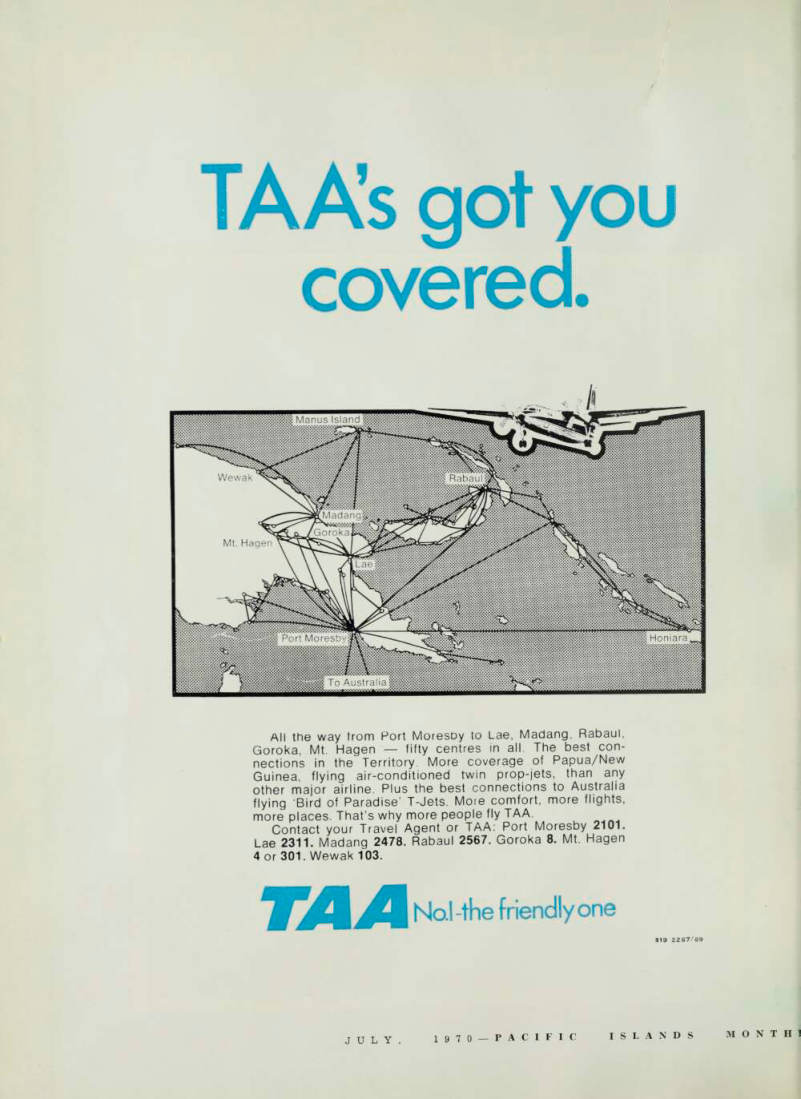 2
2 3
3 4
4 5
5 6
6 7
7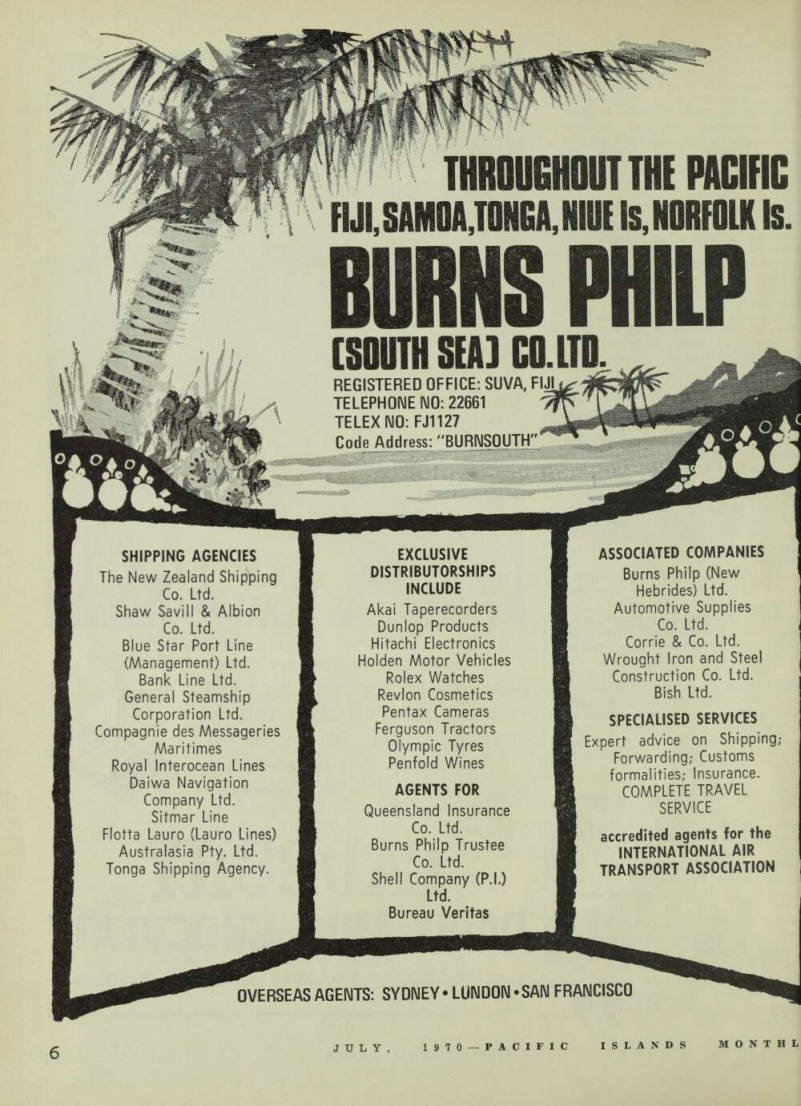 8
8 9
9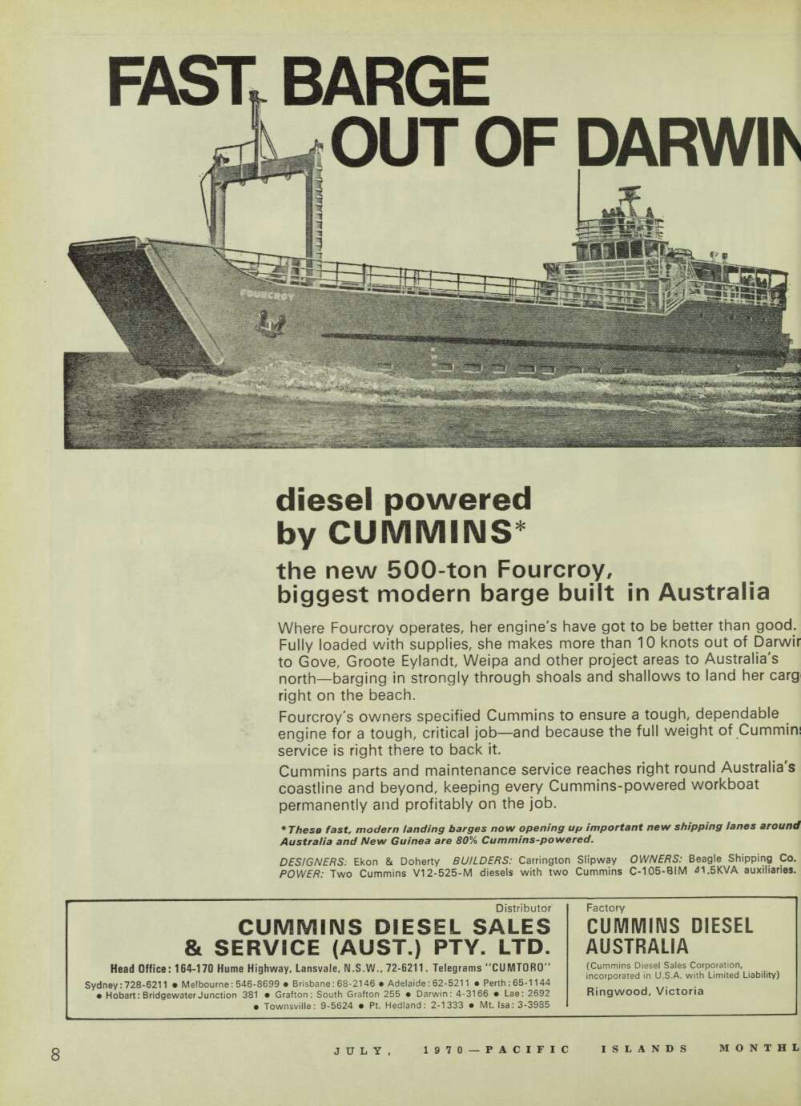 10
10 11
11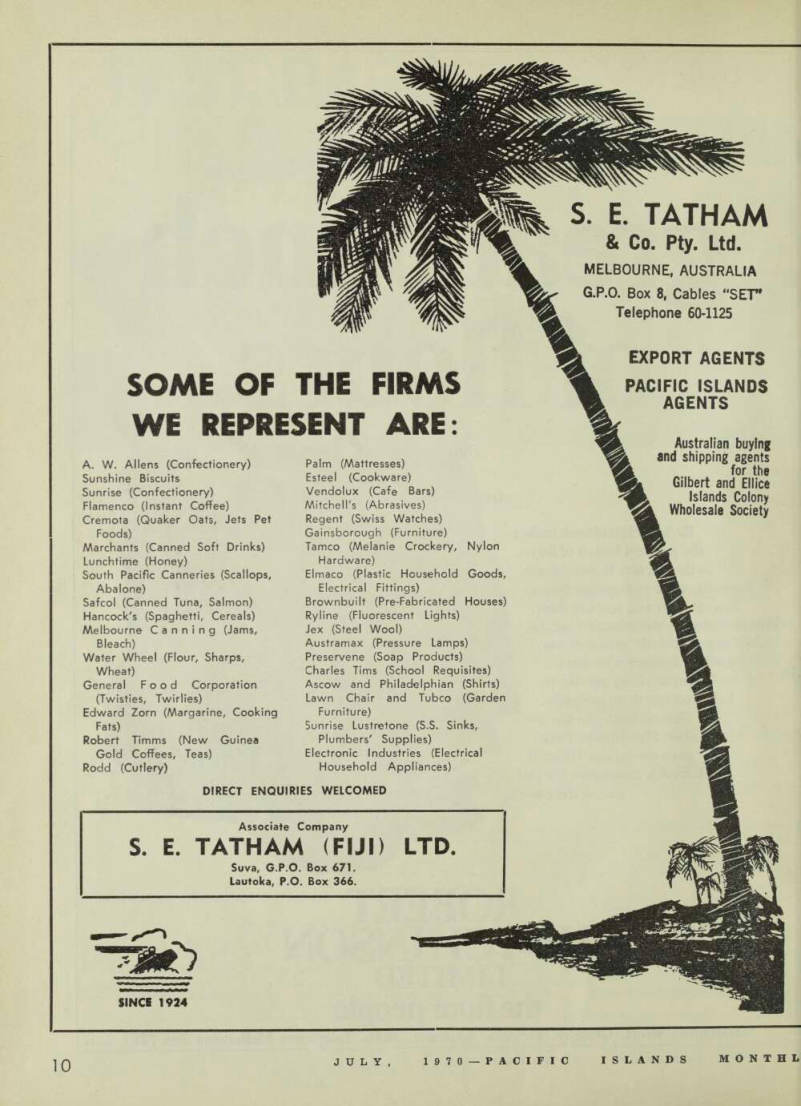 12
12 13
13 14
14 15
15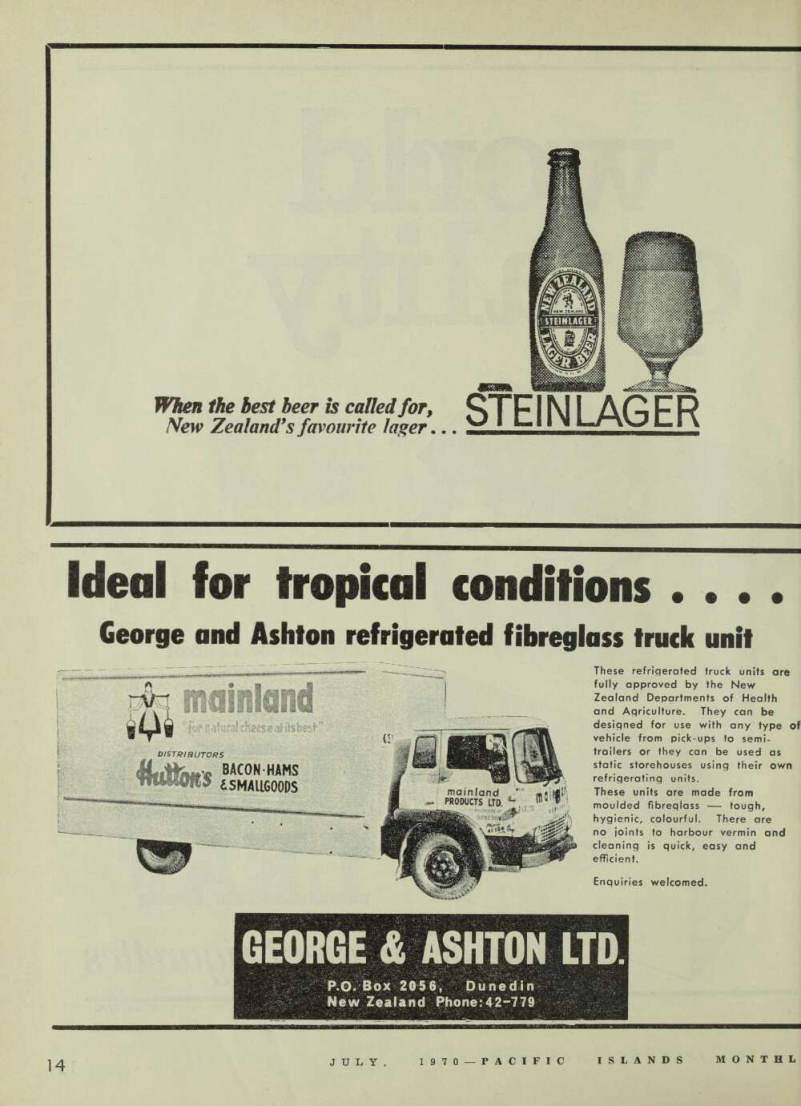 16
16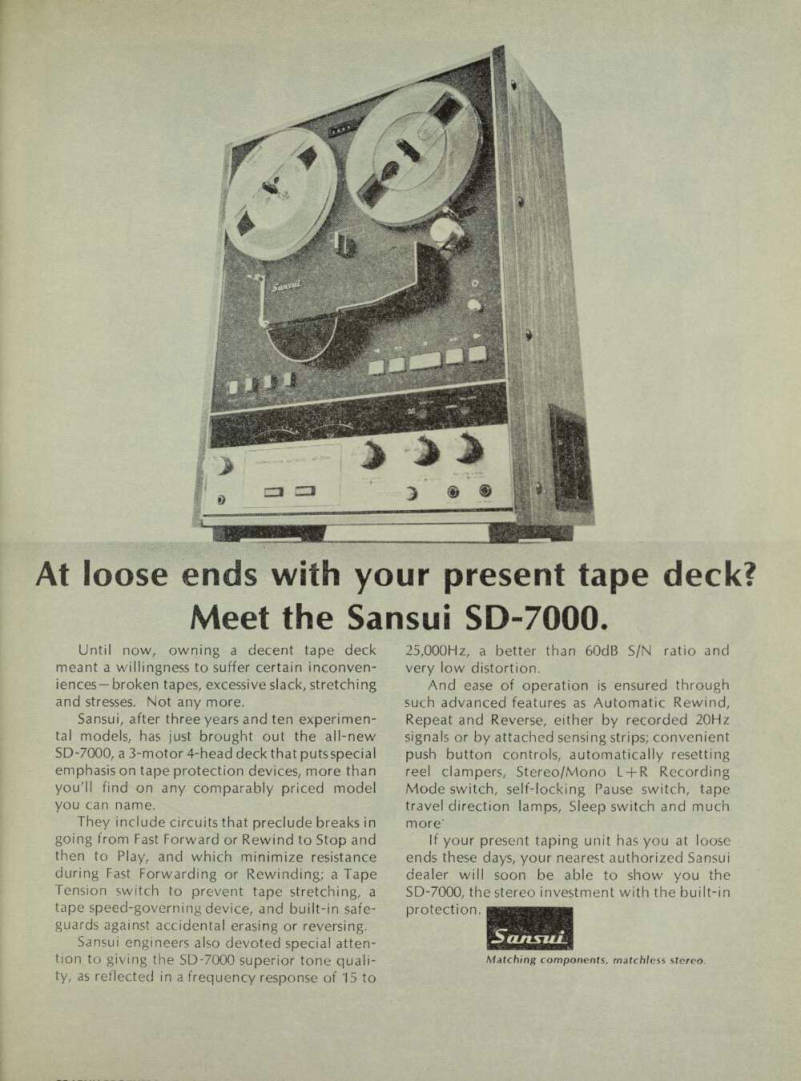 17
17 18
18 19
19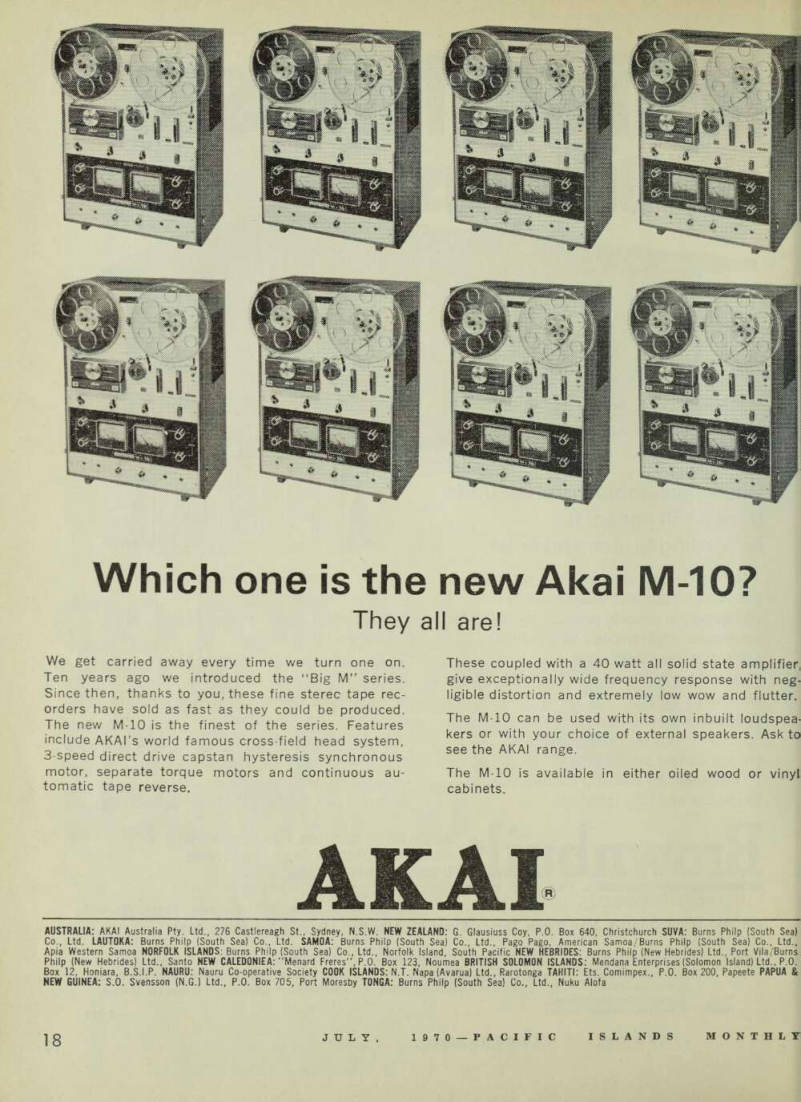 20
20 21
21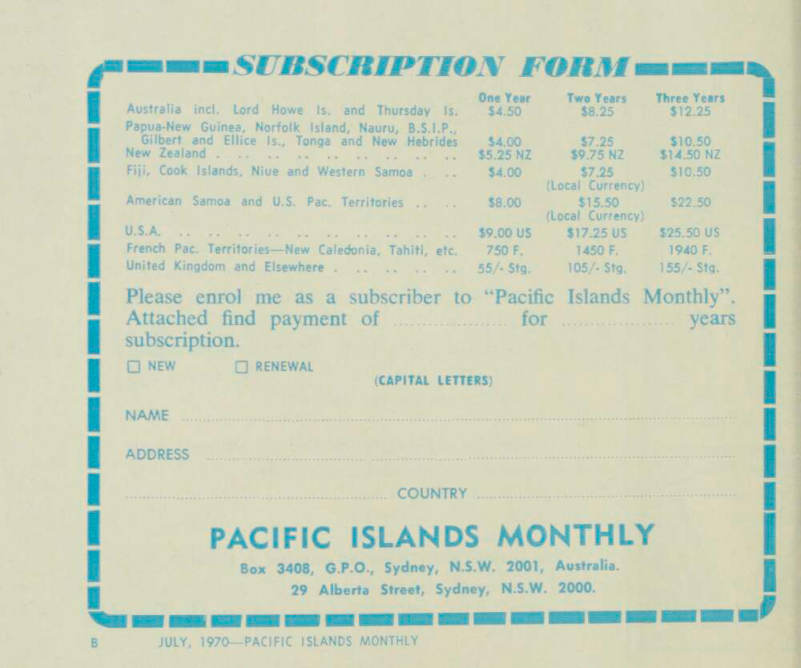 22
22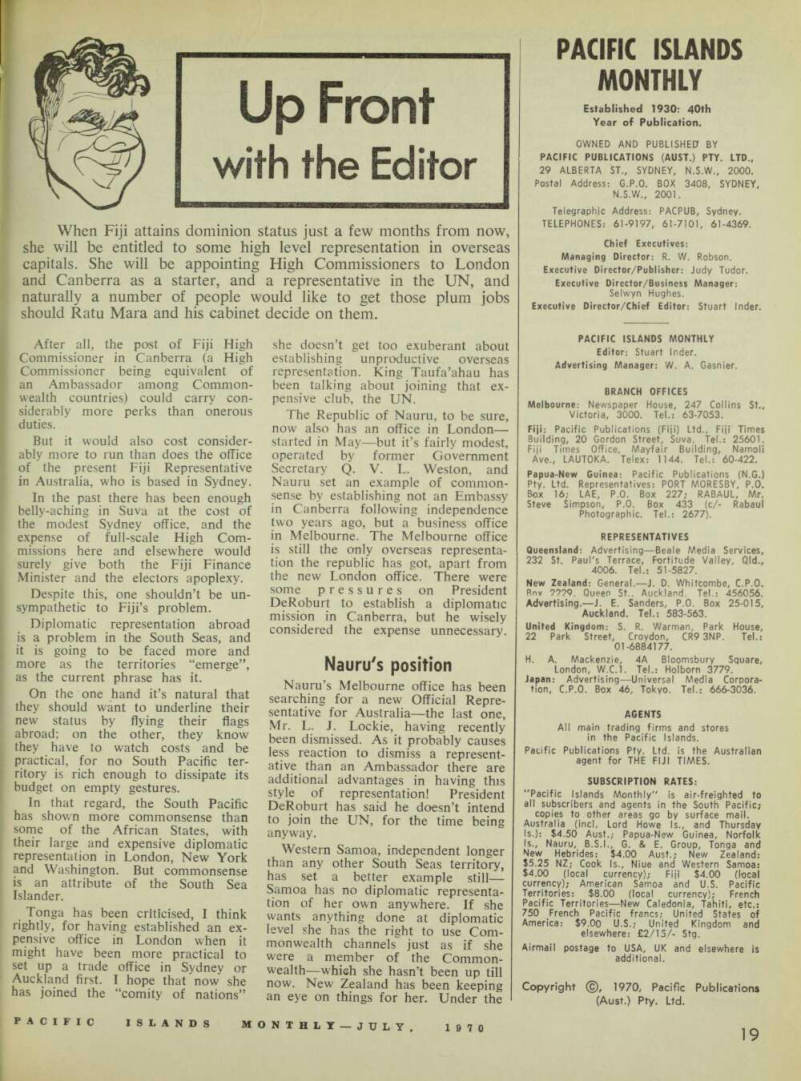 23
23 24
24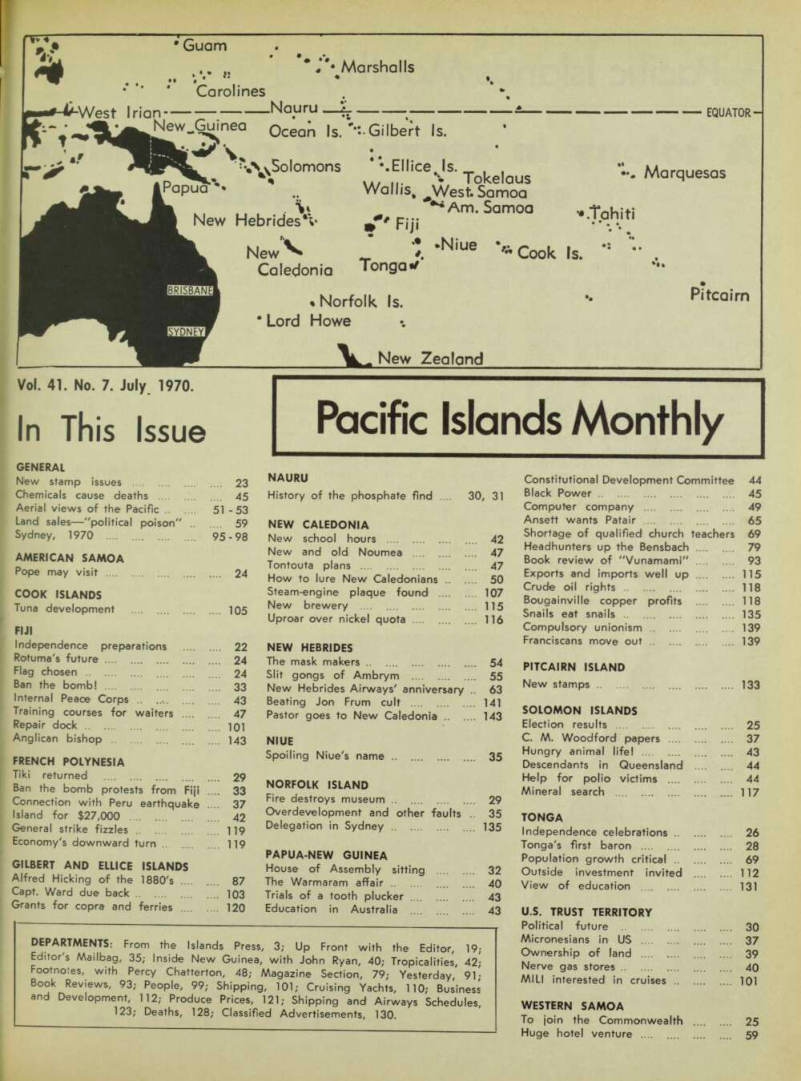 25
25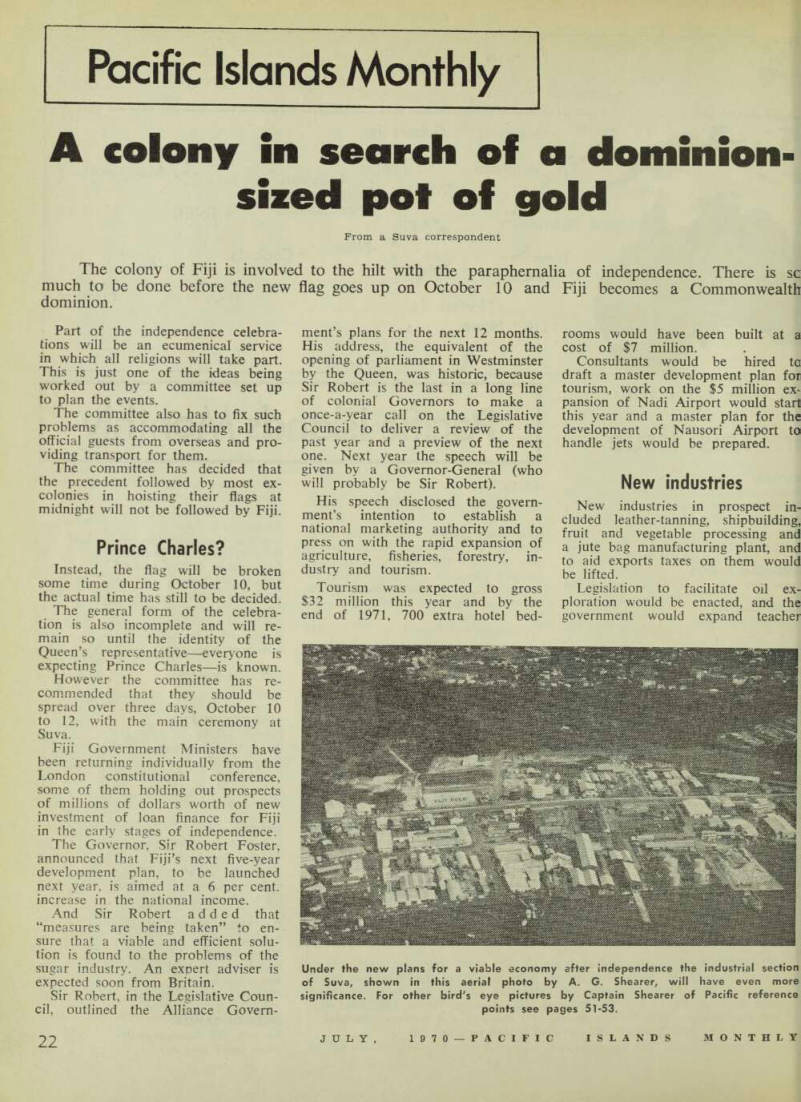 26
26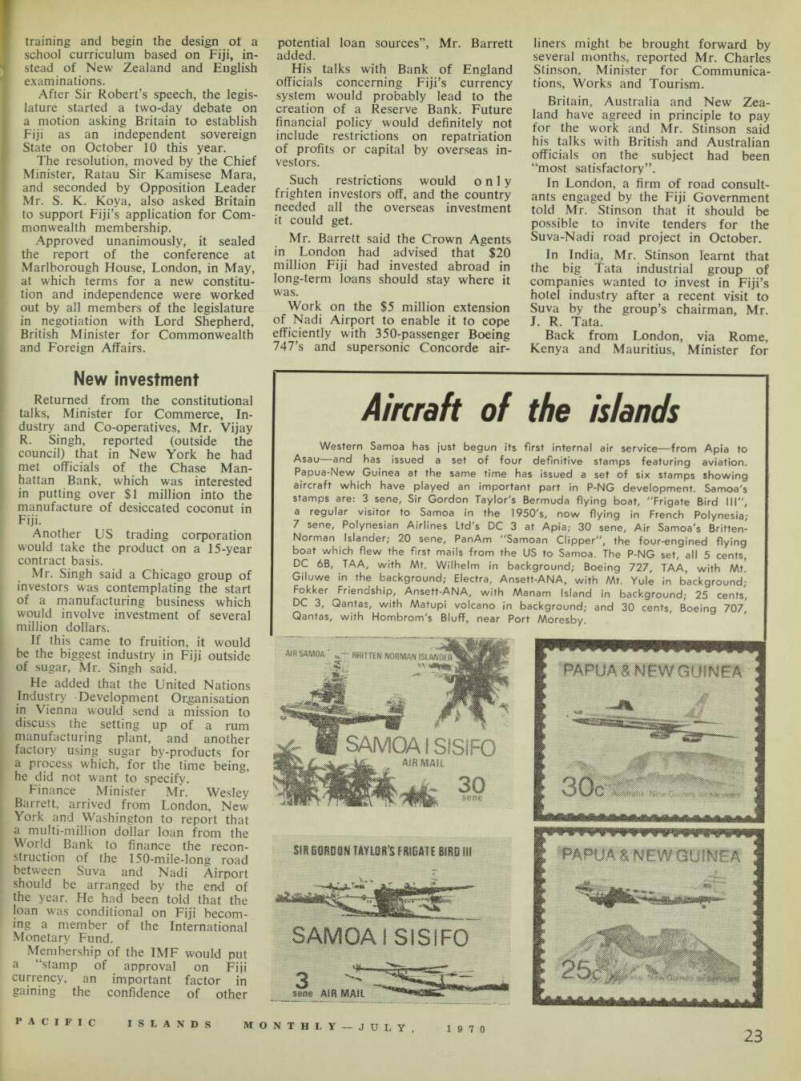 27
27 28
28 29
29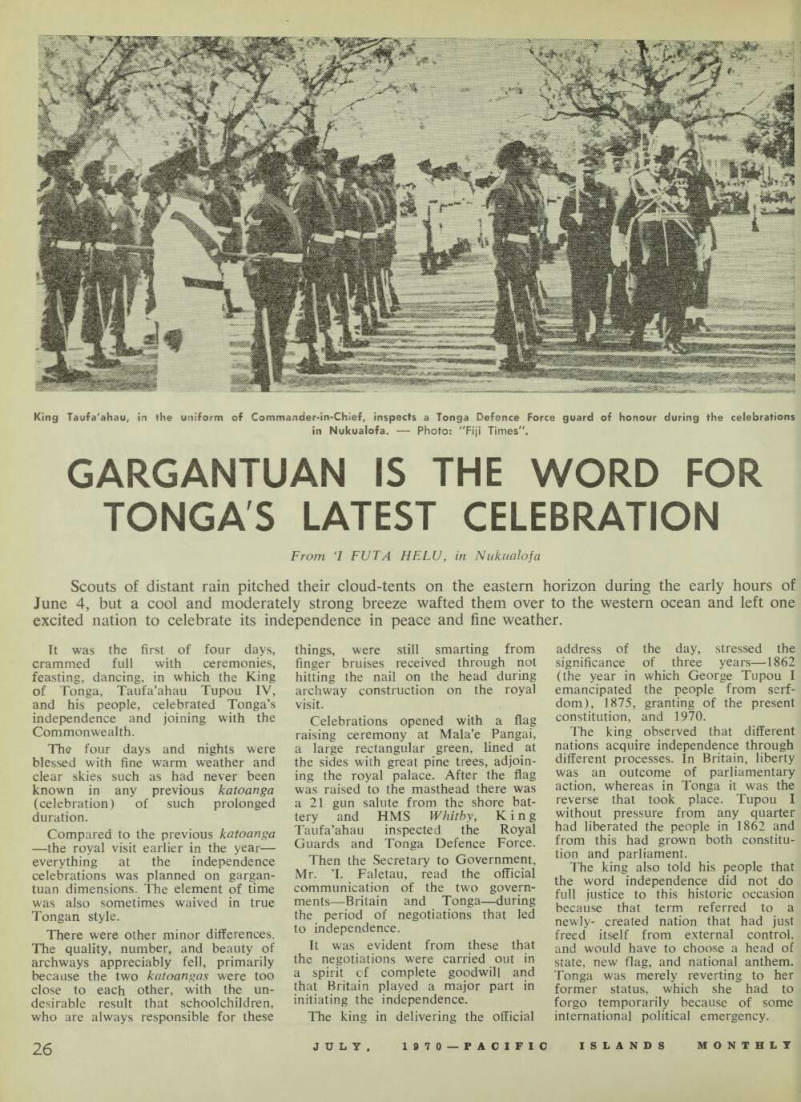 30
30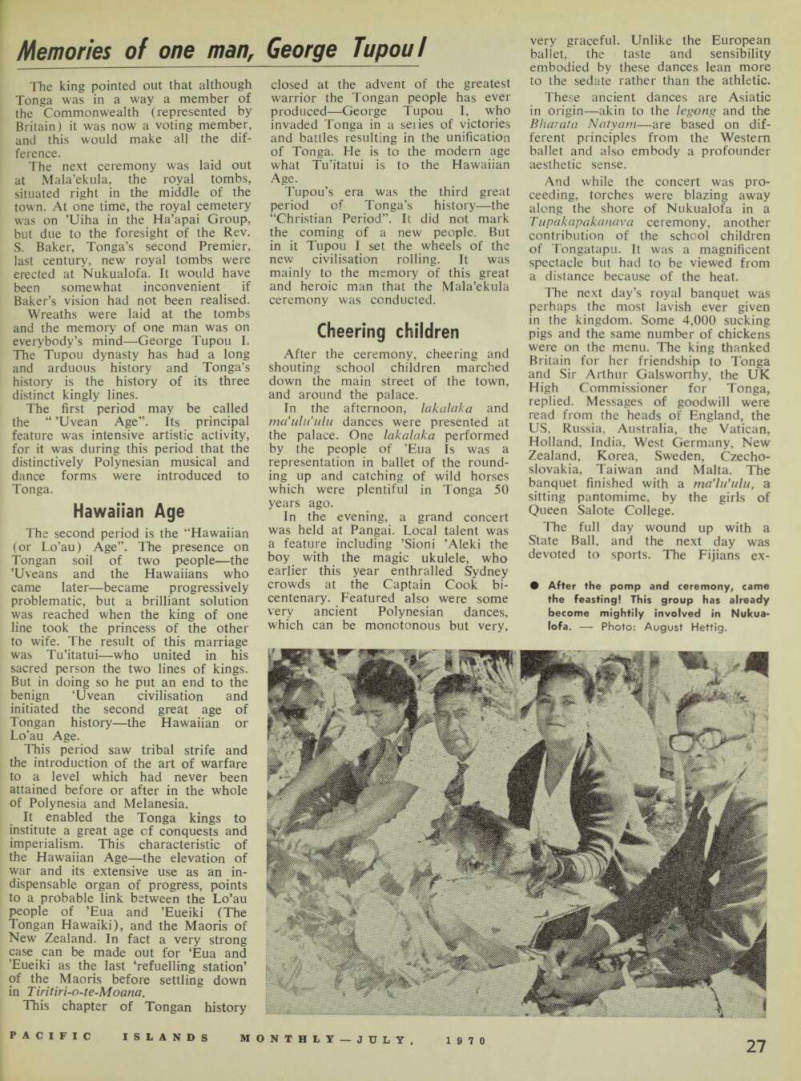 31
31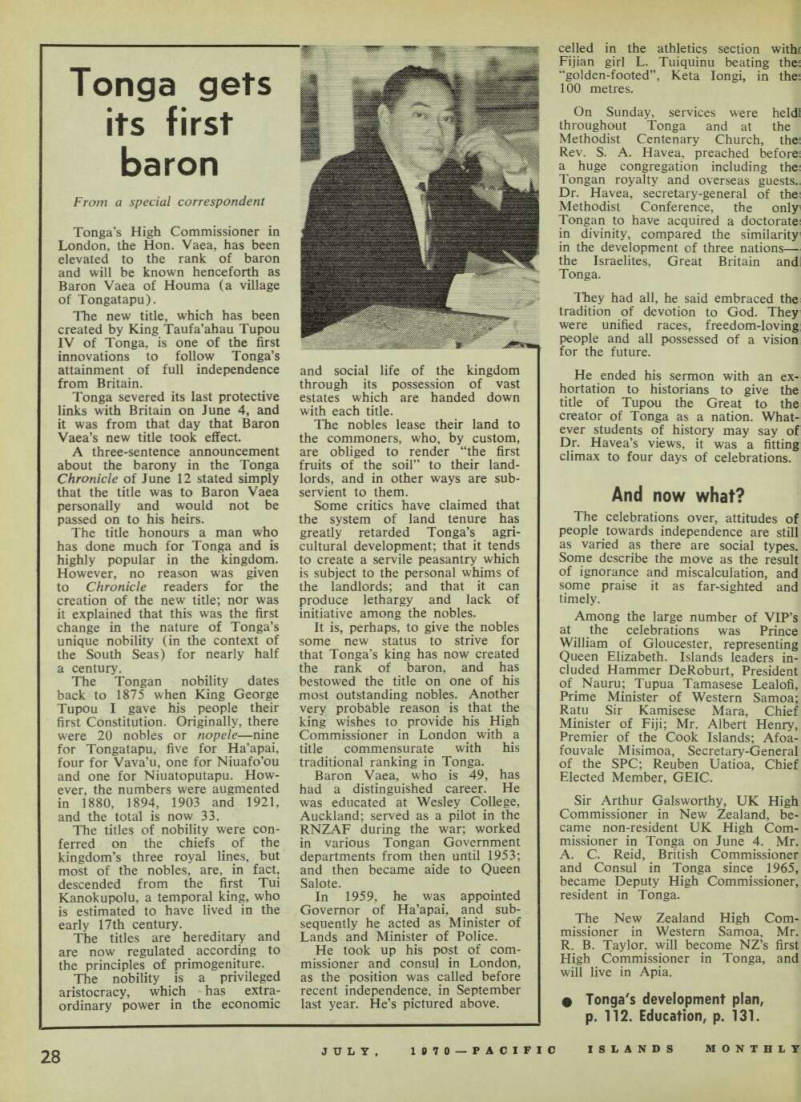 32
32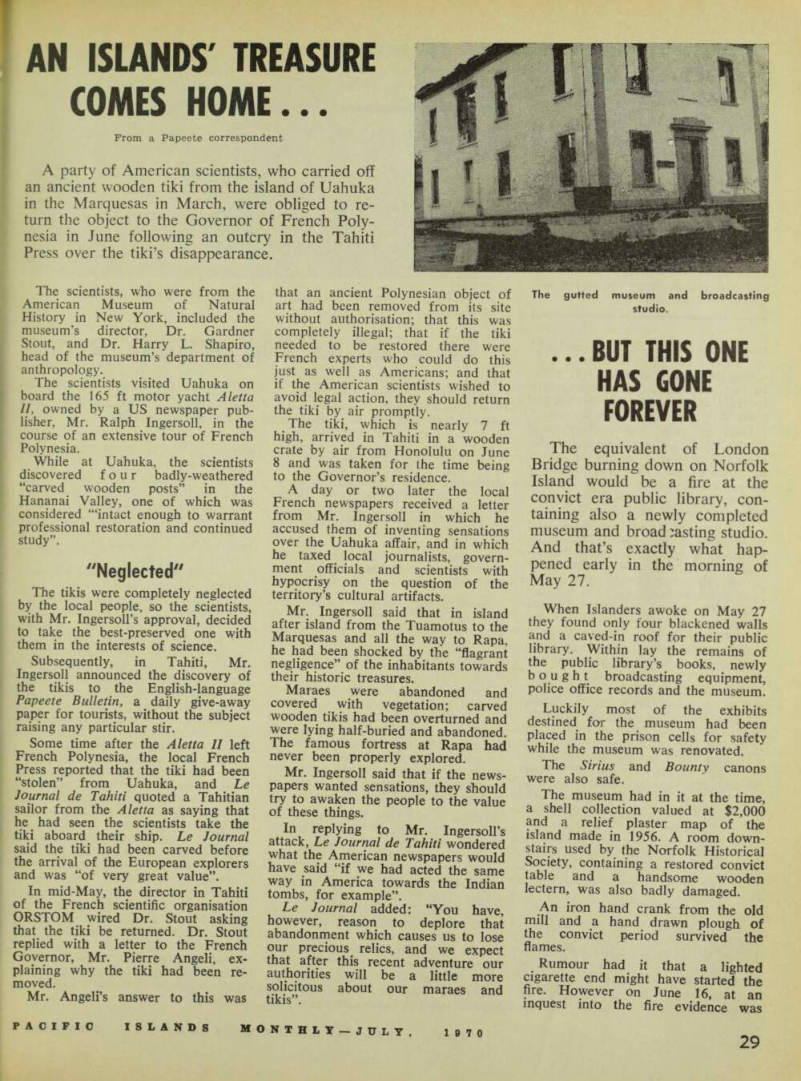 33
33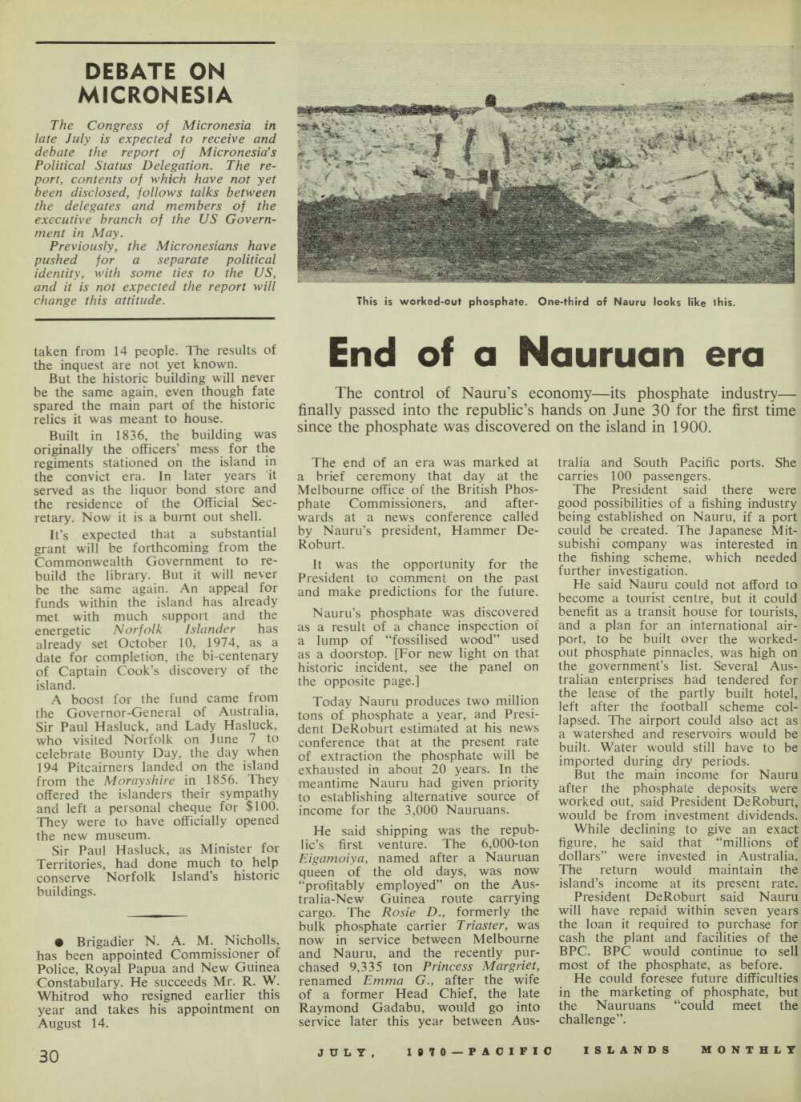 34
34 35
35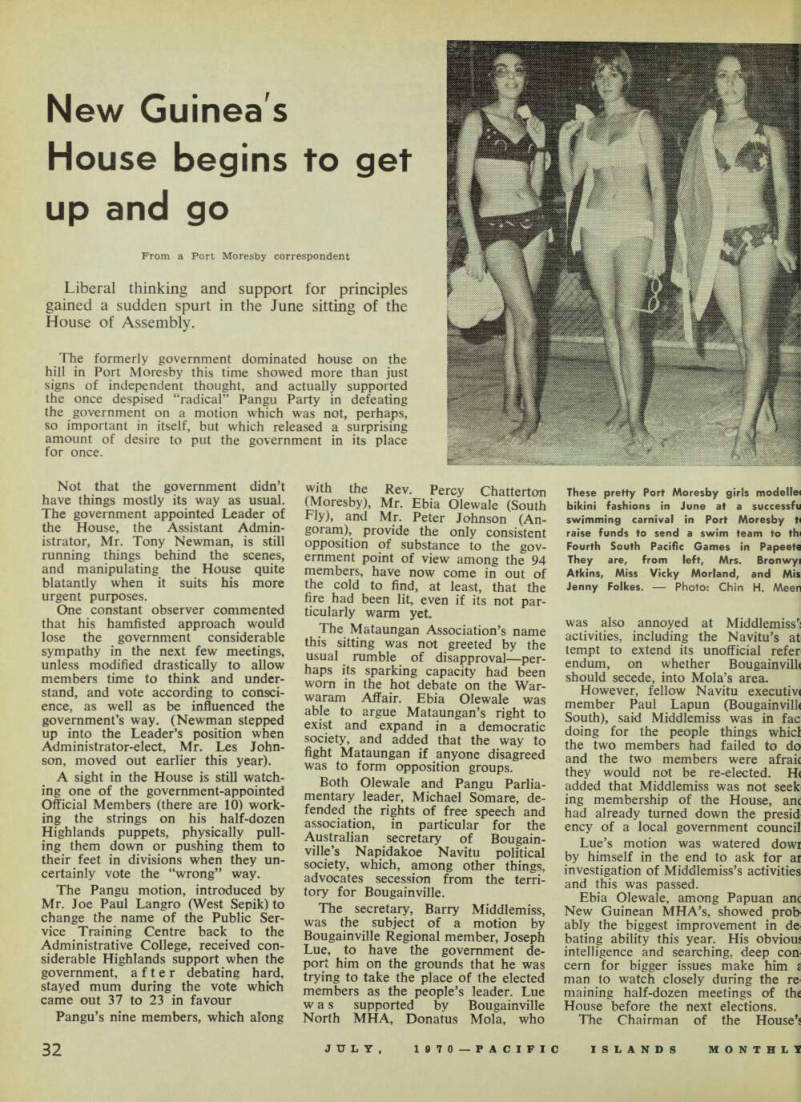 36
36 37
37 38
38 39
39 40
40 41
41 42
42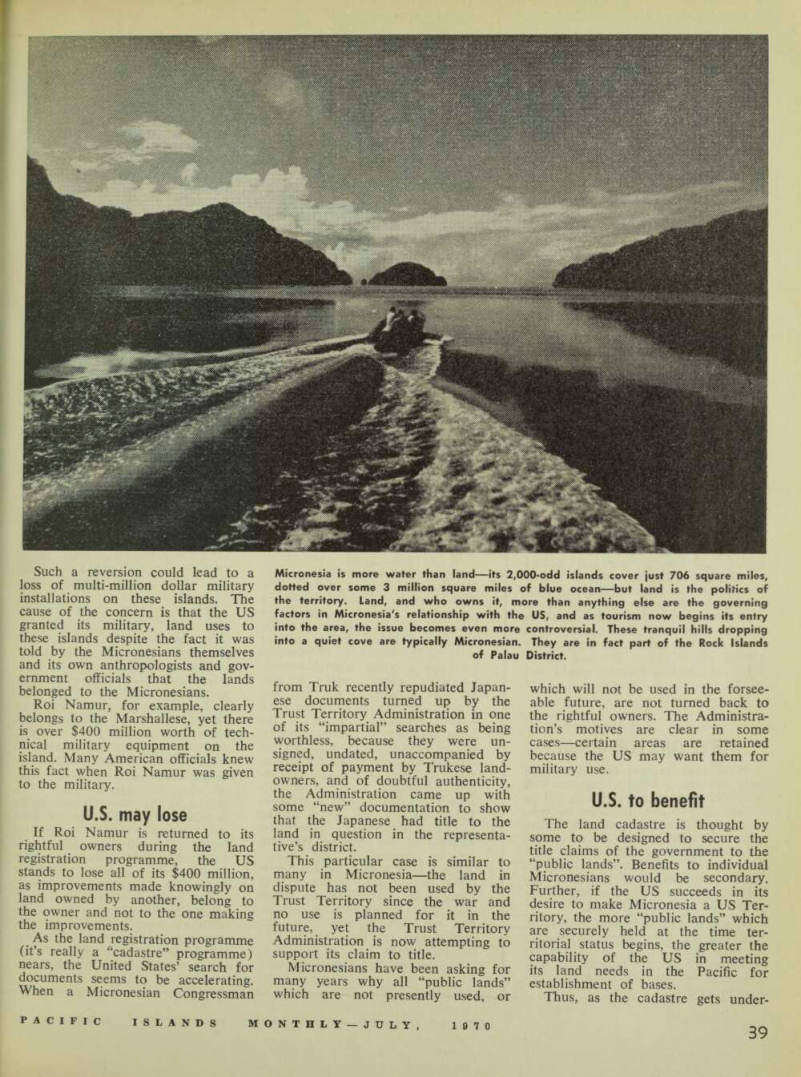 43
43 44
44 45
45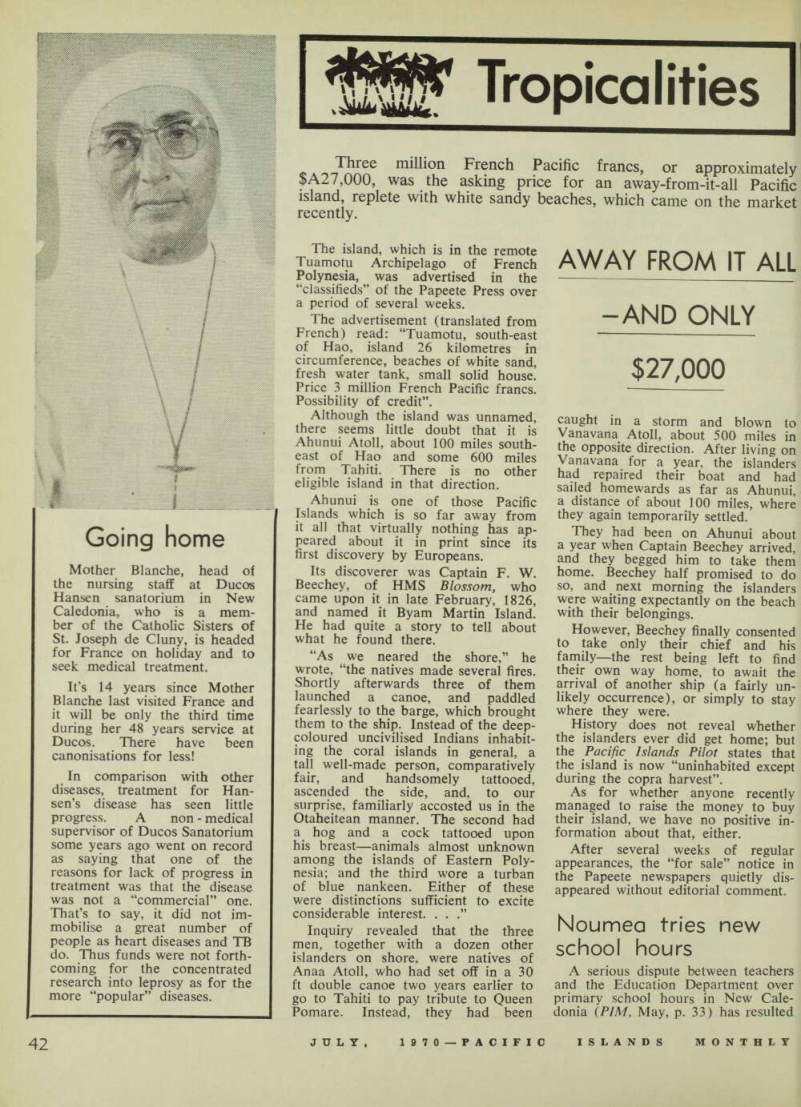 46
46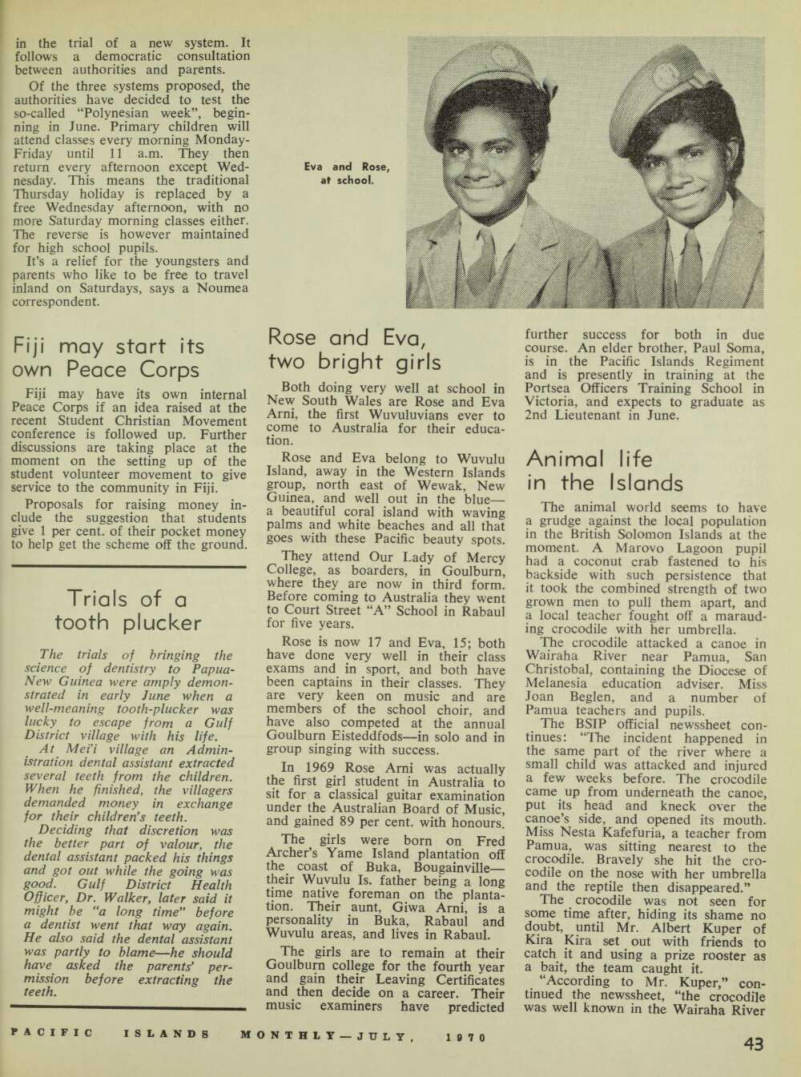 47
47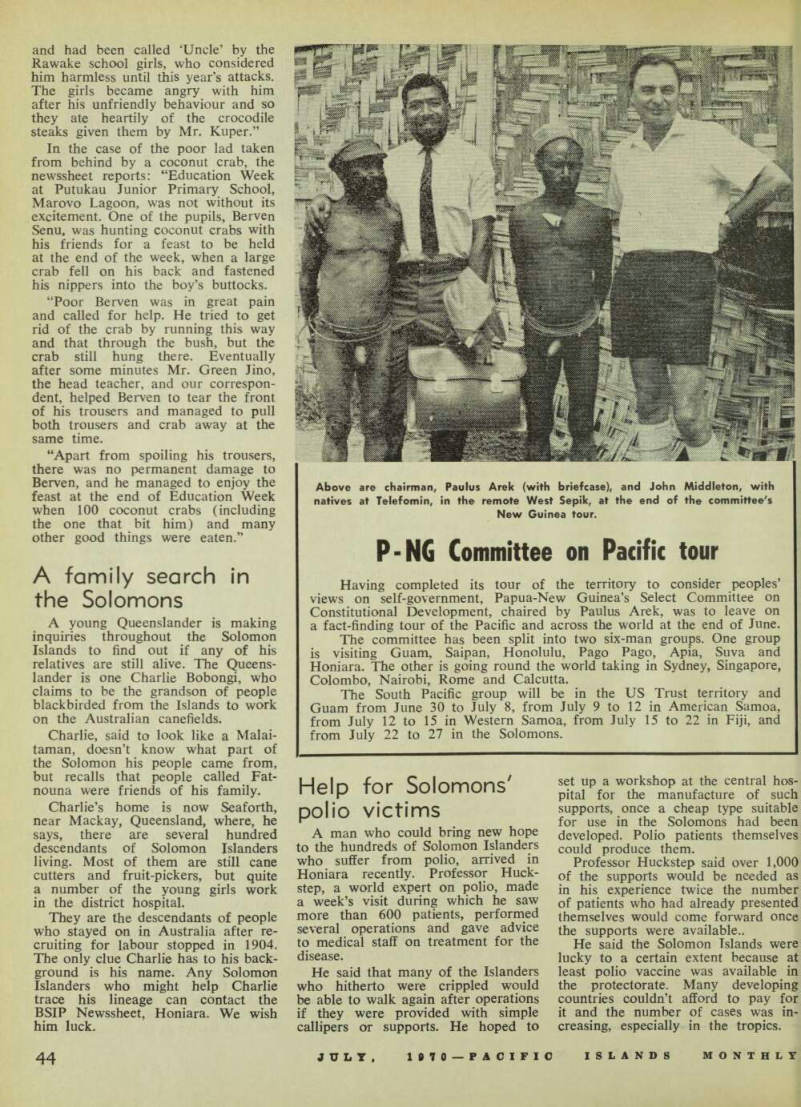 48
48 49
49 50
50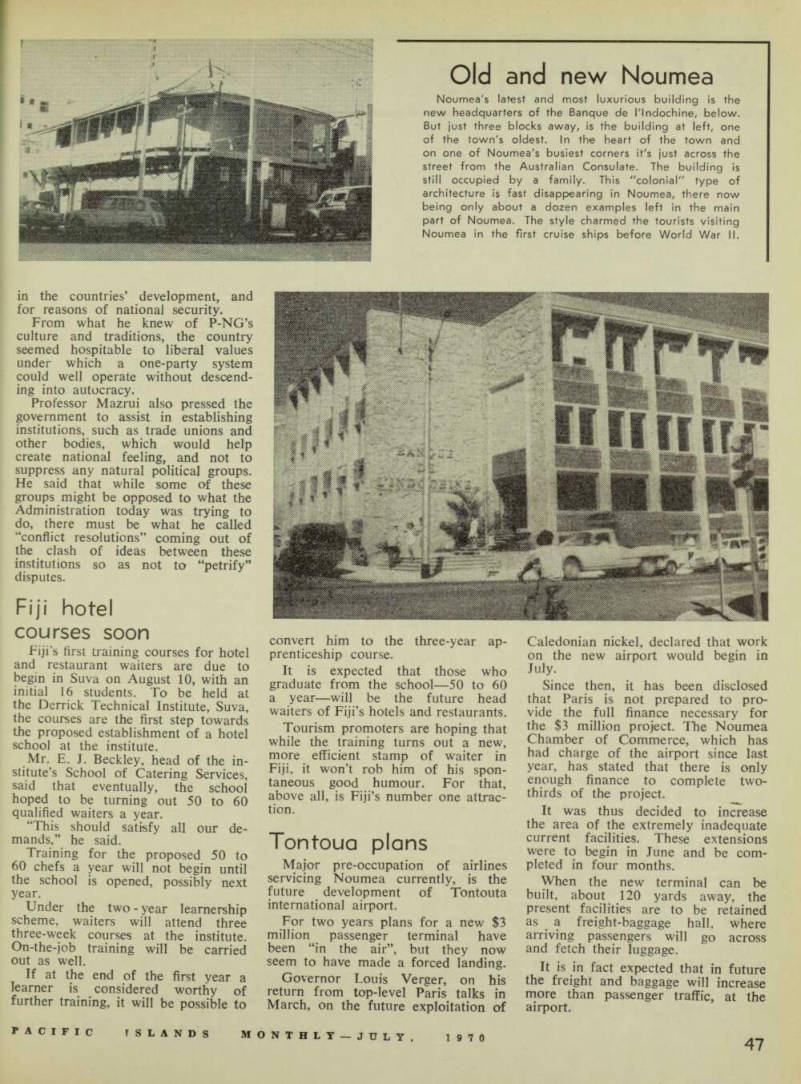 51
51 52
52 53
53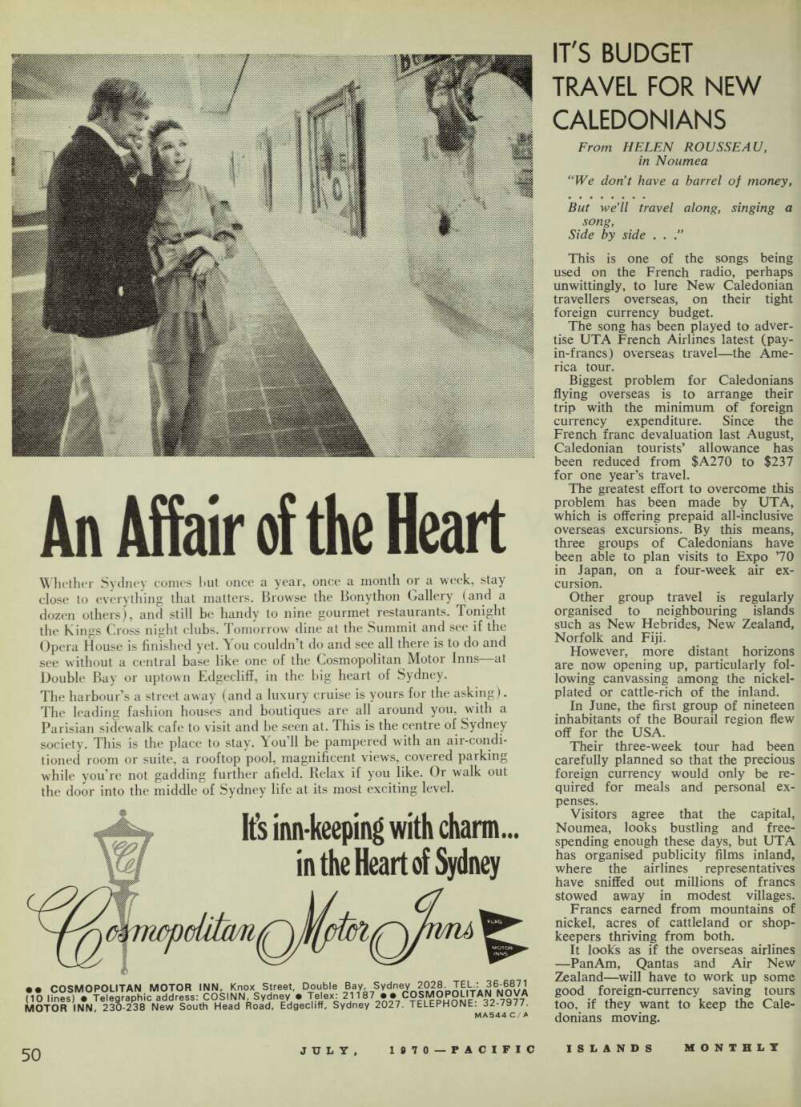 54
54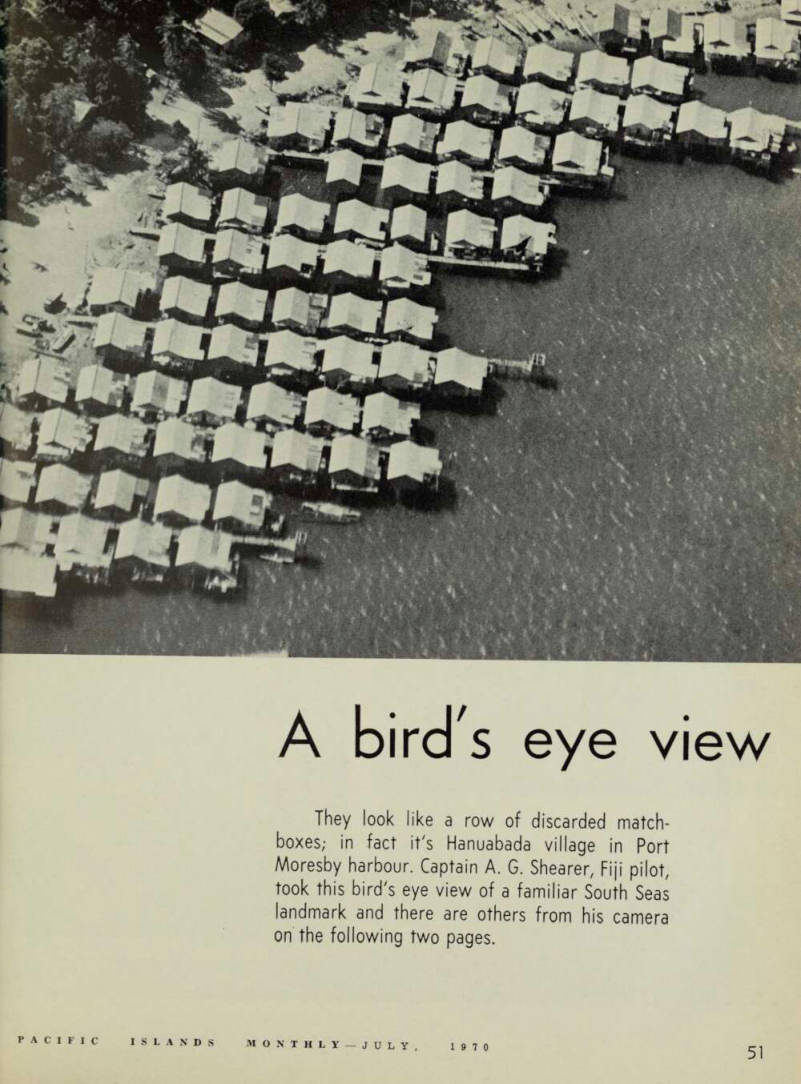 55
55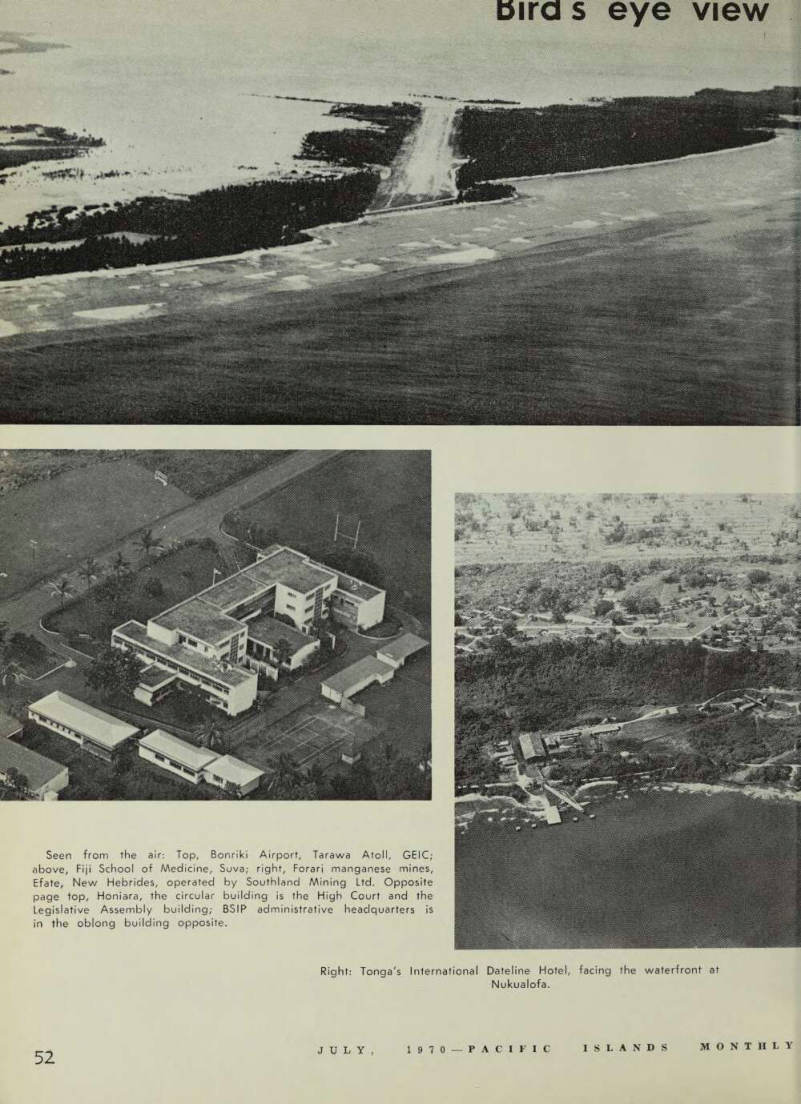 56
56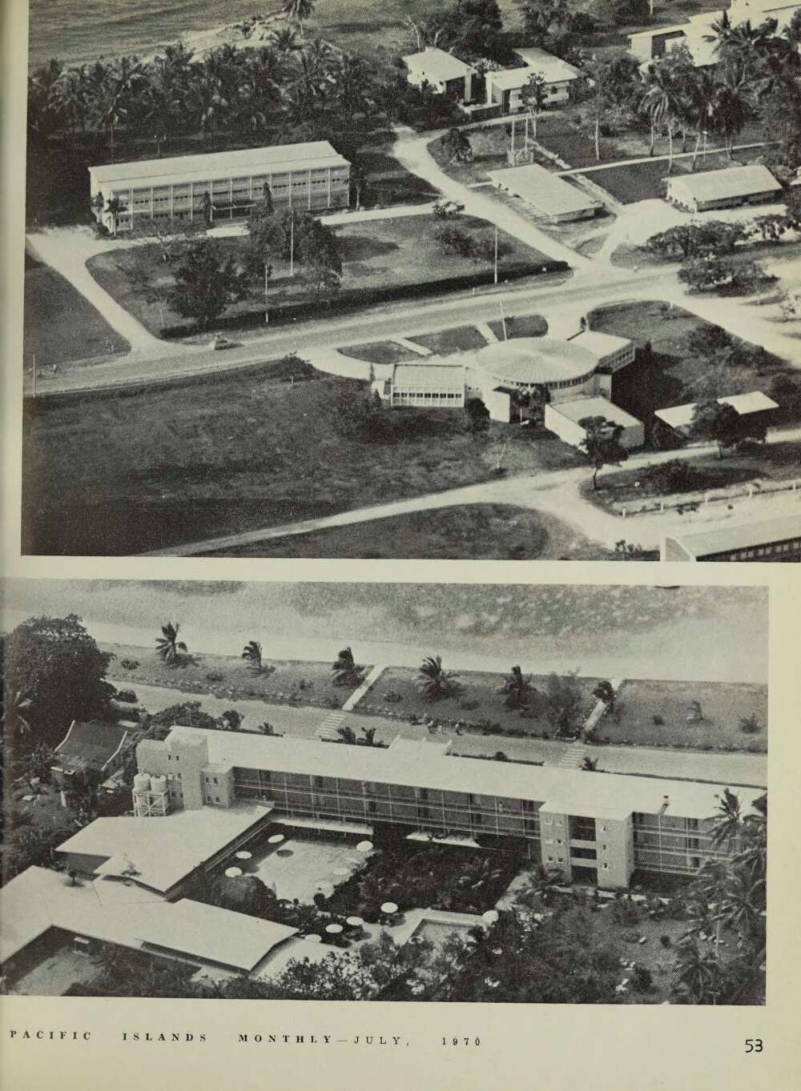 57
57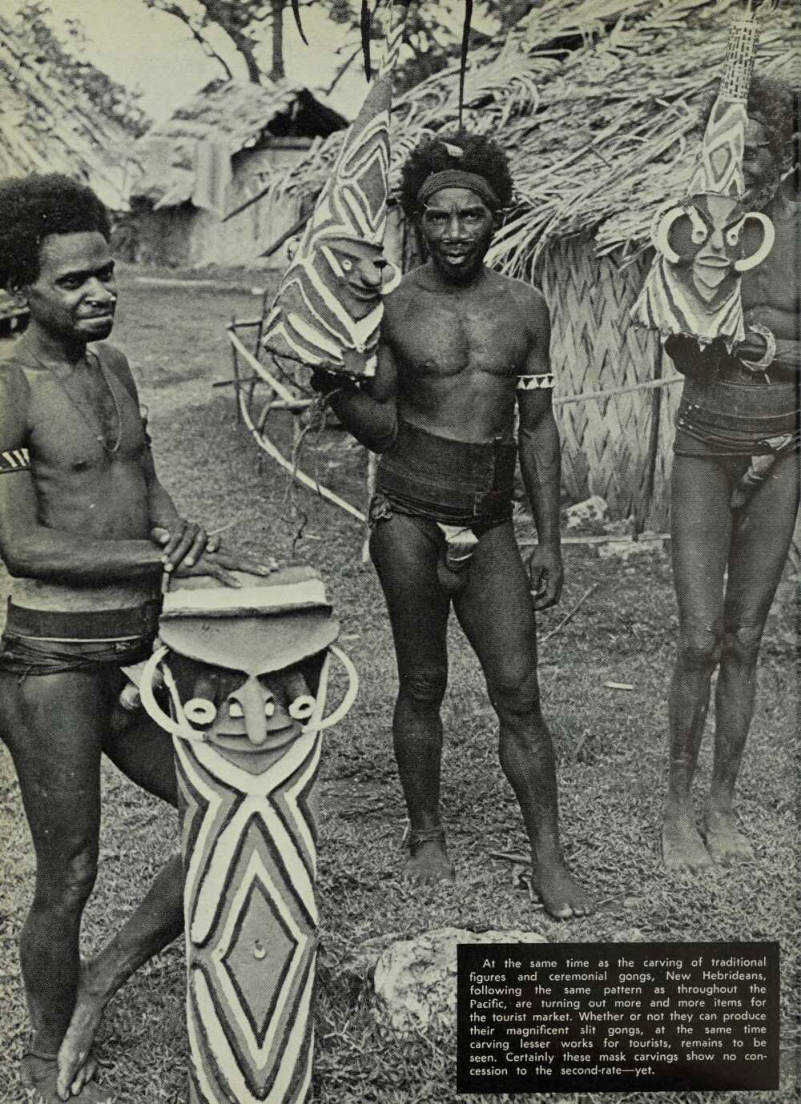 58
58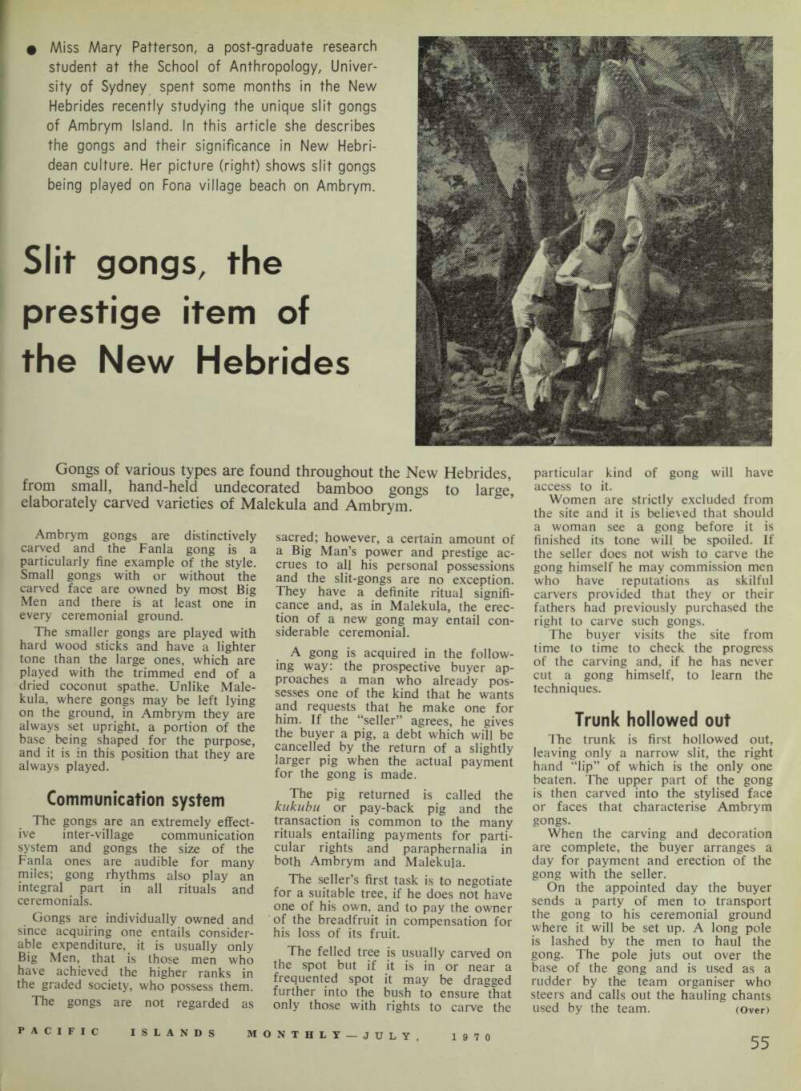 59
59 60
60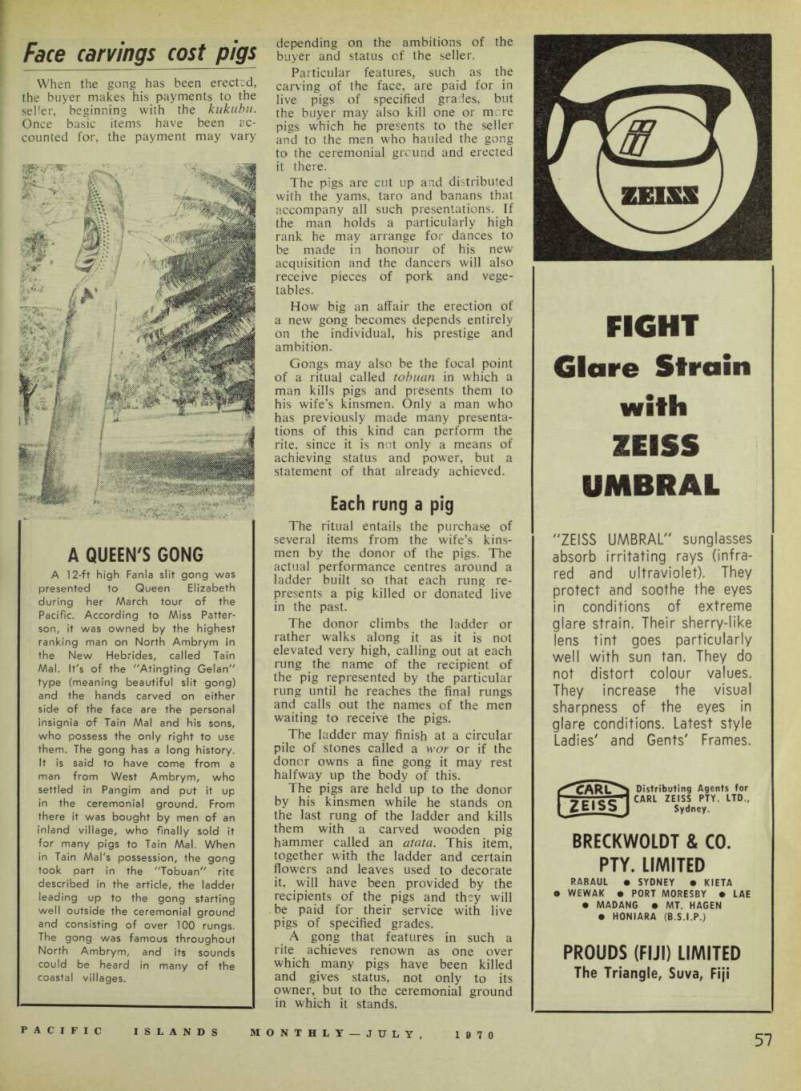 61
61 62
62 63
63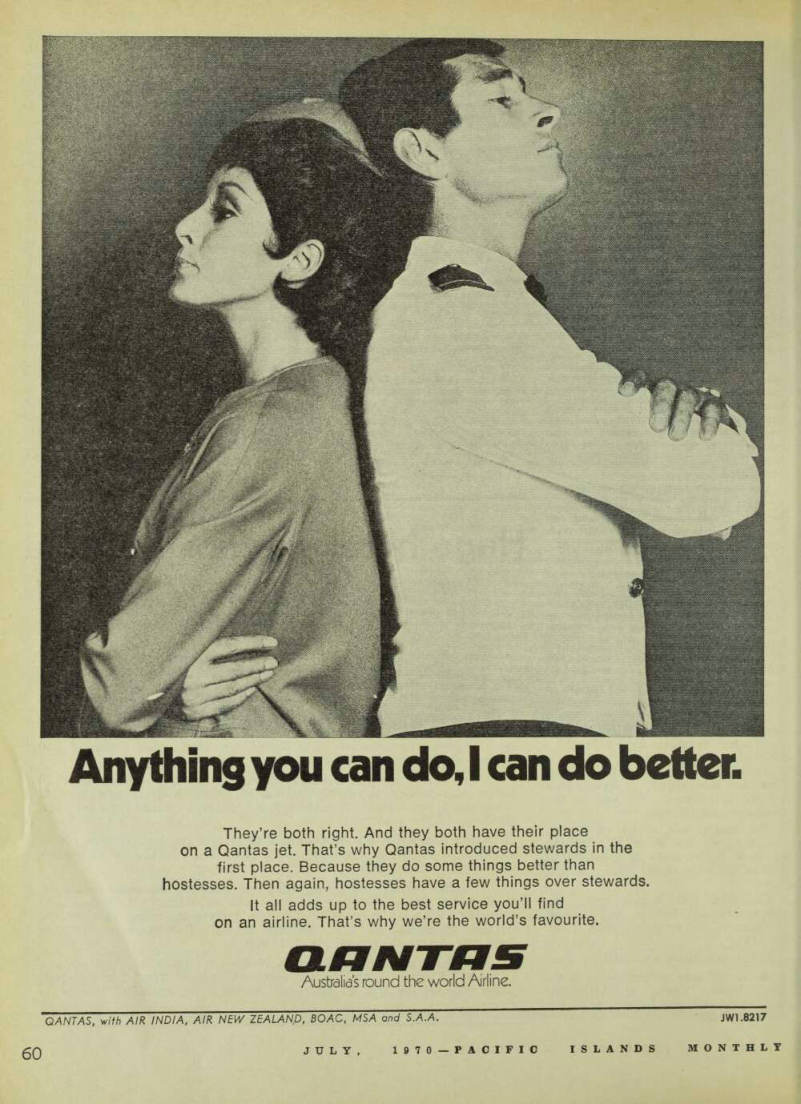 64
64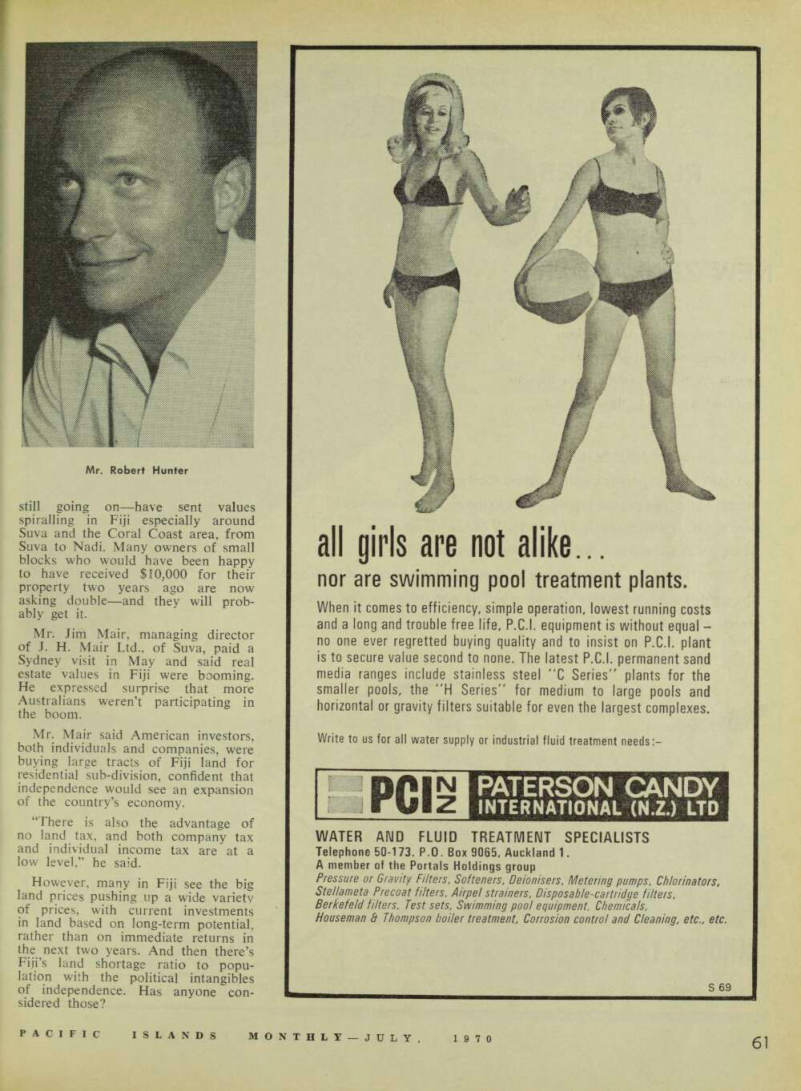 65
65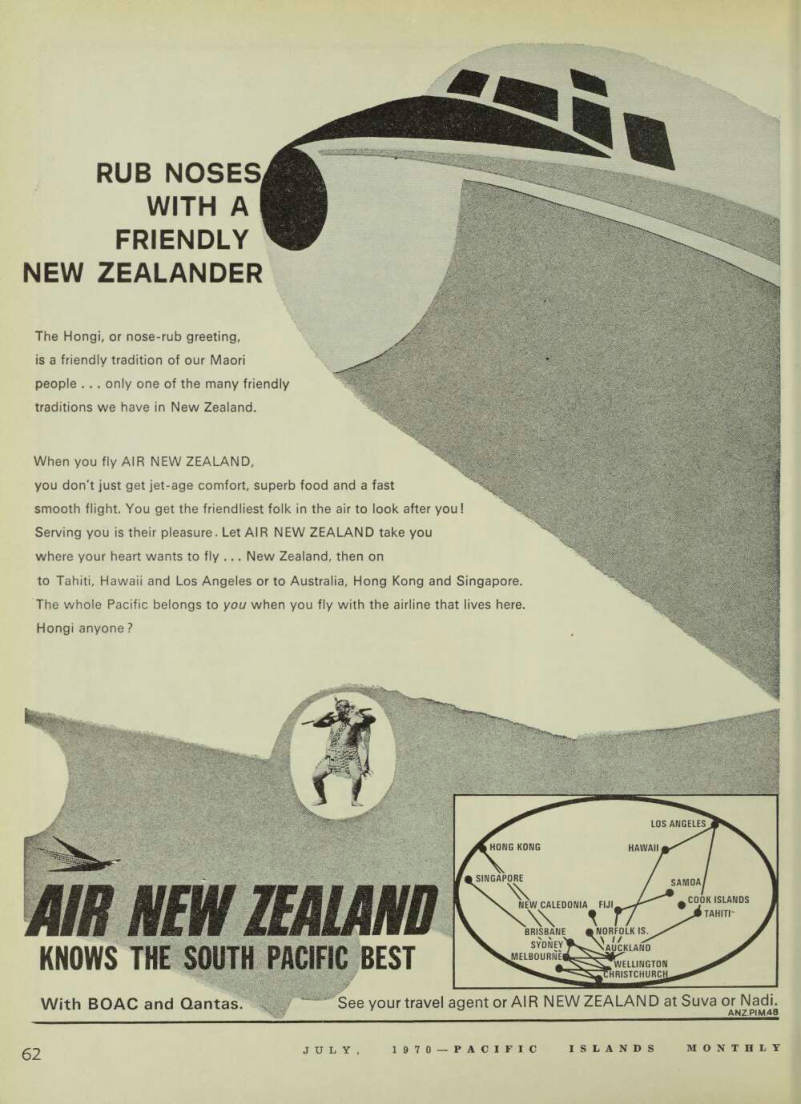 66
66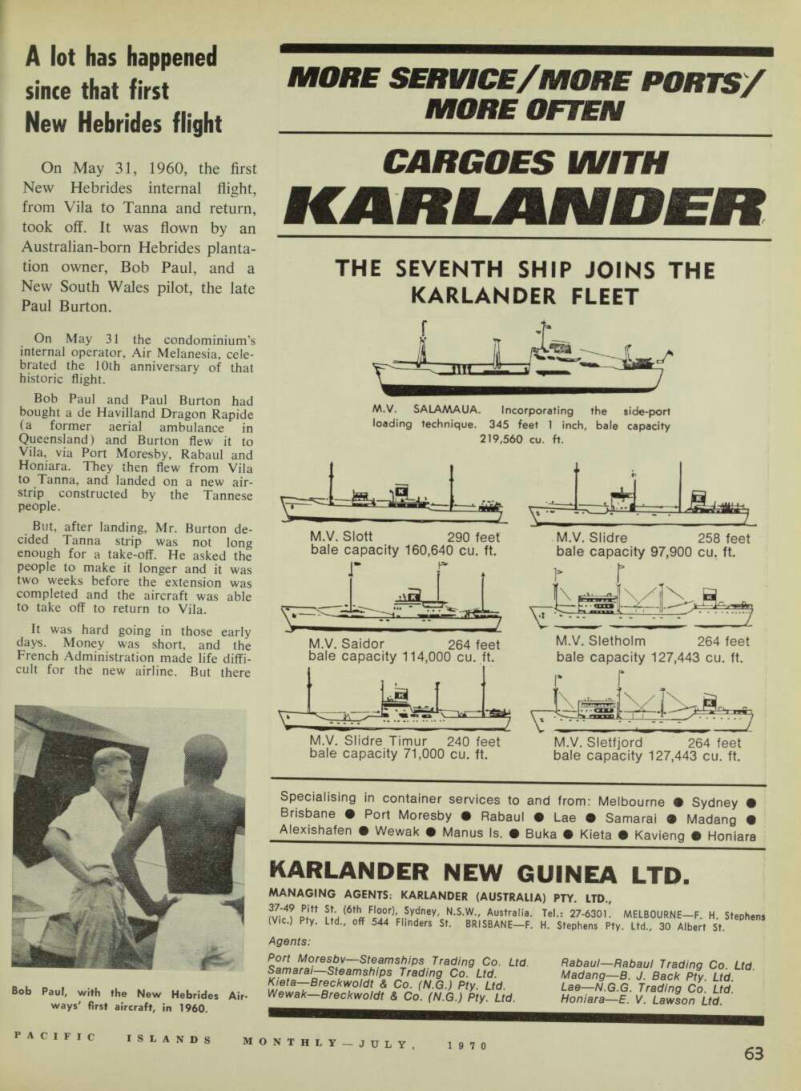 67
67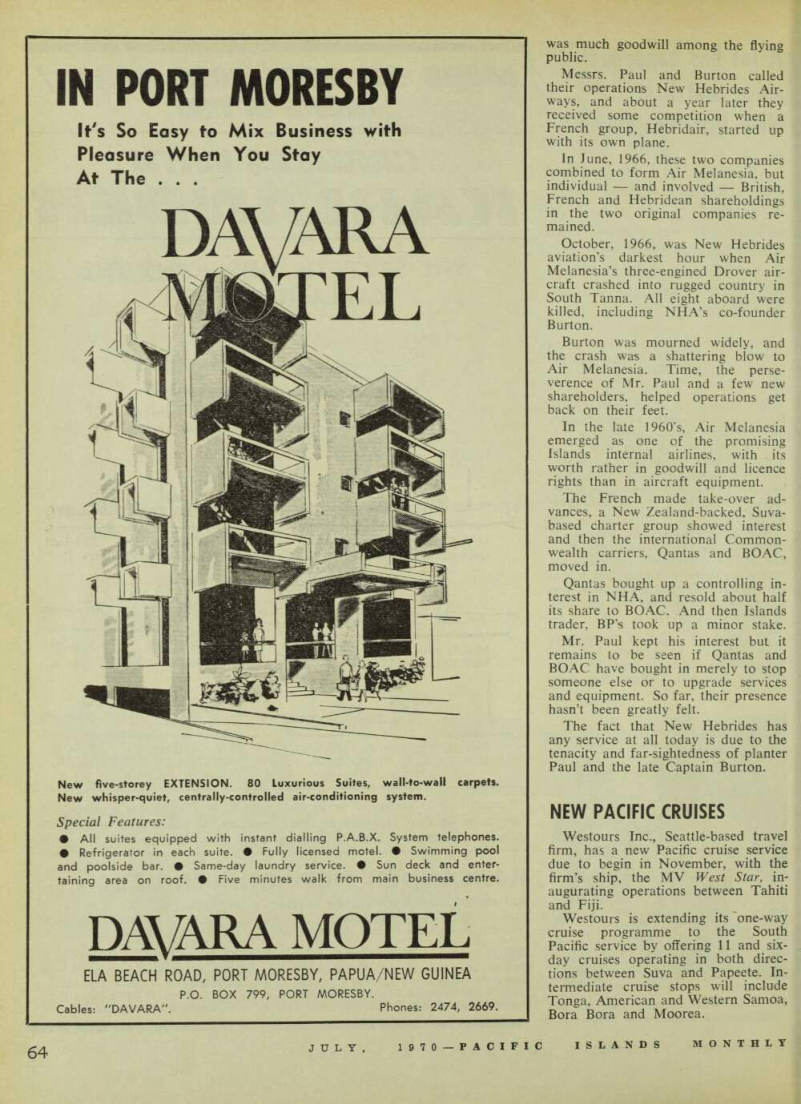 68
68 69
69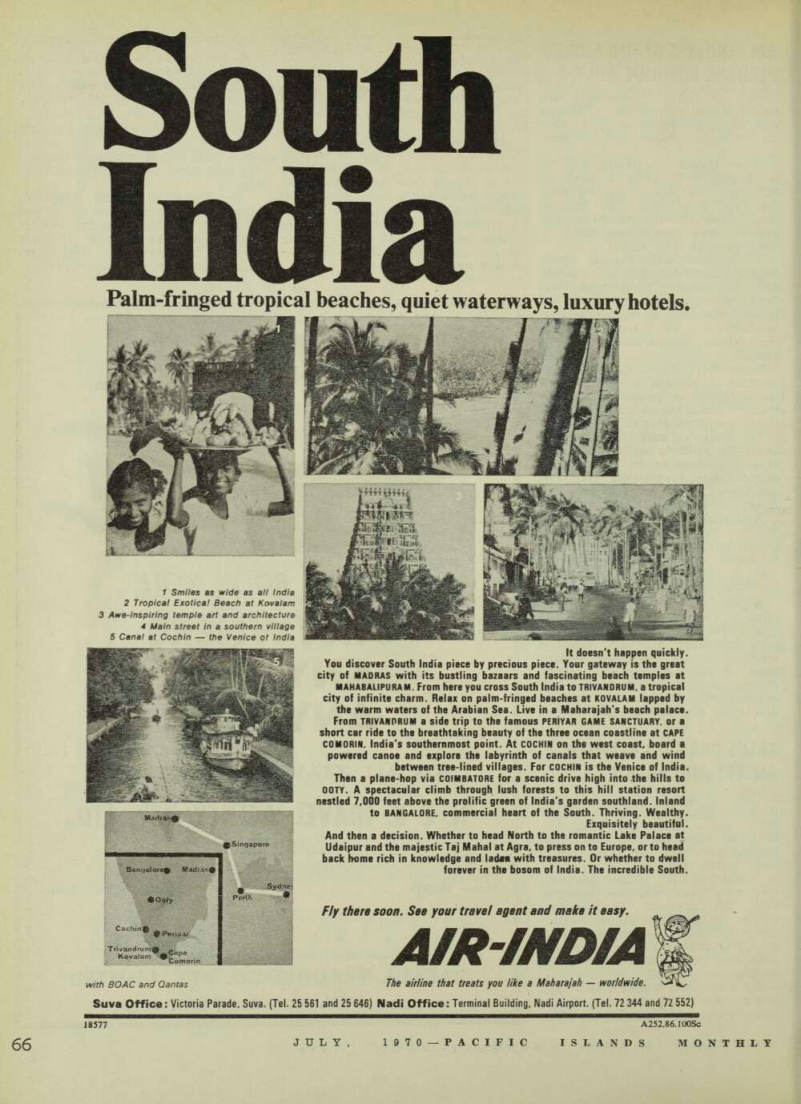 70
70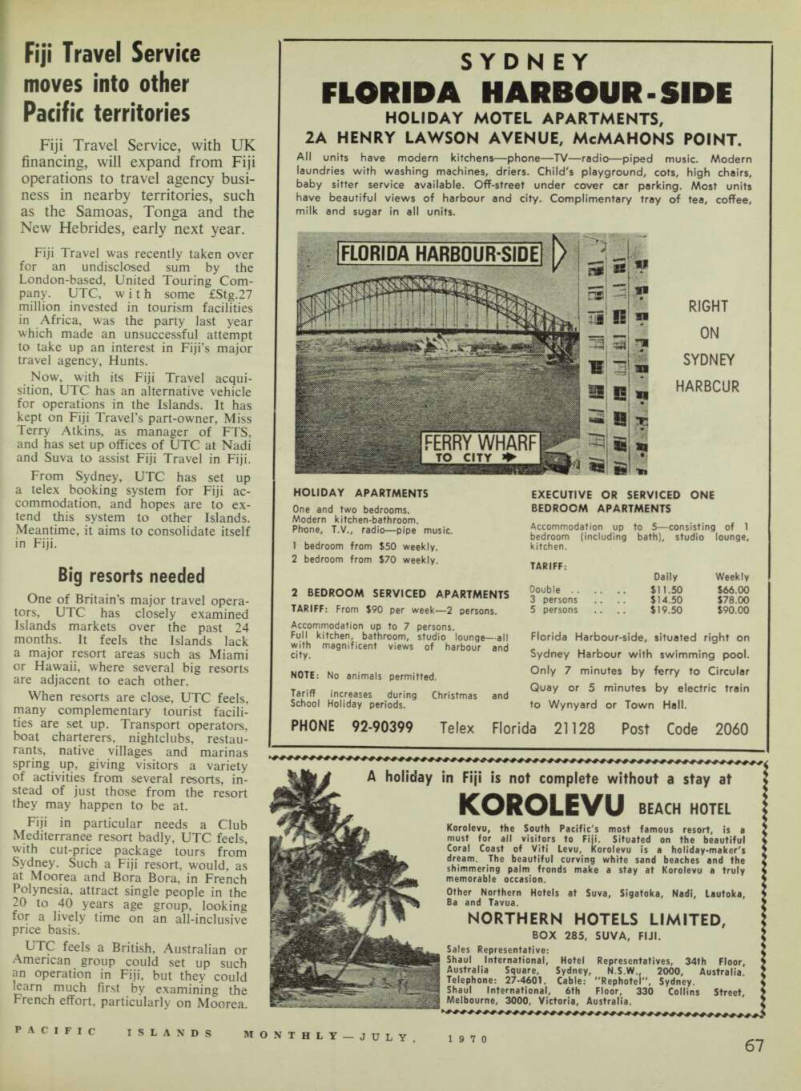 71
71 72
72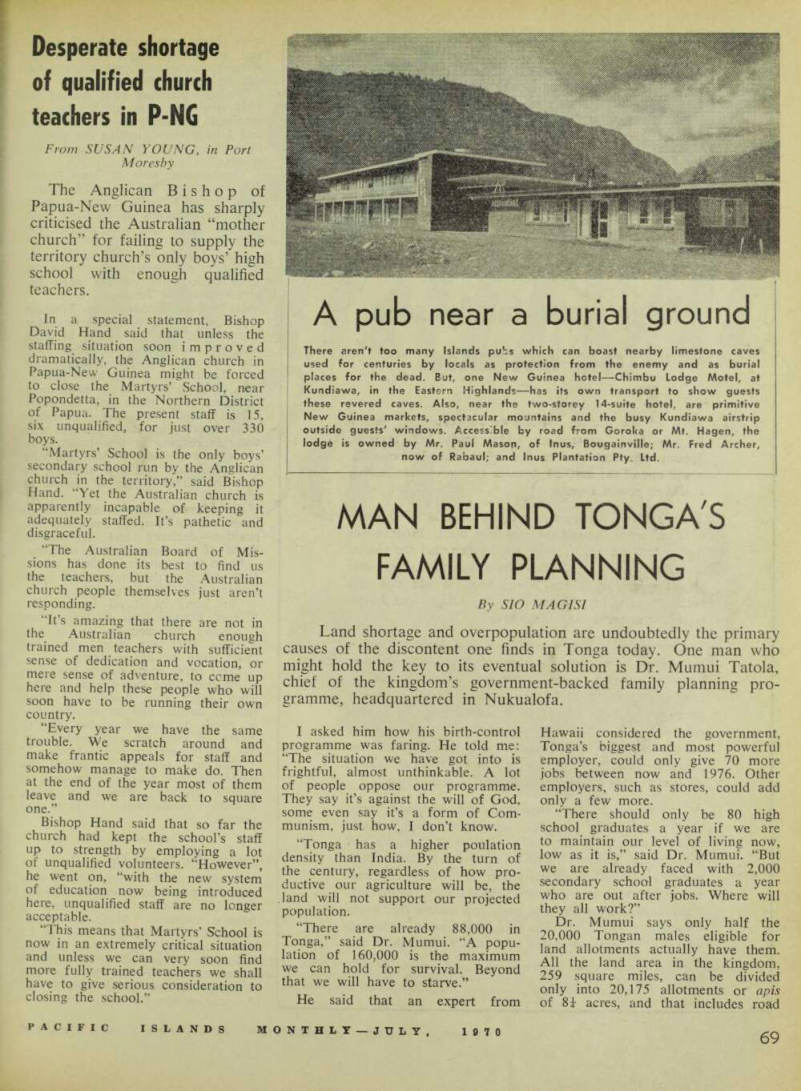 73
73 74
74 75
75 76
76 77
77 78
78 79
79 80
80 81
81 82
82 83
83 84
84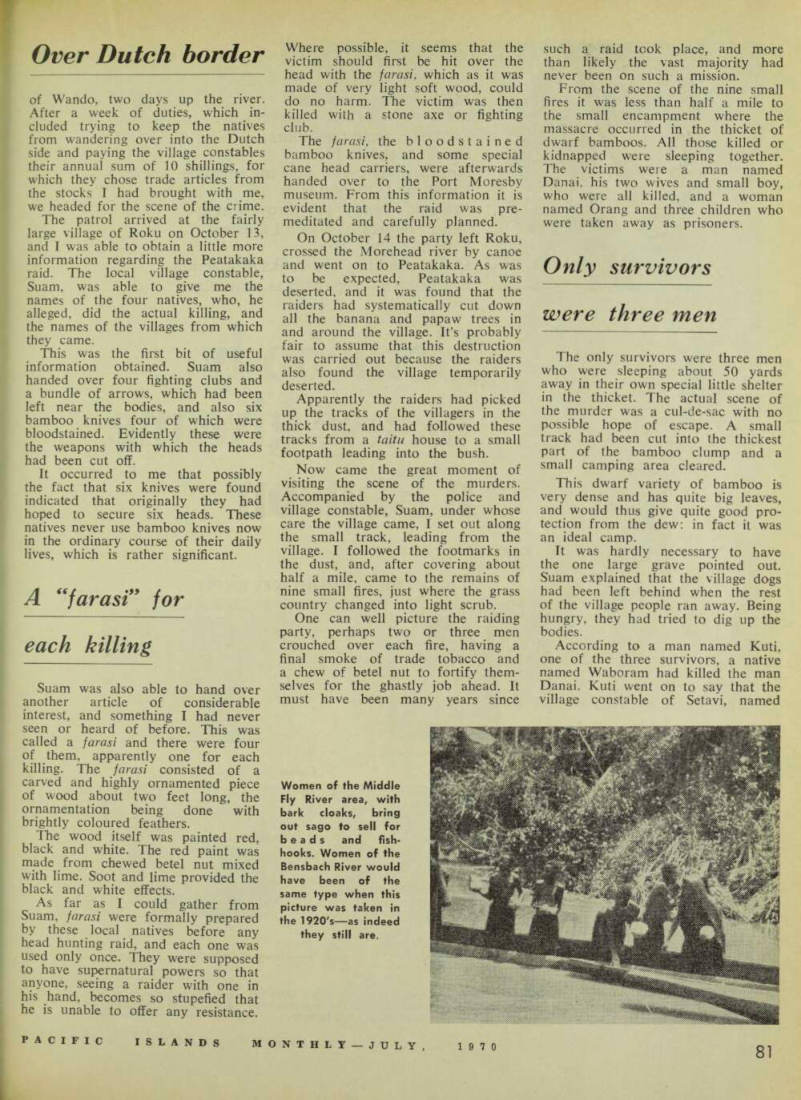 85
85 86
86 87
87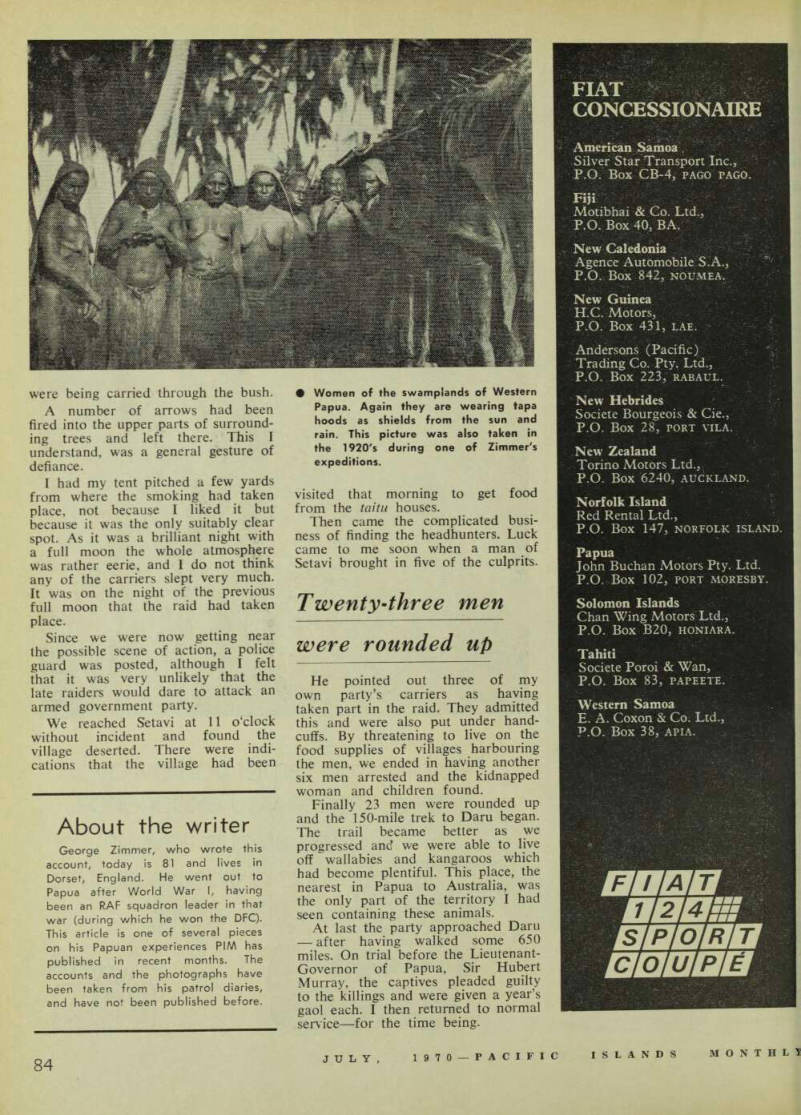 88
88 89
89 90
90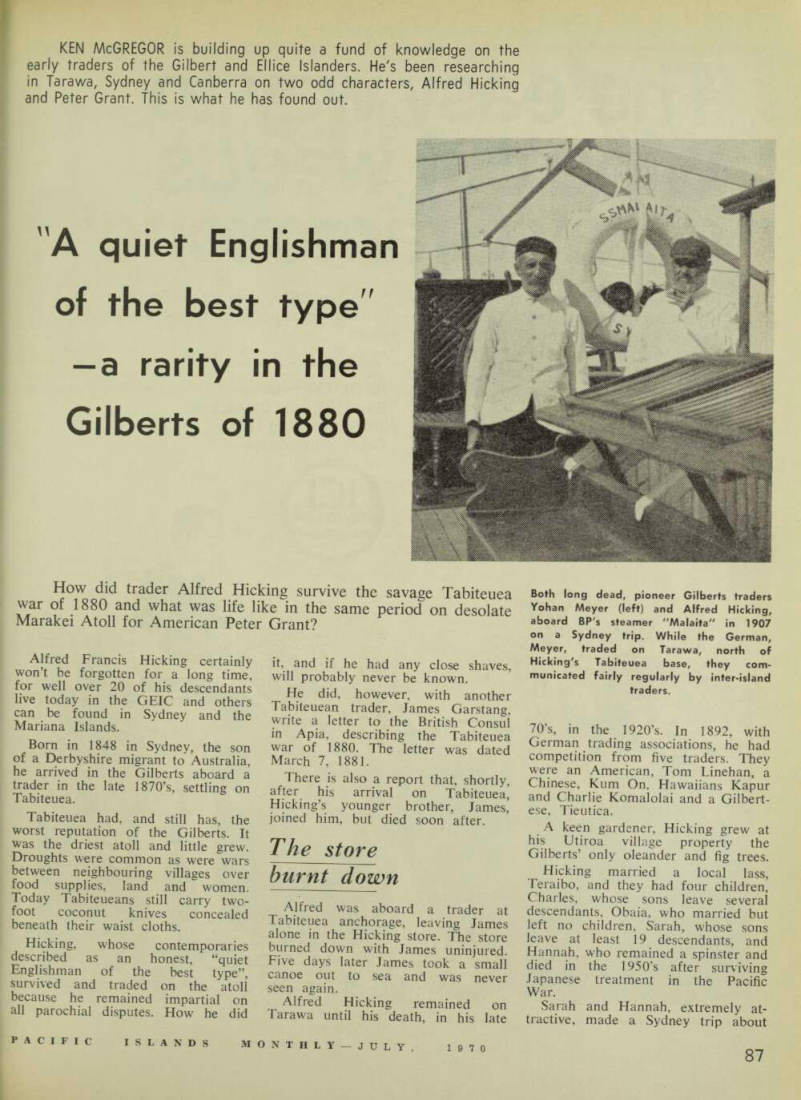 91
91 92
92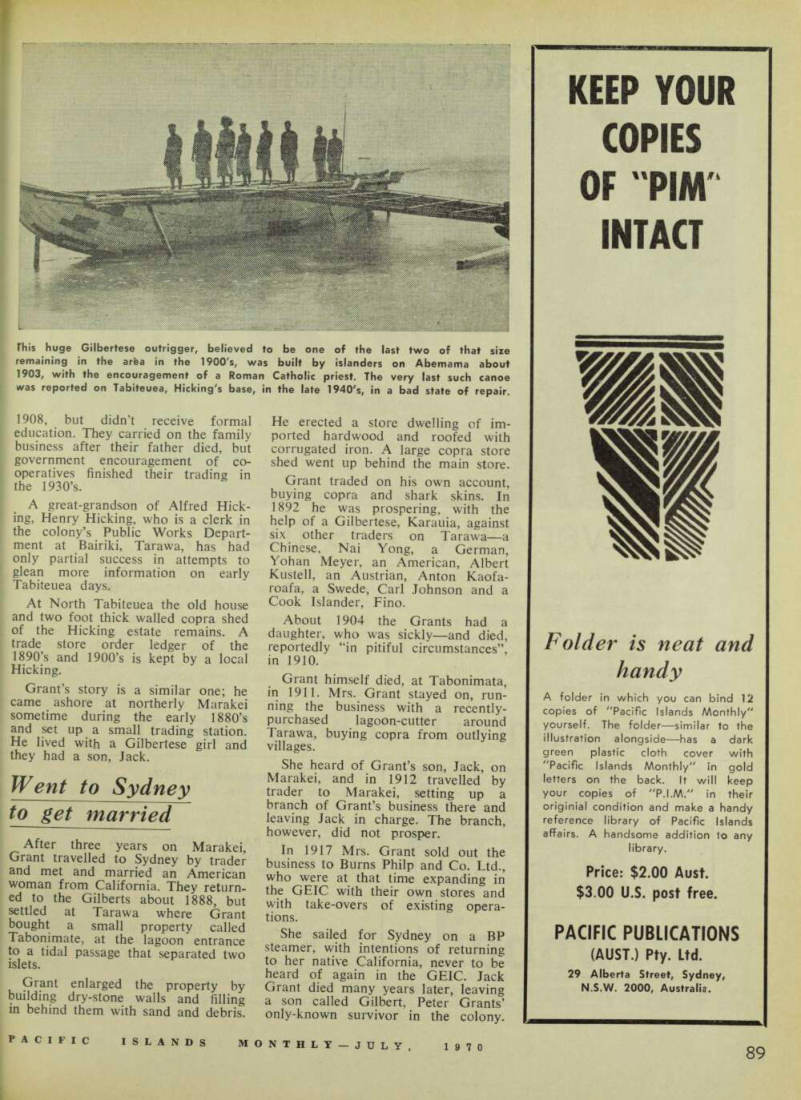 93
93 94
94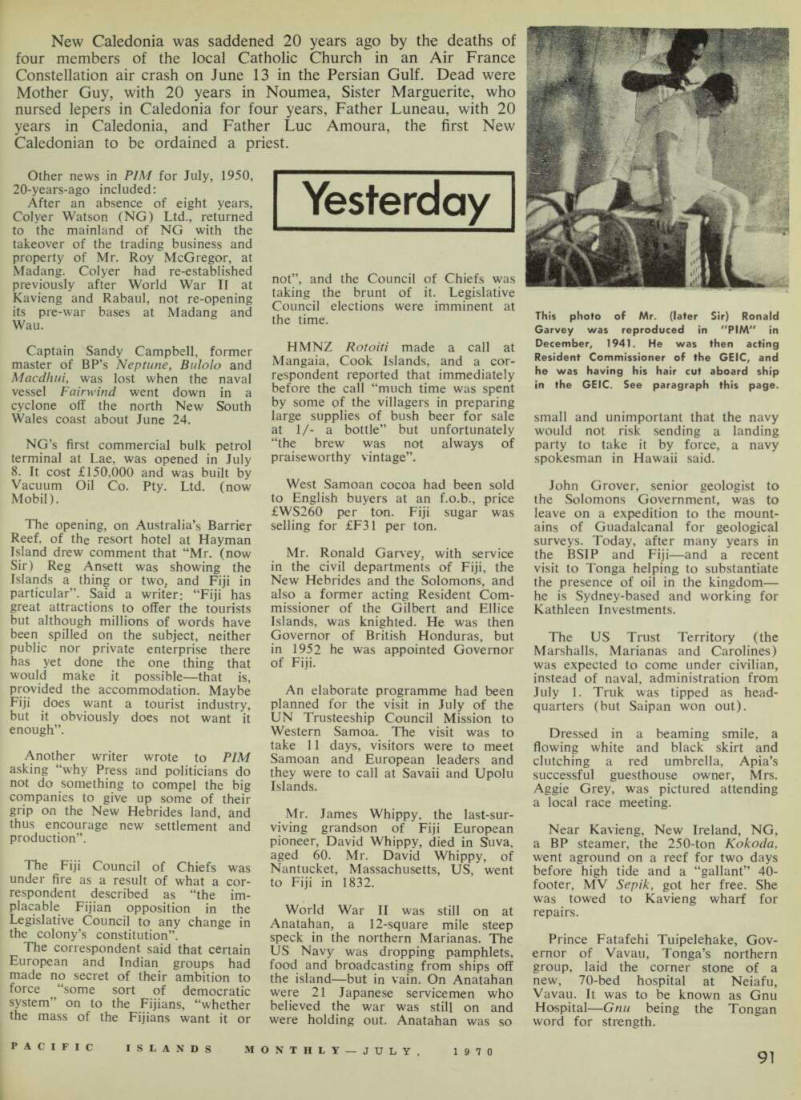 95
95 96
96 97
97 98
98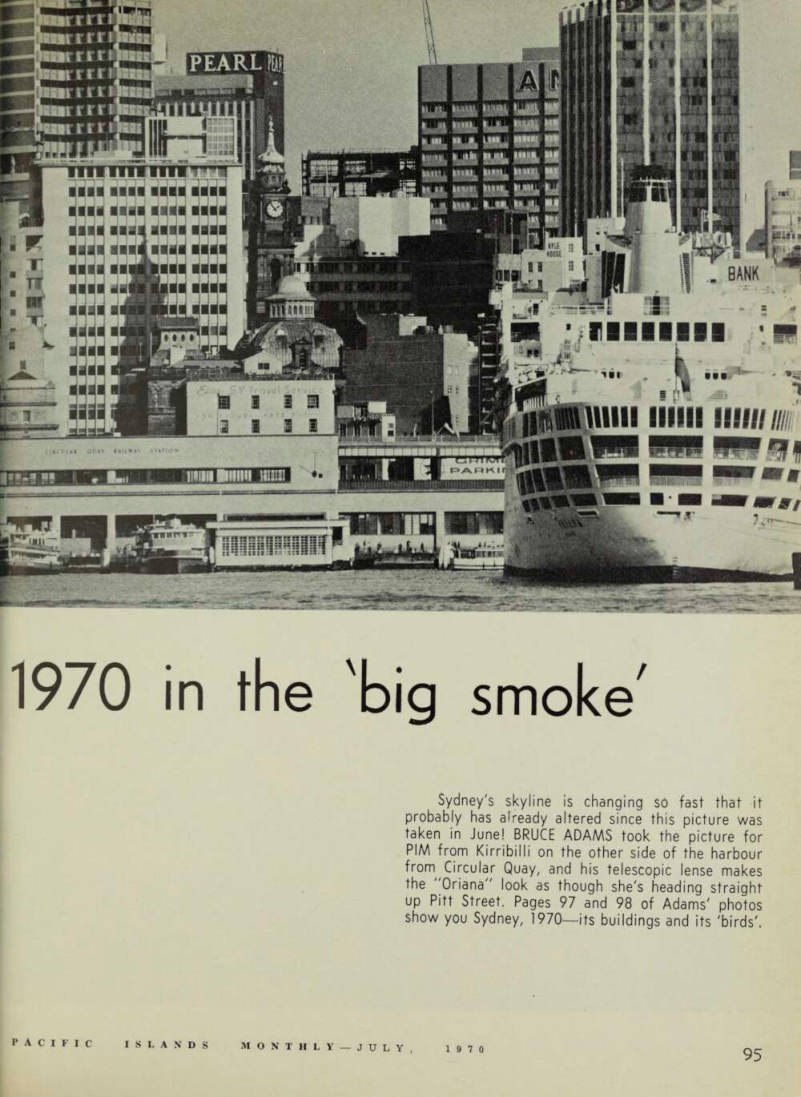 99
99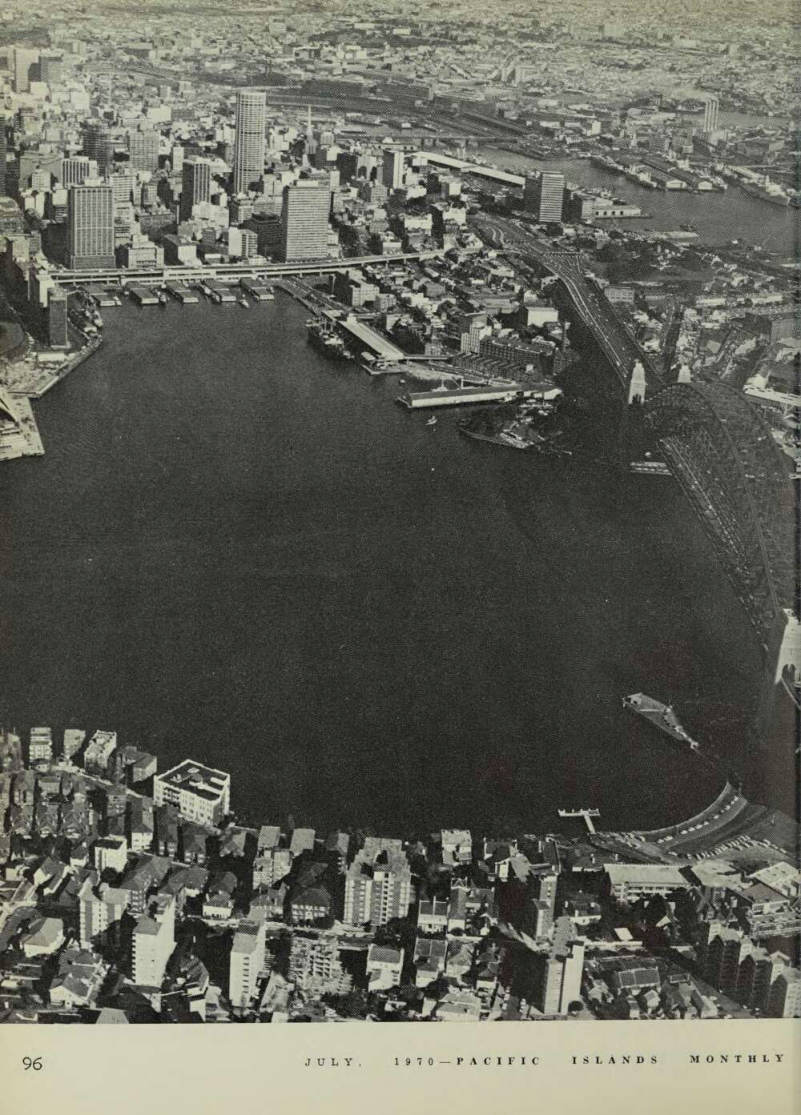 100
100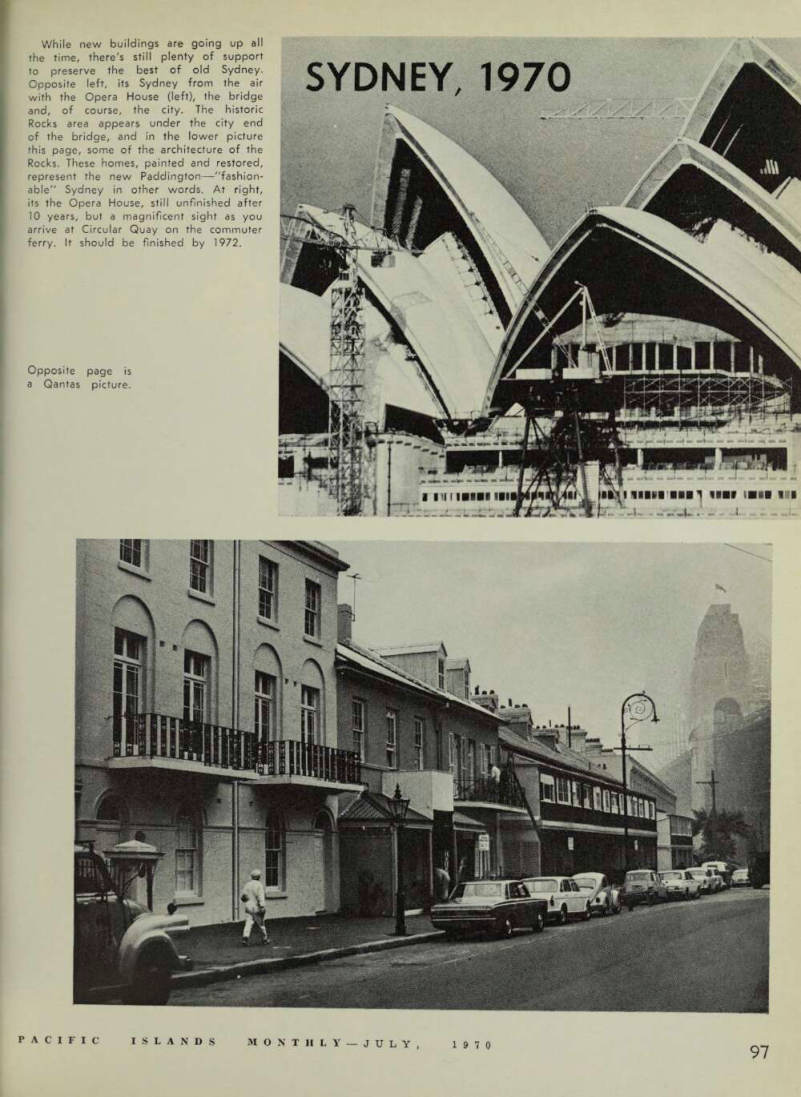 101
101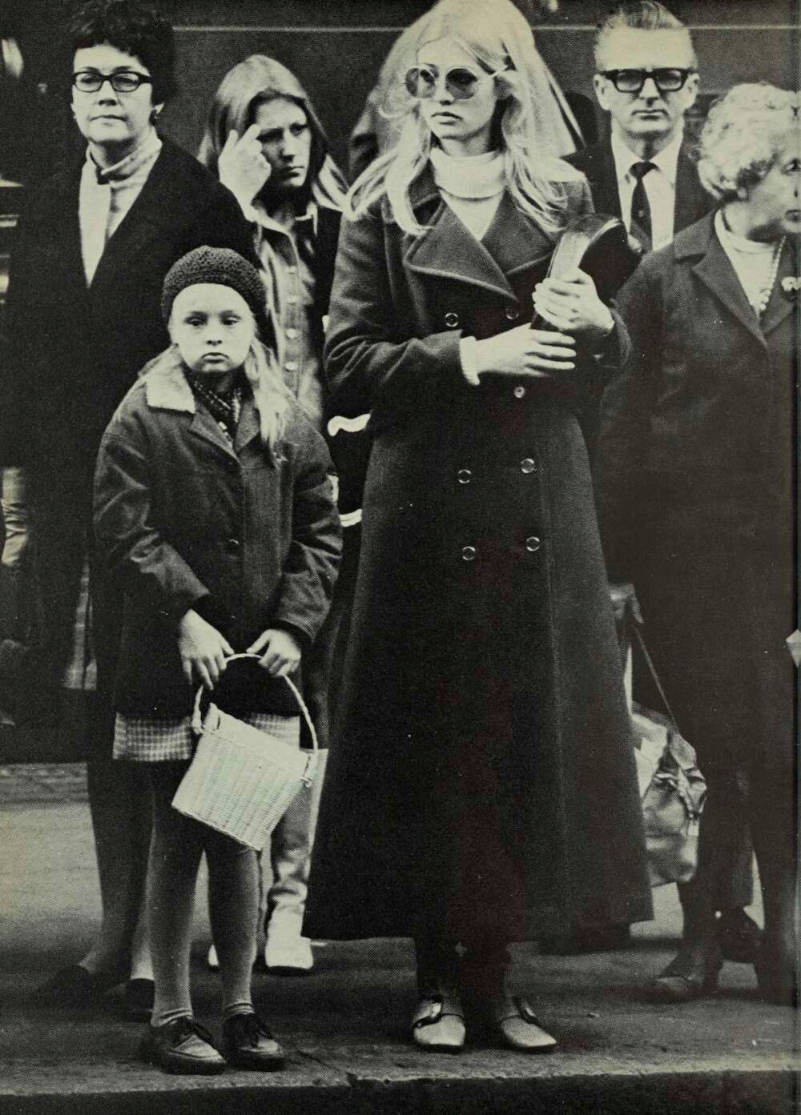 102
102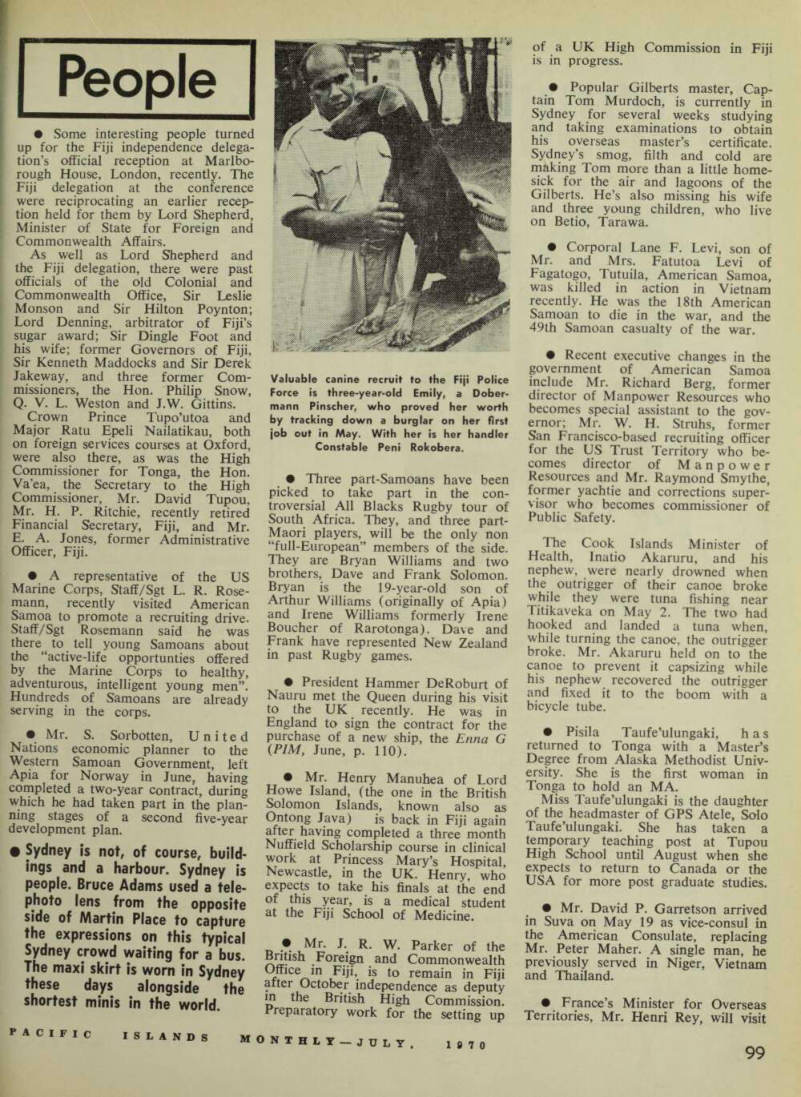 103
103 104
104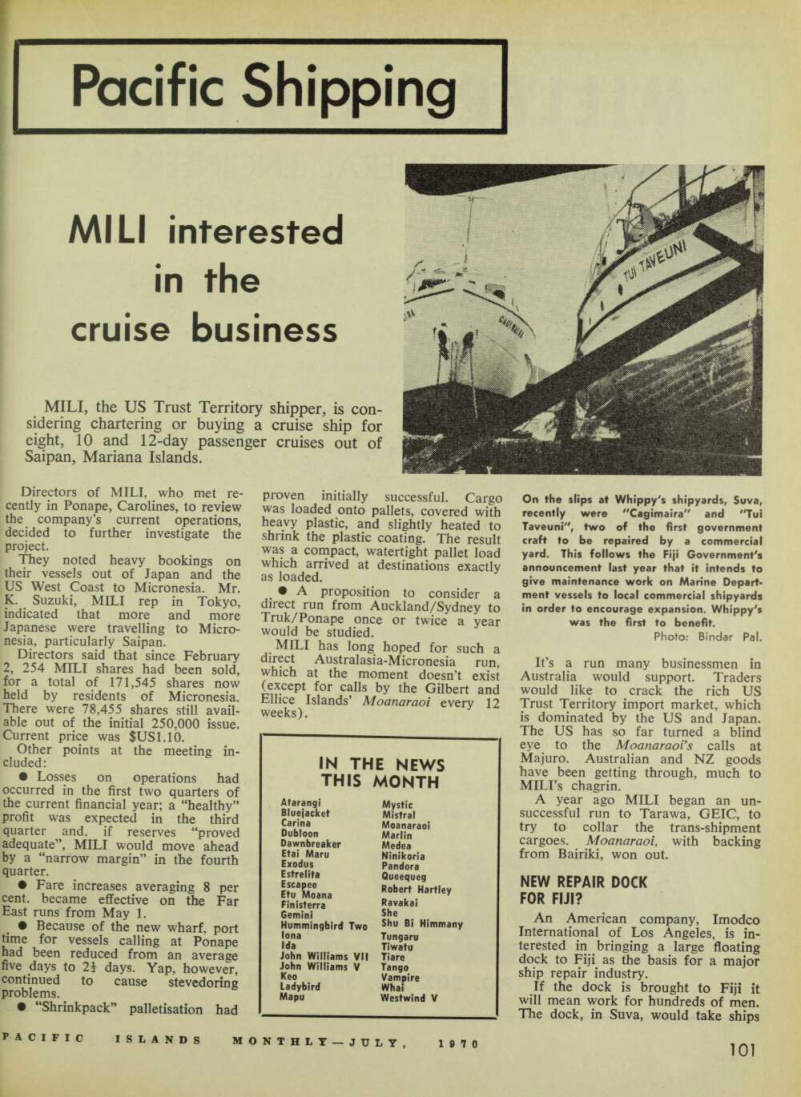 105
105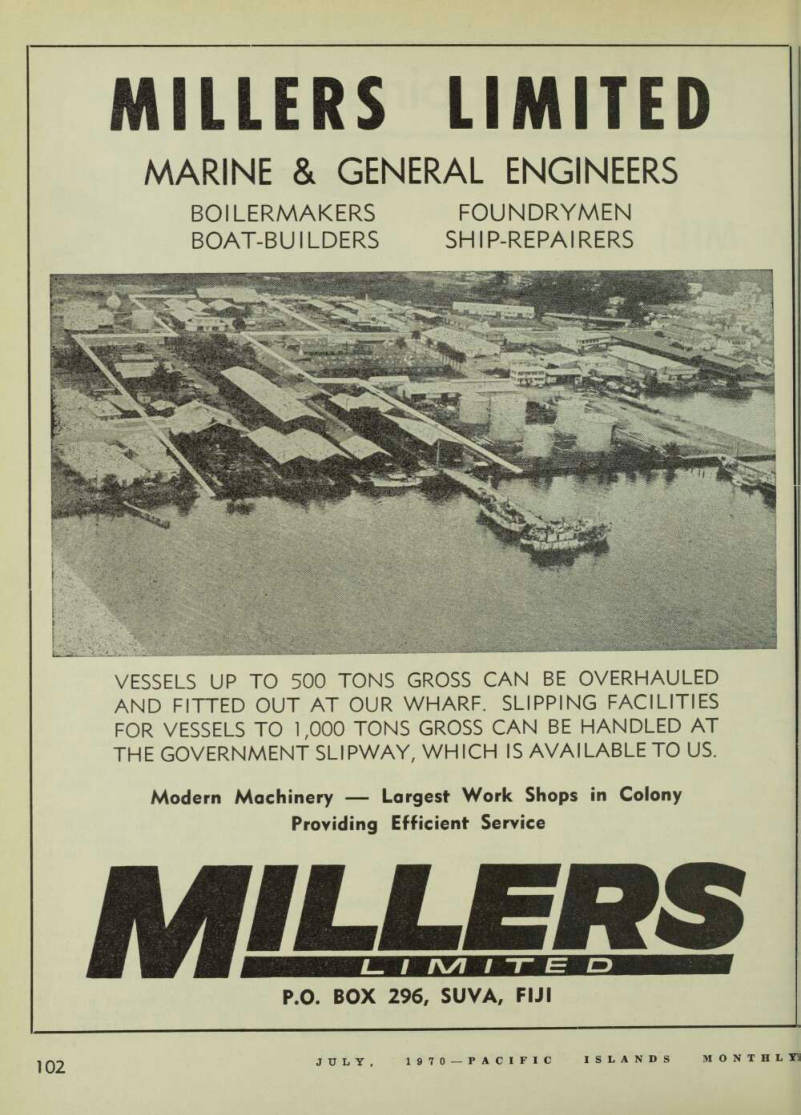 106
106 107
107 108
108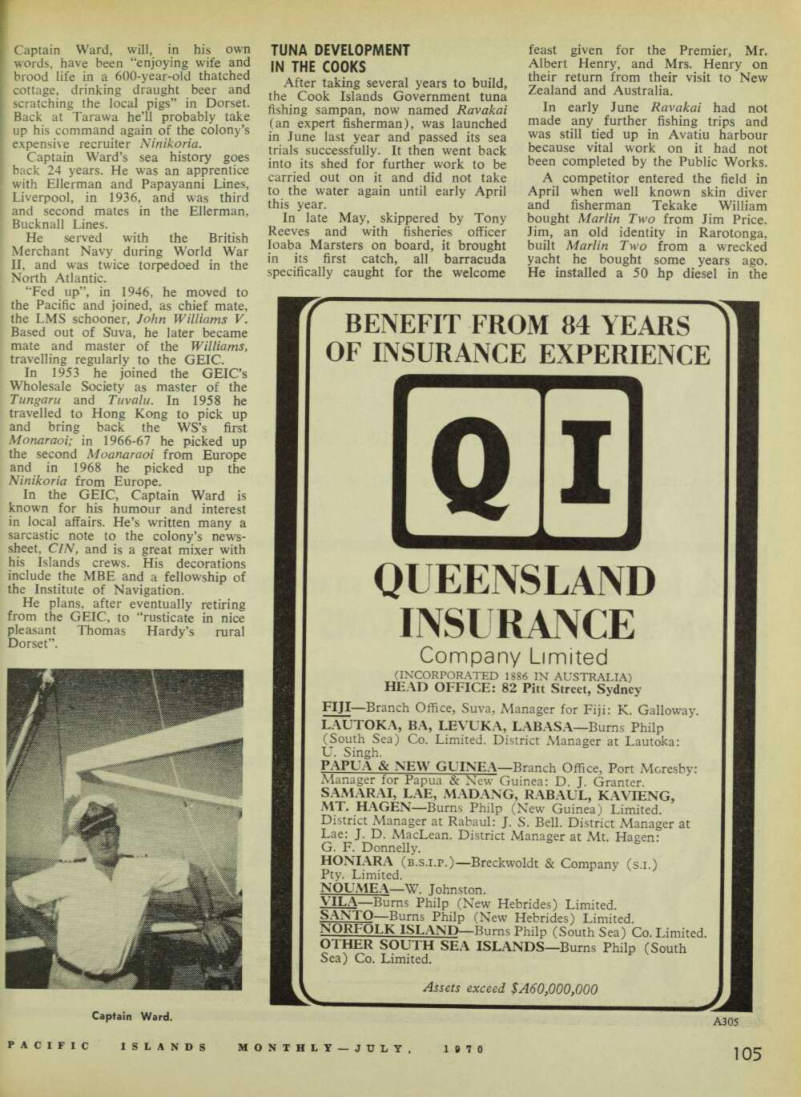 109
109 110
110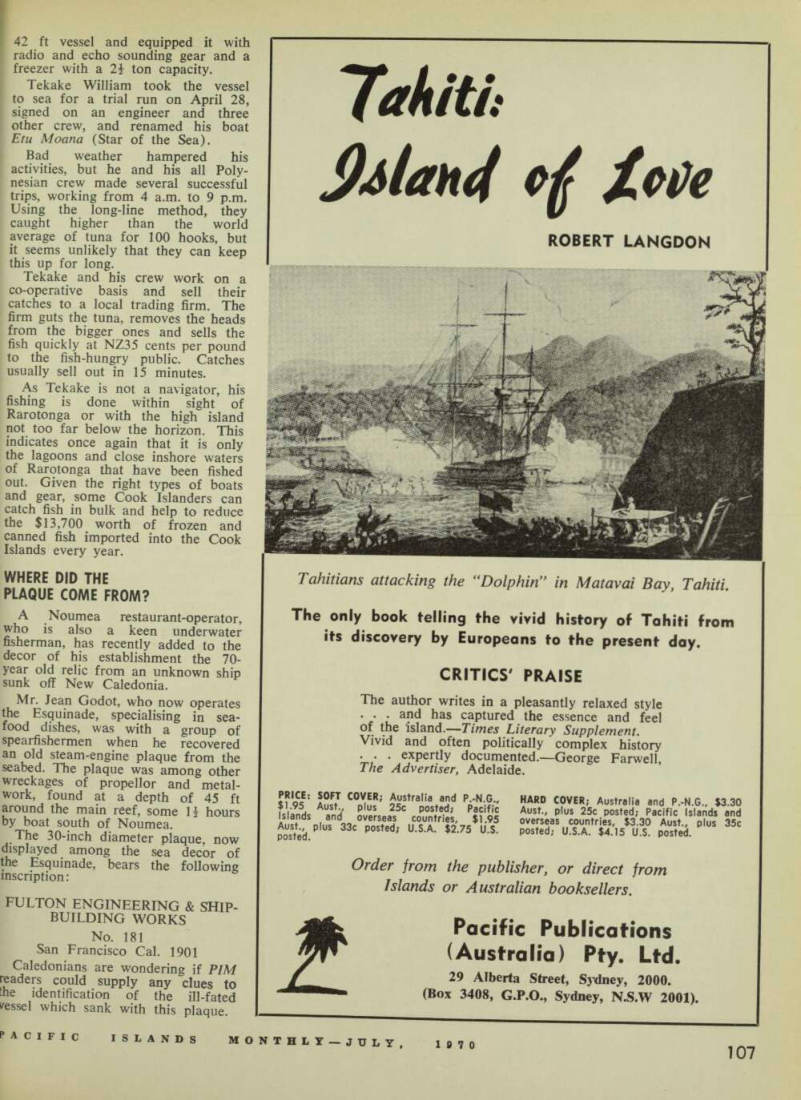 111
111 112
112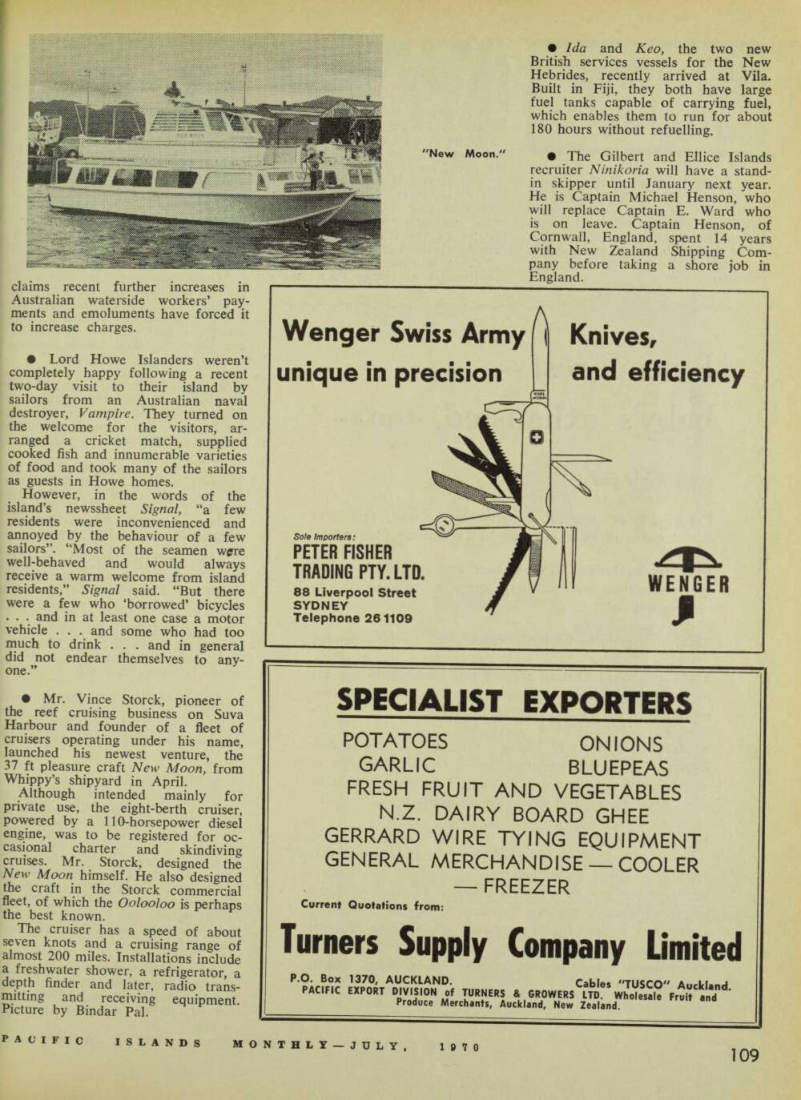 113
113 114
114 115
115 116
116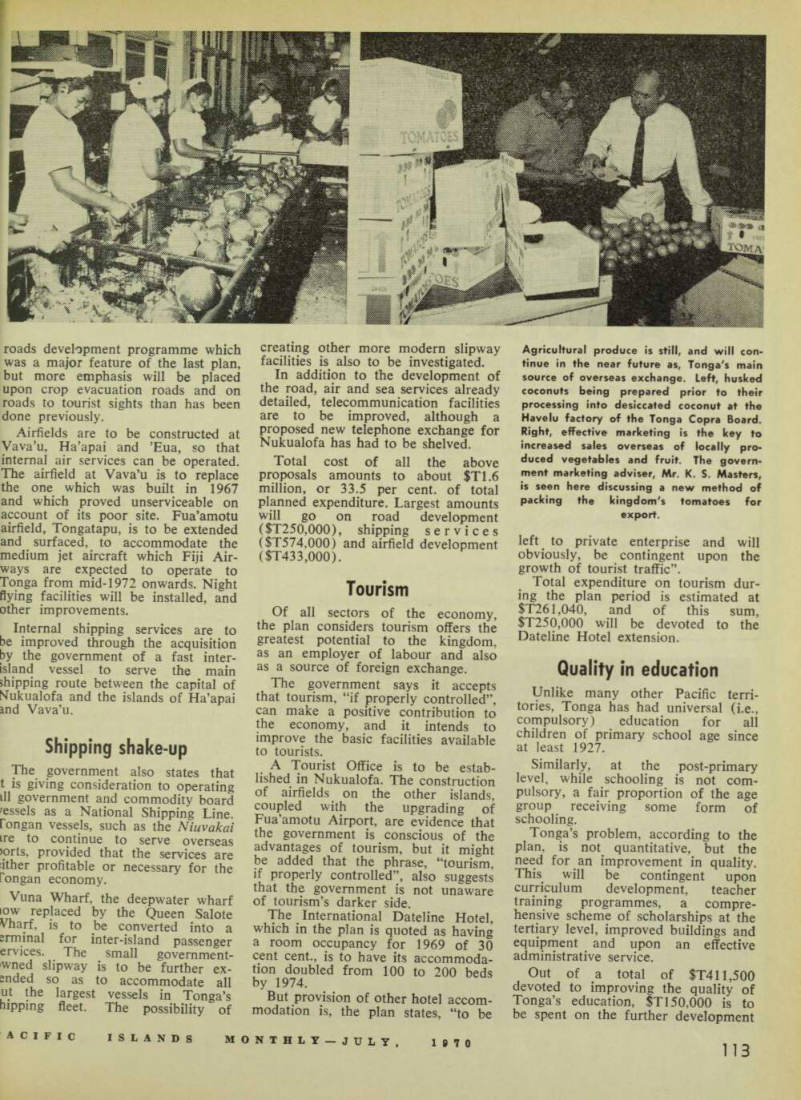 117
117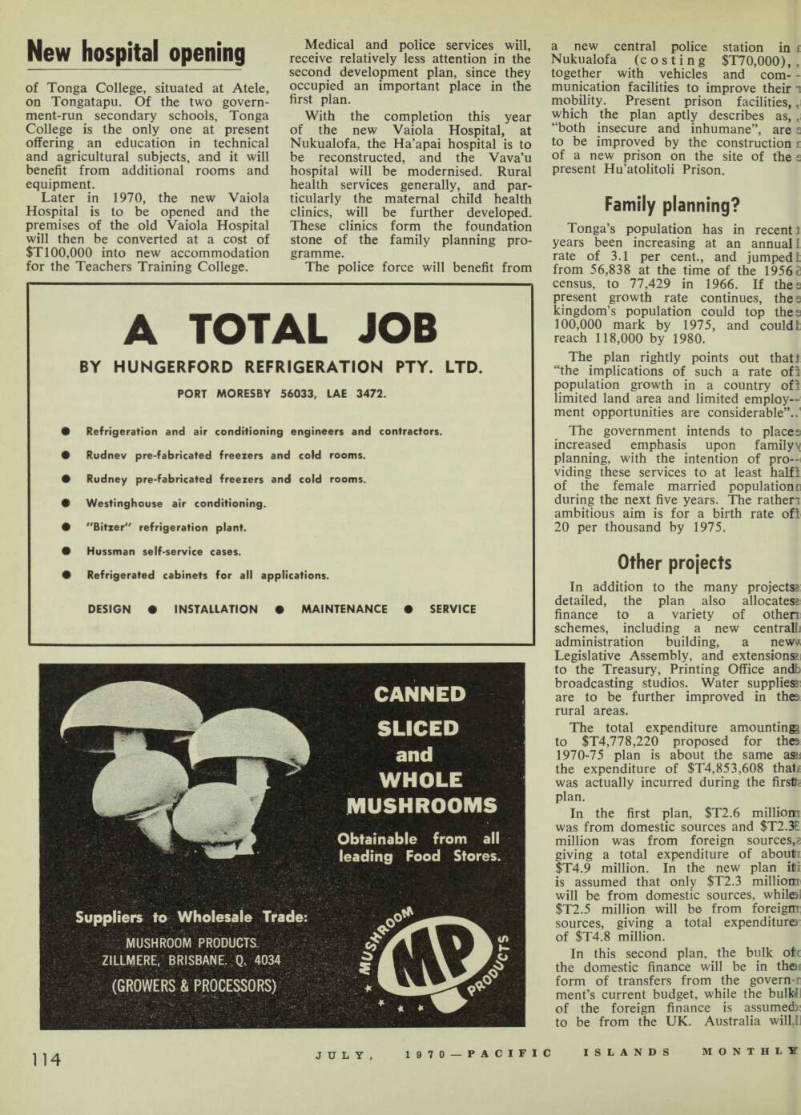 118
118 119
119 120
120 121
121 122
122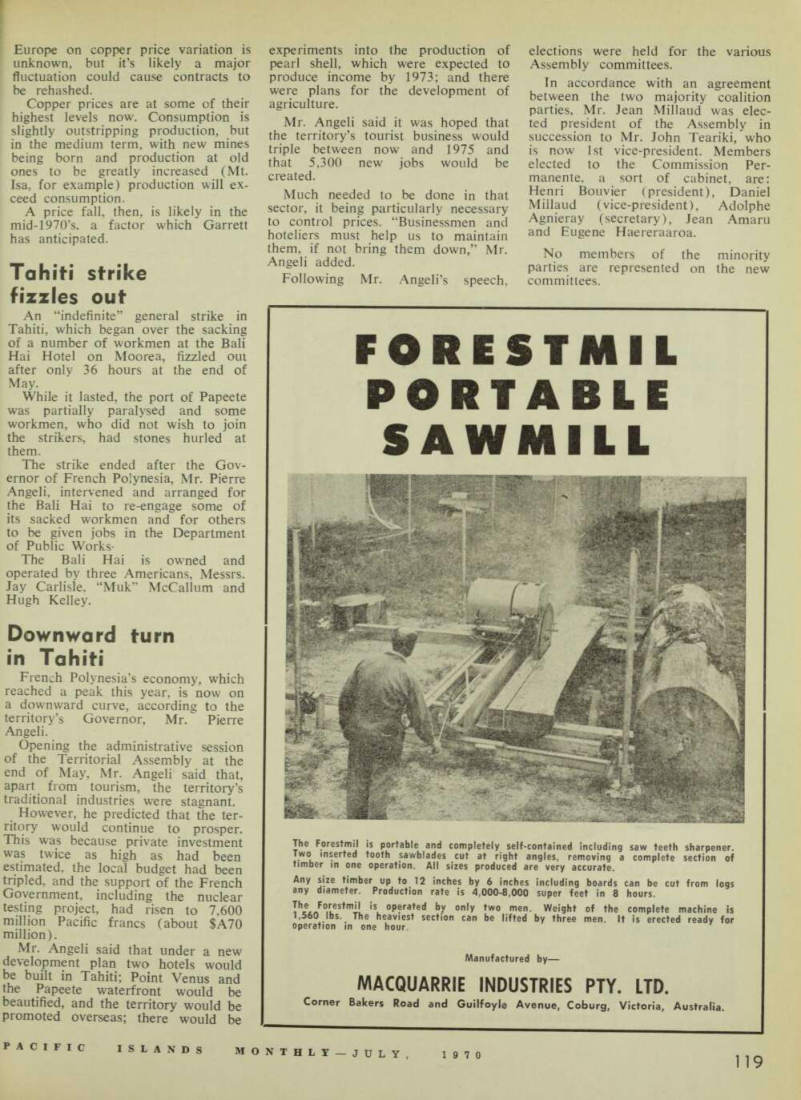 123
123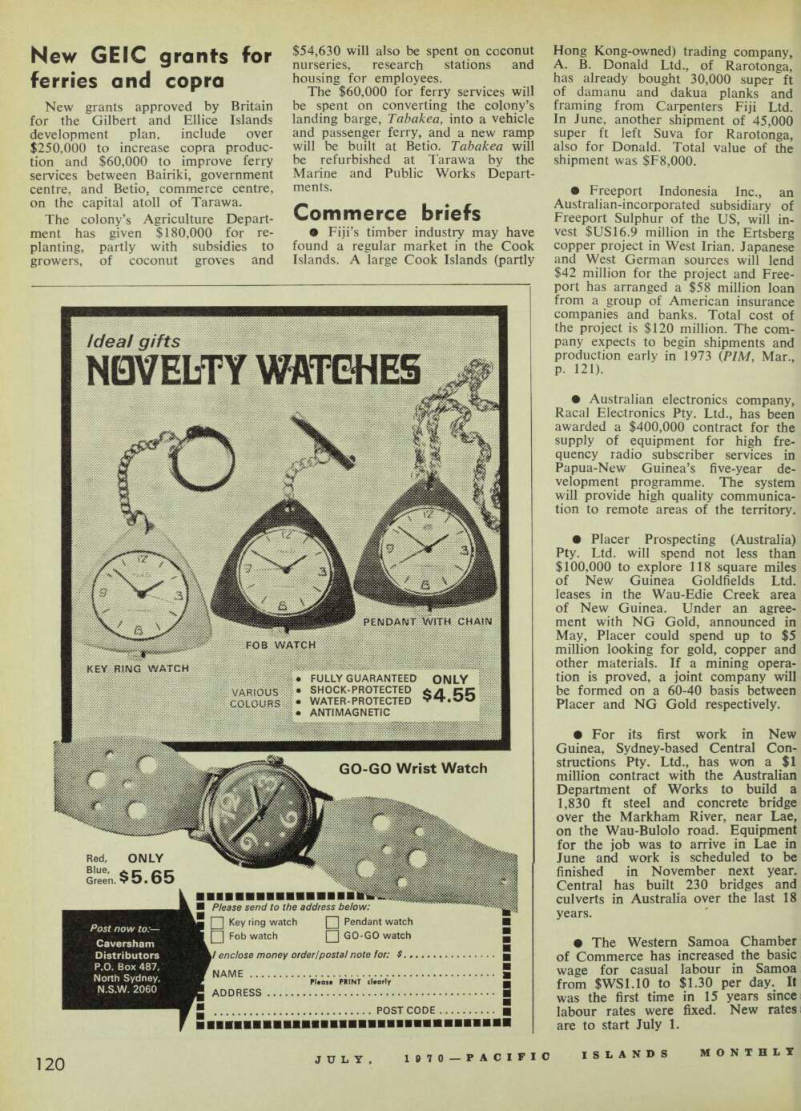 124
124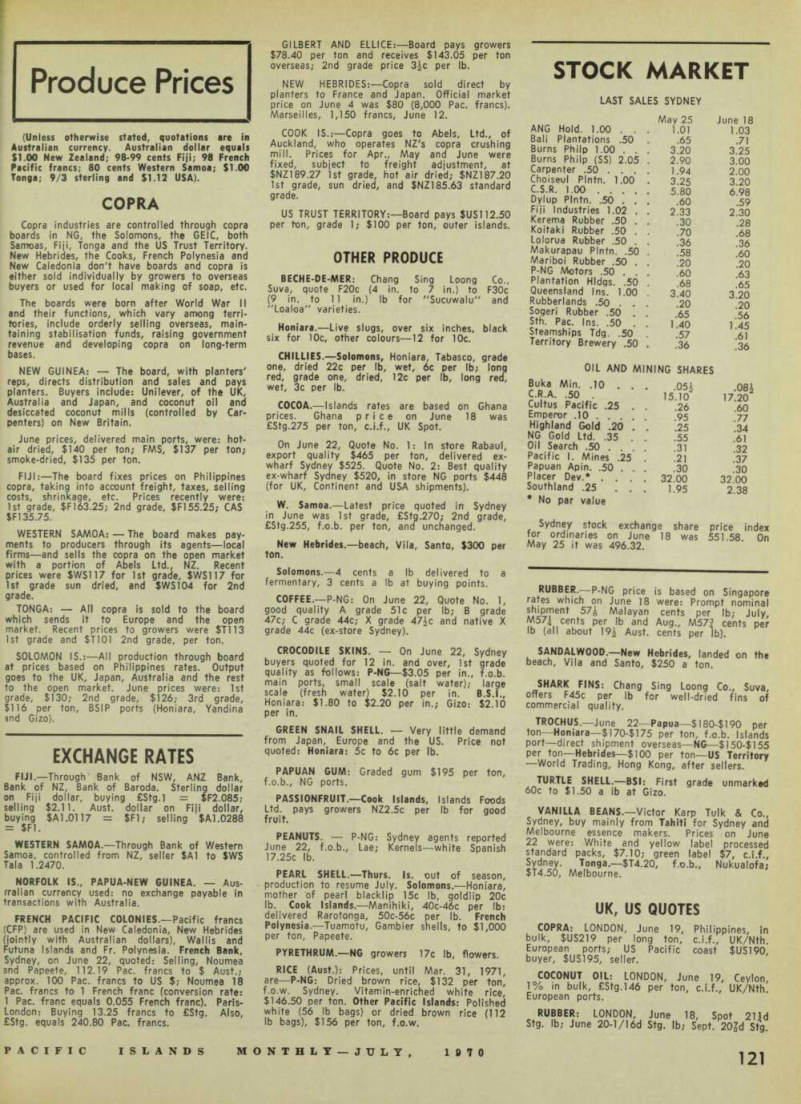 125
125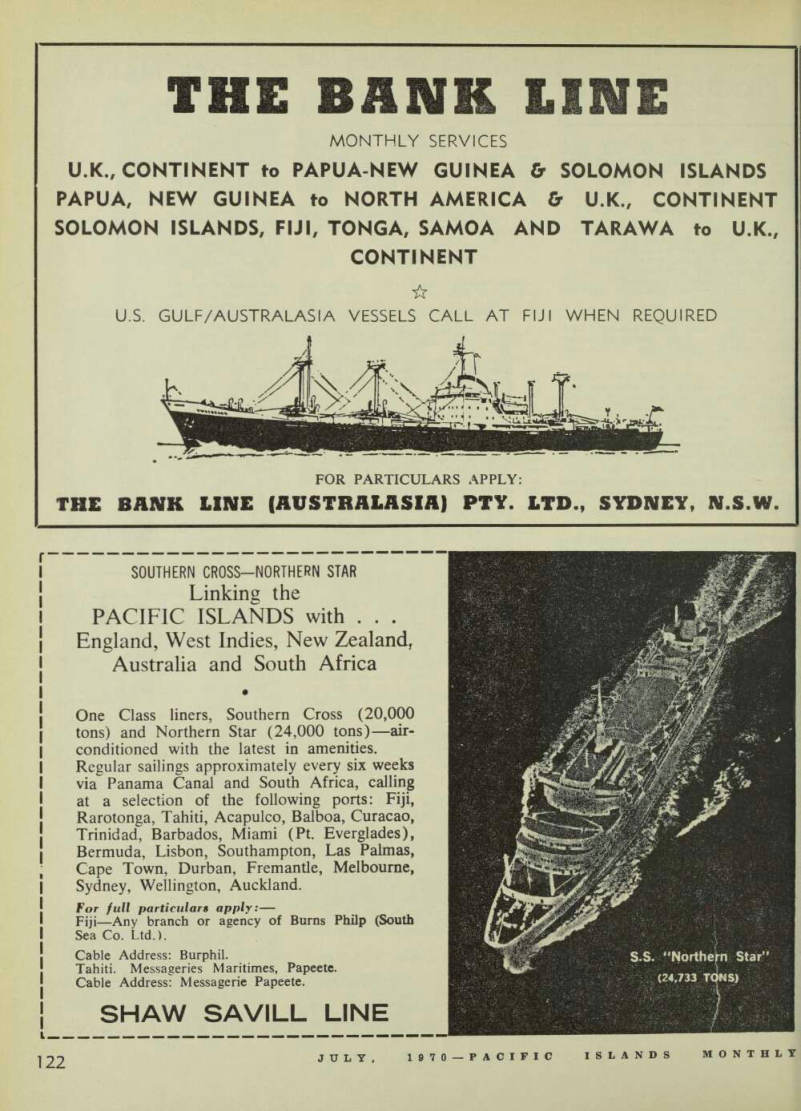 126
126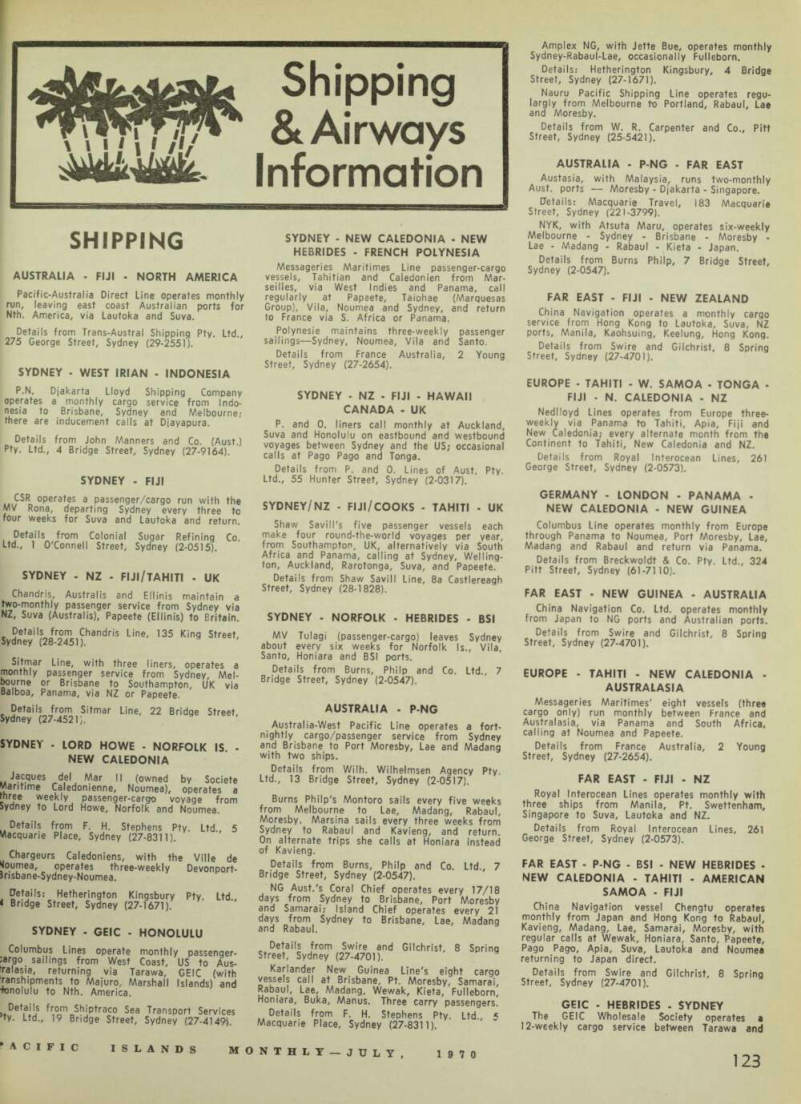 127
127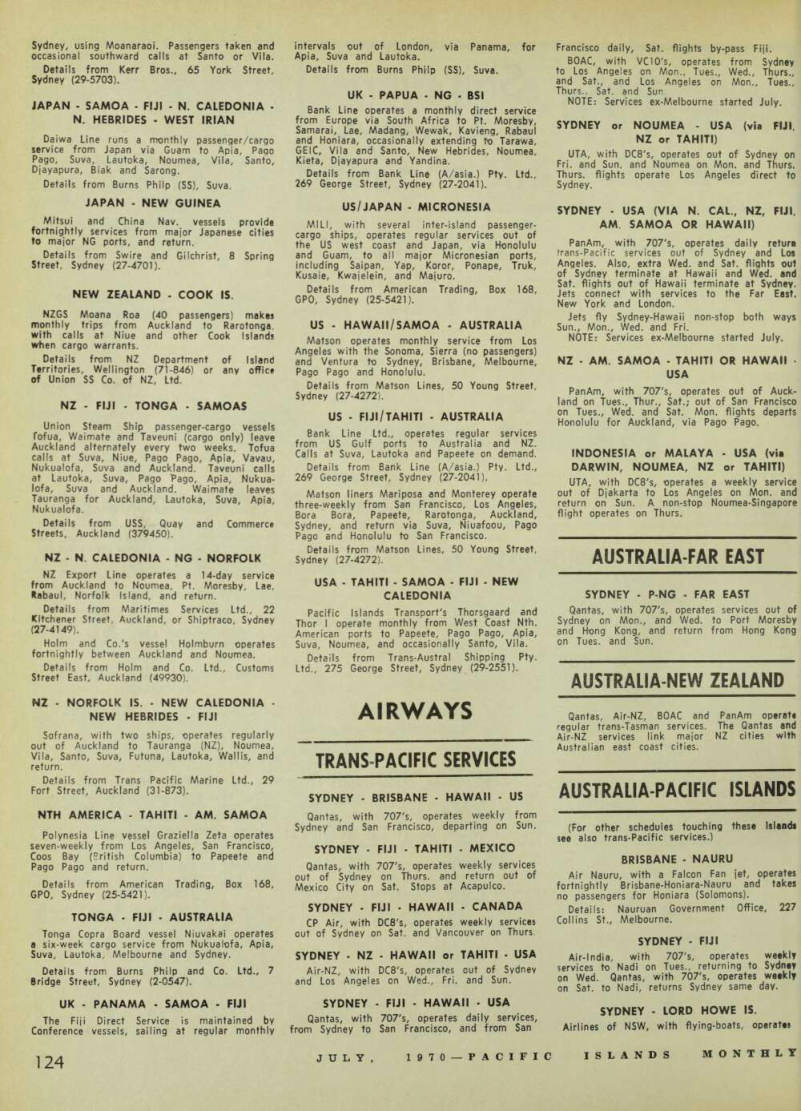 128
128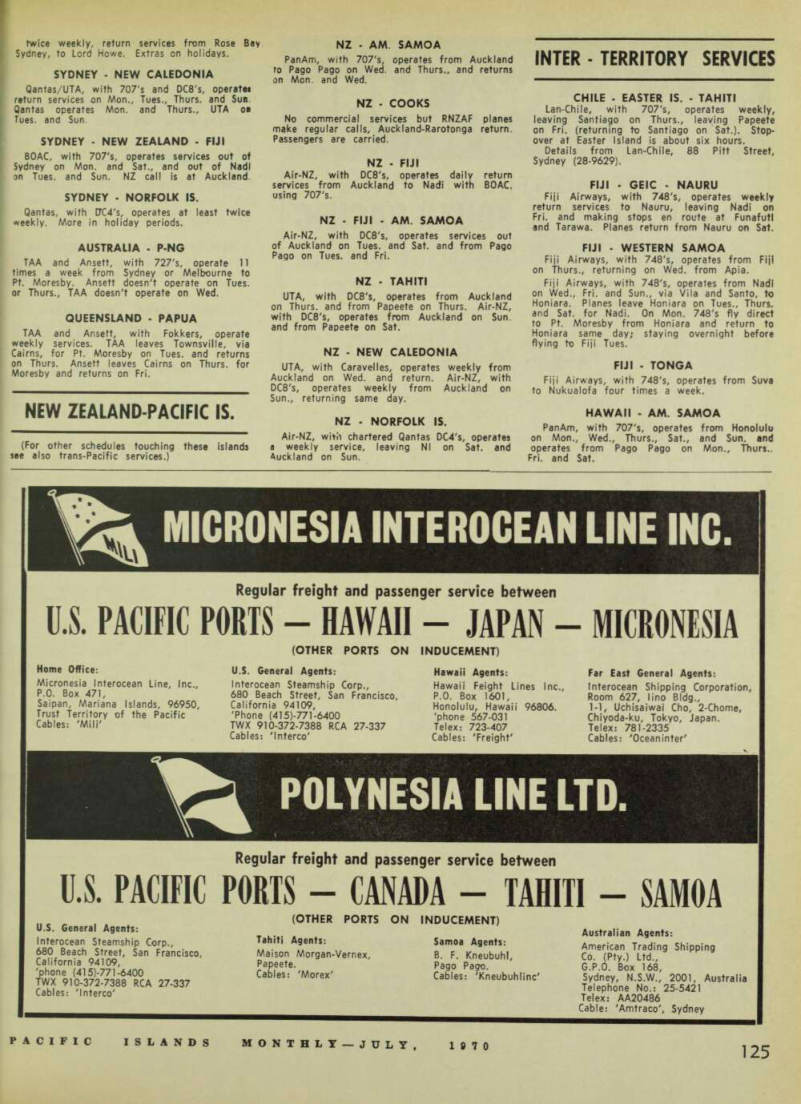 129
129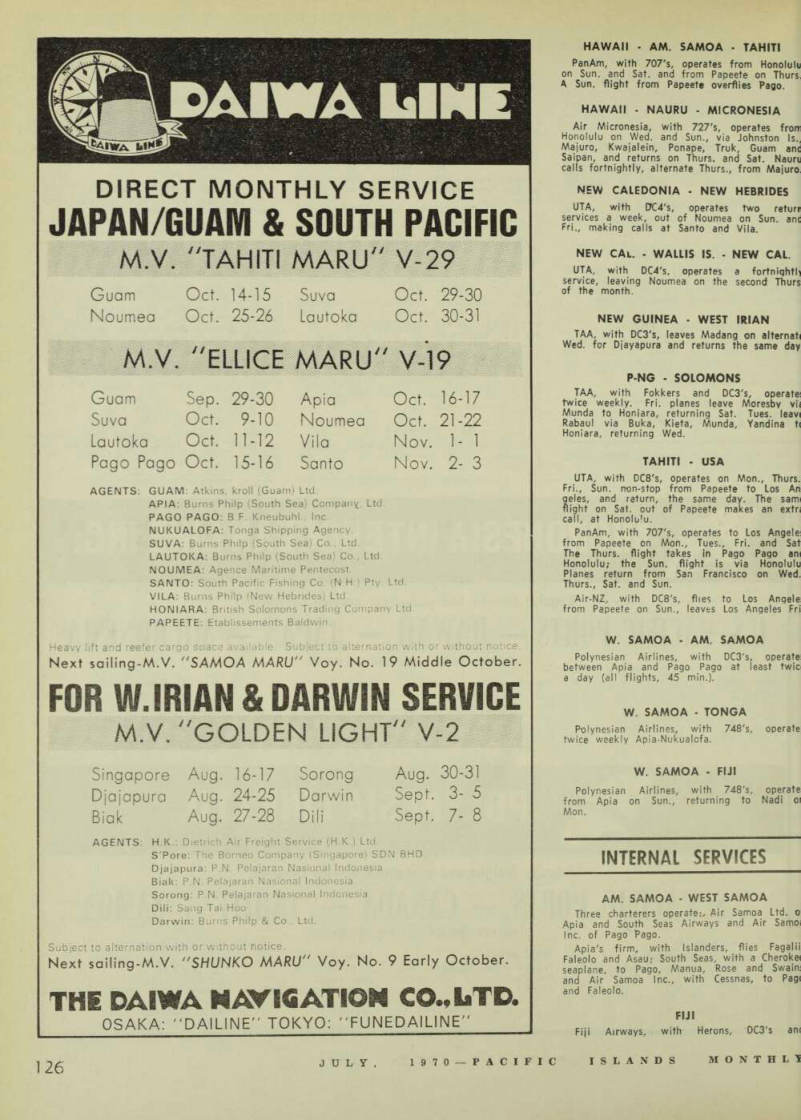 130
130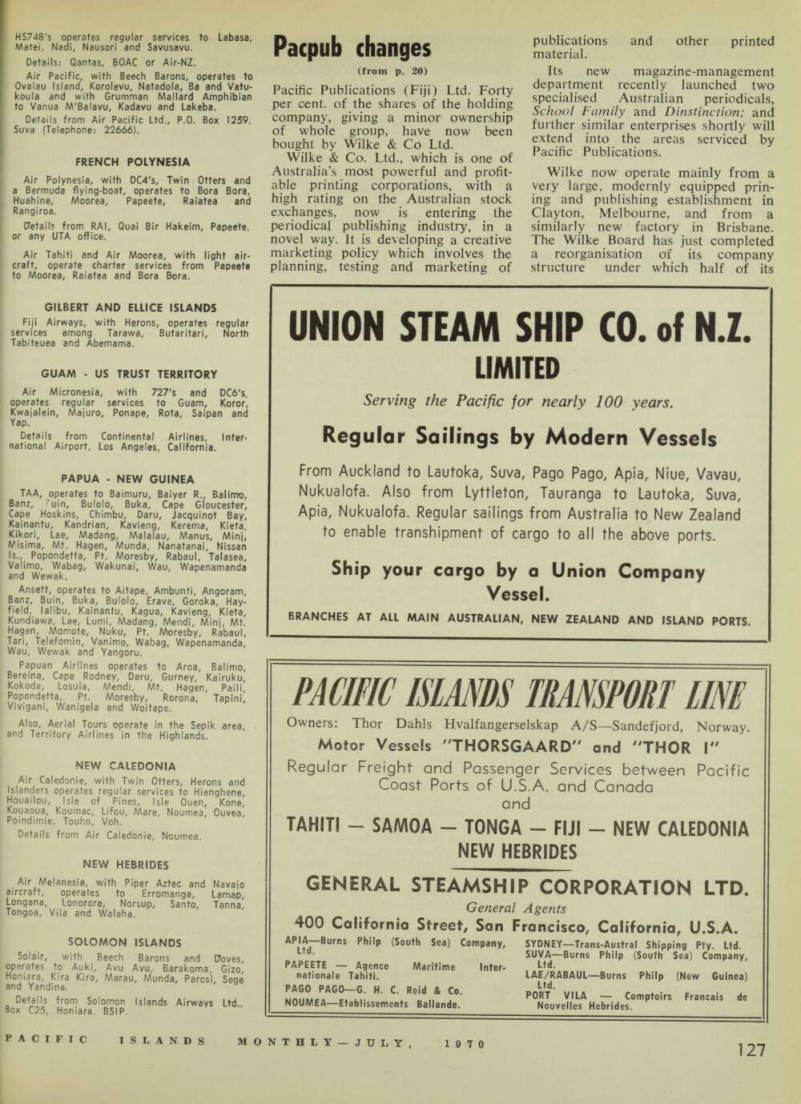 131
131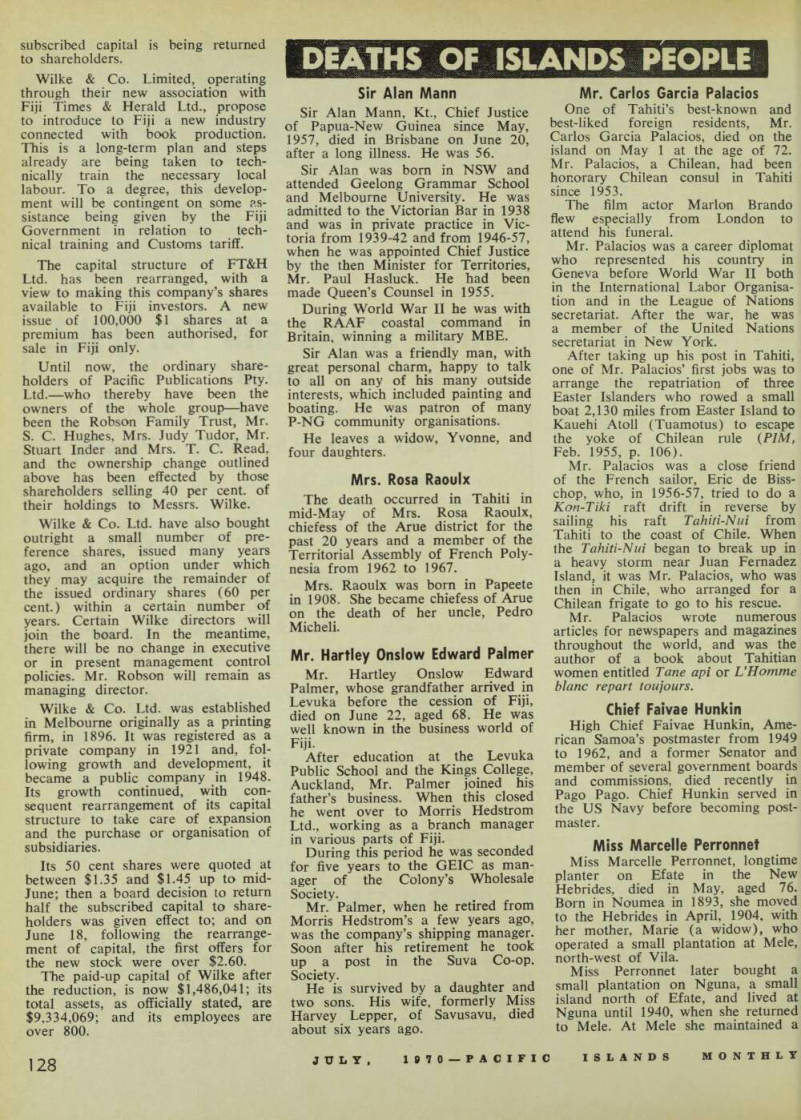 132
132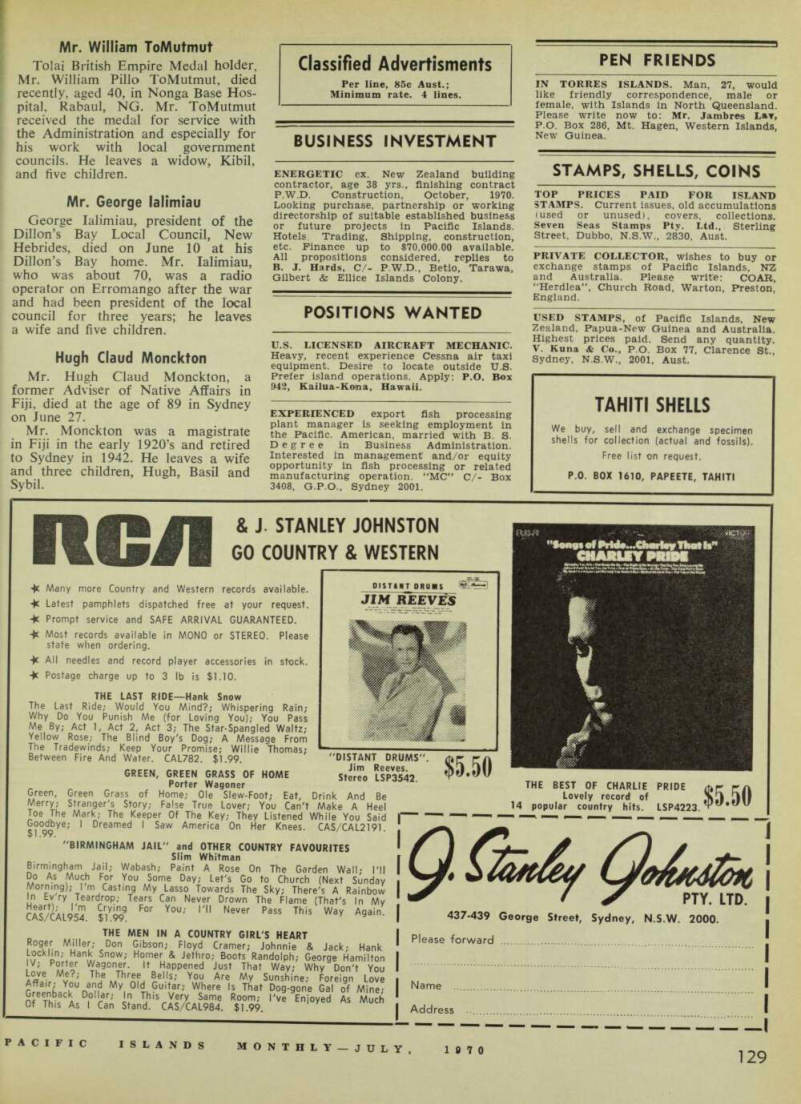 133
133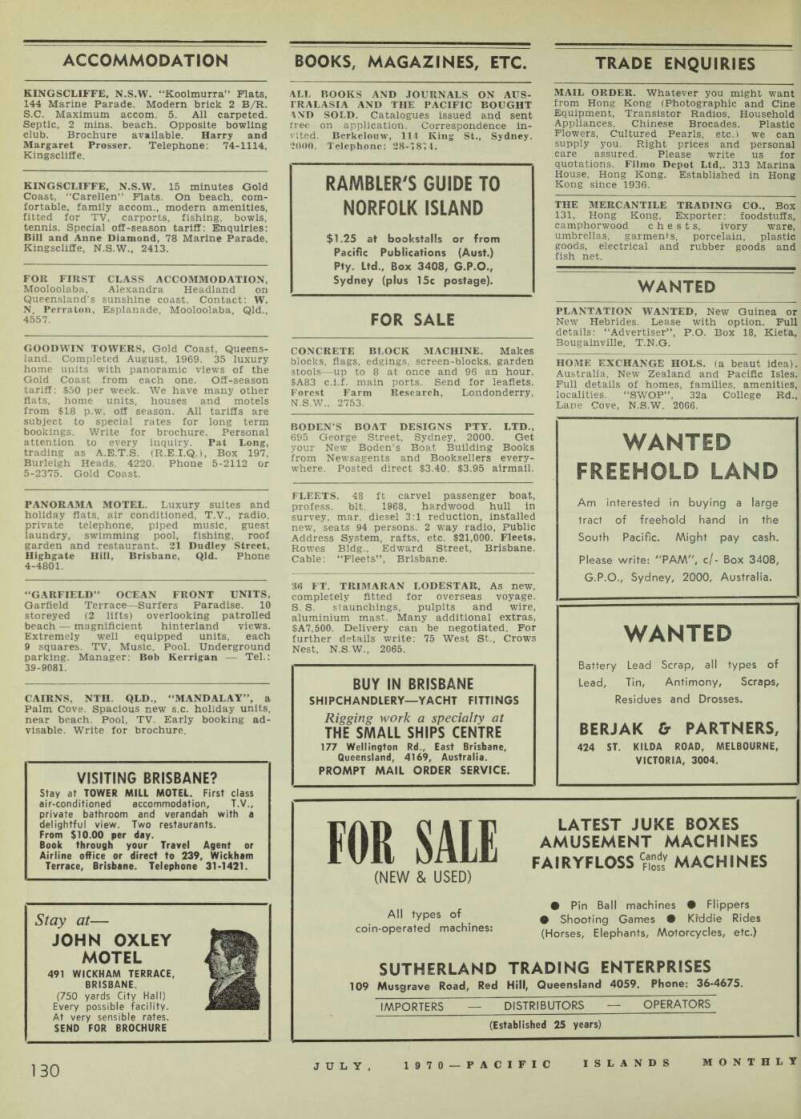 134
134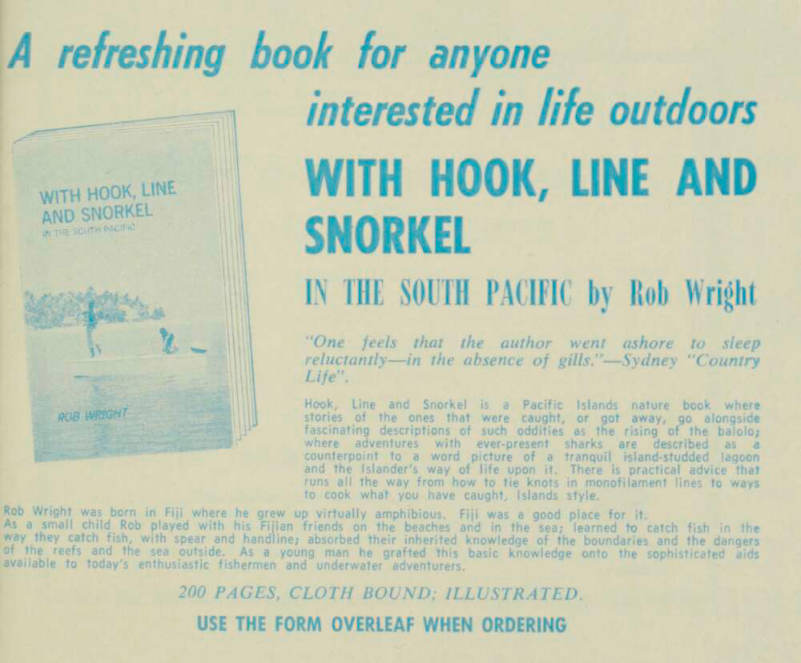 135
135 136
136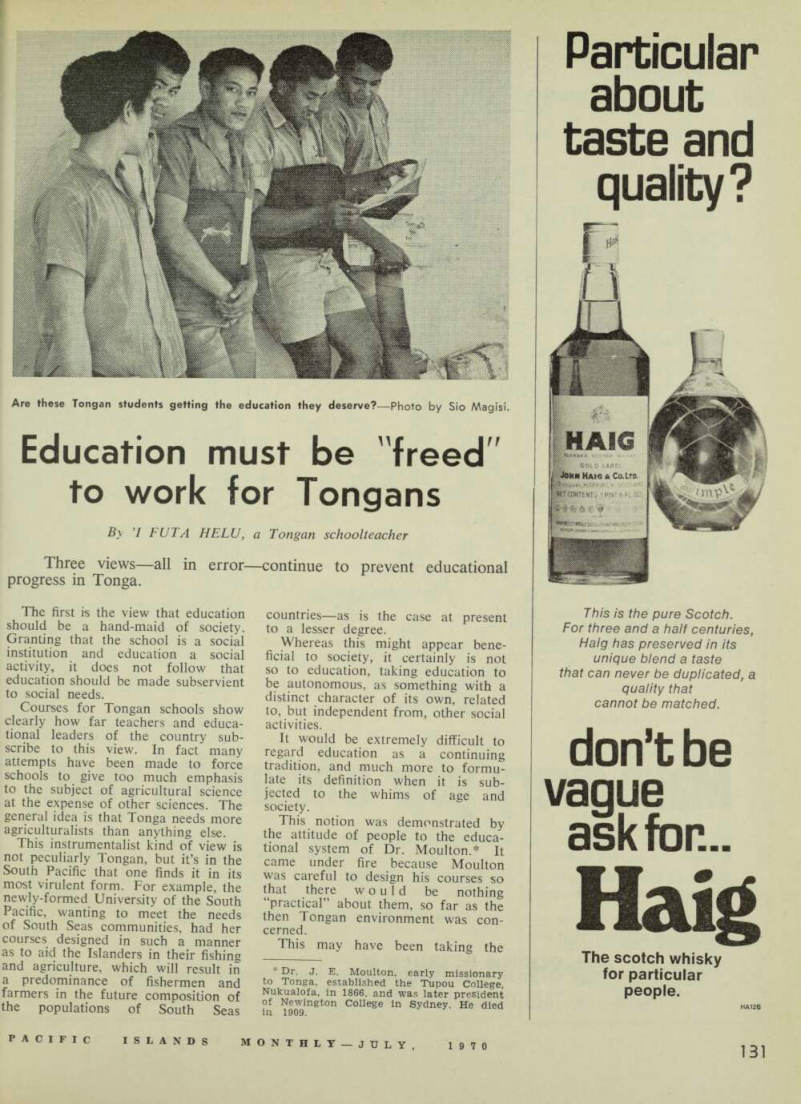 137
137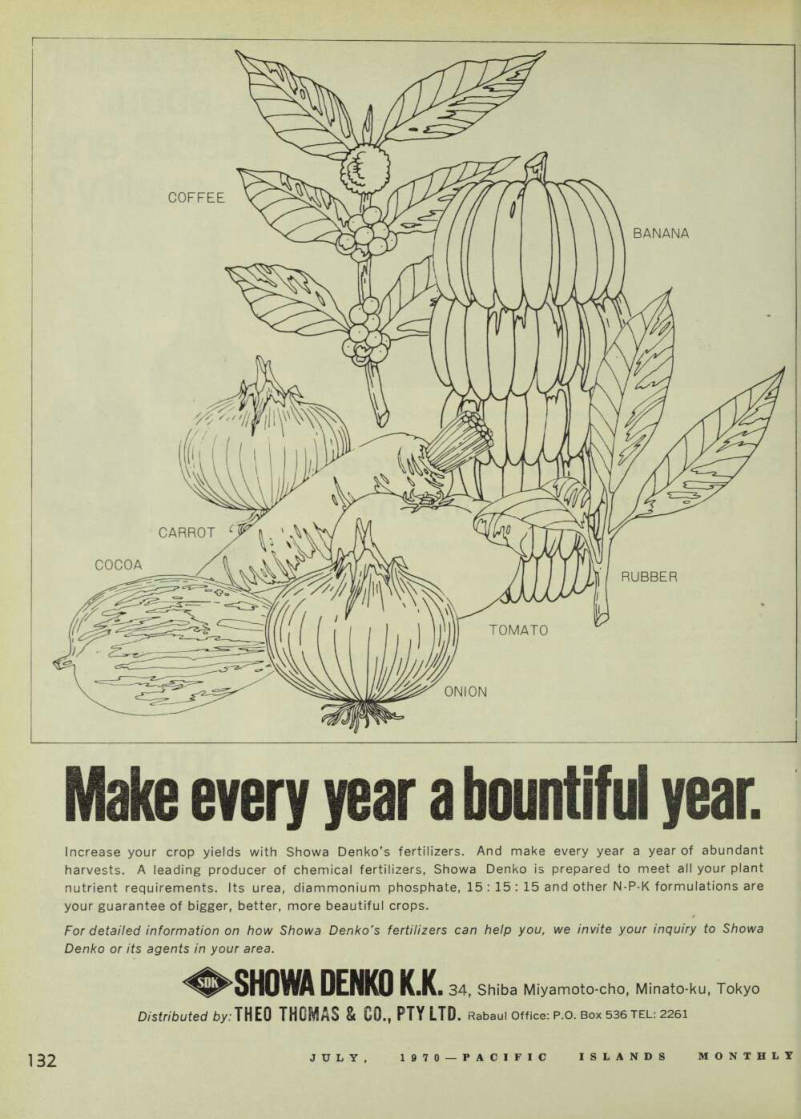 138
138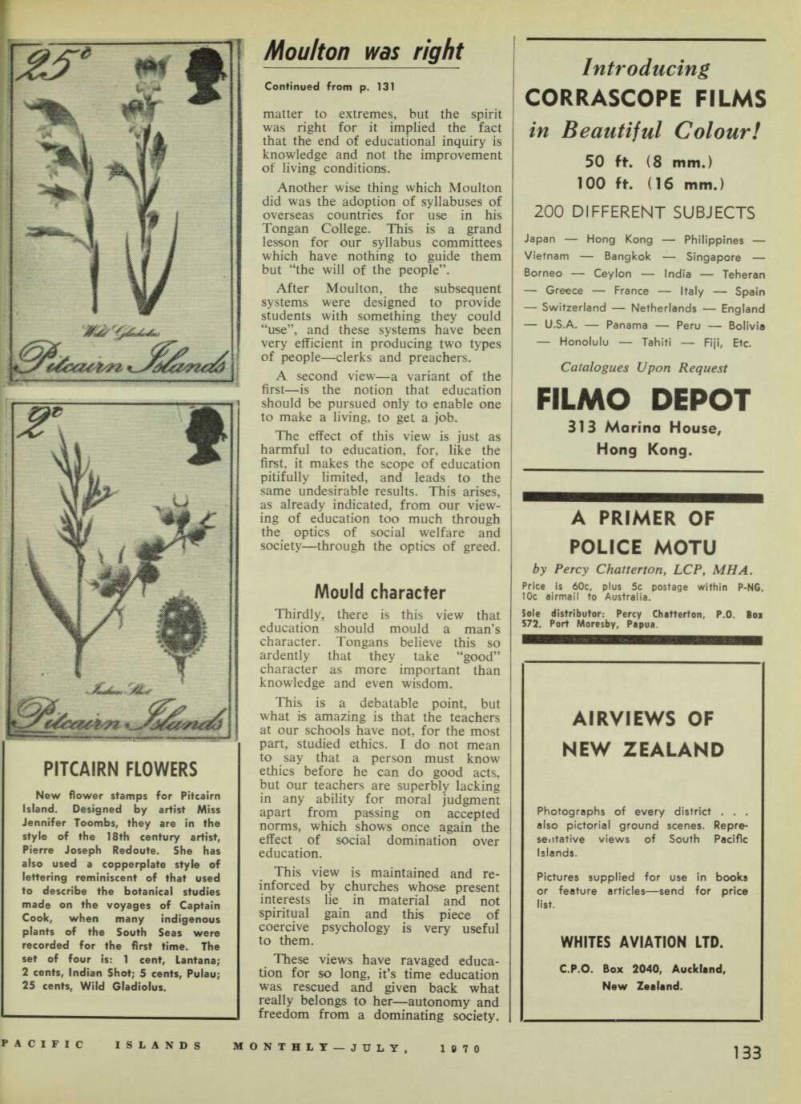 139
139 140
140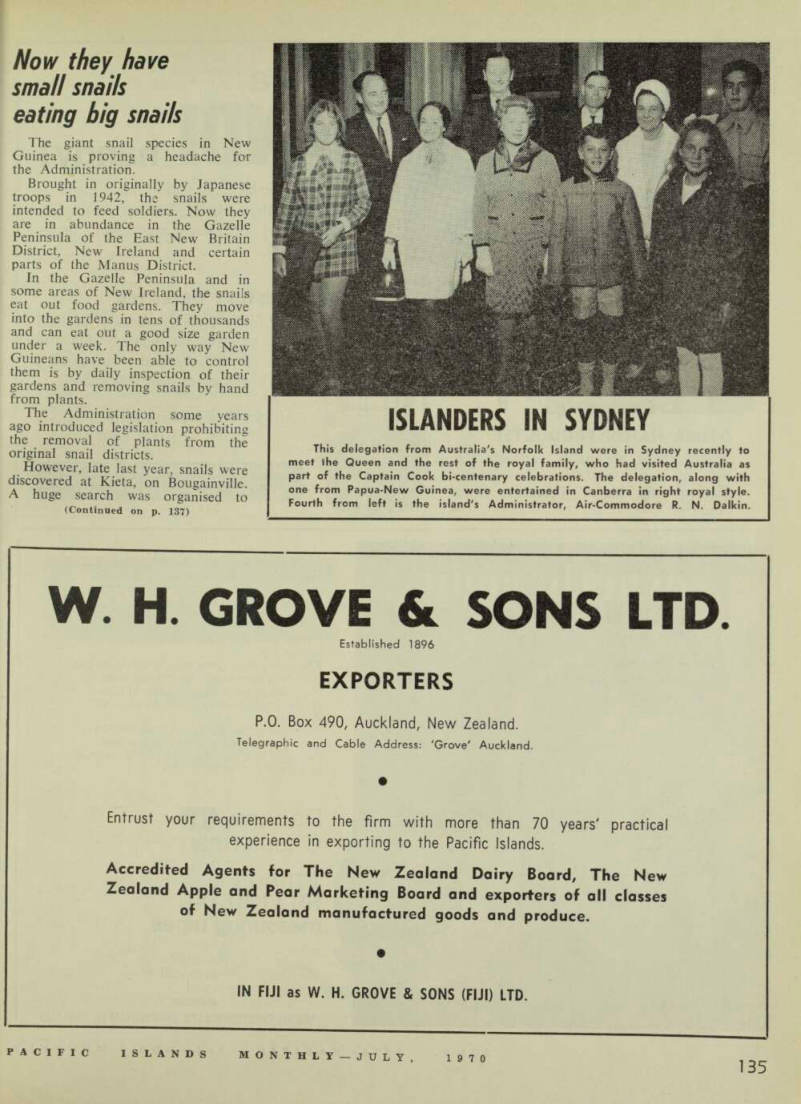 141
141 142
142 143
143 144
144 145
145 146
146 147
147 148
148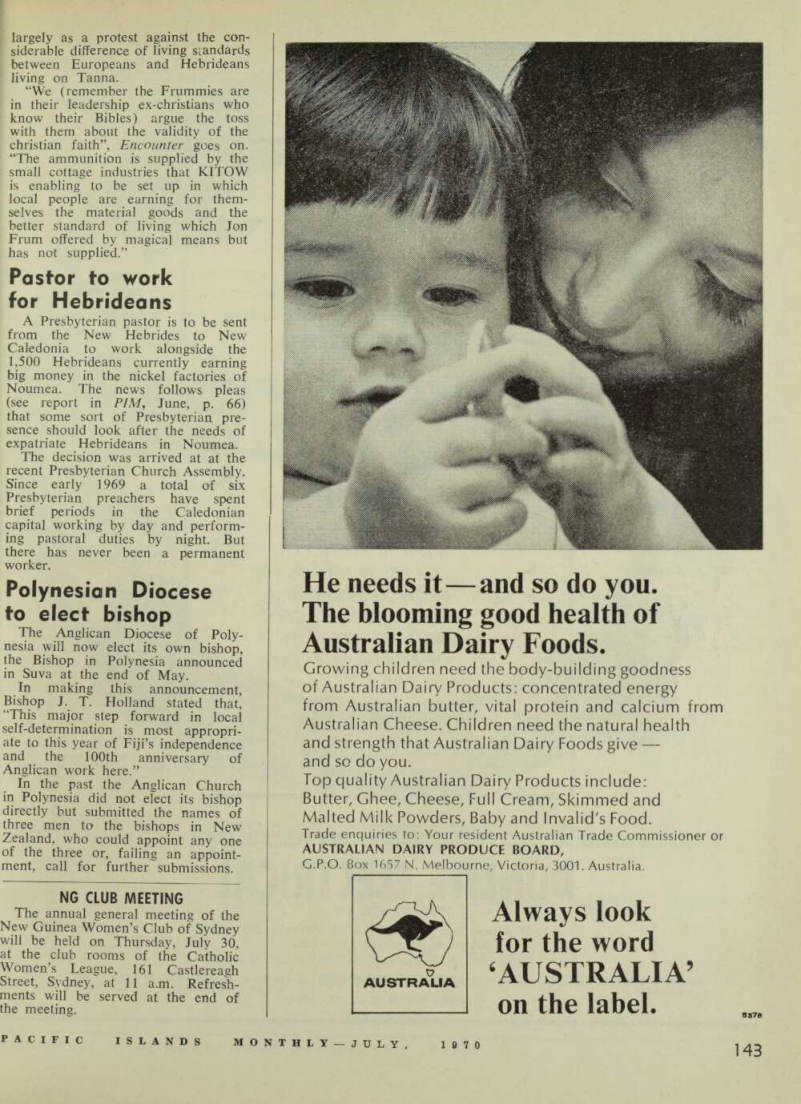 149
149 150
150 151
151 152
152 153
153 154
154 155
155 156
156