Magazine Section
pp. 83-88 · Read in the full issue


George Zimmer in the 1920's was a Papuan Administration resident magis trate who travelled widely in Papua. He had a special aptitude for chasing head hunters (see PIM, 1969, Nov., p. 85 and July, p 83) and he also had a gift for recording his expeditions in an interesting fashion. This story, from his diary, tells of a patrol up the Bensbach River of the Western District of Papua, to identify and arrest the culprits of a violent head hunt ing foray. The story begins at the coastal village of Tarara, 70 miles east of the mouth of the Bensbach River (this river today marks the southern boundary of West Irian and Papua).
"A final smoke of trade tobacco, a chew of betel nut, and then... "
t was while I was at Tarara in 1929 that the local village constable reported that, only a few days earlier, a head hunting raid had taken place at the small village of Peatakaka. There was still great excitement, and reports were very confused, but I gathered that a man named Danai, his two vV maU w5 ad i? een •5 illed and their heads cut off ’ and that a woman named Orang ad been kidnapped. Who the raiders were and whence they came was still unkown.
One thing was obvious, the matter would have to be fully investigated and arrests made. I would have rather taken more fully trained police. As it was, two of my seven police were raw recruits out for their first ex perience: No doubt they would benefit, but they would be of very little value to the patrol.
It has to be admitted that the information about this raid came as a shock, as this area had been con sidered entirely under control for a long time, so much so, that every locality of any size had been placed under the charge of a village con stable for many years, and further, there had been a permanent and regular police camp at Taunda on the Morehead River.
This had only been closed down comparatively recently as it was deemed no longer necessary. This police camp had been established mainly as a protection to these same local natives from the raiding parties
of the Togeri peopl,e who used to come from the other side of the Dutch New Guinea border.
This district, lying between the western boundary of the Fly River and the Dutch border, was only visited once a year, and as the land was all very low-lying and swampy, this could only be done during the dry season, that is to say, between September and the end of November.
100 miles of flat
mangrove swamp
My main plan of the trip was to take the stores up the Bensbach River, to the farthest point to be reached on this patrol, and to work back on foot to the government station at Daru.
The finding of the entrance to the Bensbach River was far from easy, as the land along the coast here is a dead flat mangrove swamp for over 100 miles and extends many miles into Dutch territory.
Moreover, owing to the many sandbanks and generally shallow water, it was necessary to keep the launch a good five miles out to sea, and even there the lead frequently gave us less than one fathom of water. To add to the difficulty, neither I nor any member of the launch crew had ever entered the Bensbach. All we knew was that it lay about 70 miles to the west of Tarara without a single salient feature anywhere along the coast, from which we could get our bearings.
Finally our party found an opening which turned out to be the river.
Pot shotting at passing crocodiles we sailed in our launch, Minne tonka, as far as the small village
Over Dutch border
of Wando, two days up the river.
After a week of duties, which in cluded trying to keep the natives from wandering over into the Dutch side and paying the village constables their annual sum of 10 shillings, for which they chose trade articles from the stocks I had brought with me, we headed for the scene of the crime.
The patrol arrived at the fairly large village of Roku on October 13, and I was able to obtain a little more information regarding the Peatakaka raid. The local village constable, Suam, was able to give me the names of the four natives, who, he alleged, did the actual killing, and the names of the villages from which they came.
This was the first bit of useful information obtained. Suam also handed over four fighting clubs and a bundle of arrows, which had been left near the bodies, and also six bamboo knives four of which were bloodstained. Evidently these were the weapons with which the heads had been cut off.
It occurred to me that possibly the fact that six knives were found indicated that originally they had hoped to secure six heads. These natives never use bamboo knives now in the ordinary course of their daily lives, which is rather significant.
A “farasi” for
each killing
Suam was also able to hand over another article of considerable interest, and something I had never seen or heard of before. This was called a farasi and there were four of them, apparently one for each killing. The farasi consisted of a carved and highly ornamented piece of wood about two feet long, the ornamentation being done with brightly coloured feathers.
The wood itself was painted red, black and white. The red paint was made from chewed betel nut mixed with lime. Soot and lime provided the black and white effects.
As far as I could gather from Suam, farasi were formally prepared by these local natives before any head hunting raid, and each one was used only once. They were supposed to have supernatural powers so that anyone, seeing a raider with one in his hand, becomes so stupefied that he is unable to offer any resistance.
Where possible, it seems that the victim should first be hit over the head with the farasi, which as it was made of very light soft wood, could do no harm. The victim was then killed with a stone axe or fighting club.
The farasi, the bloodstained bamboo knives, and some special cane head carriers, were afterwards handed over to the Port Moresby museum. From this information it is evident that the raid was pre meditated and carefully planned.
On October 14 the party left Roku, crossed the Morehead river by canoe and went on to Peatakaka. As was to be expected, Peatakaka was deserted, and it was found that the raiders had systematically cut down all the banana and papaw trees in and around the village. It’s probably fair to assume that this destruction was carried out because the raiders also found the village temporarily deserted.
Apparently the raiders had picked up the tracks of the villagers in the thick dust, and had followed these tracks from a taitu house to a small footpath leading into the bush.
Now came the great moment of visiting the scene of the murders.
Accompanied by the police and village constable, Suam, under whose care the village came, I set out along the small track, leading from the village. I followed the footmarks in the dust, and, after covering about half a mile, came to the remains of nine small fires, just where the grass country changed into light scrub.
One can well picture the raiding party, perhaps two or three men crouched over each fire, having a final smoke of trade tobacco and a chew of betel nut to fortify them selves for the ghastly job ahead. It must have been many years since
such a raid took place, and more than likely the vast majority had never been on such a mission.
From the scene of the nine small fires it was less than half a mile to the small encampment where the massacre occurred in the thicket of dwarf bamboos. All those killed or kidnapped were sleeping together.
The victims were a man named Danai, his two wives and small boy, who were all killed, and a woman named Orang and three children who were taken away as prisoners.
Only survivors
were three men The only survivors were three men who were sleeping about 50 yards away in their own special little shelter in the thicket. The actual scene of the murder was a cul-de-sac with no possible hope of escape. A small track had been cut into the thickest part of the bamboo clump and a small camping area cleared.
This dwarf variety of bamboo is very dense and has quite big leaves, and would thus give quite good pro tection from the dew: in fact it was an ideal camp.
It was hardly necessary to have the one large grave pointed out.
Suam explained that the village dogs had been left behind when the rest of the village people ran away. Being hungry, they had tried to dig up the bodies.
According to a man named Kuti, one of the three survivors, a native named Waboram had killed the man Danai. Kuti went on to say that the village constable of Setavi, named
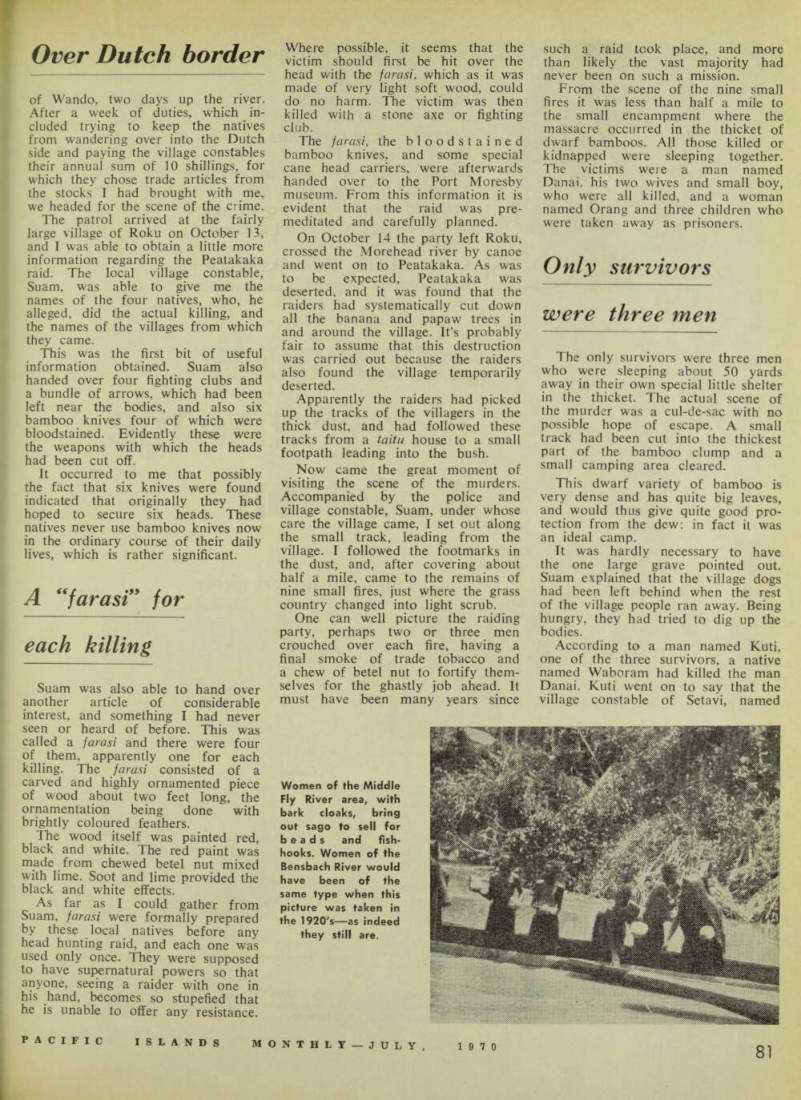
Women of the Middle Fly River area, with bark cloaks, bring out sago to sell for beads and fish hooks. Women of the Bensbach River would have been of the same type when this picture was taken in the 1920's—as indeed they still are.
Gruesome picture
Sarisap, had caught hold of Daka, and, finding that she was a woman, ? he had thrown her away from him, saying that he wanted to kill a man.
Daka, according to Kuti, was then killed by Sowa, a native of Draia.
He further stated that Sauiam and Wagi, both belonging to the village of Setavi, had killed the other woman Derka and the small boy Jendana respectively. I inspected the place where Kuti and the other two survivors were sleeping, and I doubt very much if Kuti could have seen any of these details of the murders, although he certainly could have heard any words spoken. Kuti had at least given us the names of some of the possible raiders and the villages from which they came.
The party set off once more and headed for Mata, 20 miles from Setavi, the home of the murderers.
When we arrived we found there was a rather gruesome reminder of the last occupants of the village. Il was evident that the raiding party had rested here on the first night of its homeward journey. In the middle of the clearing a fairly strong sapling had been driven into the ground, and then light boughs had been torn from the surrounding trees, and grouped round this central post.
Smoking kept the
heads ‘fresh’
The end of these boughs had been split with a knife, and the wood torn open for a distance of two or three feet, thus forming a “V” shaped fork.
It was obvious from the heap of ashes round the main sapling, and the curly hair still sticking in the torn wood of the fork, that the heads had received their first partial smoking over this fire.
This would be done to keep them fairly fresh, and a great deal of work would have to be done before they were finally cured. Apparently two heads had been smoked in the forked sticks, and from the amount of blood still sticking to a woman’s prawn net, there is little doubt that this net was used to hold the other two heads.
On the ground in the ashes were seen some white strips of Ti-tree bark. These were heavily bloodstained and had undoubtedly been used to wrap around the heads while they
were being carried through the bush.
A number of arrows had been fired into the upper parts of surround ing trees and left there. This I understand, was a general gesture of defiance.
I had my tent pitched a few yards from where the smoking had taken place, not because I liked it but because it was the only suitably clear spot. As it was a brilliant night with a full moon the whole atmosphere was rather eerie, and I do not think any of the carriers slept very much.
It was on the night of the previous full moon that the raid had taken place.
Since we were now getting near the possible scene of action, a police guard was posted, although I felt that it was very unlikely that the late raiders would dare to attack an armed government party.
We reached Setavi at 11 o‘clock without incident and found the village deserted. There were indi cations that the village had been
visited that morning to get food from the taitu houses.
Then came the complicated busi ness of finding the headhunters. Luck came to me soon when a man of Setavi brought in five of the culprits.
Twenty-three men
were rounded up
He pointed out three of my own party’s carriers as haying taken part in the raid. They admitted this and were also put under hand cuffs. By threatening to live on the food supplies of villages harbouring the men, we ended in having another six men arrested and the kidnapped woman and children found.
Finally 23 men were rounded up and the 150-mile trek to Dam began.
The trail became better as we progressed and we were able to live off wallabies and kangaroos which had become plentiful. This place, the nearest in Papua to Australia, was the only part of the territory I had seen containing these animals.
At last the party approached Dam after having walked some 650 miles. On trial before the Lieutenant- Governor of Papua, Sir Hubert Murray, the captives pleaded guilty to the killings and were given a year’s gaol each. I then returned to normal service—for the time being.
• Women of the swamplands of Western Papua. Again they are wearing tapa hoods as shields from the sun and rain. This picture was also taken in the 1920's during one of Zimmer's expeditions.