Tonga gets
p. 32 · Read in the full issue
its first baron
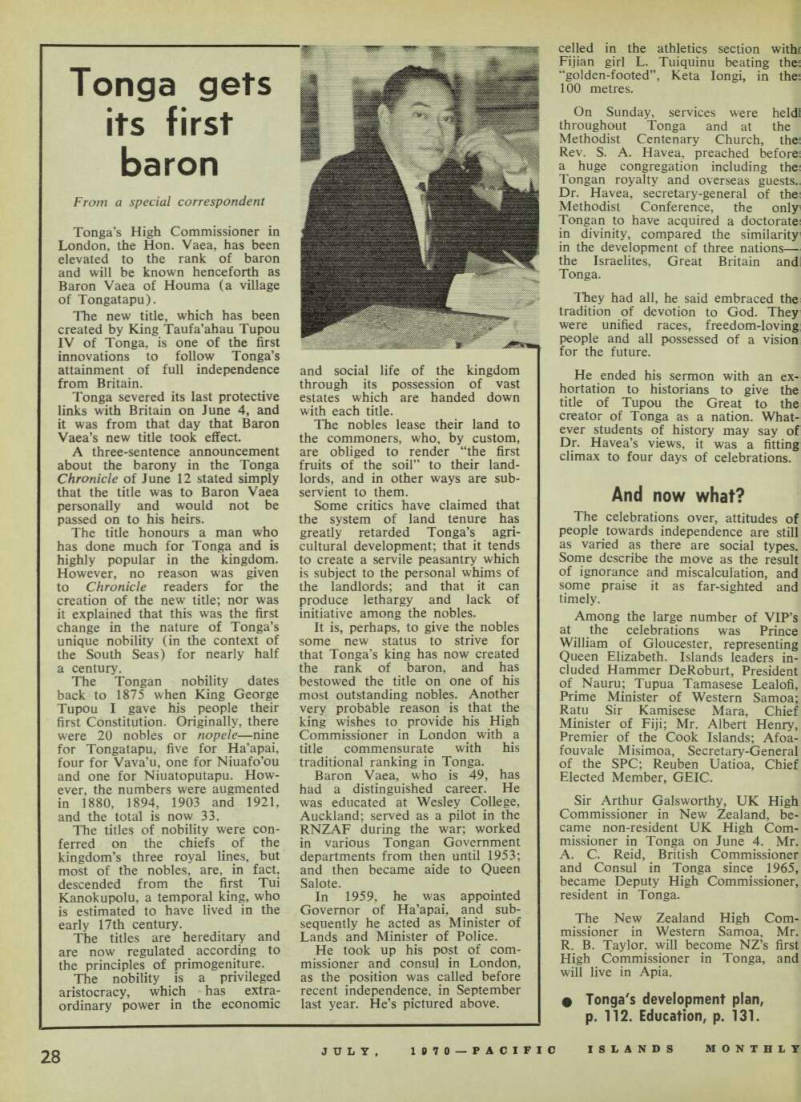
From a special correspondent Tonga’s High Commissioner in London, the Hon. Vaea, has been elevated to the rank of baron and will be known henceforth as Baron Vaea of Houma (a village of Tongatapu).
The new title, which has been created by King Taufa’ahau Tupou IV of Tonga, is one of the first innovations to follow Tonga’s attainment of full independence from Britain.
Tonga severed its last protective links with Britain on June 4, and it was from that day that Baron Vaea’s new title took effect.
A three-sentence announcement about the barony in the Tonga Chronicle of June 12 stated simply that the title was to Baron Vaea personally and would not be passed on to his heirs.
The title honours a man who has done much for Tonga and is highly popular in the kingdom.
However, no reason was given to Chronicle readers for the creation of the new title; nor was it explained that this was the first change in the nature of Tonga’s unique nobility (in the context of the South Seas) for nearly half a century.
The Tongan nobility dates back to 1875 when King George Tupou I gave his people their first Constitution. Originally, there were 20 nobles or nopele —nine for Tongatapu, five for Ha’apai, four for Vava’u, one for Niuafo’ou and one for Niuatoputapu. How ever, the numbers were augmented in 1880, 1894, 1903 and 1921, and the total is now 33.
The titles of nobility were con ferred on the chiefs of the kingdom’s three royal lines, but most of the nobles, are, in fact, descended from the first Tui Kanokupolu, a temporal king, who is estimated to have lived in the early 17th century.
The titles are hereditary and are now regulated according to the principles of primogeniture.
The nobility is a privileged aristocracy, which has extra ordinary power in the economic
and social life of the kingdom through its possession of vast estates which are handed down with each title.
The nobles lease their land to the commoners, who, by custom, are obliged to render “the first fruits of the soil” to their land lords, and in other ways are sub servient to them.
Some critics have claimed that the system of land tenure has greatly retarded Tonga’s agri cultural development; that it tends to create a servile peasantry which is subject to the personal whims of the landlords; and that it can produce lethargy and lack of initiative among the nobles.
It is, perhaps, to give the nobles some new status to strive for that Tonga’s king has now created the rank of baron, and has bestowed the title on one of his most outstanding nobles. Another very probable reason is that the king wishes to provide his High Commissioner in London with a title commensurate with his traditional ranking in Tonga.
Baron Vaea, who is 49, has had a distinguished career. He was educated at Wesley College, Auckland; served as a pilot in the RNZAF during the war; worked in various Tongan Government departments from then until 1953; and then became aide to Queen Salote.
In 1959, he was appointed Governor of Ha’apai, and sub sequently he acted as Minister of Lands and Minister of Police.
He took up his post of com missioner and consul in London, as the position was called before recent independence, in September last year. He’s pictured above.