An Islands' Treasure
p. 33 · Read in the full issue
Comes Home...
Prom a Papeete correspondent A party of American scientists, who carried off an ancient wooden tiki from the island of Uahuka in the Marquesas in March, were obliged to re turn the object to the Governor of French Poly nesia in June following an outcry in the Tahiti Press over the tiki’s disappearance.
The scientists, who were from the American Museum of Natural History in New York, included the museum’s director, Dr. Gardner Stout, and Dr. Harry L. Shapiro, head of the museum’s department of anthropology.
The scientists visited Uahuka on board the 165 ft motor yacht Aletta 11, owned by a US newspaper pub lisher, Mr. Ralph Ingersoll, in the course of an extensive tour of French Polynesia.
While at Uahuka, the scientists discovered four badly-weathered “carved wooden posts” in the Hananai Valley, one of which was considered ‘“intact enough to warrant professional restoration and continued study”.
"Neglected"
The tikis were completely neglected by the local people, so the scientists, with Mr. Ingersoll’s approval, decided to take the best-preserved one with them in the interests of science.
Subsequently, in Tahiti, Mr.
Ingersoll announced the discovery of the tikis to the English-language Papeete Bulletin, a daily give-away paper for tourists, without the subject raising any particular stir.
Some time after the Aletta 11 left French Polynesia, the local French Press reported that the tiki had been “stolen” from Uahuka, and Le Journal de Tahiti quoted a Tahitian sailor from the Aletta as saying that he had seen the scientists take the tiki aboard their ship. Le Journal said the tiki had been carved before the arrival of the European explorers and was “of very great value”.
In mid-May, the director in Tahiti of the French scientific organisation ORSTOM wired Dr. Stout asking that the tiki be returned. Dr. Stout replied with a letter to the French Governor, Mr. Pierre Angeli, ex plaining why the tiki had been re moved.
Mr. Angeli’s answer to this was
that an ancient Polynesian object of art had been removed from its site without authorisation; that this was completely illegal; that if the tiki needed to be restored there were French experts who could do this just as well as Americans; and that if the American scientists wished to avoid legal action, they should return the tiki by air promptly.
The tiki, which is nearly 7 ft high, arrived in Tahiti in a wooden crate by air from Honolulu on June 8 and was taken for the time being to the Governor’s residence.
A day or two later the local French newspapers received a letter from Mr. Ingersoll in which he accused them of inventing sensations over the Uahuka affair, and in which he taxed local journalists, govern ment officials and scientists with hypocrisy on the question of the territory’s cultural artifacts.
Mr. Ingersoll said that in island after island from the Tuamotus to the Marquesas and all the way to Rapa, he had been shocked by the “flagrant negligence” of the inhabitants towards their historic treasures.
Maraes were abandoned and covered with vegetation; carved wooden tikis had been overturned and were lying half-buried and abandoned.
The famous fortress at Rapa had never been properly explored.
Mr. Ingersoll said that if the news papers wanted sensations, they should try to awaken the people to the value of these things.
In replying to Mr. Ingersoll’s attack, Le Journal de Tahiti wondered what the American newspapers would have said “if we had acted the same way in America towards the Indian tombs, for example”.
Le Journal added: “You have, however, reason to deplore that abandonment which causes us to lose our relics, and we expect that after this recent adventure our authorities will be a little more solicitous about our maraes and tikis”.
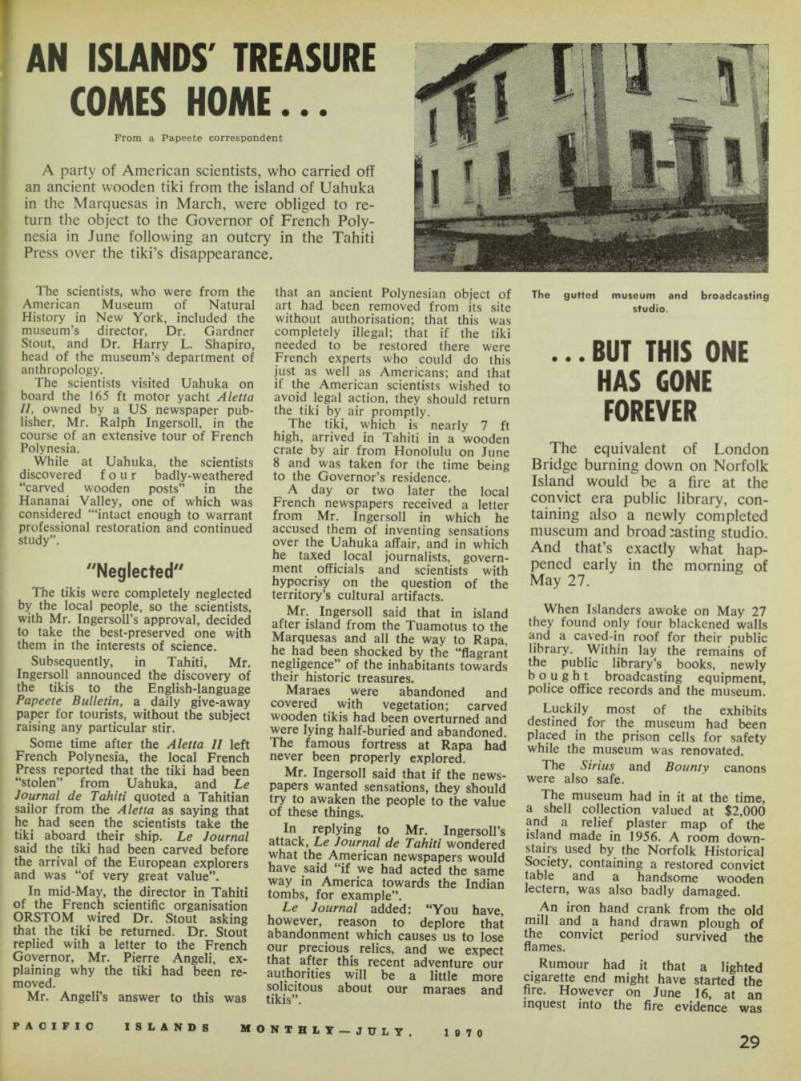
The gutted museum and broadcasting studio.