Memories of one man, George Tupoul
pp. 31-32 · Read in the full issue
The king pointed out that although Tonga was in a way a member of the Commonwealth (represented by Britain) it was now a voting member, and this would make all the dif ference.
The next ceremony was laid out at Mala’ekula, the royal tombs, situated right in the middle of the town. At one time, the royal cemetery was on ’Uiha in the Ha’apai Group, but due to the foresight of the Rev.
S. Baker, Tonga’s second Premier, last century, new royal tombs were erected at Nukualofa. It would have been somewhat inconvenient if Baker’s vision had not been realised.
Wreaths were laid at the tombs and the memory of one man was on everybody’s mind—George Tupou I.
The Tupou dynasty has had a long and arduous history and Tonga’s history is the history of its three distinct kingly lines.
The first period may be called the “ ’Uvean Age”. Its principal feature was intensive artistic activity, for it was during this period that the distinctively Polynesian musical and dance forms were introduced to Tonga.
Hawaiian Age
The second period is the “Hawaiian (or Lo’au) Age”. The presence on Tongan soil of two people—the ’Uveans and the Hawaiians who came later—became progressively problematic, but a brilliant solution was reached when the king of one line took the princess of the other to wife. The result of this marriage was Tu’itatui—who united in his sacred person the two lines of kings.
But in doing so he put an end to the benign ‘Uvean civilisation and initiated the second great age of Tongan history—the Hawaiian or Lo’au Age.
This period saw tribal strife and the introduction of the art of warfare to a level which had never been attained before or after in the whole of Polynesia and Melanesia.
It enabled the Tonga kings to institute a great age of conquests and imperialism. This characteristic of the Hawaiian Age—the elevation of war and its extensive use as an in dispensable organ of progress, points to a probable link between the Lo’au people of ’Eua and ’Eueiki (The Tongan Hawaiki), and the Maoris of New Zealand. In fact a very strong case can be made out for ‘Eua and ’Eueiki as the last ‘refuelling station’ of the Maoris before settling down in Tiritiri-o-te-Moana.
This chapter of Tongan history
closed at the advent of the greatest warrior the Tongan people has ever produced—George Tupou I, who invaded Tonga in a series of victories and battles resulting in the unification of Tonga. He is to the modern age what Tu’itatui is to the Hawaiian Age.
Tupou's era was the third great period of Tonga’s history—the “Christian Period”. It did not mark the coming of a new people. But in it Tupou I set the wheels of the new civilisation rolling. It was mainly to the memory of this great and heroic man that the Mala’ekula ceremony was conducted.
Cheering children
After the ceremony, cheering and shouting school children marched down the main street of the town, and around the palace.
In the afternoon, lakalaka and ma’ulu’ulu dances were presented at the palace. One lakalaka performed by the people of ’Eua Is was a representation in ballet of the round ing up and catching of wild horses which were plentiful in Tonga 50 years ago.
In the evening, a grand concert was held at Pangai. Local talent was a feature including ’Sioni ’Aleki the boy with the magic ukulele, who earlier this year enthralled Sydney crowds at the Captain Cook bi centenary. Featured also were some very ancient Polynesian dances, which can be monotonous but very,
very graceful. Unlike the European ballet, the taste and sensibility embodied by these dances lean more to the sedate rather than the athletic.
These ancient dances are Asiatic in origin—akin to the legong and the Bharata Natyam —are based on dif ferent principles from the Western ballet and also embody a profounder aesthetic sense.
And while the concert was pro ceeding, torches were blazing away along the shore of Nukualofa in a Tupakapakanava ceremony, another contribution of the school children of Tongatapu. It was a magnificent spectacle but had to be viewed from a distance because of the heat.
The next day’s royal banquet was perhaps the most lavish ever given in the kingdom. Some 4,000 sucking pigs and the same number of chickens were on the menu. The king thanked Britain for her friendship to Tonga and Sir Arthur Galsworthy, the UK High Commissioner for Tonga, replied. Messages of goodwill were read from the heads of England, the US, Russia. Australia, the Vatican, Holland, India, West Germany, New Zealand, Korea, Sweden, Czecho slovakia, Taiwan and Malta. The banquet finished with a ma’lu’ulu, a sitting pantomime, by the girls of Queen Salote College.
The full day wound up with a State Ball, and the next day was devoted to sports. The Fijians ex-
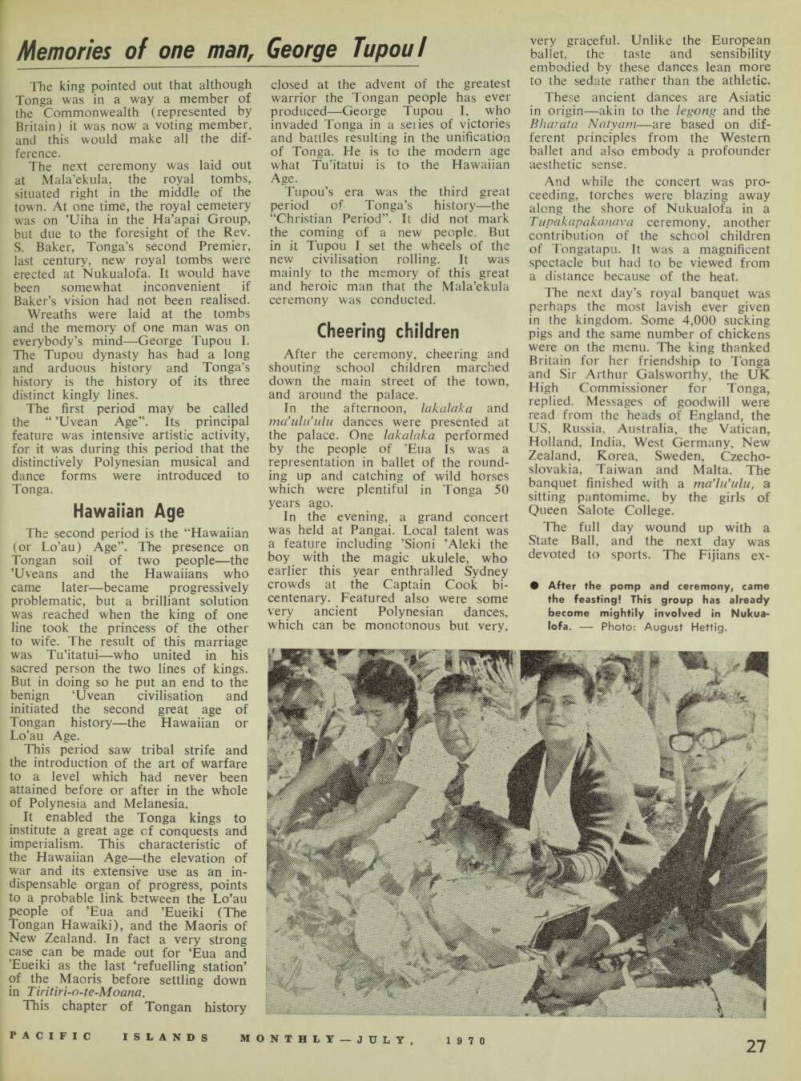
• After the pomp and ceremony, came the feasting! This group has already become mightily involved in Nukua lofa.-Photo: August Hettig.
celled in the athletics section witlw Fijian girl L. Tuiquinu beating the; “golden-footed”, Keta longi, in the; 100 metres.
On Sunday, services were heldl throughout Tonga and at the Methodist Centenary Church, the; Rev. S. A. Havea, preached before: a huge congregation including the; Tongan royalty and overseas guests..
Dr. Havea, secretary-general of the; Methodist Conference, the only' Tongan to have acquired a doctorate; in divinity, compared the similarity l in the development of three nations— the Israelites, Great Britain andl Tonga.
They had all, he said embraced the tradition of devotion to God. They were unified races, freedom-loving; people and all possessed of a vision for the future.
He ended his sermon with an ex hortation to historians to give the title of Tupou the Great to the creator of Tonga as a nation. What ever students of history may say of Dr. Havea’s views, it was a fitting climax to four days of celebrations.
And now what?
The celebrations over, attitudes of people towards independence are still as varied as there are social types.
Some describe the move as the result of ignorance and miscalculation, and some praise it as far-sighted and timely.
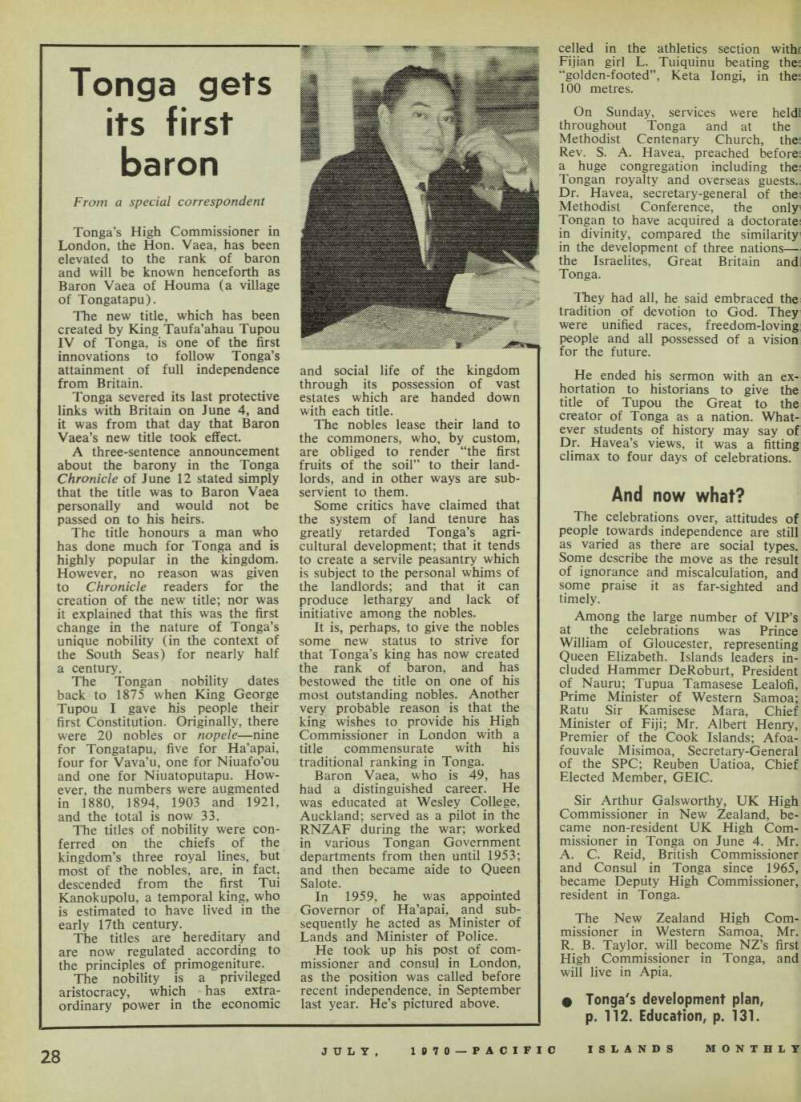
Among the large number of VlP’s at the celebrations was Prince William of Gloucester, representing Queen Elizabeth. Islands leaders in cluded Hammer Deßoburt, President of Nauru; Tupua Tamasese Lealofi, Prime Minister of Western Samoa; Ratu Sir Kamisese Mara, Chief Minister of Fiji; Mr. Albert Henry, Premier of the Cook Islands; Afoa fouvale Misimoa, Secretary-General of the SPC; Reuben Uatioa, Chief Elected Member, GEIC.
Sir Arthur Galsworthy, UK High Commissioner in New Zealand, be came non-resident UK High Com missioner in Tonga on June 4. Mr.
A. C. Reid, British Commissioner and Consul in Tonga since 1965, became Deputy High Commissioner, resident in Tonga.
The New Zealand High Com missioner in Western Samoa, Mr.
R. B. Taylor, will become NZ’s first High Commissioner in Tonga, and will live in Apia.
• Tonga's development plan,
p. 112. Education, p. 131.