Magazine Section
pp. 91-95 · Read in the full issue

Journal of an adventurous voyage to the South Seas
By Robert Langdon
In 1883, when Captain William Driver was an old man living in Nashville, Tennessee, he wrote a letter to a Nashville newspaper recalling an adventurous and profitable voyage he had made to the South Seas in 1831 in the brig Charles Doggett.
He said that when he arrived home in Salem, Massachusetts, in the spring of 1832, he had on board a cargo consisting of 1,600 lb of tortoiseshell, worth $22,400, and a hold full of sugar, all of which he had bought for “traps”, or cheap trade goods.
Driver had bought the sugar, con trary to the orders of his owners, with the proceeds from a large haul of beche-de-mer which he had gathered and cured in Fiji. However, when he sold the sugar for cash on the Salem wharf at a profit of more than 300 per cent., his owners were quick to pat him on the back and send him off on another trading voyage.
At the time of his voyage in the Charles Doggett, Driver was a man of 28 and a veteran of some 14 years at sea, including five in the Fiji beche-de-mer trade. He had first visited Fiji in quest of beche-de-mer in September 1827, as second officer
of the ship Clay under Captain Benjamin Vanderford.
It was while in the Clay that Driver learned the secret of smoke drying beche-de-mer from some sea men from Manila—a secret that paid him and his owners handsome dividends.
A journal which Driver kept on
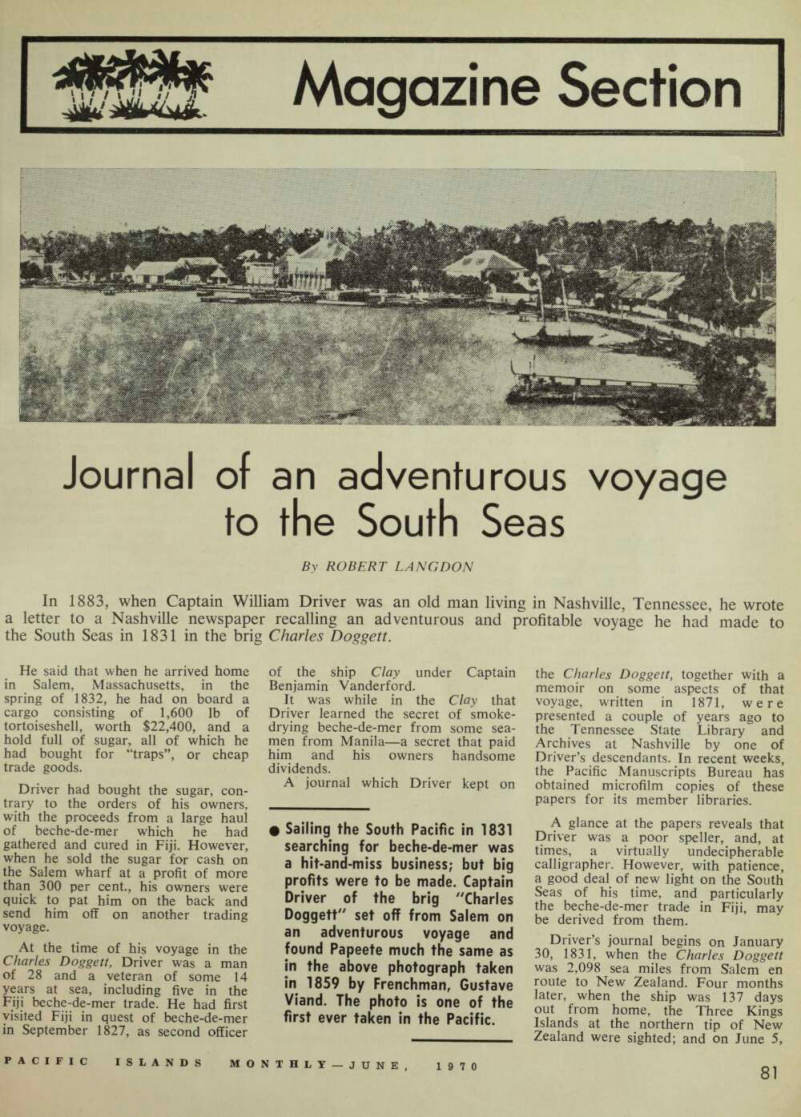
• Sailing the South Pacific in 1831 searching for beche-de-mer was a hit-and-miss business; but big profits were to be made. Captain Driver of the brig "Charles Doggett" set off from Salem on an adventurous voyage and found Papeete much the same as in the above photograph taken in 1859 by Frenchman, Gustave Viand. The photo is one of the first ever taken in the Pacific.
the Charles Doggett, together with a memoir on some aspects of that voyage, written in 1871, were presented a couple of years ago to the Tennessee State Library and Archives at Nashville by one of Driver’s descendants. In recent weeks, the Pacific Manuscripts Bureau has obtained microfilm copies of these papers for its member libraries.
A glance at the papers reveals that Driver was a poor speller, and, at times, a virtually undecipherable calligrapher. However, with patience, a good deal of new light on the South Seas of his time, and particularly the beche-de-mer trade in Fiji, may be derived from them.
Driver’s journal begins on January 30, 1831, when the Charles Doggett was 2,098 sea miles from Salem en route to New Zealand. Four months later, when the ship was 137 days out from home, the Three Kings Islands at the northern tip of New Zealand were sighted; and on June 5,
Set dog on them
1831, Driver anchored in the Bay of Islands.
“Soon after anchoring”, Driver wrote in his journal, “a large number of Indians thronged our decks and contrived to steal our deep sea lead and several other articles. Had much trouble to get rid of them and was obliged to set our dog to work e’er they would leave us. During the day, many called wishing to trade, but this I positively refused, it being Sunday.
“Spent the day unpleasantly, being debar’d our usual devotions by a throng of hethen on whoom the Light of the Gospel has hardly dawn’d and a more unworthy throng of sailors from different nations who have left their ships to spend their lives heer, wallowing in vices which een a Savage must despise, liveing unreproved, dying disreguarded, un pittyed and unknown while others are toiling almost hopelessly to cultivate the savage race of New Zealand ...”
Following this outburst against the unworthy souls to be met with at tie Bay of Islands, Driver recorded grate fully that he had received “every assistance” from the missionaries of that place and was “much indebted for their many kindnesses”.
On June 24, 1831, after three weeks in the Bay, the Charles Doggett sailed for Tahiti. En route, after a voyage of 16 days she reached Tubuai and anchored five miles from “a fine little seatlement”. One white man and six natives who came out to the ship seemed eager to trade, but could not do so because it was Sunday.
“These mild, harmless
creatures ...”
Next morning, after Driver had seen some beche-de-mer in several canoes that came off to the ship, he went ashore in a boat. However, he found little of value to exchange for his trade goods—only a few pigs, coconuts, plantains, limes, lemons, “a little beach la marr of several kinds, generally of a small size”, and a lot of arrowroot. These commodities, he recorded, seemed to “constitute the whole property of these mild, harmless creatures, on whoom the cheering rays of the sun of righteousness hass hardly deigned to glance . . .”
On July 12, the Charles Doggett continued her voyage to Tahiti. Here, Driver found 65 descendants of the
Bounty mutineers, including “ten sickly looking dispondant creatures huddled together in a large thatch house, where twelve of their number had died of a sort of Typhoid or Ship Fever”.
The Pitcairners had been moved from Pitcairn to Tahiti four months earlier because it was feared that their island was becoming overpopu lated. But now they desperately wanted to return home. Driver allowed himself to be prevailed on to take them, in exchange for some old copper worth 40 cents per lb, 12 blankets, and $l2O in cash. In doing so, he ran the risk of forfeit ing the insurance on his ship and “becoming a ruined man at 28”.
However, from the time Charles Doggett left Tahiti on August 16 until she reached Pitcairn a fortnight or so later, the weather was perfect, and the Pitcairners were landed without difficulty.
The Pitcairners were so grateful for their deliverance from the flesh pots and illnesses of Tahiti that they gave Captain Driver a “certificate” recording that he had “behaved with the greatest kindness and humanity” in taking them back.
On the return voyage to Tahiti, Driver put in at Anaa Atoll in the Tuamotu Archipelago. Here he went ashore in search of beche-de-mer and other articles of trade. He suc ceeded in buying several pearls, 30 pigs and some coconuts, but the beche-de-mer, he thought, was not worth waiting to collect. Driver recorded that the Anaans resembled the Tahitians, except that they were darker and their hair was not so straight. They got about almost naked, but were very fond of a certain blue cloth he had with him.
Back in Tahiti, Driver spent five
days before pushing on to Huahine.
Here he met the Rev. John Williams, of the London Missionary Society, who came out to his ship to make some purchases.
From Huahine, the Charles Doggett bore away for Samoa. After a voyage of three days she reached Aitutaki, and, as usual, Driver went ashore to trade. However, as it was Sunday to the Aitutakians, all busi ness was suspended, and Driver’s only achievement was to engage a Hawaiian from Oahu to replace a Tahitian who had left the ship at Huahine.
Trading zvith *
beads for s
Two days later the Charles Doggett reached Palmerston Island, which in those days was uninhabited. A boat was sent ashore to gather coconuts from the numerous palms that covered the islets of the reef. But only about 100 sound nuts could be found, although Driver got 50 tropic and other birds, which were “so tame as to sit still and be taken”.
On October 4, Driver recorded that the island of Toomahlooah was sighted. This was one of Manua islands of what is now American Samoa. Here Driver “commenced trading with the natives with blue beads for sinnet, breadfruit, plan tains, etc.”. However, he was unable to buy any pigs, “probably owing to these people being at war with their neighbours of Tanfore, 10 miles W.N. West of them”.
At sunset, the Charles Doggett bore away for Tutuila. On heaving to half a mile east of that island, Driver was visited by several canoes.
In these were several naked white men—“worthless wretches whose conduct would een put a savage to the blush”. Driver thought their object was “to prevent trading unless agreeable to them” or to decoy boats on shore and capture them.
This he wrote, had happened to a ship called Holden, two of whose boats were then on shore, their crews being detained in the hope of a ransom. The captain of the Holden had earlier been ransomed for seven muskets, powder, etc.
Driver got one piece of tortoise shell, six small pigs and some doves at Tutuila. But deciding that “stop ping among these islands was full of humbug”, he drove the natives from his ship and bore away in a hard rain squall for the Tongan island of Tafahi, then known as Boscawen’s Island.
On reaching this, the weather was
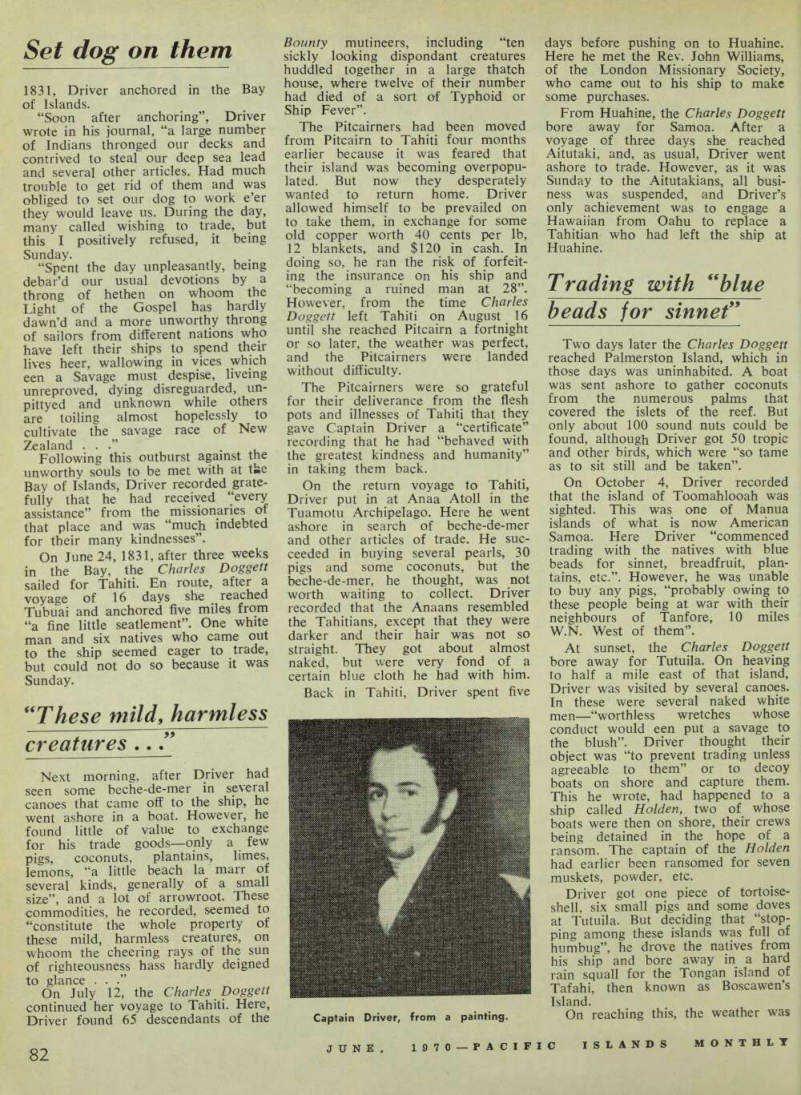
Captain Driver, from a painting.
Musket for a pig
dirty and there was a high sea, so he hauled up for Niuatoputapu (Keppel’s Island). Here several canoes came out to the ship, bringing “the king and suit”. These people demanded a musket as the price of a pig, which Driver thought was too much. They also refused to do busi ness except on shore. Driver offered to go ashore provided the king or his son would wait in the ship as a hostage. But this both of them declined to do.
“The bottom of this business,”
Driver wrote, “seemed to lay in some Englishmen on shore, who most likely wished a boat and crew to ransom, as they are of the same cast as those at Tootooilah.” Driver added that he thought the Keppel Islanders were a mixture of Tongan and Fijian tribes, and that they were “a poor sett, liveing on a sterile spott”. Their dress was “meerly a wreth of leaves of Tumarick or a narrow matt round the waist”.
From this island, Driver set sail for Tongatapu. But the wind did not permit him to put in there, and his next landfall was Lakeba in the Lau Group of Fiji. Here, he landed in the ship’s whale boat and bought pigs, taro, yams and about four bushels of tortoiseshell.
“the beaching town
in these islands”
Three days later, on October 18, 1831, he anchored at Ovalau and immediately made preparations for an excursion to the small chiefly island of Bau, which he described as “the beaching town in these isles”.
This was apparently a reference to the fact that Bau was the centre of the beche-de-mer trade between the Fijians and Europeans—a trade that had been in full swing since Vander ford’s first visit in the Clay in 1827.
Driver reached Bau on the 19th, but found the place nearly empty, “all hands gone to Natavah” [Natewaj. “The natives seemed surprised and glad to see me,”
Driver added, “and I soon collected about 70 lb of fine shells, a few pigs, &c”. He also met part of the crew of the Salem brig Niagara, which had drifted on to a reef near Viwa, about 28 miles away, during a gale about seven months previously.
Driver paid a visit to the Niagara with the king of Bau, and learned in the course of it that the chiefs who had gone to Natewa and also
to “Boona” [Taveuni] had a large stock of tortoiseshell. Determining to get this as soon as possible, Driver weighed anchor next day and headed north to seek the chiefs out.
By good luck or intuition, he called at Koro Island on the way and found that the Bau chiefs were there.
They agreed to sell him all of their shell provided he would take three of them—Marrowei, Tuta and Bungu refa—back to Bau where the shell was.
Having concurred, Driver headed once more for Bau, calling en route at Levuka on the island of Ovalau.
This place was to develop within the next few years as the main port in the Fiji group for European ships.
But at that time, its chief claim to fame _in Driver’s eyes was that Captain Archer of the Salem vessel Glide had recently lost two men there. Driver landed at Levuka, but “saw nothing amiss” and “no signs of hostility, although alone”.
Back in Bau, Driver went ashore with the local chiefs and bought more than 100 lb of tortoiseshell.
Although he was on good terms with the Bauans, he discovered on his return on board that they had been plotting to take his ship. “However, I arrived in time to shame and cool them,” he wrote.
From Bau, Driver sailed for Koro to buy provisions. Next he went to Moturiki, south of Ovalau. where he spent a week “buying shell at Bow and transient lotts from elsewhere”.
In between times, he was visited by Captain Eaglestone, of the ship Peru; his old skipper, Captain Vanderford, now of the ill-fated Niagara; and
Captain Archer, of the Glide. Captain Archer, Driver recorded, “left us not much pleased, as we had bought shell which he had try’d without success to buy, and had beat us to 13 days (before)”.
On November 10, the Charles Doggett moved on to what Driver called Peru Roads, at the mouth of the Rewa River. At Rewa, he was “received with shouts, drum beating, etc.” and he found the people, “with whom Eaglestone had much trouble, the most civil, kind and generous” of any he had seen in the islands up to that time. Beside getting about 40 lb of tortoiseshell, some pigs and an abundance of provisions, he and his men cut bamboos and made other preparations for setting up a curing station for beche-de-mer.
“Kind, civil and very
much afraid of us”
On November 19, with his bamboos, provisions and a number of “Indians”, Driver sailed for the southern island of Kandavu, which he called Cantab or Mywoola. By 1 p.m., he was on the northern side of that island; and after having passed a “small, conical island called Cooler”, he anchored half a mile north of “a small, pleasant-looking island called Endrabuna” [Ndravuni].
From there, he went in the boat to look for a safe anchorage and found one in a deep cover at Ono-i-Ra, or
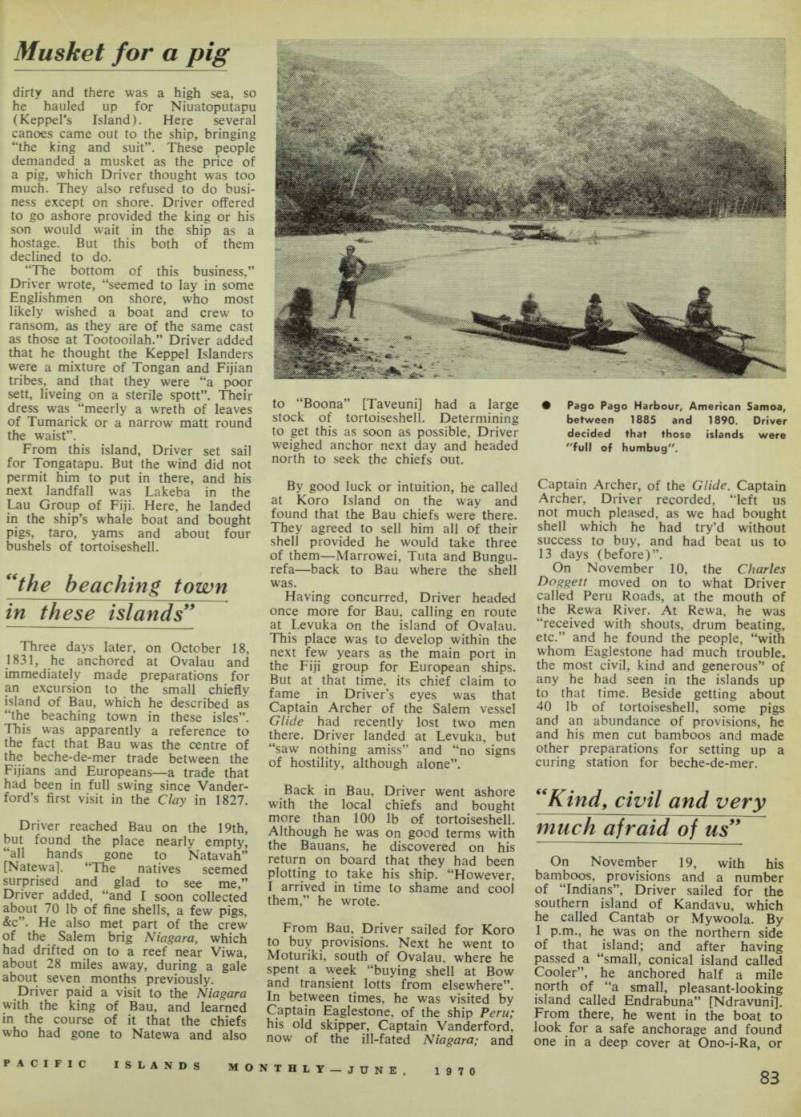
• Pago Pago Harbour, American Samoa, between 1885 and 1890. Driver decided that those islands were "full of humbug".
Whale tooth gift
Salem Island, as he also called it.
As it was then late, he spent the night at “Louvatree, in the S. West side of Salem”. This was “a fine little town” where the natives were “kind and very civil, and much afraid of us”. The first thing the natives did was to “beg good usage”. Next, they killed pigs, fowls and fish, dug up taro, and plucked fruit for their visitors. In return. Driver gave them a fine whale’s tooth and a few other small presents. This seemed to astonish them, as their first expression was, “Gods! Our fathers would have run madd to have seen this”.
At daylight next morning, Driver returned to his ship and brought her nto his newly-discovered anchorage.
Here, he landed his materials, cleared i site, and set up a building for :ur i n g beche-de-mer. “Nothing worthy of note occured from the £oth to the 28th”, Driver’s journal :ontinues. “On the above day, we :ommenced curing fish of the first juality, slowly sent our boat for pigs )r anything worth trading to Cantab, ibout 5 miles from this isle.
“Through this month quite dirty ish coming in to slowly to doe much.
However, got about 60 lbs of shell o make up. Continued at Ono until he 18th of December, finding little vorthy of note. The natives too much pressed to make any longer stay iere, we cleared off for sea, having luring a stay of 28 days collected ',510 lbs of very fine beach la mar nd 90 lbs of shell”.
On December 19, the Charles doggett was back at Peru Roads at he mouth of the Rewa, and Driver /ent over to the village where he ound things “much as usual”— nothing too good for us”. He eturned with a purchase of 60 lb if tortoiseshell.
'Oother Why 99 natives
*wild and dirty 9
Two days later, he put his men to 'ork curing fish at “Nock low”
Vakulau], a small island off Laucala ay, and then set off in a boat along ie south coast of Berta lib [Viti evu] in search of other good spots 3r beche-de-mer. Travelling west xith-west for about 60 miles, he cached a place called “Oother Why”. lere the natives were “very wild and irty” and seemed to “talk and look ke the Hebrideans, of which isles icy seemed to have knowledge . .
On the following day, Driver avelled another 20 miles and found
“considerable good fish” near a village called “Goro Lau” [Koro vou?], where there were many small canoes and many coral flats. Deciding to try this place, he headed back to the Charles Doggett as quickly as possible. That night, he slept in “a Tonga town called Namooca [Namuka], where he found the inhabitants “mean and close in the extreme”, and “hardly willing to lodge us, fear alone making them civil”.
After a night’s rest, he pushed on to “a town called Nunguras on a small island abreast of a small river”. (This was apparently Nangarra).
Here, again, the inhabitants were “Tonga-Feejees”, who placed a “bury” [house] at Driver’s disposal, which he thought resembled a type he had know in the East.
At dawn next day, Driver con tinued eastwards for about eight miles until he reached another small island called Namooca [Namuka].
“This, though a fine island,” he wrote, “has sorely felt war’s ravages, being without inhabitants save 3, called Tonga men . . .” After waiting several hours for the tide, Driver pressed on for his ship. In so doing, he got into Suva Harbour, and thus
became, in all probability, the first European to do so. “This”, he noted, “is one of the finest harbours in the world, secure from wind and sea, affording wood, water, fruit, &c, &c.
Has a fine wide passage from the south into it through the reefs, which are bare at low water. On the Main, WSWI/2W may be seen a large waterfall falling at least 150 feet, called by the natives a Suba”.
Having passed to the east of Suva Point, Driver noted the existence of another fine harbour—Laucala Bay —which was also “secured by many reefs from the trade [and] sea, and by the land (forming a deep Bight) from all other winds or sea”. The entrance he added, was wide and safe, and with “many fine towns” along the coast, it was “a good place for whalers to refit”.
Driver reached the Charles Doggett at 3 p.m. on Christmas Day, hungry and drenched with rain. A couple of days later, instead of going back to “Goro Lau”, he set off in a large canoe for Beqa, 60 miles south-west of Viti Levu, “to get if possible some of the fine fish of that place”.
Having reached that island after a good run, he and his men began to build a house, which they had ready by the 28th. They then began curing some of the finest beche-de mer Driver had ever seen. However, the natives were poor fishers, and Driver could not get sufficiently large quantities to make a long stay profit able. On January 8, 1832, he returned to the brig with 70 lb of tortoiseshell and 18 to 20 piculs (2,340 to 2,600 lb) of beche-de-mer.
“Treacherous sett
of canables 99
During the next couple of weeks, Driver sailed north to what he called Mudwater, i.e. the Macuata coast, buying shell at several places en route. At Mulia Island, he lock some presents to the chief of a “treach erous sett of oppresed canables” and made arrangements for “cureing fish with which the reefs were covered”.
Driver and his men then set to work to build a house, and hauled the Charles Doggett to within a quarter of a mile of the shore so that the house would be covered by the brig’s guns.
They were still working on the house when, as Driver put it, “the most tremendous gale sett in that I ever saw, tearing houses from the hills and bearing off uppon the Deep, Trees, their roots, &c., and fairly devasting Nature of every charm, leaving only the brown hapless trunks and witherd blades to tell that Verdure had ever clothd thees isles”.
Driver added: “Had we not been in the best harbour in the world, nothing could have saved us or dis appointed the natives who thronged the shore both far and near to divide the spoils of our misfortune”.
After blowing for 72 hours, the storm moderated, and after much trouble the Americans finished their house. Driver then went to Macuata to get fishermen, and the business of gathering and curing beche-de-mer began in earnest. By March 11, after just over a month’s stay, he had 500 piculs of beche-de-mer &c. and a full cargo.
Driver’s journal peters out a few days after this, so that one cannot learn where, how and when he dis posed of his cargo. However, if his past practice was again followed, the Charless Daggett’s beche-de-mer would have finished up in the market place at Manila, where, in 1832, the prices for that product were still large enough to make a sea captain feel that a trading voyage to the wilds of Fiji was well worth while.