problem
p. 76 · Read in the full issue
Causes and solutions to Cooks' biggest problem
From W. H. Percival,
in Rarotonga The Cook Islands Govern ment was told in no uncertain
terms in early April that public
servants were very unhappy at the way wages and salaries had not kept pace with spiralling costs in the last two years.
President of the Cooks Public Service Association, Mr. David Hosking, added in a letter to the government: “Is it any wonder that malnutrition is rife in our islands?
Fruit and vegetables, the very things that prevent malnutrition, cost 30 per cent, more than they did in 1967”
The government was the biggest employer of labour in the Cook Islands and indirectly set the basic wage for non-government employees, the letter stated. Private employers paid their staffs at the same basic rate as the government, and any in crease in the government basic wage would result in an increase for staff employed by private firms.
The basic wage in the Cook Islands, between SlO to $l4 a week, made it impossible for a man to support himself, wife and four children.
Less planting
He pointed out that a recent agricultural survey showed that there was less planting of subsistence crops on Rarotonga today than in previous years. But a large number of wage workers and public servants in Rarotonga were landless, and could only obtain fruit and vegetables by buying or stealing them.
Mr. Hosking conceded that ignorance, laziness, and neglect of child care also played their parts in causing malnutrition, but “it would be a gross deceit to hide the fact that low wages and the high cost of living are also important factors”.
His letter was published in the government-owned, and only daily newspaper, Cook Islands News , and so was a reply made by the acting premier, Mr. William Estall, the following day. The premier’s port folios include those of minister of finance and minister-in-charge of the public service.
Mr. Estall said the government is “always mindful of the need to review existing conditions, but at the same time has an overall duty to all persons living in our developing country to work within finance avail able”.
He reminded readers that the premier, Mr. A. R. Henry, had ex pressed his deep concern about the rapidly increasing salaries and wages bill of the public service many times, both during sessions of the Legisla tive Assembly and in broadcasts over Radio Cook Islands.
Mr. R. H. Scott, new director of the Cook Islands Department of Agriculture, said later he was surprised at the amount of unused land in places where some of the better soils of the island exist and, added, no small developing country such as the Cooks could for long afford the luxury of the non-use of such a valuable resource.
He realised that there were difficulties such as land tenure problems, lack of capital and of know-how, but he hoped that these could gradually be overcome. He expressed the hope that government might be able to devise some means to encourage the use of these idle lands without affecting the rights of people with interests in the lands.
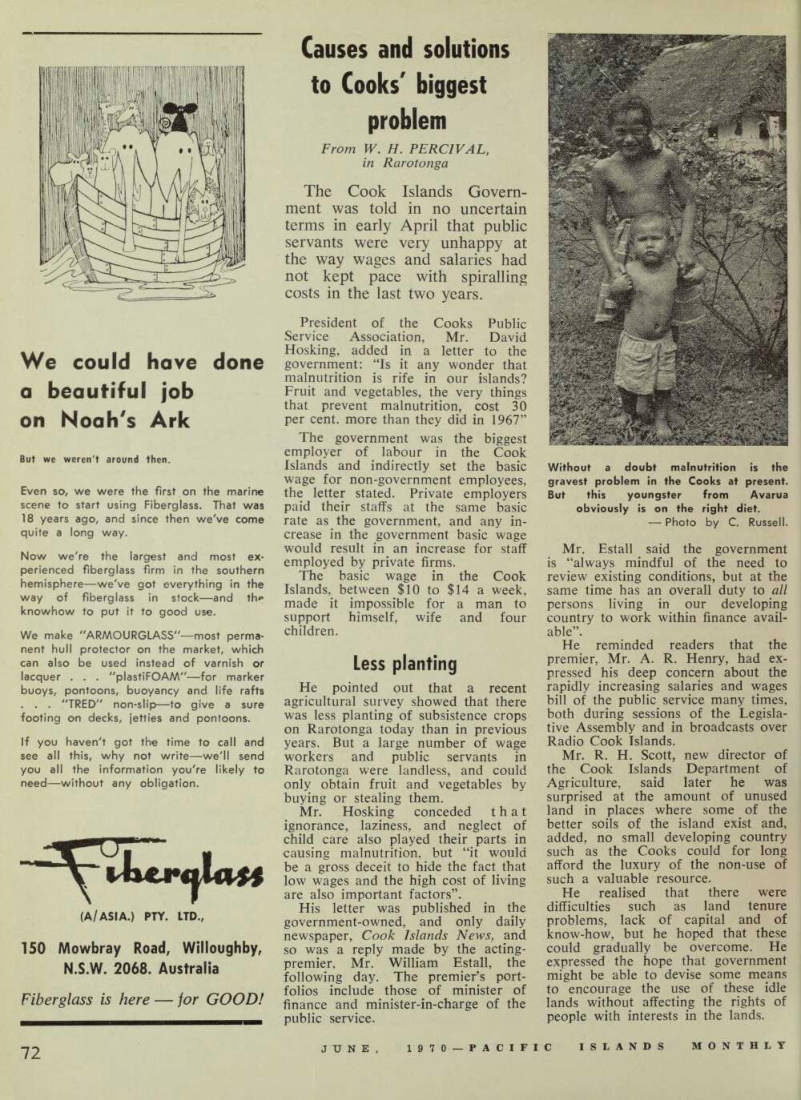
Without a doubt malnutrition is the gravest problem in the Cooks at present.
But this youngster from Avarua obviously is on the right diet. -Photo by C. Russell.