where everybody
pp. 97-101 · Read in the full issue


Pleasant Island: where everybody was at war
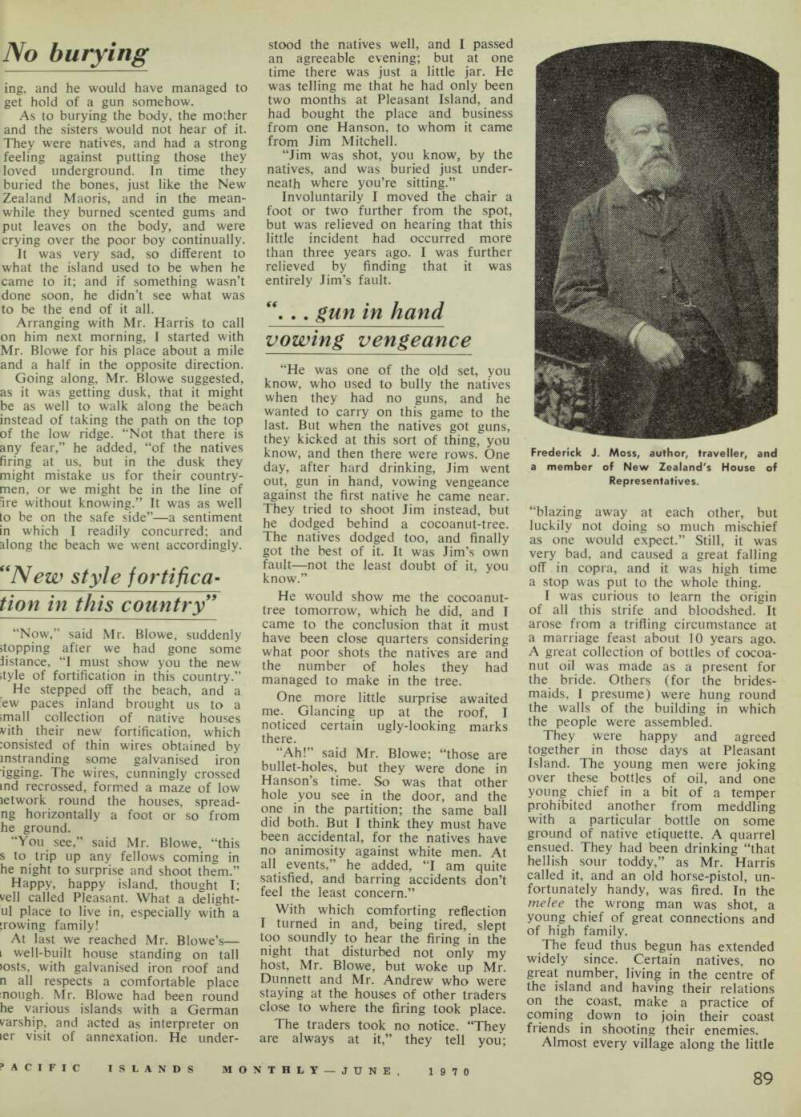
• Nobody is at war today in the tiny Republic of Nauru, but the picture was different last cen tury when former Fiji planter, Frederick J.
Moss, visited the island—then known as Pleasant Island. Moss was a member of the New Zealand Parliament when he wrote his account in 1889, of a visit he had made two years previously.
The island may have deserved the name of Pleasant Island when it was first discovered by Europeans, but certainly it does not now (wrote F. J. Moss about a visit to Nauru in 1887).
A raised coral island without good harbour or anchorage and not more than 16 or 18 miles in circum ference, it stands alone in the ocean, 150 miles from any other land, a few miles south of the Equator and within the territory which England has agreed to leave to German con trol.
Pleasant Island does not much exceed 100 feet in height at any part.
In the centre may be seen the re mains of the old lagoon, reduced to a small depression, swampy in some parts but, like the rest of the country, covered with trees, chiefly cocoanut-palms. The island used to be very productive in copra. The yield has fallen off materially and so have the people, through the sanguinary tribal feuds which have of late years distracted this little world.
The population does not now exceed a thousand souls. There are 10 white traders, some representing Auckland and German firms, others on their own account, and all of them settled at short distances from each other round the coast.
Landing on the reef, the vessel meanwhile beating about in the offing, we were welcomed by several of the traders assembled to receive us.
Going with them to Henderson and Macfarlane’s store, close at hand, a small crowd of natives soon surround ed us. They were in high good
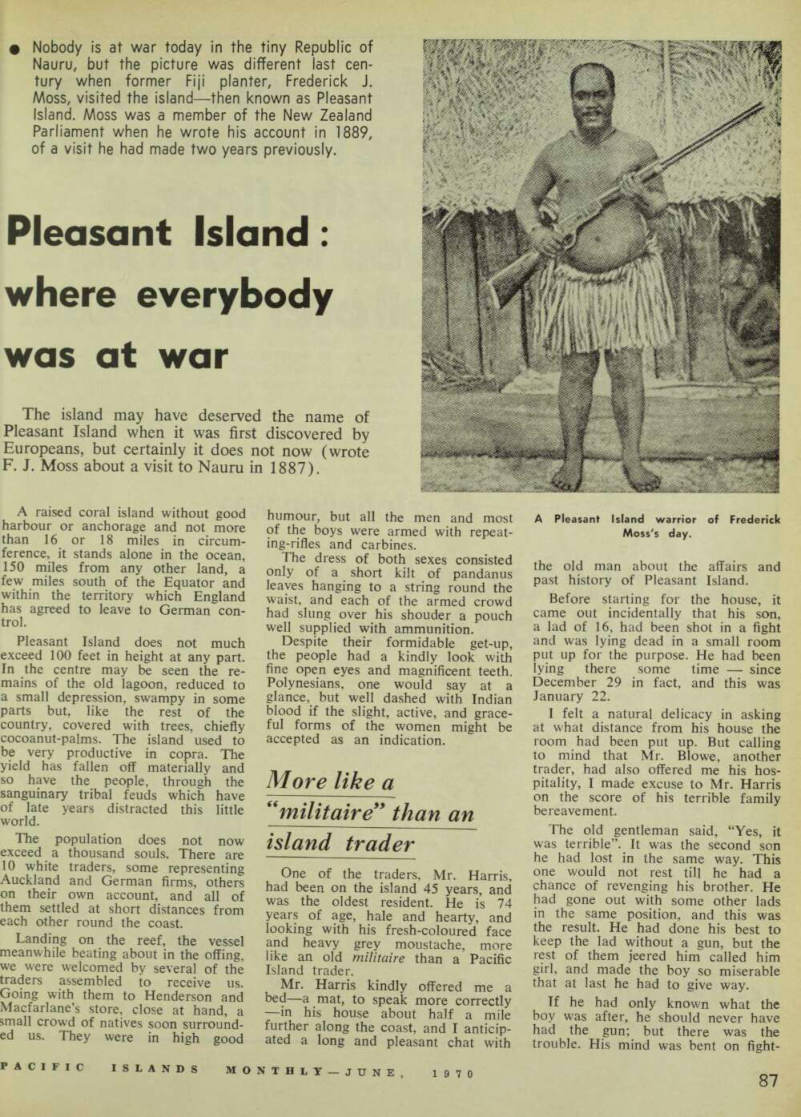
humour, but all the men and most of the boys were armed with repeat ing-rifles and carbines.
The dress of both sexes consisted only of a short kilt of pandanus leaves hanging to a string round the waist, and each of the armed crowd had slung over his shouder a pouch well supplied with ammunition.
Despite their formidable get-up, the people had a kindly look with fine open eyes and magnificent teeth.
Polynesians, one would say at a glance, but well dashed with Indian blood if the slight, active, and grace ful forms of the women might be accepted as an indication.
More like a
“militaire”an
island trader
One of the traders, Mr. Harris, had been on the island 45 years, and was the oldest resident. He is 74 years of age, hale and hearty, and looking with his fresh-coloured face and heavy grey moustache, more like an old militaire than a Pacific Island trader.
Mr. Harris kindly offered me a bed—a mat, to speak more correctly —in his house about half a mile further along the coast, and I anticip ated a long and pleasant chat with
the old man about the affairs and past history of Pleasant Island.
Before starting for the house, it came out incidentally that his son, a lad of 16, had been shot in a fight and was lying dead in a small room put up for the purpose. He had been lying there some time since December 29 in fact, and this was January 22.
I felt a natural delicacy in asking at what distance from his house the room had been put up. But calling to mind that Mr. Blowe, another trader, had also offered me his hos pitality, I made excuse to Mr. Harris on the score of his terrible family bereavement.
The old gentleman said, “Yes, it was terrible”. It was the second son he had lost in the same way. This one would not rest till he had a chance of revenging his brother. He had gone out with some other lads in the same position, and this was the result. He had done his best to keep the lad without a gun, but the rest of them jeered him called him girl, and made the boy so miserable that at last he had to give way.
If he had only known what the boy was after, he should never have had the gun; but there was the trouble. His mind was bent on fight-
A Pleasant Island warrior of Frederick Moss's day.
No burying
ing, and he would have managed to get hold of a gun somehow.
As to burying the body, the mother and the sisters would not hear of it.
They were natives, and had a strong feeling against putting those they loved underground. In time they buried the bones, just like the New Zealand Maoris, and in the mean while they burned scented gums and put leaves on the body, and were crying over the poor boy continually.
It was very sad, so different to what the island used to be when he came to it; and if something wasn’t done soon, he didn’t see what was to be the end of it all.
Arranging with Mr. Harris to call on him next morning, I started with Mr. Blowe for his place about a mile and a half in the opposite direction.
Going along, Mr. Blowe suggested, as it was getting dusk, that it might be as well to walk along the beach instead of taking the path on the top of the low ridge. “Not that there is any fear,” he added, “of the natives firing at us, but in the dusk they might mistake us for their country men, or we might be in the line of ire without knowing.” It was as well to be on the safe side”—a sentiment in which I readily concurred; and along the beach we went accordingly.
“New style fortifica
tion in this c
“Now,” said Mr. Blowe, suddenly stopping after we had gone some distance, “I must show you the new ityle of fortification in this country.”
He stepped off the beach, and a r ew paces inland brought us to a small collection of native houses vith their new fortification, which insisted of thin wires obtained by instranding some galvanised iron igging. The wires, cunningly crossed md recrossed, formed a maze of low letwork round the houses, spread ng horizontally a foot or so from he ground.
“You see,” said Mr. Blowe, “this s to trip up any fellows coming in he night to surprise and shoot them.”
Happy, happy island, thought I; veil called Pleasant. What a delight ul place to live in, especially with a 'rowing family!
At last we reached Mr. Blowe’s— l well-built house standing on tall >osts, with galvanised iron roof and n all respects a comfortable place nough. Mr. Blowe had been round he various islands with a German varship, and acted as interpreter on icr visit of annexation. He under
stood the natives well, and I passed an agreeable evening; but at one time there was just a little jar. He was telling me that he had only been two months at Pleasant Island, and had bought the place and business from one Hanson, to whom it came from Jim Mitchell.
“Jim was shot, you know, by the natives, and was buried just under neath where you’re sitting.”
Involuntarily I moved the chair a foot or two further from the spot, but was relieved on hearing that this little incident had occurred more than three years ago. I was further relieved by finding that it was entirely Jim’s fault.
.. gun in hand
vowing vengeance
“He was one of the old set, you know, who used to bully the natives when they had no guns, and he wanted to carry on this game to the last. But when the natives got guns, they kicked at this sort of thing, you know, and then there were rows. One day, after hard drinking, Jim went out, gun in hand, vowing vengeance against the first native he came near.
They tried to shoot Jim instead, but he dodged behind a cocoanut-tree.
The natives dodged too, and finally got the best of it. It was Jim’s own fault—not the least doubt of it, you know.”
He would show me the cocoanut tree tomorrow, which he did, and I came to the conclusion that it must have been close quarters considering what poor shots the natives are and the number of holes they had managed to make in the tree.
One more little surprise awaited me. Glancing up at the roof, I noticed certain ugly-looking marks there.
“Ah!” said Mr. Blowe; “those are bullet-holes, but they were done in Hanson’s time. So was that other hole you see in the door, and the one in the partition; the same ball did both. But I think they must have been accidental, for the natives have no animosity against white men. At all events,” he added, “I am quite satisfied, and barring accidents don’t feel the least concern.”
With which comforting reflection I turned in and, being tired, slept too soundly to hear the firing in the night that disturbed not only my host, Mr. Blowe, but woke up Mr.
Dunnett and Mr. Andrew who were staying at the houses of other traders close to where the firing took place.
The traders took no notice. “They are always at it,” they tell you;
“blazing away at each other, but luckily not doing so much mischief as one would expect.” Still, it was very bad, and caused a great falling off in copra, and it was high time a stop was put to the whole thing.
I was curious to learn the origin of all this strife and bloodshed. It arose from a trifling circumstance at a marriage feast about 10 years ago.
A great collection of bottles of cocoa nut oil was made as a present for the bride. Others (for the brides maids, I presume) were hung round the walls of the building in which the people were assembled.
They were happy and agreed together in those days at Pleasant Island. The young men were joking over these bottles of oil, and one young chief in a bit of a temper prohibited another from meddling with a particular bottle on some ground of native etiquette, A quarrel ensued. They had been drinking “that hellish sour toddy,” as Mr. Harris called it, and an old horse-pistol, un fortunately handy, was fired. In the melee the wrong man was shot, a young chief of great connections and of high family.
The feud thus begun has extended widely since. Certain natives, no great number, living in the centre of the island and having their relations on the coast, make a practice of coming down to join their coast friends in shooting their enemies.
Almost every village along the little
Frederick J. Moss, author, traveller, and a member of New Zealand's House of Representatives.
Deadly feuds
coast has thus become involved and is at deadly feud with its neighbour.
The fighting is in itself an absurdity, in fact not fighting at all. Small parties skulk about and blaze away at other parties at long distances on speculation, but shoot remorselessly any unfortunate man, woman, or child of the enemy’s tribe who may chance to fall in the way of these “braves” or “warriors,” as they call themselves.
The whole crowd might be dis armed in less than a week by 20 or 30 sailors with native scouts to guide them, and I sincerely hope the Ger man authorities will take the work in hand, as they only have the power to do so. As to the natives, it seemed to me they have had enough of it and would be very glad to be dis armed if it were done to all simultaneously.
The position in this respect is easily understood, especially when we con sider how many great nations in Europe are at the present time in much the same quandary, and would be glad to disarm “if only,” as the Pleasant Islanders say, “the other fellow will begin.” It is “that other fellow” who is doing all the mis chief at Pleasant Island as elsewhere.
He always does.
Taught the people to
make “sour toddy”
Mr. Harris gave me many interest ing details about the island as it used to be when he kept as many as 500 hogs in his fences to sell to the whalers in the days when whale oil was supreme. About 15 years ago >ome Kingsmill natives went to Ocean Island and taught the people there ;o make “sour toddy,” by fermenting :he sweet liquid which drops freely from the severed green fruit shoot if the cocoanut tree.
Seeing the mischief, the chiefs of 3cean Island made short work of the matter. They gave the Kingsmill visitors their choice, to leave in certain canoes which were presented ;o them and take their chance of anding elsewhere, or to remain behind and be killed.
The visitors took the canoes and anhappily reached Pleasant Island ?afely; and that, said Mr. Harris, is low the “hellish toddy” came here.
Pill then every village had its big louse in which the people used to lance and sing. Now they dare not even go to the beach to ship a few lags of copra without taking their irms to guard against surprise.
I handled a good many of the rifles, which the natives allowed me to do readily. They were in capital order, small bores of good quality and expensive pieces. The bores were not uniform, and the supply of ammunition must be considerable to keep them all going.
Mr. Harris had a strong desire to leave the place where he has so long lived. He wished to take passage with us to Strong’s Island (Kusaie), the head-quarters of the American Mis sion, and to get the remainder of his children taught at the mission school.
We could not take him, as no one is allowed to settle in Kusaie without permission. I promised however to
state his case, and had much pleasure in writing to Kusaie from Ponape.
He offered, if allowed to settle at Kusaie, to give his house and ground at Pleasant Island for a mission station.
I cannot tell what the mission authorities at Kusaie will see fit to do, but may express a hope that the old man will be successful in saving his young family from growing up amid such wretched ignorance and barbarism. It would be also pleasant to find his offer lead to the establish ment of a mission and the restora tion to peace and prosperity of this singular little island and its naturally pleasant people.