Footnotes
pp. 40-41 · Read in the full issue
Before and after free lunches, which offered, if the Post- Courier’s reporter is to be relied on, a choice of chicken, turkey or lobster, the Copper King’s European workers have been giving the not so simple-minded Bougainvillians a free lesson in how tough you can get. We can hardly expect the lesson to go unheeded, especially when we hear that Mr. Gaudi Mirau, a former MHA not noted for conciliatory or conservative attitudes, is in action on Bougainville.
For the last couple of years or so we have been told ad nauseam what a wonderful thing the Bougainville copper project will be for Niugini.
No doubt it will be, in time. But at the moment the Administration is pouring in millions to provide ser vices for CRA, some of which might perhaps not unreasonably have been a charge on the company. Indeed similar facilities, so I have been told, are being installed at their own ex pense by companies currently exploit ing Australia’s mineral wealth.
One begins to wonder whether the bargain our expert negotiators struck with CRA was as good a one as the Administration claimed it to be when it was brought down, all cut and dried and ready for rubber stamping, in the House of Assembly.
“If there is copper
let it stay there”
Of many odd things said in and about Bougainville in recent weeks perhaps the oddest was the suggestion of one of the strikers that they should “give the island back to the natives”.
This almost makes one sympathise with those Bougainvillians who, earlier in the piece, were reported to have said “If there is copper under our land, let it stay there”.
And now comes news that Kenne cott Explorations, which has been searching for copper in the far west of Papua, has struck it rich. Indeed, the find may be a richer one than CRA’s on Bougainville. If this turns out to be true, it will have a tremen dous effect not only on the economy but also on the politics of Niugini.
In the past, New Guineans have found it all too easy to sneer at Papua’s lack of economic develop
ment. Tf the Kennecott venture goes ahead it will be entertaining to listen to the sneers changing to “sweet talk”.
Will copper mining at Ningerum reproduce the headaches of Panguna?
I think that we may reasonably hope that it won’t. For one thing the people of western Papua, and indeed of Papua in general, have fewer past indignities at the hands of the white man to brood over than have the people of the New Guinea islands.
For another, there are fewer of them —61,000 spread over 40,000 square miles in the Western District of Papua as compared with 72,000 in Bougainville’s 4,000 square miles.
Again, western Papua is a less fertile land than Bougainville, and its people have reached a pitch of economic frustration in which they may be expected to clutch at any straw, and eagerly at a copper one.
And finally, we may hope that Kennecott Explorations, and even the Administration, will have learnt something from the mistakes made in Bougainville.
A FEW weeks ago the Select Com mittee on Constitutional De velopment split, amoeba-like, into two, and began a perambulation of Niugini to collect the views of the people. Predictably they are getting a mass of mutually contradictory views. Home rule immediately, in 10 years’ time, in 50 years’ time, in 100 years’ time. A federal system, a unitary system. An upper House, no upper House. More regional members. More official members, no official members. More power for ministerial members, less power for ministerial members. And so on, and so on, and so on.
The National Name Stakes has not so far produced the way-out entries of an earlier newspaper competition.
The young inventor of “Pibnib” has grown older, and perhaps wiser.
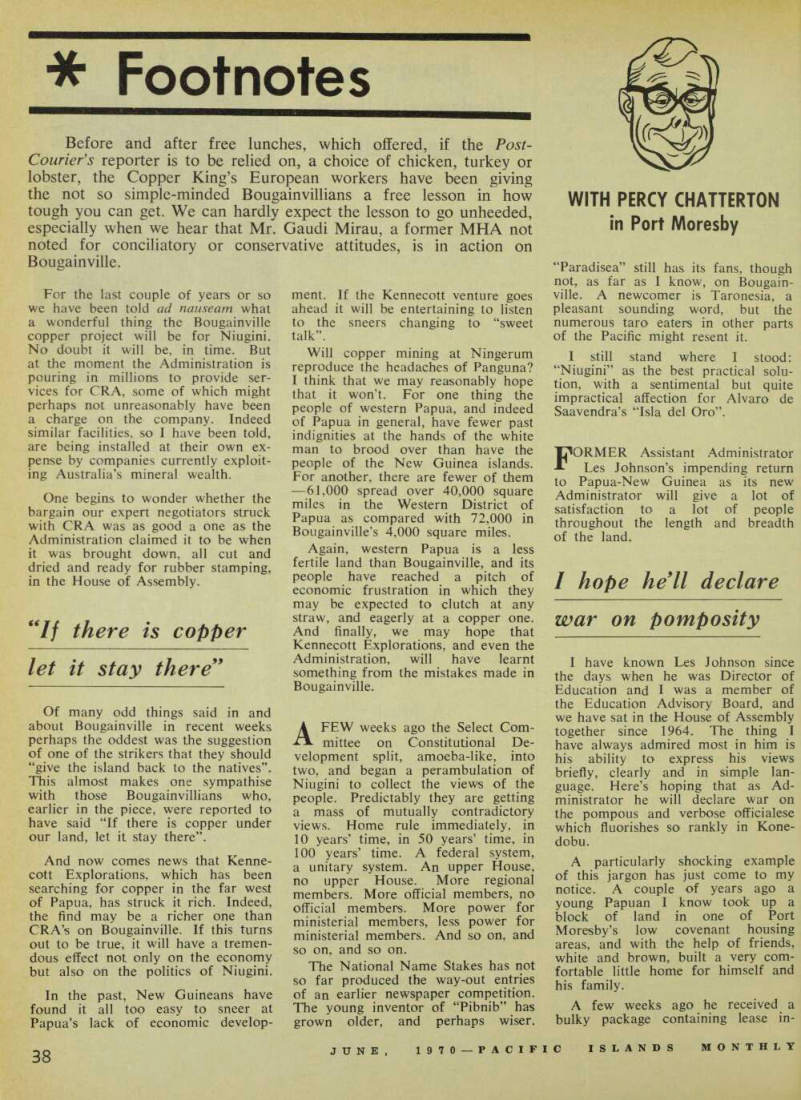
With Percy Chatterton
in Port Moresby
“Paradisea” still has its fans, though not, as far as I know, on Bougain ville. A newcomer is Taronesia, a pleasant sounding word, but the numerous taro eaters in other parts of the Pacific might resent it.
I still stand where I stood: “Niugini” as the best practical solu tion, with a sentimental but quite impractical affection for Alvaro de Saavendra’s “Isla del Oro”.
FORMER Assistant Administrator Les Johnson’s impending return to Papua-New Guinea as its new Administrator will give a lot of satisfaction to a lot of people throughout the length and breadth of the land.
I hope he’ll declare
war on pomposity I have known Les Johnson since the days when he was Director of Education and I was a member of the Education Advisory Board, and we have sat in the House of Assembly together since 1964. The thing I have always admired most in him is his ability to express his views briefly, clearly and in simple lan guage. Here’s hoping that as Ad ministrator he will declare war on the pompous and verbose officialese which fluorishes so rankly in Kone dobu.
A particularly shocking example of this jargon has just come to my notice. A couple of years ago a young Papuan I know took up a block of land in one of Port Moresby’s low covenant housing areas, and with the help of friends, white and brown, built a very com fortable little home for himself and his family.
A few weeks ago he received a bulky package containing lease in
struments to be signed, and a cover ing letter which read in part as follows: “Your attention is drawn to Section 38 of the Land Ordinance 1962-67 which states ‘The right of a successful applicant for a lease is extinguished if the applicant does not, within such time as is notified to him by the Administrator, execute the lease’.” He was further exhorted to “return all copies to this Depart ment after execution”.
The European friend to whom he rushed off in a state of great perturba tion was able to reassure him that he would neither lose his precious house and land, nor be executed.
Even more shocking than the language of this letter is the fact that it was signed by a Niuginian public servant. If Mr. Johnson can stop this rot before Niuginians take over the top positions and become in fected by it, he will earn the gratitude of posterity.
Timely words
on freedom
FULL marks to Tom Leahy, scion of a famous territory family, MHA for Markham and a member of the Administrator’s Executive Council, for his well chosen and timely words on the freedom of the individual. Touched off by proposals for the restriction of freedom of movement from rural areas to the towns, they were spoken at Kerema High School during an AEC visit to the Gulf District of Papua.
I hope that he will have an oppor tunity of repeating them at Keravat High School, a student of which writing in the Administration’s maga zine Our News, supports a move re ported to have been made by the Henganofi (Eastern Highlands) Local Government Council to make a council rule restricting the time which may be spent by villagers in mourn ing their dead.
“When time is wasted on mourn ing,” says this young man severely, “it means that agricultural produc tion suffers.”
Blimey! • The age of consent is likely to be made uniform throughout Papua- New Guinea. At present consent be comes legal at the age of 14 in Papua, but at the age of 17 in New Guinea.
The child welfare council has re commended to the P-NG Admin istration that the age of consent be a uniform 16 throughout the ter ritory, and legislation will probably be introduced at the June House of Asssembly.