Tipping-"a
p. 39 · Read in the full issue
fundamental threat to Islands culture"
By Sue Wendt
Tipping is very much on the minds of people involved with Fiji tourism, particularly those on the receiving end. Understandably.
So far, tipping hasn’t reached the “hands out” stage but with the advent of the American visitor, the practice is bound to increase.
The American is so used to paying for small courtesies, he does so automatically. And, by Fiji standards, generously. So if you’re on the receiving end in Fiji, why complain?
But some see it as an insidious and degrading practise. The most recent word on the subject has come from Mr. Michael Robinson, a director of Marketing Services (Travel & Tourism), which re presents the Fiji Visitors Bureau in the UK.
In a letter to the bureau, he urges members, through the gov ernment, to “take the initative and tackle the problem of tipping with all the power at its command”.
As the body responsible for guiding and managing the growth of Fiji’s tourism, Mr. Robinson declared, it would be a highly responsible and far-sighted move.
A threat
Mr. Robinson regards the development of tipping as a standard practise in Fiji as posing a “fundamental threat to the future of the Fijian culture and the attitudes of the people”.
“After all,” he says, “tourism is an extension of traditional hospitality to guests.
“And if tourism and hospitality are related in the minds of the people, as I believe they still are in Fiji, then any basic change in attitude towards foreign guests, i.e. tourists, can be expected to have repercussions that will affect personal attitudes between the people themselves.”
Mr. Robinson points to Tahiti and New Caledonia as examples
of countries where tipping is not encouraged.
He concedes that the industry itself was unlikely to agree to any effective discouragement of tipping. And that the local popu lation was fairly indifferent about the matter at this stage.
“In a few years time there will be too many individuals benefit ting directly from tipping for this to be the case,” he said.
“It is therefore a matter to be tackled urgently and strongly by the government. If the matter is left to drift much longer, then tipping will have become so deeply embedded in the attitude of the people and in the wages structure of the country that it will be virtually impossible to do any thing to curb it.”
It was not just a Fiji problem, he said, but one affecting all the Pacific Islands where tourism was beginning to make itself felt.
“I feel that there is still time for the whole area to adopt a positive approach to this problem, with a fair chance of success”. It was Fiji’s place to lead the way, he stressed.
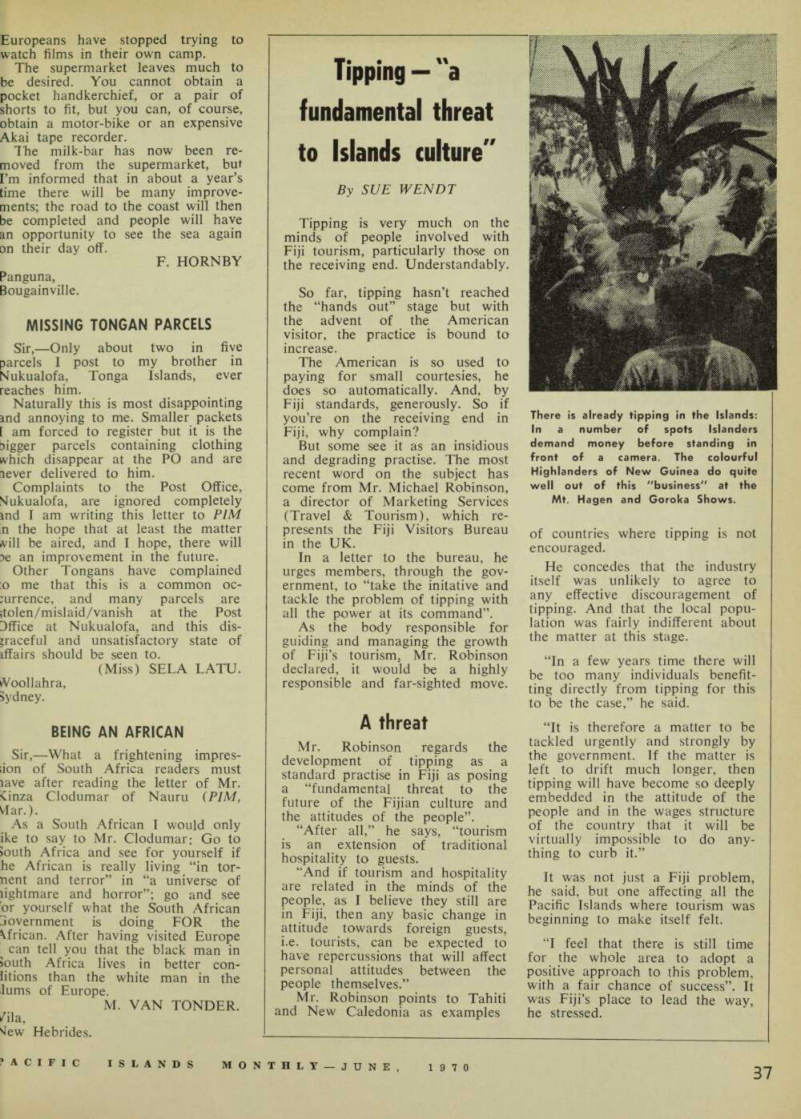
There is already tipping in the Islands: In a number of spots Islanders demand money before standing in front of a camera. The colourful Highlanders of New Guinea do quite well out of this "business" at the Mt. Hagen and Goroka Shows.