Badly neglected
pp. 41-42 · Read in the full issue
A Brett Hilder
Profile
Pioneer
Planter
Who
Suffered
Much
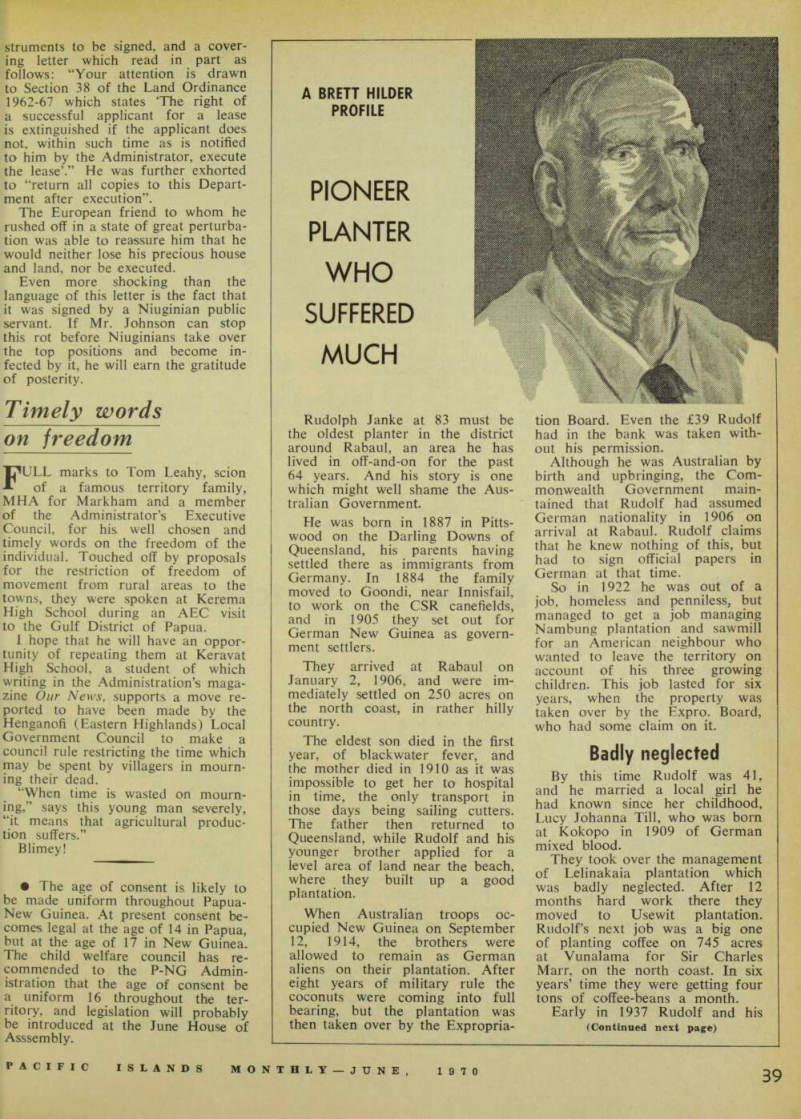
Rudolph Janke at 83 must be the oldest planter in the district around Rabaul, an area he has lived in off-and-on for the past 64 years. And his story is one which might well shame the Aus tralian Government.
He was born in 1887 in Pitts wood on the Darling Downs of Queensland, his parents having settled there as immigrants from Germany. In 1884 the family moved to Goondi, near Innisfail, to work on the CSR canefields, and in 1905 they set out for German New Guinea as govern ment settlers.
They arrived at Rabaul on January 2, 1906, and were im mediately settled on 250 acres on the north coast, in rather hilly country.
The eldest son died in the first year, of blackwater fever, and the mother died in 1910 as it was impossible to get her to hospital in time, the only transport in those days being sailing cutters.
The father then returned to Queensland, while Rudolf and his younger brother applied for a level area of land near the beach, where they built up a good plantation.
When Australian troops oc cupied New Guinea on September 12, 1914, the brothers were allowed to remain as German aliens on their plantation. After eight years of military rule the coconuts were coming into full bearing, but the plantation was then taken over by the Expropria
tion Board. Even the £39 Rudolf had in the bank was taken with out his permission.
Although he was Australian by birth and upbringing, the Com monwealth Government main tained that Rudolf had assumed German nationality in 1906 on arrival at Rabaul. Rudolf claims that he knew nothing of this, but had to sign official papers in German at that time.
So in 1922 he was out of a job, homeless and penniless, but managed to get a job managing Nambung plantation and sawmill for an American neighbour who wanted to leave the territory on account of his three growing children. This job lasted for six years, when the property was taken over by the Expro. Board, who had some claim on it.
Badly neglected
By this time Rudolf was 41, and he married a local girl he had known since her childhood, Lucy Johanna Till, who was born at Kokopo in 1909 of German mixed blood.
They took over the management of Lelinakaia plantation which was badly neglected. After 12 months hard work there they moved to Usewit plantation.
Rudolfs next job was a big one of planting coffee on 745 acres at Vunalama for Sir Charles Marr, on the north coast. In six years’ time they were getting four tons of coffee-beans a month.
Early in 1937 Rudolf and his
(Continued next page)
War broke out again
wife set off for a four-month tour of Java and the East, and during their holiday they heard of the eruption at Rabaul. On their return they were surprised to find the town habitable again. They then took over the management of two plantations belonging to Rudolf’s in-laws, Mr. and Mrs.
Till, who set off for a visit to Europe.
Mrs. Till died at Vienna, and in 1939, Mr. Till returned with a new wife. Rudolf and his wife returned from the Bainings to Rabaul, to stay with mixed-blood friends there, but as the war had broken out they were made un comfortable by local hoodlums and strict police restraint.
They then got permission to go 140 miles down the south coast to manage a plantation for Mr. Rundnagel. Six months later four police arrived, armed to the teeth, and said to Rudolf, “It’s you this time!” They had no warrant, and no charge was laid, but the Jankes were taken in custody to Rabaul.
Here Rudolf was separated from his wife, and sent with other German planters to Tatura prison camp in Australia. On the way they passed through Sydney and Melbourne in handcuffs, and suffered severely from the wintery weather of June without any warm clothing.
It was four years before Rudolf saw his wife again. She had returned to manage Wunung plantation at Jacquinot Bay, and was there when the Japanese invaded Rabaul. Some of the Aus tralian troops struggled the 140 miles to the plantation, where Mrs. Janke fed and nursed them, saving at least a dozen lives, for which she never received any recognition after the war.
When Rudolf was released he got a job and lived in Melbourne until 1947 with his wife. They returned to New Britain, and in 1959 were able to acquire a plantation of their own, Ramando, growing copra and cocoa near Kilinwasser (Cleanwater) on the north coast.
In 1968 Rudolf lost his wife, Lucy, and since then has not had good health himself. He is a fine tall man, now aged 83, and proud of the fact that he has never been
charged in court. He is highly respected by all who know him.
The Jankes had no children, and now Rudolf is cared for by kind neighbours.
His story carries a moral, a very disturbing one for Austra lians like myself. Considering that he was born in Australia, and has lived and worked under our flag for 75 years, his treatment in the two wars was shameful, more what we have come to expect from fascist or communist regimes.
Injustice
We don’t expect our petty officials and bureaucrats to deal so unjustly and inhumanely with harmless people like Rudolf Janke, who never offered a threat to the safety or security of Aus tralia, the land of his birth. I hope to heaven that we won’t allow the same injustices when New Guinea changes over to its own flag and government.
Pioneer planters like Rudolf don’t deserve a third and final catastrophe, but a peaceful and
honourable old age.