King Of The
p. 34 · Read in the full issue
Western Isles'
Dies At 97
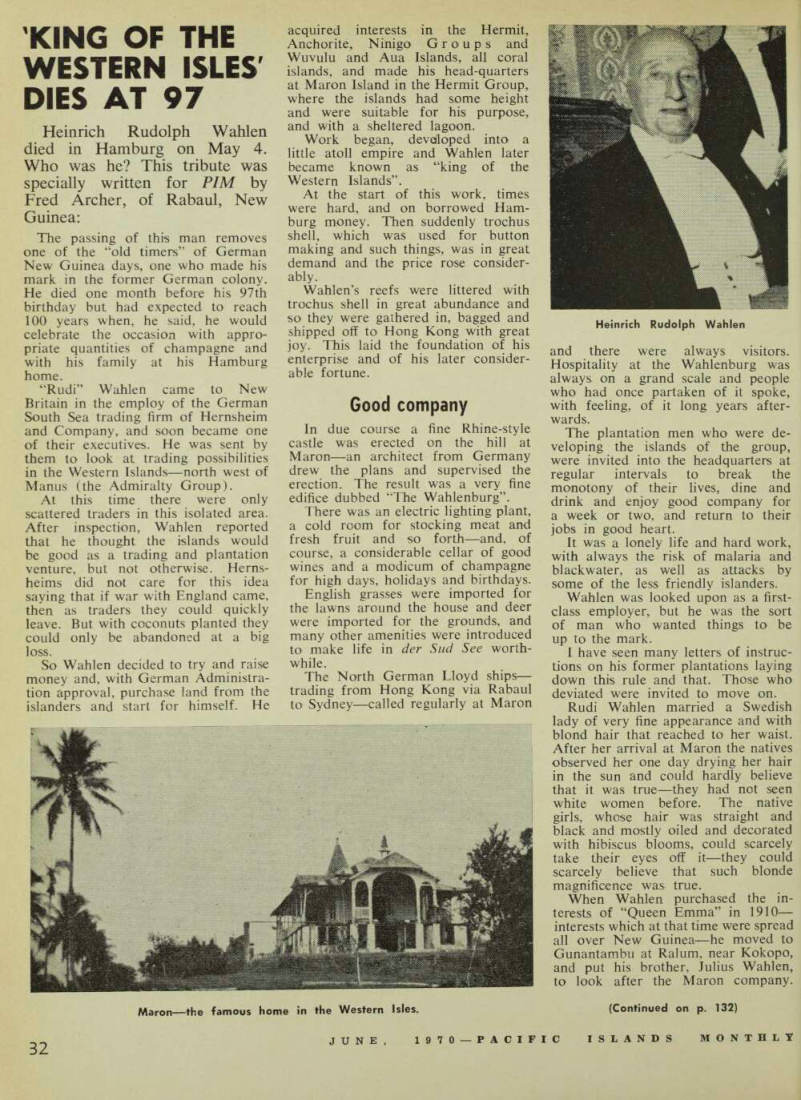
Heinrich Rudolph Wahlen died in Hamburg on May 4.
Who was he? This tribute was specially written for PIM by Fred Archer, of Rabaul, New Guinea: The passing of this man removes one of the “old timers” of German New Guinea days, one who made his mark in the former German colony.
He died one month before his 97th birthday but had expected to reach 100 years when, he said, he would celebrate the occasion with appro priate quantities of champagne and with his family at his Hamburg home.
“Rudi” Wahlen came to New Britain in the employ of the German South Sea trading firm of Hernsheim and Company, and soon became one of their executives. He was sent by them to look at trading possibilities in the Western Islands—north west of Manus (the Admiralty Group).
At this time there were only scattered traders in this isolated area.
After inspection, Wahlen reported that he thought the islands would be good as a trading and plantation venture, but not otherwise. Herns heims did not care for this idea saying that if war with England came, then as traders they could quickly leave. But with coconuts planted they could only be abandoned at a big loss.
So Wahlen decided to try and raise money and, with German Administra tion approval, purchase land from the islanders and start for himself. He
acquired interests in the Hermit, Anchorite, Ninigo Groups and Wuvulu and Aua Islands, all coral islands, and made his head-quarters at Maron Island in the Hermit Group, where the islands had some height and were suitable for his purpose, and with a sheltered lagoon.
Work began, devefloped into a little atoll empire and Wahlen later became known as “king of the Western Islands”.
At the start of this work, times were hard, and on borrowed Ham burg money. Then suddenly trochus shell, which was used for button making and such things, was in great demand and the price rose consider ably.
Wahlen’s reefs were littered with trochus shell in great abundance and so they were gathered in, bagged and shipped off to Hong Kong with great joy. This laid the foundation of his enterprise and of his later consider able fortune.
Good company
In due course a fine Rhine-style castle was erected on the hill at Maron—an architect from Germany drew the plans and supervised the erection. TTie result was a very fine edifice dubbed “The Wahlenburg”.
There was an electric lighting plant, a cold room for stocking meat and fresh fruit and so forth—and, of course, a considerable cellar of good wines and a modicum of champagne for high days, holidays and birthdays.
English grasses were imported for the lawns around the house and deer were imported for the grounds, and many other amenities were introduced to make life in der Sud See worth while.
The North German Lloyd ships— trading from Hong Kong via Rabaul to Sydney—called regularly at Maron
and there were always visitors.
Hospitality at the Wahlenburg was always on a grand scale and people who had once partaken of it spoke, with feeling, of it long years after wards.
The plantation men who were de veloping the islands of the group, were invited into the headquarters at regular intervals to break the monotony of their lives, dine and drink and enjoy good company for a week or two, and return to their jobs in good heart.
It was a lonely life and hard work, with always the risk of malaria and blackwater, as well as attacks by some of the less friendly islanders.
Wahlen was looked upon as a first class employer, but he was the sort of man who wanted things to be up to the mark.
I have seen many letters of instruc tions on his former plantations laying down this rule and that. Those who deviated were invited to move on.
Rudi Wahlen married a Swedish lady of very fine appearance and with blond hair that reached to her waist.
After her arrival at Maron the natives observed her one day drying her hair in the sun and could hardly believe that it was true —they had not seen white women before. The native girls, whose hair was straight and black and mostly oiled and decorated with hibiscus blooms, could scarcely take their eyes off it—they could scarcely believe that such blonde magnificence was true.
When Wahlen purchased the in terests of “Queen Emma” in 1910— interests which at that time were spread all over New Guinea—he moved to Gunantambu at Ralum, near Kokopo, and put his brother, Julius Wahlen, to look after the Maron company.
(Continued on p. 132)
Maron—the famous home in the Western Isles.
Heinrich Rudolph Wahlen