Even bigger changes to come
p. 33 · Read in the full issue
come in New Guinea
From correspondents in Port Moresby and Canberra Everybody was taken by surprise, including the new Adminis trator himself. But once the decision was announced, everybody approved it, and wondered why it hadn’t been thought of before.
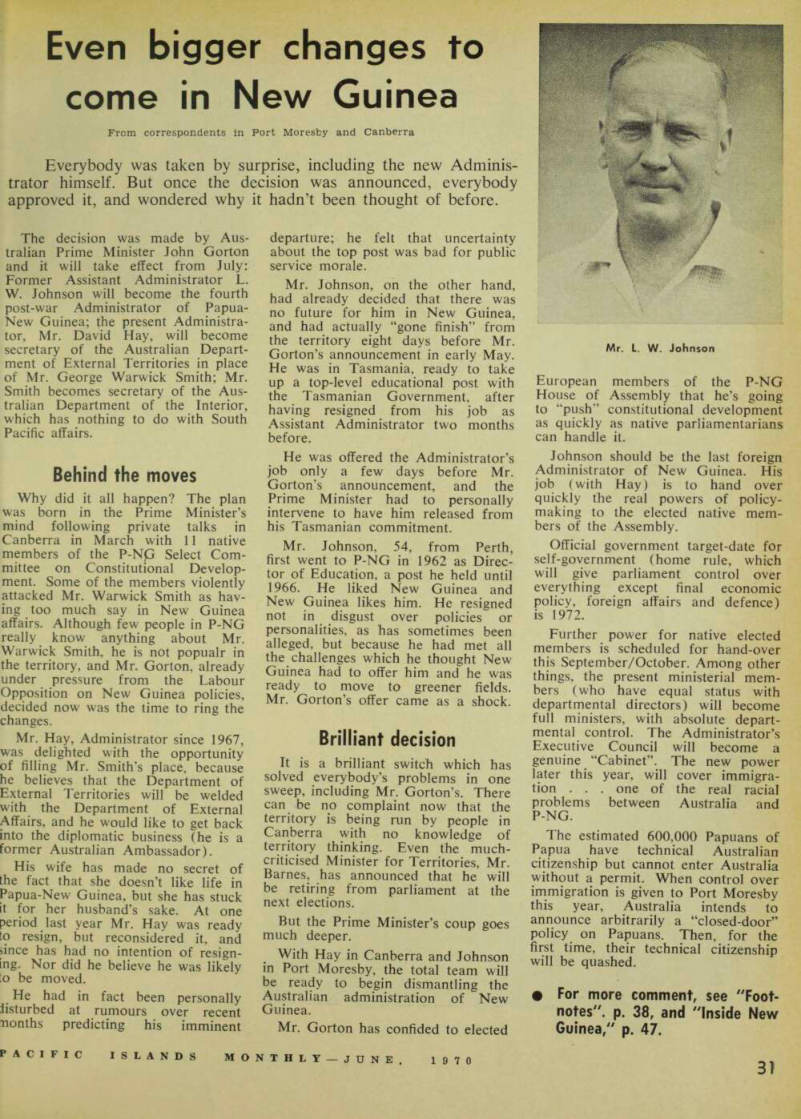
The decision was made by Aus tralian Prime Minister John Gorton and it will take effect from July: Former Assistant Administrator L.
W. Johnson will become the fourth post-war Administrator of Papua- New Guinea; the present Administra tor, Mr. David Hay, will become secretary of the Australian Depart ment of External Territories in place of Mr. George Warwick Smith; Mr.
Smith becomes secretary of the Aus tralian Department of the Interior, which has nothing to do with South Pacific affairs.
Behind the moves
Why did it all happen? The plan was born in the Prime Minister’s mind following private talks in Canberra in March with 11 native members of the P-Np Select Com mittee on Constitutional Develop ment. Some of the members violently attacked Mr. Warwick Smith as hav ing too much say in New Guinea affairs. Although few people in P-NG really know anything about Mr.
Warwick Smith, he is not popualr in the territory, and Mr. Gorton, already under pressure from the Labour Opposition on New Guinea policies, decided now was the time to ring the changes.
Mr. Hay, Administrator since 1967, was delighted with the opportunity of filling Mr. Smith’s place, because he believes that the Department of External Territories will be welded with the Department of External Affairs, and he would like to get back into the diplomatic business (he is a former Australian Ambassador).
His wife has made no secret of the fact that she doesn’t like life in Papua-New Guinea, but she has stuck it for her husband’s sake. At one period last year Mr. Hay was ready to resign, but reconsidered it, and since has had no intention of resign ing. Nor did he believe he was likely to be moved.
He had in fact been personally listurbed at rumours over recent uonths predicting his imminent
departure; he felt that uncertainty about the top post was bad for public service morale.
Mr. Johnson, on the other hand, had already decided that there was no future for him in New Guinea, and had actually “gone finish” from the territory eight days before Mr.
Gorton’s announcement in early May.
He was in Tasmania, ready to take up a top-level educational post with the Tasmanian Government, after having resigned from his job as Assistant Administrator two months before.
He was offered the Administrator’s job only a few days before Mr.
Gorton’s announcement, and the Prime Minister had to personally intervene to have him released from his Tasmanian commitment.
Mr. Johnson, 54, from Perth, first went to P-NG in 1962 as Direc tor of Education, a post he held until 1966. He liked New Guinea and New Guinea likes him. He resigned not in disgust over policies or personalities, as has sometimes been alleged, but because he had met all the challenges which he thought New Guinea had to offer him and he was ready to move to greener fields.
Mr. Gorton’s offer came as a shock.
Brilliant decision
It is a brilliant switch which has solved everybody’s problems in one sweep, including Mr. Gorton’s. There can be no complaint now that the territory is being run by people in Canberra with no knowledge of territory thinking. Even the much criticised Minister for Territories, Mr.
Barnes, has announced that he will be retiring from parliament at the next elections.
But the Prime Minister’s coup goes much deeper.
With Hay in Canberra and Johnson in Port Moresby, the total team will be ready to begin dismantling the Australian administration of New Guinea.
Mr. Gorton has confided to elected
European members of the P-NG House of Assembly that he’s going to “push” constitutional development as quickly as native parliamentarians can handle it.
Johnson should be the last foreign Administrator of New Guinea. His job (with Hay) is to hand over quickly the real powers of policy making to the elected native mem bers of the Assembly.
Official government target-date for self-government (home rule, which will give parliament control over everything except final economic policy, foreign affairs and defence) is 1972.
Further power for native elected members is scheduled for hand-over this September/October. Among other things, the present ministerial mem bers (who have equal status with departmental directors) will become full ministers, with absolute depart mental control. The Administrator’s Executive Council will become a genuine “Cabinet”. The new power later this year, will cover immigra tion . . . one of the real racial problems between Australia and
P-Ng.
The estimated 600,000 Papuans of Papua have technical Australian citizenship but cannot enter Australia without a permit. When control over immigration is given to Port Moresby this year, Australia intends to announce arbitrarily a “closed-door” policy on Papuans. Then, for the first time, their technical citizenship will be quashed.
• For more comment, see "Foot notes". p. 38, and "Inside New Guinea," p. 47.
Mr. L. W. Johnson